Minjun
Sarah Rener
https://medium.com/@sarah rener/why-wont-these-figures-stop-laughing-the-mystery-behind-yue-minjun-bab5174d8196
Yue Minjun was born in 1962 in Daqing, an industrial city in northeastern China shaped by the expansion of the oil industry during the Maoist era. His formative years unfolded within a society undergoing deep ideological control while simultaneously moving — especially toward the late 20th century — into a period of accelerated transformation marked by economic reform and cultural opening. Unlike many artists who follow a conventional academic path, Yue’s early professional life was rooted in industrial and technical work, far removed from the institutional art world. This distance is not incidental; it informs the peculiar detachment that characterizes his later work. It was only after relocating to artist communities on the outskirts of Beijing during the 1980s that he began to cultivate a visual language of his own, one that would eventually become unmistakable on a global scale. That language emerged not from formal tradition, but from lived contradiction — between ideology and individuality, expression and constraint.
This historical and personal background is essential for understanding the tone of his work, particularly in the aftermath of the Tiananmen Square protests of 1989. For many artists of his generation, that moment crystallized a sense of disillusionment that could no longer be expressed directly. Yue Minjun’s response was not explicit political critique, but something arguably more elusive and enduring: a visual system grounded in irony, repetition, and emotional ambiguity. Often associated with Cynical Realism, his work does not depict trauma in a literal sense but instead encodes it in the distortion of emotional expression itself. The laughter that dominates his canvases can be read as a symptom rather than a statement — a residual effect of historical tension that cannot be articulated openly, and therefore resurfaces as exaggeration, as performance, as something disturbingly artificial.
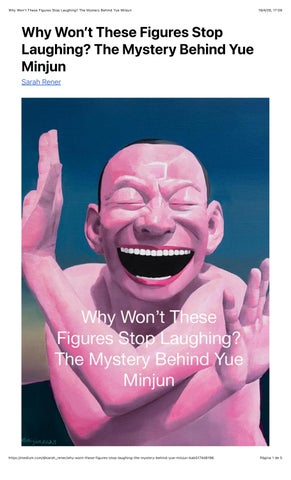
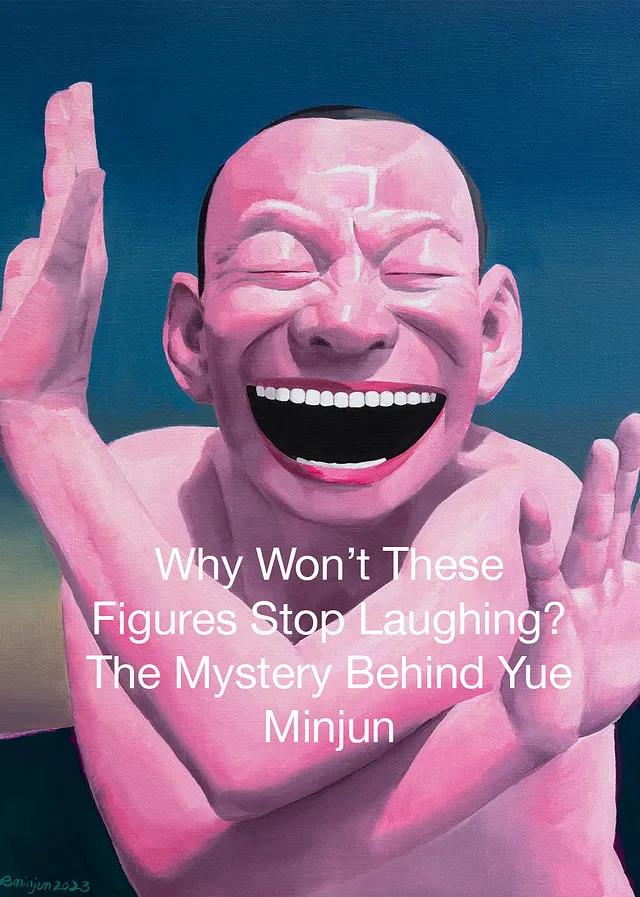
There are images that resist interpretation not because they are obscure, but because they are too clear in their insistence. Yue Minjun’s laughing figures fall into this category. Their faces — always derived from the artist himself — are frozen in an exaggerated grin, mouths stretched wide, eyes often shut, as if caught in an endless loop of laughter that no longer corresponds to any identifiable cause. At first glance, this repetition may appear playful or even humorous, inviting a superficial reading that aligns with the bright colors and simplified forms of the compositions. Yet the longer one remains with these images, the more that initial impression dissolves. The laughter begins to feel excessive, forced, almost violent in its persistence. It ceases to communicate joy and instead becomes a barrier, a surface that refuses depth, signaling
https://medium.com/@sarah rener/why-wont-these-figures-stop-laughing-the-mystery-behind-yue-minjun-bab5174d8196
not emotion but its absence. What emerges is not comedy, but a kind of existential discomfort — a sense that something essential has been evacuated and replaced with a hollow gesture.
In this sense, laughter in Yue Minjun’s work operates less as expression and more as structure. It is a rigid system imposed upon the body, repeated with mechanical precision across multiple figures that often populate the same canvas. These figures do not interact in meaningful ways; they do not acknowledge each other, nor do they seem aware of their environment. They exist in parallel, synchronized yet isolated, performing the same exaggerated reaction without variation. This repetition transforms the individual into a pattern, stripping away any trace of psychological complexity. The self becomes an image, and that image becomes infinitely reproducible. What might initially appear as self-portraiture thus reveals itself as something closer to self-erasure. The artist’s identity is not explored or expanded, but flattened, duplicated until it loses all distinction, raising unsettling questions about what it means to exist as an individual within systems that favor uniformity and replication.
At the same time, Yue Minjun engages in a sustained dialogue with the history of Western art, frequently appropriating and reconfiguring canonical works by inserting his laughing figures into familiar compositions. This strategy operates on multiple levels: it disrupts the authority of these images, destabilizes their original narratives, and introduces a form of cultural dislocation that reflects the complexities of globalization. However, the gesture is not purely subversive. Its repetition over time risks becoming predictable, even formulaic, as the shock of substitution gradually diminishes. What was once a critical intervention can begin to resemble a stylistic signature — recognizable, marketable, and therefore susceptible to the very dynamics it might seek to critique. This tension between conceptual intent and visual branding becomes increasingly difficult to ignore as his work circulates within global art markets.
Indeed, the relationship between Yue Minjun’s practice and the art market is one of its most paradoxical dimensions. His paintings have achieved extraordinary commercial success, fetching high prices at international auctions and securing his position as a leading figure in contemporary Chinese art. Yet this success raises uncomfortable questions about the fate of criticality within systems of exchange. When an image designed to evoke alienation becomes a desirable commodity, does it lose its critical force, or does it instead reveal the depth of the condition it describes? In Yue’s case,
rener/why-wont-these-figures-stop-laughing-the-mystery-behind-yue-minjun-bab5174d8196
the answer is not straightforward. The repetition of his visual language can be interpreted as both a critique of mass production and an adaptation to it, blurring the line between resistance and complicity in ways that resist definitive judgment.
What ultimately sustains the power of his work is this persistent ambiguity. The laughter that defines his imagery does not resolve into a single meaning; it oscillates between interpretations, functioning simultaneously as defense mechanism, expression of despair, and emblem of emptiness. This indeterminacy compels the viewer to remain engaged, to confront the discomfort of not knowing, of not being able to fully access what lies behind the image. In a cultural landscape saturated with clarity and immediacy, such resistance can be profoundly unsettling. Yet it is precisely this quality that allows Yue Minjun’s work to retain its relevance, even as its formal strategies risk becoming familiar.
At the same time, the danger of repetition cannot be dismissed. When a visual gesture is reiterated to the point of ubiquity, it risks losing its disruptive capacity, becoming instead part of the visual noise it once sought to interrupt. Yue Minjun’s laughing figures, once startling in their intensity, now circulate widely enough to be recognized instantly, even consumed casually. This shift from confrontation to familiarity raises important questions about the lifespan of critical forms in contemporary art. Can an image continue to provoke once it has been fully absorbed into the circuits of recognition and exchange? Or does its very absorption become part of its meaning, reflecting the impossibility of maintaining distance from the systems one inhabits?
Ultimately, encountering the work of Yue Minjun means confronting an image that does not offer resolution. It does not invite empathy in a conventional sense, nor does it provide a clear narrative to follow. Instead, it insists on its own surface — on that unchanging, relentless laughter that both attracts and repels. It is an image that cannot be easily decoded, only experienced, endured over time until its repetition begins to reveal the structures beneath it. And perhaps that is where its deepest significance lies: not in what it represents, but in what it withholds, forcing us to reckon with the limits of expression in a world where even emotion itself can become a rehearsed and reproducible form.
To explore his work further, visit Nathaniel Yue Minjun’s website:
rener/why-wont-these-figures-stop-laughing-the-mystery-behind-yue-minjun-bab5174d8196