The Perfect Lie: How Oli Epp Paints Superficiality in the Age of Instagram
Sarah Rener
Oli Epp (born in 1994 in London) is a British painter whose practice has
https://medium.com/@sarah rener/the-perfect-lie-how-oli-epp-paints-superficiality-in-the-age-of-instagram-5eb006b42280
rapidly established itself within the contemporary art scene thanks to a distinctive visual language that merges references to digital culture, figurative painting, and a sharp sensitivity to current social dynamics.
Educated at Wimbledon College of Arts and later at the City & Guilds of London Art School, Epp has developed a body of work that, despite his relative youth, has secured a strong presence in international galleries and art fairs. His practice is primarily rooted in figurative painting, yet his conceptual approach extends far beyond representation, engaging with questions of identity, performativity, and image construction in the contemporary era.
In recent decades, contemporary painting has found particularly fertile ground in the tension between traditional figuration and visual logics inherited from the digital realm. It is within this hybrid territory that Epp’s work operates. At first glance, his paintings appear seductive and accessible, but a closer look reveals a complex reflection on contemporary identity, social performance, and the aestheticization of everyday life. His pictorial language — defined by polished surfaces, flat colors, and almost caricature-like figures — is not merely a stylistic choice, but a critical device that directly interrogates the ways in which we construct and present ourselves today.
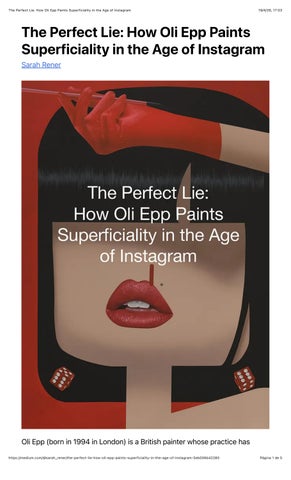
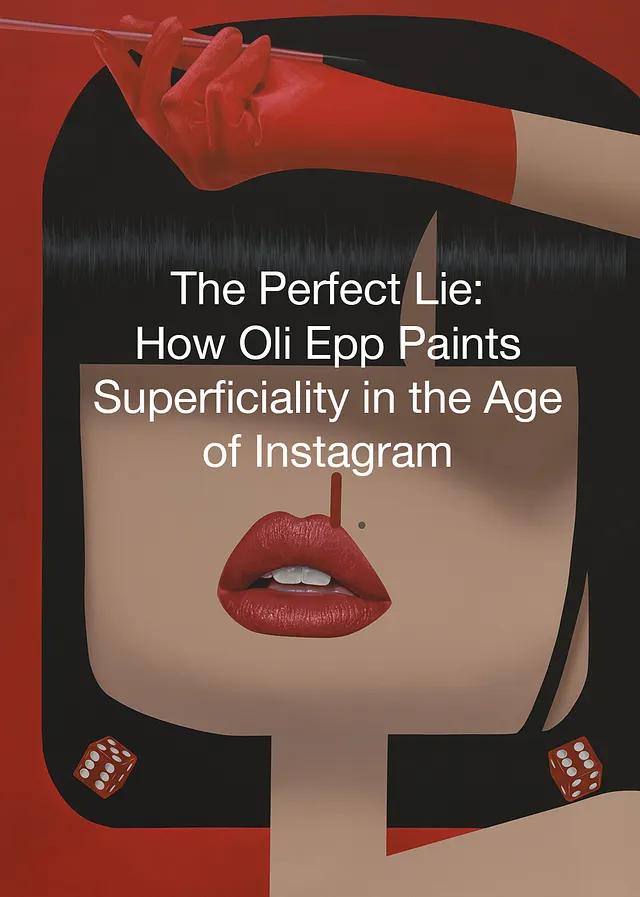
One of the most striking aspects of his work is its insistence on an artificial aesthetic that appears deliberately stripped of any human trace. Epp’s figures lack texture, imperfection, and all the elements traditionally associated with painterly gesture or expression. Their skin is smooth, almost plastic; the objects surrounding them seem rendered rather than painted; and the compositions are arranged with a clarity reminiscent of advertising imagery or digital interfaces. This emphasis on surface should not be understood as a limitation, but rather as a conceptual strategy: by removing material depth, Epp highlights the symbolic superficiality of the environments he depicts.
In this sense, his work can be read as a reflection of a visual culture deeply mediated by screens. Social media platforms, virtual environments, and the constant production of images have reshaped our relationship to the visual, turning appearance into an end in itself. Epp captures this logic with precision, constructing scenes that seem to exist in a suspended space between the real and the digital. His characters do not inhabit a tangible world, but rather a conceptual stage where everything is carefully arranged to be seen, but not necessarily lived.
https://medium.com/@sarah rener/the-perfect-lie-how-oli-epp-paints-superficiality-in-the-age-of-instagram-5eb006b42280
What makes his work particularly unsettling, however, is the tension between this appealing aesthetic and an underlying sense of emptiness. The figures that populate his paintings — often young, stylized, and seemingly selfassured — exhibit an emotional disconnection that is difficult to ignore. Their facial expressions are ambiguous, sometimes frozen in gestures that could be read as either smiles or grimaces; their poses suggest a constant awareness of being observed. There is no spontaneity in their actions, only an implicit choreography that points to the idea that every interaction is, in some way, a performance.
This performative dimension is key to understanding the critical power of his work. Rather than depicting individuals with a defined interiority, Epp presents subjects that seem shaped by their exteriority — by how they appear. This directly resonates with contemporary theories of identity as a social construction, in which the self is not a fixed essence but a series of repeated acts adapted to different contexts. In Epp’s paintings, this idea materializes in bodies that appear to be constantly rehearsing their own representation, as if they could never fully step off the stage.
Humor plays a fundamental role in this framework, though it is neither obvious nor comforting. Instead, it manifests as a subtle, sometimes uncomfortable irony that emerges from the dissonance between what we see and what we sense. There is something slightly absurd in many of his scenes: social interactions that feel overly choreographed, everyday objects that take on strange prominence, situations that oscillate between the banal and the unsettling. This humor does not seek to provoke laughter, but rather to create critical distance, prompting the viewer to question the naturalness of what is being observed.
His ability to generate discomfort without resorting to overt provocation is one of his greatest strengths. Unlike other contemporary practices that rely on immediate shock or explicit confrontation, Epp constructs a quieter, more insidious unease. His paintings do not shout; they whisper. They do not confront directly; they infiltrate the viewer’s perception, leaving behind a lingering sense of estrangement. It is precisely in this subtlety that much of their effectiveness lies.
At the same time, it is inevitable to question to what extent his work distances itself from what it seems to critique. Epp’s aesthetic is undoubtedly highly consumable: its vibrant colors, clean compositions, and impeccable finish make it particularly well-suited to digital circulation. In
https://medium.com/@sarah rener/the-perfect-lie-how-oli-epp-paints-superficiality-in-the-age-of-instagram-5eb006b42280
platforms where visibility often depends on immediate visual impact, his work fits seamlessly — raising an interesting paradox. Can an artwork so perfectly aligned with contemporary visual logic truly function as its critique?
Rather than weakening his practice, this ambiguity strengthens it. Epp does not adopt a moralizing stance nor offer a clear resolution to the tensions he presents. Instead of positioning himself outside the system he examines, he operates from within, using its own codes to expose its contradictions. This approach recalls certain strands of contemporary art that understand critique not as rejection, but as conscious engagement. In this case, the visual seduction of his paintings is not accidental, but integral to their function: they draw the viewer in, only to confront them with the superficiality of that very attraction.
Another significant aspect of his work is the way it engages with the everyday. The scenes he depicts are not extraordinary; on the contrary, they are constructed from recognizable situations, gestures, and objects that form part of daily life. Yet, when reconfigured within his visual language, these elements acquire a strange, almost theatrical quality. The everyday ceases to be familiar and becomes something to be examined. This shift allows viewers to perceive their own reality from a slightly distorted perspective, as if seeing it for the first time.
In this sense, Epp’s work can also be understood as an exploration of banality — not in a dismissive sense, but as a field of inquiry. The banality of social interactions, consumer objects, and daily routines becomes pictorial material capable of revealing deeper dynamics. By isolating these elements and presenting them with almost clinical clarity, the artist exposes the invisible structures that organize our experience.
It is no coincidence that his compositions often resemble controlled, almost scenographic spaces. There is a sense of order that borders on the clinical, as if everything were designed to eliminate any trace of chaos. This control reinforces the idea that the world he depicts is not spontaneous, but constructed. In that sense, it functions as a metaphor for contemporary environments, where much of experience is mediated by systems that seek to optimize, regulate, and aestheticize life.
Ultimately, what makes Oli Epp’s work particularly compelling is his ability to capture a generational sensibility without falling into cliché. His paintings do not simply illustrate trends; they problematize them, revealing both their
rener/the-perfect-lie-how-oli-epp-paints-superficiality-in-the-age-of-instagram-5eb006b42280
appeal and their emptiness. At a historical moment in which the image has become a dominant language, his work acts as a mirror that not only reflects but subtly distorts, allowing us to see more clearly what usually goes unnoticed.
That mirror, however, offers no comfort. There is no promise of recovered authenticity in his paintings, no nostalgia for a more “real” past. What remains instead is a lucid acceptance of the complexity of the present, with all its contradictions and ambiguities. And it is precisely this lack of resolution that makes his work deeply contemporary: it does not seek to close questions, but to keep them open, compelling us to inhabit the discomfort of having no clear answers.
To explore his work further, visit Nathaniel Oli Epp’s website:
#OliEpp #ContemporaryArt #FigurativePainting #ArtCriticism #ModernArt #DigitalCulture #VisualCulture #ArtAnalysis #Painting #EmergingArtists #ArtTheory #Aesthetics #Identity #ArtWriting #MediumArticle
rener/the-perfect-lie-how-oli-epp-paints-superficiality-in-the-age-of-instagram-5eb006b42280