The Painting That Refuses to Be Understood: Why Alma Feldhandler Disrupts Contemporary Art
Sarah Rener
https://medium.com/@sarah rener/the-painting-that-refuses-to-be-un…stood-why-alma-feldhandler-disrupts-contemporary-art-3ce067b497e2
Alma Feldhandler (b. 1994, Paris) is a Franco-Argentine artist whose practice exists at the intersection of painting, drawing, and an ongoing investigation into the mechanisms of memory, imagery, and the archive.
Trained at the École Nationale Supérieure des Beaux-Arts de Paris, her work has been exhibited across European galleries, where she has begun to establish herself as a singular voice within a generation defined by hybrid practices and the erosion of traditional categories. What distinguishes Feldhandler, however, is not only the formal coherence of her work, but the way she has constructed a visual language that resists both spectacle and immediate legibility. From her earliest exhibitions, her work has developed an iconography populated by ambiguous figures, fragmented bodies, and presences suspended in an indeterminate temporality, forming an imaginary that cannot be reduced to recognizable narratives or stable references.
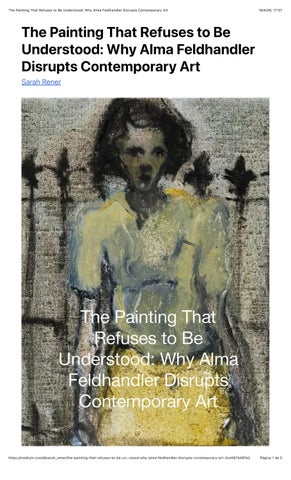
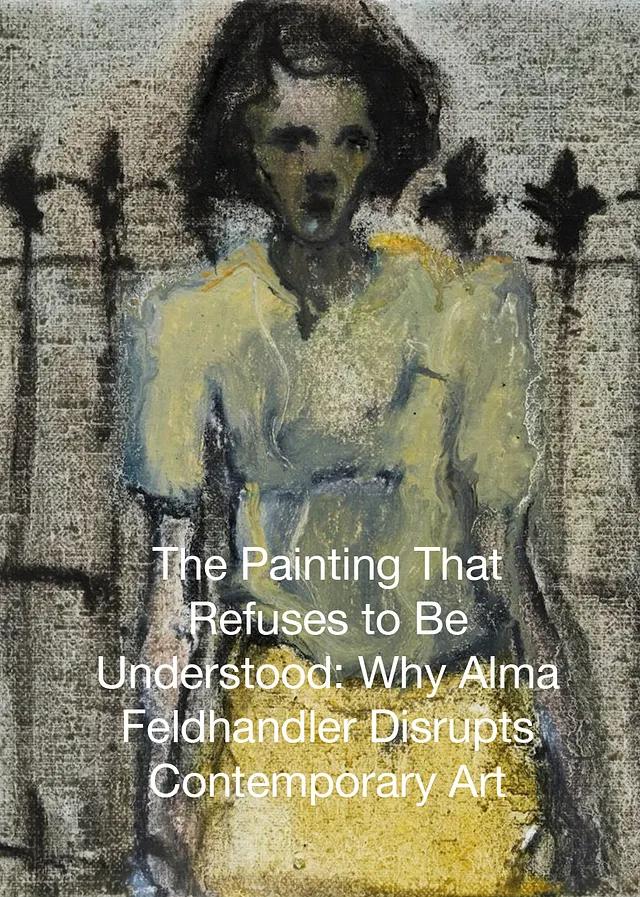
In a contemporary art ecosystem deeply shaped by the speed of image circulation and the growing demand for clear, digestible discourse, Feldhandler’s painting positions itself as a form of quiet resistance. Rather than seeking immediate impact or conceptual clarity, her practice proposes a sustained experience of estrangement, where the image does not appear as a finished object but as something in flux. Her works actively resist translation into language, not out of elitist obscurity, but because they operate in a register where representation is no longer the primary goal. The figures that inhabit her paintings do not illustrate stories or embody fixed symbols; instead, they function as remnants or traces — fragments of something that once was, or could have been, but never fully coheres. Each work becomes a site of tension where visibility and disappearance coexist without resolution.
A key framework for approaching her work is the notion of the archive, understood not as a stable system of preservation but as a volatile field where memory and loss are inseparable. Feldhandler appears to draw from archival materials — found images, diffuse historical references, cultural residues — yet instead of organizing them into coherent narratives, she subjects them to a process that intensifies their opacity. In her practice, the archive ceases to be a guarantor of truth and becomes a mechanism that exposes the impossibility of accessing the past without mediation, distortion, and violence. Her paintings do not reconstruct histories; they work with what remains of them: fragments, gaps, interruptions.
This logic is especially evident in her construction of the pictorial image. Unlike traditions that treat painting as a means of fixing representation,
rener/the-painting-that-refuses-to-be-u…stood-why-alma-feldhandler-disrupts-contemporary-art-3ce067b497e2
Feldhandler uses it as a space of instability where forms simultaneously emerge and dissolve. The line does not define, the stain does not conceal, and the layering of surfaces does not culminate in resolution. Everything exists in suspension. The figure is never fully present, yet never entirely absent — it occupies a threshold where perception becomes uncertain. This liminal condition is not incidental; it is the core of her visual language, destabilizing the conventional relationship between image and meaning.
In this sense, her work can be understood through the evocative metaphor of the phantom — the placeholder used in libraries to mark the absence of a missing book. Her paintings do not fill a void; they mark it. Each image functions as an index of absence, pointing to something that is no longer there, or perhaps never fully was, while granting that absence its own density. Rather than attempting to restore a lost whole, Feldhandler insists on its impossibility, shifting painting away from representation and toward the articulation of irretrievability. What we encounter is not the missing object, but the trace of its disappearance.
Crucially, this insistence on absence does not translate into nostalgia. Unlike many contemporary practices that lean on melancholia as a form of sentimental reconstruction, Feldhandler’s work operates differently. Hers is not a melancholia that longs, but one that acknowledges. There is no desire to recover what has been lost, only an acute awareness that loss is constitutive. Her figures do not evoke a past we wish to return to; they embody the impossibility of ever having fully inhabited it. The sadness that permeates her work does not organize itself around a clear narrative; it manifests in the materiality of the painting itself — in eroded surfaces, blurred contours, and persistent ambiguity. It is a melancholia without object, one that seems to belong not to the artist, but to the images themselves.
At the same time, her practice suggests a dimension that could be described — cautiously — as mediumistic. Not in a mystical or spiritual sense, but in the way the artist appears less as an author imposing form than as a conduit through which images emerge. What surfaces in her work is not something transcendent, but the material residue of what remains: fragments of imagery, cultural echoes, historical traces that persist discontinuously. Her painting does not channel the invisible; it reconfigures the visible through its fractures.
This approach also implies a particular ethical stance toward images. Feldhandler does not appropriate her sources in order to produce clarity or
rener/the-painting-that-refuses-to-be-u…stood-why-alma-feldhandler-disrupts-contemporary-art-3ce067b497e2
narrative closure; instead, she preserves and even intensifies their opacity. In an era where much artistic production is oriented toward generating immediate, consumable meaning, her insistence on ambiguity becomes a critical gesture. It is not a rejection of meaning, but a resistance to its simplification — a way of insisting on the irreducible complexity of experience.
That critical dimension becomes especially evident in her relationship to the contemporary regime of images. In a context saturated with visual content, where images are produced and consumed at an unprecedented pace, Feldhandler proposes a different temporality: slow, dense, and demanding. Her paintings do not offer themselves up instantly; they require time, proximity, and a willingness to remain in uncertainty. The experience they produce is not one of rapid consumption, but of gradual engagement, where the viewer’s gaze must adjust to instability.
Ultimately, Alma Feldhandler’s practice can be understood as a sustained exploration of the image as a site of conflict between presence and absence, memory and loss, visibility and opacity. Her work does not resolve these tensions; it holds them open, insisting on them as a condition of contemporary experience. At a moment when so many images seem designed to close meaning quickly and efficiently, her painting becomes a space where meaning is delayed, complicated, and sometimes suspended altogether.
Perhaps the true power of her work lies precisely in its refusal to provide clear answers. Instead, it places us before questions that resist easy resolution: what does it mean to remember when all memory is mediated? What does it mean to represent when representation always entails loss? How do we look in a world where the overproduction of images has eroded our ability to see? Feldhandler does not answer these questions — but she makes them visible, and in doing so, her painting becomes not just an aesthetic object, but a form of thought.
To explore her work further, visit Alma Feldhandler’s website:
Meyer Riegger | Alma Feldhandler
Located in Berlin, Karlsruhe and Basel the gallery maintains a diverse exhibition program with solo exhibitions of the…
rener/the-painting-that-refuses-to-be-u…stood-why-alma-feldhandler-disrupts-contemporary-art-3ce067b497e2
#ContemporaryArt #Painting #ArtCriticism #AlmaFeldhandler #VisualCulture #ArtTheory #MediumArticle #EmergingArtists #FigurativeArt #ArtWriting #CriticalThinking #ArtAnalysis #ModernArt #PaintingToday #ArtEssay
https://medium.com/@sarah rener/the-painting-that-refuses-to-be-u…stood-why-alma-feldhandler-disrupts-contemporary-art-3ce067b497e2