Ayako Rokkaku: The Artist Who Paints With Her Hands and Is Redefining Contemporary Painting
Sarah Rener
The trajectory of Ayako Rokkaku does not follow the familiar narrative of the contemporary artist shaped by academies, legitimized by institutions, and eventually absorbed into the market. Born in 1982 in Chiba, Japan, Rokkaku is essentially self-taught: she began painting without formal artistic education, developing her visual language outside traditional structures. In her early years, she worked in jobs unrelated to the art world while painting almost compulsively, using accessible materials like cardboard and acrylics — already signaling a direct, unmediated relationship with the act of creation. Her recognition came in the mid-2000s, when she
https://medium.com/@sarah rener/ayako-rokkaku-the-artist-who-paints-with-her-hands-and-is-redefining-contemporary-painting-0d787461d9be?postPublishedType=initial
began participating in art fairs and attracting the attention of international galleries, eventually leading her to relocate to Europe, particularly Berlin. This biographical trajectory is not merely contextual background but a key to understanding her practice: it does not emerge from academic tradition or an explicit dialogue with art history, but from experience itself — from making as a primary mode of constructing meaning.
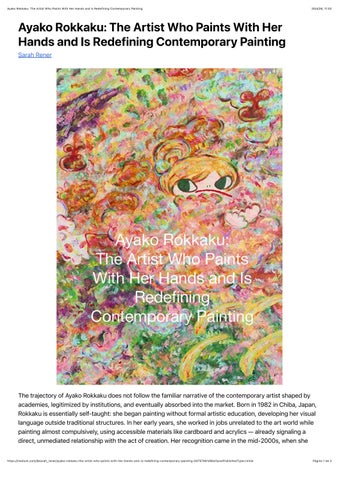
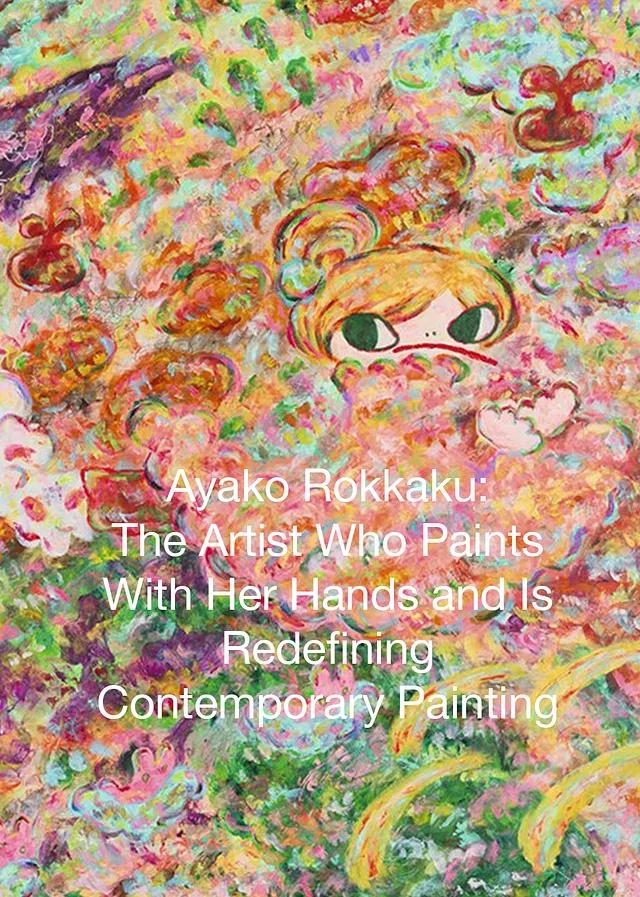
Within the ecosystem of contemporary art, where over-intellectualization and discursive mediation often dominate both production and reception, Rokkaku’s work appears as a meaningful disruption. At first glance, her paintings seem to resist analysis: childlike figures, saturated colors, compositions that suggest spontaneity and a kind of controlled chaos. Yet this initial impression — light, even deceptive — functions as an entry point into a far more complex practice. Rokkaku does not avoid thinking; she relocates it, embodies it, transforms it into gesture. Her self-taught condition does not signal a lack of reflection, but rather a reconfiguration of how artistic thought operates. Instead of executing pre-existing concepts, her work seems to emerge from an inverse logic: it is in the act of painting that form, decision, and meaning arise simultaneously.
This logic becomes especially visible in her technique. Rokkaku paints with her hands — without brushes, without intermediary tools, and without preparatory sketches. The surface — whether canvas, wood, or cardboard — ceases to function as a site of representation and becomes instead a space of direct contact between body and material. In this context, painting is no longer a medium but an extension of gesture. Each mark is both a physical trace and an aesthetic decision, with no clear separation between the two. Her practice may be situated in relation to certain 20th-century traditions such as action painting, yet comparisons with figures like Jackson Pollock also reveal crucial differences. While Pollock’s gesture carried a dramatic, almost existential intensity tied to the assertion of subjectivity, Rokkaku’s gesture shifts toward a different kind of energy — lighter in appearance, more playful, yet no less complex or ambiguous.
That ambiguity is perhaps the defining quality of her work. The figures inhabiting her paintings — typically girls with large eyes, simplified faces, and bodies dissolving into color — immediately evoke imagery associated with manga and kawaii aesthetics. In this sense, the temptation to connect her work to the Superflat movement and to artists like Takashi Murakami is almost inevitable. However, this association, while useful as a starting point, ultimately falls short. In Rokkaku’s work, “cuteness” is never entirely stable or comforting. There is a persistent unease in these figures, an emotional tension that disrupts their apparent sweetness. Her characters do not represent an idealized childhood, but rather an uncertain and fragile state. There are no clear narratives or defined contexts; the figures float, repeat, and transform, as if existing in a space where identity itself remains unstable.
This lack of narrative anchoring can be understood as a strategy that shifts attention from the “what” to the “how.” What matters is not what the images represent, but how they are constructed and experienced. In this sense, Rokkaku’s work indirectly engages with contemporary concerns about images, particularly in a digital context where constant circulation tends to dematerialize visual experience. Against this backdrop, her insistence on tactility, on the repetition of physical gesture, on the material presence of paint, acquires an almost political dimension. Painting with her hands, embracing mess, insisting on direct contact — these become acts of resistance against the increasing abstraction of aesthetic experience.
This bodily dimension is not limited to the final work but extends into the process itself, which often becomes a public event. Rokkaku frequently creates live paintings, transforming the act of painting into a shared, timebased experience. In these moments, the artwork ceases to be an autonomous object and becomes an event — something that unfolds in front of the viewer and cannot be reduced to its final form. While this practice could be interpreted as an adaptation to the contemporary attention economy, it can also be understood as a recovery of the temporal and embodied nature of art. The viewer does not simply observe an image but witnesses its formation, its uncertainty, its evolution. Painting, in this sense, becomes process before product.
At the same time, this emphasis on immediacy and embodiment coexists with a clear integration into the global art market, where Rokkaku’s works reach high prices and circulate through major galleries and collections. This coexistence introduces an inevitable tension between spontaneity and codification, between free gesture and stylistic repetition. The question arises: to what extent can a language grounded in improvisation remain open within a system that tends to stabilize and capitalize what it recognizes as valuable? In Rokkaku’s case, this tension is neither resolved nor avoided; rather, it becomes part of the work’s complexity.
Another crucial aspect of her practice lies in the relationship between improvisation and thought. When Rokkaku claims that she paints without thinking, she is not necessarily rejecting the intellectual dimension of art, but proposing another form of thought — one that does not operate through prior concepts, but emerges through doing. Her painting can thus be understood as a form of embodied knowledge, where gesture does not illustrate an idea but generates it. This perspective is particularly significant in a context where contemporary art has long privileged discourse over experience. Against this tendency, Rokkaku proposes a more direct, sensory relationship — one that does not eliminate complexity but relocates it.
Still, it would be reductive to interpret her work as pure spontaneity or as a return to some form of “pure” gesture. There is formal coherence in her work, a repetition of motifs, a continuous exploration of variation that reveals a refined aesthetic awareness. The difference lies in how these decisions appear: not as prior planning, but as adjustments emerging within the process itself. The painting is not executed according to a fixed plan; it unfolds as a series of responses to what happens during its making.
Ultimately, what makes Ayako Rokkaku’s work significant is not only its recognizable aesthetic or distinctive technique, but the way it reopens fundamental questions about painting today. In a world saturated with designed, optimized, and filtered images, her insistence on imperfection, tactility, and immediacy introduces a necessary friction. This is not about nostalgia or a naïve return to childhood, even if childhood remains a recurring motif, but about exploring alternative ways of relating to creation — where control is not absolute, where error is not eliminated, and where process retains its value alongside the result.
That ambivalence — between play and unease, spontaneity and institutionalization, body and market — is what keeps her work in a constant state of tension. And it is precisely within that tension, in that refusal to fully stabilize meaning, that her critical power resides.
To explore her work further, visit Ayako Rokkaku’s website:
#AyakoRokkaku #ContemporaryArt #Painting #ArtCriticism #ModernArt #ArtEssay #MediumWriters #VisualArt #ArtAnalysis #JapaneseArt #EmergingArtists #ArtCollectors #CreativeProcess #ArtMarket #ArtLovers