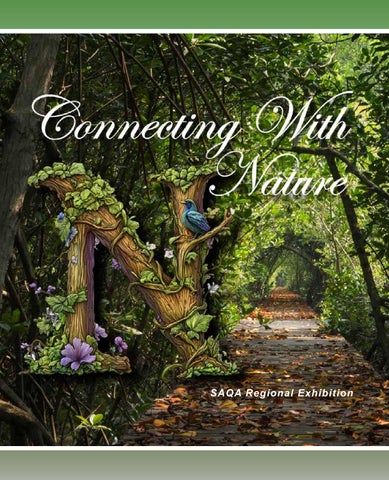
Art and Nature - A bond between the two is a journey. Step into a landscape, walk the grounds, see the details, view with a different perspective.
Thread the connection, we are all attached, we are one in the same, we can both be wild and messy, unpredictable and yet beautiful.
SAQA Regional Exhibition
Delaware / DC / Maryland / W. Virginia Regional Representative: Suzan Morgan
Regional Coordinators for Connecting With Nature Exhibit: Andrea Finch & Lana Dragon
Juror: Denise Miller
Cover artwork: Lana Dragon
Catalog design: lanadragonstudios.com
Contents copyrights @2026 Studio Art Quilts Studios Associates, Inc.
Images copyright the individual artists.
Images may not be reproduced or used in any way without permission. All right reserved.
860.530.1551
The Artists
Teresa Abney Washington, DC
This quilt depicts a 19th century travel craze—the Claude glass, a small black mirror. Travelers, instead of looking at the breathtaking vistas, would stand with their backs to the views and look at the reflection in the Claude glass. The Claude glass reduced the color and tonal range of the scenery. Thus, then reflection mimicked the look of a Claude Lorrain landscape (from the mirror gets its name).
This quilt celebrates the Clause glass craze which encouraged artistic interaction with nature, but also acknowledges the risk that travelers may have missed out on the beauty of the nature by consuming it through a filter.
Techniques: Embroidery, painting on fabric, appliqué, hand-quilting
Materials: Cotton fabric, textile paint.
Looking Away to See
Arlene L. Blackburn
Union Hall, VA
This was my view outside of my casita studio during my 30-day Artist Residency at Ghost Ranch in Abiquiu, New Mexico. The rust fabrics were created on-site with items scavenged and collected by Georgia O’Keeffe at the ranch. These just added another layer of story to the finished artwork.
Techniques: Hand-dyed and rusted fabrics by artist; machine pieced; machine quilted.
Materials: Hand-dyed and rusted cotton fabrics; wool batting; cotton/poly threads.
Eileen Marie Blazic Drums, PA
My husband and I retired to a community where we have beautiful views of our lake, birds visiting the feeders daily, and four seasons to experience every year. We have a wide variety of trees, even a beloved ginkgo planted when we first moved here 11 years ago. The only thing missing in our slice of heaven is a perennial flower garden. My ‘Just Quilt Dancing Around the Posy’ is my quilt ‘garden’ that I created because the deer eat any real flowers I plant!
The free-motion designs surrounding the posy are the abstract designs I see in the tree barks and branches, as well as in the paths I walk in my community. Creating a nature art quilt brings the beauty inside and makes it last forever!
Techniques: Free-motion machine quilting, paintied posy and leaves, machine and hand-binding.
On a cloudy day I can see not only the mountains in the distance, but the foothills before them. And before them is a fast moving stream fed by the melting snow in the mountains. The circle of nature’s life.
Techniques: Raw edge appliqué and machine stitching.
Materials: Commercial and hand-dyed cottons and silk.
Distant Mountains 20”x18” 2022
Cindy Brendzel
Overland Park, KS
I connect with nature in an otherwise mindless walk on the beach. I notice the pools of water that develop on the shore as the waves ebb and flow. Each one a totally unique world in itself
Techniques: Acrylic mono prints on fabric, matching stitching.
Materials: Commercial cotton, acrylic paint.
Tidal Pools
Susan Callahan Frankford, DE
I live on the coast, it is easy to connect with nature. I walk the beach along the shoreline, or in the state parks that have so much to offer. One of my favorite places is the Indian River Inlet. It is where the Rehoboth Bay meets the Atlantic Ocean. We go there to see it all, watch boats, people fishing and crabbing. I love to walk along the rocky edges between water. Calmer bay waters meet the strong ocean waves.
Boats have to really work to get to the marina after a day out in the ocean. I love the contrast of the power of nature and human attempts to live companionably in the world.
Techniques: Machine piecing and machine quilting.
Materials: Hand-dyed cotton fabrics cotton and metallic threads.
Cynthia Cleveland Germantown, MD
The ocean has run through my veins since before I could walk. Having been an underwater photographer for years, I wanted a new way to show my connection to this magnificent world. I designed this quilt from a photo I took in the Philippines.
Techniques: Raw-edge appliquéd, thread painted, trapunto, hand-embroidered, and free-motion quilted.
Materials: Cotton, ink pencils, fabric pen.
Leah Cooke Cary, NC
Dreaming of Spring portrays a woman becoming her garden as growth stirs beneath the surface. Vines and florals shape her face, alive with fresh greens and vivid pinks pushing through winter’s quiet. She is not waiting for the season to arrive; she is awakening alongside it. Petals drift across her gaze as energy returns—subtle, deliberate, and certain. Spring lives
within her body, unfolding at its own pace. She is blooming now, fully, and on her own terms.
Techniques: Improvisational piecing, raw-edge appliqué and machine quilted. Materials: Recycled clothing: Sarongs and batiks brought back from Singapore, cotton and rayon dresses, silk scarves and tops.
Dreaming of Spring 20”x20” 2026
Leah Cooke Cary, NC
Dreaming of Summer portrays a woman who becomes her garden in full heat and color. Her face is pieced from bold florals, saturated reds and layered patterns that pulse with energy. Flowers press forward, overlapping her features, as if growth cannot be contained. She is not remembering summer—she is inhabiting it. The quilt celebrates
vitality and presence, where color replaces skin and petals erase boundaries. Summer is not passing through her, it is who she is.
Techniques: Improvisational piecing, rawedge appliqué and machine quilted.
Materials: Recycled clothing: Cotton, rayon and embroidered dresses, African cotton batik, silk and cotton scarves.
Dreaming of Summer
20”x20” 2026
Suzette Coppage Bel Air, MD
Perched one hundred feet above the ground in the loblolly pines of the Chesapeake Bay wetlands, a young Great Blue Heron makes his presence know, squawking hungrily at his mother. Wading in the shallows, his father is stealthily fishing for dinner, so patient and focused. Once a fish is speared, he will return to the noisy rookery to feed the fledglings. Floating in my kayak, as I watch their interactions unfold, I am reminded of the rhythms and responsibilities that echo within my own family; noisy and demanding children, parents
scrambling to provide for their needs, a community to keep them safe. And just as the heron waits patiently for its catch, perhaps we too can learn to approach life’s challenges with calm and determination.
Materials: Painted whole cloth white fabric, commercial fabrics, fabric paint and markers, variety of threads including mono-filament.
The Rookery 48”x40” 2021
Photo by Roger Miller
Suzette Coppage
Bel Air, MD
I Spy An Orca, bridges the wonder of nature and personal experience, capturing the awe of an orca breaching in the San Juan Islands during our cruise. Through applique and painted details, the quilt reveals an orca whose underwater body is stitched with scenes from our journey—seaplane, kayaks, blackberries, and he islands’ map—blending memory and imagination. The background, painted with bubbles, kelp, and gentle waves, echoes the vibrancy of the underwater world, while Mount Baker and Orcas
Island’s peninsula, rendered in raw edge applique, ground the piece in place and time. This quilt is not just a visual tribute to nature’s beauty, but a celebration of shared adventure and connection.
Techniques: Whole cloth painted background, raw-edge appliqué, trapunto, micro-stippling, quilting and thread painting on a domestic machine.
Materials: White cotton, commercial fabrics, silk fabrics, variety of thread, fabric paint.
I Spy An Orca
53”x30” 2018
Photo by Roger Miller
Barbara Dahlberg Crofton, MD
Many nights I hear the fox barking in the woods behind our house. One moonlit night I looked out the window and there she sat, staring directly at me. It was magical.
Materials: Hand dyed and commercial cotton fabrics, upholstery fabric, fabric paint, variegated and solid cotton threads, silk thread, battling
Vixen
37.5”x22” 2026
PA
This piece is inspired by my favorite place in Northern Montana. I used abstract shapes to remind me of the mountains, trees and picking huckleberries.
Techniques: Improvisational designed, cut without rulers or grids, machine pieced and quilted.
Materials: Hand-dyed cotton fabrics, cotton thread and batting.
Liz Danish
Bryn Mawr,
Elizabeth Bradford Davison Washington, DC
The peace and harmony in nature inspire my fiber art. These four Ibis feeding in the marsh reflect feelings of gentleness and calm. With all the turmoil currently in the world, working on nature scenes with birds, water and plants provide respite from the outside world. Using color and textural elements create some excitement and interest. Her I have used a palette of gushing, purple and lime green as a
split complement scheme, and some iridescent film and textured ribbon for more interest and dimension in the piece.
Techniques: Fused raw edge appliqué, machine quilted, hand appliqué.
Materials: Hand dyed cotton, commercial batik cotton, polyester organza, Angelina fiber, moss mesh ribbon, acrylic paint, cotton and polyester thread, cotton batting.
White Faced Ibis
33.75”x31” 2025
Photo by Pete Duvall
Lana Dragon
Martinsburg, WV
“Nature’s Gateway” — open and step in at any time! Enter into our natural world of sights, sounds, fragrances, and endless color sensations, all wrapped into nature’s bounty of artwork. Nature is always just a few steps away in any location, brings one close to incredible beauty and wonder. All the majestic trees are my favorite!
The center image brings focus and clarity to our spectacular natural world. The animals & birds are just behind the trees, so — step in — connect!
She always said it was going to rain when pink clouds could be seen on the horizon. I don’t know how she knew, if she cold feel a shift in the weather, but she was always right. Gran knew when the light turned the fields into a fire of red and gold, that storms were moving through quickly.
On those summer afternoons, before the pink clouds brought the rain, we
would sit on the porch, snapping beans, and just watch those fields shimmer as though on fire.
Materials: Mix of hand-dyed, over-dyed and commercial fabrics, color pencil, acrylic paint, gelato paint sticks and a variety of threads.
Fields of Red 52”x28” 2023
Sarah Lykins Entsminger
Asburn, VA
Memories can soften the edges of a landscape, leaving a sense of place without the details visible when physically in the space. Color, scent, time of day, and season can impact those memories as well. I associate the color purple with fields of lavender, plants gently waving in the breeze and reflecting sunlight as they bloom. Sitting on the patio
outside my Mother’s house as we sipped our afternoon tea and watched the bees enjoying the lavender blooms with great abandon.
Materials: Hand-dyed and overpainted fabrics, acrylic paint, color pencil, gelato paint sticks, and variety of threads.
Fields
Grace R. Evans Raleigh, NC
Throughout the seasons I often look out my studio window at the layers of trees and especially at one of my favorites, an Ironwood tree. Peering out at them, I am able to collect my thoughts and find peace amidst the tasks of the day. I sketch and paint this scene from time to time and was inspired to recreate one of these paintings into this fabric piece.
Techniques: My original drawing was commercially printed on cotton in which I layered with various fabrics, thread painted and hand stitched details. It is sewn onto black fabric and mounted on wooden stretchers..
Materials: Original painting commercially printed onto fabric, commercially made fabrics including light and heavy weight cottons and satin fabrics, embroidery threads, black backing and wood stretcher bars.
Andrea Finch Chambersburg, PA
Once a traditional flat quilter, my work has left the surface to become sculptures that taunt the viewer to reach out and touch. My garden is the inspiration for my work. Starting with botanical forms, reducing the designs to more abstract forms, and finding the essence of the structure.
Continuing in my Magnolia Grandiflora series I delve further into my fascination with this prehistoric tree. The opposition of the soft, smooth tepals (petals), the curves of the stigmas in the center and the hard, sharp seed pods have led me to further exploration and abstraction. Originally the
elements of this piece were attached to a canvas. While the extensive stitching helped fight gravity its weight made the piece awkward to hand and to handle. I decided to cut the pulled stitching threads and release it from the surface to become a freestanding sculpture. The piece still holds the movement and tension but with better balance.
Techniques: Machine quilted, machine raw edge appliquéd, machine thread painted, hand & machine constructed.
After years of working as a flat quilter, with this piece, I embraced the sculptural form wholeheartedly. The Magnolia Grandiflora’s seed pod is hard & unforgiving when stepped on. The transformation from a beautiful flower to an unyielding seed case intrigues me. Magnolia Grandiflora is a Southern tree whose leathery leaves hold their green throughout the winter in my southern Pennsylvania garden. I have the joy of finding the sharp seed pods from fall through the winter. The seed pod form has inspired this and many more pieces of this series: bringing it to life in a soft medium. I use all
textiles, new and vintage conventional quilting fabrics, re-purposed quilts I made or collected, reclaimed tablecloths, curtains, and clothing from family and friends salvaged upholstery textiles, and decorator sample diverted from landfills. MG:V is nicknamed Fitz for F. Scott Fitzgerald, and American Southern writer.
Techniques: Machine quilted, machine raw edge appliquéd, hand & machine constructed.
Finding calm is always a welcome retreat for most of us. Nature that brings us serenity is treasured and the water lily is iconic. It offers calmness, serenity, peace and visual ease. Perhaps even hope. Water Lilies date back 115-125 million years to the Early Cretaceous Period. Its continues existence alone is hopeful. Capturing these descriptors through fabric was my mortal hope. It was an intentional subject choice to evoke calm and serenity,
it did in fact induce those very same emotions in it making. The layering of colors was my intent to see how “painterly” the fabrics could be.
Techniques: Raw edge appliqué and the layering up of fabric. Longarm machine quilting using a thread painting technique.
Materials: Cotton quilt fabrics, Steam-aSeam 2 fusible and polyester thread.
Finding Calm 38”x31” 2022
Robin Hamill
Charlottesville, VA
As the glaciers melt, the runoff creates beautiful, sinuous patterns in the sediment beds. These channels are dynamic and ever-changing. This quilt was inspired by a trip to Alaska and viewing the dramatic loss of glacial mass that has occurred over the past decades.
As the ice forms disappear, will we lose many of these fascinating, dancing waterways?
Techniques: Whole cloth, free-motion quilted on a domestic machine.
Materials: Commercial cotton.
Braided River IV: Alaska 43”x12” 2026
Robin Hamill
Charlottesville, VA
The ocean—its makeup and rhythm—is so closely connected to humans: salt, water, and heartbeat. There is something so soothing about sitting on a rock embracing the ebb and flow of the waves, or floating underwater sharing in the thriving community of organisms. The hand painted fabric (by Pat Pauly) invited an underwater seascape. This quilt was a fun experiment with different materials and tools.
Techniques: Hand-painted cotton and painted, Pellon non-woven fabric with acrylic paint appliquéd, commercial cotton, embellished with acrylic paint pens; machine free motion quilted on a domestic machine.
Materials: Hand painted and commercial cotton fabric, non-woven Pellon fabric, acrylic paints.
Marcia Horting Gaithersburg, MD
This piece is a view from my window: a cold winter night with a luminous full moon setting behind a stand of birch trees, its brilliance reflected in a still pool of water. I’ve always felt that looking out a window is a journey in itself. It is where our quiet, indoor lives meet the untamed world outside.
In this work, I want to show that even though nature can be unpredictable, everything is connected. The top section shows the wind blowing gently through the branches, while the bottom plumbs, the hushed stillness of the waters. The yellow stars are the common thread. They appear in both the sky and its earthly
reflection, acting as the connective tissue that binds the world together. To me they represent how we are all attached to the same world.
I hope this piece encourages you to look out your own window with a different perspective and see the beauty in all that is around us.
Techniques: Fabric hand dyed and painted using thickened paste and Procion MX dyes. Screen printed using original stencils and soy wax pattered screen. Free-motion quilting.
Materials: Hand dyed, painted, and printed cotton fabric. Cotton batting. Procion MS dyes.
Marcia Horting Gaithersburg, MD
As a regular walker on the local trails, I view the forest as a series of transitions. This piece, inspired by the River Trail, captures the journey from the forest floor to the canopy. It is an exploration of the bond between the earth that sustains us and the sky that inspires us. In this work, the landscape is a metaphor for resilience. The bottom section represents rebirth where the quiet, flood-scraped floor of the alluvial plain eventually feeds new life. The sunlight breaking through the dense canopy represents the unknown—a shimmering space of hope and future growth.
Between the two, the sturdy trees trunks that withstand each successive springtime flood, provide stability and continuity, literally bridging the ground ans sky, completing the cycle of rebirth and renewal. It is a reminder that even in the unpredictable wild of thee woods, there is a sturdy connection between where we stand and where we are headed.
Techniques: Whole cloth hand dyed and painted using thickened print paste and Procion MX Dyes. Screen printed using original stencils and soy wax patterned screens. Free-motion quilted.
Materials: Hand dyed, painted, and printed cotton fabric using Procion MX Dyes. Cotton batting.
Clover L. Kemp
Bethesda, MD
A whole piece of fabric with pierced inserted rock shapes, I have reinvented with stitch marking to reflect the water flowing across and around river rocks.
Techniques: Piecing, quilting, hand embroidery.
Materials: Cotton, thread, embroidery floss
River Rocks
49”x40” 2026
Clover L. Kemp
Bethesda, MD
I focused on lines, organic shapes and color to portray the architectural nature and environmental connection of seed pods. Pods protect and nurture seeds until they are dispersed—containers of life & potential. The purposely chosen hues suggest growth and vitality.
Techniques: Screen printing,machine quilted.
Materials: Cotton, Procion Dyes, thread.
Seed Pods 32”x20” 2025
Judy Kirpich
Takoma Park, MD
Historically my work has been directed by my emotions. Aging, self image, difficult life transitions, and anxiety have all informed my art. Recently a new emotion entered my vocabulary–”joy”. A trip to Iceland in the summer of 2022 was a life-changing event. The incredible landscape, filled with glaciers, waterfalls lava fields and basalt columns was the impetus for this series. I have never seen green with the same intensity as in Iceland, and the vernacular
architecture from crumbling out buildings and turf houses to stark village churches captivated me. For the first time I felt the emotions of happiness and wonder creeping into my work
Techniques: Quilting, pleating, acrylic painting, fabric distressing, hand stitching.
Piles of leaves create an interesting collage of colors.
Techniques: Raw edge fabric collage, machine stitched and quilted.
Materials: Hand dyed and hand painted cotton fabrics incorporating multiple surface design processes.
36x36” 2022
Melinda Lowy
Silver Spring, MD
My work features many different types of fabrics and surface design techniques. I utilize silk painting, painting with thickened dyes and acrylic paint to create some of the fabric in my art. I also like to make use of fabrics from recycled sources, from different countries and of different content, such as silk, velvet, polyester, corduroy. I employ embroidery, stenciling, stamping, needle felting, free-motion embroidery, and crochet to add additional dimension to my work. I make use of negative space to explore my
ideas in both my 2-dimensional and 3-dimensional work. My most recent work has focused on the natural world around me. Snorkeling trips, interesting patterns on rocks and trees and feathers have inspired my art.
Techniques: Machine appliquéd, hand painted, hand appliquéd, crocheted, machine quilted.
My work features many different types of fabrics and surface design techniques. I utilize silk painting, painting with thickened dyes and acrylic paint to create some of the fabric in my art. I also like to make use of fabrics from recycled sources, from different countries and of different content, such as silk, velvet, polyester, corduroy. I employ embroidery, stenciling, stamping, needle felting, free-motion embroidery, and crochet to add additional dimension to my work. I make use of negative space to explore my
ideas in both my 2-dimensional and 3-dimensional work. My most recent work has focused on the natural world around me. Snorkeling trips, interesting patterns on rocks and trees and feathers have inspired my art.
Techniques: Stamped background and leaves with acrylic paint, tea dyed organza, hand-appliqué, machine quilted.
When I run in the park, I open my senses to the natural world. I observe the texture of the grass, the delicate foliage of the trees, and the rich palette of greens, blues, yellows, and browns. I hear the subtle movements of small animals and fellow runners and know that I am only one of many creatures in the park. I smell the soil and rotting leaves and feel the wind, the warmth of the sun, and the coolness of the shade. As my feet find their rhythm on
the trail, I let go of thought and simply exist—moving as nature moves, aware, alert, and in harmony with my surroundings. In these moments, I am not separate from nature; I am woven into its fabric.
Techniques: Mono-printing with leaves and branches, transfer print photos, inktense pencil, free-motion quilting.
Materials: Linen fabric and cotton thread.
Barbara Manley
Lancaster, PA
Coxcomb is a richly-colored beauty of a flower. The convoluted, brain-like structure is fascinating to ponder. According to some, the unusual flower symbolizes courage and resilience.
Coxcomb is a hardy showpiece in any garden.
Techniques: Piecing. Materials: Quilting cotton.
Karen Middleton Richmond, VA
This quilt was created using a limited palette of grays with one contrasting color. The composition reflects the stillness of a river at winter dawn, when light is low and the landscape feels quiet and contained. Subtle shifts in value and texture suggest the meeting of water, land, and sky. Through quilting, the work considers the relationship between natural
environments and human presence, focusing on observation rather than narrative. The piece invites viewers to slow down and look closely at a familiar landscape from a quieter moment in time.
Silk screened fabrics using Procion Mx Dyes, machine pieced and quilted.
Materials: Procion Mx dyes, cotton fabric and thread, wool batting.
Myania Moses
Myania Moses Arlington,
VA
I am blessed to live in a locale with a change of seasons. I am in love with every season’s colors, shapes and bounty. In my drawing, printing and fiber practice I engage and respond to plants, earth, sky and water. Patina of winter explores my love of the winter garden, while not as colorful as spring summer and autumn, the silvers, grays, earth tone greens and
yellow ochre evoke a period of waiting and reflecting on what is to come.
Techniques: Silk screen fabrics using Procion MX Dyes on cotton, machine pieced and quilted.
Materials: Procion MX Dyes, cotton fabric and thread.
Carly E. Mul
Hamilton, VA
Inspired by local vineyards, I created a quilt where the colors of growing wine give a visual to the different blending aromas we taste.
Technique: Freestyle color collage, raw edge fusible appliqué.
Images of a week in Sedona couldn’t leave my mind. I decided to make this quilt, not from any photo, but just from memory. This is what I see when I think of that week. The turquoise of Arizona, the red of the rocks, the lines, the vastness and the magic of the wilderness.
Techniques: Freestyle color colliage, raw edges, appliqué without a pattern, free-motion quilting.
Materials: Commercial cottons, threads and batting.
Dominie Nash Bethesda, MD
Wherever I go I notice and enjoy trees, and their leaves in particular. They are such an essential part of the natural world, and at the same time present a bounty of beautiful design. With their unparalleled variety of shapes and structures, as well as patterns within the structure, they are constant source of inspiration. I use them as they are--I can’t imagine inventing a leaf that surpasses those found in nature, or changing them in any way. Even when they are full of holes or have deteriorated in some
other way they have their own peculiar beauty. They lend themselves to may different types of printing and are the focus of an ongoing treasure hunt. They can disappear at any moment and need to be protected, because of all they give us and the world around us, physically, spiritually, and aesthetically.
Techniques: Leaf rubbings with textile paint, machine appliqué and quilting.
Materials: Cotton, silk organza, textile paint.
54”x37” 2023
Photo by Guilezian/Quick Silver Photography
Debra Nagelhout Newhall Vienna, VA
Art has the capacity to capture an experience in nature that recreates both the emotional and the actual image. By softening the image, it allows the emotion to enhance the experience visually and more completely capture the memory. Sand and Sea captures one of my family’s favorite beach activities–building sand castles. The geometric approach was influenced by modern
abstract art and the piecing was done improvisational just the way in which sand castles are built. The hand guided match stick quilting was done with a variety of threads including metallic thread to imitate the shimmer of sun on the sand.
Techniques: Improvisational piecing, hand guided ruler work quilting. Materials: Cotton fabric, quilting thread.
Sand and Sea
33”x31” 2024
Photo by Benjamin Newhall
Claudia Eileen Pearce
Glenwood, MD
Shadow, the male of the Jackie and Shadow bald eagle bonded pair of Big Bear Valley, California, stares vigilantly into the nest camera. He is always on guard watching out for interlopers, tending the nest, and taking care of Jackie and the eaglets. I fell in love with them by watching Facebook posts of the nest camera in 2025 as they raised the eaglets, Sunny and Gizmo. His expression was priceless.
A nest cam photo was used as the basis of this artwork with permission of Friends of Big Bear Valley.
Materials: Commercial and hand-dyed cotton, cotton and rayon thread, polyester batting, fusible interfacing.
Queen at Sunrise 36”x36” 2025
Serengeti
Judy Pearson Brinklow, MD
Maryland’s Chesapeake Bay with its intricate web of estuaries is home to the famous Blue Crab. A bushel of steamed Maryland Blur Crabs laced with Old Bay seasoning is the star of our family’s Annual Crab Feast. Banging, picking and then sucking the sweet meat from the claws and belly offer hours of delight. Nature provides the rich palette as the blue crab turns bright orange when cooked. Richly patterned batiks capture the bay waters. The strong and graphic style applique of Ayako Miyawaki, a
Japanese artist, provided inspiration to honor this delicate, succulent creature, so important to the ecology and economy of our region. After, drafting a pattern for the large pieced crabs, the center cutouts became the inspiration for the smaller raw edge appliquéd crabs. A bushel of crabs appears on the quilt back.
Techniques: Machine pieced, raw edge appliquéd with hard embroidered buttonhole stitch, trapunto, machine quilted using a big stitch on a Sashiko 2 machine.
A piece of silk, ice dyed by the artist was the inspiration for his piece. The colors hinted at the images and colors seen in a koi pond. Hand-dyed and painted silk fabrics were used to complete the image of koi swimming in a rock rimmed pond.
Materials: Silk fabrics, silk, rayon, and polyester threads, silk batting.
Koi Pond 36.5”x36” 2020
Jenny Perry
Black Mountain, NC
A photo taken by the artist in San Miguel de Allende, Mexico was the inspiration for this piece. Silk and cotton fabrics, some hand-dyed by the artist, were used to re-create this beautiful flower, with added thread work and quilting to enhance it.
Techniques: Hand-dyed fabrics, fusing, free-motion thread-work and quilting.
Materials: Hand dyed fabrics, silk, polyester, and rayon threads, silk batting.
Bird of Paradise
Susan L. Price Springfield, VA
Whether walking in the woods or in my suburban neighborhood, I’m constantly observing the plant life that abounds, looking for pieces of nature to capture in my quilted art. These walks show the life cycle of plants through the seasons, from new growth in spring and full bloom in summer, to gradual decline in fall and dying back in winter. The prints in this quilt represent the natural world in various stages of growth and decline. Even with broken tips, holes and decaying edges, these
leaves have their own unique beauty. The cyannotype blueprint process is the perfect technique for capturing Mother Nature”s works of art on cloth at any stage of the life cycle.
Materials: Jacquard brand and blueprints on fabric pretreated cyannotype fabrics, hand-dyed fabrics, batiks and commercial print fabrics, invisible mono-filament thread, YUI 100% cotton quilting thread.
Susan L. Price Springfield, VA
I love the muted, subtle colors and leaf details that eco printing captures. It reminds me of a walk in the woods, a calming escape from reality that opens the door to let the imagination roam freely. Whether letting an idea germinate, considering techniques to use, or bing inspired by nature itself, the possibilities seem boundless when surrounded by the natural world.
Said Richard P. Feynman, American theoretical physicist, “The imagination of nature is far, far greater than the imagination of man”. I agree.
Techniques: Eco printing, Thermofax screen print, text printed on Extravorganza, hand stitched embellishments.
Materials: Eco printed cotton and silk, Extravorganza ink-jet printing sheets, silk fabrics, various embroidery threads.
The Imagination of Nature
48”x12” 2020
Sue Reno
Bethel Park, PA
This quilt references a colloquial name for the full moon of August, when fledgling birds leave the next and take to the blue skies. It serves as a metaphor for seasonal change, both in the yearly path of the earth around the sun, and in the stages of our lives as we experience them. I included vintage needlework as a homage to my aunts and grandmothers, whose farm chores left them little time for personal goals, yet they found a way to “keep their hands busy” and express themselves artistically.
The patterns they chose often portrayed the flower gardens they meticulously maintained. This work continues my long fascination and with and practice of cyanotype printing on fabrics, using botanicals directly and printing from photographic negatives.
Techniques: Traditional and wet process cyanotype prints, patchwork, stitching.
Materials: Cotton and silk fabrics, vintage needlework panel.
Under the Flying Up Moon
Sue Reno
Bethel Park, PA
Connecting with nature can be as simple as going outside and taking the time to observe carefully. Moonlight gives a soft glow to the landscape, and as one’s eyes adjust to the dim, fine details in the landscape emerge. I’m working on a series of quilts referencing the folkloric names ascribed to full moons throughout the year. Under the Pink Moon represents April, when the full moon shines down on the tender emerging foliage and flowers of spring.
The center panels are direct solar dye prints of garlic mustard, Virginia creeper, and dock leaves, all very prevalent in the woodlands of Pennsylvania. The vintage hexagon blocks, pieced from feed-sack cottons, are bordered with vivid silks.
Techniques: Wet process solar dye botanical prints, piecing, stitching.
Materials: Artist-painted and commercial cotton and silk fabric, vintage patchwork hexagons.
Under the Pink Moon
Martha E. Ressler
Hamburg, PA
I saw a relative of the reliable fall blooming aster in an arboretum in Maryland. It was humming and buzzing with pollinator activity. My photo didn’t capture the insect activity, so I added the little critters, one by one. And then more. Can you hear them now? Photo with added fabric and hand stitching.
Techniques: Photography, dye sublimation printing, raw edge appliqué, hand embroidery.
Materials: Polyester, cottons, embroidery thread.
Martha E. Ressler
Hamburg, PA
We have a certified Pollinator Friendly yard. One of the requirements is to leave part of the property unmown. This is one of the first steps anyone can take to make it critter friendly. We also eliminate pesticide and herbicide use, and choose native species to grow. And we are constantly battling invasive species.
This quilt pays homage to that first step—don’t mow a patch!
Techniques: Raw edge appliqué, hand and machine stitching.
Materials: Cottons, batting, thread.
Unmown 2
40”x32” 2020
Photo by Jay Ressler
Lesley Riley Cascade, MD
As a modern alchemist, I transform light, pigment, and plant into visual poetry, bridging centuries and reawakening the 19th-century cyanotype process with the vision of a 21stcentury fiber artist. My mountaintop walks yield more than leaves--they offer whispers from the natural world, which I gather, print, layer, and stitch into richly evocative works that blur the boundaries between quilting, photography, and printmaking. These aren’t merely botanical studies--they are soulful conversations with impermanence and memory. Like pressed
flowers in an old book, they hold emotion, story, and the passing of seasons. The addition of 19th-century botanist Ana Atkins’ photo honors her groundbreaking 1843 work with plants. Light, and chemistry.
Materials: Original botanical prints, vintage, woven, silk, rusted and printed commercial fabric, and backing.
Cyana Anna 43”x35” 2022
Mary A. Ritter Cary, NC
While walking the boardwalk in Duck, NC, I encountered this solitary tree, a true survivor of the storms the Outer Banks encounters seasonally. It had a sense of solitude even as it was amongst a highly trafficked tourist venue. Poet Mary Sarton wrote, “Loneliness is the poverty of self; solitude is richness of self.” With the Currituck Sound as its background and facing the onslaught of tourist along the boardwalk, this tree indeed had a richness of self about it.
It was lonely in that it stood alone, but its branches reached out in defiance to the elements it had survived and basked in the sunlight of this perfect day, casting its careful reflection towards the shoreline. What a great way to celebrate the Outer Banks of North Carolina!
Techniques: Artist’s photography, printed professionally on cotton poplin, stitching to enhance the reflections and solitary emphasis.
Materials: Cotton, silk and cotton threads.
Solitude on Currituck Sound
18”x18” 2023
Mary A. Ritter
Cary, NC
To everything there is season. As the bright blossoms of summer start to fade, the rich colors of the autumn leaves begin to show themselves. All of the spirited activities of the summer fade into a respite with the cooler temperatures of fall. Fall is my favorite season as I am ready to put away the garden tools and just enjoy the seasonal gifts of my labor.
Nature’s Network explores connection as a force that is intimate, feral and unavoidable. Drawing from the fantastical logic of mycelial systems this art quilt imagines relationship, not as something chosen lightly, but as something grown, entangled beneath the surface,unseen yet essential. Through layered fabric, dense stitching, and intertwining forms, the work mirrors underground networks where nourishment, memory, and power are exchanged, Mushrooms become both symbol and body: neither singular or separate, but part of a larger intelligence that survives through connection. Quilting, traditionally associated with comfort and care is used here to hold tension, between softness and
intensity, beauty and unease. This piece asks viewers to consider what it means to belong to a system that sustain us, even as it binds us, and to recognize that we are never as isolated as we imagine. We are shaped, fed, and upheld by the networks we inhabit. We are the network.
Techniques: Nature’s Network is machine pieced, machine appliquéd and hand appliquéd. It is a machine couched and machine quilted.
Materials: Nature’s Network is constructed of hand-dyed cotton fabric and commercial cotton fabric. It is machine quilted and couch with rayon and polyester threads.
Linda Salitrynski
Painted Post, NY
Walking The Wild explores the inseparable bond of art and nature, where color, line, and movement echo the rhythms of the earth. The layered, hand-dyed fabrics mirror shifting landscapes — fields, rivers, sky ever-changing, unpredictable and alive. The spiraling leaf motifs suggest cycles of growth and decay, a reminder that we are threaded into nature’s endless loop of renewal. Like a walk through wild terrain, the piece invites the eye to wander, to notice details that emerge only with pause and attention. Its vibrant contrasts embrace both harmony and disruption, reflect-
ing the dual truth of nature: it is messy and untamed, yet profoundly beautiful.
Walking The Wild is a meditation on connection—between self and landscape, chaos, and order, art and earth—revealing that we are not apart from nature, but woven into its very fabric.
Techniques: Walking The Wild is constructed using machine piecing, machine applique, hand applique, and machine quilting, and machine couching.
Materials: Hand-dyed cotton fabrics, and commercial cottons were used. Forty weight rayon and polyester threads were used for the quilting and couching.
Mary Schwarzenberger
Riegelsville, PA
This piece seeks to replicate the motion of ripples in a body of water. The ocean engages all of the senses and elicits profound feelings of relaxation and exhilaration simultaneously.
Techniques: Snow-dyeing, fabric manipulation, faux chenille, and serged edges.
Materials: Snow-dyed silk habotai.
Wavelength! 40x18.50” 2016
Mary Schwarzenberger Riegelsville, PA
This piece aims to evoke the sense of awe and serenity induced by experiencing the warm, vibrant colors of a sunset. This predictable daily event reflects the human desire to connect with nature and enhances feelings of belonging.
Techniques: Snow-dyeing, fabric manipulation, faux chenille, and serged edges.
“View Points” is the third in a series of works exploring the metaphorically rich juxtaposition of structures created by humans with those made by nature. Bridges over the Great Falls gap in the Potomac River (MD) and archways in Canyonlands National Park (UT) combine to generate a range of views for humans to experience nature. Depending on which way we look, we see turbulent threat, allure of the unknown, or the hope of reassuring calm.
No matter which view we take, the relationship between what surrounds us and what we have built offers a rich dialog.
Techniques: Multiple original digital compositions created from artist photos and other visuals; printed on fabric, re-combined and montaged: hand-guided stitching/thread sketching.
Materials: Cottons, wool batting; cotton and polyester threads.
View Points
49”x36” 2025
Photo by David W. Shively
Candace Hackett Shively
Fayetteville, GA
Walk in a botanical garden along winding paths that weave in and out, just as the branches do. Each bend leads to beautiful blossoms and textures. As we bask in the colors, our thoughts can explore new ideas along the twists and turns.
Techniques: Artist painting on fabrics, machine fabric montage, free motion quilting.
Materials: Commercial and artist-painted cottons, polyester threads, wool batting.
Garden Walks
29.5”x27” 2022
Photo by David W. Shively
Lisa Smith Garrett Park, MD
This quilt is a celebration of the flora and fauna that thrive in my yard during the heat of the summer sun. I find myself connecting with nature in my yard, simply by sharing space with the plant and animal life that color my world, Butterflies flit around pink and purple hydrangea blossoms, bringing life, motion, color and pleasure, simply by choosing to thrive.
Materials: Mono printed and hand painted fabric, acrylic paint, laser printed images, metallic thread, metallic leaf.
Hot Fun in the Summertime 23”x19” 2025
Linda
Syverson-Guild
Bethesda, MD
Poppies thrive in the Pacific Northwest. Two versions remained in my memory following a visit to Idaho:
1. The joyous flowers that moved with the breeze.
2. The mosaic that captured that dance in tiles. They share different chapters of the same story.
Techniques: Raw edge appliqué, free-motion quilting, machine quilting, hand beading, hand wrapped and stitched Dorset button, 3D petals.
Materials: Hand dyed cotton, cotton threads, glass beads, a nylon washer, cotton batting and backing.
Photo by Mark L. Guild
Harriette Tuttle
Selbyville, DE
The concept of camouflage intrigued me on a trip to Africa. Why was it so hard to see Zebras on the African plain? What about the black and white lines on their backs prevented me from seeing them clearly. This effect was exacerbated when they were under a dead tree. I later learned black and white camouflage is often used at sea by the navy.
It is called dazzle camouflage. A group of Zebras is called a dazzle. The irregular pattern of black and white lines form patterns that are hard to see at a distance.
Techniques: Pieced small squares. Couched black ribbon.
Materials: Cotton fabric, ribbon.
Zebra Dazzle
Isabel Maria Wilder
Charles Town, WV
Sitting under our Ginkgo tree, a moment of worry evolved into a magical tine. The beautiful, dry fall leaves on our cement patio invited me to play. Creativity took over worry, and I saw the leaves coming to life in a joyful dancing motion and said, “Look at these Dancing Ginkgo Girls!”
I let my imagination create without purpose, and in the end the work created gave me purpose—my own happiness.
Techniques: Improvisational piecing, hand appliqué, home machine quilting, hand embroidery, shadows effect.
Photo by Melanie Brownsmith (for front view picture only)
Dianne Miller Wolman
Chevy Chase, MD
This blossom was inspired by composite memories of my visit to the Botanical Gardens in Capetown, South Africa, where I was impressed with the variety and strangeness of many of the flowers and plants. The background reflects my fascination with the traditional narrow strip weaving in Ghana and Nigeria which is constructed in yardage.
Techniques: Machine pieced background, hand embroidered and hand quilted.
Materials: Cotton fabrics, some hand dyed, cotton batting, various threads, fabric basting glue.
African Blossom 36”x36” 2024
Photo by Lisa Helfert
Chevy Chase, MD
Gardens look and feel very different after dark. This quilt was inspired by views of a neighborhood garden I saw at night. The shadows and moonlight created a mysterious, moody glow on the flowers that obscured much of the background behind the flowers.
Techniques: Hand appliqué, hand embroidery, hand quilting.
Materials: Cotton fabrics, some recycled from an old flannel shirt, cotton batting and various threads.
Dianne Miller Wolman
Chris Zink Ellicott City, MD
A vixen and her kit are glimpsed through tree branches, resting quietly amid tall grass in a small pocket of safety within a shared world. Their flash of color instills a deep connection with nature that soothes the spirit when life seems to fast and complex. The branches frame them like a living shelter, reminding us that wildlife often survives in the margins of human space rather than far away from it. Their relaxed posture suggests trust in their environment, yet also vulnerability these animals depend on calm, undisturbed places to live and raise
their young. The scene speaks gently but clearly: nature is not separate from us, but woven into our surroundings and it needs our respect. Protection and privacy are essential if creatures like these foxes are to continue existing peacefully alongside us, unseen when they need to be, safe from harm, and free to simple be wild.
Techniques: Raw edge appliqué, embroidery, thread painting, quilting.
Materials: Quilting cotton, polyester and metallic thread, bamboo batting.
About
Studio Art Quilt Associates, Inc. (SAQA) is an international nonprofit organization whose mission is to promote the art quilt. “A creative visual work that is layered and stitched or that references this form of stitched layered structure”.
Founded in 1989, SAQA now has over 4,000 members worldwide: artist, teachers, collectors, gallery owners, museum curators, and art quilt enthusiasts.
SAQA is dedicated to bringing beautiful, thought-provoking, cutting-edge artwork to venues across the globe. With access to a museum-quality exhibition program,
SAQA members challenge the boundaries of art and change perceptions about contemporary fiber art. These exhibitions not only give artist the opportunity to show their work, but also expose the public to the variety and complexity of the art quilt medium.
In addition, SAQA documents the art quilt movement through exhibition catalogs. These serve not only as preservation and educational tools, but also as sources of inspiration and beauty to returned to again and again.
To learn more about SAQA and art quilts, visit www.saqa.com.
The Juror
Based in Fremont, California, Denise is an internationally recognized textile and mixed-media artist whose creative journey bridges art, science, and heritage. She studied mathematics at the University of California, Berkeley, and spent many years working in information technology for the Kaiser/Permanente Medical Care Program before answering the call of the studio full-time. That analytical background shows through in her meticulous craftsmanship — but it’s her spirit of curiosity and her love of nature that bring her work to life. She has studied with many outstanding artists working in several disciplines, most notably textiles and watercolors.
As a Juried Artist Member of Studio Art Quilt Associates (SAQA), Denise has exhibited widely in both national and international venues, Including Quilt National, Visions Art Museum, and the Triennial of Tapestry. Her work appears in pubic and private collections and has been recognized for its technical mastery and emotional resonance. She is a member of the Valley Art Gallery in Walnut Creek, CA, and her work can be seen frequently at the Olive Hyde Art Gallery in Fremont, CA.
Artist Statement
Some artists paint with brushes, others with words. I paint with my scissors using fabric and thread. I am inspired by the beauty found in Nature and manmade objects and structures. My quilts range from larger landscapes of light and memory to smaller designs of complexity and detail.
My quilts are often described as paintings in cloth. I hand-dye, paint, print, embellish, and layer my fabrics to create dimensional compositions that have a life of their own. My inspiration flows from the landscapes around me - California architecture, forests, hills, mountains, coastal horizons, and delicate structures found in plants, rocks, water, and architectural details. I also draw from my Japanese ancestry, weaving in the quiet harmony and reverence for Nature and old worn objects found in traditional Japanese art.