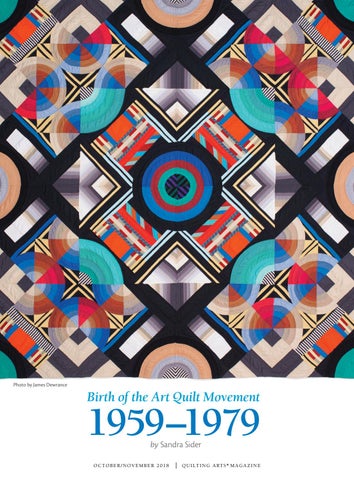
Photo by James Dewrance
Birth of the Art Quilt Movement
1959–1979 by Sandra Sider
OCTOBER/NOVEMBER 2018
|
Q U I LT I N G A RT S ® M A G A Z I N E
i
n the 1960s and 1970s, a core group of trailblazing artists developed quilts as an art form. Their exhibitions,
publications, and studio workshops helped to create a groundswell of enthusiasm for contemporary quilt art. This article explores the very beginnings of the Art Quilt Movement leading up to the first Quilt National in 1979. As you view these studio quilts created decades ago, note
This article first appeared in Quilting Arts Magazine and has been shared with permission. QuiltingDaily.com
how they differ from many of the works exhibited today. Among other differences, earlier art quilts tended to be larger, referencing the bed quilts from which they descended. While the imagery may look contemporary, the quilting usually does not fill the surface as is common today. Most of the fabrics were commercially manufactured, rather than being artist dyed or embellished with surface design.
Opposite: “March Study” (detail) Nancy Crow • 1979 • 80" × 80" Collection of the Fine Arts Museums of San Francisco Below: “Cityscape No. 1” (detail) Arturo Alonzo Sandoval • 1977 84" × 84" • Museum of Modern Art, Architectural and Design Collection, New York
The Whitney Exhibition
OCTOBER/NOVEMBER 2018
Photo by Mary S. Rezny Photography
In 1971, the Whitney Museum of American Art, New York, New York mounted the first comprehensive exhibition of quilts to be seen in a major museum—the nowfamous Abstract Design in American Quilts. Instead of displaying the quilts as historical objects that belonged on beds, the museum treated them as contemporary art to be mounted on the walls. Quilt artist Joan Lintault said that it was a wonderful experience to see such an exhibition at a prestigious museum. The 60 quilts, which were mainly Amish, were from the collection of Gail van der Hoof and Jonathan Holstein, whose backgrounds in contemporary art had led them to develop a deep appreciation of quilt design.
|
Q U I LT I N G A RT S ® M A G A Z I N E
Photo courtesy of the artist
“Motorcycle with Sidecar” • Leslie Gabrielse • 1975 • 102" × 70" • Collection of Cees Van Stijgeren
In 1973 and 1974, 21 venues in the United States exhibited parts of the collection that had been shown at the Whitney along with 30 additional quilts, in a tour directed by the Smithsonian Institution Traveling Exhibition Service. Some of the quilts also traveled to Europe; quilter Sylvia Einstein, for example, saw them in Switzerland. Numerous contemporary quilt artists saw one or more of the exhibitions. Van der Hoof and Holstein made a point of purchasing quilts that worked like paintings, “creations in which the maker had posed and successfully solved interesting aesthetic propositions.” The 1971 exhibition, along with several others exhibiting art quilts later in the decade, led young people working
in diverse media to value the quilt as an art form. Future quilt artists Marilyn Henrion, Paula Nadelstern, and Robin Schwalb were among them. Michael Cummings not only viewed the quilts as art, but also began considering Rothko paintings within a similar aesthetic framework. He recalls, “There was an historic moment when the definition of craft and art were put aside.” Reviews of Abstract Design in American Quilts revealed a deep appreciation of quilts as art, evidently to the surprise of some of the reviewers.
Textiles in the art world While textiles in general have lagged behind other materials in the jostle for gallery and museum
OCTOBER/NOVEMBER 2018
|
exhibitions, the 1950s, 1960s, and 1970s saw prominent examples of textiles and fiber in the art world that legitimized their use in works of art. Examples include Robert Rauschenberg’s inclusion of textiles and actual vintage quilts, cheesecloth and rope transformed by Eva Hesse, sculptural works in felt by Robert Morris, and monumental pop art in soft sculpture by Claes Oldenburg. These and other artists bridged cultural boundaries to create new appreciation for “lowly” materials. The Pattern and Decoration Movement of the 1970s capitalized on this trend with the femmage paintings of Miriam Schapiro featuring collaged fabrics, ornamental silk pieces by Joyce Kozloff, and large-scale draped
Q U I LT I N G A RT S ® M A G A Z I N E
Photo courtesy of the San Jose Museum of Quilts & Textiles
textiles by both Robert Kushner and Kim MacConnel, all seen in museum venues. Quilts have long been recognized as outstanding examples of folk art and fine craft, but only during the last few decades have studio quilts been categorized as fine art, partly because the very definition of ‘art’ has been in flux since the 1960s. One goal of both radical feminism and racial politics during the 1970s was to change the character of what was considered art, and quilts as art have successfully entered this arena. For example, in the early 1970s Molly Upton was exhibiting her studio quilts in a Boston gallery alongside works by Christo, who famously collaborated with his wife Jeanne-Claude on monumental textile installations.
Pioneering regions of the Art Quilt Movement Nancy Bavor, now the Executive Director of the San Jose Museum of Quilts & Textiles, researched the rise of art quilts in California for her master’s thesis. She explains, “The decades leading up to the emergence of art quilts in the 1960s portray a complex picture involving the intersection of art, craft, universities, and the traditional American quilt. Three national cultural developments resulted in the reevaluation of quilts as a suitable art medium and increased artists’ awareness of quilts: the art museum’s legitimization of the quilt as art; the junction of art and craft at the university level; and, social, political, and fashion trends that brought
“Bridget Quilt” • Therese May • 1968 • 72" × 84 • Collection of the San Jose Museum of Quilts & Textiles
quilts to national prominence.” Artists in California who pioneered the Art Quilt Movement included Jean Ray Laury, Therese May, Yvonne Porcella, and Joan Schulze. By the 1970s, makers in New England formed a second nexus of quilt artists, not surprising in a region with a strong historical focus on textiles and textile manufacturing. Ranging from craft workshops to academic training at the Master of Fine Arts level, the educational backgrounds of quilt artists prepared them to teach quilt
OCTOBER/NOVEMBER 2018
|
making throughout the region. Their quilts on exhibition and their publications exposed others to quilts as contemporary art. New England artists in the forefront of the Art Quilt Movement included Tafi Brown, Elizabeth Busch, Nancy Halpern, Michael James, Ruth B. McDowell, and Molly Upton. Makers on both sides of the Ohio River were stimulated by quiltmaking traditions and local folk art in a countercultural milieu, creating a hotbed of quilt artists seeking to extend their
Q U I LT I N G A RT S ® M A G A Z I N E
Photo by Steen Yde
“Steen’s Quilt” (detail) • Charlotte Yde • 1979 • 59" × 59"
Photo courtesy of the International Quilt Study Center & Museum
audience beyond the world of craft. Organized in Ohio by Nancy Crow, Françoise Barnes, and Virginia Randles, the first Quilt National in 1979 was a watershed event for art quilts. Other artists in Ohio and Kentucky initiating the Art Quilt Movement included Jane Burch Cochran, Terrie Hancock Mangat, and Arturo Alonzo Sandoval. These talented artists, along with others across the country, were creating original, innovative designs in fabric that were pieced, layered, collaged, stitched, and stuffed—quilts meant to be displayed on the wall. Crow and Barnes recognized the need for an appropriate showcase for what became known in the 1980s as ‘art quilts.’ Fortunately, this need coincided with the efforts of local artists and art lovers to preserve and renovate an abandoned dairy barn, the permanent venue for Quilt National. The biennial juried competition was founded to publicize and promote the transformations taking place in the world of quilting, and published reviews of the exhibition reached artists internationally.
up next History of the Art Quilt: 1980s and 1990s
“Two Pods” • Jean Ray Laury • 1959 • 16" × 23" • Collection of the International Quilt Study Center & Museum, Lincoln, Nebraska OCTOBER/NOVEMBER 2018
|
Q U I LT I N G A RT S ® M A G A Z I N E
“Red Zinger” • Michael James • 1986 • 67" × 69"
Art Quilts
1980 1999
–
y
Photo by David Caras
ou may be surprised to learn that the term “art quilt” did not exist until 1983. As Robert Shaw
explained in his 1997 book The Art Quilt, “Soon after launching The Quilt Digest, [Michael] Kile teamed with curator and writer Penny McMorris to organize The Art Quilt, a [1983] traveling exhibition of brand new works by sixteen artists they considered trailblazers in the field . . . the catalogue
What’s New?
declared, ‘The art quilt has emerged, and it heralds a
by Sandra Sider
quilts. It is art for walls, not beds, created by artists
This article first appeared in Quilting Arts Magazine and has been shared with permission. QuiltingDaily.com
dramatic and fundamental change in the history of abandoning media like painting, printmaking, and ceramics to express themselves in original designs of cloth and thread.’”
D E C E M B E R 2 0 1 8 / J A N U A RY 2 0 1 9
|
Q U I LT I N G A RT S ® M A G A Z I N E
Photo by Nagamitsu Endo
“Forest in New England” • Noriko Endo • 1996 • 55" × 84"
While many quilt artists continued to use commercially printed fabrics in their works during the 1980s and 1990s, these materials were being used to express original abstract compositions. Some artists, such as Noriko Endo, with her toothpick fabric fragments anchored by tulle, were experimenting with new techniques, and others explored new processes for producing color and texture on cloth. During these decades a few vendors, notably Lunn Fabrics and Skydyes, began creating hand-dyed cloth marketed to quilt artists. Jan MyersNewbury describes the magic of hand-dyeing fabric, “As I began to explore patternmaking through the immersion dye process … I found that the fabrics and dyes interacted in sometimes unpredictable ways. It [continues to be] a thrill for me when I unbind, wash, dry, and iron
Photo by John Coles
New techniques, processes, and motifs
“Mirrored Steps” • Pauline Burbidge • 1983 • 55" × 84" Collection of Shipley Art Gallery, Tyne & Wear Museums, United Kingdom
D E C E M B E R 2 0 1 8 / J A N U A RY 2 0 1 9
|
Q U I LT I N G A RT S ® M A G A Z I N E
New venues for art quilt exhibitions and workshops Several institutions promoting art quilts were founded in the latter 1970s and mid-1980s, including the American Museum of Quilts and Related Arts (today’s San Jose Museum of Quilts & Textiles) in 1977, Quilt San Diego (today’s Quilt Visions) in 1985, and New England Quilt Museum in Lowell, Massachusetts, in 1987. The following decade saw five quilt institutions founded across the county, beginning with the Rocky Mountain Quilt Museum in Golden, Colorado, in 1990. The following year, the National Quilt Museum was founded in Paducah, Kentucky, and in 1995 the Virginia Quilt Museum was established in
Photo by Gulf Reflections Studio, Inc.
newly dyed fabrics and begin to put them together on my design wall.” Many art quilts incorporated political, social, and environmental themes. Nancy Erickson shares her inspiration, “Although I love process and the way that the process has changed over the years, what really drives me is content. My content has always focused on animals, many of whom have lives as difficult and interesting as our own.” Other quilt artists dared to break the box with threedimensional pieces, illusionary art, and unusual shapes for their quilts. Joyce Marquess Carey remarks, “I’ve always found visual illusions fascinating, and I love working with gradations of color. I enjoy suggesting depth simply by playing with value.” “Four Patch: Hay/Wheat/Rye/Barley” • Dorothy Caldwell • 1994–95 96" × 98" • Collection of Eleanor McCain
Harrisonburg. The La Conner Quilt Museum in La Conner, Washington (now the Pacific Northwest Quilt & Fiber Arts Museum), opened its doors in 1997, the same year in which philanthropists and quilt collectors Robert and Ardis James were instrumental in founding the International Quilt Study Center & Museum at the University of Nebraska in Lincoln. These venues, which exhibit quilts of all types, provided quilt artists with refreshing new avenues to explore as well as venues where their work could be collected and appreciated. Quilt artists Nancy Crow and Linda Fowler founded the Quilt Surface Design Symposium (QSDS)
D E C E M B E R 2 0 1 8 / J A N U A RY 2 0 1 9
|
in Ohio in 1990, offering a broad variety of educational opportunities. During the first decade of QSDS, hundreds of students experimented with new techniques and processes in studio workshops. By the 1990s, Quilting By the Lake (founded in 1981) in upstate New York had also become a popular destination for quilters in general, with many classes focusing on art quilts by the end of the decade. Other inspirational studio classes expanding the creativity of quilt artists were being taught at Empty Spools Seminars in Asilomar, California (founded 1986) and at Art Quilt Tahoe (1998).
Q U I LT I N G A RT S ® M A G A Z I N E
“Dashboard Saints: In Memory of St. Christopher (Who Lost His Magnetism)” (detail) • Terrie Hancock Mangat 1985 • 99" × 124" • Collection of the International Quilt Study Center & Museum, Lincoln, Nebraska
New organizations
Photos this page courtesy of the artists
Several nonprofit professional organizations helped bring momentum and innovation to the Art Quilt Movement during the 1980s and 1990s. Founded in 1977, the Surface Design Association provides a platform for the exchange of ideas, methods, and materials in an expansive community working in textile media and fiber arts. In 1985, Dr. Carolyn L. Mazloomi founded The Women of Color Quilters Network, a non-profit group intended to foster and preserve the art of quilt making among women of color (today a few men are members). The organization offers quilts “Tessellations: Ice Flowers” Chris Wolf Edmonds • 1997 • 55" × 53"
D E C E M B E R 2 0 1 8 / J A N U A RY 2 0 1 9
|
Q U I LT I N G A RT S ® M A G A Z I N E
Left: “Robe of the Dragon” Yvonne Porcella • 1982
and fiber art to museums for exhibition, and researches and documents African-American quilt making. In 1989, Yvonne Porcella invited 50 quilt artists to join with her to found Studio Art Quilt Associates (SAQA), organizing conferences and exhibitions as well as developing a database of artwork by its members that SAQA promoted to galleries and museums. SAQA, now grown to 3,500 members in 39 countries, continues to support the art quilt through education, numerous exhibitions, professional
development, documentation, and publications. In contrast with the chaotic Art World of the 1980s and 1990s, art quilts were thriving as makers focused their energy and imagination on this relatively new medium, supported by museums and publishers catering to their talents. Artists began to travel, teaching workshops internationally, and many of them networked with students and colleagues as they shared new techniques and exhibitions.
D E C E M B E R 2 0 1 8 / J A N U A RY 2 0 1 9
|
Photo by Dara Wells
Photo courtesy of the artist’s estate
Below: “African Jazz 10” Michael Cummings • 1990 108" × 72"
They formed a flourishing community of quilt artists that would grow astronomically in the 21st century. Part two of a three-part series on history of the Art Quilt Movement. All images here are from SAQA’s new book, Art Quilts Unfolding: 50 Years of Innovation, from Schiffer Publishing. Sandra Sider is editor and co-author of the book.
Q U I LT I N G A RT S ® M A G A Z I N E
Big changes have also been driven by technology: the use of computers to speed up design, including image transfers from computer to fabric; and the use of computer-driven machines, especially longarm sewing machines. —Martha Sielman
Photo by Jim Turner
Art Quilts in the st 21 Century by Sandra Sider
F E B R U A RY / M A R C H 2 0 1 9
|
Q U I LT I N G A RT S ÂŽ M A G A Z I N E
w
hat changes have propelled the Art Quilt Movement in the 21st century? Martha Sielman, Executive
Director of Studio Art Quilt Associates (SAQA), explains, “The greatest change has been how connected we all are globally through the Internet: by email, through websites, and postings on social media. SAQA has 3,500 members in 39 countries—that could never have happened without the Internet. The other big changes have also been driven by technology: the use of computers to speed up design, including image transfers from computer to fabric; and the use of computer-driven machines, especially longarm sewing machines. While there has been some backlash and a movement toward ‘slow sewing’ and handwork, the new technologies have changed the face of quilted art.” Globalization has transformed all contemporary art, and digital technology has expanded our experience of visual culture beyond anything that we could have imagined in the 20th century, offering quilt artists an abundance of imagery and thematic material.
Opposite: “Cinmoku: Silence” Shin-hee Chin • 2012 • 60" × 42" (detail) Above: “The Story of My Life” Misik Kim • 2007 • 54" × 54" (detail) Below: “The Snake Charmer” Pamela Allen • 2006 • 42" × 46" × 2"
Collection development The first decade of the 21st century saw major art quilt exhibitions on both coasts, the Midwest, and Southwest, where private collectors made pilgrimages to acquire new and exciting works. Hilary (d. 2006) and Marvin Fletcher added 50 art quilts to their expanding collection between 2000 and 2010, Maureen Hendricks purchased 173 pieces (98 in small format), Del Thomas acquired 120, and John M. Walsh III purchased 30 quilts and commissioned six, all being relatively large artworks. Walsh’s collection is distinguished by his many commissioned quilts, in which he gives artists free rein as long as their quilts pertain in some way to water, the theme of his collection. Quilt museums have also been increasing their collections during the 21st century. The International Quilt Study Center, for example, added 246 art quilts between 2000 and 2010, while the San Jose Museum of Quilts and Textiles acquired 78. Corporate collections, notably law offices, banks, and hospitals are purchasing and displaying art quilts, and the International Quilt Festival Collection acquired 65 pieces.
F E B R U A RY / M A R C H 2 0 1 9
|
Q U I LT I N G A RT S ® M A G A Z I N E
The Modern Quilt Guild Art quilts have developed over the past 50 years as a hybrid genre situated at the nexus of craft, art, and design. Some quilt artists, such as members of the Modern Quilt Guild (founded 2009), immerse themselves in formal aspects of quilt design, following specific guidelines of composition tempered by their individual ideation. With numerous members worldwide, the MQG is becoming a steady presence, hosting the annual QuiltCon conference where typically more than 6,000 attendees view recent work and participate in seminars. Using what has come to be called “design thinking,” MQG embraces quilts as functional objects, and some members are producing iterative pieced textiles in a craft mode. Other MQG artists approach the designing stage of their work with greater freedom since they follow no rules except for their own desire to produce a well-crafted work of art. Occasionally these quilts incorporate traditional patterns, but in unique configurations of visual and physical texturing.
Photo by Andrew Sikorski
Subject matter
“Storm” • Dianne Firth • 2012 • 26" × 541/2" • Collection of John M. Walsh III
F E B R U A RY / M A R C H 2 0 1 9
|
Nancy Bavor, Director of the San Jose Museum of Quilts & Textiles, remarks, “Like contemporary artists working in other media, many quilt artists working in the 21st century use the quilt medium to address important social, political, economic, and environmental issues of the new millennium. Whether the artworks are created by artists who have spent decades exploring the quilt format, or are created by artists who embraced the art form more recently, global issues are
Q U I LT I N G A RT S ® M A G A Z I N E
Photo by Deidre Adams
“A Rash of Flamingos” • Ruth B. McDowell • 2000 • 100" × 52" • Thomas Contemporary Quilt Collection
often at the forefront of their subject matter.” These issues include feminist politics, climate change, and awareness of the natural world. Quilt aesthetics and the relationship of art quilts to other aspects of contemporary art inform the work of several major artists working today.
Innovations During the past decade, group exhibitions of art quilts as well as solo shows indicate that the makers are experimenting with threedimensional effects and freestanding objects, sometimes incorporating LED effects and sound. We are seeing wall quilts with overlapping sections, extensions that fold or
curve, and entire surfaces that undulate. Soft sculpture, popular in the 1970s, has reappeared in works imbued with humor, wit, and homage. As quilt and textile venues become more receptive to off-thewall possibilities, more artists will probably take up three-dimensional forms. 21st century artists working in quilt mode have been exploring the characteristics of reflective and translucent materials, from embellishment with mirrors and metallics to actual transparency. This work borders on conceptual art, in that the presence of materiality becomes less important than the idea being expressed. The viewer is the subject in reflective
F E B R U A RY / M A R C H 2 0 1 9
|
surfaces, and light can be seen as the subject in translucent quilts constructed to cast shadows onto the gallery wall, or onto viewers. Finally, we are seeing more quilt artists involved with installation art, working both on and off the wall. Possibly inspired by fiber artists who have long been filling galleries with thread, rope, wire, etc., makers are creating entire environments with quilts and related textiles. Often these museum installations have personal and/or political themes, while sometimes their purpose is to overwhelm and delight the viewer with color and movement. Art quilts have an appeal quite different from paintings and prints,
Q U I LT I N G A RT S ® M A G A Z I N E
Part three of a three-part series on the history of the Art Quilt Movement. All images here are from SAQA’s new book, Art Quilts Unfolding: 50 Years Of Innovation, by Schiffer Publishing. Sandra Sider is editor and co-author of the book.
This article first appeared in Quilting Arts Magazine and has been shared with permission. QuiltingDaily.com
Photo by Carolyn Wright
as the tactile nature of cloth resonates with our entire human history, from swaddling blankets to shrouds. Even the most abstract art quilts speak on a popular level, with machine stitches replacing drawn or painted lines and handwork referencing the human touch. In our digital world, art quilts that keep us grounded can be a powerful medium indeed.
Photo by Cecile M. Hooker
“Pizzicato” • Katie Pasquini Masopust • 2011 • 72" × 46"
“Artifact #22” • Tim Harding • 2004 • 54" × 43" × 2" F E B R U A RY / M A R C H 2 0 1 9
|
Q U I LT I N G A RT S ® M A G A Z I N E