
INSIDE
Los Angeles County DA has charged the driver who allegedly ordered his dog to attack a pedestrian in Santa Monica
See Page 7

Santa Monica, Coastal Commission Sign Agreement to Complete Local Coastal Program
The Local Coastal Program will give the city greater decision-making authority over coastal development projects — including temporary events, commercial tenant improvements, and outdoor dining
Santa Monica and the California Coastal Commission have entered into a memorandum of understanding to complete the city’s long-delayed Local
Coastal Program, a key planning document governing development in the coastal zone.
The Santa Monica City Council voted last week to authorize the city manager to execute the MOU, which creates a formal framework for collaboration between the city and the commission. The goal is to produce a certified Land Use Plan and Implementation Plan (zoning ordinance) for Santa Monica’s coastal zone.
Once certified, the Local Coastal Program will give the city greater decisionmaking authority over coastal development projects — including temporary events, commercial tenant improvements, adaptive reuse, outdoor dining, residential development and transportation projects — while maintaining protections for coastal resources and public access as required by the California Coastal Act.
The agreement builds on a 2018 draft Land Use Plan and years of community outreach. Work under the new MOU is expected to begin in July, with a target for full certification by the end of 2027.
“Santa Monica’s economic recovery depends on our ability to move quickly
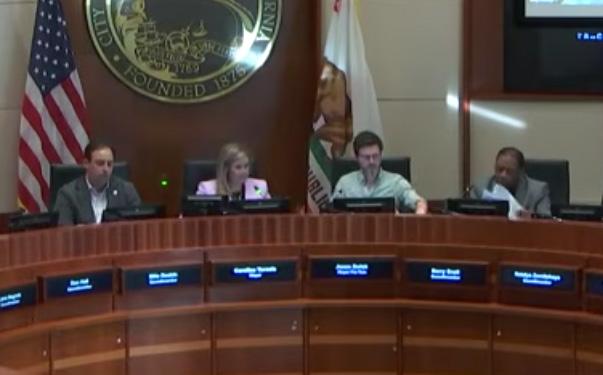
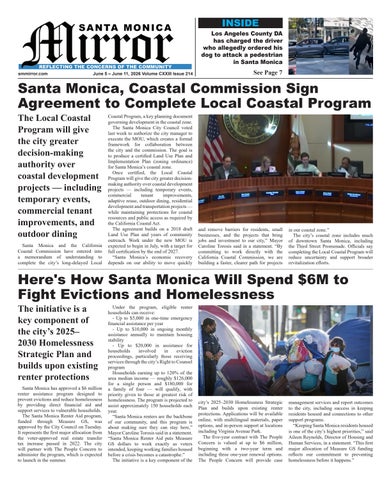
and remove barriers for residents, small businesses, and the projects that bring jobs and investment to our city,” Mayor Caroline Torosis said in a statement. “By committing to work directly with the California Coastal Commission, we are building a faster, clearer path for projects in our coastal zone.”
The city’s coastal zone includes much of downtown Santa Monica, including the Third Street Promenade. Officials say completing the Local Coastal Program will reduce uncertainty and support broader revitalization efforts.
Here's How Santa Monica Will Spend $6M to Fight Evictions and Homelessness
The initiative is a key component of the city’s 2025–2030 Homelessness
Strategic
Plan and builds upon existing renter protections
Santa Monica has approved a $6 million renter assistance program designed to prevent evictions and reduce homelessness by providing direct financial aid and support services to vulnerable households.
The Santa Monica Renter Aid program, funded through Measure GS, was approved by the City Council on Tuesday. It represents the first major allocation from the voter-approved real estate transfer tax increase passed in 2022. The city will partner with The People Concern to administer the program, which is expected to launch in the summer.
Under the program, eligible renter households can receive:
- Up to $5,000 in one-time emergency financial assistance per year
- Up to $10,000 in ongoing monthly assistance annually to maintain housing stability
- Up to $20,000 in assistance for households involved in eviction proceedings, particularly those receiving services through the city’s Right to Counsel program
Households earning up to 120% of the area median income — roughly $126,000 for a single person and $180,000 for a family of four — will qualify, with priority given to those at greatest risk of homelessness. The program is projected to assist approximately 150 households each year.
“Santa Monica renters are the backbone of our community, and this program is about making sure they can stay here,”
Mayor Caroline Torosis said in a statement.
“Santa Monica Renter Aid puts Measure GS dollars to work exactly as voters intended, keeping working families housed before a crisis becomes a catastrophe.”
The initiative is a key component of the
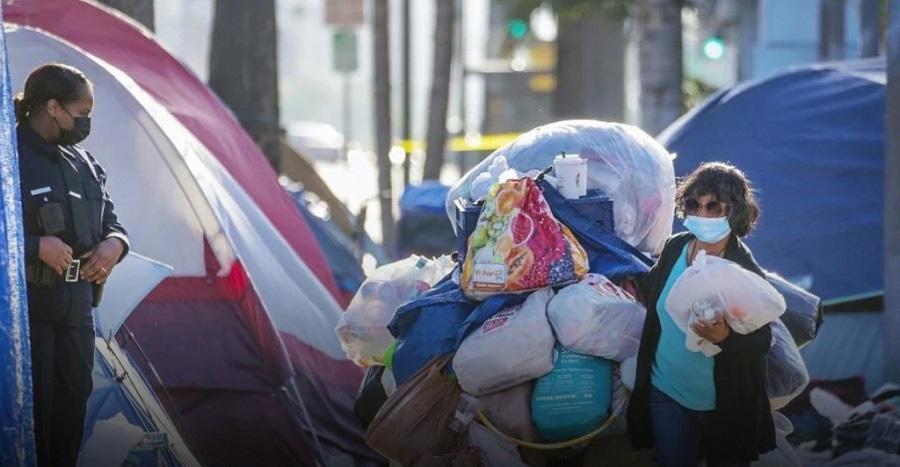
city’s 2025–2030 Homelessness Strategic Plan and builds upon existing renter protections. Applications will be available online, with multilingual materials, paper options, and in-person support at locations including Virginia Avenue Park.
The five-year contract with The People Concern is valued at up to $6 million, beginning with a two-year term and including three one-year renewal options.
The People Concern will provide case
management services and report outcomes to the city, including success in keeping residents housed and connections to other support programs.
“Keeping Santa Monica residents housed is one of the city’s highest priorities,” said Aileen Reynolds, Director of Housing and Human Services, in a statement. “This first major allocation of Measure GS funding reflects our commitment to preventing homelessness before it happens.”
Santa Monica neighborhood locked down for hours after mountain lion spotted near 14th and Montana
Police and wildlife experts were dispatched to investigate and trap the animal while the neighborhood waited.
Wildlife officials successfully tranquilized and relocated a mountain lion this evening after the big cat wandered into a residential neighborhood near 14th Street and Montana Avenue, triggering a citywide safety warning that kept residents indoors for nearly 10 hours.
Biologists with the California
Department of Fish and Wildlife safely sedated the animal in the evening, bringing a peaceful and happy end to a tense day-long standoff. State game wardens, working in coordination with the National Park Service’s Santa Monica Mountains study team, transported the mountain lion to an undisclosed wilderness area where it will be evaluated by veterinarians before being released back into the wild.
The incident began around 7:00 a.m. when the Santa Monica Police Department received reports of a large predator roaming through backyards just blocks away from the area's busy commercial corridor. Students on the way to school had seen and reported the presence of the big cat. Responding officers immediately flooded the neighborhood, issuing an urgent public safety shelter-in-place advisory.
Authorities urged community members to remain inside, secure all domestic



pets, and strictly avoid approaching or photographing the animal. No injuries to residents or domestic animals were reported during the encounter.
Local police officials expressed gratitude to the neighborhood for its patience, cooperation, and care throughout the multiagency tracking operation.

















































Rated R
109 Minutes
Released May 29th

BEHIND THE SCREEN
By Kathryn Whitney Boole
Tuner is a piano concerto of a movie, a gripping short story captured as if in a musical composition. It’s expertly shot, artfully edited, and the story is told as much in sounds and music as dialogue, a style similar to one of my all-time favorite films, Baby Driver. The sound and visuals work together so well that they make you become part of the film.
Because the director, Daniel Roher is an experienced documentarian, this film feels true, and the similarity between two key components of the story is observed in minute detail, those being pianos and safe locks.
This story wraps you into the world of a young man, “Niki,” played superbly by Leo Woodall. Niki is an apprentice to a long-time, beloved piano tuner, “Harry Horowitz,” brought to life by Dustin Hoffman. We gradually delve into Niki’s history. We are introduced to his complex and resilient personality through his reactions, choices and actions, what he chooses to wear, and his carefully framed sentences, as he goes about his job. We see glimpses of underlying tragedy in his past. Niki has a hearing affliction, hyperacusis, that frames his entire world. It’s an acute sensitivity to all sounds that turns the normal noises of daily life into a deafening cacophony. It’s also what makes Niki an excellent candidate for the job he’s training for. Niki’s talents and affliction allow him to recognize minute differences in sounds, and he is also a trained musician with perfect pitch.
This gives him the perfect skill set for listening for the intricate metallic clinks of tumblers in a safe lock dial. Of course, fate draws Niki accidentally into the nefarious world of those who would use his talent for

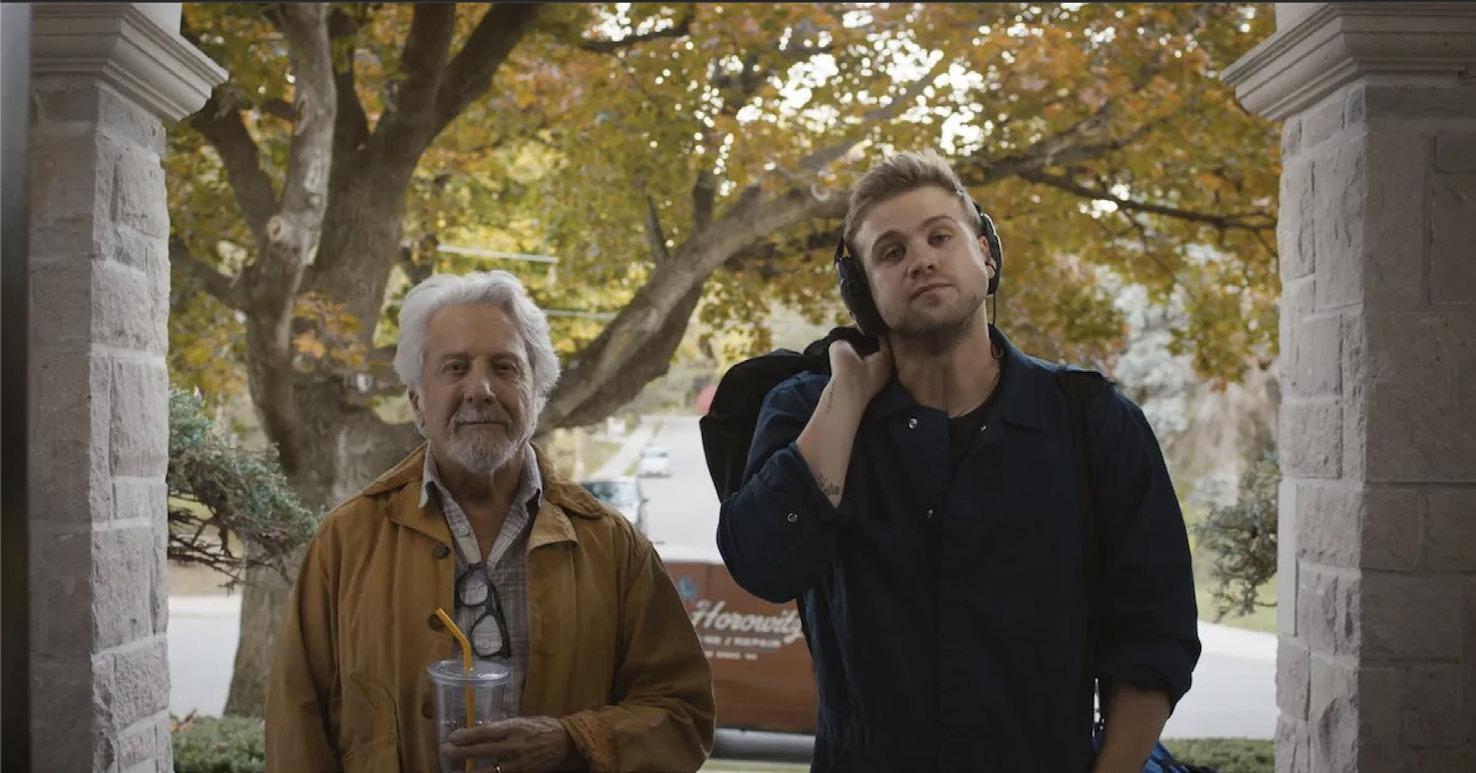
illegal means.
The film centers around Niki, but every character in his life becomes part of a tapestry of well thought out color and rich background. This attention to minute detail is probably due to the background of writer/director Roher as a fine documentary filmmaker. Jean Reno, for example, appears briefly as a music professor, and visually resembles a composite of

two legendary 20th Century composers, Dimitri Shostakovich and Igor Stravinsky. Roher was worried about his lack of experience working with actors, but says of his stars, Woodall and Havana Rose Liu, who plays concert pianist “Ruthie,” “Havana and Leo, they were both magnetic. You stick a camera 6 inches from their nose, they have this presence, this movie star thing that most people do not have.”
Woodall comes from a family of British thespians and has been acting since childhood. He went through months of extensive training to learn to play piano for Tuner, and he researched a friend of Roher’s who has hyperacusis. Liu is a professional model, singer, actor, dancer, painter, artist and jewelry-maker who played Rachel Sennott’s comedic lesbian friend in the comedy Bottoms.
She also spent hours a day for months training on the piano for Tuner. Both look like virtuosos in the film. Woodall and Hoffman were taught the specifics of piano tuner trade by two piano tuners that Roher hired to be on set, one of whom had been the inspiration for the movie. Hoffman is a

jazz aficionado and especially loves Herbie Hancock, who makes a cameo appearance in the film.
Writer/director Daniel Roher is only in his early 30’s. His film Navalny, a study of the Soviet dissident who later was poisoned and died in prison, won the 2022 Oscar for Best Feature Documentary. Roher sees the similarity in documentary and fiction in the storytelling – in one case you are writing as you are shooting, and in the other, you write and then you shoot. He says, “at the end of the day, it’s storytelling.” Documentary is a solid background for feature film directors. Many of the greatest have been documentarians, including Werner Herzog, Martin Scorsese, Agnes Varda and Ava Duvernay.
Roher explains that before writing Tuner he was going through a period in his life where he felt rudderless. He met a piano tuner and this tuner “talked like a philosopher” about the forces that make a piano go out of tune. This is how Hoffman’s character developed, who is losing his hearing, and Woodall’s, afflicted with over-sensitive ears.
Tuner does not seem like it’s the first feature for Roher. It’s a very sophisticated, highly creative and complex story with music-like variations. This is truly a great film, from the writing and the storytelling to the acting, the camera work, and above all, the sound. It will make you realize how important sound is in your life, in so many ways.
Rob Reiner, whom Roher had met at Sundance, gave him notes on making his first feature. “Rob told me, ‘Make the movie fun,” Roher says. “Create something that people want to watch, make it entertaining. Put substance in there but keep it fast on its feet.’” Tuner is dedicated to Rob and Michelle Reiner. I believe Tuner should receive multiple Oscar nominations. The film uses every aspect of cinema to its fullest.
Kathryn Whitney Boole has spent most of her life in the entertainment industry, which has been the backdrop for remarkable adventures with extraordinary people. She is a Talent Manager with Studio Talent Group in Santa Monica. kboole@gmail.com
A little imagination gRows a long way. Join us in rewilding the Santa Monica Beach Dunes. What we imagine here doesn’t stay imagined for long—plants take root, wildlife returns, and the coast begins to feel alive again. With your support, we can bring back a wilder, more resilient shoreline—one that keeps growing for generations. Discover how you can help at linktr.ee/santamonicabeachdunes



SANTA MONICA BEACH DUNES
Curious City 06/05/26: DAN HALL SUPPORTS
ZBUR’S
BEACH BILL

By CHARLES ANDREWS CAREER ADVICE FOR EMERGING STUDENTS
If you have been paying attention to what has been going on for the last 10 years in DC, state capitols, the courts, media, here and around the globe, you will be well positioned and sought after to write the history of these Alice in Blunderland times. And that will be volumes and volumes and volumes. A career! And as an expert, you will be invited to speak at universities, global conferences, and on whatever media the future comes up with. You lived through it! You are a living witness, not just a scholar. Do a little research (which may be tricky, with all the books burned and media meddled with) to fill in the details, and you emerge an expert on our most consequential era of history since the Civil War.
Or, the poor schlub in the darkest, dankest prison cell. Could go either way. We are spending billions of our tax dollars on a sprawling network of concentration camps, all across the US. But I’m betting on the exceptional American people, their laws and Constitution. And their willingness to revolt when their leaders are in the wrong and not responding to reason. It happened once, against all odds. There’s some history that needs to repeat itself.
WHICH BRINGS ME TO THIS WEEK’S PRIMARY ELECTIONS
Trust me, I will get to LA, CA, and especially SM/Santa Monica as soon as I can. There’s just so much, you know? Some might even call it chaos. Chaos as a strategy, for distraction. Intentional chaos is always hiding something, something pretty bad.
When I saw the votes for Pratt, a reality TV clown, were only four points behind Mayor Bass, qualifying him for the runoff in the fall, and eight points ahead of the one I wanted but knew had no chance (genuinely) progressive LA City Council member Nithya Raman, my heart sank. These fools have learned nothing from this horrible Trump decade we have endured? They want another ranting red-faced TV celebrity, who figured out that if he yelled about the fires he might be able to win. But he has no idea how to govern the nation’s
second-largest city. It’s like sending in someone who flunked out in 5th grade to teach a university literature class.
OK, honestly, I’m getting to Santa Monica, but do you know where this nonsense started? In the modern era, with George W., a simple man who did not have a passport when he was elected, and had to be told the Pope (a world leader of more than a billion people, and a head of state) is not addressed as “Your Excellency.” A small thing? Not if you are going to play with the big boys, and girls. Bush was a bumpkin with an Ivy League degree, so uninformed that he let those who knew what they were doing get us entangled in Middle East wars that screwed up everything, and we are still paying the price. I always hated hearing a voter say, “he’s the kind of guy I could go down to the corner bar and have a beer with.” Great! Do that! But don’t put him in the White House. Or our governor’s mansion, or wherever the mayor lives. We used to elect people based on their qualifications.
SO IS THAT OUR PROBLEM IN SANTA MONICA?
No. We have volunteer Council members (bad idea) and a mayor they choose, so there is not enough money in that way, or fanfare, to attract the pretty/angry boy/girl types who crave a big screen (like Pratt, and Donald J.). But SM real estate is like gold, and there has been plenty of mining activity for years. Our airport, set to close in a couple years, is a big hunk o’contention. Making it a Great Park would be marvey, but we don’t have the money that would cost. Without letting developers go nuts there. The last estimate I heard of the RE value of that land, by closing time, is close to $4,000,000,000.
For the better part of 40 years, Santa Monicans for Renters Rights (SMRR) has called the shots in our city government. Only one candidate, and recently one slate of three, ever got elected to Council without SMRR’s blessing. Their grip has loosened some and now Santa Monica Forward, with bulging bags of developer money available, is a formidable force. Unite Here Local 11, the union of hotel and hospitality workers, 32,000 strong, based in LA, has been key in getting what they want from power brokers because they can offer so much manpower for mailing, telephone calls, door-to-door. And you wonder why we keep getting the elected “leaders” we have in SM?
We residents have never been organized, while “the machine” has people working every day, on salary. We need a People’s PAC here, to elevate candidates who will represent residents’ concerns, not outside money interests. We don’t have that yet, but we do have people in various groups working to organize for the right kind of candidates.
THERE WILL BE MANY ISSUES
EMERGE
Between now and election day. It will

be confusing, because it is a hallmark of SM politics to do things in back rooms, without letting those pesky residents weigh in. A recent example is when residents found out about a plan to house homeless drug addicts and the mentally unbalanced in two buildings on Ocean Avenue, ostensibly to get them off the streets, but seemingly without sufficient services, or or precautions restricting them from wandering the streets of that neighborhood willy-nilly. Residents became angry again when it was revealed that Mayor Caroline Torosis knew about the plans but said nothing to her constituents.
Here’s one you are bound to hear about, if you haven’t already: AB (Assembly Bill) 1740. This one’s a doozy, an example of corruption getting more bold and open (sound like anyone in the White House to you?). It’s quite hard to follow on the twisted path it has taken, but Dan Jansenson, a Mirror columnist as one of the SM.a.r.t (Santa Monica Architects for A Responsible Tomorrow) group, took it on, and it took him three weeks’ columns to march through it, including his part 3 today that explains the changes that have taken place. (Once people opened the back room door to shed some light.) I have no doubt these changes, radical, would never have happened without public awareness.
Our Assembly member Rick Zbur, up for re-election, seems to have been a prime mover for this bill, as evidenced by some emails back and forth from his staff to city staff, who for their own reasons were fine with pushing it along. City Council member Dan Hall went to Sacramento to lobby for the bill. He did not say he represented Council, but he also did not insist clearly that he was there only as a private citizen. Some of us were pretty stunned at such dramatic public support, for a bill many consider very harmful to Santa Monica, and which did not get public input, by Dan Hall or any of the Council.
So read Jansenson’s three prt on this, and you will understand a lot of what is going on. In a nutshell, 1740 would have removed authority from the Coastal Commission, and it would have been much easier to build high-rise, market-rate (NO affordable housing component) on our beach. And, this bill would apply ONLY to Santa Monica.
Much more to come. Stay tuned. Stay SM.a.r.t.
Charles Andrews has lived in Santa Monica for 40 years and wouldn’t live anywhere else in the world. Really. Send love and/or rebuke to him at therealmrmusic@gmail.com
Santa Monica's Coast Is About to Change Forever. Most Residents Don't Know It's Happening. Part 3.
SM a.r.t.
Santa Monica Architects for a Responsible Tomorrow
The city's AB1740 effort stopped being about bicycle lanes and parking near the beach the moment residents read the bill and understood what it actually did.
For years, Santa Monica has operated under a specific condition: the city never completed a document called a Local Coastal Program, a state-required planning framework that governs what can be built along the coast and how. Because it was never finished, an independent state agency, the California Coastal Commission, has retained the legal authority to review and approve development decisions in Santa Monica's coastal zone. The city has had to answer to that agency before it could act.
AB1740 would change that. The bill, cosponsored by the City of Santa Monica and Assemblymember Rick Zbur, along with allies such as Streets for All and Abundant Housing LA, would remove the state's independent coastal watchdog from its oversight role and hand that authority to the city itself. Santa Monica would become the judge of its own coastal development decisions, including impact to sensitive resources, parking, access, and development. That is inherently good–cities should govern themselves. Local control, exercised transparently and with genuine public participation, is how democratic planning is supposed to work. The problem is that little about how this bill came about inspires confidence that those conditions will be met. The city pursued legislation that would expand its own authority without, in the earlier version of the bill, an obligation to complete a Local Coastal Plan (which requires public participation and approval by the Coastal Commission), and without first telling the people it represents. The city worked with a state legislator to strip the Coastal Commission of authority here, and move the bill through Sacramento while most residents were unaware it existed–that is the record. Whether Santa Monica will use coastal autonomy responsibly after strong public blowback is an open question soon to be answered, but how it pursued that autonomy is not.
The Coastal Commission exists because of what happened before it existed. California's coastline was developed heavily and largely without public check through the midtwentieth century. By 1972, voters passed a ballot initiative to stop it, followed in 1976 by the Coastal Act, making the Coastal Commission a permanent, independent check on coastal decisions. Its mandate was never to facilitate development. It was to protect the coast from exactly the pressures
that municipalities, acting on local political interests, had historically failed to resist.
Critics of AB1740 argue that the bill uses a procedural technicality, Santa Monica's own failure to complete its Local Coastal Program, as the justification for removing that check. Now, under a Memorandum of Understanding signed with the Coastal Commission last week, the city says it is finally ready to move forward on that plan. Which raises a question nobody in City Hall or Assemblymember Zbur’s office has answered plainly: if the city is now prepared to finish what it should have finished decades ago, and the Coastal Commission is prepared to work with it, what exactly is AB1740 still for?
The bill is in process, and not yet enacted. But its existence, and the city's role in sponsoring it, is what crystallized the opposition. What residents began to ask was simple: how much of what the city (including its City Council members and staff) was pursuing under this bill was actually required by state law, and how much was the city's own ambition, carried to Sacramento before anyone local was consulted. That distinction matters. Housing density mandates from the state are one thing, but a city co-sponsoring legislation to strip the Coastal Commission of authority and limit independent oversight of its own coastline –including development–is another.
Councilmember Dan Hall was already in Sacramento representing the city's position before public comment was opened at home, contradicting the longstanding notion that residents are genuine participants in decisions about neighborhood scale and coastal character.
For decades, planning was slow, contentious, and intensely local. The process was the politics. What residents see now is different. The substantive direction was set before the public was invited to weigh in. Opposition gets characterized as nostalgia or obstructionism, which forecloses the possibility that some of it is a legitimate civic disagreement about process and accountability. The consequence is the erosion of resident standing in decisions about their own city at the hands of its own representatives.
The bill has been extensively–even radically–amended since it first drew loud public opposition, but critics say the core problem remains. The Coastal Commission's independent oversight role, the check that residents of every California coastal community depend on to protect the coast, is still what the bill targets.
Opposition has come from across Santa Monica's civic life. The Santa Monica Democratic Club voted against the bill, Santa Monica for Renters Rights opposes it, the Santa Monica Coalition for a Livable
City opposes it. These are not fringe voices; they represent a broad cross-section of residents who arrived at the same conclusion through different roads, as has the Coastal Commission itself. Assemblymember Zbur and his allies in Sacramento and at Santa Monica City Hall have pressed forward regardless. The bill passed the State Assembly last week, and it now awaits a vote in the State Senate. What it would accomplish, given the newly signed agreement with the Coastal Commission (other than a precedent to be used by other cities), is a question no one backing the bill has yet answered. Every city changes. The question Santa Monica cannot seem to answer is whether residents still have a meaningful role in directing that change, or whether public process has become a formality, a requirement satisfied after the decisions are made. That question will outlast AB1740. If City Hall has an answer, residents have yet

to see it.
Daniel Jansenson, Architect, for S.M.a.r.t.: Santa Monica Architects for a Responsible Tomorrow
Dan Jansenson, Architect (former Building & Fire-Life Safety Commissioner); Robert H.
Taylor, Architect AIA; Mario FondaBonardi, Architect AIA (former Planning Commissioner);
Sam Tolkin, Architect (former Planning Commissioner); Michael Jolly ARE-CRE; Jack Hillbrand AIA, Landmarks Commission Architect; Phil Brock (SM Mayor, ret.); Matt Hoefler, Architect NCARB; Heather Thomason, community organizer; Charles Andrews, columnist.
journalist; Bruce Leddy, Human Services Commissioner and NOMA Co-Chair.
NOTICE OF PETITION TO ADMINISTER ESTATE OF Carollois Sturman aka Cris Sturman aka Carollois Edrich
To all heirs, beneficiaries, creditors, contingent creditors, and persons who may otherwise be interested in the will or estate, or both, of: Carollois Sturman aka Cris Sturman aka Carollois Edrich
A Petition for Probate has been filed by Joan Gilbert in the Superior Court of California, County of Los Angeles, Los Angeles County Superior Court Case No. 24STPB02344
The Petition for Probate requests that LEE STURMAN appointed as personal representative to administer the estate of the decedent.
The petition requests the decedent’s will and codicils, if any, be admitted to probate. The will and any codicils are available for examination in the file kept by the court.
The petition requests authority to administer the estate under the Independent Administration of Estates Act. The independent administration authority will be granted unless an interested person files an objection to the petition and shows good cause why the court should not grant the authority.
A hearing on the petition will be held in Los Angeles County Superior Court as follows: Date: June 25 2026, Time: 8:30 am. Dept.: 610 The address of the court: 111 North Hill Street, Los Angeles, CA 90012.
If you object to the granting of the petition, you should appear at the hearing and state your objections or file written objections with the court before the hearing. Your appearance may be in person or by your attorney.
If you are a creditor or a contingent creditor of the deceased, you must file your claim with the court and mail a copy to the personal representative appointed by the court within the later of either (1) four months from the date of first issuance of letters to a general personal representative, as defined in section 58(b) of the California Probate Code, or (2) 60 days from the date of mailing or personal delivery to you of a notice under section 9052 of the California Probate Code.
Other California statues and legal authority may affect your rights as a creditor. You may want to consult with an attorney knowledgeable in California law. You may examine the file kept by the court. If you are a person interested in the estate, you may file with the court a Request for Special Notice (form DE-154) of the filing of an inventory and appraisal of estate assets or of any petition or account as provided in Probate Code section 1250. A Request for Special Notice form is available from the court clerk.
Petitioner LEE STRUMAN C/O Debby M Ehrlich DME & Assoc., 4305 Third Ave., Ste 3405 San Diego, Ca. 92103
Published in the Santa Monica Mirror 6/5/2026, 6/12/2026, 6/19/2026