
![]()


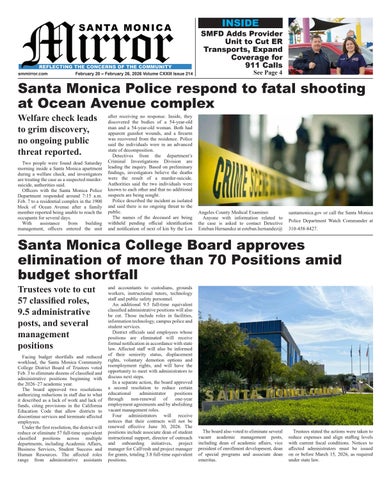
Welfare check leads to grim discovery, no ongoing public threat reported.
Two people were found dead Saturday morning inside a Santa Monica apartment during a welfare check, and investigators are treating the case as a suspected murdersuicide, authorities said.
Officers with the Santa Monica Police Department responded around 7:15 a.m. Feb. 7 to a residential complex in the 1900 block of Ocean Avenue after a family member reported being unable to reach the occupants for several days.
With assistance from building management, officers entered the unit
after receiving no response. Inside, they discovered the bodies of a 54-year-old man and a 54-year-old woman. Both had apparent gunshot wounds, and a firearm was recovered from the residence. Police said the individuals were in an advanced state of decomposition.
Detectives from the department’s Criminal Investigations Division are leading the inquiry. Based on preliminary findings, investigators believe the deaths were the result of a murder-suicide. Authorities said the two individuals were known to each other and that no additional suspects are being sought.
Police described the incident as isolated and said there is no ongoing threat to the public.
The names of the deceased are being withheld pending official identification and notification of next of kin by the Los

Angeles County Medical Examiner. Anyone with information related to the case is asked to contact Detective Esteban Hernandez at esteban.hernandez@
santamonica.gov or call the Santa Monica Police Department Watch Commander at 310-458-8427.
Facing budget shortfalls and reduced workload, the Santa Monica Community College District Board of Trustees voted Feb. 3 to eliminate dozens of classified and administrative positions beginning with the 2026–27 academic year.
The board approved two resolutions authorizing reductions in staff due to what it described as a lack of work and lack of funds, citing provisions in the California Education Code that allow districts to discontinue services and terminate affected employees.
Under the first resolution, the district will reduce or eliminate 57 full-time equivalent classified positions across multiple departments, including Academic Affairs, Business Services, Student Success and Human Resources. The affected roles range from administrative assistants
and accountants to custodians, grounds workers, instructional tutors, technology staff and public safety personnel.
An additional 9.5 full-time equivalent classified administrative positions will also be cut. Those include roles in facilities, information technology, campus police and student services.
District officials said employees whose positions are eliminated will receive formal notification in accordance with state law. Affected staff will also be informed of their seniority status, displacement rights, voluntary demotion options and reemployment rights, and will have the opportunity to meet with administrators to discuss next steps.
In a separate action, the board approved a second resolution to reduce certain educational administrator positions through non-renewal of one-year employment agreements and by abolishing vacant management roles.
Four administrators will receive notices that their contracts will not be renewed effective June 30, 2026. The positions include associate dean of student instructional support, director of outreach and onboarding initiatives, project manager for CalFresh and project manager for grants, totaling 3.8 full-time equivalent positions.

The board also
eliminate several vacant academic management posts, including dean of academic affairs, vice president of enrollment development, dean of special programs and associate dean emeritus.
Trustees stated the actions were taken to reduce expenses and align staffing levels with current fiscal conditions. Notices to affected administrators must be issued on or before March 15, 2026, as required under state law.
Year of the Horse festivities on Feb. 21 will feature cultural entertainment and family activities.
Santa Monica Place will mark Lunar New Year with a public celebration later this month featuring traditional performances, cultural activities, and family programming.
The shopping center’s Center Plaza will host a free Year of the Horse event from 2 to 5 p.m. Saturday, Feb. 21. Organizers said the space will be decorated with red and gold lanterns and cherry blossom “Wishing Trees,” creating a festive setting for the afternoon activities.
The weekend’s festivities will begin the evening before with a themed cooking class at The Gourmandise School, located at Santa Monica Place. The “Date Night: Lunar New Year Celebration” class is scheduled from 6 to 9 p.m. Friday, Feb. 20.
Couples will prepare a holiday-inspired menu that includes steamed white fish with

ginger-scallion sauce, chicken and chive potstickers, almond cookies, and a Lunar Blossom cocktail. Organizers describe the class as a shared, hands-on culinary experience designed for pairs. You can register for the class here.
Scheduled entertainment includes traditional Chinese lion dances performed by Bruce Wen and The Shaolin
Entertainment Group, along with martial arts demonstrations by the LA Wushu Club. Live music and interactive cultural stations are also planned. You can rsvp here.
Visitors can participate in hands-on activities such as Chinese dough art, calligraphy blessings, and children’s crafts. Guests will also be invited to write personal wishes for the coming year and hang them


on the decorative wishing trees. Participating retailers and restaurants throughout Santa Monica Place will offer red envelope-themed promotions during the celebration, according to organizers. Lunar New Year décor, lantern installations, and wishing trees will remain on display from Feb. 12 through March 2.


Under the model, the nurse practitioner and paramedic can conduct advanced clinical assessments, provide treatment and coordinate follow-up care
The Santa Monica City Council has approved the expansion of the city’s Advanced Provider Unit program, adding a second specialized response team to the Fire Department following early results officials say reduced unnecessary hospital transports and eased strain on emergency services.
The council voted to authorize the additional unit, building on the program’s launch in November 2025. The Advanced Provider Unit, or APU, pairs a firefighterparamedic with a nurse practitioner to respond to complex medical and behavioral health calls, particularly those involving frequent 911 users.
City officials said the expansion is part of Santa Monica’s two-year strategic Realignment Plan, aimed at increasing organizational capacity and improving coordination among fire, police and emergency medical services.
“This is what modern public safety looks like,” Mayor Caroline Torosis said in a statement following the vote. “We’re meeting people where they are, delivering advanced care in the field, reducing strain on our ERs, and keeping ambulances ready
for true emergencies.”
According to data released by the city, the first APU responded to more than 130 calls during its first three months of operation. Officials said the team provided what the department classifies as an “advanced level of care” to more than 60 patients, including conducting diagnostic testing, behavioral health screenings and in-home safety assessments.
The city reported that more than 20 patients were treated at the scene and discharged without being transported to a hospital, and that ambulances were freed up for other emergencies more than 50 times because the APU handled calls that did not require traditional transport. In two cases, officials said the unit helped place elderly patients who frequently called 911 into long-term care facilities better suited to manage their medical needs.
Under the model, the nurse practitioner and paramedic can conduct advanced clinical assessments in the field, provide treatment when appropriate and coordinate follow-up care. The unit also conducts follow-up visits with high-risk patients in an effort to manage chronic conditions and reduce repeat emergency calls.
Fire officials said that by diverting non-emergency or lower-acuity cases away from ambulances and emergency departments, the program helps maintain availability of frontline units for timecritical incidents such as fires, cardiac arrests and major trauma.
With the addition of a second unit, the Fire Department plans to expand coverage to seven days a week and increase operating hours from 7 a.m. to 5 p.m., targeting peak demand periods. Officials said the expansion is expected to further reduce avoidable ambulance transports


and emergency department use while improving overall system resiliency.
The department anticipates the second APU will be fully staffed and operational by March.
In conjunction with the expansion, the city is recruiting nurse practitioners for part-time, contracted roles within the program. Candidates must have at least one year of full-time experience as a nurse practitioner in an emergency department, urgent care or similar setting. Additional requirements include licensure by the
California Board of Registered Nursing, national board certification in a relevant specialty, current life support certifications from the American Heart Association and a valid California driver’s license.
City officials said the APU represents a shift toward mobile integrated health care, blending emergency response with proactive, community-based medical services designed to address complex health and behavioral needs outside traditional hospital settings.

The restaurant has been closed since a mudslide inundated the property with mud and debris, halting operations just weeks after it survived the Fire
Duke’s Malibu plans to fully reopen by the end of February 2026, marking the end of a nearly yearlong closure caused by a mudslide that inundated the beachfront restaurant months after it survived the Palisades Fire.
The restaurant confirmed in a December social media update that construction delays tied to weather and unforeseen circumstances pushed its reopening into
early 2026. It has since clarified that it expects to open its doors by the end of February.
“We continue to experience construction delays due to weather and unforeseen circumstances and will now be opening our doors in early 2026,” the restaurant said at the time, thanking customers for their patience and support throughout the rebuilding process.
Earlier plans had called for a phased reopening in late 2025. In October, Duke’s announced that its Barefoot Bar would reopen in mid-November, with the full restaurant expected to resume operations before the end of the year. Those plans were later delayed as reconstruction continued.
The Pacific Coast Highway restaurant has been closed since a mudslide inundated the property with mud and debris, halting operations just weeks after it survived the Palisades Fire. While the fire spared the structure, subsequent heavy rains triggered debris flows that caused extensive damage.

General Manager Jimmy Chavez previously told LAist that the cleanup process took roughly two months and required gutting much of the building, including replacing plumbing, electrical systems and kitchen equipment. About 130 staff positions were affected during the closure.
In a January social media post, the restaurant shared that it held a blessing ceremony as it prepared to welcome back employees and guests next month. “We are so grateful for the continued support from this incredible community,” the post read.

Santa Monica Architects for a Responsible Tomorrow
I: The Bill Nobody Voted For
On February 11, 2026, a National Park Service official logged onto a virtual meeting to discuss something extraordinary: whether the federal government should extend its protective reach over the Santa Monica Bay coastline, preserving it for future generations under the same laws that safeguard Yellowstone and the Grand Canyon.
The study area extends along shores where generations of Angelenos have measured their lives—first beach days, sunset walks, the unchanging horizon that anchors a changing city.
One day earlier, on February 10, State Assemblymember Rick Chavez Zbur introduced legislation that would do precisely the opposite—stripping away layers of state oversight that have protected California's coast for half a century, and handing control to local governments eager to accelerate development.
On that day, residents of Santa Monica discovered that their City is listed with two pro-development sponsors of that bill. These residents also discovered the City Council never voted on sponsorship for the bill.
Interestingly, this isn't the first time Santa Monica has faced a crossroads over its coastline. The last time the question was asked of voters, they answered decisively— and their answer was opposite to what our City appears to have pursued in Sacramento.
When Voters Had Their Say
In November 1990, our voters were asked point-blank whether they wanted beachfront development. Their response was overwhelming: No.
By a significant margin, voters approved Proposition S, the 'Save Our Beach' initiative, prohibiting hotels and large restaurants west of Ocean Avenue. Slowgrowth activist Sharon Gilpin, who led the successful campaign, offered a warning that resonates thirty-five years later: 'People are tired of the City Council doing deals and trotting them out two years later.'
In 1990, voters used the initiative process to firmly reject City Council approvals. In 2026, it appears that 2023's council priorities may have been invoked to commit Santa Monica to development-friendly state legislation—without any vote whatsoever.
A Tale of Two Futures Zbur's Assembly Bill 1740 would allow cities designated as 'urban multimodal communities' to bypass California Coastal Commission review for housing projects, transportation changes, and parking modifications. Under the bill, mixed-income housing developments in multifamily zones more than 300 feet from the beach could
proceed without Commission oversight, provided they meet the lenient minimal affordability thresholds.
The bill further exempts bike lanes, bus lanes, parking changes, outdoor dining, even 'short-term and recurring community events'—from Commission review. Local governments are handed unilateral authority over parking policy without any state oversight. Santa Monica happens to meet every qualification the bill establishes.
Meanwhile, the National Park Service study—mandated by Congress—is examining whether the coastline from Will Rogers State Beach to Torrance Beach contains 'nationally significant resources' worthy of federal protection. If designated, lands directly managed by the Park Service would be 'protected in perpetuity.'
We have two levels of government, with two radically different visions, and all for one coastline.
The Sponsorship That Never Was That day, when residents discovered Santa Monica's name on AB 1740's sponsor list, they asked, “When did the City Council approve this?”
Last week, the following responses were explained to participants in Facebook social media exchanges with current Councilmember Lana Fernandez Negrete (CC-LFN) and former Councilmember Oscar de la Torre (FC-ODLT):
CC-LFN provided a striking answer: 'No, it wasn't discussed during a City Council meeting or in closed session.'
FC-ODLT explained how this happens: 'The City Council majority sets the legislative agenda, but City staff also has access to the City's paid lobbyist.' (NOTE: Apparently, we pay Sacramento and Washington, D.C. lobbyist salaries)
FC-ODLT elaborated: 'If Council gives very loose direction, such as "support policies to expand housing," then that's all that staff needed to justify their decision to weaken the Coastal Commission.'
CC-LFN acknowledged the opacity: 'There is a practice to automatically sign onto legislative measures and send support letters or add names to support letters based on it matching up with council priorities. I've asked for an update on that policy to be able to share so the public understands how that works. Currently, the priorities listed on the website are old and from 2023.'
Sharon Gilpin's warning in 1990 has aged into prophecy. If the pattern these accounts suggest holds true, there are deals happening in Sacramento, negotiated by paid lobbyists citing outdated Council priorities, with residents learning about them only after seeing the City's name attached to the bill.
The Incomplete Framework Adding complexity to this situation is Santa Monica's regulatory standing with the Coastal Commission. The City adopted a Local Coastal Program Land Use Plan

in 2018, and the Commission certified it. However, Santa Monica does not have a fully certified Local Coastal Program because the Implementation Plan—the component containing zoning and regulatory measures—was never certified.
What this means in practice is that Santa Monica lacks the full LCP Land Use certification, therefore the Coastal Commission retains authority for coastal development permits, since local authority has not been fully delegated.
Handily for developers, AB 1740 would effectively circumvent this careful regulatory framework by granting local approval authority for a wide range of projects. Yet Santa Monica lacks the verified process designed to ensure local regulations will adequately protect coastal resources.
The California Coastal Commission was established in 1972 by voter initiative and became permanent in 1976. This was precisely because Californians recognized how local city governments—facing development pressure and responding to organized interests—were more likely to fail to protect the public's stake in coastal resources.
Fortunately, what the Commission protects is not merely sand and tideline, but the accumulated meaning of place— the coastal environment as Californians have known it, remembered it, and handed it forward. AB 1740, in effect, treats this inheritance as an obstacle to efficiency.
Now, Santa Monica City, having neglected to complete the legal process available to earn local control, has bypassed public sentiment, listing itself as a sponsor of legislation that would enable them to take that control anyway.
See next week's article, Part II: The Stakes Along the Shore Sources: City of Santa Monica Coastal Zone map (Information Systems Division); AB 1740 bill text (California Legislative Information); National Park Service study (parkplanning.nps.gov/ LosAngelesCoastal); Los Angeles Times, November 8, 1990; Social media sharing between former Councilmember Oscar de la Torre, current Councilmember Lana Fernandez Negrete, and participants during their Facebook exchanges.
Jack Hillbrand, Architect, for SMa.r.t. Santa Monica Architects for a Responsible Tomorrow Web: www.santamonicaarch. wordpress.com/writing
Mario Fonda-Bonardi AIA, Former Planning Commissioner, Robert H. Taylor AIA, Dan Jansenson, Former Building & Fire-Life Safety Commissioner, Sam Tolkin, Former Planning Commissioner, Michael Jolly ARE-CRE, Jack Hillbrand AIA, Landmarks Commission Architect, Phil Brock (Mayor, ret.), Matt Hoefler, NCARB, Architect, Heather Thomason, Community Organizer

Immerse yourself in a sanctuary where nature’s tranquility meets the vibrancy of city life. Urban Jungle is more than a plant store it’s a communitycentered oasis bringing a lush slice of paradise to your urban lifestyle. Here, we passionately believe in the power of plants to transform spaces and elevate well-being.


By Dolores Quintana
Good Luck, Have Fun, Don’t Die is a demented fairy tale that is at once completely irreverent and filled with a hearty love of humanity. It extols the resilience of the human spirit, but spits fire at the enemies of the soul, in what feels like a live-action Addams Family cartoon that starts in a Norm’s Restaurant.
The film stars Sam Rockwell, Haley Lu Richardson, Michael Peña, Zazie Beetz, Asim Chaudhry, Tom Taylor, and Juno Temple, who rock the comedic aspects of the film as easily as they lift the sadness and tragedy. Everyone does great work and is memorable, but Sam Rockwell, Haley Lu Richardson, and Juno Temple are those who are hit with tragedy, and you can see that emotion in their eyes and feel it in your heart.
Rockwell’s performance is very vulnerable, more vulnerable than I have ever seen from the actor. You can see who his character is and who he was.
Michael Peña, Zazie Beetz, and Asim Chaudhry handle the overt comedy, and Chaudhry, in particular, is an adorably dense “red shirt” who still won’t give up. Peña and Beetz are cute as buttons as they do their best to stay alive because they have already witnessed the terror of the electronic beast, and they are teachers.
The film is at war with those tech bros who want to claim creativity for themselves through “AI”, which really isn’t “AI” and is something they will never understand. The masters of LLM see art as something else they can buy, control, and thus control the rest of the populace. They can claim that making art is as simple as writing a prompt, but they are so far removed from artistry that all they can produce is slop. They have no love of art, only contempt for what they don’t understand and cannot achieve. They do have a primitive understanding of the importance of art to human beings, which is why they want it. Power. Also, an electronically anesthetized populace will never fight back.
None of them feels art in their bones, so that even if it were possible, they could never code a program that can truly create art. It calls to mind the quote from an IBM company training manual from 1979, “A computer can never be held accountable. Therefore, a computer must never make a management decision.”
The creation of art is a management decision. Also, how about not putting AI in charge of nuclear weapons systems?
We’ve seen that movie before. The director Gore Verbinski said, in a Hollywood Reporter article, “Send some sh*t through a black hole; do something that we can’t do. Or dig a ditch; do the shi*t we don’t want to do. Why is it coming after the stuff that we essentially need to do to be human beings?”
But that’s not all that the film from Verbinski has in mind, in his first film since 2016’s A Cure for Wellness. Good Luck, Have Fun, Don’t Die shows the people who refuse to deal with reality and disappear into a digital fantasyland, either because they are ill-equipped or unwilling to deal with tragedy and unhappiness, which are part of life.
Specifically, it shows the callous reactions to mass shootings in high schools. Learning to deal with loss and death is part of life; refusing to deal with the pain and grief will exact a grievous toll on you at some point or another. Simply put, if our society refuses to deal with the causes of our communal grief, the problem will only get worse. Thoughts and prayers won’t stop the next abbatoir. Do you know what will? Action.
It calls out our obsession with our cell phones and the digital world that keeps us from engaging with the world around us wholeheartedly. The desire for electronic stimulation that keeps the dopamine flowing isn’t a substitute for the joy of life. It’s not a substitute for human interaction and, yes, sometimes rejection. Put the phone down.
The film itself is a series of life lessons


for The Man From the Future and his kidnapped cohorts. It is symbolic of life itself: none of us know what we are doing, and we will continually make mistakes until we learn, get lucky, or do something so stupid that we die.
It’s just that we don’t have a reset button.
Good Luck, Have Fun, Don’t Die is easily my favorite Gore Verbinski film. It has an inner anarchy and gonzo fire inside it so strong that I wish there were more films like it. It is insanely entertaining, it pokes a satirical stick in your eye and your heart, and it managed to wring tears from this reviewer because at its core is a bruised and worried soul. It’s bananapants in the best way. A satire about the end of the world? Maybe, but it conjures such a sense of unreality that it reaches out of the screen to grab you and hold you tight in its fist.
In the end, you have to decide what’s real and what’s not.
That’s a skill we’re probably going to need going forward. Good Luck, Have
Fun, Don’t Die is very much a movie of the moment and comes with my highest recommendation. It sees the precipice we are heading towards, full speed, while we’re playing Candy Crush, instead of stomping on the brakes.
SALES MNGR
Sr VP, Int’l Sales & Marketing. Direct int’l sales & marketing efforts in the US. BA + 3 yr exp or no degree + 5 yr exp req. Int’l travel up to 30%. Salary: $320,000-$420,000/ yr. Company: JAKKS Pacific, Inc, 2951 28th Str, Santa Monica, CA 90405. FULLY REMOTE: May work from home anywhere in the US. Reports to the JAKKS office in Santa Monica, CA. Email resume to: Attn: E.Morgan/RE: SVPISM, ESMRecruiter@jakks.net.
