
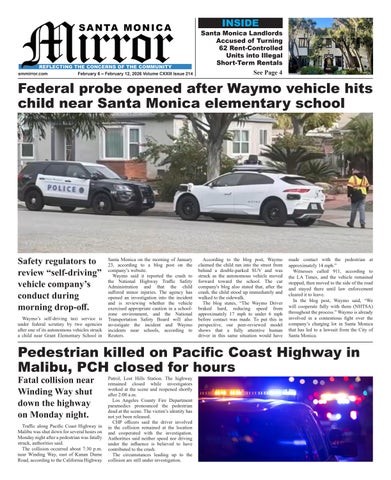
conduct during morning drop-off.
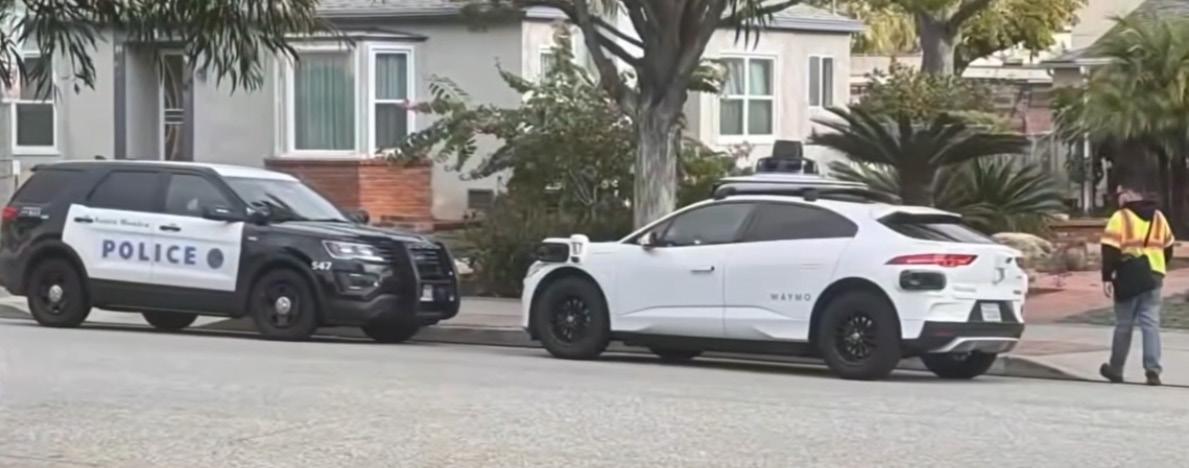
Waymo’s self-driving taxi service is under federal scrutiny by two agencies after one of its autonomous vehicles struck a child near Grant Elementary School in
Santa Monica on the morning of January 23, according to a blog post on the company’s website.
Waymo said it reported the crash to the National Highway Traffic Safety Administration and that the child suffered minor injuries. The agency has opened an investigation into the incident and is reviewing whether the vehicle exercised appropriate caution in a schoolzone environment, and the National Transportation Safety Board will also investigate the incident and Waymo incidents near schools, according to Reuters.
According to the blog post, Waymo claimed the child ran into the street from behind a double-parked SUV and was struck as the autonomous vehicle moved forward toward the school. The car company's blog also stated that, after the crash, the child stood up immediately and walked to the sidewalk.
The blog states, “The Waymo Driver braked hard, reducing speed from approximately 17 mph to under 6 mph before contact was made. To put this in perspective, our peer-reviewed model shows that a fully attentive human driver in this same situation would have
made contact with the pedestrian at approximately 14 mph.”
Witnesses called 911, according to the LA Times, and the vehicle remained stopped, then moved to the side of the road and stayed there until law enforcement cleared it to leave.
In the blog post, Waymo said, “We will cooperate fully with them (NHTSA) throughout the process.” Waymo is already involved in a contentious fight over the company’s charging lot in Santa Monica that has led to a lawsuit from the City of Santa Monica.
Traffic along Pacific Coast Highway in Malibu was shut down for several hours on Monday night after a pedestrian was fatally struck, authorities said.
The collision occurred about 7:30 p.m. near Winding Way, east of Kanan Dume Road, according to the California Highway
Patrol, Lost Hills Station. The highway remained closed while investigators worked at the scene and reopened shortly after 2:00 a.m.
Los Angeles County Fire Department paramedics pronounced the pedestrian dead at the scene. The victim’s identity has not yet been released.
CHP officers said the driver involved in the collision remained at the location and cooperated with the investigation. Authorities said neither speed nor driving under the influence is believed to have contributed to the crash.
The circumstances leading up to the collision are still under investigation.

The vision plan outlines eight principles — including nourishing existing parks, expanding parkland, connecting open space and supporting funding partnerships — and five strategies
The Santa Monica City Council unanimously approved a 25-year Parks and Recreation Vision Plan early Wednesday, setting a goal of 5 park acres per 1,000 residents while amending a staff proposal on artificial turf fields following

strong opposition from students and environmental advocates.
The council voted 7-0 to adopt the plan, which updates the city’s 1997 Parks and Recreation Master Plan and establishes “City as Habitat” as its guiding vision — framing parks, open spaces and streets as nourishing environments for people, plants, animals and programming.
A key amendment, proposed by Council Member Jesse Zwick, requires existing artificial turf fields to be re-evaluated at the end of their natural life to determine whether durable natural grass alternatives are feasible, rather than automatically replacing them with turf as originally recommended.
Council Member Dan Hall initially proposed keeping staff’s recommendation but withdrew his motion after Zwick clarified that the amendment allows staff to weigh feasibility, including impacts on adult sports capacity.
The vision plan outlines eight principles — including nourishing existing parks, expanding parkland, connecting open space and supporting funding partnerships

— and five strategies: strengthening access, rethinking streets for park potential, fostering social interaction, optimizing existing parks and creating new parkland.
Council members also directed staff to study potential recreational use of streets and segments of Interstate 10, with Council Member Ellis Raskin advocating for freeway capping to reclaim land for public parks.
The plan identifies a current park inventory of 144 acres — about 1.55 acres per 1,000 residents — below the Los Angeles County average of 3.3 acres and far below the National Recreation and Park
Association’s
for cities
Staff and advisory commissions noted high community use: 96% of survey respondents visit a park, arts or recreation facility annually, 15% above the national average, and 49% participate in city programs or events, 13% above average.
“The vision plan will guide strategic open space decisions for the next 25 years, particularly for the Santa Monica Airport Conversion Project, which presents the largest parkland expansion opportunity in the city’s 150-year history,” staff reported.





Wooden cutler y along with food scraps are allowed in your green bin.
Los cubier tos de madera, ju nto con los restos de comida, está n permi tidos en el contenedor verde.











































































































































































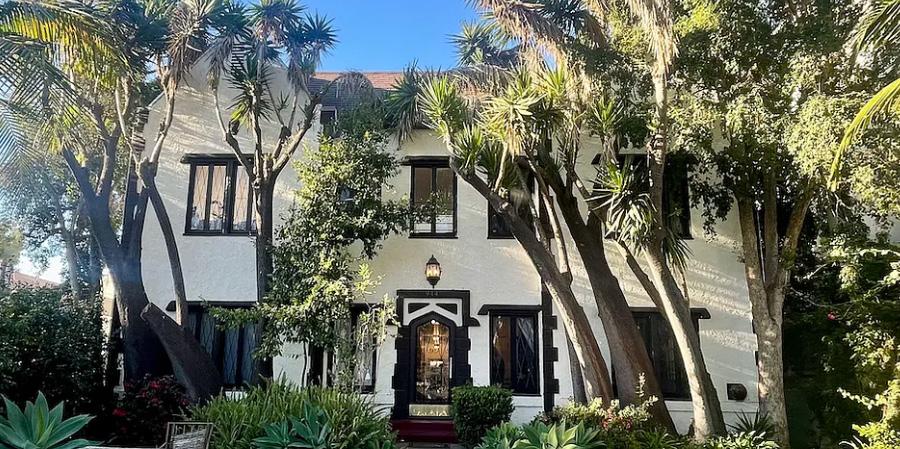
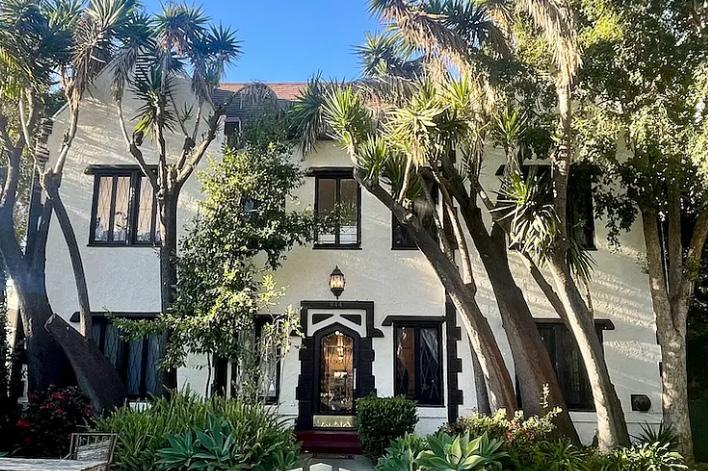
Prosecutors allege the defendants violated the Residential Leasing Requirements Ordinance by systematically renting the units to transient guests, mostly for periods of less than 100 days, nearly 3,000 times
The Santa Monica City Attorney’s Office has filed a lawsuit against a family of landlords and their companies, accusing them of illegally converting at least 62 rentcontrolled apartments across 25 properties into short-term rentals on platforms like Airbnb, generating roughly $18 million in profits over more than five years.
The Jan. 22 complaint in Los Angeles Superior Court names Hamid Enayati, Nicole Massarat, Nina Enayati, Jaleh Forouhar, Nina Property Management Inc., and multiple LLCs they control.
Prosecutors allege the defendants violated the Residential Leasing Requirements Ordinance by systematically renting the units to transient guests, mostly for periods of less than 100 days, nearly 3,000 times. The ordinance requires initial leases of at least one year for unfurnished units used as the tenant’s primary residence.
According to the complaint, the defendants advertised units on Airbnb after long-term tenants vacated, facilitated short-term bookings through the platform, required guests to sign sham one-year leases outside Airbnb to appear compliant, rented furnished units to visitors not using them as primary residences, deceived guests with fraudulent leases and statements, and either failed to register units with the Rent Control Board or submitted misleading forms.
Zillow and public records show several of the properties named in the complaint — including 1130-1134 Chelsea Ave., 1118 10th St., and 944 12th St. — are
multi-unit apartment buildings in highdemand areas like Wilshire/Montana, with recent estimates ranging from $1.1 million to higher values depending on unit count and condition.
The city seeks an injunction to halt the practice, disgorgement of approximately $18 million in alleged unlawful profits, and civil penalties of $2,500 per violation under California’s Unfair Competition Law and False Advertising Law.
Deputy City Attorney Jonathan Frank said preserving rent-controlled housing and keeping rents down remain top priorities.


Immerse yourself in a sanctuary where nature’s tranquility meets the vibrancy of city life. Urban Jungle is more than a plant store it’s a communitycentered oasis bringing a lush slice of paradise to your urban lifestyle. Here, we passionately believe in the power of plants to transform spaces and elevate well-being.









Santa Monica Architects for a Responsible Tomorrow
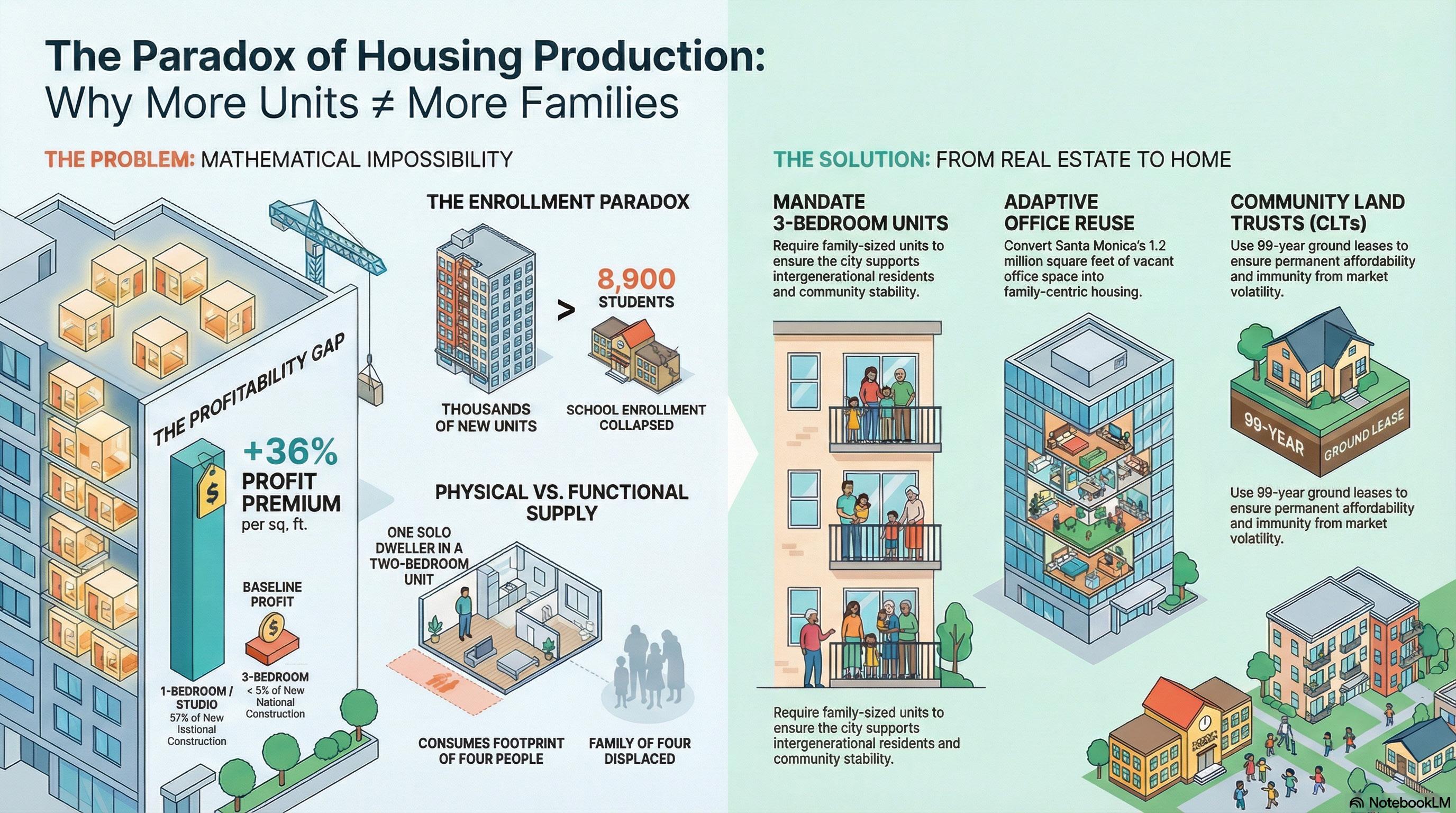
SMa.r.t.’s article last month referred to Santa Monica's collapsed school enrollment of 8,900 students. The figure arrives despite the addition of thousands of new apartment units over the past decade. This paradox defies the conventional logic of housing policy. The explanation lies not entirely in population decline but includes a new shift in our housing stock due to solo dweller occupancies. This demographic transformation has quietly converted a housing crisis into what can only be described as a mathematical impossibility.
The distinction between physical housing stock and functional supply is critical to understanding what has happened. When a single person occupies a two-bedroom unit—a common occurrence as solo dwellers outbid families for larger spaces— that unit consumes the same physical footprint that could house a family of four. A city can meet its production targets on paper while its actual capacity to house residents declines. Santa Monica has been mandated to add 8,874 units under state housing requirements, and city staff has proposed capacity for 52 percent more than that figure. Yet the community is shrinking. Our schools now import 17 percent of their students from outside the district because local units no longer translate into local children.
The economics driving this transformation are brutally straightforward. Developers favor studios and one-bedroom units because they generate 36 percent more profit per square foot than family-sized apartments. This calculus has resulted in one-bedroom units dominating 51 percent of all new national construction. As UCLA urban planning professor Michael Storper argues, "The supply you get is the wrong kind of supply."
The YIMBY belief is that more housing lowers prices by ‘filtering’, wherein new luxury construction frees up older units for lower-income residents. This concept flounders on a basic reality: housing is not interchangeable. A studio optimized for a transient professional does not become a family home when it ages. As one economist notes, when people get richer, they do not demand more housing units; they demand nicer housing, which increases prices without increasing the functional supply.
In expensive urban markets, solo dwellers often possess above-average incomes, allowing them to outbid families for limited inventory. In Santa Monica, the consequences create attacks on families from both at the entry level, where solo dwellers can claim smaller units that should serve as stepping stones for young households, and at the
upper end, these same affluent persons also claim two-bedroom units, leaving bedrooms empty while families are priced out to distant suburbs like Riverside. Meanwhile, the median one-bedroom rent is $2,350, yet the units themselves continue shrinking, becoming smaller year over year. Recent research modeling supply-side solutions found that even increased construction rates would require 18 years to make a median one-bedroom affordable for a worker without a college degree —or inordinately longer if price declines are modest. This is no way to address affordability.
Solo dwellers represent the most housinginefficient household type from a resource utilization perspective. As the percentage of solo households increases faster than overall population growth, it amplifies housing demand beyond what population numbers suggest. Economic pressures that delay marriage and childbearing extend the period of single-person household formation, prolonging demand for individual units. And solo dwellers disproportionately prefer urban locations with amenities and employment, concentrating demand in markets that are already impossibly tight.
Traditional housing metrics have become increasingly misleading. Santa Monica maintains a 10 percent residential vacancy rate, yet rents continue climbing because the housing stock has been optimized for the demographic least efficient at using it. Statelevel interventions often exacerbate rather than ameliorate the problem. Accessory Dwelling Unit legislation, while intended to increase density, frequently targets affluent solo renters rather than providing affordable family options. Builder's Remedy projects in Santa Monica average 90 percent marketrate units, which are almost exclusively transient studios designed for maximum developer return rather than community stability.
Overall, the language of housing policy
has been colonized by the ‘gentrified mindset’—a framework that treats marketrate development as an engine while equity is a mere mitigation measure. We argue about "equitable development," "inclusive growth," and "affordable housing percentages," all driven by the premise that displacement is the baseline and protection is the exception. "Housing production" sounds administrative and positive; "demolishing rent-controlled units to build luxury studios" reveals the same activity in concrete terms. Improvement becomes displacement precisely when improvements are not for our current residents. The result is curated diversity—a difference that is aesthetic rather than substantive, an Epcot Center’s model of urbanism.
Addressing this challenge requires moving beyond raw unit counts toward utilization efficiency. Occupancy standards that link unit size to household size would ensure square footage serves the maximum number of inhabitants. The 1.2 million square feet of vacant office space in Santa Monica presents an opportunity for adaptive reuse into family-centric housing rather than additional studio towers. Three-bedroom (less than 5% of new construction since three one-bedroom units generate 36% more profit) — mandating these would ensure the city supports intergenerational residents.
Community Land Trusts offer an alternative ownership model that operates outside gentrification's logic entirely, using 99-year ground leases to ensure permanent affordability and immunity from market volatility. Unlike developer-driven projects focused on profit-maximized studios, CLTs prioritize community-owned assets and can acquire and rehabilitate existing familysized apartments. Vienna's social housing model offers another template—housing decommodified as a public utility rather than an investment vehicle. These approaches require confronting property as an
institution, not just regulating its excesses. The solo dwellers are not inherently problematic—they reflect changing social patterns and individual preferences that deserve accommodation. Recognizing this does require thoughtful adaptation of housing stock and policy to ensure adequate supply for all household types. The current approach, which treats unit counts as the primary metric of success while ignoring who actually lives in those units, has produced a city that meets its housing targets while hemorrhaging families.
Until housing policy confronts the mathematics of efficiency, Santa Monica will continue replacing a rooted community with an investment vehicle that is functionally uninhabitable for families. The physical city expands while the functional city contracts. We are building housing that does not house, adding capacity that does not add capacity. The choice before us is whether to continue optimizing for the profitable forgetting of community or to implement strategies that treat the city as a home rather than merely real estate. The mathematics are unforgiving, but they are not immutable. These changes are, in the end, a policy choice that can be modified with our votes.
Jack Hillbrand, Architect, for SMa.r.t., Santa Monica Architects for a Responsible Tomorrow Mario Fonda-Bonardi AIA, Former Planning Commissioner, Robert H. Taylor AIA, Dan Jansenson, Former Building & Fire-Life Safety Commissioner, Sam Tolkin, Former Planning Commissioner, Michael Jolly ARE-CRE, Jack Hillbrand AIA, Landmarks Commission Architect, Phil Brock (Mayor, ret.), Matt Hoefler, NCARB, Architect, Heather Thomason, Community Organizer
Rated PG-13 117 Minutes
Released January 9th, Streaming on Netflix

By Kathryn Whitney Boole
People We Meet on Vacation is a classic rom-com at a time when we need it most, when uncertainty, distrust, and fear surround us, and lives are literally and figuratively torn apart in our world. I predict that this movie is going to be the “sleeper hit” of 2026, as was Anyone but You in 2024, which catapulted Sydney Sweeney and Glen Powell to Gen Z fandom. As of January 19th, People We Meet on Vacation was the #1 movie on Netflix with over 39 million views.
It stars Emily Bader and Tom Blyth as “Poppy” and “Alex” in this story based on the NY Times Best Seller romance novel published by author Emily Henry
Here, because of the simplicity of the tale, the strong character identities, and solid establishment of time and place, it works. The romance is awkward, with totally screwed up timing between the two characters, who the audience already know complete one another even though they can’t see that themselves. It reminded me of When Harry Met Sally, and on doing research later, I found that author Henry was inspired by that movie to write her novel, to take legendary screenwriter Nora Ephron’s story and create a reverse gender version.
There is a lot left unsaid, which is a good thing. The movie does not venture into the backgrounds of Poppy and Alex. This is a rom-com to be enjoyed for the witty and poignant interplay between the characters. Even Shakespeare didn’t give a lot of backstory to most of his characters - their actions and contemplations define their

in May 2021. The success of this movie will not come from the box office clout of these actors because they are relatively unknown. It will arise from the skill of their performances and the joy, grace, and personality they bring to their roles. Credit is due also to casting directors Nicola Chisholm, Jessica Kelly, and Mary Vernieu, along with director Brett Haley, for putting together an appealing cast, including the minor characters, who make this story work as an engaging film romance.
The movie was shot on a low budget with Barcelona and the surrounding countryside of Catalonia standing in for several popular European locations, and New Orleans plays itself. Poppy and Alex become friends after sharing a rental car to make the trip from college in Boston to the small town in Ohio, which they find out is their mutual home. Even though much of the road trip is disastrous on the surface due to their conflicting personalities, they both realize how much fun they had together. They decide to connect every year as platonic travel companions.
The overall story is linear, but the narrative follows a non-linear series of flashbacks, which I usually find distracting.
personalities. The music and the songs chosen are so well placed that they become a part of the dialogue without taking you away from the environment or the story.
Author Henry is based in Cincinnati and Kentucky. She is a BookTok star whose works have sold more than 10 million copies, beginning with her novel Beach Read, which blew up on TikTok five years ago. She knew there was a hunger for rom coms, which had seemed to disappear starting in the 2010’s.
Director Haley and his stars, Bader and Blyth, are all at the beginning of what will probably prove to be stellar careers. Haley was raised in Pensacola and Key West and graduated from the University of North Carolina School of the Arts in 2005. He has made three features since 2015.
Bader grew up in Temecula, CA, studied acting at Loyola Marymount and the Young Actors Space in LA, and did her first professional job on stage at the Geffen in 2018. She won the starring role in the TV series My Lady Jane, for which she had to train extensively to master horseback riding, sword fighting, and a British accent. Of her career so far, she notes, “I had no connections in the business or any clue


what I was doing. I got small jobs, and then you just move your way up the ladder. I think you have to be stubborn enough not to give up.”
Blyth is from Birmingham, England, and trained at Juilliard in New York City as one of nine applicants out of 2000 to be accepted. He played the title role of “William H. Bonney” in the TV series Billy the Kid.
This seems to be a case where the book version and the movie each stand on their own. This film will be the starting line for starring careers for Bader and Blyth. You may find yourself wondering at the end of the story what will happen with Poppy and Alex, as if they are your friends. You hope that they continue to stay together and travel the world, always finding new adventures. That’s the sign of a strong story and skilled acting – the people who populate this movie become part of your life, friends in your daydreams.
Kathryn Whitney Boole has spent
most of her life in the entertainment industry, which has been the backdrop for remarkable adventures with extraordinary people. She is a Talent Manager with Studio Talent Group in Santa Monica. kboole@gmail.com
Sr VP, Int’l Sales & Marketing. Direct int’l sales & marketing efforts in the US. BA + 3 yr exp or no degree + 5 yr exp req. Int’l travel up to 30%. Salary: $320,000-$420,000/ yr. Company: JAKKS Pacific, Inc, 2951 28th Str, Santa Monica, CA 90405. FULLY REMOTE: May work from home anywhere in the US. Reports to the JAKKS office in Santa Monica, CA. Email resume to: Attn: E.Morgan/RE: SVPISM, ESMRecruiter@jakks.net.