www.palisadesnews.com
September 2025
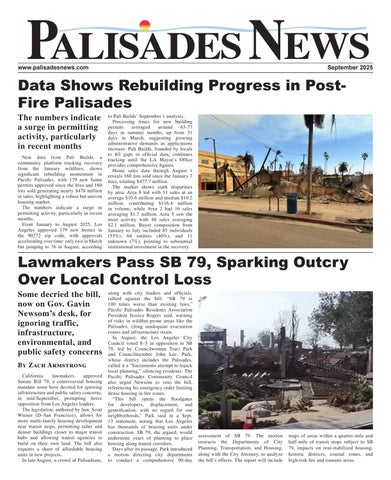
Data Shows Rebuilding Progress in PostFire Palisades The numbers indicate a surge in permitting activity, particularly in recent months New data from Pali Builds, a community platform tracking recovery from the January wildfires, shows significant rebuilding momentum in Pacific Palisades, with 179 new home permits approved since the fires and 160 lots sold generating nearly $478 million in sales, highlighting a robust but uneven housing market. The numbers indicate a surge in permitting activity, particularly in recent months. From January to August 2025, Los Angeles approved 179 new homes in the 90272 zip code, with approvals accelerating over time: only two in March but jumping to 76 in August, according
to Pali Builds’ September 1 analysis. Processing times for new building permits averaged around 63-77 days in summer months, up from 31 days in March, suggesting growing administrative demands as applications increase. Pali Builds, founded by locals to fill gaps in official data, continues tracking until the LA Mayor’s Office provides comprehensive figures. Home sales data through August 1 reveals 160 lots sold since the January 7 fires, totaling $477.7 million. The market shows stark disparities by area: Area 8 led with 11 sales at an average $10.6 million and median $10.2 million, contributing $116.4 million in volume, while Area 2 had 16 sales averaging $1.7 million. Area 5 saw the most activity with 48 sales averaging $2.1 million. Buyer composition from January to July included 85 individuals (53%), 64 entities (40%), and 11 unknown (7%), pointing to substantial institutional investment in the recovery.
Lawmakers Pass SB 79, Sparking Outcry Over Local Control Loss Some decried the bill, now on Gov. Gavin Newsom’s desk, for ignoring traffic, infrastructure, environmental, and public safety concerns By Zach Armstrong California lawmakers approved Senate Bill 79, a controversial housing mandate some have decried for ignoring infrastructure and public safety concerns, in mid-September, prompting fierce opposition from Los Angeles leaders. The legislation, authored by Sen. Scott Wiener (D–San Francisco), allows for more multi-family housing development near transit stops, permitting taller and denser buildings closer to major transit hubs and allowing transit agencies to build on their own land. The bill also requires a share of affordable housing units in new projects. In late August, a crowd of Palisadians,
along with city leaders and officials, rallied against the bill. “SB 79 is 100 times worse than existing laws,” Pacific Palisades Residents Association President Jessica Rogers said, warning of risks in wildfire-prone areas like the Palisades, citing inadequate evacuation routes and infrastructure strain. In August, the Los Angeles City Council voted 8–5 in opposition to SB 79, led by Councilwoman Traci Park and Councilmember John Lee. Park, whose district includes the Palisades, called it a “Sacramento attempt to hijack local planning,” silencing residents. The Pacific Palisades Community Council also urged Newsom to veto the bill, referencing his emergency order limiting dense housing in fire zones. “This bill opens the floodgates for developers, displacement, and gentrification, with no regard for our neighborhoods,” Park said in a Sept. 13 statement, noting that Los Angeles has thousands of housing units under construction. SB 79, she argued, would undermine years of planning to place housing along transit corridors. Days after its passage, Park introduced a motion directing city departments to conduct a comprehensive 90-day
assessment of SB 79. The motion instructs the Departments of City Planning, Transportation, and Housing, along with the City Attorney, to analyze the bill’s effects. The report will include
maps of areas within a quarter-mile and half-mile of transit stops subject to SB 79, impacts on rent-stabilized housing, historic districts, coastal zones, and high-risk fire and tsunami areas.