www.palisadesnews.com
January 2026 September 2025
Judge Upholds Use of Calabasas Landfill Data Shows Rebuilding Progress in Postfor FirePalisades PalisadesDebris Removal
in using the Calabasas Landfill to of Supervisors last year to allow Calabasas A lawsuit followed safely dispose of debrisSeptember from properties destroyed Landfill to accept wildfire debris outside its to Pali Builds’ 1 analysis. The numbers indicate in Processing times for new building typical service area. In February, the board the Palisades Fire. aa surge controversial averaged around In a decision issued this week, 63-77 Judge voted unanimously to temporarily waive in permitting permits days in summer 31 geographic restrictions that normally limit Stephen Goorvitchmonths, denied upa from petition decision by the activity, particularly for dayswritin ofMarch, mandatesuggesting filed by thegrowing city of the county-owned landfill to waste from a Los Angeles administrative demands as applications Calabasas, which challenged the county’s roughly 350-square-mile area, permitting it in recent months increase. Pali Builds, founded byand locals emergency debris removal program the to receive debris from the entire Palisades County Board to fill gaps inin official data, continues landfill’s role handling wildfire waste. Fire burn scar and potentially from other New data from Pali Builds, a tracking until the LA Mayor’smaterials Office fires, including the Eaton Fire. The ruling found that hazardous community platform tracking recovery provides comprehensive figures. of Supervisors properly separated from fire debris County officials argued the move was from the January wildfires, shows were Home sales data through August 1 and that county agencies complied with necessary to quickly remove potentially last year to allow significant rebuilding momentum in reveals 160 lots sold since the January 7 applicable laws and industry standards. toxic debris from burned properties, citing Pacific Palisades, with 179 new home fires, totaling $477.7 million. Calabasas Landfill According to the ruling, debris risks posed by ash and contaminants left on permits approved since the fires and 160 Thescreened market and shows starkby disparities was sorted the U.S. residential sites. The board also approved lots sold generatingwildfire nearly $478 million by area: Area 8 led with 11 sales at an to accept Environmental Protection Agency, the temporary increases in daily tonnage limits in sales, highlighting a robust but uneven average $10.6 million and median $10.2 U.S. Army Corps of Engineers and their at the Sunshine Canyon Landfill in Sylmar housing market. debris outside its million, contributing $116.4 million contractors before being transported to and the Lancaster Landfill to accommodate hazardous waste facilities. The numbers indicate a surge in in volume, while Area 2 had 16 sales Los Angeles County Supervisor Lindsey the landfill. Testing reviewed by the court fire-related waste. typical service permitting activity, particularlyarea in recent averaging $1.7 million. Area 5 saw the found no dangerous exceedances or the The decision drew opposition from P. Horvath said the court’s ruling affirmed months. A Los January Angeles County Superior From to August 2025,Court Los judge has ruled that the County of Los Angeles approved 179 new homes in Angeles andzip the code, Los Angeles County the 90272 with approvals Sanitation Districts acted lawfully and accelerating over time: only two in March but jumping to 76 in August, according
most activity 48 sales averaging presence of toxicwith materials in debris sent to $2.1 million. Buyer composition from Calabasas Landfill. January to July included 85 individuals The lawsuit followed a controversial (53%), 64 entities (40%), and 11 decision by the Los Angeles County Board unknown (7%), pointing to substantial institutional investment in the recovery.
residents living near the landfills, who raised concerns about airborne ash, groundwater contamination and whether wildfire debris should instead be sent to
Horvath said in a statement marking the anniversary, noting that while cleanup moved faster city than after previous disasters along with leaders and officials, and permits are being rallied against the issued bill. more “SB quickly, 79 is many families are still struggling return 100 times worse than existingto laws,” home. Pacific Palisades Residents Association County officials report that President Jessica Rogers said,rebuilding warning permits are now issued in an average 28 of risks in wildfire-prone areas likeofthe days — about three times faster than before Palisades, citing inadequate evacuation the fireand — aided by streamlined routes infrastructure strain. processes such as AI-assisted plan checks and City selfIn August, the Los Angeles certification. The county has also deferred Council voted 8–5 in opposition to SB or reduced fees, saving some households 79, led by Councilwoman Traci Park tens of thousands of dollars, and has and Councilmember John Lee. Park, distributed more than $51 million in direct whose district includes the Palisades, aid to residents, workers and businesses. called it a “Sacramento attempt to hijack Still, the impact lingers. Community local planning,” residents. The organizations saysilencing the anniversary has Pacific Palisades Community brought renewed grief for residentsCouncil coping also loss, urgeddisplacement Newsom to the pace bill, with andveto the slow referencing his emergency order limiting of rebuilding. dense firemembers, zones. leaders of In ahousing messagein to “This bill opens thedescribed floodgates American Legion Post 283 the for developers, displacement, and day as one filled with “grief, gratitude, gentrification, no regard forthose our anger, hope and with exhaustion,” urging neighborhoods,” Park said in a Sept. affected to seek support in whatever way 13 statement, noting that Los felt right. The post has served as aAngeles hub for has thousands of housing units under displaced residents since the fire, hosting construction. SB 79, she argued, would recovery meetings, resource fairs and undermine years of planning to place support services. housing along transit corridors. The Palisades Long Term Recovery Days after ParkLegion introduced Group and its thepassage, American are a motion directing city departments hosting a daylong remembrance ceremony to conduct toa honor comprehensive Wednesday those who90-day died,
recognize first responders and volunteers, and reflect on the community’s resilience. The event includes a private remembrance for families of those lost, followed by a public procession and community gathering. At the state level, California officials say lessons from the wildfire have reshaped how the state prepares for future disasters. Gov. Gavin Newsom’s administration has expanded firefighting capacity, nearly doubling CAL FIRE staffing since 2019, deploying new fire engines to Los Angeles and growing what the state calls the world’s largest aerial firefighting fleet. California has also launched its first statewide LiDAR mapping system to better track vegetation and fire risk. “These fires showed us we need to move faster and smarter,” Newsom said in a statement. Federal officials have focused on funding and preparedness. Rep. Brad Sherman said federal disaster aid has helped clear debris and provide temporary housing, but warned that future assistance remains uncertain without additional congressional action. “Natural disasters not recognize state assessment of SBdo 79. The motion borders or political parties,” Sherman said, instructs the Departments of City calling continued federal support essential Planning, Transportation, and Housing, for long-term recovery. along with the City Attorney, to analyze Los Angeles Mayor Karen Bass, the bill’s effects. The report will marking the anniversary, said the include trauma
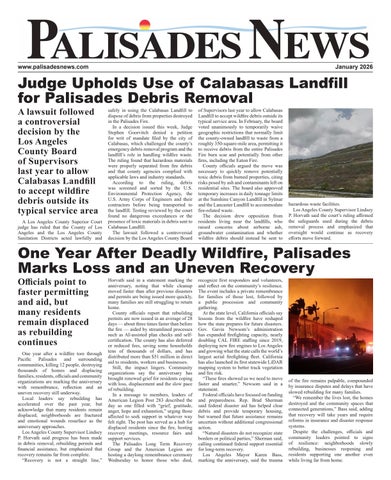
the safeguards used during the debris removal process and emphasized that oversight would continue as recovery efforts move forward.
One Year After Deadly Wildfire, Palisades Lawmakers Passan SBUneven 79, Sparking Outcry Marks Loss and Recovery Overpoint Local Control Loss Officials to faster permitting Some decried the bill, and aid,Gov. butGavin now on many residents Newsom’s desk, for remain ignoringdisplaced traffic, infrastructure, as rebuilding environmental, and continues
public safety concerns
One year after a wildfire tore through Pacific Palisades and surrounding communities, 12 people, destroying By Zachkilling Armstrong thousands of homes and displacing California approved families, residents,lawmakers officials and community Senate Bill 79, controversial housing organizations are amarking the anniversary mandate some have decried for ignoring with remembrance, reflection and an infrastructure andstill public safety concerns, uneven recovery underway. in Local mid-September, leaders sayprompting rebuilding fierce has opposition from Angeles accelerated overLosthe past leaders. year, but The legislation, authored by Sen.remain Scott acknowledge that many residents Wiener (D–San Francisco), for displaced, neighborhoods areallows fractured more multi-family housing development and emotional wounds resurface as the near transit approaches. stops, permitting taller and anniversary denser buildings closer to majorLindsey transit Los Angeles County Supervisor hubs and allowing transit to P. Horvath said progress hasagencies been made build on removal, their own land. The bill also in debris rebuilding permits and requires aassistance, share of but affordable housing financial emphasized that units in new projects. recovery remains far from complete. In late August, crowd Palisadians, “Recovery is anot a of straight line,”
of the fire remains palpable, compounded by insurance disputes and delays that have slowed rebuilding for many families. “We remember the lives lost, the homes destroyed and the community spaces that connected generations,” Bass said, adding that recovery will take years and require reforms in insurance and disaster response systems. Despite the challenges, officials and maps of areasleaders within apointed quarter-mile and community to signs half-mile of transit stops subject to SB of resilience: neighborhoods slowly 79, impacts on rent-stabilized housing, rebuilding, businesses reopening and historic districts, zones, even and residents supportingcoastal one another high-risk fire and tsunami areas. while living far from home.