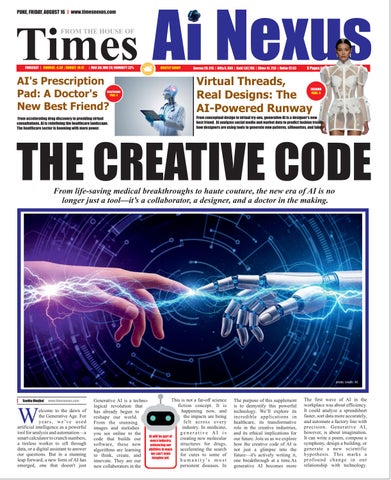

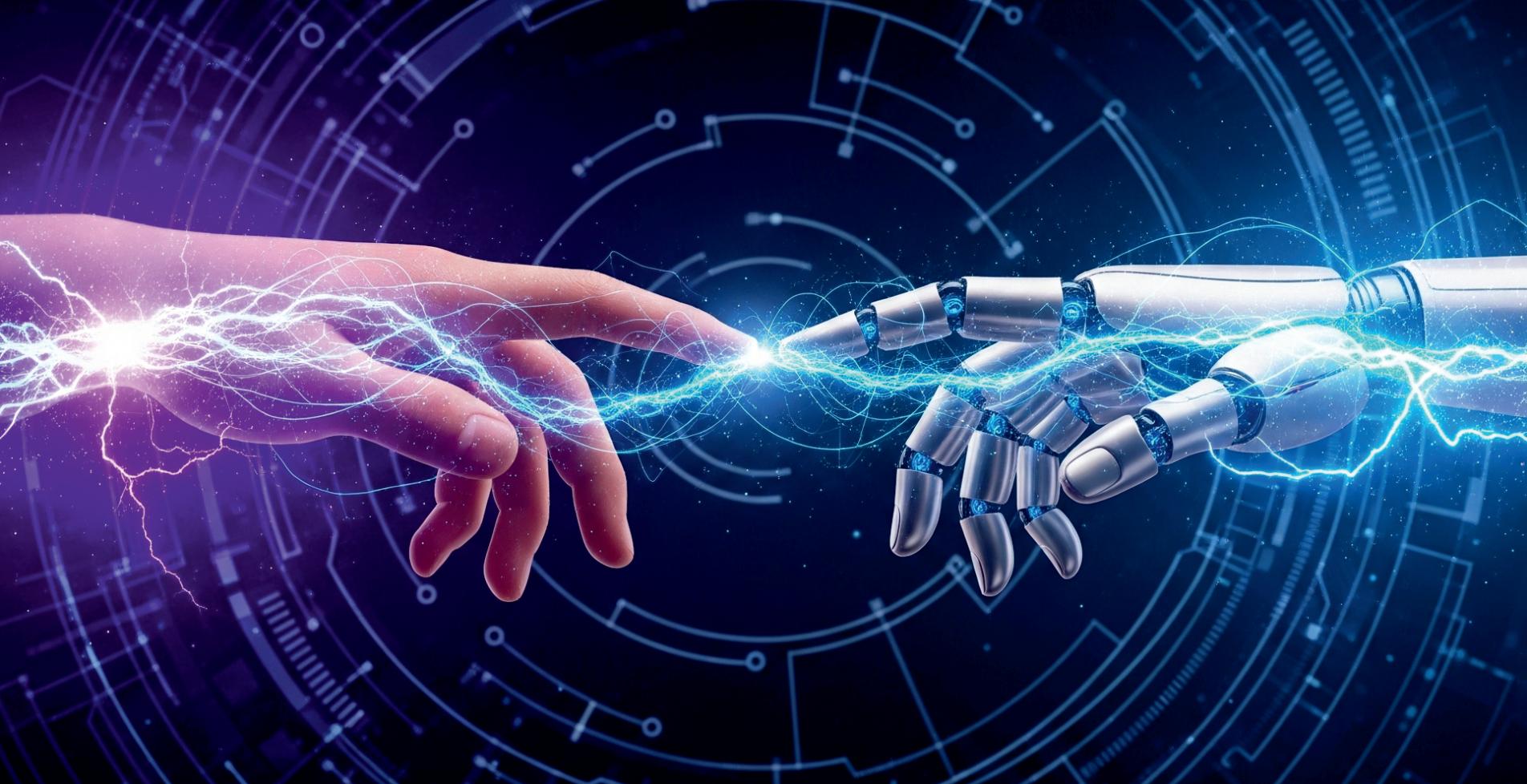
THE CREATIVE CODE Times AI Nexus

Real Designs: The
Welcome to the dawn of theGenerativeAge.For years, we’ve used artificialintelligenceasapowerful toolforanalysisandautomation—a smartcalculatortocrunchnumbers, a tireless worker to sift through data,oradigitalassistanttoanswer our questions. But in a stunning leapforward,anewformofAIhas emerged, one that doesn't just
The purpose of this supplement is to demystify this powerful technology We’ll explore its incredible applications in healthcare, its transformative role in the creative industries, and its ethical implications for ourfuture.Joinusasweexplore how the creative code of AI is not just a glimpse into the future—it's actively writing it, one breakthrough at a time.As
The first wave of AI in the workplacewasaboutefficiency. It could analyze a spreadsheet faster,sortdatamoreaccurately, andautomateafactorylinewith precision Generative AI, however, is about imagination. It can write a poem, compose a symphony,designabuilding,or generate a new scientific hypothesis This marks a profound change in our relationship with technology
Sanika Bhujbal
photo credit: AI
Times AI Nexus 2
HELLO, ALGORITHM:
Your Guide to the Generative Age
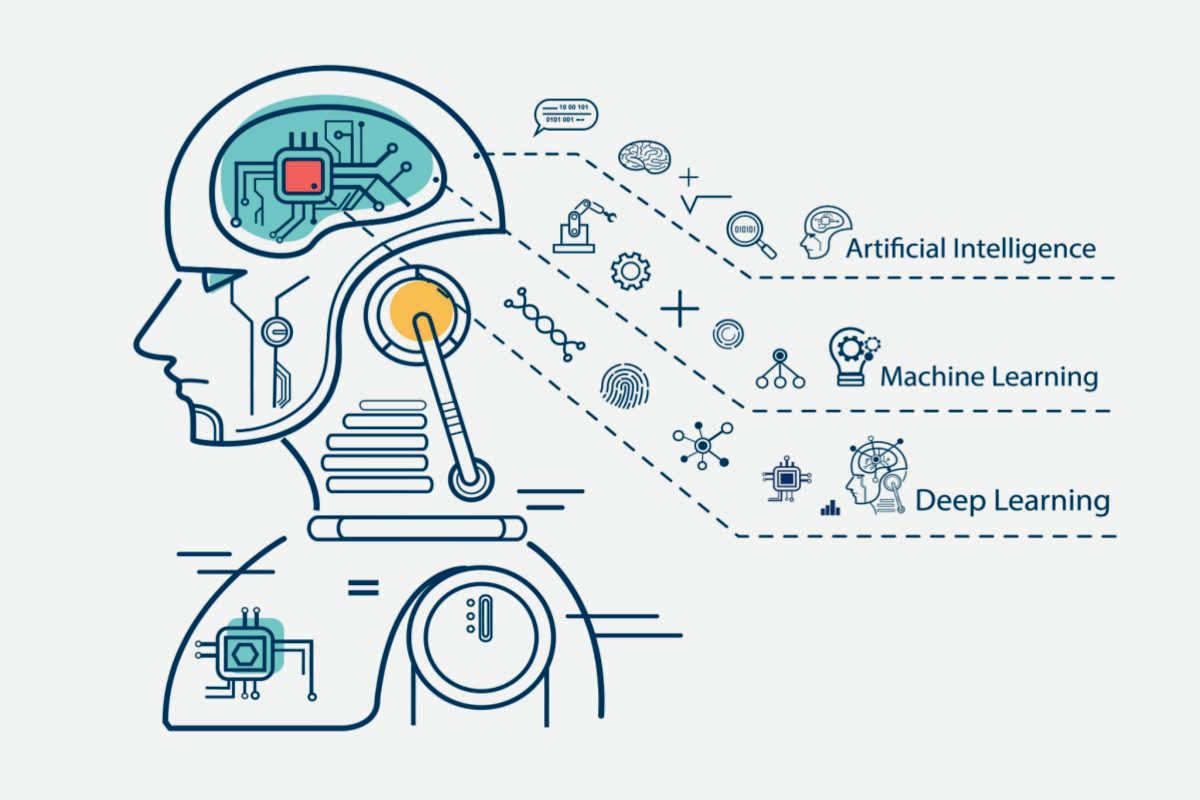
Foryears,theterm"Artificial Intelligence" brought to mindimagesofsuper-smart computers that could beat us at chess or recommend our next movie. That was AI, the brilliant analyst.Butrecently,anewkindof intelligence has stepped into the spotlight, one that doesn't just analyze the world—it adds to it. Welcome to the era of Generative AI.
TheDetectivevs.TheArtist
ThinkofTraditionalAIasaworldclass detective. It is incredibly skilled at recognizing patterns, identifying clues, and making predictions based on existing evidence. When you ask it to identify a cat in a photo, it sifts through its vast knowledge of cat imagesandsays,"Yes,that'sacat." It analyzes, categorizes, and predicts.
GenerativeAI,ontheotherhand,is like an imaginative artist. Instead of just identifying a cat, you can ask it to create a picture of a "cat wearingatinyastronauthelmet,in the style of Van Gogh." It doesn't findanexistingimage;itgenerates a completely new one from scratch,basedoneverythingithas learned about cats, helmets, and famous painters In short, traditional AI is for knowing. GenerativeAIisforcreating.
The most important new skill, however, may be the art of the "prompt."Knowinghowtoaskthe right questions, provide the right context,andguideanAItoproduce the desired output will be a key
For LLMs (The Master Storyteller):
Creative Writing: Tools like ChatGPT and Google's Geminicantakeasimpleprompt like, "Write a short story about a detective who finds a timetraveling watch," and produce a full narrative with a plot, characters, and dialogue in seconds.This isn't a search; it's a creative act.Coding: Developers are now using AI to write code. They can ask, "Write a Python script to sort a list of numbers," and the AI provides a clean, functionalcodesnippet.
made headlines by creating surreal and beautiful images from simple text descriptions. These AIs have learned the patterns of art history, photography, and design to genera
Companies are using GANs to create new shoe designs, car
complex ethical challenges that developers, governments, and societiesareonlyjustbeginning tograpplewith.Thissupplement will dive into these important topics in detail, exploring the responsibilities that come with t
p
wer. Understanding the basics is the first step; engaging with the implicationsisthenext.
The Generative Age is not just for tech experts and artists. It's for everyone. We invite you to explore the tools that are available, from simple chatbot interfaces to more advanced image generators. Your unique perspective and creativity are the vital ingredients that will
In the short time since its public debut, generative AI has moved from a technological curiosity to a force reshaping our world. We have seen it write code, design buildings, and compose music, blurring the line between creation and computation. But as we stand at the precipice of thisnewera,therealstoryisnot whattheAIcando,butwhatwe willdowithit.
Generative AI is not merely a tool;itisacreativepartnerwith boundless potential. It offers us anunprecedentedopportunityto amplify human ingenuity, freeing us from the mundane to focus on grander ideas.
However,withthispowercomesa profound responsibility We must decidewhatkindoffuturewewant to generate. We must confront the ethical questions of authorship, bias,andtruth.Thealgorithmswe build today will define the world we inhabit tomorrow The most importantpromptwewillevergive isnottotheAI,buttoourselves:to be thoughtful, ethical, and courageous in the face of this revolution. The final narrative is notpre-written—it'swaitingforus toshapeit. The GenerativeAge is not just for tech experts and artists. It's for everyone.Weinviteyoutoexplore the tools that are available, from simple chatbot interfaces to more advanced image generators. Your
THE AI PARADOX:
Confronting Creativity & The Ethical Algorithm.
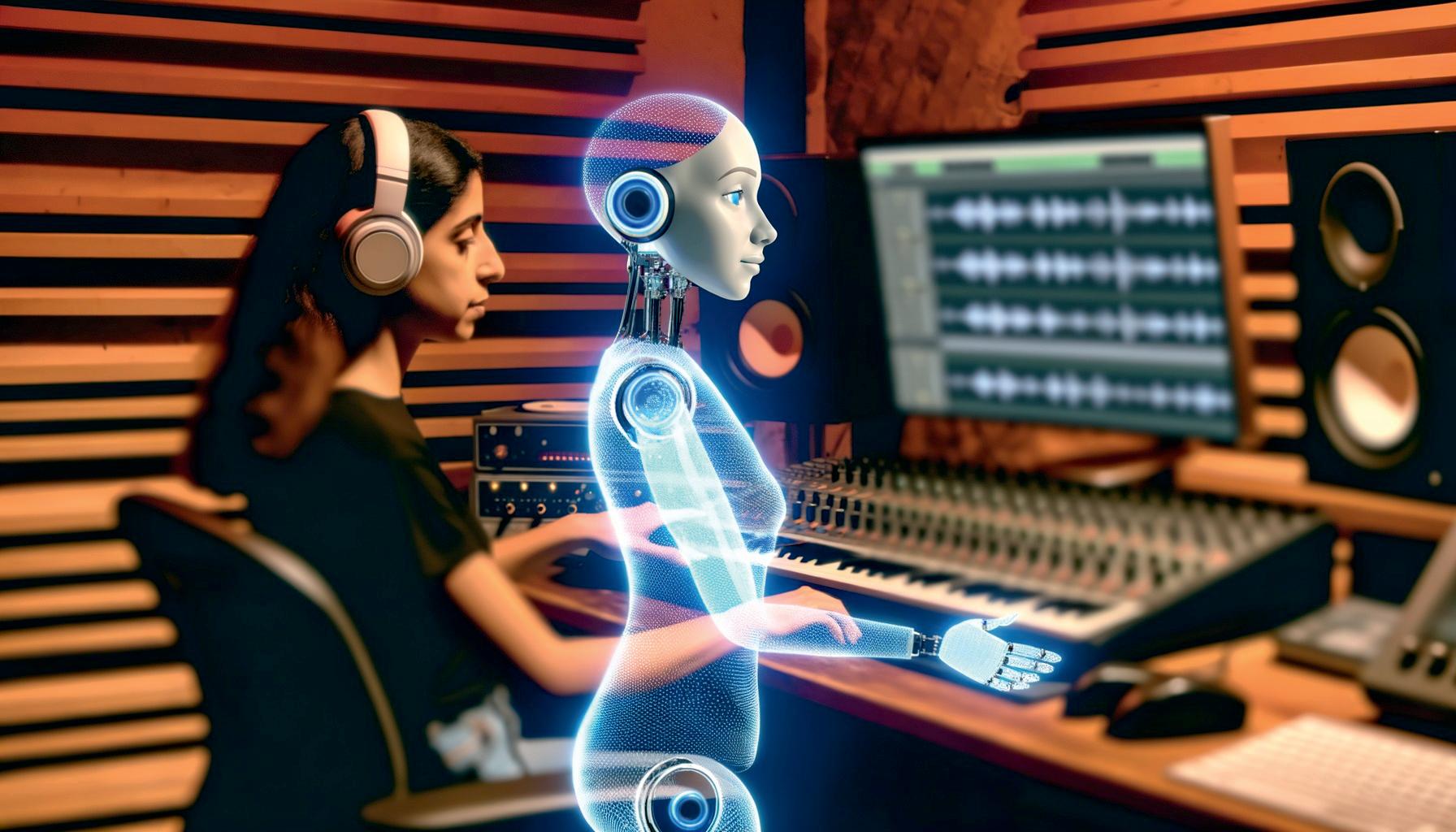
>>Can a machine be an artist?
As AI creates masterpieces and music, we must face the complex questions of originality, bias, and the human touch.
TheQuestionofOriginality
Atitscore,agenerativeAIis not a conscious being. It does not have personal experiences, emotions, or intentions. Instead, it is a complex algorithm that uses a vast dataset of paintings, musical compositions,orliteraryworks—to learn patterns and styles. When it "creates," it is essentially generating new content by remixingandre-imaginingthedata it was trained on. This leads to the question: is it truly original, or is it merelyasophisticatedechoofwhat alreadyexists?
painting may be beautiful, but doesitcontainthesamedepthor meaning as a work born from humanstruggle,joy,orpassion?
The "human touch" is what many believe imbues a work withitssoul.
The Analogy of the Apprentice
One way to look at it is that the AI is a masterful apprentice. It haslearnedfromthebest—from Van Gogh to Rembrandt—and cannowcreateintheirstyle.But without a conscious artist to guide it, does its work move beyondmereimitation?
biased,theoutputwillbeaswell.
The art it creates can unintentionally perpetuate stereotypes and historical prejudices Example: An AI trainedonimagespredominantly featuring a certain demographic might generate images that exclude others, reinforcing a narrow view of the world. This can lead to a lack of diversity in theartitproducesandtheideasit
r e p r e s e n t s E t h i c a l Responsibility:Aswerelymore on AI to generate content, we must be careful not to amplify existing societal biases. This places a new ethical burden on the developers who create these models and the artists who use
“ “
AI speaks many languages – Translation systems like Google Translate use AI to understand and convert between 100+ languages almost instantly.
PUNE, FRIDAY, AUGUST 16
A New Prescription for Personalized Care
From accelerating to providing virtual consultations Drug Discovery
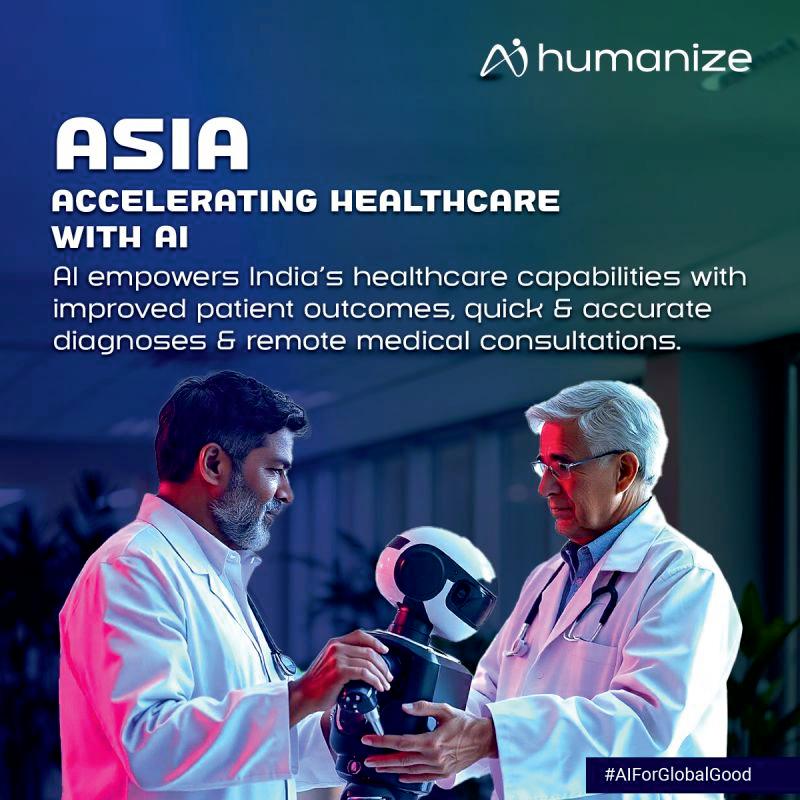
From accelerating drug discovery to providing virtual consultations, AI is redefining the healthcarelandscape.
For decades, medicine has been abouttreatingsymptoms.Today,a quiet revolution is underway, powered by artificial intelligence, that is shifting the focus from reaction to prevention and from general treatment to personalized care. The e m e r g e n c e o f GenerativeAIisnotjust a technological upgrade for hospitals; it is a fundamental rethinking of how we diagnose, treat, and heal.TheAI is no longer a tool in the background—it is a new kind of doctor, one that works tirelessly behind the scenes to save lives and streamlinecare.
How AI Helps in Drug Discovery
Faster identification of drug candidatesAI can analyze massive datasets of molecules and predict which ones might work against a disease.This reduces the time needed for the “hit and lead” discovery stage. Protein structure predictionTools like AlphaFold (by DeepMind) can predict the 3D structures of proteins with high accuracy. This helps scientists understand how diseases work and design drugs that target them.
Drug repurposingAI can scan existing drugs to see if they might treat other diseases (e.g., during COVID-19, AI helped test old drugs against the virus).Reducing clinical trial failuresAI can predict how drugs will behave in the human body (toxicity, side effects, absorption).This reduces costly trialand-error in human trials.Personalized medicineAI uses genetic and medical data to suggest drugs tailored to an individual’s unique biology
AcceleratingtheSearchfor Cures
Oneofthemostprofoundimpacts of AI is in the field of drug
Real-world Examples:Insilico Medicine: Developed a potential fibrosis drug in just 18 months using AI. BenevolentAI: Used AI to identify a drug (Baricitinib) that was later tested for COVID-19 treatment. DeepMind’s AlphaFold: Released structures for almost every known human protein, accelerating research globally
Generative AI is changing this. Instead of a manual search, AI models can now model new molecules and predict their effects with remarkable accuracy These algorithms can simulate how a compound will interact with a virus or a cancer cell without a single physical experiment. By generating and evaluating millions of potential drug candidates in a matter of days, AI is dramatically shortening the research phase.It’slikehavingateam of a thousand chemists working around the clock, allowing us to find new treatments for diseases fasterthaneverbefore. The Generative Age is not just for tech experts and artists. It's for everyone. We inviteyoutoexplorethetools thatareavailable,fromsimple chatbot interfaces to more advanced image generators Your unique perspective and creativity are the vital ingredients that will guide these algorithms to create something trulynew Don'tjustobservethe revolution;participateinit.
The
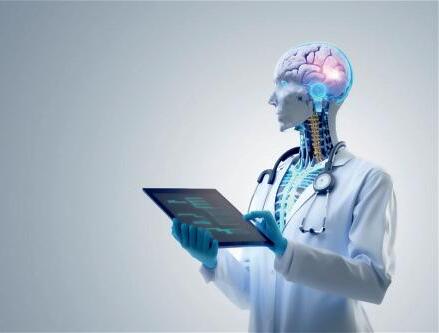
AI Doctor
VirtualConsultations:
AI-powered chatbots and virtual assistants can handle patient queries, schedule appointments, and provide preliminary symptom analysis, freeing up human staff to focus ondirectpatientcare.
AdministrativeTasks:
The technology can automate the process of writing medical notes, generating reports, and managing patient records,
VirtualConsultations:
AI-powered chatbots and virtual assistants can handle patient queries, schedule appointments, and provide preliminary symptom analysis, freeing up human staff to focus ondirectpatientcare.
AdministrativeTasks:
The technology can automate the process of writing medical notes, generating reports, and managing patient records,
However, with this power c o m e s a p r o f o u n d responsibility. We must decide what kind of future we want to generate. We must confront the ethical questions of authorship, bias, and truth. The algorithms we build today will define the worldweinhabittomorrow The most important prompt we will evergiveisnottotheAI,butto ourselves: to be thoughtful, ethical, and courageous in the faceofthisrevolution.Thefinal narrativeisnotpre-written—it's waitingforustoshapeit.
The Generative Age is not just for tech experts and artists. It's for everyone. We invite you to explore the tools that are
Generative AI is making personalizedmedicineareality By analyzingapatient'suniquegenetic data, their medical history, and real-time health data from wearables, AI can recommend treatments and dosages that are tailoredspecificallytothem.
Imagine a patient with a chronic condition. Instead of receiving a standarddoseofmedication,anAI can analyze their specific metabolicrateandgeneticmarkers to suggest a personalized dosage that maximizes effectiveness and minimizessideeffects.Thishyperpersonalized approach not only improvespatientoutcomesbutalso reduces the trial-and-error process that has long been a part of medicine.
Revolutionizing Hospital
OperationsWhile the high-tech applications of AI are groundbreaking, its impact on the day-to-day operations of hospitals is just as critical. GenerativeAI is helping to manage the vast administrativeburdenthat.
In every aspect of medicine, from the microscopic world of
TheAI-PoweredPatient
The final frontier of AI in healthcare is putting the power directly into the hands of the patient. AI-powered apps and devicesarenowservingaspersonal health coaches. These tools can analyze data from fitness trackers and smartwatches to provide personalized advice on exercise, sleep,andnutrition.Theycaneven generate personalized mental health support through conversationalAI,providingasafe and accessible space for users to exploretheirthoughts.
The GenerativeAge is not just for tech experts and artists. It's for everyone.Weinviteyoutoexplore
Sanika Bhujbal www.timesnexus.com
Sanika Bhujbal www.timesnexus.com
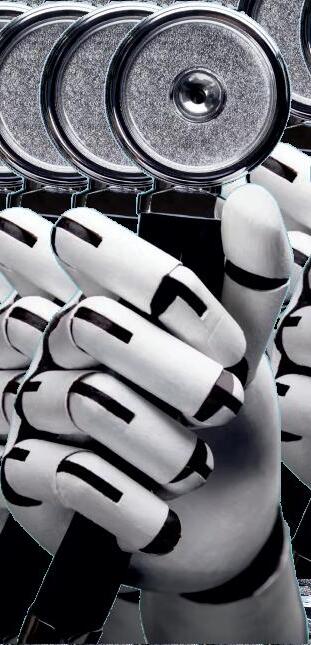
The New Stethoscope
AI is the Doctor's Most Important Partner

Inthequiethoursofahospital, behind the closed doors of a lab or a consultation room, a new colleague is joining the medicalstaff.It’snotaphysician, a nurse, or a researcher It is an algorithm For some in our profession, the rise of artificial intelligence in medicine has been met with caution, a fear that the human touch will be lost to cold data As a doctor who has witnessed this transformation firsthand, I can say with confidence that this couldn't be furtherfromthetruth
AI is not here to replace us; it is here to amplify us.For years, we have been drowning in data. A single patient's medical history, lab results, and imaging scans generate a mountain of informationthatahumancanonly process so quickly This is where AI becomes our most powerful partner It can analyze a CT scan for the earliest signs of a tumor with an accuracy that often surpasses the human eye. It can comb through millions of genetic markers to predict a patient's risk for a certain disease, enabling us to practice true preventative care. This isn't science fiction; it is the newstandardofcare,freeingusto make more informed decisions, faster.
Furthermore, AI is tackling the very real problem of physician burnout. It is automating the tedious, repetitive tasks that consume so much of our time—from transcribing patient notes to scheduling appointments and generating reports. For too long, doctors have had to choose between staring at a screen and listening to a patient AI eliminates that false choice. It gives us back the most valuable resource we have: the time to sit withourpatients,tolistentotheir stories, and to provide the empatheticcarethatisattheheart ofourprofession.
Ultimately, the best medicine is a blendofdataandempathy
The Next Frontier: AI in Genomics and Medical Research
Beyond diagnostics and operational efficiency, AI is poised to revolutionize the foundational science of medicine itself.
Sanika Bhujbal www.timesnexus.com
Beyond diagnostics and operational efficiency,
AI is poised to revolutionize the foundational science of medicine itself. By analyzingvast,complexgenetic datasets,AIcanuncoverpatterns and connections that are invisibletothehumaneye.
GenomicAnalysisandDisease Prediction:
AI models are being trained on massive databases of human genomes to identify specific genetic markers that correlate with a higher risk for diseases like cancer, diabetes, and heart disease. This capability allows for proactive intervention, enabling doctors to advise patients on lifestyle changes or screenings years before symptoms would typically appear
Accelerating Scientific Discovery:
Generative AI is not just
s generating new hypotheses ResearchersareusingAItofind correlations between different diseases, treatments, and biological pathways. For instance, anAI might analyze a dataset on a rare disease and suggest a potential treatment by findingalinktoacommondrug used for a completely different ailment.
The Future of Robotic Surgery:
While still in early stages,AI is beginningtobeusedtoenhance roboticsurgery TheAIcanhelp guidetheroboticarm,providing a steady hand that eliminates human tremor It can also analyze real-time imaging during an operation to highlight critical structures, helping to improve precision and reduce risksincomplexprocedures.
AI'sRoleinPublicHealthand MentalHealth
However,withthispowercomes a profound responsibility We must decide what kind of future we want to generate. We must confronttheethicalquestionsof authorship, bias, and truth. The algorithms we build today will define the world we inhabit tomorrow The most important promptwewillevergiveisnotto the AI, but to ourselves: to be
d courageous in the face of this revolution.Thefinalnarrativeis not pre-written—it's waiting for ustoshapeit.
The Generative Age is not just for tech experts and artists. It's for everyone. We invite you to explore the tools that are available, from simple chatbot interfaces to more advanced image generators. Your unique perspectiveandcreativity
InnovatingMedicalEducation
VirtualRealitySimulations:
Medical schools are using AIpoweredVR platforms to create highly realistic simulations of
procedures Students can
environment, receiving realtime feedback from an AI tutor thatanalyzestheirtechniqueand decision-making.
PersonalizedLearning:
AIcancreatepersonalizedstudy plans for medical students, identifying areas where they need more help and providing them with tailored resources. This ensures that every student getsthemosteffectiveeducation possible.
In every aspect of medicine, from the microscopic world of
DemocratizingHealth
InformationBeyondtheclinic,AI is poised to change how we, as patients, interact with our own health.AI-poweredplatformsand conversational agents are making complex medical information accessible and understandable. These tools can analyze a user’s lab results, explain a diagnosis in plain language, or even provide insightsintohowlifestylechoices are impacting their health. This shift puts patients in a more empowered position, allowing them to engage in informed conversations with their doctors and take a more proactive role in managing their own wellness. This democratization of data moveshealthcarefromaone-way street of doctor-to-patient instruction to a collaborative partnership.
FASHION
THE VIRTUAL THREADS:
How AI is Weaving the Fabric of Fashion's Future
From conceptual design to virtual try-ons, generative AI is a designer's new best friend.For centuries, the fashion industry has thrived on human creativity—the artist’s eye, the designer’s sketchpad, and the tailor’s hand. But today, a new, silent partner is entering the atelier: generative AI This technology is not here to replace the designer, but to amplify their vision, revolutionize the creative process, and redefine the very fabric of fashion itself. From the momentanideasparkstothefinal garmentonadigitalrunway,AIis weavingthefutureofstyle.
The AI Designer's Studio
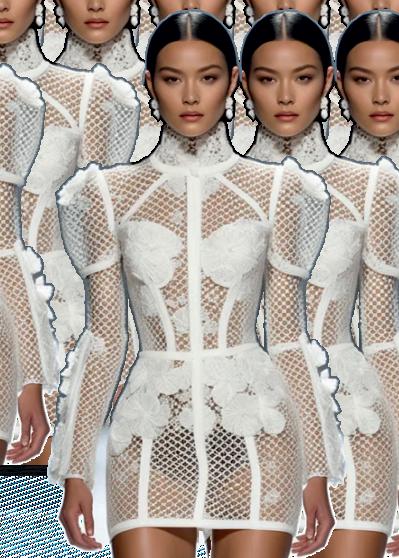
Thefirstandmostdirectimpactof generative AI is in the creative process. Designers are now using AI tools as a digital extension of their imagination By simply providing a text prompt, a designercangeneratehundredsof unique patterns, silhouettes, and fabric textures in a matter of seconds. This ability to instantly visualize concepts helps in breaking through creative blocks and accelerating the ideation phase, which once took weeks.A designer can input a few keywords like "a dress, a futuristic warrior, silk and steel"—and receive a flood of innovative designs, ready to be refinedandbroughttolife.TheAI acts as a tireless apprentice, providing an endless supply of creativerawmaterial.
AI-Powered Trend Forecasting
Fashion has always been about predicting what's next.
Traditionally, this was a manual process driven by trend spotters, runway shows, and market analysis.GenerativeAIis
Transforming this into a
data-driven science. By analyzingbillionsofdata points from social media posts,searchqueries,andstreetstyle photos to sales data and online trends—AI can identify emerging patterns with unprecedented speed and accuracy Analgorithmcanspot a budding trend on a small corneroftheinternetandpredict itsrisetomainstreampopularity long before any human could. This allows brands to make smarter decisions about what to design, produce, and market, reducing waste and increasing profitability
Redefining the Customer Experience
AI's influence extends well beyond the design studio and into the consumer experience. It's making shopping more personal, convenient,andinteractivethanever before.Virtual Try-Ons: Companies are using generative AI to create realistic virtual try-on experiences. Customers can upload a photo of themselves and see how a garment looks on their body without ever having to go to a store or order the item. This technology helps reduce product returns and gives shoppers more confidence in their purchases.Personalized Styling: AI algorithms can act as a personal stylist, analyzing a customer's purchase history, style preferences, and even their body type to offer hyper-personalized styling recommendations. It can suggest complete outfits, new items that complementexistingones,andeven accessories, creating a bespoke shoppingexperienceforeveryuser DigitalAvatars and Models: Brands arealsousingAItogeneraterealistic digital avatars and models. This allows them to showcase new collectionsonawidevarietyofbody typesandindiversesettingswithout thecostandlogisticalchallengesofa traditionalphotoshoot.
RedefiningtheCustomer Experience
AI's influence extends well beyond the design studio and into the consumer experience. It's making shopping more personal, convenient, and
Companiesareusinggenerative AI to create realistic virtual tryon experiences. Customers can upload a photo of themselves andseehowagarmentlookson their body without ever having togotoastoreorordertheitem. This technology helps reduce product returns and gives shoppers more confidence in their purchases Personalized Styling:AIalgorithmscanactas a personal stylist, analyzing a customer's purchase history, stylepreferences,andeventheir body type to offer hyperpersonalized styling recommendations It can suggest complete outfits, new items that complement existing ones, and even accessories, creating a bespoke shopping experienceforeveryuser
Digital Avatars and Models: Brands are also using AI to generate realistic digital avatars andmodels.Thisallowsthemto showcase new collections on a widevarietyofbodytypesandin diversesettingswithoutthecost and logistical challenges of a traditionalphotoshoot. Inanindustryoftencriticizedfor
( (
“We're no longer just designing with a pencil; we're designing with a prompt.”
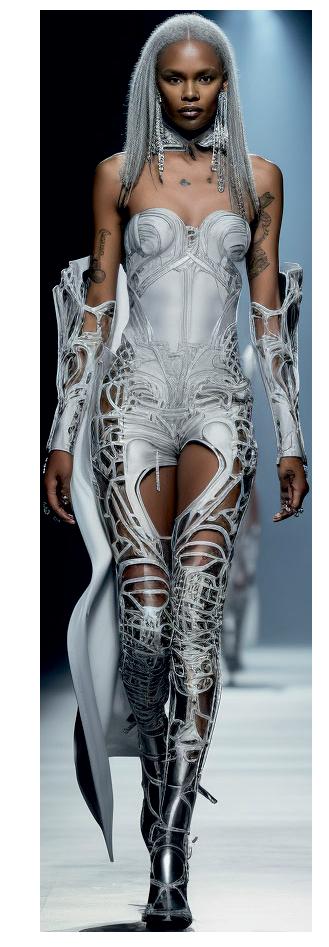
Designers are creating virtual clothing that can be "worn" by avatars in video games,orevenoverlaidonto a person's photo for social media. These digital-native garments allow designers to experiment with forms, materials, and designs that would be impossible in the physical world. This opens up an entirely new market, reduces the environmental footprint of fashion to zero, andcreatesauniqueblendof art and technology The
Sanika Bhujbal www.timesnexus.com
DIGITAL STRIDE
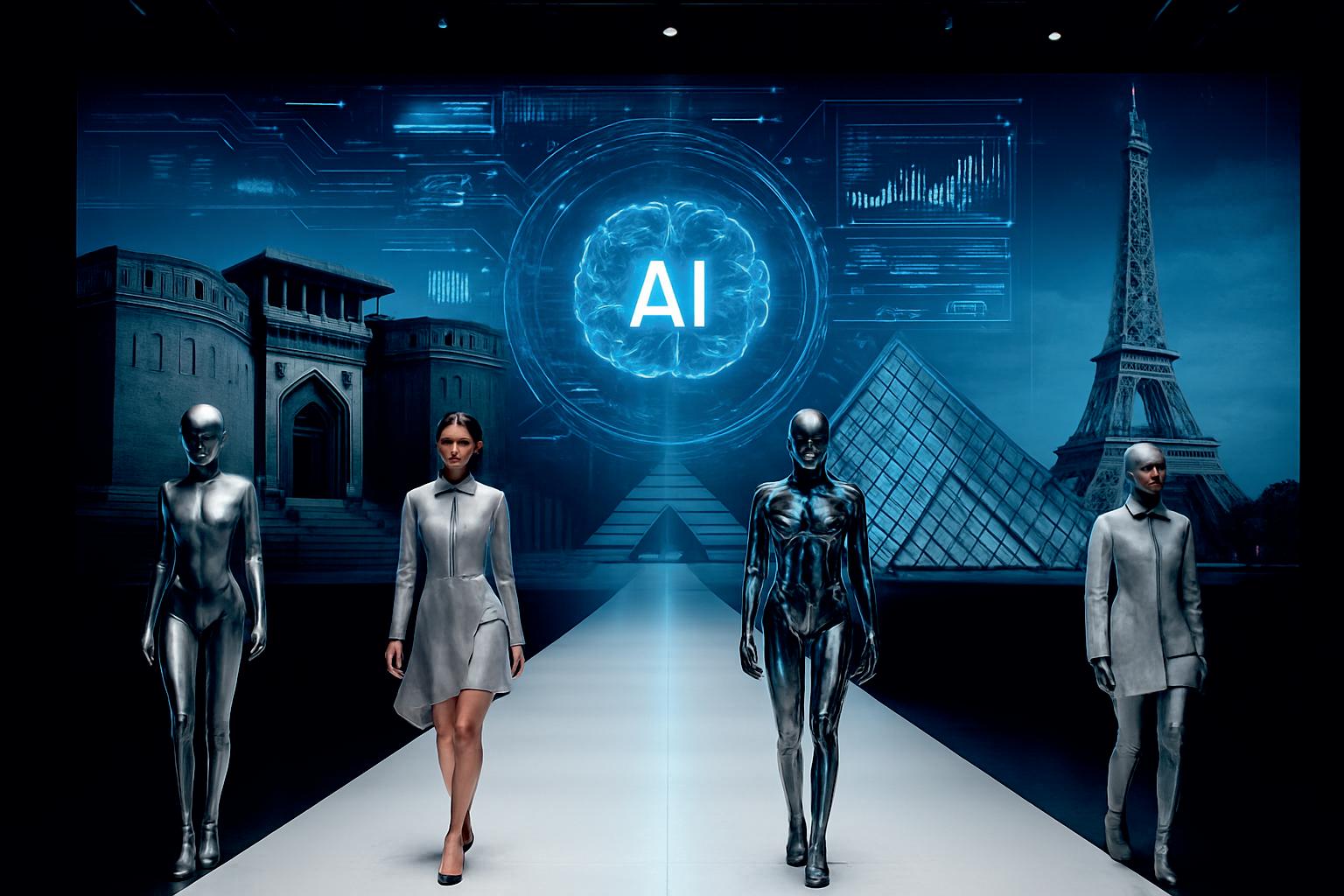
>>From the bustling textile workshops of Pune to the glittering catwalks of Paris, a silent revolution is underway in the world of high fashion.
Artificial intelligence, once relegated to back-end
logistics and trend forecasting, is now stepping onto the runway itself, not in physical form, but as a powerful force shaping every aspect of a fashion show – from the very designs showcased to the personalized experience of the audience. This isn't just a fleeting trend; it's a fundamentalshiftinhowfashionis conceived, presented, and consumedinthe21stcentury ThemostdirectimpactofAIonthe runway is the emergence of AIassisted and even AI-generated
in Koregaon Park inputting a simple prompt – "a flowing evening gown inspired by the monsoon rains of Maharashtra, incorporating traditional Paithani silk patterns." Within seconds, an AI can generate hundreds of unique design concepts,exploringvariationsin silhouette, fabric texture, and embellishmentsthatthedesigner might not have conceived on theirown.Thisdoesn'tmeanthat robots are replacing human designers. Instead, AI acts as a powerful muse and a tireless assistant. It can help overcome creative blocks, explore unconventionalcombinationsof
concepts to life, infusing them with their unique artistic vision and technical expertise. The runway of the future will likely showcase collections that are a true collaboration between human ingenuity and algorithmicpower
Imagine a Pune-based designer who wants to present their collection to a global audience. Instead of the significant costs andlogisticalhurdlesofstaging a physical show in Mumbai or Delhi,theycancreateastunning virtual runway show set against the backdrop of iconic Maharashtrian landscapes,

Sanika Bhujbal www.timesnexus.com
photo credit: AI
GAMIfy
AI TRIVIA TUSSLE!!
Question 1
What is the name of the AI created by Google that famously defeated the human champion in the game of Go?
ANS:---------------------------------
Question 2
What is the process called where an AI learns to create new images, text, or code from scratch?
ANS:---------------------------------Question 3
The word "robot" comes from a 1920 Czech play What does the original word, "robota," mean?
ANS:---------------------------------
Question
Which AI tool is primarily used by programmers to help them write code faster?
ANS:--------------------------------Question
What is the name for the type of AI that learns by being rewarded for correct actions and penalized for incorrect ones, similar to how we train a pet?
ANS:--------------------------------
Question 6
Which AI tool is primarily used by programmers to help them write
AI speaks many languages – Translation systems like Google Translate use AI to understand and convert between 100+ languages almost instantly.
Times AI Nexus 8
PUNE, FRIDAY, AUGUST 16
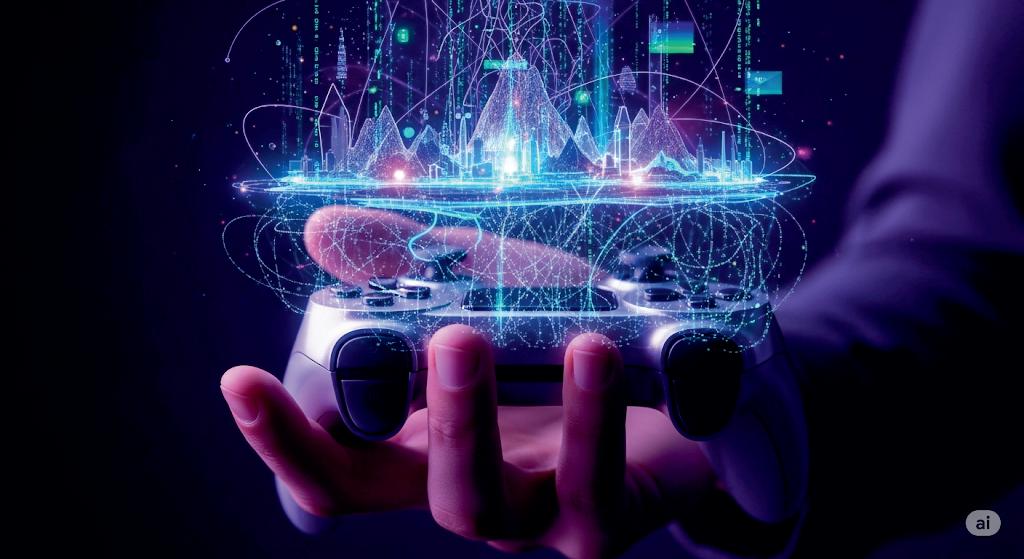
AI in Gameplay
www.timesnexus.com
The purpose of this supplement is to demystify this powerful technology We’ll explore its incredible applications in healthcare, its transformative role in the creative industries, and its ethical implications for ourfuture.Joinusasweexplore howthecreativecodeofAIisnot just a glimpse into the future—it's actively writing it, one breakthrough at a time.As generative AI becomes more integrated into our daily work,
Non-Player Characters (NPCs):
AI gives NPCs their "intelligence " This includes enemies that can strategically flank players, companions that canassistincombat,andsimple villagers that have realistic dailyroutines.
Procedural Content Generation(PCG): AI can automatically generate game levels, maps, quests, and even entire worlds.Thisallows for infinite, unique content, as seen in games like Minecraft andNoMan'sSky
THEFINALPROMPT!
www.timesnexus.com
The purpose of this
supplement is to demystifythispowerful technology We’ll explore its incredible applications in healthcare,itstransformative role in the creative industries, and its ethical implications for our future. Join usasweexplorehow thecreativecodeofAI is not just a glimpse into the future it's activelywritingit,one breakthrough at a time.As generative AI
Generative AI is not merely a tool; it is a creative partner with boundless potential. It offers us an unprecedented opportunity to amplifyhumaningenuity,freeing usfromthemundanetofocuson grander ideas. The future of innovation is a conversation, a
continuous dialogue betweenhumanintuition and algorithmic power
"The most important prompt we will ever give is not to the AI, but to ourselves: to be thoughtful, and courageous in the face of this revolution."
b e c o m e s m o r e integrated into our daily work, the skills that are most valued will also change. Rote memorization and technical execution will
As we have explored throughout this supplement, the true magicofthistechnology lies in its collaboration withus—adoctorguided by data, a designer sketchingwithcode,ora scientist discovering a molecule in an instant. However, with this power comes aprofoundresponsibility We must decide what kind of futurewewanttogenerate.
Animation and Character Creation:
AI can assist animators by automatically generating fluid and realistic character animations, reducing the need for manual keyframing. It can also create realistic character modelsandtextures.
QualityAssurance(QA):
AI is used to automatically test games for bugs and glitches. It can play through a game thousands of times in a short periodtofindissuesthathuman testersmightmiss.
Can you spot the truth from the lies in this week's
1.Fact or Fiction: An AI has been used to compose and perform an original symphony for a full orchestra.
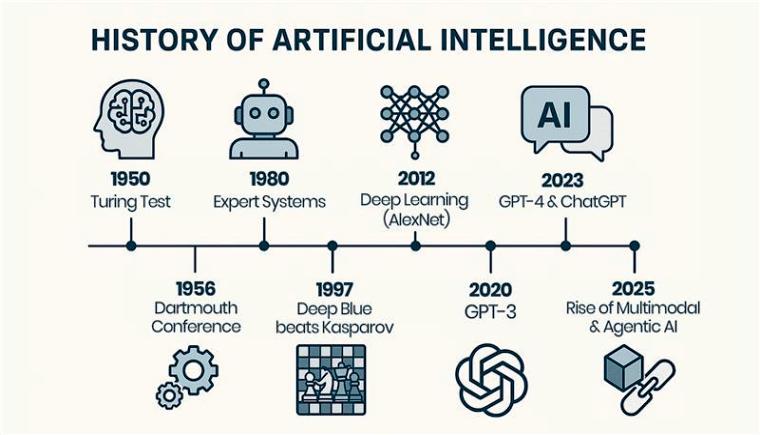
2.Fact or Fiction: An AI has successfully passed the Turing Test, convincing a human that it is a person.
3.Fact or Fiction: AI is being used by scientists to design new, more efficient batteries.
4.Fact or Fiction: There is an AI that has created its own language that humans cannot understand.
5.Fact or Fiction: AI is being used in Hollywood to create entirely new actors that don't exist in real
We must confront the ethical questions of authorship, bias, and truth. The algorithms we buildtodaywilldefinetheworld weinhabittomorrow
TheFutureisBeingWritten
Aswelookahead,thepaceofAI innovation will only accelerate. We will see AI become more
learning and mental health support to predicting the next major medicalbreakthrough.Thecreative possibilities are endless, and the new jobs created by this technology—from AI trainers to ethical oversight specialists—are only just beginning to emerge.The final narrative of this revolution is not pre-written—it's waiting for us toshapeit.ThefutureofAIisnota
Sanika Bhujbal
Sanika Bhujbal