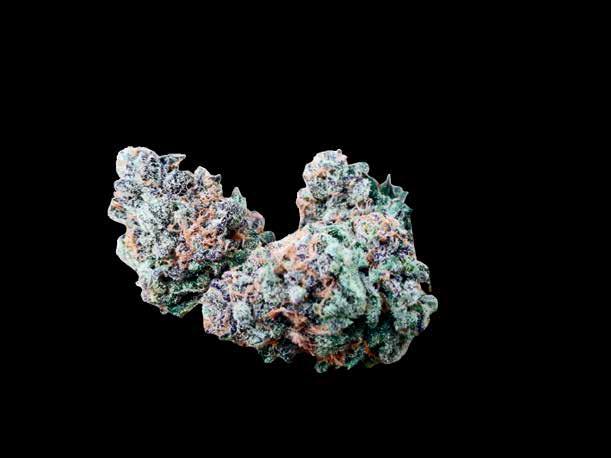

all the fuss? Why the laws, the delays, the contradictions, the counting of plants like we’re dealing with contraband tomatoes?

We all know that cannabis is one of the most versatile plants on the planet. It can be grown in a backyard or across hectares. It feeds industries—textiles, construction, food, medicine—and yet it also feeds something less tangible: a shift in how we feel, think, and connect. That’s the part that makes people nervous. You can build a hemp house and everyone claps. You light up a joint and suddenly we need a task team.
The truth is, cannabis is special because it sits at the intersection of body, mind and environment. It’s not just about getting high, although let’s be honest—that’s a big part of the appeal for many of us. It’s about relaxation, creativity, introspection, relief, connection. It’s about choosing, for a moment, to feel different. And that brings us to the real issue: control.
Because what is being regulated here is not just a plant—it’s consciousness. The right to alter your own state of mind. The right to decide what goes into your body and how you experience the world. That’s why cannabis doesn’t fit neatly into policy boxes. It’s not just agriculture. It’s not just health. It’s
uncomfortable.
The plant is only half the story. The other half—the more interesting half—is the culture. Cannabis culture in South Africa is layered, resilient and, frankly, unstoppable. From rural fields in Mpondoland to urban private clubs, from “under the Dagga tree” to slick shop counters, this culture has survived decades of prohibition and still shows up with good vibes and good coffee. It’s a culture built on sharing. Passing a zol (Remember the bittersweet lockdown memes?). Swapping seeds. Exchanging knowledge. Looking out for each other in a system that has rarely looked out for us.
It’s also a culture that has been criminalised, marginalised and, more recently, quietly (or not so quietly) co-opted. While the doors of opportunity creak open, many of the people who carried this plant through the darkest times are being left outside. That’s not just unfortunate—it’s unjust.
If cannabis is special, then so are the people who have lived with it, grown it, protected it and been punished for it. And this is where we need to get serious.
Because we cannot talk about what makes cannabis special without talking about
the freedom to make choices about our own bodies. We cannot ignore Harm Reduction— meeting people where they are, not where policy thinks they should be. And we certainly cannot continue with drug policy reform that exists on paper but fails in practice.
If we get this wrong, we don’t just mismanage a plant—we miss an opportunity to do something truly transformative.
So, what is so special about cannabis? Maybe it’s not the plant at all. Maybe it’s what it reveals.
About us. About our fears. About our need to control what we don’t fully understand. And about our capacity—if we choose it—to do things differently.
Because at the end of the day, cannabis is not going anywhere.
The real question is: are we ready to meet it where it stands?
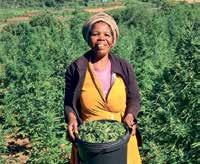
By Myrtle Clark Picture credit Fields of Green for ALL / Jo Lekkading
Edibles, reimagined - familiar ��avours with premium ingredients.


From indulgent treats to refreshing drinks, every product is thoughtfully developed to deliver a re��ned and enjoyable experience. Proudly supplying retail stores nationwide since 2020.



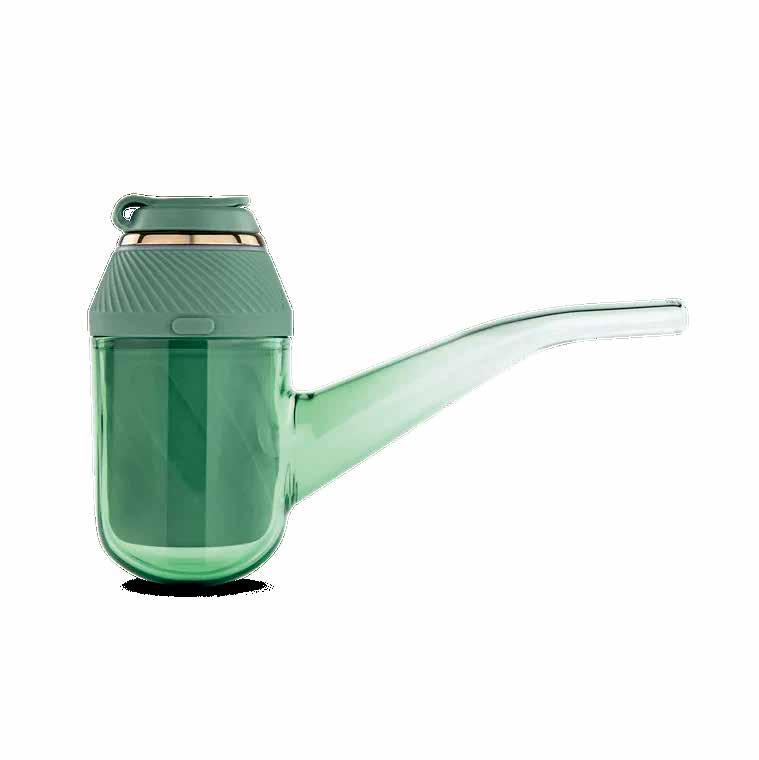










and




Page 8
How to produce HighQuality Solventless Extracts By
Storm Kenmuir
Page 10
Cannabis Justice: a dream deferred By
Garreth Prince

Page 18
The recent history of Cannabis gardening in South Africa By
Natie Ferreira
Page 22
The End of the Vegetative Phase By Cervantes Page 25
Landraces: Cannabis Varieties of the Earth By Dryas
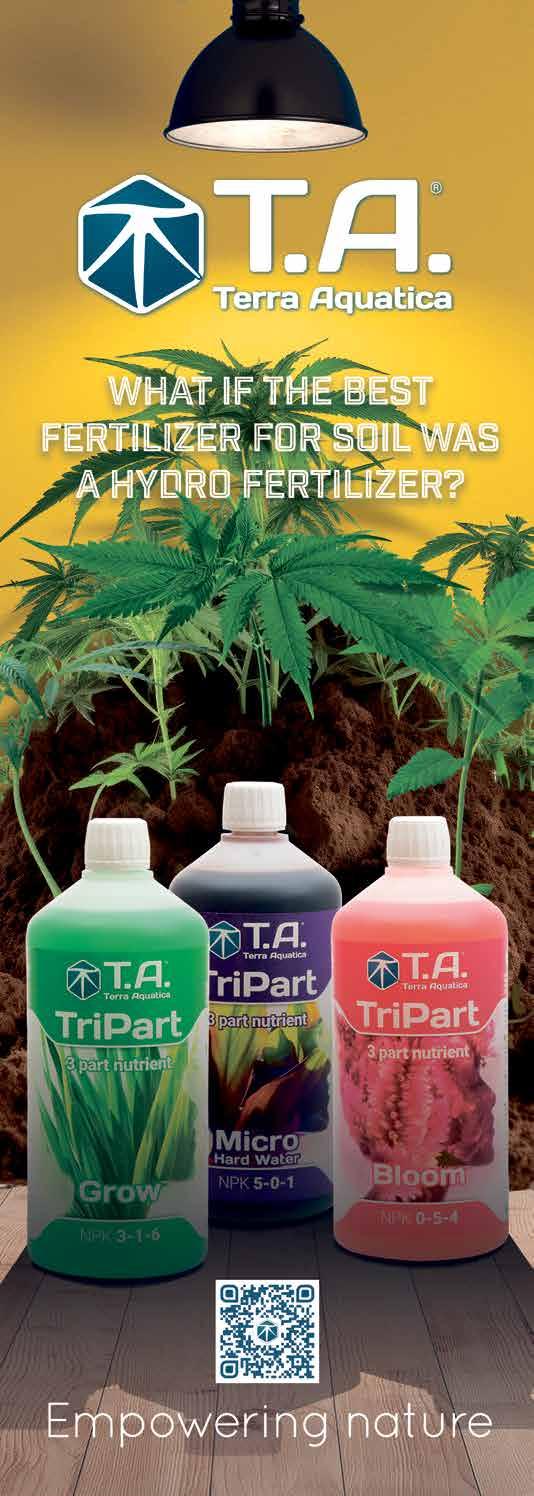
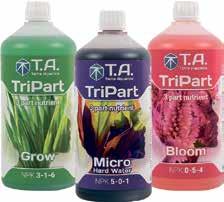
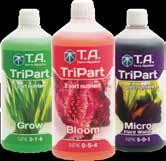
TriPart®, a complete fertilizer that is easy to use and incredibly effective. Three parts designed to precisely meet the needs of your plants, whether grown in soil, hydroponics, or coco.
TriPart® offers more than just basic nutrients. It includes a full range of trace elements and micronutrients, chelated for optimal absorption and stability.
TriPart® is available in formulations adapted to soft or hard water. TriPart® Micro optimizes the calcium content of the solution, helping to prevent deficiency issues commonly encountered with universal fertilizers.
Available in: 0.5 L, 1 L, 5 L, 10 L, 60 L, and even 1000 L.
https://www.terraaquatica.com/mineralfertiliser-solutions/tripart/

Baked & Buttered Infused Pineapple Juice is your perfect balance of flavour and feel— bright, tropical pineapple with a smooth, refreshing finish, elevated by a full-spectrum infusion . Crafted for consistency and quality, it’s available in 100ml, 250ml, and 500ml to suit every moment, from a light lift to a longer unwind. Whether you’re relaxing or socialising, this juice delivers a clean, enjoyable experience with every sip. Keep it chilled, pour it fresh, and enjoy a taste that hits just right.
www.bakedandbuttered.co.za
The uniqueness of Raw Black papers lies in their ultrafine quality, which allows for a cleaner smoke and a more enjoyable experience overall. Integrating lighter, high-quality fibers, these papers prioritize flavor and performance.
www.veloutee.co.za

Indulge in a smooth, tropical twist with King Palm Banana Cream Real Leaf Rolls—crafted from 100% natural palm leaf for a clean, tobacco-free experience. Each pack includes two pre-rolled wraps with a unique “squeeze & pop” filter that releases rich banana cream flavour on demand, delivering a sweet, creamy finish with every puff. Designed for convenience, they’re easy to pack, slow-burning, and fitted with natural corn husk tips for a cooler, smoother draw. Perfect for those who want a premium, flavour-packed session without additives or compromise.
www.sevvan.co.za

Unleash something bold with Canna Kingdom’s handmade Dragon Smoking Pipe. Crafted from high-quality glass with striking swirls of colour, this piece blends artistry with function in a way that instantly stands out. Its detailed dragon design isn’t just eye-catching—it’s a conversation starter. Durable, smooth to use, and built for those who appreciate unique pieces, it’s perfect for elevating your unforgettable. Add a touch of pipe that’s as fierce as it is refined.
www.cannakingdom.co.za

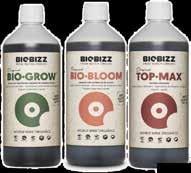
Elevate your organic grow with Biobizz - a range of liquid organic fertilisers of Dutch origin. At their core is Dutch sugar beet vinasse, meeting strict European organic input criteria, and rich in betaine, a powerful microbial activator. Feeding with Biobizz provides the perfect balance of efficiency and longevity: 30% of the nutrients are immediately available to the plant, while the remaining 70% become available over a few days as the soil microbiome breaks them down. This approach feeds the soil microbiome, which in turn feeds the plants - the true essence of organic gardening for heavier, more flavorful harvests.
Hydroponic.co.za




















Taxi Jack column
By Tshepo Modikoane
Sho’left, South Africa. It’s your boy, Taxi Jack. You know the drill: windows down, bass pumping, and that unique winter-warming scent drifting from the rank in Durban or the corner in Diepsloot. Yep, we’re talking about dagga. Now, just like a taxi trying to merge onto the M1 during load shedding, this plant’s journey through our laws has been a bumpy, hooting, half-braking mess. But between March and the end of April 2026? Bru, things got spicy. The government is finally pulling out their map, but the traffic cops (read: the Hawks and SAPS) are still pulling people over for doing 80 in a 60 zone. So buckle up. Here’s the good, the bad, and the gwijo of Mzansi’s cannabis news.

First Stop:
The Government’s “Slow Taxi” (The Positives)
For years we’ve been asking: “If I can smoke it in my yard, why can’t I buy it at the corner café?” Well, it seems the slow taxi of bureaucracy is finally finding a gear. After years of idling at the robot, the engine is coughing back to life. On April 14, whispers from Legalbrief confirmed that a new Cannabis Bill is expected to hit Parliament soon. We’re talking about a proper framework, no more grey areas where one uncle gets arrested and the next one sells openly at the robots. This isn’t just talk anymore. The document is being drafted, the lawyers are sharpening their pens, and the politicians are finally realising that Mzansi has been sitting on a green goldmine. But the real rev of the engine came in March. Parliament finally opened the books during a series of briefings. They told us the legal market is sitting on a potential R14 billion boost. Fourteen billion rand, kanti? That’s more than the entire taxi industry spends on spare clutch
kits, CV joints, and panel-beating bills in a whole year. We’re talking about real money. Real jobs. Real small-scale farmers in the Eastern Cape and KZN finally coming out of the shadows.
The government is looking to raise the legal THC limit for hemp farmers to 2% which basically means farmers can stop worrying about their plants accidentally getting “too strong” for the law. Right now, the limit is so low that even a well-fed plant breaks it. Changing that is like widening the road from a dirt path to a dual carriageway. Down in eThekwini (Durban) , they aren’t playing. On March 20, the municipality launched a Cannabis & Hemp Pilot Programme. Think of it as a “taxi rank” for weed farmers a proper, organised spot where small-scale growers can learn to commercialise legally, without looking over their shoulders. Royal Queen Seeds is helping out with funding and expertise. Durban is trying to become the King Shaka of the herb economy, and honestly? Good for them. And on March 6 Parliament confirmed
the big one: The main Cannabis Bill arrives by 2027. That sounds far, but in government years, that’s like next week. They even asked the public for comments on private use limits how much you can hold, how many plants you can grow in your backyard. For the first time, it feels like they’re talking *to* us, not at us. That’s progress. Slow progress, but progress nonetheless.
But just as you think the rank is relaxing, the blue lights flash. Eish. You see, while the politicians are writing laws for 2027, the police are still working under the old heat. The courts haven’t caught up to Parliament yet. On March 19, KZN cops pulled off a massive bust.R1.3 million worth of cannabis, five suspects in cuffs. That’s the kind of sting that makes a taxi driver check his mirror twice before picking up a passenger who looks too friendly. Then there’s the one that hurts the trust. On March 24, the Hawks
announced that a former police officer a serving member at Port Shepstone SAPS got 8 years in jail for dealing. Half suspended for five years, but still. Eight years. When the man with the badge is the one weighing the bags, no wonder the industry stays in the shadows. No wonder people don’t trust the system. You can’t build a legal market when the people enforcing the law are also brea -
“Taxi
a time”
king it. Parliament even admitted in March that the illicit market is sitting at a wild R36 billion.Let that sink in. Thirty-six billion rand moving in cash, no taxes, no quality control, no worker protections. That’s the money going to the wrong pockets because the legal route is still closed. So our cops are busy chasing street-level guys while the big fishes laugh all the way to the casino on the R21.
The Toll Fee
(What it means for you)
So where does that leave us, South Africa? It’s like a taxi rank where the owner says the rank is open, but the pavement guards still demand a bribe to let you park. We’re in that awkward, swepalicious stage. Positive? The government actually has a map now. Negative? The Hawks are still kicking down doors to make examples. For now, remember: Private use is legal-ish. Buying and selling? Still a no-no. So don’t try to run a spaza shop special until the Bill passes.Keep your six plants at home. Don’t flash your harvest on TikTok. And for God’s sake, if you see blue lights just act normal. Until next time, keep one headlight working and your story straight.
Taxi Jack Driving the news, one rank at a time.

By Myrtle Clark Picture credit: 420 Central Media / Jo LekkaDing
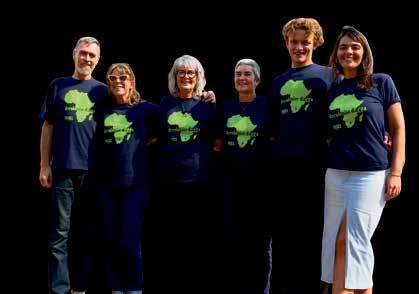
Who doesn’t love a list? Here at Fields of Green for ALL we are so immersed in all things weed that our lives are a rollercoaster of highs and lows, and everything in between. We took some time out to think of something for each letter and came up with this word salad to touch on the complexity of the situation and have a laugh (sometimes) along the way.
















L is for Landrace.
South Africa’s natural treasure. Adapted, resilient, and deeply connected to place. Protect them.
M is for Marijuana.
A word loaded with propaganda. We prefer Cannabis—but language matters, and so does reclaiming it.
N is for Nugs.
The currency of the culture. Big, small, sticky, seedy—each one tells a story.
O is for Oils.

A is for Activism.



If it wasn’t for the indignation generated by a century of prohibition, many activists across our beautiful country would never have been called to find their purpose.
B is for Bergville.
Lest we forget the “1956 Bergville Dagga War,” when 22 men from KwaZulu-Natal were executed after a clash with apartheid police over Cannabis cultivation. This is not just history—it is unfinished business. The last apartheid law.
C is for Constitution.
The supreme law of the land. It is your right to use and cultivate Cannabis in private. Rights matter. Use them.
D is for Dagga. That word. Love it or hate it, it’s ours. Rooted in “dacha,” meaning intoxication, it carries both stigma and pride in equal measure.
E is for Evidence.
The most researched plant on the planet. Yet here we are, still waiting for evidence-based regulation. The “Trial of the Plant” may be part-heard, but the science is not.
F is for Flower.
The part of the plant that everyone is so afraid of—and everyone secretly wants. From backyard grows to boutique jars, flower is where culture lives.
G is for Government.
Slow, confused, and often contradictory. One department says “economic opportunity,” another says “not so fast.” Meanwhile, the people carry on.
H is for History.
Long before prohibition, Cannabis was woven into daily life across Africa. Colonial laws disrupted that relationship—and we are still untangling the mess.
I is for Indigenous Knowledge Systems. Passed down through generations, often ignored by policymakers, yet central to understanding Cannabis in an African context.
J is for Jules.
The late Julian Stobbs, whose legacy lives on in every step forward. This movement is built on real people and real sacrifice.
K is for Kush.
The global glamour strain that found its way into our local scene. Exotic and often a far cry from our hardy landraces.
Health, wellness, industry—depending on who you ask. The lines blur quickly in this space.
P is for Prohibition.
The root of so many problems. Criminalisation has failed. It always does.
Q is for Quality.
In an unregulated market, quality is everything—and nothing. Consumers navigate a maze with little protection. This is where Harm Reduction should lead the way.
R is for Rights.
Human Rights are not negotiable. Cognitive liberty, privacy, dignity—these are not abstract ideas. They are lived realities that Cannabis policy must respect.
S is for Showing Up.
Court cases, community meetings, marches, workshops. Change doesn’t happen on WhatsApp. It happens when people pitch.
T is for Terpenes.
The magic behind the smell, taste and effect. Science meets experience in every puff.
U is for Under the Dagga Tree .
(“All is not what it seems”). Where conversations happen and community is built. Informal, resilient, very much alive.
V is for Victory.
Not there yet. There have been milestones but not a finish line. The real win is a just, inclusive system.
W is for Women.
The backbone of communities and often the unsung heroes of this movement. From growers to healers to activists—women hold it all together.
X is for the X-factor.
That unpredictable spark that Cannabis brings—creativity, connection, sometimes chaos. You can’t regulate that, no matter how hard you try.
Y is for Yield.
From small home grows to rural fields, yield is survival. When policy ignores this, it ignores livelihoods.
Z is for Zol.
The simplest expression of it all. Rolled, shared, passed around. A zol is more than a smoke—it’s a moment.
Our list, by no means exhaustive, reflects a country in transition, caught between outdated laws and emerging freedoms.
(Credit to a very inspirational South African activist, Mark Heywood, who published “In celebration of Freedom: An A to Z of why I love South Africa” in the Daily Maverick for Freedom Day on 27 April 2026.)
By Storm Kenmuir
Ice water extraction represents one of the most refined and technically demanding forms of mechanical cannabis processing. At its highest level, it is not simply a method, but a disciplined system built on deep material understanding and precise environmental control to consistently deliver high-quality results.
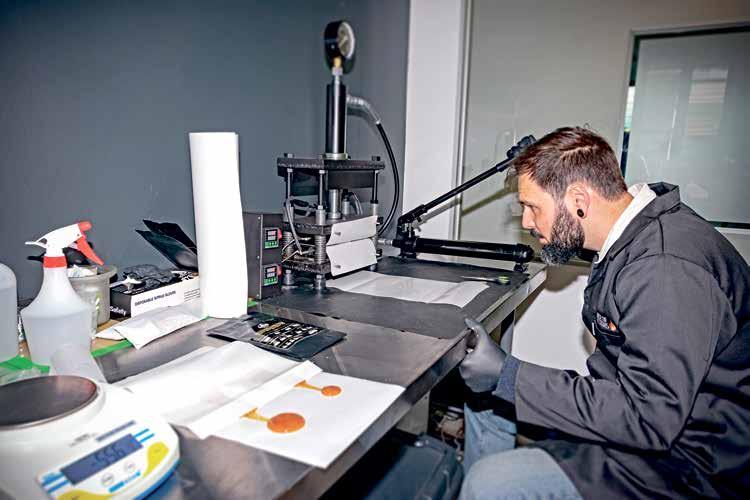
Unlike solvent-based extraction, which relies on chemical interactions to separate compounds, ice water hash operates entirely on physical separation principles. The goal is to isolate trichome heads, which are the resin glands containing the desirable compounds, through cold temperature, controlled agitation and calibrated filtration. While the concept is straightforward, achieving clean separation without contamination requires a highly refined workflow. The process begins with raw material selection, as this ultimately defines the ceiling of quality. Not all cultivars are suitable for solventless extraction.
Resin characteristics such as trichome size, density, head integrity and stalk brittleness directly influence wash performance. Cultivars that produce large, well-formed trichome heads with abscission points where the trichome stalk meets the gland, such as GMO, Chem Dawg, TMZ and Dulce de Uva to name a few, tend to perform significantly better. For this reason, careful pheno selection and alignment between cultivation and extraction goals are essential.
Material is ideally processed as fresh frozen, meaning it is harvested and immediately frozen to preserve the volatile terpenes. This approach captures the plant at peak expression, maintaining its terpene profile in its most
intact state. While dried and cured material can be used, fresh frozen inputs consistently yield superior terpene retention, brighter flavour profiles, and more dynamic resin behaviour during processing.
The material is then processed in an ice water wash, where temperature control becomes critical. Maintaining consistently low temperatures (1°- 3°C) ensures that trichome stalks become brittle, allowing the heads to detach cleanly from the plant material. If temperatu-
Over-agitation introduces contaminants such as chlorophyll and fine particulates, ultimately compromising the final product. For this reason, wash cycles are carefully timed and often repeated in controlled sequences, allowing for the progressive extraction of different resin grades across multiple passes.
Following agitation, the wash water, now containing trichome heads in suspension, is passed through a series of micron filtration bags, separating material based on particle
“Throughout the entire workflow, process control and cleanliness remain fundamental”
res rise, resin can become soft and sticky, increasing the likelihood of smearing ruptureing. Stability at this stage directly impacts both yield and overall quality.
Agitation in this step is one of the most nuanced phases of the process. The approach must be deliberate and controlled: enough movement to encourage trichome detachment, but not so much that it breaks down plant matter.
size. A typical configuration includes a 220µm work bag to contain plant material, followed by collection bags stepping down through 160µm, 120µm, 90µm, 73µm, 45µm and 25µm. Each micron range captures a different fraction of resin. Rather than treating these as fixed quality markers, we evaluate each fraction relative to the cultivar, understanding that optimal expression varies depending on trichome size and structure.
Once collected, the wet hash enters a critical handling phase. At this point, moisture presents a significant risk to both stability and microbial integrity. The resin is therefore carefully broken down into fine granules, increasing surface area and allowing for more efficient and uniform drying. This step is often overlooked, but it plays a crucial role in preserving the quality of the final product.
Drying is executed with precision.
While traditional air-drying methods can be effective under controlled conditions, the preferred approach is freeze drying, where moisture is removed through sublimation in a vacuum environment. This technique preserves terpene content, prevents oxidation, and maintains the structural integrity of the resin heads. The result is a cleaner, more stable product with improved terpene retention.
Throughout the entire workflow, process control and cleanliness remain fundamental. Water quality must be consistent and free of contaminants, environmental conditions must be tightly managed, and all equipment must adhere to strict hygiene standards. These variables, while often understated, are critical to achieving repeatable, high-quality outcomes across batches.
Post-drying, the hash may be further refined depending on the intended end product. High-grade fractions can be retained as fullmelt, while others may be pressed into rosin using controlled heat and pressure. This additional refinement allows for further separation of desirable compounds, enhancing clarity, consistency, and usability while remaining entirely within the solventless paradigm.
At every stage, the methodology reflects a core principle: consistency is achieved through control, observation, and continuous refinement. Small variables like temperature fluctuations, agitation intensity, filtration strategy, and drying technique are not incidental; they are the difference between average and exceptional results.
This is the standard upheld in every workflow at The House Of Extractions. For those looking to implement or refine this approach, we provide direct access to the knowledge and practical experience required to execute ice water hash extraction at a professional level. Through workshop intensives, consultancy, and online education, we offer a pathway from theory to application, helping cultivators and processors develop high-quality solventless systems.

By Nabeel Khan
Today, bottled silica nutrients are as commonplace as coco coir in grow shops the world over. In South Africa, the dominant formulation is a water-soluble liquid, most often potassium silicate.
I would not go so far as to dismiss silica supplementation as just another snake oil circulating in the burgeoning cannabis horticultural economy. On the contrary, these bottled liquids do function as a genuinely bioactive structural nutrient: a plant “superfood” that interacts with cannabis physiology in ways that are well documented in crop science.
My bone of contention lies not in silica supplementation itself, but in the extent to which South African growers collectively under-appreciate the subterranean source that gave us a hidden edge in the first place. Namely; the interplay between our silica-rich soils, a billion-year geological inheritance, and cannabis, a plant cultivated here as medicine for at least a thousand years (long before the border guards, chemists, and foliar-spray atomizers arrived!)

The billion-year question
How did we get to a point where the living knowledge of our soil practices has been folded into a familiar neo-colonial loop: local minerals extracted, processed into refined inputs, and then returned to us as packaged products from foreign mega-conglomerates?
I am not attempting to offer a complete answer here.
A more useful exercise is to take a step back and appreciate how South Africa’s different regions hold and express silica — and how growers, over time, have translated the silica beneath their feet into green in their pockets.
From Desert Sand to Living Soil: Silica Across South Africa’s Drylands
In the arid zones of the Northern Cape, silica exists in its most stripped-down form — vast quartz sands concentrated through deep time erosion and wind sorting, with almost no organic buffering. Here, silica is essentially static, locked in dune systems shaped by wind rather than biology, and plant-available silicon only emerges when a living soil system is introduced to reanimate an otherwise inert mineral base.
In the semi-arid interior — spanning the Free State and Northwest — silica becomes a tran -
“How growers have translated the silica beneath their feet into green in their pockets?”
sitional resource, cycling through recycled sandstone systems and hydrothermal quartz veins that add structural diversity but still depend on biological processes; microbial activity, root-driven acidification, and seasonal moisture pulses slowly unlock silicon from otherwise stable mineral matrices.
In the Mediterranean climate of the Western Cape, silica reaches its most extreme surface purity state, where ancient quartzitic landscapes have been reduced to dominant sand systems that are structurally stable but biologically poor.
Growers exploit these rich silica deposits by constructing soil profiles from the ground up rather than relying on native topsoil. Distinct layers of organic matter and mineral inputs are arranged so that each performs a specific role: organic material drives microbial life and nutrient cycling, while silica sand provides structure, drainage, and long-term stability. Over time, roots and microbes move between these layers, linking them into a single functioning system and gradually weathering surrounding silicate materials. This slow biological activity releases small amounts of plant-available silicon into the soil solution as monosilicic acid. The result is a deliberately constructed living medium where geology provides the scaffold and biology performs the activation, as growers carefully engineer growing conditions from layered components.
In the Eastern Cape and KwaZulu-Natal, especially along the wetter Wild Coast, silica enters the soil through continuous cycles of erosion and transport. Quartz-rich material is carried by rivers, reworked along coastlines, and deposited into floodplains and dunes, while organic matter builds rich topsoils above.
In Limpopo, warmer conditions and more intense weathering accelerate the breakdown of silicate minerals, creating soils where silica is more actively cycled between mineral and biological phases.
Here, growers work with natural layering rather than rebuilding it. Cultivation often follows riverbeds and floodplains, where sand
and gravel layers provide sub-irrigation and steady moisture, while organic matter accumulates naturally. These systems function as self-renewing soils, with hydrology and biology continuously cycling nutrients and silica with minimal intervention.
In Mpumalanga and Gauteng, silica is primarily stored in ancient quartzite formations of the Transvaal basin.
In Mpumalanga, this silica is largely locked within resistant rock and only becomes available through slow weathering of surface soils, where roots, microbes, and organic acids gradually release trace silicon into solution
Gauteng presents a more fractured and mixed system, where faults and intrusions increase surface area and create more pathways for weathering, making silica mobilisation more responsive to biological activity.
Growers in these regions shift silica from a locked geological form into a more reactive soil system. Adding local quartz or river sand improves structure and drainage, while organic zones drive microbial activity and mineral breakdown. The sand is not a nutrient source, but it increases the interface between water, roots, and minerals, enabling slow biological mobilisation of plant-available silicon.
Silica, then, is not just an input — it is a record of place. To treat it as a commodity alone is to miss the deeper system it comes from: landscapes shaped over billions of years, and cultivation practices that evolved in direct conversation with them.
If cannabis is to be meaningfully re-integrated into South African agriculture, the task is not simply to optimise inputs, but to re-learn context — to recognise that soil is not neutral, and that its geological memory still shapes plant potential.
In that sense, sovereignty in cultivation begins not with supply chains, but with understanding what the ground has been trying to tell us all along.

By Garreth Prince
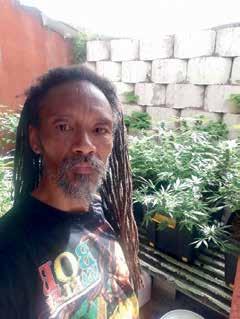
South Africa was one of the first countries in the world, together with Egypt, to agitate for global criminal Cannabis laws, so it was poetic justice when in 2018 we became the first country in the world to have a Nationwide regime of Cannabis freedom, albeit for private use only, by adults. As the Rastafari who challenged the law 20 years earlier, I was eager to implement the adage of Peter Tosh who sang “Legalize it and I will advertise it.”
South Africa is one of those countries that has a history of licit Cannabis use before the advent of the international treaties, and the herb was an important economic and cultural asset of indigenous South Africans. This historic usage of Cannabis allows us to adopt a more liberal Cannabis regime which do not have to include penal regulation, but

sadly our government continued to hold on to the colonial thinking around Cannabis. My professional career as a lawyer was put on hold because I refused to denounce my culture and reverence for Cannabis. I was declared not fit and proper to practice law; because my insistence to use Cannabis (which was prohibited then) was seen as bringing the law into disrepute. The Cape law Society held that only when a valid law is put in place could I practice as a lawyer. That was 28 years ago. It is now 8 years after the constitutional court judgment; yet there is still no valid law in place and I am still in a professional Robben Island with respect to my career. The saying justice delayed is justice denied is nowhere truer than in relation to Cannabis.
Because the issue of Cannabis is polycentric; the constitutional court did not want to be seen as prescribing to the legislature how they should go about framing the new laws;

and therefore gave a very minimalistic judgment where they found unconstitutionality only on the ground of privacy and explicitly said that they did not intend to legalize dealing in dagga. The Cannabis law was challenged as unconstitutional on several other grounds; but the court did not reach those grounds and specifically rejected the request to deal with the equality right because they said the right was not adequately
pleaded. I argued that an arrest simultaneously impacted my right to equality, dignity, and freedom. Privacy was a secondary concern in my pleadings. Arrest is prima facie unlawful under our law and once an arrest is proven, the state has the burden of justifying the arrest. It was undisputed that all of the applicants were arrested, yet strangely the court required more.
The apex court’s reference to them not intending to legalize dealing; obviously meant that it was Parliament’s duty to deal with the issue of dealing; yet Parliament misconceived the nature of this finding and interpreted the judgment of the court as meaning that dealing could not be allowed. This proved to be a turning point in the new law and misguided the legislature to not provide a legal source of Cannabis for adult citizens.
This is a fatal flaw in the new Cannabis law. It would seem that the legislature and the courts occupy a different existential reality then that of ordinary South Africans. They seemingly forgot that Apartheid’s spatial legacy is such that the majority of urban dwellers do not have the space, time, skills, or resources to cultivate Cannabis, so the right to use, possess and cultivate is illusory for them, without a legal source of Cannabis. What the court gave with their right hand, they took away with their left, because a right to use Cannabis, without a right to buy it, is illusory.
Sadly, because the injunction to change the law came from the court and did not come from government initiatives; the state acted like a child that got told to do chores after receiving a scolding. To say that they were reluctant would be an understatement. On 31 March 2026 it was 9 years since the Western Cape high Court held that South African drug laws were unconstitutional in relation to Cannabis; and that the government had to reasonably accommodate the Cannabis community by respecting, protecting, promoting and advancing the rights of our community. Sec 237 of our constitution says that the state must act diligently and without de -
lay when developing laws, yet after 9 years the law is still inchoate and there has been no justice or positive forward movement for our community. Instead, more than 1.5 million people have been arrested since the Western Cape High Court judgment on Cannabis related offenses. Instead of putting
South Africans to work our government has chosen to put our citizens in holding cells.
Bearing in mind that dagga, as the international herb is fondly known in South Africa; has several applications such as in housing, textiles, fiber, biodiesel, energy, food and medicines, we were excited as a community to work with the government to develop a legislative blueprint that could serve as a beacon for the rest of the world. Accepting that socio-economic justice for the majority of people in South Africa remain a fleeting illusion; something that is pursued but never attained, one would have thought that the government would jump at the chance to use dagga, or Cannabis, to assist them to develop a new social compact with the people whilst simultaneously enabling themselves to fulfill the promises they made to the masses 30 years ago. Millions of people still
Department of Justice, who decided against it. The 2nd version of the bill included commercial clauses and cultural exemption provisions and the public made comments on them but these clauses were unilaterally removed from the final version of the bill, without any feedback or justification to the public. The Department of Justice unilaterally decided that Cannabis would continue to be regulated via the criminal penal code and that there would be an absolute prohibition on dealing in Cannabis, with no exemptions even for customary or cultural usage. These decisions were not informed by any rational or legitimate government objectives. They were arbitrary.
A legislative regime that purports to guarantee Cannabis rights to users, but which fail to provide for a legal source of Cannabis whilst maintaining an absolute prohibition is
Despite the fact these two substances cause 100.000 deaths yearly; and cost our economy nearly R 300 billion per year, no one is considering banning alcohol or tobacco, yet Cannabis, which causes no recorded deaths and which can actually be an economic plus; is still banned and not industrially activated.
Apartheid was premised on the notion that one group of people were superior or more deserving of benefit than others. On the basis of immutable characteristics, like color, class or creed; some were afforded benefits whilst others were saddled with burdens. This was immoral in principle unworkable in practice, and an insult to the Author of Life. The same can be said of the new Cannabis laws in South Africa. The government distinguish between hemp, dagga and medical Cannabis, but their justification for this differentiation is irrational. It is based on

do not have adequate housing, food, clothes or jobs and Cannabis allowed us to provide within the basic needs of people as well as providing economic opportunities for small farmers and traders.
The legislative process has sadly been a complete sham and the dagga community was never shown the respect and dignity as the community of interest and our wishes and concerns as a community were totally ignored in the final product. Parliament adopted a Public Participation Framework in 2019, which require informing, consulting, involving and feeding back to communities; but these injunctions were totally ignored when drafting the Cannabis laws. The Bill was only published in Afrikaans and English and the only interaction with our community was online, which immediately marginalized millions in rural communities who do not have access to the internet. There were no roadshows, physical public hearings or advertising campaigns about the new law. Online Public Hearings were only held in English and not once, during the legislative process, did we feel respected or that our concerns were being listened to or meaningfully considered.
The most important decisions; namely whether Cannabis was to be regulated via the criminal penal code or via an administrative regime of fines like traffic offenses, and whether dealing in Cannabis would be allowed, were unilaterally taken by the
simply unlawful. It does not lie in the mouth of any democratic government to require of citizens to risk their freedom, dignity and job security if they want to exercise a right that is supposedly guaranteed under law.
Our law dictates, since 1 October 2015, that every bill, policy or regulation that seek cabinet approval must be accompanied by a Socio- Economic Impact Assessment Strategy, (SEIAS) which is similar to a white or green paper. The purpose of a SEIAS is to prevent unintended consequences, whether fiscal or sociological. The Government did one for the Tobacco Amendment Bill of 2020, but failed to do one for the Cannabis Bill. This demonstrates naked preference or arbitrariness, in violation of Sec 9(1) of our constitution which guarantee equality before the law. The very concerns we complained in the public participation process would have been addressed if a comprehensive SEIAS was done.
There is no normative difference between Cannabis, tobacco and alcohol. They happen to be the most used recreational substances on earth, but unlike tobacco and alcohol, which are used almost exclusively for recreational purposes; Cannabis is an economic multiplier and this country’s most valuable natural resource. Cannabis is grown predominantly by indigenous South Africans, whereas tobacco and alcohol production are controlled by white South Africans who owns the means of production.
THC content which is not what the international treaties recommend. Our government have developed regulatory frameworks for hemp and medical Cannabis but none for dagga. There are commercial pathways for hemp and medical Cannabis but none for dagga. This is patently arbitrary in that the apex court instructed the government to develop a regulatory framework for dagga, not for hemp or medical Cannabis. A holistic legislative framework would obviously have catered for all three components but the current framework is disparate and disjointed as opposed to holistic and integrated.
There has been flagrant disregard for basic legal principles and constitutional values in the making of the Cannabis laws and regulations which has forced our community to go back to the courts to demand that we get effective relief. I have filed papers in the Western Cape high courts to demand urgent relief for the Cannabis/dagga community and to get government to coordinate their activities like the constitution dictate in order to deliver the justice we deserve in this community. It is a travesty of justice that a country like Canada have collected over 3billion Canadian dollars in tax revenue since 2018 but South Africa have imprisoned 1.5 million people which probably cost our government 3 billion Rands in wasted expenditure. Justice delayed is justice denied and the green dream remain deferred.
By Leela Baer
Social Clubs have been popping up all over South Africa since the 2018 Constitutional Court Ruling granted adults the right to have and use cannabis in private spaces. Social Clubs are private, safe spaces where people can enjoy their puff or edibles of choice, hang out, and find community.
Harm Reduction has become something of a buzzword to market Social Clubs in recent times. But, what does Harm Reduction really mean, and how can Social Clubs help their members to reduce harm?
Simply put, Harm Reduction is about reducing the legal, social, and health harms associated with substance use of any kind. Legal harms come largely from prohibition as well as slow reforms. Social harms are seen in the stigma and discrimination people face for using substances. Health harms are those that directly impact a person’s wellbeing, and can vary as greatly as individuals do.
Here’s how Social Clubs can play an active role in reducing the harms associated with cannabis use, keeping their members safe while educating the communities they exist in.
Social Clubs provide cannabis users and the curious alike safe spaces in which to practice their Constitutional Rights to have and use cannabis in private spaces. Social Clubs rely on legal interpretations of both the 2018 Constitutional Court Ruling and the 2023 Police Directive on Cannabis-related Matters.
Private spaces are defined as “any space that the public does not have access to as a matter of right” in the directive. It further outlines that “a person does not need to be an owner of a space for it to be their private space” and that “more than one person may have ownership rights to personal and private cannabis”.
Ethical Social Clubs are run by members for members, all who have to be approved. Full tracking and tracing of every bit of plant, edible, and extract from grower to producer to end user ensures safe use. Ultimately, Social Clubs enable a system of sharing within the ambit of current laws and policies, reducing illicit trading and associated legal harms.
Despite this, legal harms like unlawful arrests, raids, and police harassment continue.
Good Social Clubs will always assist their members should they face issues with law enforcement of any kind for their cannabis use, cultivation, and possession. Should anything
happen at a Social Club involving the police, member safety must be prioritised.
Of course, a Social Club can best support their members if they all know their rights. Members and Social Clubs should also understand that staying calm is the best way to reduce harm, especially when cops are unruly.
Social Clubs can play a crucial role in helping members understand what their rights are around cannabis alongside what they can and can’t do when the cops rock up.
Social Harms
Most cannabis users are familiar with social harms like stigma and discrimination. Much of this is borne out of the prohibition era. Dated perspectives around cannabis persist even as cannabis is becoming more socially acceptable thanks to its decriminalisation.
Social harms can be felt in our workplaces, with our families, and even within our communities. Social Clubs offer members a safe space to escape stigma while educating the communities they exist in.
For many, Social Clubs are a home away from home where they can be themselves without judgement.
The communities in which Social Clubs exist get to see first-hand that cannabis users are regular people who choose to enjoy a substance with far less documented harms than more socially acceptable options like alcohol.
For those that have found cannabis while leaving other substances, Social Clubs offer a great alternative. It is incredibly important for Social Clubs to create welcoming environments where members can enjoy their new chapters in life, free from judgment of their past and present choices.
Cannabis is not without harm, and it is definitely not for everyone. A good Social Club will always recognise this, and welcome members to have a good time no matter how they use the plant, if at all.
While health harms are relatively low with cannabis, bad times do happen. Whether someone hits the greenies due to not eating before consuming, experiences interactions with medications, has underlying health conditions, or just a bad day, a good Social Club will support them to feel well again.
Social Clubs can help prevent health harms by being knowledgeable about terpenes and cannabinoids, and assisting members in their choices as well when things go south.
From flower to dab, quality over quantity is always the safest way to reduce most health harms. Social Clubs who focus on what their members get rather than what the owners can pocket will always have happy, healthy members who know they are safe in the club and beyond.

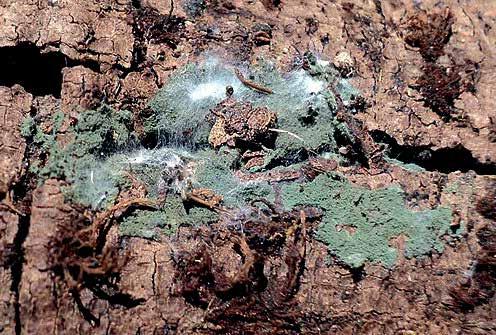
Plant growth-promoting fungi are a heterogeneous group of nonpathogenic fungi found in the soil, specifically in the rhizosphere, on the root surface, and within the roots of plants. PGPF fungi establish mutualistic relationships with their host plants, providing them with a wide range of benefits. They improve nutrient uptake, stimulate root development, increase plant vigor, and protect them from pathogenic microorganisms. Among the PGPF fungi used for marijuana cultivation, the Trichoderma genus is the most common.
Trichoderma is a genus of filamentous fungi belonging to the Hypocreaceae family. It is a cosmopolitan fungus, present in all soil types around the globe. It was first described by mycologist Christian Hendrik Persoon in 1794. Since then, 88 different species of the Trichoderma genus have been identified. This type of fungi is able to rapidly colonize diverse substrates in a variety of environmental conditions. Many Trichoderma species are avirulent and opportunistic symbiotic fungi; in other words, they can establish mutualistic relationships with plants without causing them harm. One aspect that
Trichoderma has a tremendous ability to positively influence root architecture. It's not yet clear how it exerts this influence, but it's well known that Trichoderma colonizes plant roots and stimulates their development. The root system grows strong and vigorous, its surface area dramatically increasing along with the number and thickness of root hairs, consequently increasing the plant's ability to absorb water and nutrients from the soil.
One of the most interesting benefits of Trichoderma is its ability to make a wide range of nutrients available through various biological processes such as chelation, mineralization, and
makes Trichoderma very interesting is its ability to secrete a wide range of substances, such as hydrolytic enzymes and secondary metabolites, that are beneficial to plants.
In agriculture, Trichoderma is primarily used as a biocontrol agent for fungal diseases, including Fusarium, Pythium, and Rhizoctonia. Trichoderma's effectiveness against parasitic fungi involves a series of mechanisms: mycoparasitism, competition, activation of the RAS, and antibiosis.
Mycoparasitism is a method of direct attack on pathogens through the secretion of hydrolytic enzymes that damage their cell walls and the development of mycelium within their organism, leading to their death. Competition is a defense mechanism characteristic of the rhizosphere, in which fungi of the Trichoderma genus colonize the substrate and extract vital nutrients from the pathogen, thus damaging it. Antibiosis is a system through which Trichoderma releases substances that alter the metabolism of parasites and inhibit their development, rendering them harmless to plants. Through the secretion of secondary metabolites, Trichoderma is also able to activate the plant's SAR system, acronym for Systemic Acquired Resistance, an endogenous defense system that involves the entire plant against the attack of pathogens.
fically in powder form, mixed with inert material. Inoculation is the most common method; during transplanting, the powder is distributed at the bottom of the hole where the plant will be planted, in contact with the roots. Another method involves mixing the Trichoderma with the entire substrate during its preparation. It can also be applied by irrigation, mixing it with the nutrient solution. Foliar applications are another method of use. The most effective way to use Trichoderma is to sprinkle it directly on the seeds before germination. The application doses of Trichoder-
ma vary depending on the manufacturer.
The most commonly used Trichoderma strain for marijuana cultivation is Trichoderma harzianum.
The use of PGPF in high-yield medicinal plant cultivation has great potential, as it can completely replace synthetic fertilizers and pesticides, and with zero environmental impact, it makes marijuana cultivation more sustainable.
solubilization. In the first case, Trichoderma produces siderophores, low molecular weight substances capable of binding with iron, converting it into a form that plants can absorb. Mineralization is a process by which nutrients are released from the organic matrix, transforming them into simple inorganic compounds that are readily available to plants. Phosphorus solubilization is a very important biological process because plants require large amounts of this element throughout their life cycle. Soil is rich in phosphorus, but its availability is limited due to its fixation in the form of insoluble compounds. Trichoderma is able to release enzymes and organic acids that convert phosphorus into soluble forms, making it available to plants.
The benefits of Trichoderma aren't limited to the rhizosphere; when applied to the above-ground parts of the plant—i.e., branches and leaves—it can increase photosynthesis. Be careful when applying foliar sprays; some studies have shown that these microorganisms remain residual in the inflorescences even after they dry, potentially posing a health risk.
Trichoderma can be applied at any stage of marijuana cultivation, although it is most effective when used from the beginning. Trichoderma fungi are primarily sold in solid form, more speci-


Stoney Tark
There are many ways to grow cannabis indoors, and one of the more advanced yet rewarding techniques is known as SCROG, or Screen of Green. If you’re already familiar with the SOG (Sea of Green) method, SCROG is its more meticulous version that focuses on maximizing yield from a smaller number of plants through strategic plant training and a long vegetation period.
In this article, you’ll learn how SCROG works, the training techniques involved, and the key benefits and challenges of this method, the best strains to use including my top tips.
What Is a Cannabis SCROG?
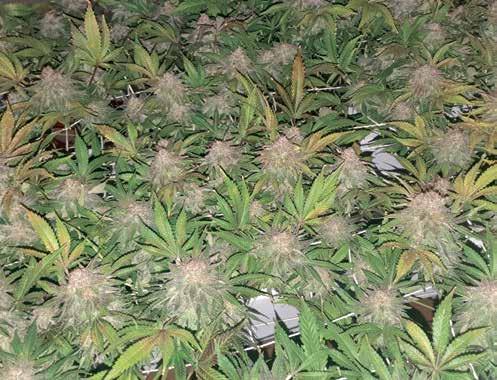
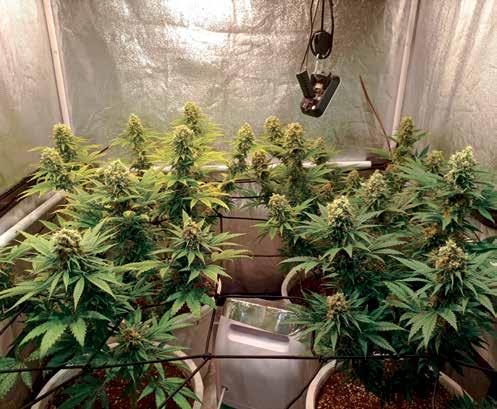
SCROG, short for Screen of Green, refers to a technique where cannabis plants are trained to grow horizontally through a screen or net. The idea is to create an even canopy with multiple bud sites exposed to optimal light, while removing growth below the screen to focus energy on top colas.
A screen (net, chicken wire, bamboo frame, or trellis) is placed above the plants.
• LST is used to guide branches through the screen during the vegetative stage.
• The screen helps distribute light evenly across all bud sites.
• Everything below the screen is pruned to direct growth energy upwards.
Benefits of the SCROG Method
A well-trained SCROG setup with 1–4 plants can match the output of a 9–12 plant SOG grow.
• The even canopy allows light to reach all buds evenly, improving quality and density.
• SCROG helps growers master advanced
training techniques and better understand plant behavior.
Training Techniques Required for a Successful SCROG
Cannabis plant training plays a major role in the outcome of a SCROg project. In order to build strong, high-yielding plants for a SCROG setup, you’ll need to use several training techniques as covered below.
Cutting the main stem encourages the plant to produce multiple colas instead of one, promoting a bushier structure. Repeated topping increases the number of dominant growth tips.
Low-Stress Training (LST)
Gently bend and guide branches through the screen to maintain an even canopy. LST helps redirect growth and light exposure to all bud sites.
Pruning and Defoliation
Remove all growth below the screen to concentrate the plant’s energy on top bud
production. This should be done progressively to reduce stress, or in one major pruning session during the veg stage.
Super Cropping
This high-stress technique involves bending and slightly breaking branches to strengthen stems and increase nutrient flow. The plant responds by building a thicker, stronger knuckle at the bend point.
Strain Selection:
Best Cannabis Genetics for SCROG
Not all strains are ideal for the SCROG method. Sativa-dominant hybrids typically perform best due to their natural height, stretch, and branching patterns. However, indica strains can still work well if managed properly.
Avoid strains with extremely short internodes or minimal stretch unless you're experienced with aggressive training. Indica leaning plants may still work well, however it is best advised to work with strains that have a larger internodal spacing.
My Top Tips for SCROG Growers
Top Tip #1 : Set the Right Screen Height
Position your screen 45–60 cm above the pots. Adjust based on plant growth, but this range offers the best training access and canopy development. You can always adjust the height of the net if necessary.
keep the plants in vegetation for between 8-10 weeks. During this time you should be applying training techniques every week.
Top Tip #3 : Choose the Right Net Size Use a net with 3-inch square spacing (chicken wire works well). This allows branches to grow through without restriction. Using the wrong size net spacing can result in plants become damaged when being pushed through anything less than 3 inches squared.
Top Tip #4 : Allow Recovery Time Between Training
Always give your plants time to recover between training sessions. Around 5 days between stress techniques such as topping, super cropping and LST. You want your plants to become as sturdy, thick and strong as possible whilst training them through the net.
Top Tip #5 : Choose Suitable Genetics
Stick with sativa-dominant hybrids that naturally grow tall and branch out well. Indicas can work, but require more management during the flowering phase, but from my experience hybrids are your best bet.
Top Tip #6 : Plenty of Air Flow
Due to the fact there will be a high number of fat colas growing through the net, you want to ensure that you have plenty of fresh air during 12/12. I suggest to use
Top Tip #2 : Long Vegetation Times
Whilst the SCROG method is well suited for growers who only want to grow a small number of plants, you will be expected to
By CANNA Research
Have you ever used grow lamps for your plants? If so, then you’ve probably been amazed by the effect of the light on the development of your plant. This article will tell you much more about the effects of light on plant development. As we will see, plant development really is something different from plant growth. We will explain the principles of light and its interaction with plants, and also give you some practical tips. Choosing the right lamp can make a huge difference to the quality and quantity of your crop.
Everyone knows that a plant needs light to grow by means of photosynthesis, a process that involves energy fixation and sugar production. But in addition to providing energy, light also plays a key role in many other plant processes, such as photomorphogenesis and photoperiodism. All these processes are influenced by the light spectrum, which is the distribution of the light across the electromagnetic spectrum. In order to explain a plant’s different responses to light, we first need to think about the phenomenon of light itself.
Principle of light and its spectrum
Light is a form of radiation, which takes the

nometres (nm, which is 10-9 m). As you can see from figure 1, this is a very small range. In fact, it is less than 1 percent of the total spectrum.
Photosynthetically active radiation (PAR), or photosynthetic photon flux density (PPFD), is the range of light that can be used by plants to photosynthesise. However, because the PPFD is a summation of all photons in the 400-700nm range, two very different spectral distributions can have the same PPFD. This means that there is no one-to-one relationship between PPFD and spectral distribution. It also means that when we compare light sources,
as well as PPFD. PPFD light is expressed as µmol/m2/s and tells us how many light photons will reach a predetermined surface area (m2) in a specified length of time (a second). To illustrate: most plants need a minimum of 30 – 50 µmol/m2/s PPFD to stay alive.
How a plant senses light
As well as providing the energy for photosynthesis, light also acts as an information source for plants. Different light spectra give the plant an indication of its environment and therefore how it should survive, and hopefully thrive and reproduce. In this sense, the composition of
form of electromagnetic waves that pass through air or vacuums. It can therefore be described in terms of three physical properties: intensity (or amplitude), frequency (or wavelength) and direction of vibration (polarisation). All possible forms of electromagnetic radiation can be described by placing them in the electromagnetic spectrum, see figure 1.
When we describe the electromagnetic or light spectrum, it’s better to talk about wavelength than about colour. That’s because visible light for humans comprises only a small portion of the light spectrum as a whole – namely the range of wavelengths between 400 and 700 na-
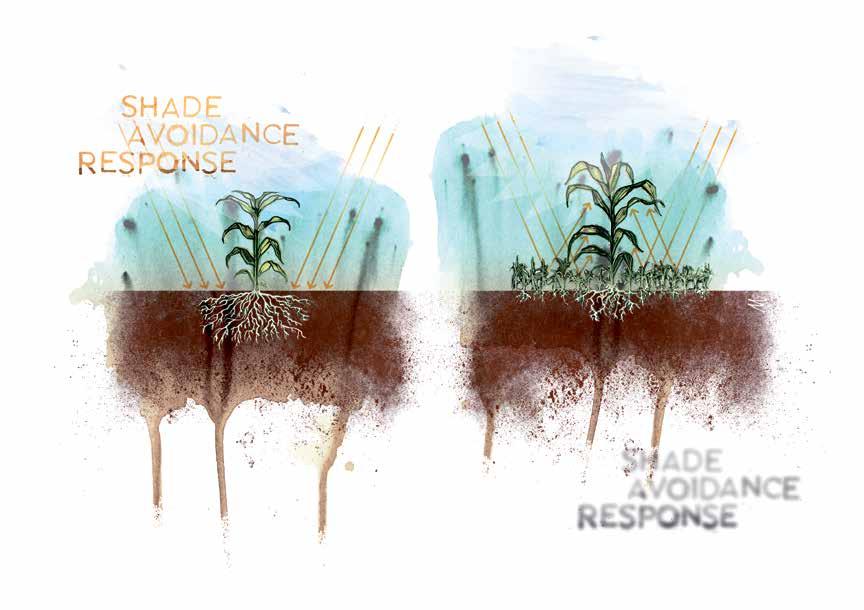
Since far-red light is mostly reflected by the surface of the leaves, a plant receives (relatively) more of this light when it is crowded in with neighbouring plants.
In order to avoid the shade, a plant grows longer stems so that it can catch more light.
of light used for photosynthesis. The light spectrum in the range of 300 to 800 nm causes a developmental response in the plant. Additionally, UV and infrared (IR) light are known to play a role in plant morphogenesis.
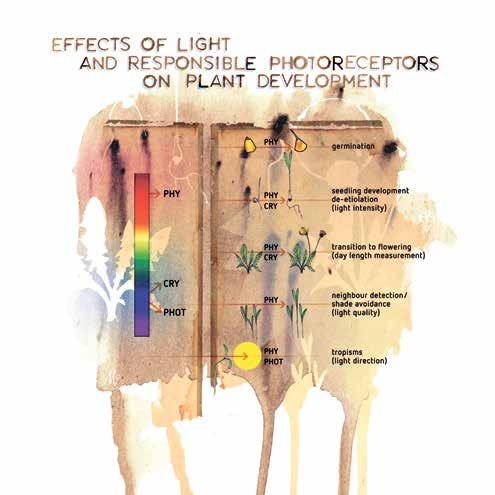
A plant gains information from the light that reaches it by means of special pigments, called photoreceptors. These photoreceptors are sensitive to different wavelengths of the light spectrum.
There are three groups of photoreceptors, see figure 2:
• Phototropins
Cryptochromes
Phytochromes
The first two photoreceptors – phototropins and cryptochromes – are active in the lower range of wavelengths (UV (A) and blue). These two receptors obviously have different functions. Phototropins are responsible for phototropism or plant movement, and the movement of chloroplasts inside the cell in response to the quantity of light. Phototropins are what cause stems to bend towards light and stomata to open.
Cryptochromes are pigments which sense the direction of the light. The inhibition of stem elongation is governed by cryptochromes as well as stomatal functioning, the synthesis of pigments and the tracking of the sun by the plants leaves.
The other photoreceptors – phytochromes – are sensitive to red and far red light. There are two forms of phytochrome, Pfr and Pr, which interact. Phytochromes have the biggest influence on photomorphogenesis. Stem elongation, shade avoidance, chlorophyll synthesis
and the flowering response are all functions typical controlled by phytochrome. In CANNAtalk 14, you can find an article called ‘The effect of the light spectrum on plant development’, which will give you much more information about phytochromes.
Now that we have looked at the light spectrum and the photoreceptors responsible for plant development, we come to the next question: how can we apply this knowledge as a grower? What makes a good light spectrum for growing? In order to answer this question, we need to think about the plant’s response to different light spectra. Because these fall mainly under visible light, we can speak about ‘colours’, starting with the most important ones for plant development.
Blue light (400 – 500 nm)
A larger proportion of blue light has an inhibitory effect on cell elongation, which leads to shorter stems and thicker leaves. Conversely, a decrease in the amount of blue light will cause a larger leaf surface area and longer stems.
In figure 3, you can see two chrysanthemum plants. The one on the left was cultivated on with ten times more blue light (43 µmol/m2/s) than the one on the right (4.3 µmol/m2/s), with equal levels of red light and PAR light.
Too little blue light will negatively affect the development of plants. Many plants need a minimum amount of blue light, which ranges from 5 to 30 µmol/m2/s for lettuce and peppers to 30 µmol/m2/s for soybean.
Interaction between red (600 – 700 nm) and far-red (700 – 800 nm) light Because red and far-red light have a higher
close together, all the red light from the sun is used for the photosynthesis process (between 400 and 700 nm) and much of the far red light is reflected by the plants (>700 nm). Most of the plants, especially those in the shade, will receive more far red than red light in this situation. As a consequence, Pr increases, and when this happens, the plant senses that it needs more light for photosynthesis and stem elongation is triggered (see figure 4). The result is taller plants with a bigger distance between the internodes and a thinner stem. This is a clear example of a shade avoidance response, where plants seek to capture more light in order to survive.
Taller plants can absorb more red light which increases the quantity of Pfr forms. This will trigger greater branching, shorter distances between the internodes and less vertical growth in order to maximise the light absorption for the photosynthesis. As a result, plants expend less energy on growing as tall as possible and allocate more resources to producing seeds and expanding their root systems.
Limited effect of green light (500 – 600 nm) on plant development
wavelength, they are less energetic than blue light. Combined with the profound influence of the red-induced phytochromes on plant morphogenesis, relatively more red and farred light is needed for plants to develop.
The two forms of phytochrome, Pfr and Pr, play an important part in this process. Because red and far-red light are both present in sunlight, plants in nature will almost always contain both Pfr and Pr phytochromes. A plant senses its environment by the ratio between those two forms; this is called the phytochrome photostationary state (PSS).
The Pr phytochrome has a light absorption peak at a wavelength of 670 nm. When the Pr absorbs red light, it is converted to the Pfr form. The Pfr form acts the other way around – when it absorbs far red light at a peak of 730 nm, it converts into a Pr form. However, because Pfr molecules can also absorb red light, some of the Pfr molecules are converted back to Pr. Because of this phenomenon, there is not a linear relationship between PSS and the ratio of red to far red. For example, when the ratio of red to far red light exceeds two, there is barely any response in the PSS and thus plant development is not affected. It is therefore better to speak about PSS than the red to far red ratio of the light.
The amount of Pr and Pfr tells a plant which light it is receiving. When there is a lot of Pr present, this means that the plant is receiving more far red light than red light. When there is less red light, the opposite conversion (from Pr to Pfr) is hampered, meaning that there is relatively more Pr.
In environments in which many plants grow
It’s often assumed that only blue and red light help plants to grow and develop but that’s not completely true. Although much of the green light is reflected back off the plant’s surface (that’s why we humans see plants green), green light itself can also be beneficial for a plant. The combination of different light colours can lead to higher photosynthesis than the sum of its parts. Research conducted on lettuce also shows that plant growth and biomass increased when 24% green light was added to a red-blue LED, while maintaining equal PAR levels (150 µmol/m2/s) between the two objects. This indicates that even green light can have a positive influence on plant growth.
Ultraviolet light (300 – 400 nm)
Ultraviolet (UV) light has an effect on plants, too, causing compact growth with short internodes and small, thick leaves. However, too much UV light is harmful for plants, since it negatively affects the DNA and membranes of the plant. Photosynthesis can be hampered by too much UV light. Research shows that this happens at UV-values higher than 4 kJ/m2/day.
Conclusion
This brings us back to the general question of ‘what makes a good light spectrum for growing?’ It’s quite hard to give a general answer to this question, since it depends heavily on the type of plant and the requirements of cultivation. For a ‘normal’ plant development these specs are recommended:
• Most plants needs a minimal amount of 30 – 50 µmol/m2/s photosynthetic light to stay alive
• A minimum amount of blue light is required, which varies between 5 and 30 µmol/m2/s
• A somewhat larger portion of red and far-red light is required, compared to the blue light
• Balance between red and far-red light: preferably a red to far red light ratio of less than 2
• A limited amount of UV light, less than 4 kJ/ m2/day
Also remember that:
• More blue light will lead to shorter stems and thicker leaves Too much far-red light or an unequal balance with the red light will result in elongated plants
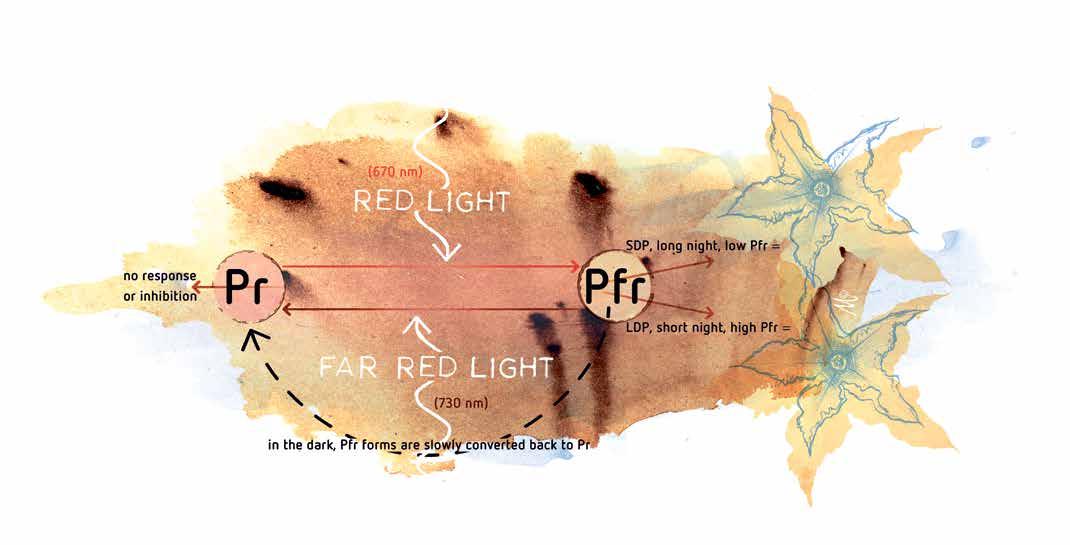
The interaction between the Pr and Pfr forms and its effect on flowering in short-day plants (SDP) and long-day plants (LDP).
• A low red to far-red ratio and consequently a limited amount of red light at the beginning of the night is important for the flowering of short-day plants
• Far red light alone does not regulate flowering Green light is beneficial for the photosynthesis, although it does not affect the flowering or plant development
The next step is to provide the best light spectrum for your situation. If sunlight is not sufficient, this can be done by selecting a good grow lamp. The emergence of light-emitting diodes
(LEDs) in plant production, which you can read more about in our other article, makes it easier than ever before for growers to optimise the light spectrum.
























By Natie Ferreira
Southern Africa has a long and deep history of Cannabis use and cultivation. The early |Xam and Khoi inhabitants of the region have been using Dagga, as the plant is locally known, for centuries. Where and when cultivation started, and how it spread into Africa and the South is not clear, but we are sure that by the time European explorers arrived, the practices surrounding cannabis use and cultivation were already well entrenched.
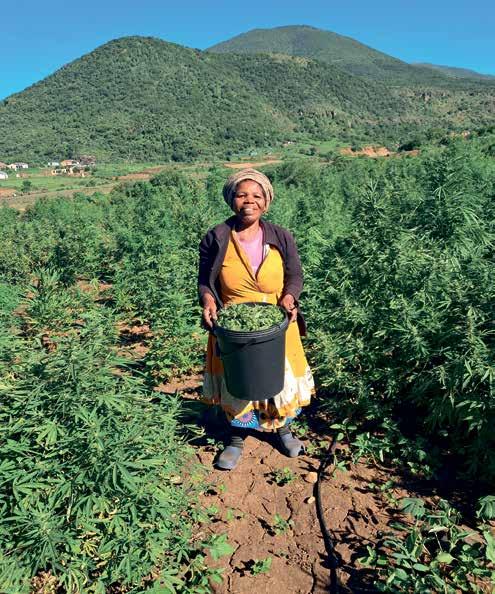
The mostly nomadic tribes of the South would travel to current-day Mpondoland, Zululand, and Lesotho to trade animal skins, beads, and other wares for their yearly supply of Dagga. Where else those farmers sold their produce is not known, but the ancient contours up the mountains in Mpondoland tell a tale of a level of agriculture not seen today, with the crop potentially exported via seafarers across the world. South Africa might have been a net exporter of agricultural produce for much longer than the school textbooks would suggest.
Much of this history has disappeared into the atrocity of prohibition, with South Africa being the first country in the world to ban the possession and cultivation of cannabis in the 19th century, with full criminalisation under the Medicines Act following in 1928. South Africa also pushed the agenda at an international level which led to criminalisation of cannabis in the USA in 1937 and the inclusion of cannabis sativa in the UN Single Convention on Narcotic Drugs in 1961.
On the ground, this clampdown on an everyday product, as common as coffee and nicotine, led to an entire industry being forced underground, with much of the cannabis supply chain migrating into the hands of cartels and revolutionary groups. Farmers found themselves at the short end of sick, as always, with farm gate prices never meeting the expectations set by a now illicit and high-value black market product. Farmers were prosecuted and hunted around the world. A light was shone on these serious human rights violations in South Africa when a group of farmers, human rights lawyers, and activists took the police to task for the aerial spraying of Glyphosate on cannabis crops. The spraying was done indiscriminately, often also taking out their subsistence food crops. Residue landing on people and property led to communities sustaining serious health defects and disease from the exposure to Roundup Turbo, a special ultra strong concentrate of Glyphosate used for these purposes. Successful challenges to this practice led to the
cessation of aerial spraying and the dismantling of the Port Edward base in 2016.
Further activism culminated for South Africans in September 2018, when a challenge, brought by a group of activists led by Garreth Prince, led to the Constitutional Court declaring parts of the Drugs and Drug Trafficking Act and Medicines Act, relating to cannabis, unconstitutional. Judge Dennis Davies in effect gave citizens the right to grow and consume cannabis in private. With the court giving Parliament two years to rectify this, the cannabis community was in celebratory mode, with the imminent full legalisation also awakening opportunistic entrepreneurs. This celebration and optimism were short-lived when Parliament deliberately dragged out this process, first by lodging an unsuccessful appeal, and then publishing various versions of a Cannabis for Private Purposes Bill with regulations that were unconstitutional,
complicated. Arrests for cannabis-related offences do continue, however, with enforcement still targeting marginalised communities and legacy tradesmen.
What nobody could argue, though, was that the private growing and consumption of cannabis is constitutionally protected, no matter what any future regulations might say. This led to a massive growth in cannabis gardening. Grow shops and online stores and a range of seed suppliers, nurseries, and clone banks made it easier for new gardeners to take up this hobby.
Companies like Cheeba Africa came to the fore with a range of online and physical courses, catering for every level of expertise. Garden Centres in the cities started to stock growing equipment and seeds, with some bold enough to even sell cannabis plants, leading
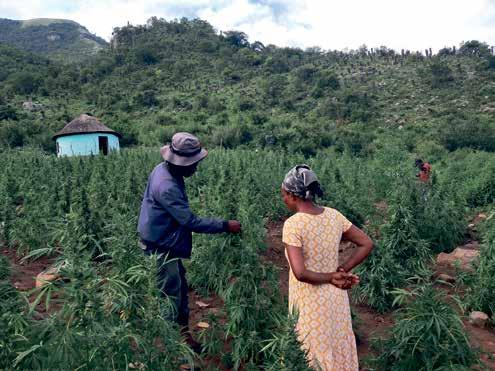
unscientific, and unjust in each instance. A version of these regulations is currently in the hands of the legislator following a round of public comments. A major positive is that the new Act defines cannabis as only the flowering tops of the plant, effectively removing any limits on non-flowering plants and seed.
So, what happened in cannabis growing culture during these long 6 years in limbo?
South Africans are ingenious, and we soon had intellectuals, entrepreneurs, academics and legal professionals dissecting the Constitutional Court judgment and the now amended Medicines Act. Various interpretations were made on presumed future regulations, and we soon had Cannabis private clubs and dispensaries sprouting in every town. Even though these establishment are operating illegally, the Constitutional Court judgment gave a sense of comfort and made enforcement by authorities
to an enthusiastic interest by non-consuming gardeners. Many are pulled in by the addictive hobby of medicinal gardening, and even the aged are now experiencing the therapeutic effects of growing their own medicine.
This growth in cannabis gardening was built on the foundation laid by back yard and closet growers. They have faced prosecution and marginalisation, while going to great lengths to ensure that us stoners get top-grade cannabis from their “Guy”, long before talks of legalisation. Underground clone banks and seed suppliers were actively hunting new genetics, with local breeders coming to the fore with potential masterpieces. All this was done blind, with only customer and grower feedback as a guide.
This all changed around 2015 when the first near infrared cannabis spectrometer was brought into the country by one of the local
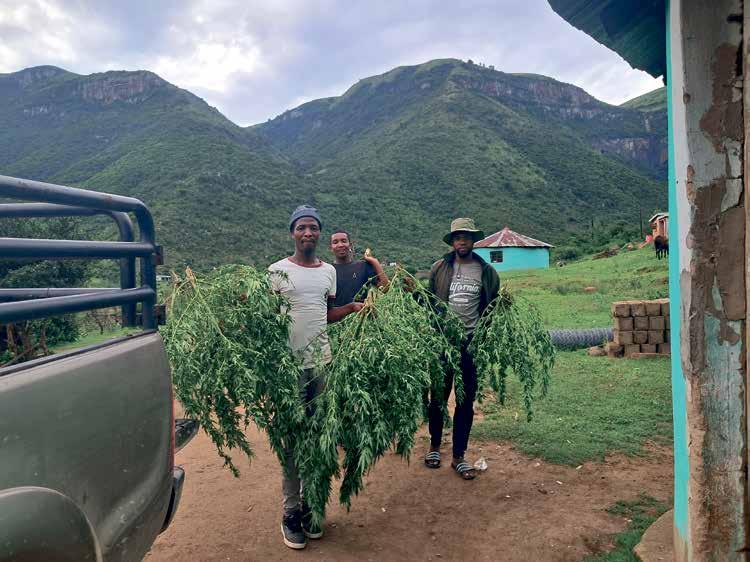
cannabis legends. His tours through the country with this analyser became legendary, hunting for the best flower in South Africa while assisting growers, breeders and clone banks in their quest for the highest-THC clone. Many popular international strains were made available from seed and cutting, and soon we had special cuts changing hands, with a crude certificate of analysis backing the high-cannabinoid claims, and leading the value often into thousands of Rands. The Constitutional Court judgment brought much of this to the fore; social media exploded with growers offering cuttings for sale, and a myriad of new seedbanks entered the country, openly advertising. Consumers started to understand and seek quality, and growing styles had to adapt. New demand also forced growers out of their strictly indoor facilities into the open, quickly learning the art and science of growing cannabis in the sun. Traditional growers have learned the science of light manipulation and irrigation, now growing some of the best outdoor cannabis in the country throughout the year.
Today, it is difficult to make the distinction between indoor and tunnel-grown cannabis in many instances, with the quality from fully outdoor-grown cannabis often coming very close.
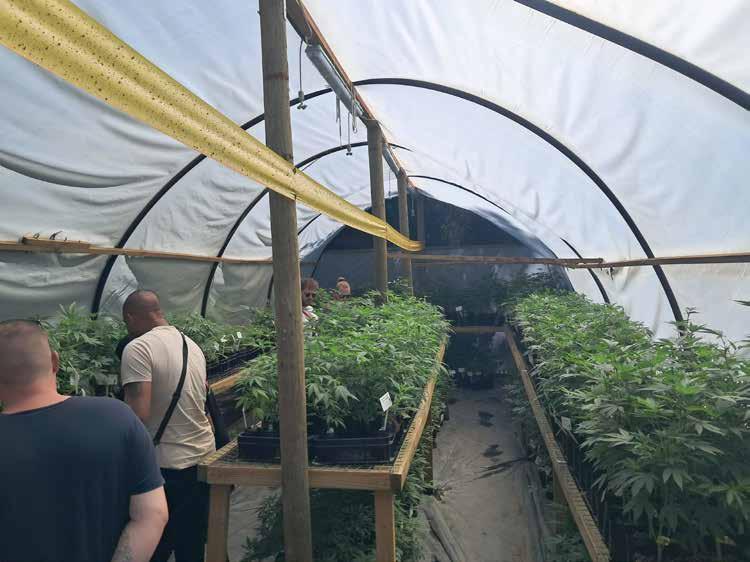
Many growers have invested heavily into infrastructure, based on contracts from private clubs. These growers are now often growing high-quality cannabis in state-of-the-art, climate-controlled greenhouses that brought the novel “green door” grade to the market, somewhere between indoor and greenhouse. The internet and hard marketing by overseas brands, have driven most of these growers to commercial growing strategies, with foolproof salt-based feeding programmes, and well-designed integrated pest management systems.
Indoor growers have been challenged by the changes in market dynamics, with supply
moving ahead of demand, and prices on a downward spiral. Those who could afford it invested heavily in technology, with modern LED lighting and accurate dosing systems keeping running costs down. Alternative sources of power require even bigger investment, and years of loadshedding and ever-increasing electricity costs have forced many indoor growers to give up their tents. The never-enders that persisted are now growing some of the best indoor can-
nabis in the world, and many consumers prefer homegrown above facility-grown.
Most home growers prefer the outdoors, though, and will strive to grow the best quality cannabis for his and his friends’ consumption whilst ensuring that there is no contamination from harmful substances. Growers have embraced the freedom that the ConCourt judgment brought, taking their plants out into
the garden, to form part of the landscaping. Seeing large backyard grows in our urban areas has become common, and most growers find themselves free from persecution. We have seen a good interest in natural farming methods like JADAM and Biodynamic farming, and many consumers can attest to the satisfaction that only full season, sun-grown, organic cannabis can bring. Unfortunately, this trend and demand have not spread into the more formal sector, with no organically registered cannabis available, despite some claims made otherwise. Those seeking the benefits of naturally grown cannabis, will still have to know and trust their farmer. Or grow their own, which has never been easier to do.
Today, the cannabis sector remains marginalised, with much of the boom seen in the cities representing a shift in the supply chain, from legacy farmers to new entrants backed with capital. Families that have been growing landrace Dagga for centuries, now find themselves living in poverty and on the edge of famine. Farms and homesteads are being abandoned, while government, civil society, and academia are locked in discussions to find the value in landrace Dagga, and ways to integrate these farmers into an economy that has already ran away from them. Maybe the new regulations will be a last opportunity to pull the supply chain away from large-scale operations to the subsistence farmer, and we look forward to the expansion of initiatives like the Pondo Plug Project to integrate rural farmers into the Private Club supply system.
What the immediate future holds for cannabis commercialisation in South Africa, nobody knows at this stage, but this uncertainty does not seem to hold cannabis culture back. We are the only people in the world who have the constitutional right to grow cannabis. Let’s keep on celebrating and outgrow the world.



Stoney Tark
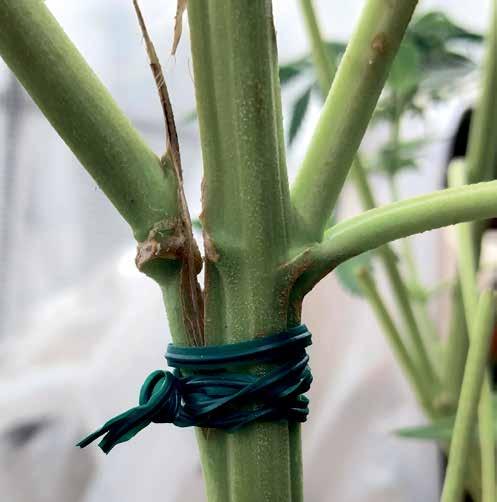
Cannabis plants grow into tough, resilient and robust plants as they mature; however, there may be a time when the branches break. It can cause an onset of pure panic, as you have a short window of time to fix the branch.
In this article, I will break down all you need to know about how branches can break, the different ways you can fix the broken branch, potential problems a broken branch causes and my top tips.
You are probably reading this article, and if you are lucky enough, you can say you have never once suffered from a branch breaking. You would be surprised how easily a branch can break, and one thing is for sure: time is of the essence, and you must act quickly to repair it. Below is a list of the different ways that a cannabis branch may snap.
The low-stress technique is a method of cannabis plant training that involves tying branches down using string or wire. In some cases, adding too much pressure or working with soft wood branches can cause the branch to snap like a piece of celery. Hardwood branches can tear at the base and closest to the stem.
When growing cannabis plants outdoors, it is common for large plants to suffer a break due to heavy winds. It is typically plants that are late into flowering that can experience a break due to the weight of the branches.
I think during my career as a grower, I am guilty of accidentally snapping a side branch when walking through the garden, and not paying attention. Be cautious when walking through your indoor garden, especially when using a Sea of Green setup.
The Different Ways to Fix a Snapped Branch
There are several ways to repair a snapped branch, and having the following list prepared in advance will be beneficial.
Gardening wire
This wire is typically green and comes with a fine metal wire with a rubber coating. Gardening wire is one of the best tools to have in the grow room, as it can also be used for LST.
Fabric string
A thick string works best as a thin string
can cut through the branch and cause it to become severed. In the past, I have even used shoelaces during an emergency, which was a great solution.
Cable ties
These can be very handy when you have to act fast and can create plenty of support. You need to be careful that you do not fasten the cable tie too tightly.
Ducting tape
I would not recommend using duct tape; however, when you are in panic mode and can only find thick tape, wrapping up the broken part may work sufficiently.
The Part of the Branch Loses Vigour
You may notice that within a short time, the top half of the branch or the entire branch has totally lost its vigour. When this happens, you will need to cut off the dead growth; otherwise, you may need to remove the entire branch.
Wire Cuts Through the Branch
Thin wire can end up growing into the new hardwood growth. Most of the time it will
During the flowering period, cannabis plants can turn hermaphrodite under different circumstances, such as high amounts of stress. A broken branch during 12/12 may result in the plant producing male and female flowers.
Tip #1: Act fast
You need to act quickly when you snap a branch, and do your best to align the break and tie the branch up. If you do not act soon, the branch will quickly wilt and become lifeless.
Tip #2: Prepare in advance
A great piece of advice I can give you is to buy some gardening wire and bamboo canes in advance. Have these in the grow room in case of an unexpected break.
Tip #3: Cause as little stress as possible
Once a branch has been repaired, allow it to recover and avoid moving it around. You will want to inflict as little stress as possible when repairing a broken branch, especially during the flowering stage.
Tip #4: Bamboo canes for extra support
I am a big fan of bamboo canes and find that they are an excellent way to give a broken
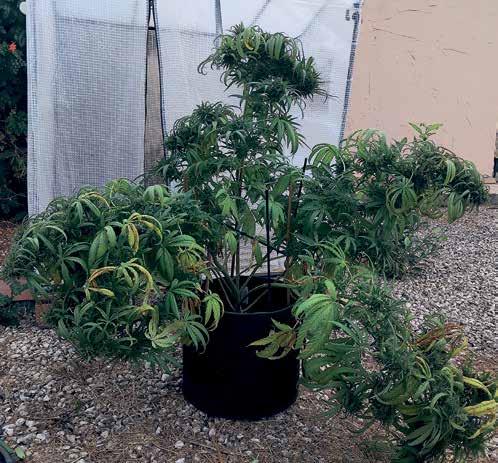
cause the plants any problems, but I have had incidents in the past when the branch was severed due to the thin wire.

By Jorge Cervantes in collaboration with Innexo BV
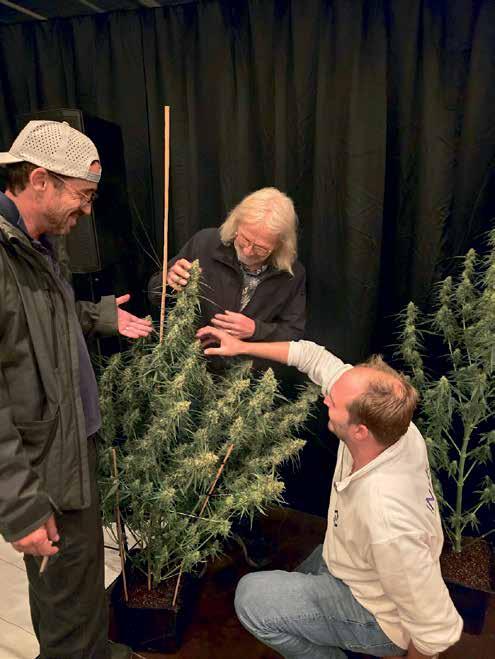
I have spent the better part of fifty years walking through cannabis gardens — from the guerrilla patches of the Emerald Triangle to high-tech indoor facilities in the Netherlands. In all that time, one Golden Rule has been followed with religious devotion by every grower I’ve ever met: you must veg your plants
We’ve all been taught that the vegetative phase is the foundation of yield. You take your seedlings or clones, put them under 18 or 24 hours of light, and spend weeks building roots, thick stems, and a lush canopy. You top them, train them, weave them through scrog nets — and you wait. Two weeks, four weeks, sometimes six, paying for electricity, nutrients, and labour while the plant produces not a single gram of flower.
But what if everything we thought we knew about the vegetative phase was wrong?
I recently reviewed groundbreaking data from the Netherlands — the spiritual home of indoor horticulture. A consortium including Innexo, Fluence, and Grodan has been running controlled trials that challenge the very foundations of how we grow. They call it the “No-Veg” technique
The idea is radical in its simplicity: take a rooted clone or a germinated seed and place it immediately — Day One — under a 12/12 flowering light cycle. No days of 18/6. No vegetative transition at all. The flowering cycle itself builds the structure: roots, stems, and canopy all develop under 12/12 as you steer the crop with irrigation, nutrition, and climate instead of veg time.
The Numbers That Changed My Mind
On a single run, classic veg still looks good on paper: the trials showed a two-week veg crop
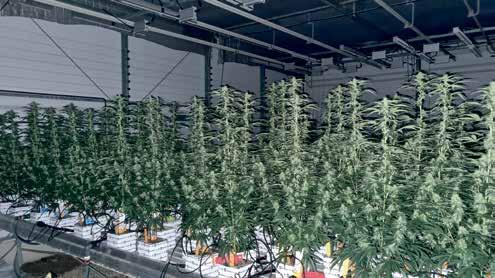
producing around 712 g/m² per harvest versus about 622 g/m² for No-Veg — roughly 13% less per cycle. Many growers stop reading there.
But stretch the view to a full year and the numbers reverse. A typical veg programme fits about four harvests; No-Veg pushes six shorter cycles in the same footprint. Annual yield jumps from roughly 4,111 g/m²/year to about 4,621 g/m²/year — around 12% more flower per square metre per year. Light energy drops roughly 30%, and labour falls about 37%. You harvest more saleable flower for less electricity and fewer crew hours.
As Innexo CEO Dominique van Gruisen told me: “Keeping plants vegetative to produce foliage that is later removed is counterproductive. The veg phase uses roughly 50% more light hours than flowering, and that hits a grower’s energy costs hard.”
Turning the Quality Pyramid Upside Down
Big, long-veg plants build a quality pyramid: a thin top of Grade A flower, a middle band of B, and a wide base of loose, airy larf that nobody wants to trim. Dense canopies shade themselves; only the top layer gets prime light.
No-Veg flips that pyramid. Instead of sprawling bushes, you grow tall, slender columns with open canopies that let light reach every bud site. In the trials, Grade A flower jumped from 20% to 35%, while Grade C larf dropped from 25% to just 5%. The harvest index — flower weight as a share of total plant biomass — lands in the 60–80% range. You trim less waste and cure more top-shelf bud.
Riding the Stretch Instead of Fighting It
So how does a plant that skips veg grow big enough to produce? The answer is the stretch — that explosive burst of vertical growth every cannabis plant goes through when it transitions to flowering. In traditional rooms we fight it; with No-Veg we embrace it
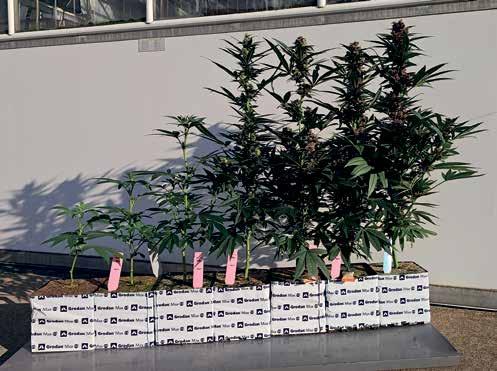
Because plants never developed a complex bush of side branches, energy flows into the main stem and a few primary colas, building a tall, clean column. Light penetrates deeper from day one, and the plant naturally balances leaves and flowers with minimal grooming. Nature does the pruning for you.
From seed: plant directly into a large final container — ideally 11–12 litres. The taproot dives deep, senses all that space, and sends an “abundance” signal to the rest of the plant. Even though 12/12 lighting says “winter is coming,” the root signal overrides the stress and drives vigorous growth.
Perfect Roots or Nothing
If there is one lesson from the trials it is this: your roots must be flawless. Grodan’s Frank Janssen put it bluntly: “There is zero margin for error in the first couple of weeks. Any issues that occur then will lead to problems for the rest of the cycle.”
Researchers use a root scoring system (0–5) for clones in rockwool plugs. The sweet spot is at 2 or 3: roots have colonized the plug with 10–30 bright white tips bursting outward, but
not yet circling or dying off. Too few roots and the plant will not survive; too many means the roots are already stressed.
Jorge’s Tip: Always start 20-30% more clones than you need and ruthlessly cull anything that is not perfect. Uniformity below ground means uniformity above ground.
Your Week-by-Week No-Veg Roadmap No-Veg is not a shortcut for lazy growers; it demands precise steering of water, nutrients, and climate. In inert substrates like rockwool, what you pour in is what the roots see — so you control the plant with surgical precision. Early on you keep things easy for the roots (lower nutrient strength, plenty of moisture) to push growth. Then you gradually dial up the stress (stronger feed, drier overnight periods) to steer the plant hard into flower production. Here is how a typical cycle unfolds:
Week 1 — Do or Die: Moderate light on 12/12, high humidity, warm (25–26°C). Do not water for the first few days — let the roots hunt for moisture. If a plant looks weak on Day 3, pull it. It will not recover.
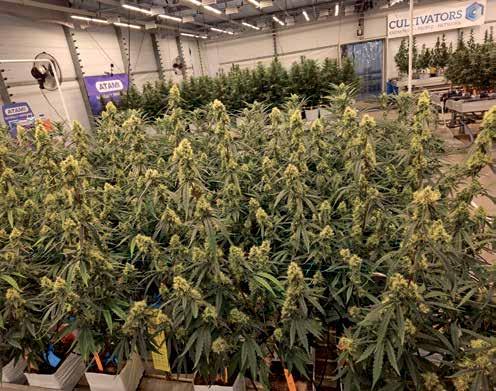
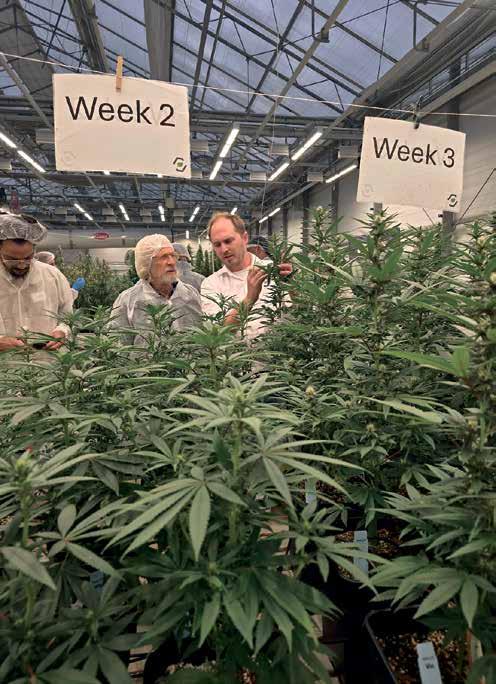
Week 2 — Ignition: Increase light intensity. Begin frequent, small waterings. The plant should be visibly growing every day.
Week 3 — Full Stretch: Lights at full power. By the end of this week, raise nutrient strength to tell the plant to stop stretching and start hardening. Let the growing medium dry back more overnight.
Week 4 — The Stack: Plants reach final height (70–120 cm) with white pistils forming at every node. Don’t strip the leaves — these smaller, perfectly positioned fan leaves are the sugar factories feeding your buds.
Weeks 5–7 — Bulking: Bigger but less frequent waterings. Push overnight dry-backs. Lower temperatures to preserve terpenes and drop humidity to prevent mould.
Weeks 8–9 — Ripening: Ease off nutrients to let the plant use its reserves. Watch the trichomes — milky with a hint of amber means chop time.
Is No-Veg For You?
Let me be direct: this technique is not for everyone. There is zero recovery time — a mistake in Week 1 is baked into your final yield. And No-Veg leans on higher plant density (8–10 per square metre), so if your local law caps you at a handful of plants, you are better off growing big trees with a long veg.
Where it fits, the benefits are hard to ignore.
Six harvests a year mean cash flow every eight weeks and faster rotation of genetics. Smaller plants are easier to manage, power and labour bills shrink, and the shorter cycles give pests and diseases less time to take hold. Dominique van Gruisen expects this approach to become the industry standard within five years for all growers not limited by plant count: “Around 2,000 industry professionals have visited our demo centre, and everyone who has seen this approach in action leaves convinced that this is the way forward.”
The cannabis industry is growing up — moving from the basement to the boardroom, from art to science. The No-Veg technique asks you to be a better grower: to master your roots, your climate, and your irrigation. It is not a free pass. But if you can execute it, the rewards are undeniable: more harvests, better quality, lower costs.
The future of cultivation is efficiency. The question is — are you ready to let go of the sacred veg?
Grow smart. Grow efficiently. And as always, grow big (yields)!
- Jorge Cervantes
Source data: Innexo, Fluence & Grodan controlled trials. For more information: innexo.nl | jorge-cervantes.com
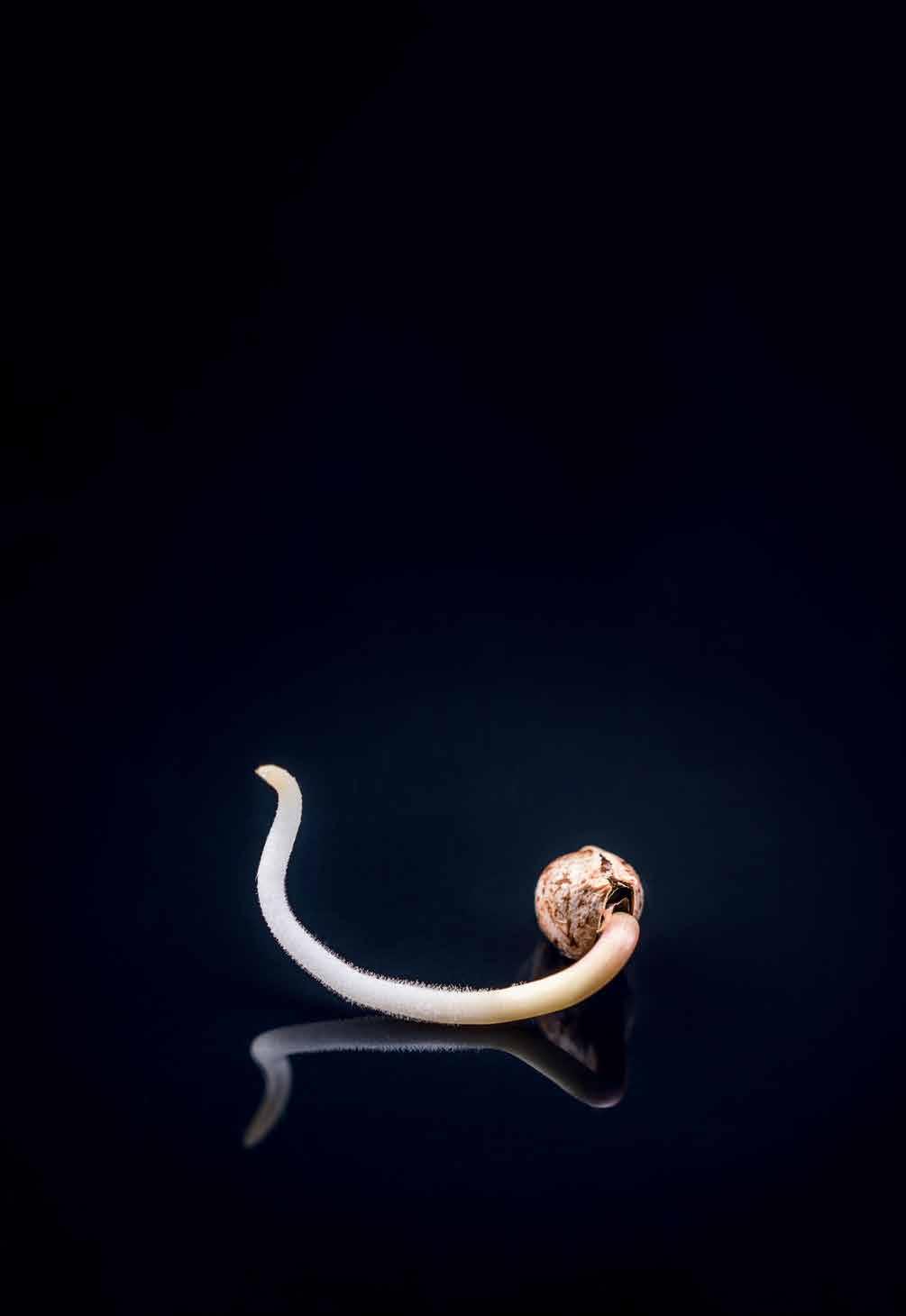
Cannabis culture
By Dryas – dryas.420@gmail.com
Native or traditional varieties of cultivated plants are of vital importance to plant breeders, as they represent one of the main sources of genetic resources.
These Cannabis populations have unique characteristics due primarily to the plant's adaptation and evolution to its environment, but also to the cultural practices of the communities that cultivate them.
We often imagine landraces as isolated populations or subpopulations in a remote, mountainous valley, almost unknown to humans and even more so to science. In reality, this is not a landrace, since traditional varieties are the result of the plant's interaction with the environment, but always modulated by local agricultural practices and uses.
The valley example mentioned earlier could more accurately be described as a native or naturalized wild population. The differences between these concepts and that of a landrace, along with the characteristics of each, will be discussed below.
Native populations
These are plants native to a place, whose origin and evolution are a result of the area's charac-
teristic ecosystem, without human intervention. This is a very easy case to distinguish for all those plants that, despite being well known to humans, have not been cultivated or used, and therefore humans have not intervened in their spread or evolution. Some examples of this are Gorse (Ulex europaeus) or Mediterranean buckthorn (Rhamnus alaternus), to mention plant species with a wider distribution than the endemic species of islands and mountain ranges, classic examples of native wild populations.
In the case of marijuana, as with many other cultivated plant species, it is difficult to establish that there are populations that, despite being wild, have not undergone crossbreeding, in the present or past, with cultivated varieties. In any case, it is fairly accepted in the scientific community that Cannabis originated in Central Asia, western China (the Tibetan Plateau), and
the foothills of the Himalayas, so barring a major surprise, we cannot expect to find native marijuana populations outside of these areas.
The study of the ancestors of the world's major crops—the populations of wild and native plants that gave rise to fruit trees, vegetables, and cereals—led Nikolai Vavilov in the 20th century to propose the theory of centers of origin for cultivated plants (Vavilov, 1926). This Soviet biologist identified a series of centers of origin for numerous cultivated species in the same locations where many of their wild relatives are found. The same is true for cannabis; its closest wild relatives (family Cannabaceae) are found in the aforementioned areas of Central Asia.
These original populations are of vital importance to plant breeders, as well as to the species itself, since they represent an immense reservoir of genes that can be of interest for improving resistance to diseases, pests, and environmental stress, in addition to both beneficial and detrimental mutations that can be the subject of research. The best way to maintain this genetic diversity is by respecting the extent and integrity of their habitats.
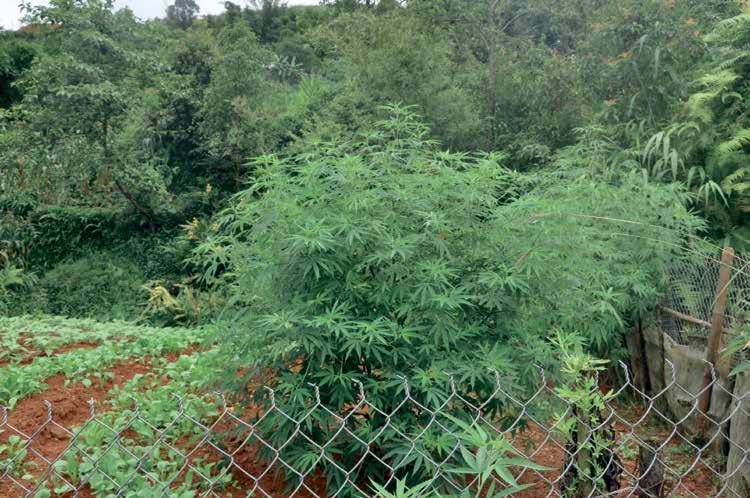
These are plants introduced or cultivated by humans, but which grow wild and persist without any human management. In many cases, it is difficult to distinguish them from native plants without a thorough knowledge of the local flora and botanical history. Correct identification of the species is also usually necessary, as not all naturalized plants are as distinctive as pampas grass (Cortaderia selloana) or ice plant (Carpobrotus edulis), classic examples of invasive plants introduced as ornamentals in the Iberian Peninsula. In any case, not all naturalized plants behave as invasive species.
In the case of cannabis, this phenomenon can be observed in European regions where hemp has been cultivated for fiber or where varieties of cannabis are used for medicinal purposes and where it now grows wild. Despite being far from its place of origin, this plant has demonstrated great adaptability, thriving without human intervention in continental climates (with cold winters, similar to its native region) such as Siberia or Romania. It also thrives in Mediterranean or subtropical climates, as is the case in India and northern Vietnam.
In the Iberian Peninsula, a recent study points to three introduction events of Cannabis: Paleolithic, Neolithic, and Medieval, with the latter two almost certainly being introduced by humans (Rull et al., 2023). This aligns with the accepted theory that the Cannabis found in Europe corresponds to cultivated varieties or naturalized hemp populations.
Naturalized plant populations are not usually of great interest for plant breeding or conservation, since much of the genetic diversity of the original population is filtered out and discarded during the selection process for cultivation and subsequent improvement. Furthermore, when a variety or certain individuals become naturalized, they lose, through successive generations, those improved characteristics (fruit size, flavor, earliness, etc.), reverting to properties that allow them to survive in the wild (toxicity, defenses such as thorns, etc.).
Native varieties of cultivated plants might now seem almost exotic, the result of the efforts of some peoples and regions to have their own varieties of plants and animals. The reality is a bit more sober, since the main goal of many communities that developed varieties has sim-
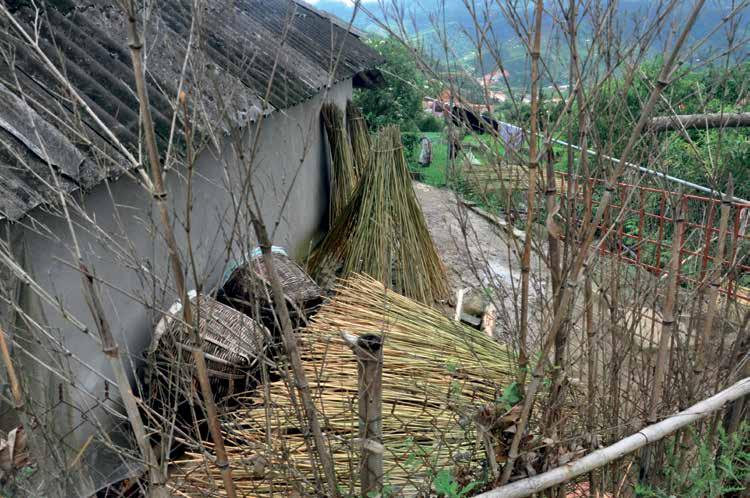
ply been survival. It's important to remember that not so long ago there were no greenhouses, mechanization, irrigation, or the countless inputs that today allow us to greatly expand the range of cultivation for many plants.
In the past, the plant species that adapted well to produce in a given territory were few, and having a better-adapted, more valued, or uniquely characteristic variety of plant or animal meant survival and even prosperity for an area. This is still very noticeable in high-value crops, such as wine grape varieties, particularly prized fruits, vegetables like asparagus and artichokes, saffron, hops, and many more.
Marijuana has numerous native varieties due to the large number of places and cultures that have worked with it; sometimes several varieties have even been developed in the same area, depending on the different uses such as fiber, food (seeds and fodder) and medicinal, something uncommon in other plants.
Some examples of landraces and landrace varieties of cannabis, based on their use, include European seed varieties, African varieties used for ritual and medicinal purposes where the entire flower is used (often fermented), Southeast Asian varieties for textile fiber and animal feed, and, of course, the Indian "Kush" varieties for dry resin extraction. There are countless examples of these, but it's important to remember that, of all the areas mentioned, only the last one could be directly derived from original natural populations, since in the other cases cannabis was introduced by humans, almost certainly from a landrace previously cultivated by other peoples.
In the case of America there is greater controversy about the introduction of marijuana to the continent, from the first humans who crossed the Bering Strait, to the different cultures that set foot on American lands in pre-Columbian times (Holmes, 1896).
The main value of these varieties lies in the fact that they represent a very interesting genetic reserve for plant breeders. In plants like cannabis, where numerous traditional varieties exist, the breadth of the genetic library resulting from combining all the landraces can be far greater than the gene pool of wild populations.
Furthermore, due to the very process by which traditional varieties are selected and cultivated (mass selection methods where numerous individuals are typically crossed), they tend to exhibit significant variability. Breeders of these varieties
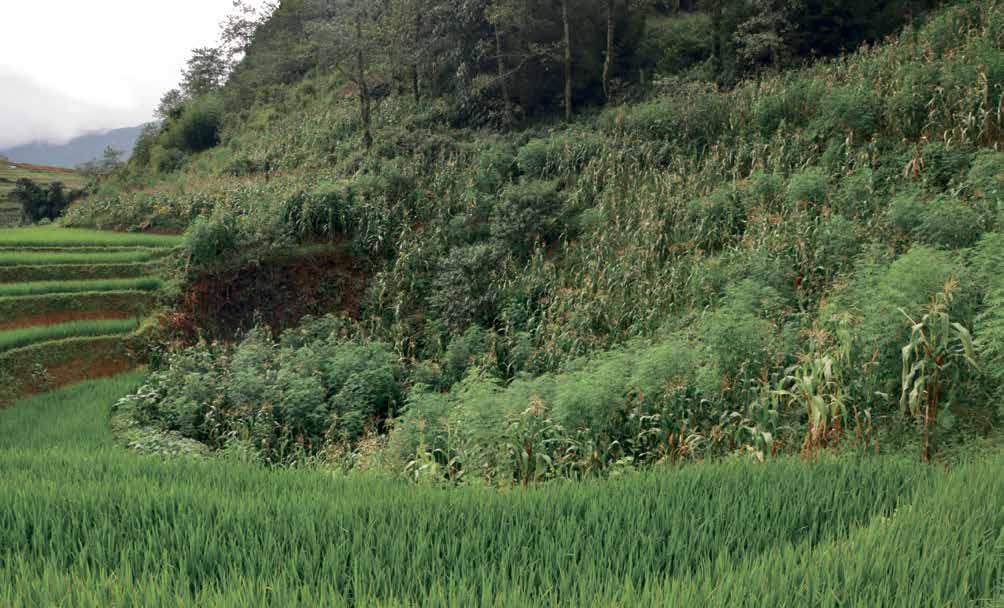
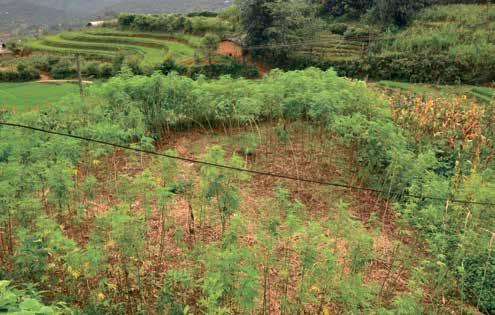
exert relatively mild selective pressure on a few characteristics (such as color and ripening), while other characteristics receive little to no selection. Consequently, the next generation includes individuals of varying sizes, levels of resistance and productivity, and so on. This does not occur in modern cultivars, where the greatest possible uniformity is sought in all aspects, with the aim of standardizing processes in the industry, but at the expense of crop adaptability.
Even without considering the genetic value of these varieties, there is a value that goes beyond the tangible, since in the process of modifying
wild plants, humankind has adapted itself to meet the needs of each organism it works with. The history of a people and many families cannot be understood without the crops to which they are linked; festivities, customs, and even the landscape and land itself constantly remind us why we are in that territory.
Landraces: Preservation or Evolution?
Many cannabis growers have surely had the opportunity to plant seeds of a traditional variety. Before making any recommendations on how to work with these types of varieties, let's clarify that experimenting and playing around with crossbreeding varieties cannot
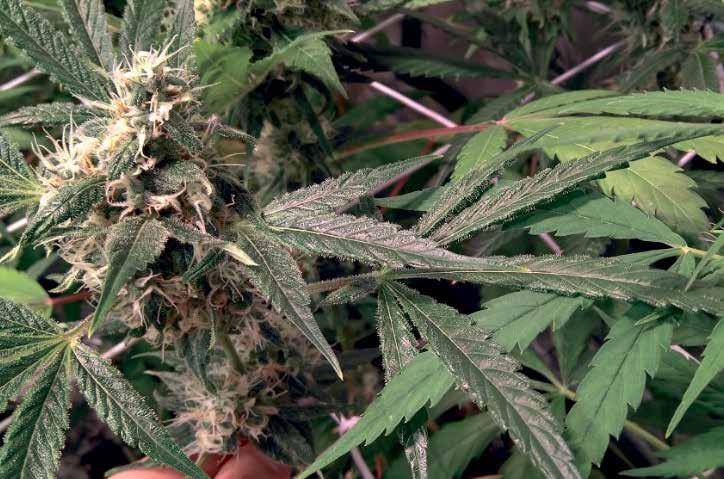
be considered inherently wrong, as long as it's done with sound judgment and honesty.
For example, if you decide to shorten the flowering time of a tropical sativa landrace by crossing it with an earlier-flowering variety, the merit lies in making a difficult-to-grow variety more accessible to the average grower. It's neither necessary nor advisable to hide the fact that the landrace has been slightly modified or adapted, as this complicates the work of subsequent breeders. Many traditional varieties suffer from a certain degree of hermaphroditism, and some seed banks specializing in traditional varieties only allow this type of selection, as it is a very difficult problem for the vast majority of growers to overcome.
If the aim is to preserve the traditional variety as faithfully as possible, the breeder (whose role in this case is limited to preservation) must cultivate the largest possible number of plants in each batch, no fewer than 100 individuals, and allow free crossbreeding among them without exerting any selection pressure. If, in addition, a similar number of individuals can be collected from the actual population to cross with our sample, we will incorporate genes that may have been missed in the initial sample. In this way, the seed bank maintains a portion that is as faithful as possible to the reality of a population, or group of individuals, which, it should never be forgotten, constitutes a living and constantly evolving entity.
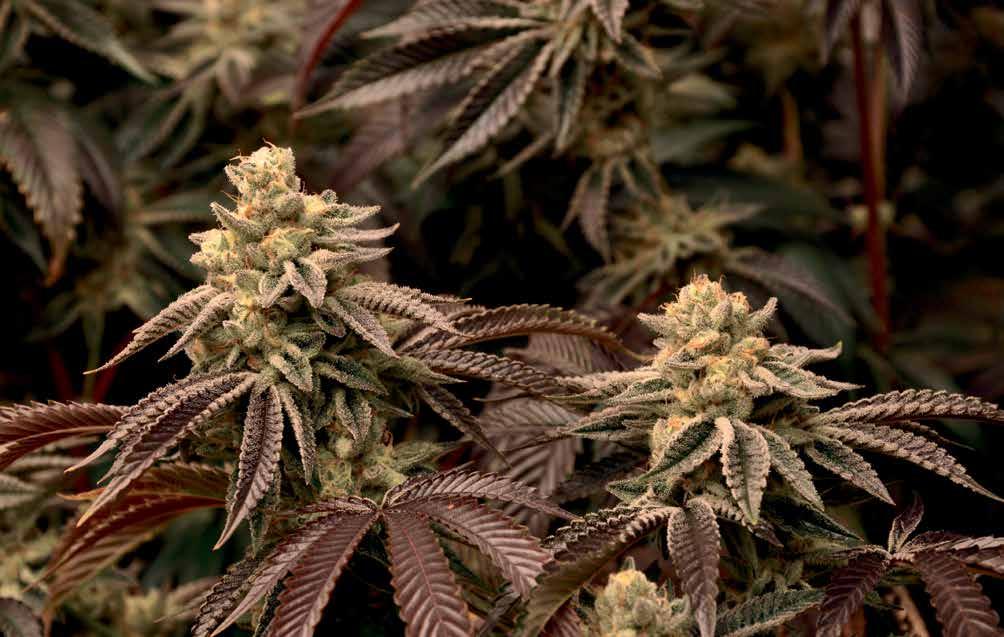
By Charles Botha

Cannabis gummies are the friendliest face of the cannabis industry. Beneath the bright colours and sweet flavours sits a serious formulation challenge: not every gummy on the market gets it right. The explosion has brought colour, flavour and convenience to the edible market, and confusion.
Gummies are treated like sweets, but they are a small pharmaceutical delivery system. Formulation, stability and dose accuracy matters. The gelling agents, infusion method and the amount of sugar influences how a gummy behaves in the body. These details help separate a well-designed medical edible from products driven more by marketing than science.
I had a call from a concerned, perhaps panicked husband, who believed he was in the process of being widowed. Earlier that day he and his wife had attended a cannabis convention, where gummy samples were handed out freely. His wife accepted a few and stashed many more in her handbag. Free sweets after all and medicine to boot what can go wrong?
Later at home she and her husband watched their favourite show, while she without sharing devoured her stash. “What can go wrong, right!” By 11pm, when her husband phoned for advice, she had already greeted several ancestors, caught up with friends and relatives long
since departed, and watched the room change colours. She was lying quietly on the couch, in what he described as a coma, we won’t say drug induced.
Cannabis gummies look harmless. As the edible market explodes, the gap between well-designed medical products and novelty is becoming impossible to ignore. One milligram, or a mystery sweet from someone’s kitchen? That moment captures the reality of the edible boom. Gummies are the most popular cannabis product. They look friendly, taste wonderful and come in cheerful colours. But behind that coloured gelatine is a complicated bit of chemistry, and a lot of guesswork.
Gummies are everywhere, easy to eat, and share. Clearly misunderstood, as a medical delivery system. Essentially a gelatinous blob, of water, sugar, flavouring and colour held together by gelatine, pectin or agar. Cannabinoids are then dispersed inside that gel. If the formulation is done correctly, it is a great
controlled, patient-friendly way to take cannabinoids. If done badly the dose varies wildly from one gummy to the next.
Sugar plays another role, gummies rolled in sugar crystals improve flavour, and speeds the dissolving in the mouth and stomach. This releases cannabinoids more rapidly and brings the onset forward. The dose has not changed, but the experience is sharper as the body receives the cannabinoids faster.
Traditional gummies are made with gelatin, [Meat eaters: boiled bones] derived from bovine collagen, creating that classic chewy texture people love. The problem is that gelatin melts easily and can vary from batch to batch. For medical products, manufacture must be consistent, this is why, modern manufacturers are moving to pectin, a fruit-derived gel used in jams. Agar-agar, a vegetarian seaweed-based gel that tolerates heat more reliably.
How the cannabis gets in there The first is infusion. The cannabinoid extract, THC or CBD distillate — is mixed into the liquid gummy mixture before it sets. Done correctly, this allows the cannabinoids to disperse evenly throughout the batch. The second method is called the “donut approach.” The gummy cannabinoids are added by spraying or coating the outside. This works faster, but the active ingredient sits on the surface and the oil can migrate, stick to packaging, or concentrate unevenly.
Cannabinoids are oil-based molecules trying to live inside a water-sugar gel. Emulsification, mixing speed, and temperature control are critical. Too much heat during production can degrade cannabinoids. Too little mixing can create “hot spots.” For patients relying on edibles for sleep or pain relief, that inconsistency can ruin the experience.
The industry is settling around a standard serving of 10 milligrams of THC. That’s already on the strong side. Patients feel comfortable effects at 2.5 to 5 milligrams. The challenge with edibles is patience. Unlike inhaled cannabis, which works within minutes, edibles take a detour through the liver. There, THC is converted into 11-hydroxy-THC, a compound that crosses the blood–brain barrier efficiently. This delay is responsible for one of the most common edible mistakes: taking a second dose because the first one “isn’t working yet.” Start low. Wait. Then decide
Cannabinoids change over time. THC gradually oxidizes into CBN, A less psychoactive but more sedative drug. Heat, light, and oxygen speed that process. Gummies can take an hour or more to working, and the effect can last longer. A poorly stored gummy can transform from what the label promised. The irony of the edible boom is that gummies look simple. They’re small, colourful, and familiar. A well-designed gummy is the result of formulation, controlled manufacturing, and lots of testing.
By Lize Farah
There was a time in my life when I decided I was not just going to smoke… I was going to evolve the experience.
That dangerous little phase where you convince yourself you are contributing. Innovating. Possibly revolutionising things… or at least confusing people.
Mine came with incense, and herbal blends I had researched just enough to feel confident… and absolutely not enough to be qualified. Naturally, I named them after goddesses.
Because if you’re going to experiment, you may as well commit fully to the drama.
Aphrodite vs Kali: The Duality of Smoke
The first blend was Aphrodite. Soft. Romantic. Slightly indulgent.
Aphrodite, unlike Kali, has become a bit of a lost gospel. I no longer have her exact recipe, which feels on-brand for a goddess of love: beautiful, memorable, and impossible to pin down. What I remember is that she was built around cannabis, rose and rosemary, tucked into a red apple paper like she had somewhere to be. She was gentle, floral and dangerously charming; the kind of smoke that made you feel emotionally available but still functional. Aphrodite did not come to rearrange anyone’s nervous system. She came to flirt, soften the edges, and make the room feel expensive.
And honestly? She was lovely. Smooth, fragrant, and just elevated enough to make you feel like journaling… or texting someone you shouldn’t, but with confidence.
Then came Kali.
Now Kali, in my mind, was going to be powerful.

Transformative. Deeply introspective. The kind where you come out wiser and possibly hydrated.
Kali was not just rolled; she was assembled like herbal prophecy: mullein, marshmallow root, lavender, cinnamon, dandelion, cannabis and tulsi. The promise was relaxing and fruity, “good for after a stressful day,” which is exactly the sentence that makes you trust a thing before it ruins a man’s afternoon.
On paper, Kali was calm, earthy, slightly spicy and emotionally available. In practice, she arrived like a wellness retreat with a hidden agenda.
Kali had other plans.
Packaging Matters, Darling
And this is where I committed to the mythology. Because it was never just about what went into the joint. Apparently, it needed a costume, a mood, and a budget.
Aphrodite was rolled in red apple papers; sweet, inviting, and theatrical enough to suggest she might ruin your evening, but gently.
Kali wore purple grape papers. Darker. Moodier. The kind of purple that says, “You may learn something about yourself, not necessarily by choice.”
I hand-rolled them in batches, sealed them with a brush instead of my tongue, because we have standards, and lit incense like I was preparing offerings instead of pre-rolls for a man at a tuckshop.
At the time, I thought I was just being extra. Looking back, I was building a ritual system.
Enter Zakele
Every experiment needs a test subject.
Mine was Zakele.
Zakele was one of those neighbourhood characters everybody knew; part hustler, part herbal logistics manager, part community legend.
He ran what we lovingly called the “community pharmacy”: a tuckshop where R20 bags moved efficiently and without unnecessary storytelling. In other words, the perfect person to test this on
I gave him one of each. No explanation. No briefing. Just vibes.
He looked at them, asked the only question that mattered: “Is it strong?”
And lit up.
The Test
Aphrodite went first.
Pause. Moment. Then a nod. A thumbs up. No speech. No breakdown. No feedback form. Just a simple, honest approval. Aphrodite passed.
The Results
Then Kali arrived, and she did not come softly. I wasn’t there for the full experience, but what
followed became history… mostly against his will. The next time I saw him, I casually offered another.
He looked at it. Paused. And said: “Oh no… not that one again.”
Apparently, Kali had delivered a ludicrous headache.
Not introspection. Not transformation. Just regret. Immediate regret.
From that day forward… Zakele changed.
He still smokes. Of course he does. That part never changed. What changed is how.
Now, before he accepts anything, he checks. Properly. Like a man who has been through things.
“Is it just weed?” he asks.
Because, in his words:
“Weed is herb… but not all herbs are weed. And I’ve suffered before.”
And honestly… fair.
Kali didn’t destroy his ego. She gave him boundaries.
What I Learned (Besides Humility)
Looking back, that playful experiment taught me something real.
Not everyone wants complexity. Not everyone wants transformation.
Sometimes people just want something familiar. Something that feels good. Something without a surprise life lesson halfway through.
Aphrodite worked because she met people where they were. Kali didn’t.
And somewhere in between, I realised something important: Intention matters… but outcome matters more.
We still laugh about it.
Every time the story comes up, someone laughs before it begins, and Zakele shakes his head like a man who has seen things.
To this day, he doesn’t refuse weed. He refuses surprises.
And me? I still believe in experimenting.
Just maybe with a little more caution… and a little less lavender.
Because sometimes, the difference between a good idea and a great story… is one unfortunate headache.
Stoner Mamma note:
These were personal experiments, not professional formulations. Herbal blends can affect people differently, especially when smoked. Start small, know your herbs, and never trust a joint just because it has a pretty name.
Soft Secrets is published by
Discover Publisher BV
Bruistensingel 400, 5232 AG ‘s Hertogenbosch
Netherlands
Telephone: +31(0)6 13 00 65 33
E-mail: info@softsecrets.nl
Web: www.softsecrets.com
Contributors: Myrtle Clark, Tshepo Modikoane, Stoney Tark, Leela Baer, Natie Ferreira, Mr. José, Jorge Cervantes, Nabeel Khan, Sudest Farm, Charl Bota, Lize Farah, Mr. Amazinyo amacane, Storm Kenmuir, Garreth Pryce and Dryas
Photography: depositphotos.com - Genereative AI.
Editorial adress:
E-Mail: info@softsecrets.nl
Advertisements:
E-Mail: fabrizio@softsecrets.nl

Soft Secrets is printed by novus print, Paarden Eiland www.novusprint.co.za
Distributed throughout Denmark, Finland, Georgia, Germany, Greece, The Netherlands, Malta, Slovenia, Spain, Switzerland, Thailand, United Kingdom (England and Ireland) and South-Africa.
A word from the publisher: World wide there is a process going on of relative liberalisation towards the use of cannabis, be it for medicinal or recreational purposes. Several countries legalised cannabis as a way of separating soft and hard drugs, as it has proven to do in Holland. Other countries legalised the use of medicinal cannabis, including the right to grow cannabis plants for one’s own use. The publisher wants to highlight the process of normalisation of cannabis use. This assumes that the publisher does not necessarily agree with everything that appears in articles and advertisements. The publisher therefore distances himself explicitly from published statements or images that might give the impression that an endorsement is being made for the use and/or production of cannabis.
Nothing from this publication may be copied or reproduced in any format without prior permission from the publisher and other copyright holders. The publisher is not responsible for the content and/or point of view of advertisements. The editor takes no responsibility for unsollicited submissions.
The publisher has endeavored to reach all copyright holders of photos and/or images. Those who still believe they are entitled to these rights may contact the publisher.
Next issue out