
Reader_August27_2015

Page 1


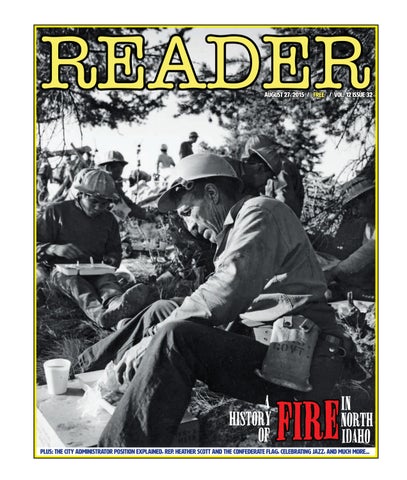
Plus: The city administrator position explained, Rep. Heather Scott and the confederate flag, celebrating jazz, and much more...
DEAR READERS, (wo)MAN on the street

Do you think Sandpoint should hire a city administrator, or stick with the established polit-

“I have heard a lot of rumors about this and it has not been made clear what the advantages

“Yes, I do. I trust the judgment of the city’s elected leaders. They perceive the need for an administrator. I support them.”

Environmental advocate

“I do not think they should hire a city administrator because of

Mara Lei Monroe

Bonner General Health Sandpoint

“It’s a done deal. They are going to start advertising and will interview the top three. I don’t like the usual grandstanders criticizing anything other than what they are used to. Actually, I would like to see your husband [Stephen Drinkard] apply.”

Ray Kosse Counselor

We’re rapidly approaching my favorite time of the year, which starts right after Labor Day Weekend. The town quiets down a bit. The smoke clears from the air (let’s hope). School starts. Mornings are brisk and chilly, the days still warm.

Some summers are lost to booze, to good times, to music, to travel, to work. This summer, I feel, has left a smoky impression on us all. Between the early heat waves, the relentless wildfires raging all over the northern counties and the smoke-filled skies, we haven’t had much of a reprieve.

Fall will provide. Though it’s still more than a month away, I feel it calling to us, ready to sooth our summer bones.

Hang in there folks. We’ll be watching the lake go down and the leaves turn color before we know it. Embrace what is left of our summer in those awesome ways you know how. The lake felt great today.

“I don’t think we’re currently at that level of city government. Keeping it affordable for the people who live here is the important thing to consider.”

Graphic designer, artist

“I can only ask, ‘What would Ronald Reagan do?’”

Eric Paull V.P. of Commercial Banking Washington Trust Bank Sandpoint

READER

111 Cedar Street, Suite 9 Sandpoint, ID 83864 (208)265-9724

www.sandpointreader.com

Publisher: Ben Olson ben@sandpointreader.com

Editor: Cameron Rasmusson cameron@sandpointreader.com

Zach Hagadone (emeritus)

Contributing Artists: Chuck Peterson, Bonner County Historical Society (cover), Ben Olson, Angela Euliarte, Lee Santa

Contributing Writers: Cameron Rasmusson, Ben Olson, Nick Gier, Scarlette Quille, Ted Bowers, Dan Eskelson, Lee Santa

Submit stories to: stories@sandpointreader.com

Printed weekly at: Griffin Publishing Spokane, Wash.

Subscription Price: $75 per year

Advertising: Jen Landis jen@sandpointreader.com

Greg Larson greg@sandpointreader.com

Clint Nicholson clint@keokee.com

Web Content: Keokee

The Sandpoint Reader is a weekly publication owned and operated by Ben Olson and Keokee. It is devoted to the arts, entertainment, politics and lifestyle in and around Sandpoint, Idaho.

We hope to provide a quality alternative by offering honest, in-depth reporting that reflects the intelligence and interests of our diverse and growing community

The Reader is printed on recycled paper using soy-based ink. Leftover copies are collected and recycled weekly, or burned in massive bonfires to appease the gods of journalism. Free to all, limit two copies per person.

SandpointReader letter policy:

The Sandpoint Reader welcomes letters to the editor on all topics.

Requirements:

–No more than 400 words –Letters may not contain excessive profanity or libelous material. Please elevate the discussion.

Letters will be edited to comply with the above requirements. Opinions expressed in these pages are those of the writers, not necessarily the publishers.

Email letters to: letters@sandpointreader.com

Check us out on the web at: www.sandpointreader.com

Like us on Facebook.

About the Cover

This week’s cover is a photograph credited to Chuck Peterson, given to us for use by the Bonner County Historical Society. The photograph is of a firefighter camp in the 1960s, possibly the Sundance Fire or one of the other fires that season.

In praise of all beings with hearts and minds

About 500 protesters (including 30 counter demonstrators) gathered near the office of Planned Parenthood in Pullman, Washington on last Saturday morning. Those who were interviewed by the local newspaper were repeating arguments that have been discredited. Contrary to their claims, Planned Parenthood does not sell fetal tissue and it does not use federal funds to provide abortions, which is only 3 percent of their life-saving activities.

Far too many Christians are unaware of the fact that our moral, legal and religious traditions support the 1973 Supreme Court decision. The great Catholic philosopher Thomas Aquinas, for example, agreed with Roe v. Wade: The fetus is not a person until the third trimester.

Jacques Maritain, 20th century Catholic theologian, states: “To admit that the human fetus is a person from the moment of its conception sounds to me like a philosophical absurdity. It is absurd to call a fertilized ovum a baby.” Catholic canon law did not move the cut-off point back to conception until 1917. For more on the theological history of abortion, go to www.webpages.uidaho.edu/ngier/abortion.htm.

English Common Law allowed abortions until the fetus “quickened in the womb,” which

LETTERS

Shooting could have been avoided...

Earlier this month an incident took place in Sandpoint where a law enforcement officer used deadly force in the execution of his duties. Sad to say, but this confrontation was easily avoidable. I’m not for one

is essentially the Roe v. Wade viability criterion. In the 17th century, jurist Sir Edward Coke argued that the fetus is not a “reasonable creature [a person] until it is born alive.” Under the influence of Sir William Blackstone (1732-80) the criterion of quickening returned as the accepted standard. Our founding thinkers would have followed Blackstone, and so should American judges who insist on conforming to the intentions of those who wrote the Constitution.

Many anti-abortionists argue that the fetus has a unique genetic identity, and this means that we must protect its life from conception on. Genetic identity, however, is not personal identity. Animal fetuses are genetically unique, but most people would not call them persons because of it. A human zygote can twin up to 20 days, which proves that genes can divide but to say that persons can is absurd. Identical twins are of course the same genetically, but as distinct persons they are issued different birth certificates and Social Security numbers.

Most of the recent state laws challenging Roe v. Wade have been ruled unconstitutional. Some states and a bill now in Congress would ban abortion after 20 weeks, because supporters say that the fetus experiences pain at this time. A study published in the Journal of the American Medical Association demonstrated that the fetus does not feel pain until 28

minute saying the use of deadly force was not justified. Quite the opposite, it was justified and necessary. What I’m saying is that it was easily avoidable if the criminal justice system had done its job.

The perpetrator in this instance was one Casey George Alarcon, a figure well known to the criminal justice system. His long list of criminal convictions for violence should have prevented him from being free in

weeks. Medical scientists in the United Kingdom have come to the same conclusion.

A new law in Arkansas that prohibits abortion after 12 weeks is now on appeal and will most assuredly be declared unconstitutional. A North Dakota law drawing the line at six weeks, when a fetal heart beat can be detected, has been ruled contrary to Roe v. Wade.

Animal fetuses have beating hearts and they also feel pain. We must be able to make moral and legal distinctions between humans and animals; otherwise we would be compelled to extend a right to life to them. As a vegetarian, however, I would be in favor of that.

Just three weeks ago Manhattan Supreme Court Judge Barbara Jaffe ruled that two chimpanzees were not legal persons.

society to not only prey upon the innocent but to endanger lives around him. In days of the past, he would have been considered a career criminal and would have been incarcarated for life years ago. But in today’s “catch and release” attitude of the courts, and the powers that be, Alarcon was granted chance after chance to prey upon the innocent.

Reading his rap sheet is like walking the line of a Sunday buffet. A little bit of everything

Attorneys for the Nonhuman Rights Project had argued that Hercules and Leo, retired lab chimps at the State University of New York, should be freed from their cages and allowed to live in a sanctuary in Florida.

In a previous ruling it appeared that Judge Jaffe had granted the chimps a writ of habeas corpus, which would indeed make them persons. In her final brief Judge Jaffe corrected that implication, but she did concede that this campaign “may someday succeed.” She pointed to the fact that Supreme Court has granted corporations the “legal fiction of personhood.”

Chimps share 97 percent of our DNA and their fetuses look just like human ones. (See the ultrasound at www.webpages.uidaho.edu/ngier/apefetus. htm.) Scientific accounts of

from robbery, firearm offenses to resisting officers. His four felony convictions should have been ample reason to segregate Alarcon from civilized society. But somehow this social misfit was never required to serve a full sentence and was allowed to continue his criminal lifestyle until our failed criminal justice system forced law enforcement officers to use deadly force.

His case is not unique. Seldom in today’s world is a

their high quality emotional and mental lives are certainly not fictional. Chimps have learned sign language, have invented new words (“water birds” for ducks), and have passed this language onto to their babies. In 1986 Koko the Gorilla was interviewed in Playboy magazine, and she signed enthusiastically about the interviewer’s “fake (gold) tooth.” She also insisted that she was a person and that her non-signing mate Michael was just an animal. How many of you will join me in protecting the right of apes, dolphins, and whales to “life, liberty, and the pursuit of happiness”?

Nick Gier of Moscow taught religion and philosophy at the University of Idaho for 31 years.

dangerous, anti-social criminal forced to serve a full term. Alarcon’s last hurrah involved shots being fired not only at law enforcement officers but in a neighborhood environment where innocent people could have been injured or killed. How many other armed Alarcons are walking free among us?

Hercules and Leo. Courtesy photo.

PERSPECTIVES

Why singles secretly hate married people

Part two of a two-part series

Caption Contest Winner

I received a few requests to write a “part two” to my most recent column entitled “Why Married People Secretly hate Singles.” In order to be fair, and because I loved all the awesome feedback I received, I decided to oblige.

If you are married, and you have the sneaking suspicion that your single friends may secretly hate you, I have provided some of the reasons this may be accurate.

1. You get to be fat. Since you have already gone out and captured your quarry, you no longer have to worry about being a lean mean predator on the prowl. You can relax, gain a few pounds and sail across a ranch dressing sea in a French fry canoe, enjoying the fact that your extra pounds do not affect the amount of dates you go on. You already have a captive date, ready for all occasions.

2. Tax Breaks. Seriously. How is it fair that you have presumably twice the earning potential as one lone person, and yet you get government discounts? Married people have their relationship acknowledged and receive federal perks for being married. I am not sure that I fully understand the logic behind this practice, but it sure makes people angry. If you are a single person who makes decent money, you remain dangerously close to being poor, because you are paying taxes up the wazzoo. It’s like living alone is slapping society right in the face, and the more successful you are, the harder they slap. Married people get deeper discounts with every member they add to their tribe, even when it passes the limit of human decency. Duggars? Seriously, they should have been fined after they surpassed 12.

3. You get to spend someone else’s money. You have two people who work. You get equal say in the way the money is spent. New

dishwasher? A trip? A car? A pair of new religion jeans? It’s all up for negotiation. One of you doesn’t work at all? The jobless person gets to spend the other person’s money. That’s a sweet deal.

4. Question Free Excuses. Your single friend asks you to go out and be their wingman, or Mom wants you to come over and see the latest addition to her vast ceramic animal collection? You get to say no. My spouse needs me to blah, blah, blah. It doesn’t matter what the spouse needs, just that you have one, and they need you. That’s enough, you are off the hook. Also your spouse is legally obligated to corroborate the story. No single person ever gets to make an excuse with out the other party questioning it’s validity.

5. Sex Nights. You have them on the schedule. It’s weird. My married friends give me excuses for their lack of participation in activities like this: “Every Thursday night is a no for me. I can’t play women’s league softball. That’s sex night.”

I get it that this swings both ways. I mean what if that is the only night you have sex? However, if you are a single person in a “dry spell,” sex once a week sounds pretty good. Also you can plan for the sex. This means your attention to hygenic details such as grooming and hair removal only has to be on point, once a week. Seriously, let’s say you get in the mood on a nonsex night—the other person can’t complain about your hair or odor. How were you supposed to know that sex was going to happen on a non-scheduled night? There must be some comfort in that. Which brings me to the next point;

6. Hair removal. For a single person this day in age, it is practically an obligation to remove every bit of pubic hair from your body Otherwise, you are not attractive. Even men have to “manscape.” Somewhere out there in this world right now there is a single woman on all fours on top of a raised bed, there is someone applying hot wax to her entire crack, and

then planning on ripping it off. As she anxiously waits for the painful procedure to be over, she remembers a conversation with her married friend at the gym. The married woman is laughing at her hairy pits in pilates, because she hasn’t shaved for two weeks as her razor is dull. As the first layer of skin and pubic hair is ripped from the single woman’s nether regions, she thinks about how much she hates you, married friend.

7. Boys and girls “nights.” Single people do not understand this. Why must all “nights” have a name and an expectation attached to them. Girls’ Night, Boys’ Night, Sex Night, Family Night, Taco Night: It’s exhausting. These same sex gatherings typically end badly for the single attendees as we are expected to babysit our married friends as they act like they have been released from prison straight into the streets of Vegas. Girls’ night should really be called “Husbands Watch The Kids While We Drink Too Much Wine And Complain About Them Night.”

8. Pet names. This is what it is. I expect “Honey” and “Babe” as pet names that are pretty universal and often used to soften the blow of an indirect accusation, such as, “Honey, did you pay the water bill?” However the private pet names like Squishy or Big Man shouldn’t be used in public. They are disturbing and leave your company wondering about their origins. It’s unnerving. There is only one exception to this that I have ever seen. My cousin and her husband call each other “Vern.” It is such an innocent and androgynous name. Nothing weirdly perverse is instantaneously associated with it. They have been together so long that they have a unisex pet name that does not inflict nausea on innocent bystanders. This is enough to make anyone jealous.

9. Setting us up with your single friends. No one wants you to set them up with your “single” friend. This is a bad idea. We get it, it would be nice if all your single friends were in a committed relationship with similarly scheduled

sex nights and the like. However, often times your only prerequisite for setting us up on the date with the other person is that they are single. This doesn’t cut it. Also it’s a real pain in the ass when we humor you and go out with the guy from your work who is 15 years older than us and has an extensive collection of antique swords, and then you become offended when it doesn’t work out. Stop doing this. Stop. If you must play matchmaker, at least ask for a list of criteria.

10. Shared Chores. Married people, there is someone else in your house who does tedious things like wipe counters, take out trash and pick up groceries (if you are married, and there is no one else in your house who does these things, you might want to evaluate that in

some way. I do not carry the licensure to provide advice on those type of arrangements). However, I often fantasize daily on what it would be like to live in an environment where someone else, sometime, even once, folded laundry and put it away. Seriously, if that was going on in my house, sex night would be like seven times a week and twice on Sunday.

See, married people, there are things we singles hate and envy about you too!

Thank you for all the amazing feedback from my last column!

Love , Scarlette Q

Honorable mention:

Heather Scott sparks new Confederate flag debate

Just when we thought we were out, they pull us back in.

It seems we just can’t stop arguing about the Army of Northern Virginia battle flag, better known as the Confederate flag. The latest uproar centers on District 1 Rep. Heather Scott, R-Blanchard, who posted a Facebook photo on July 25 of her proudly displaying the flag along with three American flags. The photo is accompanied by the caption, “Protecting and promoting our freedom of speech is an honor.”

Apparently, the picture was taken at the Timber Days celebration in Priest River. However, the post went unnoticed until the Spokesman-Review published a news story this week, which touched off yet another blaze of Internet arguments about what the flag really represents.

Scott didn’t return our calls requesting a comment. However, she defended

Sandemonium!

If you’re a fan of comics, video games, manga, anime or just about any nerdy pastime, remember to check out Sandemonium at the Sandpoint library this Saturday.

From 10 a.m. to 5 p.m. Saturday, Aug. 29, the library is going to be filled with workshops, panels, presentations, video game tournaments, contests and much more. If you’re into cosplay, or dressing up as your favorite fictional characters, be sure to ready a costume in time for the event. You could win a prize in either purchased or homemade costume categories.

Sponsored by the library, the Panida Theater and the Reader, Sandemonium is Sandpoint’s first fandom event. Keep an eye out for it in future years. There’s no telling how much it could grow. [CR]

her display of the flag to the Spokesman-Review in much the same terms as her Facebook post.

“We see it as a symbol of free speech,” she said.

“I’m sure some people find an American flag offensive, right?” she added. “There’s people that burn it, there’s people that disrespect it. I will never kill someone’s freedom of speech.”

However, Idaho’s history with the Confederate flag is remarkably touchy for a state that didn’t even exist during the Civil War. The flag was a common sight along with the Nazi swastika during North Idaho’s battles with white supremacist factions that sought to establish local footholds.

Tony Stewart of the Kootenai County Human Rights Task Force told the Spokesman-Review he remembers when Aryan Nations member Richard Butler paraded the streets of Coeur d’Alene in 2004, displaying the Confederate flag and Nazi swastikas while dragging be-

Idaho running out of 208 numbers

It’s no wonder that Idahoans are fond of the 208 area code. After all, Idaho is just one of 12 states with a single telephone area code, which gives residents a special numerical identity to cherish. Enjoy it while you can, folks, because those days may be coming to an end.

The Boise Weekly reports the the Idaho Public Utilities Commission expects to run out of 208 numbers by mid-2018, meaning that they need a plan to implement a new area code in a way that pisses off the fewest people. The idea now is to go for a “geographic overlay” which would essentially introduce the new area code to new numbers. This is opposed to a “geographic split,” which would divide the state in two. The only downside to that plan? You’d have to dial the number plus the area code no matter where in Idaho you’re calling.

Either way, the change will see Idaho lose membership in the rather exclusive single-area-code-state club. The only other states that still remain include Delaware, Maine, New Hampshire, Rhode Island, Vermont, Alaska, Hawaii, Montana, North Dakota, South Dakota and Wyoming. [CR]

hind him the flag of Israel.

“We find it very unfortunate that any political leader would send such a message to their constituents that would be so highly offended or hurt by that symbol,” said Stewart

More recently, the flag was a common sight at Shaun Winkler’s North Idaho compound. In 2012, Winkler attempted to continue Butler’s white supremacist efforts in North Idaho, capping off his labors with a run for the Bonner County Sheriff’s Office in 2012.

“Hate speech is protected under the First Amendment,” said Stewart. “But we also would really, really encourage people not to do that, because it doesn’t move us forward towards equality. It resurfaces a form of discrimination.”

The Bonner County Human Rights Task Force agrees with its colleagues in Coeur d’Alene.

“We agree with Mr. Stewart that freedom is protected under the First Amendment,” said organization president Lynn

Open fires banned in Sandpoint

Fire season continues to impact everyone’s summer, but this week, even in-town residents felt the burn.

There’s the smoke that still permeates the air, sure. But the city also took action on the extreme danger, prohibiting open fires within city limits. Barbecues are the most residents can manage if they’re looking for a little open-flame outdoor recreation.

Of special concern is the Little Sand Creek Watershed, one of the city’s most important water sources and the subject of routine timber sales and maintenance to reduce the threat of wildfire. Nevertheless, city officials report that on July 24, Sandpoint, Sagle and Schweitzer firefighters battled a human-caused fire within the watershed.

That wasn’t the only way the fire danger interfered with local plans. Fires in Essex, Mont., led to railroad closures in the state, which in turn suspended Amtrak service earlier this week in Sandpoint. The transportation agency arranged bus transportation to work around the closed sections of rail.

If you have any questions about fire prohibitions, call Selkirk Fire, Rescue and EMS Department at 263-3502 or 263-3533. [CR]

Candidate slate starts shaping up

Ladies and gentlemen, we officially have a race for the Sandpoint mayor’s office. According to Sandpoint City Clerk Maree Peck, two candidates have filed their paperwork so far, formally throwing their hats into the political ring. Mose Dunkel vies for the seat against Shelby Rognstad, who announced his candidacy two weeks ago.

However, there are still plenty of city seats that need to be filled. In addition to the four-year mayor’s office, there are three four-year council positions that are still open for candidates. The first day to file a declaration of candidacy kicked off Aug. 24, and residents have until Friday, Sept. 4 to submit paperwork to Sandpoint CityHall. Otherwise, you have until Oct. 6 to declare intent to run as a write-in candidate.

Candidates must certify that they are at least 18 years old, a U.S. citizen and have lived within Sandpoint city limits for at least 30 days prior to submitting candidate paperwork. They also need to appoint and certify a political treasurer and fill out the appropriate forms, although candidates can handle their own candidacy finances if they so choose.

All necessary forms and information are available at the Sandpoint city clerk’s office or at www.cityofsandpoint.com. Call 263-3310 if you have additional questions. [CR]

Bridges. “We also agree that the Confederate flag represents far more than freedom of speech for many in the U.S.”
Rep. Heather Scott posing with the Confederate flag in a photo taken from her Facebook page.

FEATURE

From the Big Burn to today:

A look at some of the big fire seasons that have affected North Idaho

A retrospective look at in north idaho

FIRE

Fire is burned into Idaho history just as surely as the accomplishments of its people.

From its beginnings as a hunting ground for trappers to its transition into a region of timber communities, Idaho’s forest lands have provided opportunity for untold numbers over the years. But with the opportunity came danger, and none more widespread or destructive than wildfire. As we’ve seen with this year’s historically destructive fire season, it’s a threat that no amount of technological progress can mitigate.

Under the right circumstances—usually hot, dry summers and the right mix of weather conditions—the results can be truly devastating. There is perhaps no better example of this than the Great Fire of 1910, also known as the Big Burn, which ravaged North Idaho, East Washington and West Montana for two days, killing 87 people, devastating towns and reducing 3 million acres into cinder. Despite firefighters’ best efforts, it was only a cold front and steady rain that finally

conquered the inferno, and the disaster in large part established the then-tiny U.S. Forest Service’s raison d’etre.

“You hear a lot about Wallace, but you don’t hear about the other areas around here that burned,” Dick Creed, who worked on the 1967 fire, said of the 1910 incident. “Sagle burned. Gold Mountain was on fire, too.”

Still within living memory, the 1967 fire season, which included the famous Sundance Fire in addition to smaller blazes like Trappers Peak, provides a close analogue to the 2015 season. Both seasons were the products of a hot, dry summer that turned forests into tinderboxes. Both pitted firefighters against infernos of surprising ferocity. Both blanketed the region in a thick smog of smoke. And both were only controlled through the efforts of an army of firefighters.

“Back in [1967], I think the conditions were even worse than they are today,” said Larry Stone, who worked for the U.S. Forest Service in 1967. “The smoke in particular was as bad, if not worse, as it is now.”

In all cases, Idaho’s historic fire seasons were characterized by the incredible speed of its growth. This year, the Cape Horn fire spread from initial reports on

July 5 to a 2,000-acre disaster requiring evacuations by the next day. Similarly, powerful gales turned the several small fires in 1910 into the giant firestorm it became. And in the case of the Sundance Fire, danger and devastation that no one anticipated was the work of a few hours.

“The fire started on Sundance Peak,” said Creed. “It grew to 3,500 acres real

The Big Burn (1910)

Origin: August 20, 1910. Cause unknown.

Acres Burned: 3 million

Lives lost: 87

No one knows exactly how the Big Burn of 1910 started, but we do know that 1910 was the driest year in anyone’s memory. The snow pack melted early and spring rains never fell. By June, there were small fires burning everywhere in the region.

On July 15, a bad electrical storm started fires all over. Depending on who was doing the counting, there were anywhere from 1,700 to 3,000 fires burning in North Idaho and western Montana. Most were small and in the process of being contained.

On August 20, all hell broke loose. Hurricane force winds blew across the Inland Northwest, turning hundred of small blazes into one or two massive infernos. The firestorm burned throughout northeast Washington, the Idaho Panhandle, and western Montana. It attacked the Bitterroot, Cabinet, Clearwater, Coeur d’ Alene, Flathead, Kaniksu, Kootenai, Lewis and Clark, Lolo and St. Joe National Forests. The strong winds turned the burning trees into blowtorches, scattering embers and starting the virgin timber for miles around.

The firestorm burned for two days and killed 87 people, most of them firefighters on the front lines. One crew of 28 called the “Lost Crew” perished when they were overcome with flames by Setzer Creek near Avery, Idaho. Another famous story of heroism involved Ed Pulaski, a U.S. Forest Service Ranger who led a crew of his to safety in an abandoned mine outside of Wallace, Idaho. Knowing that they would have no chance of survival if they ran, Pulaski drew his pistol, threatening to shoot the first person who tried to leave. In the end, all but five of the forty or so men survived.

Smoke was reported to have been seen as far east as New York and as far south as Denver, Colorado.

Several towns in Idaho and Montana were burned completly to the ground. One third of Wallace, Idaho was destroyed.

The Big Burn of 1910 remains one of the most destructive wildfires in American history, maybe even the world.

The town of Wallace, Idaho photographed in 1915, five years after the fire’s destruction.
Dick Creed talks about the Sundance Fire in 1967. Photo by Ben Olson.

Bouquets:

•Being a musician in a small town, you get to know your audiences fairly well. Some places, you play your heart out and can’t buy a round of applause. Other venues, you are overwhelmed with good vibes the moment you pluck your first chord. But, one of the absolute best parts about playing music in Sandpoint is identifying certain members in the audience who make it worthwhile. I’m talking about guys like Seth Phalen, who seems to attend just about every live music event in North Idaho. I’m talking about Will Harrison, who takes the tip jar for a circle around the room without being asked and always ends up earning bands an extra fifty bucks or so. These, and so many more I haven’t mentioned deserve a bouquet for understanding that it’s not always easy to play in front of a crowd, especially when it’s your home town and you went to school with half of them.

Barbs:

•Boo to Rep. Heather Scott (R-Blanchard) for recently posting a photo of herself posing with a Confederate flag on Facebook. This is just poor form, especially in a state that still associates the flag as a symbol of racism by Richard Butler’s Aryan Nations. What does she hope to accomplish by this photo?

“We see it as a symbol of free speech,” Scott was reported to have said.

Do you know what I see it as a symbol of? Racism. Segregation. Bigotry. More backwards politics that plagues Idaho (especially North Idaho). It’s an embarassment and extremely offensive that a representative of the people of this great state sends this kind of message. Boo!

Got a bouquet or barb you’d like to offer? Write me at ben@ sandpointreader.com with “BB” in the subject line.

The City Administrator post explained

Call it the big Sandpoint budget controversy that wasn’t. When Sandpoint City Council members announced in Juy they were considering adding a city administrator position to the roster of government employees, plenty of residents had a less than enthusiastic reaction. Many bristled at what they perceived as not just a hefty public expense—the job carries a salary of more than $100,000—but also a kind of disenfranchisement, a transfer of powers from elected officials to a permanent, well-paid position. Residents expressed frustration in letters to the editor and social media posts.

Cut to the council meeting of Aug. 19, when members conducted a final public hearing before voting on the budget. Only a handful of people attended the meeting, and no one offered any commentary on the budget or the new position— most attendees were there to request that Sandpoint formally call for a new investigation into the Sept. 11, 2001 attacks. According to Mayor Carrie Logan, the city only received a handful of official citizen comments throughout the entire budgeting process.

Public engagement may have fizzled, but the fact is that Sandpoint’s adoption of a city administrator does represent a major structural change for the way the city does business. And like every other shift in policy or governance, only time will gauge its effectiveness.

A city administrator is more than just a city planner. The position requires a highly educated and experienced individual who unifies public policy across all city departments. Post Falls city administrator Shelly Enderud describes her role as similar to that of a chief executive officer of a company.

“[It’s about] trying to grow your city in smart ways,” she said. “You don’t want to have the wrong kind of growth in the wrong places.”

Like a CEO, Enderud’s responsibilities are varied and extensive. She works with ter-

minated city employees to determine whether or not they were justly fired. She writes grants to promote growth and minimize local costs. And she enacts economic initiatives to attract new businesses and jobs into the area, working as a middleman between the state, developers and business leaders. Of course, the administrator also works with elected officials to execute their policies and sometimes recommends new policy to consider.

“I think when you have the right people and the right policy in place, you have [a system] with fewer liabilities and more [productivity,]” she said.

According to Logan, the addition of a administrator takes pressure off a multitude of officials within the city. Department heads, for instance, would be able to focus on the direct management of their employees.

tency City Hall has otherwise lacked

This isn’t the first time Sandpoint has hired an administrator, according to former city clerk and council member Helen Newton. She said a similar position was created in the late 1970s because the mayor was a full-time pastor. The position was later removed in the 1980s due to community dissatisfaction, especially from the business community.

“That was a long time ago,” she added. “I’m not saying this couldn’t work now—with the right person.”

More recent conversations about bringing on an administrator extend back to 2007. However, it wasn’t until former

mine pay scales commensurate with Sandpoint’s population.

“We don’t just pull that number out of a hat,” Logan said.

According to Logan, the city funded the position with money cleared up through a reduction in payments to the Public Retirement System of Idaho for firefighter benefits. Reduced costs this year in water and sewer also freed up some money for budgeting.

“Only a handful of people attended the meeting, and no one offered any commentary on the budget or the new position— most attendees were there to request that Sandpoint formally call for a new investigation into the Sept. 11, 2001 attacks.”

“This is great for our department heads who, you have to remember, are working department heads and not just administrators,” Logan said.

It also clarifies the responsibilities of mayor, an office that could either wield a strong or light touch depending on the person filling it.

“[Fire Chief Ron Stocking] felt in effect I was doing the job of a city administrator,” Logan said.

Rather than replacing the will of elected officials, Logan said a city administrator would help ease transitions between elections, providing a consis-

planning and zoning director Jeremy Grimm left the city early this year that officials began serious conversations.

“In my mind, we needed to look at how best to use that position,” Logan said.

When residents first heard about the proposed position this summer, many balked at the salary it commanded. At just over $100,000 per year, the job brings in more than twice the average Bonner County household income. According to Logan, those rates aren’t determined by the city—they work with outside agencies to deter-

Following the adoption of the budget on Aug. 19, the city published advertisements for the position. As of this Monday, they already had four applications. Logan said the plan is to evaluate candidates throughout September. If everything moves along quickly, the city could have its administrator within the first two weeks of October. With the job search moving forward, it’s only a matter of time before Sandpoint has a new city administrator. For her part, Newton questions whether or not the city needs the new position.

“We already have eight exceedingly well-paid department heads who, in my view, are doing a very good job,” she said. Nevertheless, she’s keeping an open mind, and she believes the success or failure of the change depends entirely on the person hired. If she had her way, however, she would add one additional requirement to his or her contract.

“I’d require that the city administrator live within city limits so [he or she] is under the same regulations as everyone else,” she said.

Dollar Beers!

8pm @ Eichardt’s Pub

27 28 29 30 31 1 2 3

Magic Mountain Music Fest

Up Baldy Road, 1.1 miles past the pavement, left at Larsen Ranch.

Check out Ghandi Lee on FB for more info

Yappy Hour 4pm - 7pm @ Evans Brothers Coffee

Bring your furry friends over to Evans Brothers and watch as they quickly make more friends than you. Featuring live music, drinks and good times

Pinot and Pilsner and The Pearl, Oh My!

5pm @ Georgia Mae Plaza (Bonners)

Come to the Georgia Mae Plaza in Bonners Ferry for a wine and beer tasting event, starting at 5 p.m. Sample tasty food and drink, enjoy live music, fun and games - all to support the Pearl Theater’s membership drive! Cost is $20 per person

Sandpoint Farmers Market 9am - 1pm @ Farmin Park

Live music by Kathy Colton

Used Book Sale

10am - 2pm @ Bonner Mall

The public is welcome to bring books and sell them; there’s no cost and tables are provided. Shoppers - this is a great chance to find books at a huge discount!

Live Music w/ Monarch Mountain Band 5:30pm @ Pend d’Oreille Winery

Live Music w/ David Walsh 5pm - 7pm @ Idaho Pour Authority

Live Music w/ Justin Lantrip 9pm - 12am @ 219 Lounge Local singer/songwriter

Sandpoint Chess Club

Gratefulness

5:30pm @ Sandpoint

Come down trees in the SASi your last chance before they come

Live Music w/ Jean Mann

5:30pm @ Pend d’Oreille Winery Soft, acoustic, indi-folk/rock musician from coastal Washington

Live Music w/ Chris Lynch 6pm - 9pm @ Arlo’s Ristorante

“No Service” play

7:30pm @ The Heartwood Center

Unknown Locals production of an original play by Chris Herron

Summer Sounds 4pm - 6pm @ Park Place Stage Featuring Kathy Colton and the Reluctants

Live Music w/ Lorin Walker Madison 8pm @ Eichardt’s Pub

Special B-day show, $5 cover

Live Music w/ Brother Music 7pm @ La Rosa Club

9am @ Evans Brothers Coffee Meets every Sunday at 9am. All are welcome

Monday Night Blues Jam w/ Truck Mills 7:30pm @ Eichardt’s Pub

First Tuesday at Eichardt’s 7pm @ Eichardt’s Pub

Hosted by Jake Robin, come enjoy some live music and cold beer

Bingo Night 6:30pm @ MickDuff’s Beer Hall

Sandpoint Farmers Market 3pm - 5:30pm @ Farmin Park

Live music by Möbius Riff

Dollar Beers!

8pm @ Eichardt’s Pub

Good until the keg’s dry

Trout and About Festival 11am @ The Granary (near Evans Bros.)

An event where parents and their kids can cialize, listen to great music, learn some facts about trout, dance it up and have fun!

9/11: Blueprint For Truth presentation 7pm @ The Heartwood Center

A dynamic live presentation by architect ard Gage describing the scientific forensic idence about the explosive destruction three World Trade Center high-rises on

Trivia Night 7pm - 9pm @ MickDuff’s

Karaoke Night 9pm - Midnight @ 219

Rock Creek Alliance end of summer party 5pm - 8pm @ Idaho Pour Authority

Live music with Beth Pedersen. Silent Auction Complimentary Appetizers. Come down and Creek Alliance in their quest to protect Lake

Monarch Open Mic 6pm - 9pm @ Monarch Mountain Coffee Held on the first and third Thursday

Magic Mountain Music Fest

ful

Gratefulness Blessing

5:30pm @ Sandpoint Senior Center

Come down and say goodbye to the two smaller trees in the SASi parking lot. Artists, this is also your last chance to paint or photograph the trees before they come down Friday

Winery

August 27 - September 3, 2015

A weekly entertainment guide to keep you on your toes. To list your event free, please send an email to calendar@sandpointreader.com.

Reader recommended

Be Bear Aware

5:30pm @ Bonners Ferry Ranger Station

Learn from experts about grizzly bears, traveling safely in bear country, and how to use bear spray as one tool in bear conflict avoidance. Registration is required. Sign up at IdahoConservation.org or call 208-265-9565.

“No Service” play

7:30pm @ The Heartwood Center

Unknown Locals production of an original play by Chris Herron. “No Service” is a darkly humorous story about life, death, and the complications of family. Anne is dying of an unknown illness. Her best friend, Kim, travels to Anne’s remote cabin to see her one final time. Upon learning that Anne has become estranged from her daughter, Kim does her best to put her nose where it doesn’t belong and reunite mother and daughter before it’s too late. $12 general admission, $10 seniors/students

Live Music w/ Eartha-Kiit and Gold Tooth

9pm @ 219 Lounge

Two great rock bands in one night, on the patio at the 219. Eartha-Kiit is known for its amped up rock sensibilities. Gold Tooth is Vance Bergeson’s new band with a mix of punk with funky rock

Live Music w/ Marty Perron & Doug Bond 5pm - 7pm @ Idaho Pour Authority

Live Music w/ Ken Mayginnes 7pm @ La Rosa Club

Live Music w/ Rob Smith & Friends 8pm @ Eichardt’s Pub

Reluctants

Madison

Sandemonium!

10am - 5pm @ Sandpoint Library North Idaho’s first fandom event, featuring a cosplay contest, vendors, Artist Alley, workshops, panels and more. Attendees are encouraged to suit up as their favorite comic superhero, anime, video game or movie character, with prizes ready for the best in both store-bought and homemade costumes. They should also ready their creativity for a celebration of fandom communities, including their artwork, fiction and music. Sponsored by The Library, the Sandpoint Reader and Panida Theater. Attendence is FREE and open to all

Full Moon and Hors d’oeuvres Cruise 7pm @ Sandpoint City Beach

Enjoy a variety of excellent complimentary hors d’oeuvres while cruising through eagle territory aboard the Shawnodese. To cap off the evening, watch the full moon slowly rise above the spectacular Cabinet Mountains before returning to port. Departs Sandpoint City Beach at 7 p.m. Fare is $36 per person. Evans Bros.) their kids can solearn some fun and have fun!

Live Music w/ Devon Wade 9pm - 12am @ 219 Lounge

Local country music star presentation Center by architect Richscientific forensic evdestruction of all high-rises on 9/11

Night

Midnight @ 219 Lounge

summer party

Silent Auction and Raffle. down and support Rock protect Lake Pend Oreille

Mountain Coffee Thursday of every month.

Live Music w/ Chris Lynch 6pm - 9pm @ Arlo’s Ristorante

UPCOMING EVENTS

Sept. 4-5 - “No Service” @ the Heartwood Center

Sept. 5-6 - Funky Junk Antique Show @ Bonner County Fairgrounds

Sept. 5-7 - Fall Fest @ Schweitzer Mountain Resort

Charley Packard & Friends

7:30pm @ Eichardt’s Pub

Come on down and see the one, the only, Charley Packard. He’s back, baby!

Reggae Wednesday at the Niner 9pm - 12am @ 219 Lounge

Come down and listen to some reggae with Josh Adams on the patio

Magic Mountain Music Fest

To submit your own pet photos, please send a photograph and a little bit of information about your special friend to ben@sandpointreader.com. Please put “PET PHOTOS” in the subject line.

Maisey adopted me when I got lonely living in a big empty house during my short time in NorCal before coming back home to Rapid Lightning about five years ago.

She was just over a year old then and full of energy. She’s mellowed a bit since and has become the most loyal guardian and friend a North Idaho mountain girl could ask for.

Her ground squirrel body count this summer is higher than my dude’s with his .22 rifle. Her thirst for adventure shall never be quenched (this picture was taken on the Clark Fork on our way to Scotchman Peak last fall), she’s smarter than some fifth-graders I know and everywhere we go people want to know her breed because, “She’s so pretty!” Shelter mutt, friends. Best breed there is.

quick. Then we got a strong Palouse wind. I was working nights then. My wife woke me up to see this big column of smoke burning out upper Pack River.”

Stone recalls the amazing speed with which the Sundance Fire spread. Thought to be controlled on Aug. 29, 1967, the fire grew throughout the evening and overran containment lines.

“That fire jumped over a fireline eight dozer-blades long,” said Stone.

By Sept. 1, the Sundance Fire churned through woodlands at amazing rates, growing from 4,000 acres to 55,900 acres within 12 hours, Stone said.

“That fire was really moving,” he added.

The speed caught everyone off guard. The sheer energy of the spread was astounding, firefighters remembered.

“They say the energy expended every five minutes on that fire was equal to the bomb at Hiroshima. A column of smoke went 30,000 feet into the air,” said Creed.

The fire also posed the greatest amount of danger anyone had seen from a wildfire in years. Two men were trapped by the fire and perished.

“They were caught on the west side of Pack River drainage,” said Creed. “One was a dozer operator. They were caught in a blowup. If you’re caught, you clear the ground and hide under the

heavy equipment. That’s what they train you to do. You don’t want to lose anyone. It drove home the fact that this was a really dangerous situation.”

Stone remembers another, Randy Langston, who very nearly became a third casualty. Stationed at fire lookout, the young man, just out of high school, received radio instructions to leave his post and get picked up. When he found himself blocked off by fire, he had to bunker down in the wilderness before he was finally rescued the next morning.

“It was a very close call,” Stone said.

Creed, meanwhile, worked as a night dispatcher, coordinating between eight to 10 buses during the Sundance Fire. He coordinated multiple agencies throughout the ordeal.

“We had Native American crews that would come in,” he said. “Crow, North Cheyenne, the Flatheads. They had their own crews. They were very well organized.”

The comparisons between 1967 and 2015 are plentiful, firefighters said, but Creed sees some key differences in the firefighting strategies of today. The aggressiveness of the initial push against fire starts is probably the most prominent, he said.

“The change I see more of is that I

don’t think they are fighting the initial fire as aggressively. Parker Ridge is an example. Also Scotchman. In certain weather conditions, if you’ve got a lot of moisture, letting it burn is a strategy. This summer is hot, dry, low precipitation, it may not be a good time to let things burn.”

Ben Olson contributed to the reporting of this article.

From the Big Burn to today:

A look at some of the big fire seasons that have affected North Idaho

The Sundance Fire (1967)

Origin: August 23, 1967. Lightning caused.

Acres Burned: 51,000

Lives lost: 2

The 1967 fire season built slowly, with abundunt rains falling in the forests of the Northern Region. Though some early season forest fires were reported, they fed only on the dead growth from the year before and were quickly extinguished.

By the end of July, 635 fires had been extinguished in Northern Region National Forests, burning just under 600 acres despite a spate of 131 fires in a single day on July 12. The rains ceased before mid-July. Temperatures rose. Humidities fell. Drying winds helped transform the green carpet into an explosive fuel mass.

The first major dry lightning storm struck on August 11, setting 167 fires ablaze in a single day. Other storms followed, and during the next month, crews battled an average of 25 new fires a day.

On August 23, there were 11 uncontrolled National Forest fires, each larger than 100 acres, of which Sundance and Trapper Peak were the toughest opponents. Combined, the two fires accounted for 64 percent of the burned acreage within the National Forest boundaries.

Trapper Peak burned over 16,000 acres in rugged, nearly inaccessible terrain.

Sundance literally exploded in a single night and day on Aug. 30 - Sept. 1, fanned by tornadic winds, increasing its perimeter by 70 miles and eating up a square mile of timber in as little as three minutes.

Because of a SNAFU involving not obtaining radios within 24 hours after a team switchover, two firefighters were killed after the sudden gusts moved the fire where they did not expect it. Luther Rodarte, 36, and Lee Collins, 53, were found underneath their bulldozer two days after they had perished.

When it was all said and done, Sundance consumed 56,000 acres before it was controlled.

At the time, it was called the worst fire season in over 50 years. Over 7,000 men worked the firelines at its peak. A combined total of 100,000 acres burned in the Northern Region, racking up a fire suppression bill of over $22 million, not to mention the loss of human life and natural resources.

Larry Stone. Photo by Ben Olson.
The aftermath of the Sundance Fire in 1967. Photo by Chuck Peterson, courtesy of Bonner County Historical Society.

Senior Center trees to come down Friday

The Sandpoint Senior Center (SASi) has announced they will make a first leap forward in beginning the parking lot project. Friday morning, two of the three trees in the lot—a western larch and ponderosa pine—will be removed.

The “SASi Elder Tree,” a 140-year-old ponderosa pine which was saved from destruction last month, will remain in place thanks to some quick reorganization and planning after members of the public announced their support for keeping it.

There will be a “Gratefulness Blessing” event held at the parking lot Thursday at 5:30 p.m. It will be an opportunity to express feelings about the smaller trees and learn more about the entire parking lot project and the progress that is happening.

“It’s an impromptu type of thing,” said Ellen Weissman, Executive Director of SASi. “Some people have been wanting to say goodbye to the trees. It’s a way to acknowledge their presence and thank them for being here and say goodbye.”

erly entrance to the parking lot, and for more parking spaces.

“We will be replacing them with four smaller trees right away, and later four more,” said Weissman. “When it’s finished, it will be safe and lovely.”

Thursday will also be the last chance for artists and photographers to capture the smaller trees before they are removed Friday.

“We had a lot of artists that did a lot of paintings of the big tree,” said Weissman. “But I’d really love them to paint the larch before it comes down.”

Friday morning, Simon

two trees down. It is expected that it will take a few hours to complete the falling. The normal Friday morning breakfast at 8:30 a.m. will still take place, but folks are asked to park further back for safety.

“One thing has just come up,” said Weissman. “We’re going to have to store the logs for a bit of time, to allow them to dry out so we can use them to make benches and signs. We’re looking for someone to transport the logs and a location to store them.”

Anyone interested in helping with this request should call Ellen Weissman at SASi, 263-

Businesswoman from Learjet family to speak at Bird Museum

For Shanda Lear, inspiration isn’t something that comes from inside the brain.

That conclusion is not just based on her life but her family’s as well. In her 55 minute multimedia show “The Secrets to the Success of Moya and Bill Lear ... And the Learjet,” Shanda Lear outlines with songs, humor and insight, the principles of problem solving used by her family that are easy to understand and apply by anyone. The presentation takes place at Inventors Association of Idaho meeting 2 p.m. Tuesday, Sept. 1 at the Bird Aviation Museum and Invention Center in Sagle. Lear is a Renaissance woman: a business woman, author, entertainer, big band singer, teacher, international board certified lactation consultant and metaphysician. She shares what she learned from her famous parents with pictures, video of Lear Jets, songs from the era and inspiring, funny stories of how they used the technology of “mental engineering” to solve problems. Like her father, her knack for invention and problem solving, together with the brilliance of the design and engineering of her husband Terry Baylor, laid the foundation for the Lear Electric Boats company: www.lear-electricboats.com.

turned into flourishing businesses. Rather, they followed their personal passions and looked to a higher source for the answers.

“If you have an idea, the way you know it is a good one and has come from a higher source to bless mankind is not to ask people if it is a ‘good’ idea,” Lear said. “If they pitch in to help, you know the idea is from that higher source.”

he taught sailors everything he knew about the radio. While he had raw talents as young man, Lear-Baylor said he didn’t harness them until reading “The Secret of the Ages” by Robert Collier, which teaches that true creativity comes from a universal conscious ness.

be a victim and a nobody,” she said. “Then I share with them the proven technology to ‘see’ and experience joy and abundance in their lives. What you see in your ‘mind’s eye’ ... is what you get.”

While Lear’s presentation should be a good fit for North Idaho inventors—no doubt kindred souls for a woman from a family of entrepreneurs—she said the concepts in her talk are applicable for anyone. You just have to know you have a right to solve whatever problem presents itself to you. The key is having a burning desire to get it done.

She recalls one young man who, stuck at a miserable desk job, confided his love for coaching baseball. Following her ad-

vice, he found a path to follow his passion, joining the Peace Corps and teaching the sport overseas. It paved the way for an entire career.

For Pamela Riddle Bird, co-founder of the Bird Museum with recently-deceased inventor and aviator Forrest M. Bird, Lear-Baylor’s visit is an exciting event, and one that showcases the museum’s continued commitment to inspiring and motivating creative and scientific minds. It’s just one part of the legacy Bird leaves behind for the community.

“The foundation and footprints have been left by him to carry on,” Pam Bird said. “We’ll push harder and stronger to continue his legacy for generations to come.”

Despite her and her fathers’ accomplishments, she doesn’t take credit for the ideas they

According to Lear, her father wasn’t born into a life that promised great success. The son of an abusive, alcoholic mother, Lear’s only refuge was the public library. There, his escapes were books on electricity and radio and telegraph communications. By the time he got to high school, he knew more than the teachers, dropped out after six weeks, lied about his age and joined the Navy, where

“Was he a genius? No,” said Lear-Baylor. “What he had was a burning desire to overcome obstacles.”

Time has proven the Lear Corporation’s strength as a business, and Shanda Lear sees his life as proof of the power of “mental engineering:” turning from victim-thinking to lucrative vision.

“I always tell [people], if you think of yourself as a victim, a nobody, you will

The larch and smaller ponderosa pine.
Shanda Lear. Courtesy photo.
The Lectra-Lift retractable top boat, designed by Terry Baylor.

The (in)equality of women in Idaho

Earlier this week marked the 95th anniversary of the 19th Amendment, giving women across the country the right to vote. To coincide with the anniversary, an organization called Wallet Hub has taken a comprehensive look at the evolution of women’s equality in the U.S.— including executive positions held, educational gaps, political power and pay gaps—and found that Idaho ranks overall at the bottom of the field. Only Utah scored worse.

“We broke it up into three different categories,” said Jill Gonzalez, an analyst for Wallet Hub. “Workplace environment, educational ranking and political empowerment. Idaho fared worst in education.”

Gonzalez said the survey looked at a subset of math test scores for boys and girls, at the fourth-grade level, and again at grade eight. The highest gap in grade four was 2 percent, meaning that males scored 2 percent better on their scores. The differential ranked Idaho dead last in education.

“That doesn’t sound like a lot, but that gap has been closed so much over the past five decades, two percent is actually a very high number,” said Gonzalez.

By grade eight, the gap was closed to just 0.3-percent differential, ranking Idaho at 37th.

“In higher education, the gap is right around 2 percent again,” said Gonzalez. “Only Utah had more of a gap at 5 percent. Other places, like Alaska, have a 5-percent gap in the opposite direction.”

When asked if there were any trends or indications to the data, Gonzalez said, “A lot of people ask if the low rankings are all from southern states, or at the top if they come from the northeast ... but we do have these little pockets spurning up—Idaho, Utah, Wyoming. The one thing they all have in common starts with educational ranking. It’s a snowball effect. The more women with bachelor’s degrees, the better position they will have in relation to their male counterparts.”

Another point that has been brought up before is the higher saturation of religious households in Idaho and Utah, particularly Mormons, who have traditionally believed a woman’s place is at home raising the children.

“That could skew the numbers Idaho and Utah had,” said Gonzalez. “Idaho and Utah had the biggest and largest gaps between men and women bachelor’s degree holders.”

The survey also took a look at gaps in pay between women and men. Nationwide, women make 79 cents on the dollar compared to men.

“In Idaho, surprisingly, although it

has a pretty high executive gap, the pay gap was one of the lowest we saw at just 12.4 percent,” said Gonzalez.

The absolute lowest was Vermont, with women earning only 8.7 percent less than men. The highest? Wyoming at 31.4 percent. This means that Wyoming women earn 69 cents on the dollar compared to their male counterparts.

The survey’s intention was to open the nation’s eyes in regards to women’s equality, nearly 100 years after the passage of the 19th Amendment. Though women’s rights in the U.S. have grown in leaps and bounds since 1920, many women still struggle today in cracking the glass ceiling. Nationwide, the gender gap is still a chasm. In 2014, the U.S. failed to make the top 10 of the World Economic Forum’s list of the most gender-equal countries. It even lagged behind several developing nations such as Burundi, Latvia, Nicaragua and the Philippines, with a primary area of weakness in health and political empowerment.

According to the Center for American Progress, women “are only 14.6 percent of executive officers, 8.1 percent of top earners, and 4.6 percent of Fortune 500 CEOs.”

Even though they comprise the majority of the labor force in the financial services and health care industries, not a single woman in these fields is head honcho of her company.”

“This is the time to really look into this,” said Gonzalez. “We have women running for office right now. The issues are coming up in debates and on the campaign trail.”

One bright spot in the survey was Idaho’s unemployment rate for women, which ranked as the lowest in the nation.

“We want to shine a light on the states that are doing better,” said Gonzalez, “and maybe bring up some things in those states who aren’t, especially for the women in those states working the same hours as their male counterparts.”

Sen. Shawn Keough, R-Sandpoint, is one female politician in Idaho who strives to point out that though they are underrepresented, women have remained a crucial part of the political process.

“Idaho has many very talented women in leadership roles, whether in the Legislature, running political campaigns, running elected officials offices and serving as the elected officials regional representatives and more,” said Keough. “Idaho’s budget committee, which some say is the ‘most powerful’ committee in the Legislature—for the first time in history—is now co-chaired by two women. We may be outnumbered but women are very much in key leadership roles in the political circles and power spots of Idaho.”

Woman suffrage headquarters in Upper Euclid Avenue, Cleveland. Library of Congress photo.

Notes from a Builder: Catastrophes do happen

In my last article, I wrote about safety and what we can do to prevent accidents and injuries. My wife pointed out after reading it that I had left out a very important aspect of safety; keeping a clean and orderly work site.

I, of course, agree. Not only is it safer to not be tripping over cords, hoses, tools and boards, it is much more efficient.

Other elements of a safe and efficient job are patience, forethought and attention to detail. Having had the experience of rushing to finish a project and screwing it up at the end, I have learned (and relearned) the wisdom of keeping a calm and steady attitude from beginning to end.

Here’s a story full of examples of how not to do a job:

Shortly after going out on my own in the business, I was asked by a fellow builder to take on building a slab floor in the

basement of a new home he was contracting. It was on the river down by Laclede.

There were three eight-foot walls and an open wall facing the river. This was to be a nice home and I was being trusted to do a good job on the slab.

The floor joists, a stack of 16foot 2x12s were on the site to be used as floor joists once the slab was finished. It was late in the fall and the rainy season had begun and we were losing good weather. A series of rain fronts had been passing through every few days and a guessing game began to fit this concrete pour in between storms. I had scheduled the batch plant to come out with trucks twice and had to cancel both times due to rain.

Finally, it looked like we were going to have a few days of relatively clear weather to pour and let the mud set up before another rain, so I called the trucks in. I say trucks because this was a good sized slab—roughly 32 by 32 feet, and it required two large trucks for the job.

We emptied the first truck without incident although the sky had begun to darken ominously. There was no turning back though, and the second truck was already waiting to move in and begin unloading, so forward we went with nervous looms toward the sky. We were discussing a backup plan as we worked. It involved using the 2x12s laid flat on a temporary wall we’d build using ten foot studs and beams from more 2x12s. We would then spread plastic sheeting over the top to protect the wet concrete in case of rain. Sure enough, as soon as the last truck was empty, it began to rain. We hurriedly put the plan into motion, erecting three

studs, one at each end and one in the middle, nailed two of the 2x12s on them, and began laying floor joists flat on them every two feet to carry the plastic. It was going quickly and we had hopes that things were going to turn out fine when the whole mess collapsed into the wet concrete.

Exhausted, drenched, with rain and night falling on us, we could only stand there horrified at the catastrophe. It turned out that in our haste to erect the shelter we had nailed our 2x12 beam to the center post with one 16-penny nail. A 16-penny nail is three-and-a-quarter inches long has a sheer strength of around 300 pounds, which can vary with many factors. Suffice to say that 1,500 pounds of wet sixteen foot 2x12s was enough to break that nail loose and drop everything into 20 yards of wetand-getting-wetter concrete at around 1 p.m. on a November afternoon, with about four hours of daylight left. I about shit my

pants, or as Earl would say, “I was sittin’ on a turd a foot high!”

There was nothing to do but rebuild the whole thing and continue on. By 10 p.m. that night we were sitting around a fire drying out—the rain had mercifully stopped a few hours before. The slab was screeded—leveled and reasonably flat—and curing very slowly. We were finally able to finish troweling it sometime in the morning. It wasn’t a thing of beauty but was fine for a basement floor that was to be carpeted. We lucked out, really. The price we paid for our stupidity was small compared to what might have happened. Someone could have been standing under that load when it dropped. Patience, forethought and attention to detail could have, at any phase of that operation, averted disaster

Sometimes ya gotta wonder how we survive this long.

Write with your comments to: bowersconstruction1980@ gmail.com

Every garden season brings new insights and knowledge, so I hesitate to call myself a “master gardener.” Presumed expertise is often shocked into submission by surprises and failures in the garden. One thing we can do to minimize problems and level out the bumps and valleys of our garden season is to understand and apply the principles soil fertility.

In a very fertile soil with plenty of organic matter, excellent drainage and perfect structure, additions of fertilizer would not be necessary. Unfortunately this perfect balance of soil fertility and plant food soil is seldom found, and even if found, will not remain perfect because of the loss of fertility

Understanding soil fertility

through leaching, vaporization and use by plants.

So we need to amend our soils with ingredients that supply specific nutrients which can become available to plants. Plant nutrients in fertilizers are classified as major nutrients, secondary nutrients and micronutrients. The most important major nutrients are nitrogen (N), phosphorus (P) and potassium (K). Plants require these nutrients in relatively large amounts, and these are the nutrients most likely to be deficient for plant growth.

Other major nutrients, called secondary nutrients, are calcium (Ca), magnesium (Mg) and sulfur (S). They are also required in relatively large amounts but are less likely to be deficient. Micronutrients are essential for plant growth, but plants require relatively small amounts of them. They include boron (B), copper (Cu), iron (Fe), manganese (Mn), molybdenum (Mo) and zinc (Zn). These elements may also be referred to as minor or trace elements.

The debate continues to rage

over which form of fertilizer is better: synthetic or natural. Proponents of synthetic fertilizers claim that all the essential elements can be supplied in greater quantity and at less cost than their natural counterparts.

Proponents of the natural organic fertilizers counter that indeed the synthetic fertilizers supply the chemical forms of the essential nutrients, but these materials, actually derived from crude oil, lack the necessary beneficial soil microorganisms that help to break down the nutrients into plant-available forms.

It’s also been pointed out that the common overuse of chemical fertilizers has resulted in the buildup of harmful salts in the soil, excessive tissue growth resulting in weak plants susceptible to disease and insects, reduced drought tolerance and increased dependence on foreign oil.

Natural fertilizers like compost, manure, blood and bone meal, kelp and others all contribute to the quantity and health of beneficial bacteria, fungi and

algae, which in turn benefit plant growth. An old adage among organic gardeners is “feed the soil, not the plants.”

In recent years a number of companies have developed granular, easily applied natural fertilizers consisting of mixtures of the traditional organic fertilizers listed above. These can be used in place of the “traditional” chemical or synthetic fertilizers. Local nurseries carry a good selection of these products.

Yes, natural fertilizers are more expensive because the raw ingredients are not as plentiful and preparation is more involved. An analogy is useful to explain the difference: You can get a burger and fries at the fast food place, or enjoy a well prepared meal of fresh ingredients at a quality restaurant. You’ll save a bit of money at the fast food place, but you may not be happy with the long term effects of regular meals there.

The prepared products mentioned above should not be used as a substitute for general soil improvement. Bulk compost and manures should be used as soil amendments when planting new gardens and landscapes and when mulching established plantings. In addition to supplying essential nutrients, these materials will add to the store of beneficial organisms, increase soil humus and improve the structure of both clay and sandy soils.

I’ve used natural fertilizers since the 1960s and have found no reason to do otherwise. It’s good to know that I’m feeding my soil without adverse effects to our planet.

Garden Questions? Visit http://clearwaterlandscapes. com/questions.

MUSIC

100 years of America’s only indigenous art form: jazz

As America’s only indige nous art form, jazz is hard.

Serious jazz is even hard er. It’s a very difficult music to appreciate and requires a great deal of effort to learn its language. The world of jazz is painted with a very broad brush, so when I say “serious jazz,” I am referring to the likes of Charlie Parker, Thelonious Monk, John Coltrane, Cecil Taylor, Sun Ra, Albert Ayler and Ornette Coleman, just to name a few. Their music is not for the lazy, timid or musically challenged. And it scares the shit outta most people.

I reacted the same way when I first listened to a Cecil Taylor vinyl in a Tower Records listen ing booth in 1964. It scared the hell outta me. CT’s music made me so nervous I had to turn it off after about 30 seconds. But I didn’t give up. A few months later, I gave the record another chance, and it clicked. In the meantime, I had been listening to some of the others listed above thereby improving my musical vocabulary.

I am the first to admit that when it comes to music, I am a snob. I consider jazz to be the greatest, most important music ever created. Over the past 100 years jazz has had, when it comes to musical ideas and instrumental technique, greater influence than any other genre on musical development. If jazz had never existed, all pop and classical music created over the past 100 years would sound very, very different.

For example, because of Louis Armstrong, classical composers started writing differently for the trumpet.

In the 1920s and ‘30s, whenever Armstrong and his Hot Five played in a town where there was a symphony orchestra, the trumpet players from those symphonies would sit down front to watch Armstrong’s fingering. They were trying to figure out how he was doing it.

Beginning with Armstrong, there has been in jazz an explosion of originality and creativity that no other musical genre has even come close to equaling in such a short period of time.

And the period beginning with Bird, Monk and Diz (bebop), through Miles, Trane, Ayler, Sun Ra, CT and Ornette into the ‘80s saw, because of these people, the greatest period of musical creativity this planet has ever seen (CDs of every musician mentioned can be found at the East Bonner County Library).

This past June 1, mankind lost Ornette Coleman, one of the most important musicians and composers this planet has produced. He was 85.

Both Leonard Bernstein (director of the New York Philharmonic) and Gunther Schuller declared Ornette Coleman to be a genius. In fact, Schuller, who was involved with The Festival at Sandpoint for several years, wrote the liner notes for many of Coleman’s albums.

Coleman received dozens of awards over the years for his

work and playing (on alto and tenor saxophones, violin and trumpet) including a Pulitzer in 2007 for his album “Sound Grammar.” He also received a Recording Academy Lifetime Achievement Award in 2007, and in 2012, the Library of Congress added his 1959 Atlantic album, “The Shape of Jazz to Come,” to the National Recording Registry. In 2015, the album was then inducted into the Grammy Hall Of Fame.

You Deadheads may be interested to know that Ornette Coleman sat in with the Grateful Dead (Oakland Coliseum ArenaFeb., 1993) and Jerry Garcia played guitar on three tracks from Coleman’s 1988 album “Virgin Beauty.”

I first learned of Coleman

around 1964 and was privileged to see him in concert on three occasions.

Our library has five of Ornette Coleman’s CDs including his Grammy Hall Of Fame album.

Also at the library and recommended: Thelonious Monk, “Brilliant Corners;” Sun Ra, “Jazz in Silhouette;” Miles Davis,“Kind of Blue;” John Coltrane, “A Love Supreme” and Cecil Taylor, “Unit Structures.”

This week’s

Norman MacLean’s writing is comforting, almost like listening to your old uncle or grandpa telling a story you’ve never heard.

When I first read his short novel “A River Runs Through It and other stories,” I found that I finally discovered a writer who wrote about this area of the country with authority and realness to his voice.

It wasn’t just the main story that captured my attention, but some of the “other stories” that proved to be entertaining and informative, especially the one about life in the logging camps.

I like modern nostalgia. What I mean by modern nostalgia is something that is vintage, but not old.

A perfect example of this is Nirvana’s “Unplugged in New York” live album. It takes me back to my teens, in those glorious mid-90s before the digital age erupted.

The album is a perfect specimen of reimagined originals and unique covers by Nirvana, and remains one of the best live albums by a popular band in history. The addition of a cello makes their grunge rock sound beautiful and haunting, which is the genius to this entire album.

READ LISTEN WATCH

“True Story” is a new release on DVD that left me scratching my head after it was over.

Starring Jonah Hill and James Franco, the film explores the relationship with New York Times reporter Michael Finkle and a convicted killer named Christian Longo. Longo, for largely unexplained reasons, killed his wife and three children and was found in Mexico hiding under the identity of Finkle.

The film does a good job of telling the strange story, and Franco plays an eerie, charming killer who breaks a lot of archtypes in normal true crime dramas.

L to R: Denardo Coleman, Charlie Haden, Coleman and Dewey Redman, Hearst Greek Amphitheatre. Photo by Lee Santa.
by Ben Olson

Then & Now

Each week, we feature a new photograph taken from the same vantage point as one taken long ago. See how we’ve changed, and how we’ve stayed the same.

Historical information provided and verified by Bonner County Museum staff and volunteers. The Museum is located at 611 S. Ella — (208) 263-2344.

The 1st Long Wagon Bridge over Pend Oreille River. This photo used to be a postcard for Sandpoint Drug. The bridge was the main corridor leading into Sandpoint, providing residents south of town easy access across the river. This bridge served for 30 years, and used to connect into Sandpoint where First Avenue meets the water.

The same view today. We are currently on our fourth Long Bridge, completed in 1981. The third bridge runs alongside the current bridge, and is what we use for our biking and walking across the water. The dock in the photograph is the dock in front of 41 South restaurant.

Corrections: In last week’s feature about Blue Sky Broadcasting, we referred to Dylan Benefield as the owner, when in fact he is the General Manager of Blue Sky. Sorry for the confusion.

CROSSWORD

Drying

Why is this man frowning?

Turn static files into dynamic content formats.

Create a flipbook