

![]()


compiled by Susan Drinkard
The Beatles album “1967-1970” made it to number one in May of 1973. What is your all-time favorite Beatles song? Do you still listen to the Beatles?


“‘Rocky Racoon’ is my favorite. I remember being with a friend the night before her wedding at a guest ranch in the Black Hills of South Dakota. We were all in a circle hugging and dancing to that song.”
Suzanne Davis
Children’s librarian Sandpoint
“‘Something’ because it is a deep romantic song. I grew up with the Beatles and was jealous of them taking all the teenaged girls at the time.”
Steve Berenson Business owner Out of the Blue Eyewear Sandpoint
“‘Hey Jude’ because that was my mom’s favorite. She played it on the piano. I come from a musical family. I still like the Beatles.”
Erica Bennett Peer Support Specialist Sandpoint native
“‘Yesterday.’ I still listen to them occasionally. I like the fact that so may of their songs have been put into orchestral arrangement. That says a lot for their music.”
Paul Graves Elder advocate Sandpoint
“I still listen to the Beatles. ‘I Want to Hold Your Hand’ is my favorite because I go back … I remember exactly where I was when I first heard them: in junior high school in Centralia, Wash.”
Catherine Hawkins
Chemical Dependency Admin. Sandpoint
“‘Cry Baby Cry.’ My mom listens to them a lot and I had a ringtone of one of their songs until my phone got smashed.’’
Amara Larkin Sixth grade at Farmin Sagle
I’ve been a published writer since I was in my early twenties. I had one book published, some magazine articles and a few sniffs at greatness that never panned out to much. As any writer will admit, I always wanted more, but I’m content with my life here, bringing you the Reader every week.
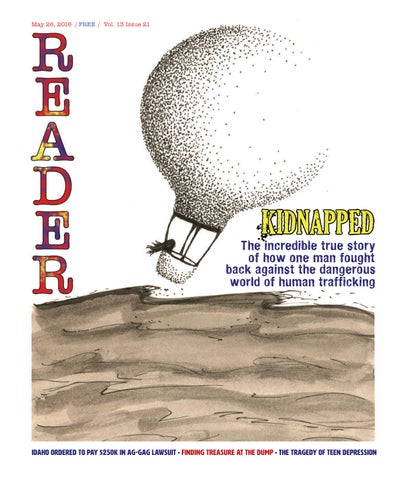
Sometimes a story comes along and changes everything. This happened to me recently. In all my years as a writer and journalist, I have never been so moved as I was when writing this week’s feature story, “Kidnapped: The incredible true story of how one man fought back against the dangerous world of human trafficking.”
It’s a story of violence, justice and innocence lost. It is a story that sheds light on the hidden world of human trafficking, and how one person laid it all on the line to make a difference. It is a story that has to be told.
Thanks for reading, dear readers. We appreciate you more than you’ll ever know.
-Ben Olson, Publisher
111 Cedar Street, Suite 9 Sandpoint, ID 83864 (208)265-9724
www.sandpointreader.com
Publisher: Ben Olson
ben@sandpointreader.com
Editor: Cameron Rasmusson cameron@sandpointreader.com
Zach Hagadone (emeritus) John Reuter (emeritus)
Contributing Artists: Claire Christy (cover), Ben Olson, Jen Jackson Quintano, bTizzy, SWS, Laurie Brown.
Contributing Writers:
Cameron Rasmusson, Ben Olson, Louie de Palma, Alexandra Blackwood, Jen Jackson Quintano, Brenden Bobby, Jim Mitsui, Beth Weber, Karen Seashore, Linda Jones, Jeannette Schandelmeier, Marcia Pilgeram, Laurie Brown, Dr. Michael Genoff
Submit stories to: stories@sandpointreader.com
Printed weekly at: Griffin Publishing Spokane, Wash.

Subscription Price: $95 per year
Advertising: Dion Nizzi dion@sandpointreader.com Clint Nicholson clint@keokee.com
Web Content: Keokee


The Sandpoint Reader is a weekly publication owned and operated by Ben Olson and Keokee. It is devoted to the arts, entertainment, politics and lifestyle in and around Sandpoint, Idaho. We hope to provide a quality alternative by offering honest, in-depth reporting that reflects the intelligence and interests of our diverse and growing community

The Reader is printed on recycled paper using soy-based ink. Leftover copies are collected and recycled weekly, or burned in massive bonfires to appease the gods of journalism. Free to all, limit two copies per person.
SandpointReader letter policy:
The Sandpoint Reader welcomes letters to the editor on all topics. Requirements:
–No more than 400 words –Letters may not contain excessive profanity or libelous material. Please elevate the discussion. Letters will be edited to comply with the above requirements. Opinions expressed in these pages are those of the writers, not necessarily the publishers.
Email letters to: letters@sandpointreader.com
Check us out on the web at: www.sandpointreader.com
Like us on Facebook.
About the Cover
This week’s cover is an original piece of art by Sandpoint artist Claire Christy. It’s done in ink and titled, “Not Like This One.” This piece was part of the POAC’s “Emerging Young Artists” show last Februrary. Great job, Claire!

By Louie de Palma Reader Staff
Pulling up to a prospective customer’s humble abode recently, I noticed one of the tires on his mobile domicile seemed to be low. For a moment, I envied his dedication to the gypsy lifestyle. No doubt he was cutting-edge hip, clearly having lived in a tiny home a decade before it was cool.
My concentration was broken as the customer finally approached. I noticed in an instant of utter disappointment his tribal tattoo, no doubt a symbol of the worst of these tribes: the Monster Energy Drink Tribe. His affiliation was confirmed by a UFC hat and crocs.
At first, the drive went as expected. The man initiated a conversation almost exactly like the common monster tribe greeting: “Can you bump some gangster-ass shee-yit up in this beeeotch? Sorry, I just slammed like two Four Lokos. Can I vape in here? I wonder if you could vape a Four Loko. DUUUUUUDE!? You should put an LED bar on this taxi bruhh-sith. Get it? Bruuh-Sith. ‘Star Wars.’ I made it up.”
“No, no, no and no,” I responded. “Where are you headed? A&P’s or Roxy’s?”
Inevitably, he began haranguing me to tell a story. A crazy story! The craziest thing that ever happened to me! I usually insist that nothing crazy happens. But Monster Tribe members thirst for stories of extreme depravity. It fuels their fire and restores their faith in their own depraved lifestyle. I told him I wouldn’t tell him a story, mostly because some of my crazier experiences are exhausting and reliving them all day is the last thing I want to do. He continued to beg. Finally, as we parked, it became came

clear he wasn’t going to stop. And like a twisted genie I made an agreement.
“Fine! I will tell you three short stories, not the craziest but ones that happened this week. I’m going to run the meter the whole time. You won’t interrupt. At the end I will tell you the moral of each story like a modern day Aesop’s fable. Hopefully then you’ll stop insulting everyone with your presence like a stale, half-empty bottle of Old English filled with Prime Time butts.”
Story One: There are many places in this town that I hate getting calls from and going to. The worst are usually the jail, the hospital and one of the assisted living places in town. Nine out of 10 times a fare from any of these places is a huge pain in the colon bag because I probably won’t be paid enough, if at all.
Worse than that is when they bleed into each other, like a ride from the ER to assisted living. Yesterday, I picked a lady up from the hospital to join her up with the other assisted livers, and the hospital insisted on only paying $10 ahead of time. I drove that lady all over hell and creation for close to 30 minutes trying to bring her home. Yet every time I went to make a correct turn she insisted I was going the wrong way and would scream at the top of her decrepit lungs. She told me I was terrorizing her and kept insisting I slow down below 10 mph because there was a baby in the car. There was no baby.
Eventually we got her there. I walked her to her room because the staff seemed to be … well, I don’t know what they were doing. Eating patients’ pills on Nilla wafers topped with tapioca pudding, maybe. I bid her farewell. She told me to have a good baby
Story Two: A couple days ago I drove a man in a revealing dress who smelled of touching himself and sour socks. Socks that had been soaked in curdled milk.
He had $100 and wanted to go somewhere he could do nothing, be naked and take drugs.
I said, “Hey, me too, buddy. Let me know when you find it.” It became apparent he wasn’t joking, so I asked Siri where the nearest nudist colony was. No results. Google. Thompson Falls— not enough cash. I suggested the woods, but he made a good point that it was hard to find gas stations and drugs in the woods. I couldn’t disagree. I suggested an agricultural commune but he said he didn’t want to work.
For the next 45 minutes, the conversation got philosophical as I tried to explain that there wasn’t really any place to just do drugs, be nude and do nothing. Trying to live like that in Idaho will just get you jailed. I suggested he go to Washington where they have more social services. There, I explained, you can be a homeless person and not get arrested as much, and they even have shelters and free food. Probably more drugs, too. He said OK, and I took him to downtown Spokane and dropped him off.
Story Three: Earlier in the week, a guy called to have me deliver ice cream to Bonners Ferry. He explained that he was really stoned and could trade his EBT (food stamps) money for $60 dollars.
Having finished my stories, I turned to the Monster Tribe member.
“Here are your three lessons,” I said. “In life, if you don’t know where you’re going, don’t fake like you do. But if think you might know, proceed slowly and drive like you have a baby in the car. If you aren’t going to contribute and don’t want to go to jail, move to Washington. And if you ever call me again asking me to deliver ice cream for EBT money again, I’m going to jam that e-cig in your eye so it looks like you’re walking around with an LED bar on your head. Now pay and get out. The Taxi Genie has spoken.”
Bonner County Voters, I would like to take this opportunity to thank all of you who came out to vote on May 17. Voting is an important responsibility and you took it seriously. There are many in our communities who put a great deal of time and energy into working for my campaign for Bonner County Commissioner. I cannot tell you how grateful I am for your dedication.
As I said throughout the campaign, I am here for our communities and for our county. Thank you for your support.
Jeff Connolly Bonner Co. Commissioner elect Priest River
Dear Editor,
In the May 5, 2016 issue of the Reader Ben Olson said some hurtful things at the end of my letter that almost made me cry. I got the impression that he doesn’t love me anymore. Is this true Ben, don’t you love me anymore? I still love you. I love all those at the Reader
The only problem I have with the Reader is it lied to me. Several months ago, and shortly after submitting my first article using the pen name Rabbi Ayatollah Krishna I was in the Reader office and told that authors have to use their real names. That means Drake the Dog is actually doing the writing and Scarlette Quille and Louie de Palma are the author’s real names. All the Reader had to tell me is Rabbi Ayatollah Krishna is politically incorrect, which is the real reason.
Ben Olson referred to my May 5, 2016 letter as drivel. So Mr. Olson, specifically what was it in my letter that you considered to be drivel and why?
Switching gears:
A recent issue of Sandpoint Magazine had an article about the Civilian Conservation Corp in Bonner County in the 1930s.
Here is a story about the CCC in Bonner County you will never see in Sandpoint Magazine. The story was told to me by my friend Dick who had witnessed the commotion, while passing by, without realizing what was going on.
The year was somewhere around 1935 and Farmin school was where the city parking lot and U.S. Bank currently are. A carnival was set up on the school grounds and several people from the areas CCC camps attended.
What then transpired is one of the most horrible things to ever happen in Sandpoint.
Sandpoint’s post master had a handicapped daughter who was raped to death by many of these people from the CCC camps. She choked to death on semen which was found in every orifice of her body.
The local authorities hushed up what happened as they were supposedly afraid of a vigilante mob going after the CCC camps.
There is a dark side to Sandpoint that most here are unwilling to address, especially transplants to the area. These transplants remind me of the Rock Hudson film “Seconds” which can be found at the library. Watch it and see if you see yourselves.
Lee,
I’m so bored with this back and forth. Unlike you, I have a job that demands my attention. Get a hobby, man. Maybe find one of those “Little Brother” programs where people take old, confused people out for walks and listen to them gripe about nonsense for hours. Seriously though, you are a cancer to intelligent thought. You find the negative in everything and smear it in everyone’s faces. Your logic is fascinating; you dare me to publish your work and when I tell you that your writing sucks (which it absolutely does, Lee) you say that we are censoring you or being politically correct. I suspect if I did publish your dreck, you’d find something wrong with that too. Let me tell you this: the articles you barrage me with under your pen name are rubbish. One of them enters the world of holocaust denial, which I consider cowardly and stupid. I refuse to publish such crap. GET A CLUE, Lee, we don’t want you here! Lee Santa. Such a jolly name for such a mean, pedantic twerp of a man. And by the way, the dog writes circles around you.
-Ben Olson, Publisher.
By Alexandra Blackwood Reader Contributor
The following article is dedicated primarily to those suffering the affliction of mental illness, and to inform individuals unaware of how these illnesses affect others. It is depicted through the voice of a 15-year-old teenager, who has silently surveyed the corruption that dwells within each individual. A personal victim and witness of such travesty, this young adolescent seeks only to ease the burden of our own torment. She would also very much wish to recognize those who aided her in writing this essay, as well as those that provided for her a better understanding of just how monstrous we can allow ourselves to become. We’ve given her a pseudonym to protect her privacy.
Echoed whispers fazed my clouded mind, as the images twisted before a hollowed soul. Darkness cascaded through my withering figure, once more rupturing the faded glimmers of hope. Feverish gasps lurched from within me, as I heaved to the earth. Desperately clutching an unfathomable light. Shaky hands withered upon my skull, as I screamed of endless terror. The caverns hollowed in surreal darkness. No light. No way out. Pain etched upon my sunken features, as I surveyed the land of bewitching blackness. Shadows fled across blackened ruins, as the strange silence surrounded me. Beckoning me closer within its inflicting doom. And so I was falling. Drowning amidst the inner madness I had become.
High school is a corrupt and twisted reality for many individuals. It provokes the darkest of natures within us, as it requires youths to decipher the very essence of existence. They have come upon this dwelling to determine they should achieve in life. However, they must also face a world they’ve never known, to come to terms with a discrete land of unfamiliarity.
A phrase commonly spoken here is, “We love you!” These words are often said after the tragic suicide of a student. Officials within the school board are then required to create some form of prevention following these tragic circumstances. However, many are oblivious to the idea in that love

can and must be expressed in a number of forms, and must not be limited to one. Love is an emotion vital to the natural health of an individual.
Just like anyone, students desire a strong need of purpose, which is particularly vivid during their teenage years. They require much more than vocalization. They require companionship, compassion, love and purpose, to genuinely experience these necessities. It is these elements in which teenagers so commonly lack.
Suicide is a leading cause of death in America, very much prominent among adolescents. This, in itself, is a travesty of injustice which should not be taken lightly. Pressure put upon teenagers of this era is scientifically proven to be a leading cause of high suicide rates. Many do not consider the causes of teenage depression or what exactly leads an adolescent to periods of complete desperation. This is a desperation so severe that it stirs the youth to feel so helpless, so utterly isolated in that they feel only solution is to end it all.
Many, too, do not realize that
simple acts of compassion to each individual may drastically alter the perspective of another. In the simplest of terms, kindness is a virtue many take for granted. A small acknowledgment, such as a greeting or compliment, may help a teenager struggling with the effects of depression. Just one friend. That is all many desire.
Small and subtle acts of affection are incredibly significant to restore the health of a depressed individual. Physical contact, also, is drastically important. Hugs. Kisses. Affirmation of love. Humanity requires physical contact, and lack of physical contact commonly triggers bouts of depression. Words. Actions. Many expressions of love exist, and should be continuously displayed for every human being, although prominently depressed individuals.
Depression is a condition. This is a concept many adults particularly find difficult to grasp. It often leads to physical symptoms, including lack of motivation, fatigue, irritability, withdrawal from social interaction, etc. Parents of adolescents in particular must be
perceptive and continuously aware of their child’s behavior. They must attempt to empathize with his or her needs and demonstrate both compassion and affection every day. This is a necessity for the well-being of an individual.
Treatment for the condition of depression varies for each individual, depending primarily on what appears effective. Of course, continuous affirmations of affection are a must, as well as support and guidance through difficult times. One must come to an awareness of how to interpret signs of depression. Individuals can vary on how they express depression. Some are prone to display obvious signs of depression, whilst others are very subtle and introverted.
Communication of depression triggers is also incredibly necessary, as well as good communication in general. This is necessary both in the family environment and any kind of social interaction. School, work, etc. One with depression may often benefit from the aide of a trained professional and perhaps a medical diagnosis and treatment. However, many have found the most benefits for
those with depression are the simplest ones: purpose, social interaction, friends, groups that continuously express gratitude to each other. Teens in particular must feel connected. Lack of connection often contributes to depression.
As difficult as it may seem, each individual student needs to feel nurtured and genuinely cared for. This is often difficult in a heavily dense population, such as a high school. However, it is not an impossible task. Depression is not a condition that is impossible to treat. With the correct amount of compassion, empathy, and support, one may touch the lives of another through the simplest of actions. Simple, yet effective. Actions of meaningful love.
Depression is often characterized as a negative stigma. Not as a medical condition, but rather as a personal conviction. But, at its basic nature, depression is a disease. A monster. It takes the strongest of individuals, and shatters them until they are left hollow. These individuals are victims under the savage compulsion of themselves. This is depression.
And so, a young girl shall sit. Day after day, week after week, month after month. She shall grin with hope at others surrounding her, she shall open her heart to those in need. And yet, day after day, month after month, she shall sit. Alone. Forgotten. Forsaken. A once kind and wonderful soul, left to wither among the darkened ruins of her own reality. For so she realized, true monsters have no fangs or claws. They possess no hidden venom or physical means of torture. No. True monsters are those that manifest themselves within. Those that tear you apart, from the inside out. For monsters don’t exist. Only humanity does. And oftentimes, that, in itself, is the worst kind of monster.
If you, or someone you know is depressed and/or suicidal and would like to get help, don’t hesitate to call the North Idaho After Hours Crisis Line at 208946-5595, or the National Suicide Prevention Hotline at 800-2738255.
By Cameron Rasmusson Reader Staff
It turns out Idaho isn’t finished paying for the ag-gag bill struck down as unconstitutional last year.
The state is on the line for nearly $250,000 after federal judge B. Lynn Winmill recently ordered it to pay the opposition’s legal fees. It’s yet another victory for the coalition of animal rights and civil rights groups that took the state to court for the so-called ag-gag bill, and members are holding Idaho up as a cautionary tale for other states.
“This ruling is a warning to other states that PETA will challenge ‘ag-gag’ laws, we will win, and it will be costly for the state,” said People for the Ethical Treatment of Animals general counsel Jeffrey Kerr. “The American public has a right to know when the meat industry is breaking the law, and Idaho’s ‘ag-gag’ law was a blatant violation of free speech.”
The ag-gag bill was in part a reaction to a campaign by Los Angeles-based animal rights group Mercy For Animals. In the summer of 2012, members of the groups infiltrated the massive Bettencourt Dairies in Hansen, where they recorded video of employees beating and kicking cows, dragging them with tractors and more.
Signed into law Feb. 28, 2014, the ag-gag bill criminalized the recording of audio or video with “the intent to cause economic injury” at any agricultural facility. First-time penalties for breaking the law included an up-to-$5,000 fine and a year of imprisonment. For comparison, the first violation of Idaho’s animal cruelty law is punishable by no more than six months in jail. After being signed by Gov. C.L. “Butch” Otter, the new law received immediate push-back.
“If the government starts criminalizing the documentation of what goes on at these places, it makes life very diffi-
cult for journalists,” American Civil Liberties Union of Idaho legal director Richard Alan Eppink said.
The bill drew criticism from several different spheres. Animal rights groups protested the harsh penalties for informing the public of animal cruelty. Civil rights groups resisted the weakening of First Amendment rights to free speech. Others worried that the law would make it easier to cover up public health violations in the dairy industry.
“The way I see it, farms are producing products for consumption by the public,” Sandpoint Vegetarians co-founder Stephen Augustine told the Reader last year. “Why is it not acceptable to be able to record how that food is produced?”
Sandpoint Vegetarians was a local branch in the diverse team of organizations that sued the state of Idaho, joining PETA, the ACLU of Idaho, the Animal Legal Defense Fund and the Center for Food Safety.

By Ben Olson Reader Staff
In August, Winmill rejected the state’s arguments, ruling that a criminalization of whistle-blowing in the agricultural industry was unconstitutional.
“The remedy for misleading speech, or speech we do not like, is more speech, not enforced silence,” wrote Judge B. Lynn Winmill in the ruling.”The Court finds that [the Ag-Gag law] violates the First Amendment.”
Winmill’s order to pay legal fees may be another victory for ag-gag opponents, but it’s a bittersweet one for people like
Sandpoint Vegetarians co-founder Eric Ridgway. After the bill was struck down last year, he bemoaned the wasted taxpayer money spent defending it.
“The citizens of Idaho deserve better management of their tax dollars than [using them] for the creation of laws that were bound to be overturned, and that were enacted strictly to benefit the profits of corporations over the health of citizens,” he said.
If you support local community radio, be sure to mark June 10-11 on your calendar.
Everyone’s favorite community radio station of the Idaho Panhandle, 88.5 KRFY, is holding its annual membership drive at its old Snow River location. The event will feature in-studio concerts each hour by local musicians. And if you happen to be passing by on the street, you just might find yourself invited into the studio to check out the performance and share your thoughts on air.
More details about the event will be available in the coming weeks, so keep your dials tuned to 88.5 KRFY. [CR]
By Cameron Rasmusson Reader Staff
A bomb threat that resulted in the evacuation of Farmin Stidwell Elementary on Monday afternoon proved to be a hoax perpetuated by a robocall.
According to Sandpoint Police Chief Corey Coon, police confirmed that there was no danger or bomb threatening the elementary school. After school staff received the threat, police evacuated the building and conducted a room-by-room sweep but found nothing out of place.
However, the bomb threat was far from an isolated incident. Coon said threats have
been popping up around the country, with schools in Washington, Utah, Oregon, Colorado and other states among the list. Spokane County, for instance, also received a threat to Sunset Elementary School. Ochoa Elementary in Pasco, Wash., received a threat as well.
Coon said the threats are all similar in nature. In the case of Farmin Stidwell, an automated robocall featuring a male voice stated there was a detonator and explosives in the school, which would explode if police arrived.
Last April made the 12th consecutive month of record-breaking monthly temperatures around the globe. This makes it the longest hot streak in the 137-year record, which dates back to 1880.
During April, the average global temperature was 1.98 degrees F above the 20th-century average of 56.7 degrees F, according to scientists from NOAA’s National Centers for Environmental Information. This temperature departure from average was not only the highest for the month of April in the 1880-2016 record, but also the fourth highest among all months on record.
The globally average sea surface temperature for April was also highest for this month on record and surpassed the same period in 1998 by .43 degrees F. 1998 was the last time an El Niño of similar strength occurred.
This April we also saw the smallest Northern Hemisphere snow pack extent recorded in 50 years of snow pack data collection. According to the Rutgers Global Snow Lab data, the Northern Hemisphere snow pack extent during April was 890,000 square miles below the 1981-2010 average. The snow pack extent was the 11th smallest on record for North America.
For the four months of 2016 (January—April), the average temperature for the globe was 2.05 degrees F above the 20th-century average of 54.8 degrees F. This was the highest temperature for this period in the record, breaking the previous record set in 2015 by .54 degrees F.
By Ben Olson Reader Staff
Editor’s note: A couple weeks back, I ran into an old friend. We had worked together in Los Angeles years ago while I was still working in the film industry. Hailing from a small town in Michigan, he and I clicked and became close friends. We had built a strong bond in that large, dangerous city, so I was saddened when he left the city to travel the world. Just a few weeks ago, I was playing a gig with my band in Washington and ran into him randomly at the bar afterward. We hadn’t seen each other in years. We got to talking and I asked what he had been up to since we last spoke. The story he told was not what I was expecting. It is a story of violence, justice and innocence lost. It is a story that sheds light on the hidden world of human trafficking, and how one person tried to make a difference.
I have changed all the names and some other small bits of information for his protection (you’ll find out why), but everything else that follows is true. This is a no-holds-barred look at how human trafficking affected one Midwestern man, who has laid it all on the line to eradicate the worldwide abduction of children. This is the first part in a series of articles about this important issue. The next article will discuss how human trafficking affects us inside the United States. As the following tale is extremely graphic, reader discretion is advised.
backpacking his way east. He ended up living in Thailand and falling in love with it. Later, he traveled into Laos and Cambodia where Tom met Zee, the owner of a cozy little bar. Tom lived there for a year, learning the language and meeting the locals. Tom also met and became friends with an Englishman named Derek.
“Derek and I were having some beers one night and Zee came running up frantically,” Tom said. “There were these guerrillas from Laos that were hired by Chinese Triads who came into the [Cambodian] village and made an offer to the head of the tribe.”
The guerrillas said they needed young women and boys. They would take them from the village and provide them with a good education and teach them how to make a living so that they may send money back to their families. The mainly Buddhist tribe politely denied the guerrillas—they knew what these men wanted their children for, and none of it was good.
“We rented a few vans and got ahold of some weapons. Just that was crazy, buying weapons like that. We spent every penny on them and got some more people together. We were going to get them back.”
-Tom
Tom is from Michigan. After graduating high school he joined the military and spent four years serving his country before heading to Los Angeles to find work in the movies. Like many in his mid-twenties, Tom also wanted to travel the world. He saved his money and departed to Europe,
“It was then that guns were pulled,” said Tom. “They took the people they wanted, tossed them into trucks and left. Zee ended up having a sister and four cousins that were taken.” When Zee came in frantically and told Tom and Derek about the situation, Tom’s first thought was how they could keep that from happening again.
“I kept thinking, ‘What if that was my wife or my baby sister they took?’” he said. “If that was my family, I would do whatever I had to do to get them back. I had to do something. I felt compelled. People think that just because it’s a third world country, that life isn’t as important as it is here in
America. It’s just not true.”
Tom and Derek took action. They unwittingly entered the dangerous world of human trafficking. They pooled their money together—somewhere around five thousand dollars—and came up with a plan to get the children back.
“We rented a few vans and got ahold of some weapons,” said Tom. “Just that was crazy, buying weapons like that. We spent every penny on them and got some more people together. We were going to get them back.”
Tom and Derek, along with five others, joined forces. They were dedicated to finding and saving Zee’s family and other members of the tribe that were taken, as well as stopping this from happening again to other nearby tribes.
“There were three tribes close together, connected by this one road,” said Tom. “We knew they would try it again at another tribe, so we drove up to the second village and dug in.”
Tom and his group dug into a bank looking over the only road coming into the village. They rigged trees to fall in the road and prepared for a fight.
“It was surreal,” said Tom. “We waited two days for them, and when they finally showed up, we felled one

of the trees across the road and stuck to our plan.”
Tom and his group took the traffickers by surprise, engaging in a firefight and killing several of the invaders. No children were taken that day.
“We took them by surprise from about 40 yards away,” said Tom. “Quite a few were killed. It’s like the first time I jumped [out of an airplane]. You’re scared and you’re unsure, but all of a sudden, you just do it. You jump. That’s what it was like. I had to build myself up to do it.”

The guerrillas came back a second time, however, and weren’t taken by surprise this time.
“They came back with .50 caliber machine guns and clay pots filled with homemade napalm,” said Tom. “They would toss these in the trees and fire rained down on us. We all got burned pretty bad.”
Two of Tom’s group were killed in this second attack—one was shot in the chest and died instantly, but another was shot in the stomach and needed medical attention right away. The nearest hospital was four hours away in Phnom Penh. They took the latter there, as he screamed in agony the whole trip, only to have him die on the front steps of the hospital.
“It was definitely the scariest thing I’d ever done in my life,” said Tom. “After that, I didn’t know what to do. I didn’t know if I could do it anymore.”
But when information came back that Zee’s family were held by a corrupt police detective at a mechanic’s shop in Phnom Penh, Tom and his band of defenders went into action again.
“There were a few different places they held them,” said Tom. “There were four or five guys in each place. You can’t just fire a gun in Phnom Penh. It would draw too much attention. So we went in with brass knuckles and knives and raided the place and got them out.”
Tom wore a headscarf to hide
See KIDNAPPED, page 8

Bouquets:
•A bouquet to the city of Sandpoint, the BID and all those involved for those beautiful flower baskets that went up last week. I think it’s a great program that makes Sandpoint shine to tourists and locals alike.
•Another bouquet goes to Carolyn Gleason from Second Avenue Pizza for all the tireless (and sometimes thankless) work she does to bring Lost in the ‘50s back to Sandpoint every year. We appreciate all that you do, Carolyn!
Barbs:
•I had a guy call here at the office the other day complaining about a news article we had published last week being both wrong and “sensational.” The article in question was referring to the low snowpack totals for 2016 that could contribute to another elevated fire season.
This is an example of how not to call your friendly newspaperman: Start out by griping about an issue, allow the friendly newspaperman three seconds to talk, then interrupt him with another long diatribe. Next, allow the friendly newspaperman four seconds before interrupting him again, then hang up. I still never got a chance to say my piece.
What I wanted to tell the man, before he so rudely interrupted and hung up, was that I don’t come up with data. I don’t fish for scientific fact that backs up some clandestine theory. I have no dog in this fight. I honestly don’t want it to be another smoky fire season. But facts are facts: snowpack was 45 percent of normal this year. April was the twelfth consecutive record-breaking month for temperature. These are facts. This tendency for people to either ignore, deny or simply make up facts to bolster their own ideological viewpoint is not only annoying, but dangerous. That’s an opinion, not a fact. See the difference?
his identity as an American, but it was ripped off him during the fight that ensued.
“A kid ran up to me and snapped my photo with a camera phone, and two days later a wanted poster for me was all over,” said Tom.
During the fight, Tom was knocked down after being hit in the face with an blunt object.
“I woke up and saw that someone was stabbing me in the chest,” he said, lowering his collar to show me a three-inch scar below his throat. “I was lucky. He hit my sternum and the blade slid down and didn’t do too much damage.”
Despite the injuries, Tom and his men managed to free everyone from the trafficking ring—an astounding 75 people. Zee’s sister and four cousins who were initially taken were among those that were saved. They packed them into some rented vans like sardines and drove them to several different safe houses to get them out of danger.
“After the shit I saw, it got under my skin,” said Tom. “I saw some horrible things. Just horrible. There was a nine-year-old boy getting raped by two men. I don’t know how you can ever come back from that.”
For Tom, looking at the faces of those who had been kidnapped was like looking into an empty mask: “They just looked devastated. Gone. Even when we came to get them out, we had to prod them to move and get them to the safe houses, who rehabilitate them the best they can.”
Tom built a relationship with one safe house in particular, run by a Christian woman. But, he pointed out, “They don’t push Christianity on the Buddhists. They just want to help these kids get out, and they said they needed someone like me.”
With a wanted poster of him posted all over the city and country, Tom understood his time in Cambodia was coming to a close. When his English friend Derek was found murdered, he knew it was time to get out of the country.
“We smelled Derek’s body through his hotel door,” said Tom. “When we broke in, we found him. He’d been dead awhile. They tortured him. He had been crucified.”
Before leaving the country, Tom learned that the corrupt police detective who was the main instigator for the trafficking ring had been killed: “That detective isn’t around anymore,” said Tom. Tom crossed into Thailand and was close to getting out of South-

east Asia. He was talking to his father on the phone when he heard a commotion outside his hotel.
“I told my dad ‘I think I’m getting kidnapped’,” Tom said. “I told him to call the U.S. Consulate and said not to tell my mom.”
Tom then hid his phone in his mattress to protect his family’s identity from the kidnappers and waited in the bathroom while they kicked down his door: “It was the only place I could defend myself one-on-one.”
“Tom”
that mattered.”
“I’ve broken bones, I’ve been stabbed, hit with brass knuckles. I’ve had to kill people. I can’t put my family through this again.”
When the men kicked in the door, Tom said it was a fight for his life.
“I got another knife in the arm and brought two of them down before the hotel owner and his sons came to break up the fight,” he said. “They saved my life.”
The Thai police came and hauled the invaders away and said for Tom to remain where he was so they could ask him some questions. Seizing his chance, Tom bailed immediately after they left and got on a plane shortly after, leaving the last three months behind him like a surreal dream.
“When I was on the plane, I wondered how I was going to live my life back in America,” he said. “I saw horrible shit happen to good people. It affected me. It changed me. And when I got back here, I saw that everybody was the same but I was different.”
Looking back, Tom said that he has no regrets for the experience: “I can always look back on my life and say I did something
-Tom
Now, Tom is preparing to leave the U.S. again, this time bound for South Africa, where Rapha House—the safe house he built a relationship with in Cambodia— operates another branch. Where lesser men would vow never to enter that world again, especially after the trauma he had endured, Tom was heading right back into it.
“They got in contact with me and asked if I would head up a team down there in Africa,” said Tom. “It will probably be three months before I start working. I’ll have to make local contacts and brush up on the language.”
Tom said it would be much the same work, but hopefully without the violence: “I’ve broken bones, I’ve been stabbed, hit with brass knuckles. I’ve had to kill people. I can’t put my family through this again. Hopefully I’ll be building relationships and gathering info and I don’t have to go kicking down doors again.”
Though Tom’s family remains proud and supportive of their son, they can’t help but be scared for his safety.
“It’s not a normal thing,” said Tom. “They understand my feelings and I hope they know I’m going to be as safe as possible. This is the biggest evil I can ever think of—taking the most
innocent of lives and completely destroying them. I just have to do something about it.”
Rapha House, based out of Missouri, owns safe houses all over the world. The Christian-affiliated organization is dedicated to “love, rescue and heal children who have been rescued from trafficking and sexual exploitation,” according to its website.
“Just because we don’t see this happening as much here in the States doesn’t mean it isn’t happening,” said Tom. “This happens everywhere in the world on a scale that people can’t comprehend. It’s a multi-billion dollar industry. I put every cent I had into it, but I had all of these really rich friends who wouldn’t even donate $100 toward one of these safe houses. I couldn’t believe it.”
When asked why he allowed me to publish his story, Tom said, “I was on the fence about it, actually. Then I thought, maybe all that I have done won’t count for anything if I can’t raise awareness about what’s really going on. These safe houses need to be funded. They do such good work.”
If anyone is interested in donating to Rapha House to help eradicate human trafficking, please go to www.raphahouse.org.
For Tom, who unwittingly went from backpacking his way through Europe to braving gunfire and stabbings to save children from horrors we can only imagine, the cause of human trafficking has given him a new purpose in life. A purpose that he would give his life for.
“After the shit I saw, I’d gladly give up my life to save those kids,” said Tom. “If I don’t, who will?”
By Jen Jackson Quintano Reader Contributor
We were unprepared our first visit. We simply had no sense for the possibilities. We stood in the valley between two long ridges of lumber waste and stared in awe – like pioneers in a newfound promised land. Like scavengers in a trash-filled wonderland. Skeletal furniture legs peeked from the cracks afforded by a tangle of branches and plywood. Pallets and dimensional lumber whispered to us of DIY opportunities.
We could take any of it. We could take all of it.
We’d discovered the marvel that is the Colburn Transfer Station.
The only furniture in our home at that time was of the folding variety – futon, card table, camp chairs –but what our eyes soon rested upon was the real, home-furnishing deal: a wooden couch frame and chair. Novices that we were, however (we thought this was just a place to drop off trash), we’d brought no tie-down straps. I ransacked the truck and emerged triumphant with the dog leash. We “secured” the couch to the vehicle, tucked the chair inside of its frame, and drove happily – albeit slowly – away.
God bless the Bonner County Solid Waste District for making our house a home.
The Colburn Transfer Station is the poor man’s Ikea and Home Depot wrapped up in an odiferous yet tantalizing package. In fact, I’ve heard it referred to as the Colburn Mall. Our first poverty-stricken years in Sandpoint found us “shopping” there more often than not. Sometimes, we would simply peruse the wood waste pile as a pick-me-up in the throes of a shared what-are-we-doing-withour-lives depression. The dump rarely disappointed.
An enumeration of our finds includes:
•One couch (for which we had no cushions, so I slightly inflated our air mattress, tucked it into the frame, and covered it with a blanket…voila!)
•Two TV trays (though we don’t own a television)
•Countless chairs (typically used as our lawn furniture until they disintegrate under the elements; then we trade them in at the dump).
•Dimensional lumber (enough to build a deck at no cost, save screws).
•A carved bear (because everyone in Bonner County needs one).
•Numerous pallets (used for making items like coat racks, tables, garden beds and more)
•A gliding rocking chair (for the baby’s room)
•Ample flooring (for an Airstream trailer renovation)
•Partial sheets of OSB (we used them to put on a new roof; no leaks!)
•Assorted mundane items (compost bin, storage boxes, shelving, etc.)
•And the crowning jewel: an eagle-topped totem pole that stands over our garden (who takes a totem pole to the dump?!)
Such a wonder is the Colburn Transfer Station, we tend to take visiting family there. Not to the lake, not to Schweitzer, but to the dump.
My parents visited one Easter weekend, and Sunday morning was spent spelunking in the woodpile – like an Easter egg hunt, but with greater chances at tetanus. Tyler’s parents may now live here due to the lure of the dump. Though I’m sure the grandbaby had something to do with their relocation, I also know that they’ve been visiting the transfer station on their own.
When we escorted my young cousins to Colburn, they were in awe. Their poor father had to curb rampant enthusiasm, limiting takehome treasures to what could fit in one hand. Reagan found a magic wand (a spindle from a chair back). Emerson found what came to be called “The Rabbit Stick:” a long cane with twine and some part of a deceased furry creature attached. I’m pretty sure it was a magic wand.
One family trip – with aunts, uncles and cousins – found us filling the back of the Subaru with bricks in order to build raised beds for strawberries. The plants are now flourishing. The same seven members of the family will return this month, so I will feed them strawberries…and take them to the dump.
We once joked to a neighbor that our coming weekend plans were to set up a cooler, chairs and
an umbrella in front of the lumber heap. That way, we could be the first to vet and snag incoming items. Our neighbor told us that his father might have actually beaten us to the punch.
Several years ago, we met a man at the dump who proudly informed us that the structures on his property were built entirely of scavenged lumber. We’ve met people who get all of their firewood from the pile. They bring their chainsaws to the dump and buck up home construction byproducts to heat their own abodes.
What we have at Colburn is rare. Few dumps allow foraging for purposes of repurposing. Most transfer stations are rather proprietary about their waste and are overly afraid of lawsuits from people who do stupid things while combing through it. Bonner County actually trusts us residents to be rational and safe when perusing the woodpile. All we rubbish connoisseurs have to do is sign a waiver, and great riches (albeit riches full of nails) become accessible. It’s a winwin situation: Area citizens find appropriate items for their homes at no cost while the county saves money by disposing of less waste.
Sadly, we don’t often visit the transfer station these days. Now that Rapid Lightning is paved, we enjoy trash service. And though we still need lumber for various and sundry projects, our business recently purchased a sawmill. We’ve moved up in the world.
I miss Colburn, though. There was always a sense of anticipatory glee on the drive there: Would today be the day that we struck gold? Another totem pole, perhaps? Or would we get skunked? It was like a trip to the dirtbag casino, but without the cloud of cigarette smoke, the cost, or the hangover. Recently, we did have reason to return. Property cleanup left us with a trailer-load of trash too large for Waste Management to handle. We hoisted our little girl into the truck for her first visit to the Colburn Transfer Station (a milestone in any child’s life).
As Tyler disposed of our wood waste, I walked Sylvie along the base of the hill. On that day, it was mostly branches and logs. It was not the homecoming I had hoped for. What would we do for lawn

chairs this year? Just as I turned around to head back to the truck, Sylvie became animated.
“Dat! Dat! Dat!”
I scanned the ground where she pointed, and there rested a perfectly intact toy horse – her favorite animal. Sure, it was in need of a bath, but it was only covered in dirt, not biohazard ooze or anything. Wet wipes did the trick for the drive home.
The horse is now cherished, as are many other dump items.
The couch frame was our main seating for years. It is where I dozed with my brand new baby on the first languid afternoons of her life. The totem pole eagle has blessed numerous kale and carrot crops. The TV trays held food and drink at the dinner gatherings that caused our newfound social circle to coalesce.
Reduce, reuse, recycle. Recover, redeem, rejoice, repeat. This is the Colburn Transfer Station. This is Sandpoint. This is home.

By Brenden Bobby Reader Columnist
We haven’t talked about the planets in a while, so they’re getting restless and are in desperate need of the limelight. The planets can be such divas, especially Pluto. But we’re not talking about Pluto, right now. We’re going to talk about Earth and Mars.
Earth: From our vantage point, it seems pretty mundane. There’s the coffee shop, there’s work, drive there in my car, come home and get a beer. I know Earth. Stop and think about it for a moment, though. As far as we’re aware, we’re the only planet in this system that has life of any kind. We are most definitely the only intelligent life of any kind in our system. There are countless things on our mundane rock that we’re so used to that isn’t even possible in most places in the galaxy.
That coffee shop? Built by wood that came from trees that spent millions of


years reproducing, spreading, and changing over many generations. Your car, whether it’s nice or a real clunker is an astounding feat of engineering. Metal pulled from the Earth, heated, bent and shaped to perform a very specific, yet versatile task. Your beer, made from hops that, in all likelihood, had their evolutionary future modified and bent by human will and selective reproduction under highly controlled conditions. You’d be hard pressed (literally) to find that on Venus..

Why is Earth the way it is? Honestly, we’re not entirely sure. Whatever the case, there’s a key ingredient at the center of it: liquid water. All life we’ve ever observed thrives on and requires it. A key part of that equation is oxygen. Oxygen is supremely important for life as it exists now on Earth. If you don’t believe me, try holding your breath and prove me wrong.
That key element almost didn’t occur in such prevalence on Earth. Instead, had things gone a little differently, life may have evolved in unexpected ways, or not at all. When life first dawned and ruled the planet for at least a billion years (possibly up to 3 billion), they were simple little microbes that loved carbon dioxide. Oh yeah, the planet was covered in the stuff, tons of it. The planet probably flew into countless global climate changes until some of these microbes figured out a way to start pulling energy from the sun. It was evolution in its simplest form. However, this came with a unique effect that would forever change the history of life on Earth. While harnessing the power of photosynthesis, these microbes separated the carbon and the oxygen. This was such an efficient process that they were able to start reproducing more quickly than their competition. Over time, the CO2 in the atmosphere was replaced by oxygen, and these little guys literally suffocated their competition, which allowed for the evolution and spread of what would (much, much) later become multicellular organisms.

There is nothing mundane about Earth. We are truly a unique world, as far as we can tell.
Our next door neighbor is pretty interesting, too: Mars, the red planet. Despite being neighbors, Mars is pretty far away. On average, Mars is 225 million kilometers (139 million miles) away from Earth. When they are both in opposition of one another, this number nearly doubles.
The first thing you notice when you look at Mars is that everything, and I mean everything, is red. That’s because iron particles exist within the dust on the surface. There is a lot of this dust— it’s literally everywhere on Mars. The iron reacted with the oxygen in the atmosphere and it rusted, turning it red. Now, storms hurl the dust all over the place, break it up even further and stain
the sky red, too.
So what’s the fuss about water on Mars?
Water, in its liquid form, is important, as we found out from our continued existence on this planet. Finding liquid water brings the distinct opportunity to find things living in the water, and when we find things living in the water on other planets, it’s sort of a huge deal; it would prove that we’re not a one-of-a-kind accident, that life is able to and has sprung up on other worlds than our own. We’ve proven that, at one point, Mars had liquid water from the channels carved throughout the planet’s surface. Most of it’s gone now, though.
Where did the water go?
At one point, Mars underwent a process we’re seeing happen on Earth now. Mars’ atmosphere was either stripped away over time, or stripped away very suddenly, leaving it with more CO2 than oxygen. Oxygen is a great deflector of heat, while CO2 is kind of like holding a magnifying glass over an ant. Sound familiar?
Essentially, with the sun being able to freely peek on through the atmosphere, the water evaporated into hydrogen and oxygen. Then the sun’s solar winds just whipped them right off the surface and into space. Mars’ water literally got blown into the abyss.
Hopefully you learned something about one of these planets today. Hopefully we’ll all study the hard lesson of our neighbor Mars. I like water. It lets me eat tacos, and I like tacos.


Yappy Hour
4-7pm @ Taylor and Sons Chevrolet
Dollar Beers!
8pm @ Eichardt’s Pub
Live music, beverages and fun for you and your favorite pooch
Good until the keg’s dry
Throwback Thursdays 7-11pm @ 219 Lounge Featuring live music with and Chris Lynch and drink
Live Music w/ Liam Kyle Cahill
5-7pm @ Idaho Pour Authority
Acoustic artist from Reno, NV with great energy and lyrical prowess
Live Music w/ Ron Greene
6:30-9:30pm @ MickDuff’s Beer Hall
A dynamin, passionate stage presence and singer
“Cactus Pass” play by SHS
7pm @ Sandpoint High School auditorium
A fun roadtrip play through the American West. $5 for this musical comedy presented by Sandpoint’s local teens
Teen Writers Club
3pm @ Sandpoint Library
Live Music w/ Mike and Sadie Wagoner
5-8pm @ Pend d’Oreille Winery
Father-daughter duo singing some classic tunes
Sandpoint Farmers Market
9am - 1pm @ Farmin Park
Shop for plant starts, locally grown produce, browse vendor booths, and more. Live music with Jake Robin
Priest Lake Spring Festival (Sat & Sun)
9am-3pm @ Coolin, ID
Festivities include bake sales, food booths, a quilt display, an arts and crafts fair, a Saturday parade, the Lions Club
Kids Carnival, the Priest Lake People


26 27 28 29 30 31 1 2
Live Music
9pm-12am@
The indie beer and failed

Teens who write, unite! Collaboration, peer reviews, brainstorming activities. Writing supplies and refreshments provided
BLM Botany in North Idaho
9:45-11:30am @ Spt. Community Hall

LeAnn Abell, botanist in the BLM, will discuss recent projects. Free admission, public welcome
“Swing into Summer” dance
7-10pm @ Spt. Community Hall
A swing dance lesson will be taught from 7-8 p.m., followed by general dancing until 10 p.m. There will also be refreshments, door prizes and mixers
Helping People dinner and auction, and Sunday’s walk/run races Used Book Sale
Live Music w/ Chris Lynch 6pm - 9pm @ Arlo’s Ristorante
Sandpoint Chess Club
10am-2pm @ Bonner Mall
Buy ‘em cheap, sell ‘em fast
9am @ Evans Brothers Coffee Meets every Sunday at 9am. All are welcome
Monday Night Blues Jam w/ Truck Mills
7:30pm @ Eichardt’s Pub
Trivia Night
7pm - 9pm @ MickDuff’s
Impress your friends with how much useless crap you know. Show up early for a good seat
Karaoke Night
10pm - Midnight @ 219 Lounge Sing, me hearties! Sing!
Make It at The Library
3-4:30pm @ Sandpoint Library

Game Night at the Niner 9pm @ 219 Lounge
Three-Year 2-7pm @ Celebrate the IPA crew. from 2-4pm, Complimentary items and ing to the
7 Keys to 1-2:30pm
In this interactive you” sweet to take home. sugar fix!
Learn to dance the Swing – 7pm @ SWAC
Learn the Triple Time East Coast Swing from Diane Peters. 610-1770 for info
Sandpoint Farmers Market
3-5:30pm @ Farmin Park
Shop for plant starts, locally grown produce, browse vendor booths, and more, including live music
Robotics with Lego Mindstorm 3pm @ Clark Fork Library
For more information contact the Clark Fork branch library at 266-1321
Tasty Traditional Thai Dishes 6pm @ Winter Ridge Natural Foods
Kids create with robotics, Arduinos, needlework, Legos and other projects, 3-4:30 PM in rooms 103 & 104
Open Mic Night w/ Scott Reid
6-8pm @ Monarch Mountain Coffee
All are welcome to attend this open mic night with Scott Reid. Held the first Thursday of every month
Dollar Beers!
8pm @ Eichardt’s Pub Good until the keg’s dry
Learn how to make Tom Yam Soup ry with instructor Raquel Kaelin. Free
Throwback Thursdays
7-11pm @ 219 Lounge
Featuring live music with Brian Jacobs and friends, $2 domestics and $3 crafts. Join in playing in this informal open mic night setting every Thursday night
The annual State of the 6pm @ Forrest M. Bird Charter
The yearly affair is a chance an update on the Scotchman posal—which has made past year—including legislative projects, education and outreach

Thursdays at the 219
219 Lounge
live music with Brian Jacobs Lynch and drink specials
Live Music w/ Harold’s IGA
9pm-12am@ 219 Lounge
May 26 - June 2, 2016
A weekly entertainment guide to keep you on your toes. To list your event free, please send an email to calendar@sandpointreader.com.

Reader recommended
Live Music w/ Liam Kyle Cahill
6-9pm @ MickDuff’s Beer Hall
Acoustic artist from Reno, NV with great energy and lyrical prowess
The indie rock trio appears courtesy of beer and failed dreams. Enjoy!

SHS Student Photography Art Exhibit
5:30-7pm @ Columbia Bank Community Plaza (231 N. 3rd Ave.)
Collaboration,
A showing of work from the fall 2015
Our World Focus project featuring photographs taken by SHS students
IPA Three-Year Anniversary Party
2-7pm @ Idaho Pour Authority
Celebrate three years of good beers with the IPA crew. Live music from John Firshi from 2-4pm, and US TWO from 5-7pm. Complimentary appetizers, silent auction items and raffle prizes with proceeds going to the Bonner Community Food Bank
7 Keys to Downsize Sugar Cravings
1-2:30pm @ Talus Rock Retreat
Live Music w/ Chris Lynch 6pm - 9pm @ Arlo’s Ristorante
“Louder Than Bombs” film
7:30pm @ Panida Theater
BLM Botany in North Idaho
9:45-11:30am @ Spt. Community Hall
LeAnn Abell, Botanist in the Bureau of Land Management, Coeur d’Alene District Office will discuss recent projects. Free admission, public welcome
Live Music w/ Nate Vernon and Carly Fetzer
5-8pm @ Pend d’Oreille Winery

Nate and Carly are members of the band Wartime Blues, who have opened for the Decemberists. Great post-Western folk
“Cactus Pass” play by SHS
7pm @ Sandpoint High School auditorium
A fun roadtrip play through the American West. $5 for this musical comedy presented by Sandpoint’s local teens
In this interactive class, we’ll make some “good for you” sweet treats. We’ll taste ‘em. I’ll give you recipes to take home. Learn how to lessen your need for the sugar fix! $12 suggested donation. RSVP 255-8458
Colleen Raney and Hanz Araki Concert
7:30pm @ Di Luna’s Cafe
@ SWAC Swing from
promore,
Award-winning traditional Irish musicians. Tickets $12 advance, $15 day of show. Dinner served starting at 5:30 p.m. day of the show. 263-0846.
Live Music w/ Dodgy Mountain Men
7:30pm @ Eichardt’s Pub
A high energy, fun group out of Montana. Come dance and cut loose!
Sunday in the Park
1-5pm @ Farmin Park
A family-friendly event with live music by local groups and churches, poetry, and other visual and performing arts
Dishes
Natural Foods
Yam Soup and Vegetable Green CurKaelin. Free and open to the public
State of the Scotchmans Meeting
M. Bird Charter School
affair is a chance for FSPW staff to give the Scotchman Peaks wilderness prohas made some exciting progress in the year—including legislative progress, stewardship education and outreach over the past year
Live Music w/ Scotia Road
6:30-9:30pm @ MickDuff’s Beer Hall
A four-piece family band with guitar, mandolin, upright bass and vocal harmonies
Swing into Summer Dance
7-10pm @ Sandpoint Community Hall
A swing dance lesson taught by a professional instructor from 7-8 p.m. Following the lesson until 10 p.m. will be general dancing, refreshments, door prizes, mixers, and more. Sponsored by Sandpoint’s USA Dance chapter. 699-0421
Summer Sounds
4-6pm @ Park Place Stage (near Arlo’s)
Sponsored by BID and Holly Eve, featuring live music from the Monarch Mtn. Band
Live Music w/ Liam Kyle Cahill
9pm-12am @ 219 Lounge
Raw energy and passion is the fuel behind the driving sound of Reno-based Liam Kyle Cahill
Live Music w/ Mike and Sadie Wagoner
7:30pm @ Eichardt’s Pub
A great father-daughter duo with some fun classics and some originals too

June 3
Spring Serenade Instructors Concert @ First Lutheran Church
June 4
Timberfest @ Bonner Co. Fairgrounds
June 11
Sand Creek Paddlers Challenge @ City Beach
June 12
Bay Trail Fun Run @ Trinity at City Beach


The name of this bi-weekly column comes from a quote by past U.S. Poet Laureaute, Billy Collins who said, “What the oven is to the baker and the berry-stained blouse to the dry cleaner, so the window is to the poet.”
The arts, including literature, are thriving here in North Idaho, and it’s time to view the work of local writers. Not just poets.
You are invited to submit a maximum of two poems or a prose piece (fiction or non-fiction); limit around 400-500 words. Please no manuscripts or complete works. Send attachment to Jim3wells@aol.com.
Subject matter should be regional, although work may be accepted if written by a local writer about a vacation trip or a childhood memory set in a different locale. Poetry should be contemporary—the majority of poetry written today is free-verse. There is no age limit. Author retains copyright. Include a brief biography of a few sentences. Acceptances will depend on the space allotted by the Reader. No rejection notice or critique will be offered.
by Karen Seashore
A few nights ago I lay in the v-berth of our sailboat, playing the scales of patience, waiting to capture sleep in Ballet Bay.
Content as a Buddha, Tom lightly snored. The boat barely rocked. The halyards silent.
Beneath us, clear-as-glass jellyfish pulsed. Creatures swam & crawled. I rolled onto my back. Centered in the open hatch— my oldest sky-friend Big Dipper hung. A sleep charm, vast and heavenly.
Karen Seashore
Malaspina Island, 6/10/15
Karen Seashore, a resident of Sandpoint, recently rafted the Colorado River through the Grand Canyon. She and her husband, Tom, regularly sail on Lake Pend Oreille as well as The San Juan Islands in Washington. This poem captures what it’s like to sleep onboard.

SPRING IS that crow not laughing from a branch but busy flying. Mouth smiling around a twig.
Beth Weber March 26, 2016
Beth Weber teaches string instruments, loves to kayak in Idaho & Montana, and lives in Cocolalla. This delightful poem is a great example of the compression of language & imagery. It also captures the essence of spring and nature in North Idaho.
felt, a gentle disturbance in the air—the pair voiced no more than a quiet knock and I knew, they were raven not common crow. They flew westward over my roof and beyond the pine forest without performing their catalogue of calls as the dissonance of the dayto-day cacophony returned.
L.S. Jones
A native of Northern California, Linda Jones lives on Lakeshore Drive in Sagle. This poem captures the contrast of the noise of traffic on Highway 95, trains crossing the lake, and the constant reminder of nature—in this case the timeless sounds of ravens flying directly overhead.
Standing in their flight path, a rare moment of silence occurred—the clamor of traffic on Highway 95, the rumbling of trains crossing Lake Pend Oreille, and the hammering of new construction down the road, ceased.
My cognizance of time faded as they flew toward me.
The rise and fall of wings mesmerizing--breath held, heartbeat measured, I heard the susurrus of wings as they passed overhead. The flutter of each feather
The earliest blush in the east sends them swooping gracefully to the aspens of the chicken yard to await the light. Stealthily they hop to the ground, bounce up like over-filled balloons, swagger along the wall to look for ingresses to the chickenhouse lean-to. Finding one— this week a break in the wall, paper feedsack stuffed in the hole rotted away—they march across the open space, through the tunnel and into the henhouse, hop up to the nest boxes, and steal eggs from under sitting hens. Last week
it was the opening for the drainage channel, suspiciously enlarged to almost raven size. It must not have been quite large enough, for an egg was dropped by the exit.
Both accesses are now blocked; I wonder how they will get in next week. I watch them take flight when they hear the front door slam, often with a chicken egg in a beak
I can hardly believe opens that wide. They can strip a dead hen down to red spine in two days and are not shy about me watching, but hop to a nearby log until I leave. Protected,
despite their thievery, even if I could get a shot at them, I wouldn’t. Black as glistening hardened charcoal, they have a spirit about them that invites respect, even worship, hence
the legends in native peoples’ mythologies, and I am not immune. There’s something about these birds, their shadows in the apricot dawn, their intelligence and cunning, that attracts my admiration.
Jeanette Schandelmeier 4/3/16
A former teacher, Jeannette Schandelmeier grew up in Alaska and now lives on a farm in Sagle. This poem captures the trials involved in raising chickens.
By Jason Wiley Sandpoint Parks and Rec. Reader Contributor
June is a great month for Sandpoint’s many public parks. The sun is shining, the birds are chirping and the hot summer days are just a few weeks away.
There’s a lot going on in Sandpoint’s many public parks, and June is a great month to get out and get active. The sun is shining, the birds are chirping and the hot summer days are just a few weeks away.
The Sandpoint Parks and Recreation Summer Activity Booklet is out! You can pick up your copy at the Parks and Recreation Office (1123 Lake St.), the Library (while supplies last) or online at www.sandpointidaho.gov/parksrecreation. This season’s booklet is full of fun, active and educational opportunities for all ages. For complete program listings, more information or to register for any of these program please contact the Sandpoint Parks and Recreation Department 208-263-3613.
Sunday in the Park – June 5, 12, 19, 26 – an afternoon celebration of the Arts – Farmin Park
Sandpoint Parks and Recreation, Brother Music and Creations for Sandpoint is celebrating our artistic community at Farmin Park at Third Avenue and Main Street in Sandpoint. Come down every Sunday from 1-5 p.m. from May through September for this free event. Kid friendly and a great way to spend a Sunday afternoon.
Free Tennis Block Party – June 4 –Travers Park Tennis Courts
Use this free opportunity to try your
hand at a great life sport. Participants will enjoy fun games as well as gain playing tips, networking and lesson information for the summer. Age specific times are applicable, so check the website for more information.
Daughters and Sons Day at the Range – June 11-12
A great way to spend time with your family is hitting golf balls on the driving range. Must register by June 3. Pick up a registration form in the Parks and Recreation office, or online at www. bonnercountysportsmen.org.
8th Annual Sand Creek Paddlers
Challenge – June 11 – City Beach
Kayakers, canoers, paddleboaters, start your paddling. This fun event takes place Saturday, June 11, at Sandpoint City Beach. On-site registration and check in at 9-9:30 a.m. at the City Beach Pavilion The fee is $10 per boat. Prerace at 9:30 a.m., race start at 10 a.m.
Summer Tennis Lessons for Ages 4-104 – June 13
Tennis lessons start the week of June 13 and run through the end of July. Most Parks and Recreation lessons are in one-week sessions and run from Monday through Thursday, with Friday available for rain make-ups. These lessons are a fun learning opportunity and give students a chance to try and get involved with a great life spot. Tennis rackets are available to borrow for lessons at no charge. Partial scholarships are available on a need basis.
Pickle Ball – June 23-July 28
Come take part in the fast growing
The Old Ninth Grade Center Field located at the corner of Highway 2 and Boyer Ave. is a 1.6 acre park in the City of Sandpoint Park System. The green space was once part of the old Junior High School complex. It was incorporated into the City of Sandpoint Parks System in 1991. In addition to general play, the sports field is used annually by local youth sport organizations such as Little League and Sandpoint Soccer Association.
The Sandpoint Community Garden is a special use area that was added to the field in 2009. Plots at the Community Garden are full for summer 2016. More in-
sport of pickle ball! Games will take place every Thursday from June 23 to July 28. $26 gets you into the fun, and must register by June 17 ($2 city discount).
Walk With Ease – June 7–July 15
Walk With Ease is an evidence-based walking program designed for people with or without arthritis brought to you by Sandpoint Parks and Recreation, Kaniksu Land Trust, Arthritis Foundation and the National Recreation and Park Association. $15, register by June 1. Time A: Tues, Thurs, Fri @ 8:309:15 a.m. Time B: Tues, Weds, Thurs. @ 6:15-7 p.m.
Adult Co-Ed ASA Softball – July 7 (register by June 6)
Summer Ballroom Dance Series –Sandpoint Community Hall (204 N. 1st Ave.)
Argentine Tango: Wednesdays, June 8-29 @ 6:30-7:30 p.m. Register by June 1.
Cowboy Cha Cha: Wednesdays, June 8-29 @ 7:30-8:30 p.m. Register by June 1.
Makerpoint Studios Classes:
Introduction to Autodesk Fusion 360 Sketching: Tuesday, June 7, 6-9 p.m. $71. Register by June 3.
Introduction to Mig Welding: Wednesday, June 8, 6-9 p.m., $71. Register by June 3.
Introduction to Woodworking (custom cutting boards): Wednesday, June 15, 6-9 p.m. $71. Register by June 9.
Introduction to the CNC Plasma Cutter & Design: Wednesday, June 29, 6-9 p.m. $71. Register by June 24.
All classes have a $2 city discount.
By Ben Olson Reader Staff

Golf is a game that can provide a lifetime of entertainment (or is that frustration?). Without question, the earlier you start to hone your golf swing, the more you’ll be thankful in the future.
The Sandpoint Elks Lodge #1376 are dedicated to helping kids start this fun sport. The Elks will be holding two T-Level clinics for youths aged 8-15 years who have never played golf and do not have their own clubs.
There is no cost for the program as it is paid for by the Sandpoint Elks Lodge. Interested parties can sign up for the T-Level clinic on May 21 at 9 a.m. Space is limited and signups will be first come, first serve.
The T-Level clinic session 1 will be held July 11-15 from 9-10:30 a.m. Session 2 will be held July 25-29 from 9-10:30 a.m.
formation about the Community Garden can be obtained on the city website and linking to the Parks and Recreation Department Home Page.
The Old Ninth Grade Center Field received several ADA improvements last summer including a new sidewalk on Lake Street, installation of a drinking fountain and an accessible route to a portable toilet.

Be prepared for registration; guardians will need to know whether the student is right- or left-handed as well as their height. If possible, bring your youth participatnt to sign-up.
Each session will consist of five days of instruction. Day one will take place at the Elks Golf Course, then three days at the Vanal Driving Range, and a final day at the Elks Golf Course with a participant and parents two or three hold mini-scramble on the golf course. Participants must have their own transportation.
For more information, contact the Elks at 263-4321 or Sandpoint Parks and Recreation at 263-3613.
By Ben Olson Reader Staff
It’s always a good thing when money is put into the hands of those who might do wonders with it. The Sandpoint Waldorf School (SWS) received a pair of grants this spring; one with a goal to improve children’s nutrition and the other to provide scholarships to children who might not otherwise be able to attend.
The first grant was earmarked to expand a garden through Whole Kids Foundation’s Garden Grant Program, which was created in partnership with FoodCorps to help schools and organizations grow kids’ relationships with food through gardening.
“We are overwhelmed by the enthusiasm for the Garden Grant Program,” said Nona Evans, executive director of Whole Kids Foundation. “It is so inspiring to see the diversity and creativity in the types of gardens that will be planted across the country and the interaction between kids and their communities.”
SWS has offered gardening as part of its curriculum since its inception 24 years ago. With the grant from Whole Kids Foundation, the school will be
able to expand its gardens.
Over the years, Sandpoint West Athletic Club owner Don Helander has leased his field to the school to build a garden at the edge of that field. As well, Co-Op Country Store has generously donated much of the cost for the fencing.
The expanded gardens will give the classes the opportunity to actively engage in the study of botany, gardening and food chemistry. They will also form the basis for the SWS Summer Camp from June 27 to July 22, where students will learn crafts, work in the garden and help cook nutritious lunches from the daily harvest. The camp is open to the public; contact the school for more information: 265-2683.
“We are very grateful to Whole Kids Foundation and SWAC for this opportunity to expand our gardening program,” said Julie McCallan, the Educational Administrator and Garden Director at SWS. “We look forward in the future to developing opportunities to share our garden program with the wider community … Growing food helps us not only to grow the minds and bodies of our children, but to grow friends as well.”
SWS also received a $6,168 grant

The grant was part of seven grants totaling $98,000 that the Idaho Future
By Ben Olson Reader Staff
The power of a vital community is downright awe-inspiring.
Last week, Community Assistance League (CAL) awarded $91,500 in grants to 43 different nonprofit organizations throughout Bonner County. All the funds were raised through the charity thrift store, Bizarre Bazaar, located at 502 Church St.
“We’ve given out over one million dollars since we started giving our grants and scholarships,” said Marilyn Haddad, CAL publicity chairperson.
Haddad said that CAL ended up funding just about every application that was submitted this spring. These organizations include Kinderhaven, Festival at Sandpoint, the Bonner County Food Bank, as well as smaller organizations such as the Clark Fork Area Seniors, Bonner Partners in Care, the Bonner General Hospice to run their kids grief camp, plus many more.
“Any nonprofit that’s in Bonner County can submit their application in April,” said Haddad. “The grants com-
mittee views them and allocates funding based on the request and how well we see that it fits into our vision for helping the community as a whole. That’s our common goal here at CAL.”
CAL operates with 250 volunteers, of which 99.9 percent are women: “It’s kind of a sisterhood, with a common goal to work really hard to give money to worthy organizations,” said Haddad.
“Men are welcome, too, of course. We do have one man volunteering now.”
Haddad said that after paying the rent and utilities for Bizarre Bazaar, the rest of the money is given away.
“Everything we have for sale at Bizarre Bizaar is donated, and all the workers are volunteers,” said Haddad. “We love to give money away to our community.”
Furthermore, Haddad said CAL will be awarding $33,000 in scholarships for local students. The scholarships will be awarded on June 15 at 10:30 a.m. at the Columbia Bank Building.
To find out more information about CAL, contact Bizarre Bazaar at 2633400.
12 students for the 2016-2017 school year.


By Laurie Brown Reader Columnist

When I first moved up here, I was told that you couldn’t grow roses (or tomatoes). But I’d still see them, both in the wild and in people’s yards. After years, and many dollars spent, I’ve found that, while an awful lot of types of roses can’t be grown here, a large number can. The number of roses hardy enough for this area is so large, in fact, that one article cannot begin to cover them.
Of course there are native roses, and ones that seem native because they’ve been here so long, like Harrison’s Yellow that is blooming so beautifully right now. These roses bloom once a year, like the old European garden roses: the Albas, Damasks, Centifolias, and Gallicas. These roses tend to be large bushes, mainly unsuitable for city lots but wonderful when you have space. The old garden roses are wildly fragrant and cover themselves with flowers during their early summer bloom. The Rugosas, all huge shrubs, are repeat bloomers but their first bloom is the best. The early European hybrids- Bourbons, Portlands, and Hybrid Perpetuals- repeat and have large, very fragrant flowers, but are less hardy than the once bloomers.
The hardy roses most suitable for city or suburban lots are hybrids that meld winter toughness with repeat blooming and moderate size. One of the hardiest is Therese Bugnet, bred in Canada in 1950. Her linage is complex, and includes genes from the Arctic rose. She has large, very double, very fragrant pink blooms early in the season and repeats throughout the summer. Other Canadian roses like the Explorers and the Mordens are equally easy to grow. Most are pink, but newer ones, like ‘Winter Sunrise’, have some peach shades. The Buck roses, bred at the University of Iowa, vary
DrGString@SandpointReader.com
in hardiness. They span the spectrum, but the yellows and peaches are less hardy than the pinks and reds. They also come in sizes from small to huge, and the shapes of the flowers vary from slender, Tea type blooms to blowzy, loose ones. Then there is the category called ‘shrubs’. The term only means that the rose has an informal growth habit and is lower maintenance than a Hybrid Tea. Most are fairly hardy and disease resistant. They come in every color.
Some Hybrid Teas and Floribundas are hardy enough for our area, like Chrysler, Double Delight, Lincoln, Iceberg, and Sunsprite. To ensure survival, plant them deep. Get the graft buried at least 2 inches. This way, even if the plant freezes to the ground, the shoots that come up will be the rose you wanted, rather than rootstock. If possible, get the rose grown on its own roots to avoid the rootstock problem altogether. Some roses, though, are not suitable for ownroot growing; they aren’t strong enough to thrive without the push of the vigorous root system.
Don’t fertilize roses after mid-July; you don’t want to encourage soft, new, growth going into autumn. I like to fertilize midMay and then in mid-June. Likewise, don’t prune after mid-summer as this encourages new growth. Leave the hips on the bushthey add winter interest. I don’t like mulching roses deep; it gives rodents a place to live while they eat the tender bark on the stems. If you must cover a rose, use garden soil but do NOT dig the soil from right around the rose and expose the roots. When planting, find the warmer spots in your garden; against walls, next to water or large rocks, in alcoves, and away from winter winds. It can make all the difference.
By Dr. Michael Genoff Reader Advice Columnist
Now that the temperature is starting to get warmer, I’ve noticed that I suffer from terrible body odor. I shower regularly and always wear deodorant, but I always seem to have a funky smell. Is it something I’m eating?
As you’ve discovered, funk is good when it comes to music. Not so much under your arms! Let Dr. G-string “break it down” for ya: Your skin has two types of sweat glands: eccrine glands and apocrine glands. Eccrine glands are over most areas of skin and secrete water and electrolytes onto the surface, where it cools as it evaporates. Apocrine glands secrete a milky fluid, water and proteins, into the hair follicles. Both glands are stimulated by body temperature, stress or arousal. This is why you sweat a bit when you are around someone you are attracted to (possibly where the term “that chick/dude is so hot” came from?). Neither of these secretions has any significant smell until bacteria, normally found on your skin, break them down.
If you sweat a lot it’s called Hyperhidrosis, if your sweat stinks its called Bromhidrosis (a Greek term meaning “the buck’s stench”). All of which makes a male buck attractive to females of the ungulate species (deer, elk, etc). Back in Neanderthal times these scents were useful for finding and attracting a mate. Unfortunately these aromas don’t work too well today on “the girl next door!”
So how can you get a handle on all this funkiness? Body chemistry can be something of a strange brew, so finding what works for you is more art than science. Here are some suggestions to “turn down the funk”:
•Shower more frequently and especially after periods of exercise, or stress.
•Use an anti-bacterial soap – although you can’t eliminate bacteria, decreasing quantity of them on your skin can help.
•Use a strong antiperspirant designed for people with hyperhidrosis. Prescription strength products are also available.
•Try a crystal deodorant (potassium alum). This compound inhibits the growth of odor-causing bacteria.
•Shave underarm hair to cut down (literally!) on the places that bacteria can hide.
•Avoid foods known to cause body odor: broccoli, cabbage, cauliflower, onions and garlic.
•Avoid foods that raise body temperature or cause sweating: chilies and curries.
•Don’t wear clothes (or God forbid, underwear) for more than one day. (You’d never do that, right?)
•Treat clothes that have persistent odor with baking soda as a soak or paste applied to the problem areas before you wash them.
If all these simple remedies fail, and you
just can’t stand the stench, there are more invasive treatments to consider:
•Botox injections have been FDA approved for hyperhidrosis and may decrease odor as well.
•A microwave treatment that destroys sweat glands and hair, miraDry, has also been approved by the FDA for this condition.
•Laser treatments alone or combined with liposuction can help by removing the glands from beneath the skin.
As a last resort, consider moving to the north or south poles where there’s less chance of perspiring and you’ll be wearing so many clothes the funk will be self-contained.
Where did you get the name: Dr. G-string? Inquiring minds want to know.
Well, it’s a long story, and I hate talking about myself (cough, cough) but since you asked.
In a former life I was an MD, a surgeon actually. My last name starts with a G so I was often called Dr. G. I also played guitar and sang in an old time rock and roll cover band made up of mostly other doctors, called “Dr. Dendrite and the Twisted Synapses.” We played mostly charity events and one day we were giving away a guitar donated by a music store and signed by the band. Rather than sign my real name (I believe alcohol was involved at this point!) I modified it to Dr. G-string and (as you could imagine) the name stuck. When the chance to write for an esteemed, cutting edge publication like the Reader came up, well, I jumped at the chance. The Reader staff, in their infinite wisdom, adopted the nickname for the column.
Ask the Doctor:
If you have a burning question about a healthcare related topic, please send it to DrGString@SandpointReader.com. You may want to use a pseudonym if your question reveals more than you want to share. Your secrets are safe with us!
Legal Disclaimer:
All content found in this column is for entertainment purposes only and is not intended to be a substitute for professional medical advice, diagnosis, or treatment. Always seek the advice of your physician or other qualified health provider with any questions you may have regarding a medical condition. Never disregard professional medical advice or delay in seeking it because of something you have read in this column.
By Cameron Rasmusson Reader Staff
Most people want to feel like they’re a productive member of society regardless of the challenges in their way. That sense is exactly want locally based business bTizzy provides.
It’s to the company’s great credit that it also offers a marketplace full of high-quality products. That those products happen to be made by people with disabilities is almost irrelevant, but then again, it’s integral to the company’s reason for being. For many, bTizzy represents a new opportunity to become self-sufficient.
“Offering [people with disabilities] a platform and presenting it in a way that public could appreciate seemed to be greatest need, and that’s what bTizzy provides,” said business owner Nikki Zimmerman.
Zimmerman, who herself had a daughter with disabilities, knows full well the talent that many disabled individuals bring to the table. They only need the presentation, professional marketplace and promotion that bespeaks their work’s quality. That’s how the idea for bTizzy came together.
“A lot of our vendors did not have the means to do their own outreach and marketing,” Zimmerman said. “They needed a full platform for them to be seen in positive way.”
Located online at btizzy.com, the marketplace features a professional, easy-to-navigate design with pages featuring the work of each contributor. The artists and artisans themselves come from a variety of circumstances, some suffering from physical disorders like blindness or paraplegia and others from intellectual disabilities. What can’t be denied is the quality of their work, which ranges from beautifully detailed artwork to jewelry to home products like artisinal soaps and olive oil.
“These folks are so tremendous that
it’s just a privilege to work with them,” Zimmerman said.
“It’s a testimony to their resolve.”
Likewise, the bTizzy producers are happy to have a marketplace for their work. Zimmerman said it’s a misconception that people on public disability insurance are content to stay there. They want the chance to make their own way and support or entirely fulfill their own livelihood.
“I’ve never met one person who didn’t want to participate in the economy,” Zimmerman said.

For bTizzy producer Charlotte, who makes earrings on her bTizzy page, the website is a terrific opportunity to express her creativity and sell a valuable product. She sees it as a step in the right direction for people with disabilities, who want to work but are often limited in their opportunities.
“Any employment or any type of work that a disabled person or any person for that matter can do is great,” she said. “I think that the more people that we have employed the better in any way, shape or form that could possibly be.”
BTizzy product creators come from all over the country, as do the their supporters. Zimmerman said the site has generated significant interest since launching last summer. She’s hoping to build that momentum into a nationally recognized option for disabled people. The company motto is “get into one”— find one artist or producer that sparks your interest—and Zimmerman hopes that call to action will open up new worlds to many.
“We have people all over the U.S. who are contacting us,” she said. “The need is so great and interest is so high, so it’s kind of daunting.”

Sunday, may 29 @ 6:30pm
JUNE 9 @ 7:30PM / JUNE 10 @ 5:30PM JUNE 11 @ 5:30 & 8:30PM / JUNE 12 @ 7:30PM just announced - gallagher’s final tour (september) May 28 @ 7:30pm / May 29 @ 3:30pm
JUNE 3 & 4 @ 7pm


By Marcia Pilgeram Reader Food Columnist
In preparation for National Hamburger Day this coming Saturday, May 28, I masterminded a not so scientific search for Sandpoint’s best burger. With the results in from my Facebook poll, I learned a couple of things (look for an update after I have eaten my way through the Top 5). While little is certain in this life of ours, don’t mess with a man (or woman) and their burger. The only post that came close in editorial content was a heated election clash. Clearly, people are more loyal and serious about their favorite burger joint than their preferred politician
The almighty burger. Many claimed the original recipe from around the turn of the 20th century, when they began slapping a patty of cooked ground beef between two slices of bread. While no one can be truly certain of the origin, this was no “flash in the pan” fad. About 25 years later, on a whim, a fry cook in California tossed a slice of American cheese on a sizzling patty and the cheeseburger was born (I’m not sure why it took that long, but I am forever grateful to Lionel Sternberger for making that bold move).
Everyone has an opinion about where to eat them, how to cook them and what to serve with them. Remember your first hamburger? Everyone has a childhood favorite: Wimpy’s, Bob’s Big Boy, In-N-Out, White Castle or Hudson’s in nearby Coeur d’ Alene.
When I was a kid in Montana, every couple of months or
so, my mom would prepare two main dishes, liver and onions for her and my oldest sister, and sauerkraut and wieners for my father and my other sister. Really? What about the hungry ten-year old? I couldn’t get out of that house fast enough. On those nights, Mom would hand me a quarter for a burger and I’d head on down to Smith’s Bar in East Helena with my buddy, Irene. Occasionally my mom would throw in a nickel for a soda pop. Though I soon learned to never ask outright for that nickel, or else I was admonished for my spendthrift behavior and sentenced to water.
Oh, those burgers! Charlie Smith would throw them on the grill, peel off the slick white paper and toss on a little premixed salt and pepper from a worn old metal shaker. From
my stool at the bar, I’d twirl back and forth in eager anticipation (twirling was an art, if the stool squeaked, we risked being scolded by Charlie). The other stools were filled with old immigrant smelter workers, rewarding themselves with a chilled mug of beer after their swing shift at the smelter, and sometimes they’d give us a nickel for a coveted cola. Or a dime, which meant on the way home we’d stop at Lucky’s Fountain for penny candy (sometimes lingering at the entrance to hear Charlie Pride and the Nighthawks performing at the U & I Club, right next door). Once Charlie slapped the mounded top bun on the burger and covered it all with a grease splattered dome lid, I could almost taste that burger. Fifty years later, burgers
are not just iconic to us: you’ll find one sizzling in nearly every country in the free world. There are more than 6,000 burger-related books listed on Amazon, and more than 20,000 items you might be able to live without. If you’re not on a budget, how about a caviar or black truffle topped burger, in the $300 to $400 range?
If that sounds excessive, you might be interested in the Blended Burger Project™. It’s a movement encouraging restaurants to make burgers better by blending ground meat with chopped mushrooms, creating an incredibly delicious patty that’s healthier and more sustainable for the planet (one lucky participating chef will win a trip to cook at the historic James Beard House).
While many locally-favorite
May 28th is
burger restaurants cite success to their meat source (namely Wood’s), others still claim the flavor comes from their grill or sauces. When I make burgers, I like to include lots of condiments and toppings for a widerange of palates. My favorite cheese is Jarlsberg (I like the way it melts on the burger), and some of my favorite toppings are bacon jam (recipe in my May 12 column), tziki, thick with lots of feta, and my own version of secret sauce (now no longer secret).
So whether your burger experience requires a boat, a bike, a broiler or even a bun (mine don’t), I hope you’ll bite in to one on Saturday—or sooner— in honor of this sacred holiday.
This sauce is super tasty smeared on a grilled burger (or practically anything else, wonderful on top of thick tomato slices too).
•16 oz. thick Greek yogurt
•8 oz. Feta Cheese (highly recommend Pasture of Eden/ Yoke’s Deli)
•2 tbs olive oil
•½ lemon, zested and juiced
•2 cucumbers, peeled, seeded and chopped fine
•2 cloves garlic, peeled and minced
•½ cup finely chopped red onion
•2 tbs fresh finely chopped oregano
•Salt and pepper

(aka Fry Sauce)
Especially good on a bacon-cheeseburger, the smoked paprika that gives it just the right blend between zesty and smoky.
•¼ cup mayonnaise
•1 tsp lemon juice
•2 tsp rice vinegar
•1 ½ tsp ketchup

Place feta in mixing bowl, and break up to pea-sized pieces, whisk in yogurt, olive oil and lemon juice and whisk until well mixed. With a spoon, stir in cucumber, garlic, onions and oregano and zest. Mix well and add salt and pepper as you please. Store in refrigerator.
•1 tsp prepared horseradish
•¼ tsp smoked paprika
•¼ tsp garlic powder
•¼ tsp onion powder
Stir all ingredients together. Taste and adjust seasoning to your palate.
By Ben Olson Reader Staff
A line to an oft-covered song by Robert Earl Keen goes: “The road goes on forever and the party never ends.” For traveling singer/songwriter Liam Kyle Cahill, that’s just fine with him.
The troubadour hailing from Reno, Nev., will be appearing in Sandpoint for a trio of shows this weekend as part of his full-time touring around the country.
“Last year I did 188 shows in 17 states,” said Cahill. “That’s more than a show every other day. I’m currently on pace to do about the same this year.”
Cahill will be playing MickDuff’s Beer Hall on Thursday, May 26, Idaho Pour Authority on Friday, May 27 and the 219 Lounge on Saturday, May 28. Times are listed at the end of the article.
It may seem like a dream job to travel around the country playing music from place to place, but Cahill confesses that it’s a labor of love most of the time.
“I’m able to pay the bills from playing full time, but it’s always tight,” he said. “I have to be real smart with travel and food expenses. I do a lot of couch surfing and staying with friends because I can’t afford to pay for hotels.”
While a lot of full-time musicians rely on booking agents to do the dirty work and schedule shows, Cahill also takes on this onerous task himself: “Booking is my least favorite part of playing music, but it’s a big part of it.”

the middle of nowhere and played his guitar.
“I taught myself how to play,” he said. “I would go into the nearest major town and do my open mic stuff there. By the end of the summer I could sing and play at the same time. I wrote my first tune. It just rolled from there.”
“John [Craigie]’s been a huge inspiration for me. His work ethic, his ability to write lyrics that dig deep and mean something. That’s what I’m all about. I’m all about the lyrics.”
-Liam Kyle Cahill
Cahill has lived in Reno, Nev., the past decade, though he spends most of his time on the road. He began playing music before entering college at University of Nevada Reno.
“I got an acoustic guitar a month before I started college,” he said. “I grew up in love with music, but because of sports and stuff I never really had time for it.”
When he took a job in Wisconsin doing climate change research between his junior and senior year, Cahill locked himself away in a bunkhouse in
When Cahill came to a crossroads whether
to continue doing scientific research or play music, he chose the latter.
“I went from a stable, good-paying job to music, which is the most difficult thing I’ve ever done,” he said. “I really work my butt off, even though that’s not the perception of people looking in. They think you just sit around and play guitar all day, but it’s not like that.”
For inspiration, Cahill lists three artists that resonate above the rest: English songwriter Frank Turner, Bob Dylan and traveling folk musician John Craigie.
“John’s been a huge inspiration for me,” he said. “His work ethic, his ability to write lyrics that dig deep and mean something. That’s what I’m all about.
I’m all about the lyrics.”
Cahill’s traveling in support of a new EP called “Four Leaf Clover” which will be for sale at his shows. He’s also got a Indiegogo campaign going now to help fund his next full length album due out next year.
For now, Cahill is content to keep traveling down the lonesome highway, in search of his next gig.
“Deciding to go 110 percent toward what you love, well, there’s nothing wrong with that,” he said. “Some nights are great and some are less great. It’s like that with anything in life, with any job.”
Cahill plays MickDuff’s Beer Hall on Thursday, May 26 from 6-9 p.m.; Idaho Pour Authority on Friday, May 27 from 5-7 p.m. and 219 Lounge on Saturday, May 28 from 9 p.m. to 12 a.m.

“How Music Works” by David Byrne (of the Talking Heads) is a great book to read for musicians, music lovers or simply those who appreciate a well-written book on an interesting subject.
Byrne managed to give a historical, technological, psychological and sociological examination of music with this book. He focuses both on his own experience with music and those of historical figures.
It’s available on Amazon, but I’m sure you could go to one of our local bookstores and ask them for a copy.

Fans of last year’s Festival artist Vetiver will probably love the band the Fruit Bats
I enjoy all of their albums, but if hard pressed to list a favorite, it would be “Mouthfuls,” which features a fun, harmonic trip from song to song.
Known as an early entrant to the folk-rock boom of the early 2000s, the Fruit Bats is always changing personnel, but singer/songwriter Eric D. Johnson remains faithful to the early style. This

I never thought I’d recommend the following film for educational purposes, but these are strange times in which we are living.
“Idiocracy” is a satirical film by Mike Judge in which two people wake up 500 years after a weird hibernation experiment and find the world rampant with commercialism and anti-intellectualism. There is a lack of intelligence and human rights, as well as social responsibility.
Although the film is downright silly at times, it seems that we are traveling closer and closer to this fate, when the president operates more like a wrestler from ‘80s television than a world leader.

compiled by Ben Olson

Each week, we feature a new photograph taken from the same vantage point as one taken long ago. See how we’ve changed, and how we’ve stayed the same.
Historical information provided and verified by Bonner County Museum staff and volunteers. The Museum is located at 611 S. Ella — (208) 263-2344.
The corner of Fourth Ave. and Oak St. in Sandpoint, looking east. Farmin Park is across Oak Street to the left (out of frame).

The same corner today. The site is now home to the food court across from Farmin Park, with lots of yummy options. The sidewalk has been replaced and bike rack added, but the old cottonwood on the left is still the same!


Tattles
Not that
Rate
A green fabric mixture
Lease
Prima donna problems
Poplar tree
Austrian peaks
A brown sauce
Daughter of Zeus and Demeter
Not first
Wiggle room
Gossip
Twosome
Sweet potato
Balcony section
Makes a mistake
Deserved
Type of shellfish
Connection
Type of mushroom
Genuine
Test
By means of
Card with one symbol
Go on horseback
Subordinate
Gull-like bird
in
1. Eerie; weird; spooky.
“The eldritch atomosphere of the house was enough to spook even the staunchest ghost hunters.”
Corrections: We usually hear about our mistakes from you, dear readers. This week, we didn’t hear any reports. Dare we say we made it a week without bungling anything? I think we dare. We dare big.

65. Not tight
Tropical tuber
Unit of land
Redress
Glance over
Extend credit
Purposes
Unbending
Mediator
Shining 12. Dried coconut meat
An analytic literary composition
Burdened
Acquire deservedly
Burrowing marine mollusk
Vagabond
Food thickener
Video entertainment
Relaxed
Cab
Quaint outburst

38. A Greek territorial unit 40. Hodgepodge
Blockage of the intestine
Not western
Brute 51. Milkshakes
52. Of a pelvic bone 53. Nigerian monetary unit
55. Collection of maps
58. Agreeable 59. Greek letter 60. Cozy corner 61. Feudal worker 62. Views
If you ever get some outer-space guy in a headlock, and his head starts throbbing and glowing different colors, don’t let go. That just means the headlock is working.

