SAN DIEGO
Volume 275, 2026 $6.95
The Legal Industry Has a Trust Problem
Arlety Campos Bowman Regan Cucinell 5 Interview Questions That Help You Find the Right Legal Support
Array
The Best Live Chat Services for Law Firms in 2026
The Modern Firm
Why AI-Generated Leads Are 3x More Likely to Hire Your Law Firm and How to Attract Them
Katie Hollar Barnard People Trust People— Why Employee Engagement Drives Law Firm Marketing
Brianna Loewke Gillian Flannery
The Hidden Cost of Marketing Production Work
Murray Joslin
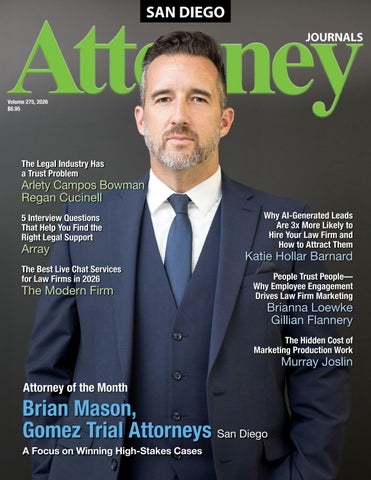
Attorney of the Month
Brian Mason, Gomez Trial Attorneys San Diego A Focus on Winning High-Stakes Cases
SPECIALIZING IN COMPLEX BUSINESS LITIGATION
BET-THE-COMPANY CASES OVER 65 YEARS OF COMBINED EXPERIENCE REFERRALS/SUBSTITUTIONS ACCEPTED AT ALL STAGES OF LITIGATION, INCLUDING TRIAL • 2026 – Jason obtained a complete defense jury verdict for his client that was sued for sexual harassment, negligence, and retaliation. Plaintiff’s final pre-trial settlement demand was $3 million. • 2025 – Jason obtained a complete defense arbitration award for his client in a contract dispute wherein the alleged damages were in excess of $1 million. • 2025 – Mike obtained a final arbitration award in excess of $13 million for his client, an employee of a large public company. • 2024 – Jason obtained a jury verdict of $550,000 for his client, an Uber driver assaulted by a passenger. • 2021 – Mike and Jason obtained a $22 million settlement for clients defrauded in a local Ponzi scheme.
501 West Broadway | Suite 1310 | San Diego, CA 92101 | 619-487-1500 | www.kirbyandkirbylaw.com
2026 EDITION—NO.275
TABLE OF CONTENTS 6 The Legal Industry Has a Trust Problem by Arlety Campos Bowman and Regan Cucinell
8 The Best Live Chat Services for Law Firms in 2026 by The Modern Firm
6
EXECUTIVE PUBLISHER Brian Topor EDITOR Wendy Price
12 Five Interview Questions That Help You Find the Right Legal Support
PUBLICATION DESIGN Penn Creative
by Array
CIRCULATION Angela Watson
ATTORNEY OF THE MONTH
16 Brian Mason, Gomez Trial Attorneys, San Diego A Focus on Winning High-Stakes Cases
PHOTOGRAPHY Chris Griffiths STAFF WRITERS Dan Baldwin Jennifer Hadley CONTRIBUTING EDITORIALISTS Array Katie Hollar Barnard Arlety Campos Bowman Regan Cucinell Gillian Flannery Murray Joslin Brianna Loewke The Modern Firm ADVERTISING INQUIRIES Info@AttorneyJournals.com SUBMIT AN ARTICLE Editorial@AttorneyJournals.com OFFICE 1950 W Corporate Way #21011 Anaheim, CA 92801 www.AttorneyJournals.com ADDRESS CHANGES Address corrections can be made via email or postal mail.
by Dan Baldwin
16
22 The Hidden Cost of Marketing Production Work by Murray Joslin
24 Why AI-Generated Leads Are 3x More Likely to Hire Your Law Firm and How to Attract Them by Katie Hollar Barnard
26 People Trust People—Why Employee Engagement Drives Law Firm Marketing by Brianna Loewke and Gillian Flannery
24
Editorial material appears in Attorney Journals as an informational service for readers. Article contents are the opinions of the authors and not necessarily those of Attorney Journals. Attorney Journals makes every effort to publish credible, responsible advertisements. Inclusion of product advertisements or announcements does not imply endorsement. Attorney Journals is a trademark of Sticky Media. Not affiliated with any other trade publication or association. Copyright 2026 by Sticky Media. All rights reserved. Contents may not be reproduced without written permission from Sticky Media. Printed in the USA
The Legal Industry Has a Trust Problem by Arlety Campos Bowman and Regan Cucinell
A
rtificial intelligence has fundamentally changed how legal work is produced. Work that once required hours of legal analysis can now be produced in minutes. That is an extraordinary gain in efficiency, but it also changes where the real value lies. The challenge is no longer producing an answer. It is knowing whether the answer is accurate, complete, and can be trusted. The profession is beginning to respond to that challenge. In June 2026, Rhode Island joined a growing number of jurisdictions issuing guidance on lawyers’ use of artificial intelligence, reinforcing a principle that has always existed: technology can assist the work, but it cannot assume responsibility for it. Lawyers remain accountable for the accuracy of AI-assisted work and for exercising appropriate professional judgment. That guidance reflects a broader shift taking place across the profession. As AI lowers the cost of producing legal work, the competitive advantage increasingly shifts to those who can review, supervise, and exercise sound judgment. That shift has implications well beyond professional responsibility. It is beginning to reshape the economics and talent model of law firms. For decades, law firms were built around a simple reality. High-quality legal work required skilled human effort. If a client needed a research memorandum, a contract review, or a brief, someone had to spend the hours producing it. Firms hired and trained large classes of associates because legal work was inherently labor-intensive. Artificial intelligence changes that equation. Today, a well-crafted prompt can generate a first draft in seconds. Research can be synthesized almost instantly. Contracts can be reviewed in a fraction of the time they once required. The bottleneck has moved. It is no longer creating legal work. It is determining whether that work is accurate.
When Wrong Looks Right Lawyers make mistakes and junior associates miss issues. What makes AI different is not that it gets things wrong. It is how convincing those mistakes can look.
6
Attorney Journals San Diego | Volume 275, 2026
A bad first-year associate draft usually contains clues: the analysis may be incomplete, the writing may be awkward, or citations may be thin. Something often signals that the work needs attention. AI-generated work frequently removes those signals. The language is polished and the structure is clean. Everything appears finished, which creates a different problem for reviewers. They are no longer reading rough drafts that invite scrutiny. They are reading work that appears complete even when it contains fabricated citations, faulty reasoning, or unsupported conclusions. That matters because errors can travel further before anyone catches them. A flawed analysis can be reused, cited, or incorporated into other work long before someone realizes there is a problem. As a result, the burden shifts upward. Senior lawyers should be spending less time improving work and more time determining whether they can trust it.
What Happens Inside Firms The traditional pyramid was designed around work production. Junior lawyers performed large amounts of work. Midlevel lawyers refined it. Partners supervised it. Increasingly, firms need to become review organizations: AI generates an initial draft; a junior lawyer checks sources, citations, and basic reasoning; a midlevel lawyer pushes on assumptions and looks for weaknesses; and a partner decides whether the work is strong enough to put in front of a client or in front of a judge. The work moves through layers of review. The limiting factor is how quickly someone with judgment can determine whether the draft should be trusted.
Who Should Firms Hire? Many firms still recruit using signals that made sense in a different environment: prestigious schools, strong credentials, polished communication, and confidence under pressure. Those qualities still matter. They are simply no longer enough.
The lawyers who become more valuable in this environment are the ones who keep asking questions after everyone else thinks the answer has been found. They check the citation. They test the assumption. They follow the logic one step further. They are harder to impress with polished work because they care more about whether it survives scrutiny. Some of the traits firms have traditionally rewarded can become liabilities if left unchecked. Confidence can turn into overconfidence. Speed can reduce examination. Fluency can create the appearance of understanding where little exists. The profession has spent decades identifying people who can produce answers. It now needs to become better at identifying people who can challenge them.
How Do Lawyers Learn Judgment Now? This presents another obstacle. For generations, junior lawyers developed judgment through repetition. They reviewed documents, drafted motions, researched issues, and received feedback from more experienced lawyers. The process was often inefficient, but it worked. If that work gets absorbed by AI, the next question becomes obvious: How does a lawyer learn judgment if fewer opportunities exist to exercise it? The answer is unlikely to be more policy manuals or additional AI training sessions. Firms will need to create experiences that force lawyers to evaluate, challenge, and defend conclusions. That may involve reviewing intentionally flawed analyses. It may involve exercises built around finding errors rather than producing drafts. It may involve more direct coaching from senior lawyers than many firms currently provide. Whatever the solution, firms cannot assume judgment develops automatically. The apprenticeship model depended on exposure to work. If the work changes, the training model must change with it.
Two Different Futures Law firms appear to be moving in two different directions. Some will use AI to deliver work faster and at a lower cost. Others will focus on something different: trust. Their pitch to clients will not be that they can generate an answer quickly. Everyone will be able to do that. Their pitch will be that their answer has been challenged, examined, and defended before it reaches the client. Both approaches can work. The mistake is assuming they require the same people, the same incentives, or the same management systems. They do not.
The Real Scarcity The legal industry does not have a shortage of intelligent people. It never has. What it has now is a growing shortage of people willing and able to look at a polished answer and ask, “How do we know this is right?” For decades, firms built their economics around producing legal work. Increasingly, their value will come from validating it. Artificial intelligence can draft a brief. It can summarize a case. It can produce an answer that sounds convincing. But, it cannot accept responsibility for that answer. A lawyer still has to do that. The firms that understand the difference will have a significant advantage over those that do not. n Arlety Campos Bowman is a lawyer and trustee whose work focuses on governance design, fiduciary decision-making, and management structures. Her experience spans legal practice, board leadership, and philanthropic advisory work, with a particular emphasis on how governance frameworks influence accountability, strategic execution, and organizational resilience. Regan Cucinell is currently responsible for organizational strategy and HR business alignment at a global Fortune 500 company. Prior to that, Regan served as an Executive Adviser and Consultant for various companies in the NYC/CT area. Regan also served as the Chief People Officer at Osprey Funds.
References: 1. Stanford Human-Centered Artificial Intelligence, AI on Trial: Legal Models Hallucinate in 1 out of 6 (or More) Benchmarking Queries (May 23, 2024). 2. Thomson Reuters Institute, GenAI Hallucinations Are Still Pervasive in Legal Filings, but Better Lawyering Is the Cure (Aug. 18, 2025). 3. Reuters, Sullivan & Cromwell Law Firm Apologizes for AI “Hallucinations” in Court Filing (Apr. 21, 2026). 4. Reuters, U.S. Appeals Court Sanctions Lawyers Over AI “Hallucinations,” Lack of Candor (June 3, 2026). 5. Reuters, Rhode Island Joins States Issuing AI Rules for Lawyers (June 17, 2026), 6. American Bar Association, Avoiding AI Hallucinations in Legal Practice (June 15, 2026). 7. American Bar Association, Lawyer Sanctioned for Failure to Catch AI “Hallucination” (Mar. 13, 2025). 8. American Bar Association, Top Six AI Legal Issues and Concerns for Legal Practitioners (2025). 9. American Bar Association, Generative AI for Lawyers Part 1: Competence, Professionalism, and Risks (Sept. 30, 2024). 10. Thomson Reuters, Legal Issues with AI: Ethics, Risks, and Policy (July 29, 2025)
Attorney Journals San Diego | Volume 275, 2026
7
The Best Live Chat Services for Law Firms in 2026 by The Modern Firm
M
ost law firms have a contact form on their website. Far fewer have anything that can actually have a conversation with a visitor at 11 p.m. or when the attorney is in court or at a family event. This disconnect is the problem that live chat helps close, and after working with law firms on their websites for over two decades, we can say it’s one of the most valuable features a firm can add. This guide is for firms trying to figure out which live chat service makes sense for them. Below we walk through why chat matters now more than it used to, the four types of services available, what to look for, what to expect with pricing, and a short list of the providers we see doing it best.
Why Live Chat Matters for Law Firms A 2011 study published in Harvard Business Review by James Oldroyd and his colleagues at MIT and InsideSales.com remains the most cited research on this subject, and the findings have held up across many follow-up studies since. Firms that responded to a web inquiry within an hour were nearly seven times more likely to qualify the lead than firms that waited just sixty minutes longer, and more than sixty times more likely than firms that waited 24 hours or more. (See “The Short Life of Online Sales Leads,” HBR, March 2011.) The lesson is straightforward: the value of an inbound lead decays fast, and the firms that respond first usually win. Live chat is one of the best ways to drop the response time down to zero. Someone visits a law firm’s website in the middle of the night researching divorce attorneys, or on their lunch break trying to understand a wage garnishment letter, but instead of getting a contact form and a promise of a callback, they get a real conversation. That conversation can answer basic questions, screen the matter, and book a consultation in a single interaction. Once a consultation is on the calendar, the chances that the prospect keeps shopping the competition drop substantially, and the odds they actually show up to the meeting go up.
8
Attorney Journals San Diego | Volume 275, 2026
There is also a generational dynamic worth pointing out. The oldest millennials are now 45, and they have spent their adult lives texting rather than calling. For many people, especially in emotionally loaded practice areas, picking up the phone to call a stranger about their problem is genuinely intimidating. Chat lowers that barrier by letting the prospective client feel out the firm (how responsive you are, how the staff sounds, whether you handle their type of case) before committing to a full conversation. The good news is that all of the chat options below are easy to install. They run as a small piece of code that can be added to your website within minutes. The harder choice, and the one this guide is built around, is which type of service makes sense for your firm and getting it properly configured for success.
Types of Live Chat Services There are four main categories of live chat service.
Managed Live Chat Services Specialty companies like Blazeo (formerly Apex Chat), Ngage, Ruby and Juvo Leads professionally staff live chat specifically for law firms. Their employees are trained on the legal market, they work from a script your firm provides, and they operate around the clock. Optionally, when a chat meets certain criteria you’ve defined, say, a personal injury inquiry involving a hospitalization, they can warm-transfer the chat directly to a phone call with you or your staff for immediate follow-up. For firms that don’t have in-house staff to field chats, this is often the easiest and most turn-key option. The main downsides are cost and personality. These services typically bill either per chat or per qualified lead and the conversations will feel less personal than if someone at your firm were running them. However, in practice, the aroundthe-clock availability and not having to dedicate in-house staff usually outweigh both concerns, especially for small firms and for fast-moving practice areas where a missed lead at 9 p.m. has committed to another firm by the morning.
AI Chatbot / Automated Services
Key Features to Look For
The boom in AI over the last few years has produced a parallel boom in legal-specific chatbot services. With AI chatbots, response time is never a problem; the bot is always on, trained on your firm’s website, intake materials, and scripts, and is configured to handle basic intake and triage. Pricing typically comes in well under a managed live chat service, which is part of the appeal. The downsides are perception and capability. For a prospective client who is already stressed about a legal problem, opening a chat and immediately encountering an obvious AI can feel like the first step in being processed by a system rather than helped by a person. It’s the same feeling people get when they hit an automated phone tree and start mashing zero. The capability concern is more serious: the bots have to be tightly trained and strictly scoped. We absolutely do not want a law firm chatbot doing what the Chevrolet of Watsonville chatbot cheerfully did in 2023, when a user convinced it to sell a 2024 Tahoe for $1. For a law firm, the equivalent risk is a bot that wanders into giving substantive legal information, or worse, advice. This is why we only recommend providers that specialize in working with law firms; most of the necessary guardrails are baked in from the start.
When you’re considering chat providers, here are the features and characteristics we’ve found to be the most important to law firms.
Chat Software Operated by In-House Staff The third category is just chat software, run by your own staff. Tools like LiveChat, Olark or HubSpot’s free chat widget cost comparatively little, and the chats are handled by people who actually know the firm: what attorneys are available, how the intake process works, the personality of the place. This delivers the most personal client experience of any option. The downside is in implementation and operation. Someone has to actually be watching the chat queue and able to respond quickly, which means a dedicated receptionist or a clearly assigned role. A chat that sits unanswered is worse than no chat at all, because you’ve signaled to the visitor exactly how responsive your firm is. In-house chat is also only available during business hours; most software defaults to either being invisible or displaying a contact form when nobody’s logged in. This works, but doesn’t capture the after-hours visitor in the way live coverage would.
Hybrid Approach The categories above can be combined, and some firms and providers do exactly that. An AI-enabled chatbot can initially gather basic information and then triage the inquiry to a live human (either in-house or with a managed service) when the inquiry meets thresholds defined by the firm. Another option is to staff the chat in-house during the day and switch to a managed service during closed business hours.
• Law firm focus. Companies that specifically serve law firms can hit the ground running to save you time and avoid mistakes. They have script templates, intake workflows, and guardrails built into their onboarding process. • Security and compliance. Encryption is pretty well standard these days. But, depending on your practice area, you may want to look for HIPAA compliance and other security assurances if potential clients may be sharing medical or other sensitive information. • Call transfer or warm handoff. The ability to define criteria that allow chats to be escalated directly to an attorney or firm staff greatly increases the chances of securing a meeting with the client or nipping trouble in the bud. • CRM integration. Integration with your firm’s existing software such as Clio Grow, MyCase, Smokeball, and PracticePanther will ensure that leads and chat transcripts land in your system and will save you from having to check a separate inbox. • 24/7 availability. Around-the-clock availability increases the chances of booking a meeting, especially in practice areas where inquiry often happens at off-hours. • Calendar integration. The ability for the chat operator, human or AI, to schedule appointments on the correct calendar in real-time will keep everyone on the same page. • Bilingual support. Spanish-language chat (and other languages) may be valuable for firms in immigration, criminal defense, personal injury, and many regional markets.
Pro Tips From Our Experience A few things separate the firms that get real value from chat and the ones that get frustrated and eventually bail. Take the time to script and train the service properly. Chat may be the first interactive impression a potential client has of your firm so it’s worth investing real effort to get it set up correctly. For managed services, this means working through their full onboarding rather than rushing it. For AI services, this means feeding them not just your website, but your intake protocols, scheduling rules, escalation criteria, and the kinds of questions you actually get from clients. The providers we recommend all have onboarding teams whose job is to do exactly this so make sure to use them. Limit scope. Unless your chat is being run by knowledgeable in-house staff, restrict the topics the chat service can engage on. Initial screening, conflict-check basics, scheduling, and
Attorney Journals San Diego | Volume 275, 2026
9
simple customer service questions like office hours and parking. That’s it. Live chat, especially AI-operated chat, should never be answering substantive legal questions or anything that resembles legal advice. The script should be explicit about deferring those questions to an attorney. Test, test and test again. Every reputable provider will let you stress-test the service before going live. Run through realistic scenarios; throw curveballs at it; recruit staff and a few friends to do the same. You will likely find issues that your initial configuration didn’t anticipate. Review transcripts regularly. This is the single most common mistake we see. A firm sets up chat, it works for the first few weeks, and then nobody ever looks at it again. This is not one of those As Seen on TV Rotisserie Ovens (www.youtube.com/watch?v=Nb91-j861DI&t=18s) you can set and forget. Once a service is operating in the real world it will encounter scenarios you didn’t dream up, and the only way to catch problems is to spend some time reading the transcripts on a regular basis. This is where you’ll find refinements that can make a big difference such as the chat operator not following the escalation rules, missed scheduling opportunities, and language or tone that’s landing wrong.
Recommended Live Chat Services for Law Firms Here is a short list of chat providers we often work with and recommend to our clients. The right fit for your firm will depend heavily on your practice area, volume, and budget. 1. Blazeo (formerly Apex Chat). A long-running managed live chat service that has been in the legal market for years. Blazeo has expanded well beyond chat; it now positions itself as a full lead conversion platform with live chat, AI chatbots, voice call center support, appointment setting, SMS, and even retainer signing. Offers full-human and AI/Human hybrid options. 2. Ngage Live Chat. A managed, legal-specific service with encryption, video chat options, and strong analytics and lead reporting. Ngage has also been in the legal space for a long time 3. Ruby. Most known for receptionist services, Ruby has extended their friendly brand into chat. Pricing scales by usage and many integrations are available. If you already use Ruby, you can add on chat services at a discounted rate. 4. Client Chat Live. Built specifically for law firms since 2008, with a focus on B2C practice areas like personal injury, mass tort, and criminal defense. 5. Juvo Leads. Live operators only (no AI). Strong reputation in PI and criminal defense.
10
Attorney Journals San Diego | Volume 275, 2026
6. Intaker. An AI-first option for firms that want automated intake at a lower monthly cost than a fully staffed service. Features an attractive video option to customize the chat widget throughout the website and increase engagement.
What to Expect on Pricing Managed chat services typically charge on a per chat basis ($1020/chat) or per qualified lead basis ($30-40/lead), often with a monthly minimum that puts most firms in the range of roughly $150 to $500 per month. AI powered bots also charge on a per chat basis and sometimes have a cost component based on the volume of website traffic. AI enabled services usually come in around half the cost of managed chat. Chat software operated by in-house staff usually runs around $20-$50 per month for the license but requires your staff’s time. An additional thing to note is that most managed and AI chat services will not charge for spam chats and those asking for just basic information such as a phone number. However, this should be clarified with the provider.
Closing Thoughts The right live chat service depends on your firm’s size, your practice area, your budget, and whether you’d rather have someone else handle the conversations or keep them in-house. Either way, for most practice areas, live chat is one of the few tools that can capture and convert leads while you are actually billing hours, and the firms that set it up properly are getting solid returns from it year after year.
Key Takeaways • Responding to a lead within an hour makes them far more likely to convert, and live chat cuts that response time to zero. • There are four types of chat services: managed/staffed chat, AI chatbots, in-house staffed software, and hybrid combinations. • Managed services and AI chatbots offer round-the-clock coverage, while in-house chat is more personal but limited to business hours. • Look for providers with legal-industry experience, strong security, CRM integration, and warm call transfer options. • Pricing ranges from $20 to $50 per month for in-house software up to $150 to $500 per month for managed services, with AI chatbots falling in between. • Ongoing success requires proper training, a limited chat scope, thorough testing, and regular transcript reviews. n This article was provided by The Modern Firm, which is a website design and online marketing company that has worked with over a thousand small law firms by providing a one-stopshop experience for everything a small firm needs to succeed online. Learn more at www.themodernfirm.com.
When the verdict must be historic. Prominent firms refer their toughest, highest-stakes cases to BRUNO | NALU, and for good reason. With well over 100 jury trials and a record of landmark verdicts, we step in as trial counsel to radically increase the value of settlements and awards.
$857M PRODUCT LIABILITY $412M MEDICAL MALPRACTICE $48M SEXUAL ASSAULT $40M WRONGFUL DEATH $21.3M TRUCK ACCIDENT Representative verdicts. Prior results do not guarantee a similar outcome.
Keith J. Bruno & Angela Bruno, Founding Trial Lawyers, BRUNO | NALU
Refer with confidence.
Battle-tested trial counsel.
www.brunonalu.com 866.519.3098 18201 Von Karman Avenue, Suite 1180, Irvine, CA 92612
5 Interview Questions That Help You Find the Right Legal Support by Array
H
iring legal support staff can feel straightforward on paper, but in practice it is one of the most consequential decisions a legal team makes. The right paralegal, contract attorney, or legal assistant can improve workflow efficiency, reduce risk, and keep matters moving under tight deadlines. The wrong hire can slow down case progress, create rework, and place additional strain on already stretched teams. First-time hiring managers and HR leads are not just reviewing resumes. It is knowing what to ask in an interview that reveals how a candidate will actually perform in a real legal environment. Strong hiring tips focus less on surfacelevel qualifications and more on judgment, reliability, and adaptability under pressure. Below are five interview prompts/questions designed to improve paralegal vetting, strengthen team-building decisions, and help you identify legal support professionals who will truly add value.
1. Walk me through how you prioritize tasks when everything is urgent. Legal work rarely arrives in a neat queue. Deadlines overlap, attorneys make last-minute requests, and discovery demands can escalate quickly. This question reveals how a candidate handles competing priorities without losing accuracy or composure. Strong candidates will describe a structured approach, such as assessing deadlines, identifying dependencies, and communicating proactively when workload shifts. Weak answers often rely on vague statements like “I just get it all done” without explaining the process. For team building, this question helps you understand whether a candidate can operate independently or whether they require constant direction.
2. Tell me about a time you caught an error before it became a problem. Attention to detail is non-negotiable in legal support roles. Whether reviewing documents, preparing discovery
12
Attorney Journals San Diego | Volume 275, 2026
responses, or managing filings, small mistakes can lead to significant consequences. This question is especially valuable for paralegal vetting because it surfaces how carefully a candidate actually works under pressure. Look for answers that show ownership, such as reviewing work proactively, double-checking citations, or implementing personal quality control steps. The strongest responses will also include how the candidate communicated the issue and corrected it, not just how they found it.
3. How do you handle assignments when instructions are incomplete or unclear? In fast-paced litigation environments, instructions are not always perfect. A strong legal support professional knows how to move forward without making assumptions that could create risk. This question evaluates judgment and communication skills. Effective candidates will explain that they pause to clarify expectations, ask targeted questions, and confirm assumptions before proceeding. They will also show that they can make reasonable decisions when immediate clarification is not possible. From a hiring-tips perspective, this question helps identify candidates who balance independence with appropriate caution.
4. Describe your experience working with attorneys who have very different communication styles. Legal teams are rarely uniform in how they operate. Some attorneys want constant updates, while others prefer minimal interruption. Some are highly detail-oriented, while others focus on big-picture strategy. This question is critical for team building because it reveals how adaptable a candidate is in real workplace dynamics. Strong candidates will demonstrate emotional intelligence,
flexibility, and the ability to adjust communication styles based on the person they are supporting. Look for signs that the candidate does not take feedback personally and can maintain professionalism even in highpressure interactions.
5. What does high-quality legal work mean to you, and how do you ensure it in your day-to-day work? This question helps you understand a candidate’s internal standard for excellence. It also highlights whether their definition of quality aligns with your team’s expectations. Strong answers often reference consistency, accuracy, documentation, and accountability. Candidates may also mention checklists, peer review habits, or time management techniques they use to maintain accuracy. This is one of the most important questions for paralegal vetting because it goes beyond experience and focuses on mindset. Technical skills can be taught, but personal standards for quality are much harder to change.
Beyond Performance: Addressing Potential Hiring Risks While behavioral interview questions help assess how a candidate is likely to perform on the job, experienced legal recruiters also recommend adding a few straightforward screening questions to identify potential concerns early in the hiring process. These questions are not about eliminating candidates based on isolated answers. Instead, they create space for transparency, context, and a clearer understanding of career decisions. Consider asking: • What prompted you to leave your last position? • Can you walk me through your recent career moves, particularly if you’ve had several short-term roles? • Is there anything about your professional experience or career path that you’d like to provide additional context for? These types of questions help hiring managers understand patterns, clarify timelines, and surface anything that may be relevant to long-term success in the role. They also ensure the conversation stays grounded in professional experience while allowing candidates to explain their journey in their own words.
Why Structured Interviews Matter More Than Ever Legal hiring has become increasingly complex. Teams are often hiring under time pressure, with limited visibility into a candidate’s real day-to-day capabilities. Without structured questions, interviews can easily become conversations about resumes rather than evaluations of performance. By using intentional hiring tips like the questions above, organizations can improve consistency in decision-making and reduce the risk of mismatched hires. This is especially important when building teams that need to scale quickly or support high-stakes litigation work. Strong interview design also supports better team building. Each hire does not just fill a role. They integrate into workflows, communication patterns, and case strategy execution. The better the fit, the more efficient the entire team becomes.
Supporting Smarter Hiring Decisions At Array, we understand that finding qualified legal professionals is not just about filling open roles. It is about ensuring every placement supports accuracy, efficiency, and long-term success. Through our legal staffing and recruiting services, we connect firms and legal departments with carefully vetted professionals who are prepared to contribute from day one. Our approach to paralegal vetting and legal talent placement is designed to reduce uncertainty in hiring decisions. By focusing on experience, reliability, and proven performance in real legal environments, we help teams avoid costly hiring missteps and maintain momentum across matters. Whether you are building a new team or expanding support for growing caseloads, the right interview strategy is the first step toward stronger outcomes. With the right questions and the right staffing partner, hiring becomes less of a risk and more of a strategic advantage. n Array is a litigation support company that combines proprietary technology, predictive analytics, and generative AI with handson legal expertise to help law firms and legal teams manage cases of all sizes. Its platform spans eDiscovery, AI-powered document review, court reporting and transcript analysis, digital forensics, and cybersecurity services, all delivered through a hybrid model that pairs technology with dedicated account support. Array has been named to Inc. Magazine’s 5000 fastest-growing private companies list for four consecutive years and maintains SOC 2 compliance. Learn more at www.trustarray.com.
Attorney Journals San Diego | Volume 275, 2026
13
A FOCUS ON WINNING HIGH-STAKES CASES At Gomez Trial Lawyers, Brian R. Mason’s team starts every case with trial-readiness in mind, not settlement. By Dan Baldwin My practice is focused on complex, high-stakes cases that require substantial investigation, expert involvement, and a willingness to go to trial. I am particularly drawn to cases where the harm is significant, responsibility is disputed, and the client needs an attorney who will take the time to understand their story and pursue every available avenue of recovery,” says Brian R. Mason, Partner and Trial Attorney at Gomez Trial Attorneys. Mason’s clients are typically individual persons and families whose lives have been permanently changed by catastrophic injury, medical negligence, wrongful death, civil rights violations, or other serious misconduct. Events, often tragic and involving multiple victims, are overwhelming and create grief and an uncertain future. In the middle of personal crisis, people seeking their due justice find themselves confronting a hospital, a large corporation, a powerful insurance company, or a government entity with far greater capital and resources. A plaintiff attorney faces enormous challenges because a sound defense requires detailed medical analysis, extensive expert involvement, and the willingness to pursue accountability against hospitals, healthcare systems, government entities and other well-resourced defendants. “My clients are often seeking not only compensation for financial loss, but an explanation of what happened and assurance that the same failure will not happen to someone else. I get to help people who need help, who are going up against really big companies or government entities. Our clients have rights we can protect,” Mason says. Mason takes his work seriously and he does not like to lose. He is quick to point out that his drive to succeed never confuses intensity with unnecessary aggression in the courtroom. Whether he speaks with a client, opposing counsel, or a jury, he believes people respond best to someone who is direct,
16
Attorney Journals San Diego | Volume 275, 2026
authentic, and prepared. He works hard do everything to can to be the most reasonable person in the room, he says.
VICTORIES FOR THE COMMUNITY Big wins for a single client or for a family are often major victories for the entire community. The case of Anthony McGaff eloquently and forcefully makes that point. While riding a public transit bus, McGaff, a 30-year-old black man, died after being placed in a prolonged chokehold by another passenger. The driver was aware of the emergency, but continued traveling while McGaff remained restrained and unconscious. The case was heavily contested and required years of preparation, persistence, and ultimately a jury trial against a powerful public entity. “I knew going in it was going to be a tough case because there were a lot of difficult facts, but the more I dug into it, the more I learned about the safety procedures of the Metropolitan Transit System and how they failed. By the time we were in trial, I knew this was an important case not just for my client, but for the entire community,” Mason says. The jury returned an $8.5 million verdict and assigned zero percent responsibility to McGaff. That finding was extraordinarily meaningful because the defense had attempted to place blame on the victim. For his family, the verdict was not simply about financial compensation; it was a public acknowledgment that McGaff was not responsible for what happened to him and that his life mattered. “The experience reinforced that every case is ultimately about a person and a family. Anthony’s family placed an enormous amount of trust in me and my team and I felt a deep responsibility to make sure the jury understood who he was, what happened to him, and the magnitude of the family’s loss,” Mason says.
JOURNALS
ATTORNEY
OF THE MONTH
© Bauman Photographers
2026
Brian R. Mason, Partner
Early in life, Mason never thought about becoming an attorney. A totally committed basketball player in high school and college, he planned a career in coaching. Unfortunately, his dedication to the sport wasn’t matched by a similar dedication to academics. He left the four-year university he was attending and enrolled in community college with no academic plan. That’s when he had his “Aha!” moment. To borrow a sports term, his career choice took a pivot. His brother, Josh Mason, who was attending law school, invited him to sit in on a criminal procedure class. “And then I just kind of got the—I just loved it. It was all about the Fourth Amendment, search and seizure of a vehicle. That’s the first time I really thought I should consider law school,” Mason says. In a dramatic change of academic direction from his earlier years, Mason graduated in the top ten percent of his class at Thomas Jefferson Law School. After graduating, he worked for six years as a criminal defense attorney before switching to civil defense for Mercury Insurance Company for the next seven years. He found the work satisfying, yet discovered something important was missing in his life. He made another career pivot after meeting John Gomez in late 2021. Gomez was looking for someone to run a trial team on the plaintiff’s side. “I had admired John for years, not only because of the exceptional results he has achieved, but because of the way he built a firm around trial excellence, preparation, and a willingness to take on powerful defendants. That’s something I had always wanted to do, especially for a firm like Gomez Trial Attorneys that gives so much back to the community, and so that’s how I ended up making the change. I’ve never looked back.”
© Bauman Photographers
PIVOTING AT AN “AHA!” MOMENT
A WINNING COMBINATION Mason’s upgraded education, his trial experience and his total commitment to the success and well-being of his clients are distinguishing factors in his career path. He combines those essential skills with real-world trial experience and the resources necessary to fully develop complex cases and take them all the way to a successful conclusion. “We do not treat clients as case numbers or simply move files toward the quickest available settlement. I stay personally involved in the cases I handle,” Mason says. He meets with clients, learns their histories and families, prepares them for depositions and trial, and makes sure they understand the important decisions in their cases through each step of the process. In a serious injury or wrongful death matter, he shows a genuine skill for presenting the client’s full story in court or across the negotiating table. His philosophy is to prepare each case from the beginning as if it will go for trial. That means preserving evidence immediately, locating witnesses, obtaining surveillance and electronic evidence, retaining qualified experts, taking key depositions, and developing demonstrative evidence that will allow a jury to understand 18
Attorney Journals San Diego | Volume 275, 2026
complicated medical, scientific, or technical issues. He does not believe in waiting until the eve of trial to determine how the case will be proven. Preparing for trial from day one means they are prepared for any eventuality or opportunity along the way. Mason stresses the value of his and his firm’s substantial courtroom experience. “Many attorneys advertise themselves as trial lawyers but rarely try cases. Our willingness and ability to present a case to a jury changes the way defendants, insurance companies, hospitals, corporations, and public entities evaluate our clients’ claims. That’s one of the reasons our success rate and our client satisfaction ratings are so high,” Mason says.
Team Mason: Jansen Hyatt, Lizbeth Boyd, Brian R. Mason, Yoselin Lopez, Victoria Arrieta, and Vern Pendergraft
TEAMWORKING THE TOUGHEST CASES Mason learned the invaluable lesson of teamwork during his days playing basketball. It is a knowledge he applies to handling cases. Mason gives a lot of credit to his team, which is sizeable—necessary considering the size and resources available to the opposing sides. The team includes attorneys Lara Deitz and Jansen Hyatt, two paralegals, two legal assistants, and a part-time nurse. He doesn’t shy away from tough cases and embraces challenges other attorneys or firms prefer to avoid or refer to someone else. “What I really enjoy are the cases where other lawyers don’t want it because appears
to be too tough, but the damages are really significant. Those are the kind of cases I really enjoy,” he says. Sound and in-depth preparation is a hallmark of Mason’s approach to every case; a commitment developed during the course of his 18-year career in the courtroom. “When I was a defense attorney there were times when the plaintiff attorney got client’s name wrong or said something that I knew wasn’t true because I had studied all the medical records. I was just staggard by such a lack of preparation and vowed to never fall into that trap. Here at Gomez Trial Attorneys, we take the preparation part so seriously that it gives us a powerful edge over competitors.”
Attorney Journals San Diego | Volume 275, 2026
19
BEYOND THE OFFICE Mason and his wife of 18 years, Creslyn, live in San Diego County with their three children ages 11, 15 and 17. As a family, they enjoy travel and have been to 28 states along with multiple other countries so far. The kids are all homeschooled by Creslyn Mason, who founded an expanding homeschooling group in the community. “We feel fortunate to have built our family’s life in the San Diego community. It’s a place we would never leave,” he says. Mason credits his wife, Creslyn, as an essential part of his success, both in the courtroom and beyond. “Building a demanding trial practice requires long hours and significant sacrifice—not only from the lawyer, but from the entire family. Creslyn has been the foundation of our family and a constant source of strength throughout my career.” Mason hasn’t forgotten his basketball roots and stays in shape by playing the game three days a week. “Being with my family and playing basketball gives me a chance to step away from the intensity of litigation and recharge. But outside the courtroom, family remains the center of my life,” he says. For Mason, that perspective carries directly into his work and the relationships he builds with his clients. “Representing individuals and families facing the consequences of a serious injury, medical negligence, or the loss of someone they love is very fulfilling. They are often going through one of the most difficult experiences of their lives, and it is a privilege to stand beside them and tell their story in the courtroom.” n Contact Gomez Trial Attorneys 755 Front Street San Diego, CA 92101 TheGomezFirm.com
20
Attorney Journals San Diego | Volume 275, 2026
Brian R. Mason, Partner
» EDUCATION • Thomas Jefferson School of Law, J.D., cum laude: 2007 • University of Oregon, BS in Sociology with a Specialization in Politics and Social Movements: 2003
» HONORS & AWARDS • Super Lawyer: 2018-2026 • Super Lawyer Rising Star: 2018 - 2023 • TOP 100 Personal Injury Lawyers in America Club: 2023 • National Top 100 Trial Lawyers: 2022 • Pro Bono Honors Award, Thomas Jefferson School of Law: 2007 • Pro Bono Award from San Diego County Public Defender’s Multiple Conflicts Office:
» BAR ADMISSIONS • California; US District Court Southern District of CA • US District Court Central District of CA
» MEMBERSHIPS • Associate Member of the American Board of Trial Advocates (ABOTA) since 2020. • Consumer Attorneys of San Diego: 2022 - Present • San Diego County Bar Association: 2009 - Present • California Young Lawyers Association: 2009 - Present • North County Bar Association: 2009 - Present • State Bar of California: 2009 - Present • Adjunct Professor of Law at Thomas Jefferson School of Law: 2017
© Bauman Photographers
EXP ER I ENCE
Mason and his team have recovered more than $75 million since he joined Gomez Trial Attorneys in 2022. One case resulted in a $15 million recovery for a child who suffered serious injuries in a trucking collision that involved complex agency and cross-border issues. Another case resulted in a $6.1 million recovery in a civil rights case involving inadequate medical care in jail. That case was particularly meaningful because it involved holding a government institution accountable for failing to provide necessary care to a person in its custody. In another case, he represented a 15-year-old girl who was seriously injured in a motor vehicle collision. The available insurance limits totaled only $2.3 million, but he secured an additional $3.5 million beyond those limits, resulting in a total recovery of $5.8 million. Mason says, “That case reflects the importance of looking beyond the obvious sources of recovery and continuing to pursue every available avenue for an injured client.”
Congratulations to the 2025-26
Law Firm Challenge Winners! Firms with 10+ Alumni 100% ALUMNI PARTICIPATION Allen Matkins Blanchard, Krasner & French* Finch, Thornton & Baird, LLP* Jones Day Morrison & Foerster LLP Pillsbury
GREATEST NUMBER OF ALUMNI PARTICIPATING Allen Matkins Blanchard, Krasner & French* Higgs Fletcher & Mack LLP* Jones Day Morrison & Foerster LLP Wilson Sonsini* Witham Mahoney & Abbott
SIGNIFICANT DOLLARS RAISED Buchalter Clark Hill PLC Cooley LLP DLA Piper* Jones Day Morrison & Foerster LLP Procopio* Qualcomm* Snell and Wilmer L.L.P. Wilson Sonsini* Witham Mahoney & Abbott
Firms with 6-9 Alumni 100% ALUMNI PARTICIPATION RJS Law*
GREATEST NUMBER OF ALUMNI PARTICIPATING RJS Law*
SIGNIFICANT DOLLARS RAISED Delphi Law Group, LLP* RJS Law*
Firms with 2-5 Alumni 100% ALUMNI PARTICIPATION Dallo Law Group, APC Fell Law* Montage Legal Group
GREATEST NUMBER OF ALUMNI PARTICIPATING Dallo Law Group, APC Fell Law* Montage Legal Group
SIGNIFICANT DOLLARS RAISED CaseyGerry* Fell Law* GERSONLAW*
To see the list of all participating firms and to join the Law Firm Challenge, visit law.sandiego.edu/lawfirmchallenge. *Special thanks to firms that have funded private student scholarships.
The Hidden Cost of Marketing Production Work by Murray Joslin
Why do law firm marketing teams spend too much time producing documents and not enough time driving growth? Expectations for law firm marketing teams are higher than ever. Marketers are expected to drive business development, boost the firm’s image, create strong thought leadership, deliver market and client insights, improve client experience, measure marketing performance, and help attorneys win new business, while also handling day-to-day requests. At the same time, they manage a large amount of production work. This includes updating pitch materials, formatting PowerPoint slides, revising proposals, keeping credentials current, and preparing marketing materials. Each task may seem manageable by itself, but together they add up to hundreds or even thousands of hours each year. The real cost is not just the time spent on these tasks. It’s also the important work marketing teams cannot do because they are busy with production.
The Production Work That Quietly Consumes Marketing Few firms intentionally hire highly skilled marketing professionals to spend their days adjusting formatting, updating biographies, or correcting slide layouts. Yet these activities often become a large part of the daily routine. Consider a typical week: • A partner asks for last-minute changes to a pitch deck. • A proposal team needs attorney biographies refreshed before an RFP submission. • A practice group asks for experience lists to be reformatted for a client meeting. • A credentials database needs to be updated after lateral hires. • Dozens of PowerPoint slides need branding and formatting before a board presentation. None of these requests are unnecessary, in fact, they’re essential. But these tasks are repetitive and often urgent, which pulls marketing professionals away from higher-value work. 22
Attorney Journals San Diego | Volume 275, 2026
Death by a Thousand Requests Marketing leaders rarely face just one big project. Instead, they handle hundreds of small production requests, which makes them reactive instead of proactive. Creative projects, planning, and business development support often get delayed because urgent production work comes first. Over time, this becomes the normal way of working—not because it is the best method, but because it is the only way to keep up.
The Opportunity Cost Is Often Invisible Production work requires more than just time; it also takes expertise. When senior marketing professionals spend hours formatting documents or putting together presentations, they are not: • Creating campaigns that lead to new opportunities. • Advising partners on business development strategy. • Supporting cross-selling initiatives. • Analyzing market trends. • Creating thought leadership. • Strengthening the firm’s brand. • Building deeper client engagement programs. There is no question that production work must be done. The real issue is whether the firm’s most experienced marketing professionals should be the ones doing it.
Four Areas Where Production Work Has the Biggest Impact 1. Presentation production. PowerPoint remains one of the most important tools for business development in the professional services sector. Creating polished, ready-topresent slides often takes hours of formatting, aligning graphics, updating templates, and making revisions. A lot of this work is necessary, but it is not always strategic.
2. Proposal revisions. Successful proposals rarely come together in one draft. The content develops over time, and partner feedback often arrives late. Client requirements change. Formatting shifts with every revision. The workload can be significant, especially for large projects with many contributors. 3. Credential and experience management. Attorney biographies. Representative matters. Practice descriptions. Awards. Industry experience. Keeping these materials up to date is essential for business development, but it takes constant attention. Without good processes, outdated information can easily end up in client materials. 4. Document formatting and brand consistency. Every client-facing document reflects the firm’s brand. Formatting may seem simple, but inconsistencies in typography, layout, graphics, and templates can hurt professionalism and create extra work. Maintaining quality across thousands of documents each year takes both good processes and expertise.
Technology Helps, but It Doesn’t Solve the Problem AI and automation are reducing the time required for many production activities: • Documents can be summarized • Presentations drafted • Images generated • Templates populated • Formatting accelerated These capabilities are helpful, but firms still need experienced professionals. Someone needs to make sure materials match the firm’s brand, use current information, meet client expectations, and send the right message. Human judgment is still key for quality, consistency, and strategy. The best marketing teams don’t replace people with technology. Instead, they use AI-powered workflows alongside skilled production specialists to work faster without sacrificing quality.
A Better Operating Model for Law Firm Marketing More leading law firms are rethinking how they do marketing. They want to separate strategic marketing from high-volume production work. The goal is not to create silos or replace internal teams, but rather to make sure the right people use the right technology, so marketing professionals can focus on where they add the most value.
Routine production work, including tasks like presentation development, document formatting, proposal support, credential management, and other high-volume marketing activities, can be streamlined through standardized workflows, AI-enabled tools, and experienced production specialists. Many firms are partnering with specialized marketing service providers that combine creative and design expertise, business services, and technology-enabled delivery to provide scalable support as an extension of their in-house team. This model lets companies increase capacity without hiring more staff. It also ensures production work is done efficiently, consistently, and to a high standard. Internal marketing and business development teams can fully focus on the initiatives that drive growth: shaping strategy, strengthening client relationships, supporting attorneys, developing campaigns, and identifying new business opportunities. The result is a more agile marketing team that can respond faster, support the business better, and have a bigger impact on the company’s growth.
Moving Marketing up the Value Chain Production work will always be part of any marketing team. The goal is not to get rid of it, but to make sure it does not take up the time of those who can drive strategic impact. As AI and technology change marketing operations, the firms that benefit most will not just be those with the most automation. The real winners will be those who build a model where technology, skilled production staff, and strategic marketers each focus on what they do best.
Key Takeaways • Law firm marketing teams lose thousands of hours a year to formatting, proposal revisions, and credential updates that senior professionals were never hired to do. • Because those tasks are usually urgent, marketing teams stay reactive and the campaigns, cross-selling support, and thought leadership get pushed aside. • The fix is structural: pair AI-enabled workflows with dedicated production specialists so strategists can stay on strategy. n Murray Joslin is Executive Vice President of Creative & Business Solutions at Integreon, where he leads global strategy, product innovation, and client delivery across creative, marketing, and business research services. With over 20 years of experience, including executive roles at RR Donnelley, Bowne, and Williams Lea, his expertise spans client acquisition, operational transformation, and technology implementation across financial services, legal, consulting, and corporate sectors. Learn more at www.integreon.com.
Attorney Journals San Diego | Volume 275, 2026
23
In a world full of mergers and monopolies, count on us to keep it real.
When it comes to court reporting, video and litigation services, Peterson delivers real reporters, real experience, and real service. Day by day, year by year, case by case, we’ve been setting the high bar for integrity, technology and reach for over 35 years. Independently owned and operated 100% Woman-owned Business WBE Certified Serving CA and the US since 1986
Nationwide Reporting | petersonreporting.com | 800-649-6353
Peterson Reporting 2023 Atty Journal HPH.indd 1
24
Attorney Journals San Diego | Volume 275, 2026
4/25/23 4:45 PM
Law Offices of
Anna R. Yum Former Prosecutor, National TV Legal Analyst and Award-Winning Trial Attorney
CRIMINAL DEFENSE DUI Domestic Violence Assault and Battery Sexual Harassment - Plaintiff Sexual Assault - Plaintiff Murder
AWARDS • Super Lawyers – 2025 • U.S. News & World Report – Best Lawyers • Martindale Hubbell AV Preeminent Rated Lawyer • The Nation’s Top 1% – National Association of Distinguished Counsel • The National Trial Lawyers: Top 100 Trial Lawyers • Avvo.com Client’s Choice Award • Avvo.com rating of 10 out of 10 as a top attorney practicing criminal defense based upon client reviews and peer endorsements
REFERRALS PAID 501 W. Broadway Suite 1660, San Diego, CA 92101 (619) 648-4136 | www.annayumlaw.com
People Trust People: Why Employee Engagement Drives Law Firm Marketing by Brianna Loewke and Gillian Flannery
B
usiness development doesn’t always require a new strategy, a larger budget or another hire. Sometimes, it starts with a click. For many law firms, LinkedIn has become an essential marketing and business development platform. Firms invest significant time and resources creating thought leadership articles, client alerts, webinar promotions and firm announcements, yet one of the most effective ways to increase the reach of that content often costs nothing at all. Employee engagement. When attorneys and professional staff consistently like, comment on and share firm content, they do more than support the marketing department. They help introduce the firm’s work to new audiences, strengthen its credibility and expand its visibility beyond the firm’s own followers. For firms looking to maximize the value of their existing marketing efforts, encouraging internal engagement may be one of the simplest and most cost-effective business development strategies available.
People Trust People More Than Pages Firm pages serve an important purpose, but people are far more likely to engage with content shared by someone they know. Whether it’s a partner commenting on a client alert, an associate sharing a webinar invitation or a member of the marketing team celebrating a firm accomplishment, those interactions feel personal. They carry an endorsement that a company page simply can’t replicate. That matters because every attorney has their own professional network of clients, referral sources, former colleagues, classmates and industry contacts. Those networks represent audiences the firm’s LinkedIn page may never reach on its own. When employees engage with firm content, they’re effectively opening another door into those professional relationships.
26
Attorney Journals San Diego | Volume 275, 2026
How the LinkedIn Algorithm Works LinkedIn rewards engagement by showing activity to other users. When someone likes, comments on or shares a post, LinkedIn often surfaces that activity within the person’s network. As a result, the firm’s content appears before people who may not follow the firm’s page but are connected to the employee who engaged with it. Imagine two attorneys commenting on a new client alert discussing changes in employment law. Their activity may expose that article to hundreds or even thousands of additional professionals, many of whom never would have seen it otherwise. Every interaction creates another opportunity for a prospective client, referral source or future recruit to discover the firm’s work.
The Notifications Effect Engagement also influences how LinkedIn decides which content deserves broader distribution. When multiple people interact with the same post, LinkedIn recognizes that activity as a signal that the content is relevant. The platform may then recommend the post to additional users or surface it more prominently in their feeds, even if they don’t follow the firm’s page. Unlike paid advertising, those recommendations appear organically through the platform, making them feel more authentic and increasing the likelihood that users will click through to learn more. Simply put, the more employees who engage with a post, the more opportunities LinkedIn has to introduce that content to new audiences.
Why This Matters for Law Firms Law firms compete for attention every day. Prospective clients are researching legal issues. Referral sources are evaluating firms to recommend. Law students and lateral candidates are deciding where they want to build their careers. Many of those first impressions happen online.
When attorneys actively engage with firm content, they help reinforce the firm’s experience and culture in a way that feels authentic. A client alert with thoughtful comments from attorneys demonstrates that the firm isn’t simply publishing content—its lawyers are actively discussing the issues that matter to clients. That visibility also supports recruiting efforts. Prospective employees often review a firm’s LinkedIn presence before applying. A page with active engagement from attorneys and staff signals a collaborative culture and demonstrates that employees take pride in the firm’s accomplishments.
Building a Culture of Engagement Creating that visibility doesn’t require a formal social media campaign. Instead, firms should encourage attorneys and professional staff to make engagement part of their routine. Taking a few seconds to react to a post, leave a thoughtful comment or share content with a brief personal perspective can collectively have a significant impact on how far that content travels. Marketing teams can make participation easier by regularly sharing links to new posts internally, highlighting key messages employees may want to emphasize or drafting language to use,
with a reminder to colleagues that even small interactions help amplify the firm’s voice.
Key Takeaways Every firm wants its thought leadership, client alerts and announcements to reach the right audience. The good news is that firms already have one of the most effective tools for doing exactly that: their people. Encouraging attorneys and professional staff to actively engage with firm content isn’t simply a social media best practice. It’s a practical business development strategy that expands visibility, strengthens credibility and helps firms maximize the value of the content they’re already creating. n As a Senior Associate at Poston, Brianna Loewke works at the intersection of media relations and brand development for her clients, advising on strategy and managing the day-to-day tasks. In addition to collaborating with the Public Relations and Content teams, Brianna manages the firm’s internal marketing strategy and social media engagements, including its monthly newsletter. Gillian Flannery is a content intern at Poston Communications, working to deliver high quality, engaging and creative content. Learn more at www.postoncommunications.com.
Attorney Journals San Diego | Volume 275, 2026
27
Trusted referrals start with a conversation.
FOR ATTORNEYS WHO REFER WITH CONFIDENCE
When Your Clients Freedom Is on the Line in San Diego, Refer Them to the Firm That Wins Superior Law Center is San Diego's go-to criminal defense referral—trusted by attorneys to protect their clients, and their reputations. When a client walks in with a criminal matter outside your practice area, the referral you make reflects on you. That's why San Diego and Orange County attorneys send their criminal cases to Superior Law Center. Led by Erik Friis, our firm has secured more than 2,000 victories in San Diego County since 1999, backed by 27 years in these courtrooms. We handle the full spectrum—DUI, felonies, drug and violent crimes, sex crimes, theft, federal charges, appeals, and expungements—with the discipline and discretion your clients deserve. Refer with confidence. We'll take it from there. Erik Friis, Founding Attorney—Superior Law Center
27 Years in San Diego Courts
2,000 + Victories
24/7 Free Consultations
Superior Law Center • 2667 Camino del Rio South, Suite 304-1, San Diego, CA 92108 • 619-743-9130 www.superiorlawcenter.com
A R E F E R R A L PA R T N E R F O R C A L I F O R N I A C O U N S E L
Elder litigation · Civil & probate · Statewide
WHEN YOUR CLIENT'S CASE CROSSES A LINE
Refer the Elder Abuse Case to the Team Built to Win It. Financial exploitation. Nursing home neglect. Will & trust fraud. For 30+ years, California attorneys have trusted us with the complex elder litigation their own practices weren't built for—in both civil and probate court.
You didn't build your practice around financial elder abuse statutes, mandatory-reporter rules, capacity evaluations, and probate-versus-civil strategy decisions. We did. Send us the case. Keep the client. Protect the family. I.
II.
III.
Nursing Home & Care Facility Abuse
Financial Elder Abuse
Will & Trust Fraud
Real-estate transfers, account looting, annuity fraud, undue influence, caregiver exploitation, mortgage & reverse-mortgage schemes. Civil recovery and probate remedies.
Contested amendments, forged instruments, breach of fiduciary duty by trustees & conservators, inheritance disputes. Prosecuted in probate court by Certified Specialists.
Pressure ulcers, falls, malnutrition, medication errors, physical and sexual abuse, elopement, sepsis, wrongful death. Complex medical liability handled with in-house medical knowledge.
Why Counsel Refer to Us
— six reasons it's the right call.
Nursing home abuse: pure contingency. No cost to your client. No fee unless we recover.
Financial abuse & trust fraud: flexible fees. Contingency, hourly, or hybrid — structured to fit.
Referral fees honored. Per Rule 1.5.1, with full client disclosure.
Civil and probate. We litigate wherever the remedy lies.
Certified Specialist on team. CA State Bar — Elder Law and Estate Planning, Trust & Probate.
30+ years of verdicts. AV Preeminent. Super Lawyers. Outstanding Trial Lawyer.
AV Preeminent
Super Lawyers
MARTINDALE-HUBBELL
E L D E R L AW
Outstanding Trial Lawyer
Law Firm of the Month
C O N S U M E R AT T O R N E Y S O F SAN DIEGO
AT T O R N E Y J O U R N A L S · SAN DIEGO
BRYANT DIERINGER WILSON, LLP Fighting for elders. Answering to counsel.
402 West Broadway, Suite 2700 · San Diego, CA 92101 · Serving all of Southern California
REFERRALS & CO-COUNSEL
619.693.4900
californiaelderabuselawyer.com
Why AI-Generated Leads Are 3x More Likely to Hire Your Law Firm and How to Attract Them by Katie Hollar Barnard
If your law firm hasn’t started paying attention to its LLM presence, there’s a new compelling reason you should—in fact, 29 million of them. In a study of 97 B2B websites, Orbit Media found that visitors who come from AI sources (ChatGPT, Perplexity, Claude, you name it) are more likely to become an actual lead than visitors from other sources. Specifically, by examining the analytics for these websites, spanning one year and 29 million visits, Orbit Media discovered that visitors who come from AI are three times more likely to convert into leads than those who come from organic (nonadvertisement) traffic sources. Why? Orbit Media presented four theories: • The AI guided the user through a “shortlist” process. Here, we assume that before clicking on a link supplied by a tool like ChatGPT, the user had engaged in a series of qualifying questions with the LLM. For example, “Help me find a trademark law firm in Florida” led to discussions of specific cities, industry verticals, or fee structures. • The user already knows your firm, but the LLM prompted final action. This would occur if a potential client had chatted about your firm before or simply asked the LLM for your website link. • Users view AI responses as advice, not ads. While a Google search brings a long list of possibilities—and we’ve all become cynical at the riffraff inherent therein—LLM output feels more like a sensible advisor. (Keep in mind that, according to one study, ChatGPT may now be the single largest provider of mental health care in the U.S. Trust in these platforms is dangerously high.) • AI users “skew serious.” As Orbit Media put it, people don’t open ChatGPT to kill time the way they scroll on social media. People go to it with specific questions when they have specific intent. They’re not curious about trademark law generally; they’re looking to get one registered. Whatever the specific reason, it’s imperative for law firms to ensure their websites are well-positioned to capture this audience. Start by determining your current “Share of Model.” What are the LLM queries that matter most to your firm, and how are you showing up now? This can be done manually or through dedicated software; if done manually, ensure you take into account inherent bias. LLM tools that you have used before will be familiar with your firm, and results will be falsely positive. Understanding the current landscape will help you put together an action plan to increase the firm’s visibility. While every situation is different, marketing tactics we are recommending include: 30
Attorney Journals San Diego | Volume 275, 2026
• Practice pages. A Firesign review showed law firm practice pages were the most-cited URLs by ChatGPT, Perplexity and Google AI Overview. Revise your practice pages to be “AI-friendly” with elements like Frequently Asked Questions, statistics, definitions and lists. • Awards and rankings. Firesign analysis shows Perplexity and Google AI Overview both rely on industry rankings like Chambers USA, Super Lawyers, Best Lawyers and Best Law Firms to refer lawyers. Consider which award programs you need to add, which you need to enhance, and ensure your current listings are accurate and specific. • PR. When it comes to law firm recommendations, at Firesign we see LLMs referring to trade media (Law360, regional Lawyers Weekly publications); press releases on reputable newswires, such as Globe Newswire; and Wikipedia. Executing all of these creates a credibility loop, as press releases can bring earned media, and earned media is a critical component of becoming “Wikipedia-worthy.” As you explore this new (and ever-changing) aspect of law firm marketing, a few caveats: • Beware “one-size-fits-all” advice. There are a lot of general recommendations for growing a company’s AI visibility that don’t necessarily work for the legal sector. For example, many “best practices” stress earned media alone, but it’s evident that for law firms, the LLMs have been trained to incorporate specific rankings, like Chambers. • Don’t exhaust yourself trying to be everywhere. If you have limited time and resources, focus on ChatGPT. According to Orbit Media’s study, ChatGPT drives 8 in 10 AI visits, five times more than every other AI tool combined. Pay attention to its specific favorites (Wikipedia, law firm practice pages) and run some smart experiments. • Don’t focus solely on AI visibility. In the Orbit Media analysis of 97 B2B sites, Google Search drove 100 times more traffic. The conversion is lower, but the volume is critical. As always, a well-rounded marketing strategy that incorporates a full range of channels (website content, PR, awards, social media) is the best bet for sustainable success wherever clients are looking. n Katie Hollar Barnard is the Founder and Chief Executive Officer for Firesign to help legal industry clients attract, win, and retain business. She draws upon more than 10 years of experience at two of the nation’s largest law firms to build brands that connect and business plans that deliver. Learn more at www.firesignmarketing.com.
PRSRT STD U.S. POSTAGE
PAID PERMIT # 100 CLAREMONT, CA
We’ve Got Nevada Covered Too. MEET OUR NEVADA LICENSED ATTORNEYS
OVER $1.4 BILLION IN JUDGMENTS AND SETTLEMENTS PAID IN 2025
Panish | Shea | Ravipudi LLP attorneys fight
We invite you
every day to obtain justice for our clients and
to visit our Las
make a difference in their lives. But our expertise
Vegas office,
in personal injury litigation doesn’t stop at the
located across
California state line. With 19 attorneys licensed
the street from
in Nevada, we have obtained record results in
the Courthouse,
the state. The Firm welcomes all joint venture
where we offer attorneys use of our full
opportunities, including with attorneys who want
courtroom to conduct focus groups,
to stay more actively involved in a case.
mock trials, and witness preparation.
GENEROUS REFERRAL FEES OFFERED UNDER APPLICABLE STATE BAR RULES, INCLUDING CRPC 1.5.1, NRPC 1.5(e) and AZ ER 1.5
Past results do not guarantee, warrant, or predict future cases.
877.800.1700
panish.law
CALIFORNIA | NEVADA | ARIZONA
S T R E N G T H B Y Y OUR S IDE
®