Opening demands and offers set the tone for mediation and often affect the outcome. Here are some suggestions for improving your chances of a favorable settlement.
Plaintiff’s Opening Demand
The opening demand should be no greater than the full value of your claim if you were to win at trial on absolutely everything. From there, you can negotiate down if there are any weaknesses in your case that would jeopardize a favorable jury verdict or when the costs of continued litigation are likely to exceed what you can afford.
Risks vary from case to case. Your concessions during negotiation will depend on the facts of your particular case and the law(s) applicable to it. In some situations, you will have to lower your demand dramatically; in others, you can hold firm. If you really face little risk at trial, there is no reason to discount your case beyond your client’s desire to settle and move on, although the one certainty of trials is uncertainty. Using a simple calculation to formulate your demand, such as doubling the full value of your claim, may seem like a reasonable approach, but there are some drawbacks:
1. You won’t be able to justify that demand. If you are asked to provide the basis for your demand, you must be able to do so. Starting out with an absurdly high demand “to leave room to negotiate” is not a plausible justification.
2. You will lose credibility. If you start with a demand that is higher than the maximum amount you could possibly be awarded at trial, the defense team may conclude that you are not a competent evaluator. When you later address another issue (your chances of winning on causation, for example), the defense has likely already determined that you are an exaggerator with an unrealistic view of your case. If you want to maintain credibility with the defense, try saying something like this: “I believe the full value of my case if I win on everything is $250,000. Of course, I may not win on everything, so let’s talk.”
3. You will telegraph your target. If you always ask for three times what you want, word will spread. Soon enough, your demand for $300,000 will be interpreted as a demand for $100,000. Your negotiations should be based on the specific
Opening Demands and Offers in Personal Injury Mediations
by Matt White
facts of your case, not a predictable calculation that can easily be recognized by the defense.
4. You will invite similarly unrealistic offers. If you’ve ever been to a mediation, you know the routine: The plaintiff asks for the moon, and the defense offers $250. When challenged, the defense says, “Of course our offer is low. We’ll get realistic, but only when plaintiff returns from the stratosphere.”[1] The plaintiff then becomes outraged at such an insulting offer and, in response, drops their demand by $250. The defense ups their offer to $500. Everyone arrived at the mediation hopeful and optimistic, but now the mood is gloomy and sullen, and resentment is building. Time has been wasted and trust has diminished. By contrast, a realistic opening demand usually engenders a reasonable opening offer. This saves time and builds momentum toward resolution.
5. There is no upside to an unrealistic demand. Anchoring, which is starting high to shift the range of negotiations upward, works well when a valuation is not easily calculable. Insurers, though, have immense databases of cases and results. Accurately or otherwise, your claim has already been evaluated, perhaps by a distant claims committee, and any additional authority will likely be modest. Your unrealistically high demand is not likely to shift the insurer’s evaluation; in fact, it may move the needle in the wrong direction (see No. 2 above). As many mediators will tell you, the goal is to push the insurer to its top dollar and then decide whether to settle or go to trial. There is no risk that you are leaving money on the table by starting with a rational demand; the insurer was never going to pay two or three times your own estimate of your best possible result at trial.
Defendant’s Opening Offer
Some of the rules regarding a plaintiff’s opening demand apply to a defendant’s opening offer. A reasonable opening offer sets the tone for a productive mediation by building trust, optimism and momentum. A ridiculously low offer will usually result in little or no movement from the plaintiff. Spending hours just to get into a realistic settlement range wastes time and money. In some ways, though, the defendant’s strategy must be
different. As a practical matter, the defense cannot start with its best possible outcome at trial. An opening offer of “We will pay nothing and you will reimburse us for all of our costs and expert fees” might work in the movies,[2] but not in real life.
6. Put some money on the table and justify your calculation. As with plaintiff’s demand, you must be able to explain the reasoning behind your offer: “We think the case is worth $100,000, and we think we have an 80% chance of winning on causation. Plus, a comparative negligence finding is likely. Therefore, our opening offer is $20,000.” Any plausible explanation is fine, but saying “The plaintiff’s demand is too high, so our offer is very low” sounds shallow and petty.
Of course, you don’t have to offer anything at all, but then why did you agree to mediation?
7. Nobody will make you split the difference between the opening demand and the opening offer. As negotiations wear on, parties naturally become focused on the midpoint between their positions. Invariably, when the numbers get close, someone is going to suggest that the parties split the difference. It’s theoretically possible that the opening demand and the first offer are so close that the parties laugh, split the difference and go home. But this almost never happens. Make a reasonable opening offer and worry later about the midpoint.
8. Make your offer before the mediation. Commonly, an insured defendant won’t make an offer until mediation. Instead, they may serve a brief that says, in effect, “We didn’t do anything wrong, and plaintiff wasn’t hurt, so we owe nothing. But we will participate in good faith.” This is ineffective. Most personal injury plaintiffs are not experienced litigators and need time to grasp the realities of litigation. Early offers encourage plaintiffs to discuss and consider realistic settlement ranges in advance of the hearing, which in turn leads to more productive (and efficient) negotiations.
Despite disagreeing on the merits, most mediation participants have a common goal: achieving a mutually satisfactory resolution that avoids the costs and risks of continued litigation. To increase the odds of reaching this goal, start with reasonable, defensible and timely opening demands and offers. n
JAMS arbitrator and mediator, Matt White has more than 40 years of experience in civil litigation, personal injury and alternative dispute resolution (ADR). He is known for his practical approach to case management, strong command of civil procedure and evidence, and ability to facilitate productive settlement discussions. He is recognized for his analytical approach, understanding of the law and ability to manage challenging matters efficiently and impartially. Learn more at www.jamsadr.com.
[1] Technically, the moon is far above the stratosphere, but most lawyers are not meteorologists and tend to use atmospheric terms inaccurately.
[2] Michael Corleone in The Godfather Part II makes a dramatic point by declaring during negotiations with a corrupt politician, “My offer is this: nothing.” But in real life, a more conciliatory approach is necessary. Also, Michael Corleone died isolated and unhappy after most of his family was killed by gang violence. Find a better role model.
Monty A. McIntyre, Esq. Mediator, Arbitrator & Referee ADR Services, Inc.
To schedule, contact Haward Cho: (213) 683-1600 and (619) 233-1323 or haward@adrservices.com
Short summaries (one-paragraph), organized by legal topic, of every new published CA civil case, helping CA attorneys save time, win more, and make more money. Monthly, quarterly, annual, and annual practice area publications are available. Subscribe at www.cacasesummaries.com
If you are the CMO or marketing director of an Am Law 200 firm, you have almost certainly sat in a meeting in the last six months where someone asked, “Are we showing up in AI??” and you have almost certainly looked down at a report that did not actually answer the question.
This is not a failure of effort on the part of your in-house team or agency. It is a lack of measurement framework. The metrics that prove whether generative engine optimization is working for your firm do not live inside Google Analytics, and most generative engine optimization agencies are not tracking them at the level of rigor an Am Law 200 firm needs. This article lays out what real GEO reporting looks like, the three metrics that actually measure progress, and the questions to ask any agency before you sign.
Why Your Current Analytics Dashboard Won’t Tell You If GEO Is Working
Here is the structural problem. GA4 measures clicks to your website. It does not measure the growing share of users who get a complete answer from ChatGPT, Perplexity, or a Google AI Overview and never click through at all. Traditional rank trackers tell you where you rank organically. They do not tell you whether your firm is being cited as a source in the AIgenerated answer that sits above the organic results.
The result is a measurement vacuum. This is not a data availability problem. The data exists. The problem is that capturing it requires a different reporting architecture than what most agencies are set up to deliver.
Activity Reporting vs. Outcome Reporting
The clearest way to evaluate whether your reporting is keeping pace with the search landscape is to look at what they are measuring.
Activity reporting tells you what the agency did: pages optimized, content published, schema markup added, backlinks earned. These are inputs. They are real work, and they matter, but they are not evidence that the work moved the needle.
The AI Visibility Report Am Law 200 Marketing Leaders Should Be Demanding From Their Agencies
by Robyn Addis
Outcome reporting tells you what changed in the market: how often your firm is cited in AI answers, how your visibility compares to named competitors, which practice area queries return your firm as a source and which do not. These are outputs. They are the only data points that tell a managing partner whether the firm is winning or losing.
If the report you receive every month is heavy on the first and silent on the second, the engagement is producing motion without proof.
The Three Metrics That Actually Measure GEO Progress
Three signals together determine whether your firm is gaining or losing ground in generative search. These are the metrics 9Sail tracks on an ongoing basis for Am Law 200 and other law firm clients, and the metrics you should expect from any true AI visibility reporting.
AI Citation Frequency
AI Citation Frequency is how often your firm’s content, website, or attorneys are cited as a source in AI-generated answers across ChatGPT, Perplexity, Google AI Overviews, Claude, and other generative platforms.
This matters because the overwhelming majority of AI summaries cite three or more sources. There are consistent citation slots available in the AI answers your prospects are reading. Tracking citation frequency means running a defined set of 50 to 200 practice area-specific prompts across target platforms on a recurring basis and recording whether your firm appears. This is an ongoing monitoring workflow, not a onetime or infrequent audit.
One important nuance for legal: citation rate and mention rate are different signals. An AI model may pull content directly from your firm’s website and strip the firm name from the answer. Both need to be tracked separately, because they imply different optimization responses.
Share of Model Voice
The percentage of relevant AI-generated answers that include your firm, measured against a defined set of competitor firms in your practice areas and markets.
This metric translates GEO performance into language firm leadership already uses. Share of voice is a familiar concept from traditional media and brand measurement, and the AIsearch version works the same way. If your firm is cited in 22% of AI answers for commercial litigation queries in your market, and your primary competitor appears in 41%, that gap is the business case, either for continued investment or for a strategic shift in how you are competing.
For enterprise law firm engagements, share of model voice is typically tracked across 50 to 200 priority queries and 4 to 6 AI platforms on a weekly basis, with monthly rollups for reporting.
Prompt Coverage by Practice Area
Across the full universe of questions your target clients ask AI tools, how many of those prompts return a response that includes your firm?
Practice-area segmentation is what separates a usable report from a vanity dashboard. A firm that performs well for corporate M&A queries in ChatGPT may be entirely absent from IP litigation queries in Perplexity. Without segmentation, those gaps are invisible, and they are exactly the gaps that matter most, because they map directly to business development priorities.
For an Am Law 200 firm with 15 to 30+ practice areas, prompt coverage analysis has to be structured enough to surface which practices are performing, which are losing ground, and where the optimization priority queue should sit for the next quarter. And also, being realistic about what can be tracked is equally as important. Start with the priority practices of the firm; the practices that have the highest revenue potential, best profitability, and that firm leadership wants to grow.
How It Works: The AI Visibility Report Am Law 200 Delivery Cadence
9Sail’s reporting cadence is built around what Am Law 200 marketing leaders actually need to bring into a partner meeting, not what is easiest to auto-generate from a tool dashboard.
Daily monitoring. Prompt testing-at-scale across target platforms tracks citation changes in near real-time and surfaces content wins and emerging gaps before they become quarterlong blind spots.
Monthly reporting. A structured report covers AI citation frequency, share of model voice versus defined competitors, prompt coverage by practice area, and a recommended optimization priority list for the following 30 days.
Quarterly strategy consultation. A deeper review connects GEO data to business development priorities, attorney visibility
goals, and content investment decisions. This is the meeting where the numbers become a strategy.
Every report includes interpretation—what changed, why it likely changed, and what action it drives. An automated dashboard with no context is not a deliverable; it is a screenshot.
The AI Visibility Report Am Law 200 also feeds directly back into the work. If monthly data shows a firm’s family law practice is being cited on Perplexity but absent from Google AI Overviews, the optimization response is different from a firm that is absent across the board. Reporting at the practice area, geographic market, and platform level is the granularity an Am Law 200 firm’s internal reporting actually requires.
Most Am Law 200 firms are winning visibility for queries that include their own brand, and losing the visibility battle on the practice-area and issue-specific queries that actually drive new business conversations.
What to Ask Any AI Optimization Agency Before You Sign
A short, practical checklist for evaluating whether an agency’s reporting will hold up under partner scrutiny:
• Ask for a sample AI citation report. It should include a platform-level breakdown and a competitor comparison, not just a list of what they published last month.
• Ask for their prompt monitoring methodology. How many prompts, which platforms, how frequently, who reviews the results, and how prompts are refreshed as the firm’s practice mix evolves.
• Ask for an example of reporting driving strategy. At least one concrete case where reporting data changed the content plan or optimization approach for a client.
• Ask about their conflict policy. Do they work with competing firms in the same market and practice area, and how is that managed?
If the agency cannot answer these specifically, reporting will be the weakest part of the engagement, and reporting is the part that matters most when firm leadership asks whether the investment is working.
See Where Your Firm Stands
9Sail works exclusively with law firms and holds itself to the same accountability standard it is asking agencies to meet. n
As Chief Revenue Officer at 9Sail, Robyn Addis leverages her expertise in data-driven strategy to help law firms unlock their digital potential and capture market share in a highly competitive marketplace. Robyn’s career spans over 20 years in legal marketing, marketing technology, and global operations. Learn more at www.9sail.com.
ATTORNEYS WHO REFER WITH CONFIDENCE
Superior Law Center is San Diego's go-to criminal defense referral—trusted by attorneys to protect their clients, and their reputations.
When a client walks in with a criminal matter outside your practice area, the referral you make reflects on you. That's why San Diego and Orange County attorneys send their criminal cases to Superior Law Center.
Led by Erik Friis, our firm has secured more than 2,000 victories in San Diego County since 1999, backed by 27 years in these courtrooms. We handle the full spectrum—DUI, felonies, drug and violent crimes, sex crimes, theft, federal charges, appeals, and expungements—with the discipline and discretion your clients deserve. Refer with confidence. We'll take it from there.
Friis,
Prominent firms refer their toughest, highest-stakes cases to BRUNO | NALU, and for good reason. With well over 100 jury trials and a record of landmark verdicts, we step in as trial counsel to radically increase the value of settlements and awards.
Representative verdicts. Prior results do not guarantee a similar outcome.
Keith J. Bruno & Angela Bruno, Founding Trial Lawyers, BRUNO | NALU
People Don’t Come In to Be Talked Out of What They Want
There’s a common mistake many attorneys make in initial consultations and it costs them clients every single day in a very real and measurable way.
They become naysayers.
They believe they are being honest, realistic, or even ethically cautious in their communication. But to a potential client sitting across the table, often in a stressful and emotional situation, it comes across very differently. It can feel discouraging, overly critical, and at times even like the attorney is lecturing or reprimanding them.
That is not what people are looking for when they walk into a family law consultation, especially when they are already feeling uncertain about their future.
When someone schedules a consultation, they are usually dealing with one of the most difficult periods of their life. They have spent time thinking about their situation, discussing it with friends or family, and often researching online to understand their options. By the time they arrive, they are not starting from zero.
Instead, they generally walk in with a clear idea of what they want.
Maybe they want sole custody because they feel it is in the child’s best interest. Maybe they want to keep the house because of stability concerns. Maybe they want to limit the other party’s time due to past conflict or trust issues.
Whether those goals are ultimately realistic or not is a separate conversation.
But the key point remains the same: they want what they want, and they have reasons, right or wrong, for feeling that way. Trying to immediately talk them out of those goals is rarely productive and almost never leads to a retained client.
Why Naysayers Lose Clients in Initial Consultations
by Kirk Stange
You’re Not Changing Someone’s Worldview in an Hour
Some attorneys approach consultations as if their role is to correct the client’s thinking as quickly as possible. They push back hard, emphasize all the obstacles, and focus on explaining why something will not work under the law. While that may feel like responsible lawyering, it often has the opposite effect in a consultation setting.
A better way to think about it is this:
Trying to change a potential client’s position in a one-hour consultation is like trying to turn a lifelong Democrat into a Republican, or a Republican into a Democrat, in that same amount of time. It is not a realistic expectation, no matter how logical or well-supported your arguments may be.
People do not abandon deeply held beliefs or goals in a short meeting. When an attorney tries to force that shift too quickly, it often creates resistance instead of trust. The client may feel unheard, dismissed, or even misunderstood, which makes it far less likely they will choose to move forward with that attorney.
Naysaying Feels Like Judgment
Even when not intended that way, a negative or overly critical tone can come across as judgmental to the client. The attorney may believe they are simply explaining the law, but the delivery matters just as much as the content.
Statements that are meant to be realistic can come across as dismissive or harsh. The client may hear not just the legal limitation, but also an implied criticism of their judgment or expectations. That can create distance very quickly in what should be a relationship-building conversation.
To many clients, this kind of interaction feels less like guidance and more like being corrected or reprimanded. Instead of feeling supported, they may feel like they are being talked down to or even indirectly aligned against.
That is not a strong foundation for building trust or rapport, and without that foundation, the consultation is unlikely to lead to a new client.
What Clients Actually Want
Most potential clients are not walking into a consultation expecting guarantees or unrealistic promises. They understand, at least on some level, that legal outcomes are uncertain and that there are limits to what any attorney can accomplish. What they are looking for is much more straightforward and much more important.
They want to feel heard and understood. They want to know that their concerns matter and that their goals are being taken seriously. They want to believe that the attorney sitting across from them will stand up for them, communicate effectively on their behalf, and make a genuine effort to pursue the best possible outcome.
In other words, they want someone who will try. They want someone who will advocate. They want someone who will fight for their interests within the bounds of the law, even if the path forward is challenging. If they do not feel that sense of advocacy and commitment during the consultation, they will continue looking until they find an attorney who provides it.
The Better Approach: Balance, Not Blowback
This does not mean that attorneys should simply tell clients whatever they want to hear or make promises they cannot keep. That approach creates its own problems and ultimately undermines credibility.
However, there is a meaningful difference between being realistic and being discouraging, and successful consultations strike that balance.
A strong consultation acknowledges what the client wants and why it matters to them. It takes the time to validate their concerns and show that their perspective is being understood. From there, it explains how the legal system is likely to view the situation, including both strengths and potential challenges.
Most importantly, it outlines a path forward. It gives the client a sense of direction and shows them that there is a strategy in place to pursue their goals as effectively as possible. When an attorney communicates in this way, they maintain honesty while still demonstrating advocacy. That combination builds trust and confidence, which are critical to converting consultations into retained clients.
If You Won’t Advocate, Someone Else Will
At the end of the day, potential clients are making a relatively simple decision, even if the circumstances are complex. They are asking themselves whether the attorney they are meeting with will stand up for them and represent their interests with the effort and commitment they deserve.
If the answer feels like no, they will move on without much hesitation. In many cases, they will say they do not have the money as a way to end the consultation without conflict or discomfort, but that is rarely the real reason they are not retaining.
There are many attorneys who are willing to advocate, to try, and to fight for their clients within the framework of the law. Those attorneys may not promise outcomes, but they do convey effort, engagement, and determination.
Those are the attorneys who get retained, because clients feel confident that their case will be taken seriously and pursued with purpose.
Final Thought
Initial consultations are not about shutting people down or immediately correcting every perceived misunderstanding. They are an opportunity to connect with the client, understand their goals, and demonstrate that you will stand by them during a difficult time.
Attorneys who focus too heavily on what cannot be done risk losing sight of what the client actually needs in that moment. Even if the legal analysis is accurate, the overall experience may leave the client feeling discouraged and unsupported.
You can be right on the law and still lose the client if you come across as a naysayer.
In today’s environment, where clients have many options and high expectations, that is a mistake most firms simply cannot afford to keep making. n
In 2007, Kirk Stange founded Stange Law Firm, PC with his wife Paola and has worked diligently to grow the firm to what it is today. In addition to practicing law, Kirk spends time educating attorneys and other law professionals at CLE Seminars through the Missouri Bar, myLawCLE, the National Business Institute and other organizations. To learn more, please visit www.stangelawfirm.com.
WHEN YOUR CLIENT'S CASE CROSSES A LINE
Refer the Elder Abuse Case to the Team Built to Win It.
Financial exploitation. Nursing home neglect. Will & trust fraud. For 30+ years, California attorneys have trusted us with the complex elder litigation their own practices weren't built for—in both civil and probate court.
You didn't build your practice around financial elder abuse statutes, mandatory-reporter rules, capacity evaluations, and probate-versus-civil strategy decisions. We did. Send us the case. Keep the client. Protect thefamily.
I. Nursing Home & Care Facility Abuse
Pressure ulcers, falls, malnutrition, medication errors, physical and sexual abuse, elopement, sepsis, wrongful death. Complex medical liability handled with in-house medical knowledge.
Contested amendments, forged instruments, breach of fiduciary duty by trustees & conservators, inheritance disputes. Prosecuted in probate court by Certified Specialists.
— six reasons it's the right call.
Nursing home abuse: pure contingency. No cost to your client. No fee unless we recover.
Referral fees honored. Per Rule 1.5.1, with full client disclosure.
Certified Specialist on team. CA State Bar — Elder Law and Estate Planning, Trust & Probate.
Financial abuse & trust fraud: flexible fees. Contingency, hourly, or hybrid — structured to fit.
Civil and probate. We litigate wherever the remedy lies.
30+ years of verdicts. AV Preeminent. Super Lawyers. Outstanding Trial Lawyer.
Law Firm of the Month
Family Values, Teamwork, and Relentless Advocacy
For Robert Francavilla, the values that shape his home life are the same ones that win cases.
By Dan Baldwin & Paola Niebla
Family has played, and continues to play, a significant role in shaping one of Southern California’s most successful personal injury attorneys. He credits much of his success to the values instilled by his parents, including a strong work ethic, an unwavering commitment to honesty, a deep love and dedication to his family, and treating everyone he encounters with dignity and respect.
“Above all, my mom and dad taught me compassion and to follow the adage of treating other people as I want them to treat me. I live my life trying to make a little part of this world better by helping others, many of them facing the toughest challenges of their lives,” says Robert Francavilla, Partner in CaseyGerry Francavilla Blatt LLP.
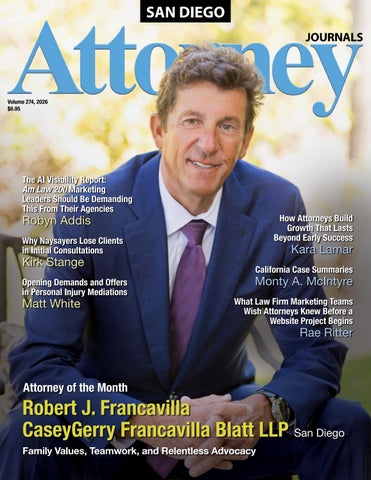
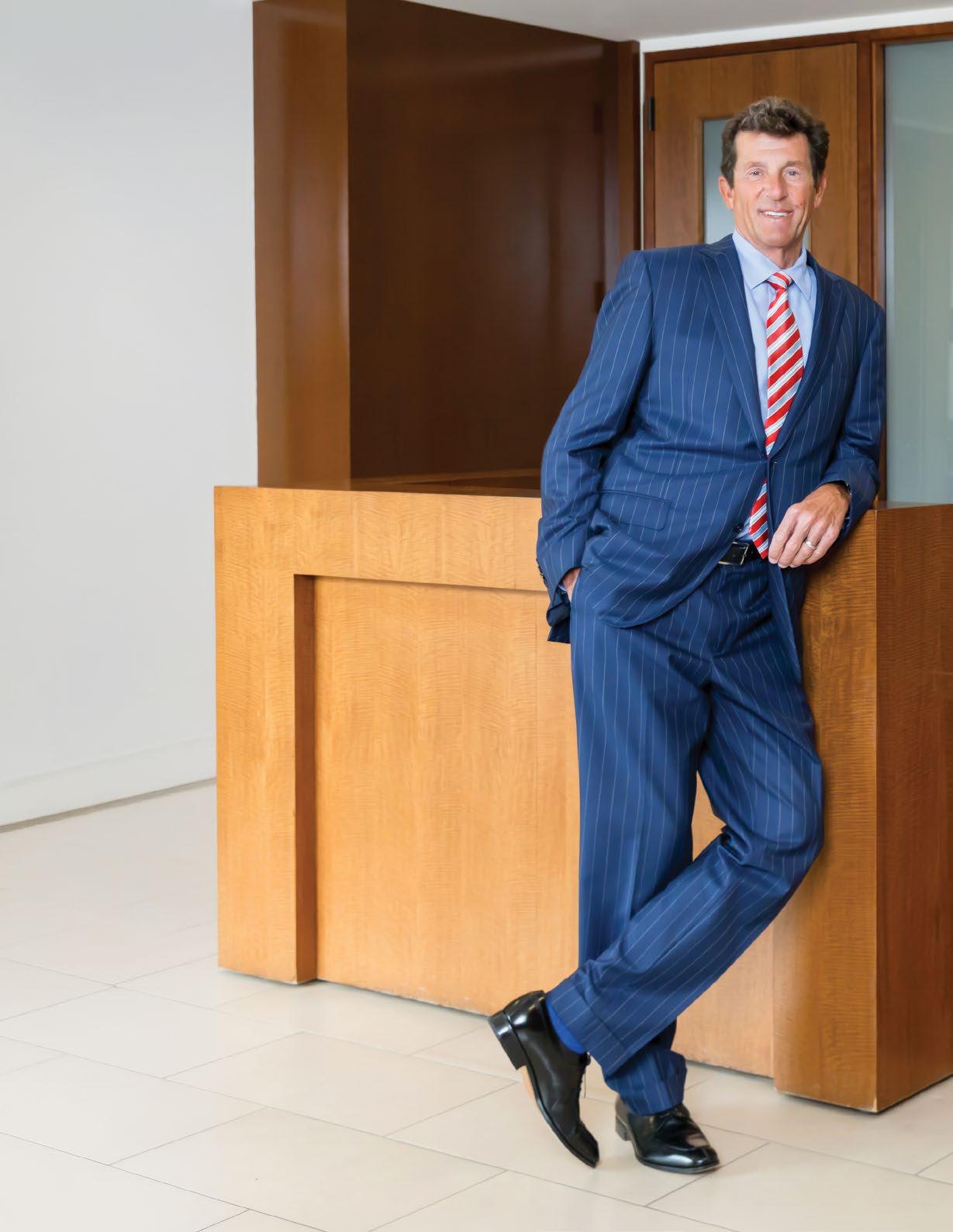
Robert J. Francavilla, CaseyGerry partner and leading San Diego accident lawyer. ATTORNEY OF THE MONTH 2026
“I have an older brother and a younger brother, and as the middle child, I was often the one who had to mediate disputes. I learned how to bring people together, find common ground, and work through disagreements. Looking back, being the one in the middle was great preparation for a career in the law,” he says.
The skills he developed early in life have become hallmarks of his legal career. Known for his tenacity and unwavering commitment to his clients, Francavilla has represented individuals in some of the nation’s most notable cases, including one with Olympic proportions.
A Fight Beyond The Mat
Richard Perry, a young wrestler seeking a position on the U.S. Olympic team, attended a national wrestling camp at Marine Corps Base Camp Pendleton in 2020. During the camp, USA Wrestling conducted simulated combat exercises to fulfill contractual obligations related to training and promotional videos.
That training involved participating in drills modeled after exercises used to prepare Marines for life-and-death combat situations. While Marines typically spend years training before participating in these exercises, the wrestlers were expected to perform them without receiving any prior instruction in this type of simulated combat. Instead, participants faced one another wearing cage-style helmets with narrow openings, similar to those worn in hockey, and carrying padded batons resembling boat paddles. They were instructed to attack one another and score a “kill shot” to the head, a decision that would have devastating consequences. Because of his size, Perry was given a traditional football helmet, which had wider openings than the cage-style helmets worn by the other participants. During one of the exercises, his opponent was using a worn-out baton. As he attempted a “kill shot,” the baton’s protective cover tore away, allowing it to pass through the opening in Perry’s face mask. The exposed baton struck Perry’s right eye socket, penetrated his brain, and caused catastrophic injuries. The trauma was so severe that, while Perry was in surgery, his wife was told to prepare for the worst. The Olympic dream he had spent years pursuing was over.
Perry and the legal team focused on demonstrating that, although he had reached the highest levels of competitive wrestling, he was never trained to participate in military combat exercises. Their case emphasized that excelling in one sport did not prepare an athlete for dangerous combat drills that require years of specialized training, especially when worn-out equipment is involved.
Although the activity was presented as cross-training, the United States and USA Wrestling vigorously defended the case, contesting nearly every issue. “I don’t get intimidated
by the lawyers, firms, or entities I go up against, regardless of their reputation, size, or resources. I look at every case as a challenge. I do whatever it takes to achieve the best possible outcome for the people I represent, and that’s exactly what we did,” Francavilla says.
Working alongside his law partner, Adam B. Levine, Francavilla secured a $12 million recovery for Perry and his family from the United States of America.
Leaving No Stone Unturned
CaseyGerry Francavilla Blatt primarily handles catastrophic personal injury and wrongful death cases, often representing clients against powerful corporations and large insurance companies with extensive legal and financial resources. Francavilla thrives on taking on organizations that believe they are already on the winning side of a case.
“I try to understand what my clients go through every day. They wake up in pain, and they go to bed with that same pain every night. I strive to help a jury understand not only the extent of my clients’ pain and the profound impact it has had on their lives, but also the responsibility of the organizations whose actions or inactions caused that pain, grief, harm, and loss,” he says.
Whether he is in the courtroom or at the negotiating table, Francavilla is committed to outworking the defense and doing everything possible to achieve the best outcome for his clients. His approach is to know every detail of a case by mastering the law, uncovering critical evidence, and understanding exactly what his clients have endured. He then presents that story in a way that helps judges and juries understand both the full extent of a client’s suffering and the responsibility of those who caused it. “I dig deep to find out what every moment of every day is like for my client in order to make a positive change in the quality and enjoyment of their lives and get them the justice that they truly deserve. I always fight with real passion and true belief in my client,” he says.
That philosophy was put into practice in a case involving a woman injured while exiting a rideshare vehicle. The driver stopped at a red light rather than pulling over to a safe location, leaving her no choice but to exit while the rideshare vehicle remained in traffic. As she stepped out, another vehicle pulled away from a parallel parking space beside the rideshare vehicle, crushing her leg between the two vehicles and causing a serious fracture.
Francavilla secured a several-million-dollar recovery on her behalf. While he was pleased with the outcome for his client, he also believed the case had the potential to influence rideshare industry safety policies and practices. “She was one of the sweetest, kindest people I’ve ever represented, and she deserved full compensation,” he says.
Another case that Robert tried with his partner Gayle Blatt involved an incident in a gym in which the at-fault defendant offered minor compensation for a major injury. Their client had regularly played basketball at the gym in question for years. Overnight when cleaning the basketball court, the gym’s maintenance company had mistakenly put stainless steel polish on the floor instead of the type of wood polish required for basketball courts. Francavilla’s client slipped, fell and suffered a major injury to his ankle.
The gym did not take the incident seriously, claiming that players slipped on basketball courts all the time and it was just “one of those things that happen”. The defendants also argued that the plaintiff suffered, “only a sprained ankle.” Francavilla demonstrated that the maintenance company negligently applied the wrong product to the court and that the gym failed to properly inspect and oversee the work. Moreover, he proved the injury caused a substantial change in his client’s quality and enjoyment of life.
The defendants initially offered pennies on the dollar to resolve the case. Francavilla and Blatt refused to settle, took the case to trial, and a jury awarded their client nearly $2 million.
Turning Doubt Into Determination
Looking at Robert Francavilla’s career today, it’s hard to imagine that one of his greatest sources of motivation came from one of the biggest setbacks of his academic career. During his first semester of law school, he earned the lowest grade in his contracts class. Determined to improve, he met with his professor to understand where he had gone wrong. The professor told Francavilla that he had completely missed the mark. His advice was to head to the admissions office, request a tuition refund, and pursue another career because he simply did not have what it takes to become a lawyer.
Unwilling to let someone else define his future, Francavilla accepted the professor’s remarks as a challenge. He persevered through law school, and even though he graduated just above 50 percent of his class, he was determined to prove that one grade would not define the rest of his career and that he could become a great trial lawyer.
The lesson he took from that experience led to a lifelong commitment to mentoring law students and young attorneys. “I went into that meeting with the professor operating out of fear, but he did me a real favor because I came out of there resolved to do everything possible to become a great trial lawyer. Today, I tell new lawyers to always believe in themselves and to never let anybody tell them that they can’t do something. And never, ever think about the money. Think about the good we are trying to accomplish for the people we represent,” Francavilla says.
Paying It Forward
The law student once encouraged to seek a tuition refund is now a partner at one of California’s premier personal injury firms, where he works alongside ten attorneys and a dedicated support staff committed to serving individuals and families during some of the most challenging times of their lives. Today, he leads by example both in the courtroom and through mentorship.
Francavilla believes the best way to motivate others is by leading through example. Despite practicing law for several decades, he continues to be one of the hardest-working
attorneys at the firm, approaching each day with the same dedication to his clients and their cases as he did on his first day on the job. His door is always open, and he is known for providing guidance, advice, and mentorship to fellow attorneys and staff alike. “Our people make the biggest difference in our success. Without them, I would never have accomplished what I have. I am grateful for the success I have had as a lawyer, but I also recognize and appreciate just how important my amazing team is to the results we achieve for the deserving people we represent.”
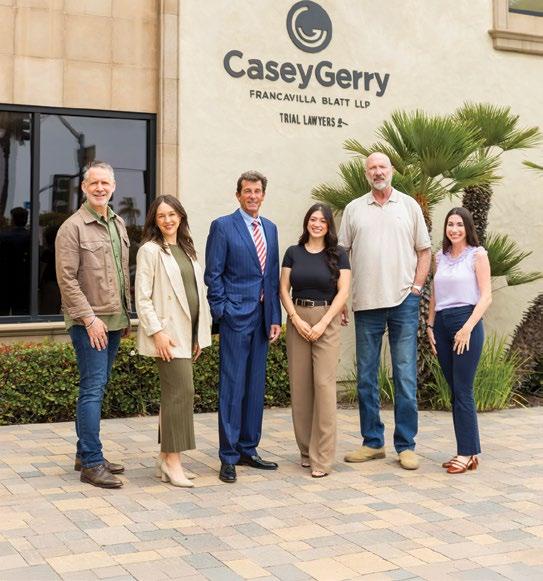
Francavilla leads Team RJF, a group of outstanding legal minds. He directly oversees associate attorneys Samantha
Kaplan and Kelly Wacker, along with talented paralegal Andrea Melgoza. Supporting the team are investigator Paul Francavilla, Robert’s brother, and Steve Leonard, whom Managing Partner David S. Casey Jr. has nicknamed the firm’s “air traffic controller.”
A Family Affair
One of Francavilla’s most memorable case strategies came from an unexpected source: his family. In a case involving a client who was struck by an intoxicated driver after crossing against a red light, the legal challenges were significant. While discussing the case at home, his 20-year-old son,
Zach, asked a simple question: “Dad, when I’m leaving the house, what are you most likely to tell me about safety? Don’t jaywalk or don’t drink and drive?” The question reshaped the way Francavilla viewed the case. It became the central theme, and his client ultimately prevailed.
Francavilla and his wife, Carla, have been married for 25 years and have two sons, Zach, 20, and Dominic, 16. “I was worried about the outcome of an important case some time ago, and Carla gave me some great advice that all attorneys should follow. She told me to focus on the process, and the outcome would take care of itself. As usual, my wife was right again.”
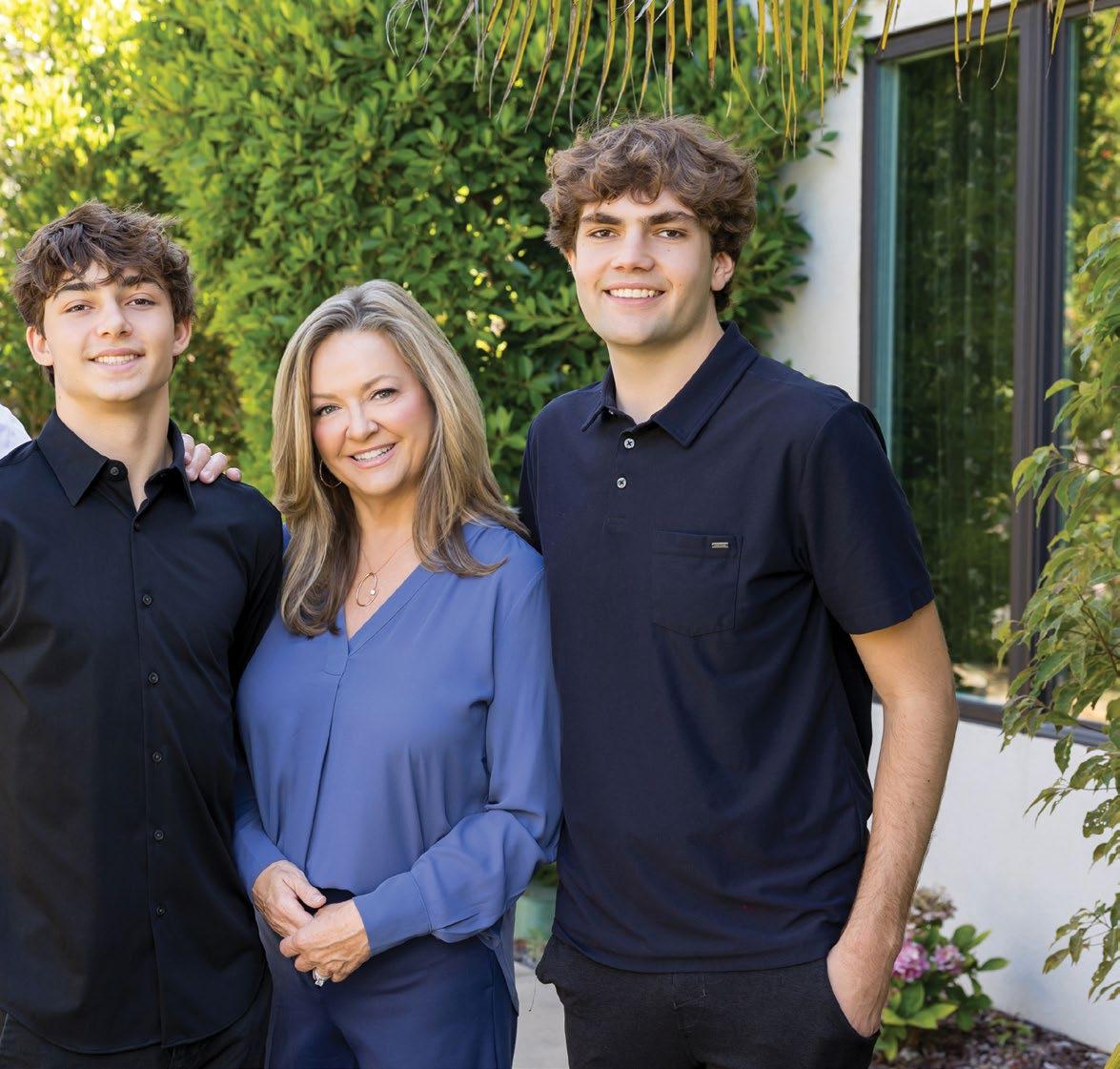
(Left to Right) Robert Francavilla, Dominic (16), Carla, and Zach (20).
That same sense of family extends into Francavilla’s professional life. His brother, Paul Francavilla, has served as one of the firm’s private investigators for more than 20 years, further emphasizing the family values that have guided both Robert’s life and career.
Outside the courtroom, Francavilla and his wife Carla, enjoy attending their sons’ various sporting events, and as selfproclaimed sports fanatics, the entire family loves watching games and playing basketball together. Zach was a Varsity basketball player at Cathedral Catholic and is now head basketball coach for Cathedral’s freshman team. He also studies finance at Cal State San Marcos. Dominic is now a Varsity basketball player and great student at Cathedral. Much of their travel revolves around their sons’ high school and AAU basketball competitions, but they also enjoy taking family vacations to Hawaii.
“If I have to work until midnight just so I can attend one of their games, that’s what I do. My family injects me with the fuel I need to keep going. I love them dearly. My family is everything to me, and that’s the same type of passion and care that I put into my clients’ cases and my law practice,” he says.
Francavilla believes that being an effective advocate requires continual learning, both inside and outside the courtroom. He stays physically and mentally sharp by working out at the gym four times a week, studying accomplished trial lawyers, and trying cases whenever he has the opportunity. He unwinds with action movies, comedies, and television series.
One of the things Francavilla enjoys most about practicing law is the opportunity to learn something new every day. This ensures the law remains exciting and invigorating. It is a mindset he encourages in the young attorneys he mentors, believing that a commitment to continual learning helps them grow not only as lawyers, but as people.
“Think about what we do. Every day we help right a wrong or prevent an injustice that otherwise would occur if we didn’t step in and do something. I like working hard because I think that’s one thing we can do in this world to show ourselves and others that we can truly make a difference. The harder you work at something, the more likely you are to succeed. And my family and clients are more than worth the effort.” n
Contact
CaseyGerry Francavilla Blatt LLP
110 Laurel Street
San Diego, CA, 92101-1486
619-238-1811
www.CaseyGerry.com
EXPERIENCE
(Left to Right) Steve Leonard, Samantha Kaplan, Robert J. Francavilla, Andrea Melgoza, Paul Francavilla, and Kelly Wacker.
» EDUCATION
• J.D., University of San Diego
• B.B.A., University of San Diego
»
HONORS & AWARDS
• Top Plaintiff Lawyers 2025, Daily Journal
• Lawdragon 500 Leading Plaintiff Consumer Lawyers (2019–2025)
• The Best Lawyers in America (2008–2026)
• Top 50: San Diego Super Lawyers (2008–2010, 2018, 2024–2026)
• San Diego Super Lawyers (2007–2026)
• Trial Lawyer of the Year, Consumer Attorneys of San Diego (2016)
• Outstanding Trial Lawyers Award, Consumer Attorneys of San Diego (Seven-Time Recipient)
• Best Attorneys, SD Metro Magazine (2017)
• Top 25 Plaintiff Lawyers, Daily Journal (2015)
• Lawyer of the Year, Products Liability Litigation— Plaintiffs, Best Lawyers (2014)
• 50 People to Watch, San Diego Magazine (2012)
• Top Attorneys, San Diego Daily Transcript (2012–2013)
• Top 50 San Diego Super Lawyers (2010)
» PROFESSIONAL
ASSOCIATIONS
• State Bar of California
• American Board of Trial Advocates (ABOTA)
• International Academy of Trial Lawyers (IATL)
• American Association for Justice (AAJ)
• Consumer Attorneys of California, Board of Governors (1998)
Empower Your Law Practice with Tailored Banking Solutions
Full-Service Banking for the Legal Industry
At California Bank & Trust, we understand that attorneys and law firms require more than generic banking. That’s why we offer fullservice, tailored banking solutions exclusively for law firms—from solo practitioners to large practices.
Let our knowledgeable bankers and years of experience help you optimize operations and advance your firm with confidence.
Scan the QR code to see how we can support your law firm.
Most attorneys chase growth. Few build it to last. Across the legal profession, one trend is becoming increasingly clear: many attorneys experience periods of rapid growth, but far fewer build practices that continue thriving year after year. The difference isn’t talent alone. It’s the systems, relationships, and mindset that allow success to compound over time.
Too often, growth is viewed as landing the next big client or winning the next significant case. While those milestones matter, they don’t necessarily create lasting momentum. Sustainable growth comes from making intentional decisions that strengthen an attorney’s foundation long before the results become visible.
Why Growth Looks Different In Today’s Legal Market
Across firms of every size, leaders are asking the same question: Why do some attorneys continue growing through changing markets while others plateau after early success?
Several factors are contributing to this challenge:
• Competition continues to increase, making differentiation more important than ever.
• Client expectations have evolved, with greater emphasis on efficiency, communication, responsiveness, and consistency.
• Technology and AI are reshaping how legal services are delivered, rewarding firms that adapt early.
• Growth is becoming more operational, requiring attorneys to build businesses—not simply maintain busy practices.
The attorneys who sustain growth over years, or even decades, recognize that success isn’t built on isolated wins. It’s built on repeatable habits that create long-term value.
What Separates Attorneys Who Build Lasting Growth?
They prioritize trust over transactions. The strongest practices are built one interaction at a time. Every client call, email, and meeting either strengthens or
How Can Attorneys Build Growth That Lasts Beyond Early Success?
by Kara Lamar
weakens trust. Attorneys who experience sustained growth consistently focus on responsiveness, clear communication, honest expectation-setting, and emotional intelligence. Their reputation becomes their most valuable business development asset because clients refer them with confidence.
They build a business, not just a practice.
Many talented attorneys eventually become the bottleneck in their own growth because every decision, workflow, and client interaction depends on them personally. Sustainable growth requires stepping back from purely doing the work to intentionally shaping how the work gets done through clearer processes, smarter delegation, more intentional use of support, and better systems for client experience. Over time, growth becomes less dependent on the attorney’s constant involvement and more dependent on how effectively they’ve structured their practice to run and scale.
They invest in relationship capital long before they need it.
The most valuable referral networks rarely appear overnight. Attorneys with enduring success consistently invest time in former clients, referral sources, professional peers, community leaders, and court personnel. They stay connected through genuine relationships rather than constant self-promotion, allowing trust to compound over time.
They adapt before change becomes unavoidable.
Legal markets are constantly evolving. Consumer expectations shift. Technology advances. Billing models change. New practice areas emerge while others become more competitive. Rather than resisting change, successful attorneys evaluate new trends early and make thoughtful adjustments before external pressure forces them to react.
They develop the discipline to endure.
Legal practice is demanding, and long-term growth requires more than ambition. It requires emotional resilience. The attorneys who sustain momentum learn to navigate setbacks without making reactive decisions, maintain healthy boundaries, stay disciplined during slower periods, and remain focused on long-term objectives instead of short-term fluctuations.
How To Put It Into Practice
1. Think in decades, not quarters.
Attorneys who build enduring practices ask different questions. Instead of focusing only on immediate revenue, they ask whether today’s decisions will strengthen their reputation, positioning, and scalability five or even ten years from now.
2. Become known for something specific.
General visibility may generate attention, but specific expertise generates referrals. The strongest personal brands are built around a clear niche, a distinctive client experience, or a particular type of matter.
3. Build consistency into everything you do.
Long-term success rarely comes from occasional bursts of effort. It comes from consistently delivering exceptional client service, following up with contacts, investing in relationships, improving operations, and leading teams with discipline over time.
4. Invest in your people as much as your practice.
Eventually, growth becomes less about legal skill and more about
leadership. Attorneys that continue growing and honing their practice invest in associates, paralegals, intake professionals, operations leaders, and marketing partners who strengthen the client experience.
5. Create systems that compound.
The most successful attorneys don’t rely on momentum alone. They build repeatable systems for client service, business development, operations, and leadership that continue producing results regardless of market conditions. Over time, these small improvements create a significant competitive advantage.
Short-term success is often driven by individual accomplishments. Long-term success is built through systems, relationships, and habits that compound over time.
The attorneys who experience sustained growth aren’t simply chasing the next opportunity. They’re intentionally building practices that become stronger, more resilient, and more valuable with every client they serve and every decision they make. n
Kara Lamar is an Affiliated Marketing Consultant with Society 54, where she helps businesses identify and act on opportunities to strengthen their marketing performance. Her work centers on using client and business data to shape communication strategies and to build brand visibility through storytelling and thought leadership. Learn more at www.society54.com.
CALIFORNIA
SUPREME COURT
Civil Procedure
California Case Summaries New California Civil Cases
by Monty A. McIntyre, Esq.
These recent case summaries were provided by Monty A. McIntyre, a mediator, arbitrator and referee and come from his online publication California Case Summaries™ (https://cacasesummaries.com), which helps California civil lawyers and law firms win more cases by always knowing the new case law in their practice areas. Law Firms and Solo Practitioners can get a free 1-year subscription to California Case Summaries™ when they mediate with Monty. Monty handles cases in the areas of employment, torts, business, insurance, real property and trust and estate/probate. To easily schedule a mediation, pick your date at https://montymcintyre.com.
J.O. v. Super. Ct. (2026) _ Cal.App.5th _ , 2026 WL 1488791: the California Supreme Court reversed the Court of Appeal decision summarily denying writ relief after the trial court denied petitioner’s objection to County Counsel’s alleged blanket Code of Civil Procedure section 170.6 challenges to Judge Guy Castillo. The trial court denied the objection, concluding it was barred under Solberg v. Superior Court (1977) 19 Cal.3d 182 (Solberg) and the Court of Appeal summarily denied writ relief. The California Supreme Court overruled Solberg to the extent it immunized blanket abuses of section 170.6 from as-applied separation of powers challenges, holding that if a party makes a prima facie showing of bad faith blanket challenges, a court may look behind the section 170.6 affidavit and inquire into the legitimacy of the prejudice claim, and remanded to the Court of Appeal for further proceedings. Practitioner Takeaways: (1) Courts may now entertain separation of powers objections to alleged blanket section 170.6 challenges—the Solberg shield is gone; (2) a party opposing a section 170.6 motion must timely object and establish a prima facie case of bad faith blanket challenges using a Batson v. Kentucky (1986) 476 U.S. 79 style burden-shifting framework; (3) the separation of powers problem arises from the legislative scheme itself, meaning blanket abuses by any party—not just executive branch actors—may be challenged; and (4) the Legislature retains authority to amend section 170.6, and further statutory reform addressing blanket challenges remains a live possibility. (May 28, 2026.)
CALIFORNIA COURTS OF APPEAL
Employment
Smith v. The Superior Court of Alameda County (2026) _ Cal.App.5th _ , 2026 WL 1876096: The Court of Appeal reversed the trial court and granted a writ petition vacating the trial court’s order. Plaintiffs, who were former class members in Vaughn, et al. v. Tesla, Inc. (Super. Court Alameda County, 2017, No. RG17882082) (Vaughn), alleged, in five related complaints filed by 440 Tesla factory workers, that defendant Tesla, Inc. (Tesla) maintained a pattern and practice of racial discrimination and harassment at its factory and systematically failed to investigate or address it, in violation of FEHA. The trial court found misjoinder and ordered that, in each of five related complaints filed by 440 former Tesla factory workers, all plaintiffs except the first-named must be dismissed and refiled individually. The Court of Appeal disagreed and held the claims were properly joined under Code of Civil Procedure section 378 because they arose from a common corporate policy or practice, and that section 379.5 did not authorize the trial court to dismiss properly joined plaintiffs based on manageability, judicial economy, or filing-fee concerns. Practitioner Takeaways: Section 378 joinder is construed liberally—a defendant’s common policy or practice causing harm to plaintiffs at different times/ locations can satisfy the “same transaction or occurrence” test without identical individual facts. Manageability, judicial economy, and filingfee shortfalls are not grounds for misjoinder under section 378; courts may only address them post-joinder (e.g., severed trials under section 379.5), and broader limits must come from the Legislature. A related case’s class-decertification findings don’t bind differently-represented individual plaintiffs from establishing proper joinder in followon suits. Federal Rule 21 has no California counterpart, so federal mass-joinder dismissals under Rule 21 carry little weight in section 378/379.5 analysis. (C.A. 1st, June 30, 2026.) n
Former Prosecutor, National TV Legal Analyst and Award-Winning Trial Attorney
CRIMINAL DEFENSE
DUI
Domestic Violence
Assault and Battery
Sexual Harassment - Plaintiff
Sexual Assault - Plaintiff
Murder AWARDS
• Super Lawyers – 2025
• U.S. News & World Report – Best Lawyers
• Martindale Hubbell AV Preeminent Rated Lawyer
• The Nation’s Top 1% – National Association of Distinguished Counsel
• The National Trial Lawyers: Top 100 Trial Lawyers
• Avvo.com Client’s Choice Award
• Avvo.com rating of 10 out of 10 as a top attorney practicing criminal defense based upon client reviews and peer endorsements
Law firm website redesigns are rarely just website projects. There’s always more under the surface. From the outside, a website project can seem straightforward: hire a web agency, pick a design, update some content, and launch the new site. Easy peasy.
In reality, law firm website projects are often some of the most politically and operationally complicated initiatives a marketing team manages. And they can seem completely overwhelming because there are so many decisions and steps leading to a very public outcome. We once had a client practically in tears just thinking about the project ahead. However, like any big project, when you break it down into smaller parts, clearly define roles and responsibilities, and work with an agency team that has done this for decades, it becomes not only manageable but positive. Our previously overwhelmed client quickly fell into our project cadence and launched a very successful website.
Every law firm is different, but we see similar challenges again and again: competing opinions, practice group dynamics, endless content reviews, questions about branding, business development, SEO, recruiting, intake, technology, and budget. And somewhere in the middle of all that, the marketing team is trying to keep the project moving forward without losing momentum—or their sanity.
The disconnect is that attorneys and marketing teams are often looking at the website through completely different lenses. Attorneys may see the website as a branding exercise. Marketing teams are thinking about user experience, search visibility, lead generation, positioning, analytics, and longterm business development strategy.
Neither perspective is wrong. But when those priorities aren’t aligned early, website projects tend to stall.
Most Website Problems Start Before Design Begins
Consensus Culture Risks Gridlock Without Clear Ownership
Law firms are collaborative by nature, which works well in many situations, but website projects are not always one of them. As the saying goes, too many cooks in the kitchen spoil the broth.
When every stakeholder weighs in on every design decision, progress slows. Feedback becomes contradictory, minor
What Law Firm Marketing Teams Wish Attorneys Knew Before a Website Project Begins
by Rae Ritter
decisions turn into lengthy discussions, and the project can gradually become a collection of compromises rather than a strategic initiative.
That’s why one of the first questions we ask during discovery is how the firm plans to make decisions and who will be involved. Some firms haven’t considered that question before, but establishing a decision-making process early is critical to keeping the project moving.
The most successful website projects have clear ownership. Attorneys should absolutely provide input, but someone needs final decision-making authority. Otherwise, simple questions—like whether to have a navigation bar or hamburger menu on your homepage—can get stuck in endless discussion. The goal isn’t to limit collaboration. It’s to create a process where collaboration leads to decisions.
Redesigns Can Reveal Internal Misalignment
Before anyone sees a homepage concept, firms often have to answer harder questions:
• What are our priority practices?
• Who are we trying to reach?
• How do we describe ourselves?
• What actually makes us different?
That process can uncover inconsistent messaging, outdated positioning, or disagreements around strategy within the firm. The website design process does not create those problems, but it can surface them.
And yes, if it sounds like I am harping on the value of a thorough discovery phase in your website project, that just means you are listening. One of the most important outcomes of discovery is an approved list of project goals. Those goals become the North Star later, especially when opinions start flying, and decisions get harder.
Trust Between Attorneys and Marketing is Critical Marketing teams do a tremendous amount of behindthe-scenes work during a redesign. They’re coordinating stakeholders, managing approvals, balancing competing opinions, protecting timelines, and keeping the project focused on the firm’s goals. Having worked on in-house marketing teams at AmLaw 100 firms, I know firsthand how much of this work goes unnoticed.
Attorneys bring the legal expertise. Marketing brings a different perspective—business development, user experience, SEO, recruiting, analytics, and positioning. Neither works particularly well without the other.
That’s why trust matters. Attorneys need to trust that marketing’s recommendations are based on strategy, not personal preference. And marketing needs the credibility to guide difficult conversations when opinions inevitably differ.
The same is true for the agency. Firms should do their homework before selecting a website partner, but once the project begins, trust becomes essential. The strongest website projects happen when attorneys, marketing, and the agency respect each other’s expertise and stay focused on the same goal.
A Website Project Is a Business Development Project, Not Just a Design Exercise
One of the biggest challenges in law firm website projects is that people often reduce the conversation to aesthetics.
• Do we like the homepage?
• Should the photos be darker?
• Can we make the logo bigger?
But a high-impact modern law firm website has to do much more than look polished.
The Website Is Often a Firm’s First Impression
For many prospective clients, your website is your firm. Before someone speaks with an attorney, attends an event, or receives a proposal, they’ve probably already visited your website. In many cases, they’re making judgments about credibility within seconds.
A dated website creates assumptions—fair or unfair—about the firm itself. Today’s websites function more like digital offices than digital brochures. Clients expect clear information, intuitive navigation, mobile usability, and fast answers. And increasingly, they expect all of that immediately.
Marketing Teams Are Thinking About Conversion, Not Just Appearance
When marketing teams evaluate a website, they’re usually thinking about questions like:
• What are the relevant KPIs, and are we achieving our goals?
• Can users quickly find the right practice area?
• Is the intake process clear?
• Does the site perform well on mobile devices?
• Is the content structured properly for SEO and AI search?
• Are we guiding visitors toward meaningful next steps?
That’s a very different conversation from “Do we like this design?” A beautiful website that frustrates users or hides important information isn’t helping the firm grow.
“I Don’t Like It” Is Not Strategic Feedback
This is where projects often start drifting off course. Personal preferences matter, but subjective opinion is not the same as strategic decision-making.
Your website partner should be able to guide you from abstract comments such as:
• “I don’t like that image.”
• “Can we make this page look more like Firm X?”
• “I preferred the old homepage.”
Good feedback turns those instincts into informed, specific decisions based on your goals, not just your gut.”
Good website decisions should be grounded in:
• User behavior
• Analytics
• SEO strategy
• Conversion goals
• Content structure
• Usability
Individual feedback is critical, but it should reflect the firm’s personality and unique culture, not individual taste. As a result, projects move much more smoothly when firms separate subjective opinions from actual business objectives.
Good Legal Websites Require Attorneys to Participate Marketing teams cannot build strong legal websites in isolation. Attorney participation matters. A lot.
Marketing Cannot Invent Institutional Knowledge
Attorneys hold the insights clients actually care about:
• Common client concerns
• Recurring misconceptions
• Industry nuance
• Practical legal guidance
Marketing teams can shape and structure content strategically, but they can’t manufacture subject-matter expertise. The best law firm websites combine marketing strategy with real attorney insight.
A Website Project Should Capture Attorney Knowledge, Not Consume Attorney Time
Attorneys need to be involved in content, but that does not mean they are responsible for lifting that heavy load. One of the biggest misconceptions about website projects is that attorneys need to sit down and draft polished copy from scratch. That’s rarely the best approach.
In many cases, the strongest content comes from carefully guided attorney interviews, recorded discussions and meetings, and review of existing materials. A good marketing team or content partner can then synthesize those insights into website copy that is valuable to both human users and search engines.
Fast Responses Improve Outcomes
Momentum matters during website projects. But the business of a law firm continues. Trial dates remain on the calendar, real estate closings cannot be moved, and clients need answers. Your website partner needs to understand and plan for this in your project timeline so that the project does not stall.
When reviews, approvals, and feedback from attorneys and decision-makers happen promptly, timelines stay intact, costs remain predictable, and projects maintain strategic focus. Long delays create friction, increase revision cycles, and can lead to budget creep.
You Get the Website You Pay For
This is probably not the most fun part of the conversation, but it’s an important one. Law firm websites can be expensive. And when firms start reviewing proposals, there’s often a temptation to focus primarily on the lowest number. That’s understandable. Website projects are a significant investment, and budget pressure is real.
But website proposals are not always comparing the same thing. A lower-cost agency may be cutting corners in ways that aren’t immediately obvious during the proposal stage:
• Limited strategy and discovery work
• Templated designs
• Fewer rounds of design revisions
• Minimal SEO and AI-search planning
• Weak content support
• Limited or no content migration included
• Little accessibility consideration
• Outsourced development resulting in more issues in QA
• Rushed QA and testing
• Lack of long-term support
On the surface, two proposals may look similar. In reality, the process and final product can be very different. Unfortunately, many firms don’t realize what’s missing until the project is already underway—or worse, after launch.
Cheap Websites Often Become Expensive Later
One of the more frustrating situations is when firms try to save money upfront, only to end up rebuilding or heavily revising the website a few years later.
Sometimes the site looks dated quickly. Sometimes the backend is difficult to manage. Sometimes the SEO foundation was never properly built in the first place. Sometimes the website simply doesn’t perform. That usually leads to another redesign conversation much sooner than anyone expected. Ironically, trying to save money up front creates a greater expense in the long term.
If SEO Isn’t Guiding Your Strategy, You May Be Rebuilding Your Website Later
SEO (Search Engine Optimization) is still one of the most misunderstood parts of legal websites. One of the biggest mistakes firms make is treating it like something that gets added at the end.
Clients Search Differently Than Attorneys Think Attorneys naturally think in legal terminology. Clients usually don’t. They often use long-form lay terms in questions in both search engines and AI-powered search to find answers to their questions:
• “What happens after a data breach?”
• “Can I sue over a noncompete?”
• “How do I respond to an EEOC complaint?”
This matters to your website project because it should inform your content structure, your practice names, the information fields on your blog posts, your homepage messaging, and much more. Formal practice area names like Dram Shop, RICO, and ERISA may not be part of your target clients’ search terms, but if your target client is an in-house counsel, they may be searching with more nuanced legal terminology. In general, for SEO and AEO, it’s best not to rely on legal jargon.
Thought Leadership Should Be Part of the Website
Strategy
In 2026, thought leadership isn’t separate from the website anymore. It is part of SEO and your website strategy. Your attorneys’ thought leadership includes all of the content that they disseminate, whether online or in person—blogs, videos, podcasts, speaking engagements, continuing education presentations, practice area FAQs, recent case analyses, and even firm news and press releases. All these pieces should have a footprint online and contribute to your digital presence and authority for SEO and GEO purposes. How they appear on your website affects things.
Your website agency should guide the strategy regarding how your content is coded and categorized for your clients and targets—this may be topic, author, location, industry, or something else specific to the practice. When the content structure is optimized, creating human-friendly and SEO/ GEO-friendly thought leadership hubs will:
• Help your audience find key answers to their questions
• Answer the question: is this firm highly knowledgeable on this topic to help me with my legal issue
• Support content discovery and in-depth consumption of the thought leadership
• Be found in search engine results to drive traffic to your website
• Present clients with no click answers in AI queries that build credibility and authority, and also drive traffic to your website
Strong firms build resource centers, industry-focused content collections, and insight libraries to support SEO, AI search visibility, credibility, authority, and ultimately drive business development via their website content.
Modern Law Firm Websites Must Balance Branding With Usability
Law firms naturally care about branding because they want their brand and core differentiators to be known by their clients and prospective clients. They should. But usability matters just as much.
Copying Competitors Weakens Differentiation
It’s common for firms to reference competitor websites during redesigns. That can be helpful for inspiration—including ideas on what design elements to avoid! However, copying
competitors creates websites that feel interchangeable, which will not support business development or branding goals. At LISI, we drill down during the discovery phase on what is unique and different about a law firm and how that benefits its clients. Next, we look at how we can communicate that in a compelling way on the website to support engagement and conversions. The goal should never be to look like everyone else. It should be to communicate your firm’s strengths clearly and effectively.
Clients Care More About Clarity Than Cleverness
Most users are not looking for an award-winning creative experience. Instead, they want:
• Clear navigation
• Fast answers
• Attorney credibility
• An easy way to contact the firm
Overcomplicated navigation and overly clever messaging often create more friction than value. I use the example of renting a car at the airport. You want the wiper button, headlights, radio, etc., to be where you expect them to be. You don’t want to be fumbling for them while zooming down the interstate to your destination in the dark! Usability matters. Don’t make your website visitors pause and think: where do I find the blog posts—even if you think the navigational menu “Stuff We Think” is cute.
The Mobile Experience Is No Longer Optional
For many firms, mobile traffic now represents the majority of website visits. And yet mobile usability is still often treated as secondary during redesign discussions. A frustrating mobile experience creates intake friction immediately:
• Homepage imaging that does not wrap properly
• Forms that are hard to complete
• Poor navigation
• Unreadable bios
• Slow load times
That directly impacts user experience and conversion.
What the Most Successful Website Projects Have in Common
After working on enough law firm website projects, patterns emerge. The firms that have the smoothest projects are not necessarily the largest firms or the ones with the biggest budgets. More often than not, they’re the firms that have alignment from the beginning.
Leadership understands why the project matters, what success looks like, and how decisions will be made. Marketing has a seat at the table as a strategic advisor. Attorneys provide meaningful input, but there is a clear process for gathering feedback and moving forward.
Those firms also tend to stay focused on outcomes rather than personal preferences. Instead of debating whether they like a particular image or headline, they ask whether the website will
help attract better leads, strengthen the firm’s market position, improve recruiting, or create a better user experience.
Perhaps most importantly, they understand that a website project is not just about the website. It’s about supporting the firm’s broader business goals. When everyone is working toward that shared objective, decisions become easier, timelines move faster, and the final result is almost always better.
A Better Website Process, Built for Law Firms
You may be thinking that law firm website projects sound complicated. That’s because they are.
The good news is that most of the challenges we’ve discussed are predictable. After decades of working exclusively with law firms, we’ve seen the same obstacles emerge again and again. The difference is knowing how to navigate them before they become real project delays or even obstacles.
At LISI, our perspective is shaped by real law firm experience. Members of our team have worked in-house at large law firms and understand the realities of partnership structures, attorney feedback cycles, budget approvals, and internal politics. We know that launching a successful website is not just an IT or marketing initiative. It is a firm-wide business development project.
That starts with discovery. Before we talk about design, we help firms align around goals, decision-making processes, stakeholder involvement, and project expectations. Those conversations often determine the success of a project long before the first homepage concept is presented.
Then we keep moving forward. We’ve built a process that creates momentum. We help clients anticipate content bottlenecks, establish accountability, keep projects moving, and stay focused on business outcomes rather than personal preferences.
We apply our years of legal and digital marketing experience to design and development decisions. We know attorney bios and the homepage are the most-visited pages on a law firm’s website. We understand that clients, referral sources, and lateral hires need to easily locate attorney credentials, law schools, clerkships, and representative experience. By building strategic marketing advice into our design and development process, we can create a website that functions seamlessly and supports the firm’s goals and business development strategy.
The result is a website that not only looks good on launch day but also continues to support business development, recruiting, thought leadership, SEO, and firm growth for years to come. We plan for long-term growth.
Because ultimately, the goal isn’t just to build a website. It’s to build a website that helps the firm achieve its goals. n
For ten years Rae Ritter has been the Director of Client Service and Marketing at LISI, where she sits on the other side of the table—guiding law firm clients through strategic planning to convert website goals and ideas into high-performing, unique websites. Learn more at www.legalisi.com.
We’ve Got Nevada Covered Too.
MEET OUR NEVADA LICENSED ATTORNEYS
Panish | Shea | Ravipudi LLP attorneys fight every day to obtain justice for our clients and make a difference in their lives. But our expertise in personal injury litigation doesn’t stop at the California state line. With 19 attorneys licensed in Nevada, we have obtained record results in the state. The Firm welcomes all joint venture opportunities, including with attorneys who want to stay more actively involved in a case.
OVER $1.4 BILLION IN JUDGMENTS AND SETTLEMENTS PAID IN 2025
We invite you to visit our Las Vegas office, located across the street from the Courthouse, where we offer attorneys use of our full courtroom to conduct focus groups, mock trials, and witness preparation.