The legal profession has spent decades monetizing time, process, and technical execution. But as artificial intelligence rapidly transforms how legal work is performed, law firms are entering a new era, one where the most valuable offerings may no longer be rooted in how long something takes, but in the quality of judgment, insight, and strategic guidance delivered along the way.
That shift does not signal the decline of the legal profession. In many ways, it represents an opportunity for firms to elevate the very capabilities clients have always valued most but firms have not always clearly articulated.
AI can draft documents, summarize information, and accelerate research at extraordinary speed. What it cannot do, at least not in the way clients truly need, is understand organizational dynamics, stakeholder sensitivities, business risk tolerance, leadership priorities, or the practical realities shaping complex decisions.
Clients are not simply hiring lawyers to produce legal work product. They are hiring trusted advisors to help them navigate uncertainty with confidence.
That distinction matters.
The Shift from Monetizing Time to Monetizing Judgment
The conversation surrounding AI in law firms often centers on efficiency, automation, and productivity. While those are certainly important considerations, they may not represent the most significant long-term impact.
The larger challenge is economic.
What happens when technology materially compresses the time required to complete work inside a profession that still largely monetizes time?
Clients are increasingly less focused on how many hours something took and more focused on whether their lawyers helped them solve a meaningful business problem, mitigate risk, or make a better decision. As a result, firms are being pushed to rethink not only pricing models, but also how they define and communicate value.
Kristen Bateman Leis, Chief Marketing & Business Development Officer at Parker Poe, believes the profession is
How Law Firms Monetize Human Value to Gain a Competitive Edge
by Jill Huse
moving toward a more human-centered definition of value.
“I think firms need to move from monetizing effort to monetizing judgment, outcomes, and strategic value,” she explains. “Clients do not necessarily expect discounts because firms use AI. They expect efficiency to benefit them too through predictability, clearer communication, fewer surprises, and better client service.”
That perspective reflects an important shift in client expectations. Efficiency alone is no longer differentiating. Increasingly, it is simply expected.
The Rise of “Business Translation”
One of the more interesting developments AI may accelerate is the growing importance of what Bateman Leis describes as “business translation.”
“The most effective lawyers will not simply provide legal analysis,” she says. “They will help clients understand what that analysis means operationally, financially, reputationally, and strategically.”
This may become one of the defining capabilities of the next generation of successful lawyers.
Legal knowledge remains essential, but technical excellence alone is becoming the baseline rather than the differentiator. The firms that stand apart will likely be those that can connect legal advice to business outcomes in ways that are practical, strategic, and actionable.
In many respects, AI may push the profession back toward its original counselor role, where perspective, judgment, and trusted guidance become the true premium offering.
That also creates a tremendous opportunity for law firms willing to invest in stronger client listening strategies. Firms with robust client feedback programs and meaningful interview processes are often far more attuned to how expectations are evolving. They understand that value is not universally defined by the firm; it is defined individually by the client.
For some clients, value means speed. For others, it means responsiveness, predictability, strategic thinking, industry depth, or simply confidence that their lawyer understands the pressures facing their business.
Ultimately, value is experienced through service.
Developing Lawyers for a Different Future
AI will not eliminate the need for lawyers. But it will likely reshape how lawyers are developed, trained, and evaluated.
Bateman Leis notes that younger lawyers may be particularly well positioned for this transition because they are often less attached to traditional assumptions around hierarchy, productivity, and the billable hour.
“Many are more comfortable viewing AI as part of an integrated workflow rather than a threat to professional identity,” she says. “That perspective may become a competitive advantage for firms willing to rethink how legal services are delivered and how lawyers create value.”
That evolution will require firms to invest differently in talent development.
Technical skills will always matter, but firms may need to place greater emphasis on capabilities AI cannot easily replicate: executive communication, relationship management, strategic thinking, emotional intelligence, industry fluency, and sound judgment developed through experience.
Perhaps most importantly, firms will need to lead rather than trail when it comes to technology adoption and client engagement. Clients increasingly expect their outside counsel to demonstrate not only awareness of emerging tools, but also intentionality in how those tools are being leveraged to improve service delivery, efficiency, and outcomes.
Practical Steps Firms Can Take Now
While the pace of change can feel overwhelming, firms do not need to reinvent themselves overnight. But they do need to start making intentional investments in the future.
A few practical areas of focus include:
• Strengthening client feedback loops to better understand evolving expectations
• Training lawyers to communicate business impact, not just legal analysis
• Investing in AI literacy across the firm, not just within innovation teams
• Exploring pricing models tied more closely to outcomes and strategic value
• Developing lawyers’ relationship and advisory skills earlier in their careers
• Communicating more proactively about how technology benefits the client experience
Clients are unlikely to pay a premium for work that technology can perform faster, cheaper, and at scale. They will, however, continue paying for judgment, perspective, and advisors who understand the business consequences behind the legal issue. That may be uncomfortable for some firms. But it is also the opportunity.
Turns out, the future of legal value may look a lot more human than expected. n
Society 54 Co-Founder and Chief Strategy Officer Jill Huse is renowned as a trusted professional services advisor. Jill, a certified Business Coach, is highly regarded for her progressive ingenuity, research-based strategy and, most importantly, her ability to deliver results for clients. Learn more at www.society54.com.
Articles discussing misconceptions that people or organizations have about the law or legal issues build your authority in their eyes. Here’s how to write one. If I had to bet on the single genre of thought leadership articles most likely to generate inquiries from prospective clients and referral sources, I’d bet on articles concerning misconceptions. They’re not produced nearly as often as other forms of thought leadership articles, but you’ve probably come across one or two of them at some point in your professional reading. They normally cover misconceptions regarding areas of the law (such as divorce or complying with a particular statute) or misconceptions about how to do certain things (like litigate or investigate certain matters, or handle certain types of transactions).
The reason why misconceptions articles can be so effective at generating inquiries from prospective clients or referral sources is that by explaining what people are likely to get wrong about an area of the law, you demonstrate knowledge and wisdom regarding that area. You’re so good at what you do that you know the kinds of issues that tend to trip people up. Obviously, clients and referral sources want to work with and send clients to attorneys who are good at what they do.
So, how exactly do you write the kinds of misconceptions articles that are likely to land with clients and referral sources? By doing these six things.
First, Decide Who You’re Talking to
The first task at hand with a misconceptions article is to determine who the article is talking to. Who will be the audience? Are you talking to clients? Are you talking to referral sources? Are you talking to both?
Whether you serve individuals or organizations, misconceptions articles can target clients or referral sources.
For example, a personal injury attorney could talk to other personal injury attorneys (i.e., potential referral sources) about what they often get wrong when litigating traumatic brain injury cases.
Or, a complex commercial litigator at a corporate defense firm could discuss how corporate/M&A attorneys often have misconceptions about complying with a statute or avoiding litigation arising out of particular types of transactions.
Add “Misconceptions” Articles to Your Thought Leadership Arsenal
by Wayne Pollock
With that kind of article, the litigator could be talking to inhouse counsel at an organization or corporate/M&A attorneys at other law firms that don’t have a go-to litigator to refer cases to or consult with when their clients might have a litigation issue on their hands.
Second, Decide the Category of Misconceptions Your Audience Cares About
This sounds like common sense, but if your audience doesn’t care about the misconceptions you’re covering, they’re not going to read or even skim your article. If they don’t read your article, it can’t do its job positioning you as an authority regarding the work you do.
For this reason, even if there are misconceptions about an area of the law that you’re dying to talk about, you’ve got to be sure that your audience will care. To ensure they do, put yourself in their shoes and consider whether the misconceptions you plan to discuss would be relevant to them. If you don’t think they will—pivot to a new set of misconceptions.
For example, if you’re a personal injury attorney who handles complex cases referred by other attorneys, you know that PI attorneys who don’t handle those kinds of cases might be concerned about mishandling one, leaving money on the table and possibly exposing themselves to a malpractice claim.
Or, if you’re a commercial litigator, you know that corporate attorneys at law firms and inside organizations worry about screwing up deals and transactions that could lead to litigation, them getting fired, and maybe even a malpractice claim.
Focus on misconceptions about these issues: the kinds of legal and business issues clients and referral sources worry about. When you do, you’re subtly saying to them, “I got you. I know how to handle these issues if you’re uncomfortable handling them yourself.”
Third, Decide on The Number of Misconceptions to Cover
Now that you have an idea of the direction you’re going in terms of who you’re targeting with a misconceptions article and the misconceptions they likely have, the next step is to
determine how many misconceptions to cover. I would focus on three to seven.
You’ll have to balance covering a decent number of misconceptions with the depth you’d like to go into about them.
If you want to cover six or seven, your analysis of each one should likely be a paragraph long. This number of misconceptions is appropriate for ones for which there’s not much to say.
If there are misconceptions you’d like to cover in depth, you could certainly do so, but I’d recommend covering three or four.
If you go deep with too many misconceptions, you’ll suddenly have a 2500-word article that could be tough to read. If you can’t help yourself and want to cover many misconceptions in depth, consider turning your one article into a two- (or if you really want, a three-) part series with each article topping out at between 1500 and 1800ish words.
Fourth, Make Sure Your Misconceptions Reflect Your Real-World Experience
The misconceptions you cover should be based on your experience hearing and seeing clients, attorneys, and others actually having these misconceptions.
That way, you can show, subtly or not, that you’ve seen these misconceptions (frequently?) occur in the past, which means you have a long track record of handling the kinds of issues and matters that are the basis for these misconceptions.
You could talk about high-level misconceptions, but it’s better to focus on “in the weeds” misconceptions that demonstrate your judgment, knowledge, wisdom, and experience handling those matters.
Fifth, Stick Your Neck Out A Bit
In a misconceptions article, don’t be afraid to tackle issues that aren’t black and white. Stick your neck out by challenging conventional wisdom.
Why? By doing so, you show through your misconceptions article that you are so knowledgeable and wise about the area of law you’re discussing that you can call out when the majority gets things wrong. In other words, don’t be afraid to cover misconceptions that reasonable people could disagree about.
For example, you could discuss a misconception about the experts to be retained for a particular type of litigation or a negotiation style for certain types of deals.
The reason why it doesn’t hurt to cover misconceptions where people could disagree is that when you do, you suggest that you know so much about the underlying legal issues and business issues for which these misconceptions arise that you’re able to stand above the fray and point out where you think the majority is getting things wrong.
Sixth, Use This Three-Step Structure When Discussing Misconceptions
When you finally sit down to write your misconceptions article, here’s the structure I suggest you follow for each misconception.
First, describe the misconception.
Second, explain why people likely think that way.
Finally, explain to the audience why those people are wrong.
This structure forces you to “show your work,” which more persuasively demonstrates your knowledge and wisdom. You’re making clear that not only do you know why people are wrong for thinking a certain way, but you know why they think that way and you know why they’re getting it wrong.
Sure, a misconceptions article that focuses on what people think—that is, you describe the misconceptions and why they’re misconceptions—is probably serviceable and could still demonstrate knowledge and wisdom on behalf of the author.
But covering why people think a certain way—why they have this misconception—signals a next level of knowledge, wisdom, experience, and judgment that’s going to persuade current and prospective clients and referral sources to turn to you to help them with the legal issues and the business issues for which people have the misconceptions you discussed.
Add “Misconceptions” Articles Into Your Rotation
If you were to tally the most popular types of thought leadership articles that attorneys and other professional services providers write, I’m not sure that misconceptions articles would be in the top five or even the top 10. But they’re an immensely persuasive form of thought leadership.
You needn’t write a misconceptions article every time you write a thought leadership article; the novelty will wear off quickly. But you should consider working these articles into your thought leadership article rotation by writing them a few times a year.
By talking about the misconceptions that clients, referral sources, and other people are likely to have regarding particular legal and business issues, you’re positioning yourself as the first person they should call when those issues arise. n
Wayne Pollock is the founder of the Law Firm Editorial Service. The Law Firm Editorial Service sets free the knowledge and wisdom trapped inside Big Law and boutique law firm partners by collaborating with them to strategize and ethically ghostwrite book-of-business-building marketing and business development content. Learn more at: www. lawfirmeditorialservice.com.
Prominent firms refer their toughest, highest-stakes cases to BRUNO | NALU, and for good reason. With well over 100 jury trials and a record of landmark verdicts, we step in as trial counsel to radically increase the value of settlements and awards.
Representative verdicts. Prior results do not guarantee a similar outcome.
Keith J. Bruno & Angela Bruno, Founding Trial Lawyers, BRUNO | NALU
Whether you’re representing a plaintiff, defendant, business owner or insurer, thoughtful preparation can significantly increase the likelihood of a successful outcome. The following checklist highlights 12 practical ways to get the most out of your next mediation.
1. If you need their money or approval, then get decision-makers involved early in the process.
• Insurance carriers —If you expect insurance carriers to participate in the settlement process, then:
ˏ Give plenty of notice so that internal timelines can be met and procedures can be followed
ˏ Provide detailed information
ˏ Make sure that the carrier is not surprised by the strategy or tactics you plan to use at the mediation session
• Board members, owners, family members and financial partners
ˏ Have they been informed about possible outcomes, risks, costs, and goals for the mediation? If the dispute poses a significant risk (existential?), then you should take steps to avoid surprises.
ˏ Do they feel differently about risks than the executive, family member or general counsel who has been your primary point of contact?
A missing or uninformed decision-maker can delay or derail settlement efforts.
2. Talk about money with your client
• What has been spent?
ˏ Any cost/benefit/risk analysis should start with reviewing what has been spent. A sometimes painful, but necessary, discussion.
• What is the range of possible outcomes?
12 Ways to Help You “Win” at Your Next Mediation
by Marc Alan Fong
ˏ Are there any similar cases? Are there any verdicts or judgments that could help guide the client’s expectations?
ˏ Consider all the possibilities, including:
• Is a Sec. 998 offer pending? Should one be made?
• Is there any risk of being required to pay the other side’s attorneys’ fees and costs?
• Is there any risk of punitive damages or claims that won’t be covered by an insurance carrier?
• Are there any liens that must be satisfied?
• Could a bad outcome lead to the need for bankruptcy protection?
• Are there any tax liabilities that need to be considered?
• How much will be spent going forward?
ˏ Can the client really afford a full-blown legal battle? Strong emotions shouldn’t trump practical limitations.
• Be ready to cut a check.
ˏ If a case does not settle at the mediation, the client may be required to immediately cut a large check as a deposit for anticipated litigation costs. This can be a difficult discussion.
Mediation works best when decisions are grounded in economic reality—not just legal positions or strong emotions.
3. Discuss the delays and uncertainties that will follow if a settlement is not reached.
It is important to maintain a realistic view of what happens if the case doesn’t settle.
• Months or years of delay just getting to trial, then appealing a verdict or ruling
• An outcome determined by a third party (judge, jury, or arbitrator)
Mediation provides control. Litigation surrenders that control to others.
4. How does the possibility of continuing or ending litigation affect the business?
Discuss how the dispute could have an impact on the following:
• Investors
• Plans to go public
• Potential acquisitions or the sale of a company
• Public relations or reputation
• The potential to create an unfavorable precedent
• The distraction, expense, lost time and stress that litigation can impose on owners and key executives, particularly in smaller organizations
In some cases, these factors outweigh legal outcomes in driving resolution.
5. Have a solid understanding of the other side’s position.
• What “ballpark” is the other side playing in?
• Are settlement expectations wildly misaligned?
• Are there fundamentally different views of the facts that need to be reconciled?
Knowing what to expect can avoid unnecessary impasses early in the process.
6. Discovery: Formal discovery is focused on what you need in the courtroom; mediation is focused on resolution.
• If your opponent has raised a challenging argument, or hints at damaging evidence, the mediation session can provide an opportunity to informally obtain information that would otherwise require months of expensive, formal discovery.
• Arm the mediator with the arguments and evidence that you want the other side to consider.
• Don’t hold out for “perfect information” when sufficient information exists to support a settlement.
• “Smoking guns” are sometimes most effective when revealed during a mediation. If they will help to settle the case, use them.
• Experts: Before investing the money, evaluate whether they are needed to clarify, question or substantiate important issues that are critical to settlement discussions.
• Are you managing expectations properly?
• Have you provided enough information to the other side to support your client’s damages claims?
• Are you appropriately discounting your damages based on the liability arguments you will face at trial or arbitration?
The most productive mediations often involve the informal exchange of information, saving a lot of time and expense for the parties.
7. Given potential costs and risks, be clear on overall goals.
• What does success look like?
• What is acceptable?
• What is off the table?
Without clarity on goals, even productive discussions can stall.
8. Use mediation briefs strategically.
• A clear, concise brief will help to frame the issues and set expectations.
• Consider whether two versions are appropriate:
ˏ One for the opposing party
ˏ One for the mediator, with additional sensitive/ confidential information
A strong brief can accelerate progress before the mediation even begins.
9. Give the mediator a heads-up
Make sure that the mediator is aware of any unique considerations that could affect the mediation:
• Behavioral issues
• Personality dynamics
• Emotional or sensitive topics
• Financial or business limitations
• Concerns involving the case, opposing counsel or the client
• Challenges in the client’s assessment of litigation risks and potential outcomes
The mediation will be more productive if the mediator knows what to expect and how to best communicate with the parties.
10. Be ready with creative alternatives.
Not all disputes are resolved through a payment. Consider:
• Alternative deal structures and business solutions (e.g., teaming, licensing, payments over time, etc.)
• If there will be any ongoing relationships
Often, the best outcomes come from expanding the options— not narrowing them.
11. Be ready with a draft settlement agreement.
It can be difficult after a long day of mediation discussions to start editing a settlement agreement. Both parties will save a lot of time and money if you prepare beforehand and are ready with an agreement that just requires some minor tweaks. This is especially important if there are any unique considerations or terms that need to be taken into account to resolve the dispute.
12. Treat mediation as trial preparation.
Being well prepared for mediation can strengthen your trial or arbitration posture. It can:
• Clarify themes
• Test arguments
• Reveal strengths and weaknesses
Even if the case does not settle, the process can add value.
Final Thoughts
Mediation is an important strategic opportunity. The parties who get the most out of it:
• Prepare thoughtfully
• Align internally and have the difficult discussions with the client before the session begins
• Engage realistically
• Remain open to both legal and business solutions
The parties who achieve the best outcomes are typically those who arrive prepared—not only with a strong understanding of the legal issues, but also with a realistic assessment of the business, financial and personal considerations at stake. When approached thoughtfully, mediation can do more than resolve a dispute. It can help parties avoid unnecessary costs, preserve important relationships and reach resolutions that better reflect their business objectives, financial realities and long-term interests. n
Marc Alan Fong is a mediator and arbitrator with JAMS. Mr. Fong has legal career spanning over 45 years. His experience covers a wide range of practice areas, including real property, construction defect litigation, business litigation, injury litigation and commercial transactions. Mr. Fong has a track record of successfully resolving complex and highvalue cases. He has been recognized as a Northern California Super Lawyer and holds a rating of AV Preeminent from Martindale-Hubbell. Learn more at www.jamsadr.com/neutrals/fong.
WHEN YOUR CLIENT'S CASE CROSSES A LINE
Refer the Elder Abuse Case to the Team Built to Win It.
Financial exploitation. Nursing home neglect. Will & trust fraud. For 30+ years, California attorneys have trusted us with the complex elder litigation their own practices weren't built for—in both civil and probate court.
You didn't build your practice around financial elder abuse statutes, mandatory-reporter rules, capacity evaluations, and probate-versus-civil strategy decisions. We did. Send us the case. Keep the client. Protect thefamily.
I. Nursing Home & Care Facility Abuse
Pressure ulcers, falls, malnutrition, medication errors, physical and sexual abuse, elopement, sepsis, wrongful death. Complex medical liability handled with in-house medical knowledge.
Contested amendments, forged instruments, breach of fiduciary duty by trustees & conservators, inheritance disputes. Prosecuted in probate court by Certified Specialists.
— six reasons it's the right call.
Nursing home abuse: pure contingency. No cost to your client. No fee unless we recover.
Referral fees honored. Per Rule 1.5.1, with full client disclosure.
Certified Specialist on team. CA State Bar — Elder Law and Estate Planning, Trust & Probate.
Financial abuse & trust fraud: flexible fees. Contingency, hourly, or hybrid — structured to fit.
Civil and probate. We litigate wherever the remedy lies.
30+ years of verdicts. AV Preeminent. Super Lawyers. Outstanding Trial Lawyer.
Law Firm of the Month
Serious Results. Real Solutions. Decisive Action.
Founded on trust, driven by expertise, and built for the modern economy, Rosing Pott & Strohbehn is redefining what a boutique litigation firm can be.
by Dan Baldwin
When a company’s future, a professional’s career, or an individual’s freedom rides on a single case, the call goes to the firm with the most experienced lawyers in the room. Increasingly, in San Diego and beyond, that firm is Rosing Pott & Strohbehn.
“Clients call us when the stakes are enormous: high-dollar, high-profile, a company or a career on the line,” says Founding Partner Earll Pott. “We built a litigation boutique with the firepower to meet that moment.”
They built it fast. Formed in December 2024, RPS came out of the gate firing on all cylinders. “We launched with 17 lawyers, a substantial firm to start from scratch, and we’ve already grown to 25,” Pott says. “The work came fast, and the wins came with it. There’s real satisfaction in having built a litigation boutique that comes through when a client’s company or career is on the line.”
The firm’s practice centers on three kinds of clients. The first is professionals and the organizations that serve them: lawyers, accountants, fiduciaries, and other licensed professionals who need defense, or ethics and risk-management advice. The second is businesses, from startups to established companies, that need complex commercial litigation, intellectual property enforcement, data-privacy counsel, or outside general counsel support. And the third is individuals and companies facing high-stakes white-collar, regulatory, or investigative matters.
“The common thread in our client base isn’t industry. It’s stakes and sophistication,” Pott explains. “We made a decision to focus our skillsets on complex and challenging cases.”
A Shared Vision
Founding Partners Heather L. Rosing, Earll Pott, and Samuel B. Strohbehn have practiced together for years and were close friends long before they were business partners. That foundation, and a shared conviction about what a modern litigation boutique could be, drove them to build a firm that reflected their values.
“Understanding what we wanted the firm to be, and the specific direction we wanted to take it, was absolutely essential from the beginning,” Rosing says. “With that guiding vision in place, it was far easier to articulate what set us apart and to recruit lawyers and staff who were excited to build it with us.”
Strohbehn couldn’t agree more. “The bedrock of any new firm is a shared vision among the partners and the trust they place in one another,” he says. “Set a clear vision, partner with people you trust completely, harness your respective strengths, and bet big on yourselves. Success will follow.”
RPS’s 25 attorneys include the three founders, partners, a general counsel, and a deep bench of senior counsel, of counsel, counsel, and associates, supported by an experienced administrative and operations team. A majority of the firm’s attorneys are women, a rare achievement in the profession. Many are recognized by Super Lawyers, Best Lawyers, Martindale-Hubbell, and the Daily Journal; eleven RPS attorneys were named San Diego Super Lawyers in 2026.
Your Favorite Firm’s Favorite Attorneys
Some of the firm’s best clients are other attorneys and law firms. “We’re the firm other lawyers trust with their hardest problems,” Rosing says. “We’re your favorite firm’s favorite attorneys.”
RPS attorneys are premier professional liability, legal ethics, and complex business and intellectual property litigators who regularly represent, and litigate against, AmLaw 100 firms. They’re frequently brought in as co-counsel or local counsel on complex matters, and they’re the go-to resource when a colleague hits a conflict, an ethics question, a malpractice exposure, or a bet-the-company dispute that demands true specialists.
Rosing leads the firm’s Complex Litigation and Professional Liability Department as well as its Discipline Defense, Ethics, and Risk Management Department’, with notable victories in complex, multiparty matters involving fraud, breach of fiduciary duty, and professional negligence across state court, federal court, and arbitration.
Pott focuses on white-collar criminal defense, professional licensing litigation, professional liability defense, and complex civil business litigation in state and federal court. He has more than 50 trials to his credit, including matters involving criminal securities fraud, false claims, and political corruption, and has defended professional licenses before the medical, nursing, and psychology boards.
Strohbehn leads the firm’s complex business and intellectual property litigation practice, handling disputes over trademarks, trade secrets, technology, data privacy, and cybersecurity in state and federal courts and before the Trademark Trial and Appeal Board. He has also negotiated hundreds of licenses and agreements with the largest companies in the entertainment and gaming sectors, and oversees and enforces trademark and trade-secret portfolios for dozens of clients.
Those credentials translate into results. The firm has earned significant trial victories and countless favorable confidential resolutions. “Our lawyers routinely take on, and stand beside, the largest firms in the country in complex business and intellectual property disputes,” Strohbehn says. “The common thread in our cases isn’t industry. It’s stakes and complexity, and a boutique built around senior trial lawyers is exactly what that work demands.”
“We set out to build something deliberately different,” Pott adds. “A boutique committed to a particular kind of highstakes litigation: focused, nimble, and powerful enough to face any opponent regardless of their resources. Our record shows we’re achieving it.”
How the Firm Runs
All three founders are active in the firm’s day-to-day management and long-term planning, alongside an office administrator who is just as involved in firm decisions. The four meet regularly to share ideas, assign responsibility, and monitor the progress of both individual cases and the firm itself, and the founders hold a “dedicated meeting every month.”
Rosing describes the management style in two words: approachable and flexible. “We’re well-organized without being bureaucratic,” she says. “We have something close to
an allergy to hard-and-fast rules and protocols. Decisions get made quickly, everyone is welcome to contribute, and we maintain an open-door policy for every employee.”
That flexibility is also how a boutique competes for talent against firms with deeper pockets. RPS offers a highly attractive “bundle of goods” that brings in top-caliber applicants and creates a genuine culture of respect and excellence. “We pay competitively, and we’re committed to developing talent straight out of law school, with a summer law clerk program and a mentorship and training program for every junior attorney,” Strohbehn says. “And when our people need to work remotely to be with their families, we make that work.”
Doing the Two-Step
One matter captures both how RPS operates and how readily it works alongside other firms. Pott represented a labor union and a former union employee who had been sued civilly for defamation. They prevailed. But the case had a second step: the former employee also faced criminal charges arising from some of the same alleged conduct. A few months after the civil judgment, the employee’s criminal defense attorney suffered a health scare and could no longer continue, and Pott was asked to step in. The case went to trial last December and ended in a hung jury; the district attorney ultimately dismissed it.
Trust, Integrity, Excellence, and Fun
“We’re a boutique earning big wins for big clients, and those wins rest on four strategic ideas: trust, integrity, excellence, and fun,” Strohbehn says.
The firm works hard, and with candor and care, to earn its clients’ trust. Integrity matters doubly for lawyers who advise other attorneys and firms on ethics and professional responsibility, so RPS holds itself to the highest standards. Everyone, from staff to senior partner, is committed to absolute excellence in the practice of law. And then there’s the fourth idea, the one that makes it all work.
“Fun is an essential element of our firm,” Pott says. “We’re dear friends who genuinely enjoy practicing law together, and we built this firm to prove that a serious, high-stakes practice and loving both the work and the people you do it with don’t have to be mutually exclusive.”
Beyond those values, Pott points to five things that set the firm apart.
First is a total commitment to ethics. Rosing served as a longtime chair of the ABA’s Standing Committee on Lawyers’ Professional Liability and as an advisor on California’s wholesale revision of the Rules of Professional Conduct. The team includes six full-time ethicists and several State Bar Certified Specialists in Legal Malpractice Law. “We don’t just litigate professional-responsibility and malpractice issues,” Rosing says. “We help shape the rules.”
California Bank & Trust’s Gail King (SVP, Corporate Banking Relationship Manager) and Pej Kalantar (VP, Private Banking Relationship Manager).
Second is its work at the leading edge of how law firms are owned and operated. RPS advises on Arizona’s Alternative Business Structures (ABS) framework, one of the most forward-looking developments in the profession, and an area most firms haven’t touched.
Third is the convergence of business, technology, and law. “We’re built for the modern economy, with depth in intellectual property, data privacy, cybersecurity, and the fast-emerging law around artificial intelligence,” Pott says. He recently published a law-review article on incorporating generative AI into legal practice within the Rules of Professional Conduct, and the firm’s lawyers regularly write, speak at conferences nationwide, and advise and defend other firms on their use of AI.
Fourth is a genuine commitment to the bar and to pro bono service as an integral part of the job. Rosing helped launch the 100,000-member California Lawyers Association, serving as its inaugural president.
Fifth is a rare pairing of diversity and meritocracy. Sixteen of the firm’s 25 attorneys are women. “We’re committed to diversity in hiring, and we feel strongly that women are some of the best litigators and have historically been underrepresented,” Pott says. Partner Sidra Zaheer chairs a DEI Committee that treats inclusion and merit as partners, not tradeoffs.
Banking on CB&T
When the founders left their previous firm to build a business from scratch, one with 17 attorneys out of the gate, no less, they immediately recognized the need for a banking partner that was competent, experienced, and trustworthy. California Bank & Trust fit that need perfectly and became one of the firm’s first business successes.
The partners examined CB&T’s law-firm banking practice and were drawn at once to its integrated, relationship-driven approach, which brings commercial banking, private banking, and wealth management together under one coordinated strategy. “We saw how they partner closely with law firms to deliver customized financial solutions that address firmlevel operations and individual partner needs alike, aligning financial planning with business objectives to drive stronger long-term outcomes,” Pott says. “They jumped right in with sound advice and the capital resources we needed.”
Working closely with the new firm, CB&T designed and implemented a comprehensive structure of operating accounts, an IOLTA account, and a tailored line of credit to stabilize and optimize cash flow, giving RPS the liquidity and operational flexibility to scale with confidence. More recently,
Founding Partners Heather L. Rosing, Sam Strohbehn and Earll Pott, plus California Bank & Trust’s Gail King and Pej Kalantar.
the firm rolled out a customized 401(k) plan for employees through CB&T’s platform, with the bank taking a forwardlooking approach that aligns the firm’s retirement plan and the partners’ individual wealth strategies with its long-term business goals.
Pott credits CB&T’s Gail King and Pej Kalantar, who work hand-in-hand on the RPS account. “Working with Gail and Pej has been a highly collaborative, strategic experience,” he says. “Gail’s deep relationships within the legal community, combined with Pej’s extensive private-banking and wealthmanagement expertise, created a seamless onboarding process and a holistic financial strategy for the firm.”
The two take a proactive, hands-on approach rooted in partnership, responsiveness, and long-term planning, investing the time to understand the firm’s business model and each partner’s individual goals so they can anticipate needs and deliver tailored solutions. “What sets Gail and Pej apart is their ability to operate as true advisors rather than transactional bankers,” Pott says. “Their collaboration across commercial and private banking lets them spot opportunities and risks that might otherwise go unnoticed. Combined with their industry expertise, responsiveness, and commitment to customized solutions, they deliver a level of insight and service that goes well beyond a traditional banking relationship.”
In the Community
Rosing Pott & Strohbehn is active in the life of the community it serves, and pro bono service is one of the firm’s founding principles. The firm supports the Girl Scouts, including representing the organization in litigation against its longtime cookie baker. It has also contributed to amicus briefs in rule-oflaw matters and proudly supported an amici curiae brief cited in Perkins Coie LLP v. U.S. Department of Justice.
The firm is equally invested in shaping the future of the practice, counseling firms large and small on the ethical and regulatory challenges posed by the rapid adoption of artificial intelligence, sharing insights at conferences and in print, and advising on Arizona’s ABS framework.
“Our work demands that we anticipate where the legal industry is heading and help our clients get there first,” Rosing says. “We expect continued strategic growth over the next five years in California and Arizona. We’ll never grow for growth’s sake, but we’re always looking for litigators and ethicists who’ll bring our values to the practice.” n
Contact
Rosing Pott & Strohbehn LLP
770 1st Avenue, Suite 200
San Diego, CA 92101
619-990-3158
www.rosinglaw.com
Founding Partners Sam Strohbehn, Heather L. Rosing, and Earll Pott.
Why Law Firms Are Seeing Changes in New Case Flow
by Calvin Carter
Why rankings and traffic alone no longer fully explain intake performance.
Many law firms still evaluate marketing performance primarily through rankings, traffic, and lead volume. These metrics are still important, but they no longer explain the entire intake picture.
A law firm can rank well, generate traffic, and still quietly lose potential clients before a consultation request ever occurs. Most of the time, the issue is not visibility alone. It is what happens during the evaluation process between the search result and the first contact.
Potential clients now compare reviews, validate firms through branded searches, evaluate attorney credibility, and ask AI tools legal questions before deciding who to trust. Important decisions are being made before a law firm website is ever visited.
That shift is changing how firms should think about visibility, differentiation, and new case flow.
Rankings No Longer Tell the Full Story
Traditional SEO reporting still focuses heavily on rankings, impressions, clicks, and traffic.
Those metrics still matter, but they do not fully capture several factors that now influence whether visibility actually turns into consultations and retained cases. Issues like losing trust during comparison, weak differentiation, intake friction, review inconsistency, AI-assisted pre-screening, and poor Google Maps visibility can all hurt intake performance long before a consultation request ever occurs.
Visibility and consideration are no longer the same thing.
Two firms may rank similarly while producing very different intake outcomes. One firm may appear more specialized, more trustworthy, or more established during the evaluation process, even when both firms are ranking in search results.
That difference can directly impact consultation volume and retained cases.
The New Client Evaluation Process Starts Earlier
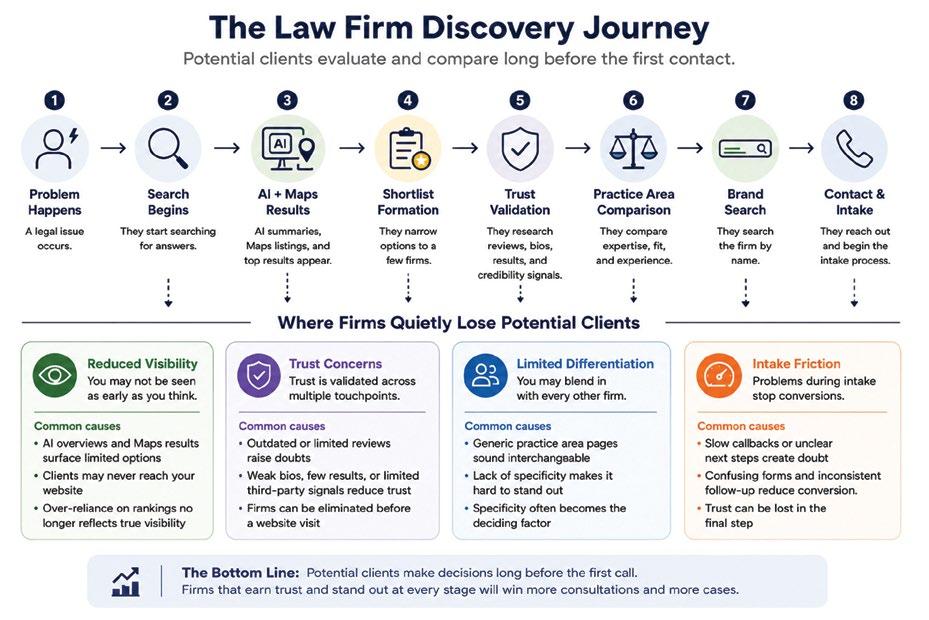
One way to understand this shift is through what can be called the “Law Firm Discovery Journey”:
Problem Happens Search Begins AI + Maps Results
Shortlist Formation Trust Validation Practice Area
Comparison Brand Search Contact & Intake
At each stage, potential clients are making small decisions about trust, relevance, and credibility.
The process often begins immediately after a legal issue occurs. Someone involved in a car accident, employment dispute, or business conflict may begin searching online under stress and with a limited understanding of the legal process.
Historically, those searches were relatively direct:
• “San Diego employment lawyer”
• “Orange County personal injury attorney”
Now, the process often starts much earlier and more conversationally.
Potential clients can ask AI:
• “Do I even need a lawyer for wrongful termination?”
• “What is my case worth?”
• “Should I settle?”
• “How long do claims usually take?”
• “What should I do after a truck accident?”
A recent LexisNexis consumer survey found that among consumers familiar with generative AI tools, 48% had already used AI for legal advice or assistance with a legal question. That changes how firms enter the decision-making process.
Many people now receive preliminary information before ever reaching a law firm website. Google’s AI Overviews, ChatGPT, Gemini, and other AI-assisted tools can summarize information directly within search experiences.
Research from the Pew Research Center recently found that users presented with AI-generated summaries were less likely to click traditional search results than users who did not encounter AI summaries.
In many cases, the law firm website is no longer the first impression. It is simply one checkpoint within a broader evaluation process.
Where Firms Quietly Lose Potential Clients
Many intake problems occur before the intake team ever receives the lead. That is one of the biggest shifts many firms fail to measure properly.
Reduced Visibility
AI-generated summaries and Maps results are changing how users interact with search results. Potential clients may narrow options before clicking through to websites at all.
In some cases, potential clients place more weight on branded searches, Google Maps visibility, review platforms, and thirdparty credibility signals than traditional rankings alone.
Trust Concerns
Potential clients now validate firms across multiple touchpoints before making contact. They may compare Google reviews, attorney bios, verdicts and settlements, directory profiles, media mentions, and AI-generated summaries before deciding who to trust.
Someone comparing multiple firms may quickly eliminate a firm that appears outdated, inactive, or less established online, even if that firm ranks well organically.
Limited Differentiation
Many practice area pages still sound interchangeable. Potential clients look for signals that a firm specifically handles situations similar to their own. A person researching a trucking accident case may look for references to catastrophic injuries, commercial vehicle litigation, or trial experience instead of broad personal injury language.
Specificity often becomes the deciding factor during the comparison stage.
Intake Friction
Even after a potential client decides to contact a firm, intake problems can still interrupt conversion.
Slow callbacks, unclear next steps, confusing forms, and
inconsistent follow-up can all reduce conversion during intake. A firm may successfully build trust throughout the discovery process only to lose that trust during the final stage.
What Law Firms Should Actually Monitor
As search behavior evolves, firms may need to pay closer attention to signals beyond rankings alone, including:
• Google Maps visibility
• Review recency and consistency
• Intake response speed
• Branded search activity
• Practice area specificity
• AI-generated summaries
• Comparison-stage trust signals
• Consultation-to-retainer conversion trends
This is no longer just about SEO in the traditional sense. It is about how trust forms before a consultation request ever occurs.
Potential clients now evaluate firms across multiple touchpoints before deciding who to contact. Firms that appear more trustworthy and differentiated during those early stages
may outperform firms with similar rankings but weaker comparison-stage signals.
Conclusion
Search visibility still matters, but the relationship between visibility and retained cases is becoming more layered than it once was.
Potential clients now ask AI tools questions before contacting attorneys. They compare firms through Maps listings, reviews, AI-generated summaries, and branded searches before deciding who to trust. In many cases, important decisions are being made before a website visit or consultation request ever occurs.
Firms that continue evaluating marketing performance primarily through rankings and traffic may miss important changes happening earlier in the client decision-making process.
The firms that adapt fastest may not simply be the firms that rank highest, but the firms that build the most trust throughout the entire discovery journey. n
Calvin Carter is the founder of RankCraftr, an autonomous SEO and visibility intelligence platform focused on law firms. He writes about AI search behavior, digital trust formation and how evolving online discovery patterns are changing legal client acquisition. Learn more at www.rankcraftr.com.
Monty A. McIntyre, Esq.
Mediator, Arbitrator & Referee CA attorney since 1980. ABOTA member since 1995. Past President SD County Bar Assn. (2002) Past President SD ABOTA Chapter (2014)
To schedule a matter, visit Monty’s website: montymcintyre.com
Short summaries (one-paragraph), organized by legal topic, of every new published CA civil case, helping CA attorneys save time, win more, and make more money. Monthly, quarterly, annual, and annual practice area publications are available. Subscribe at www.cacasesummaries.com
You see this mistake across law firm websites. Even the “good” ones.
The homepage looks sharp. The design is modern. The messaging feels confident. At a glance, the firm appears sophisticated and well put together.
Then a visitor clicks deeper into the site.
They land on a practice page that feels thin or outdated.
A bio that sounds nothing like the one before it.
Different voices, formats, and levels of detail from page to page.
The overall experience suddenly feels less cohesive.
This is what I call the Homepage Halo.
The term borrows from the halo effect in psychology: when a strong first impression leads us to assume quality everywhere else. In the context of law firm websites, a polished homepage creates the expectation that the rest of the site will deliver the same level of clarity, cohesion, and professionalism.
When it doesn’t, the halo fades, and trust fades with it.
The issue isn’t that the homepage is misleading. It’s that the rest of the site isn’t keeping up, leaving the homepage to do too much work on its own.
Why This Happens So Often
Lazy website redesigns focus heavily on the homepage because it’s visible, emotional, and easier to align around. It’s where firms invest the most time, energy, and debate.
But the homepage is rarely where prospective clients make their final judgment.
They click into attorney bios.
They read practice descriptions.
They look for signals that the firm is thoughtful, aligned, and credible.
Those deeper pages make up the majority of the website experience.
And in many firms, they’ve evolved over time, written by different people, updated in different phases, and rarely governed by a consistent framework. If this is not addressed during the website redesign, the result is a patchwork of content that feels uneven, even when the homepage itself is polished.
Visitors rarely articulate the problem directly. They don’t say, “This firm lacks content consistency.”
The Homepage Halo: Why Your Website Looks Polished … Until Someone Clicks
by Andrea Arteaga
They simply feel that something is off.
In professional services, where trust and credibility matter deeply, that feeling matters.
Consistency Is Brand (Even When You Don’t Call It That)
When people think about branding, they often focus on visual elements: logos, color palettes, typography.
These are crucial to a cohesive website, but branding does not stop there. For law firms, branding also shows up in the details:
• How attorney bios are structured
• How practice areas are explained
• Whether the tone speaks to clients or primarily to other lawyers
• Whether proof points appear consistently across the site
When these elements vary significantly from page to page, the experience begins to feel fragmented.
Consistency doesn’t mean every page should sound identical. Lawyers should still have individual voices and personalities. Practice pages can still be tailored to different target audiences.
But the framework around those voices should feel intentional and cohesive.
That cohesion makes the user experience more intuitive and signals professionalism and reliability to prospective clients.
Where the Breakdown Usually Happens
This disconnect between the homepage and the rest of the site tends to follow the same course.
Three patterns appear frequently.
Inconsistent Voice
Some bios read like formal résumés, while others feel more conversational. Practice descriptions may shift between technical language and marketing language depending on who wrote them.
Individually, none of these approaches are wrong. But when they appear side by side, the experience begins to feel uneven.
Uneven Structure
Attorney profiles and practice pages often vary dramatically in length, organization, and depth. One page may clearly explain how the firm approaches a client’s problem, while another lists credentials with little context.
For visitors comparing attorneys or services, this inconsistency can make the site feel less cohesive than the firm itself actually is.
Missing Proof Points
Strong professional services websites reinforce credibility consistently across the site. When achievements, thought leadership, or notable work appear on some pages but not others, the firm’s strengths become harder for visitors to quickly recognize.
Looking Beyond the Homepage
Fixing the Homepage Halo doesn’t always require a complete website rebuild. More often, it requires stepping back and looking at the site as a whole.
Law firm websites tend to grow organically over time, with pages added or updated in response to immediate needs. Without a clear structure guiding those changes, inconsistencies naturally emerge.
Addressing the issue often begins with evaluating the firm’s
marketing objectives as informed by the broader goals of the firm. Then you can evaluate how the site supports these goals and functions as a unified experience: how attorney bios are presented, how practice areas are described, and whether the tone and depth of information feel aligned across pages.
When those elements begin to work together, the website starts to feel less like a collection of individual pages and more like a coherent reflection of the firm itself.
Your Website Should Fulfill The Promise of the Homepage
A law firm website needs to feel intentional to be effective. When the experience beyond the homepage reflects the same professionalism and confidence that the homepage promises, the site becomes more than a digital brochure. It becomes an extension of the firm’s reputation.
And that’s where the real value lies. n
Andrea Arteaga has spent nearly 15 years helping law firms of all sizes, from litigation boutiques to global legal networks, define their brands, sharpen their messaging, and build marketing programs that actually move the business forward. As Director of Marketing + Client Growth at LISI, she brings that same hands-on experience to firms that are ready to grow with intention. Learn more at www.legalisi.com.
Rainmaking is not magic—it’s a discipline. While some individuals seem naturally gifted at bringing in business, the truth is that rainmakers cultivate specific habits, behaviors, and mindsets that consistently produce results. They push themselves to build strong networks, deepen client trust, and stay relentlessly focused on growth. They know that success is not a one time event but a continuous cycle of effort, learning, and refinement.
Below are the ten traits that set top rainmakers apart—and that anyone can develop with intention and practice.
1. They stay connected to a high number of contacts.
Rainmakers understand that business development is a numbers game built on genuine relationships. They are constant “Rolodex builders,” always expanding their networks and nurturing connections with peers, alumni, competitors, referral sources, and community leaders. They know that opportunities often come from unexpected places and that staying visible and engaged dramatically increases the likelihood of being top of mind when legal needs arise.
They don’t wait for people to reach out—they initiate. They check in, congratulate others on successes, share useful information, and maintain a steady presence. And they know it’s never too late to start building a network.
2. They are highly motivated.
A study by the Legal Sales and Service Organization found that top rainmakers rebound quickly from setbacks. Losing a pitch doesn’t derail them; it motivates them. They stay in touch with prospects who selected another firm, demonstrating professionalism and resilience—and often earning a second chance later.
Rainmakers also integrate business development into their daily routines. They treat it like exercise: consistency matters more than intensity. They enjoy the challenge, the recognition, and the long term rewards of building a thriving practice.
Ten Traits of Highly Successful Rainmakers
by Silvia Coulter
3. They are well-groomed.
Clients buy people, not just legal expertise. Rainmakers understand that they are the product. Professional appearance—clean nails, polished shoes, well-fitted clothing, good posture, and confident body language— reinforces credibility and trust.
This isn’t about vanity; their lawyer represents their success. Rainmakers project confidence and competence in every interaction, knowing that presentation influences perception.
4. They are confident.
Confidence is the backbone of rainmaking. Top business developers believe deeply in their firm, their colleagues, and themselves. They ask for the business directly and without hesitation. They look clients in the eye, articulate their value, and stand behind their recommendations.
Importantly, confidence is not arrogance. The most successful rainmakers don’t hoard clients or credit. They trust their teams, share opportunities, and know they can rebuild and grow their books of business year after year.
5. They are team oriented.
Rainmakers elevate others. They share credit, introduce colleagues to clients, and help teammates close business. They understand that collaboration strengthens client relationships and expands the firm’s overall capacity.
A hallmark of a true rainmaker is their willingness to delegate work so they can focus on what they do best: bringing in new clients. Their generosity builds loyalty, strengthens culture, and ultimately increases their own success.
Rainmakers team up with their sales and business development professionals and view them as “partners” for sales success.
6. They use technology effectively.
Modern rainmakers embrace technology as a force multiplier. They use CRM systems to track relationships, follow ups, and opportunities. They leverage LinkedIn to stay visible, share insights, and identify new connections. They use data analytics to understand client trends and anticipate needs.
They also adopt tools that streamline communication— from automated reminders to digital note taking to Aipowered research. Technology doesn’t replace relationship building, but it enhances consistency, efficiency, and reach.
Rainmakers don’t wait for the firm to train them on tools; they proactively learn what will make them better.
7. They are genuinely interested in others.
Curiosity is a rainmaker’s secret weapon. They ask thoughtful questions, listen actively, and remember details about people’s careers, families, and business goals. They make others feel seen and valued.
This interest is not transactional—it’s authentic. Rainmakers understand that trust grows when clients feel understood. They invest time in learning about industries, business challenges, and personal motivations. They know that relationships deepen when conversations go beyond legal issues.
8. They are client-focused.
Rainmakers think like clients. They anticipate needs, offer proactive solutions, and communicate in ways that make clients’ lives easier. They understand the pressures clients face—budget constraints, internal politics, deadlines, and risk management—and tailor their approach accordingly. They also follow up consistently, deliver on promises, and check in even when no active matter is pending. They know that loyalty is built through reliability, responsiveness, and genuine care.
Rainmakers don’t sell services; they anticipate and solve business problems.
9.
They develop clear goals.
Successful rainmakers don’t leave business development to chance. They set specific, measurable goals—number of
meetings, outreach targets, industry involvement, revenue objectives, and strategic relationships to cultivate.
Their goals are realistic but ambitious. They revisit them regularly, track progress, and adjust as needed. They understand that clarity drives action and that goals create accountability.
Without goals, business development becomes reactive. With goals, it becomes intentional.
10. They follow a plan.
A plan turns goals into results. Rainmakers create structured business development and pipeline plans that outline:
• Key target clients and industries
• Relationship building activities
• Speaking, writing, and visibility opportunities
• Cross selling strategies
• Follow up schedules
• Quarterly milestones
They treat the plan and pipeline (aka sales forecast) as living documents—not a one time exercise. They review and update these monthly, refine them, and stay disciplined. Rainmakers know that consistency compounds and that well-executed plans are the difference between hoping for business and generating it.
Final Thought
Rainmaking is not reserved for a select few. These traits are learnable, repeatable, and accessible to anyone willing to commit to the process. With focus, discipline, and a genuine interest in others, every lawyer can build stronger relationships, deepen client trust, and contribute meaningfully to the firm’s growth. n
Silvia Coulter is a Co-founding Principal of LawVision. Silvia is widely regarded as one of the legal industry’s most experienced sales, key client planning, and leadership experts. Her experience includes working as a former strategic account executive and sales leader at a Fortune 50 company, a chief marketing and business development officer at two global law firms, and consultant and facilitator to firms across the globe. Learn more at: www.lawvision.com.