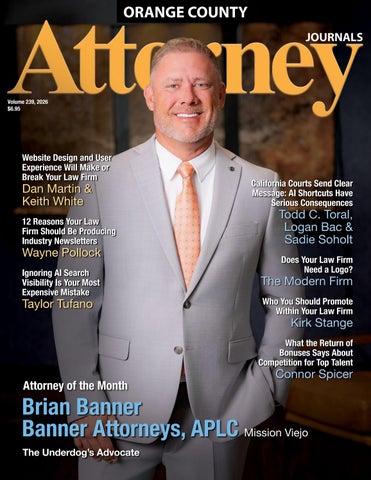
Website Design and User Experience Will Make or Break Your Law Firm
Dan Martin & Keith White
12 Reasons Your Law Firm Should Be Producing Industry Newsletters
Wayne Pollock
Ignoring AI Search Visibility Is Your Most Expensive Mistake
Website Design and User Experience Will Make or Break Your Law Firm
Dan Martin & Keith White
12 Reasons Your Law Firm Should Be Producing Industry Newsletters
Wayne Pollock
Ignoring AI Search Visibility Is Your Most Expensive Mistake

California Courts Send Clear Message: AI Shortcuts Have Serious Consequences Todd C. Toral, Logan Bac & Sadie Soholt Does Your Law Firm Need a Logo? The Modern Firm
Who You Should Promote Within Your Law Firm Kirk Stange
What the Return of Bonuses Says About Competition for Top Talent Connor Spicer
Attorney of the Month













































































There was a time when the client journey began with a phone call or a visit to your office. But today, that first impression happens almost entirely online—often on a screen that fits in the palm of someone’s hand. In 2026, your law firm’s website isn’t just your digital presence. It’s your receptionist, intake coordinator, and sometimes even your paralegal, all rolled into one.
Clients aren’t just browsing. They’re evaluating. And they’re doing it quickly. They expect your site to load fast, work flawlessly on mobile, and tell them clearly who you are, what you do, and why they should trust you. If it doesn’t, they won’t dig for answers. They’ll move on.
That’s where user experience comes in. Often shortened to UX, it refers to how easy and intuitive it is for someone to use your website. Think of it like client service, but online. Just as you’d never expect a client to find your office without directions, wait 10 minutes in a silent lobby, or fill out a 12-page intake form without help, you can’t expect online visitors to put up with clunky navigation, broken links, or unclear messaging.
UX is the online equivalent of professional hospitality. A well-designed law firm website doesn’t just bring in more leads, it brings in better ones. Clear practice descriptions, straightforward forms, and transparent messaging help set expectations early. That means fewer misaligned inquiries, less strain on intake teams, and better client relationships from the first conversation. In that sense, UX isn’t just a marketing tool. It’s an operational one.
If your site isn’t doing that today, it’s time to rethink your law firm’s website strategy.
For decades, law firm websites were built more for lawyers than for clients. The visuals were formal, the language dense, and the user journey unclear. It was all very professional, but rarely helpful to the end users: potential clients or prospective team members.
by Dan Martin and Keith White
People seeking legal counsel don’t want to read a law review article when they land on your homepage. They’re looking for reassurance. They want to know they’re in the right place, that someone understands their problem, and that help is just a click away. Our recent homepage study revealed that many firms still miss this mark, failing to deliver clear, client-focused messaging in those crucial first few seconds. It’s not about dumbing things down—it’s about meeting people where they are.
Outdated content, broken links, or clunky design can raise red flags. On the other hand, a clean, modern layout, paired with authentic attorney bios and testimonials, makes visitors feel safe. It indicates that they’ve found professionals who know what they’re doing.
And visuals matter. A warm, professional photo of your team. Testimonials from real people, not stock quotes. A clear message about what your firm stands for. These elements aren’t just decorative. They’re signals of safety and professionalism.
It’s a bit like choosing where to park your car. Faced with a dim, dirty lot with no attendant or a clean, well-lit garage with someone at the desk, most people won’t think twice. They’ll go where they feel secure. Your website sends the same kind of message. If it looks neglected or unclear, visitors will keep driving. But if it feels trustworthy and welcoming, they’ll stop and take a closer look.
Look around a courtroom, a coffee shop, or even a client’s living room. Chances are, the device they’re using to find legal help isn’t a laptop, it’s a phone.
Mobile-first design isn’t a design trend anymore. It’s a baseline expectation. If your site doesn’t work beautifully on mobile, it doesn’t work.
From page speed to click-to-call buttons, everything needs to be designed for smaller screens and on-the-go attention spans. It only takes a three-second delay to lose a potential case. And that’s not a hypothetical, it’s reality.
A clean, responsive mobile experience makes all the difference between a site that converts and one that is abandoned before the first page even loads. If you’re not sure how your site stacks up, consider our Law Firm Website Performance Audit Checklist.
In recent years, digital accessibility has shifted from a best practice to a business imperative, especially for law firms. Sites that aren’t inclusive leave out entire groups of potential clients and open the door to legal risk.
And yet, accessibility is about more than lawsuits. It’s about the message you send. A firm that pays attention to detail, that makes sure everyone can use their website, is a firm people are more likely to trust.
Think readable fonts, high-contrast color schemes, working keyboard navigation, and screen reader compatibility. It’s not glamorous, it’s essential.
We break down this often-overlooked issue in our article on accessibility for your law firm website.
Every design choice should help someone take the next step. Whether that’s calling your firm, booking a consultation, or simply learning more, your website should guide them there effortlessly. Additionally, this path should feel familiar to the user.
In UX, there’s a principle called Jakob’s Law, which states: Users spend most of their time on other websites. In practice, this means users prefer your site to work the same way as all the other sites they already know. They bring expectations shaped by experiences on other law firm websites, Amazon, CNN, and even their local dentist’s website. When your navigation, layout, or interface breaks from those familiar patterns, it doesn’t feel innovative; it feels confusing.
This doesn’t mean your website has to look like everyone else’s. But it does mean that intuitive navigation, clear labeling, and conventional design patterns aren’t just safe, they’re strategic. Following Jakob’s Law ensures that users don’t have to relearn how to interact with your site. Instead, they can focus on evaluating your expertise and how to reach out.
Think of it like a conversation. You want to share your message, but you don’t want to overwhelm them with too much information at once or leave them unsure of what to do next. Strong calls to action, clear forms, and thoughtfully
placed buttons all work together to move visitors forward. And yes, tools like live chat or AI-assisted intake can help. As long as they’re legally and ethically compliant and respectful of the user’s time and privacy, they can make a real difference in how many leads your site turns into clients.
One of the biggest mistakes law firms make is treating their website like a one-time project. But the truth is, a website is more like a living document.
User needs and expectations change. Technology evolves. Search behavior shifts. Content gets outdated. If you’re not regularly checking in, updating content, testing performance, ensuring accessibility, you’re falling behind.
The firms seeing the most success in 2026 are the ones treating their websites as active business assets, used every day by the people they’re trying to reach. They test. They adjust. They improve.
If you’re ready to evolve your site into a conversion-driving powerhouse, our website design services for law firms can help you get there.
Today’s clients don’t just judge your firm by your courtroom record. They judge it by your online experience. If your site feels outdated, hard to use, or unclear, it reflects on your firm, even if your legal skills are top-tier.
But if your website is fast, helpful, accessible, and human? You’ve already made a strong first impression.
And in a competitive legal market, that first impression is often the one that counts. n


Dan Martin is the Director of Marketing Technology + Operations at LISI. Dan helps clients move strategies forward with data-driven insights and the technical support they need. He oversees campaign management processes including automation, execution, and measurement of key digital marketing programs.
Keith White is LISI’s Chief Development Specialist overseeing backend and frontend development for all LISI clients. Keith has designed or developed multiple award-winning website projects at LISI. His seasoned expertise and innate creativity consistently produce stunning visuals and seamless functionality. Learn more at www.legalisi.com.

Industry newsletters build authority and open doors like no other thought leadership tool can.
I don’t see many law firms using industry newsletters as a thought-leadership tool to help their industry groups build their authority. They should be.
A consistent newsletter delivered every week or two, covering legal developments in an industry (including an industry group’s own recent and relevant thought leadership), along with other “news” relevant to executives and people in that industry, is an incredibly potent thought leadership tool whose effectiveness and cachet will compound over time.
Here are 12 reasons why, if your law firm has industry groups, they should produce newsletters that cover what’s happening in their industries.
First, obviously, an industry newsletter demonstrates that an industry group and its attorneys are knowledgeable about, and are keeping tabs on what’s happening in a particular industry beyond just legal issues affecting industry players.
An industry group will be seen as being knowledgeable about the industry it covers in a newsletter because its content is focused on the industry and covers a wide range of developments within it. The newsletter becomes a reliable, credible source for news about that industry. For some industries, or segments of some industries, the newsletter might be the only credible source of news about that industry or segment.
Second, on a related note, by curating content for an industry newsletter, your attorneys will be seen as authorities regarding that industry.
Not only does an industry-focused newsletter demonstrate knowledge of an industry simply by offering a collection of relevant content (as I mentioned above), but the act of whittling down countless news articles, thought leadership from industry players, videos, podcasts, and other industry-related content
by Wayne Pollock
implicitly builds attorneys’ authority regarding the industry. An industry group’s attorneys will be seen as authorities on the industry because they can separate the wheat from the chaff, providing industry-related content that’s relevant to industry executives and other industry players.
Third, unlike some other forms of thought leadership content, industry newsletters are assets whose value increases over time. They’re marketable assets because they can be used in a call to action at the end of every presentation or in other thoughtleadership pieces, such as blog posts or articles. They’re a reliable and effective way to offer industry players the opportunity to raise their hands and say, “Yes, I’m someone who’s interested in staying abreast of what’s happening in [x] industry.”
Industry newsletters are also compounding assets. Over time, assuming its quality remains high, and it’s consistently published, an industry newsletter will increasingly be seen as a, if not THE, go-to source of information regarding an industry. Over the weeks, months, and years the newsletter has been published, it will become more authoritative due to its longevity and consistency.
Fourth, once someone has opted in to receive an industry newsletter, it becomes an ongoing relationship builder that reliably keeps you and your colleagues at the top of that subscriber’s mind and reinforces your and your colleagues’ authority regarding the industry you serve.
Unlike other pieces of thought leadership that clients and other industry players might discover by reading online publications or scrolling on social media, industry newsletters proactively reinforce your industry group’s authority by arriving in the email inboxes (or mailboxes) of clients and industry players. Even if your industry group did nothing more to engage with people on its email list than send its newsletter, the newsletter will reinforce your industry group’s authority.
Fifth, I love thought leadership articles: 1000- to 1500word articles that demonstrate authors’ expertise, credibility, knowledge, and wisdom. But not all attorneys have time to regularly produce thought leadership, nor do they all have ideas to power a thought leadership program.
When you produce an industry newsletter, however, you’re typically writing fewer words because you’re summarizing and explaining the relevance of the pieces of content you’re including in your newsletter, whether that content is your firm’s thought leadership, other organizations’ thought leadership, or news articles about the industry.
You probably need less than 1000 words to do all of that work, which will come in the form of short blurbs that are easier to write than in-depth thought leadership articles.
Sixth, in my experience, most industry publications that accept contributed articles are welcoming to individuals who want to submit articles. Yes, they have standards and minimum requirements, but if they accept articles, there’s a good chance they’ll publish a well-written one.
But a “good chance” does not mean “they absolutely will,” nor is there a guarantee of when they will publish an article or how well they will publicize it to their subscribers, such as by featuring it on the first page of their website or in emails to subscribers.
Compare that to an industry newsletter. Assuming there are no issues with deliverability or overzealous spam filters, there’s no gatekeeper preventing that content from reaching recipients.
Seventh, on a related point, industry newsletters aren’t subject to the whims of algorithms.
Again, assuming no issues with deliverability or spam filtering, when your industry group sends a newsletter, it lands in recipients’ email inboxes or mailboxes.
If you published that same content on LinkedIn or some other social media platform, their algorithms would likely deliver the content to a small percentage of your followers. We’re talking, probably, less than 10 percent.
But, again, assuming no deliverability or spam filter issues, if there are 500, 5,000, or 50,000 people on your industry group’s email list, all 500, 5,000, or 50,000 should receive the email.
Eighth, industry newsletters draw industry players into the light when they opt in to receive them. Though you probably have a
general sense of the people and organizations interested in the goings on in a particular industry, you won’t always know who those people and organizations are, especially if there are new entrants.
When they opt into your group’s industry newsletter, they’re sending a signal that they have some interest in the industry. They transform from an entity you didn’t know existed into a potential client, referral source, or co-marketer.
Ninth, industry newsletters are the perfect delivery mechanism for your industry group’s own thought leadership, assuming you share one or two pieces of content per newsletter that are relevant and timely. Including your content in your newsletter ensures people see it (for the reasons I mentioned in the previous two sections).
But your industry newsletter is not the forum within which to shove 10 recent blog posts down recipients’ throats, nor is it the forum to distribute an article from three years ago that has little value to them.
Tenth, industry newsletters make it easy for recipients to get in touch with members of your industry group to give feedback, ask questions, or request meetings.
All professional services providers should strive to eliminate any friction that current and prospective clients and referral sources may face when they want to speak with that provider. With industry email newsletters, recipients can easily click “reply” and start a conversation.
Eleventh, on a related point, industry newsletters provide opportunities for collaboration with newsletter recipients beyond you and your colleagues getting hired by one.
Your firm’s industry newsletter might spark an idea that a current or prospective client or referral source has about teaming up to co-author an article, give a presentation at a conference, or appear on a podcast.
Perhaps one of your group’s thought leadership pieces you included in a newsletter issue indicates to a potential referral source that you’ve handled particular kinds of matters previously, which they didn’t realize, and sparks a conversation about how they could work with you to service their clients’ needs.
Consistently publishing a newsletter that reaches industry players will open doors to partnerships you likely would have never seen coming.
Finally, twelfth, compared to many other marketing and business development tools, industry newsletters are a light lift.
You don’t need to buy expensive equipment or software. You don’t need to hire people with special training.
For email newsletters, you’re likely looking at no more than $1000/month to use software like MailChimp, Kit, or Beehiiv, and that’s if you have tens of thousands of subscribers.
(If you don’t have that many subscribers, the monthly fee could be under $200.)
For hard-copy newsletters, you’re looking at the cost of producing the newsletters and the cost of postage.
In terms of labor costs, you won’t need an army of people to assemble each newsletter. You’ll need someone to curate content, ideally an administrative person who follows an agreed-upon process for vetting potential content for inclusion in a newsletter. You’ll also need an attorney who gives the final approval for including the “winning” pieces of content and writes short blurbs that explain the “so what” and “now what” of the topics of that content.
And if an industry newsletter effort can’t get off the ground or build momentum, there will be minimal costs for an industry group to exit if it decides to shut down the newsletter. Subscriptions to email newsletter software

can be canceled. Postage and production that would have otherwise been purchased to deliver future hard-copy issues will not be purchased.
I’m always surprised by how many attorneys and law firm industry groups overlook industry newsletters as thought leadership tools. The irony is that so many attorneys and law firm executives subscribe to newsletters.
They see firsthand, perhaps without realizing it, that published newsletters consistently position the sender as credible and authoritative on the topics they cover.
If your industry group doesn’t have an industry newsletter already, it should be your group’s next thought leadership initiative. n

Wayne Pollock is the founder of the Law Firm Editorial Service. The Law Firm Editorial Service sets free the knowledge and wisdom trapped inside Big Law and boutique law firm partners by collaborating with them to strategize and ethically ghostwrite book-of-business-building marketing and business development content. Learn more at: www.lawfirmeditorialservice.com










Deciding who to promote inside a law firm is one of the most important leadership decisions you will make. Promotions do more than change titles; they shape firm culture, reinforce expectations, and influence how your team views opportunity and fairness.
When handled thoughtfully, they motivate performance and reward the right behaviors. When handled poorly, they can create resentment, reduce productivity, and send the wrong message about what the organization truly values.
For this reason, law firms need to think long-term about whom to promote to managerial or supervisory positions and whom to avoid promoting.
In many cases, the best promotion candidates are not the individuals actively asking for advancement. Instead, they are the ones who show up every day, work hard, and consistently produce strong results. These team members meet or exceed productivity metrics, take ownership of their responsibilities, and provide a high level of service to clients. They tend to be dependable, teamoriented, and focused on the firm’s success rather than their own personal recognition. By the time they are promoted, they are often already functioning at the next level, and the promotion simply acknowledges the role they have been performing all along.
Promotions driven by pressure or demands can create long-term problems. When an employee insists on being promoted or presents an ultimatum, it can signal a sense of entitlement that does not align with a performance-based culture. Advancement should never be used as a tool to retain someone who has not demonstrated consistent productivity, strong performance, and alignment with the firm’s values.
That does not mean employees cannot express interest in their future. It is perfectly appropriate for someone to communicate that they enjoy working at the law firm and would be honored to be considered for advancement when the time is right. The key distinction is between professional interest in growth and a demand for a title.
Time and consistency are critical factors in promotion decisions. While there is no single formula, it is usually wise to see an
by Kirk Stange
employee perform through different seasons of the practice before elevating them. A lawyer or staff member may perform well for a few months, but the real test is whether they can maintain that performance during busy, slower, and challenging periods.
In many instances, a year or more with the firm provides the opportunity to evaluate reliability, judgment, work ethic, and cultural fit. You are not simply promoting technical ability; you are promoting trust.
The strongest candidates for promotion are those who make the firm better in measurable and intangible ways. They improve the client experience, enhance efficiency, and positively influence the people around them. Their attitude and professionalism set a standard that others naturally begin to follow. When these individuals are promoted, the decision reinforces a culture where advancement is earned through performance, humility, and consistency rather than personality or politics.
Every promotion sends a message to the rest of the organization. It tells your team what success looks like, what behaviors are rewarded, and what standards truly matter. If promotions are tied to productivity, client satisfaction, teamwork, and longterm performance, the firm will attract and retain people who embody those qualities. If they are tied to pressure or short-term needs, the culture will gradually shift in that direction.
The most effective promotion decisions are deliberate rather than reactive. They recognize sustained excellence, reward the right behaviors, and position the firm for long-term success. In most cases, the right people to promote are not those asking for the opportunity, but those who have already earned it through their work. n

In 2007, Kirk Stange founded Stange Law Firm, PC with his wife Paola, and has worked diligently to grow the firm to what it is today. In addition to practicing law, Kirk spends time educating attorneys and other law professionals at CLE Seminars through the Missouri Bar, myLawCLE, the National Business Institute and other organizations. To learn more, please visit www.stangelawfirm.com.


















For Clients Whose Lives Were Permanently Changed A premier law firm handling and welcoming referrals or partnering with lawyers/law firms on very serious injury and wrongful death cases. When negligence causes catastrophic harm, results matter.

Handling high-stakes claims and litigation including spinal injuries, those with permanent neurological damage, brain injuries, amputations, burns, life-altering injuries and deaths caused by the negligence of others. Our record reflects disciplined relentless preparation, with trial strategy and willingness to take cases all the way.


Practice Focus
• Spinal Injuries
• Brain Injuries

• Loss of Limbs & Amputations
• Serious Back Injuries


• Neurological Injuries
• Loss of Sight, Hearing or Other Senses
• Orthopedic Injuries
• Other Serious & Catastrophic Injuries


When a Nevada County prosecutor cited three completely fabricated cases in court—and then blamed “scrivener’s errors”—the California Supreme Court had seen enough.
The unanimous decision in Kjoller v. Superior Court of Nevada County marks a turning point in how California courts will handle AI-generated hallucinations in legal filings. Combined with the recent passage of SB 574 by the California Senate, the message to practitioners is unmistakable: the era of plausible deniability for AI mistakes is over.
The facts in Kjoller read like a cautionary tale written specifically for the AI age. A Nevada County District Attorney submitted a response brief citing eight cases. Three didn’t exist at all. Three more existed but said nothing resembling what the DA claimed. Even a cited constitutional provision was irrelevant to the point being argued.
When opposing counsel discovered the fabrications and filed for sanctions, the DA’s response made matters worse. First came a phone call claiming she was just “going too fast in her research.” Then came a brief characterizing wholesale fabrication as “scrivener’s errors”—the legal equivalent of claiming the dog ate your homework.
The Court of Appeal twice denied sanctions motions without explanation. But the California Supreme Court wasn’t buying it. In a unanimous order, the Court directed the Court of Appeal to issue an order to show cause why sanctions should not be imposed. More significantly, the Court gestured to the civil referee process governed by California Code of Civil Procedure §§ 638-640 as a mechanism for the trial court to investigate and resolve the matter—essentially green-lighting a formal inquiry into whether the DA had relied on AI hallucinations.
by Todd C. Toral, Logan Bac, and Sadie Soholt
The Supreme Court’s decision to recommend a referee appointment signals something crucial: how attorneys respond after discovering AI errors matters as much as the errors themselves.
The Court was clearly influenced by: United States v. Hayes, where the Eastern District of California sanctioned an attorney who also blamed “hasty” drafting for AI hallucinations. That court didn’t just impose monetary penalties—it ordered the sanctions notice be sent to every state bar where the attorney was licensed and to every judge in the district. A permanent, public record of professional failure.
Kjoller follows the same trajectory. By denying responsibility and offering implausible explanations, the DA transformed a correctable mistake into an ethics investigation that could result in career-altering consequences.
The lesson is stark: attorneys who immediately acknowledge AI errors and take corrective action face manageable consequences. However, those who deflect, deny, or minimize face investigations, public embarrassment, and escalating sanctions.
Many practitioners assume that premium legal research platforms are immune to AI hallucinations. The data tells a different story.
Research presented in the Kjoller petition reveals that AI tools from LexisNexis and Thomson Reuters—the gold standard names in legal research—hallucinate between 17% and 33% of the time. These aren’t experimental startups; these are established platforms with decades of credibility. Yet one in five citations generated by their AI tools may be fabricated.
For context, general-purpose models like ChatGPT hallucinate legal queries between 58% and 88% of the time. The specialized tools are better, but not reliable enough to justify blind trust.
A fabricated case is misconduct regardless of which platform generated it. The glossy marketing materials and brand recognition of premium vendors don’t change that fundamental reality. As the Kjoller petition states plainly: “using AI to generate briefing without carefully cite checking the drafts often will result in the citation of fabricated authorities, which is misconduct.”
Law firms cannot outsource verification responsibility to technology vendors. If anything, AI-generated research demands more scrutiny than traditional methods, not less. Every citation must be independently verified, every case read in full, every proposition confirmed against the actual source material.
Kjoller involves criminal defense, where AI hallucinations can have “horrific, life-shattering consequences” for defendants facing incarceration. The stakes in criminal cases naturally heighten judicial concern.
But the California Supreme Court’s reasoning applies with equal force to civil practice. The Court’s message transcends practice areas: submitting unverified AI outputs to any court invites significant sanctions, including formal investigations into your competence and ethics.
The fundamental obligations haven’t changed. Attorneys must present truthful information to courts. They must conduct adequate research. They must verify their sources. AI hasn’t automated these responsibilities away—if anything, it’s placed them under a microscope.
Two weeks after Kjoller, the California Senate passed SB 574, which would require attorneys to take “reasonable steps” to verify all AI-generated materials, correct hallucinations, and remove biased content. The bill also prohibits inputting confidential client information into AI tools and bars arbitrators from delegating decisions to AI.
SB 574 was modeled after existing judicial AI rules and a recent sanctions case—but the timing and substance align perfectly with Kjoller ’s themes. The trend is unmistakable: courts are sanctioning lawyers for unverified AI output, and legislatures are moving to make verification protocols mandatory.
Whether SB 574 becomes law or not, the writing is on the wall. Practitioners who wait for formal legislative mandates are already behind. The standard of care is being established now, case by case, sanction by sanction.
The implications of Kjoller and the legislative momentum behind SB 574 demand immediate action:
Implement mandatory verification protocols. Every AIgenerated citation must be independently verified. Every case must be read in full. Every legal proposition must be confirmed against original sources. Make verification a required step in your quality control process, not an optional safeguard.
Apply equal scrutiny to all AI tools. Don’t assume premium platforms are hallucination-proof. Whether research comes from ChatGPT or LexisNexis AI, the verification requirements are identical.
Train your team. Ensure everyone using AI tools understands both the technology’s limitations and the professional consequences of submitting fabricated authority. Make it clear that “I didn’t know” isn’t a defense.
Own your mistakes immediately. If you discover AI hallucinations in filed documents, acknowledge the error promptly and file corrections. The cover-up is worse than the crime.
Protect client confidentiality. Never input confidential information into AI tools unless you have explicit protocols ensuring compliance with ethical obligations.
The California Supreme Court and Senate have made their positions clear. AI is a tool, not a substitute for professional judgment. Attorneys who treat it as such will benefit from its capabilities. Those who use it as a shortcut will face consequences that could define their careers—for all the wrong reasons. n



Todd C. Toral is a Co-Chair at Jenner & Block LLP’s Financial Litigation Practice whose practice focuses on serving clients in the financial services, insurance, entertainment, and real estate sectors. Logan Bac is an Associate at Jenner & Block LLP. He received his JD from the University of California, Los Angeles School of Law, where he served as a Legal Research and Writing Advisor. Sadie Soholt received her JD from the University of Southern California Gould School of Law. While in law school, Sadie served as an Academic Success Fellow, mentoring first-year students, and as an Article Editor of the Southern California Interdisciplinary Law Journal. Learn more at www.jenner.com.


After surviving a devastating crash himself, Brian Banner built a law firm rooted in discipline, gratitude, and an unwavering commitment to clients who need someone truly on their side.
by Dan Baldwin
Brian Banner, Founder
I believe firmly that we stand out more than anyone else in our total focus on our clients. It’s easy to say ‘we put the client first, ‘but our testimonials across the board prove it. Many people sign with us rather than bigger law firms because they feel like they know us and they’re confident they’ll get the attention they deserve and need,” says Brian Banner, founder of Banner Attorneys, APLC.
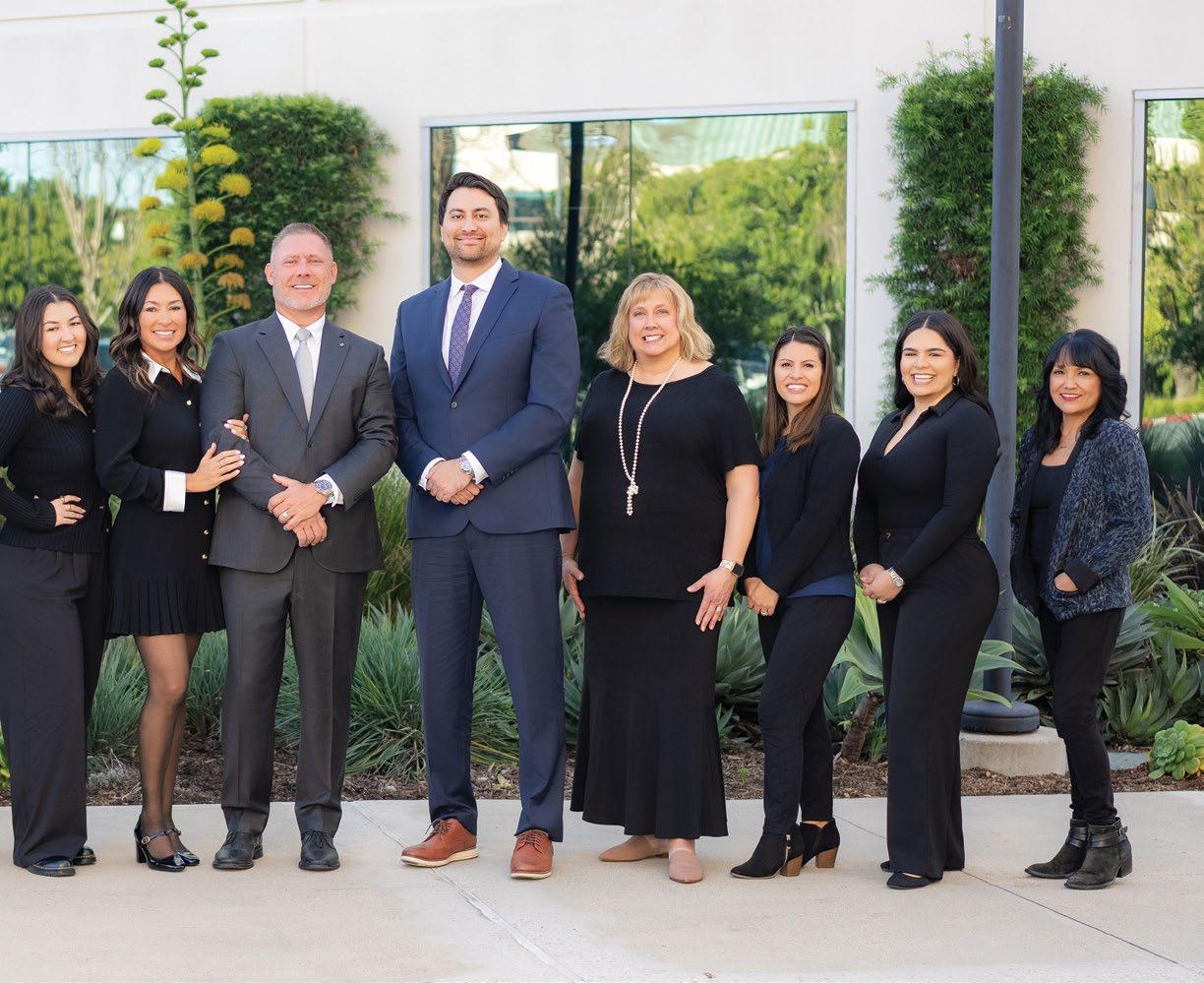
In 14 years, the firm has grown from a single attorney working from his kitchen table to an office with two attorneys and nine support staff ranging from receptionists to paralegals.
In addition to high-dollar verdicts and settlements, Banner finds genuine rewards in helping people who are suffering and in serious need of professional help. One of his cases involved a single mom who was a teacher seriously hurt in an accident. Her recovery required extensive neck surgery. The firm’s efforts resulted in the woman receiving a $1.5 million settlement. She moved to the Inland Empire and purchased a home for her and her daughter, where they are living a safe, stable and happy life. “If you want to define a ‘feel good moment,’ that’s it,” he says.
Banner says, “We are a law firm, but we are really in the people business. Every day and with every client we prove that

lawyers are good people, too. It’s funny, but I hear from a lot of people that they’re shocked I’m a lawyer in the sense that I’m just a normal guy. I’m a regular guy; I just happen to go to law school. So, I’ve got a little bit of information, education to help them. That’s where I focus my practice— on people.”
“Facing a sudden life-changing motor vehicle collision is one of the most stressful things I’ve experienced. I’m 48 and have never hired an attorney. I am so glad that I did. My advice if you find yourself in this situation is to contact Banner Attorneys immediately so you feel supported and can put your energy into healing and getting your life back in order. Their team is caring, personable, responsive, and will be on your side.” —Rebecca P.
“I’m a sucker for the underdog. I get that from my parents,” Banner says. He grew up in a blue-collar family that moved around a bit before settling in Redlands in the Inland Empire. He inherited his dad’s concern for the less fortunate. Once while in the drivethrough of a fast-food restaurant, his father saw a bully harassing a street person. His dad got out of the car and chased away the bully. His dad was also one of those men who were always working. When not on
the job, he worked in the yard, worked on the family car, and took care of whatever needed care. Watching and sometimes helping his dad taught Banner not only the value of work but the discipline necessary to do the work consistently and professionally. His care for people as people comes from his mother, who taught him the value of nurturing others.
That compassion came naturally, but a traumatic personal experience at age 30 rammed home the message. Two weeks before taking the bar exam, he was in a bad automobile collision. A 17-year-old driving a white Jetta in a 35mph zone crashed head-on into Banner’s car. The airbags inflated, a protein shake spilled from its cupholder and was dripping from the ceiling, and the smell of smoke choked him. He made it out of his vehicle and sat down on the curb, dazed and jittery.
At first, he thought he was bleeding and that his car was on fire. The immediate trauma turned into long-term back, neck and shoulder pain. He also had burns on his left arm from the airbag deployment. He had a torn labrum in his left shoulder that needed surgery. His recovery required epidural injections, acupuncture and other treatments. The accident and recovery gave Banner insight and an in-depth look at the experiences many of his clients go through.
Recovery alone is exhausting. Combined with dealing with insurance companies and the legal system dramatically adds to that stress. Banner says, “I can be a little more patient and understanding. I tell them I’ve gone through medical procedures that are similar to some they have experienced. That wreck was, in a way, the famous blessing in disguise because the experience helped me to better understand them and what they’re going through. I’ve been there, I tell them, and that helps create a genuine bond.”
Banner never wanted to be an attorney. He was active in sports in high school and was offered a baseball scholarship to California State University, Northridge. He turned it down to go on a two-year mission where he served in Barcelona, Spain, where he became fluent in the language. After serving his mission, he attended UCI, where he earned a degree in Spanish literature and language.
While working at a bank, he met an attorney who offered him a job. He accepted and learned he enjoyed meeting clients, claims adjusters, doctors and others in and related to the legal profession. “It was exciting. Litigation in the courtroom was like a sport. I thought ‘I can do this,’ but I was intimidated about going to law school.” He held back after graduating and spent two years selling real estate at an agequalified community in Nevada. He soon realized that he was following the wrong career path. He was married with two children at the time.

He was accepted at California Western School of Law, which offered a two-year program. One of his most important lessons was learned in a class on property in which the instructor taught him the importance of recognizing that there are always two sides to every story. “I take a very methodical approach to a case, and to me, really understanding the other side’s position is essential to success on our side of the table. That insight stuck with me and has been invaluable,” he says.
Banner soon found work with a large firm, but just as soon found he was not suited for that environment. The work did not provide a sense of fulfillment. He wanted to experience really helping people in genuine need. “Life in a big organization was all about getting clients and getting fees, and not so much about taking care of clients and getting good results for them. I thought, ‘Is this what I really want to do with my law degree?’ It just didn’t feel right, so I decided to open my own shop and serve clients the way they deserve to be treated.”
The transition came with challenges. The biggest was creating, organizing, and managing an efficient and effective law firm with, as many young attorneys discover, no base in the business side of managing an organization. Suddenly, he was faced with a need for business forms, equipment, phone systems, networking, being his own receptionist and secretary, finding and hiring suppliers and staff, and promoting a law firm in a competitive environment.
“I had no clue what I was doing and, at first, it was scary to say the least. I realized if I stuck to my core values, maintained discipline, and continued to treat people as individual persons and not numbers, I would succeed,” he says. Fortunately, those ten years when he had worked in a law firm paid off handsomely. He already had a head start on learning how a law office should be set up, how it should be run, and how to be both an attorney and a boss.
The firm’s record of achievement in personal injury proves Banner’s point. For example, in recent years they have recovered more than $10 million in verdicts and settlements. Cases include such successes as a $650,000 auto accident settlement, a $300,000 premises liability settlement, a $250,000 property damage settlement, a $240,000 car accident settlement, and a $100,000 auto accident, which was the policy limit.
Banner is not a micromanager. He prefers to hire talented people who are self-motivated to succeed through serving clients and coworkers. “I set a good example, teach them what to do, and then let them use their unique skills. I may tweak something here and there along the way, but basically, I get out of the way and let them do what they do best—win.” His personal philosophy is to always look at the big picture. Living the “attitude of gratitude” lifestyle is a core value. “Every day can bring its own set of challenges, but if we focus on what
we’re grateful for, the good things that are going on, then the bad things can’t overwhelm us. Some of my hardest days are my most rewarding days because those challenges hand me puzzles to put together and fix.”
Occasionally, a personal injury case breaks out of the arena of tragedy and trauma and enters into the realm of comedy. Banner’s success in what he calls his almost a dog bite story illustrates the sometimes-humorous side of a very serious practice area.
His client lived with his son next to a neighbor who had an aggressive dog. The neighbor repeatedly warned the client against entering the man’s backyard. “My dog is dangerous. He could kill you,” and other disturbing warnings were given. The client took those warnings to heart. One day, as the father and son were returning from a trip and as they crossed the neighbor’s front yard, they saw that the dog was on the neighbor’s front porch. The dog leaped up and ran ferociously toward the now panicking father and son.
Instinctively, the father shielded his son and, in doing so, tripped over the sidewalk, fell back, and shattered his elbow. Just as the dog was about to reach them, a chain jerked him back. The dog would never have reached them—something they could not possibly have known at the time. The neighbor’s insurance company claimed the neighbor was innocent of any damage because the dog was chained. Banner noted that the neighbor had repeatedly warned them of the danger the dog presented and that the father’s reaction was a normal outcome because he was unaware of the chain. The fear was legitimate and the harm a natural result of the neighbor’s negligence. The case settled for $155,000.
Banner has expanded his firm with offices in Fontana and Hemet. He and his team are committed to the people and the communities they serve. His Banner Athletes supports disadvantaged youth through athletic events and races. Every fall, they host soup kitchens. They are involved in the Miracle for Kids program, which sponsors families in dire need. Members of the team go to the donation warehouse and pitch in on wrapping presents and other duties. They have been a financial sponsor for Mission Viejo High School. They sponsor the FFA program out of the new Hemet office. They are also making specific efforts to reach out to the Latino community. Banner and two-thirds of his staff are fluent in Spanish.

Banner is an avid golfer and softball player. He enjoys Latin music and country and western. He and his wife Sindy are the proud parents of three sons and three daughters. They enjoy pickleball together, the beach, following the Angels baseball team, and traveling, especially to Latin American countries.
“I’m a big believer in karma and just being good. And I feel like I’ve been extremely blessed and taken care of by treating people the way I’d want to be treated. A lot of really good people have their lives turned upside down. And all they need is somebody to really treat them like a person, listen to them, and just give them the best care and compensation you can.” n
Contact
Banner Attorneys, APLC
25950 Acero, Suite 200 Mission Viejo, CA 92691 855-411-BANNER
www.bannersgotyourback.com


The rules of digital visibility have fundamentally changed, and most law firms are still following the old playbook. AI search engines like ChatGPT, Perplexity, and Copilot now handle a ton of queries monthly. If your firm isn’t showing up in AI-generated answers, you’re invisible to a rapidly growing segment of your target market.
The cost of ignoring AI search visibility will be detrimental to your law firm’s growth. The time is now to invest in the future of your firm by paying attention to AI and ensuring that your firm is showing up.
Across the legal industry, firms that spent years building their organic search presence are watching their traffic numbers drop, despite maintaining the same content quality and SEO best practices that previously delivered results. The culprit isn’t a Google algorithm update or increased competition. It’s the rise of zero-click searches and AI-powered answers that resolve queries without users ever needing to visit a website.
Consider the typical client journey that law firms have relied on for years: a potential client searches “how to file for divorce in California,” clicks through to a law firm’s blog post, reads the content, and eventually contacts the firm. Today, that same searcher asks ChatGPT or uses Google’s AI Overview and receives a comprehensive answer instantly. The search ends there. No click. A Pew Research study found that when Google users don’t see an AI-generated summary, they click on conventional search result links roughly 15% of the time. In contrast, users who are shown an AI summary tend to stop there. In fact, just 8% of users continue scrolling to click on standard search results.
Right now, AI search optimization is still a frontier, and the firms that move quickly have a genuine first-mover advantage. But this window won’t stay open and is rapidly closing as time goes on. Every day, more legal marketing teams recognize the shift and start investing in AI visibility. The firms establishing
by Taylor Tufano
themselves as authoritative sources in AI responses today are creating a competitive advantage that will be nearly impossible to overcome later.
AI-engines are still in their learning phase when it comes to legal queries. They are actively identifying which sources demonstrate genuine expertise, which firms provide reliable information, and which legal professionals deserve to be cited as authorities. The firms establishing themselves as trusted sources right now aren’t just capturing today’s opportunities; they’re becoming the default citations that AI models will rely on for years to come. Each time your firm appears in an AIgenerated response, it reinforces your authority in the model’s understanding, creating a compounding effect that becomes increasingly difficult for competitors to disrupt as these platforms mature.
Additionally, the same content strategies that build “traditional” SEO authority, such as demonstrating expertise, establishing trust signals, and creating genuinely valuable content, are exactly what Ai-engines prioritize when determining which sources to cite. This means firms that invested heavily in quality content, thought leadership, and digital authority already have a significant head start. They have the domain strength, media mentions, and content depth that AI models recognize as credible. Meanwhile, firms that neglected these strategies will need to build both traditional authority and AI visibility simultaneously.
The gap between leaders and laggards will only continue to widen. Early movers are currently training AI platforms to associate their firms with specific practice areas and legal expertise. As these associations solidify and AI models refine their understanding of which sources to trust, breaking into the citation pool becomes exponentially harder. The firms acting now are locking in a lasting competitive advantage because they established authority during the critical window when AI search was still determining who the trusted voices in law actually are.
Every day you delay optimizing for AI visibility, your competitors’ content is being indexed, analyzed, and cited by AI platforms while yours remains invisible. Each month that passes allow early-moving firms to deepen their authority signals, accumulate more citations, and strengthen their position as the default recommendations in your practice areas. While you’re waiting for more data or clearer best practices, they’re building an AI visibility foundation that will keep you locked out.
The truth is, potential clients are using ChatGPT and other Ai-engines to research legal options right now. The cost of “waiting to see” will be felt in fewer potential new client opportunities and lost revenue.
While traffic may never be where it used to be because of AI and how it’s reshaping the search landscape, your lead volume and quality should be increasing with guidance from an evolved SEO strategy that takes into account AI visibility.
At 9Sail, we like to say good SEO is good GEO (generative engine optimization). The same fundamental principles that drive organic rankings are exactly what determine AI citations:
• Authoritative content
• Clear expertise signals
• Technical quality
• Trustworthiness
If your firm ranks well in traditional search, you already have many of the building blocks AI platforms prioritize.
Ai-engines don’t crawl content the way traditional search engines do; they interpret it, synthesize it, and decide whether it’s worthy of citation. That means the structure and format of your content matter as much as its quality. With that said, AIready content is built for direct answers. Examples of this include FAQ formats that clearly pair questions with comprehensive responses, headers that frame issues the way potential clients actually ask them, and formatting your content in a way that makes it easy for AI models to extract and attribute specific insights (for example, bullet points and concise paragraphs).
Additionally, schema has evolved from an SEO nice-to-have to an AI-visibility necessity. Implementing structured data like Legal Service, FAQ Page, Attorney, and Organization schema helps Aiengines understand exactly what your firm does, what questions your content answers, and why you’re an authoritative source.
Law firms have spent years perfecting their ability to track Google rankings by checking keyword positions, monitoring organic traffic, and tracking conversions. But when it comes to AI visibility, most firms are flying completely blind. You can’t simply log into a dashboard to see if ChatGPT recommended your firm, check your ranking in Perplexity’s results, or monitor how often Claude cites your content. The tracking tools and measurement systems that became standard for traditional SEO simply don’t exist yet for AI search, leaving firms to either conduct time-consuming manual research or operate without any visibility into their AI presence whatsoever.
Right now, Google Analytics 4 can show you referral traffic from Ai-engines when users click through, but it tells you nothing about citation frequency, the context in which you were recommended, or the queries where you’re invisible. You’re measuring a fraction of the picture while making strategic decisions as if you see the whole landscape.
While there are a handful of AI search visibility tools, many that have come out are still in testing phases or don’t necessarily have all the information needed to make true data-driven decisions. Additionally, they can be quite expensive, especially for firms with smaller marketing budgets. A trustworthy GEO partner like 9Sail can help bridge the measurement gap for law firms when it comes to AI visibility.
Before deciding whether AI visibility deserves your attention, ask yourself the following questions:
1. Do you know if AI platforms currently recommend your firm?
2. Is your content structured to be cited, or just to rank?
3. Are you measuring AI visibility alongside traditional SEO metrics?
If you answered “no” to any of these, you’re operating blind in a channel that’s already reshaping how clients find lawyers. The firms that will dominate AI search in 2026 and beyond are building on strong SEO and GEO foundations today, not waiting for proof that it matters. n

Taylor Tufano is a Senior Digital Strategist at 9Sail, specializing in search engine optimization (SEO), payper-click (PPC) advertising, and AI search visibility. With a strong foundation in content strategy and social media marketing, she helps law firms and other professional services organizations build authoritative digital presences that perform across both traditional and AI-driven search platforms. Learn more at www.9sail.com.

You never get a second chance to make a first impression. And in these days of increasingly short attention spans, the opportunity to make that first impression is often only a few seconds. During those fleeting moments, your law firm logo does some heavy lifting. Yet many law firms give little attention to the image that introduces, and represents, them to the world. That’s a lost opportunity.
A law firm logo is more than just decoration; it’s communication. In a sense, it is your firm’s signature, a consistent, recognizable endorsement. In law, even more than other professions, clients choose firms they trust. Your firm’s logo is a visual signal of your law firm’s credibility, trustworthiness, and reputation. Your logo is an important component of your branding, but it is not your brand. The logo is a symbol, while the brand is the meaning that the symbol evokes: your law firm’s values and culture, and the emotional response that people have to the firm. In short, your law firm logo is a visual anchor, calling to mind what your firm means to people every time they see it.
A logo is the nucleus of the visual representation of your brand. As such, it’s a springboard for other elements of your visual brand, including color palette and typography. When it comes to designing a law firm website, a strong logo is like a painter having a full set of brushes at their disposal, opening up a world of possibilities for expression. A weak, bland, or uninspiring logo is like having a single broken brush: it’s possible to be creative within those constraints, but your options will be limited.
Given the importance of a logo to the development of a visual brand, it’s important to understand just what goes into an effective logo.
Unless you’re a mega-brand like Apple or Nike, your law firm’s name generally needs to appear in your logo. When the name is included in your logo, this is often referred to as the logotype, or wordmark.
by The Modern Firm
The logo designer will select a font that evokes your firm’s brand, or perhaps a combination of fonts, for your firm name. Once you have a font selected for your logo, you’ll be able to reuse that font across all of your written communications. For your website, we’ll use that font and find complementary fonts that match it.
Many law firm logos consist only of the logotype. This can work well if you’re an established name in your field, have a unique firm name, or otherwise are less concerned with marketing for your firm.
A logo often has an illustrated or designed visual element, called a symbol or logomark. In addition to giving the logo visual interest, the logomark can hint at the firm’s personality.
Perhaps the logomark is an abstract design. Or maybe it’s a bold way of framing the partners’ initials. Some law firms include an image in their logomark that serves as a metaphor for the firm’s approach to practice, like a lighthouse that shows the firm can help a client navigate through the storm of a lawsuit. No matter what the final look is, it should be consistent with the image the firm wants to present.
A tagline might appear in a logo to provide an additional text description of the firm. A tagline could simply state the focus of your practice (“Real Estate Attorneys”), or it might be a more marketing-heavy phrase that highlights your firm’s values (“Client-Focused Advocacy”). For newer law firms, or firms that are focused on marketing, we recommend having a tagline along with the logo to make it clear to potential clients that they’re in the right place.
It’s likely that one iteration of your logo isn’t going to meet all your needs. Depending on how much active marketing your firm is involved in, you might need horizontally and vertically oriented versions of your logo. You may want a black and white rendering, one that can work on light backgrounds or dark backgrounds, resized versions for social media, etc.
While they won’t be identical to one another, they should be similar enough that someone seeing any variation of your logo will instantly understand its connection to your firm. There are innumerable ways variants of your logo might be reused, including:
• Website
• Email signatures
• Zoom/Teams backgrounds and virtual meeting assets
• Letterhead and envelopes
• Proposals, pitch decks, and presentations
• Informational brochures
• Newsletters and firm announcements
• Exterior and interior office signage
• Client portals and document management systems
• Merchandise and promotional items
• Event materials
Having a clear idea of the components of the logo, as well as having the design files on hand, will allow your designer to quickly create what you need. The repetition of your logo on various media creates a cohesive, professional image for your firm.
Fun fact: just because you didn’t design a logo doesn’t mean you don’t have one!
If you think your law firm doesn’t have a logo, here’s some unfortunate news: as soon as you picked the font for your letterhead or business cards, you also took the first step to designing your firm’s visual identity.
Like it or not, using Word’s default font constitutes a decision on how you want to present your firm to the world. Since clients, colleagues, and the public are going to form a visual impression of your firm no matter what you do (or don’t do), you might as well purposefully shape that impression.
If you’d prefer not to have a logo-by-default, it might be time to contact a logo designer!
You don’t technically need a design professional to create your logo, in much the way you don’t technically need a barber to cut your hair: you can do it yourself, but you might not like what the result says about you.
There are three primary reasons we recommend that attorneys work with a professional designer on their logo:
Almost always, your time is better spent on billable work than design work. If you don’t have experience in this area, you
could lose valuable time wading through options and jargon, not to mention learning the software and file types needed to create a professional-looking image that’s usable on the web.
A professionally-designed logo also ages better and requires fewer redesigns. It makes future marketing easier, and reduces your costs in the long term.
A professional designer doesn’t begin with visuals; they work to understand your practice area, client profile, tone, and style. They take into account your preferences and build from there. An experienced designer also understands how a logo will appear in print versus digitally; how to make a logo legible at all sizes, and how to use typography to signal trust, sophistication, or other traits. In short, they’ll ensure that your logo looks right and truly represents your firm’s brand.
When you work with someone to design a logo, the goal is to be able to use that logo for many years, and for many needs. When you work with a skilled designer, especially one associated with an agency, you get a system, not just an image. There are color rules and font standards that prevent “drift” in your logo image over time. If you discover a new need or use for your logo, your designer will have the files on hand to make it happen.
Remember the purpose of your logo: to create a positive impression of your firm in the eyes of those who encounter it. Working with a professional designer on your logo is an investment in your firm’s image and brand.
• Your law firm logo makes a critical first impression on viewers
• A logo may be composed of a logomark, logotype, and perhaps a tagline
• You will probably need variations of your logo for various digital media, print collateral, and promotional items
• If you don’t intentionally create a logo, your font choices will serve as your “default” logo
• An experienced designer can help you express your visual brand professionally, consistently, and cost-effectively. n

This article was provided by The Modern Firm, which is a website design and online marketing company that has worked with over a thousand small law firms by providing a one-stop shop experience for everything a small firm needs to succeed online. Learn more at www.themodernfirm.com.











Last year saw the return of special and signing bonuses in the US legal market, signaling sustained competition for elite legal talent. Rather than indicating a broadbased hiring surge, this trend is in fact indicative of a laserguided recruitment strategy in which firms are willing to pay significant premiums for attorneys with very specific expertise.
While there are many corporate lawyers working in major cities, the proportion with this very defined skillset is small, so they can effectively name their price. Based on what we have observed in recent months and the hiring activity of the top firms, I certainly believe this trend is one which will continue for the foreseeable future. What seems to have happened is that those firms were all looking for the best people at the same time, so inevitably that creates considerable competition. This means that those associates were in a very good position to obtain big signing bonuses.
The years following the pandemic were two of the best ever in the legal recruitment industry. This could be very obviously explained by so much activity being shut down during Covid and then rebounding with such an unprecedented surge. For reasons that are harder to pin down, there is almost a similar level of confidence in the marketplace now, which started toward the end of last year and still prevails. The offers we are seeing are almost reaching the level of the post-Covid flurry, when it was almost impossible to fulfill the demand.
While M&A was not as busy last year because of geopolitical issues like the tariffs implemented by President Trump and the ongoing conflict in Ukraine, that seems to have smoothed over. Interest rates appear to be coming down, and we are in a period of high investment. There are multiple explanations. But regardless of the exact reasoning, as a result of that improvement in confidence, deals are happening again, so there is going to be real demand in both leveraged finance, M&A and funds.
Looking ahead, the market for the best attorneys at the top 20 firms in New York is likely to remain incredibly competitive in these high-demand practice areas. Recent market activity has seen multiple offers exceeding $100,000, highlighting how competition for experienced attorneys is approaching the levels last seen in 2021 and 2022.
Firms are hiring more senior people than before, and the
by Connor Spicer
shrinking pool of suitably experienced senior associates and counsel is intensifying pressure on firms to secure talent earlier and at higher cost. I think it is perfectly possible that this sign-on bonus figure could rise still higher for certain people. Although $100,000 is a high number and not that common, we have seen a few rare instances in which bonus offers have exceeded $125,000. It is hard to envisage signing bonuses increasing beyond that, but we generally see more offers having sign on bonuses then not.
Despite the apparent reluctance among firms to create an escalating bidding war, clearly the level of experience of the candidate might give them even more sway when negotiating a signing bonus with a firm desperate for a very tailored acquisition.
Senior associates, counsel, and non-equity partners (NEP) are also in higher demand right now. The effect of this is that lateral moves and step-ups have been made more accessible for the right candidates, particularly where firms are prepared to be flexible on role and title.
Beforehand, firms were less inclined to take people on at senior level, or even senior associate level. They would typically be looking for a two to six-year associate. Traditionally, the reason for this is that anyone above that six-year threshold would be getting closer to partnership level, which evidently brings its own risks. They wanted people at the mid-level because they are not too expensive; they are also at a stage in their career in which they can be molded and trained according to a firm’s particular demands and structure.
Today, however, given the intensity of the competition between these top firms, there is more willingness to take on people already in senior positions. It comes down to the simple necessity of having to deal with the workload and having the ability to further grow their practices.
Firms are much more flexible about paying massive incentives simply to get these prized assets through the door. Candidates have considerably more leverage than they would have done if they were just desperate to move. When it is a case of an attorney being willing to jump at anything, the firm holds all of the cards.
But in a marketplace as busy and tight as this one, the candidate or the associate tends—in many cases—to be able to assert much more bargaining power. So, they’re able
to be a bit more aggressive with their negotiations and more straightforward. Plainly this can give them the platform for obtaining much better offers.
At the same time as changes in the hiring environment, we have also been observing structural changes to partnership tracks at different firms. This too is playing a significant part. Different firms are putting different structures in place to create alternative progression pathways.
Based on this evolving template, candidates can increasingly weigh the relative value of early partnership titles versus more substantive routes toward equity elsewhere. For example, Kirkland and Ellis promotes attorneys to partner at the seventh-year level, but for some candidates this milestone carries less weight, as it is widely viewed as an expected progression within the firm.
As a result, some attorneys choose instead to move to another firm as a non-equity partner, where the role may represent a more substantive and credible step towards equity. Historically, prior to this uptick in activity of the last two to three years, there was only a limited selection of promotional pathways for associates. For example, at a firm like Kirkland, from associate to non-equity partner to equity partner.
Alternatively, you could stay as an associate for eight years and then try to make partner or become a counsel and then a partner. These were the only real routes. Now, however, so many different firms have so many different pathways. Some firms are now promoting attorneys to counsel at seven years, to non-equity at nine years, and then equity at 11 years. Others
are just going for straight equity partner after seven years.
The natural implication of this is that if an associate doesn’t like the structure that they’re on at their current firm, there is a much broader variety out there to pick and choose from. If they are unhappy in their role, this wealth of options provides them with infinitely more choice. It is no longer a case of complaining but sucking it up because you are entrapped by an inflexible promotion structure.
This broad hiring phenomenon looks set to proceed at the same rate in the first half of this year. Firms are still being very aggressive, and there are no immediate signs of that stopping. When you have surges in the core markets of finance and M&A in particular, other areas such as tax also start to become busy because they are effectively a side-product of the substantive corporate work. There is, therefore, a high chance that these secondary areas might increase their level of activity, further bolstering the need for firms to make the right hires at associate level. I cannot envisage any immediate slowdown. n

Connor Spicer is Vice President at Buchanan Law. Based in Miami, he works with leading law firms and top attorneys across the country, helping high-performing associates, counsels, and partners make strategic career moves within the top law firms in the U.S. and internationally. With over five years’ experience in legal recruitment, Connor has been involved in hundreds of successful lateral placements across the world’s top 20 firms. Learn more at https://wearebuchanan.com/find-people.







9 - FIGURES
Consumer Class Action
MULTIPLE 8 - FIGURES
Burn Injury - Product Defect
MULTIPLE 8 - FIGURES
15-Passenger Van - Auto Defect
MULTIPLE 7 - FIGURES
Wage & Hour Class Action
MULTIPLE 7 - FIGURES
Door Latch Failure - Auto Defect
MULTIPLE 7 - FIGURES
Tread Separation - Auto Defect
MULTIPLE 8 - FIGURES
Seatback Failure - Auto Defect
MULTIPLE 8 - FIGURES
Negligence - Rehab Facility
MULTIPLE 8 - FIGURES
Rollover - Auto Defect
MULTIPLE 7 - FIGURES
Wage & Hour - PAGA Class Action
MULTIPLE 7 - FIGURES
Roof Crush - Auto Defect
MULTIPLE 7 - FIGURES
Seat Belt Failure - Auto Defect

MULTIPLE 8 - FIGURES Dangerous
MULTIPLE 8 - FIGURES Motorcycle Accident
MULTIPLE 8 - FIGURES
Caustic Ingestion - Premises Liability
MULTIPLE 7 - FIGURES Dangerous
MULTIPLE 7 - FIGURES
Airbag - Auto Defect
MULTIPLE 7 - FIGURES
Post-Collision Fire - Auto Defect