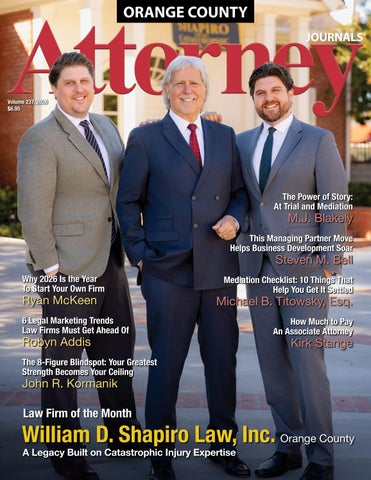
ORANGE COUNTY
Volume 237, 2026 $6.95
The Power of Story: At Trial and Mediation
M.J. Blakely
This Managing Partner Move Helps Business Development Soar
Steven M. Bell
Why 2026 Is the Year To Start Your Own Firm
Ryan McKeen
Mediation Checklist: 10 Things That Help You Get It Settled
Michael B. Titowsky, Esq.
6 Legal Marketing Trends Law Firms Must Get Ahead Of
Robyn Addis
How Much to Pay An Associate Attorney
Kirk Stange
The 8-Figure Blindspot: Your Greatest Strength Becomes Your Ceiling
John R. Kormanik
Law Firm of the Month
William D. Shapiro Law, Inc. Orange County A Legacy Built on Catastrophic Injury Expertise
Experienced PERSONAL INJURY LAWYERS
For Last-Minute Trials At Bentley & More LLP, we provide aggressive legal representation to consumers and employees across California. Our attorneys are fierce litigators with decades of experience advocating for our clients. While we are effective in resolving many kinds of conflicts outside of litigation, we have a proven track record of fearlessness in taking matters to trial and beyond.
Referral Fees Paid
Specialists in Cases Involving: • Personal Injury • Business Interruption • Car Accidents • E-Cigarette Explosion • Workers’ Compensation • Wrongful Death • Insurance Bad Faith
4931 Birch Street, Newport Beach, CA 92660 | (949) 870-3800 | www.bentleymore.com
2026 EDITION—NO.237
TABLE OF CONTENTS 6 Why 2026 Is the Year to Start Your Own Firm by Ryan McKeen
10 Six Legal Marketing Trends Law Firms Must Get Ahead of in 2026 by Robyn Addis
EXECUTIVE PUBLISHER Brian Topor
14 The 8-Figure Blindspot: Your Greatest Strength Becomes Your Ceiling
EDITOR Wendy Price
LAW FIRM OF THE MONTH
16 William D. Shapiro Law, Inc., Orange County A Legacy Built on Catastrophic Injury Expertise
PUBLICATION DESIGN Penn Creative CIRCULATION Angela Watson PHOTOGRAPHY Chris Griffiths
by Dan Baldwin
22 Mediation Checklist: Ten Things That Help You Get It Settled
STAFF WRITERS Dan Baldwin Jennifer Hadley CONTRIBUTING EDITORIALISTS Robyn Addis Steven M. Bell M.J. Blakely John R. Kormanik Ryan McKeen Kirk Stange Michael B. Titowsky, Esq. ADVERTISING INQUIRIES Info@AttorneyJournals.com
by Michael B. Titowsky, Esq.
16
SUBMIT AN ARTICLE Editorial@AttorneyJournals.com
26 This Managing Partner Move Helps Business Development Soar
OFFICE 1950 W Corporate Way #21011 Anaheim, CA 92801 www.AttorneyJournals.com
28 How Much to Pay An Associate Attorney
ADDRESS CHANGES Address corrections can be made via email or postal mail.
10
by John R. Kormanik
24 The Power of Story: At Trial and Mediation by M.J. Blakely
by Steven M. Bell
by Kirk Stange
28
Editorial material appears in Attorney Journals as an informational service for readers. Article contents are the opinions of the authors and not necessarily those of Attorney Journals. Attorney Journals makes every effort to publish credible, responsible advertisements. Inclusion of product advertisements or announcements does not imply endorsement. Attorney Journals is a trademark of Sticky Media. Not affiliated with any other trade publication or association. Copyright 2026 by Sticky Media. All rights reserved. Contents may not be reproduced without written permission from Sticky Media. Printed in the USA
Why 2026 Is the Year to Start Your Own Firm Your Bonus Check Is Your Escape Hatch by Ryan McKeen
D
ecember is here. Bonuses hit bank accounts. And thousands of lawyers are doing the same math they do every year: Is this enough to keep me here? Here is the truth most BigLaw partners will never tell you: The barriers to starting your own law firm have never been lower. The economics have never been better. And the myths keeping you chained to your desk are exactly that. Myths.
The Fear Factory The legal profession runs on fear. Fear of failure. Fear of losing prestige. Fear of the unknown. Law firm leadership depends on this fear to maintain the status quo. You have been told that clients expect a corner office in a downtown high-rise. You have been told that going solo means taking a pay cut. None of this is true anymore. The partners who tell you these things are not lying. They are repeating what they believed when they started practicing. But technology has fundamentally changed the economics of running a law firm. Most lawyers over 50 have not updated their mental models. Your clients have changed too. They work from home. They take Zoom calls in their kitchens. They do not care if you have a mahogany conference table. They care if you answer your phone and solve their problems.
The Real Numbers Let me show you what a lean law practice actually costs in 2025. Google Workspace Business Standard plan: $14 per month. This gives you professional email, cloud storage, video conferencing, and document collaboration. Gemini 3 is probably all of the AI software you need and it’s included in Workspace. Throw in $10 a month for a Google Voice number, and it’s everything you need to run a modern practice. Web domain and basic hosting: $500 per year. You need a professional website. You do not need to spend $10,000 on a marketing agency to build it. Hardware: $3,000 for a new MacBook Air, printer, and scanner. This is a one-time expense that will last you years.
6
Attorney Journals Orange County | Volume 237, 2026
Malpractice insurance: $1,500 for your first year. This is the cheapest it will ever be because you have no claims history and limited exposure. That is $5,072 in core expenses. Add your phone bill at $1,200 per year. Budget $7,500 for accounting and bookkeeping. Throw in $1,500 for incidental software like Adobe. Get Fastcase for legal research at $995. You are now at $16,267 in annual expenses. You have nearly $9,000 left in a $25,000 budget for things like co-working space, marketing, additional monitors, or case management software. Some lawyers are running profitable practices for under $20,000 per year in total expenses. Compare this to what your firm bills clients for your time minus what they actually pay you. The math is not complicated.
The Myth of the Pay Cut Here is the most persistent lie in legal practice: Going solo means making less money. The opposite is often true. When you work at a firm, you generate revenue and keep a fraction of it. The rest goes to partners who did not do the work, overhead you do not need, and profit margins that benefit everyone except you. When you run your own practice, every dollar of revenue above your expenses is yours. A solo practitioner billing $300 per hour who works 1,500 billable hours generates $450,000 in revenue. Subtract $25,000 in expenses. That leaves $425,000 before taxes. How many BigLaw associates make $425,000? How many have the flexibility to take a Tuesday afternoon off to watch their kid’s school play? The economics favor the entrepreneur. They always have. The legal profession just convinced you otherwise.
The Office Myth Your clients do not want to come to your office. The pandemic proved what technology already enabled: Legal work can happen anywhere. Clients prefer the convenience of video calls.
A physical office is a fixed cost that drains your cash flow every month whether you have clients or not. It limits your flexibility. It is a relic of a business model designed for a different era. If you need to meet a client in person, rent a conference room for an hour. It costs a fraction of monthly office rent and signals that you are efficient with resources.
What You Actually Need Starting a successful law firm requires three things: vision, values, and community. Vision means knowing what kind of practice you want to build. Not every lawyer should go solo. But if you are reading this article in January while looking at your bonus check, you probably already know what you want. You just need permission to pursue it. Values mean understanding what matters to you beyond money. Do you want flexibility? Autonomy? The ability to choose your clients? Control over your own schedule? Community means surrounding yourself with people who have done what you want to do. The loneliest path is the one you walk alone. Find mentors who have built successful practices. Learn from their mistakes.
The Best Investment You Will Make If you are serious about starting a firm, do the foundational work first. Define your vision. Clarify your values. Build a business plan that reflects who you are, not what someone else thinks a law firm should look like. You can run a law firm for $25,000 a year. You can make more money than you do now. You can have the flexibility and autonomy you crave. The barriers are not financial. They are psychological. The question is not whether you can afford to start your own firm. The question is whether you can afford to keep waiting. Your bonus check is sitting in your account. What are you going to do with it? n Ryan McKeen is a co-founder of Best Era, LLC. Ryan has an extensive background as a lawyer and law firm owner drives his commitment to helping the legal community thrive. Ryan is dedicated to enriching the legal field by sharing insights from his experience. He co-authored the best-selling books “Tiger Tactics: Powerful Strategies for Winning Law Firms” and “CEO Edition,” and regularly speaks at national legal conferences on topics including innovative marketing, artificial intelligence, law’s future, and effective management. Learn more at www.bestera.io.
Monty A. McIntyre, Esq. Mediator, Arbitrator & Referee ADR Services, Inc.
To schedule, contact Haward Cho: (213) 683-1600 and (619) 233-1323 or haward@adrservices.com
Short summaries (one-paragraph), organized by legal topic, of every new published CA civil case, helping CA attorneys save time, win more, and make more money. Monthly, quarterly, annual, and annual practice area publications are available. Subscribe at www.cacasesummaries.com
Attorney Journals Orange County | Volume 237, 2026
7
Six Legal Marketing Trends Law Firms Must Get Ahead of in 2026 by Robyn Addis
T
he firms that will dominate client acquisition in 2026 are making fundamentally different strategic moves than their competitors. Will your firm lead the transition or chase after it? Today, there are six critical shifts reshaping legal marketing:
• First-mover advantage exists. Only 2-3 agencies in the legal marketing space offer true GEO services currently. • Timeline urgency is real. You have a 12–18-month window before this becomes table stakes rather than competitive advantage.
1. The AI search revolution that’s already capturing a growing percentage of legal research queries
Practical First Steps for AI Search Visibility
2. The death of generic marketing strategies
Start with an honest assessment of where you stand:
3. The rising importance of referral validation infrastructure
• Audit your current AI search presence by testing your firm name and practice areas in ChatGPT, Claude, and Perplexity.
4. The technical SEO factors separating visible firms from invisible ones 5. The measurement frameworks that prove (or disprove) marketing ROI 6. The specialization imperative driving client selection Understanding these trends and acting on them is the difference between growth and stagnation. At 9Sail, we’ve been tracking these shifts for more than a decade, and we’re seeing the competitive advantages compound for firms who moved early. The 12–18-month head start available to forward-thinking firms in early 2026 represents a once-in-a-decade opportunity to establish digital authority before markets become saturated.
The AI Search Revolution Is Already Here (And Most Firms Are Invisible) The firms dominating these AI platforms aren’t there by accident—they’re there by strategy.
• Identify content gaps by asking which client questions AI platforms answer without citing your firm. • Prioritize comprehensive, authoritative content over thin keyword-stuffed pages that served the old SEO playbook. • Consider GEO-specific technical implementation for your highest-value practice area pages. Traditional SEO focused on keywords and backlinks. Generative Engine Optimization (GEO) requires citationworthy content structure and authoritative source signals that AI platforms trust and reference. AI search represents the most significant shift in client discovery since Google transformed legal marketing two decades ago, but it’s compounded by the death of generic marketing strategies.
Generic Marketing Strategies Now Actively Harm Multi-Practice Firms
GEO isn’t just another marketing buzzword—it’s a fundamental shift in how legal expertise is discovered:
The “one-size-fits-all” digital marketing approach that many large, multi-practice firms have relied on for years is now actively costing firms high-value clients. When a boutique firm with specialized expertise outranks a full-service firm with superior resources, it’s not an accident—it’s the market punishing generic positioning.
• Content becomes citation-worthy. AI platforms need comprehensive, authoritative content that directly answers complex queries.
Why Specialized Boutique Firms Are Winning Digital Battles
• Technical implementation matters. Structured data, clear schema markup, and LLMs.txt files signal credibility to AI.
Sophisticated clients don’t search for “law firms near me.” They search for specific solutions to specific problems. Boutique firms
What Generative Engine Optimization (GEO) Means for Law Firms
10
Attorney Journals Orange County | Volume 237, 2026
optimize deeply for narrow specialization. Multi-practice firms often optimize shallowly across everything, trying to be all things to all people. As a result, boutique firms with 10 attorneys outrank their much larger counterparts because their digital presence screams expertise rather than whispers competence. The solution isn’t becoming a boutique firm. It’s marketing like you have deep, niche expertise in each practice area. That requires abandoning firm-wide generic approaches in favor of practicespecific strategies that demonstrate depth rather than breadth.
Your digital infrastructure either converts referrals or loses them. There’s no middle ground.
Practice-Specific Content Architecture
• Clear, immediate contact mechanisms instead of a single contact form that is removed from the intake process.
Implementation starts with honest assessment: • Audit your website structure. Do you have generic “practice areas” pages or deep, authoritative content that answers every question prospects ask? • Develop practice-specific content calendars that address the unique questions criminal defense clients ask versus questions business law clients’ research. • Create practice-specific conversion paths instead of funneling everyone to the same generic contact form.
Building Digital Infrastructure That Converts Referrals Converting referrals requires specific digital assets: • Recent, relevant thought leadership that shows active practice rather than stale content from 2009.
• Social proof and credibility indicators including case results, speaking engagements, and third-party publications. • Mobile-optimized experience because many prospects research on phones during initial contact moments (not to mention Google gives preferences to well-optimized mobile experiences).
Measuring Referral Conversion vs. Lead Generation
• Build practice-specific landing pages for paid campaigns rather than wasting ad spend sending prospects to your homepage.
Track referrals in a central database:
Specialization matters more than ever because referral validation has fundamentally changed how prospects evaluate law firms.
• Measure time between referral received and prospect contact
Referral Validation Infrastructure Determines Conversion Rates The most expensive marketing failure isn’t generating too few leads—it’s losing warm referrals during their digital validation research. When a CPA refers a client to your business law group, and that client researches your firm online but never calls, you’ve lost a qualified prospect with the highest possible intent. This “referral validation gap” costs firms millions in lost revenue.
Referral Research Before They Contact You. For Real. The referral journey has changed permanently: • Data shows referred prospects research the attorney online before making contact. • Referral sources expect firms to have strong digital presence that validates their recommendation. • What prospects look for during validation: specific expertise demonstration, recent relevant content, professional credibility signals, and a clear engagement path. • Weak digital presence doesn’t just fail to generate leads—it actively kills referrals you’ve already received.
• Monitor referral source attribution separately from organic traffic. • Identify drop-off points in the referral journey (where do they research but not engage?). • Survey referred prospects who don’t convert: “What made you choose another firm?” • Calculate cost of referral leakage: [referrals received] x [conversion rate] x [average case value]. Referral conversion depends heavily on technical foundations most firms completely ignore.
Technical SEO Is Now a Revenue Driver, Not Just an IT Issue Technical SEO factors invisibly determine whether prospects can find you at all. Core Web Vitals, mobile performance, structured data, and site architecture aren’t technical minutiae. They’re revenue enablers. Or revenue killers.
Core Web Vitals and the Speed-to-Lead Connection Google’s Core Web Vitals measure loading speed, interactivity, and visual stability. These directly impact rankings, but the business impact is more severe: slow sites lose prospects before they engage.
Attorney Journals Orange County | Volume 237, 2026
11
Sites loading in 1–2 seconds convert at significantly higher rates than sites loading in 5–6 seconds. Legal searchers have high intent but are time-poor. Technical performance determines conversion before content quality even enters the equation.
Schema Markup and AI Search Readiness Schema markup helps search engines and AI platforms understand your content structure. Critical schemas for law firms include Local Business, Attorney, Legal Service, and FAQ Page. Proper schema enables rich results like FAQ expansions and local pack inclusion. AI platforms use schema to validate authority and extract structured information. Most law firm websites have incomplete or incorrect schema implementation—lowhanging fruit that dramatically improves both traditional and AI search visibility.
The LLMs.txt and Robots.txt Strategy Control how AI platforms access your content: • Implement LLMs.txt to direct AI platforms toward your most authoritative content.
The gap between what firms measure and what partners care about creates budget vulnerability. When budgets get cut, firms tracking vanity metrics lose funding while firms demonstrating revenue impact get increases. Compare “Our traffic increased 45%” versus “Our marketing generated $487K in new revenue at 4:1 ROI.” Which statement wins budget discussions?
Attribution Models for Legal Services Legal services have long sales cycles, multiple touchpoints, and referral complexity that make attribution challenging: • First-touch attribution. What initially brought the prospect to your firm? • Last-touch attribution. What finally converted them to a client? • Multi-touch attribution. Which touchpoints contributed throughout the journey? Track the full journey but weight last-touch for budget allocation decisions. Don’t forget that referral validation touches count even if the referral itself is “first touch.”
Building Your Marketing Dashboard
• Review robots.txt to ensure you’re not accidentally blocking valuable content from AI crawlers.
Essential KPIs for law firm marketing:
• Create XML sitemaps specifically for high-value practice area content.
• Lead metrics. Marketing Qualified Leads (MQLs), Sales Qualified Leads (SQLs)
• Conduct regular technical audits (quarterly minimum) to catch issues before they impact rankings.
• Cost metrics. Cost Per Acquisition (CPA), Return on Ad Spend (ROAS)
• Test mobile-first because what works on desktop often breaks on mobile.
• Conversion metrics. Lead-to-Client Conversion Rate by source and practice area
But technical foundations only matter if you can measure what’s working.
Track by channel to identify which sources generate highestquality leads at lowest cost. Track by practice area to understand where marketing ROI is strongest. Focus monthly executive reporting on revenue metrics, not vanity metrics. Use data to inform budget allocation—double down on highROI channels. Measurement reveals which specialization investments actually pay off.
ROI Measurement Frameworks Now Make or Break Marketing Budgets “We’re getting more traffic” no longer justifies marketing budgets. Managing partners and executive committees demand clear connections between marketing spend and revenue generation. The marketing teams winning budget battles in 2026 will be those with the clearest ROI measurement.
Moving Beyond Vanity Metrics Vanity metrics (website traffic, social media followers, keyword rankings) are easy to track but don’t connect to revenue. Revenue metrics (cost per qualified lead, lead-toclient conversion rate, revenue per marketing dollar, client lifetime value) require more sophisticated tracking but actually justify budgets.
12
Attorney Journals Orange County | Volume 237, 2026
Generic Expertise Claims No Longer Persuade “We handle all types of business legal matters” was acceptable positioning in 2015. In 2026, it’s a liability. Clients don’t want generalists who can handle their case, they want specialists who’ve handled dozens, if not hundreds, of similar cases. Digital marketing must reflect this specialization, not obscure it.
How Clients Actually Select Attorneys Clients choose attorneys based on specific experience, not general capability. So naturally, digital content must demonstrate depth, not breadth. Being known for everything means being known for nothing. (Or as my father liked to say, “Some men know everything. But that’s all they know.”) The expertise paradox is real: the more broadly you position yourself, the less credible you become for any specific need.
Content Depth as a Competitive Moat Build unassailable positions in your strongest practice areas: • Identify 2-3 practice areas where your firm has deepest expertise and highest revenue potential. • Build comprehensive content libraries for those areas (50+ pieces minimum). • Address every question prospective clients ask during initial consultations. • Use content depth to differentiate from competitors with thin practice area pages. • Measure content effectiveness by tracking which pieces drive qualified inquiries.
Specialization is about demonstrating depth in the areas where you compete for high-value work.
Decisions to Make in 2026 The landscape in 2026 rewards firms that understand these critical shifts. The common thread across all six is strategic sophistication. Firms that view digital marketing as a cost center to minimize will lose ground to firms that view it as a revenue driver to optimize. The question isn’t whether to invest in these areas—it’s which priorities to address first based on your competitive positioning, practice mix, and current digital foundation. Begin your 2026 planning by auditing where your firm stands across these six dimensions. Which represent your biggest opportunities? Which pose the greatest competitive threats? n As the Chief Marketing and Business Development Officer at Legal Internet Solutions Inc., Robyn Addis leads the strategic direction and execution of marketing communications, events, and business development efforts for their agency and outsourced legal marketing services clients. Learn more at www.legalisi.com.
Las Vegas
Elevate Your Business Presence. Domestic Phone Answering + Nevada Mailing Address We help you look established, credible, and ready for anything. At Intelligent Office Las Vegas, we provide: • • •
Live phone answering for your business Bilingual spanish/english Flexible, affordable packages
GIVE US A CALL! 9550 S. Eastern Ave., Suite 253, Las Vegas, Nevada, 89123
702.515.7464 Attorney Journals Orange County | Volume 237, 2026
13
The 8-Figure Blindspot: Why Your Greatest Strength Becomes Your Ceiling by John R. Kormanik, Esq.
T
here’s a moment every ambitious founder eventually faces—one that separates the leaders who rise from seven figures into eight … and those who stall out despite their brilliance. I see it every week with the managing partners, founders, and high-achieving lawyers I coach. But the clearest example came recently, during a conversation I had in Berlin with a managing partner who runs a highly successful seven-figure firm. He’s sharp. Strategic. Respected. The exact profile of someone you expect to see at an international legal conference. Over lunch, he shared his plan to scale to eight figures—a smart move in his market. So, I asked him the most natural question in the world: “Who’s your coach?” He paused. Smiled. And said, confidently: “I don’t need a coach.” And in that instant, he revealed the most dangerous blind spot every high performer has—the myth of more.
The Myth of More: When What Got You Here Stops Working High performers tend to trust the formula that rewarded them in the past: • More effort • More hours • More control • More personal execution • More of you holding everything together This founder had built a seven-figure firm by being a world-class problem solver. That strength had served him extraordinarily well. But it had also quietly become a ceiling. Many founders mistakenly believe that the path to eight figures is simply a continuation of the path that got them to seven. They assume linear effort will keep creating exponential results. It won’t.
14
Attorney Journals Orange County | Volume 237, 2026
At a certain point—often right around the seven-figure mark—the model collapses under its own weight. More hours begin to burn out the leader and the leadership team. More control creates bottlenecks instead of momentum. More involvement forces everything to route through a single person. The strengths that once produced success become liabilities.
Eight Figures Is Not an Operational Challenge—It’s an Identity Shift Scaling to eight figures isn’t about optimizing your schedule or hiring more support staff. It requires something far more uncomfortable: It requires you to change. Not as a technician. Not as a lawyer. Not even as a CEO. You must evolve into something that many high-performing attorneys have never been taught to be: A leader of leaders. This requires a complete internal shift—from elite doer to builder of other elite doers. • A doer controls and executes. A leader delegates and inspires. • A doer solves problems. A leader asks better questions. The founder in Berlin had elevated himself into the CEO seat, but he was still operating like the most elite technician on the team. He was leading with the same instincts that once earned him success in the courtroom. And that’s why he was stuck.
The Invisible Ceiling: The Belief You Don’t Know You Have Every founder carries a belief that helped them win early in their career. For many lawyers, the belief sounds like this: “If you want it done right, do it yourself.” That belief absolutely builds a seven-figure law firm. It absolutely destroys an eight-figure one. Because scaling requires you to let go.
Let go of control. Let go of being the answer. Let go of being the bottleneck your entire team unconsciously depends on. But here’s the catch: You can’t see your own limiting beliefs. You’re standing inside the frame. You cannot read the ingredients on the cereal box from the inside. That’s why an invisible ceiling is so dangerous—it’s built from patterns you’ve repeated for decades, patterns that feel like strengths but function like restraints.
Why You Cannot Break the Invisible Ceiling Alone
• Her leaders finally stepped into their full roles. • She reclaimed her strategic headspace. • The client experience improved. • She became the CEO the business needed. She stopped being the operator and grew into the visionary. That is the identity shift required to go from seven figures to eight.
The Question That Separates Leaders Who Scale From Leaders Who Stall
• Employees are influenced by power dynamics.
If I could go back to that moment in Berlin, I still wouldn’t try to convince that founder he needed a coach. High performers shut down when you try to “fix” them. Instead, I’d ask him a simple question—the same one I’m going to ask you now: Are you willing to bet your eight-figure dream on the belief that you have zero blind spots? Sit with that. Now ask yourself a second question: What is the one belief that has always served you—but may now be the invisible ceiling holding you back? Every founder has one. The ones who scale are the ones brave enough to examine it.
• Spouses want to protect you from discomfort.
Your Next Level Requires a New You
Let me give you the blunt truth: There is no high-performing founder in the world who breaks through their invisible ceiling alone. Not because they lack intelligence. Not because they lack discipline. Not because they lack courage. But because no one in their life is positioned to tell them the unfiltered truth. • Partners have their own political interests.
• Friends want to support you, not challenge you.
Scaling isn’t about doing more. It’s about becoming more:
Only one person has no agenda other than your success: A coach. Someone who reflects the patterns you can’t see, asks the questions no one else asks, and challenges beliefs no one else would dare confront. This is why the founder in Berlin will not scale to eight figures until he stops trying to do it alone. And this is why my highest-performing clients scale faster than their peers—because they have a mirror, an accountability engine, and a strategic sparring partner all in one.
• More aware.
Real-World Evidence: What Happens After the Identity Shift Let me make this real: A client of mine—also a seven-figure founder—was stuck. She had the team. She had the systems. She even had a leadership layer in place. But she still felt guilt about stepping back. She still believed she “needed to be in the weeds” to justify her value to the firm. She couldn’t imagine allowing her leaders to fail, even though failure is the only path to growth. Within six months of shifting from managing people to leading leaders:
• More intentional. • More visionary. • More willing to be challenged. • More willing to see what you cannot see alone. The leaders who reach eight figures are never the ones who go alone. They’re the ones who choose to evolve. n John R. Kormanik, Esq., is a Professional Certified Coach with the International Coach Federation who draws on more than two decades as a practicing attorney, partner, and law-firm owner to help lawyers break past the limitations traditional legal training can create. Before launching his attorney-only coaching practice, he served as an Idaho Deputy Attorney General and later built and led his own firm for 16 years. His extensive coaching credentials—combined with real-world leadership experience—allow him to guide clients through genuinely transformational professional and personal growth. Learn more at www.irglobal.com.
• She worked fewer hours. • Her firm’s revenue increased.
Attorney Journals Orange County | Volume 237, 2026
15
A Legacy Built On Catastrophic Injury Expertise A family-led firm staying true to its roots, delivering elite advocacy, life-changing results, and unwavering commitment to clients for more than four decades by Dan Baldwin I’m one of those guys who believes when you're holding yourself out as an expert in a field, you should be an expert in that specific field. In our area of law, which involves serious catastrophic personal injuries, wrongful death, and related cases, we choose not to expand beyond those areas,” William D. Shapiro, Founder of William D. Shapiro Law, Inc. says. Practicing since 1979, he founded the firm in 1983 with specific practice areas including claims arising from spinal/ back injuries, head/brain injuries, amputations, car/truck/ motorcycle collisions, Uber and Lyft accidents, pedestrian accidents, defective products, roadways and premises, as well as medical malpractice. Shapiro leads the team with sons, attorneys Brian D. Shapiro and Mathew D. Shapiro. The adage, the more things change, the more they stay the same, in many ways applies to William D. Shapiro Law, Inc. Throughout the decades the firm has remained steadfastly committed to serving those whose lives have changed due to devastating injuries or to the death of a loved one. “We’re a boutique firm handling a limited number of cases. The most important thing to me is that we maintain our focus on quality lawyering at every level from being introduced to clients through trial. Most of our cases are referred by past clients, other attorneys, judges, court staff and others. We take great pride in the quality of our workmanship, the relationships we have with our clients and the results we achieve,” Shapiro says.
16
Attorney Journals Orange County | Volume 237, 2026
“Our office and law firm have worked with Bill Shapiro and his exceptional staff for several years. Bill has done an outstanding job navigating complex and catastrophic injury cases, achieving remarkable results. His staff is attentive, diligent, and maintains excellent communication. Most recently, Bill Shapiro and his team, including Brian Shapiro, excelled in a case where our office served as Guardian Ad Litem. They passionately advocated for a young girl whose life was profoundly altered by a horrific, catastrophic injury. The hours and dedication the firm invested in this matter were truly impressive to witness firsthand. We are deeply grateful for the outstanding work and results achieved by this firm.” – Matthew D. Scott
Family Wins
As a father-and-sons team, they have recently won sevenand eight-figure injury and wrongful death cases, which has been the case for many years. Recent cases include a mideight-figures win for an infant girl who suffered catastrophic brain injury due to social services failures. Other successes include another mid-eight-figure wrongful death result against multiple commercial motor carriers and their maintenance contractors whose collective negligent conduct caused the death of a young wife and mother. The firm has overcome sports waivers, prevailing in a spinal injury claim against recreational company. They have taken on cities, counties and the State in catastrophic injury and wrongful death claims
© Christopher TODD Studios
JOURNALS
LAW FIRM
OF THE MONTH
The Team: Brian D. Shapiro, William D. Shapiro and Matthew D. Shapiro
2026
© Christopher TODD Studios
Brian D. Shapiro for dangerous roadways and other conditions, and a public entity whose staff refused to respond to a medical emergency due to alleged “Covid policies.” They have prosecuted many multimillion-dollar medical malpractice actions stemming from birth injuries, brain injuries, amputations and deaths against negligent doctors, hospitals and health care providers and have recovered on behalf of numerous victims of the Route 91 music festival shooting. Their current caseload exemplifies the breadth of their services within the firm’s niche: a young man who lost his entire immediate family (mother, father, brother) in a tragic traffic collision against the adverse driver, his employer and the public entity that owned and maintained the roadway; a husband and wife each suffering catastrophic injuries in another traffic collision against the State due to an alleged dangerous roadway condition. The firm is handling multiple trucking cases including a wrongful death traffic collision case involving a truck with mechanical issues stopped on the freeway, the driver slowing for hundreds of feet, claiming he couldn’t pull over; another a brain injury case in a truck/ pedestrian incident; a young man who lost his father on a motorcycle when struck by a FedEx delivery driver who wasn’t paying attention; a husband who lost his wife after she died as a result of unsuspecting tuberculosis when a surgeon used bone material during a surgery that was contaminated with tuberculosis; a baby whose mother died due to alleged improper
18
Attorney Journals Orange County | Volume 237, 2026
ET tube placement resulting in lack of oxygen; a husband and injured daughter who lost their wife/mother in motor vehicle accident allegedly caused by a negligent driver and inadequate traffic signal placement; and a two-year-old girl who suffered lacerations all over her face after being attacked by a dog. They also completed two hotly disputed mid-seven-figure medical malpractice cases just before trial. One concerned a 36-yearold woman who while in a rehab hospital, suffered quadriplegic injuries from a fall allegedly due to alleged lack of supervision. The other case where the endotracheal tube in a one-yearold boy allegedly dislodged during transport in the hospital resulting in lack of oxygen and brain injuries. Brian Shapiro says, “When you experience heart issues, you go to a heart specialist. When you have a brain-related problem, you see a neurologist. That wisdom should apply to seeking a lawyer when people are injured or suffer losses in our practice areas. We are current on the applicable laws, procedures and ability to present these cases. We meet the challenges and the opportunities and incorporate the most effective means of presenting catastrophic injury and wrongful death cases.” Matthew Shapiro says, “Working statewide and sometimes beyond, much of our work comes from other attorneys and others who have seen our results. We have built and will continue to build strong relationships with many lawyers, past clients and people in the communities we serve. We’re honored by the number of referrals and the testimonials we receive, which says a lot and we’re honored and proud of the recognition we receive of the quality of our work, results and our expertise in our practice areas.”
Collaborative Management and Family Ties
Shapiro describes the firm as being “freakish on being fundamental” while taking creative approaches to solving the challenges in their practice areas. Although he may think out of the box and sometimes take non-traditional approaches, his management philosophy is conservative. That conservative approach is exemplified in the collaborative approach he takes with Brian and Matt who are actively sharing management roles at the firm. Although he works diligently to transfer his more than 47 years of experience, he does not micromanage the shared responsibilities. Shapiro says in the office, his sons get no credit for being his blood, only for being outstanding attorneys. Brian Shapiro says, “Each of us shares a firm belief there’s no replacement for hard work, dedication and passion and that’s how we practice law. We understand our clients trust us to be their voice, their advocate regarding something tragic that has happened in their life. We must be the best we can be and through everything I’ve experienced at this office, that’s the way it’s always been, that’s the way Matt and I were raised. We don’t always all agree, but we always end up with what is in the best interest of our client.”
© Christopher TODD Studios
Collaboration is a key element of the firm’s ongoing success. For example, Bill Shapiro will be the president of National of the American Board of Trial Advocates (ABOTA) in 2026, which will require him to be out of the office a significant amount of time. While out of the office, he’ll be in constant contact through phone, email and Zoom contacts. Much of the day-to-day management will rest with Brian and Matthew Shapiro. Shapiro also notes there will be a day when he will retire, but not yet. “I’m seeing to it that the firm is and will remain in the capable hands of outstanding attorneys. Brian and Matt are the next generation of the firm.”
Staying Ahead of the Technology Curve
Shapiro says, “We have increased the effectiveness of our traditional methods using the latest modern systems and equipment. We use cutting-edge technology, AI tools and remote communications to stay ahead of the curve and keep pace with the ever-changing legal field.” For example, William D. Shapiro Law, Inc. was among the first firms in California compelled to conduct a hybrid trial during Covid—beginning in person and continuing remotely for several months. Shapiro and his team have learned from that experience and woven that knowledge into their long-term approach from opening a file to trial. They are prepared for how cases will be handled and tried in the future. Shapiro emphasizes that he and the team use and manage the latest technology but take the necessary steps to make sure they are not misguided or misled by technology. The use of AI by legal firms is a good example. AI is a valuable tool provided those who use it are careful of the results obtained and who remain in full control of the data and its uses. For example, many firms cite instances in which AI used as a research tool actually falsely created case references that fit the needs of the attorney or firm using the process. “I’ve given some programs or participated in programs relating to AI and when these things hallucinate, it's false. You can never rely on AI for final legal research.” The firm uses the technology, but always backs up anything related to research by personally reviewing the case, the research, and the supporting documentation. They are careful to never rely on AI for firsthand research. They do their own writing for final drafts and presentations. Shapiro finds that AI is an exceptionally good tool in summarizing depositions and other things, but still the information obtained needs to be verified before use. Brian says, “AI can be amazing however you always have to double check it. The lawyers who use it without double checking are practicing at risk. If they want to use the initial results as a final draft, they're going to get themselves in a pickle. In fact, some courts are now saying they want you to sign a declaration that you did not use AI in the drafting of this document. We don’t and never will make that mistake.”
Matthew D. Shapiro Overuse of technology is another danger. Shapiro warns students in his Trial Practice classes about the dangers involved in over-dependence on AI and other technologies, such as smartphone communications and a reliance on texting. Attorneys must have the ability to write and communicate, converse with juries, clients, other attorneys, service suppliers, and judges. They must be able to articulate quickly and, on the spot, using the right words and inflections to create powerful images in a person’s mind. “Many of the people coming out of schools today, not just law schools, but all schools are not communicating. They’re too abbreviated. Many are in such a hurry to communicate that they’ve actually lost the ability.” Shapiro tells his law students and young lawyers that fifty percent of trial work has little or nothing to do with law. Juries make decisions on such non-legal matters such as the attorney’s manner, the presentation, pacing, body language, positioning and being civil and courteous. “These are all things having nothing at all to do with law. For me to get a damage award, I have to paint a vivid word picture that tells my client’s story not only factually, but emotionally so that the jury understands the challenges my client faces. We trial lawyers must concentrate on the skill of storytelling, with descriptions using sixth grade English, so things are easy to understand.”
Attorney Journals Orange County | Volume 237, 2026
19
© Christopher TODD Studios
Matthew D. Shapiro, William D. Shapiro and Brian D. Shapiro
A Change of Address
William D. Shapiro Law, Inc. has experienced one major change between the then and now. The firm’s client base has continually expanded to include Orange County. Opening a new office by the courthouse in Santa Ana became the logical next move for the firm. This makes serving clients more convenient and efficient. The firm is committed to more than just operating out of a new facility. Shapiro says he and everyone in the office have planted a physical footprint in the community—a statement that they are an active member of and are committed to enhancing the lives of the people in that community. Matthew Shapiro says, “We are striving to be a vital part of the community, and the people in the community are learning that. We’re not just a number in a big online ad on the internet pretending to be in the community, we’re here. Our neighbors can drive by and see our location. They can see we’re real people really here.” Community involvement and action is a hallmark of the firm’s management team. William Shapiro has been active on the executive board and a volunteer of Legal Aid for more than 40 years. Brian and Matt Shapiro volunteer regularly to provide pro bono services to the community. All three attorneys contribute significant time, energy and resources to preserve the rights of consumers through the legislative process. Long ago, establishing the William and Susan Shapiro Scholarship, Bill has for years contributed in their name to 20
Attorney Journals Orange County | Volume 237, 2026
two deserving Western State law school students. Additionally, the firm donates extensive resources to the foundations of American Board of Trial Advocates, the International Society of Barristers, and the International Academy of Trial Lawyers all of which goes to humanitarian causes. William D. Shapiro not only looks back on previous and current success within the legal field; he has a strong desire to ensure that his firm will continue to have a positive impact on the future. “I have always wanted to leave my profession in a better place than when I entered it. I love the law; my sons do as well. I love the people we work with, represent, and the system of justice we’ve made our profession. While I may have started off to be a coach, I’m so fortunate to have found my calling. n Contact William D. Shapiro Law, Inc. Orange County Office: 1020 Ross Street Santa Ana, CA 92701 Inland Empire Office: 893 East Brier Drive San Bernardino, CA 92408 714-602-6990 949-922-8690 www.wshapiro.com
Mediation Checklist: Ten Things That Help You Get It Settled by Michael B. Titowsky, Esq.
H
aving participated in mediations as an advocate and as a mediator, I can say that the mediation process lends itself well to the resolution of all kinds of personal injury claims. From motor vehicle and premises liability cases to medical malpractice, products liability and labor law matters, a good mediator will give the parties the opportunity to manage risks and avoid the uncertainty of having the fates of the litigants decided by six people you have never met before. A mediation will often be the last best opportunity for the parties to discuss a resolution in earnest before they get into a courtroom and start trying the case. Of course, cases can settle during trial, but those settlement figures are often skewed by the courtroom events. If an important witness is obliterated on cross-examination (or does not even show up), the settlement numbers will go up or down accordingly. A mediation gives you the chance to discuss the case “as is,” without the unpredictability of a trial. Mediations are similar to trials in the sense that they work so much better when everyone is fully prepared. So, if you agree to mediate a case, take that opportunity seriously. A cursory review of your file the night before the mediation generally will not suffice. Indeed, when I look back at the cases that have not settled at mediation, the number one reason was that one or more of the parties did not properly prepare. What follows is a checklist of sorts, that will hopefully help attorneys and litigants on both sides get better results from the mediation process. Here are the ten things that you will need to get the case resolved: 1. Bring your clients. This may seem painfully obvious, yet I hear so many attorneys say, “The claims examiner is on phone call alert” or “My client is waiting to hear from me.” As a general rule, the more involved the clients are in the mediation, the greater your chances of success are. Now, when I say that you should “bring” your clients to the mediation, I am using that word in a broad sense. For better or worse, the overwhelming majority of personal injury mediations are now done virtually. The plaintiff
22
Attorney Journals Orange County | Volume 237, 2026
himself or herself does not necessarily need to be in front of a camera, listening to every word that is said. But having the plaintiff physically present in the attorney’s office shows a level of commitment to the process. It also makes the conversations about offers and demands much easier and helps to move the mediation forward. On the defendants’ side, having the claims professional on the Zoom call helps tremendously. The mediation process becomes disjointed and often loses steam when all developments have to be discussed in private phone calls between defense counsel and the insurance company representative. 2. Listen. Nobody in the history of the world ever learned a thing just by talking. The single most important thing that the participants can do during the mediation itself is listen – not just to the mediator, but to all of the other participants. You need to listen to the other side explain precisely what the evidentiary basis is for their current demand or offer. Yes, there will surely be some posturing by the attorneys. A big part of the mediator’s job is to get the parties past the bravado and unhelpful rhetoric and move them toward a more reasonable and realistic place. 3. Have pre-mediation discussions. I am always amazed when the parties tell me that they have not had any settlement discussions at all before the mediation session. Pick up the phone, people! As a general rule, the plaintiff should make a settlement demand well in advance of the mediation, as this allows the other side sufficient time to evaluate the settlement possibilities. 4. Have pre-mediation discussions with your codefendants. The proper evaluation of a personal injury case from a defendant’s perspective must include an opinion on the percentages of contribution needed from each defendant and third-party defendant. Yet we often see co-defendants taking diametrically opposed positions on percentages that have never been discussed before the
mediation. If your evaluation relies on your co-defendant for a significant contribution towards the overall settlement, pick up the phone and discuss the case with the attorney and/or the claims professional in advance of the mediation. Alternatively, you can consider a defenseonly mediation session, where contribution, indemnity, and coverage issues can be resolved, so that the focus can be solely on the value of the case when it is discussed at the next session with plaintiff’s counsel. 5. Prepare BRIEF submissions. Take the time to prepare submissions for your mediator. They do not have to be voluminous; in fact, they should be quite succinct. Do not send your summary judgment motion with complete copies of all 47 exhibits. Brief statements on key liability and damages issues, with references to the specific supporting evidence, are most helpful. Please include the history of all prior settlement discussions, as well as insurance coverage information for the defendants. 6. Meet with your clients. This is crucial, whether you are representing the plaintiff or a defendant. Decisions need to be made, in advance of the mediation, on where the settlement discussions will begin and end. (Of course, the end point may change at the mediation. See item 10.) Regardless of which side you are on, make sure that you have these conversations with the actual decision makers. A spouse or relative may have significant influence on the plaintiff’s decisions. If so, get them involved early on with the discussions. If the settlement money required on a case is above the authority limits of the claims professional to whom you have been reporting, have communications in advance with the supervisors who possess the requisite authority, as it may prove difficult to get their input during the mediation, especially if they have not reviewed the case previously. 7. Don’t try your case at a mediation. The trial of a personal injury case is an exceptionally adversarial proceeding. Everybody wants to win and the trial attorneys will go to great lengths (within the bounds of fair play, of course) to get that victory. A mediation, on the other hand, is a more collaborative event. While the attorneys will surely advocate for their clients at a mediation, the result that they seek is a settlement to which everyone must agree. So, it is best to leave the “scorched earth” tactics and the “winner-take-all” trial mindset at your office when mediating a case. However…
8. Bring your admissible evidence. While we are not trying the case at a mediation, we are evaluating the case based on the potentially admissible evidence. This is sometimes referred to as the “lens of admissibility.” Be prepared to highlight the admissible evidence that supports your position. Whether it is a photograph of a clearly defective condition, a series of questions and answers in a deposition transcript, or an emergency room record, the evidence itself should be brought to the attention of not just the mediator, but everyone in attendance. Always remember that it is the other side that you are trying to convince as to the value of the case, not just the mediator. 9. Watch your language. Once the parties agree to a mediation, they all have the common goal of a settled case. All attendees at a mediation are well advised to ask themselves: Is what I am about to say going to be helpful in getting this case resolved? For example, we often hear settlement demands described as “outrageous.” According to Roget’s Thesaurus, synonyms for “outrageous” include: barbaric, disgraceful, heinous, inhuman, scandalous, and wanton. Is that the word you really want to use? 10. Keep an open mind. The trial judge gives this admonition to the jury throughout the trial, so that jurors do not make up their mind too soon, thereby ignoring potentially game-changing evidence. Mediation participants must be prepared to adjust their positions, so that a settlement can be reached. It may seem counterintuitive to spend so much time and effort on evaluating the case before the mediation, only to revise your numbers during the mediation. But the evaluation of personal injury claims is enormously subjective, and reasonable minds will differ. So, the question is not just what YOU think the case is worth; it is also what range of numbers will achieve the desired goal of getting the case resolved. So that’s my list. If you think that I left something out, I would love to hear from you. I can’t promise you that your mediations will all be successful if you follow these ten steps. But I can pretty much guarantee that if you don’t do any of them, your case is going to trial. n Michael B. Titowsky, Esq. is a highly experienced attorney who has represented thousands of clients in court litigation and private mediation throughout the New York Metropolitan area for more than 40 years. As both an attorney in private practice and as a hearing officer for NAM. Learn more at www.namadr.com.
Attorney Journals Orange County | Volume 237, 2026
23
The Power of Story: How to Use Stories at Trial and Mediation by M.J. Blakely
T
rial lawyers are master storytellers, and storytelling is a powerful art. It’s powerful because human beings communicate, plan, operate, and live every day in the context of stories—fantastic narratives in which we mutually agree to abide, and from which we understand the world around us. Because stories are such a critical part of the human experience, honing the art of narrative storytelling will make you a better trial lawyer, and a more effective advocate for your clients in mediation as well. A story, when carefully crafted, is like a Trojan horse—it’s a vehicle for infiltrating the minds and hearts of others with a message, and once safely secured behind the walls of our prejudices and preconceived notions, the story takes hold of our conscious mind and imposes its will. The Trojan horse was a military weapon of subterfuge used to conquer a great city, but stories don’t have to be used for nefarious purposes. They can also be used to provide information that empowers people to establish justice.
What Are Stories and Why Are They so Important? Stories are the primary way that our species exchanges information. Wherever information is shared, critical messages are communicated via a story. The better the story, the better the communication. As a vehicle, a story can transport us through time and space, take us to places we’ve never been or that don’t exist, and trigger real, physiological responses—from joy to grief. Stories are important because they are powerful, uniquely human tools. Our species has been engaged in the practice of telling and believing stories ever since the first apes gazed at the stars and fashioned them into gods. Perhaps this ability to tell and believe a narrative is what separates us from the other animals. While I don’t know why we make up and believe stories, as a trial lawyer, I’m an expert storyteller and have seen, firsthand, the impact of stories, not only on juries, but also on people in general—and so have you. It’s just that the make-believe is so commonplace that we often fail to realize we are a part of the narrative. Whether it be the story behind a nation’s flag, which
24
Attorney Journals Orange County | Volume 237, 2026
may instill the pride we have in our country; the stories we believe about money, which convert a mere paper object into currency; or the stories wielded by a trial lawyer spinning a yarn of evidence into a verdict of gold, we find ourselves yielding helplessly to the narrative. Not out of naiveté, but because stories are useful. They bind us to one another and allow people to cooperate in complex ways, which is why I am fond of telling plaintiff’s and defense lawyers alike that, “if you want a jury to connect and cooperate with you, then you must have them accept your invitation to become a part of a story.”
The Mechanics of a Good Story So, let’s talk about the elements of a good story. Take a typical auto accident case. It’s easy to become a little lazy when it comes to the narrative. The police officer’s incident report tells us what happened, and the medical records provide evidence of damages, so our instinct is to frame the story around what the officer has described and what the doctor has diagnosed. But the officer has been trained to provide the most boring factually neutral story possible, and the doctor is a scientist, not a storyteller. On the other hand, trial lawyers are tethered only by evidence and procedure. Because the evidentiary elements of our cases are so critical, we can often be tempted to spend inordinate amounts of time developing our evidence at the expense of developing a compelling story—all while squandering the trial lawyer’s gift. Do not fall prey to the tide of form over substance. Resist by crafting your evidence into a gripping and persuasive story. A good story need not be complex, but it must be told well. Stories, at least those stories that tend to move people, generally follow a problem/solution pattern. There is a status quo that exists. A situational problem arises. Then a solution or victory is obtained, often by a person who is a hero. The knottier or thornier the problem, and the more creative the solution, the more that story resonates, and picks open locks in our minds. This is why inside a good story, we’re more open-minded, and more persuadable.
Coincidentally, the classic framework of a captivating story is the same framework encountered in many of our cases. A person is bumping along, living his or her life, and then—bang! Bad things happen; perhaps a contract is breached or someone becomes horribly injured. Now the person must fight through the problem. He may have lost a critical business opportunity, or she might have medical expenses, pain, suffering, loss of a job, or other troubles. As lawyers, we have the opportunity to fashion the evidence into a story that empowers a jury to accept the solution that our clients desire. If you have told the type of story that has brought the jury into the life of the character—your client—the jury will step into the story and take on the role that they’ve seen played out repeatedly in stories throughout their lives. They become the agent of change. The hero who dispenses justice and restores righteousness and order to the lives of the parties involved. Whether your client is the plaintiff or the defendant, when it comes to the jury, the best story (vehicle for transmitting your ideas) wins. To sum up, the facts of your case are the battleground, but the story is the fight. The main ingredients of a story are character, conflict, and resolution. Your story should include your client, how his or her life was disrupted, and then (hopefully) a verdict in his or her favor. You want the jury, your audience, to care about your client/character, and you want the relief to be an appropriate remedy.
Using Stories at Mediation and Trial Remember this as you build your case. Look beyond the facts in a contract, police report, medical records, testimony, or other evidence, and ask yourself—what story does this tell? Because the story is what compels people. The story is what captures people’s most vulnerable human instincts, and the story is what wins. To build this kind of narrative as you prepare for trial: • Identify your story early and keep an open mind because you may need to adapt it. • Choose a main character—perhaps your client (or your client’s family), a business owner (or the business’s employees). And make your characters real-life, multi-dimensional people that the jury can grow to know and love. • Establish trust. People will avoid talking about difficult circumstances unless there is trust, and it’s the difficult things that make a story rich and exciting. When clients/witnesses trust you, they provide deeper, more complex information for your story.
• Look for a theme that runs throughout your story. Is it about distracted driving? Profits over people? Safety? The theme is often connected to the essence of the conflict. For example, the conflict may look like, “the red car hit the blue car.” And that’s a story, but it isn’t a good story. A good story is that the person in the red car was distracted when she was supposed to be guarding the safety and well-being of her fellow motorists. Case facts don’t make themselves into a story on their own. They must be shaped. A jury is supposed to carefully evaluate each party’s facts and determine, by the evidence presented, what outcome should take place. But we’re human beings. We construct and believe in stories, and so the better-told story can often mean the difference between a win and a loss or a win and a big win. When you understand your story, you develop evidence that supports that story. Think of the “whys”. Why did the tragedy happen? Think of big-picture aspects that are bigger than the incident that caused the harm. What can the jury fix? How can the jury fix it? Stories are not only useful at trial. Your client’s story can also be an effective tool at mediation and can help the mediator understand not only the facts of the case but also how your client has been affected—and how a jury is likely to respond to your client. At mediation your goal isn’t to convince a jury; nevertheless, crafting a thoughtful, compelling story can help you better prepare for mediation and for trial, should mediation fail. Finally, practice your story. Share it with your significant other, your law partners, the Lyft driver. Tell it over and over again. You’ll find yourself tweaking it and perfecting it along the way. Tell it so often and so well that it ceases to be a mirage and becomes a manifested reality. Don’t worry about sounding contrived. You’re telling a story, and that’s what juries and people want. I say this—the good lawyers practice and practice until they get it right. The great ones practice and practice until they can’t get it wrong. n *Originally published in the Daily Report and reprinted with permission. M.J. Blakely is a mediator, trial lawyer, and complex litigation specialist with a passion for establishing justice for all. His real-world legal experience led him to the conclusion that most cases settle, so he dedicated a part of his practice to ensuring parties reach the best possible settlement outcomes. M.J.’s mediation practice includes catastrophic personal injury and wrongful death cases, product liability cases, class actions, mass tort cases, civil rights cases, and commercial business disputes. Learn more at www.milesmediation.com.
Attorney Journals Orange County | Volume 237, 2026
25
This Managing Partner Move Helps Business Development Soar by Steven M. Bell
A
firm’s client base should be a crystal-clear reflection of its strategy. Here’s how leadership can help ensure that business development professionals bring that part of law firm strategy to life.
Setting the Stage: Strategy and the Client Base of the Future In a previous post, we explored how even the busiest firm leaders can personally contribute to sales success. This follow-on focuses on one small but powerful—and too often overlooked—step in the strategic planning process: targeting. When a firm plans for its next three to five years, it envisions its future market positioning, geographic footprint, brand, buyer awareness, services, people, and other key factors. Even if only implicitly, the strategy also illuminates the client base of the future. Most new law firm strategies define an ideal client profile. That’s a start, but as Tony Robbins said, “You can’t hit a target if you don’t know what it is.” A profile alone is too abstract to drive consistent action. What’s needed is a specific, strategy-driven target list—by name—of clients to retain and nurture, and prospects to pursue. The questions, then, are: • Which current clients deserve continued investment, and which have run their course? • Which prospective clients align with the firm’s future direction and need to experience direct and energetic sales efforts?
The Leadership Imperative Today’s client development teams, now equipped with sophisticated tools, including generative AI, can generate remarkably precise target lists. But without visible and ongoing leadership sponsorship, those lists rarely take hold. Leaders are well-advised to make clear that targeting is a strategic, sanctioned, monitored, and rewarded activity. Otherwise, even the best-intentioned efforts will fade into 26
Attorney Journals Orange County | Volume 237, 2026
“business as usual,” and strategic plans will gather dust on a metaphorical shelf. Two contrasting examples illustrate the points made in this blog post: 1. The cautionary tale. A mid-sized firm we advised generated a strategy to become a leading advisor to middle-market businesses across all the firm’s limited geographies. With this guidance, the client development team built a list of 3,000 companies, identified key buyers, mapped relationships, and generated preliminary action plans. It was a promising approach, but leadership did little more than acknowledge the existence of a list. Without leaders reviewing, refining, endorsing, and enforcing accountability, enthusiasm waned. Within two years, the middle-market strategy had been replaced by the de facto goal of opportunistic expansion, including “growing globally.” 2. The success story. A then-Big Six accounting firm embraced a strategy “to serve global companies globally” (my words). Leadership made it clear: “Your job is to serve or pursue Global 1000 clients. Other work is your choice, but we will not invest in it, and it will not drive recognition or compensation.” Within two years, the firm’s annual growth rate rose from single digits to 16%+, it expanded into previously unserved markets where its clients and targets operated, and its workforce expanded by an estimated 20%.
What Firm Leaders Should Consider Doing Client development teams can deftly perform most of the back-office work required to develop great, strategically guided target lists. But to ensure that names on target lists become names on client lists, leadership might take some or all of the following actions: • Publicly charter the effort. Empower client development leaders to craft and maintain target lists that reflect firm strategy.
• Know the lists. Be conversant with their composition and alignment with firm priorities.
• Collaboration. Lawyers coordinate around shared priorities, enhancing the client experience.
• Communicate relentlessly. Reinforce who the firm serves now, who we will serve next, and how each lawyer’s work contributes.
• Efficiency. Time, attention, and resources flow toward what matters most.
• Monitor the pipeline. Track traction against target lists and step in when progress stalls.
• Cultural alignment. The firm speaks with one voice about growth and purpose.
• Provide resources and alignment. Support the effort through budget, technology, incentives, and lateral hiring.
Why This Matters
• Recognize performance. Celebrate wins that reflect strategy and quietly correct those who are off course.
A firm’s client base should be a direct function of its strategy. When leadership sets clear boundaries and expectations, client development becomes not just a clerical exercise but a manifestation of strategic intent. Turning a strategy into a defined client base requires more than capable business developers; it requires leadership resolve. Ask yourself: Does everyone in your firm know exactly which clients define your future? If not, now is a propitious time to make that clear. n
• Help lawyers and staff learn to say “no” to proposed offstrategy actions and investments.
The Payoff When leadership and client development teams align around specific targets, the results are transformative. • Accountability. Progress can be tracked, and success measured, against named targets. • Clarity. Everyone knows the firm’s priorities and what’s expected of them. • Focus. Effort and investment concentrate where they yield the highest return.
Steven M. Bell is a pioneer of law firm Sales and Business Development, in 2001, Steve created one of the legal profession’s first sales functions at Womble Carlyle Sandridge & Rice (now Womble Bond Dickinson) and has consulted with professional services firms around the globe on establishing and operating sales departments, navigating ethical requirements, and designing compensation systems for professional services salespeople. Learn more at www.LawVision.com.
20+ Years Helping Businesses Reach More Clients
Establish Your Professional Authority! Expert writing and graphic design for your ... • Website • Presentations • Social Media • Email Marketing
• Signage • Press Releases • Print & Digital Ads • Business Cards
• Newsletters • Blog Posts • Speaking Engagements • Brochures, Flyers & More
Women-Owned Business • 215-550-1435 • penn-creative.com
Attorney Journals Orange County | Volume 237, 2026
27
How Much to Pay an Associate Attorney by Kirk Stange
H
ow much a law firm should pay an associate attorney is an age-old question that many law firms consider. Many law firms debate this question, making it difficult for them to develop a workable formula that works within their budget. Law firms often gravitate to one of two extremes. One extreme is that law firms overpay associates to lure them to work for their firm. However, if a law firm overpays for talent, the law firm owner often makes no money themselves. It may also be challenging to meet other firm financial obligations if the payroll is too high. Law firms that pay associates too much money ultimately get overextended, have to let employees go, and implode. To a lesser extent, some law firms may not offer enough in salary. If that is the case, it is hard to attract top talent to the law firm. When that occurs, it is hard for a law firm to hire lawyers. Law firms do need to consider average salary data to determine a reasonable pay range. Yet, the salary data is not the be-all and end-all. The numbers still have to work financially, based on the law firm’s budget and forecasts.
What Is a Reasonable Way to Pay Associate Attorneys? Every law firm is a little different. Depending on the practice area, how a law firm pays associates can change. However, many prognosticators argue that a law firm associate should receive about one-third of the revenue generated by them. Many would refer to this system as the “old rule of thirds” for paying lawyers. Under this system, one-third goes to the lawyer, one-third to overhead, and one-third to the law firm. Thus, if a lawyer brings in $300,000 in actual revenue, many would argue the lawyer should make a base salary of about $100,000 per year. Of course, the analysis gets complicated when the lawyer did not bring any of the business into the law firm, but instead, all their revenue comes from cases generated by the law firm’s marketing efforts, given that marketing is often expensive. With increasing overhead costs, including rising health care costs, the formula can also be more complex.
28
Attorney Journals Orange County | Volume 237, 2026
Collection rates can muddy the water, too. If a lawyer bills $300,000 in billable hours per year but collects only $200,000 of that amount, the associate would not receive $100,000 under the rule of thirds. Instead, to the chagrin of many associate attorneys, they would receive a salary of $66,666.66. One lawyer argues today that the new norm for paying an associate is 20 percent of the revenue they generate for the law firm. The rationale for the 20 percent argument is challenging economic conditions and rising benefit costs, including health care costs. Such a position also makes sense when considering inflationary factors, including the cost of advertising to bring in potential clients when an associate does not have their own book of business. While many law firm associates may not like hearing that their base salary should be somewhere between 20 and 33 percent of the revenue they can reasonably be expected to earn, the reality is that law firm owners would be wise to heed this guidance. If they pay more than this amount to attract or retain talent, they will likely put themselves and their firm in financial trouble. Many law firms specifically get themselves into trouble by offering a base salary that is not within the 20 to 33 percent range of the revenue the lawyer can reasonably generate. Instead, many law firms set salary ranges solely on online salary data or what it takes to hire lawyers away from their competitors. When that happens, many law firm owners become frustrated when their lawyers do not meet their billable-hour or revenue requirements. They also suffer financially, and the firm’s viability can be jeopardized. Thus, law firm owners need to follow the metrics of their lawyers and law firm to ensure that the salaries they are paying make financial sense.
What About Incentives on Top of Base Salary? Many law firm owners also wonder whether incentives, in addition to the base salary, will motivate lawyers to meet their productivity metrics. Paying lawyers incentives probably
makes sense for many law firms. By doing so, lawyers have an incentive to exceed their goals because they will make extra money. Law firms can set up incentives in many different ways. A law firm may: 1. Pay a set discretionary bonus to an associate lawyer who met the billable hour and accounts receivable goals; 2. Pay lawyers a discretionary bonus if they bring in a case outside of the law firm’s marketing efforts; and/or 3. Come up with a formula-driven bonus system that pays associates a portion of any profit they make for the firm, although complicated formulas can lead to computation disputes with associates. Truth be told, many associate attorneys are not impressed by incentive-based pay. Most are merely looking for guaranteed money—and they will jump ship if a competitor offers more. In their defense, the desire to make the highest guaranteed salary possible makes sense when you consider that many lawyers are coming out of law school with significant student loan debt. It is also challenging to buy a home and have a
family in this day and age with rising prices. Yet what many associate attorneys fail to realize is that, if they ever become partners, there is no guaranteed salary. If the firm is not making money, they do not get paid. In the end, law firms that want to be fiscally responsible need to follow the guidance above. Suppose an associate intends to depart for a higher guaranteed salary. If they are asking for more than 20-33% of the revenue they actually generate, most law firms should let them go. While it is often sad when an associate departs, the law firm is usually better off not to over-extend to keep them. If they do it often, the firm can struggle to succeed. The law firm should instead hire another lawyer with a reasonable salary expectation and move forward. n In 2007, Kirk Stange founded Stange Law Firm, PC, with his wife Paola and has worked diligently to grow the firm to what it is today. In addition to practicing law, Kirk spends time educating attorneys and other law professionals at CLE Seminars through the Missouri Bar, myLawCLE, the National Business Institute and other organizations. To learn more, please visit www.stangelawfirm.com.
Attorney Journals Orange County | Volume 237, 2026
29
Fighting for individuals nationwide who have been harmed by utility-caused wildfires or have suffered catastrophic personal injuries
$1 BILLION IN TOTAL RECOVERIES*
OVER 3,500 INDIVIDUALS & BUSINESSES HELPED
(858) 256-7616 • info@foxlawapc.com
www.FoxLawAPC.com Representative Cases • Airport Fire • Atlas Fire • Butte Fire • Camp Fire
• County Fire • Dixie Fire • Gray Fire • Marshall Fire
• Maui Fire • McBride Fire • McKinney Fire • Mill Fire
201 Lomas Santa Fe Dr # 420 Solana Beach, CA 92075
• Mosquito Fire • Mountain View Fire • Nuns Fire • Powerhouse Fire
• Redwood Valley Fire • Round Fire • Slater Fire • Sulphur Fire
• Thomas Fire • Tubbs Fire • Woolsey Fire • Zogg Fire
*Gross recoveries derive from both wildfire and personal injury cases over several years. Attorney advertisement. Results not guaranteed.
PRSRT STD U.S. POSTAGE
PAID PERMIT # 100 CLAREMONT, CA
DON’T MISS OUT ON MILLIONS IN REFERRAL FEES
BRIAN CHASE OCBA Board of Directors Masters Division - 2025 Chair - OCBA Tort & Trial Section - 2023 Daily Journal Top Plaintiff Lawyer - 2020–21, 2023 President CAOC - 2015 Trial Lawyer of the Year OCTLA - 2014 Trial Lawyer of the Year CAOC - 2012 Trial Lawyer of the Year Nominee CAALA - 2012 President OCTLA - 2007
Auto Defect, Class Action, Personal Injury, Employment & Gov’t Entity
Product Liability Trial Lawyer of the Year OCTLA - 2004
9 - FIGURES Consumer Class Action
MULTIPLE 8 - FIGURES Seatback Failure - Auto Defect
MULTIPLE 8 - FIGURES Dangerous Condition - Govt. Entity
MULTIPLE 8 - FIGURES Burn Injury - Product Defect
MULTIPLE 8 - FIGURES Negligence - Rehab Facility
MULTIPLE 8 - FIGURES Motorcycle Accident
8 - FIGURES 15-Passenger Van - Auto Defect
8 - FIGURES Rollover - Auto Defect
8 - FIGURES Caustic Ingestion - Premises Liability
MULTIPLE 7 - FIGURES Wage & Hour Class Action
MULTIPLE 7 - FIGURES Wage & Hour - PAGA Class Action
MULTIPLE 7 - FIGURES Dangerous Condition - Govt. Entity
MULTIPLE 7 - FIGURES Door Latch Failure - Auto Defect
MULTIPLE 7 - FIGURES Roof Crush - Auto Defect
MULTIPLE 7 - FIGURES Airbag - Auto Defect
MULTIPLE 7 - FIGURES Tread Separation - Auto Defect
MULTIPLE 7 - FIGURES Seat Belt Failure - Auto Defect
MULTIPLE 7 - FIGURES Post-Collision Fire - Auto Defect
Nationwide Law Firm 1301 Dove Street, Suite 120, Newport Beach, CA 92660 | www.BestAttorney.com | Tel: 800-561-4887 | Serving clients since 1978