Practical Ideas on Client Development for Associates
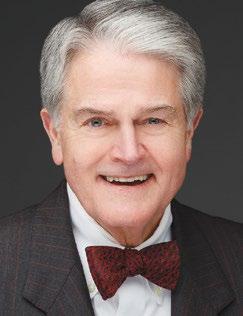
Cordell M. Parvin
5 Truths Every Attorney Needs to Know About Referrals
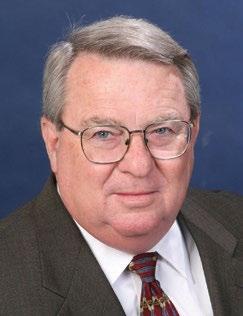
Stephen Fairley
6 Ways to Make Clients
Happy To Pay Your Bills
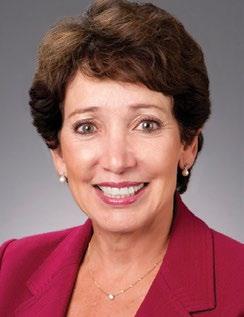
Merrilyn Astin Tarlton
SAN DIEGO
Is Your Vocabulary Costing You Money? Tom Hopkins
Seize Your Reader’s Attention and Erase Doubt from Your Marketing Copy Tom Trush
7 Steps to Productive Meetings Paul Burton
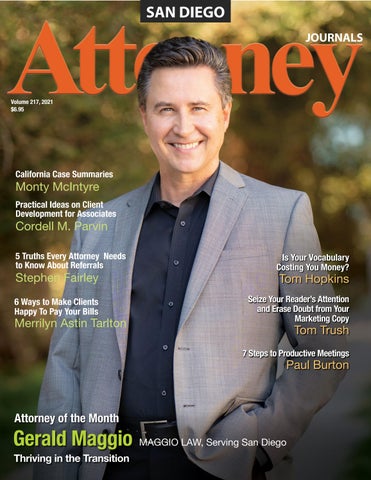
Thriving in the Transition Attorney of the Month
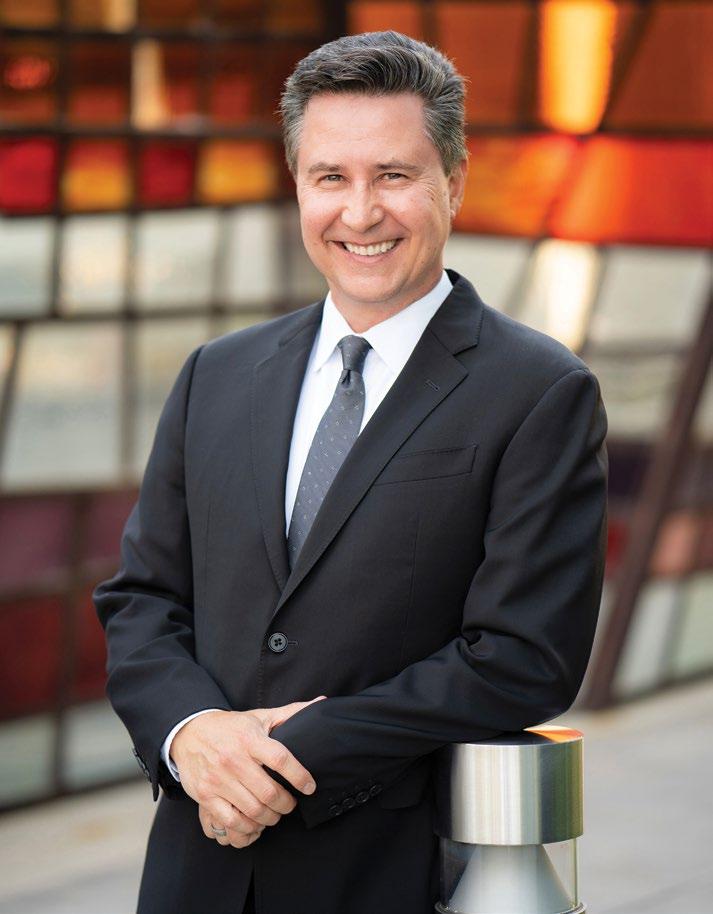
Gerald Maggio
• Complete defense jury verdict in real estate dispute and more than $400,000 collected for attorneys’ fees and costs in Batter v. McElhinney, et al. (2019)(Jason Kirby).
• $2.1 million jury verdict for firm client in Doe v. San Diego Unified School District, et al. (2018)(Jason Kirby & Michael Kirby).
• $1.1 million arbitration award for firm clients on cross-complaint after zeroing plaintiff on $6 million damage claim in Step Strategy Advisors v. Solid Gold Health Products for Pets, Inc., et al. (2018)(Jason Kirby lead counsel).
• Michael Kirby received the 2021 Best Lawyers in America® distinction for (1) Bet-the-Company Litigation, (2) Commercial Litigation, (3) Litigation –Real Estate, and (4) Litigation – Securities.
“Rick
~ C. Michael Alder, Esq., Alder Law, Los Angeles, California, CAALA Past President and Former Trial Lawyer of the Year
7 Steps to Productive Meetings
by Paul Burton
Meetings are the most expensive periods of time we spend together. Try, for example, adding up the loaded employee cost of a simple weekly status meeting. Your answer will make it immediately clear why meetings need to be highly productive to justify the expense.
EFFECTIVE MEETING ELEMENTS
Let’s focus on the components of a meeting, and how you can use a new structure to produce more efficient meetings that get the job done. These seven simple steps make every meeting more productive:
1. Set an Agenda
How can meetings occur without an agenda? It’s like scheduling a business trip without an itinerary! Agendas are simple to construct and distribute. The road map they provide not only prepares attendees for what will be covered, but agendas are a terrific way to keep the meeting on track. The more specific, the better the road map, and the more likely you are to accomplish the stated objectives.
2. Make Sure There Is a Hard Start and Hard Stop
Meetings need a physical structure, which means predetermined start and end times. The old saying that
“work fills the time allotted” is completely true. Always state the start and end times at the beginning of a meeting. This serves as a reminder and sets the parameters for everyone involved.
3. Prepare Necessary Materials—Only
A lot of work can go into preparing for a meeting, so prepare (or instruct others to prepare) only what is truly necessary to communicate effectively during the meeting. One thing that should be eliminated from virtually every team meeting is PowerPoint slides! Read that sentence again because it’s important. Most people use PowerPoint to put their speaking points on the screen. BORING! We can read speaking points, so why are we here in a meeting? Moreover, creating a list is much easier to do in an email or Microsoft Word than in PowerPoint—and there’s no setup time required to fiddle with the projector and such.
4. Distribute Materials in Advance
Send out materials well before the meeting—preferably, the day before—with a request people review them and come prepared to discuss the items listed. You don’t want to waste everyone’s time by reading your summaries to them! You want to leverage that time for input.
5. Moderate the Discussion
If this is your meeting, it’s your job to “run” or moderate it. That means staying quiet most of the time and acting as a guide to keep everyone on course (topic-wise) and moving forward (productivity-wise) within the time allotted. Think of it as a referee or facilitator role. You want to marshal these valuable resources (people and their ideas) toward an effective end. If you, as the leader, participate too much, you’ll run the risk of commandeering the meeting, which is not an effective use of team members’ time.
6. Confirm Decisions and Action Items
It’s the moderator’s responsibility to confirm, out loud with everyone in attendance, the decisions made, the action items determined (if any), and the people assigned to those action items. This can be reduced to a follow-up email and placed on a future agenda for updates. This is a huge point of failure for many meetings—the failure to articulate decisions, action items and attendant responsibilities. Ironically, it is generally the stated reason for meetings! Fix this hole by stating things clearly before everyone disperses.
7. Identify Follow-Up Expectations
The final point of any effective meeting is identifying and stating the next point of follow-up, if there is one. Place parameters around the work so people have relatively shortterm goals for producing a result. Make the follow-up period reasonable within the context of the work to be performed, but make it date-certain.
THE PATH TO MEETING PRODUCTIVITY
Group leaders and managers are charged with using their own time effectively, as well as leveraging their team’s time. Meetings are a perfect opportunity to do both! Make a checklist in Microsoft Word or Evernote so you have this meeting checklist available whenever a meeting is approaching. n
Paul Burton is a recovering corporate finance attorney who helps people regain command of their day. As a nationally recognized time management expert, Paul regularly speaks to audiences about getting more done and enjoying greater personal and professional satisfaction. He is the author of five books on productivity. Learn more at quietspacing.com and follow him @QuietSpacing. Previously published in Attorney at Work
Local Solutions. Global Reach.
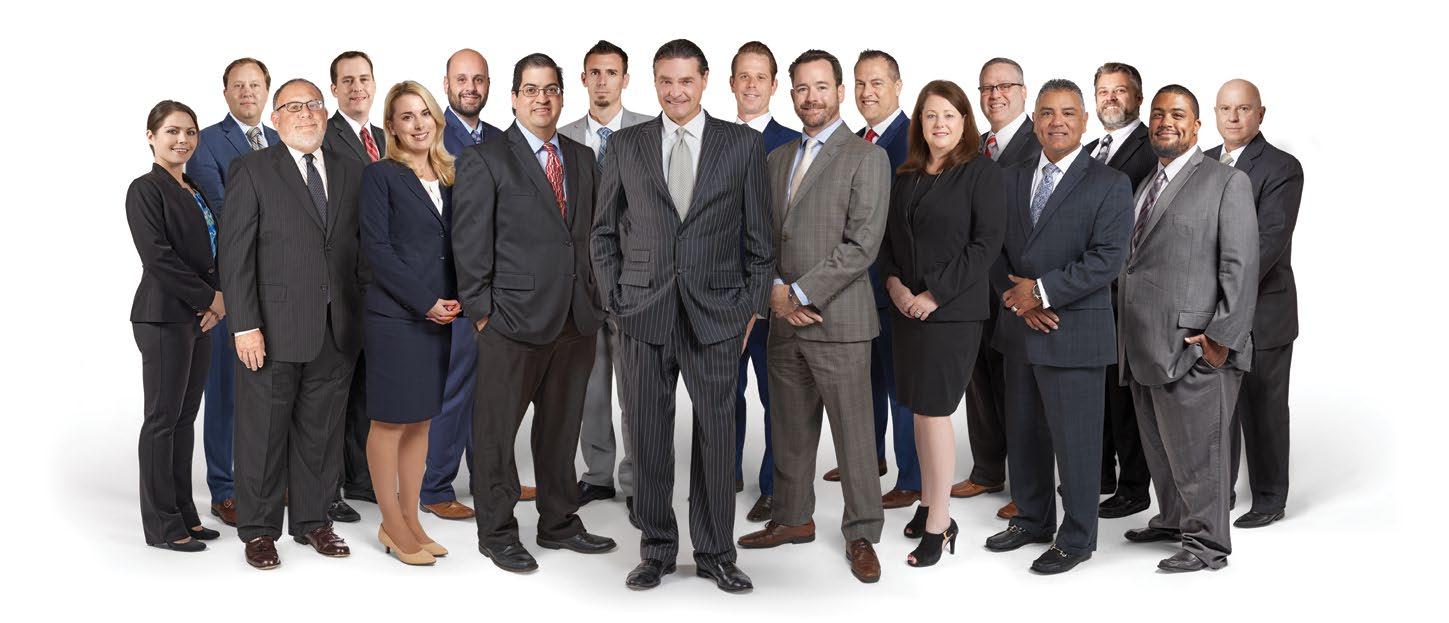
We are pleased to announce the return of Stanford And Associates, the original legal malpractice firm founded three decades ago.
We’ve reassembled our original team of lawyers, with a combined 50 years of prosecuting and trying legal malpractice claims throughout the state.
Don’t be fooled by others claiming to be a legal malpractice firm. Stanford And Associates is the original legal malpractice law firm and we:
• Never charge a consultation fee
• Never bill our clients by the hour
• Never represent or defend lawyers
• Never handle fee disputes between lawyers
We are pure contingency fee lawyers and we pay referral fees!
810
TEL: (619) 695-0655 FAX: (619) 810-7766
TOLL-FREE: (833) 309-6236
www.stanfordandassociates.com
Dan Stanford OWNER & FOUNDER
Kacie Vinel Co-Founder/Partner
Ben Coughlan Co-Founder/Partner
IPractical Ideas on Client Development for Associates
by Cordell M. Parvin
have done a lot of work helping associates with client development in my old firm and now as a coach. In this article, I want to share with you my practical ideas on associate client development.
Set Yourself Apart
Client development is more challenging today for a variety of reasons. First, business clients are no longer local or loyal and there are many more lawyers from which to choose. Second, you have less time but more choices of client development actions. Because you have too many choices, you may either never get started, or become ineffective in your efforts. However, if you have a plan, become visible to your target market and find ways to become a valuable resource and advisor for those clients and potential clients, you can become very successful. It is important that you start your efforts as early in your career as possible.
Client Development Myths
Associates seem to buy into client development myths and this stifles their efforts. Here are several of those myths:
• You either have it or you don’t. I can tell you from my personal experience that I did not have it. Knowing that drove me to work at it and develop my skills;
• Just do good work, get a Martindale AV rating, and wait for the phone to ring. There are thousands of lawyers in your city or area who do good work. Client development is a contact sport. It is about building relationships and adding value beyond the good work;
• “Too young and inexperienced to.…” Lawyers should start learning client development skills as early as possible. This is a marathon not a sprint, and even though you may not bring in a client now that fits your firm’s client profile, you are building towards doing so later;
• You have to be an extrovert and know how to work a room. I know lawyers who are very outgoing and do poorly because they talk about themselves and do not listen. I know introverted lawyers who do very well because they ask great questions and listen;
• You have to “ask” for business. Lawyers who are good
at asking for business do not come across as needy or greedy. I, personally, was uncomfortable asking so I tried to be the “go to” lawyer who would be sought by clients in my target market; and
• Associates in big firms do not need to learn client development. At the very least, associates in big firms with institutional clients need to learn about those clients and find ways to become more valuable to them. As expressed above, institutional clients are no longer loyal; they can’t be counted on as they have been in the past. So learning the skill set to get new clients is more important today than before.
What Successful Associates Share in Common
Here are some of the characteristics that I have observed over the years in the most successful associates:
• They are patient, persistent, and perseverant;
• They focus client development on things they are passionate about;
• They have a plan for their non-billable time as well as written goals;
• They regularly work on client development;
• They are seeking to become more visible to their target markets;
• They are getting feedback on their ideas and how they are doing;
• They find ways to hold themselves accountable;
• They all wish they had started their efforts earlier in their careers.
What Differences Do Associates Have?
Several associates with whom I have worked are “connectors.” Those lawyers are active in their communities and/or active in the bar. Other associates enjoy writing. They are writing articles that are published. When supported by their firms, they are blogging. Those lawyers are using writing as a way to
get speaking engagements in front of their target markets. Associates I have coached do their planning in a variety of ways. Some associates begin their planning looking forward five years and then working back. Others emphasize setting 90-day goals. Several associates use weekly plans and journals as their method of holding themselves accountable.
Successful associates do not “find” time for client development. Instead, they make time. Each associate develops different ways of making it. Several associates with whom I have worked spend time on client development after their children go to bed. Some associates work on client development on weekend mornings.
Some associates are using LinkedIn, Facebook and Twitter as tools to reconnect with classmates, firm alums, friends, and potential clients. Others are reaching out by phone.
Deliberate Practice
Practice things you want to get better at doing. Examples might include:
• Treating your supervising lawyers like clients, figuring out what they want and need and exceeding their expectations;
• Finding out what is going on that impacts your clients;
• Networking;
• Working on your elevator speech/questions;
• Identifying future issues impacting your clients;
• Writing articles for a business audience designed to get you hired;
• Public speaking;
• Questions for clients and potential clients;
• Active listening;
• Building the team and assigning work;
• Supervising and giving feedback.
Reading an article like this has very limited value by itself. It has to be translated into practice. If you want to get something out of the article ask yourself, “What can I do based on what I learned?” If you want to share your plan with me, I would enjoy hearing from you. n
Cordell M. Parvin built a national construction practice during his 35 years practicing law. At Jenkens & Gilchrist, Mr. Parvin was the construction law practice group leader and was also responsible for the firm’s attorney development practice. While there he taught client development and created a coaching program for junior partners. In 2005, Mr. Parvin left the firm and started Cordell Parvin LLC. He now works with lawyers and law firms on career development and planning and client development. He is the co-author of “Say Ciao to Chow Mein: Conquering Career Burnout” and other books for lawyers. To learn more visit his website www.cordellparvin.com or contact him at cparvin@cordellparvin.com.
YOU’VE BUILT A SUCCESSFUL BUSINESS. NOW YOU NEED A SUCCESSION PLAN.
Did you know that private and family business owners can use an Employee Stock Ownership Plan (ESOP) as a compelling alternative for selling their business at fair value while enabling it to remain independent?
Did you also know that ESOPs possess the ability to create retirement wealth for employees, support senior leadership recruiting and enable the owners to remain involved in the business, if they so choose?
Want to know more about the benefits of an ESOP for your company?
Contact Marc Schechter for more information: mschechter@bsllp.com | (858) 444-2300
One of the benefits of an ESOP is that it gives employees an interest in the longterm success of the business. Owners and founders invested in the continued success of the company can still maintain a majority interest and control of the company to ensure the company continues the traditions of quality, while rewarding the employees who helped build the company. ESOPs provide a transition process from private ownership to employee ownership, based on the owner's terms and timeline.
No one likes to pay bills. Even when the service or product we are paying for was way more valuable than the actual dollar amount on the invoice, we humans just hate to see the money out the door. And that natural resistance to doling out the bucks can often leave a lawyer looking at high accounts receivable and collections tasks galore. Yuck.
Why not implement a few changes to help your clients feel more positively disposed—dare I say enthusiastic—to pay promptly next month? These six things will help.
Don’t feel squeamish about this. Done the right way, marketing yourself does not diminish your reputation. On the contrary, it builds your reputation to the point where you will be turning clients away because your firm is in such high demand.
1. Greet them as a friend. Not only is it easier to pay someone you like, it is harder to stiff that person. Make a point of treating your clients as trusted and loyal friends. Use first names, express enthusiasm to see them, know about their business and their family, remember birthdays, understand what’s going on in their lives and refer to it, demonstrate that you are sitting on their side of the table. This will make doing business with you more pleasant (and improve your own experience of the time you spend in the office). Remember, too, that your client deals with others in your office, not just you. Model the way to make sure everyone—paralegals, secretaries, assistants, associates, partners, billing clerks—forms good relationships with all client representatives.
2. Keep them informed. Study. You may think it is your responsibility to do the job and tell the client about it afterward. And you may be right, that is what some clients want from you. Others want to know what’s going on when it is going on. Ask how they want to be updated, and make sure you give them what they want. This also applies to how you describe the work on your bills. I guarantee no one really wants to pay for an hour of your time, but if you can describe well what you did in that hour—and couch it in terms that show the value of the activity to them—clients will know more clearly why it makes good sense to pay you for it.
3. Go the extra mile. Demonstrate that a client’s relationship with you is worth more than the legal work you
6 Ways to Make Clients Happy to Pay Your Bills
by Merrilyn Astin Tarlton
perform. Make introductions to people who may be useful in their business or private life. Offer to co-write an article for publication about something significant you helped them do. Ask them to serve on a panel discussion with you to illustrate a new legal strategy. (Yes, this benefits you, too. Isn’t that nice?)
4. Please them with the work. Sure, winning the big case always pleases clients and makes them happier to pay the bill. But even when it’s not a big win, the way you handle yourself and their interests demonstrates that you are doing everything you can to help them resolve a conflict or strike an agreement. And it shouldn’t go without saying: Don’t take their emotional responses to developments lightly. Do listen well and feed back what you hear to assure them they are heard. Don’t take shortcuts. Do proofread to avoid misspellings and other errors.
5. Make the bill simple to understand. While we’re on the subject of misspelling and proofreading, please avoid legalese and financial gobbledygook in drafting your bills. Speak and write clearly. If the system you use doesn’t allow text descriptions on the actual invoice, write a cover letter or memo to clearly restate the charges and any necessary explanation.
6. Always, always say thank you. That client doesn’t have to engage you. There are a lot of lawyers out there looking for work—looking for good clients. Make sure your clients know that you are grateful for their business and pleased by their trust and loyalty. Thank them whenever you meet and whenever you write. Send a gift to honor business anniversaries or family birthdays, or just because. Make them feel important and appreciated.
It will make it so much easier for them to pay your bill. n
Merrilyn Astin Tarlton is the author of the new Attorney at Work book Getting Clients: For Lawyers Starting Out or Starting Over. She has been helping lawyers and law firms think differently about the business of practicing law since 1984. She is a founding member of the Legal Marketing Association, an LMA Hall of Fame Inductee, and a past President of the College of Law Practice Management. Merrilyn was a founding partner of Attorney at Work. Learn more about Merrilyn and follow her on Twitter @astintarlton. Previously published in Attorney at Work
THRIVING IN THE TRANSITION
Family Law Firm Adapts and Thrives in a Changing Legal and Health Environment
by Dan Baldwin
As with many firms, Maggio Law Orange County Divorce Attorneys found the pandemic a major challenge to not only serving clients, but also to survive as a business. In adapting and making the necessary changes, the firm found itself in a position of providing even better, more flexible, and more personal service to its family law clients.
Founder Gerald Maggio says, “Covid has marked the biggest changes in our firm, how we operate and how we interact with our clients and the legal system. We had to react in a very short time period. The changes were tough, but we’re a much better firm for taking on the challenge.”
The process of making the transition from a standard office to a remotely connected operation took several weeks. Not only did Maggio have to set up people for remote work, but he also had to purchase new equipment to enable staff to work remotely. The firm purchased an internet-based phone system that allowed the staff to have all calls routed to individual attorneys or support staff. They bought another set of computers along with printers and scanners for every staff member to be able to work remotely. The process was made
an even bigger challenge because, due to the lockdown, all the changes had to be made remotely. Eventually, the lawyers and staff communicated in virtually the same manner as standard inter-office communication regardless of distance.
Clients, suppliers, and members of the legal system took to the process quickly and appreciated their efforts and proved to be enthusiastic about the transition.
Maggio Law also handles mediation cases, usually a face-to-face process, but those challenges too were readily handled. “We’re able to conduct mediation by video conferencing. In many ways, the process is more efficient. The participants can be anywhere, at home at the office, anywhere. There is a lot more flexibility now for clients,” Maggio says.
The other big change was using remote video in family law court. Maggio has been to court physically only four or five times since March of last year. He says that his firm has found the remote video process in many ways better for clients because they didn’t have to travel to court, wait around in court, or pay attorneys for that travel and wait time.
He says, “Many of us in this area of the legal community hope they keep up some process for some hearings to be conducted via remote video post-Covid. More complex hearings can be handled in person; it’s better that way. For simple hearings and so on, I hope the court will keep something in place in that regard. Overall, the challenge of making the transition has proven to be a significant benefit to the firm and especially to our clients.”
KEEPING IT REAL
The typical client for Maggio Law Orange County Divorce Attorneys is someone looking to file for divorce or respond to a filing for divorce—someone who has a job or is selfemployed, has at least one child, owns a home, and has assets and debts to divide. There are usually issues of child custody, child support, spousal support, division of assets and debts, and in cases of people that are self-employed, there can be issues of business valuation and cash flow analysis. The firm handles paternity cases that involve custody and child support issues as well as stepparent adoptions.
Maggio says, “We keep it real. I do not try to overcomplicate matters just to drag out cases and churn out more legal fees. I have a practical approach to all cases and where it makes sense to settle, we always make strong efforts to do so. It makes no sense to spend one to two years in litigation to end up settling based on what could have been worked out the same way in the first six months. Divorce is expensive and can cause clients and their families financial damage in the process, which should be avoided if it can be. But when cases or issues need to be litigated, we don’t hesitate to do so.”
For example, he handled a complicated case involving division of assets including three business plus custody and more. The spouse was horrible to his client and very contentious throughout the process. Ultimately, the case went to trial, which ended with a good outcome for his client. Justice was served because the other spouse didn’t get what they were asking for and in fact, the court didn’t even require his client to pay legal fees. That spouse left with a lot of legal bills and expert bills because Maggio and his team were able to get the court to see that person for who they were.
Maggio practices patience, real caring for clients, and being a good listener when working with clients. “When I take a case, I have to understand what a client wants and why and really listen to them while also making sure they understand the ramifications of what they may want in a case, because in the end, it’s really their case and their life. I need to advocate for their rights and what they want while also making sure that they are not asking for something that would be considered completely unreasonable or not credible in the eyes of the Court. I’ve said it often, an attorney has to ‘keep it real.’”
LEARNING FROM AND GAINING EXPERIENCE
Maggio stresses to his attorneys and staff the importance of learning from every case and every work experience. He cites his own work record as proof. He had worked for a number of law firms while going to law school and after passing the Bar, developing a lot of experience in several areas of law. He went to work for several firms for about five years before going out on his own. “I knew the week that I went to work at the last firm I worked for that I had made a mistake and within a year, I decided to open my own law firm with only a few cases in hand. That was a risk since I had three young children at that time. However, it proved to be worth it the first year, I started my own practice in 2005 and I never looked back or regretted my decision.”
Maggio Law Orange County Divorce Attorneys now
employs a full-time associate attorney, a paralegal and two other legal assistants. He recently changed the name of the firm to reflect the growth and direction of the firm. “Our firm is a team. Changing the firm name reflects how we’ve survived, how we’ve grown, and where we are going.”
He cites an example of a divorce case that worked out fine for his client but a case in which both parties spent more money than they should have. They were a lower middle-class family and could not afford to spend what they spent. The problem was basic; neither side could agree on anything.
“I believe that their attitude in that case likely affects them and their children financially to this day. That experience led me to become a trained divorce mediator. Divorce mediation is something I really believe in and can save parties a tremendous amount of money over traditional divorce litigation if the parties are willing to be reasonable and compromise. I created a saying from that experience: not every marriage can be saved, but every family can. That’s especially true when it comes to using divorce
mediation as a cost-effective way to end a marriage.
Learning from experience pays off in many ways. For example, the firm’s newest attorney, Ellie Fazeli, met Maggio when they were on opposing sides during a case. She says, “I found him to be a great attorney. He was very professional, and I enjoyed working with him even though he was on the opposite side. We met again by pure luck. He had a blind job posting. I applied not knowing it was for his firm. From the way the job posting was worded I felt that the office really cared about their clients. When I applied, he remembered me and the case and he called me. It has now been over a year that I have been part of this amazing team and it is one of the positive things that has happened during the pandemic.”
“I realize that there are a lot of lives, particularly the children’s, who are impacted by what we do every single day. I am dedicated to our clients and the children. I enjoy my work because I am constantly learning something new. It’s a great professional environment. We get things done,” she says.
The Maggio Law Team: Debbie Maggio, Carol Sullivan, Gerald Maggio, Ellie Fazeli, Britney Vargas and Sara Fenn
LOOKING FORWARD TO THRIVING IN FUTURE CHALLENGES
In the end, the turmoil created by the pandemic has created a stronger legal firm. “Now because of what has happened we’re more flexible because we don’t have to go into the office. We can work anywhere.
Maggio believes the Covid situation was a wakeup call to the court system as to the desirability of using the latest in communication technology. He notes that family court was technology-wise behind in many ways and didn’t keep pace. Covid changed all that. Although he doesn’t predict that the advances will replace all court appearances, he firmly believes that overall, they will improve the system for everybody. Cases will be handled faster, better and more efficiently in the future.
His plans for the firm include hiring more staff as their case load increases. He is also seeking to expand their divorce mediation practice not only in Orange County but other counties, which is now much more plausible with the ability to use remote video that most people are now comfortable with after the last year and a half of Covid restrictions. He notes that although the number of divorce cases has gone down the past year, the firm hasn’t noticed that at the office. There was a lull in the first months of the Covid lockdown, but once it worked its way through, everybody adjusted to the new reality and people began returning to family court. Their case load has actually increased.
“When you practice family law and divorce, you wear a lot of different hats, which can include almost being a therapist and having compassion for what clients are going through. It can be a very emotional and personal area of law and I have colleagues and friends that practice other areas of law that say that because of that, they could never practice divorce and family law. However, I came to realize that my personality and interpersonal skills are best suited for this area of law. Moreover, what I do feels more real to me than other areas of law because I’m dealing with people’s lives and I have the ability to help make a difference in those lives more than I ever could practicing another area of law,” Maggio says. n
Contact Gerald Maggio MAGGIO LAW
Orange County Divorce Attorneys 420 Exchange, Suite 270 Irvine, CA 92602 (949) 553-0304
team@maggiolawfirm.com www.maggiolawfirm.com
»
EDUCATION
• Graduated from San Diego State University 1990
• Graduated from Western State University College of Law 1998
» AWARDS AND REVIEWS
• OC Metro Top Attorneys
• Prime Buyers Report Top 10 Certified
• American Institute of Family Law Attorneys 10 Best Attorneys for California for 2017–2021
• American Society of Legal Advocates Top 100 Family Lawyer for California 2018–2021
• Lawyers of Distinction 2019–2021
• National Association of Distinguished Counsel Nation’s Top One Percent 2015–present
• AVVO Rating: “Excellent” 10.0 rating with 103 client reviews as of August 2021
• Google Reviews: “Excellent” 5.0 Star rating with 60 client reviews as of August 2021
» ASSOCIATIONS
• Member, Orange County Bar Association, 1996–present
• Member, the American Society of Legal Advocates
• Member, the American Institute of Family Law Attorneys
• Member, the National Association of Distinguished Counsel
California Case Summaries New California Civil Cases
by Monty A. McIntyre, Esq.
These recent cases summarized by Monty A. McIntyre are from his publication California Case Summaries™. Monty prepares short summaries (one paragraph), organized by legal topic, of every new published California civil and family law case that California lawyers can subscribe to on either a monthly, quarterly or annual basis. Monty also offers specialized practice area annual summaries in the areas of Employment, Family Law, Real Property and Torts. For more information go to https://cacasesummaries.com. A California civil trial lawyer since 1980, a member of ABOTA since 1995, a past president of the SDCBA and San Diego ABOTA, and also an expert Zoom user, Monty serves as a mediator, arbitrator and referee with ADR Services, Inc. handling cases throughout California in the areas of business, elder abuse, employment/wage & hour, insurance bad faith, legal malpractice, medical malpractice, personal injury, real property and wrongful death. Web: https://www. adrservices.com/neutrals/mcintyre-monty/ To schedule a matter, contact Monty’s case manager Haward Cho, (619) 233-1323 or haward@adrservices.com.
Shalabi v. City of Fontana (2021) _ Cal.5th _ , 2021 WL 2908526: The California Supreme Court affirmed the judgment of the Court of Appeal concluding that plaintiff’s action under 42 United States Code section 1983, for the wrongful death of his father, was not barred by the two-year statute of limitations. Plaintiff was a minor when his father was killed. Code of Civil Procedure section 352(a) provides that when a minor is injured, the statute of limitations for any claim arising from the injury is tolled until the minor reaches age 18. The California Supreme Court ruled that, pursuant to Code of Civil Procedure section 12, an individual’s 18th birthday is excluded when calculating the applicable limitations period. The California Supreme Court also ruled that its earlier decision in Ganahl v. Soher (1884) 2 Cal.Unrep. 415 (Ganahl I) was not binding because the California Supreme Court granted a hearing in bank in Ganahl I and issued a subsequent superseding decision, thereby vacating Ganahl I. (July 12, 2021.)
Employment
Ferra v. Loews Hollywood Hotel, LLC (2021) _ Cal.5th _ , 2021 WL 2965438: The California Supreme Court reversed the judgment of the Court of Appeal concluding that the employer did not have to include nondiscretionary payments when calculating the amount to pay their employee for noncompliant meal or rest breaks in accordance with her “regular rate of compensation” as required by Labor Code section 226.7(c). The California Supreme Court held that the term “regular rate of compensation” in section 226.7(c) has the same meaning as “regular rate of pay” in Labor Code section 510(a) and encompasses not only hourly
wages but all nondiscretionary payments for work performed by the employee. (July 15, 2021.)
CALIFORNIA COURTS OF APPEAL
Arbitration
Law Finance Group, LLC v. Key (2021) _ Cal.App.5th _ , 2021 WL 3240276: The Court of Appeals reversed the trial court’s order vacating an arbitration award in favor of claimant awarding it simple interest in the amount of $778,351 and costs and attorney fees in the amount of $838,864 as the prevailing party. Respondent had borrowed $2.4 million from claimant to finance her probate litigation. After respondent prevailed in that litigation, she repaid claimant the principal of $2.4 million but refused to pay interest claiming the loan was a consumer loan that violated the California Financing Law (Financial Code, section 22000 et seq.). A panel of three arbitrators found that some of the loan terms were invalid but otherwise enforced the loan agreement. The panel served the modified award on September 18, 2019. On October 1, 2019, claimant filed a petition to confirm the award. Respondent filed a motion to vacate the award 130 days after the service of the modified award, claiming the arbitrators exceeded their authority by finding that the loan was a consumer loan but nevertheless enforcing some of the terms of the loan agreement rather than finding it void. Nine days later, respondent filed a response to claimant’s petition to confirm the award that raised the same argument. The Court of Appeal ruled that both respondent’s motion to vacate the award and her response to the motion to confirm the award were untimely because they were not filed within 100 days of the service of the award as required by Code of Civil Procedure sections 1288 and 1288.2. (C.A. 2nd, July 30, 2021.)
Remedial Construction Services v. Aecom (2021) _ Cal.App.5th _ , 2021 WL 2431256: The Court of Appeal affirmed the trial court’s order denying defendant’s motion to compel arbitration. Plaintiff, a subcontractor on a construction project, sued defendant, the general contractor. Defendant moved to compel arbitration based upon an arbitration agreement in the contract (prime agreement) between defendant and the property owner. The subcontract between plaintiff and defendant incorporated the 151-page prime agreement including the arbitration agreement. The trial court properly ruled that the subcontract’s incorporation of the voluminous prime agreement containing an arbitration agreement between other parties was insufficient to subject plaintiff to arbitration of its claims against defendant. In the absence of a clear agreement to submit a dispute to arbitration, courts will not infer a waiver of a party’s jury trial rights. (See Avery v. Integrated Healthcare Holdings, Inc. (2013) 218 Cal.App.4th 50, 59.) (C.A. 2nd, June 15, 2021.)
Attorney Fees
Harris v. Rojas (2021) _ Cal.App.5th _ , 2021 WL 3046421: The Court of Appeal affirmed the trial court’s order concluding there was no prevailing party and awarding no attorney fees. The action was filed by the commercial tenant plaintiff against his landlord who cross-complained back against the tenant. The litigation continued for nearly three years and culminated in a seven-day jury trial. Plaintiff asked the jury for $200,000 and the jury gave him $6,450 on his contract claim. Plaintiff’s lawyers demanded $296,744.68 in attorney fees from defendant. The trial court denied the fee request on the ground there was no prevailing party. The Court of Appeal affirmed, concluding that when the demand was $200,000 and the verdict was $6,450 or less, the trial judge had discretion to decide the “victory” was pyrrhic and nobody won. (See Hsu v. Abbara (1995) 9 Cal.4th 863, 875.) (C.A. 2nd, July 20, 2021.)
Pasternack v. McCullough (2021) _ Cal.App.5th _ , 2021 WL 2633050: The Court of Appeal affirmed the trial court’s order awarding attorney fees of $146,010 to defendant after he prevailed in an anti-SLAPP motion to strike. Plaintiff argued the fee award was excessive because the awarded fees were higher than the insurance defense rate (a package rate of $140 per hour) actually paid to the defense firm by the carrier. Defendant’s motion for fees had requested a fee award of $330,420. The Court of Appeal held a trial court has discretion to award an hourly rate under the lodestar method that exceeds the rate that was actually incurred or paid. The trial court properly determined the market rate for experienced appellate lawyers in Los Angeles County and exercised its discretion to not so narrowly focus on the insurance defense package rate agreed to in this matter. (C.A. 2nd, filed June 7, 2021, published June 25, 2021.)
Civil Procedure
Cahill Construction Co., Inc. v. Superior Court (2021) _ Cal. App.5th _ , 2021 WL 3030225: The Court of Appeal denied a writ petition seeking to overturn the trial court’s order denying a defendant’s request to depose the plaintiff for more than 14 hours in an action against 105 defendants alleging 11 causes of action arising out of plaintiff Edward Richards’ alleged asbestos exposure that sought both compensatory and punitive damages. Ruling on an issue of first impression, the Court of Appeal held that a trial court cannot grant deposition time in excess of the 14-hour cap set forth in Code of Civil Procedure section 025.295(b)(2). (C.A. 1st, July 19, 2021.)
Employment
Levanoff v. Dragas (2021) _ Cal.App.5th _ , 2021 WL 2621360: The Court of Appeal affirmed the trial court’s conclusion, following a bench trial, regarding a subclass of dual rate employees who allegedly were underpaid by defendants for overtime hours worked, that defendants did not violate California employment law by using the rate-in-effect method for calculating the overtime rate of pay and its subsequent order decertifying the dual rate overtime subclass and dismissing the claims under the Labor Code Private Attorneys General Act of 2004 (PAGA; Labor Code section 2698 et seq.). Defendants did not violate California law by using the rate-in-effect method for calculating the regular rate of pay for purposes of establishing the overtime rate of pay for dual rate employees. California law does not mandate the use of the weighted average method, and defendants’ dual rate employees, including plaintiffs, overall received net greater overtime pay under the rate-in-effect method than they would have received under the weighted average method. Because defendants did not violate California law by using the rate-in-effect method, the trial court did not err by decertifying the dual rate overtime subclass and dismissing the dual rate overtime PAGA claim. (C.A. 4th, June 25, 2021.)
Torts
Swanson v. The Marley-Wylain Co. (2021) _ Cal.App.5th _ , 2021 WL 2282641: The Court of Appeal reversed the judgment for plaintiff, following a jury trial, awarding plaintiff $5,489,688.68 in an action for injuries due to exposure to asbestos. Earlier in the case the Court of Appeal granted a peremptory writ of mandate directing the trial court to grant a motion for an order that Michigan law applied to plaintiff’s claims against defendant. The evidence of causation presented at trial would have been sufficient under Michigan law to support the jury’s verdict. But, the trial court’s instructions to the jury regarding causation reflected California law, not Michigan law. The Court of Appeal concluded that the trial court improperly instructed the jury on Michigan law and that error was prejudicial, and therefore reversed the judgment and remanded to the trial court for retrial. (C.A. 2nd, filed June 4, 2021, published June 24, 2021.) n
WIs Your Vocabulary Costing You Money?
by Tom Hopkins
hen we give a presentation to a future client not only do our appearance, visual aids, and body language relay a message, but the words we use create pictures in their minds. When we hear a word, we often picture a symbol of what that word represents. We may even attach emotions to some of these words. For example, let’s consider the words, SPRING, SUMMER, AUTUMN, WINTER. Depending on your particular experience, each of those words can generate positive or negative emotions in you, right?
The same applies to the words you use in your contacts with customers. You don’t know in advance which words will generate positive feelings in your clients about you, your product and your company. That’s why people in selling must become extra sensitive to the use of words if they want to have successful careers or businesses.
One of the most commonly used words in sales is the term “contract.” What type of mental image does that term bring to your mind, especially when you picture yourself as a consumer? For most of us, it’s negative. We have an image of fine print, legalities and being locked into something that requires legal action to get out of. For this reason, I recommend that salespeople stop using that term, unless your particular line of business requires it. Instead, use the terms paperwork, agreement or form. Think about each of those terms for a moment. Do they bring to mind threatening images? If they do, I’ll bet those images are a lot less threatening than those created by the term contract. Do yourself a favor and eliminate that term from your vocabulary. Use paperwork, agreement or form instead.
What about the words “cost” and “price?” What pictures do they bring to your mind? If you’re like me, I see my hard-earned cash leaving my pocket. Substitute the terms investment or amount in place of cost or price. When most people hear investment, they envision getting a return on their money which is something positive. Now, there are products for which the term investment would not be appropriate so let’s use the term amount for them. That word has been proven to be less threatening to most consumers than the terms cost and price.
The same idea goes for the next terms, “down payment” and “monthly payment.” Most people envision down payments as large deposits that lock them into many smaller monthly payments for a considerable time period. They may see themselves receiving bills and writing checks every month. Not too positive a picture, is it? Replace those phrases with these: initial investment or initial amount and monthly investment or monthly amount.
The next terms I’d recommend you change are “sell” and “sold.” Many salespeople will tell prospective customers about how many units of their product they have sold. Or, they’ll brag about having sold the same product to another customer. What are the mental images here? No one likes the idea of or the feeling derived from being sold anything. It sounds as if the customer didn’t really have much say in the matter. Replace sell or sold with helped them acquire or got them involved.
Another term I feel is over-used by salespeople is the term “deal.” What does this bring to mind? Something we’ve always wanted, but never found. Top salespeople never offer deals to their clients. They offer opportunities or get them involved in transactions.
The last, but definitely not the least important term I recommend you change is “sign.” Never again ask a customer to sign your agreement, form or paperwork. We’ve all had it drilled into us from early childhood never to sign anything without careful consideration, haven’t we? So, why would you want to create that emotion in anyone you were trying to get happily involved in your product or service? Instead of asking them to sign, ask them to approve, authorize, endorse or OK your paperwork, agreement or form. n
Tom Hopkins International has been dedicated to providing the finest sales training strategies and techniques to individuals and companies alike. Tom Hopkins is world-renowned as The Builder of Sales Champions. His selling skills and sales strategies have helped millions of sales professionals and business owners in industries from A to Z to serve more clients, make more sales and earn millions in income. Copyright Tom Hopkins International, Inc. See more at: www.tomhopkins.com
SAN DIEGO CRIMINAL LAWYERS
5 Truths Every Attorney Needs to Know About Referrals
by Stephen Fairley
At The Rainmaker Institute, we specialize in helping attorneys improve their revenues and increase the quality and quantity of their referrals. One of the things attorneys most frequently ask us is: “How do I find more clients fast?”
The answer to this question is deceptively simple, yet amazingly complex to resolve. Referrals are near the top of the list when it comes to the best ways of finding new clients, but there are three pervasive myths, discussed in a previous article that I would like to dispel about referrals first.
1. Clients are the best sources for referrals
2. Other attorneys provide the most referrals
3. Networking provides great referrals
While there is some truth to these myths, they are not entirely accurate.
Clients aren’t the best source for referrals, just the most obvious. They are not always aware of all your services and you may not be the first person to come to mind when a friend comes to them for legal advice.
Also, attorneys assume that most referrals can come from other attorneys, but that’s because they aren’t considering the other professionals that they surround themselves with. Consider accountants, financial advisors, realtors and other professionals with whom you can ally yourself. Choose professionals in careers that cater to the same sort of clients as your practice and you will be able to become natural allies without the concern of competition.
Networking groups are also great places to make contacts, but attorneys don’t always follow up and create solid connections or they attend the wrong events. If you go to a luncheon filled with other attorneys in the same field, then you’re limiting the effectiveness of your efforts. If, however, you attend networking events filled with prospective clients, you’ll make better use of your time. If you’re a business attorney, consider joining a local business networking group. While these myths may mislead attorneys, these five compelling truths about referrals will help guide you to more business:
Truth #1: People Make Referrals to Build Social Capital
Most people enjoy making referrals to their friends and associates as a way of building social capital. If you truly want to build a referral-based law firm then you need to develop a habit of referring your clients and contacts to other professionals. It must be reciprocal to work longterm. When you refer a client to another professional, they feel more inclined to refer one of their clients to you. This becomes a give and take process. The more referral relationships you develop among your professional associates, the easier it will be for your practice to flourish from the referral business.
Truth #2: Mitigating Risk Is Important
All referrals involve some risk—if someone sends you a referral and it turns our poorly, chances are you won’t receive too many other referrals. Attorneys who count on referrals for business generation need to take necessary steps to mitigate this risk with clear communication, setting expectations from the start, ongoing client education and stellar follow-up. This risk goes both ways. If you refer one of your clients to a professional associate and it doesn’t go well, than it reflects poorly on you. Don’t make referrals lightly; ensure that the professional associate is capable of handling the case.
Truth #3: People Refer Great Experiences
People who have had great experiences with a product or service tend to refer it to their friends and colleagues. Which is why cultivating a culture of great client service is a must for gaining more referrals. How can you create a “VIP” experience for each client and referral that walks in your door?
While a lot of referrals can come from a referral network or a professional associate, clients also have the ability to spread your name. It is important to remember that people will tell friends and family about a bad experience before they will brag about a positive one. In order to keep your positive service top of the mind, make sure that you keep past and current clients up to date on your practice, awards and services. If a friend comes to them, they may remember reading your newsletter about a recent case or award. They may be more inclined to recall their own positive experience with you.
Truth #4: Referrals Require Trust
Even if someone raves to a friend about you, that referral is likely to conduct a credibility search for you on the Internet. If the referral can’t find good content, reviews or social network participation, they will be less likely to proceed with contacting you. You need to manage your online image. Make sure to regularly check sites with client reviews. If someone posts a negative review, address it immediately. Don’t let a bad review turn away potential clients.
Also, make sure that clients can easily find you. Make your LinkedIn profile public, so they can look over your
endorsements, your honors and your work experience. Make sure that you claim any attorney directory pages, so that it has accurate information. Clients should be able to contact you from any webpage.
Truth #5: Referrals Require a System
Attorneys need to create a referral strategy that includes a systematic approach to educating referral sources what a good referral looks like and how to make it. This includes keeping all clients and professional associates current with your practice. Make sure that they are on your newsletter list. If you write an article about your practice area, send it out to everyone. n
Stephen Fairley is CEO of The Rainmaker Institute, LLC, the nation’s largest law firm marketing company specializing in small law firms. Over 8,000 attorneys have benefited from applying their proven Rainmaker Marketing System. Stephen is a best-selling author of 10 books and a nationally recognized law firm marketing expert. He has appeared in the American Bar Association’s Journal, Harvard Management Update, Inc and Entrepreneur. To receive your free copy of his book “Top 10 Marketing Mistakes Attorneys Make” visit www.TheRainmakerInstitute.com or call 888-588-5891.
Drafting the Headline
During the last century, countless advertising and marketing experts have crowned it king of the copy castle —the most critical element in any promotional piece.
This status is well-deserved.
After all, the headline is your first opportunity to grab your prospect’s attention. If you fail to attract eyeballs and communicate a reason to continue reading, then there’s little
“On
the average, five times as many people read the headlines as read the body copy. It follows that unless your headline sells your product, you have wasted 90 percent of your money.”
—David
Ogilvy, world-famous advertising executive and best-selling author of “Ogilvy on Advertising.”
use for the remaining copy because most people won’t see it.
The good news is you don’t have to be a great wordsmith to write powerful headlines. You can simply alter ones that are already written to fit your needs.
Once you understand the inner workings of a powerful headline, you can replace the elements with your own information.
For example, let’s look at this article’s title (which serves the same purpose as a headline on an advertisement or marketing piece). There are at least three words you could change to target a completely different audience. In my opinion, the easiest terms to remove and replace are “Writer’s,” “Creating” and “Headlines.”
If you want to target people who hate crunching numbers at tax time, why not use the headline The Reluctant Accountant’s Guide to Filing Taxes ?
If you want to target people who are hesitant about cooking their Thanksgiving turkey, you could try The
Seize Your Reader’s Attention and Erase Doubt From Your Marketing Copy
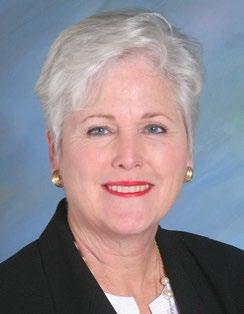
by Tom Trush
Reluctant Cook’s Guide to Roasting the Perfect Turkey.
Get the idea?
A great source for coming up with headlines is Digg (www.digg.com). A social news website for discovering and sharing content from the Internet, Digg allows its users to determine the value of information using votes (or “diggs”).
When you visit the site, it won’t take you long to notice a trend. Many posts with the most votes on Digg are numbered lists. Here are a few examples from this morning:
5 Ways Restaurants Provide You With Better Service
Top 5 Food Shortage Nightmares
15 Best Free Windows Mobile Apps
“How to” headlines are also common on Digg. If you study Ogilvy’s ads, you’ll see he frequently used “how to” headlines to tell potential clients about his agency’s expertise ...
How to Create Corporate Advertising That Gets Results
How to Launch New Products
How to Make Your Sales Promotions More Profitable
The reason numbered lists and “how to” headlines are so effective is because they promise readers helpful information.
If you use these types of headlines, be prepared to provide valuable content in your body copy so you reward readers for investing their time. You’ll be amazed at how fast you can build credibility and trust with them when you share your knowledge.
7 Quick Ways to Erase Doubt From Your Marketing Copy
Your prospects become suspicious the instant they start reading your marketing materials.
The reaction is only natural. After all, when you’re a prospect and you’re asked to take action on an offer, your internal skeptic alarm goes off, too.
Right?
So you realize you have only a few seconds to reverse your prospects’ thought process and get them on your side. The challenge is figuring out how to complete this transformation. Here are 7 quick ways to eliminate your prospects’ doubt when they read your marketing copy:
1. Address doubts immediately. The longer you let suspicions linger, the more you risk your prospects fleeing to another marketing piece that better addresses their concerns. When you deal with objections, you become someone who helps rather than sells.
2. Add personality. Your copy isn’t just words on a page. If you want interaction, you must view the words you write as a friendly conversation. Prove to your prospects why you’re just like them and you’ll gain credibility.
3. Write the way your prospects talk. When you “speak” their language, you quickly establish a level of trust. Long words and jargon can create confusion and, in some cases, a sense of inadequacy.
4. Support your claims with proof. Testimonials, statistics and case studies go a long way in reducing doubt. Your prospects want to know people just like them were successful using your legal services.
5. Encourage involvement. Ask for opinions or responses to questions. Give prospects a checklist to help determine desires. You can even lead them to an audio, video or photo to engage their senses.
6. Give an escape route. This means making your offer risk-free. A guarantee or trial period shows confidence in what you offer and allows prospects to test your legal services on their own terms.
7. Deliver value. When you give freely, your prospects will feel more inclined to return the favor. There’s no substitute for making them feel like you truly care about their needs.
Keep in mind, regardless of how well you write your copy, you’ll never get prospects to do anything they don’t want to do. All you can do is capitalize on an unfilled need or desire. n
Tom Trush is a Phoenix, Arizona-based directresponse copywriter who helps entrepreneurs and executives craft lead-generating marketing materials. Pick up his latest book, Escape the Expected: The Secret Psychology of Selling to Today’s Skeptical Customers.
To schedule, contact Haward Cho: (619) 231-1323 or haward@adrservices.com
succinct summaries of
California civil and family law case, published every month for $50.00 a month. Subscribe at www.cacasesummaries.com