
This year’s Crib to College includes a plethora of stories tailored to inform and appeal to students of all ages, parents, academic instructors and community members. Teens and parents with teenagers will be able to soak in the teachings of South Orange County experts on the topics of mental health, what new drivers need to know about insurance coverage, learning how to be a financially sound student in preparation for college and more.
insurance coverage information parents and new drivers should know about


BY ELAINE LAVINE
Learning to drive is a classic rite of passage for any young person, but along with the excitement and the freedom of driving come new responsibilities. Adding a teen driver will likely lead to changes in your household, as well as changes to your auto insurance policy.
Because teens are high-risk drivers, adding a teenager to your auto insurance policy will lead to an increase in your overall premium. Why?
The facts are telling. According to the Centers for Disease Control and Prevention (CDC), traffic accidents are the leading cause of death for 15- to 20-year-olds in the United States.
Below are a few tips to keep your teen safe and to keep the costs down:
• Safe driving discounts. Enroll in the Steer Clear® Driver Discount Program. Your teen will need to log their supervised practice drives, sign a parent/teen agreement, do a pre-and-post program assessment, and meet with your State Farm® agent.
• Good student discounts. In some states, some insurance companies actually offer discounts for students who maintain a

high grade point average. Consistently earning high grades is one of the most effective ways your teen can save you money on your auto insurance.
• Driver safety training. It’s important to make sure your teen is aware of the new risks and new costs associated with driving, as well as the importance of maintaining a clean driving record. Traffic violations will often lead to even higher premiums. Know and enforce your state’s Graduated Driver Licensing laws.
If additional driver safety courses are available in your area, encourage your teen to enroll in them. In some states, attending classes beyond what’s required to earn a driver’s license can lead to additional savings. See the State Farm Teen Driving resources for more information about teen driver safety and tools for new drivers and their parents at www.statefarm.com.

Elaine LaVine is an insurance agent for State Farm of Dana Point. She is an expert on driver safety, auto insurance and program assessment. She can be reached at elaine. lavine.a493@statefarm.com.


BY ANDREA PAPAGIANIS-CAMACHO
This is a cautionary tale. Not one meant to scare, but one aimed to prompt action—careful planning coupled with dedicated execution. Stay your course, stay engaged and you can get through this. College that is. Hopefully without a heap of debt under your feet as you start into the world.
Let’s start off with a couple of facts: (these are all about undergraduate education)
• Community colleges across California have the same state-mandated enrollment fee: $46. That’s $46 per unit. So if you take a full course load—or 12 units—that comes to $552 in course fees.
• Students enrolled in the California State University system pay the same base tuition fee: $5,742. This figure is for in-state students attending school full time (six or more units a semester).
• California residents attending a University of California campus full time
pay the same in system-wide tuition and fees: $12,630. You can add about $1,000 in campus-specific fees to this number.
This is just tuition costs. And these, as you may soon learn, are subject to increasing without much notice. There are other things that come along too. You’ve also got to take into account housing, books, supplies, transportation and the ever important necessity, food—coffees, snacks and late-night cravings included.
It’s overwhelming. But you aren’t alone.
According to the National Center for Education Statistics, some 20.4 million students are attending American colleges and universities this fall—that’s about 5.1 million more college students than in 2000. It’s safe to say there are a few people in the same boat, navigating the college-funding waters.

the Federal Reserve Bank of New York estimates that American students carry a massive $1.31 trillion in outstanding student loan balances. Upon graduation, nearly half of student loan borrowers owe at least $20,000. That’s double the share from a decade ago, according to a recent report by the Consumer Financial Protection Bureau. While loans may be inevitable, you can try to keep the amount you borrow on the low end.

One more fact before we get to the goods. The nation’s outstanding studentdebt is on the rise. As of Dec. 31, 2016,
Because here’s the thing: Everyone should be able to affordably access a quality education.
Here are a couple ideas to help you win funds and keep your costs down: (be sure to share your newfound knowledge)
• FAFSA. Learn the acronym. Apply, apply every year.
Every year, the U.S. Department of Education gives out more than $120 billion in the form of federal grants, loans and work-study funds to some 13 million college students. It’s the largest provider of student financial aid, and, the money received doesn’t have to be repaid. This year, NerdWallet found that some $2.3 billion in financial aid went unclaimed due to some 36 percent of high school graduates not applying for FAFSA. Use NerdWallet’s FAFSA Guide to ease the application process. Once you have everything in order, it takes about 30 minutes to complete. The 2018-2019 application opened on Oct. 1. What are you waiting for?


accepted year round. You just have to look for them. Lucky for you the internet makes this fairly simple. We’ve even found a couple sites to help you out. Sign up for Scholly (www.myscholly.com). Web or mobile app, Scholly has you fill out eight parameters then delivers a verified, personalized list of scholarships. It also has management tools to help you track deadlines and progress. Also check out U Can Go 2 (www.ucango2.org). Here you’ll find a running list of scholarships, sorted by deadline dates and into categories.

• Apply for scholarships. Lots of them. Never underestimate yourself. There is a scholarship, or 10, for everyone. And scholarship applications are being
• Look at alternative-housing options. While campus housing is fun and a great place to meet new people, it’s often expensive and not for everyone. If you are attending school close to home, maybe stay a little longer. You can save on housing and food while focusing on school and getting involved on campus. Take the time to join organizations, volunteer and apply for a campus job. Or, look for off-campus housing. It’s often less expensive when you are splitting costs with roommates. A couple of other things to consider. Textbooks are expensive. If you can, avoid purchasing new books. You may be able to cut costs by sharing a book with a friend or roommate and by looking for a former class taker to purchase a book from. Book stores often buy books back for little to no money, so it could be a win-win for you and the seller. Also, think about skipping campus food. It’s pricey and not all that good. Sure, there may be a salad bar, but the French fry smell from around the corner is enticing. In the dorm or off campus, think about splitting groceries with roommates and eat your meals at home.




Weighing the pros and cons of home education for your child or teen
BY JEANNINE WILLS-KOFFORD, M.D.
Homeschooling is an increasingly popular educational opportunity for our children. In California, 2.8 percent of students are now homeschooled, and that number is increasing every year. Interestingly, it was the choice of many of our forefathers before the 1850s, when homeschooling and apprenticeships were more the norm. Many founding fathers and great Americans were home-educated, including Benjamin Franklin, John Adams, Thomas Jefferson, Mark Twain, Abraham Lincoln and the Wright brothers. George Washington preferred to spend his time dancing and horseback riding than in a schoolhouse. Famously, Thomas Edison’s public school expelled him at age 7 for being “feeble-minded.”
In our day, parents are recognizing the academic and social freedom afforded to our children with home education. There are many reasons to homeschool: academic excellence, academic challenges, religious freedom, vaccination laws, health issues and bullying. Whatever the reason, there has never been more options.
There are three main ways to homeschool: with California
state curriculum under the supervision of your local school district, private hybrid homeschooling through a private or charter school where the student attends class a few days a week and the curriculum is supervised, or independently with a curriculum of the parent’s choosing. The third option offers the most freedom for your child, but involves more work for the parent. In California, you must file a private school affidavit annually between Oct. 1-15 should you choose the independent option. A fourth option is private tutoring by a credentialed California teacher.
A great resource to visit is Homeschool Legal Defense Association at www.hslda.org to get started with the legalities and local resources. Also, visit the Christian Home Educators Association of California website for an extensive list of private school satellite programs at www.cheaofca.org.
The most often asked question is, “What about socialization?” Think of what parents do before their child enters school: play dates, moms’ groups, sports and church groups. Those things all may continue, offering a rich social experience for your child. Home education offers many more opportunities for “socialization outside the box.” There are more, not fewer, opportunities for community involvement
and participation such as volunteering and interacting with positive role model adults and older or younger children.
Another often asked question is, “What about college?” Today, homeschooling is a well-recognized and legitimate educational option. Even Ivy League universities accept home-educated students, provided their college entrance exam scores are strong. Many colleges recognize homeschool students are unique and creative thinkers. Over twothirds of homeschoolers eventually graduate from college. Homeschoolers also consistently outperform traditionalschooled students on standardized testing.
Still not sure? To summarize, below is a list of pros and cons associated with homeschooling:
Pros: Family bonding time; academic advancement; time to address academic challenges; unique and custom coursework not offered in public or private schools; cost effectiveness; travel; field trips; free days; exploring the outdoors; low stress levels; no bullying; no drugs; opportunities for specialization in art, theater, music and sports; community participation.
Homeschooled students learn to manage their time, and by their junior or senior year of high school, they assume more responsibility for their own education.
Cons: Requires a high level of parental participation and organization; time management; potential educational gaps (which also could occur in traditional school settings).
For whatever your reasons, dive in and enjoy the rich diversity of educational experiences available to your child as a home educator. Education in our modern tech savvy world can be as diverse and unique as your own children.

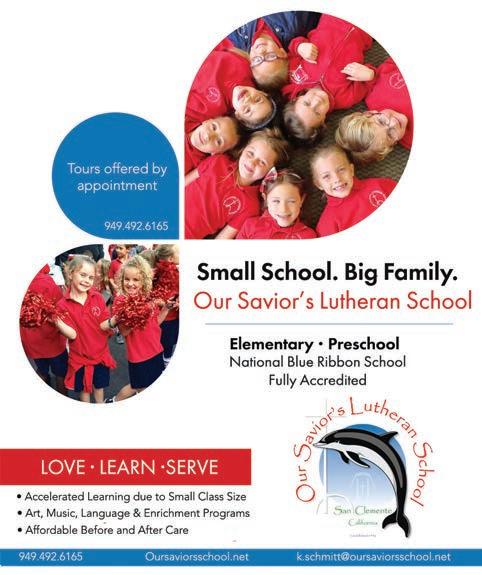
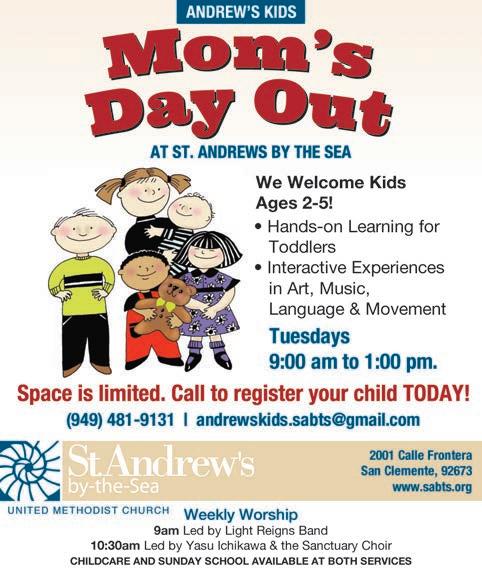
Fall and Winter 2017 Events Calendar for Children and Teens
Big Kat Youth Wrestling Club
Become a life champion in a sport where life lessons happen on the mat. Any youth in kindergarten through eighth grade can join. Winter season starts Oct. 30. Recreation is $70 per month; elite competition is $80 (two months due at registration). Register at www.bigkatwrestling.com. Meet at Capistrano Valley High School Wrestling room. 26301 Escolar, Mission Viejo. 949.307.4390.
Youth Painting Classes
Von Lortz Sidestreet Gallery, San Clemente’s original painting gallery, offers painting classes for youth and adults. Youth classes are on Tuesdays and Thursdays from 3:305:30 p.m., and every first and third Saturday of the month from 9-11 a.m. 205 Avenida Cabrillo, San Clemente. 949.492.7244. www.sanclementeartclasses.com.
The Arts Project of Orange County
The Arts Project is a one-stop shop for all things art. The studio offers classes in theatre, music, dance, vocals and art for all ages and levels. Spots are still open for this season’s production, Annie. Email the director for acting or crew opportunities at emily@theartsprojectoc.com or call the front desk. The ensemble performs Dec. 14-16. 1317 Calle Avanzado, San Clemente. 949.276.2787. www.theartsprojectoc.com.
Ballet/Tap Combo Class
A beginning combination class of ballet and tap, using popular children’s music for ages 3-4. Classes begin Oct. 30 and Oct. 31 and run through Dec. 11 and 12. Monday’s class is from 10-11 a.m. or on Tuesday from 10-11 a.m. and 2-3 p.m. It’s $60 for residents and $63 for non-residents. The class meets at SCAC Friends Meeting room, San Clemente Aquatics Center. 987 Avenida Vista Hermosa, San Clemente. Registration is available through www.san-clemente.org.
Youth Basketball League
Join youth basketball for boys and girls 6-9 years of age. This is a low-key instructional basketball league, emphasizing teamwork, respect and fun. Practices begin early November 2017. $50 for residents of Dana Point and Capistrano Beach; $65 for non-residents. For information, contact Kolleen Wallace at kwallace@danapoint.org. 949.248.3530. www.danapoint.org.
Club Literacy Book Bunch
Book Bunch at Club Literacy is available for first through third-graders. Children are en-
couraged to become great readers and writers through powerful literature. There will be a lot of journal writing, providing learners with techniques that will propel them to achieve the highest standards in school. The class meets on Mondays from 4-5:30 p.m. starting Nov. 6. 34085 Pacific Coast Highway, Suite 105, Dana Point. 949.717.6624. www.clubliteracy.com.
Danman’s Music School
Danman’s has eight private teaching studios and a recording studio. Parents can purchase single lessons, a package of four or more, academy program lessons and semi-private lessons. There are 20 or more qualified music teachers that give lessons on the guitar, piano, bass, drums, voice, violin, flute, banjo, ukulele, clarinet, viola, cello and more. 24699 Del Prado, Dana Point. 949.496.6556. www.danmans.com.
South Coast Conservatory
South Coast Conservatory offers recreational pre-academy dance classes for children ages 2-7, and academy classes for those ages 8-17 in ballet, tap, hip hop, jazz, tumbling and musical theatre. 400 Camino De Estrella, Suite C, San Clemente. 949.682.7977. www.scconservatory.com.
Beach Cities Rock Club
For those who want to learn to rock, Beach Cities offer affordable instrument and singing lessons. They are open 9 a.m. to 9 p.m. every day. 73 Via Pico Plaza, San Clemente. 949.463.1968. www.beachcitiesrockclub.com.
Teen Winter Ceramic Classes
Hand-build and work on the wheel to make cool projects and have fun. It’s an 8-week session starting Jan. 18 and runs through March 15 for teens ages 12-17. Class meets Thursdays from 4-6 p.m. Fee is $199 and a $35 materials fee. 31878 Del Obispo Street Suite 106, San Juan Capistrano. 949.412.9241. www.theceramicstudio.com.
Musical Theatre at Acting Academy for Kids
The Musical Theatre series is an educational experience for children ages 5-16. The students are taken through the musical theatre process from start to finish. No previous experience is required, and everyone gets a role. The next season begins Jan. 2018. Z Playhouse. 35 Via Pico Plaza, San Clemente. 949.427.0072. www.actingacademyforkids.com.
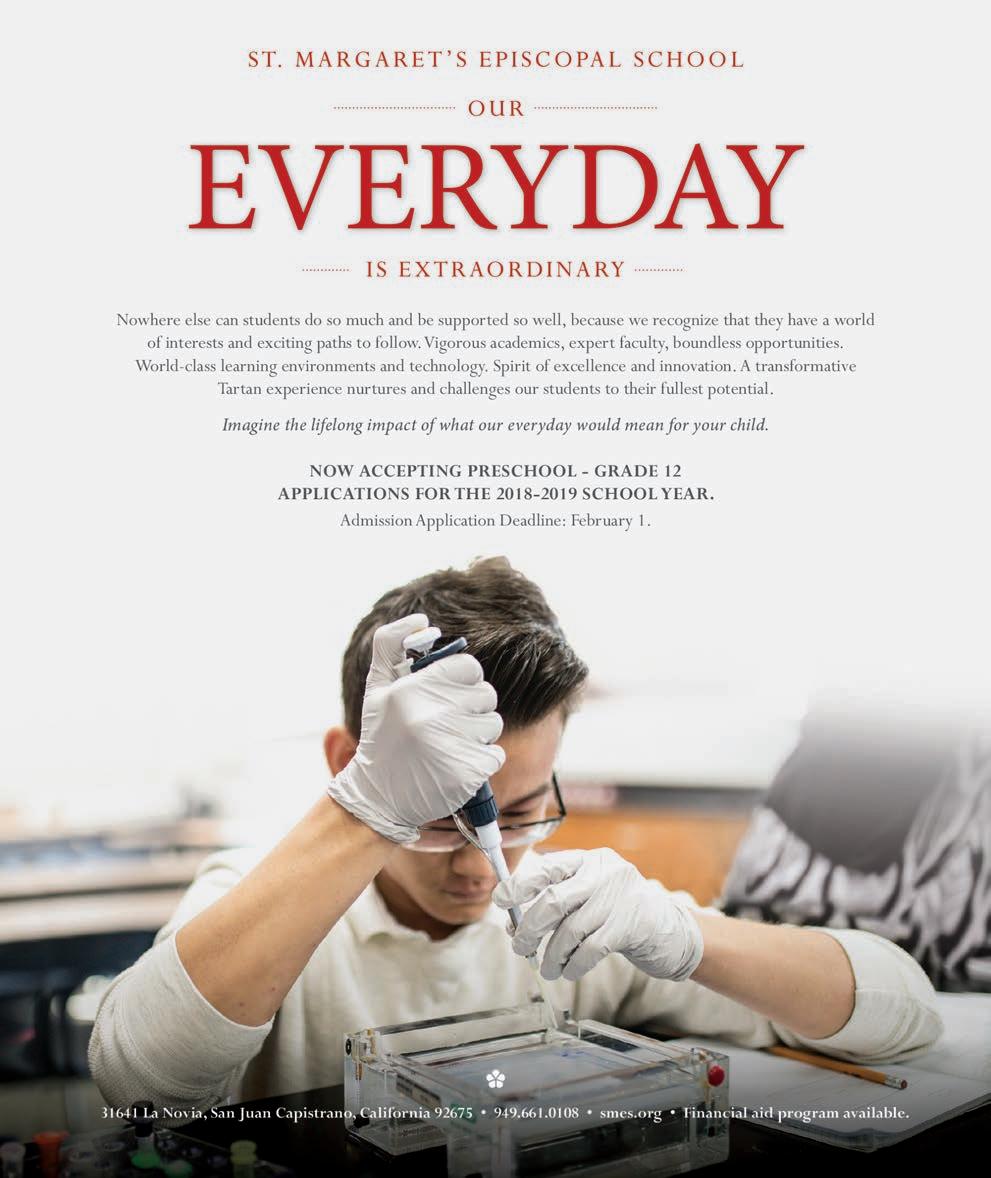
The dreams we have for our children are based on hopes for a lifetime of success, happiness and purpose. At Capistrano Valley Christian Schools, we believe the foundations of those dreams are built on a rich academic program coupled with an emphasis on spiritual and moral development. Our students learn through a program that values and develops critical thinking, innovation, creativity and foundational skills to prepare them for life after graduation. Visit our website and get a sense of the dynamic learning environment we have created in order to prepare our students for success in all their future endeavors.
CVCS has been serving students from junior kindergarten through high school for more than 40 years. 32032 Del Obispo St., San Juan Capistrano. 949.493.5683. www.cvcs.org.
Our Mission: Goodwill is in the business of helping people who are facing barriers to get and keep jobs, which provides purpose, pride and dignity. We believe the power of work changes lives.
Through our retail stores, our e-commerce platform, shopgoodwill.com, and our business services, we create jobs and provide job training and education, helping people and our local community to thrive.
Thank you for making our mission your mission.
410 N. Fairview, Santa Ana, CA 92703, 714.547.6308, ocgoodwill.org.

Our Lady of Fatima Parish Academy
Nurture ~ Encourage ~ Empower
OLF Academy cultivates faith-filled learners whom daily demonstrate spiritual and academic excellence, 1:1 technology acquisition, and dedication of service to their
community. Visitors to our campus witness an engaged learning environment that is centered on family values. Fully accredited, OLF is blessed with exceptionally dedicated teachers and is proud to be Home to San Clemente’s Teacher of the Year. OLF’s academic rigor is complemented with enriched course offerings such as Spanish, Music/ Piano, Art, Academic Decathlon, Choir, P. E. and Drama and a distinctive offering of Junior High electives. Our students cultivate a zest for life-long learning, develop effective communication skills, and advance as globally responsible citizens. OLF’s exceptional Transitional Kindergarten is specifically designed to provide 4 and 5 year old children the “developmental gift of time.” Utilizing a cross-curricular approach to instruction, all students experience daily differentiated opportunities in which to explore, investigate, and integrate their academic abilities. Participation in the PAL Sports League, and providing After School Day Care, Programs and Homework Help round out OLF Academy.
105 N. La Esperanza, San Clemente, 949.492.7320, www.olfschool.net, kwindes@olfschool.net.
With academic tracks tailored to meet the needs of varied learners; more than 85 clubs and activities; competitive, characterbuilding athletics; and an award-winning arts program—all in a nurturing, Christcentered environment—Santa Margarita students are empowered to grow spiritually, intellectually, socially and morally. Santa Margarita has the distinction of being the county’s only Catholic International Baccalaureate high school and is ranked as the top Catholic high school in Southern California by The Washington Post. The school’s beautiful 42-acre campus includes a Digital Media Studio, Eagle Athletic Center, Academic Services Center, modernized Library Media Center, Olympic-sized pool and Sacred Heart Chapel. Recognized as a Microsoft Showcase School, Santa Margarita’s Oneto-One Tablet PC Program provides an immersive educational experience preparing students for college and beyond. The Class of 2017 received $42.1 million in scholarship offers with 99 percent of the class attending college. Visit SMCHS at 22062 Antonio Parkway, Rancho Santa Margarita. Info: www.smhs.org.
Anne School
Nurture with care. Teach with creativity. Embrace life. Treasure faith. These are the guiding principles that shape St. Anne School, a private, independent Catholic school that welcomes preschool through grade 8 students of all faiths. St. Anne’s mission is to develop future generations of creative thinkers, innovative problem solvers, effective communicators and emerging leaders, guided by the Catholic faith, to influence our local and global communities for the greater good.
The St. Anne experience promotes a love of learning through rigor¬ous academic, artistic and athletic programs. With the guidance and dedication of faculty, students gain a solid foundation rooted in problem solving, collaboration, creative expression, leadership, faith, technology and global citizenship.
We invite you to see for yourself all that St. Anne has to offer. Join us for our Admission Open House on Thursday, January 11 from 9-11 a.m. RSVP to admissions@st-anne. org, or call 949.276.6753.
32451 Bear Brand Road, Laguna Niguel, 949.276.6700, www.st-anne.org.
St. Margaret’s Episcopal School
Members of the St. Margaret’s Episcopal School community will tell you what an extraordinary and special place it is, unlike any other. Some will tout the leading preschool through grade 12 academic program that nurtures and challenges every student to his
or her full potential. Others will avail you of stories of dedicated and expert faculty who know and love every student, going above and beyond every day. Some are awestruck with the world of opportunities available to every student from vibrant performing and visual arts, to a thoughtful physical education program focused on sportsmanship, teamwork and the scholar-athlete that culminates with 24 varsity sports.
St. Margaret’s says the true answer resides in the school’s Episcopal identity, shared mission and deep commitment to nurturing the intellectual and spiritual growth of every student, who they are today and who they are becoming for tomorrow. This focus on a “transformational Tartan experience,” is vitally important work, and it fosters a spirit of excellence and innovation in every aspect of the St. Margaret’s experience.
St. Margaret’s is a premier, independent college-preparatory school educating 1,234 students in preschool through grade 12. The school’s reputation for the depth and quality of its education brings more than 150 colleges and universities to campus annually to recruit its graduates. California Institute of Technology, University of California, Berkeley, University of California, Los Angeles, University of Chicago, Dartmouth College, Emory University, Harvard University, New York University, Northwestern University, University of Notre Dame, Princeton University and Stanford University are some of the fine institutions that welcomed St. Margaret’s graduates from the Class of 2017 this fall.
St. Margaret’s is situated on a picturesque 22-acre campus with world-class technology-rich learning environments, including dedicated performing and visual arts centers, library, 18 maker spaces and studios for science, computer science, engineering, robotics and media art, technology labs, athletics fields, gymnasiums and campus commons.
St. Margaret’s students and 2,200 alumni are recognized for their integrity, character, compassion, responsibility and the courage to lead and serve others.
31641 La Novia, San Juan Capistrano, CA 92675, 949.661.0108, www.smes.org

BY JIM TAYLOR
An average of one per day. That is the estimated number of people who die by suicide in Orange County. It is probable that number is higher, maybe even much higher given the overall stigma casting a shadow on not just suicide but mental health issues in general. Religious and societal pressures can cause suicides to go unreported as a cause of death. This stigma is very present in death and it can be worse in life.
But what about our children?
According to the latest statistics regarding suicide and self-harm from the Orange County Health Care Agency, San Clemente is included in the cities with the highest teen suicide rate. At the American Foundation for Suicide Prevention’s (AFSP) annual conference held in Irvine this year, it was revealed that the Centers for Disease Control and Prevention (CDC) is now tracking suicides in 8-10-year-olds.
In an informal survey conducted by the American Foundation for Suicide Prevention with eighth-graders in Pennsylvania, a rhetorical question was asked.
“Give me an example of an adult you would talk to if you were struggling.”
The students were silent. When asked why they wouldn’t even tell their parents if they might have thoughts of suicide, the response was, “because your parents want you to do well, so I’d be ashamed to tell them.”
Even in children there is shame in admitting a mental issue.
Why? Stigma.
There is no shame in telling someone you have the flu. People don’t get embarrassed if they have cancer. Somehow, we need to alleviate and ultimately remove the barriers society has put in place to discourage people—and our children—from discussing something that can be harmful or even fatal.
So how do we do it?
• Talk about what happens in the news. When a story surfaces on the news about a suicide, talk about it. At times, people who cannot conceive the thought of taking their own lives will denigrate the victim. Yes, victim. Saying things like the individual was a “fool,” “how could they do this to their family” or sweeping it under the carpet with the “they were sick” comment doesn’t help.
To a person without suicidal thoughts this bounces off of them. However, to a person currently struggling, it reinforces the idea that their thoughts are sick, hurtful to others and selfish. Talking about suicide casually in conversation without labeling can work wonders in letting someone know that per-
haps they can be helped.
• Words are powerful and so are the way they are phrased. Most people in the suicide prevention arena do not use the phrase that someone “committed suicide” as though the person committed a crime. We say, “died by suicide.” Even the Associated Press has included this in their style guidelines, and the California Department of Education utilizes this phrase on their Youth Suicide Prevention page. The Suicide Hotline has been renamed to the Suicide Prevention Lifeline too. Simple changes like these can start to promote positive change.
• Attend a workshop or orchestrate one. Many suicide prevention organizations, including AFSP, have presentations and seminars on the subject, including training on how to speak to someone who appears to be struggling. They also discuss how to provide resources to those who need them most, and ultimately, get them to a healthcare professional who can help.
• Get involved with a mental health or suicide prevention organization. Even just showing up at an event and being present
makes a huge difference. There is comfort in knowing you are not alone. Almost 2,000 people attended the Out of the Darkness Walk in Fountain Valley last September. This was an event to shine a light on suicide, to get people talking about suicide and to lessen the stigma associated with it.
• Give them a safe environment to talk. If you have the slightest suspicion that your child may be depressed or if they are becoming more withdrawn, talk to them about it in a positive way. People get sad and some people get more than sad. The thought that a person has something wrong with them mentally, and that possible illness is a societal taboo, only compounds the problem. If they feel safe talking about it they will. You need to make them feel safe before they will open up.
The mental health world is changing for the better, but it is a slow change. This year, Governor Brown signed AB 2246 which requires California schools to adopt suicide prevention policies for students in grades seven through twelve. We can keep the momentum going by changing the way we think about mental health issues, reduce and eliminate the stigma, shine a light on the problem and save lives.

Jim Taylor is the Chairman for the Orange County Chapter of

BY JAMIE CARGO
Leaving high school for college can feel as scary as entering the haunted house down the street. But don’t worry, Saddleback College is here to illuminate the path to your success.
Capistrano Unified School District (CUSD) and Saddleback Valley Unified School District (SVUSD) high school students can start by taking Counseling 100 for free in the spring. Saddleback College brings professional counseling expertise to the high schools, where students can learn about concurrent and dual enrollment opportunities. The college plans to expand its concurrent enrollment soon by offering a variety of college courses at each area high school.
The class of 2018 can also get in on the Freshman Advantage program, designed for new incoming freshman of any age who will be attending Saddleback College in Fall 2018. Eligible students can enroll in classes before the majority of continuing students.
Counseling 100 and Freshman Advantage help students receive priority registration and get the classes they need to hit the ground running during their first semester in college.
Maybe you haven’t found a career you love yet. At Saddleback, you can choose from over 300 associate degrees, certificates and occupational skills awards in 190 program areas taught by a faculty renowned for its expertise, experience and commitment to student success.
Give back as you learn
Over the summer, students interested in science, technology, engineering and math (STEM) began creating upper limb assistive devices for those in need through the e-NABLE hand project, a group of volunteers
from across the globe that use 3D printers to create free prosthetics.
The Saddleback College team recently advanced to creating its own design by integrating Arduino Uno technology with a sensor that detects electrical activity of muscles to control robotic hand movements of the device. Using a 3D CAD design software, students engage in group projects led by engineers from San Clemente’s Swift Engineering Inc., and faculty and staff from Saddleback College. Students get real world experience involving physics, engineering, manufacturing, mathematics and computer science, which will help them explore potential majors and careers.
“The students are learning as much from each other as they are from us,” said Katlin Choi, the grant project manager. “They learn project management aspects such as how to brainstorm and make decisions as a team and how to take a lead role for a particular project component as well as the content of the project.”
Mechanical engineering major Chris McDonald found the project challenging and fulfilling.
“I’m surprised by the complexity of this project and that it’s almost impossible to replicate the natural hand,” he said. “Being able to apply the knowledge I’ve learned in a way that helps out someone else is very rewarding. I want to make an impact in this world and doing a small project like this is one step closer to doing that.”
Bryce Martin, a second-year mechanical engineering major, discovered a career path, saying, “I found through helping in the project that I want to pursue an internship next summer with a company that designs and manufactures prosthetics.”
The students in turn inspire the faculty.
Larry Perez, chair of the Computer Science Department, said, “I’m very excited to be part of this project working alongside our students promoting (STEM) awareness in the spirit of the maker movement.”

Jamie Cargo serves as the public information officer at Saddleback College, which provides dynamic, innovative and student-centered postsecondary education and training to the greater South Orange County community. For more information, please visit www.saddleback.edu.
BY RYAN DAHLEM
The concept of entrepreneurship has certainly evolved as it applies to young people in recent years. For many parents, entrepreneurship evokes memories of running a neighborhood lemonade stand with the thrill of tending a cash box while learning the basics of a balance sheet. Today, however, the barriers of entry to starting a business are so low that a young person with access to the internet and a desire to change the world can set out to do just that.
Children and teens should be encouraged to develop an entrepreneurial mindset that can be applied not only in the alluring world of start-ups, but more importantly, in how they approach bringing ideas into reality, whether it be a new app or considering where they may attend college. Here are five areas of focus for developing an entrepreneurial mindset:
1. Be a “need finder,” not a “problem solver.” While it is tempting to begin by developing a solution to an assumed problem, the best entrepreneurs are experts at finding true needs. To identify needs, talk to people. Conduct ethnographic interviews with them about their daily experiences and listen for true needs that would make their lives better if solved. That is the beginning of a compelling product or solution.
2. Learn the design thinking process (Empathize, Define, Ideate, Prototype, Test). Innovators have been implementing this process for years and it has yielded a variety of game-changing inventions, from the computer mouse to the stand-up toothpaste tube. Empathizing with your potential “end-user,” defining needs from their point of view, “ideating” solutions through brainstorming, prototyping rough versions of your solutions to test with your end-users for feedback, and then iterating your prototype based on feedback accelerates the design process and moves you toward innovative solutions more quickly. This method is best described by the Stanford d.school where you can take a free design thinking workshop.
3. Don’t go it alone. Entrepreneurs know the value of networking within an ecosystem and the creative power of “radical collaboration,” as described by Bill Burnett and Dave Evans, Stanford University d.school professors and authors of “Designing Your Life.” Creativity is contagious and idea sharing
breeds better ideas. Young people should connect with one another about their creative ideas and seek mentors who can share valuable lessons from paths already traveled and provide inspiration to take new risks.
4. Failure is part of the process. Thinking like an entrepreneur means acting on an idea that often involves taking risks. Things rarely succeed on the first try. That’s okay! Think back to the design process—it’s time to iterate and test again. “Failure is not the opposite of success,” said Jason Goldberg, St. Margaret’s Episcopal School alumnus ‘13 and entrepreneur. Jason is the founder and president of VYRL, an exchange-based ecosystem for influencers and brands, and has partnered with St. Margaret’s on a high school entrepreneurship course. “Failure is a means of learning important lessons to be applied later.” This can be difficult for young people who have been insulated from failure in other aspects of their lives. A helpful mantra used by many entrepreneurs is to “fail forward.”
5. Start with your passion! Young people sometimes have a difficult time identifying a passion. Instead, ask them, “If you had an extra hour each day, what would you do with it?” Entrepreneurs invest an incredible amount of time in their projects, and your passion is a good place to start need-finding through research and talking to people. “I had a passion for video games growing up,” Goldberg said. “So, my first companies were in that space. That’s when I realized I could own the servers the players were playing on.”
Encouraging young people to develop an entrepreneurial mindset has benefits that extend far beyond founding the next big invention or start-up. Believing one can bring an idea into reality, and possessing the skills to do so, will not only affect the way they see the world, but also their outlook on themselves and what is possible in their futures.

Ryan Dahlem is the Assistant Head of School for Strategic Initiatives with St. Margaret’s Episcopal School and is leading the development of an entrepreneurship program based in innovation and design thinking methodology. Mr. Dahlem has participated in design thinking workshops including the Educator’s Workshop for Entrepreneurial Studies and Innovative Learning Conference, and teaches an entrepreneurial studies course at St. Margaret’s.
Creative programs offer teens a self-expression outlet; prepares them for future beyond school
BY RACHAEL GARCIA
Many parents assume that creativity is an inherent talent that their kids are either born with or not. But creativity can be more of a skill than inborn talent, and it is a skill parents can help their kids foster.
This is something Heather Linberg of Rancho Santa Margarita, did for her daughter Ava Domini. Domini, a 14-year-old singer, songwriter and guitarist whom has performed solo at the House of Blues Anaheim, Los Angeles and New Orleans, among other venues, was exposed to different instruments at a young age.

“I would leave instruments out for her to experiment with when she was a toddler, just as I would leave vegetables out so that Ava would learn to grab for them rather than unhealthy snacks when she was hungry,” Linberg said.
Constant exposure lead to skill, passion and a healthy outlet for Ava to express herself.
At eight years old, Domini learned how to play a whole song in her first 45-minute guitar lesson which lead Linberg to find in-house instructors and after school programs where her daughter could strengthen her skills.
Linberg believes it’s important that Ava interacts with other kids who share the same interests and dedication. She did a lot of research and one of the places she found was Community Outreach Alliance (COA).
COA is a nonprofit organization based in San Clemente that offers fun and healthy activities to the community to help curb the use of drug and alcohol abuse among teens. They also offer acoustic guitar lessons, piano lessons and an improv comedy night.
Domini attends COA’s open mic nights for teens, where she connects and networks with other teens who also use creative outlets to express themselves.
“Whenever I’m emotional, happy or sad, being able to express myself through playing or writing a song helps cleanse my feelings,” Domini said.
Orange County High School of the Arts
Some teens crave a different high school experience, rather than just after school programs, where other teens and instructors
who are dedicated to creative outlets surround them. In such cases, these teens can apply for admission to the Orange County High School of the Arts (OCSA).
Olivia Ross of Ladera Ranch was a gymnast and a violist getting ready to start high school at San Juan Hills. Her mom Valerie Ross had always encouraged her to participate in enrichment programs.
“I always wanted something more fulfilling for Olivia, something that she can take with her throughout her life,” Valerie said.
Olivia was passionate about both of her extra-curricular activities, but gymnastics was taking up all of her time. She decided that she wanted to focus all of her attention on the viola. The very day she quit gymnastics, she decided to apply to OCSA.
“OCSA is a positive environment where the passion for arts is contagious and everyone can be themselves,” Olivia said.
Students at OCSA score 20 percent higher than the state average on the SATs and ACTs. Forty-six percent of OCSA alumni go on to have math and science careers, and 54 percent continue with careers in music.
Olivia’s mom Valerie noticed that whenever she goes to productions, the student body that participates in the music program is passionate about life, education and music.
“The level of dedication spills over into all areas of their lives. It definitely helps them prepare for the future beyond high school.”
The Ceramic Studio in San Juan Capistrano: Offers ceramics classes for children ages 2 to 17. They are located at 31878 Del Obispo, Suite 106, and can be reach at 949.412-9241 or at www.theceramicsstudio.com.
Tspoons Cooking Classes in San Juan Capistrano: Offers child and teen cooking classes and camps. They are located at 31770 Camino Capistrano, Suite D and can be reached at 949.218.5218 or at www.tspoons.com.
Los Rios Rock School in San Juan Capistrano: Provides instrumental instruction in guitar, drums, piano and all rock instruments, as well as vocals, songwriting, theory, sight-reading, engineering and recording. They are located at 32124 Paseo Adelanto, Suite 5 and can be reached at 949.456.1081 or at www.losriosrockschool.com.