THE SAN BERNARDINO
Scan QR Code to visit our Website
AMERICAN
“A Man In Debt is So Far A Slave” -Emerson
NEWSPAPER A Community Newspaper Serving San Bernardino, Riverside & Los Angeles Counties Volume 51 No. 44
February 18, 2021- February 24, 2021
Mailing: P.O. Box 837, Victorville, CA 92393
Office: (909) 889-7677
Email: Mary @Sb-American.com
Website: www.SB-American.com
Power concedes nothing without a demand. It never did and it never will. Find out just what people will submit to and you have found out the exact amount of injustice and wrong which will be imposed upon them and these will continue till they have resisted either with words or blows or with both. The limits of tyrants are prescribed by the endurance those of whom they suppress. —Fredrick Douglass (1849)
Black Broadway, Madame Lillian Evanti and Washington DC’s Black History By Stacy M. Brown, NNPA Newswire Senior National Correspondent @StacyBrownMedia
Black History Month News
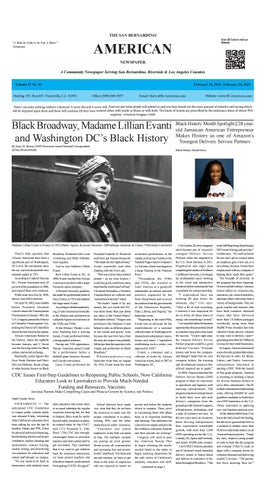
Madame Lillian Evanti in France in 1926 (Photo: Agence de presse Meurisse - Bibliothèque nationale de France / Wikimedia Commons) There’s little question that African Americans have been a significant part of Washington, DC’s civic life and identity since the city was first declared the new national capital in 1791. According to Cultural Tourism DC, African Americans were 25 percent of the population in 1800, and most of them were enslaved. While most were free by 1830, slavery was still in practice. On April 16, 1862, nine months before President Abraham Lincoln issued the Emancipation Proclamation in January 1863, the U.S. Congress passed the District of Columbia Emancipation Act, making the District of Columbia’s slaves the first freed in the nation. African Americans flocked to the District, where the nightlife became famous, and U Street was the thriving center for Black culture and social exchange. Reportedly, iconic figures like Zora Neale Hurston and Mary McLeod Bethune found refuge in what became known as Black
Broadway. Performers like Louis Armstrong and Billie Holliday were regulars. And so was Madame Lillian Evanti. Born Lillian Evans in D.C. in 1890, Evanti was the first African American to perform with a major European opera company. A Howard University graduate, she made her professional debut in Nice, France, in 1924 and adopted the stage name Evanti. According to whitehousehistory. org, Evanti returned periodically to the District and performed on Lafayette Square several times in the 1920s and 1930s. At the Belasco Theater, a sixstory building had a soaring facade, Evanti performed before a desegregated audience. During one 1926 appearance, Marian Anderson joined Evanti for a performance before a football game between Howard and Lincoln universities. Later, Evanti performed for
President Franklin D. Roosevelt and First Lady Eleanor Roosevelt. “She made me feel right at home,” Evanti reportedly said after chatting with the First Lady. “That was a time when colored people – as we were known – could feel good, could have some hope that the world wasn’t all bad,” Cleveland McFadden, a Northern Virginia-based art collector and “sometimes historian” noted. “We hadn’t ‘made it’ by any means, but you could feel D.C. was more home than just about any place in the United States,” McFadden offered. “Singers and performers like Madame Evanti helped to take us different places in our minds and spirits. And, because she was from here, from the area, her impact was probably felt deeper than the superstars who visited and performed on Black Broadway.” W h i t e h o u s e h i s t o r y.o r g historians wrote that, on August 28, 1943, Evanti made her most
acclaimed performance in the capital, portraying Violetta in the National Negro Opera Company’s La Traviata, which was staged on a barge floating in the Potomac River. “Throughout the 1940s and 1950s, she traveled to Latin America as a good-will ambassador on cultural outreach journeys organized by the State Department and received decorations from the governments of the Dominican Republic, Haiti, Liberia, and Nigeria,” the historians wrote. “Beginning in the mid-1930s, Evanti was an advocate for the establishment of a national cultural center in Washington for classical and contemporary music, drama and dance – legislation establishing such a center was approved in 1958.” Evanti, a composer and a collector of works by African American artists, died in 1967 in Washington, DC.
CDC Issues First-Step Guidelines to Reopening Public Schools, Now California Educators Look to Lawmakers to Provide Much-Needed Funding and Resources, Vaccines Anxious Parents Make Compelling Cases and Pleas to Govern by Science, not Politics
State/ County News SACRAMENTO — The anticipated CDC Guidelines to reopen public schools safely was released Friday, reiterating what California’s educators have been calling for over the last 10 months: Masks and PPE, 6-feet for physical and social distancing, handwashing stations and proper ventilation, surface cleaning and sanitization; contact tracing, weekly testing, and prioritizing vaccinations for educators and school staff already on campus. “No one wants to be back in classrooms with students more
than educators who know there is no equal substitute for regular in-person learning but, for that to happen, there must be multilayered safety measures in place, as echoed today by the CDC," said CTA President E. Toby Boyd. “The CDC also strongly encouraged states to prioritize teachers and other school staff to get vaccinated. They cautioned that if we want to get children back for in-person instruction, we must protect teachers and education support professionals from getting COVID. We agree!”
Black History Month Spotlight || 28 yearold Jamaican American Entrepreneur Makes History as one of Amazon's Youngest Delivery Service Partners
School districts have made very clear that they do not have the resources to make sure the proper ventilation is in place, testing, PPE, and the other multi-layered safety measures. “Educators and school employees in the field can attest to that. The multiple variants are posing an even greater threat across all communities and increasing fear and anxiety levels,” said Boyd. “For these and myriad reasons, we have to get shots in the arms of employees who are required to report in-
person and before the students return to campus. Then, pivot to vaccinating those who phase back in to in-person teaching and learning. This addresses the concerns over supply and provide the confidence educators, students and their parents are seeking.” Congress will need to pass the American Rescue Plan to begin releasing the muchneeded funds to the states to begin readying classrooms for the safe return of California’s students, educators and staff. continued on page 2
Cori Gordon, 28, never imagined she’d become one of Amazon’s youngest Delivery Service Partners when she migrated to the U.S. from Jamaica in 2013. Bright-eyed and eager post completing her studies at Northern Caribbean University, Cori began her professional career working in the retail and automotive industries before realizing she had a penchant for entrepreneurship. “I experienced burn out working 80 plus hours for someone else,” Cori says. “After a bit of soul searching, I realized it was important for me to direct all those hours of energy into something I owned.” Cori searched online for business opportunities that presented a built in customer base and a clear track for success. “I knew right away the Amazon Delivery Service Partner program could be a great fit for me,” Cori says. “Everyone knows and loves the company and though I hadn’t led my own company before, the training and development resources they offered inspired me to apply.” In 2018, Amazon launched the Delivery Service Partner (DSP) program to share its experience in operations and logistics with aspiring entrepreneurs. The program empowers entrepreneurs to build their own last mile delivery companies from the ground up with Amazon’s support, infrastructure, technology, and a suite of exclusive services. In the two years since its inception, these thriving entrepreneurs have experienced remarkable growth, with more than 1,300 DSPs operating across the U.S., Canada, UK, Spain, and Germany and nearly 85,000 jobs created. Cori’s DSP, Cortoyou operates out of Amazon’s newly launched delivery station in Staten Island and delivers to customers in her home borough of Brooklyn. “The
most fulfilling thing about being a DSP owner is being a job provider,” Gordon says. “It’s such an honor for me and I get so excited when an employee gets a new car, or a new phone, because I know their employment with my company is helping them reach their goals.” The breadth of diversity in the program has been inspiring. Owners include military veterans, former sellers on Amazon.com, educators, city council members, and many others who come from a variety of backgrounds. They are great coaches and mentors who have built customer obsessed teams that have delivered more than 1.8 billion packages worldwide, using more than 40,000 Prime branded last mile vehicles—from electric vehicles to step vans to delivery vans— generating more than $4.5 billion in revenue for their small businesses. In August, Amazon announced a new diversity grant to help reduce the barriers to entry for Black, Latinx, and Native American entrepreneurs interested in starting a DSP. With the launch of this grant program, Amazon is investing in building a future for diverse business owners to serve their communities. The $1 million commitment funds startup costs, offering $10,000 for each qualified candidate to build their own DSP businesses in the U.S. Those interested in applying can visit logistics.amazon.com. As the eldest child of nine, Cori knew she had a knack for leading, but she never guessed she’d be in a position to employ more than 50 drivers and make history as an Amazon business partner. “I hope my story inspires young people of color to look into the program and evaluate if they’re ready to align with a company driven by customer obsession and delivering results,” Cori says. “The journey has been amazing thus far.”
February 18, 2021
Page 2 COMMUNITY/EDUCATION/ADVERTISING
Nixing Prison Time for Certain Crimes Among Proposed Changes to Calif. Penal Code Antonio Ray Harvey | California Black Media
Senator Steven Bradford ( D- Los Angeles) and Chair of California Black Legislative Caucus California’s Committee on Revision of the Penal Code (CRPC) released its first annual report last week. The proposal included 10 recommendations that would significantly reform California’s criminal justice system – if they are adapted into law. Sen. Steven Bradford (D-Gardena), the chair of the Senate Committee on Public Safety, praised CRPC’s inaugural recommendations that, he says, “represent broad consensus among a wide array” of stakeholders, including law enforcement, crime victims, civil rights leaders, and individuals directly impacted by the legal system. “I commend the members of
the Committee on Revision of the Penal Code for their diligent work in examining our state’s criminal laws and justice system,” said Bradford, who is also the chair of the California Legislative Black Caucus (CLBC). In the past year, Californians have rallied for systemic criminal justice reform and have repeatedly rejected tough-on-crime measures at the ballot box. As Chair of the Senate Committee on Public Safety, I look forward to working with my colleagues and stakeholders on these recommendations.” The recommendations are: · eliminating incarceration and reducing fines and fees for certain traffic offenses; requiring that short prison sentences be served in county jails; · ending mandatory minimum sentences for nonviolent offenses; establishing that low-value thefts without serious injury or use of a weapon are misdemeanors; · prov id i ng g u id a nce for judge s c on side r i ng se nt e nce e n h a nce me nt s; · limiting gang enhancements
to the most dangerous offenses; · retroactively applying sentence enhancements previously repealed by the Legislature; · equalizing custody credits for people who committed the same offenses, regardless of where or when they are incarcerated; · clarifying parole suitability standards to focus on risk of future violent or serious offenses; · establishing judicial process for “second look” resentencing. The recommendations, the report stated, address some of the most obvious problems that the CRPC found and indicate are glaringly widespread. The committee says the findings in the report are based on hard data and observational research. “The current system has deep racial inequity at its core,” the CRPC detailed in the 89-page report. “New data published for the first time in this report reveals that racial disparities may be even worse than many imagined. This report confirms people of color are disproportionately punished under state laws.” The recommendations follow a year of studying California’s criminal punishments, guided by testimony from 56 expert witnesses, extensive public comment, staff research, and over 50 hours of public hearings and committee deliberation. “We also sought out reforms that would have as broad an impact as possible with general consensus across interest groups, keeping in
mind the twin goals of improving public safety and creating a more humane system,” the report stated. The CRPC was established to rationalize and simplify California’s criminal laws. The committee is also charged with advancing policies that keep the state on the course of improving public safety while making an effort to reduce unnecessary incarceration. The Legislature handed the CRPC special data-gathering powers, allowing it to observe all aspects of criminal law and procedures to make recommendations that would adhere to the state’s penal code. Many law enforcement and judicial leaders appeared before the Committee this year to address these problems and offer solutions that enhance public safety. “California must be a leader in criminal justice reform that will keep our communities safe and address the impacts that mass incarceration and ineffective policing have taken on poor communities of color,” Bradford stated. The recommendations in the CRPC report line up with two potentially game-changing criminal justice reform bills making their way through the legislature, Senate Bill (SB) 81 and SB 82, introduced on Feb. 9 by Sen. Nancy Skinner (D-Berkeley). continued on page 3
Publisher’s Corner
Clifton Harris Editor in Chief Investigative Reporter sbamericannews@gmail.com Mary Martin-Harris / Editor Clifton B. Harris / Audio Engineering Editor Legal /Display Advertising (909) 889-7677 The San Bernardino American News was established May 6, 1969. A legally adjudicated newspaper of general circulation on September 30, 1971, case number 15313 by the Superior Court of San Bernardino County. The San Bernardino AMERICAN News subscription rate is $58.00 per year. The San Bernardino AMERICAN News is committed to serving its readers by presenting news unbiased and objective, trusting in the mature judgment of the readers and, in so doing, strive to achieve a united community. News releases appearing in the San Bernardino AMERICAN News do not necessarily express the policy nor the opinion of the publishers. The San Bernardino AMERICAN News reserves the right to edit or rewrite all news releases.
TIME WISE
Private Investigations
“On Time, Just in Time” License Number 25694
Clifton Harris, BA, MLS Private Investigator Retired Law Enforcement Officer P.O. Box 837 Victorville, CA 92393
Telephone (760) 514-8310 Fax: (909) 889-2882 E-mail: timewisepi968@gmail.com
CDC Issues First-Step Guidelines to Reopening Public Schools, Now California Educators Look to Lawmakers to Provide Much-Needed Funding and Resources, Vaccines...continued from page 1 In a virtual noon news conference today, anxious and concerned parents from around the state said reopening schools while COVID-19 rages on – and with new and dangerous variants appearing – would be premature and urged lawmakers to ‘govern by science, not politics.’ Watch the entire news conference here. “The people speaking out are not part of our communities,” said Pecolia Manigo, an Oakland parent and executive director of Parent Leadership Action Network. “We need to hear Black, Latinx, immigrant and indigenous communities before we assume we know what they need.” “Our community has been hit very hard by the Coronavirus. There has been a lot of heartbreak. People have lost family members, friends and, just this past week, we had a father and son die within hours… So I am here today because I am scared,” said Fresno mother of four, Maricela Velasquez. “It’s hard to trust the schools will be able to keep them safe. I certainly don’t trust the parents who are speaking loudly right now about us opening schools for our children to go back. Let me be clear, they don’t speak for me and they don’t speak for my community! I won’t be sending my kids back until it is safe, until the virus infection rates have gone down, until the district has provided resources for all for safety measures and until the teachers have had the vaccine.” Maria Osorio from Los Angeles agreed. “Every day, thousands of people are still getting infected and dying,” said Los Angeles parent Osorio. “It’s too much to return under these conditions.” Lisa Delano-Wood is a parent of a child in San Diego schools and also an associate professor and clinical neuropsychologist
in the Department of Psychiatry at UC San Diego. She said at the press conference that it is wrong to point to low transmission rates among students and schools as evidence that schools can reopen. “Without surveillance testing of students in schools, we don’t have that data,” she said. “I’m very frustrated with what has become a national health problem. It’s disingenuous to say this virus only spreads in homes or gatherings. We have no idea what the spread looks like in schools.” Delano-Wood said that with new coronavirus variants and high case rates, it’s too soon to reopen local schools. In an opinion piece in the San Diego Union Tribune on Feb. 11 she wrote, “We must delay opening our schools given that case rates of COVID-19 are still nearly five times what the highest tier allows; and the new B.1.1.7 variant that early indications suggest is 50 percent more infectious — particularly in children and adolescents — is rapidly spreading in San Diego County.” Low-income communities and communities of color have been ha rdest h it. “The virus is ripping through my students’ communities,” said teacher Matthew Schneck. “It’s heartbreaking to see the pain and impact on my kids. I’m struggling with the emotional impact of students coming to their teachers with stories of death.” Several parents stressed that those calling for immediate return to in-person instruction, particularly in the name of “equity” around distance learning, do not speak for them or their communities and are not hearing their voices. “While distance learning is undoubtedly inequitable,
the devastation of this virus is inequitable as well,” said Dawniel Carlock-Stewart, a parent of three. “We need to be listening to voices in these communities – not just picking out whatever equity talking points meet our agenda.” “We want our kids in school, but as parents our number one priority is their safety and health. That means that we need lawmakers to provide more resources right now to support students during distance learning and to support students when schools reopen. I support vaccinations, guidelines and protocols to make sure that we have what’s necessary for our children to be safe,” said Khallid Al-Alim, a Los Angeles parent. “We know that some parents in more affluent communities have been calling for the opening up of our schools. But my message to them is: please DON’T use the disproportionate impact on our communities to justify your desire to open up schools unsafely!” Teacher Christine Kratt contracted COVID-19 on school grounds last Spring. “Living with that worry and that concern is something that I don’t wish on anyone. As a parent and as a teacher, I need to have absolute trust in the decisions that are being made by my board of education to make sure that not just the least but the most safety precautions are in place. There is a false sense of security in the community. I need to believe strongly that when I put my own child back into a classroom that every single thing that is being recommended to be done is being done. And that their teacher feels the ability to concentrate and focus on what it is that she is teaching,” said Kratt. For more i nfor mat ion and COVID-19 resources go t o c t a .o r g /c ov id19.
February 18, 2021
Page 3 STATE/GOVERNMENT/BUSINESS
SoCal: COVID 19 Testing Is Coming to a Black Church Near You Antonio Ray Harvey | California Black Media
Rev. “J.” Edgar Boyd, Senior Pastor, First AME Church of Los Angeles The Tabernacle Community Development Cor poration (TCDC) in partnership with the Los Angeles County Health Services has launched a new program to expand access to free community-based COVID-19 testing in the Black community. TCDC is setting in motion its effort in some areas of Los Angeles County where there have been the most minority COVID-19 deaths, infections and hospitalizations. The death rate for African Americans in California’s most populous county is 155 for every 100,000 people compared to 95 for every 100,000 among Whites. Latinos in Los Angeles County have the highest death rate at 276 for every 100,000. This expansion is part of the “Black Church COVID-19 Testing Partnership,” a Southern California grassroots public initiative that will provide free coronavirus exams at pop-up health centers located at 35 Black churches. The program goal is to provide free tests to 150 individuals at each church location daily through June 30. “Throughout Black communities in California, and across the country, lack of medical service has resulted in a disproportionate and an inequitable higher percentage of deaths and infections by this deadly pandemic,” said the Rev. J. Edgar Boyd, Senior Minister at First AME Church of Los
Angeles, commonly called “FAME” by Black Angelenos. “The Black community bears a great burden with poor health outcomes due to longstanding inequities and racism in healthcare and related institutions,” Boyd continued. “The Black church has long played the role of advocate and provider, a place of trust. When the government failed us historically, the church stepped in to provide and care for our community. That work continues today.” So far, across California, about 7.5 million vaccines have been administered in the state. L.A. County residents – who total to about 10.4 million people -have received about 1.4 million of those COVID-19 shots. About 2.8 % of all African Americans across the state have been vaccinated. Black Californians make about around 6% of the state’s total population of about 40 million people. The African American Community Empowerment Council of California (AACECC), a San Francisco-based nonprofit, has also kicked off an effort to provide COVID-19 exam sites at eight churches in Black communities that have been under-tested since the COVID-19 pandemic began. Working in collaboration with the TCDC of San Francisco, the launch also includes onsite, drivethru COVID-19 testing at FAME.
Rev. Gerald Agee, Statewide Director for COVID-19 Testing Program, Tabernacle Community Development Corporation. Founded in 1872, FAME is the oldest house of worship founded by African Americans in the city and one of the eight churches that will host COVID-19 testing sites. The new testing sites at the churches will not require appointments, removing one barrier that has prevented some African Americans around the country from getting tested. “L.A. County is grateful to work alongside First A.M.E. Church of Los Angeles, a longtime leader in this community, to roll out this new program that will increase COVID-19 testing access for the County’s Black residents,” Dr. Hong said. “While L.A. County has made strides in expanding access to COVID-19 testing, this new partnership will further ensure equitable access to testing for the Black community as testing remains a critical piece of reducing community transmission and improving health outcomes.” Los Angeles County Health Services formed the partnership because the Black clergy and the church community has proven to be a trusted source of information and influence in the Black community, members of the African American clergy in Los Angeles say. “Trust is sacred, and it hangs by a thread between the Black community and some of our institutions. The church has always
been the bridge to engage the Black community, rebuilding the trust that has been broken,” said the Rev. Gerald Agee, founder and pastor of Friendship Christian Church (FCC). “We urge those in our community to get tested. It is one way to help keep you and those you live with safe,” Agee continued. Los Angeles County Health Services (DHS) is the secondlargest municipal health system in the United States – after New York Health and Hospitals. Through its integrated system of 27 health centers and four hospitals and an expansive network of community partner clinics – DHS annually provides direct care for over 600,000 patients, employs over 23,000 staff, and has an annual budget of over $6 billion. Boyd said he looks forward to joining hands with the county and state to fulfill a critical healthcare need in his community. “We are thankful for the support of Dr. Clemens Hong of the Los Angeles County Health Services, other county officials and Governor Gavin Newsom and his administration for the investment in this testing partnership with Black churches,” he added. For additional information regarding the testing sites and DHS, please visit www.dhs. lacounty.gov
Amanda Gorman Was Step Ahead of CDC on Rocking Double Masks Quinci LeGardye | California Black Media
Since President Biden’s inauguration, people have been raving about the “riveting” inaugural performance – and equally enchanting Super Bowl appearance -- of former Youth Poet Laureate of Los Angeles Amanda Gorman. Beyond her gripping poetry and captivating sense of fashion, another Gorman style that has been catching media attention is her choice to wear two masks at once -- a decorative cloth mask strapped over a plain surgical one. Now, it seems, double masks have been popping up everywhere, quickly becoming the newest trend in fashion-aware COVID-19 protective wear. Several lawmakers and celebrities have been spotted wearing two masks at once in public. Then, last week, the U.S. Centers for Disease Control and Prevention (CDC) released a report
that found that double masking can drastically reduce the spread of COVID-19 particles, both for the wearer and for those around them. According to the CDC research, the effectiveness of cloth masks and surgical masks that fit more loosely than N95s can be improved by either wearing a cloth mask over a surgical mask, also known as double masking. To tighten the mask combo, knot the ear loops of a surgical mask where they attach to the edges of the face covering and tuck in and flatten any extra loose material close to the face. For double masking specifically, the study tested combinations of common surgical and multilayer cloth masks by stimulating coughing between pairs of dummies in a laboratory. When a cloth mask was worn on top of a disposable mask, 92.5 percent of cough droplets were blocked,
versus 42 percent of droplets when just wearing a disposable mask. The study also reiterated that universal mask-wearing is a highly effective way to slow the spread of COVID-19, in addition to physical distancing, avoiding poorly ventilated indoor spaces and good hand hygiene. Universal mask-wearing has been one goal of the new Biden administration. Federal health authorities have mandated wearing masks in public settings, including planes, airports, buses and other forms of public transportation and transportation hubs, as of Feb. 1. At a White House COVID-19 briefing, CDC Director Rochelle Walensky said, “I want to be clear that these new scientific data released today do not change the specific recommendations about who should wear a mask or when they should wear one. But they do provide new information on why wearing a well-fitting mask is so important.” According to the updated CDC guidelines, effective masks both fit snugly against the wearer’s face and has layers to block COVID-19 particles. The two ways to layer that the website recommends is either wearing a cloth mask with multiple layers of fabric, or wearing
a disposable surgical mask underneath a cloth mask. The website also points out that people should not layer two disposable masks on top of each other, or combine any mask with a KN95 mask. The authentic KN95 mask itself should be enough coverage. For a closer fit, the CDC suggests choosing masks with a nose wire that can be adjusted for a snug fit, or to use a mask brace to improve the fit. Before the new CDC announcement about mask wearing on Jan. 25, infectious disease expert Dr. Anthony Fauci told NBC News’ TODAY that it is likely that double masking provides more protection than wearing one mask. “This is a physical covering to prevent droplets and the virus to get in. So, if you have a physical covering with one layer, you put another layer on, it just makes common sense that it likely would be more effective. That’s the reason why you see people either double masking or doing a version of an N95,” said Dr. Fauci. If options are scarce, or two masks are not available, researchers have recommended wearing a cloth mask with a continued in next 2 columns
Amanda Gorman Was Step Ahead of CDC on Rocking Double Masks...continued pocket that can be stuffed with filter material, like the kind found in vacuum bags. For a test to see if the mask is effective, try to blow out a candle while wearing it. If the mask is effective, the candle won’t go out. Sources:
h t t p s : / / w w w. c d c . g o v / coronavirus/2019-ncov/preventgetting-sick/about-facehttps://www.cdc.gov/mmwr/ volumes/70/wr/mm7007e1.htm https://www.cbsnews.com/ news/double-face-mask-covid19-cdc/
Asm. Kamlager Introduces Bill to Innovate How Medical Care is Delivered to Homeless Populations State/Government News (SACRAMENTO) -- 1,383 homeless individuals died on the streets of Los Angeles in 2020-- setting a grim record for the city. Most died from preventable diseases. While homeless deaths in LA have been rising for years, the pandemic has only made matters worse. People exper iencing homelessness (PEH) are sicker than the general population but have less access to preventative and mental health care. Even when insured under Medi-Cal, 73% have never seen a healthcare provider. Concerns for basic survival needs, transportation, difficulty keeping active insurance due to lack of a mailing address, lack of ID and mental illness, make it difficult, if not impossible, for PEH to access care in the traditional healthcare model. Assemblymember Sydney Kamlager (D–Los Angeles) introduced the Street Medicine Act to change that. The Street Medicine Act will increase access to medical care and social services for PEH through an innovative health care model: street medicine. Street medicine removes access barriers by providing direct, comprehensive care to the unsheltered homeless on the streets and under bridges where they live. “Right now, the unsheltered homeless are dying in record numbers on the streets of Los Angeles. Asking them to find a doctor, get an insurance card,
leave their belongings behind unguarded and get to a doctor’s office clearly isn’t working. AB 369 is about going to the streets, meeting our brothers and sisters where they are, and getting them the consistent, preventative care they need,” Kamlager said. Street medicine has been shown to reduce avoidable, expensive hospital admissions by 2/3, and to reduce the duration of hospitalization. “We know that people experiencing homelessness have life expectancies that are 30 years shorter than folks who are housed. We know that they have 740% more admission days at 170% higher cost. And we know that all of that is bad math,” said Kamlager. If passed, AB 369 would make California the first state in the nation to formally recognize street medicine as a model of care. “Health care is a basic human right,” Kamlager added. “At the end of the day, it’s about equity. It’s about justice. It’s about compassion and doing what’s right.” To schedule an interview w it h Assembly member Kamlager, contact Nik ki Johnson at (916) 319-2054. Assembly District 54 consists of Baldwin Hills, Cheviot Hills, the Crenshaw District, Century City, Culver City, Ladera Heights, Mar Vista, Palms, Rancho Park, Westwood and parts of South Los Angeles and Inglewood.
Subscribe to The San Bernardino American News Annual Subscription only $58 to suscribe call us @ (909) 889-7677 or go to our website: sb-american.com
Nixing Prison Time for Certain Crimes Among Proposed Changes to Calif. Penal Code...continued from page 2 Skinner and Assemblymember Sydney Kamlager, who is vice chair of the legislature’s Black caucus, are also members of CRPC. SB 81 would reform the state’s use of sentencing enhancements that add years to prison sentences. The bill would also reform a 150-yearold law that gives prosecutors the ability to classify a petty theft charge as felony robbery. “Serving on the Committee on
the Revision of the Penal Code gave me the opportunity to engage with experts and advocates to identify common sense proposals for criminal justice reform.” Sen. Skinner said. “SB 81 sends a clear message to our courts: Sentence enhancements should be used judiciously, and only when the enhancement is necessary to protect the public. And SB 82 will help ensure that in the case of theft, the punishment meets the crime.”
February 18, 2021
Page 4 RELIGION/LIFESTYLE
“As We Come to the Close of the Month Designated to Honoring and Remembering The Central Role of Blacks in U.S. History...” By: Lou Yeboah
Lou Yeboah Let us not forget how far we have traveled but lo, how far there is to go. Remember the chains of slavery are gone—but we are all not yet free. As our national leader of the abolitionist movement Frederick Douglass stated, we must continue to bring the “Thunder.” And in order to do that we cannot continue to be a kingdom divided. For every kingdom divided against itself is brought to desolation and every city or house divided against itself will not stand.” [Matthew 12:25, Mark 3:25, and Luke 11:17]. The God we serve is a God of unity. God stands and affirms the power of unity in getting things done. In [Genesis 11:6] the Lord spoke of the power of the people of Babel saying, "Behold, they are one people, and they have all one language, and this is only the beginning of what they will do. And nothing that they propose to do will now be impossible for them." These people were united for the wrong reasons, and yet God acknowledged what ability they had. Imagine what we can do if we are united for the right reason. I want you to know that the Triune GOD, the Father, Son and Holy Spirit, are never able to be divided. They are in total agreement, always. Nothing separates them from purpose, plans and divine will. And nothing should separate us from purpose, plans and divine will. Agreement and becoming congruent are the KEYS to survival. Don’t let the unity that takes place between us as a people doing the month of February end. Let us continue in unity so that we can succeed in fulfilling the purpose and plan and vision and destiny that GOD has purposed for us. For when we are divided against our own selves, we will not stand. Let us strive to be undivided. The apostles were all with one accord in one place. [Acts 2:1]. “Walk with me, I’ll walk with you, down these troubled roads we’ll stumble into, we’ll all in this thing together we’ll gonna make it through. If you walk with me, I'll
walk with you. Be there for me, I'll be there for you. When we can't see where we're going, what the world is coming to, you walk with me I'll walk with you.” [Goldford]. One thing is definitely true … the geese are all in it together. Whether they are rotating positions, flapping their wings, helping a sick goose, or simply honking … the flock is in it together. By sticking to it together, they are able to accomplish far more than if they were trying to do it on their own. For too long, we have been divided by race and immigration status, religion, issue area, sexuality, and gender. For too long we have been fed the lie of scarcity when we live in a world of abundance — where the only scarcity we have is the political will to establish justice, promote the general welfare, and secure the blessings of liberty for absolutely all. We, as a nation, as a movement, as a people must break through the lie that only small changes, on one issue at a time, are possible. When we cry out, when we organize from grassroots, when we take bold action together, it can be done. The freedom fighters who we celebrate remind us that we don’t just awake the nation with what is wrong, but we come together, in power, with demands. We rise together and demand justice, until we claim our rights. The world is fractured and divided, but we must not be! As [Dr. Martin Luther, King, Jr. “Where Do We Go from Here?” Sermon, 50 Years Later.] says, “This is no time for romantic illusions and empty philosophical debates about freedom. This is a time for action. What is needed is a strategy for change, a tactical program that will bring the Negro into the mainstream of American life as quickly as possible. So far, this has only been offered by the nonviolent movement. Without recognizing this we will end up with solutions that don’t solve, answers that don’t answer, and explanations that don’t explain… And so, I conclude by saying today that we have a task, and let us go out with a divine dissatisfaction…” I ask you, “What moral debt, if any, do we owe our ancestors?” To keep on keeping on! Celebrating Black History!
Witness For Justice#1034
There is Enough for All – Even During a Pandemic Noel Andersen In the midst of lockdowns and toilet paper shortages, many have turned toward the myth of scarcity, that there is not enough to go around. The human survival instinct, combined with the influence of consumerism and capitalism, create a breeding ground for fear, division, exclusion, and hate. Our sacred scriptures and faith tradition draw a vivid contrast, reminding us that if we share, there will be enough for all, and if we extend ourselves in faith, God will provide. When there are just five loaves and two fish, many can be fed on little. As we prepare for the beginning of Lent, often observed with spiritual sacrifices, we recognize
that any act of sacrifice should not be for sacrifice alone but for transformation and solidarity with others. The current oncein-a-century pandemic is having a disproportionate impact on marginalized communities. Many have lost their jobs, can no longer pay rent, or find little access to health care. Workers who are often paid the least –farm workers, meat packers, grocery clerks, sanitation workers, whose work is finally recognized as essential – also face greater risk of exposure to the deadly virus. The inequality is overwhelming: while 29 million people and 12 million children in the U.S. face hunger, billionaires continued in next 2 columns
There is Enough for All – Even During a Pandemic... continued made 3.9 trillion dollars, and data shows Black, Latinos and Asians dying at a much higher rate. There is no easy solution, but there is something we can do. The Biden administration has set forth a plan that pushes the U.S. forward in this struggle to end the pandemic, and recognizes the benefits we all enjoy from the hard work of those now deemed essential. Congress can pass this plan that includes addressing the hunger crisis, renewing unemployment benefits, equitable distribution of stimulus checks, restoring worker protections, funding for vaccine roll-out, and raising the minimum wage to fifteen dollars per hour. As an advocate for immigrants’ rights, I recognize the limitations of the Biden plan – and the new possibilities. The workers now lauded as vital during this pandemic? Undocumented and under-documented people make up over 5 million essential workers, over one million of those are “Dreamers” and DACA-eligible people. The anti-immigrant rhetoric and the separation of families over the last four years has been heartbreaking. In 2019 at a meatpacking facility, Mississippi saw the biggest workplace raid ever in a single state. One employee, Maria DomingoGarcia, was a mother to a 4-month
old, 3-year-old and 11-year-old, all children who are U.S. Citizens. She was detained and ripped away from her children, even though she was still breastfeeding the youngest. This is the way so many essential workers have been treated. Although Maria had been in the country for 11 years with no criminal record and paying taxes, she was still deported and torn from her children. People like Maria should be part of this stimulus package. Congress should include all essential workers as part of the stimulus and Covid-19 relief efforts. People like Maria who were unjustly deported should be reunited with her family on humanitarian visas. Creating a pathway to citizenship would be a boon for the economy, increasing tax revenue, decreasing deficits, and adding billions of dollars to the GDP. In times of fear and crisis, it is easy to look inward and forget about our neighbors in need, but as people of faith, we know that there is enough for all. We can and should work to build equitable systems during this crisis when the most marginalized are at their greatest need. Noel Andersen is the UCC & CWS Grassroots Coordinator for Immigrants' Rights for the United Church of Christ.
Peiffer Wolf: Most Successful Black McDonald’s Franchise Operator Faces Racial Discrimination, Forced To Sell 7 Stores To White Owners “Targeted for Extinction”: Former Michigan State University Track Star and Oakland A’s Player Herb Washington’s Civil Rights Lawsuit Details How McDonald’s “Redlines” Black Owners Into Sub-Par Locations and Is Now Driving Black Franchisees Out of Its System. Lifestyle News
WASHINGTON, D.C. – February 16, 2021 – Herb Washington, a college track star at Michigan StateImage University, former Oakland A’s player, community leader, and one of the most notable success stories in Black American business history, filed a civil rights lawsuit today against fastfood giant McDonald’s, exposing the company’s campaign of racial discrimination and retaliation against him as a Black franchisee. The complaint filed by the law firm Peiffer Wolf Carr Kane & Conway details how McDonalds “redlined” Washington and other Black store owners into its least desirable locations, withheld advantages provided to white store owners, and then, in the case of Washington, systematically dismantled his 27-store chain empire in New York, Pennsylvania and Ohio – forcing him to sell seven stores in the last three years, in every case, to white owners. Despite McDonald’s hostility to Black franchise owners and being relegated to sub-par locations with an average of $700,000 less in annual sales per store than white owners, Washington became the largest Black McDonald’s restaurant operator in the United States. Washington succeeded against incredible odds posed in the form of obstacles created by McDonald’s to impede
and undermine Black store owners. McDonald’s put the screws to Washington when he objected to its discriminatory treatment of himself and other Black store owners, saying that he is “not a house negro and will not be treated like one.” Herb Washington said: “There are two McDonald’s systems: one that is designed for white owners to flourish and grow and another that is designed to pigeonhole and oppress Black owners. I will no longer give up my seat on the bus for white franchisees. After four decades in the McDonald’s system, I have been targeted for extinction. When I stood up for myself and other Black franchisees, McDonald’s began dismantling my life’s work, forcing me to sell one store after another to white operators. At the very same time, McDonald’s deemed my 35-year-old son ineligible to purchase any stores. While it may look like a multicultural Mecca in TV commercials, the McDonald’s experience for Black franchisees is one of redlining and retaliation. Behind the curtain, McDonald’s is about cultural appropriation and restricting the transfer of intergenerational wealth in the Black community.” Joseph Peiffer, managing partner, Peiffer Wolf Carr Kane & Conway, said: “If a Black business continued in next 2 columns
Peiffer Wolf: Most Successful Black McDonald’s Franchise Operator Faces Racial Discrimination, Forced To Sell 7 Stores To White Owners...continued leader like Herb Washington can be silenced for speaking up against racial discrimination by a major U.S. corporation, then what Black businessperson is safe? McDonald’s acknowledged its discriminatory racial-steering policy decades ago and promised to ensure parity for its Black franchisees, but then failed to do so. If anything, it’s even worse today for Herb Washington and other Black store owners. In 1998, there were 377 Black franchisees in the McDonald’s system. Now there are 186. These numbers lay bare McDonald’s intentionally racist policies and practices toward Black franchisees.” Kevin Conway, partner, Peiffer Wolf Carr Kane & Conway, said: “While McDonald’s has joined the chorus of brands releasing hollow solidarity statements in support of Black Lives Matter and has launched a marketing campaign to profit from that movement, it has done nothing to change its own internal policies that perpetuate systemic racism by disadvantaging and squeezing out its Black franchise owners.” When the McDonald’s franchise system was established in 1955, its restaurants were located only in white neighborhoods and owned exclusively by white franchisees. During the 1960s, white flight to the suburbs led to changing neighborhood demographics, with McDonald’s locations once in predominantly white neighborhoods now located in predominantly Black ones. In the wake of protests after the murder of Dr. Martin Luther King, McDonald’s recognized its first Black store owner in 1968. In 1996, McDonald’s admitted its policy of “redlining” Black operators into less desirable store locations, with Executive Vice President Thomas S. Dentice writing: “for business reasons we thought valid at the time, the Company has placed many Black Franchisees in restaurants that have not allowed them to achieve the same level of economic success as their peers.” He promised to “create and implement a strategy designed to achieve parity for African American franchisees.” However, such promises remain unfulfilled as, one by one, Black franchisees are pushed out of the McDonald’s system and those
remaining continue to earn vastly less than white franchisees because of McDonald’s longstanding and demonstrable disparate treatment of Black franchisees. Peiffer said: “Herb Washington remained in the McDonald’s system because McDonald’s continued to promise that it would end its history of discrimination and achieve parity. He reasonably believed that once parity was achieved, the revenue and profitability numbers McDonald’s touts would finally be obtainable for him. While he has been waiting for fair and equal treatment, McDonald’s has enjoyed a steady stream of rent and fees from our client’s efforts and success under racially discriminatory circumstances. Now, McDonald’s is working to dismantle his life’s work to create the illusion of parity in cash flow between white and Black franchisees. And it is targeting Herb Washington because of his opposition to the relentless discrimination he has endured in the McDonald’s system.” Before becoming a McDonald’s franchisee, Washington was a world-class athlete. He attended Michigan State University on a track scholarship. Washington was a four-time All-American, won seven Big Ten Titles and an NCAA championship, and narrowly missed the 1972 Olympic track team. I n 1972 , Wa sh i ng t on participated in a protest at a Michigan State men’s basketball game over the lack of Black coaches and officials in the Big Ten. As a scholarship athlete, it was a huge risk for him to take. But he believed then, as he believes now, in standing up to injustice. The following season, Tom Rucker became the first Black men’s basketball official in the Big Ten. After graduating from Michigan State, Washington played for the Oakland Athletics professional baseball team from 1974-75, including a trip to the Word Series. Four years later, he became a McDonald’s franchisee. The law f ir m Peiffer Wolf Carr Kane & Conway maintains offices in Cleveland, Youngstown, St. Louis, New York, Los Angeles, San Francisco, Austin, and New Orleans.
February 18, 2021
Page 5 LEGALS/CLASSIFIEDS FICTITIOUS BUSINESS NAME FICTITIOUS BUSINESS NAME STATEMENT 20210000952 Date Filed: 01/29/2021 Filing Expires On: 01/29/2026 FICTITIOUS BUSINESS NAME (as shown in the Articles of Inc./Org./Reg.): LP BODY REPAIR County of Principal Place of Business: SAN BERNARDINO Street Address of Principal Place of Business:16666 FOOTHILL BLVD. FONTANA, CA 92336 Name of Individual Registrant: PATRICIA LOPEZ Name of corporation or limited liability company as shown in the Articles of Inc./Org./Reg.: State of Inc./Org./Reg.: Inc./Org./Reg. No.: Residence Street Address: 11317 HOMEWOOD DR. FONTANA, CA 92337 This business is/was conducted by: An Individual Registrant has commenced to transact business under the fictitious business name or names listed above on: May 01, 2020 Patricia Lopez, Owner, declares that all information in this statement true and correct. NOTICE- IN ACCORDANCE WITH SUBDIVISION (a) OF SECTION 17920, A FICTITIOUS NAME STATEMENT GENERALLY EXPIRES AT THE END OF FIVE YEARS FROM THE DATE ON WHICH IT WAS FILED IN THE OFFICE OF THE COUNTY CLERK, EXCEPT, AS PROVIDED IN SUBDIVISION (b) OF SECTION 17920. WHERE IT EXPIRES 40 DAYS AFTER ANY CHANGE IN THE FACTS SET FORT IN THE STATEMENT PURSUANT TO SECTION 17913 OTHER THAN A CHANGE IN THE RESIDENCE ADDRESS OF A REGISTERED OWNER. A NEW FICTITIOUS BUSINESS NAME STATEMENT MUST BE FILED BEFORE THE EXPIRATION. THE FILING OF THIS STATEMENT DOES NOT OF ITSELF AUTHORIZE THE USE IN THIS STATE OF A FICTITIOUS BUSINESS NAME IN VIOLATION OF THE RIGHTS OF ANOTHER UNDER FEDERAL, STATE, OR COMMON LAW (SEE SECTION 14411 ET. SEQ., BUSINESS AND PROFESSIONS CODE.) Published in the San Bernardino American Newspaper February 11, 18, 25, March 4, 2021.
FICTITIOUS BUSINESS NAME STATEMENT 20210001023 Date Filed: 02/01/2021 Filing Expires On: 02/01/2026 FICTITIOUS BUSINESS NAME (as shown in the Articles of Inc./Org./Reg.): FLAGSHIP LOGISTICS County of Principal Place of Business: SAN BERNARDINO Street Address of Principal Place of Business: 1030 NORTH MOUNTAIN AVE. #337 ONTARIO, CA 91762 Mailing Address: 1030 NORTH MOUNTAIN AVE. #337 ONTARIO, CA 91762 Name of Individual Registrant: ARTHERLEY G. WILLIAMS JR. Name of corporation or limited liability company as shown in the Articles of Inc./Org./Reg.: State of Inc./Org./Reg.: Inc./Org./Reg. No.: Residence Street Address: 1030 NORTH MOUNTAIN AVE. #337 ONTARIO, CA 91762 This business is/was conducted by: An Individual Registrant has commenced to transact business under the fictitious business name or names listed above on: Jan 21, 2021 Artherley G. Williams Jr., Owner, declares that all information in this statement is true and correct. NOTICE- IN ACCORDANCE WITH SUBDIVISION (a) OF SECTION 17920, A FICTITIOUS NAME STATEMENT GENERALLY EXPIRES AT THE END OF FIVE YEARS FROM THE DATE ON WHICH IT WAS FILED IN THE OFFICE OF THE COUNTY CLERK, EXCEPT, AS PROVIDED IN SUBDIVISION (b) OF SECTION 17920. WHERE IT EXPIRES 40 DAYS AFTER ANY CHANGE IN THE FACTS SET FORT IN THE STATEMENT PURSUANT TO SECTION 17913 OTHER THAN A CHANGE IN THE RESIDENCE ADDRESS OF A REGISTERED OWNER. A NEW FICTITIOUS BUSINESS NAME STATEMENT MUST BE FILED BEFORE THE EXPIRATION. THE FILING OF THIS STATEMENT DOES NOT OF ITSELF AUTHORIZE THE USE IN THIS STATE OF A FICTITIOUS BUSINESS NAME IN VIOLATION OF THE RIGHTS OF ANOTHER UNDER FEDERAL, STATE, OR COMMON LAW (SEE SECTION 14411 ET. SEQ., BUSINESS AND PROFESSIONS CODE.) Published in the San Bernardino American Newspaper February 11, 18, 25, March 4, 2021.
FICTITIOUS BUSINESS NAME STATEMENT 20210000568 Date Filed: 01/20/2021 Filing Expires On: 01/20/2026 FICTITIOUS BUSINESS NAME (as shown in the Articles of Inc./Org./Reg.): RUSTIC LOVE BY TAMARA County of Principal Place of Business: SAN BERNARDINO Street Address of Principal Place of Business: 12804 EASY ST. CHINO, CA 91710 Name of Individual Registrant: TAMARA J. SPEAR Name of corporation or limited liability company as shown in the Articles of Inc./Org./Reg.: State of Inc./Org./Reg.: Inc./Org./Reg. No.: Residence Street Address: 12804 EASY ST. CHINO, CA 91710 This business is/was conducted by: An Individual Registrant has commenced to transact business under the fictitious business name or names listed above on: Not Applicable Tamara Spear, declares that all information in this statement is true and correct. NOTICE- IN ACCORDANCE WITH SUBDIVISION (a) OF SECTION 17920, A FICTITIOUS NAME STATEMENT GENERALLY EXPIRES AT THE END OF FIVE YEARS FROM THE DATE ON WHICH IT WAS FILED IN THE OFFICE OF THE COUNTY CLERK, EXCEPT, AS PROVIDED IN SUBDIVISION (b) OF SECTION 17920. WHERE IT EXPIRES 40 DAYS AFTER ANY CHANGE IN THE FACTS SET FORT IN THE STATEMENT PURSUANT TO SECTION 17913 OTHER THAN A CHANGE IN THE RESIDENCE ADDRESS OF A REGISTERED OWNER. A NEW FICTITIOUS BUSINESS NAME STATEMENT MUST BE FILED BEFORE THE EXPIRATION. THE FILING OF THIS STATEMENT DOES NOT OF ITSELF AUTHORIZE THE USE IN THIS STATE OF A FICTITIOUS BUSINESS NAME IN VIOLATION OF THE RIGHTS OF ANOTHER UNDER FEDERAL, STATE, OR COMMON LAW (SEE SECTION 14411 ET. SEQ., BUSINESS AND PROFESSIONS CODE.) Published in the San Bernardino American Newspaper January 28, February 4, 11, 18, 2021
FICTITIOUS BUSINESS NAME STATEMENT 20210000802 Date Filed: 01/27/2021 Filing Expires On: 01/27/2026 FICTITIOUS BUSINESS NAME (as shown in the Articles of Inc./Org./Reg.): 1. EMPIRE AUTO SALES 2. SULLIVAN BROS. AUTO GROUP County of Principal Place of Business: SAN BERNARDINO Street Address of Principal Place of Business: 1428 RANDY ST., A UPLAND, CA 91786 Name of Individual Registrant Name of corporation or limited liability company as shown in the Articles of Inc./Org./Reg.: SULLIVAN BROS. LLC State of Inc./Org./ Reg.: NV Inc./Org./Reg. No.: 202035310015 Residence Street Address: 2925 COVATTA CT. LAS VEGAS, NV 89086 This business is/was conducted by: A Limited Liability Company Registrant has commenced to transact business under the fictitious business name or names listed above on: Feb 20, 2020 Andre Lathon, Managing Member, declares that all information in this statement is true and correct. NOTICE- IN ACCORDANCE WITH SUBDIVISION (a) OF SECTION 17920, A FICTITIOUS NAME STATEMENT GENERALLY EXPIRES AT THE END OF FIVE YEARS FROM THE DATE ON WHICH IT WAS FILED IN THE OFFICE OF THE COUNTY CLERK, EXCEPT, AS PROVIDED IN SUBDIVISION (b) OF SECTION 17920. WHERE IT EXPIRES 40 DAYS AFTER ANY CHANGE IN THE FACTS SET FORT IN THE STATEMENT PURSUANT TO SECTION 17913 OTHER THAN A CHANGE IN THE RESIDENCE ADDRESS OF A REGISTERED OWNER. A NEW FICTITIOUS BUSINESS NAME STATEMENT MUST BE FILED BEFORE THE EXPIRATION. THE FILING OF THIS STATEMENT DOES NOT OF ITSELF AUTHORIZE THE USE IN THIS STATE OF A FICTITIOUS BUSINESS NAME IN VIOLATION OF THE RIGHTS OF ANOTHER UNDER FEDERAL, STATE, OR COMMON LAW (SEE SECTION 14411 ET. SEQ., BUSINESS AND PROFESSIONS CODE.) Published in the San Bernardino American Newspaper February 4, 11, 18, 25, 2021.
FICTITIOUS BUSINESS NAME STATEMENT 20210000200 Date Filed: 01/07/2021 Filing Expires On: 01/07/2026 FICTITIOUS BUSINESS NAME (as shown in the Articles of Inc./Org./Reg.): ACT SERVICES County of Principal Place of Business: SAN BERNARDINO Street Address of Principal Place of Business: 13231 9TH ST. CHINO, CA 91710 Name of Individual Registrant: ANEDIA S. ARROYO Name of corporation or limited liability company as shown in the Articles of Inc./Org./Reg.: State of Inc./Org./Reg.: CA Inc./Org./Reg. No.: Residence Street Address: 13231 9TH ST. CHINO, CA 91710 This business is/was conducted by: An Individual Registrant has commenced to transact business under the fictitious business name or names listed above on: January 06, 2021 Anedia S. Arroyo, declares that all information in this statement is true and correct. NOTICE- IN ACCORDANCE WITH SUBDIVISION (a) OF SECTION 17920, A FICTITIOUS NAME STATEMENT GENERALLY EXPIRES AT THE END OF FIVE YEARS FROM THE DATE ON WHICH IT WAS FILED IN THE OFFICE OF THE COUNTY CLERK, EXCEPT, AS PROVIDED IN SUBDIVISION (b) OF SECTION 17920. WHERE IT EXPIRES 40 DAYS AFTER ANY CHANGE IN THE FACTS SET FORT IN THE STATEMENT PURSUANT TO SECTION 17913 OTHER THAN A CHANGE IN THE RESIDENCE ADDRESS OF A REGISTERED OWNER. A NEW FICTITIOUS BUSINESS NAME STATEMENT MUST BE FILED BEFORE THE EXPIRATION. THE FILING OF THIS STATEMENT DOES NOT OF ITSELF AUTHORIZE THE USE IN THIS STATE OF A FICTITIOUS BUSINESS NAME IN VIOLATION OF THE RIGHTS OF ANOTHER UNDER FEDERAL, STATE, OR COMMON LAW (SEE SECTION 14411 ET. SEQ., BUSINESS AND PROFESSIONS CODE.) Published in the San Bernardino American Newspaper February 4, 11, 18, 25, 2021.
FICTITIOUS BUSINESS NAME STATEMENT 20210001138 Date Filed: 02/04/2021 Filing Expires On: 02/04/2026 FICTITIOUS BUSINESS NAME (as shown in the Articles of Inc./Org./Reg.): SOCAL GARAGE DOOR SERVICE County of Principal Place of Business: SAN BERNARDINO Street Address of Principal Place of Business:14870 FARMINGTON ST. HESPERIA, CA 92345 Name of Individual Registrant: MARK A. VEGA Name of corporation or limited liability company as shown in the Articles of Inc./Org./Reg.: State of Inc./Org./Reg.: Inc./Org./Reg. No.: Residence Street Address: 14870 FARMINGTON ST. HESPERIA, CA 92345 This business is/was conducted by: An Individual Registrant has commenced to transact business under the fictitious business name or names listed above on: June 01, 2015 Mark A. Vega, Owner, declares that all information in this statement is true and correct. NOTICE- IN ACCORDANCE WITH SUBDIVISION (a) OF SECTION 17920, A FICTITIOUS NAME STATEMENT GENERALLY EXPIRES AT THE END OF FIVE YEARS FROM THE DATE ON WHICH IT WAS FILED IN THE OFFICE OF THE COUNTY CLERK, EXCEPT, AS PROVIDED IN SUBDIVISION (b) OF SECTION 17920. WHERE IT EXPIRES 40 DAYS AFTER ANY CHANGE IN THE FACTS SET FORT IN THE STATEMENT PURSUANT TO SECTION 17913 OTHER THAN A CHANGE IN THE RESIDENCE ADDRESS OF A REGISTERED OWNER. A NEW FICTITIOUS BUSINESS NAME STATEMENT MUST BE FILED BEFORE THE EXPIRATION. THE FILING OF THIS STATEMENT DOES NOT OF ITSELF AUTHORIZE THE USE IN THIS STATE OF A FICTITIOUS BUSINESS NAME IN VIOLATION OF THE RIGHTS OF ANOTHER UNDER FEDERAL, STATE, OR COMMON LAW (SEE SECTION 14411 ET. SEQ., BUSINESS AND PROFESSIONS CODE.) Published in the San Bernardino American Newspaper February 18, 25, March 4, 11, 2021.
FICTITIOUS BUSINESS NAME STATEMENT 20210001358 Date Filed: 02/10/2021 Filing Expires On: 02/10//2026 FICTITIOUS BUSINESS NAME (as shown in the Articles of Inc./Org./Reg.): THE CAR GUYS RC County of Principal Place of Business: SAN BERNARDINO Street Address of Principal Place of Business: 8180 MASI DR., SUITE A RANCHO CUCAMONGA, CA 91730 Mailing Address: 313 MINARET ST. CORONA, CA 92881 Name of Individual Registrant Name of corporation or limited liability company as shown in the Articles of Inc./Org./Reg.: 1 & S CORPORATION State of Inc./Org./Reg.: CA Inc./Org./Reg. No.: C4308514 Residence Street Address: 313 MINARET ST. CORONA, CA 92881 This business is/was conducted by: A Corporation Registrant has commenced to transact business under the fictitious business name or names listed above on: Not Applicable Mohammad Patel, President, declares that all information in this statement is true and correct. NOTICE- IN ACCORDANCE WITH SUBDIVISION (a) OF SECTION 17920, A FICTITIOUS NAME STATEMENT GENERALLY EXPIRES AT THE END OF FIVE YEARS FROM THE DATE ON WHICH IT WAS FILED IN THE OFFICE OF THE COUNTY CLERK, EXCEPT, AS PROVIDED IN SUBDIVISION (b) OF SECTION 17920. WHERE IT EXPIRES 40 DAYS AFTER ANY CHANGE IN THE FACTS SET FORT IN THE STATEMENT PURSUANT TO SECTION 17913 OTHER THAN A CHANGE IN THE RESIDENCE ADDRESS OF A REGISTERED OWNER. A NEW FICTITIOUS BUSINESS NAME STATEMENT MUST BE FILED BEFORE THE EXPIRATION. THE FILING OF THIS STATEMENT DOES NOT OF ITSELF AUTHORIZE THE USE IN THIS STATE OF A FICTITIOUS BUSINESS NAME IN VIOLATION OF THE RIGHTS OF ANOTHER UNDER FEDERAL, STATE, OR COMMON LAW (SEE SECTION 14411 ET. SEQ., BUSINESS AND PROFESSIONS CODE.) Published in the San Bernardino American Newspaper February 18, 25, March 4, 11, 2021.
Workforce Development Board Prison 2 Employment: “We need someone in our corner” SB County News
Submission Deadline For All Legals &
Tom A mb e r son had college degrees and plenty of work experience, but a felony conviction and nearly six years in prison made him unsuitable for hiring in the eyes of many would-be employers. “I applied for lots of jobs, but kept getting ‘nos’ along the way. It’s so discouraging,” says Amberson, a former counselor who found life after incarceration every bit as challenging – and in some ways, even more so – than his time spent behind bars. That is, until Goodwill Southern California took him under his wing and, with the support the state’s Prison to Employment Initiative (P2E), provided him the pathway to rebuild his life at age 65. This past year, the San Bernardino County Workforce Development Board (WDB) partnered with its counterpart in Riverside County to support re-entry services under P2E and help
ensure that individuals such as Amberson get the opportunity to work and live independent lives. I n A m b e r s o n’s case, Goodwill is the P2E provider, and he currently works 3035 hours per week at one of the nonprofit organization’s Upland ret ail locations. “I can’t stress enough that felons coming out of prison need someone in their corner, to help you walk through things and get you on your feet. Employment and housing – when you get those two in place, then we have a chance,” Amberson says. California releases approximately 36,000 individuals from state prison each year, and while re-entry services have been available for years, there hasn’t been a formal coordinated effort to link education, job training and other support services. Under P2E, $37 million was committed statewide t o op e r at ion al i ze
integration of workforce and reentry services across the state over a three-year period. Jonathan Weldy, who chairs WDB’s Special Populations Committee, believes the investment will pay off in multiple ways. “You see the impact it is having on so many individuals who now have the opportunity to re-establish their lives, live independently and contribute to society in a greater way. At the end of the day, too, it strengthens our labor pool and contributes to a healthier local and regional economy,” Weldy says. Lowell King, Regional Operations Officer for Goodwill Southern California, says P2E aligns directly with the organization’s mission of transforming lives through the p owe r of wo r k . “Having a job is about so much more than a paycheck. It’s as source
of self-respect, pride and identity. We’re proud to be a P2E provider and to help individuals who have been incarcerated take that next step in their lives,” King says. Amberson’s goal is to someday own his own business. While in prison, he used his education and experience to tutor fellow inmates who were pursuing their GEDs. He became president of the prison toastmasters and earned a business degree. After his release, he was in a halfway house for 10 months – looking for work but consistently being rejected. “No one would look at me because I had a felony. Eventually I ended up at Goodwill in Victorville, and got hired on the spot,” he says. “If you’ve been in prison, getting a job makes all the difference in the world to your selfesteem. It’s enabled me to get on my feet as I wait for the next step.”
Classifieds is 5pm Mondays
Publish Your FBN Statement with The San Bernardino American News For ONLY $45 go to sb-american.com to upload. Payments are accepted by debit/credit card
February 18, 2021
Page 6 WORLD/ENTERTAINMENT NEWS
Former NFL Player Found Dead at 38 World/Entertainment News
Vincent Jackson The body of former NFL wide receiver Vincent Jackson was discovered by a housekeeper at around 11:30 a.m., according to the Hillsborough County Sheriff ’s Office (HCSO). He was only 38 years old. Jackson, who was a South Tampa resident, checked into the hotel located on Palm River Road on Jan. 11. He had been staying there since then, hotel staff said. On Feb. 10, Jackson’s family members called the sheriff’s office to report him missing. A formal report was filed on Feb. 11, and on Feb. 12, deputies found Jackson at the hotel. After assessing his wellbeing, the missing persons case was cancelled, according to HCSO. Jackson’s 12 seasons in the NFL Jackson played college football at the University of Northern Colorado where he was a standout player, according to the school. He was drafted to the San Diego Chargers in 2005 and played there for six seasons, making the NFL Pro Bowl twice. He ultimately played 12 seasons in the league, spending his first seven with the Chargers and last five with the Tampa Bay Buccaneers. He went on to play for the Tampa Bay Buccaneers — who won Super Bowl LV earlier this month — from 2012 until 2016. In 2012, he made a third
appearance in the Pro Bowl. Jackson is survived by his wife, Lindsey VanDeweghe, whom he wed in July 2011. The couple shared three children: Carter, Amaya and Dominick. After retiring from the NFL in 2016, Jackson and his family made South Tampa, Florida, their home. Off of the field, the NFL star was committed to making an impact through his charitable efforts. He launched the Jackson In Action 83 Foundation in 2012 as a way to help support military families, focusing especially on kids’ educational, emotional and physical health. “Many former athletes have a foundation. Few have the passion, commitment, execution and ultimately results that [Jackson] has demonstrated,” Jay Mize, a board member of the foundation, told Bold Business in March 2019. “He does it for the right reasons, does not care about the credit and in my opinion has created one of the strongest military-based foundations in the country, if not the strongest.” The Chargers, now based out of Los Angeles, released a statement Monday saying the team was “shocked and deeply saddened” by the news of Jackson’s death. continued in next 2 columns
Former NFL Player Found Dead at 38...continued “Vincent was a fan favorite not only for his Pro Bowl play on the field but for the impact he made on the community off of it,” the statement read. “The work he has done on behalf of military families through his foundation in the years since his retirement has been an inspiration to all of us.” The Buccaneers, who recently won the 2021 Super Bowl, said in a statement that Jackson was “a consummate professional” during his five years with the team. “Vincent was a dedicated father, husband, businessman and philanthropist, who made a deep impact on our community
through his unyielding advocacy for military families, supported by the Jackson in Action 83 Foundation,” the statement read. Cause of Death The Hillsborough County Medical Examiner’s Office is working to determine the cause of death. There were no apparent signs of trauma, according to HCSO. The medical examiner is also working to officially identify Jackson’s remains based on dental records. This investigation is ongoing. Our prayers go out to the family of Jackson and his family.
Sen. Melendez Introduces AntiDiscrimination Package to Fight Cancel Culture World/Entertainment News SACRAMENTO – Senator Melissa Melendez (R -Lake Elsinore) introduced an AntiDiscrimination bill package aimed to protect against cancel culture discrimination, today. “It is unfathomable to me that corporations and members of the public would ruin a person’s career, business and family because of their political ideology,” said Melendez. “A free society shouldn’t allow thoughts and ideas to be censored. Free speech covers all speech, not just that with which you agree.” Senate Bill (SB) 238, known as the Diversity of Thought Act, aims to amend the Fair Employment and Housing Act (FEHA) in the Government Code, by adding political affiliation as a protected class under California’s AntiDiscrimination laws. If enacted, the bill protects California residents from discrimination when seeking employment opportunities or housing, based on political affiliation. Senate Bill (SB) 249 amends the Education Code, including
political affiliation, to prohibit discrimination, harassment, intimidation, and bullying in schools. The package affirms Californians are supported in their right to open dialogue and diversity of thought. “Cancel culture and the efforts to silence differing opinions and voices should be a growing concern for all of us,” said Melendez. “A climate of intolerance has been established and has stifled healthy and normal debate. Anyone who values their own freedom of speech should be concerned. This cannot and should not be allowed to continue.” State Senator Melissa A. Melendez represents the 28th Senate District which is entirely encompassed in Riverside County and includes the cities of Blythe, Canyon Lake, Cathedral City, Coachella, Desert Hot Springs, Indian Wells, Indio, Lake Elsinore, La Quinta, Murrieta, Temecula, Palm Desert, Palm Springs, Rancho Mirage, and Wildomar.. Follow her on Twitter: @senatormelendez
The public’s right to know vs. protecting law enforcement’s sources and methods
Attorney Jim Terrell cited a Federal Bureau Investigation communication to the San Bernardino County District Attorney’s Office objecting to the San Bernardino County Sheriff’s Department illegal use of StingRay Devices 303 times without a warrant and raising the question as to the San Bernardino County District Attorney’s Office’s lack of prosecution. Gail Fry/Contributor At a January 15, court hearing attended by The San Bernardino American News, San Bernardino Superior Court Judge Dwight Moore ruled in favor of keeping eight search warrants and their affidavits sealed indefinitely, warrants authorizing the use of StingRay Devices, a device that secretly allows law enforcement to intercept cell phone data. The dispute over the public’s right to know where search warrants are open for public inspection and law enforcement’s rights to protect its sources and methods where search warrants can be sealed from the public indefinitely, began with a lawsuit filed on October 23, 2018, by the Electronic Frontier Foundation (EFF) against the County of San Bernardino and its Sheriff John McMahon. EFF’s original lawsuit was dismissed after receiving some of the records sought, and the issue elevated when EFF filed a new complaint on October 8, 2019, adding the Superior Court for the State of California, County of San Bernardino as well as the San Bernardino County District Attorney’s Office and seeking to specifically unseal eight (8) search warrants related to searches conducting
using StingRay Devices. EFF, the leading nonprofit organization defending civil liberties in the digital world, championed the Electronic Communications Privacy Act, Penal Code Section 1546.1, signed by then California Governor Jerry Brown October 8, 2015, effective January 1, 2016, provided for a “uniform warrant rule for law enforcement access[ing]” electronic and digital information. Prior to the passage of the Electronic Communications Privacy Act, law enforcement agencies were not legally required to obtain a search warrant in order to intercept cell phone data of unsuspecting cell phone users. However, what most cell phone users don’t realize is that when a StingRay Device is used to target a suspect and gather cell phone data, the device acts as a cell tower and captures all cell phone data within a certain range of that device, thereby, gathering cell phone data of innocent cell phone users in the area and violating their privacy rights. The California Constitution, Article 1, Section 1, gives each citizen an “inalienable right” to pursue and obtain “privacy.” Due to the indefinite sealing
of these StingRay Warrants from the public, members of the public and/or civil rights advocates have no avenue available to the public to determine if in fact their privacy was violated by such a device. San Bernardino County Superior Court Judge Judge Dwight Moore justified his decision to keep these eight search warrants sealed indefinitely explaining they are tied to a multidefendant gang murder case and two other cases where even partial release of these search warrants could “unwind the identification of a confidential informant” and opining “some of the information should never get out” as it would reveal “intelligence sources and methods” and “create a danger to somebody.” “I am not at liberty to disclose what is in an affidavit, that should not be released now or ever, not for a very long time,” Judge Moore reasoned concluding that EFF had not shown the legal basis to support his petition “I am not finding laws or case laws that I can create a new precedent.” Risher argued that while he appreciated the sensitivity of the matter, it was hard to believe that a general description of a person who swears to an affidavit’s
attributes would be so sensitive it needed to be kept from the public; and based on the Fourth Amendment of the United States Constitution, California Penal Code Section 1534, and Rules of Court 2.551, there was no legal basis allowing the indefinite sealing of a search warrant. “A declaration to seal is typical in San Bernardino County, the largest county in the nation, with lots of agencies where the detectives use different search warrant formats,” Judge Moore acknowledged justifying the continued sealing of certain search warrants and their affidavits when those documents include information that, if made public, would be given to the defendant’s attorneys revealing “lots of stuff law enforcement uses” that should be kept far from “members of the public and it should stay that way.” San Bernardino County District Attorney Mark Vos pushed further for a ruling from Judge Moore that would deny standing to EFF or members of the public the right to obtain access to search warrants that include the identity of a confidential informant. Judge Moore responded that he was “not in a position to make a ruling along those continued in next 2 columns
The public’s right to know vs. protecting law enforcement’s sources and methods...continued lines” clarifying that his ruling would only apply as to this case. In what he described as his last ruling as a superior court judge, Judge Dwight Moore explained that these specific warrants “complicate state interests, sources and methods, or danger posed to confidential informants, there is no other remedy but to keep these warrants sealed” reasoning “if information gets into the wrong hands” in criminal cases, “People die.” Following the court’s ruling, EFF Attorney Michael Risher requested Judge Moore to make a record for a potential appeal including the stipulation and order to partially unseal search warrants as well as the eight search warrants and affidavits. In an interview with The San Bernardino American News, EFF Attorney Michael Risher explained no decision has yet been made whether EFF would appeal the judge’s decision. As to the multi-defendant gang murder cases as a basis to keep the eight search warrants and affidavits sealed indefinitely, Risher explained the argument to keep the documents sealed lessens when a prosecution starts, and all the cases have been filed, one ended with a guilty verdict, another reached a guilty plea and one is awaiting trial. Risher explained the usual process would be for the Court to “redact a few things; and submit an attachment that would remain sealed that contains all the sensitive information” and make the records, warrants, affidavits open to inspection. “It violates the law,” Risher declared when describing the practice of San Bernardino County to request “indefinite sealing in almost every warrant that is submitted” as “too many sealing orders” more than in any other part of the state and “in my opinion, courts are granting too many of them” and “we don’t know how they are being used.” “The First Amendment provides a qualified right of access to all sorts of court proceedings and court documents with limited exceptions,” he said, adding that the California Supreme Court has held that in general civil, and criminal proceedings and documents are open to the public, as well as California Rule of Court 2.551, and Penal Code Section 1534, explaining the First Amendment “protects not only the right to speak freely but also the ability to obtain the information you wish to speak about.” San Bernardino County Attorney Jim Terrell told The San Bernardino American News that law enforcement has “eviscerated the idea that a person’s home was their castle” explaining there are “so many exceptions, any officer can create an exigent circumstance for the judge.” The Fourth Amendment of the United States Constitution guarantees “the right of the people to be secure in their persons, houses, papers, and effects, against unreasonable searches and seizures, shall not be violated, and no Warrants shall issue, but upon probable cause, supported by Oath or affirmation, and particularly describing the place to be searched, and the persons or things to be seized.” In a dissenting opinion in the United States Supreme Court decision in Kentucky v. King, issued May 16, 2011, Justice Ruth Bader Ginsberg opined, “The
Court today arms the police with a way routinely to dishonor the Fourth Amendment’s warrant requirement in drug cases. In lieu of presenting their evidence to a neutral magistrate, police officers may now knock, listen, then break the door down, never mind that they had ample time to obtain a warrant. I dissent from the Court’s reduction of the Fourth Amendment’s force.” Terrell shared in his career as a criminal attorney, he and other members of the defense bar he heard from declared they have never seen the use of a StingRay Device as the “original source” of the probable cause for the criminal charge leading him and other defense attorneys to suspect every day law enforcement in San Bernardino County are illegally using these devices to “spy illegally, illegally obtain the information and then give a redacted version of the information” as the probable cause for search and arrest warrants. Terrell explained that the San Bernardino County Sheriff’s Depar tment’s contract ual agreement with the manufacturer of the StingRay devices that it has a proprietary interest in the StingRay devices, therefore, law enforcement is legally obligated to not disclose its existence in law enforcement investigations and are trained to do so. Terrell alluded to the existence of a Federal Bureau of Investigation communication exposing San Bernardino County Sheriff’s Department’s excessive abuse of the StingRay devices to obtain cell phone data on at least 303 occasions, known to the FBI, when no legal warrant existed. “That suggests to me there were far more,” Terrell reasoned while questioning why these law enforcement officers weren’t held accountable for violating the law, “I don’t know of any citizen who could go out and commit 303 felonies and nothing happens.” Terrell pointed to the oath of office that all government officials take where they raise their hand to support the constitution to say they will support the constitution yet none of our public officials have been “concerned there have been violations of the Fourth Amendment, no one is concerned about transparency, or the importance to trust in our law enforcement officers, to trust in the system, and trust that everything is being done correctly, fairly and constitutionally.” Terrell shared that his experiences as a defense attorney in San Bernardino County have led him to question the truthfulness of law enforcement, and questioning the role of the Court in secreting the information from the public so the public will never know. “We have a conspiracy, more than one person intending to violate the law,” Terrell alleged and when we try to find out the information, the judge says” we don’t want the public know like it would be the worst day in America if the public knew what really goes on.” “What we really need to be spending our money on are the dash cams for the units and body cams for the officers and let’s get them in use,” Terrell testified, warning due to lack of transparency we are in “danger of losing our faith in our institutions” and opining many government officials have violated their oath to uphold the United States Constitution. 42 usc 1983 _________.
February 18, 2021
Page 7 NATIONAL/HEALTH NEWS/ADVERTISING
WE ARE ALL BETTER
TOGETHER
Across the nation, the Black community is disproportionately affected by COVID-19 cases.
In California, Black residents are the 4th most affected group by COVID-19, making up 4% of all California cases. Historically known as advocates and providers, Black churches across the state are stepping up to bridge the gap between the government and free access to community-based testing. As leaders in the community, the church testing sites are exemplifying the way to properly engage the Black community in providing resources and reducing the spread of COVID-19.
AACEC-CAL.ORG/COVID19TESTING
Covered California Launches New Television Ad Campaign to Reach Uninsured Californians During the COVID-19 Pandemic New television ads began airing today in California’s biggest media markets, in both English and Spanish, to let uninsured Californians know that they still have time to sign up for health insurance. The ads support Covered California’s new special-enrollment period, which runs through May 15, in response to the ongoing pandemic. The special-enrollment period allows anyone who is uninsured and eligible to enroll to sign up for health care coverage immediately. Covered California’s new ad campaign coincides with President Biden’s executive order that established a special-enrollment period in the 36 states served by the federal marketplace, which also begins today. An estimated 2.7 million Californians are uninsured, including 1.2 million who are eligible for financial help from Covered California or through Medi-Cal. County /Health News SACRAMENTO, Calif. — Covered California launched a new television ad campaign on Monday to reach uninsured Califor nians du r ing the COVID-19 pandemic. The ads support Covered California’s new special-enrollment period, which started on Feb. 1 and runs through May 15, to let uninsured Californians know that they still have time to sign up for health insurance. “Taking care of your health has never more important than it is right now, and we want everyone to know that if you do not have health insurance, the time is now to check out Covered California and see if you are eligible for financial help to lower the cost of your coverage,” said Peter V. Lee, executive director of Covered California. “You do not want to be uninsured right now and anyone who needs coverage – and is eligible to sign up through Covered California – can do so immediately.” The ads began airing today in California’s biggest media markets, in both English and Spanish, to make sure that consumers know that enrollment is open due to the COVID-19 pandemic. You can see the ads here. Covered California is investing more than $6 million over the next few months to
encourage consumers to check out their options. Digital ads have been appearing online since Feb. 1. “Californians will be seeing ads from both Covered California AND the federal government for the first time in four years,” Lee said. “We look forward to not only working with the new administration to get the word out that now is the time to enroll in affordable coverage, but also building on the Affordable Care Act to move us forward to coverage for all.” The new special-enrollment period allows uninsured individuals to sign up for coverage without needing to meet the normal qualifying life events, such as recent loss of coverage or moving. Anyone who meets Covered California’s eligibility requirements, which are similar to those in place during the annual open-enrollment period, can sign up for coverage through May 15 and have their coverage begin on the first of the following month. “Every Covered California plan is comprehensive, covering everything from preventive care to mental health,” Lee said. “It’s safe, it’s secure, and in just minutes you can find out if you are eligible for financial help and the options available in your area.”
Figure 1: Where California’s Uninsured Who Are Eligible for Financial Help Live
help, almost half — more than 660,000 — benefit from the state subsidy program launched in 2020 to make coverage more affordable, including 46,400 middle-income consumers who were previously ineligible for assistance because they exceeded the federal income requirements. Federal Special-Enrollment Period
Many Still Need Coverage The COVID-19 pandemic continues to endanger the lives of Californians across the state. The most recent data shows 3.4 million people have been infected and the death toll is nearly 47,000. The most recent data available shows an estimated 2.7 million Californians remain uninsured, including a projected 1.2 million who are eligible for financial help through Covered California or for low-cost or no-cost coverage through Medi-Cal. The largest portion of these uninsured who are eligible for help are in Southern California, with an estimated 718,000 people living in the Los Angeles, Inland Empire, Orange and San Diego metro areas (see Figure 1: Where California’s
Uninsured Who Are Eligible for Financial Help Live). “The biggest hurdle to health insurance remains affordability, but most people who are uninsured do not know they are eligible for financial assistance, which is why everyone should just take a few minutes to check out their options,” Lee said. “In just a few minutes you can see what your options are and find out if you qualify for financial assistance that helps bring the cost of coverage within reach.” Nearly 90 percent of Covered California’s enrollees, or about 1.4 million people, receive financial help that lowers the cost of their monthly premium by an average 80 percent. Of those receiving financial
Covered California’s new television ad campaign coincides with the start of a new specialenrollment period for the 36 states who operate in the federal marketplace. The federal specialenrollment period is the result of President Joe Biden’s executive order which reopened federal health care marketplaces from Feb. 15 to May 15 due to the pandemic. In addition, the Centers for Medicare and Medicaid Services plans to spend $50 million on outreach and education to promote the special-enrollment period and encourage enrollment. “We applaud President Biden’s actions and his commitment to do the national outreach that is essential to fostering more enrollment,” Lee said. “Leaning in to help those who are uninsured get the financial help they need
to get covered has never been so critical.” Shop and Compare Those interested in applying for coverage can explore their options — and find out whether they are eligible for financial help — in just a few minutes by using the Shop and Compare Tool at CoveredCA. com. All they need to do is enter their ZIP code, household income and the ages of those who need coverage to find out which plans are available in their area. Another important reason to sign up is that California’s individual mandate penalty remains in place for 2021. Consumers who can afford health care coverage, but choose to go without, could pay a penalty when filing their state income taxes in 2022. The penalty is administered by California’s Franchise Tax Board, and could be as much as $2,250 for a family of four. Staying Safe While Getting Help Enrolling Covered California also continues to support COVID-19 safety precautions — including wearing a mask, washing continued on page 8
February 18, 2021
Page 8 COUNTY/LOCAL NEWS/ADVERTISING
New Plan Moves People with Disabilities to Front of COVID Vaccine Line
New Plan Moves People with Disabilities to Front of COVID Vaccine Line...continued
Quinci LeGardye | California Black Media
At the beginning of February, the state launched a high-level task force which included members from the departments of Aging, Disability Services and Health and Human Services, to determine logistics for how Californians with disabilities and underlying health conditions would be prioritized, based on a proposal by the state’s vaccine advisory committee. The task force had announced that it would make its official recommendation in a meeting last week. Andy Imparato of Disability Rights California, who also serves on the state’s vaccine advisory committee, said, “There’s no question that there’s going to be
On Feb. 12, after disability rights activists had blasted the state’s vaccine rollout for weeks, California officials made an announcement that might cool their criticisms. Health officials announced that people suffering from COVID-19 co-morbidities or who are at higher risk of dying from the disease because of other medical conditions will be eligible for vaccination in March. “Begin ning March 15, healthcare providers may use their clinical judgement to vaccinate individuals age 1664 who are deemed to be at the very highest risk for morbidity and mortality from COVID-19,” read the California Department of Public Health bulletin. According to the updated guidelines, beginning next month, healthcare providers can vaccinate individuals with certain high-risk underlying medical conditions, including cancer, chronic kidney disease at stage 4 or above, chronic pulmonary disease, Down syndrome, immunocompromised state from an organ transplant, pregnancy, sickle cell disease, heart
failure, coronary artery disease, cardiomyopathies (excluding hypertension), severe obesity and Type 2 diabetes mellitus. The guidelines also include individuals with developmental disabilities or other severehigh risk disabilities for whom catching COVID-19 will limit their ability to receive ongoing care vital to their well-being, or for whom providing adequate and timely COVID care would be particularly challenging. Officials estimate that the change will open eligibility to 4 to 6 million more people once it goes into effect, bringing the total amount of eligible Californians from an estimated 17 million to 19 million people. According to California Health and Human Services Secretary Dr. Mark Ghaly, implementation and verification details were still being sorted out as of Feb. 12. Previously, Gov. Gavin Newsom had announced that the state would shift to an agebased eligibility structure after the current Phase 1a and 1b tiers, which prioritize healthcare workers, certain essential workers and older Californians. The announcement was met with criticism from multiple disability rights advocates, who were concerned that younger people with disabilities would remain de-prioritized even though they were high-risk. continued in next 2 columns
a lot of challenges, but there’s also no question that this new policy is dramatically better. This creates a safety valve for people under 65 who have a high morbidity risk from COVID.” Several disability rights advocates held a conference Feb. 10, before the eligibility change announcement, calling for a plan to give people living with disabilities access to the vaccines sooner. “We are waiting for that specific plan, we believe we can make that plan happen. There are a lot of resources in the disability community to make that plan work very seamlessly,” said Judy Mark, president of Disability Voices United.
California Launches New Multilingual, Statewide Ad Campaign Featuring Real California Mothers Urging Families to Get COVID-19 Vaccines County Local News SACRAMENTO - With six million administered doses of the COVID-19 vaccine administered statewide, the California Department of Public Health (CDPH) today released a new public service announcement (PSA) campaign. The PSAs features real California mothers making an emotional connection to highlight the importance of getting the vaccine. The mothers talk about what COVID-19 has taken from them – from being able to see their children and grandchildren in
person to hugging their loved ones. The video ends on a hopeful note, with the mothers putting on masks with handwritten words explaining why they are urging their loved ones to get vaccinated. The closing message in the ad is a powerful reminder that “love means getting vaccinated.” “As a mother, I know that COVID-19 is impacting families in every part of our state and disproportionately affecting communities of color,” said California Surgeon General, Dr. continued in next 2 columns
California Launches New Multilingual, Statewide Ad Campaign Featuring Real California Mothers Urging Families to Get COVID-19 Vaccines...continued Nadine Burke Harris. “We wanted to make a heartfelt connection from some of the most trusted voices available: our moms. While we still have a long road ahead of us and need to keep our guard up, it’s heartening to see millions of Californians getting the vaccine as we are finally starting to see some light at the end of the tunnel.” The campaign is running statewide, reaching California media markets through the middle of March, and seeks to reach diverse communities with videos in English and Spanish, as well as digital ads in English, Spanish, and Mandarin. “I know that myself and millions of Californians are missing our
loved ones,” said California State Epidemiologist Dr. Erica Pan. “Now that we have safe, highly effective vaccines, we need every single Californian to do their part by continuing to wear their masks, staying socially safe, and taking the vaccine when it’s their turn.” The new ads were filmed with actual California mothers, in accordance with CDPH's strict public health guidelines for filming. To view the ads on YouTube, see links here for English and Spanish. The campaign website is VaccinateAll58.com. For more tips about keeping yourself and your community safe, visit the COVID-19 web page at covid19.ca.gov.
Covered California Launches New Television Ad Campaign to Reach Uninsured Californians During the COVID-19 Pandemic...continued from page 7 your hands and watching your distance — as well as contactfree enrollment over the phone or online. Consumers can safely find out if they are eligible for financial help through Covered California, or low-cost or no-cost MediCal, and see which plans are available in their area by using the CoveredCA.Com Shop and Compare Tool. All they need to do is enter their ZIP code, household income and the ages of those who need coverage and they will see the options available in their area. Covered California is also working with more than 10,000
Licensed Insurance Agents who help Californians sign up and understand their coverage options through phone-based service models. Those interested in learning more about their coverage options can also: Visit www.CoveredCA.com. Get free and confidential assistance over the phone, in a variety of languages, from a certified enroller. Have a certified enroller call them and help them for free. Call Covered California at (800) 300-1506.
COVID-19
COMMUNITY CHAMPIONS
COVID-19 Community Champions are everyday Californians working to make life better during the pandemic, and it’s an honor
DR. KIZZMEKIA CORBETT Viral Immunologist Vaccine Research Center at the National Institute of Allergy and Infectious Diseases National Institutes of Health
DR. DAVID M. CARLISLE, M.D. President Charles R. Drew University of Medicine and Science Los Angeles
DR. ELAINE BATCHLOR, M.D. Chief Executive Officer Martin Luther King, Jr. Community Hospital Los Angeles
DR. RODNEY HOOD President & Chairman Multicultural Health Foundation San Diego
DR. ADRIAN JAMES, M.D. Chief Media Officer West Oakland Health Council
DR. MARK SMITH, M.D. Founder, Former President & CEO California Healthcare Foundation Bay Area
to celebrate them during Black History Month. They remind us that wearing a mask, washing our hands, watching our distance, and waiting to see loved ones, is our way of doing our part to help #StopTheSpread of COVID-19. So when it's your turn, get vaccinated and help #EndThePandemic.
DR. ARNOLD PERKINS Former Director Alameda County Public Health Department Bay Area
DR. JANINE BERA, M.D. Chief Medical Officer Wellspace Medical Center Sacramento
DR. GARY S. MAY Chancellor University of California, Davis
DR. OLIVIA KASIRYE, M.D. Sacramento County Public Health Officer
DR. SCHERY MITCHELL-JAMES, M.D. Pediatrician Kaiser Permanente Sacramento
DR. JERROD WRITT, M.D. Family Medicine The Permanente Medical Group Sacramento
DR. DAWNTÉ EARLY Epidemiologist Sacramento
DR. HAROLD JACKSON Orthopedic Surgeon Northern California Orthopaedic Associates Sacramento
DR. HAKEEM ADENIYI, JR., M.D. Medical Director Sacramento Native American Health Center
DR. TERRY L. SPEED, DDS Dentist Terri Speed and Associates Sacramento
Share your COVID-19 Community Champion story on social media using #COVIDCommunityChampion. Learn more about vaccines at VaccinateALL58.com.
Your Actions Save Lives