THE SAN BERNARDINO
Scan QR Code to visit our Website
AMERICAN
“A Man In Debt is So Far A Slave” -R.W. Emerson
NEWSPAPER A Community Newspaper Serving San Bernardino, Riverside & Los Angeles Counties
September 30, 2021 Thursday Edition
Volume 52 No. 24 Mailing: P.O. Box 837, Victorville, CA 92393
Office: (909) 889-7677
Email: Mary @Sb-American.com
Website: www.SB-American.com
Power concedes nothing without a demand. It never did and it never will. Find out just what people will submit to and you have found out the exact amount of injustice and wrong which will be imposed upon them and these will continue till they have resisted either with words or blows or with both. The limits of tyrants are prescribed by the endurance those of whom they suppress. —Fredrick Douglass (1849)
Don’t Raise Taxes on the Investments Black-Owned Businesses Depend On
Commentary – It’s Time to Rethink U.S. Haiti Policy: Shocking Treatment of Migrants Should Prompt Discussion Bocchit Edmond, Haitian Ambassador to U.S. | Special to California Black Media Partners
By Larry D. Ivory, President of the National Black Chamber of Commerce
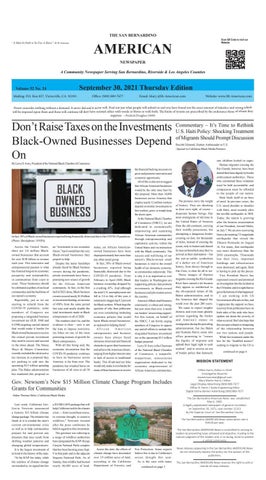
In fact, 58% of Black-owned businesses reported being financially distressed due to the COVID-19 pandemic. (Photo: iStockphoto / NNPA) Across the United States, there are 2.6 million Blackowned businesses that account for over $138 billion in revenue each year. This innovative and entrepreneurial passion is what has fostered long-term economic prosperity and sustainability in communities from coast to coast. These businesses should be celebrated as pillars of our local communities and the backbone of our nation’s economy. Regrettably, just as we are starting to rebuild from the COVID-19 pandemic, some members of Congress are proposing a misguided business investment tax (H.R. 1068 and S.1598) targeting carried interest that would make it harder for Black-owned businesses to receive the critical private investment they need to recover and succeed in the times ahead. The House Ways & Means Committee recently included this destructive tax increase in a proposal they are pushing to add into the upcoming $3.5 trillion spending plan. The Biden administration has marketed this proposal as
an “investment in our economic future,” but it would hurt the very Black-owned businesses they proport to help. Despite the many hardships already faced by Black business owners during the pandemic, private investments have been a promising new source of growth for the African American community. In fact, in the first half of 2021 alone, Black business owners secured nearly $1.8 billion in investment funding, an increase of 450% from the same period last year and nearly double the total investments made in Black entrepreneurs in all of 2020. The numbers don’t lie, and the evidence is clear – now is not the time to impose restrictive tax hikes on one of the most promising avenues of growth for Black entrepreneurs. With all this being said, the economic devastation that the COVID-19 pandemic continues to have on businesses across America, is far from over. The pandemic has wreaked havoc on businesses of all sizes in all 50
states, yet African Americanowned businesses have been disproportionately hurt more than any other racial group. In fact, 58% of Black-owned businesses reported being financially distressed due to the COVID-19 pandemic. From February to April 2020, Black business ownership dropped by a crushing 41%. And although the total U.S. unemployment rate fell to 5.4 in July of this year, it remained a staggering 8.2 percent for Black workers. Which begs the question of why then politicians are even considering instituting economic policies that would harm Black-owned businesses, as opposed to helping them? African American entrepreneurs and business owners have always faced immense structural and financial obstacles to grow their businesses and achieve the American dream, ranging from higher interest rates to lack of access to traditional banks. This ill-advised tax hike would only make it even harder for many of these businesses to receive
the financial backing necessary to grow and promote innovation and economic opportunity. All of this is also not to suggest that African American businesses would be the only ones hurt by this proposal. More than 14,000 businesses across America that employ nearly 12 million workers depend on similar investments to hire workers, grow, or simply keep the doors open. At the National Black Chamber of Commerce (NBCC), we are dedicated to economically empowering and sustaining African American communities through entrepreneurship and capitalistic activity within the United States and via interaction with the Black community. The success and well-being of our nation’s Black-owned small businesses is vital to the overall health of our domestic economy, in communities nationwide. This is why it is as important as ever that leaders in Washington are supporting policies that promote investments in Black-owned businesses and job creation across the country. America’s Black small business community is robust and strong, but now more than ever, it needs our leaders’ unwavering support. For this reason, on behalf of the NBCC, I am firmly urging members of Congress to oppose any and all efforts to include this misguided business investment tax in the upcoming $3.5 trillion budget proposal. Larry D. Ivory is the Chairman of the National Black Chamber of Commerce, a nonprofit, nonpartisan, nonsectarian organization dedicated to the economic empowerment of African American communities.
Gov. Newsom’s New $15 Million Climate Change Program Includes Grants for Communities Aldon Thomas Stiles | California Black Media Last week, California Gov. Gavin Newsom announced a historic $15 billion climate change package. The initiative has funds in it to combat the state’s current environmental crisis as well as to help communities prepare for and prevent any disasters that may result from shifting weather patterns and changing global temperatures. It is the largest investment of its kind in the history of the state. "At the KNP fire today, while the realities of climate change surrounded us, we signed into law
a $15 BILLION package that will help California tackle the climate crisis — from record heat waves, to extreme drought, to massive wildfires," Newsom tweeted after the press conference he held in regards to this investment. The governor was referring to a range of wildfires authorities have designated the KNP (Kings Canyon National Park) complex that has been burning since Sept. 9 in that park and in the adjacent Sequoia National Park. As of Sunday, that wildfire had burned nearly 46,000 acres of land.
The pictures carry the weight of history. They are shocking in their own right, of course – desperate human beings, like most immigrants of old time to the United States of America from the old continent, carrying their worldly possessions, but attempting a dangerous border crossing on foot, for thousands of miles, instead of crossing the ocean, only to beaten and chased by men on horseback once they've arrived at their destination – but the not-so-subtle symbolism of a darker era of American history, from slavery through to Jim Crow, is clear for all to see. These images of Haitian migrants crossing the Rio Grande River have caused a stir because they appear so antithetical to the oft-repeated values of the Biden administration, and to the America that shaped the world over the past 200 years. We came to expect tougher rhetoric and even more ghastly actions regarding the border and America’s stance on immigration during the preceding administration, but Joe Biden and Kamala Harris came into office promising to ‘’ensure the dignity of migrants and uphold their legal right to seek asylum’’ and to reverse an era of border policy that famously
saw children locked in cages. Haitian migrants crossing the Rio Grande, however, have been denied their basic dignity by border enforcement authorities. Those who committed these violations must be held accountable, and compassion must be afforded to the people of our nation. Haiti finds itself at an hour of need. In previous crises, the U.S. stood shoulder to shoulder with Haiti, most recently after the terrible earthquake in 2010. Today, the nation is grieving after the heinous assassination of our President, Jovenel Moïse, on July 7. We are now recovering from a devastating 7.2 magnitude earthquake that struck the Tiburon Peninsula on August 14. For many, that earthquake was more disastrous than the 2010 catastrophe. Thousands lost their lives, important buildings and infrastructure were destroyed, and again, Haiti is having to pick up the pieces. Vice President Harris has expressed concern and promised an investigation into the incident at the US border, and it is right that we get to the bottom of what happened. I am working with US Government officials on this, and I appreciate the support we have received from politicians here on both sides of the aisle who have spoken out about the severity of what occurred. But I also hope that this can spur a deeper re-imagining of the relationship between our two nations and people. While fair treatment under the law for the “huddled masses” seeking to migrate to the US is continued on page 6
MISSION STATEMENT Clifton Harris /Editor in Chief Investigative Reporter sbamericannews@gmail.com Mary Martin-Harris / Editor Legal /Display Advertising (909) 889-7677 Clifton B. Harris / Audio Engineering Editor Digital Online Banner Advertising (909) 889-7677 The San Bernardino American News was established May 6, 1969. A legally adjudicated newspaper of general circulation on September 30, 1971, case number 15313 by the Superior Court of San Bernardino County. The San Bernardino AMERICAN News subscription rate is $59.00 per year. The San Bernardino AMERICAN News is committed to serving its readers by presenting news unbiased and objective, trusting in the mature judgment of the readers and, in so doing, strive to achieve a united community.
Across the state, the effects of climate change have decimated over 1.9 million acres of land, according to the California Department of Forestry and
Fire Protection. Some experts believe this is due to California’s severe drought this year. As is the case with many continued on page 3
News releases appearing in the San Bernardino AMERICAN News do not necessarily express the policy nor the opinion of the publishers. The San Bernardino AMERICAN News reserves the right to edit or rewrite all news releases.
Thursday, September 30, 2021
Page 2
COMMUNITY/EDUCATION/ADVERTISING
Clean, Affordable California Water a Challenge for Low-Income Communities By Dan Ross
The pumping station for the Las Deltas drinking water system in Las Deltas, California. All photos by David Bacon. Amid the vast water wars of the drought-parched Central Valley, the tiny community of Las Deltas in Fresno County is enduring its own largely hidden battle over California’s liquid gold. In many ways, Las Deltas projects a sense of time standing still — a feeling fostered by the decaying wooden skeletons of long abandoned buildings lining the roadside in an area with some of the highest levels of poverty in the nation. But the historical threads of the region aren’t just visible above ground. The old asbestos pipes of Las Deltas’ water distribution system, which serves fewer than 100 homes and businesses with water piped from the nearby town of Firebaugh, is crumbling beneath the residents’ feet. A small band of locals started and ran the Las Deltas Mutual Water Company for decades. They disbanded it a couple of years ago, however, overwhelmed by the bureaucracy of running the disintegrating system and worried about potential lawsuits over its
much-needed upgrades. Right now, no one is formally at the helm. When a pipe bursts, as it frequently does, a plumber is called from nearby Firebaugh to patch it up — a temporary fix in lieu of a long-term solution. The price tag for upgrading the distribution system was estimated at some $4.8 million. It’s still unclear where the money will come from. But the average resident — some of them low income farm workers — can’t afford it, as they already pay $100 a month for their water, close to double the state average. A massive funding gap means that some of California’s most broken small water systems, like that in Las Deltas, will face a yawning wait for desperately needed economic assistance. “There’s a lot of poverty here,” says Tim Ward, a spry and wiry 72-year-old with a snow-white handlebar mustache, who has lived in Las Deltas all his life. As the former president of Las Deltas Mutual Water Company, Ward helped maintain the system for
years, going out day or night to plug leaks. He believes an issue as crucial as clean, affordable water should prompt the county or state to help. On a recent tour of the community, he sums up his take: “They don’t care about us.” Nearly 10 years ago, California enacted the Human Right to Water Act to help beleaguered communities like Las Deltas. This landmark legislation obligates the state to work towards safe, clean, affordable and accessible drinking water to the 1 million residents without it. Since then, there have been several key developments designed to bring this law to life, including a funding program to help failing systems get up to code. In his latest budget, Governor Newsom included nearly $1 billion to help users pay off a mammoth debt in unpaid water bills. As the state moves toward its statutory goal, however, hundreds of small drinking water system operators and their mostly low income users face a tough reckoning. The reasons why include years of deferred infrastructure improvements, dwindling groundwater tables, tightening environmental standards and a dearth of trained talent within their ranks to oversee the work that desperately needs to happen. Perhaps most crucially, a massive funding gap means that some of the state’s most broken small water systems, like that in Las Deltas, will face a yawning wait for desperately needed economic assistance.
“It’s a bit like Ginger Rogers and Fred Astaire,” says Jennifer Clary, California director of Clean Water Action, an environmental advocacy organization, comparing the lopsided challenges between larger and smaller systems. “Ginger Rogers had to do everything that Fred Astaire did, but backwards and in high heels.” * * * In April, the state released its first ever needs assessment, and the eagerly awaited 332page report provides a stark overview of the challenges ahead. Of the 2,779 small water systems investigated — including those with 3,300 or fewer service connections, and systems serving K-12 schools — the state labeled 326 as “highest priority” for being out of compliance or consistently failing to meet mandatory drinking water standards. That list is growing, the report states, not shrinking. While the projected costs over five years to bring just the most at-risk small water systems in California up to speed is $10.3 billion, the available financial assistance is short by some $4.7 billion. When it comes to affordable drinking water, approximately one-third of small water systems serving vulnerable communities exceeded at least one of three key affordability thresholds: share of household income going towards water payments, extreme water bills and shut-offs through nonpayment. A recent state water board survey drew an
Clean, Affordable California Water a Challenge for LowIncome Communities...continued even starker picture. The survey found at least 12% of households have water debt totalling some $600 million-$700 million, with low-income communities of color disproportionately impacted. In his latest budget, Gov. Newsom earmarked nearly $1 billion to wipe out drinking and wastewater debt accrued between March 4, 2020, and June 15, 2021. But community members and advocacy organizations raise fears about the program’s purported benefits, especially awareness among the public and of participation among operators. “We are concerned that some water systems are choosing not to participate even as their customers drown in debts from the pandemic and risk losing access to drinking water,” wrote Kyle Jones, policy director for Community Water Center, in a press release Wednesday. In an email to Capital and Main, Robert Brownwood, an assistant deputy director at the water board, wrote, “This is a real concern for the Board who is aggressively work ing with nu merous entities to get the word out to all community water systems.” Questions of short-term debt relief invariably lead to a much more intractable problem: What happens when these monies dry out and the debt starts to mount again? And rise it will, for the art of divining clean and accessible drinking water in California doesn’t come cheap, which, for its part, the state realizes. A key aim of the needs
assessment is to help regulators identify where to prioritize a sizable pot of state money for water infrastructure projects. This includes the Safe and Affordable Funding for Equity and Resilience (SAFER) program, launched in 2019 to provide a funding mechanism for disadvantaged communities. Indeed, the town of Firebaugh is in the process of applying for an estimated $2.5 million grant through this program to replace the damaged storage tank used to supply water to Las Deltas. But while the projected costs over five years to bring just the most at-risk small water systems in California up to speed is some $10.3 billion, the available financial assistance — including from SAFER — is short by some $4.7 billion. “Where does that money come from? That’s a huge question,” says Sue Ruiz, a community development specialist with SelfHelp Enterprises, a non-profit that provides low-income communities with tools for self-sustainment. Ruiz has been helping Las Deltas for several years, and she’s concerned that much needed funds to both improve the community’s water distribution system and to properly consolidate the system with that of Firebaugh could take years to materialize. “ Pe o p l e a r e g e t t i n g discouraged, rightfully so,” Ruiz adds. “But they’re not forgotten.” Read the complete article on the Capital & Main website info@capit aland main.com
New Mr. and Miss Cardinal City Court Crowned: COVID Safety Measures Provide a Safe and Fun Event Community /Education News
After a mask-wearing and music-filled event on Saturday, September 25 that brought much joy and excitement to the San Bernardino High School (SBHS) community, Abdel-Rahman Hussein and Jamie Villalobos were crowned the new Mr. and Miss Cardinal City, respectively. The 2021–2022 pageant was unlike any held before. According to pageant director and SBHS bilingual school outreach worker Jaime Rios, due to COVID-related cancellations of the separate 2020–2021 Mr. Cardinal and Miss Cardinal pageants, he made the decision to combine the pageants for 2021–2022. “The students and staff have waited so long for the pageant,” Rios said. “It’s become a tradition and something that everyone looks forward to. Once we had the proper safety precautions in place to make it happen, I wanted to involve both sets of contestants.” Rios worked closely with staff from SBHS and Sturges Center for the Fine Arts, where the pageant was held, to make sure that everyone would be as safe as possible from COVID. He also consulted with District officials, including the San Bernardino City Unified School District (SBCUSD) Safety & Emergency Manager Eric Vetere. The COVID safety measures involved limiting the pageant audience to 250 invited guests only, which included only 10 members of each contestant’s family, pageant judges, performers, and a small, select group of Sturges and SBHS staff and judges’ guests. Since Sturges can accommodate 700 audience members, the extra
(l-r) Newly crowned Miss Cardinal City Jamie Villalobos and Mr. Cardinal City Abdel-Rahman Hussein with his court, Saul Felix and Carmel Gonzales. (Photo by Corina Borsuk and provided courtesy of SBCUSD) space allowed the audience to be grouped by household with empty seats between groups. Additionally, every person in attendance was asked to wear a face covering over their nose and mouth at all times, excluding when sipping water or for children under age 2, as allowed by law. Signage reminded attendees to assess their health before entering Sturges, and everyone had to submit to a temperature check. Hand sanitizer stations were available for the judges, backstage for the contestants, and for the audience. An industrial-sized, HEPAgrade air filter in the auditorium filtered the air for virus particles. Filling out Mr. Cardinal City’s court are first runnerup Carmel Gonzales and second runner-up Saul Felix. Miss Cardinal City’s court includes first runner-up Kylee Bravo and second runner-up Laura Galindo. Miss International Beauty 2021 Trinity Ortega and Teen International Beauty 2021
Ashley Torrez were also crowned Saturday night and will be part of the Miss Cardinal City court. The pageant also included several special presentations. Ivan Cruz, a SBHS Class of 2021 graduate, was named Mr. Cardinal City 2020–2021. “The Mr. Cardinal City 2020– 2021 pageant was cancelled just weeks before the event due to the COVID-19 lockdowns,” Rios said. “The contestants had been practicing and providing hours of community service up to that point, but they never got to take the stage. I couldn’t give that back to them, but I could crown an honorary Mr. Cardinal City 2020– 2021 from among the contestants.” Cruz was crowned shortly before Mr. Cardinal City 2021– 2022 was announced, so his reign was short lived, but he will be listed as a former Mr. Cardinal City in official documents. Dr. Harold Vollkommer, retired SBCUSD interim superintendent continued on page 7
Thursday, September 30, 2021
Page 3
STATE/GOVERNMENT/BUSINESS
Black Lives Matter and The Color Aguilar Announces $777,000 for Inland Empire Housing Services of Your Skin By Roger Caldwell, NNPA Newswire Contributor
On many different levels people of color are advancing, and there is much to be proud of. There are now more children of color being born, than White children each year, and White people are concerned with their existence. There is a pervasive sickness in America, and it is called White supremacy, and systemic racism. These ideologies are invisible, and many Americans now believe that success has nothing to do with the color of an individual’s skin. Discrimination no longer exists, and everyone has the same opportunities. It is very easy to get caught in this frame of mind, because you can look at the millions of people of color, who are a success in one generation. Instead of challenging and fighting racism, they put the blame on the person. On many different levels people of color are advancing, and there is much to be proud of. There are now more children of color being born, than White children each year, and White people are concerned with their existence. “White supremacy or White supremacism is the belief that White people are superior to those of other races and thus should dominate them. The belief favors the maintenance and defense of White power and privilege. White supremacy has roots in the now discredited doctrine of scientific racism, and was a key justification for colonialism,” states Wikipedia. The Democrats would want Americans to think that in 2021, only Republicans are the only party that is racist, but racism is systemic and institutionalized. When White folks get together, there are always the Black jokes, and the jokes about how fast Black men can run. Many would think that Black jokes are harmless, and they would never say them in front of their Black friends, but sometimes other words slip out. There is something fundamentally different about being born White, and more doors are opened, from the start. Some call it “White privilege” and it is a benefit that is enjoyed by all White folks, and it does not matter if you are a Democrat or Republican. There is a cultural thread that runs through the society, and Whites take
advantage of all these benefits. White privilege is an aspect of White power, and all White people have the ability to pull out their White power card. History in America has demonstrated that White citizens will make war, and justifying horrific atrocities against Black people, including lynching. Even after slavery was abolished, there was still lynching, and many today believe police brutality is still connected to the history of lynching. There were 3436 people lynched from 1889 to 1932, and the majority was Black people, according to publisher Ida Wells. As Black Americans look to the past for answers, Ida Wells was always very vocal in her campaigns to stop lynching and racial violence against her community. When her newspaper was published, she risked being lynched, and her office was burned to the ground. She was determined to make a change, and in 2021, Black Americans must agree on a Black Agenda to make significant change. When White supremacy and racism shows its ugly face, it is important that the community is prepared to fight. In 16 states, White supremacy is fighting to disenfranchise Blacks and people of color. Everyone and it does not matter your color, should be fighting to uphold voting rights. All these organizations should take a page from Ida Wells, and become the loudest voice in the room. We must be more vocal, and racial justice and change must be a part of every conversation. Intimidation never stopped Ida Wells from getting up in the morning, to do what is right, and it cannot stop us from winning in 2021. Our ancestors have shown us the way, and it is time to come together and start a Black, people of color movement for change. The color of your skin makes you Black, and All Black Lives Matter, and we must change America, and next the world.
Gov. Newsom’s New $15 Million Climate Change Program Includes Grants for Communities..continued from page 1 other crises in the United St ates, com mu n it ies of color are disproportionately affected by climate change. This climate package hopes to change that by providing grants to help communities plan for climate change, as well as bolstering fire and drought prevention and response through program funding. "California is doubling down on our nation-leading policies to confront the climate crisis headon while protecting the hardesthit communities," said Newsom. " We’r e d e p l o y i n g a comprehensive approach to meet the sobering challenges
of the extreme weather patterns that imperil our way of life and the Golden State as we know it, including the largest investment in state history to bolster wildfire resilience, funding to tackle the drought emergency while building long-term water resilience, and strategic investments across the spectrum to protect communities from extreme heat, sea level rise and other climate risks that endanger the most vulnerable among us," he explained. The state has not yet announced a schedule for release of the funding to communities or at how it will be dispersed. California Black Media will be following that process
State/Government News San Bernardino, CA—Today, Rep. Pete Aguilar announced that Neighborhood Housing Services of the Inland Empire (NHSIE) received $273,122 and Neighborhood Partnership Housing Services, Inc. (NPHS) received $504,450 in federal grant funding from NeighborWorks America through its Housing Stability Counseling Program (HSCP). NeighborWorks is a congressionally-chartered and funded nonprofit created to help address affordable housing issues. “In Congress, one of my top priorities is addressing the affordable housing crisis in the Inland Empire and throughout California. This funding will help homeowners and families access housing counseling and other key resources to make sure more families in our community can achieve and sustain the dream of homeownership,” said Rep. Aguilar. “We are appreciative of the support of Congressman Aguilar as we continue our work of providing the tools needed to help preserve homeownership and housing stability in the Inland Empire. Now, more than ever, the pandemic and social
inequities have highlighted the health and economic challenges faced by many families in our communities. As a HUDApproved Housing Counseling Agency, we will use this award to support the delivery of housing counseling services for those community members who are facing housing instability due to eviction, default, foreclosure, or loss of income,” said Felicia Brow n-Smith, Executive Director/CEO of NHSIE. “The Housing Stability Counseling Grant will play a critical role in elevating NPHS’ comprehensive foreclosure intervention counseling efforts,” said Clemente Mojica, NPHS CEO. “With thousands of families in our region falling behind on their mortgage due to the COVID-19 pandemic’s unemployment effects, we are doing everything in our power to keep families in their homes and avoid foreclosure.” Aguilar serves on the House Appropr iat ions Hou si ng and Urban Development Subcommittee, the subcommittee that oversees federal funding for agencies like NeighborWorks.
By 2026, Cal Education Chief Wants Every Third Grader to Know How to Read Joe W. Bowers Jr. | California Black Media
State Superintendent of Public Instruction Tony Thurmond held a press conference via zoom and on Facebook last week to unveil an ambitious new education achievement plan for California. It is a campaign that has been designed to ensure, by 2026, every California third grader will know how to read. The effort will also include a biliteracy milestone for d u a l -l a n g u a ge le a r n e r s . Thurmond announced that he will be forming a task force of practitioners, advocates, researchers, foundation partners, thought leaders, students, parents, and other experts to identify key strategies that school districts and charter schools can employ to help their students achieve this bold goal. Education researchers point out that children are expected to be able to learn about the world through reading by third and fourth grade. This is when their math lessons are taught using word problems and reasoning skills are developed through discussing text they’ve been assigned to read. Children who fall behind developing reading skills quickly find themselves struggling to keep up with their coursework. A study by researchers at the Stanford Graduate School of Education reached the conclusion that during the pandemic inadequate reading instruction has contributed to students’ reading fluency in second and third grade to be approximately
30 % behind what would be expected in a typical year. Thurmond said during his opening remarks, “We already know that when students learn to read, they can read to learn anything. This is a gateway skill that can carry them to any point in their life, in their career, and in their journey. We also know that when students don't learn to read by third grade, they're at greater risk to drop out of school, and they are greater risk to end up in the criminal justice system” On the state’s Smarter Balanced tests during the 201819 school year only 33% of Black students in grades three through 11 tested at grade level or above in English language; only 31% of third graders tested at grade level or above in English language arts. In addition to announcing the task force formation, Thurmond revealed that Assemblymember Mia Bonta (D-Oakland) has agreed to sponsor legislation that will formally be introduced in 2022 to support the task force’s recommendations. “We will bring forward legislation in the next legislative cycle that will help us to have the resources for professional learning, and the other things that we'll need to support our students,” he said. Thur mond expects the legislation to consider issues of continued in next 2 columns
By 2026, Cal Education Chief Wants Every Third Grader to Know How to Read...continued readiness, chronic absenteeism, needs of students with disabilities and multilingual learners, early education, and socioeconomic factors that impact a student’s ability to learn to read. “I look forward to working closely with you all in the coming weeks and months on improving childhood literacy and biliteracy,” said Assemblymember Bonta speaking at the press conference. “I applaud Superintendent Thurmond for this targeted campaign. It is a bold, aggressive agenda. I’m on board and willing to make sure that we have the ability to provide legislation that is going to be meaningful and focus on implementation and making this a reality for every single child in this state. Literacy is the key to equity.” Also present at the press conference were: E. Toby Boyd, California Teachers Association;
Hedy Chang, Executive Director, Attendance Works; Dr. Francisco Escobedo, Executive Director, National Center for Urban School Transformation; Assemblymember Jim Frazier (D-Fairfield), Liaison to Advisory Commission on Special Education; Jan Gustafson-Corea, Chief Executive Officer, California Association of Bilingual Education (CABE); Matt Navo, Executive Director, California Collaborative for Educational Excellence (CCEE); Dr. Christopher J. Nellum, Executive Director, The Education Trust— West; and Jackie Thu-Huong Wong, Chief Deputy Director, First 5 California. Keith Pace, Executive Director, California School Employees Association was invited but did not participate. continued on page 8
Assemblywoman Luz Rivas’ Bill to Remove the Derogatory Term “Alien” from State Law Signed by the Governor State/Government News SACRAMENTO – Today, Governor Gavin Newsom signed Assemblywoman Luz Rivas’ (D-San Fernando Valley) Assembly Bill (AB) 1096 into law. AB 1096 eliminates the offensive term “alien” from all state laws and policies, replacing it with other language that is more reflective of today’s legal terminology, such a “noncitizen” or “immigrant.” “Today marks a huge step forward in the fight to dismantle institutional racism targeted specif ically towards our immigrant communities,” said Assemblywoman Luz Rivas. “For decades, the term ‘alien’ has become weaponized and has been used in place of explicitly racial slurs to dehumanize immigrants. The words we say and the language we adopt in our laws matter – this racist term ‘alien’ must be removed from California statute immediately. I want to thank Governor Newsom for recognizing the importance of this bill and taking action to remove derogatory language from our laws.” “The word ‘alien’ has no right to be in California statute – no human being is an ‘alien,’” said long-time civil rights activist Dolores Huerta. "It is insulting and dehumanizing to have that terminology in our laws. Words are powerful instruments and history has shown us how they can be used to justify institutional racism and even violence. I want to thank Governor Newsom for signing this important measure.” “Using the outdated term ‘alien’ to describe a person is dehumanizing, and AB 1096 will change that,” said Lieutenant Governor Eleni Kounalakis. “As a daughter of an immigrant, I understand the weight that the word ‘alien’ carries, and the impact of this bill becoming law. I commend Governor Newsom for solidifying this effort to change the narrative around immigration in California.” California’s legislature first introduced “alien” into statute in 1937 to refer to fully naturalized U.S. citizens and immigrants living within U.S. borders. In the 1990s, people began to use the word “alien” as a dog whistle to express bigotry and hatred without using explicitly racist language. “Nearly 11 million Californians were born outside of the United
States, and we are proud of that fact,” said Senator María Elena Durazo (D-Los Angeles), coauthor and Chair of the California Latino Legislative Caucus. “Our immigrant communities add so much to California. It’s time we get rid of the dehumanizing, xenophobic language in the California Code referring to immigrants as 'aliens', and replace it with a term that gives the dignity to our immigrant population that they deserve.” “As an off icial Latino Caucus priority, I am proud that Governor Newsom signed AB 1096 into law,” said Latino Caucus Vice-Chair and co-author, Assemblymember Robert Rivas (D-Salinas). “The term ‘illegal alien’ has historically been used to discriminate and dehumanize our undocumented neighbors. This legislation will update state law to reflect California’s values of diversity and inclusivity.” “AB 1096 makes it clear that no human being is an ‘alien,’ regardless of where a person is born. I’m proud to have partnered with Assemblymember Luz Rivas in introducing this legislation and very grateful to Governor Newsom for signing it into law. The offensive immigration policies of the past will no longer dictate California’s future,” said Assemblymember Evan Low (D-Silicon Valley). “When we speak about undocumented Californians, we’re talking about our friends and neighbors—people who are vital members of our families and our communities. It’s essential that state law reflects this reality and that we treat them with the respect and dignity that they deserve,” said Assemblymember Jesse Gabriel (D-Woodland Hills), Chair of the California Legislative Jewish Caucus. “I applaud Assemblymember Luz Rivas for leading the effort to remove this offensive term from state law and thank Governor Newsom for signing this important measure.” A s s e m b l y wo m a n L u z Rivas proudly represents the 39th Assembly District, which includes the City of Los Angeles communities of Arleta, Lake View Terrace, Granada Hills, Mission Hills, North Hollywood, Pacoima, Sun Valley, Sunland-Tujunga, Sylmar, and the City of San Fernando.
Thursday, September 30, 2021
Page 4
LIFESTYLE/SPORTS/ENTERTAINMENT/RELIGION
Temptations Release New Song with Smokey Robinson Commemorating Group’s 60th Anniversary BlackPressUSA News
The Temptations last surviving original member, Otis Williams’, critically acclaimed autobiography, Temptations, was recently released as an audiobook edition for the first time, with a new introduction by Williams. This year marks the 60th Anniversary celebration of The Temptations, the legendary, Grammy Award-Winning group known as the “No. 1 R&B Artists of All Time” (Billboard). And releasing today is their brand-new single, “Is it Gonna Be Yes or No,” a duet between the group and the equally legendary Smokey Robinson, the man who delivered their first hits. The song, also written and produced by Smokey, is a preview of the upcoming TEMPTATIONS 60 album. Robinson brought in stellar studio musicians to play on the ballad, including his longtime associate Dave Garfield on keyboards, bassist Freddie Washington and drummer Steve Ferrone. And in all the years Robinson has delivered such timeless Temptations classics as “The Way You Do the Things You Do,” “My Girl,” “Since I Lost My Baby,” “Get Ready” and more, the duet marks the only time he and the Temptations have sung lead together, save for a recording of “The Christmas Song” in 1989. “It’s wonderful to be back together. When The Tempts first met Smoke we were teenagers, young black men in Detroit who had no clue that our partnership at Motown would produce ‘My Girl,’ one of the greatest hits of all time,” says Williams. “And our success together didn’t stop there. We had chart hit after chart hit and, soon after, our music
was heard around the world. Now, 60 years later, as I turn 80, Smoke and I have come full circle. I never imagined we would have the opportunity to get back in the studio and do it all again.” Smokey adds, “When Otis called me and said, ‘Hey man, we’re doing a new album and we’d like you to do a song, that got me excited about working together again. That was it, that’s all it took. I proceeded to write a new song for them, and I was very happy to, because it’s been a long time. When I showed up at the studio, Otis said, ‘Man, I want you to sing on this one with us.’ So, I said, ‘Oh, okay, I’m very excited about the song, let’s do it! You, know, it’s just great working with them, always.” The Temptations’ 60th Anniversary campaign launched this summer and will run through June 2022, in a celebration befitting one of the most revered and prolific musical institutions of all time. The year-long campaign includes the new album in 2022; a 50-city tour through the end of this year, with more global dates to be announced; remastering of their music videos, including “Standing on the Top” with Rick James and their No. 1 hit “Stay;” a new content series; the Imperial Theatre re-opening on October 16th of the Broadway musical, Ain’t Too Proud: The Life and Times of the Temptations, based on Otis Williams’s personal journey that was nominated for 12 Tony
Awards, including Best Musical and won the Tony Award for Best Choreography at the 73rd Tony Awards ceremony in June 2019 and whose original cast album was GRAMMY-nominated; and celebratory events along the way including Otis Williams’ 80th birthday on October 30th. Their Emmy Award-Winning Television mini-series, The Temptations, which first aired to rave reviews in 1998, is still on air or streaming every day somewhere in the world. Williams’ critically acclaimed autobiography, Temptations, was recently released as an audiobook edition for the first time, with a new introduction by Williams. Temptations History The Temptations are today one of the most iconic, bestselling brands in the entertainment world. With Otis Williams, the founding and sole surviving member of The Temptations, their track record of history-making music is breathtaking, their presence across multi-media platforms has never been more vivid, and their popularity is ever-increasing. Most recently, adding to their dozens of sampled tracks, their hit “Papa Was a Rollin’ Stone,” was used as the foundation of the Migos smash, “Avalanche.” The Temptations were among the first African American musical artists to crossover into mainstream America and appear on popular, national mainstream television programs, such as The Ed Sullivan Show, and The Hollywood Palace in the 60s. Trailblazers, the group’s star power was so striking that these top-rated, national programs, and many others, scheduled appearances for the Temptations multiple times during a single
year. At the time, this was an unparalleled accomplishment for African American entertainers. The Temptations helped change the face of primetime television and fueled the growth in the performing arts and entertainment world for African Americans artists forever. The Temptations rank No. 1 in Billboard magazine’s most recent list of Greatest R&B/HipHop Artists of All Time, and the group appears in the magazine’s list of 125 Greatest of All Time Artists. Rolling Stone magazine commented that the Temptations are “Indisputably the greatest black vocal group of the Modern Era…,” and listed the group’s Anthology album among the 500 Greatest Albums of All Time. The group has won four GRAMMY Awards, including Motown’s first-ever statuette, awarded to the Tempts for “Cloud Nine” for Best Rhythm and Blues Performance by a Duo or Group, Vocal or Instrumental in 1969. The Tempts were also awarded a GRAMMY Lifetime Achievement Award, while their No. 1 hits “My Girl” and “Papa Was a Rollin’ Stone” are in the GRAMMY Hall of Fame. The group has been inducted into the Rock & Roll, National Rhythm & Blues Music, and Vocal Group Halls of Fame, and they have a star on both the Hollywood Walk of Fame and the Apollo Theater’s Walk of Fame. Throughout the group’s evolution, they have released countless gold, platinum and multi-platinum chart hits, many of which are considered American masterpieces. They have 16 No. 1 R&B chart albums, 44 Top 10 R&B chart hits, including, 14 No. 1 R&B singles, plus four No. 1 Hot 100 singles.
Melvin Van Peebles, Godfather of Black Cinema, Dies... continued Air Force and began writing. In 1956, he married German actress and photographer Maria Marx, who appeared with him in this iconic film Sweet Sweetback’s Baadasssss Song.
They lived in Europe and Mexico before he returned to the states and worked as a cable car operator in San Francisco. continued on page 7
Melvin Van Peebles, Godfather of Black “I’ve Told You On Many Occasions Cinema, Dies By Nsenga K. Burton, Ph.D., NNPA Newswire Culture and Entertainment Editor
to Repent But You Refuse to Listen!” By: Lou Yeboah
Lou Yeboah
Born in Chicago in 1932, Van Peebles was the son of a tailor and homemaker. After graduating high school, he enrolled in West Virginia State University before transferring to Ohio Wesleyan University. (Photo: Georges Biard | Wikimedia Commons https://commons.wikimedia.org/ wiki/File:Melvin_Van_Peebles_Deauville_2012_2.jpg) The film world is reeling over the loss of influential filmmaker Melvin Van Peebles who passed away yesterday in Manhattan. Van Peebles is best known for his classic independent films Watermelon Man (1970) and Sweet Sweetback’s Baadasssss Song (1971), which offered a bold critique of racism, power and Black liberation in the United States. Van Peebles, the father of actor/director Mario Van Peebles, created
the blueprint for what would become the Blaxploitation genre of filmmaking with his Sweet Sweetback’s Baaadasssss Song. Born in Chicago in 1932, Van Peebles was the son of a tailor and homemaker. After graduating high school, he enrolled in West Virginia State University before transferring to Ohio Wesleyan University. Following graduation, the future filmmaker joined the continued in next 2 columns
Okay, no more warnings! Have it your way. But you ought to know that there will be terrible consequences for those who refuse to repent- those who choose to do their own thing. Choosing the creation, but refusing the Creator, what’s wrong with you? You will perish [Luke 13: 3, 5] even though that is not what I desire- [2 Peter 3:9). Even now you are filling up a "store house" of wrath that will one day be poured out on you – [Romans 2:5. Acts 17:30] “I have sharpened My sword; I have bent My bow and made it ready [Psalms 7:12]. Since you have refused to repent, now it’s my prerogative, and I will do what I want, says the Lord.
I tell you, making decisions without consider ing the consequences is foolish and dangerous. The price to pay is always catastrophic. Listen, God in His justice and forbearance has given you opportunity after opportunity to turn to Him, but you refuse, but God will not be mock; you will suffer the consequences of your choice. If a sinner can be sent to hell for all eternity, this clearly demonstrates God’s full hatred toward disobedience. As people whom God deeply cares about, he wants us to deal with disobedience wisely. Remember, nobody can ever please God while living in rebellion. Rebelling against Him is equivalent to rejecting Him and His Word. Repent or Perish! The choice is your! A warning about a coming day: In [Revelation 6:8] one-fourth of the world's population are killed, and the remaining three-fourths of continued in next 2 columns
“I’ve Told You On Many Occasions to Repent...continued the people survive. In [Revelation 9:18] one-third of these survivors are killed. Even after half of the world's population has been killed, the survivors refused to repent of their sin and idolatry – [Revelation 9:20-21]. Later, God let the sun scorch them with a burning heat. At this time, they not only refused to repent and glorify God, but they also cursed him – [Revelation 16:9]. Then God sent darkness, along with pain [pain from the burns and sores of the previous judgment]. The people still refused to repent of what they had done – [Revelation 16:11[. At that point, there is nothing left for God to do, except to return and bring judgment upon them, at the final battle of Armageddon. [Revelation 16:21] Woe to you, Chorazin! Woe to you, Bethsaida! For if the mighty works done in you had been done in Tyre and Sidon, they would have repented long ago, sitting in sackcloth and ashes. But it shall be more tolerable in the judgment for Tyre and Sidon than for you. And you, Capernaum, will you be exalted to heaven? You shall be brought down to Hades. Even though God has brought correction to a rebellious people to turn them back to truth, they would not listen but instead hardened their hearts to remain in opposition to God. Failure to repent while still able seals their doom when they die. [Luke 10:13-15].
[Revelation chapter 16] man’s last chance to turn. They didn’t want to hear what God had to say. They refused to apply the words of prophesy to themselves and to take the shame for what they had done. They had no remorse, no guilt. The prophet’s words did not move the people to a place of repentance. Their hearts were too hardened, and their necks were too stiffened to take heed to the forewarning of impending doom. They didn’t want to hear that they were not right in the eyes of God. They didn’t want to hear words of rebuke that lets them know they have fallen short of the glory of God. They didn’t want to hear sound doctrine. Therefore, they refused to listen at all. They wanted their ears tickled with words of blessings and peace. Doom and gloom was not the type of prophet they wanted so they refused to hear and obey. “As surely as I live, declares the Sovereign Lord, I take no pleasure in the death of the wicked, but rather that they turn from their ways and live. Turn! Turn from your evil ways! Why will you die, O house of Israel?” [Ezekiel 33:11]. Now is the time of God’s favor. Now is the day of salvation.” [2 Corinthians 6:2]. Repent! And do this, understanding the present time: The night is nearly over; the day is almost here. [Romans 12:11-14].
Witness For Justice#1066
Join the Movement John Dorhauer
In his book Lies across America: What Our Historic Sites Get Wrong, Smithsonian historian and author James Loewen uncovers the truth about white America: its monuments reinforce the lies we tell and the truths we hide about our racist past. Since the rise of the Black Lives Matter movement, there has been a serious movement to rediscover hidden truths about racism and to demolish monuments to our racist past. Statues of insurrectionists, Confederate traitors, and racist, slave-holding and slavery-defending oligarchs have been toppled. New markers and museums that tell the truth about the courage, creativity, and remarkable endurance of enslaved populations are finally being built. Getting this story right is important. Fierce debates are now ensuing as white supremacists, manifesting both their privilege and their ignorance, seek to shut down one source of this rediscovered history: critical race theory. Largely ignorant of what it actually teaches and fueled by fear that the established white infrastructure will soon collapse under the weight of truths revealed, white bigots are running scared and trying hard to stop a growing movement for racial equity and justice. It is in this cauldron of growing tension between those who want to perpetuate systems of white privilege and those who want to dismantle it that the United Church of Christ begins two projects we hope will engage us as critical allies in the struggle for racial equity. At the behest of the United Church of Christ Board of Directors, the National Setting
of the UCC has hired a firm to conduct a thorough race audit of our practices, our policies, and our documents. To what extent does the National Setting continue to center whiteness and manifest privilege? That is the question we are seeking answers to in an effort to cast honest eyes on our past and present and ferret out any and all vestiges of our white privilege. And by recommendation of the Mission Planning Council of the United Church of Christ, the National Setting is also engaging the entire denomination in a coordinated effort to uncover all the truth there is to be told about our commitments to become an anti-racist church. Velda Love, our Minister for Racial Justice, will lead what we are calling “Join the Movement,” which launched at General Synod. The invitation is for churches to act for racial justice and equity, and then share their stories of committed justice action on the soon-to-be-launched "Join the Movement" website. Over the next biennium, and perhaps – likely – beyond, it is our hope that we will begin to recount our commitments to racial equity and to account for our racist past. We must all do our part to commit to truth telling. We must be vigilant in our dedication to dismantle the vestiges of white power and privilege. We must uncenter whiteness as the nor m. We must recenter a Jesus whose love was freely offered to all. We must recreate the body of Christ in the image and likeness of a God who shows no partiality. J o i n t h e m ove m e n t . John Dorhauer is the General Minister and President for the United Church of Christ.
Thursday, September 30, 2021
Page 5
LEGALS/CLASSIFIEDS/NEWS FICTITIOUS BUSINESS NAME FICTITIOUS BUSINESS NAME STATEMENT 20210009424 Date Filed: 09/16/2021 Filing Expires On: 09/16/2026 FICTITIOUS BUSINESS NAME (as shown in the Articles of Inc./Org./Reg.): FAMILY NAILS & SPA LLC County of Principal Place of Business: SAN BERNARDINO Street Address of Principal Place of Business: 1270 W. FOOTHILL BLVD. UPLAND, CA 91786 Name of Individual Registrant: Name of corporation or limited liability company as shown in the Articles of Inc./Org./Reg.: FAMILY NAILS & SPA LLC State of Inc./Org./ Reg.: CA Inc./Org./Reg. No.: Residence Street Address:1270 W. FOOTHILL BLVD. UPLAND, CA 91786 This business is/was conducted by: A Limited Liability Company Registrant has commenced to transact business under the fictitious business name or names listed above on: May 28, 2021 Tan D. Tran, CEO, declares that all information in this statement is true and correct. NOTICE- IN ACCORDANCE WITH SUBDIVISION (a) OF SECTION 17920, A FICTITIOUS NAME STATEMENT GENERALLY EXPIRES AT THE END OF FIVE YEARS FROM THE DATE ON WHICH IT WAS FILED IN THE OFFICE OF THE COUNTY CLERK, EXCEPT, AS PROVIDED IN SUBDIVISION (b) OF SECTION 17920. WHERE IT EXPIRES 40 DAYS AFTER ANY CHANGE IN THE FACTS SET FORT IN THE STATEMENT PURSUANT TO SECTION 17913 OTHER THAN A CHANGE IN THE RESIDENCE ADDRESS OF A REGISTERED OWNER. A NEW FICTITIOUS BUSINESS NAME STATEMENT MUST BE FILED BEFORE THE EXPIRATION. THE FILING OF THIS STATEMENT DOES NOT OF ITSELF AUTHORIZE THE USE IN THIS STATE OF A FICTITIOUS BUSINESS NAME IN VIOLATION OF THE RIGHTS OF ANOTHER UNDER FEDERAL, STATE, OR COMMON LAW (SEE SECTION 14411 ET. SEQ., BUSINESS AND PROFESSIONS CODE.) Published in the San Bernardino American Newspaper September 30, October 7, 14, 21, 2021. FICTITIOUS BUSINESS NAME STATEMENT 20210008962 Date Filed: 08/30/2021 Filing Expires On: 08/30/2026 FICTITIOUS BUSINESS NAME (as shown in the Articles of Inc./Org./Reg.): NTE CONSULTING County of Principal Place of Business: SAN BERNARDINO Street Address of Principal Place of Business: 16636 NISQUALLI ROAD VICTORVILLE, CA 92395 Name of Individual Registrant: NATASHA T. LOWERY-EDWARDS Name of corporation or limited liability company as shown in the Articles of Inc./Org./Reg.: State of Inc./Org./Reg.: Inc./Org./Reg. No.: Residence Street Address: 16636 NISQUALLI ROAD VICTORVILLE, CA 92395 This business is/was conducted by: An Individual Registrant has commenced to transact business under the fictitious business name or names listed above on: Jun 15, 2021 Natasha T. Lowery-Edwards, declares that all information in this statement is true and correct. NOTICE- IN ACCORDANCE WITH SUBDIVISION (a) OF SECTION 17920, A FICTITIOUS NAME STATEMENT GENERALLY EXPIRES AT THE END OF FIVE YEARS FROM THE DATE ON WHICH IT WAS FILED IN THE OFFICE OF THE COUNTY CLERK, EXCEPT, AS PROVIDED IN SUBDIVISION (b) OF SECTION 17920. WHERE IT EXPIRES 40 DAYS AFTER ANY CHANGE IN THE FACTS SET FORT IN THE STATEMENT PURSUANT TO SECTION 17913 OTHER THAN A CHANGE IN THE RESIDENCE ADDRESS OF A REGISTERED OWNER. A NEW FICTITIOUS BUSINESS NAME STATEMENT MUST BE FILED BEFORE THE EXPIRATION. THE FILING OF THIS STATEMENT DOES NOT OF ITSELF AUTHORIZE THE USE IN THIS STATE OF A FICTITIOUS BUSINESS NAME IN VIOLATION OF THE RIGHTS OF ANOTHER UNDER FEDERAL, STATE, OR COMMON LAW (SEE SECTION 14411 ET. SEQ., BUSINESS AND PROFESSIONS CODE.) Published in the San Bernardino American Newspaper September 9, 16, 23, 30, 2021.
FICTITIOUS BUSINESS NAME STATEMENT 20210009381 Date Filed: 09/15/2021 Filing Expires On: 09/15/2026 FICTITIOUS BUSINESS NAME (as shown in the Articles of Inc./Org./Reg.): KROWND CONSTRUCTION County of Principal Place of Business: SAN BERNARDINO Street Address of Principal Place of Business: 16039 KNOLL VIEW CIR VICTORVILLE, CA 92395 Name of Individual Registrant: SAMUEL PASILLAS Name of corporation or limited liability company as shown in the Articles of Inc./Org./Reg.: State of Inc./Org./Reg.: Inc./Org./Reg. No.: Residence Street Address: 16039 KNOLL VIEW CIR VICTORVILLE, CA 92395 This business is/was conducted by: An Individual Registrant has commenced to transact business under the fictitious business name or names listed above on: Not Applicable Samuel Pasillas, declares that all information in this statement is true and correct. NOTICE- IN ACCORDANCE WITH SUBDIVISION (a) OF SECTION 17920, A FICTITIOUS NAME STATEMENT GENERALLY EXPIRES AT THE END OF FIVE YEARS FROM THE DATE ON WHICH IT WAS FILED IN THE OFFICE OF THE COUNTY CLERK, EXCEPT, AS PROVIDED IN SUBDIVISION (b) OF SECTION 17920. WHERE IT EXPIRES 40 DAYS AFTER ANY CHANGE IN THE FACTS SET FORT IN THE STATEMENT PURSUANT TO SECTION 17913 OTHER THAN A CHANGE IN THE RESIDENCE ADDRESS OF A REGISTERED OWNER. A NEW FICTITIOUS BUSINESS NAME STATEMENT MUST BE FILED BEFORE THE EXPIRATION. THE FILING OF THIS STATEMENT DOES NOT OF ITSELF AUTHORIZE THE USE IN THIS STATE OF A FICTITIOUS BUSINESS NAME IN VIOLATION OF THE RIGHTS OF ANOTHER UNDER FEDERAL, STATE, OR COMMON LAW (SEE SECTION 14411 ET. SEQ., BUSINESS AND PROFESSIONS CODE.) Published in the San Bernardino American Newspaper September 23, 30, October 7, 14, 2021. FICTITIOUS BUSINESS NAME STATEMENT 20210009429 Date Filed: 09/16/2021 Filing Expires On: 09/16/2026 FICTITIOUS BUSINESS NAME (as shown in the Articles of Inc./Org./Reg.): HOLLYWOODLAND FILM SOCIETY & ARCHIVE County of Principal Place of Business: SAN BERNARDINO Street Address of Principal Place of Business: 216 E. REDLANDS BLVD. REDLANDS, CA 92373 Name of Individual Registrant: Name of corporation or limited liability company as shown in the Articles of Inc./Org./ Reg.: HOLLYWOODLAND FILM SOCIETY & ARCHIVE CORP State of Inc./Org./Reg.: CA Inc./Org./Reg. No.: C4653779 Residence Street Address: 216 E. REDLANDS BLVD. REDLANDS, CA 92373 Name of Individual Registrant: Residence Street Address: This business is/was conducted by: A Corporation Registrant has commenced to transact business under the fictitious business name or names listed above on: Not Applicable Louis D. Bernal, CEO, declares that all information in this statement is true and correct. NOTICE- IN ACCORDANCE WITH SUBDIVISION (a) OF SECTION 17920, A FICTITIOUS NAME STATEMENT GENERALLY EXPIRES AT THE END OF FIVE YEARS FROM THE DATE ON WHICH IT WAS FILED IN THE OFFICE OF THE COUNTY CLERK, EXCEPT, AS PROVIDED IN SUBDIVISION (b) OF SECTION 17920. WHERE IT EXPIRES 40 DAYS AFTER ANY CHANGE IN THE FACTS SET FORT IN THE STATEMENT PURSUANT TO SECTION 17913 OTHER THAN A CHANGE IN THE RESIDENCE ADDRESS OF A REGISTERED OWNER. A NEW FICTITIOUS BUSINESS NAME STATEMENT MUST BE FILED BEFORE THE EXPIRATION. THE FILING OF THIS STATEMENT DOES NOT OF ITSELF AUTHORIZE THE USE IN THIS STATE OF A FICTITIOUS BUSINESS NAME IN VIOLATION OF THE RIGHTS OF ANOTHER UNDER FEDERAL, STATE, OR COMMON LAW (SEE SECTION 14411 ET. SEQ., BUSINESS AND PROFESSIONS CODE.) Published in the San Bernardino American Newspaper September 23, 30, October 7, 14, 2021.
FICTITIOUS BUSINESS NAME STATEMENT 20210008618 Date Filed: 08/19/2021 Filing Expires On: 08/19/2026 FICTITIOUS BUSINESS NAME (as shown in the Articles of Inc./Org./Reg.): ARIANA’S RUNWAY SHAPEWEAR County of Principal Place of Business: SAN BERNARDINO Street Address of Principal Place of Business:14400 BEAR VALLEY RD. STE. 313 VICTORVILLE, CA 92301 Mailing Address: 11255 CACTUS RD. ADELANTO, CA 92301 Number of Employees: 0 Name of Individual Registrant: ARIANA G. ROJO Name of corporation or limited liability company as shown in the Articles of Inc./Org./Reg.: State of Inc./Org./Reg.: Inc./Org./Reg. No.: Residence Street Address: 11255 CACTUS RD. ADELANTO, CA 92301 This business is/was conducted by: An Individual Registrant has commenced to transact business under the fictitious business name or names listed above on: Jul 01, 2021 Ariana G. Rojo, Owner, declares that all information in this statement is true and correct. NOTICE- IN ACCORDANCE WITH SUBDIVISION (a) OF SECTION 17920, A FICTITIOUS NAME STATEMENT GENERALLY EXPIRES AT THE END OF FIVE YEARS FROM THE DATE ON WHICH IT WAS FILED IN THE OFFICE OF THE COUNTY CLERK, EXCEPT, AS PROVIDED IN SUBDIVISION (b) OF SECTION 17920. WHERE IT EXPIRES 40 DAYS AFTER ANY CHANGE IN THE FACTS SET FORT IN THE STATEMENT PURSUANT TO SECTION 17913 OTHER THAN A CHANGE IN THE RESIDENCE ADDRESS OF A REGISTERED OWNER. A NEW FICTITIOUS BUSINESS NAME STATEMENT MUST BE FILED BEFORE THE EXPIRATION. THE FILING OF THIS STATEMENT DOES NOT OF ITSELF AUTHORIZE THE USE IN THIS STATE OF A FICTITIOUS BUSINESS NAME IN VIOLATION OF THE RIGHTS OF ANOTHER UNDER FEDERAL, STATE, OR COMMON LAW (SEE SECTION 14411 ET. SEQ., BUSINESS AND PROFESSIONS CODE.) Published in the San Bernardino American Newspaper September 9, 16, 23, 30, 2021.
FICTITIOUS BUSINESS NAME STATEMENT 20210008941 Date Filed: 08/27/2021 Filing Expires On: 08/27/2026 FICTITIOUS BUSINESS NAME (as shown in the Articles of Inc./Org./Reg.): 1. STYLES OF GALORE 2. YOU’RE CREATED TO INSPIRE MINISTRIES County of Principal Place of Business: SAN BERNARDINO Street Address of Principal Place of Business: 14779 SENECA RD., #290 VICTORVILLE, CA 92392 Name of Individual Registrant: NAKENDRA L. HARRIS Name of corporation or limited liability company as shown in the Articles of Inc./Org./Reg.: State of Inc./Org./Reg.: Inc./Org./Reg. No.: Residence Street Address: 14779 SENECA RD., #290 VICTORVILLE, CA 92392 This business is/was conducted by: An Individual Registrant has commenced to transact business under the fictitious business name or names listed above on: Not Applicable Nakendra L. Harris, CEO, declares that all information in this statement is true and correct. NOTICE- IN ACCORDANCE WITH SUBDIVISION (a) OF SECTION 17920, A FICTITIOUS NAME STATEMENT GENERALLY EXPIRES AT THE END OF FIVE YEARS FROM THE DATE ON WHICH IT WAS FILED IN THE OFFICE OF THE COUNTY CLERK, EXCEPT, AS PROVIDED IN SUBDIVISION (b) OF SECTION 17920. WHERE IT EXPIRES 40 DAYS AFTER ANY CHANGE IN THE FACTS SET FORT IN THE STATEMENT PURSUANT TO SECTION 17913 OTHER THAN A CHANGE IN THE RESIDENCE ADDRESS OF A REGISTERED OWNER. A NEW FICTITIOUS BUSINESS NAME STATEMENT MUST BE FILED BEFORE THE EXPIRATION. THE FILING OF THIS STATEMENT DOES NOT OF ITSELF AUTHORIZE THE USE IN THIS STATE OF A FICTITIOUS BUSINESS NAME IN VIOLATION OF THE RIGHTS OF ANOTHER UNDER FEDERAL, STATE, OR COMMON LAW (SEE SECTION 14411 ET. SEQ., BUSINESS AND PROFESSIONS CODE.) Published in the San Bernardino American Newspaper September 9, 16, 23, 30, 2021.
FICTITIOUS BUSINESS NAME STATEMENT 20210009044 Date Filed: 09/01/2021 Filing Expires On: 09/01/2026 FICTITIOUS BUSINESS NAME (as shown in the Articles of Inc./Org./Reg.): SAPPHIRE WAX STUDIO County of Principal Place of Business: SAN BERNARDINO Street Address of Principal Place of Business: 5041 N. VARSITY AVE. SAN BERNARDINO, CA 92407 Name of Individual Registrant: LORI A. PAEZ Name of corporation or limited liability company as shown in the Articles of Inc./Org./Reg.: State of Inc./Org./Reg.: Inc./Org./Reg. No.: Residence Street Address: 5041 N. VARSITY AVE. SAN BERNARDINO, CA 92407 This business is/was conducted by: An Individual Registrant has commenced to transact business under the fictitious business name or names listed above on: Not Applicable Lori A. Paez, declares that all information in this statement is true and correct. NOTICE- IN ACCORDANCE WITH SUBDIVISION (a) OF SECTION 17920, A FICTITIOUS NAME STATEMENT GENERALLY EXPIRES AT THE END OF FIVE YEARS FROM THE DATE ON WHICH IT WAS FILED IN THE OFFICE OF THE COUNTY CLERK, EXCEPT, AS PROVIDED IN SUBDIVISION (b) OF SECTION 17920. WHERE IT EXPIRES 40 DAYS AFTER ANY CHANGE IN THE FACTS SET FORT IN THE STATEMENT PURSUANT TO SECTION 17913 OTHER THAN A CHANGE IN THE RESIDENCE ADDRESS OF A REGISTERED OWNER. A NEW FICTITIOUS BUSINESS NAME STATEMENT MUST BE FILED BEFORE THE EXPIRATION. THE FILING OF THIS STATEMENT DOES NOT OF ITSELF AUTHORIZE THE USE IN THIS STATE OF A FICTITIOUS BUSINESS NAME IN VIOLATION OF THE RIGHTS OF ANOTHER UNDER FEDERAL, STATE, OR COMMON LAW (SEE SECTION 14411 ET. SEQ., BUSINESS AND PROFESSIONS CODE.) Published in the San Bernardino American Newspaper September 9, 16, 23, 30, 2021.
ORDER TO SHOW CAUSE FOR CHANGE OF NAME CIVSB 2123615 TO ALL INTERESTED PERSONS: Petitioner: RACHEL ANN LIE filed a petition with this court for a decree changing names as follows: Present name: a RACHEL ANN LIE Proposed name: to: RACHEL ANN KWAN THE COURT ORDERS that all persons interested in this matter shall appear before this court at the hearing indicated below to show cause, if any, why the petition for change of name should not be granted. Any person objecting to the name changes described above must file a written objection at least two court days before the matter is scheduled to be heard and must appear at the hearing to show cause why the petition should not be granted. If no written objection is timely filed, the court may grant the petition without a hearing. NOTICE OF HEARING Date: 10/14/2021 Time 9:00 a.m. Dept.:S17 The address of the court is: SUPERIOR COURT OF CALIFORNIA, COUNTY OF SAN BERNARDINO San Bernardino Justice Center 247 West Third Street San Bernardino, CA 92415-0210 A Copy of this Order to Show Cause shall be published at least once each week for four successive weeks prior to the date set for hearing on the petition in the following newspaper of general circulation, printed in this county: The San Bernardino American Newspaper P.O. Box 837 Victorville, CA 92393 Date: Sep 07, 2021
ORDER TO SHOW CAUSE FOR CHANGE OF NAME
Lynn M. Poncin Judge Of The Superior Court Published in the San Bernardino American Newspaper September 16, 23, 30,October 7, 2021.
ORDER TO SHOW CAUSE FOR CHANGE OF NAME CIVBA 2100285 TO ALL INTERESTED PERSONS: Petitioner: MATAUTU HURRELL-BROWN filed a petition with this court for a decree changing names as follows: Present name: a. TUITAITAGA MATAUTU SINIVA HURRELL LAUFALETAUA Proposed name: to: TUTAITAGA MATAUTU HURRELL THE COURT ORDERS that all persons interested in this matter shall appear before this court at the hearing indicated below to show cause, if any, why the petition for change of name should not be granted. Any person objecting to the name changes described above must file a written objection at least two court days before the matter is scheduled to be heard and must appear at the hearing to show cause why the petition should not be granted. If no written objection is timely filed, the court may grant the petition without a hearing. NOTICE OF HEARING Date: Oct 04, 2021 Time 1:30 p.m. Dept.: B2 The address of the court is: SUPERIOR COURT OF CALIFORNIA, COUNTY OF SAN BERNARDINO 235 East Mountain View Street Barstow, CA 92311 Barstow Branch A Copy of this Order to Show Cause shall be published at least once each week for four successive weeks prior to the date set for hearing on the petition in the following newspaper of general circulation, printed in this county: The San Bernardino American Newspaper P.O. Box 837 Victorville, CA 92393
ORDER TO SHOW CAUSE FOR CHANGE OF NAME CIVSB 2123770 TO ALL INTERESTED PERSONS: Petitioner: KEVIN PAUL SMITH filed a petition with this court for a decree changing names as follows: Present name: a. KEVIN PAUL SMITH Proposed name: to: SHUKRI RASHEED THE COURT ORDERS that all persons interested in this matter shall appear before this court at the hearing indicated below to show cause, if any, why the petition for change of name should not be granted. Any person objecting to the name changes described above must file a written objection at least two court days before the matter is scheduled to be heard and must appear at the hearing to show cause why the petition should not be granted. If no written objection is timely filed, the court may grant the petition without a hearing. NOTICE OF HEARING Date: 11/01/2021 Time 9:00 a.m. Dept.: S16 The address of the court is: SUPERIOR COURT OF CALIFORNIA, COUNTY OF SAN BERNARDINO San Bernardino Justice Center 247 West Third Street San Bernardino, CA 92415-0210 A Copy of this Order to Show Cause shall be published at least once each week for four successive weeks prior to the date set for hearing on the petition in the following newspaper of general circulation, printed in this county: The San Bernardino American Newspaper P.O. Box 837 Victorville, CA 92393
Date: 8/16/2021
Date: Sep 20, 2021
Carne Halgrimson Judge Of The Superior Court
Lynn M. Poncin Judge Of The Superior Court
Published in the San Bernardino American Newspaper September 16, correction 23, 30, October 7, 2021.
Published in the San Bernardino American Newspaper September 30, October 7,14, 21, 2021.
Your Classified Ad Goes Here! Call Today! (909) 889-7677
ORDER TO SHOW CAUSE FOR CHANGE OF NAME CIVMB 2100142 TO ALL INTERESTED PERSONS: Petitioner: YURELI LOPEZ & ISMAEL MEDINA filed a petition with this court for a decree changing names as follows: Present name: a. JUNIOR OBED MEDINA LOPEZ Proposed name: to: ISMAEL OBED MEDINA LOPEZ THE COURT ORDERS that all persons interested in this matter shall appear before this court at the hearing indicated below to show cause, if any, why the petition for change of name should not be granted. Any person objecting to the name changes described above must file a written objection at least two court days before the matter is scheduled to be heard and must appear at the hearing to show cause why the petition should not be granted. If no written objection is timely filed, the court may grant the petition without a hearing. NOTICE OF HEARING Date: 10/22/21 Time: 8:30 a.m. Dept.:M4 The address of the court is: SUPERIOR COURT OF CALIFORNIA, COUNTY OF SAN BERNARDINO Joshua Tree Courthouse 6527 White Feather Rd. Joshua Tree, CA 92252 A Copy of this Order to Show Cause shall be published at least once each week for four successive weeks prior to the date set for hearing on the petition in the following newspaper of general circulation, printed in this county: The San Bernardino American Newspaper P.O. Box 837 Victorville, CA 92393 Date: Sep 03, 2021 John W. Burdick Judge Of The Superior Court Published in the San Bernardino American Newspaper September 16, 23, 30, October 7, 2021.
PUBLISH ALL YOUR LEGAL PUBLICATIONS WITH THE SAN BERNARDINO AMERICAN NEWS FBN PUBLICATIONS WITH 1 BUSINESS CAN BE PUBLISHED FOR $45 IT IS EASY AND CONVENIENT! SCAN AND UPLOAD ANY LEGAL PUBLICATION ON OUR WEBSITE: sb-american.com ALL MAJOR CREDIT CARDS ARE ACCEPTED ON THE PAY FEATURE
USDA Announces Intent to Establish an Equity Commission, Solicits Nominations for Membership
WASHINGTON, September 24, 2021 — The U.S. Department of Agriculture (USDA) today announced it will establish an Equity Commission and is requesting nominations for membership on the Equity Commission Advisory Committee and Equity Commission Subcommittee on Agriculture. The Notice represents an important step towards implementing President Biden’s commitment to create an Equity Commission and the American Rescue Plan Act provision that directs USDA to "address historical discrimination and disparities in the agriculture sector… [through] one or more equity commissions to address racial equity issues within USDA and its programs." “USDA is committed to advancing equity throughout our Department,” said Agriculture Secretary Tom Vilsack. “The Equity Commission is an important step in dismantling barriers historically underserved communities have faced in accessing USDA programs and services, especially with regard to access and inclusion in USDA agricultural programs and services. The Equity Commission will be an invaluable advisor on USDA’s continuing march towards justice and equity; we look forward to receiving a wide-ranging and diverse set of nominations from the public to serve on this transformational commission.” “Today truly is a historic day at USDA. We are serious about our efforts to end discrimination across all areas of the Department and to improving access to services for key stakeholders,” said Deputy Secretary Jewel Bronaugh. “The American Rescue Plan supports USDA’s effort to address equity issues through the creation of an Equity Commission; we understand the importance of involving the public in this process of continuing to build trust among our customers and ensure fair and equitable programming, benefits, and services.” The Equity Commission will advise the Secretary of Agriculture by identifying USDA programs, policies, systems, structures, and practices that contribute to barriers to inclusion or access, systemic discrimination, or exacerbate or perpetuate racial, economic, health and social disparities. The Subcommittee on Agriculture will be formed concurrently and will report back to the Equity Commission and provide recommendations on issues of concern related to agriculture. Subsequent subcommittees will focus on other policy areas, such as rural community and economic development. The Equity Commission will deliver an interim report and provide actionable recommendations no later than 12 months after inception. A final report will be generated within a two-year timeframe. USDA is soliciting nominations to consider membership on both the Equity Commission and the Subcommittee on Agriculture. Both seek to reflect a diversity in demographics, regions of the country, background, and in experience and expertise. The Equity Commission and Subcommittee on Agriculture will require substantial representation from those whose mission is to serve or advocate for underserved communities, minorities, women, individuals with disabilities, individuals with limited English proficiency, rural communities, and LGBTQI+ communities. Other perspectives to capture include those from the small business community, higher education institutions, farmworker groups, and members of the American population and communities who bring their personal experiences to the discussion. Nomination for the Equity Commission and the Subcommittee on Agriculture membership is open to the public and any interested person or organization may nominate qualified individuals for membership. The Equity Commission and the Subcommittee on Agriculture will each be comprised of 15 members. The Deputy and the Secretary will designate a Co-Chair to serve along with the Deputy Secretary as co-chairs of the Equity Commission. President Biden signed an Executive Order On Advancing Racial Equity and Support for Underserved Communities Through the Federal Government and committed to creating an Equity Commission as part of his rural agenda and commitment to closing the racial wealth gap and addressing longstanding inequities in agriculture. Section 1006 of the American Rescue Plan directed USDA to create the Equity Commission and funded the effort along with an additional $1 billion in funding to support forward-looking activities that will advance equity and opportunity for historically underserved farmers, ranchers, forest land owners. The funding will be utilized to remove gaps that currently exist in USDA program benefits, improve access to resources, and restore trust and confidence in the Department for groups that have not had equal access to such resources through a combination of grants, loans, pilot programs, technical assistance, cooperative agreements, and more. In June, USDA published a Request for Information on Racial Justice and Equity and held over 15 hours of listening sessions with a wide-range of stakeholders to learn about experiences and receive feedback about its programs and services. The information collected will serve as a strong foundation for both the Equity Commission and to ensure these funds are deployed effectively and in response to the needs and priorities of underserved communities.
Thursday, September 30, 2021
Page 6
COUNTY/NATIONAL/HEALTH NEWS
Rep. Carter Urges Federal Agencies to Include DBEs in Post-Ida Recovery Contracting By Ryan Whirty, The Louisiana Weekly, Contributing Writer
“Contracts must be awarded to Black businesses that create jobs in their communities and help to fuel the region’s economy,” said LaVerne Toombs, executive director of the New Orleans Regional Black Chamber of Commerce. Small business advocates and economic-improvement organizations focusing on economic development within disadvantaged New Orleans communities echoed the thoughts of Congressman Troy Carter, who wrote a letter to the heads of FEMA and the U.S. Army Corps of Engineers pressing the federal agencies to include small, local, disadvantaged business enterprises (DEBs) in the postHurricane Ida rebuilding process. In a September 8 letter, Carter stressed the importance of
including DBEs in the process of awarding federal recovery contracts as the southeast Louisiana region rebuilds from the devastation wrought by Hurricane Ida late last month. Carter cited the Stafford Act of 1988, which outlines the requirements for federal disaster-response efforts, in his Sept. 8 communication. “I write today to urge you to ensure that your contracting efforts in the aftermath of Hurricane Ida include full participation
From Wellness To Resilience: AmeriHealth Caritas Announces Creation of Social Determinants of Life, Inc. New company to focus on life outcomes, beginning with $29 million investment to leverage social networks for improved health and mobility out of poverty County/National/Health News Ph i l a d elp h i a , Pa . — AmeriHealth Caritas, a national leader in Medicaid managed care and other solutions for those most in need, announced today the creation of a new company, Social Determinants of Life, Inc. An early pioneer in addressing the health outcomes of people who are challenged by poverty and disability, AmeriHealth Caritas is now pursuing a longer-term focus on resilience and life outcomes. The Social Determinants of LifeSM category encompasses all of the social and environmental factors that engender or inhibit wellness and opportunity. “We know today that up to 80% of our health is tied to social determinants: things like housing, education, job training, transportation and access to healthy foods. Your ZIP Code can have a much greater impact on how long you live, and on your quality of life, than your genetic code,” said Paul A. Tufano, Chairman and CEO of AmeriHealth Caritas. “That’s why we refer to the Social Determinants of LifeSM. We are looking beyond health outcomes and leveraging our unique expertise and grassroots approach to improve life outcomes. We need to help people overcome poverty and achieve their American Dream.” Addressing underlying root causes in addition to acute health needs – with a goal of building long-term resilience – marks a shift in the industry’s current model for achieving and measuring success. Launching Social Determinants of Life, Inc. Despite the outsized importance of social, environmental, and
behavioral factors, our health care system was built on a clinical framework and remains primarily oriented to clinical interactions and interventions. The newly established Social Determinants of Life, Inc. is a unique social determinants-first company that has been designed to solve for the Social Determinants of LifeSM. “AmeriHealth Caritas is remaking the clinical-first architecture of our current health care system, building a new model that places social and environmental factors at the foundation – where they belong. The creation of Social Determinants of Life, Inc. is a turning point as we partner with millions of Americans on their journey from wellness to resilience,” said Tufano. Hiring for key leadership positions at Social Determinants of Life, Inc. is being initiated. The new company – a wholly owned subsidiary of AmeriHealth Caritas – will invest in, support, and deploy solutions to help people in need build resilience, and help improve their life outcomes. Leveraging the Power of Social Networks As an initial move to accelerate promising work in social determinants and life outcomes, the company has made a substantial Series B investment of $29 million in Wider Circle, a California-based startup that builds tech-enabled, hyper-local health programs and peer-topeer social networks. Through Social Determinants of Life, Inc., AmeriHealth Caritas is now the single largest shareholder in Wider continued in next 2 columns
From Wellness To Resilience: AmeriHealth Caritas Announces Creation of Social Determinants of Life, Inc....continued Circle and will have a seat on the company’s board of directors. Research has demonstrated that robust social networks underpin many of the social determinants, not only contributing to better health but also enhancing resilience and positively altering life trajectories. A January 2021 report by the Brookings Institute found, “Social networks, providing access to support, information, power, and resources, are a critical and often neglected element of opportunity structures. Social capital matters for mobility.” Similarly, as recently stated in Stanford Social Innovation Review, social networks “forge
an interrelated and mutually reinforcing cycle that affects a person’s ability to manage or take advantage of his or her challenges and opportunities.” “Our investment in Wider Circle lays the groundwork for a long-term partnership that will leverage the power of social networks to not only improve health, but also to elevate life outcomes and create mobility out of poverty,” said Tufano. “This is only a first step for what’s to come, but it is an exciting launchpad for the innovative work that will be done through Social Determinants of Life, Inc.”
Rep. Carter Urges Federal Agencies to Include DBEs in Post-Ida Recovery Contracting...continued of minority-owned, womenowned and veteran-owned small businesses,” Carter wrote in the letter to FEMA and the USACE. “Any contracting done pursuant to the Stafford Act or related to disaster recovery efforts in affected areas should fully comply with any applicable small, local or disadvantaged business enterprise requirements. I hope you will consider not just meeting these statutory requirements but setting goals that exceed them.” Carter added in the letter that President Joe Biden has stressed the importance of providing opportunities to DBEs since Biden took office earlier this year and has already directed federal agencies to increase contracting with DBEs by 50 percent, a move Carter called “a great effort that illustrates an important step toward equity for our historically and systemically disadvantaged small businesses.” “Efforts to support and recognize DBEs should always be implemented, and the need to do so is even greater in the aftermath of a disaster,” Carter added. Local DBE advocates agreed with the congressman and stressed the need to involve people of color, women and other demographics that historically have been shut out or unfairly compensated for crucial post-disaster recovery contracts. LaVerne Toombs, executive director of the New Orleans Regional Black Chamber of Commerce, said giving business to DBEs will provide employment opportunities for local residents,
thereby kickstarting the economies of disadvantaged communities. “Contracts must be awarded to Black businesses that create jobs in their communities and help to fuel the region’s economy,” Toombs said. However, she said, she remains worried that small Black businesses might again fall victim to long-held historical precedents that unfairly shun DBEs. “My concerns are that Black businesses won’t be treated equally and are continually faced with systemic racism,” Toombs said. “Unfortunately, Black businesses receive a minuscule portion of the contracts doled out annually.” Judy Reese Morse, president and CEO of the Urban League of Louisiana, said the importance of involving businesses owned and run by people of color in the post-hurricane rebuilding of the local region would be far-reaching and much needed. “It’s critical that Black-owned businesses are able to equitably compete for disaster contracts in the aftermath of any event that has ravaged the very places they were created to serve,” Morse said. “As established anchors in their communities, Black-owned businesses provide essential goods and services, create jobs, offer mentorship opportunities and are a vital component of helping to close the wealth gap.” Morse said the Urban League is well aware of the barriers to continued in next 2 columns
Commentary – It’s Time to Rethink U.S. Haiti Policy: Shocking Treatment of Migrants Should Prompt Discussion...continued from page 1 very important and in line with the Biden Administration’s bedrock principles, there are clear root causes to the flight of our people, and we urge more collaboration as we work hard to address them. The support of our most important ally will be crucial in getting us back on our feet. As a priority, we need urgent support through direct aid to rebuild parts of the country devastated by the recent earthquake. That includes greater disaster relief to victims, and capacity building and support for our underfunded institutions, particularly the National Police. Haiti, the first Black republic and today a strong geopolitical partner of the United States, has much to offer in this partnership. The Haitian diaspora in the U.S. is over 2 million strong, and Haiti has had a lasting impact on the culture and economy of our much bigger neighbor, along with which
we share the pride of being the first two independent Republics of the Western Hemisphere. Every human being deserves dignity and the chance for a good life. We must work to ensure the hateful acts and summary expulsion are never repeated. And we must work to rebuild Haiti from the rubble, so our people no longer feel so desperate, and without options at home, even as we Haitians recognize our sole responsibility for solving Haiti's myriad problems. Perhaps, from this terrible moment, we can find our way to a bet ter place. About
the
Author
Bocchit Edmond is Haiti’s Ambassador to the United States. He previously served as Minister for Foreign Affairs and as Haiti’s Ambassador to the UK
Biden-Harris Administration Provides $139,140,656 in American Rescue Plan Funds to Support Ongoing COVID-19 and Primary Health Care Infrastructure Needs in California Resources Further Advances Health Equity Efforts in Medically Underserved Communities in California County/Health News Today, the U.S. Department of Health and Human Services, through the Health Resources and Services Administration (HRSA), awarded $139,140,656 in American Rescue Plan funding to 166 health centers in California to expand their primary health care infrastructure in medically underserved communities. Additionally, to bolster their efforts combatting COVID-19 locally, health center recipients in California may also use this funding to secure freezers to store COVID-19 vaccines, purchase mobile vans to better reach and vaccinate marginalized communities, or construct, renovate or expand their facilities so they are better equipped for future pandemics or public health challenges. In total, this funding will support 247 health center projects in California. "Health centers are lifelines for many of our most vulnerable families across the country, especially amidst the pandemic,” said Health and Human Services Secretary Xavier Becerra. “Thanks to American Rescue Plan funds, we’re modernizing facilities across the country to better meet the most pressing public health challenges associated with COVID-19. This historic investment means we get to expand access to care for COVID-19 testing, treatment and vaccination – all with an eye towards advancing equity.”
Nationwide, HRSA awarded nearly $1 billion to nearly 1,300 health centers in all 50 states, the District of Columbia and the U.S. territories. The funds were awarded to health centers that serve medically underserved and other vulnerable populations and communities, which are disproportionately affected by COVID-19 and other health conditions. More than 91 percent of the nearly 29 million health center patients are individuals or families living at or below 200% of the Federal Poverty Guidelines and nearly 63 percent are racial/ethnic minorities. “HRSA-funded health centers play a vital role in the local community response to the COVID-19 pandemic,” said HRSA Acting Administrator Diana Espinosa. “Investing in health center construction and modernization will significantly increase access to affordable, high quality primary health care services in underserved communities across the nation.” For a map of the FY 2021 American Rescue Plan Funding for Health Center Construction and Capital Improvements award recipients, visit: https://bphc. hrsa.gov/program-opportunities/ american-rescue-plan/arp-capitalimprovements/fy21-awards To locate a HRSA-funded health center, visit: https:// findahealthcenter.hrsa.gov/.
Rep. Carter Urges Federal Agencies to Include DBEs in Post-Ida Recovery Contracting...continued development and improvement that face DBEs at all times, especially after disasters like hurricanes. She added that Hurricane Katrina provided a poor, dysfunctional model for a recovery process, and hopefully, things will be different this time around. She noted that the ongoing COVID-19 pandemic surge provides even more potential obstacles. “When those challenges [facing DBEs] are combined with a catastrophic hurricane that also coincides with the ongoing COVID pandemic, the capacity to survive is exponentially jeopardized,” Morse said. “It is very important to us to ensure that the mistakes made in the aftermath of Hurricane Katrina, with regard to contracting opportunities for Black-owned businesses, are never repeated again.” For their part, federal officials say they are attentive to the needs, and to the potential, of DBEs during the recovery effort. Army Corps of Engineers Office of Public Affairs Gene Pawlik told The Louisiana Weekly that the Corps was aware of Carter’s letter to the military unit and that the USACE will respond to the communication with respect to the Congressman’s concerns about post-disaster contracts. He added that local small businesses will certainly be involved in the recovery process. “USACE places emphasis on direct awards to small businesses, and we are especially sensitive to awards to local firms in times
of disaster,” Pawlik said in a statement to The Weekly. “We plan to transition work to local firms at the earliest practical opportunity. “As we serve communities adversely impacted by storm events, we must consider the potential duration and severity of the disaster, the scope and structure of the existing contracts, and the potential impact(s) of a transition to the local economies.” Toombs and Morse each singled out ways that their organizations are among the several local agencies that can help local DBEs obtain federal contracts and other vital economic-development business, including right now after Ida. “Black businesses must receive contracts to assist with rebuilding the infrastructure in the region,” Toombs said. “However, my concerns are the capacity for a number of our small Black businesses. That’s why the New Orleans Regional Black Chamber of Commerce (NORBCC) strives daily to provide valuable resources and continue to be the voice for Black businesses in the 10-parish region.” She added that the Chamber “is focused on promoting inclusivity and awareness of the opportunity for local small and emerging Black Businesses within our region. Through our outreach efforts and programs, we work to connect the local business community by policing updates, contracting opportunities, financial assistance, continued on page 8
Thursday, September 30, 2021
Page 7
WORLD/LOCAL NEWS/ADVERTISING
The Case for Reparations: Cal Task Force Hears Painful Personal, Family Stories Antonio Ray Harvey | California Black Media
Last week, California’s Task Force to Study and Develop Reparation Proposals took an expansive but deeply personalized look at the history of Slavery, racial violence and injustice in America and traced how that past still shapes how we live now. During the two-day meeting that concluded Sept. 24, participants shared details of harrowing incidents that happened in California and across the country. Their stories will help the panel determine what compensation should be for descendants of enslaved people in the United States who provided free labor for nearly 250 years and survived discrimination, lynching, racial violence and Jim Crow laws for more than a century after that. The nine-member panel listened to close to five hours of emotional testimony presented by slave-trade experts, academic scholars, historians, and members of the Black community. “The pain is real,” said California Secretary of State Shirley Weber after hearing testimony from individuals sharing personal and family experiences of bigotry and enslavement. Weber, too, testified in front of the Task Force on Sept. 24.
“I think when we all reflect on it, we try not to reflect on it often because it is extremely painful,” said Weber, who authored Assembly Bill (AB) 3121, signed into law in 2020, that created the California task force that is currently investigating the history and costs of slavery and discrimination in America – and the extent of California’s involvement. Weber, providing a broad understanding of why she penned AB 3121, discussed how her family was forced out of Arkansas and fled to Southern California after her father attempted to organize union rights for sharecroppers. Weber also shared a largely unknown part of history that has direct ties to why reparations are being discussed. She highlighted the 1919 race riots in Elaine, Arkansas, which has not gotten the attention of other mob incidents of racial terror that happened in places like Chicago, St. Louis and Tulsa. Historians document a series of those massacres that occurred from April to November 1919 as “Red Summer,” when a wave of anti-Black riots and lynching took place after World War I. The word “red” symbolizes the color of the fires that engulfed
COVID’s effects worsen America’s racial wealth gap:
Blacks own 22 cents for every dollar held by whites Closing gaps would create 1.7 million jobs, add $300-450 billion to the economy By Charlene Crowell
As the global pandemic continues to take lives and infect multiple generations, virtually every dimension of life is challenged. And people with the fewest financial resources before COVID-19 are being challenged more than ever before. It is both a challenge and an opportunity for leadership in the Biden Administration, Congress, the Federal Housing Finance Agency, the Department of Housing and Urban Development, along with the private sector address to effect policies and practices that reverse the nation’s still-growing racial wealth gap. Tried and true wealth-building tools like targeted homeownership and expanded small business investments together would bring sustainable and meaningful changes to those who historically have been financially marginalized. In an effort to better understand and solve the dual sagas wrought from centuries of racial discrimination and COVID, major universities, government agencies, public policy institutes and corporations are releasing new research that analyzes the pandemic’s added challenges that exacerbate historical racial inequities. For example, from January through March of this year, Blacks on average had 22 cents for every
dollar of white family wealth, according to the St. Louis Federal Reserve’s Institute for Economic Equity These substantial gaps have remained largely unchanged since 1989 to the present, according to the Institute. The gap’s disparities are also reflected in findings from research conducted by Harvard University. This esteemed Ivy League institution drew a key distinction between America’s income and wealth inequalities. “Income is unequal, but wealth is even more unequal,” said Alexandra Killewald, professor of sociology at Harvard, who studies inequality in the contemporary U.S. “You can think of income as water flowing into your bathtub, whereas wealth is like the water that’s sitting in the bathtub,” she said. “If you have wealth, it can protect you if you lose your job or your house. Wealth is distinctive because it can be used as a cushion, and it can be directly passed down across generations,” providing families more choices and greater opportunity in the present and the future… white Americans are benefiting from legacies of advantage…The typical white American family has roughly 10 times as much wealth as the typical African American family and the typical Latino family.” While the issues raised by the
continued in next 2 columns
burning, Black churches. Weber’s family was from nearby Hope, Arkansas, but during her research, she discovered that Black farmers “were chased in the fields, the cotton fields” murdered by non-Black people “to strike a sense of fear” in African Americans. Weber said “hundreds of people” were killed. Weber, whose father was born in 1918, a year before Red Summer, says she was more concerned with her grandfather’s mental state after the incident because he was “fearful of White people.” “Elaine, Arkansas, had the worst race riot of any state in the nation. It was considered the deadliest race riot in the United States. Deadlier than what happened in (Tulsa) Oklahoma,” Weber said. “It’s now being researched and looked at, but I have to begin to ask myself what impact probably did the race riots of 1919 have on my grandfather.” Bertha Gaffney Gorman, who worked for The Sacramento Bee newspaper from 1971 to 1978, was one of the only Black reporters in the newsroom at the time. She also testified to “tell her family’s history” and discrimination they experienced in the Golden State. Gorman is the grandmother of Amanda Gorman, 23, the first National Youth Poet Laureate in 2017 who recited her powerful poem “The Hill We Climb” at Joe Biden’s presidential inauguration. The younger Gorman, who graduated from Harvard University, was born and raised in Los Angeles. The elder Gorman said in Texas, where she was born in 1940, members of her family “were
free on paper but not in reality.” Gorman said that Black Codes and vagrancy laws restricted freedom for members of her family and bound them to serve as cheap labor. Her fam ily wit nessed intimidations, beating, hangings of free Black people who “continued to work for their enslavers, lived in the same shacks, and experienced the same cruelty and control,” she said, drawing parallels between their life conditions and those of their enslaved ancestors. Gorman shared specifics about racism she experienced working and living in the state’s capital city. She moved to Sacramento in the late 1950s to attend Sacramento City College. While enrolled, Gorman lost her job because she tried to take a test for a clerk position for the state of California. Eventually, Gorman was able to land a job with the California State Assembly, but says she was given every “imaginable excuse” to prevent her from taking the test before she realized it was the color of her skin that was holding her back. “I hope my story will further the understanding of the legacy of harm and the Post Traumatic Stress Disorder that our people suffered and (that affected) my ancestors and their descendants. And the discrimination that followed them from Texas, New Mexico to California,” Gorman said. Isabel Wilkerson, the author of “The Warmth of Other Suns: The Epic Story of America’s Great Migration,” said during her testimony that about six million Black people left the continued in next 2 columns
COVID’s effects worsen America’s racial wealth gap:... continued Federal Reserve and Harvard may sound like variations on an old theme, a 150-year-old global financial firm, Goldman Sachs, urges targeted and sustained investment by both the public and private sectors to erase America’s racial wealth gap. While the report focuses on Black women, its projected outcomes would benefit Black men as well. “If the improvements benefit
Black women and men alike, we estimate larger increases in U.S. employment of 1.7 million jobs and in U.S. Gross Domestic Product (GDP) of 2.1%, which corresponds to $450 billion per year.” Titled, Black Womenomics: Investing in the Underinvested, the March 2021 report calls for access to capital, education, equitable earnings, health care, and housing
continued on page 8
Melvin Van Peebles, Godfather of Black Cinema, Dies...continued from page 4 In the early 1960s Van Peebles published four novels and onestory collection in French and made a short film, Cinq cent balles (1965), about a child trying to retrieve a banc note in a tenuous world. In 1968, Van Peebles made his first feature-length film, The Story of a Three-Day Pass (La Permission). The renaissance man starred with actress Nicole Berger in the film which explored themes around interracial romance, nation and identity. Three-Day Pass was well-received by audiences and critics and put him on the map in Hollywood, many of whom thought they had discovered a French auteur instead of a talented Black man from Chicago. In 1970, Van Peebles made his first Hollywood film entitled Watermelon Man starring Godfrey Cambridge. Released by Columbia Pictures, the film told the story of a racist White man who one day wakes up Black and the fallout from his family, friends and place of employment because of it. In interviews,
Melvin Van Peebles said it was the experience of making Watermelon Man within the Hollywood film system that convinced him to work as an independent filmmaker so he could have complete control over his films. The independent artist struck out on his own with the goal of making Sweet Sweetback’s Baadasssss Song, a film that explored themes of Black power and liberation. The auteur raised $500,000 from investments by supporters including Bill Cosby and earnings from his previous work. The film featured a soundtrack by Earth, Wind and Fire, a then up and coming jazz and R&B band and offered a gritty, unapologetic look into Black America’s underground economy. The film highlighted the story of a wrongfully accused Black man’s journey from sideshow to revolutionary. Sweetback put forth a bold Black aesthetic embracing Black fashion of the time, elements of the Black Power movement and continued in next 2 columns
Melvin Van Peebles, Godfather of Black Cinema, Dies...continued articulating the idea of American freedom through a distinctly Black revolutionary socio-political lens. Much like Black f ilm pioneer Oscar Micheaux, Van Peebles’ films were celebrated and condemned for exploring controversial topics and for what some critics called technical issues. Using a distribution technique like Micheaux, Van Peebles rented out theaters in Black cities and showed his films to sold out audiences keeping all of the profits. This distribution technique practiced by Micheaux and Van Peebles is now referred to as four walling, a term coined in 1965. Through this distribution model, Van Peebles earned $10 million at the box office and Hollywood noticed. Film companies like United Artists which was on the brink of economic collapse at the time, appropriated the narrative and stylistic elements of his films, giving birth to what would become the Blaxploitation era of filmmaking. Blaxploitation films were cheaply made, featured Black casts, R&B/Soul soundtracks, highlighted Black fashion and culture of the time and explored themes of resistance. The genre turned fashion models Richard Roundtree and Tamara Dobson and aspiring actress Pam Grier into bonafide movie stars. Known as the Godfather of Black Cinema, Van Peebles was a man of many talents, all of which were on display with the film Sweet Sweetback’s Baadasssss Song, which he produced, directed, starred in and distributed the film. While Van Peebles
continued writing and directing film, he appeared as an actor in 44 films and television shows including Boomerang, Living Single, Panther, Girlfriends and Peeples. He also continued writing and performing songs, releasing six solo albums over the years. In 2014, Van Peebles released The Last Transmission, a spoken word and jazz collaboration with the Heliocentrics. He collaborated with other music artists, appearing in the visual album for Standing on the Corner’s single, “Angel” in 2020. The Criterion Collection, which will release a retrospective box set of Van Peebles’ work next week, announced his death in a statement. They wrote on Twitter: “We are saddened to announce the passing of a giant of American cinema, Melvin Van Peebles, who died last night, at home with family, at the age of 89. In an unparalleled career, Van Peebles made an indelible mark on the international cultural landscape. He will be deeply missed.” Mario Van Peebles released a statement about his father’s passing through Criterion: “Dad knew that Black images matter,” Mario Van Peebles offered. “If a picture is worth a thousand words, what was a movie worth? We want to be the success we see, thus we need to see ourselves being free.” Melvin Van Peebles is survived by three children Mario Van Peebles, Megan Van Peebles and Max Van Peebles and a host of grandchildren. He was 89.
The Case for Reparations: Cal Task Force Hears Painful Personal, Family Stories...continued deep South former slaveholding states and moved too western and northern states and territories from the 1900s to 1970s. After ar riving to thei r dest i nat ions, they st r uggled with housing, employment, and educational discrimination, the author said. “I am testifying because not enough Americans know the truth and full history of our country or the origins of the division we now face and thus of the karmic, social, economic, and indebtedness to African Americans that the country has inherited,” Wilkerson said. Members of the task force are: Kamilah V. Moore, a Los Angelesbased attorney, reparations scholar and activist; vice-chair Dr. Amos Brown, a civil rights leader and respected Bay Area pastor whose
journey to leadership started under the tutelage of Dr. Martin Luther King Jr in the 1960s; Cheryl Grills, a professor at Loyola Marymount University in Los Angeles; Lisa Holder, a nationally recognized trial attorney; Sen. Steven Bradford (D-Gardena); Assemblymember Reginald Jones-Sawyer (D-Los Angeles); San Diego Councilmember Monica Montgomery Steppe; Dr. Jovan Scott Lewis, chair of the Department of Geography at the University of California Berkeley; and Attorney Don Tamaki, Esq. is an attorney best known for his role in the Supreme Court case of Korematsu v. the United States. Tamaki overturned the conviction of Fred Korematsu who refused to be taken into custody during the imprisonment of Japanese Americans in World War II.
New Mr. and Miss Cardinal City Court Crowned: COVID Safety Measures Provide a Safe and Fun Event...continued from page 2 and former deputy superintendent, was honored for his longtime support of the Mr. and Miss Cardinal City pageants. He has judged several pageants and been the master of ceremonies for others. Mr. and Miss Cardinal City and their Courts will represent Cardinal City, which is an official chartered city that encompasses the SBHS campus and all of its current students and staff, at various inperson and virtual functions. According to Susan Jeske Irvine, the holder of the trademark for Miss International Beauty and Teen International Beauty, both titles focus on using the exhilaration of pageantry to teach women and girls important life skills, encourage involvement in community service, and use
their “Crown for a Purpose,” while shaping the leaders of tomorrow. Miss International Beauty and Teen International Beauty were incorporated into the Miss Cardinal City pageant this year as part of a set of unique circumstances because of COVID and the passing of founder Louise Madlin. Mr. and Miss Cardinal City are eligible for college scholarships when they graduate from SBHS. To donate to the Cardinal Scholarship fund, contact Communications/ Community Relations secretary Susan Zavala at (909) 381-1250. Miss International Beauty 2021 and Teen International Beaut y 2021 will each receive $100 in prize money.
Thursday, September 30, 2021
Page 8
COUNTY/POLITICAL NEWS/ADVERTISING
Utterly Sickening: Treatment of Haitians at Mexican Border Sparks Outrage
It’s That Time of the Year The Social Lites Inc. are Looking For A Few Good Young Men
By
We Mentor Men Towards A Better Future – This year marks the 65th year of the Social Lites Inc. as an organization and 55th year of us making a strong and lasting impact on our black and brown young men of our Inland Empire community. This year we are excited to be ushered in by President Sheri Lewis and Vice President Elsie Paulino who bring a wealth of knowledge and a combined 30+ years with new ideas to our program. The Beautillion Program provides services that ensure that our youth are college bound and equipped to succeed in college and realize their full potential as men, career professionals, entrepreneurs, and productive citizens through the program. We also provide mentoring, leadership and character and life development
Lau re n
Vict or ia
Bu rke
Haiti has recently experienced an earthquake and a presidential assassination. Many are asking why Haitians at the Mexican border aren’t eligible for political asylum. (Photo: iStockphoto / NNPA) After over 12,000 Haitian migrants gathered at the Mexican border, shocking footage of them being herded like cattle, whipped with horse lariats and treated in a way unlike any other immigrants entering the U.S. in recent memory became public. U.S. Border Control Agents on horseback were widely criticized as were the policies behind their actions after video first broadcast by Al Jazeera went viral for all the wrong reasons. “If we were to close our eyes and this was occurring under the Trump administration, what would we do? The inhumane treatment of the Haitian refugees seeking help is utterly sickening,” wrote NAACP President Derrick Johnson on September 21. “Our nation claims to be better than this… SHOW IT!” Johnson demanded the day before. “Whips and horses? That’s what we do? To people that are vulnerable? Do we see any
Haitians with guns and knives? No! We see them with the clothes on their back and the babies in their arms,” said Patrice Lawrence, co-Director of the UndocuBlack Network, during a September 20 appearance on Roland Martin Unf iltered. UndocuBlack Network assists currently and formerly undocumented Black people to find community and access to resources. “This is cruelty. It’s evil… What I saw today was slave patrol — it is shameful and absolutely disgraceful,” she added. Members of the Congressional Black Caucus gathered at a reception on the night of September 20 at the National Observatory to celebrate the CBC’s 50th anniversary. Though the reception took place at the Vice President’s residence, there wasn’t a lengthy discussion on the crisis at the border. But members are asking for an investigation into what they saw on video.
Rep. Carter Urges Federal Agencies to Include DBEs in Post-Ida Recovery Contracting...continued from page 6 and technical assistance on strengthening the viability of our Black business community.” Morse said the Urban League of Louisiana has partnered with the Foundation for Louisiana to establish the Black Business Works Fund to aid businesses in coming back from the hurricane even stronger than before. She said Black-ow ned businesses can visit urbanleaguela. org/ida to access disasterrecovery and relief opportunities, including links to the Office of State Procurement’s current bid openings and to the Louisiana Business Emergency Operations Center, which works to increase the use of Louisiana businesses in meeting emergency and/ or disaster-related needs. She added that the Urban League of Louisiana’s Center for Entrepreneurship & Innovation can provide small business support services such as business planning, identifying funding resources, and preparation for accessing post-hurricane procurement opportunities. Toombs noted that the City of New Orleans has already made moves to allot city work contracts to local DBEs, a fact that reflects the overall movement toward building DBEs and creating employment options.
“I know the city of New Orleans has implemented a procurement process to improve supplier diversity when awarding and tracking City contracts to local businesses,” Toombs said. “I applaud the Mayor [LaToya Cantrell] for making City Hall a more equitable place to do business. There’s still a lot of work to build trust within the Black business community to believe there are real contract opportunities.” Returning to Carter, the Congressman concluded his letter by underscoring the thoughts of Morse, Toombs and others in the New Orleans area. “I urge you to heed the President’s directive and prioritize contracting for these businesses in the coming days, weeks and months,” Carter wrote. “Now is the time to increase those commitments… Giving our small and local businesses an opportunity to participate in the rebuilding of their community is key to a strong recovery and stronger communities. It’s one of the surest ways we can build back better. I urge you to do everything in your power to provide contracting opportunities to our local small, minority-owned, women-owned and veteran-owned businesses.”
America has accepted other refugees from around the world from Syria, Afghanistan and Central America. Policy regarding Haiti appears to be different. The scenes were reminiscent of illustrations from the early 1800s during slavery in the U.S. when runaway slaves were tracked down by bounty hunters and overseers on horseback. When the footage was shown widely on social media the outrage was quick to follow. Haiti has recently experienced an earthquake and a presidential assassination. Many are asking why Haitians at the Mexican border aren’t eligible for political asylum. On September 21, the Vice President responded to the c o n t r o v e r s y. “What I saw depicting and treating human beings the way they were was horrible. I fully support what is happening right now which is a thorough investigation into what is going
COVID’s
on here — but human beings should never be treated that way,” said Vice President Harris during a trip to Maryland. “These are human rights abuses, plain and simple. Cruel, inhumane, and a violation of domestic and international law,” Rep. Ilan Omar (D-Minn.) tweeted. “There needs to be a course correction and the issuance of a clear directive on how to humanely process asylum seekers at our border.” Though Mayorkas appeared before a Senate committee last week, he is likely to have to answer many more questions in the weeks to come. Lauren Victoria Burke is an independent journalist and the host of the podcast BURKEFILE. She is a political analyst who appears regularly on #RolandMartinUnfiltered. She may be contacted at L B u r ke 0 0 7@ g m a i l .c o m and on twitter at @LVBurke
effects
to lay the groundwork to reverse historical disadvantages, while creating financial independence and personal wealth. Most importantly, the report calls for the participation of Blacks – and especially Black women -- to shape their own futures. “[A]ny efforts to effectively address the issues can only be successful if Black women are actively engaged in formulating the strategies and framing the outcomes. Moreover, addressing discrimination and bias will be fundamental to real and sustainable progress…The large wealth gap faced by single Black women is particularly important because Black women are more and increasingly likely to be single and breadwinner mothers…Among Black mothers, more than 80% are breadwinners compared to 50% of white mothers,” states the report. How existing financial disparities leave Black women more financially vulnerable is found in the report’s data points: Black women face a 90% wealth gap; The wage gap of Black women widens through their whole worklife, and especially rapidly between ages 20 and 35; Black women are five times more likely than white men to rely on expensive payday loans; Black women are nearly three times more likely to forego
worsen
The Social Lites Inc. News
By 2026, Cal Education Chief Wants Every Third Grader to Know How to Read...continued from page 3 Each participant shared personal stories and encouraged statewide support for literacy and biliteracy for all of California’s students. “This has been an incredibly challenging year for our students, our educators, and their families,” E. Toby Boyd, President of the California Teachers Association, said. “The pandemic has shined a light on the challenges that our schools and communities face in serving the six million students in our system. I, along with my 310,000 educators, are ready to work with Superintendent Thurmond, Assemblymembers Bonta and Frazier, and the members of the task force to develop thoughtful strategies and policies for our youngest learners, and also for the future of California public education.” “We're extremely excited about this campaign for a number of reasons, but for me and for
America’s
prescription medicine, and also much more likely than white men not to see a doctor because they cannot afford it; and The median single Black woman does not own a home, and single Black women are 24 times less likely than single white men to own a business. Additionally, the nation’s shortage of affordable housing translates into 85% of Black women with families facing housing costs ranging from more than 30% to 50% of their incomes. Once the monthly rent is paid, these housing-burdened households have little left to cover utilities, food, childcare or other household needs. Even Black families earning a median income will need 14 years just to save a 5% home down payment, according to a recent analysis by the Center for Responsible Lending (CRL). A legacy of historically modest incomes and little inter-generational wealth available to be passed down by families leaves most Black Americans without the comparable financial advantages enjoyed by other races and ethnicities. These and other circumstances lead many women – especially women of color -- to turn to highcost loans of only a few hundred dollars. Although the typical payday loan of $350 is marketed as a shortterm fix to an unexpected expense, the reality for many with modest
skills to makes students from Elementary to High School. In addition, participating high school seniors who express a desire to attend college may qualify for academic scholarships after completing a rigorous six-month extracurricular program that involves academics, community service projects, and refining social skills. To date, we have given out approximately $2.5 million dollars in scholarships to our college bound young men. Our Beautillion Briefing will be from 2:00 to 3:30 Sunday, October 10th held at The Center for Youth & Community, 468 West 5Th Street in San Bernardino, CA. Please call Marlene Davis at (909) 709-5502 for more information. Mark your calendars, this is will a life changing opportunity for the young men in your lives.
racial
incomes is that the high-cost loan – which can come with interest as high as 400% -- becomes yet another long-term financial burden that worsens financial strains with[every renewal. “Predatory, high-interest lenders pull people down into financial quicksand, making them more likely to experience a range of harms, such as losing their bank account, defaulting on their bills, losing their car, and declaring bankruptcy. It is low-income consumers, and disproportionately communities of color – whom the lenders target – that are being harmed,” said Ashley Harrington, of CRL in testimony this summer before the U.S. Senate Banking Committee. The harms of wealth inequality also extend to the broader U.S. economy, according to the Goldman Sachs report. In its view, expanding opportunities for Black women who are often on the bottom rung of the economic ladder can create a pathway to individual and national prosperity. “Overcoming these adverse economic trends would make for not only a fairer, but also a richer society. We estimate that confronting the earnings gap for Black women could create 1.2-1.7 million U.S. jobs and raise the level of annual U.S. gross domestic product (GDP) by 1.4-2.1% each year, or $300-450 billion in current dollars.” The sum of these findings
us this campaign launches at a time when we've all seen how drastically our education systems can change during a crisis,” said Christopher Nellum, executive director of Education TrustWest. “And in our opinion now is the time to act with the same sort of urgency with regard to our literacy crisis in California.” In his closing remarks Thurmond said, “I thought I'd have eight years to work on this in some way. The pandemic has upended, some of those efforts. But, I just have to say, as I feel about to borrow from the wonderful Congresswoman Maxine Waters, ‘I'm reclaiming my time’ to work on an initiative that I know is so important.” An archived broadcast of the press conference with American Sign Language interpretation service can be viewed on the CDE Facebook page
wealth
gap:
underscores the frustration felt by much of Black America. The Civil War ended slavery and promised the emancipated 40 acres and a mule. The civil rights laws of the 1960s promised to eliminate discrimination in voting, housing, and public accommodations. Next, the affirmative action programs of the 1970s promised equal opportunity employment in fields that had been previously barred to Blacks and other people of color. It is time for this nation to make good on its age-old promises. Creating neighborhoods of opportunity from poverty pockets would strengthen cities and suburbs alike. If corporate leadership would join with the Administration and Congress to ensure that Black America and other people of color share in the nation’s prosperity, everyone would be better off. No person and certainly no community will ever beg its way out of poverty. But down payment assistance for first generation, mortgage-ready homebuyers would build family wealth. Similarly, creating an equity investment fund targeted to struggling small Black businesses would preserve neighborhood opportunities, including more permanent jobs. . In the timeless words of the late Dr. Martin Luther King, Jr., “All we say to America is, ‘Be true to what you said on paper.”