THE SAN BERNARDINO Scan QR Code to visit our Website
AMERICAN
“A Man In Debt is So Far A Slave” -Emerson
NEWSPAPER A Community Newspaper Serving San Bernardino, Riverside & Los Angeles Counties Volume 51 No. 11 Mailing: P.O. Box 837, Victorville, CA 92383
Office: (909) 889-7677
July 02, 2020 - July 08, 2020 Email: sbamericannews@gmail.com
Website: www.SB-American.com
Power concedes nothing without a demand. It never did and it never will. Find out just what people will submit to and you have found out the exact amount of injustice and wrong which will be imposed upon them and these will continue till they have resisted either with words or blows or with both. The limits of tyrants are prescribed by the endurance those of whom they suppress. —Fredrick Douglass (1849)
Tina Knowles-Lawson, Beyoncé Knowles Carter, Mothers of the Movement Urge Senate to Pass HEROES Act NNPA Newswire Staff
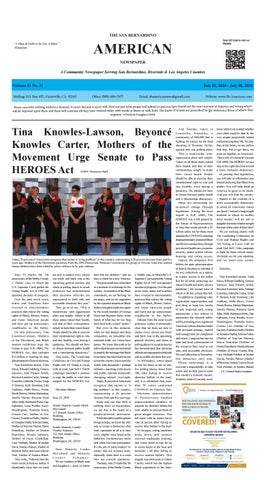
Today, 76 percent of Americans recognize that racism is “a big problem” in this country, representing a 26 percent increase from just five years ago. Mothers of the Movement (pictured, from the 2016 Democratic National Convention) is a group of African American women whose children have been killed by police officers or by gun violence. June 25 marks the 7th anniversary of the Shelby County v. Holder case, in which the U.S. Supreme Court gutted the Voting Rights Act of 1965 and upended decades of progress. Over the past seven years, states and localities have reverted to discriminatory practices that restrict the voting rights of Black, Brown, Native, and Asian American people and have put up unnecessary roadblocks to the ballot. On this anniversary, Tina Knowles-Lawson, Mothers of the Movement, and Black women celebrities urge the Senate to pass H.R. 6800, The HEROES Act, that includes $3.6 billion in funding for state administration of federal elections. Tina Knowles-Lawson; Viola Davis; Whoopi Goldberg; Octavia Spencer; Jada Pinkett Smith; Beyoncé Knowles Carter; Solange Knowles; Gabrielle Union; Taraji P. Henson; Kelly Rowland; Lala Anthony; Halle Berry; Yvette Nicole Brown; Melina Matsoukas; Janelle Monáe; Bozoma Saint John; Holly Robinson Peete; Oge Egbuonu; Lena Waithe; Kerry Washington; Rashida Jones; Gwenn Carr, Mother of Eric Garner; Kadiatou Diallo, Mother of Amadou Diallo; Sybrina Fulton, Mother of Trayvon Martin; Maria Hamilton, Mother of Dontre Hamilton; Wanda Johnson, Mother of Oscar Grant;Rep. Lucy McBath, Mother of Jordan Davis Tamika Palmer, Mother of Breonna Taylor; and Geneva ReedVeal, Mother of Sandra Bland. They write, “Fall-out from the most recent primaries makes it abundantly clear that we must
act now to ensure every citizen can freely and fairly vote in the upcoming general election, and chaos at polling places in recent primaries has demonstrated that elections officials are unprepared to hold safe and accessible elections this year.” They go on to say, “This is modern-day voter suppression plain and simple. Voters in all these states risked their health, and that of their communities, simply to make their voices heard. People should be able to exercise their constitutional right to vote and stay healthy, even during a pandemic. We should not have to choose between public health and a functioning democracy.” Also today, The Leadership Conference on Civil and Human Rights and All Voting is Local, with its joint And Still I VoteW campaign launched a petition to urge the public to voice their support for the HEROES Act. The letter follows:
June 25, 2020 Senate Majority Leader Mitch McConnell 317 Russell Senate Office Building Washington, DC 20510 Senate Minority Leader Charles Schumer 322 Hart Senate Office Building Washington, DC 20510 Dear Major it y Leader McConnell and Minority Leader Schumer: We are mothers of Black sons and daughters – some of whom
have lost our children – and we have a vision for a new America. This past month has culminated in a moment of reckoning for the country. As members of the Black community, we are hurting, we are angry, and we are anguished by the repeated assaults on Black bodies, brought to light once again by the recent murders of George Floyd and Breonna Taylor at the hands of what has for too long been incorrectly coined “justice.” But even in this moment, when we feel despair and deep exhaustion, we remember one essential truth: our voices have power. We know this truth to be self-evident because our movement to amplify the message that Black lives matter has taken hold not just across the country, but around the world, with thousands – perhaps millions – marching in the streets and public opinion drastically changing almost overnight. Today, 76 percent of Americans recognize that racism is “a big problem” in this country, representing a 26 percent increase from just five years ago. Some may say this shift is nothing short of miraculous; we say this is the result of a people-powered movement. While this shift in public opinion brings us hope, we know the only way to create a democracy that truly represents us all is to have every eligible voice heard at the ballot box. Our democracy works best when everyone participates. It’s the job of policymakers’ to ensure that our systems work, especially when there is a crisis like our current pandemic. Thursday, June 25 marks the 7th anniversary of the Shelby County
v. Holder case, in which the U.S. Supreme Court gutted the Voting Rights Act of 1965 and upended decades of progress. Over the past seven years, states and localities have reverted to discriminatory practices that restrict the voting rights of Black, Brown, Native, and Asian American people and have put up unnecessary roadblocks to the ballot. Fall-out from the most recent primaries makes it abundantly clear that we must act now to ensure every citizen can freely and fairly vote in the upcoming general election, and chaos at polling places in recent primaries has demonstrated that elections officials are unprepared to hold safe and accessible elections this year: In Milwaukee, voters stood in line for hours at one of only five polling places, down from 180, after failing to receive absentee ballots in the mail, and it is estimated that more than 70 voters contracted COVID-19 on Election Day. Elections administrators in Pennsylvania handled unprecedented numbers of requests for absentee ballots but were unable to process them all given meager resources. This left many with no choice but to vote in person after failing to receive their ballots in the mail. In Georgia, voting machines broke down, poll workers received inadequate training, and voters stood in line for up to seven hours in the heat and humidity – all after failing to receive mailed ballots. This tragedy was most acute in Fulton County, which has the highest Black population in the state.
And Tuesday, voters in Louisville, Kent uck y, a community of 600,000 that is fighting for justice for the fatal shooting of Breonna Taylor, opened only one polling place. This is modern-day voter suppression plain and simple. Voters in all these states risked their health, and that of their communities, simply to make their voices heard. People should be able to exercise their constitutional right to vote and stay healthy, even during a pandemic. We should not have to choose between public health and a functioning democracy. Many are advocating for structural change through legislation. Among the most urgent is H.R. 6800, The HEROES Act, a bill passed by the House of Representatives in May that would provide a $3 trillion safety net for those most impacted by COVID-19, including disproportionately impacted Black and Brown communities, through provision of health care, economic security, justice system reform, housing, and voting access. Indeed, the proposed $3.6 billion for state administration of federal elections is essential if we are, collectively as a nation, to ensure access to the ballot box for all while protecting our nation’s health and safety amid a pandemic – the second wave of which is all but certain this fall. In addition to expanding voter registration opportunities and providing at least two weeks of safe in-person early voting nationwide, a key reform to administer the election safely will be providing every registered American with an absentee ballot with pre-paid postage, mailed with enough time for completion and return. Congress has starved state and local communities of the resources they need to run safe, and accessible elections. We can’t allow this in November. Our democracy can’t wait. Please understand, it is everyone’s responsibility to take action and do their part to undo this country’s systemic racism. Senators, some of you may never
know what it is to wonder whether your child could be shot by the very people purportedly tasked with protecting their life. We pray that, in the future, no one suffers that fear. But to get there, we must act together, as Americans. That is why it’s essential you pass H.R. 6800, The HEROES Act as a step in the right direction toward a more inclusive democracy. In passing this legislation, you will take an affirmative step toward declaring that Black lives matter. You will help build an America as good as its ideals. And you will lead the country – thanks to the creation of a more accountable democracy in which all Americans’ voices are heard – toward a long-sought moment in which no mother need wonder: will my son or daughter not make it home tonight because of the color of their skin? We are working closely with The Leadership Conference on Civil and Human Rights and All Voting is Local with its joint And Still I Vote campaign to fight for these critical issues. We thank you for your attention, and we await your action. Sincerely, Tina Knowles-Lawson, Viola Davis, Whoopi Goldberg, Octavia Spencer, Jada Pinkett Smith, Beyoncé Knowles Carter, Solange Knowles, Gabrielle Union, Taraji P. Henson, Kelly Rowland, Lala Anthony, Halle Berry, Yvette Nicole Brown, Melina Matsoukas, Janelle Monáe, Bozoma Saint John, Holly Robinson Peete, Oge Egbuonu, Lena Waithe, Kerry Washington, Rashida Jones, Gwenn Carr (Mother of Eric Garner), Kadiatou Diallo (Mother of Amadou Diallo), Sybrina Fulton (Mother of Trayvon Martin), Maria Hamilton (Mother of Dontre Hamilton), Wanda Johnson (Mother of Oscar Grant), Rep. Lucy McBath (Mother of Jordan Davis), Tamika Palmer (Mother of Breonna Taylor), Geneva ReedVeal (Mother of Sandra Bland) CC: United States Senators
Page 2
Visit Us Online: www.SB-American.com
July 2, 2020
COMMUNITY/LIFESTYLE
OP-ED: Black People Suffer Disproportionately from Dementia Crisis By Dr. Lucille Ridgill
The healthcare needs of people with dementia at the end of life are unique and require special consideration. It is also important to discuss important life challenges caused by dementia of any sort earlier in the disease process so you can address important end-oflife care decisions and family business. Request an appointment with your physician and attorney. (Photo: iStockphoto / NNPA) Alzheimer’s disease (the most common type of dementia) is the 6th leading cause of death among White people, but the 4th leading cause of death for Black people like me. The Black population age 65+ is projected to more than double in size in the next 10 years, which means dementia diagnoses in our community also could more than double in number. Dementia is called a “silent epidemic” among Black people because many of us refuse to acknowledge or discuss this horrific disease. As a physician who has a close family member who was recently diagnosed with dementia, I feel the great loss of the ever-decreasing communication with my loved one and that is very painful. Its increasing toll is also due to untreated or inadequately treated hypertension and diabetes causing vascular dementia. This occurrence is due to the progressive destruction of the vascular supply. The disease progresses slowly so that family members and physicians are shocked when it becomes apparent. Unfortunately, there’s not much you can do to prevent Alzheimer’s at this time, but you can check your glucose and
blood pressure regularly and take anti-hypertensive and diabetes medications as prescribed to delay or prevent vascular dementia. It is important to make sure family members understand their susceptibility and take action as necessary. Failure to do so can lead to delayed medical care and caregiver burnout of family members. That’s why it is important for Black people to use “Alzheimer’s And Brain Awareness Month” as inspiration to remedy this situation. One major reason Black people suffer disproportionately from Alzheimer’s is we are underrepresented in dementia research, in part because many of us are unwilling to donate our brains to research or participate in brain studies due to distrust of the medical system. The good news is that this problem is dissipating as more physicians and health care workers of color enter the healthcare system. Another reason is Black people suffer disproportionately from diseases linked to a higher risk of dementia, including high blood pressure and type 2 diabetes. It is no coincidence that twothirds of my Medicare patients
(67%) suffer from vascular and Alzheimer’s disease, 71 percent have diabetes and 75 percent have high blood pressure. The Black com munit y must demand that lawmakers significantly increase financial resources to reduce dementia among people of color, but we also must take personal responsibility for improving our eating habits and lifestyle to reduce our susceptibility to it. If fresh fruits and vegetables are not available where you live, you can buy them at the increasingly available farmers market or grow them in your own garden, increasing your exercise activity, while providing you with good, healthy food. However, since dementia is incurable, we also must do advance planning for the care we would want in case we get dementia, so we don’t have to suffer needlessly by involuntarily receiving treatments we don’t want to artificially extend our life during the last, most debilitating stages of dementia. For example, when we have lost everything that matters to us: the memory of loved ones, of our life, our identity, and the ability to speak. In fact, people with dementia m ay e nd u r e i m pla nt e d def ibrillators, mechanical ventilation, feeding tubes, and other invasive interventions— all given with the intention to extend life—but often at a cost of diminished quality of life and prolonged suffering. Even seemingly simple treatments like chest x-rays, urine samples (which often require bladder catheterizations), blood draws, and hospital transfers may become uncomfortable and invasive for cognitive impairment.
The healthcare needs of people with dementia at the end of life are unique and require special consideration. It is also important to discuss important life challenges caused by dementia of any sort earlier in the disease process so you can address important endof-life care decisions and family business. Request an appointment with your physician and attorney. In addition, a national profit organization, Compassion & Choices, has created a Dementia Values & Priorities Tool to facilitate this care planning process. This free, fully customizable tool walks you through 15 common symptoms of dementia and helps you to identify if and when your goal for care may change from “do everything possible” to “allow for my natural death.” Creating a dementia-specific advance care plan relieves the burden from loved ones and/or the healthcare proxy to make difficult decisions when you can no longer speak for yourself. A complementary tool, the Dementia Decoder allows you or a healthcare proxy to indicate the current status of your dementia diagnosis, specify what you or your healthcare proxy hope to learn and accomplish from an upcoming clinical appointment and customize that experience from a list of helpful questions. Take it from a physician of color repeatedly heartbroken from watching many patients suffer needlessly from dementia: it is infinitely better to plan for your care for dementia and not get it than it is to not plan for your care for dementia and get it. Dr. Lucille Ridgill is an internist and primary care provider for adults in Rancho Palos Verdes, CA.
Nearly 500 Small Businesses File Bankruptcy Using Increased BlackPressUSA Eligibility Limit Since Februaryw
Publisher’s Corner
Clifton Harris Editor in Chief Investigative Reporter sbamericannews@gmail.com
Mary Martin-Harris / Editor Clifton B. Harris / Audio Engineering Editor Legal /Display Advertising (909) 889-7677 The San Bernardino American News was established May 6, 1969. A legally adjudicated newspaper of general circulation on September 30, 1971, case number 15313 by the Superior Court of San Bernardino County. The San Bernardino AMERICAN News subscription rate is $58.00 per year. The San Bernardino AMERICAN News is committed to serving its readers by presenting news unbiased and objective, trusting in the mature judgment of the readers and, in so doing, strive to achieve a united community. News releases appearing in the San Bernardino AMERICAN News do not necessarily express the policy nor the opinion of the publishers. The San Bernardino AMERICAN News reserves the right to edit or rewrite all news releases.
THE SAN BERNARDINO AMERICAN NEWS SUBSCRIPTION RATE IS $58.00 PER YEAR.
Governor Newsom Announces Action to Close Bars in Certain Counwties California Public Health Officials Issue Guidance Requiring Counties on Monitoring List for 14 Days or More to Close Bars and Recommends Bar Closure for All Counties on Monitoring List for More than 3 days Seven Counties Are Required to Close Bars Immediately & 8 More Counties Are Recommended to Do the Same Community News
While no official (e.g., government) figures on subchapter V cases have been released to date, ABI’s Ed Flynn compiled the figures after a case-by-case review of records from the PACER system. (Photo: iStockphoto / NNPA) New statistical table and analysis available on the American Banking Institute’s (ABI) SBRA Resources website show that 471 small businesses have elected to file for bankruptcy relief under new subchapter V to chapter 11 of the Code since it was enacted. T he Small Business Reorganization Act of 2019 (SBRA) took effect on February 19, 2020, to provide a better path for small businesses to successfully restructure, reduce liquidations, save jobs and increase recoveries to creditors, and it also recognizes the value provided by entrepreneurs. In response to the economic distress caused by the COVID-19 coronavirus pandemic, the CARES Act on March 27 increased the eligibility limit
for small businesses looking to file under subchapter V from $2,725,625 of debt to $7,500,000. The threshold will return to $2,725,625 after 1 year. While no official (e.g., government) figures on subchapter V cases have been released to date, ABI’s Ed Flynn compiled the figures after a case-by-case review of records from the PACER system. A consultant and special editor to the ABI Journal, Flynn previously worked for more than 30 years at the Executive Office for U.S. Trustees and the Administrative Office of the U.S. Courts. In addition to providing the monthly totals of subchapter V elections, he included an analysis of the filings on the SBRA Resources website that also breaks down the subchapter V elections by circuit.
“The data on subchapter V elections and additional analysis from Ed Flynn will help provide a better picture to practitioners, researchers and the public about how struggling small businesses are utilizing the new law,” said ABI Executive Director Amy Quackenboss. “These statistics, and the wealth of information contained within ABI’s SBRA Resources site, make the site an invaluable reference.” ABI launched the “SBRA Resources” website in February to help practitioners and struggling small businesses learn about the new law and stay updated on SBRA developments. The site features information on ABI events on the new law, FAQs about the SBRA, an infographic, the legislative
history of the SBRA, informative videos of ABI presentations on the SBRA, updated news and commentary, articles from the ABI Journal and ABI committee newsletters, and more. ABI is the largest multidisciplinar y, nonpar tisan organization dedicated to research and education on matters related to insolvency. ABI was founded in 1982 to provide Congress and the public with unbiased analysis of bankruptcy issues. The ABI membership includes nearly 11,000 attorneys, accountants, bankers, judges, professors, lenders, turnaround specialists and other bankruptcy professionals, providing a forum for the exchange of ideas and information.
SACR AMENTO – The California Department of Public Health and California Governor Gavin Newsom today released guidance on the closure of bars for counties on the County Monitoring List. The Department recommends that counties on the County Monitoring List for three or more consecutive days, but less than 14 days, close bars through local health officer order (or do not allow for the opening if bars have not yet been allowed to open in the county). Counties which have been on the list for 14 days or more are required to immediately close bars. Guid ance for Closu re of Bars in Counties on Cou nt y Monitor ing List “Californians must remain vigilant against this virus,” said Governor Gavin Newsom. “COVID-19 is still circulating in California, and in some parts of the state, growing stronger. That’s why it is critical we take this step to limit the spread of the virus in the counties that are seeing the biggest increases. Each
of us has the power to limit the spread of this virus. Wear a face covering and keep physically distant outside the home. Don’t gather in groups, and if you are older or have a condition that puts you at higher risk of COVID-19, protect yourself by staying home.” "California is using data and science to guide our response to COVID-19. We are actively monitoring COVID-19 across the state and working closely with counties where there are increased rates and concerning patterns of transmission. Closing bars in these counties is one of a number of targeted actions counties are implementing across our state to slow the virus’ spread and reduce risk,” said Dr. Sonia Angell, State Public Health Officer and Director of the California Department of Public Health. “We all have our part in the fight against community spread of COVID 19. If you go out then remember, wear a face covering, keep your distance and wash your hands frequently.” continued on page 3
Page 3
Visit Us Online: www.SB-American.com
July 2, 2020
EDUCATION/RELIGION
Bars ordered closed in Riverside County in response to upswing in coronavirus cases Educational News Public Health Off icer Dr. Cameron Kaiser has ordered all bars in Riverside County closed to help slow the spread of coronavirus, which has seen a recent upswing in confirmed cases. The order, which is effective Tuesday (June 30), comes on the heels of a recommendation from Gov. Gavin Newsom, who suggested Sunday that Riverside and seven other counties on a watch list close their drinking establishments. Newsom also ordered on Sunday that seven counties, including Los Angeles County, close their bars. “People don’t social distance well after a couple drinks, and it’s one of the hardest environments to trace contacts in,” said Dr. Cameron Kaiser, Riverside County public health officer. “My hope is that this will be only temporary and further closures won’t be needed, but it all depends on what every one of us as a county do to slow more spread.” Bars had been allowed to operate in Riverside County since June 12 as the region and state reopened the economy under accelerated stage two. But local and state health officials became concerned as the number of confirmed coronavirus cases started to grow, along with
an increase in hospitalizations and ICU beds in use. “Since mid-June, there has been a growing health crisis with rising coronavirus cases, hospitalizations and ICU bed usage throughout our nation, the State of California and here in Riverside County,” said Riverside County Board Chair and Fourth District Supervisor V. Manuel Perez. “A local Riverside County order on bar closures has unfortunately become necessary to slow the spread of this virus. I want to remind everyone that facial coverings are a requirement, and encourage continuously keeping physical distance and washing our hands.” Restaurants, pubs and breweries that offer dine-in services may still offer alcoholic drinks, but only in the same transaction as a meal. If a bar offers meals, they are required to comply with the same industry guidance as restaurants. In Riverside County, officials with the Depar tment of Environmental Health will enforce the closure order, starting with reaching out to all impacted bars, pubs, breweries and restaurants to explain the order and impacts to their operations. Officials said they believe most bars will comply with the order, but those who do not may face additional action.
Governor Newsom Announces Action to Close Bars in Certain Counties...continued Com mu nit y spread of COVID-19 continues to be a concern across the state, and in particular for counties on the County Monitoring List. Community spread increases the likelihood of expanded transmission of COVID-19 in settings such as nursing homes, homeless shelters, jails and prisons. Counties will continue to take action to limit the transmission of COVID-19, including reinstituting community measures such as the closure of bars. Impacted Counties Recommended Bar Closure: Mandatory Bar Closure: Riverside Sacramento San Bernardino Santa Barbara Stanislaus Ventura Fresno Kern Kings Los Angeles Tulare
Please note, the following counties do not have bars open currently and are recommended to keep them closed (Contra Costa and Santa Clara) or required to keep them closed (Imperial and San Joaquin) based upon their duration on the county monitoring list. Bars are social environments
where groups of people mix. In these environments alcohol consumption reduces inhibition and impairs judgment, leading to reduced compliance with recommended core personal protective measures, such as the mandatory use of face coverings and the practice of social and physical distancing. Bars are generally louder environments requiring raised voices leading to the greater projection of droplets. These factors present a higher likelihood of transmission of COVID-19 within groups, between groups, and among the workforce. Public health professionals within California and throughout the nation have identified bars as the highest risk sector of non-essential business currently open. Beyond the higher risk of transmission in bar settings, contract tracing, a key measure needed to control spread, is also more challenging in bars because of the constant mixing among patrons and a lack of recordkeeping of those in attendance. More information about the state's COVID-19 guidance is on the California Department of Public Health's Guidance web page. More information about reopening California and what individuals can do to prevent the spread of COVID-19, visit Coronavirus (COVID-19) in California. w w w.c d ph.ca .gov
Show & Tell A Story Event Educational News Sat., June 27, 2020, San Bernardino, CA. - The Enterprise Building and The 320 Premiere Hall will be hosting a special July 4th holiday series of events on July 4th and 5th from 11 AM to 3 PM, at 320 North E Street in downtown San Bernardino called, “Show & Tell: A Story
of Our Ancestors Freedom Fight!”. All families are encouraged to participate in observance of America’s other Independence Day of Juneteenth marking the end of slavery to today’s Black Lives Matter and their importance continued in next 2 columns
Show & Tell A Story Event...continued for all people’s edification. The events are coordinated by LUE Dowdy, Vice President of the Southern California Black Chamber of Commerce Inland Citiies East Chapter, along with volunteers from local community organizations such as LUE Productions, Youth Build Inland Empire, Purposely Awakened , and the Westside Story Newspaper. Participating organizations at this event a re: *Youth Build School A f r ica A mer ica n Icon s *Southern California Black Chamber of Commerce ICC - Before Black Wall Street, The Story of Eatonville, FL. *Westside Story Newspaper Liberation Through Black Media *T’ana Phelice Productions “The Only Tired I Am” (short skit) *LU E P r o d u c t io n s Musical Timeline of Music That Helped Our People Sustained Through Dark Times *African American Mental Health Coalition - Methods Of Treatment Provided For African American Women with Mental Health conditions *Music Changing Lives When The 4th of July was Black *P u r posely Awa ken -
Liberation through Black Media in Conjunction with the Westside Story Newspaper *Off The Chain Alliance - The Discrimination and Elimination of African American Hair *Unitee - Born Guilty, A Look At Incarceration and Social Inequality *Painter, Maurice Howard *Young Women Empowerment (YWE) - Human Trafficking Awareness - Social and Emotional Bar riers That Prevent Young Women From Achieving Their Aspirations *We 3 Productions Isolation Concent rations: Under The Boabab Tree These events are sponsored by The Enterprise Building and will be a COVID-19 required setting for participants to maintain social distancing and wearing of masks in order participate. “Don’t wait! You can register your tour today and select your tour time. Please visit the link below. We Look forward to seeing you at the events. Remember to bring your entire family, especially your children” — LUE Dowdy For further information, contact LUE Productions at: Lue@ Blackchamberofcommerce. org. I 888.466.7408, Ext. 11, or Mobile phone at: 909.566.1000
Statement Regarding San Manuel Casino Health & Safety Plan - Update: June 29, 2020 Educational News “As we have developed our plans for reopening San Manuel Casino, we built them with the notion that we would need to be flexible as the region and the state grapple with ongoing efforts to contain COVID-19. We have determined that for the health and safety of our team members and guests, we will be implementing the following temporary changes to our operations in order to support facial covering mandates and
to minimize opportunities for multiple-person gatherings at bars. Starting Tuesday, June 30 at 9am. · Smoking will be limited to designated areas, which for now will be located outside of the casino. · Alcohol service will be provided at slots a nd t able ga mes on ly. We appreciate your patience and understanding as we navigate this fluid situation. We will continue to notify you of additional changes if necessary.” · San Manuel Casino
“Adding Insult to Injury!” By: Lou Yeboah
Lou Yeboah America’s 4th of July Celebration – “What to the American Slave, is your Fourth of July? I answer; a day that reveals to him, more than all other days in the year, the gross injustice and cruelty to which he is the constant victim. To him, your celebration is a sham; your boasted liberty, an unholy license; your national greatness, swelling vanity; your sounds of rejoicing are empty and heartless; your denunciation of tyrants, brass fronted impudence; your shouts of liberty and equality, hollow mockery; your prayers and hymns, your sermons and thanksgivings, with all your religious parade and solemnity, are, to him, mere bombast, fraud, deception, impiety and hypocrisy—a thin veil to cover up crimes which would disgrace a nation of savages.” “I am not included within the pale of this glorious anniversary!
This Fourth [of] July is yours not mine. The sunlight that brought life and healing to you, has brought stripes and death to me. You may rejoice, I must mourn. Your high independence only reveals the immeasurable distance between us. The blessings in which you, this day, rejoice, are not enjoyed in common. The rich inheritance of justice, liberty, prosperity and independence, bequeathed by your fathers, is shared by you, not by me.” “I hear the mournful wail of millions whose chains, heavy and grievous yesterday, are, today, rendered more intolerable by the jubilee shouts that reach them. America is false to the past, false to the present, and solemnly binds herself to be false to the future. Celebrating the Fourth of July just makes the United States look even worse than it did before.” [Frederick Douglass “What to the Slave is the Fourth of July 1852?] The American people have this lesson to learn: that where justice is denied, where poverty is enforced, where ignorance prevails, and where any one class is made to feel that society is an organized conspiracy to oppress, rob, and degrade them, neither persons nor property will be safe. [Southern Barbarism” speech on the occasion of the 24th Anniversary of Emancipation, continued in next 2 columns
“Adding Insult to Injury!”...continued Washington, D.C., 1886]. It astounds me sometimes that a country proclaiming itself as “The Land of the Free,” still struggles to this day to grant its own citizens this civil right. The document written clearly declares our commitment to “unalienable Rights” defined as “Life, Liberty and the pursuit of Happiness.” It even goes so far as to say that when a government fails to protect these rights, it is the duty of the people to alter or abolish it, and that a leader whose actions resemble a tyrant cannot be trusted to rule and uphold the freedom of the people. Take a snapshot of the United States at this exact moment, and you will realize that we do not have good governance, and that many in our country still lack the rights which the Declaration of Independence deems “inalienable.” This note was a promise that “ALL” men, yes, black men as well as white men, would be
guaranteed the unalienable rights of life, liberty, and the pursuit of happiness. It is obvious today that America has defaulted on this promissory note insofar as her citizens of color are concerned.” The Fourth of July, therefore, currently has little meaning for African Americans outside of being a wonderful outdoor holiday with food, family and fireworks. It will remain so until the community unifies, embraces a common set of empowering values, and rises out of psychological enslavement. Black people will remain “unindependent,” i.e., not independent, as long as there is a dependence upon a white supremacist infrastructure to set it free. Douglass’ speech is as relevant today as it was in 1852. What, to us, is the Fourth of July when our freedoms are provisional and subject to alteration? Our current political climate speaks volumes on our country’s interpretation of freedom. If you are not white, your freedom is conditional, not a guarantee. Adding Insult to Injury!
WITNESS FOR JUSTICE #1001
The Wait Is Over Velda Love Minister of Racial Justice On April 16, 1963, while sitting inside a jail cell after being arrested for protesting and demonstrating peacefully in Birmingham Alabama, King wrote a response to eight white Alabama clergymen. The eight clergymen wrote a letter criticizing his presence in Birmingham and the aggressive approach to securing civil rights for black people in the state of Alabama. They were worried that the civil rights movement and its demands for equal justice would cause violence. Yet they and other whites across the country refused to acknowledge the centuries of violence perpetuated on black bodies since 1619. Their concern for the comfort and safety of white people led them to oppose the civil rights movement. Equality and access to public spaces, education, housing, economic advancement, and political power would mean black people would no longer be seen as inferior, subservient, and 3/5ths of a person. Jim Crow and Black Codes were institutional safeguards to ensure that black lives were never free and seen as equal to whites within the U.S. King was labeled an extremist and told they— black people—should be patient. “ Yo u deplore the demonstrations taking place In Birmingham. But your statement, I am sorry to say, fails to express a similar concern for the conditions that brought about the demonstrations. I am sure that none of you would want to rest content with the superficial kind of social analysis that deals merely with effects and does not grapple with underlying causes. It is unfortunate that demonstrations are taking place in Birmingham, but it is even more unfortunate that the city's white power structure left the Negro community with no alternative.” – Letter from a Birmingham Jail This was America in 1963. It
is 2020, and yet the New Jim Crow is upon us. Racists feel empowered by government supported state sanctioned militaristic weaponry and training. Let the visuals, voices, and people on the street be a witness to this truth—people of African descent are not waiting for the Christian Church to speak up and demand structural and institutional policy changes. As can be seen from daily protesters around the world, the wait is over and white Christians are not being asked to educate themselves on the long history of racism. Young people of African descent are leading this movement against the government. They are showing up with solidarity partners for Black lives to matter. As a clergyperson of African descent, and a racial justice practitioner my question is, what are clergy of European descent waiting for as black lives are being lynched on a daily basis— choked to death until the breath leaves our bodies, murdered with knees on our necks, left swinging from ropes in trees, and mutilated with bullets—shot while praying in church, jogging, sitting, kneeling, walking, driving, eating, and sleeping. Dear white Christians, one workshop, one intensive weekend, one month of talking with your black friends, and one year of intense anti-racism work will not undo 500 years of entrenched feelings of white Christian supremacy. Becoming an ant-racist is a life-long journey. It happens in community with other committed people who journey together and commit to decentering whiteness, leaning into practices to decolonize socialized patterns of thinking and behaviors. The process includes relearning history, correcting false narratives, and working towards radical shifts in policies and structures that harm black lives. The movement to secure and protect Black lives is going forth. Answer the call, be an extremist, because patience has run out and the wait is over.
Page 4
Visit Us Online: www.SB-American.com
July 2, 2020
STATE / GOVERNMENT
California’s Home Visiting Program Aims to Help the Next For Seniors, Another COVID-19 Hazard: Scammers By Claudia Boyd-Barrett Generation Rise from Inequality By Claudia Boyd-Barrett
Two seniors wearing masks sit on a bench near Venice beach in mid-April. Photo by Ana M Amortegui. Photo by Warren Goldswain/iStock. Marceda Harris could be forgiven for sometimes feeling overwhelmed. The single mother from Long Beach is raising five children on her own, including one son with special needs and a rambunctious, inquisitive 5 year old. So it’s a welcome respite when, every couple of weeks, she and her children receive a visit from Sherida Harris. “She comes in and we do activities together. She brings books to read and explains projects,” said Marceda Harris, who is not related to Sherida Harris. “She brings me coloring books to help me calm down so I have alone time, even if it’s just 10 minutes.” Sherida Harris is a home visitor with SHIELDS for Families in South Los Angeles. The nonprofit group is among more than 50 community organizations, health care providers, school districts and other agencies in Los Angeles County that send trained professionals to the homes of pregnant women and parents of children up to age 5. These programs provide oneon-one outreach to parents who may be struggling to care for their children, often because of stressors such as poverty, or who simply want guidance on prenatal health and parenting. Home visitors coach parents on how to bond with their children, parent effectively and stimulate brain development. They also screen kids for health problems and developmental delays, and link parents to resources such as health care, employment t r ai n i ng or cou nseli ng. Research shows home visiting programs can help prevent child abuse and neglect, improve school readiness, increase physical and mental wellbeing of moms and kids, boost parents’ confidence in caring for their children, and result in greater economic selfsufficiency for families. They may also help reduce racial health disparities in breastfeeding and infant mortality, according to the California Budget and Policy Center. More than 85 percent of participants in several LA County home visiting programs are Black or Latinx. These families are more likely than white families to live in poverty, lack adequate health care, and suffer higher rates of infant death. Home visiting can help counter these inequalities, which arise from structural racism and economic disadvantage, prog r a m of f icials said. Yet fewer than 2 percent of potentially eligible families statewide receive home visits, according to a report by the advocacy organization Children Now. That puts California behind more than 20 other states, including Oklahoma, Kansas and Missouri, according to data from the 2020 State of Babies Yearbook. “There’s a big, big gap between the available programs and the need,” said Angela Rothermel, Children Now’s
director of early childhood policy. “We want to get more of those supports out to families.” Part of the reason for the lag is that California did not directly invest in home visiting with state funds until 2018, resulting in a patchwork of local and federally funded programs that varied by county, said Rothermel. However, under Gov. Jerry Brown and now Gavin Newsom, California has committed almost $140 million in state-controlled money to home visiting, mainly for expectant parents and those with children under age 2 in the state’s welfare-towork program, CalWORKS. Once fully implemented, around 18,500 families each year are expected to benefit from this funding. The pace of that expansion has hit a speed bump, however, as Newsom and legislators wrestle a $54 billion budget deficit. A final budget agreement reached June 22 removes an additional $30 million that Newsom had proposed for home visiting in January, which would have extended the services to thousands more families. Legislators plan to reinstate that funding in the 2021 to 2022 fiscal year. “We need to grow the system exponentially from where we are,” said Rothermel. “The pandemic just means it’s going to take more time.” In Los Angeles County, home visiting programs serve almost 32,000 families through seven home visiting models, each with slightly different eligibility criteria and approaches, but with similar goals. The largest is Welcome Baby, launched and funded by First Five Los Angeles starting in 2009, and which reaches about 15,000 women who are pregnant or have babies up to 9 months old. Other models include NurseFamily Partnership, Healthy Start, Parents as Teachers and Healthy Families America. These are nationwide programs adopted by agencies at the local level. Some serve families with children up to 5 years old. Parents sign up for the programs voluntarily and receive the services for free. Like Marceda Harris and her children, most families enrolled in home visiting have very limited incomes. Many parents face additional stressors such as homelessness, have mental health issues or have children that have been put into foster care. These factors increase children’s risk for suffering toxic stress and trauma, which can result in lifelong problems including learning difficulties, and physical and mental health challenges. By intervening early, the goal of home visitors is to set families and children up for a healthier, more successful life. “Home visiting is a prevention program,” said Jana Wright, coordinator of the Los Angeles County Perinatal and Early
Marceda Harris and her sons Jay’on and Tevin. Harris is enrolled in a home visiting program with SHIELDS for Families. Photo courtesy of Marceda Harris. Childhood Home Visitation Consortium, a network of home visiting programs and providers. “The home visitor can display what healthy parenting looks like, how you should engage with your child to make sure you have those brain-building moments, to make sure your child has the best outcomes in life.” Los Angeles County has one of the most robust home visiting networks in the state, said Wright. Even so, less than 4 percent of eligible families in the county receive home visiting services, the consortium found. Additional state funding to expand the programs to more families is necessary, she said, especially because tobacco taxes—which fund First Five commissions— have been gradually declining. Investment in home visiting helps children who are facing the fallout from structural racism and income inequality, and reduces child welfare encounters, she said. “It is not fair for communities and government to take away children when you provide no support for these families to do better for themselves,” Wright said. “In this state we have stated time and time again that our values are our children, and if that’s true that needs to be all of our children, not just the white children, not just the wealthy children.” Qwanea Clemons of South Los Angeles is enrolled in a Parents as Teachers program through SHIELDS for Families. Since October, she’s been working with home visitor Kimberlyn Lundy, a former preschool teacher, on strengthening her relationships with her two daughters, ages 2 and 4. The girls were put into foster care because of domestic violence in the home. Clemons left the violent relationship and is now working on getting her daughters back. Lundy has helped Clemons navigate the court system and stay on track with requirements for r eg a i n i ng c u s t o d y. The children currently stay with Clemons four nights a week. Lundy guided her on how to plan for their visits, engage her daughters
in constructive activities, and deal positively with challenging behavior. Clemons said she used to be distracted as a parent. Now she plays, dances and sings with her kids, and if they’re watching TV she watches with them. “I’m just more involved,” she said. “They’re happy when they come home. They’re happy to see me.” For Marceda Harris, who is also in the Parents as Teachers program, having a home visitor has helped her learn how to be more patient with her children, especially her 5 year old son. She’s learned simple games she can play with her kids, like “tennis” using balloons and paper plates, she said. Her home visitor also helped her find a new apartment after the place she was living in flooded, and to get a job as a nursing assistant after more than a year of being unemployed. “I’m very excited,” said Marceda Harris. “I’ve been wanting to work for a long time.” Home visitors have had to adapt during the pandemic and are reaching out to their families over the phone and through video chat, said Ava Moten, program manager for Parents as Teachers at SHIELDS for Families. They’ve found that families need even more support than in the past. Many parents are struggling with job losses, stress, uncertainty and disruption to their family’s routines. Some don’t have enough food for their children now that they’re home all day and not getting meals at school. Home visitors have delivered groceries and diapers, connected parents to food banks and mental health support, and helped moms manage stress and set routines for their children, Moten said. “Before, I knew home visiting was important,” she said. “With COVID-19 I have really seen how essential it is.” Claudia Boyd-Barrett reported this story with the support of the Fund for Journalism on Child Well-Being, a program of the USC A n nenberg Center for Health Journalism.
TIME WISE
Private Investigations
“On Time, Just in Time” License Number 25694
Clifton Harris, BA, MLS Private Investigator Retired Law Enforcement Officer P.O. Box 837 Victorville, CA 92393
Telephone (760) 514-8310 Fax: (909) 889-2882 E-mail: timewisepi968@gmail.com
Kathy Fear of Roseville knew something was amiss when her elderly mother-in-law Evelyn Rocconi, who lives with her, started getting packages stuffed with knee and back braces in the mail. Rocconi, 86, has memory issues, but doesn’t need back and knee braces. She also has no credit or debit card, so couldn’t have purchased the items herself. Yet the packages kept arriving, at one point more than three in the same week. Each time, Fear returned the items to the sending address. As it turned out, Rocconi had been a victim of Medicare fraud. When her Medicare statement arrived a few weeks later, it listed thousands of dollars in fraudulent charges to the program under Rocconi’s name. Fear suspects a scammer called her mother-in-law on her cell phone and tricked her into giving over her Medicare number. Fear reported the abuse to Medicare. “It bothers me,” said Fear. “I thought, what if (Rocconi) hadn’t been living with us? How many other older people that are living on their own get ripped off like this?”
If you come across any coronavirus or other health care scams, call California Senior Medicare Patrol at 855-613-7080. For free information and one-onone guidance about Medicare, contact the Health Insurance Counseling and Advocacy Program (HICAP) at 1-800434-0222, or online to find your local office. Photo by kjophoto. Medicare fraud is a rampant problem in California and across the country, sucking billions of dollars in taxpayer money each year from the federally funded health insurance program for seniors. Common scams include billing Medicare for medical equipment or medical services that the senior doesn’t need or didn’t receive, and coercing beneficiaries to enroll in Medicare plans or programs that aren’t right for them but are profitable for the unscrupulous provider or insurance agent. Ordering back and knee braces that a senior doesn’t need, as happened to Rocconi, is a classic type of Medicare fraud. Fraudsters also persuade healthy seniors to enroll in hospice care. Once enrolled, these seniors find they can’t get treatment for curable health conditions because they’re restricted to only receiving end-of-life care. Other scams involve getting seniors to sign up for unneeded services by offering them free gifts. The abuse can happen in-person,
online, through phone calls, flyers, and misleading presentations or television advertisements. Now, advocates who work with seniors are bracing for a new wave of scams related to the COVID-19 pandemic. Already, California Senior Medicare Patrol, a federally funded organization that helps Medicare beneficiaries avoid, detect and report health care fraud, has received reports of several new scams. Fraudsters have visited residents in senior housing and assisted living facilities offering them “oppor tunities” for COVID-19 testing in exchange for their Medicare number. Con artists posing as Medicare officials have called seniors and promised them virus test kits or a (nonexistent) COVID-19 vaccine if they can verify their Medicare or Social Security number. Some even ask seniors to send them money, said Micki Nozaki, director of Senior Medicare Patrol. “They’re playing on fear and confusion,” Nozaki said. “Scammers take advantage of whatever is out there.” In addition to potentially billing for COVID-19-related services, once a scammer has someone’s Medicare number they may use it to file other fraudulent claims, such as for durable medical equipment and doctor’s visits. California Senior Medicare Patrol operates a hotline that receives around 500 calls a year about Medicare fraud and abuse. The number of COVID-related fraud reports so far is small, but expected to increase. California Senior Medicare Patrol received 8 reports in April, Nozaki said. Advocates help seniors, their caregivers and family members report suspected fraud to state and federal agencies for investigation. While Medicare fraud has been a problem for decades, COVID-19 has made seniors more vulnerable than ever, said Tatiana Fassieux, a training specialist for California Health Advocates, which operates Senior Medicare Patrol. Many seniors are stuck at home and distanced from family and friends because of the virus. “When (they) see these toogood-to-be-true advertisements on television or get a phone call, it sucks the person right in because during these times people’s anxiety is much higher, and if they’re alone they want to talk,” she said. “It’s the contact that people are yearning for.” While fraudsters target seniors from all socioeconomic backgrounds, they prey especially on low-income seniors with limited English proficiency, said Fassieux. The scammers assume these seniors are less likely to ask the right questions or understand how the Medicare program works, she said. They also often need relief and will accept the help the scammers offer, she said. Additionally, some of the usual channels for warning seniors about Medicare fraud aren’t available because of COVID-19. Many (continued on page 8)
Page 5
Visit Us Online: www.SB-American.com
July 2, 2020
LEGALS/CLASSIFIEDS FICTITIOUS BUSINESS NAME FICTITIOUS BUSINESS NAME S TAT E M E N T 20200004913 Date Filed: 05/28/2020 Filing Expires On: 05/28/2025 FICTITIOUS BUSINESS NAME (as shown in the Articles of Inc./ Org./Reg.): HELPING MINDS County of Principal Place of Business: SAN BERNARDINO COUNTY Street Address of Principal Place of Business: 14499 BEGONIA RD. #69 VICTORVILLE, CA 92392 Name of Individual Registrant: SANDY G. MENDOZA Name of corporation or limited liability company as shown in the Articles of Inc./Org./Reg.: State of Inc./Org./Reg.: Inc./Org./Reg. No.: Residence Street Address: 14499 BEGONIA RD. #69 VICTORVILLE, CA 92392 This business is/was conducted by: An Individual Registrant has commenced to transact business under the fictitious business name or names listed above on: May 26, 2020 Sandy Mendoza, Owner, declares that all information in this statement is true and correct. NOTICE- IN ACCORDANCE WITH SUBDIVISION (a) OF SECTION 17920, A FICTITIOUS NAME S T AT E M E N T GENERALLY EXPIRES AT THE END OF FIVE YEARS FROM THE DATE ON WHICH IT WAS FILED IN THE OFFICE OF THE COUNTY CLERK, EXCEPT, AS PROVIDED IN SUBDIVISION (b) OF SECTION 17920. WHERE IT EXPIRES 40 DAYS AFTER ANY CHANGE IN THE FACTS SET FORT IN THE STATEMENT PURSUANT TO SECTION 17913 OTHER THAN A CHANGE IN THE RESIDENCE ADDRESS OF A REGISTERED OWNER. A NEW FICTITIOUS BUSINESS NAME STATEMENT MUST BE FILED BEFORE THE EXPIRATION. THE FILING OF THIS STATEMENT DOES NOT OF ITSELF AUTHORIZE THE USE IN THIS STATE OF A FICTITIOUS BUSINESS NAME IN VIOLATION OF THE RIGHTS OF ANOTHER UNDER FEDERAL, STATE, OR COMMON LAW (SEE SECTION 14411 ET. SEQ., BUSINESS AND PROFESSIONS CODE.) Published in the San Bernardino American Newspaper June 11, 18, 25, July 2, 2020. FICTITIOUS BUSINESS NAME S TAT E M E N T 20200005098 Date Filed: 06/04/22020 Filing Expires On: 06/04/2025 F IC T I T IOUS BUSI N E SS NAME (as shown in the Articles of Inc./Org./Reg.): HIBISCUS STREET NURSERY County of Principal Place of Business: SAN BERNARDINO Street Address of Principal Place of Business: 17433 HIBISCUS STREET FONTANA, CA 92335 Name of Individual Registrant: ELIZABETH L. FLORES Name of corporation or limited liability company as shown in the Articles of Inc./Org./Reg.: State of Inc./Org./Reg.: Inc./ Org./Reg. No.: Residence Street Address: 17433 HIBISCUS STREET FONTANA, CA 92335 This business is/was conducted by: An Individual Registrant has commenced to transact business under the fictitious business name or names listed above on: May 08, 2020 Elizabeth L. Flores, declares that all information in this statement is true and correct. NOTICE - IN ACCORDANCE WITH SUBDIVISION (a) OF SECTION 17920, A FICT IT IOUS NA M E STATEMENT GENERALLY EXPIRES AT THE END OF FIVE YEARS FROM THE DATE ON WHICH IT WAS FILED IN THE OFFICE OF T H E COU N T Y CLER K , EXCEPT, AS PROV IDED I N SUBDIVISION (b) OF SECTION 17920. WHERE IT EXPIRES 40 DAYS AFTER A N Y CH A NGE I N T H E FACTS SET FORT IN THE STATEMENT PURSUANT TO SECTION 17913 OTHER THAN A CHANGE IN THE RESIDENCE ADDRESS OF A REGISTERED OWNER. A NEW FICTITIOUS BUSINESS NAME STATEMENT MUST BE FILED BEFOR E THE EXPIRATION. THE FILING OF THIS STATEMENT DOES NOT OF ITSELF AUTHORIZE THE USE IN THIS STATE OF A FICTITIOUS BUSINESS NAME IN VIOLATION OF THE RIGHTS OF ANOTHER UNDER FEDERAL, STATE, OR COMMON LAW (SEE SECTION 14411 ET. SEQ., BUSINESS AND PROFESSIONS CODE.) Published in the San Bernardino American Newspaper June 18, 25, July 2, 9, 2020.
Publish Your FBN Publication For Only $40 go to our website:
sb-american.com
to upload your legal
FICTITIOUS BUSINESS NAME S TAT E M E N T 202000045125 Date Filed: 06/08/2020 Filing Expires On: 06/08/2025 FICTITIOUS BUSINESS NAME (as shown in the Articles of Inc./ Org./Reg.): TACO HUT County of Principal Place of Business: SAN BERNARDINO Street Address of Principal Place of Business: 11815 FOOTHILL BLVD., STE E RANCHO CUCAMONGA, CA 91730 Mailing Address: 18711 VIA TORINO IRVINE, CA 92603 Name of Individual Registrant: Name of corporation or limited liability company as shown in the Articles of Inc./Org./Reg.: MAX FORTUNE GROUP LLC State of Inc./Org./Reg.: CA Inc./Org./Reg. No.:2013330310377 Residence Street Address: 9451 FOOTHILL BLVD. RANCHO CUCAMONGA, CA 91730 This business is/was conducted by: A Limited Liability Company Registrant has commenced to transact business under the fictitious business name or names listed above on: May 01, 2015 Robert Yang, Managing Member, declares that all information in this statement is true and correct. NOTICE- IN ACCORDANCE WITH SUBDIVISION (a) OF SECTION 17920, A FICTITIOUS NAME S T AT E M E N T GENERALLY EXPIRES AT THE END OF FIVE YEARS FROM THE DATE ON WHICH IT WAS FILED IN THE OFFICE OF THE COUNTY CLERK, EXCEPT, AS PROVIDED IN SUBDIVISION (b) OF SECTION 17920. WHERE IT EXPIRES 40 DAYS AFTER ANY CHANGE IN THE FACTS SET FORT IN THE STATEMENT PURSUANT TO SECTION 17913 OTHER THAN A CHANGE IN THE RESIDENCE ADDRESS OF A REGISTERED OWNER. A NEW FICTITIOUS BUSINESS NAME STATEMENT MUST BE FILED BEFORE THE EXPIRATION. THE FILING OF THIS STATEMENT DOES NOT OF ITSELF AUTHORIZE THE USE IN THIS STATE OF A FICTITIOUS BUSINESS NAME IN VIOLATION OF THE RIGHTS OF ANOTHER UNDER FEDERAL, STATE, OR COMMON LAW (SEE SECTION 14411 ET. SEQ., BUSINESS AND PROFESSIONS CODE.) Published in the San Bernardino American Newspaper June 18, Correction 25, July 2, 9, 2020. FICTITIOUS BUSINESS NAME S TAT E M E N T 20200005376 Date Filed: 06/15/2020 Filing Expires On: 06/15/2025 FICTITIOUS BUSINESS NAME (as shown in the Articles of Inc./ Org./Reg.): AMBER STEEL County of Principal Place of Business: SAN BERNARDINO Street Address of Principal Place of Business: 312 SOUTH WILLOW AVENUE RIALTO, CA 92376 Mailing Address: P.O. BOX 900 RIALTO, CA 92377 Name of Individual Registrant: Name of corporation or limited liability company as shown in the Articles of Inc./Org./Reg.:H. WAYNE LEWIS, INC. State of Inc./Org./Reg.: CA Inc./Org./Reg. No.:C0610376 Residence Street Address: 312 SOUTH WLLOW AVENUE RIALTO, CA 92376 This business is/was conducted by: A Corporation Registrant has commenced to transact business under the fictitious business name or names listed above on: May 9, 1995 Kriss Lewis, President, declares that all information in this statement is true and correct. NOTICE- IN ACCORDANCE WITH SUBDIVISION (a) OF SECTION 17920, A FICTITIOUS NAME S T AT E M E N T GENERALLY EXPIRES AT THE END OF FIVE YEARS FROM THE DATE ON WHICH IT WAS FILED IN THE OFFICE OF THE COUNTY CLERK, EXCEPT, AS PROVIDED IN SUBDIVISION (b) OF SECTION 17920. WHERE IT EXPIRES 40 DAYS AFTER ANY CHANGE IN THE FACTS SET FORT IN THE STATEMENT PURSUANT TO SECTION 17913 OTHER THAN A CHANGE IN THE RESIDENCE ADDRESS OF A REGISTERED OWNER. A NEW FICTITIOUS BUSINESS NAME STATEMENT MUST BE FILED BEFORE THE EXPIRATION. THE FILING OF THIS STATEMENT DOES NOT OF ITSELF AUTHORIZE THE USE IN THIS STATE OF A FICTITIOUS BUSINESS NAME IN VIOLATION OF THE RIGHTS OF ANOTHER UNDER FEDERAL, STATE, OR COMMON LAW (SEE SECTION 14411 ET. SEQ., BUSINESS AND PROFESSIONS CODE.) Published in the San Bernardino American Newspaper July 2, 9, 16, 23, 2020. SUMMONS SUMMONS (CITACION JUDICIAL) CASE NUMBER (Número del Caso): C I V D S 1 9 2 8 1 2 0 NOTICE TO DEFENDANT (AVISO AL DEMANDADO): MATTHEW LEECH AND DOES 1 TO 10 YOU ARE BEING SUED BY PLAINTIFF (LO ESTÁ DEMANDANDO EL DEMANDANTE): ANCHOR GENERAL INSURANCE CO. NOTICE! You have been sued. The court may decide against you without your being heard unless you respond within 30 days. Read the information below. You have 30 CALENDAR DAYS after this summons and legal papers are served
on you to file a written response at this court and have a copy served on the plaintiff. A letter or phone call will not protect you. Your written response must be in proper legal form if you want the court to hear your case. There may be a court form that you can use for your response. You can find these court forms and more information at the California Courts Online SelfHelp Center (www.courtinfo.ca.gov/ selfhelp), your county law library, or the courthouse nearest you. If you cannot pay the filing fee, ask the court clerk for a fee waiver form. If you do not file your response on time, you may lose the case by default, and your wages, money, and property may be taken without further warning from the court. There are other legal requirements. You may want to call an attorney right away. If you do not know an attorney, you may want to call an attorney referral service. If you cannot afford an attorney, you may be eligible for free legal services from a nonprofit legal services program. You can locate these nonprofit groups at the California Legal Services Web site (www.lawhelpcalifornia.org), the California Courts Online Self-Help Center (www.courtinfo.ca.gov/selfhelp), or by contacting your local court or county bar association. NOTE: The court has a statutory lien for waived fees and costs on any settlement or arbitration award of $10,000 or more in a civil case. The court's lien must be paid before the court will dismiss the case. ¡AVISO! Lo han demandado. Si no responde dentro de 30 días, la corte puede decidir en su contra sin escuchar su versión. Lea la información a continuación. Tiene 30 DÍAS DE CALENDARIO después de que le entreguen esta citación y papeles legales para presentar una respuesta por escrito en esta corte y hacer que se entregue una copia al demandante. Una carta o una llamada telefónica no lo protegen. Su respuesta por escrito tiene que estar en formato legal correcto si desea que procesen su caso en la corte. Es posible que haya un formulario que usted pueda usar para su respuesta. Puede encontrar estos formularios de la corte y más información en el Centro de Ayuda de las Cortes de California (www.sucorte. ca.gov), en la biblioteca de leyes de su condado o en la corte que le quede más cerca. Si no puede pagar la cuota de presentación, pida al secretario de la corte que le dé un formulario de exención de pago de cuotas. Si no presenta su respuesta a tiempo, puede perder el caso por incumplimiento y la corte le podrá quitar su sueldo, dinero y bienes sin más advertencia. Hay otros requisitos legales. Es recomendable que llame a un abogado inmediatamente. Si no conoce a un abogado, puede llamar a un servicio de remisión a abogados. Si no puede pagar a un abogado, es posible que cumpla con los requisitos para obtener servicios legales gratuitos de un programa de servicios legales sin fines de lucro. Puede encontrar estos grupos sin fines de lucro en el sitio web de California Legal Services, (www. lawhelpcalifornia.org), en el Centro de Ayuda de las Cortes de California, (www.sucorte.ca.gov) o poniéndose en contacto con la corte o el colegio de abogados locales. AVISO: Por ley, la corte tiene derecho a reclamar las cuotas y los costos exentos por imponer un gravamen sobre cualquier recuperación de $10,000 ó más de valor recibida mediante un acuerdo o una concesión de arbitraje en un caso de derecho civil. Tiene que pagar el gravamen de la corte antes de que la corte pueda desechar el caso. The name and address of the court is (El nombre y dirección de la corte es): SUPERIOR COURT OF CALIFORNIA, COUNTY OF SAN BERNARDINO, 247 West Third Street, San Bernardino, CA 92415-0210 The name, address, and telephone number of plaintiff's attorney, or plaintiff without an attorney, is (El nombre, la dirección y el número de teléfono del abogado del demandante, o del demandante que no tiene abogado, es): REESE LAW GROUP, APLC, Michael D. Schoeck, Esq., Bar # 277945, 3168 Lionshead Ave. Carlsbad CA 92010 760/842-5850 DATE (Fecha): SEP 19 2019 by Daisy Bailon, Deputy (Adjunto) (SEAL) NOTICE TO THE PERSON SERVED: You are served as an individual defendant STATEMENT OF DAMAGES (Personal Injury or Wrongful Death) To: MATTHEW LEECH Plaintiff: ANCHOR GENERAL INSURANCE CO seeks damages in the above-entitled action, as follows: General damages Pain, suffering and inconvenience... $3,064.00 Special damages Medical expenses (to date)... $164.00 Property damage... $5,038.15 Date: September 9, 2019 S/ Michael D. Schoeck, Esq. 6/18, 6/25, 7/2, 7/9/20 CNS-3371527# THE SAN BERNARDINO AMERICAN
PETITION/PROBATE
NOTICE OF PETITION TO ADMINISTER ESTATE (Probate-Decedents’ Estates)
Notice Of Petition to Administer Estate Of: JESSIE RODRIGUEZ
PARTIDA
Case Number: PROPS 2000309 To all heirs, beneficiaries, creditors, contingent creditors, and persons who may otherwise be interested in the will or estate, or both, of: JESSIE
RODRIGUEZ
PA RT I D A
A Petition for Probate has been filed by: GLORIA N. BLAYLOCK in the Superior Court of California, County of: SAN BERNARDINO The Petition for Probate requests that GLORIA N. BLAYLOCK be appointed as personal representative to administer the estate of the decedent. The petition requests authority to administer the estate under the Independent Administration of Estates Act. (This authority will allow the personal representative to take many actions without obtaining court approval. Before taking certain very important actions, however, the personal representative will be required to give notice to interested persons unless they have waived notice or consented to the proposed action.) The independent administration authority will be granted unless an interested person
files an objection to the petition and shows good cause why the court should not grant the authority. A hearing on the petition will be held in this court as follows: Date: July 21, 2020 Time: 1:30 p.m. Dept:: S37 SUPERIOR COURT OF CALIFORNIA, COUNTY OF SAN BERNARDINO, 247 WEST THIRD STREET SAN BERNARDINO, CA 92415 SAN BERNARDINO JUSTICE CENTER JUSTICE CENTER/ PROBATE If you object to the granting of the petition, you should appear at the hearing and state your objections or file written objections with the court before the hearing. Your appearance may be in person or by your attorney. If you are a creditor or a contingent creditor of the decedent, you must file your claim with the court and mail a copy to the personal representative appointed by the court within the later of either (1) four months from the date of first issuance of letters to a general personal representative, as defined in section 58(b) of the California Probate Code, or (2) 60 days from the date of mailing or personal delivery to you of a notice under section 9052 of the California Probate Code. Other California statutes and legal authority may affect your rights as a creditor. You may want to consult with an attorney knowledgeable in California law. You may examine the file kept by the court. If you are a person interested in the estate, you may file with the court a Request for Special Notice (form DE-154) of the filing of an inventory and appraisal of estate assets or of any petition or account as provided in Probate Code section 1250. A Request for Special Notice form is available from the court clerk. Attorney for Petitioner: GLORIA N. BLAYLOCK 1091 Shannon Street Upland, CA 91784 Telephone: (909) 608-1507 Published in The San Bernardino American Newspaper June 18, 25, July 2, 2020.
NOTICE OF PETITION TO ADMINISTER ESTATE (Probate-Decedents’ Estates)
Notice Of Petition to Administer Estate Of: CAROLE M. HARDER Case Number: PROPS 2000294 To all heirs, beneficiaries, creditors, contingent creditors, and persons who may otherwise be interested in the will or estate, or both, of: CAROLE M. HARDER A Petition for Probate has been filed by: ROBERT D. HARDER in the Superior Court of California, County of: SAN BERNARDINO The Petition for Probate requests that ROBERT D. HARDER be appointed as personal representative to administer the estate of the decedent. The petition requests authority to administer the estate under the Independent Administration of Estates Act. (This authority will allow the personal representative to take many actions without obtaining court approval. Before taking certain very important actions, however, the personal representative will be required to give notice to interested persons unless they have waived notice or consented to the proposed action.) The independent administration authority will be granted unless an interested person files an objection to the petition and shows good cause why the court should not grant the authority. A hearing on the petition will be held in this court as follows: Date: July 16, 2020 Time: 1:30 p.m. Dept:: S36 SUPERIOR COURT OF CALIFORNIA, COUNTY OF SAN BERNARDINO, 247 WEST THIRD STREET SAN BERNARDINO, CA 92415 SAN BERNARDINO JUSTICE CENTER JUSTICE CENTER/ PROBATE If you object to the granting of the petition, you should appear at the hearing and state your objections or file written objections with the court before the hearing. Your appearance may be in person or by your attorney. If you are a creditor or a contingent creditor of the decedent, you must file your claim with the court and mail a copy to the personal representative appointed by the court within the later of either (1) four months from the date of first issuance of letters to a general personal representative, as defined in section 58(b) of the California Probate Code, or (2) 60 days from the date of mailing or personal delivery to you of a notice under section 9052 of the California Probate Code. Other California statutes and legal authority may affect your rights as a creditor. You may want to consult with an attorney knowledgeable in California law. You may examine the file kept by the court. If you are a person interested in the estate, you may file with the court a Request for Special Notice (form DE-154) of the filing of an inventory and appraisal of estate assets or of any petition or account as provided in Probate Code section 1250. A Request for Special Notice form is available from the court clerk. Attorney for Petitioner: GUAY P. WILSON 14 N. EIGHTH STREET REDLANDS, CA 92373 Telephone: (909) 793-2044 Published in The San Bernardino American Newspaper June 25, July 2, 9, 2020.
Please submit your legal publication by 5 pm on Mondays
NOTICE INVITING BIDS Upgrade Existing Marked Crosswalks on Various Arterials Federal Project No. HSIPL-5441(071) City Project No. 808 0028
Need to publish your legal?
The City of Moreno Valley is accepting bids until 2:00 p.m., July 23, 2020 only through the City’s Bid Portal on PlanetBids for the Upgrade Existing Marked Crosswalks on Various Arterials Project, City Project No. 808 0028, Federal No. HSIPL-5441(071). The link to register to become a prospective bidder to download bidding documents and submit electronically bid can be found at the following address:
We publish these and more:
http://www.planetbids.com/portal/portal.cfm?CompanyID=24660
FBN, Name Change, Summons, Probate, Bids, Proposals, etc. go to our website:
The cost for downloading is $25.00. The bid results will be available on the above website immediately following the time of bid deadline. The work shall be done in accordance with the project’s plans and contract documents, Caltrans’ Standard Plans and Specifications (latest edition), and the City’s standard plans, including any or all supplements or addenda thereto issued prior to bid opening date. The project consists of supplying all materials, equipment, labor, and appurtenances required to provide a fully functioning Pedestrian Hybrid Beacon or Rapid Rectangular Flashing Beacon at certain existing marked crosswalks on arterials citywide, in accordance with the manufacturer’s requirements, including (but not limited to) installing foundations, poles, conduits, pullboxes, wiring, solar power delivery systems, electrical service pedestal(s), and controllers. At certain locations, replace existing wheelchair ramps with new ADA-compliant ramps. This project is funded with federal grants and subject to all federal-aid regulations and requirements, including Disadvantage Business Enterprise (“DBE”) and Buy America requirements. The City has established a goal of 11% for DBE participation on this project. All work must be completed within the Contract Time of Forty-Five (45) working days after the date of commencement specified in the Notice to Proceed to Fulfill Preconstruction Requirements. For technical information relating to the details of this project and bidding requirements, please submit all Requests for Information (RFI) via the “Questions and Answer” tab within PlanetBids. All RFI’s shall be submitted no later than July 15, 2020, by 2:00 p.m. Any RFI received after the date and time specified herein will not be considered. The bidder is solely responsible for on time submission of their electronic bid. The City will only consider bids that have been transmitted successfully and have been issued an ebid confirmation number with a time stamp from the Bid Management System indicating that bid was submitted successfully. Transmission of bids by any other means will not be accepted. Failure of the bidder to successfully submit an electronic bid shall be at the bidder's sole risk and no relief will be given for late and/or improperly submitted bids. Bidders experiencing any technical difficulties with the bid submission process may contact PlanetBids at (818) 992-1771. Neither the City, nor PlanetBids, makes any guarantee as to the timely availability of assistance, or assurance that any given problem will be resolved by the bid submission deadline. Dated: June 30, 2020 Published in The San Bernardino American Newspaper July 2, 2020.
sb-american.com to upload your legal and make payment through PayPal You do not have to worry about social distancing. It’s that easy!
Page 6
Visit Us Online: www.SB-American.com
July 2, 2020
SPORTS/HEALTH
Footballer Jerry Rice Makes Big Play For Kidney Health Health News
Venus Williams Says Her Greatest Victory Didn’t Come On The Tennis Court Written by Paul Meara The tennis legend successfully lobbied for women to receive equal pay at Wimbledon. Venus Williams, like every other professional tennis player, will not compete at Wimbledon this year as the coronavirus pandemic has cancelled the annual championship event for the first time since World War II. That said, it’s giving Williams time to reflect on what she considers her biggest accomplishment in tennis. During the mid-2000s, Venus was instrumental in convincing the governing bodies of Wimbledon and the French Open to award men and women equal prize money. “That was something we had been working on since the 1960s,” Williams remembered
during a conversation with PEOPLE. “It was long overdue.” More recently, Williams has been using that same yearning for change in condemning police brutality and promoting racial equality. On June 8, she posted an emotional message on Instagram, reading: “Just as sexism is not only a ‘women’s issue,’ racism is not only a ‘Black issue.’” “We need to make sure lives are saved and preserved—to me, that’s number one,” Williams told PEOPLE. “We change that by recognizing and giving a voice to what’s happening in our world. We also need to address other invisible faces of racism,
from how we hire to whom we cast on television shows.” Also during the COVID-19 outbreak, Williams has been using her recurring Instagram Live #CoachVenus workouts to raise money for the Equal Justice Initiative. She’s matching all donations to the nonprofit, whose goal is to end mass incarceration and excessive punishment, challenge racial and economic injustice, and protect basic human rights. “I’m passionate about creating opportunities for Black youth at a grassroots level, especially with tennis and education,” Williams explained. “It’s important for
me to help give minorities, disadvantaged youth and Black children the opportunity to play sports and have an education—just as I was given those opportunities. In turn, that gives them the opportunity to be excellent.” Williams says her mother, Oracene Price, was a main inspiration for her work off the tennis court. “Throughout my career, my mom has challenged me to pursue my creative side,” Williams explained. “Her support and encouragement is what led me to realize my love for fashion and design and to get degrees in those fields.”
Why safely reopening high school sports is going to be a lot harder than opening college and pro ball Sports News Those on the sidelines will also need to observe social distancing and wear face coverings. Getty Images / SDI Productions
When amateur sport returns, you will likely see players and coaches wearing face coverings and observing social distancing as much as possible. Getty Images / SDI Productionds
Ongoing testing, say the authors, is critical to bringing back amateur sports. Getty Images / Erik Isakson
Along with the revival of professional sports comes the yearning for a return to amateur sports – high school, college and club. Governing officials are now offering guidance as to when and how to resume play. However, lost in the current conversation is how schools and club sports with limited resources can safely reopen. As an exercise scientist who studies athlete health and an emergency medicine physician who leads Michigan’s COVID-19 mobile testing unit, we wish to empower athletes, coaches and parents by sharing information related to the risks of returning to play without COVID-19 testing. This includes blood tests to see if athletes have already had COVID-19 plus nasal swabs to test for the active SARS-CoV-2 virus. Regular COVID-19 testing on all athletes may seem like overkill, but the current tally of 150 collegiate athletes, mostly football players, who have tested positive for COVID-19 grows longer by the day. In sports – particularly contact sports – it’s critical to remove asymptomatic athletes – or those who do not show symptoms – before they infect others. This did not happen in South Korea, where one asymptomatic fitness instructor spread the virus to 112 people across 12 facilities, over 124 miles, and within 14 days. All this happened following a single
vigorous four-hour dance session. The scariest point of this story is that these fitness instructors were spreading the virus before showing any symptoms. The risk for virus transmission from an undetected COVID-19positive athlete is considerable, particularly those who compete without a face cover and in close proximity to others. Recent data suggests virus particles may travel through the air up to 27 feet, far beyond the sixfoot recommendation for social distancing. Clouds of aerosolized virus can remain suspended for three hours. What’s more, during maximal intensity exercise, athletes breathe faster and more deeply – up to 20 times faster – than when resting comfortably. This increases both the amount and depth of inhaled and exhaled virus particles. Athletes also spit and sweat, which further contaminates equipment, clothing and playing surfaces. Saliva has been shown to contain 92% of active SARSCoV-2 particles, and sweat can transmit the virus through contamination with saliva or respiratory droplets. Along with all of this, vigorous training can decrease an athlete’s immune function which makes them more susceptible to infections. The latest NCAA report confirms that roughly 8 million high school and 480,000 college
athletes participate in sports every year. How many could become infected? One way to estimate is by examining current models. They suggest the virus could infect 20% of people, with a fatality rate of about 1%. Extrapolate those numbers, and the estimate is frightening: About 1.7 million involved in amateur sports in the U.S. – which does not include coaches, trainers, and parents – could become infected. About 16,000 could die. We recognize that testing young athletes isn’t easy. It takes considerable time and expense. Our team – with approximately 80 researchers and four mobile COVID-19 units – can reliably test up to 500 people per day, at a cost of US$75 to $100 per person. And those at greatest risk – frontline workers, symptomatic individuals and people in poor communities, nursing homes and prisons – must be examined first. That means routine testing of amateur athletes before weekly competitions may become unsustainable. Our five suggestions The recent reopening of college football practice is already off to a rocky start, with LSU isolating 30 of 115 players after about two weeks of practice, while both Kansas State and the University of Houston have suspended voluntary practice due to COVID-19 outbreaks. In this evolving natural experiment, this small sample merely represents
college football players returning to voluntary summer practice, where both COVID-19 cases and player-to-player contacts are expected to be low. Extrapolate that to about 8 million high school athletes competing in fall, with limited resources, and you can just imagine the consequences. Nevertheless, to keep high school, college and club sports participation safe, we do recommend the following: Prior to each competition, all athletes and on-field coaches must be tested for the virus. Anyone who is COVID-19positive will be removed from play and quarantined for 14 days, with contact tracing initiated. Game officials should verify that competitors have tested negative 24 hours prior to play. Pooled testing would save time and money. Should a pooled sample show a positive test, then all athletes would be screened. Blood tests should be considered. Athletes who have COVID-19 and are IgG antibodypositive were exposed at least two to three weeks prior to testing; they are likely carrying a dead virus and not at risk of infecting others. Provided they are asymptomatic, they could return to sports earlier. But those with the IgM antibody probably have an acute infection; those athletes should not be on the field. Those at the event, including athletes/competitors, should wear face coverings. The production of “athletic-friendly”
(NAPSI)—Fans might think Jerry Rice, at 56, should be satisfied to sail silently into the sunset reflecting on his Pro Football Hall of Fame status, three Super Bowl rings, and two decades in the National Football League. Indeed, the iconic wide receiver retired his professional cleats years ago. Yet, he still uses his youthful, seemingly boundless energy to keep carrying the ball for the cause closest to his heart: tackling chronic kidney disease (CKD). “My brother Tom has CKD,” Rice said. “I’ve watched him go to dialysis three days a week for years, which is really hard on the body. He’s a very positive individual. Still, sometimes I spend the long hours that he endures just sitting by his side. It was my brother, after all, who loved, encouraged and pushed me early on by telling me that I had to make it to the NFL.” Getting The Word Out To that end, in a new PSA series for the National Kidney Foundation (NKF) to be broadcast nationwide, Rice focuses on promoting kidney health and raising awareness of kidney disease. The NKF is the largest, most comprehensive and longstanding organization dedicated to the awareness, prevention and treatment of kidney disease. Given Rice’s genuine concern about and personal connection to the disease, NKF enlisted the widely beloved sports legend to help to speak to the general public as well as kidney patients. He already has lots of practice doing so up close and personally whenever he joins his brother at a neighborhood dialysis center in Jackson, Miss. “I’d go there to mainly be with my brother, of course, but I always walk around the room to say hello and socialize with the other dialysis patients,” Rice said. “You don’t realize it until you see for yourself in centers that there are lots of people on dialysis. It puts everything face coverings, for use during vigorous training and competition, would reduce viral transmission. Social distancing, hand-washing and frequent disinfection of equipment, surfaces and clothing should remain strictly enforced, especially on the sidelines. Sharing food, fluids and utensils should be avoided. Athletes should use personal water bottles. An important point to remember is that the safety bubble of professional sports is a pipe dream for amateur sports. Daily temperature checks and symptom screenings in freeliving individuals – that is, amateur sports – are not suitable
in perspective whenever I start complaining. When I visit the dialysis center, people often know who I am and are happy to see me, and if I can bring a smile to some faces and make them forget even for a second, that warms my heart. That’s how I felt playing football, seeing the smiles in the stands and helping people to forget problems for a little while.” Rice is also part of NKF’s continuing and growing Heart Your Kidneys (#HeartYourKidneys) public campaign to help elevate awareness of the kidneys to the status of other vital organs such as the heart. He is amazed that most people know very little about their kidneys and that some don’t know the kidneys are located in the lower back below the rib cage—or that each person has two. Rice hopes his new PSAs with NKF will help change that. “It’s important to me to keep working hard to get the word out with NKF, because you can see that this really hits home for me in more ways than one,” Rice said. Kidney Facts And Jerry Rice’s Tips • African Americans are three times more likely to experience kidney failure than are people of other races. • Because kidney disease often has no symptoms, it can go unnoticed until it is very advanced. • The kidneys’ major function is to filter out waste products and excess fluid from the body. • Eat healthy and drink water instead of sugary drinks. •
Exe r cise
r eg u la rly.
• A s k yo u r d o c t o r about your kidney health. Learn More For further information about kidney disease and how to tell whether you’re at risk, call (800) 622-9010 or visit www.kidney.org. replacements for daily COVID-19 testing and imposed quarantines, such as in professional sports. Forehead temperature checks are inaccurate and often underestimate fever. Once an athlete starts to develop signs and symptoms of COVID-19, they have already begun passing the virus around for about two days. Therefore, the prompt identification and removal of asymptomatic athletes – at all levels – must be enforced throughout the season and between competing individuals. If not, then our genuine hope for normalcy becomes complicit with ongoing disease transmission.
Page 7
Visit Us Online: www.SB-American.com
July 2, 2020
COUNTY/NATIONAL
For many migrant teens in California, school closures led to work in the fields
by Elizabeth Aguilera
This story originally appeared in CalMatters, an independent public interest journalism venture covering California state politics and government.
Elizabeth Aguilera / CalMatters
Elizabeth Aguilera / CalMatters
Elizabeth Aguilera / CalMatters
Pictured above, sisters Maria (left) and Jennifer Salvador of Oxnard are two of the many California teenagers who worked in the farm fields to help support their family when their high school closed during the pandemic. In the evening, the sisters tried to do homework online and via email without the benefit of any direct instruction that took place digitally during the day.
The Salvador sisters earned $3 for each 20-pound box of strawberries they picked.
When the coronavirus pandemic interrupted education across the state, many teenagers went to work picking strawberries or other crops. Advocates worry they’re falling behind. Sisters Maria and Jennifer Salvador start their days before the sun. The Southern California teenagers report to work at an Oxnard strawberry farm with one goal: To harvest as many bright red strawberries as they can. In the evenings when school was still in session, albeit remotely— and after chores at home were done—Maria and Jennifer turned to their school work. The two relied primarily on their father’s cell phone because the school district’s hot spot didn’t work in their Oxnard neighborhood. “It has gone badly for me,” said 16-year-old Jennifer about remote learning. “It’s not the same because it’s difficult to know how to do the work that the teachers send. You can’t ask questions. It’s like being all alone.” Like many students in Califor n ia’s ag r icult u ral communities, the Salvador sisters’ personal and educational lives have been upended by the coronavirus pandemic When the health crisis interrupted education across the state, closing schools in March and moving learning online, many of these students went to work in the vast green fields that feed much of the country. Jennifer and her 19-yearold sister, for instance, missed out on live digital meetings with their teachers and small group meetings that took place while they were curved over strawberry plants, sifting for the ripest berries. This poses a challenge for California schools whose migrant students fell behind this spring. As fall approaches, administrators and teachers are scrambling to figure out how school will look amid the ongoing pandemic — and how to help these students
return to classes and catch up. Advocates worry some students could decide to continue working instead of going back to school if they feel they have lost their educational footing. In Oxnard, where Maria and Jennifer are students, school district officials knew the fields would beckon students whose families already live on the economic edge. “We absolutely saw this as an outcome of the school closure,” said Tom McCoy, assistant superintendent of educational services at Oxnard Union High School District. “We are working to make sure they have a chance to make up those classes and help them do that once we get set up again. It’s really about being as flexible as we can be to keep the kids connected with their schooling.” McCoy said a committee is studying options, including making school viable for students who may need to work. The district is planning to extend office hours, and to require that digital meetings be recorded for later viewing. Shifting to a quarter system is also on the table, he said. Quarters allow students to take more classes overall but focus on three to four classes each quarter instead of six or seven throughout a semester. Cla sse s on we eke nd s and evenings also may be offered, McCoy said. So far, state-issued guidance for returning to schools focuses mostly on pandemic safety— social distancing and taking temperatures, for instance—rather than offering recommendations for how to support students who have fallen behind. The state Department of Education guidance outlines three possible
models for bringing students back that include distance learning, in-class small group instruction and a hybrid of the two. Advocates worry the virtual or hybrid models could keep students in the fields and affect their education long-term. Statistics on how many students worked in the fields because of pandemic-related school closures are non-existent. Federal regulations allow kids as young as 12 to work in agriculture as long as school is not in session. Those who are at least 16 and not enrolled in school can work any time. A U. S . G ove r n m e n t Accountability Office report, released in 2018, found there were nearly half a million youth in the U.S. under 18 working in agriculture in 2016, including on their own family farms. California is home to the largest share of minors working as hired crop hands. Concerns about children working in agriculture during school is part of a larger issue. For decades, efforts have been made to raise the age limit because of the perils of pesticides, back-breaking work and dangerous equipment that has maimed or killed children. “The law says students can’t work during school hours, but there are no hours going on right now so many of them are working,” said Kendra Moesle of the Association of Farmworker Opportunity Programs and Children in the Fields Campaign. “It’s really going to impact education because they are not focusing on school work and, secondly, there is the physical danger.” The dilemma is playing out in agricultural communities from Imperial County on the
Carla Diaz, 16, works in the raspberry orchards in Oxnard with her mother. She went to work in the fields when schools closed and she did her schoolwork in the evenings to try to stay caught up.
southern border to Monterey on the Central Coast to Butte County in Northern California. Students went to work because their parents’ jobs were lost or reduced or because parents got sick, said Yvette Irving, superintendent of the Gonzales Unified School District, in the Salinas Valley. “Our migrant students don’t sit idle in the summer,” she said. “So this just expedited things and did not allow them to finish the semester of their high school program.” Irving said her district’s priority is bringing the students back to in-person instruction, but it will provide distance learning for those who need it. “We are concerned about getting them back on track in a traditional classroom setting with daily teacher-to-student interaction and making sure they have all the prerequisites they need to go on to college or a different aspect of the workforce,” Irving said. The Gonzales Unified School District is in Monterey County, where a federally funded program for migrant students went into overdrive this year to reach migrant students when remote learning began, said Summer Prather-Smith, senior director of the Migrant Education Program Office. Monterey County is home to the largest share of migrant students enrolled in the program in California, with more than 11,000 youths ages 3 to 21. But the program only supports students whose families move for work every three years. Many of the teens also work. Since March, counselors and case workers met with students, set up learning plans and provided
late-night support. The program gave all students access to an online tutoring program and hired extra teachers to teach math in the evenings. Toward the end, like most students, the kids dropped off but the outreach will continue into summer and the new school year, said Prather-Smith. She said she is even more focused on how to lure students back to school and wants the district to offer quiet spaces for students to use for remote learning, much like a traditional study hall with social distancing. “The longer they are disengaged from it the harder it is to ask them to go back,” she said. “We have to be more enticing than the money they are going to make.” As an added challenge, a growing number of California’s farmworkers have come from indigenous com mu nities, mostly in Mexico, who speak dialects including Mixteco. This can make it more difficult for families to engage with schools, said Arcenio Lopez, executive director of the Mixteco/Indigena Community Organization Project, an organization founded to help the indigenous farmworkers. “Our students are not feeling like they will be able to enter the university or college and we are seeing a lot of emotions and stress and mental health issues,” said Lopez. “They are very stressed.” Carla Diaz, 16, is from one of t hese fa m ilies. For her, schooling began once she returned home from the raspberry orchards in Oxnard where she toiled alongside her mother. A couple of classes scheduled virtual meetings after 5 p.m. but mostly she communicated only
by email — a wearisome task, as Mixteco is her first language, Spanish her second and she is learning English. But she did it, keeping an eye on her A average. “I miss my teachers, I miss the extra counseling,” said Carla, who is the fifth of 10 children. Her parents have little education, she said, and while they want her to have success they can’t help her with homeschooling. “My mom says I have to work for a better future, because she doesn’t want us to suffer like they have,” said Carla. “They didn’t go to school and that’s why they work in the fields.” Carla and the sisters are members of a youth group called Tequio, focused on getting kids from the fields to college and is run by the Mixteco/Indigena Community Organization Project. The Salvador sisters vow to return to school but for now, they are the sole earners for their family of nine. Their mother had a baby just weeks ago and their father is caring for them. With only their eyes showing above a bandana and below a baseball hat, they focus only on the strawberries, swooping their hands into plants to cut the berries with sharp metal tubes wrapped around their thumbs. Older sister Maria can turn in 50, 20-pound tubs of strawberries a day; Jennifer aims for 30. “I haven’t learned anything during this time, it’s very sad,” said Maria Salvador, who graduated from Hueneme High School on June 12. “It’s very hard to work in the fields. I want a better future.” She hopes to enroll at Oxnard College in the fall. END
Page 8
Visit Us Online: www.SB-American.com
July 2, 2020
LOCAL/ADVERTISING
President Trump Tweets Out White Power Message, Black Republican Senator Tim Scott Expresses Dismay By Lauren Victoria Burke, NNPA Newswire Contributor
“He should take it down — there isn’t much to be said,” Sen. Scott said during a June 28 interview on “Face the Nation.” Later, on CNN, he called the tweet “indefensible” and said it should be taken down. (Photo: CBS Face the Nation [screen capture] In yet another social media moment invoking race in America, President Donald Trump retweeted a video of a supporter heard yelling, “White power!” The tweet displayed a video of a parade of supporters of the President riding golf carts through a retirement community in Florida called “The Villages.” Detractors of the president’s were seen on a sidewalk holding signs with both groups shouting at each other. The social media incident was yet another example of the President retweeting dubious messages from his twitter account. The tweet regarding “The Villages” was later deleted after Black Republican Senator Tim Scott expressed dismay. The Republican from South Carolina also called the video a “terrible display.” “He should take it down — there
isn’t much to be said,” Sen. Scott said during a June 28 interview on “Face the Nation.” Later, on CNN, he called the tweet “indefensible” and said it should be taken down. On July 29, 2019, Trump wrote on twitter that certain Democratic congresswomen should just “go back and help fix the totally broken and crime infested places from which they came.” Trump’s remarks were targeted to four women members of Congress all of whom were minorities. Trump launched his 2016 presidential campaign with a speech saying disparaging things about Mexican immigrants. “They’re bringing drugs. They’re bringing crime. They’re rapists. And some, I assume, are good people,” Trump said as he launched his presidential campaign in New York. He would later refuse to denounce David Duke and his
supporters during the campaign. Trump claimed a judge with “Mexican heritage” should be disqualified from deciding cases against him. Trump has also retweeted false statistics claiming that African Americans are responsible for the majority of murders of white Americans. Trump appears to believe that he can appeal to the base of the Republican Party and motivate them to vote for him based on racial division. President Trump’s messaging arrives at a time when many in America are focused on racial justice after the murder of
George Floyd by a Minneapolis Police Officer on Memorial Day. Major American companies are releasing various messages of concern regarding racial justice. On June 26, the Mississippi legislature is now considering removing the confederate battle flag from the state flag. Lauren Victoria Burke is an independent journalist for NNPA and the host of the podcast BURKEFILE. She is also a political strategist as Principal of Win Digital Media LLC. She may be contacted at LBurke007@gmail.com and on twitter at @LVBurke
Conversation with Children’s Advocate Mayra Alvarez – Kids Could Go Hungry If There’s A Census Undercount School lunch programs – an essential lifeline during the pandemic -- are going broke, and a 2020 Census undercount will damage them even more, says children´s advocate Mayra Alvarez.
Pilar Marrero Ethnic Media Services School lunch programs, which fed nearly half of American’s schoolchildren before the Coronavirus, have turned into a lifeline for families hit by unemployment and rising food prices during the pandemic.
Many of those programs are now going broke, and their very existence over the next decade depends on the population numbers being gathered by the U.S. Census in communities that continued in next 2 columns
For Seniors, Another COVID-19 Hazard: Scammers...continued from page 3 senior centers, nutrition sites, and community events where advocates typically connect with Medicare beneficiaries and provide information about Medicare fraud have shut down because of the virus. Lupe Garcia, who manages a Medicare counseling program for Kern County’s Aging and Adult Services division, said her office is still counseling seniors over the phone, and recently included informational flyers about Medicare fraud with a distribution of toiletries. But it’s not the same as getting the word out in person, she said. Even as senior centers and other places frequented by elderly community members open up, she worries many seniors will continue to shelter at home. “It’s a hurdle we’ll have to cross,” she said. In the meantime, Fear is on the alert for more scams targeting her mother-inlaw. She’s learned to listen for signs in Rocconi’s tone of voice that indicate she’s speaking to someone she doesn’t know on the phone. Fear and her husband have warned Rocconi repeatedly not to give anyone her Medicare number. “It irritates me,” Fear said of the scammers. “It’s going to hurt other people in the long run.” The California Health Report receives funding from California Medicare Pat r ol but r e m a i n s editorially independent.
Conversation with Children’s Advocate Mayra Alvarez –...continued are considered “hard to count,” says Mayra E. Alvarez, President of The Children’s Partnership, a nonprofit which advocates for underserved children. When asked about the impact of the U.S. Census, which is conducted every ten years and has been delayed and disrupted (but NOT canceled) by the pandemic, Alvarez mentions this program first, although it’s hardly the only one that would be affected if there is a severe undercount of children and low income families. In the past three months, school lunch programs have lost at least $1 billion during lockdowns and school closures that eliminated the revenue from families who were able to pay for the meals. At the same time, costs have outstripped federal rei mbu rsement s for t he emergency meals. Relief bills passed by Congress have helped, but the long-term survival of the programs depend on data from the 2020 Census. For populations concerned with survival, filling out or responding to the 2020 Census may seem a distant priority. But nothing is more important for vulnerable families than an accurate count, says Alvarez. For starters, the biggest, most impactful federal and state programs that serve the health and well-being of children and families depend on formulas driven by census data. The more people that are counted, particularly in those communities that need a variety of programs, the more money is allocated to serve them. “We can point to Medicaid and CHIP (Children’s Health Insurance Program), two fundamental programs for health care, which are partly based on census numbers,” said Alvarez. “The programs that rely on census data are the ones the majority of people rely one, like Medicaid, food stamps, cash assistance”.
Medicaid, for example, is “part of a formula that distributes money to states, based on population and income; the states put money in and the federal government matches it.” Experts estimate that the federal government provides between $1,700 and $2,000 for each person counted in the census. For a minimum wage earner who’s a single mother of two, being counted or not counted in the census “can make a whole world of difference,” Alvarez says. “If there is no adequate reflection of people like her in the census data, she may not be able to qualify for food stamps or enroll her children in child care because there won’t be enough slots”, Alvarez explains. ”She may also lose out on health coverage for her children, not find space in a neighborhood school and have to bus her children to another school. She might have to go farther away to find a hospital if the child gets sick because the hospital wasn’t built in her community since the population count did not reflect her presence,” she continues. “This could be a very dire situation if the undercount is severe.” “It is so much more important to be accurate right now because so many families are struggling,” Alvarez says. “These programs pretty much impact every aspect of their lives”. Going back to school lunches, Alvarez says, an undercount of children and families could mean more hunger at a time when it’s unclear how soon will schools be able to go back to some kind of “normality” “If families that have kids that depend on free and reduced lunch are undercounted, there will not be as many resources to make sure they are eating when they go to school”, Alvarez says. “These are kids that may not be able to eat at home or bring money for lunch”.
“ATTORNEY ADVERTISEMENT” Bob Conaway
REQUEST FOR PUBLIC INFORMATION ON SAN BERNARDINO COUNTY SHERIFF STOP-AND-ID INCIDENTS In a continuing effort to assess the fact & nature of, scope of and frequency of San Bernardino County Sheriff’s Department’s (alleged) practice of stopping private citizens in public areas who have not committed or private citizens not in the process of committing any crime [and being told to provide their identification or face arrest], I am asking people to provide at my email [rdconaway@gmail.com] or to my fax number information on their personal experiences [ideally I would like date or dates of such contacts, time of day, your age, your race/ ethnicity, location of contact, officer’s name if known, whether you were arrested or not [or threatened with arrest], what you were doing prior to the contact from the deputy sheriff].This is not a solicitation for clients or a representation that I will (or can) represent you, but is a fact gathering outreach only. As a matter of disclosure, I, Robert Conaway, am an attorney and can be reached at the below address and phone and involved in a legal matter for a client involving a “Stop&ID” situation:
VV-00109345
ROBERT D. CONAWAY SBN 119657 LAW OFFICE of ROBERT D. CONAWAY PO Box 2655 Apple Valley CA 92307 (760) 503-9010 (office) (760) 867-2874 (fax) (760) 617-8305 (cell) Email: rdconaway@gmail.com