THE SAN BERNARDINO
Scan QR Code to visit our Website
AMERICAN
“A Man In Debt is So Far A Slave” -Emerson
NEWSPAPER A Community Newspaper Serving San Bernardino, Riverside & Los Angeles Counties Volume 51 No. 42
February 4, 2021- February 10, 2021
Mailing: P.O. Box 837, Victorville, CA 92393
Office: (909) 889-7677
Email: Mary @Sb-American.com
Website: www.SB-American.com
Power concedes nothing without a demand. It never did and it never will. Find out just what people will submit to and you have found out the exact amount of injustice and wrong which will be imposed upon them and these will continue till they have resisted either with words or blows or with both. The limits of tyrants are prescribed by the endurance those of whom they suppress. —Fredrick Douglass (1849)
The History of Black History Month The Man who inspired the creation of Black History Month
Written by Deborah McDowell, Director of the Carter G. Woodson Institute for African-American and African Studies, and Alice Griffin Professor of English, College and Graduate School of Arts & Sciences Fe b r u a r y 2, 2 0 18 Universit y of Virginia Yesterday began the official celebration of Black History Month, founded by the Woodson Institute's namesake, Carter Godwin Woodson. To kick off the 28-day celebration, yesterday's Google Doodle celebrates Woodson, known to many as the "Father of Black History." When Woodson founded Negro History Week in 1926, the nation was inching toward the "winter" that was the Great Depression, but in calling for a celebration to be observed annually in the week between the birthdays of Abraham Lincoln and Frederick Douglass, Woodson- ever attuned to the eloquence of the symbolic-expressed his lifelong faith in and commitment to the "emancipatory" promises of African-American history. Negro History Week eventually expanded to Black History Month in 1976 (the year of the bicentennial) and is now observed across the nation in rural hamlets, small towns, and urban capitals alike and, to this day, Carter G. Woodson remains revered as "The Father of African-American History." In agitating for the
and roughly two years before the Compromise of 1877, which ended Reconstruction. The son of former slaves, he worked in the mines and quarries until the age of twenty, obtaining his education during the four month term then customary for black pupils. He graduated from high school at age twenty-two and immediately enrolled at Berea College in Kentucky, graduating with honors. After working in the Philippines as a school
his thirty-five-year tenure as editor of this quarterly, it became the single most influential outlet for pioneering work in AfricanAmerican and African Studies. For Woodson, AfricanAmerican history was more than a field of scholarly endeavor and significance; it was, he insisted, a "Cause" that would spare "the Negro . . . the awful fate of becoming a negligible factor in the thought of the world." Expansive in reach, Woodson's
creation of a national celebration of the heritages of peoples of African descent, Woodson sought to educate the nation about the intimate linkages between the cultures and societies of Africa and those established by persons of African descent in the "New World." But more, he sought to remold the attitude of the popular mind by establishing that the Negro was a "factor in world culture," not the distorted creature and creation of social science. At the start of this Black History Month allow me to acquaint some and reacquaint others with the man, as well as the work of the Institute that bears his name. Woodson was born in 1875 in New Canton, Virginia (Buckingham Country), a scant ten years after the Civil War
supervisor, Woodson returned to the United States in order to attend the University of Chicago, from which he received both a BA (in 1907) and MA (1908). Woodson then journeyed abroad to do graduate work in history at the Sorbonne. He completed his graduate training at Harvard, receiving a doctorate in History in 1912, only the second African-American to earn a Ph.D. in history at Harvard, the first being the eminent scholar, W. E. B. DuBois. Woodson went on to found the Association for the Study of Negro Life and History (ASALH), a learned society, in 1915, and the Journal of Negro History (now The Journal of African-American History) the very next year, its first issue appearing January 1, 1916. During
"cause" encompassed not just a comprehensive program of scholarly research and publication; it also included a program of public education in the fullest meaning of the term. Woodson founded The Negro History Bulletin, a journal targeted at primary and secondary school teachers, established Negro History Clubs, and a Research Department which worked with teachers to plan courses and curricula in this new field of African-American history. On the occasion of the 25th Anniversary of the Association for the Study of Negro Life and History, Woodson provided an account of the organization and its multi-faceted agenda: At present the Association for the Study of Negro Life and History publishes two magazines,
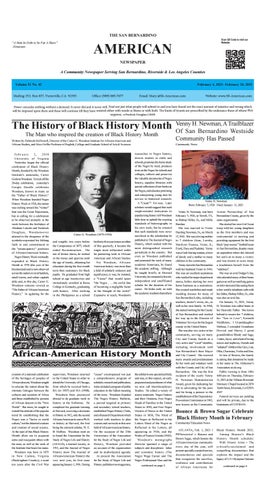
Carter G. Woodson (1875-1950)
Venny H. Newman, A Trailblazer Of San Bernardino Westside Community Has Passed Community News
researches in Negro history, directs studies in clubs and schools, promotes the home study of the Negro by mail; produces texts on the Negro for schools and colleges, collects and preserves the valuable documents of Negro history, supplies libraries with special collections of rare books on the Negro, and educates promising and enterprising young men for service in historical research. A "Cause"? For sure. Later scholars would suggest that such single-minded dedication to popularizing history left Woodson little time to uphold the exacting standards of historiography in his own work, but he ensured that such standards were never sacrificed in the scholarship he published in The Journal of Negro History, which ranked with the most distinguished research periodicals in the country. But even as Woodson published and promoted the work of many academic historians, he found the academy stifling. Although he taught briefly at Howard University, he remained a fiercely independent and unaffiliated scholar for the duration of his career. He broke early on with the academic tradition that tethers
the scholar to one specialized field, and was, in this respect, an early proponent and practitioner of what we now call Interdisciplinary Studies. He edited a variety of source materials: Negro Orators and their Orations, Free Negro Heads of Families in the United States in 1830, and Free Negro Owners of Slaves in the United States in 1830, The Mind of the Negro as Reflected in his Letters Mind of the Negro as Reflected in his Letters, all appearing in 1926; and the Works of Francis Grimke (1942). Woodson's monog raphs likewise spanned a range of subjects and disciplines: labor and economic history (The Negro Wage Earner and The Negro Professional Man and the continued on page 2
Venny H. Newman Born: February 7, 1926 Died: January 11, 2021 Venny H. Newman, was born February 7, 1926, in Terrell, TX, to Bishop Miller, Sr., and Millie Burdine She was married to Victor Harding Newman, Sr., on March 17, 1942. She was a loving mother to 7 children (Jean, Loretta, Marilynn Frances, Victor, Jr., Frank, Dave and Paulette). Venny was a God- fearing woman, a lover of family and a mother to many children in her community. Venny moved to San Bernardino with her husband Victor in 1944. She was an excellent seamstress who worked for major department stores, before starting her own home business as a seamstress. She created wardrobes and made wedding dresses for many of San Bernardino’s elite, including teachers, doctor’s wives, etc., as well as her own family. In 1968, she started working for the County of San Bernardino and worked her way up to the Director of Volunteer Services for the largest county in the United States. She was also very active in her community, serving on many City and County boards as a very active and “vocal” member, including involvement with San Bernardino’s then Mayor and City Council. She received many awards and proclamations for her work and volunteer work with the County and City of San Bernardino. She was the first recipient of the yearly Venny H. Newman Humanitarian Award, given for dedicating her life to advocating for the poor and for being a pioneer in the establishment of the Dependency Pre-vention Commission in 1965, now known as the Community
Action Partnership of San Bernardino County, given by the same organization. She started her own Girl Scout troop with her young daughters as the first members and was instrumental in starting and providing equipment for the first black “pop warner” football team in San Bernardino, despite many an opposition where she cheered her son’s on to many a victory and was known to score many a touchdown herself from the “sidelines”. She was an avid Dodger’s fan, who attended many of their home games as well as watching games on television and discussing them in her weekly telephone calls with her father, Bishop Miller, Sr., who was also an avid fan. On January 11, 2021, Venny H. Newman was called home to her Heavenly Father. She leaves behind to mourn her 7 children; her “Son in Love”, Kenneth Middleton; 1 Granddaughter Melissa; 2 extended Grandsons Derrick and Mario; 2 great grandchildren Rhody and Sage; 1 sister, Joyce; and a host of loving nieces and nephews, friends and “adopted” children like Gary, Liat, Ollie, Charmian, Yvette and Don. In lieu of flowers, the family is asking that donations be made in her name to The Alzheimer’s Association at alz.org. Public viewing is from 1:004:00 pm on Thursday, February 11, 2021 at the Tillman Riverside Mortuary Chapel located at 2874 Tenth Street, Riverside, Ca 925074947 Funeral services are pending and will be private, due to the limitations of COVID-19..
Bounce & Brown Sugar Celebrate Black History Month in February Community/ Education News ATLANTA, Feb. 1, 2021 / PRNewswire/ -- Bounce and Brown Sugar, which honors the African-American community every day of the year, will present specially-curated movies, documentaries and specials that recognizes the sacrifice, resilience and contributions of African Americans for
Black History Month 2021. Among Bounce's Black Histor y Month schedule: With Drawn Arms - The cr it ically-acclai med a nd compelling documentary that explores the impact and the legacy of U.S. Olympian Tommie continued on page 6
February 4, 2021
Page 2 COMMUNITY/EDUCATION/ADVERTISING
Lawmakers propose extending eviction moratorium until June 30 By Nigel Duara
Publisher’s Corner
and provide relief to additional tenants.”
Galen Mancino, left, and Betsy Kinsey, hold up banners during a housing justice demonstration in the Adams Point neighborhood of Oakland on Dec. 5, 2020. Photo by Anne Wernikoff for CalMatters IN SUMMARY Under a legislative agreement, California would extend its eviction moratorium to the end of June. Landlords would get an incentive to forgive back rent using an extra $2.6 billion from federal relief. Legislators are prepared to extend California’s eviction moratorium to the end of June while offering landlords an incentive to forgive back rent using an extra $2.6 billion the state received from the latest federal relief bill. Legislators and groups representing landlords and tenants worked on a deal over the weekend, and the bill, SB 91, was introduced this morning, which means lawmakers can vote on it Thursday morning. “We have a deal,” Gov. Gavin Newsom said at a press conference, noting that the deal also extended to financial assistance for unpaid utilities. “The whole idea is to leverage the (federal) dollars to pay back back rent and get about 20%
(forgiven),” Newsom said. “Those tenants are allowed to at least get their lives a little more stable.” EVICTIONS Demonstrators hold up a banner in front of an apartment building in the Adams Point neighborhood of Oakland to protest rent payment and evictions during the coronavirus pandemic on Dec. 5, 2020. Photo by Anne Wernikoff for CalMatters Despite a federal eviction moratorium that runs until the end of March, legislators were working to preserve the complicated and delicate framework of California’s deal, which allowed those who have paid 25% of their rent during the pandemic to avoid eviction and owe the back rent as civil debt. California’s original eviction moratorium ends Jan. 31, and a new deal would need to be in place before then. Tenant groups told CalMatters during negotiations over the extension that they had been sidelined, and raised those concerns again today. Their
chief objection to the deal is the provision allowing landlords to decline the federal rental relief. “If federal tenant protection policies are mandatory because of the decades of evidence that landlords discriminate, such as fair housing, why would we allow landlords to opt out of a tenant protection program where the cost to society and human life could be catastrophic,” said Alliance of Californians for Community Empower ment execut ive director Christina Livingston in a statement. Assemblymember David Chiu, a San Francisco Democrat who wrote the original eviction moratorium that took effect in September, called the proposal “necessary but far from perfect.” “The power imbalance between tenants and landlords is troubling as the amount of rental assistance a tenant receives is determined solely by the cooperation of their landlord,” Chiu said in a statement Monday morning. “I expect there will be a need to revisit this legislation to address gaps
Staying Sheltered Series The proposed moratorium extension deal also addressed one of the California Apartment Association’s major demands: A unified statewide eviction moratorium that preempts any local efforts to establish a longer moratorium. The association’s chief lobbyist, Debra Carlton, said that “while the bill doesn’t contain everything we asked for,” the group is satisfied that the deal includes back rent owed to landlords. “Without this money, many landlords are at risk of losing their rental units,” Carlton said in a statement. “It is imperative that the state release that money quickly. Using $2.6 billion in federal relief as rental subsidies, the proposal would pay landlords 80% of unpaid back rent incurred between April 2020 and March 2021 if landlords agree to forgive the remaining 20% in back rent and agree not to pursue evictions. Should landlords not agree to accept the rental relief dollars, the deal instructs courts to reduce damages owed the landlord, assuming the tenant met the eligibility requirements. Per federal rules, rental assistance is limited to those who make up to 80% of the Area Median Income (AMI). The outline obtained Monday suggests that priority for rental relief will go to those earning less than 50% AMI. Area Median Income for a four-person household in Los Angeles County is $77,300. Eighty percent of that is $61,840.
The History of Black History Month........continued from page 1 Community); religious studies (The History of the Negro Church); collective biography (African Heroes and Heroines); the history of education (The Education of the Negro Prior to 1861) and The Mis-Education of the Negro, a collection of essays and speeches, which first appeared in Black newspapers. Woodson's best known work, especially among contemporary audiences, The Mis-Education is provocative, at times even sensational in its claims and is perhaps best regarded as a witty homiletic text, particular insights of which retain their relevance now almost seventy-five years later. Some of its ideas anticipate a range of concepts and conversations that scholars across the disciplines would initiate in the decades to come: "situated knowledge," "positionality," "cultural literacy." And in campaigning for the importance of international study in a well-rounded curriculum, Woodson can be seen to be an early proponent of "Global Studies." As he put it in The Mis-Education, "The world is not circumscribed by the United States, and the Negro must become a pioneer in making use of a larger portion of the universe." Indeed, Woodson's travels abroad did much to illustrate to him "how people should and should not be taught." Traveling to China with a group of missionaries from the U. S. Woodson described one Todd, from North Carolina, who rushed headlong and unthinking into the missionary enterprise. He "had not been in China five months before he and his wife had been poisoned by their native
cook who had become incensed at the way they interfered with the institutions of his people." Woodson described a similar phenomenon in the Philippines where U. S. teachers trained at Harvard, Yale, Columbia, and Chicago, failed repeatedly in their efforts to teach Filipino children, all because they did not take into account the alienating materials of instruction they selected. In teaching music, the Americans began with "Come Shake the Apple tree," though Filipino children had never seen such a tree. When they taught "Come shake the Lomoy Tree," which students had actually done, teachers met with more success, just as they had in teaching reading. It was pointless to concentrate "On the story of how George Washington always told the truth." Teaching Filipino children to read from books based solely on American myths and heroes would never prove successful, he maintained. Woodson readily complicated these positions by suggesting that no "people should ignore the record of the progress of other races . . . We say, hold on to the real facts of history as they are, but complete such knowledge by studying also the history of races and nations which have been purposely ignored." Those who have dismissed Woodson's commitment to the "cause" of Black History as populist propaganda miss the larger point of Woodson's multifaceted enterprise. Even if one attempts to reduce Woodson's investment in African-American history to its popularizing objectives, it must still be
conceded that Woodson was no less committed to developing the institutional structures that would promote the study of AfricanAmerican and African history and culture, and provide subsequent generations of scholars the support they needed to carry out their work. Without such structures, AfricanAmerican Studies could not claim the lasting and transformative effects on intellectual life. Woodson also understood that building and maintaining such structures was unimaginable without reliable funding streams. With mixed success Woodson appealed to philanthropists and philanthropic agencies to support his work. Some answered that appeal, but when their backing came with strings attached that threatened his professional autonomy, Woodson refused to compromise. Cutting these ties, he worked to develop alternative funding sources. In one instance he dispatched to the South a group of young men in training as historians, who traveled from state to state selling books published by Woodson's Associated Publishers. Woodson even poured his own salary, speaking fees, and book profits into The Journal of Negro History, and used the profits from the Association for the Study of Negro Life and History, to send African-American scholars"Woodson's Boys," as they were called-to the best graduate schools in the country. Trained according to the current canons of historical research, these scholars formed the ranks of the first professional African-American historians. Charles Wesley, one of these
scholars, wrote The Collapse of the Confederacy (1937), which influenced the scholarship of the late Armstead Robinson, founder of the Carter G. Woodson Institute. When Robinson founded the Institute for African-American Studies in 1981, soon thereafter, he petitioned the University to rename the Institute in honor of Carter G. Woodson. This was entirely fitting, not merely because Woodson was, like Robinson, was a historian. Not because he was a Virginian, but because Woodson had devoted his life and work to designing and maintaining the institutional structures that advanced the study of AfricanAmerican history, providing subsequent generations of scholars the support they needed to build professional careers that would not have been possible otherwise. The Institute's subsequent director, Reginald Butler, as well as the associate and interim directors over the years-William Jackson, Scot French, Cynthia Hoehler-Fatton, and Deborah McDowell-have worked to sustain and advance Carter Woodson's dynamic approach to the study of black history and culture, approach ambitious in its aims and global in its reach. The work of our students, faculty members, as well as the pre- and postdoctoral fellows encompasses diverse fields of inquiry and methodologies." Collectively, they are proudly carrying on the legacy and commitments of our namesake, bringing the study of African American history and culture out of the nation's shadows and into public light and life.
Clifton Harris Editor in Chief Investigative Reporter sbamericannews@gmail.com Mary Martin-Harris / Editor Clifton B. Harris / Audio Engineering Editor Legal /Display Advertising (909) 889-7677 The San Bernardino American News was established May 6, 1969. A legally adjudicated newspaper of general circulation on September 30, 1971, case number 15313 by the Superior Court of San Bernardino County. The San Bernardino AMERICAN News subscription rate is $58.00 per year. The San Bernardino AMERICAN News is committed to serving its readers by presenting news unbiased and objective, trusting in the mature judgment of the readers and, in so doing, strive to achieve a united community. News releases appearing in the San Bernardino AMERICAN News do not necessarily express the policy nor the opinion of the publishers. The San Bernardino AMERICAN News reserves the right to edit or rewrite all news releases.
Neiman Marcus Group Celebrates Black History by Supporting Black Futures Community/Education News
DALLAS, Feb. 1, 2021 / PRNewswire/ -- Today, in honor of Black History Month, Nei m a n Ma rcu s G roup ("NMG" or the "Company") launches its "Celebrating Black History by Supporting Black Futures" campaign, focused on fostering Black excellence. Through numerous longstanding and new partnerships, NMG is investing in the leadership of tomorrow in the various stages of academic and professional life: young student, college student, preprofessional, young professional, and professional. NMG has also announced the achievement of raising and donating $1 million over a three-year period to nonprofit organizations that support Black communities across the U.S. "Neiman Marcus Group is investing in a strong foundation of educational support, mentoring, and leadership skills, which are all crucial to the success of our communities," said Amber Seikaly, Vice President, ESG and Chief Communications Officer, Neiman Marcus Group. "We have a commitment to serving communities across the U.S., and we're thrilled to continue suppor ting organizations that build brighter futures." As part of its three-year partnership with Boys & Girls Clubs of America, NMG has pledged to continue fundraising in Neiman Marcus stores throughout February, with the goal to deliver more than $1 million towards the advancement of youth. With 4.6 million young people in Boys & Girls Clubs of America, 26 percent, or 1.1 million, are Black. Donations from NMG ensure all youth, including Black youth, receive the knowledge, skills, and experiences to prepare them for school, work, and life. Donations are also used to advance young emerging scholars interested in STEM (science, technology, engineering, and mathematics). NMG has more than a centurylong history of philanthropic par t nerships withi n the community, demonstrating the company's core value of being "All Heart." Through its philanthropic
foundation, The Heart of Neiman Marcus, the Company will continue to support Dallas Black Dance Theatre and begins a partnership with the 100K Mentor Challenge powered by ProMazo. The 100K Mentor Challenge, built by students for students during the COVID-19 pandemic, aims to provide 100,000 mentors for 100,000 underrepresented students over the next two years to ensure they have access to networking and mentorship opportunities. NMG associates coast-to-coast will make a meaningful impact on leaders of tomorrow by mentoring college students through this partnership. In addition to philanthropic partnerships, NMG will continue to celebrate Black History Month by hosting Nikole Hannah-Jones, a Pulitzer Prize-winning reporter covering racial injustice for The New York Times Magazine and creator of the landmark 1619 Project, for an associate and customer-facing fireside chat with the company's Chief Legal Counsel, Tracy Preston. Customers can RSVP for the virtual event by visiting www.neimanmarcus. com/virtualevents. NMG will also donate to the Ida B. Wells Society for Investigative Reporting in honor of Hannah-Jones. As part of the Company's honor of Black History Month, Blackled businesses and designers of brand partners are highlighted through Neiman Marcus' "Spotlight on Diversity" story on NeimanMarcus.com. Black and minority-owned brands are also featured in a shoppable "Spotlight on Diversity" category on Neiman Marcus' website. "NMG is a place where everyone belongs, where diversity is valued, and where showing up as your full and authentic self is expected," said Eric Severson, Chief People & Belonging Officer, Neiman Marcus Group. "As we progress on our Belonging journey, our people and their voices are a priceless way we highlight the excellence that makes up our company." To read more about NMG's philanthropic work, visit The Heart of Neiman Marcus.
February 4, 2021
Page 3 STATE/GOVERNMENT/BUSINESS
Black Leaders: Biden Order Is First to Recognize America’s History of Housing Injustice Quinci LeGardye | California Black Media
Black Leaders and civil rights groups – including the NAACP and the Greenlining Institute -- are hailing a memorandum President Joe Biden issued last week directing the Department of Housing and Urban Development (HUD) to “take actions to undo historic patterns of segregation and other types of housing discrimination that afford access to long denied opportunities.” The directive is based on an executive order the President of the United States signed on Jan. 27. It launched a package of White House actions crafted to promote equity that also includes ending the federal use of private prisons. In the Presidential Memorandum directed to HUD, President Biden publicly acknowledged that in the 20th century, U.S. federal, state and local governments “systematically implemented” discriminatory housing policies and supported discrimination in housing and mortgage lending. The memo also outlined the wide-
reaching effects of racial housing discrimination, which includes the racial gap in homeownership, persistent undervaluation of homes owned by people of color and a disproportionate amount of pollution and exposure to climate change in communities of color. According to an analysis of the order by the Urban Institute, the memorandum is the first time a president has explicitly recognized the federal gover nment’s culpability in housing injustice. “The Federal Government must recognize and acknowledge its role in systematically declining to invest in communities of color and preventing residents of those communities from accessing the same services and resources as their white counterparts,” the memorandum reads. California’s Black communities have long experienced the effects racial housing discrimination and they continue to feel that pinch. According to a 2015 report by continued in next 2 columns
BOE Member Malia Cohen Raises Red Flag on Bank-Breaking Prop 19 Tax Costs Antonio Ray Harvey | California Black Media Malia M. Cohen, the only African American member of the California Board of Equalization (BOE), has some critical concerns about the cost homeowners will have to bear because of Proposition 19, a constitutional amendment that took effect on Dec. 16, 2020. Cohen, who represents 10 million Californians in 23 counties on the board, is concerned with how Prop 19 will affect Black and other minority homeowners across California. The BOE is the commission responsible for implementing the law. “The challenge is that it was voted upon and the election has been certified. So, it’s the law,” Cohen said during a virtual media news briefing with reporters from across the state on Jan. 29 organized by California Black Media. In her commentary, Cohen discussed the ways the law will impact all property owners. “It not only affects our respective Black communities,” she told the reporters. “It affects all homeowners and property owners in the state of California. When people wake up there is going to be a massive coalition (to fight it) -possibly an uprising. People need to know what the real deal is.” Cohen said, at appearances she is planning similar to the news briefing she had with CBM, residents of California will begin to hear about “the first steps” they can take to become educated about how Prop.19 will hit their bottom lines. This is something she feels was not adequately explained to voters when the referendum was placed on the ballot last November.
On Nov. 3, 2020, California voters approved Prop. 19, the “Home Protection for Seniors, Severely Disabled, Families, and Victims of Wildfire or Natural Disasters Act.” Although Prop 19 was enacted in December, Cohen warns that a critical part of the legislation will take effect on Feb 16. Until that date, the state currently allows tax breaks for parent-child transfers. When parents give or sell real property to their children (or perhaps, grandchildren), that heir continues to pay property taxes at the same rate assessed on the home value as the parent. After Feb. 16, Prop. 19 will eradicate the parent-child exclusion. Then, parents would still be able to transfer their house to a child, and the child may keep the parent’s assessed value. But the Prop. 19 law has added one critical condition: the child must move into the residence and make the property his or her own primary residence. If not, the property will be reassessed at what the current tax cost is for the home at that time. Cohen discussed the immediate property tax implications and how it might impede property owners' intentions to create generational wealth by transferring their personal residence and other property they own to their children as part of their estate planning. BOE Tax Counsel Richard Moon also participated in the briefing. “What is required that a child continued in next 2 columns
BOE Member Malia Cohen Raises Red Flag on BankBreaking Prop 19 Tax Costs...continued moving into the home must file a homeowner exemption and that needs to be done within a year of the transfer date,” Moon said. “The child has one year to move into the family home and maintain that family home in order to keep the exclusion. But if they move out after three years, the property would be assessed at that point.” Rates of Black homeownership in California and across the country are still far below that of Whites and other minorities. Critics of the law say the fact that Prop. 19 could set up even more barriers to African Americans owning homes – and straddle struggling families with additional financial burdens – is problematic. About 2.2 million Black people reside in California, around 5.5% of the state’s population. According to the U.S. Census Bureau, the rate of White American homeownership sails over 73%, while that of African Americans stands at 41%, Black Enterprise magazine reported in 2019. According to data compiled by Lending Tree, the country’s leading online home loan marketplace, Los Angeles is one of the cities with the highest percentage of Black homeowners. Utah’s Salt Lake City, Texas’ San Antonio, Oregon’s Portland, and Northern California’s San Jose are also included on that list. African Americans primarily generate wealth th rough homeownership and home inheritances, according to data included in the Urban Institute’s “2019 Black Homeownership Gap: Research Trends and Why Growing Gap Matters” report. “Homeownership is currently the largest single source of wealth-building” among the Black population, the study stated. Between 2005 and 2008, over 240,000 African Americans lost their homes to foreclosure according to the Center for Responsible Lending. “The financial crisis triggered a massive destruction of wealth for African Americans,” Alanna McCargo, co-director of the Urban Institute’s Housing Finance Policy
Center told the Washington Post in 2019. “Wealth is inextricably linked to housing, and that wealth gap is evident in figures for Blackowned property in this country.” The law, as it is written, would exclude from the term “purchase” and the phrase “change in ownership” for purposes of determining the “full cash value” of property in the purchase or transfer of a family home or family farm, for example. Hardy Brown, Publisher Emertius of the Black Voice News in Riverside – the oldest African American-owned newspaper in that city -- says some of the spirit of Prop 19 may have been positive. The state intended to provide financial cover for the mostly White Californians living in fire and flood prone parts of the state in the event disaster happens. But what it ends up doing, he argues, is decimate the wealth of Blacks and other minorities. “It doesn’t help,” says Brown. “It might make a quick buck for campaign contributors or help the state to be a good neighbor to some people, but severely harms others in the process. What it really ends up doing is putting another law on the necks of Black people in the state of California. It will choke the breath right out of us.” Under its constitutional mandate, the BOE oversees the assessment practices of the state’s 58 county assessors, who are charged with establishing values for approximately 13.6 million properties each year. “We are not talking about $25 million palaces in Malibu. We are talking about humble homes. Middle-class homes,” Cohen said. “I live in the Bay View community (of San Francisco). We’re talking about Baldwin Hills of Los Angeles or Encanto in San Diego and other communities throughout California. Homes that were purchased for $100,000 decades ago that now have a market value of over $1 million. These homes were paid for through hard work and could be potentially lost.”
Black Leaders: Biden Order Is First to Recognize America’s History of Housing Injustice...continued the California Budget and Policy Center, a nonpartisan research firm, people of color made up more than two thirds of Californians with unaffordable housing costs, with unaffordable costs defined as spending over 30 % of household income on housing. This report found that 6.6 % of Californians with unaffordable housing costs are Black, despite Black Californians counting for about 6.5 percent of the state’s total population. Also, according to a 2019 HUD report, nearly 40 % of California’s homeless population is Black. Debra Gore-Mann, president and CEO of the Oaklandbased Greenlining Institute, told California Black Media, “American housing policy has been steeped in racial animus from the National Housing Act of 1934 that created the FHA -- which explicitly promoted redlining -- all the way to the subprime mortgage crisis that blew up from 2007 to 2010. “Today, communities of color teeter on the brink of eviction and foreclosure,” Gore-Mann continued. “President Biden’s order on redressing this nation’s history of housing discrimination and his call to Congress to pass protections and financial relief for Americans at risk of losing their homes because of the coronavirus
pandemic are impor tant and come at a critical time.” The memorandum’s specific directives are aimed at two rules that were weakened or relaxed under the Trump administration: one governs how cities assess and enforce efforts to reduce segregation, and the other combats discrimination in rental housing and mortgage lending. Biden also ordered incoming Housing Secretary Marcia Fudge to take the necessary steps to align HUD’s policies with the Fair Housing Act of 1968. During her confirmation hearing Jan. 28, Fudge, a previous chair of the Congressional Black Caucus and former mayor of Warrensville Heights, a majority-Black suburb of Cleveland, Ohio, committed to the Biden administration’s priorities of expanding the Black homeownership rate and breaking down barriers to building new apartment buildings. “It bears mentioning, particularly in this moment of crisis, that HUD — perhaps more than any other department — exists to serve the most vulnerable people in America,” Fudge said in her prepared remarks. “That mandate matters a great deal to continued in next 2 columns
Black Leaders: Biden Order Is First to Recognize America’s History of Housing Injustice...continued me. It is consistent with my own values, and it is precisely what has always motivated me to service.” Several civil rights groups and housing activists are applauding the memorandum as an important first step in combating a legacy of housing discrimination. It comes after four years of the Trump administration either ignoring or taking steps to weaken fair housing protections, they say, and amid a national pandemic that is hitting communities of color hardest. “We are gratified by today’s Memorandum reaff irming the federal government’s role in ensuring fair and equitable housing policies. We welcome the prioritization of this essential federal role in advancing equity and look forward to working to reverse the devastating practices undertaken by HUD during the Trump Administration, and to advancing a bold, progressive vision of fair housing,” said Sher rilyn If ill, President and Director-Counsel of the NAACP Legal Defense and Educational Fund, Inc. However, these same civil rights and housing groups
are emphasizing the fact that communities impacted by housing discrimination, especially Black communities, need help in the form of concrete action. Some concrete actions that the federal government could take to redress housing discrimination include confronting forms of discrimination in today’s housing market, such as realtor and landlord practices, and supporting homeownership for communities of color, according to the Urban Institute. “This open dialogue represents a big first step, but it’s just the first step on our way to a just recovery. We must demand new policies to remedy and make right this longstanding, unfair economic burden on too many Americans. We do not need more analysis, assessments nor this too familiar call to action by Congress. We, the public, must clearly demand proactive, concrete actions performed intentionally and consciously to build a clear pathway for communities of color to build real prosperity,” said Gore-Mann.
OneUnited Bank, Largest Black Owned Bank And Visa Launch OneTransaction Campaign Focusing on Closing the Racial Wealth Gap State/Government News
LOS ANGELES, Feb. 2, 2021 / PRNewswire/ -- OneUnited Bank, the largest Black owned bank and first and only Black owned digital bank in the country and Visa are proud to announce for Black History Month the OneTransaction Campaign to close the racial wealth gap. The Campaign includes a state-of-the-art, free virtual financial conference on Juneteenth (June 19, 2021). O n eUn it e d B a n k , i n partnership with Visa, launches the OneTransaction Campaign & Conference during Black History Month to close the racial wealth gap. In 2020, America was forced to recognize the impact of systemic racism, and the resulting racial wealth gap. According to Brookings, the net worth of a Black family is $17,150 compared to $171,000 for a white family. While public policy is critical to addressing the consequences of discrimination, public policy moves slowly. More importantly, OneUnited Bank encourages all Black Americans to focus on One Transaction in 2021 that will increase their net worth. That transaction could be a will, life insurance, home ownership, a profitable business, automatic savings, an investment portfolio or an improved credit score. T h e # O n eTr a n s a c t io n Campaign encourages Black families to select One Transaction to accomplish in 2021 and provides action steps to accomplish that transaction. "The reality is the racial wealth gap for each family can be closed by one strategic transaction," says Kevin Cohee, Chairman & CEO of OneUnited
Bank. "By encouraging our community to accomplish One Transaction in 2021, we can make financial literacy a core value of the Black community and create generational wealth." The Campaign includes a free state-of-the-art #OneTransaction Virtual Financial Conference in partnership with Visa, to be held on June 19, 2021 or Juneteenth, a holiday celebrating the emancipation of those who had been enslaved in the United States. The OneTransaction Conference includes expert presenters in business and personal finance including Tiffany Aliche, The Bugetnista, an award winning financial education teacher, Sharon Epperson, Senior Personal Finance Correspondent for CNBC, Karen Hunter, Pulitzer Prize-winning journalist and host of The Karen Hunter Show on Sirius XM Urban View, Daymond John, globally recognized from ABC's Shark Tank, founder and CEO of FUBU and a Presidential Ambassador for Global Entrepreneurship, Calvin Martyr, founder of #BlackOutDay2020 and The Blackout Coalition, Everett Sands, founder and CEO of Lendistry, a Black-owned SBA Preferred Lender, Michelle Singletary, personal finance columnist and author of upcoming book "What To Do With Your Money When Crisis Hits", Kemberley Washington, CPA and Tax Analyst with Forbes Advisor among others. To secure your free ticket, go to www. oneunited.com/onetransaction. (Limited a v a i l a b i l i t y) "P r ior it i z i ng f i na ncial educational and tailoring solutions to close the financial disparities is key to building generational wealth," says Mary Ann Reilly, senior vice president, Head of North America Marketing, Visa. "By partnering with OneUnited Bank, we are both working towards driving lasting systemic change and enabling individuals, businesses and economies to thrive."
February 4, 2021
Page 4 RELIGION/LIFESTYLE
“My People─ Don’t You Worry About A Thing!” By: Lou Yeboah
Lou Yeboah “I want you to know tonight, that we, as a people, will get to the promised land.” [Martin Luther King, Jr.]. God has chosen us out of all the peoples on the face of the earth to be his people, his treasured possession. The LORD did not set his affection on us and chose us, because we were more numerous than other peoples, for we were the fewest of all peoples. But because the LORD loved us and is keeping the oath He swore to our forefathers that He brought out with a mighty hand and redeemed from the land of slavery. [Deuteronomy 7:6-8]. We have been elected. He chose us. Let that continue to encourage you and give you confidence that He will keep you until the end. Yes, we are the peculiar people of God; all His own, closest to His affections, under His protection, the recipients of all needed. I tell you, don't you worry about a thing, because God got you! I’m reminded of when the Children of Israel who had come to what seemed like the end of their journey on the banks of Jordan, Moses told them to go on ahead. They began to wonder what would happen to them next, and the Lord said tell them… “Be strong and of a good courage, do not fear, nor be afraid of them: for the LORD your God, He is the One who goes with you; He will not fail you, nor forsake you… [Deuteronomy 31:6]. My people, “I want you to know tonight, that we, as a people, will get to the promised land.” We are a chosen race, a royal priesthood, a holy nation, a people of God’s possession.” [1 Peter 2:9]. Therefore, “Do not think its strange concerning the fiery trial which is to try you, as though some strange thing happened unto you: But rejoice, inasmuch as ye are partakers of Christ’s sufferings; that, when his glory shall be revealed, ye may be glad also with exceeding joy. [1 Peter 4:12-14]. For we’ve come “Out of Africa” now into the wilderness. But God has promised to be with us every step of the way. I tell you, don’t you worry about a thing, God got you! What then shall we say to these things? If God is for us, who can be against us? Who shall bring a charge against God's elect? It is God who justifies. Who is he who condemns? It is Christ who makes intercession for us. Who shall separate us from the love of Christ? Shall tribulation, or distress,
or persecution, or famine, or nakedness, or peril, or sword? As it is written: "... we are accounted as sheep for the slaughter." Yet in all these things we are more than conquerors through Him who loved us. For I am persuaded that neither death nor life, nor angels, nor principalities, nor powers, nor things present nor things to come, nor height nor depth, nor any other created thing, shall be able to separate us from the love of God which is in Christ Jesus our Lord. [Romans 8:31-39]. Take this confident assurance forward with you through whatever trial or hazard besets you, and faithfully prepare to cross the Jordan, into the land that Christ has giving unto us as He promised to Moses. From the wilderness and the Lebanon as far as the great river, the river Euphrates, all the land of the Hittites, to the Great Sea in the west shall be our territory. Moving forward knowing that no one shall be able to stand against you all the days of your life. As God was with Moses, so He will be with you; For He said, “I will not fail you or forsake you. Only be strong and very courageous, being careful to act in accordance with all the law that His servant Moses commanded us, Do not turn from it to the right hand or to the left, so that you may be successful wherever you go. [Joshua 1:111]. For, He said, "Today I will begin to exalt you in the sight of all Israel, so they will know that I will be with you just as I was with Moses. [Joshua 3:7-8]. I tell you, having monuments to God's faithfulness that we can look back on can encourage our faith for the future. [Joshua chapter 4]. Even when it seems like we’re not making any progress, the Lord’s command is: “FORWARD M A RCH!” [Exodus 14]. Advancing with confidence to that promised inheritance as we celebrate Black History Month! “Lift every voice and sing, Till earth and heaven ring, ring with the harmonies of Liberty. Let our rejoicing rise, high as the listening skies, let it resound loud as the rolling sea. Sing a song full of the faith that the dark past has taught us. Sing a song full of the hope that the present has brought us. Facing the rising sun of our new day begun. Let us march on till victory is won..” [Lift Every Voice and Sing – often called “The Black National Anthem” – was written as a poem by NAACP leader James Weldon Johnson (1871-1938) and then set to music by his brother John Rosamond Johnson (1873-1954) in 1899.]
Witness For Justice#1032
E Pluribus Unum Karen Georgia Thompson Associate General Minister for Wider Church Ministries & Operations and Co-Executive for Global Ministries On January 20, 2021, the world watched as President Joe R. Biden and Vice President Kamala Harris were sworn in at the United States Capitol. The small gathering was appropriately distanced, observing the protocols required for the pandemic. This was a historic moment on many fronts. It was not lost on me, as I watched the ceremony and pondered the election, that a mere two weeks before on January 6th, as the U.S. Congress gathered to ratify the vote of the Electoral College, a rioting mob had attacked the very
building that served as the iconic backdrop for the inauguration. As President Biden addressed the nation for the first time, he declared his intention to be a unifying force for the country, saying: “To overcome these challenges – to restore the soul and to secure the future of America – requires more than words. It requires that most elusive of things in a democracy: Unity.” In 1776 as the United Stated of America was being formed, the suggestion was made that the continued in next 2 columns
E Pluribus Unum...continued motto of the new nation should be E pluribus unum – out of many, one. The motto was later adopted as a part of the Great Seal of the United States. Perhaps it is time to revisit and reaffirm these words as we consider what it means to hold the diversities that are reflective of this country as we seek unity in days, weeks, and months to come. “Out of many, one” points to the diversity that is possible even in a vision for unity. Unity does not require uniformity;. we all don’t have to look alike, dress alike, think alike, or even speak the same language for unity to exist and flourish among us. We can retain the uniqueness of who we are, while holding common values and assumptions as a nation. The traditions that reflect the uniqueness of the places from whence we came as immigrants to this land bring us joy and pride, while connecting us to the past and our identities. The great divide among us has to be addressed in ways
that allow us to be respectful in hearing each other’s opinions and welcoming the full breadth of the diversities that are present in the US. Rather than dividing us, the differences that each of us brings to the table adds deep rich texture to the fabric that represents who we are as citizens and residents of this country. Unity means we understand ourselves as a whole, joined together. One people. “This is our historic moment of crisis and challenge, and unity is the path forward. And, we must meet this moment as the United States of America. If we do that, I guarantee you, we will not fail. We have never, ever, ever failed in America when we have acted together. And so today, at this time and in this place, let us start afresh. All of us. Let us listen to one another. Hear one another. See one another. Show respect to one another.” – President Joseph R. Biden 46th President of the United States
New Federal Theatre Celebrates Black History Month With Retrospective Readings Series Featuring Noteworthy Plays NEW YORK -- On Saturdays from February 13 to 27, 2021 New York's New Federal Theatre (NFT) will present "New Federal Theatre Celebrates Black History Month," a retrospective readings series in which three rarelydone yet noteworthy plays, all previously produced by NFT, will be recreated by savvy actors and directors. These plays illuminate burning issues of their time and are newly instructive today. The readings will be free and accessible from NFT's website, newfederaltheatre.com. Donations will be gratefully accepted. February 13 @ 7:00 PM ( EST ), st rea m i ng u nt il February 15 @ midnight. "When the Chickens Come Home to Roost" by Laurence Holder, directed by Ralph McCain Featuring Allie Woods as Elijah Muhammad and Lawrence Winslow as Malcolm X.
The play centers on the relationship between Malcolm X and Elijah Muhammad – the beating heart of the Black Muslim movement. Its title is a reference to Malcolm X’s notorious comment in the wake of JFK’s assassination. The comment caused him to be censored by his leader, Elijah Muhammad causing a rift between the Nation of Islam’s founder and his star disciple. New Federal Theatre's 1981 premiere production starred Kirk Kirksey as Elijah Muhammad and Denzel Washington as Malcolm X. February 20 @ 7:00 PM; February 21 @ 7:00 PM and February 22 @ 7:00 PM (EST) "The Meeting" by Jeff Stetson, directed by Ajene D. Washington Featuring: Joseph L. Edwards as Dr. Martin Luther King, Tyler Fauntleroy as Resheed, Beethovan Oden as Malcolm X. continued on page 6
IN MEMORIAM: Cicely Tyson, a Legend Who Portrayed African Americans with Dignity and Strength, Dies at 96 By Lauren Victoria Burke
Cicely Tyson, pictured with Wintley Phipps (left) and Larenz Tate (right). (PHOTO: Dream In Color Photography / NNPA) Actress and model Cicely Tyson, a legend of the stage and screen whose roles showcased the lives of famous African American women died on January 28 in New York at 96. Tyson was a much respected and revered artist. Her acting was replete with authenticity and her portrayals won her many dedicated admirers. She was also famously married to another legend, Jazz trumpeter Miles Davis from 1981 to 1988. Tyson iconicly portrayed Kunta Kinte’s mother in the epic television mini-series “Roots” in 1977. She played Coretta Scott King in the 1978 NBC mini-series “King.” She also portrayed Harriet Tubman, in “A Woman Called Moses” (1978) and in 1994, she won an Emmy for her portrayal of Castalia in the mini-series, “Oldest Living Confederate Widow Tells All.” Her roles spanned decades and include theater, television and feature films. Tyson stressed the importance of portraying the lives of African Americans with dignity — regardless of whether the character was rich or poor. Tyson recently finished her memoir which was promoting at the time of her death. Her new book is called “Just as I Am.” The autobiography spans over seven decades of Tyson’s career and life experiences. Praise for a life well lived flooded in for Tyson. “In her extraordinary career, Cicely Tyson was one of the rare award-winning actors whose
work on the screen was surpassed only by what she was able to accomplish off of it. She had a heart unlike any other—and for 96 years, she left a mark on the world that few will ever match,” wrote President Barack Obama after hearing the news of Tyson’s death. “So saddened to hear my friend #CicelyTyson has passed-one of the most profound, talented and celebrated actors in the industry. She was a serious actor, beautiful & spiritual woman who had unlocked the key to longevity in the way she lived her life. Forever all my love and respect,” wrote Congresswoman Maxine Waters on the actress. “My heart is truly broken. Yesterday, we lost not only an iconic award-winning actress who distinguished herself in theater, film and television, but a true pillar of African American culture,” said Melanie Campbell, President of the National Coalition on Black Civic Participation. Her death was announced by her longtime manager, Larry Thompson. At the time of this writing, funeral arrangements have not yet been announced. Lauren Victoria Burke is an independent journalist for NNPA and the host of the podcast BURKEFILE. She is also a political strategist as Principal of Win Digital Media LLC. She may be contacted at LBurke007@gmail.com and on twitter at @LVBurke
Arizona State University Renames Film School to Honor Sidney Poitier By Stacy M. Brown, NNPA Newswire Senior National Correspondent
President Barack Obama awarded Poitier the Presidential Medal of Freedom in 2009, and in 2011, he earned the Film Society of Lincoln Center’s prestigious Chaplin Lifetime Achievement Award. (Photo: John Mathew Smith & www.celebrity-photos.com from Laurel Maryland, USA / Wikimedia Commons) Arizona State University has named its new film school after legendary actor Sidney Poitier. According to a USA Today report, the decision to name the school after Poitier, 93, is about much more than an emphasis on diversity. In an interview ahead of The Sidney Poitier New American Film School’s unveiling, University President Michael M. Crow said Poitier embodies everything that one would look for in an icon. “With Sidney Poitier, it’s his creative energy, his dynamism, his drive, his ambition, the kinds of projects he worked on, the ways in
which he advanced his life,” Crow asserted, according to USA Today. The legendary actor filmed his Oscar-winning “Lilies of the Field” in Arizona in 1963. Poitier became the first Black person to win an Oscar for lead actor in a motion picture. Crow noted the unusually scandal-free life that the superstar has lived despite being in the public limelight for decades. “Look at his life: It’s a story of a person who found a way,” Crow added. “How do we help other young people find their way?” As noted in his biography at Oscar.com, Poitier is
both an esteemed actor and a respected humanitarian. In addition to his Oscar for Best Actor, he received an Honorary Award in 2001. Born in Miami, he grew up both in the Bahamas and the United States and became a noted actor both on the stage and in such films as “The Defiant Ones” in 1958, which he earned his first Oscar nomination. Throughout his career, Poitier provided some of the most legendary performances ever on the Silver Screen. Among the most memorable were “A Patch of Blue” in 1965, “In the Heat of the Night” in 1967, and “Guess Who’s Coming to Dinner” in 1967. Poitier also directed and starred in a series of 1970’s hits with Bill Cosby, including “Let’s Do it Again” and “Uptown Saturday Night.” He went on to direct nine feat ure films. In 2000, Poitier published the autobiography “The Measure of a Man” and earned a Grammy Award for the best-spoken word album for the audio version of “The Measure of a Man.” He fol lowe d u p h i s autobiography eight years later when he published “Life
Beyond Measure: Letters to My Great-Granddaughter.” A recipient of numerous awards and honors throughout this career, Poitier was knighted in 1974 by the British government. President Barack Obama awarded Poitier the Presidential Medal of Freedom in 2009, and in 2011, he earned the Film Society of Lincoln Center’s prestigious Chaplin Lifetime Achievement Award. According to USA Today, Arizona University reportedly has invested millions of dollars in technology to create what’s intended to be one of the largest, most accessible, and most diverse film schools. Crow said the film school would measure success not by exclusivity but by inclusivity. “If it has my Dad’s name on it, it has to be inclusive because that’s the foundation of who he is and what he stands for,” Anika Poitier, the legend’s daughter, remarked. “And it’s important to not only have inclusion but to have diversity, and to give people the opportunity to tell their stories. I think it’s imperative to cast a wide net and allow anyone who’s called to tell their story to learn how to do that.”
February 4, 2021
Page 5 LEGALS/CLASSIFIEDS FICTITIOUS BUSINESS NAME FICTITIOUS BUSINESS NAME STATEMENT 20210000200 Date Filed: 01/07/2021 Filing Expires On: 01/07/2026 FICTITIOUS BUSINESS NAME (as shown in the Articles of Inc./Org./Reg.): ACT SERVICES County of Principal Place of Business: SAN BERNARDINO Street Address of Principal Place of Business: 13231 9TH ST. CHINO, CA 91710 Name of Individual Registrant: ANEDIA S. ARROYO Name of corporation or limited liability company as shown in the Articles of Inc./Org./Reg.: State of Inc./Org./Reg.: CA Inc./Org./Reg. No.: Residence Street Address: 13231 9TH ST. CHINO, CA 91710 This business is/was conducted by: An Individual Registrant has commenced to transact business under the fictitious business name or names listed above on: January 06, 2021 Anedia S. Arroyo, declares that all information in this statement is true and correct. NOTICE- IN ACCORDANCE WITH SUBDIVISION (a) OF SECTION 17920, A FICTITIOUS NAME STATEMENT GENERALLY EXPIRES AT THE END OF FIVE YEARS FROM THE DATE ON WHICH IT WAS FILED IN THE OFFICE OF THE COUNTY CLERK, EXCEPT, AS PROVIDED IN SUBDIVISION (b) OF SECTION 17920. WHERE IT EXPIRES 40 DAYS AFTER ANY CHANGE IN THE FACTS SET FORT IN THE STATEMENT PURSUANT TO SECTION 17913 OTHER THAN A CHANGE IN THE RESIDENCE ADDRESS OF A REGISTERED OWNER. A NEW FICTITIOUS BUSINESS NAME STATEMENT MUST BE FILED BEFORE THE EXPIRATION. THE FILING OF THIS STATEMENT DOES NOT OF ITSELF AUTHORIZE THE USE IN THIS STATE OF A FICTITIOUS BUSINESS NAME IN VIOLATION OF THE RIGHTS OF ANOTHER UNDER FEDERAL, STATE, OR COMMON LAW (SEE SECTION 14411 ET. SEQ., BUSINESS AND PROFESSIONS CODE.) Published in the San Bernardino American Newspaper February 4, 11, 18, 25, 2021.
FICTITIOUS BUSINESS NAME STATEMENT 20200011685 Date Filed: 12/23/2020 Filing Expires On: 12/23/2025 FICTITIOUS BUSINESS NAME (as shown in the Articles of Inc./Org./Reg.): U FIRST INCOME TAX & BUSINESS SOLUTIONS County of Principal Place of Business: SAN BERNARDINO Street Address of Principal Place of Business: 1264 S. WATERMAN AVE. SUITE 18 SAN BERNARDINO, CA 92408 Mailing Address: 7473 CATALPA AVE. HIGHLAND, CA 92346 Name of Individual Registrant: Name of corporation or limited liability company as shown in the Articles of Inc./Org./Reg.: THE RAGLAND GROUP LLC State of Inc./Org./Reg.: Inc./Org./Reg. No.: Residence Street Address: 7473 CATALPA AVE. HIGHLAND, CA 92346 This business is/was conducted by: A Limited Liability Company Registrant has commenced to transact business under the fictitious business name or names listed above on: Oct. 10, 2017 Tanisha Mack, Managing Member, declares that all information in this statement is true and correct. NOTICE- IN ACCORDANCE WITH SUBDIVISION (a) OF SECTION 17920, A FICTITIOUS NAME STATEMENT GENERALLY EXPIRES AT THE END OF FIVE YEARS FROM THE DATE ON WHICH IT WAS FILED IN THE OFFICE OF THE COUNTY CLERK, EXCEPT, AS PROVIDED IN SUBDIVISION (b) OF SECTION 17920. WHERE IT EXPIRES 40 DAYS AFTER ANY CHANGE IN THE FACTS SET FORT IN THE STATEMENT PURSUANT TO SECTION 17913 OTHER THAN A CHANGE IN THE RESIDENCE ADDRESS OF A REGISTERED OWNER. A NEW FICTITIOUS BUSINESS NAME STATEMENT MUST BE FILED BEFORE THE EXPIRATION. THE FILING OF THIS STATEMENT DOES NOT OF ITSELF AUTHORIZE THE USE IN THIS STATE OF A FICTITIOUS BUSINESS NAME IN VIOLATION OF THE RIGHTS OF ANOTHER UNDER FEDERAL, STATE, OR COMMON LAW (SEE SECTION 14411 ET. SEQ., BUSINESS AND PROFESSIONS CODE.) Published in the San Bernardino American Newspaper January 14, Correction 21, 28, February 4, 2021.
FICTITIOUS BUSINESS NAME STATEMENT 20200011688 Date Filed: 12/23/2020 Filing Expires On: 12/23/2025 FICTITIOUS BUSINESS NAME (as shown in the Articles of Inc./Org./Reg.): DIRECT PALLET CONSULTANTS County of Principal Place of Business: SAN BERNARDINO Street Address of Principal Place of Business: 7473 CATALPA AVE. HIGHLAND, CA 92346 Name of Individual Registrant: Name of corporation or limited liability company as shown in the Articles of Inc./Org./Reg.: THE RAGLAND GROUP LLC State of Inc./Org./Reg.: CA Inc./Org./Reg. No.: Residence Street Address: 7473 CATALPA AVE. HIGHLAND, CA 92346 This business is/was conducted by: A Limited Liability Company Registrant has commenced to transact business under the fictitious business name or names listed above on: Dec 22, 2020 Tanisha Mack, Managing Member, declares that all information in this statement is true and correct. NOTICE- IN ACCORDANCE WITH SUBDIVISION (a) OF SECTION 17920, A FICTITIOUS NAME STATEMENT GENERALLY EXPIRES AT THE END OF FIVE YEARS FROM THE DATE ON WHICH IT WAS FILED IN THE OFFICE OF THE COUNTY CLERK, EXCEPT, AS PROVIDED IN SUBDIVISION (b) OF SECTION 17920. WHERE IT EXPIRES 40 DAYS AFTER ANY CHANGE IN THE FACTS SET FORT IN THE STATEMENT PURSUANT TO SECTION 17913 OTHER THAN A CHANGE IN THE RESIDENCE ADDRESS OF A REGISTERED OWNER. A NEW FICTITIOUS BUSINESS NAME STATEMENT MUST BE FILED BEFORE THE EXPIRATION. THE FILING OF THIS STATEMENT DOES NOT OF ITSELF AUTHORIZE THE USE IN THIS STATE OF A FICTITIOUS BUSINESS NAME IN VIOLATION OF THE RIGHTS OF ANOTHER UNDER FEDERAL, STATE, OR COMMON LAW (SEE SECTION 14411 ET. SEQ., BUSINESS AND PROFESSIONS CODE.) Published in the San Bernardino American Newspaper January 14, 21, 28, February 4, 2021. FICTITIOUS BUSINESS NAME STATEMENT 20200011439 Date Filed: 12/16/2020 Filing Expires On: 12/16/2025 FICTITIOUS BUSINESS NAME (as shown in the Articles of Inc./Org./Reg.): MUSCLE SUPPLY County of Principal Place of Business: SAN BERNARDINO Street Address of Principal Place of Business: 4013 KATSURA WAY SAN BERNARDINO, CA 92407 Name of Individual Registrant: MATTHEW J. GOMEZ Name of corporation or limited liability company as shown in the Articles of Inc./Org./Reg.: State of Inc./Org./Reg.: Inc./Org./Reg. No.: Residence Street Address: 4013 KATSURA WAY SAN BERNARDINO, CA 92407 This business is/was conducted by: An Individual Registrant has commenced to transact business under the fictitious business name or names listed above on: Dec 14, 2020 Matthew Gomez, declares that all information in this statement is true and correct. NOTICE- IN ACCORDANCE WITH SUBDIVISION (a) OF SECTION 17920, A FICTITIOUS NAME STATEMENT GENERALLY EXPIRES AT THE END OF FIVE YEARS FROM THE DATE ON WHICH IT WAS FILED IN THE OFFICE OF THE COUNTY CLERK, EXCEPT, AS PROVIDED IN SUBDIVISION (b) OF SECTION 17920. WHERE IT EXPIRES 40 DAYS AFTER ANY CHANGE IN THE FACTS SET FORT IN THE STATEMENT PURSUANT TO SECTION 17913 OTHER THAN A CHANGE IN THE RESIDENCE ADDRESS OF A REGISTERED OWNER. A NEW FICTITIOUS BUSINESS NAME STATEMENT MUST BE FILED BEFORE THE EXPIRATION. THE FILING OF THIS STATEMENT DOES NOT OF ITSELF AUTHORIZE THE USE IN THIS STATE OF A FICTITIOUS BUSINESS NAME IN VIOLATION OF THE RIGHTS OF ANOTHER UNDER FEDERAL, STATE, OR COMMON LAW (SEE SECTION 14411 ET. SEQ., BUSINESS AND PROFESSIONS CODE.) Published in the San Bernardino American Newspaper January 14, Correction 21, 28, February 4, 2021.
FICTITIOUS BUSINESS NAME STATEMENT 20200011699 Date Filed: 12/23/2020 Filing Expires On: 12/23/2025 FICTITIOUS BUSINESS NAME (as shown in the Articles of Inc./Org./Reg.): A TUTOR TO GO County of Principal Place of Business: SAN BERNARDINO Street Address of Principal Place of Business: 13169 AURORA AVE. VICTORVILLE, CA 92392 Mailing Address: PO BOX 1752 VICTORVILLE, CA 92393 Name of Individual Registrant: SARAH SHABAZZ-UGWUMBA Name of corporation or limited liability company as shown in the Articles of Inc./Org./Reg.: State of Inc./Org./Reg.: CA Inc./Org./Reg. No.: Residence Street Address: 13169 AURORA AVE. VICTORVILLE, CA 92392 This business is/was conducted by: An Individual Registrant has commenced to transact business under the fictitious business name or names listed above on: 12/01/2020 Sarah Shabazz-Ugwumba, Owner, declares that all information in this statement is true and correct. NOTICE- IN ACCORDANCE WITH SUBDIVISION (a) OF SECTION 17920, A FICTITIOUS NAME STATEMENT GENERALLY EXPIRES AT THE END OF FIVE YEARS FROM THE DATE ON WHICH IT WAS FILED IN THE OFFICE OF THE COUNTY CLERK, EXCEPT, AS PROVIDED IN SUBDIVISION (b) OF SECTION 17920. WHERE IT EXPIRES 40 DAYS AFTER ANY CHANGE IN THE FACTS SET FORT IN THE STATEMENT PURSUANT TO SECTION 17913 OTHER THAN A CHANGE IN THE RESIDENCE ADDRESS OF A REGISTERED OWNER. A NEW FICTITIOUS BUSINESS NAME STATEMENT MUST BE FILED BEFORE THE EXPIRATION. THE FILING OF THIS STATEMENT DOES NOT OF ITSELF AUTHORIZE THE USE IN THIS STATE OF A FICTITIOUS BUSINESS NAME IN VIOLATION OF THE RIGHTS OF ANOTHER UNDER FEDERAL, STATE, OR COMMON LAW (SEE SECTION 14411 ET. SEQ., BUSINESS AND PROFESSIONS CODE.) Published in the San Bernardino American Newspaper January 14, 21, 28, February 4, 2021. FICTITIOUS BUSINESS NAME STATEMENT 20210000802 Date Filed: 01/27/2021 Filing Expires On: 01/27/2026 FICTITIOUS BUSINESS NAME (as shown in the Articles of Inc./Org./Reg.): 1. EMPIRE AUTO SALES 2. SULLIVAN BROS. AUTO GROUP County of Principal Place of Business: SAN BERNARDINO Street Address of Principal Place of Business: 1428 RANDY ST., A UPLAND, CA 91786 Name of Individual Registrant Name of corporation or limited liability company as shown in the Articles of Inc./Org./Reg.: SULLIVAN BROS. LLC State of Inc./Org./ Reg.: NV Inc./Org./Reg. No.: 202035310015 Residence Street Address: 2925 COVATTA CT. LAS VEGAS, NV 89086 This business is/was conducted by: A Limited Liability Company Registrant has commenced to transact business under the fictitious business name or names listed above on: Feb 20, 2020 Andre Lathon, Managing Member, declares that all information in this statement is true and correct. NOTICE- IN ACCORDANCE WITH SUBDIVISION (a) OF SECTION 17920, A FICTITIOUS NAME STATEMENT GENERALLY EXPIRES AT THE END OF FIVE YEARS FROM THE DATE ON WHICH IT WAS FILED IN THE OFFICE OF THE COUNTY CLERK, EXCEPT, AS PROVIDED IN SUBDIVISION (b) OF SECTION 17920. WHERE IT EXPIRES 40 DAYS AFTER ANY CHANGE IN THE FACTS SET FORT IN THE STATEMENT PURSUANT TO SECTION 17913 OTHER THAN A CHANGE IN THE RESIDENCE ADDRESS OF A REGISTERED OWNER. A NEW FICTITIOUS BUSINESS NAME STATEMENT MUST BE FILED BEFORE THE EXPIRATION. THE FILING OF THIS STATEMENT DOES NOT OF ITSELF AUTHORIZE THE USE IN THIS STATE OF A FICTITIOUS BUSINESS NAME IN VIOLATION OF THE RIGHTS OF ANOTHER UNDER FEDERAL, STATE, OR COMMON LAW (SEE SECTION 14411 ET. SEQ., BUSINESS AND PROFESSIONS CODE.) Published in the San Bernardino American Newspaper February 4, 11, 18, 25, 2021.
FICTITIOUS BUSINESS NAME STATEMENT 20210000568 Date Filed: 01/20/2021 Filing Expires On: 01/20/2026 FICTITIOUS BUSINESS NAME (as shown in the Articles of Inc./Org./Reg.): RUSTIC LOVE BY TAMARA County of Principal Place of Business: SAN BERNARDINO Street Address of Principal Place of Business: 12804 EASY ST. CHINO, CA 91710 Name of Individual Registrant: TAMARA J. SPEAR Name of corporation or limited liability company as shown in the Articles of Inc./Org./Reg.: State of Inc./Org./Reg.: Inc./Org./Reg. No.: Residence Street Address: 12804 EASY ST. CHINO, CA 91710 This business is/was conducted by: An Individual Registrant has commenced to transact business under the fictitious business name or names listed above on: Not Applicable Tamara Spear, declares that all information in this statement is true and correct. NOTICE- IN ACCORDANCE WITH SUBDIVISION (a) OF SECTION 17920, A FICTITIOUS NAME STATEMENT GENERALLY EXPIRES AT THE END OF FIVE YEARS FROM THE DATE ON WHICH IT WAS FILED IN THE OFFICE OF THE COUNTY CLERK, EXCEPT, AS PROVIDED IN SUBDIVISION (b) OF SECTION 17920. WHERE IT EXPIRES 40 DAYS AFTER ANY CHANGE IN THE FACTS SET FORT IN THE STATEMENT PURSUANT TO SECTION 17913 OTHER THAN A CHANGE IN THE RESIDENCE ADDRESS OF A REGISTERED OWNER. A NEW FICTITIOUS BUSINESS NAME STATEMENT MUST BE FILED BEFORE THE EXPIRATION. THE FILING OF THIS STATEMENT DOES NOT OF ITSELF AUTHORIZE THE USE IN THIS STATE OF A FICTITIOUS BUSINESS NAME IN VIOLATION OF THE RIGHTS OF ANOTHER UNDER FEDERAL, STATE, OR COMMON LAW (SEE SECTION 14411 ET. SEQ., BUSINESS AND PROFESSIONS CODE.) Published in the San Bernardino American Newspaper January 28, February 4, 11, 18, 2021
PETITION/PROBATE NOTICE OF PETITION TO ADMINISTER ESTATE OF: ROBERT JOEL SCARBOROUGH CASE NO : PROPS 2100021 To all heirs, beneficiaries, creditors, contingent creditors, and persons who may otherwise be interested in the will or estate, or both of: ROBERT
JOEL SCARBOROUGH
A PETITION FOR PROBATE has been filed by: CRAIG SCARBOROUGH in the Superior Court of California, County of SAN BERNARDINO. THE PETITION FOR PROBATE requests that: CRAIG SCARBOROUGH be appointed as personal representative to administer the estate of the decedent. THE PETITION requests authority to administer the estate under the Independent Administration of Estates Act. (This authority will allow the personal representative to take many actions without obtaining court approval. Before taking certain very important actions, however, the personal representative will be required to give notice to interested persons unless they have waived notice or consented to the proposed action.) The independent administration authority will be granted unless an interested person files an objection to the petition and shows good cause why the court should not grant the authority. A hearing on the petition will be held in this court as follows: Date: 02/25/2021 Time: 9:00 a.m. Dept: S35 SUPERIOR COURT OF CALIFORNIA
County of San Bernardino 247 West Third Street San Bernardino, CA 92415-0210 San Bernardino District-Probate Division IF YOU OBJECT to the granting of the petition, you should appear at the hearing and state your objections or file written objections with the court before the hearing. Your appearance may be in person or by your attorney. IF YOU ARE A CREDITOR or a contingent creditor of the decedent, you must file your claim with the court and mail a copy to the personal representative appointed by the court within the later of either (1) four months from the date of first issuance of letters to a general personal representative, as defined in section 58(b) of the California Probate Code, or (2) 60 days from the date of mailing or personal delivery to you of a notice under section 9052 of the California Probate Code. Other California statutes and legal authority may affect your rights as a creditor. You may want to consult with an attorney knowledgeable in California law. YOU MAY EXAMINE the file kept by the court. If you are a person interested in the estate, you may file with the court a Request for Special Notice (form DE-154) of the filing of an inventory and appraisal of estate assets or of any petition or account as provided in Probate Code section 1250. A Request for Special Notice form is available from the court clerk. Attorney for Petitioner: RYAN S. CARRIGAN SBN 279709 6800 BROCKTON AVE. RIVERSIDE, CA 92506 (951)530-3297
ScholarShare 529 Launches Matching Grant Program Eligible families get up to $225 for opening a new account
SACRAMENTO – Saving for your children’s college is always a great idea. Now it’s even better. Beginning February 1, 2021, a program by ScholarShare 529, California’s official college savings plan, provides eligible families with up to $225 if they open an account and contribute regularly.
Submission Deadline For All Legals & Classifieds is 5pm Mondays
Published in The San Bernardino American Newspaper January 21, 28, February 4, 2021.
NOTICE INVITING BIDS
NOTICE INVITING BIDS SR-60/Moreno Beach Drive Interchange Improvements (Phase 2) City Project No. 801 0021 Caltrans Contract 08-323034 Project ID 0812000059 The City of Moreno Valley is accepting bids until 5:00 p.m., March 12, 2021 only through the City’s Bid Portal on PlanetBids for the SR-60/Moreno Beach Drive Interchange Improvements (Phase 2) Project, City Project No. 801 0021, Caltrans Contract 08-323034, and Project ID 0812000059. The link for registering to become a prospective bidder in order to download bidding documents and submit electronically bid can be found at the following address: h t t p : / / w w w. p l a n e t b i d s . c o m / p o r t a l / p o r t a l . cfm?CompanyID=24660 The cost for downloading is $75.00. The bid results will be available on the above website immediately following the time of bid deadline. The work shall be done in accordance with the project’s plans and contract documents, Caltrans’ Standard Plans and Specifications (latest edition), and the City’s standard plans, including any or all supplements or addenda thereto issued prior to bid opening date. The project consists of the following: (1) reconstruction and realignment of westbound ramps; (2) addition of westbound direct on-ramp; (3) construction of new westbound auxiliary lane, (4) installation of signal at the intersection of the westbound ramp and Moreno Beach; (5) addition of ramp metering, (6) demolition of existing SR-60/Moreno Beach overcrossing structure; (7) replacement of SR-60/Moreno Beach overcrossing structure including raising roadway profile and adjusting eastbound ramps, traffic signals, and Moreno Beach to grade, (8) utility relocations and installations in the bridge, (9) provision for highway planting, irrigation, hardscape, and erosion control; (10) off-site drainage pipeline called Line K-1 (along Ironwood Avenue 1/2 mile north); (11) addition of bike lanes and sidewalks; (12) electrical facilities construction; and (13) related work. Utility coordination with Moreno Valley Utility (MVU), Frontier Communications, Southern California Edison (SCE), and Eastern Municipal Water District (EMWD) is required. Base Bid No. 1 consists of the roadway and structures work at the SR-60/Moreno Beach Drive interchange. Additive Alternate Bid No. 1 consists of the planting and irrigation work. Base Bid No. 2 consists of the storm drain Line K-1 work located along Ironwood Avenue. Base Bid No. 3 consists of the EMWD water line relocation on Ironwood Ave. Base Bid No. 4 consists of Moreno Valley Utility work at the SR-60/Moreno Beach. Additive Alternate Bid No. 2 is a Rock Mulch/Erosion Control alternative in place of the planting and irrigation. Base Bid Nos. 1 through 4 and Additive Alternate Bid No. 1 are shown on the plans. Additive Alternate Bid No. 2 is shown in the Bid Documents - Appendix A. Low bidder will be determined based upon lowest total of Base Bid Nos. 1, 2, 3, and 4 plus Additive Alternate Bid No. 1 plus Additive Alternate Bid No. 2. For technical information relating to the details of this project and bidding requirements, please submit all Requests for Information (RFI) via the “Questions and Answer” tab within PlanetBids. All RFI’s shall be submitted no later than February 24, 2021 by 5:00 p.m. Any RFI received after the date and time specified herein will not be considered. The bidder is solely responsible for on time submission of their electronic bid. The City will only consider bids that have been transmitted successfully and have been issued an ebid confirmation number with a time stamp from the Bid Management System indicating that bid was submitted successfully. Transmission of bids by any other means will not be accepted. Failure of the bidder to successfully submit an electronic bid shall be at the bidder's sole risk and no relief will be given for late and/or improperly submitted bids. Bidders experiencing any technical difficulties with the bid submission process may contact PlanetBids at (818) 992-1771. Neither the City, nor PlanetBids, makes any guarantee as to the timely availability of assistance, or assurance that any given problem will be resolved by the bid submission deadline. Dated: February 1, 2021 Published in The San Bernardino American Newspaper February 4, 2021.
The Matching Grant Program, designed to help low- to moderate-income families save for their children’s future college expenses, provides a dollar-for-dollar match for contributions to a new ScholarShare 529 account up to $200 and a $25 bonus for establishing an automatic contribution plan. The program is open to all families who meet the eligibility requirements. Nearly half of California’s population is eligible to participate, according to U.S. Census Bureau household income data. "This is a great deal, a win-win," said California State Treasurer Fiona Ma. "The first win – opening a college savings account to help make higher education a reality for your child. The second win – getting up to $225 in matching and bonus contributions – to put in the account. I’d like all eligible California families to consider taking advantage of this great opportunity to kickstart their college savings in 2021." The Matching Grant Program has been helping parents realize their higher education dreams since 2018. Since the program’s inception, savings in new accounts opened through the program total more than $2.3 million, and in 2020, the number of program applications increased 24 percent over 2019. ScholarShare 529 works closely with community-based organizations across California to help eligible families participate. Eligible parents/ guardians must be California residents at enrollment, have a valid social security number or a federal tax ID number, and have an annual adjusted gross income of $75,000 or less. "These grants are vital because they help open a pathway to post-secondary education and provide a critical incentive for many families to start saving for college," said Nalleli Sandoval of the United Ways of California, a partner of ScholarShare 529’s Matching Grant Program. ScholarShare 529 provides a great combination of benefits for college savers. The plan offers 100 percent tax-free growth, which can mean more money for college, and the low-cost investments help savings grow faster. ScholarShare 529 had a record year in 2020, as many California families deepened their commitment to saving for higher education. Compared to 2019, total contributions to ScholarShare 529 accounts increased 15 percent and the number of new accounts opened increased by 19 percent. For more information about ScholarShare 529’s 2021 Matching Grant Program, including eligibility requirements, complete terms and conditions, and instructions for applying, visit www.ScholarShare529.com/MGP. About ScholarShare 529 ScholarShare 529 serves as California’s official college savings plan. Administered by the ScholarShare Investment Board, ScholarShare 529 provides families with a valuable tool that offers a diverse set of investment options, tax-deferred growth, and withdrawals free from state and federal taxes when used for qualified higher education expenses, such as tuition and fees, books, certain room and board costs, computer equipment, and other required supplies. ScholarShare 529 manages over $11.3 billion in plan assets across more than 352,000 accounts as of 12/31/2020. To open a ScholarShare 529 account or get more information about the plan, visit www.ScholarShare529.com. For information about the ScholarShare Investment Board, visit www.treasurer.ca.gov/scholarshare, like ScholarShare 529 on Facebook at www.facebook.com/ scholarshare529, subscribe to the YouTube channel at https://www.youtube.com/channel/UCtlSHU65BSCSpYCAmSVXl4Q and follow them on Twitter at @ScholarShare529.
Most affordable public HBCUs
Elizabeth City State University is the cheapest public HBCU — not including public community colleges — at $3,260 a year. It’s worth noting that 2019-20 in-state undergraduate tuition at the university was substantially lower than when it was No. 1 in our previous report on this topic. Here are the five most affordable public HBCUs, and what else you should know about them. 1. Elizabeth City State University: Elizabeth City, N.C. In-state undergraduate tuition: $3,260 Out-of-state undergraduate tuition: $7,260 Previous ranking among most affordable public HBCUs: No. 1 While out-of-state undergraduates would owe more than double that of in-state undergraduates at this North Carolina public HBCU, it’s the smallest difference between the two rates among our most affordable public schools. The school, which is part of the University of North Carolina System, was founded in 1891 after a bill sponsored by Hugh Cale, an African American representative in the state General Assembly. It aimed to support Black students in their education, training them to become teachers themselves. Today, the school offers a wide variety of majors, including 27 undergraduate programs spread across three schools: The School of Humanities & Social Sciences, the School of Education & Business and the School of Science, Aviation, Health & Technology. 2. University of the Virgin Islands: St. Thomas, U.S. Virgin Islands Undergraduate tuition for residents: $5,235 Undergraduate tuition for nonresidents: $14,496 Previous ranking among most affordable public HBCUs: No. 3 The University of the Virgin Islands moved up a spot on our list, finishing as the second most affordable public HBCU. Founded in 1962, it offers 47 undergraduate and graduate degree programs. These programs operate out of several schools, including the College of Liberal Arts & Social Sciences, the College of Science & Mathematics, the School of Business, the School of Education and the School of Nursing. The school has about 2,500 students spread across its two campuses on St. Thomas and St. Croix. It’s also the only school in a U.S. territory in our rankings. Following a trend of schools opting out of SAT/ACT testing requirements — which some have called out as inherently biased against students of color — the university doesn’t require those test scores on applications. It also boasts the second-highest acceptance rate (98.4%) of the HBCUs we examined. However, it’s worth noting that the school has a 31% overall graduation rate and a 25% transfer-out rate. That, combined with the higher costs for nonresidents, could deter some students. 3. Fayetteville State University: Fayetteville, N.C. In-state undergraduate tuition: $5,274 Out-of-state undergraduate tuition: $16,882 Previous ranking among most affordable public HBCUs: No. 2 Slipping to third is Fayetteville State University. Despite its rankings drop, both in-state and out-of-state tuition have only risen by $91. And it’s also a good sign for North Carolinians that this is the second public university in the state on our list. Founded in 1867 and initially established in a chapel as the Howard School, the university boasts a wide variety of programs, including business and economics; education; health, science and technology; and humanities and social sciences. Fayetteville State houses the Center for Defense and Homeland Security for those interested in cybersecurity and national security. The university also has also established satellite campuses on two North Carolina military bases. 4. Harris-Stowe State University: St. Louis In-state undergraduate tuition: $5,484 Out-of-state undergraduate tuition: $10,116 Previous ranking among most affordable public HBCUs: No. 4 The only Midwest HBCU on this list, Harris-Stowe State University kept the fourth spot. Students can choose from 59 majors, minors, certificates and other academic options. To help meet its goals of supporting students of color in the St. Louis area, Harris-Stowe State University also offers a college preparatory academy. The university traces its history back to almost a decade before the end of the Civil War as two teaching schools that were eventually combined. Its name honors William Torrey Harris, a superintendent of instruction in St. Louis Public Schools who also served as a U.S. education commissioner, as well as abolitionist and novelist Harriet Beecher Stowe. 5. Florida A&M University: Tallahassee, Fla. In-state undergraduate tuition: $5,785 Out-of-state undergraduate tuition: $17,725 Previous ranking among most affordable public HBCUs: No. 8 With Florida Agricultural and Mechanical (A&M) University’s in-state tuition remaining the same from our previous report, the school rose from the eighth spot to fifth. Founded in 1887, the university began with just 15 students and two instructors. The university was part of a bill that set out to create two segregated institutions: One for white students and the other for Black students, the latter of which would become Florida A&M University. Today, FAMU has nearly 10,000 students enrolled, offering 54 bachelor’s degrees, 29 master’s degrees, three professional degrees and 12 doctoral degrees. It’s the only HBCU in the State University System of Florida. The school also has the only college of pharmacy in the U.S. that offers nationally accredited Master of Public Health (MPH) and Doctor of Public Health (DrPH) degree programs. Fell out of most affordable public HBCUs Albany State University in Albany, Ga. (No. 5 to No. 8) Most affordable private HBCUs Private schools are generally more expensive than public schools. For instance, there were 12 two-year or public four-year HBCUs in the rankings that preceded any private HBCUs. And Shorter College, the most affordable private college on this list, is unique as it’s the U.S.’s only private, two-year HBCU. In fact, the 35 schools at the bottom of our most affordable list are all private. That said, there are some cheaper private HBCUs that can offer students lower-cost options, especially if they’re looking for a faith-based school. 1. Shorter College: North Little Rock, Ark. In-state and out-of state undergraduate tuition: $5,596 Previous ranking among most affordable private HBCUs: Unranked, as the college was graded among 2-year colleges in our previous iteration Founded in 1886 by the African Methodist Episcopal Church, Shorter College is a faith-based, two-year HBCU. As a private institution, this HBCU has no difference in tuition for in-state or out-of-state students (as with the rest on this list), so even those coming from out of state can cash in on the lower price tag. It’s worth noting that the school is quite small, at just about 570 students. Students of Shorter College can study subjects including church leadership and ministry, childhood development, criminal justice, entrepreneurial studies and computer programming. It also has options available for those who are on parole, as well as those in the state juvenile justice system. 2. Simmons College of Kentucky: Louisville, Ky. In-state and out-of-state undergraduate tuition: $6,390 Previous ranking among most affordable private HBCUs: No. 1 Ranking as the second most affordable private HBCU — and the 21st among all the HBCUs we studied — is Simmons College of Kentucky. Its $6,390 tuition comes in just over the maximum Pell Grant award for the 2020-21 academic year ($6,345). Like Shorter College, Simmons has its roots in religion, via the Kentucky State Convention of Colored Baptist Churches, which proposed the college in the 1860s. It describes itself as an “institution of biblical higher education,” and this religious background does figure heavily into its educational offerings: Bachelor of Arts students are required to take a series of “Biblical-Ethical” courses to graduate.
February 4, 2021
Page 6 WORLD/ENTERTAINMENT NEWS
Police Bodycam Footage Shows Officers Lying, Conspiring, And Tampering With Evidence In The Brittany Chrishawn Williams Case Brittany Chrishawn Williams, who was brutalized after police trespassed on her property in Jacksonville, Florida, releases bodycam footage that exposes the lies of the officers. World News
Jacksonville, FL (BlackNews. com) -- Brittany Chrishawn (Williams), the award-winning police brutality filmmaker who was brutalized by police and left with broken teeth and permanent nerve damage, has finally received bodycam footage after a 7-month long wait (Watch the footage here). This footage exposes the lies of the officers, and parts of the body cam footage released by prosecutor Richard James Giglio have been edited to protect the police. There are random sections in some of the videos where the audio has been removed, and these sections happen to be at the exact moments that Brittany Chrishawn Williams had already described in her affidavit of facts. She wrote in her affidavit back in May 2020 that she heard JSO police officers plotting to conspire against her and joking about being able to get away with illegal acts. This is a major issue that must be brought to light because police officers should not be able to edit body camera footage to protect themselves and convict innocent people. It is unlawful and inhumane for Brittany to be facing up to ten years in prison for fictitious felony charges that have been wrongfully conspired against her. And it is unethical and unjust for the justice system of the United States to allow tampering of police bodycam footage. Brittany’s case sheds light on the countless number of other police brutality victims who are suffering because of corrupt evidence. But regardless of the edited body camera footage, the police misconduct that did make the final cut is crystal clear. The footage shows Officer A. Carmona #64386, who trespassed on Brittany’s property and initiated the incident, lying about standstill traffic being the reason for him trespassing. All of the footage available clearly shows that there
was absolutely no traffic at all. And Carmona admits to leaving the public lot of the corner store to back into Brittany’s driveway. There’s a clip from the officer's body camera where his supervisor (D.P. Jadlocki #63949) keeps asking why he parked in Brittany’s private driveway because there is a variety of other open lots on that street. There’s even the large vacant public lot that the police officers usually park in which is only feet away from Brittany’s driveway. All of these public lots are located within the same block. There’s also a gas station right across the street from Brittany’s house where Carmona could have parked as well. The supervisor goes on to accuse A. Carmona of having a sexual relationship with his victim because that is the only logical conclusion the 15-year veteran could determine based on the invalidity of his subordinate’s story. The bodycam footage also shows that officer C. Padgett #74181 breaks Brittany’s teeth by slamming her face into the floor of her home after entering without a warrant; you can see particles of Brittany’s teeth on the floor after his attack. Soon after, officer Padgett slams Brittany’s face again into the bars of his police car causing even further damage. Yet, he tells the supervisor that Brittany ran into the door of her home breaking her own teeth. In addition to this, Padgett claims he was kicked by Brittany; however, his body cam catches an eye-witness across the street saying “She didn’t kick you.” Padgett then dismisses the witness with intimidation. There’s even a clip where the supervisor, D.P. Jadlocki, tries to help officer A. Carmona #64386 conspire against Brittany. Carmona claims Brittany Chrishawn Williams came outside
and allegedly started yelling and throwing a plastic spoon that he claims hit him in the forearm while seated in his vehicle. But his own police report backs up Brittany’s version of the story which says she approached his car and politely asked if she could help him. There’s absolutely no evidence of Brittany throwing a spoon and hitting the officer. In the footage, you can see the supervisor coaching Carmona on how to deceptively write his police report. If Brittany immediately came out acting belligerent as Carmona says, why did he not turn on his body camera to show this? Why does he later say on camera to Brittany’s sister and in his report that Brittany initially walked up to ask if she could help him? And why does Brittany’s footage show him collecting the spoon from outside of his vehicle when he claims the spoon hit him on the inside of the vehicle? Eye-witness, Ausar Moore, also explains in the bodycam footage that Carmona was actually the one who started yelling at Brittany after she went outside to ask if she could help him. “I heard him yelling at her from inside the house…” he explains to officer C. Padgett who responds with “yeah, well he naturally has a loud voice.” But when Brittany began to question the officers to defend herself, Padgett told her she needed to be quiet and stop yelling. He then enters her home and physically attacks her along with officer Tyler Landerville #68044. And in the police report, they describe Brittany’s voice as “LOUD”. This is clearly a double standard based on sex and race. Why is it that Carmona can be loud on Brittany’s property and yell so loudly that her husband heard him from inside of the house, but Brittany cannot loudly respond in defense of
herself on her own property? Another officer involved, M. H ig h sm it h #79736, further threatened Brittany’s constitutional rights on camera. Highsmith asked if she wanted to explain what happened, and Brittany expressed to him that her mouth was hurting from the officers breaking her teeth. She told him that she didn’t want to talk. Highsmith then tried to intimidate her by saying “...ok, refusing to cooperate…” as if she didn’t have the right to refuse to talk to him. The list of civil and human rights violations, police misconduct, and blatant lies these police officers partook in is outrageous and a detriment to society. They even went as far as entering and searching Brittany’s home without a warrant when she did nothing wrong and should have never even been arrested. Brittany is a college graduate, an award-winning filmmaker, and a property owner with no criminal record or history whatsoever. The police showed up in her driveway for no reason at all. She did what’s supposed to be the right thing by calling 911 for help, and the police she called for help battered her, arrested her, and violated her rights. How many more innocent people are suffering from police misconduct? JSO police officers are making the United States of America look like the mascot for racism. Police officers who tamper with evidence should be punished to the highest extent. Jacksonville Sheriff’s Office should be held accountable for allowing police misconduct to continue to flourish. Too many innocent people have suffered at the hands of police misconduct and it must stop now. Followers of this story believe this incident was deliberate and may be tied to the fact that Brittany Chrishawn (WilliamsMoore) and her husband Ausar Tesfa Moore produced an award-winning film about police brutality called Illville. Illville is a dramatic satire that explores the psychology behind police brutality and how it negatively affects society. The day the soundtrack to Illville was released is ironically the same day that Brittany was brutalized by the police. Wa t c h the body camera video here: https://youtu.be/E0Xe22w1edI Find Brittany’s online petition and other ways to support her here: BrittanyChrishawn.com/justice For press inquiries, contact Julius Campbell at office@ artbytrade.com or 626-639-7699.
NFL’s 2021 Opportunity to Diversify Team Ownership By Dr. Benjamin F. Chavis Jr., President and CEO, National Newspaper Publishers Association
Today, nearly 70% of NFL players are African American but there are no African American NFL owners. (Photo: iStockphoto / NNPA)
As we approach the 55th NFL Superbowl next Sunday in Tampa, Florida amidst the continued national spread of COVID-19, I believe that the time has come for the close-knit group of team owners in the National
Football League (NFL) to take the necessary steps to open the door to African American business leaders who hope to join that exclusive club of owners. Given the large number of outstanding African American
players today on NFL teams and the growing racial and ethnic diversity of NFL fans and supporters in all the cities where NFL teams are located, the ownership of NFL teams should begin to become as diverse as its fan and support base. Today, nearly 70% of NFL players are African American but there are no African American NFL owners. I see this as an opportunity for the leadership and owners of the NFL. I speak not only as a fan of professional football but also as someone who has a direct interest in helping the NFL
fulfill its laudable and historic commitment to building a diverse and equitable league for players, coaches, owners and the thousands of others who make professional football one of the most popular sports in the world. Indeed, the NFL recently became a trusted partner and sponsor of the National Newspaper Publishers Association (NNPA), which represents 230 African American-owned newspapers who deliver news to our communities across various platforms, including print, continued in next 2 columns
NFL’s 2021 Opportunity to Diversify Team Ownership... continued digital and social media formats. Our member publications cover the news, sports, entertainment, and culture pertaining to our excellence of performance in all aspects of human endeavor in the United States and throughout the world. And the NFL’s sponsorship will help enable our media properties to continue serving our communities at a tumultuous and confusing time when there is a great need for honest and accurate reporting. For that support, we at NNPA are profoundly grateful. But there is more that could be done to advance the cause of social justice, particularly on the question of opening the NFL’s Owners Club to African Americans. We have a unique opportunity to address this matter, given that America is focused on the inequalities in our culture – from economy to the delivery of health care – that the pandemic has laid bare for all Americans to see. In this context, the NFL, a
sports business giant, should begin taking steps toward diversifying the ranks of NFL team owners. More than that, the league should leverage the current debate about social justice to ensure greater diversity and inclusion in all aspects of American corporate life. It does appear that the NFL is slowly making some progress on the hiring of African American and other persons of color in the top executive positions of NFL general managers and head coaches. I know, for example, that Rod Graves, former general manager of the Arizona Cardinals and current executive director of the Fritz Pollard Alliance, is working hard on this issue of inclusive executive hiring. Brother Graves is to be saluted for his consequential work. I am also aware that overall, Troy Vincent, the NFL’s executive vice president, and NFL Commissioner Roger Goodell have stated their resolve and commitment to continued on page 8
New Federal Theatre Celebrates Black History Month With Retrospective Readings Series Featuring Noteworthy Plays...continued from page 4 "The Meeting," whose premiere was presented by NFT in 1987, is an imaginary encounter between Martin Luther King Jr. and Malcolm X in 1965 in a hotel in Harlem. Differing in their philosophies but alike in their mutual respect, the two men debate their varying approaches to the same grave social problems. Both are prepared to die for their beliefs but neither is aware of how soon assassins' bullets await
them. The play was televised on American Playhouse in 1989. February 27 @ 7:00 PM ( EST ), st rea m i ng u nt il March 1 @ midnight (EST) "Widows" by Mf u nd i Vu n d l a , d i r e c t o r T BA C a s t T B A This drama, originally presented by NFT in 1981, is about the struggle of three African women to overcome oppressive conditions in South Africa.
Bounce & Brown Sugar Celebrate Black History Month in February...continued from page 1 Smith's then-shocking symbol of protest against social injustice while receiving a gold medal at the 1968 Summer Olympics. King - The three-part miniseries about Dr. Martin Luther King Jr., stretching from his days as a Southern Baptist minister up to the fateful day in Memphis in 1968. Paul Winfield stars as King along with acting legends Cicely Tyson, Ossie Davis and Howard E. Rollins Jr. Southside With You - The tale of the 1989 summer afternoon when the future President of the United States, Barack Obama, wooed his future First Lady, Michelle Obama, on their initial date in Chicago. Road To Freedom: The Vernon Johns Story - James Earl Jones stars in this inspirational story of the life of Vernon Johns who preceded Martin Luther King Jr. as minister of the Dexter Avenue Baptist Church in Montgomery, Alabama and is known as the father of the civil rights movement. Lean On Me - The movie based on the true story of New Jersey high school principal Joe Clark, played by Morgan Freeman, who wins the support and respect of his students for his controversial methods in ridding the school of violent students and drug dealers. Go here for dates/times. https:// www.bouncetv.com/schedule/ Brown Sugar's recognition of Black History Month includes a curated collection called A Change is Gonna Come with such documentaries and movies as: Dr. Martin Luther King Jr An in-depth historical look at the remarkable life of Dr. King and the significant roles he played in leading the Civil Rights Movement. Michelle Obama: With Hope Come Change, the 2019
documentary which retraces Michelle Obama's inspirational journey from a working-class family on the south side of Chicago to the first family in the White House and beyond. Behind The Movement, the untold story of how a group of everyday people decided that Rosa Parks' refusal to give up her seat launching the historymaking Montgomery Bus Boycott was the right time to take a stand for their civil rights and demand equal treatment. Huey P Newton: Prelude to a Revolution - a detailed look at the life and legacy of Huey P Newton, the Black Panther Minister of Defense who was incarcerated in an Oakland jail after police stormed a house to round up Black Panther leaders. A Woman Called Moses, the acclaimed miniseries based on the life of Harriet Tubman, the escaped slave who helped to organize the Underground Railroad; Cicely Tyson stars. Bounce, the first and only broadcast and multi-platform entertainment network serving African Americans, is seen overthe-air, on cable, on DISH channel 359, over-the-top on Roku®, on mobile devices via the Bounce and Brown Sugar apps and on the web via BounceTV.com. Brown Sugar is available on Apple TV, Roku, Chromecast, Comcast Xfinity X1, Amazon Channels, Amazon Fire TV, Amazon Kindle, Android TV, Windows/Xbox, Android and Apple smartphones and tablets and web browsers via BrownSugar. com. Visit www.BrownSugar. com for more information. Bounce and Brown Sugar are both a part of The E.W. Scripps Company (NASDAQ: SSP).
February 4, 2021
Page 7 NATIONAL/HEALTH NEWS
Back to Normal? What’s Normal?
‘Building Atlanta: The Story of Herman J. Russell’ Documentary to be Featured by Delta Air Lines Starting in Black History Month...continued
By Julianne Malveaux, NNPA Newswire Contributor
Dr. Julianne Malveaux is an economist and author. I got my first COVID vaccination last week. No big deal, an achy arm, but otherwise, just like a flu shot. The young lady who administered the shot smiled and said, “after you get your second shot, you can get back to normal.” I wanted to ask her what was normal, but the man in line behind me seemed impatient, so I smiled and made my way out of the store. I thought about it all the way home, though. What’s normal? I don’t think crowding thirty or forty young people into a classroom is normal. I don’t believe that food lines snaking for blocks is normal. I don’t think that high Black unemployment rates are normal. I don’t think the wealth gap is normal. I don’t think that more than 400,000 people dead is normal. The inability to formally mourn our departed loved ones isn’t normal. Crazy white people storming the Capitol surely isn’t normal. And conspiracy theorist, Marjorie Taylor Green, is so far away from normal that she is on the insanity spectrum. In the ten months since the
pandemic hit, we have seen changes in our communications, our employment, our economy, and more. Many of us, reasonably, yearn for the “normal” days when we could sit at a restaurant and have a meal, go to a play or a concert, invite a bunch of folks over to gather. But we should ask ourselves what was normal about our normal. In other words, were we so comfortable in our world that we didn’t look outside our world? We can’t miss the food lines now, but there were food lines, too, a year ago. We are focused on disparities now, but those disparities aren’t new. Does back to normal mean accepting the inequities and absurdities of life as it was? Somebody tweeted that “Rona was a disruption, and she is an opportunity.” I embrace that sentiment (though I had to do a double-take at “Rona” and pray that nobody chooses to name their child after this virus). This virus is an opportunity for us to scrutinize what we consider normal and how we need to change it. Let’s start with education and
the achievement gap. Students who come from low-income families don’t have the same academic support that others do. They often don’t have the technology to do virtual learning or the support to work through their assignments. Too often, their parents are essential workers—nurses, bus drivers, grocery store workers. Do we ever take a look at the people who serve us and notice that they are disproportionately Black and Brown? When we see them do we wonder about their facts of life, about their challenges, or do we know the status quo as “normal”? Is it normal for teachers’ unions and mayors to be so far apart? If we want students back in their classrooms, why can’t we vaccinate every teacher and school worker? But the conflict between teachers and elected officials, especially in Chicago, calls for a national conversation with educators, students, and parents. We’ve heard from everyone but students in this conversation. What are they thinking and feeling? Is any of this normal? We never saw mask-wearing as
standard, and even now, with more than 400,000 dead, some fools refuse to wear them. But here’s the real deal –vaccine or not, I’ll likely be wearing double masks until the end of the year, and so should you. People who have had the vaccine have still tested positive. They still need to wear masks and wash their hands frequently. But too many have made mask wearing a political statement. Our nonmask-wearing former president contracted COVID and got priority treatment and had access to the drug Regeneron, which is not available to the general public. And he still won’t wear a mask, emboldening his sycophants. I really don’t know what is normal anymore, but I am sure that if 2019 was normal, we must embrace the abnormal. Or we need to define the new normal as safe, fair, and equitable. As my anonymous tweeter said, “Rona” is an opportunity for us to check ourselves and maybe get it right. Dr. Julianne Malveaux is an economist and author. She can be reached at juliannemalveaux.com
‘Building Atlanta: The Story of Herman J. Russell’ Documentary to be Featured by Delta Air Lines Starting in Black History Month “Herman Russell helped to make real the legacy of a city too busy to hate.”
(Black PR Wire) ATLANTA (Feb. 2, 2021) – On your next Delta Air Lines flight, if equipped with seatback in-flight entertainment, you’ll have the opportunity to view ‘Building Atlanta: The Story of Herman J. Russell’, a documentary film about the inspiring life and legacy of Atlanta businessman and founder of one of the country’s largest Black-owned commercial
real estate development and construction firms, H. J. Russell & Company. Delta is bringing the film onboard as part of all new content on Delta Studio, its in-flight entertainment platform, beginning this month. The nearly hour-long film features interviews with notable Atlantans who knew Herman J. Russell well. Here is a 60-second trailer of the film.
“As Atlanta natives, we pride ourselves on telling stories of some of the most consequential figures in our city’s and state’s history through film, and it was particularly rewarding to be able to create a documentary about an Atlanta icon who quietly and fearlessly did so much to help create the Atlanta we know today,” said co-director, David Duke of Living Stories Film & Video. “We are excited to have, for the first time in our filmmaking history, a film that Delta customers will get to see and learn about the amazing life and legacy of Herman J. Russell, one of Atlanta’s most prolific business leaders who truly helped inspire and shape not only Atlanta’s skyline, but also helped integrate a multicultural, partnering workforce in our hometown.” Herman J. Russell, who founded Atlanta-based H. J. Russell & Company in 1952 and Concessions International, LLC, in 1979, is known for helping to build the Atlanta skyline as it’s seen today as well as for shaping
the airport dining experience for travelers throughout the country and the U. S. Virgin Islands. However, his beginnings were humble. The Great Depression was a challenging time for most Americans, but particularly for a young African-American boy who was born in 1930 in the segregated South. As early as the age of 8, Herman J. Russell was inspired to build and own real estate, and to be his own employer. Through working with his father and watching how he ran his plastering business, he felt the urgency and necessity to create jobs during the difficult economic times, and that is when his entrepreneurial spirit was born, which lasted throughout his life until his passing in 2014. That entrepreneurial spirit was passed on through his legacy to his children and grandchildren. “As humble as he was, I think he would be thrilled that a movie about his life would air on Delta flights around the world,” said Herman J. Russell’s continued in next 2 columns
son, Michael B. Russell, CEO, H. J. Russell & Company. “We are grateful Delta is interested in featuring his story onboard to inspire an even larger audience.” “Our family felt it was important to document the legacy of our family patriarch in film for generations to enjoy and be inspired by, as we were all of our lives,” said Herman J. Russell’s daughter, Donata Russell Ross, CEO, Concessions International, LLC. “When we embarked on this family project, we never dreamed his life would be made available to be seen on television, let alone by millions of Delta customers.” “In the 1980s, Delta had the foresight to put a Blackowned company and a whiteowned company together, H. J. Russell & Company and Holder Construction, to build the company’s headquarters,” said his son H. Jerome Russell, Jr., Chairman of the Board, the Russell Center for Innovation & Entrepreneurship (RCIE). “The documentary is also the inspirational back story on which RCIE is being created to grow Black entrepreneurship. The two men who built Delta’s headquarters grew up two miles and two worlds apart in segregated Atlanta and came together through business opportunities to do great things to uplift our city and country.”
‘Building Atlanta: The Story of Herman J. Russell’ will be airing on Delta Studio until May 31, 2021 and will be featured within the airline’s “Must See Documentaries” spotlight collection. Those who won’t be flying in the coming months can also enjoy the film on H. J. Russell & Company’s YouTube channel. The documentary originally aired in February 2020 on ATL PBA. An interview with the filmmakers can be found on the H. J. Russell & Company “We Build: The Podcast” here or on other podcast platforms. ‘Building Atlanta: The Story of Herman J. Russell’ was created in coordination with the Russell family by Emmy Award-winning father and son co-directors, David and John Duke of Living Stories Film & Video. "We met Mr. Russell when we interviewed him for our documentary on former City of Atlanta Mayor Ivan Allen,” said John Duke. “As we worked on Mr. Russell's own story, we quickly saw that he built more than buildings; he built relationships. The trust, confidence, and lasting friendships he established enabled a new generation of Black entrepreneurs to move into the mainstream. Herman Russell helped to make real the legacy of a city too busy to hate.”
Madam Secretary: Shirley Weber Takes Oath to Serve as California Secretary of State Tanu Henry | California Black Media On Jan. 29, for mer Assemblymember Shirley N. Weber, who represented parts of San Diego and its eastern suburbs in the lower house of the state legislature for eight years, has been sworn in as Secretary of State of California. In her new role as the state’s top election official, the former chair of the California Black Legislative Caucus replaces Alex Padilla, who Gov. Newsom appointed to represent California in the U.S. Senate. “I will be the 1st Black woman to serve in this role and only the 5th Black person to serve as a constitutional officer ever #RepresentationMatters,” Weber tweeted, celebrating her confirmation and the mark she has made on California political history. Later, she thanked the people of California for placing their confidence in her and promised to fulfill the duties of the role. “I am humbled to be able to continue to stand up for Californians as Secretary of State," Weber said. "I thank the governor for his nomination, the state senators and the Assembly members who voted to confirm my appointment, and the Californians who expressed their faith in my ability to assume this critical office. I look forward to lifting up and defending our democratic values of inclusivity and participation in this new role." Both houses of the state leg islat u re u na n i mou sly confirmed Weber. On Thursday, Senators gave Weber their nod with a 20-0 vote. No republicans voted. The day before, her former Assembly colleagues approved her appointment by a 70-0 vote. “Dr. Weber is a tireless advocate and change agent with
unimpeachable integrity,” Gov. Newsom praised Weber when he appointed her in December. “The daughter of sharecroppers from Arkansas, Dr. Weber’s father didn’t get to vote until his 30s and her grandfather never got to vote because he died before the Voting Rights Act passed in 1965,” the governor continued. “When her family moved to South Central Los Angeles, she saw as a child her parents rearrange furniture in their living room to serve as a local polling site for multiple elections. Now, she’ll be at the helm of California’s elections as the next Secretary of State – defending and expanding the right to vote.” Assembly Speaker Anthony Rendon (D-Lakewood) tweeted After the Senate confirmed Weber. “This is a loss for the assembly, but a huge gain for our state. @ ShirleyWeberPHD has been an incredible leader of our house. We will miss her, but I know she will serve as secretary of state with the same strength and leadership she brought as a legislator.” In the Assembly, Weber authored several high-profile bills that became law, including a measure that created one of the strongest laws against police use of force in the country. Another set up an 8-member commission to study California’s role in the enslavement of – and discriminatory practices against -- Black men, women and children, and the ways the state may be liable for those actions. No date has been set yet for the special election to replace weber in the state’s 79th Assembly District. But late last month, Weber’s daughter, Akilah Weber, who is a medical doctor based in San Diego, announced her candidacy to run for the seat her mom just vacated.
February 4, 2021
Page 8 COUNTY/LOCAL NEWS/ADVERTISING
CVS Health to Administer COVID-19 Vaccines at 100 Pharmacy Locations in California as Part of Multi-State Activation California is among an initial 11 state rollout and part of the company’s larger plan to expand access to COVID-19 vaccines at CVS Pharmacy locations across the country County Local News
WOONSOCKET, R.I., Tuesday, February 2, 2021 — Building on the company’s comprehensive efforts to help slow the spread of the virus, CVS Health (NYSE: CVS) will begin to administer COVID-19 vaccines to eligible populations on Thursday, February 11 at 100 CVS Pharmacy locations across California. For CVS Pharmacy locations that will begin to offer COVID-19 vaccinations on February 11, appointments will become available for booking as early as February 9 as stores receive shipments of vaccine. Supply for the limited rollout in the state, which is sourced directly from the federal pharmacy partnership program, will be
approximately 81,900 total doses. Participating CVS Pharmacies are in communities throughout California, including Agoura Hills, Bakersfield, Carmel, Carlsbad, Chula Vista, Clovis, Eureka, Huntington Beach, Irvine, La Jolla, Los Angeles, Modesto, Monterey, Newport Beach, San Diego, San Francisco, Sonoma, Sunnyvale, Ventura and Yuba City. As more supply becomes available the company will expand to more locations and offer additional appointments. “One of our greatest strengths as a company is our presence in communities across the country, which makes us an ideal partner for administering vaccines in a safe, convenient, and familiar manner,”
said Karen S. Lynch, President and Chief Executive Officer, CVS Health. “We continue to be grateful for the commitment of our frontline colleagues whose dedication has allowed us to deliver care and peace of mind throughout the pandemic.” Vaccines at participating CVS Pharmacy locations in California will be available to individuals meeting state criteria, which will confirmed by the state in advance of the rollout. Patients must register in advance at CVS.com or through the CVS Pharmacy app, and people without online access can contact CVS customer service: (800) 746-7287. Walk-in vaccinations without an appointment will not be provided.
The availability of COVID-19 vaccines in California is part of an initial 11 state rollout and includes approximately 335 CVS Pharmacy locations across Connecticut, Hawaii, Massachusetts, Maryland, New Jersey, New York, Rhode Island, South Carolina, Texas, and Virginia. Vaccines will eventually be available at CVS Pharmacy locations throughout the country subject to product availability, with the capacity to administer 20 – 25 million shots per month. In addition to making COVID-19 vaccines available in local pharmacy locations, CVS Health continues to make progress in its effort to vaccinate residents and staff at more than 15,000 long-term care facilities across California. As made clear by regularly updated data CVS Health makes publicly available, first doses at all facilities in the state that selected CVS Health to provide COVID-19 vaccinations will be complete by mid-February with second doses well underway.[1] Multimedia assets, including b-roll and still photography from long-term care facility and instore COVID-19 vaccinations, are available here. More information on steps CVS Health has taken to address the pandemic is available at the company's frequently updated COVID-19 resource center.
NFL’s 2021 Opportunity to Diversify Team Ownership... continued from page 6 social and racial justice, and as well to leading the NFL forward on the issues of diversity and inclusion. We wish them well. Yet, if I have learned anything during my long 60-year career in civil rights and in the freedom struggle in America, it is that the issue of equity requires ownership and investment in order to sustain social transformation. I also know that if given the genuine opportunity from the NFL fraternity of owners, there are African Americans who are financially endowed and desirous to become NFL team owners. One such person who comes to mind is Robert F. Smith, the chairman and CEO of Vista Equity Partners who in 2019 pledged to donate
$34 million to pay off loan debt for 400 students who graduated Morehouse College that year. But there are plenty of other capable African Americans whom the NFL can tap for those positions. The point is that if the league makes this a priority, the opportunity is here to open the doors of this elite club to people from historically under represented groups. Dr. Benjamin F. Chavis, Jr. is President and CEO of the National Newspaper Publishers Association (N NPA) and Executive Producer & Host of The Chavis Chronicles on national PBS TV network. He can be reached at dr.bchavis@nnpa.org
NAIAA Celebrates Black History Month This Black History Month, and every day, we honor the achievements by African Americans and our contribution to U.S. history. ”We must never forget that Black History is American History. The
achievements of African Americans have contributed to our nation’s greatness.” – Yvette Clarke
Essential Workers, Others at High-Risk Push Back on State’s Age-Based Vaccine Rollout Quinci LeGardye | California Black Media COVID-19 vaccine distribution has been a complex puzzle for California’s state and local governments so far, with efforts to vaccinate as many people as possible coming up against a limited statewide supply, technology issues with appointments and protests from anti-vaxxers. On Jan. 25, Gov. Gavin Newsom announced multiple actions aimed to improve the state’s vaccination rollout, including transitioning to a statewide network and launching a new scheduling and data system in early February. Newsom also announced that, going forward, California will shift to a statewide age-based vaccine eligibility system. The state will continue through the current vaccination tier, which includes individuals age 65 and over, and healthcare workers. In midFebruary, eligibility will expand statewide to include teachers, school staff, emergency services – as well as food and agriculture workers in mid-February. After those groups are vaccinated, the state will determine the next tier of vaccine eligibility based on age. State officials say that the new simplified approach to vaccine distribution will ensure that more vaccines get administered to Californians vulnerable to COVID-19, as well as provide clarity in a vaccine rollout that has differed county by county. “We realize we have got to increase throughout, and while we are proud of the framework we put out, we recognize that it has advantages and disadvantages as it relates to speed and efficiency,” Newsom said at the Jan. 25 announcement. According to the state’s coronavirus website, California has received over 4.7 million vaccine doses and distributed over 3.4 million doses as of Jan. 31. At the
Jan. 25 briefing, California Health and Human Services Secretary Dr. Mark Ghaly said about 125,000 people are receiving doses each day. “At this moment of scarcity, we need to make sure the vaccine is not just used to get to herd immunity, but to ensure that our most vulnerable [are protected],” Ghaly said. The announcement was met with concern from groups who have been advocating for earlier access to vaccines, including certain classes of essential workers and people with chronic medical conditions. Under the new age-based system, it’s unclear where Californians younger than 65 with disabilities or underlying medical conditions will fall on the state’s priority list. The CDC categorizes adults of any age with certain conditions -- including heart failure, chronic kidney disease, Type 2 diabetes, a body mass index (BMI) over 30 -- and smokers, among other vulnerable groups, at “increased risk “of severe illness from COVID-19. Advocates have argued that people with severe disabilities should be prioritized according to the original vaccine rollout tiers. At a Jan. 29 press conference, Executive Director of Disability Rights California Andy Imparato said, “The governor has said he is committed to equity. We share his commitment, and we support vaccinating older Californians as a priority group, but the commitment to equity is meaningless if all of the high-risk people who aren’t over 65 have to wait until June to be vaccinated. So many people living with high-risk disabilities, including those who are also in marginalized communities, are going to die if the governor doesn’t reconsider.” The switch to age-based distribution also means that younger essential workers were pushed further back in the line to receive
the vaccine. The next group of industries scheduled to receive the vaccine before the change included transportation and logistics; critical manufacturing; and industrial, commercial, residential and sheltering facilities/services. SEIU California President Bob Schoonover released a statement on Jan. 25 regarding the eligibilit y change. “ M i l l io n s of wo r k i n g Californians, most of them people of color, have no choice but to leave their homes and work each day, exposing themselves, their families, and their communities to COVID-19 and its devastation. Research shows that work is a major source of transmission. California labeled these workers essential when the state wanted their service through the pandemic; if they are removed from the priority list for vaccination, the state is now saying they are expendable,” says Schoonover. T he Califor n ia Tr a nsit Association sent a letter to Newsom on Jan. 25 urging the governor to return to the previous tier system or prioritize transit frontline workers alongside healthcare, emergency services, food and education workers. In the letter Executive Director Michael Pimentel argues that public transit workers have provided critical services to essential workers and filled important gaps in emergency and social services. “For many low-income people, disabled individuals, seniors, communities of color, and essential workers, accessing the vaccine will require a trip on a bus, rail car or paratransit vehicle. It would be unfortunate for the state to not ensure that those trips are as safe as possible for the rider and the transit frontline worker by ensuring transit frontline workers are vaccinated,” the letter reads.