Vol. 51 No. 5
May 21, 2020 -May 27, 2020
Power concedes nothing without a demand. It never did and it never will. Find out just what people will submit to and you have found out the exact amount of injustice and wrong which will be imposed upon them and these will continue till they have resisted either with words or blows or words or with both. The limits of tyrants are prescribed by the endurance of those whom they suppress. —Fredrick Douglass (1849)
The Black crisis in the midst of the coronavirus crisis NNPA NEWSWIRE — “They don’t have culturally competent messages for us,” Karenga said, claiming that at least 46 percent of coronavirus victims are Black. “Even though Black people are in the emerging hot zones… Chicago, Detroit, Milwaukee, New Orleans…we lack the ethnic data. Who’s tested positive? Who has died? We don’t have any of that.”
Publisher’s Corner Publisher of The San Bernardino AMERICAN News
Email: sbamericannews@gmail.com
Clifton Harris Editor in Chief
Immigrant Advocates See Fatal Flaws in Detention Centers Why ICE’s immigration detention facilities throughout the country have become COVID-19 hotspots. By Nidia Bautista
California's Adelanto Detention Facility. (Photo by John Moore/Getty Images
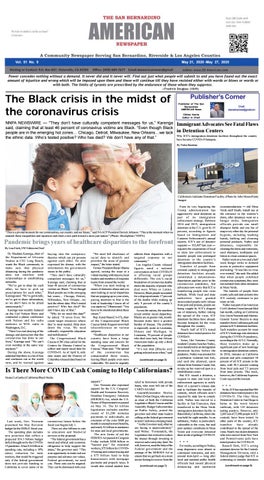
“This is a pivotal moment for our communities, our country and our future,” said NAACP President Derrick Johnson. “This is the moment when we unmask those inequalities and injustices and chart a new path toward a more just nation.” (Photo: iStockphoto / NNPA)
Pandemic brings years of healthcare disparities to the forefront By Lisa Fitch, OW Editor-in-Chief Dr. Maulana Karenga, chair of the Department of Africana Studies at CSU Long Beach, wants the Black community to make sure that physical distancing during the pandemic does not interfere with relationships or establishing networks. “We’ve got to shop for each other, we have to pick up prescriptions for each other,” Karenga said. “We’ve got to talk; we’ve got to share information, so we don’t have to be afraid unnecessarily.” Karenga was recently featured on the Carl Nelson Show and conducted a phone conference with Nelson and his radio audience at WOL radio in Washington, D.C. “There’s no real denying of the damage and destruction that this coronavirus has done to our lives,” Karenga said. “We can’t even worship in the same way anymore.” During the show, Karenga admitted that there is a lot of fear and confusion out in the world now, and he warned against
buying into the conspiracy theories which can pit persons against each other. He also expressed his dismay with the information the government issues to the public. “They don’t have culturally competent messages for us,” Karenga said, claiming that at least 46 percent of coronavirus victims are Black. “Even though Black people are in the emerging hot zones… Chicago, Detroit, Milwaukee, New Orleans…we lack the ethnic data. Who’s tested positive? Who has died? We don’t have any of that.” “Why do we need this data?” he asked. “It saves lives. We could target resources where they’re most needed. Help slow down the virus. We need culturally responsible education and mobilization.” The Congressional Black Caucus (CBC) has called for the Centers for Disease Control to collect and report racial data for COVID-19. As of April 8, only nine states and the District of Columbia released data based on race.
“We need full disclosure of racial data to identify and prioritize the areas of greatest impact,” the letter stated. Former President Barak Obama agreed, raising the issue at a virtual meeting with mayors, local leaders and members of response teams from around the world. “When you start looking at issues of domestic abuse and you start looking at racial disparities that are popping up in your cities, paying attention to that is the kind of leadership I know all of you aspire to,” Obama said. “You have to be intentional about these issues.” Rep. Karen Bass (CA-37), chair of the Congressional Black Caucus holds frequent town hall teleconferences on various subjects. “Healthcare disparities in our country have been a longstanding issue and concern for the Congressional Black Caucus,” Bass said. “The spread of the coronavirus has compounded these issues, leaving Black people even more vulnerable. We need to urgently
address these disparities with a targeted response to our community.” Los Angeles County released figures amid a national conversation on how COVID-19 is affecting racial groups differently. The city’s racial breakdown of coronavirus deaths shows the majority of people who died were White or Latino. However, Black people accounted for a disproportionate 17 percent of the deaths while making up only 9 percent of the county’s population. Across the nation, the numbers reveal similar racial disparities. Blacks are at greater risk, mostly because many have a greater burden of disease. The problem is especially acute in Louisiana, Illinois and Michigan. In Louisiana, 70 percent of people who died were lack, but African Americans make up only a third of the population “It’s not that [Blacks are] getting infected more often,” said (continued on page 3)
Is There More COVID Cash Coming to Help Californians? Quinci LeGardye | California Black Media
Last week, Gov. Newsom presented his May Revision budget for the 2020-21 fiscal year. The spending plan includes new priorities that reflect a projected $54.3 billion budget deficit brought on by the COVID19 pandemic. It has $14 billion in spending cuts, including a 10% salary reduction for state workers, that would be triggered only if the federal government does not provide funding to California to cover some of its
coronavirus losses before the fiscal year begins July 1. There are also billions in cuts to education and Medi-Cal services in the proposal. “The federal government has a moral and ethical and economic obligation to help support the states,” the governor said. “This is an opportunity to make real our purpose and advance our values. Federal government, we need you. These cuts can be negated. They can be dismissed with your
support.” Gov. Newsom also expressed support for the U.S. Congress’ Health and Economic Recovery Omnibus Emergency Solutions (HEROES) Act, which the U.S. House of Representatives passed on May 16. The $3 trillion legislation includes another round of $1,200 stimulus payments to individuals, an extension of the extra $600 per month in unemployment benefits, and nearly $1 trillion in assistance for state and local governments. The new forms of aid the HEROES Act passed in Congress Friday include $200 billion in “hazard pay” for essential workers, $75 billion for COVID19 testing and contact tracing and a $75 billion fund to help homeowners with mortgage payments and property taxes. It would also extend student loan
relief to borrowers with private loans, who were left out of the CARES Act relief. Assemblymember Shirley Weber (D-San Diego), who serves as chair of both the California Legislative Black Caucus and the Assembly Budget Subcommittee on Public Safety, joined the governor and other state leaders calling on the federal government to lend California a helping hand. "As the Governor said, what we are facing is unprecedented,” said Weber. “Fortunately, the Legislature has worked to reduce the impact through investing in reserves and a rainy-day fund. We will, however, need the help of the Federal government and the passage of the HEROES Act to ensure that we get back on a more secure footing to recover from the (continued on page 7)
From its very beginning the Trump administration has aggressively used detention as part of its immigration enforcement strategy. Between 2016 and 2019, immigration detention in the U.S. grew by 45 percent, according to figures based on Immigration and Customs Enforcement’s annual reports. ICE’s use of detainer requests — 165,487 last year — requires the cooperation of local or state law enforcement to transfer people into prolonged detention in the country’s immigration detention facilities. Transfers of people from criminal custody to immigration detention facilities already constituted a detention-todeportation pipeline prior to the coronavirus pandemic, but advocates now worry that ICE is transferring people into virus hotbeds. While local and state authorities have granted incarcerated people early release from jails and prisons, people are being caught by ICE’s dragnet use of detainers, further risking the spread of the virus. ICE detention facilities have already become hotspots for the virus throughout the country. Nearly half of ICE’s tested detainees have tested positive for COVID-19. Some, like Sonoma County resident Coraima Sanchez Nuñez, were transferred to an immigration detention facility before the pandemic. Nuñez was arrested for a probation violation last July, and said she planned, upon release from Sonoma County Jail, to take up her reserved spot in a rehabilitation center. But ICE issued a detainer, a request to state and local law enforcement agencies to notify them of a person’s release date and to facilitate the transfer of custody, which officials aren’t required by state law to comply with. Nuñez was moved to a facility in San Francisco, then transferred to the Mesa Verde immigration detention facility in Bakersfield, California, where she was held for eight months. As an asthmatic, Nuñez is particularly vulnerable to the virus, but said poor sanitary conditions in Mesa Verde put everyone detained there at risk of getting COVID-19. * * * For weeks, according to Nuñez, soap dispensers were absent in communal restrooms, and only around mid-April — long after local and national public health officials had issued physical distancing and sanitation
recommendations — did Mesa Verde staff finally install one at the entrance to the women’s dorm, after detainees went on a hunger strike. Immigration officials provide one small shampoo bottle and one bar of soap every other day for personal hygiene, including washing hands, bathing and cleaning personal products. Nuñez said detainees, responsible for cleaning the dorm and restrooms, used shampoo, toothpaste and lotion to clean common spaces. Nuñez went on a two and a half week hunger strike to demand access to protective equipment and testing. “It was like no virus ever existed,” she said. She added that when people exhibited coronavirus symptoms, they were not isolated from other detainees at Mesa Verde. The transfer of people from county jails and state prisons into ICE custody continues to put many at risk. Nuñez was part of an American Civil Liberties Union lawsuit filed last month, calling on California Gov. Gavin Newsom and Attorney General Xavier Becerra to stop transfers from California jails and prisons to ICE detention facilities. Such transfers account for most of ICE’s bookings into detention during the COVID-19 pandemic, according to the ACLU. Normally, these transfers make up a significant part of new bookings in immigration detention centers. In 2018, inmates at California prisons and jails comprised 38 percent of all ICE arrests in the state, with 30.5 percent coming from local jails and 7.5 percent from state prisons. This week, however, the California Supreme Court rejected the lawsuit. * * * So far, ICE has reported that 986 detainees have tested positive for COVID-19. The Otay Mesa Detention Center in San Diego is home to the worst known outbreak, with 149 detainees testing positive. However, only 2,045 out of 27,908 people in ICE custody have been tested. In other parts of the country, ICE transfers have already contributed to the spread of the virus. Nearly two dozen detainees who were moved from New York and Pennsylvania jails have tested positive for COVID-19. Russell Hott, ICE’s acting assistant director for the Custody Management Division, told a federal district judge that ICE is continuing to transfer detainees (continued on page 5)
Visit Us Online: www.SB-American.com
PAGE 2
May 21, 2020
COMMUNITY/EDUCATION/NATIONWIDE
The Strange ‘Kawasaki-Like Disease’ Attacking Children Community/Nationwide News
A new detailed analysis just released from the hub of Italy’s Covid-19 outbreak found 10 cases of a Kawasaki disease-like illness in children, adding to reports of about 90 similar cases from New York and England. Kawasaki disease is a rare condition that typically affects children younger than five years old. It causes blood vessels to become inflamed and swollen. Typical symptoms include fever and rash, red eyes, dry or cracked lips or mouth, redness on the palms of the hands and soles of the feet, and swollen glands. But it is a disease that is very similar to Kawasaki disease that has the medical community worried. Pediatric Multisystem Inflammatory Syndrome or PMIS is a new health condition that has started appearing in children during the pandemic and it shares similar symptoms to Kawasaki disease, marked by a persistent fever that lasts several days, inflammation and poor function in one or more organs. Kawasaki disease also presents suddenly, although it’s usually only seen in children under 5. PMIS is showing up in patients up to 21 years old,
although most of the New York cases have involved kids between the ages 5 and 14. While most children do fully recover, some children get sicker more rapidly, and this can lead to organ failure if left untreated. Three children in New York have died from this mysterious infection. New York Governor, Andrew Cuomo said that New York State and the Department of Health are at the “forefront” of investigating this nationally, and urged that “parents should be aware, and parents should be informed of this.” “It’s a wide array of symptoms, as you can see, which makes it even harder for parents to know exactly what they’re dealing with,” Cuomo said previously. “As a parent, I can tell you this is a parent’s worst nightmare, right?” he continued. “We thought that children were not specifically affected by the virus. To now find out they might be, and it might be several weeks later … this is truly disturbing.” Doctors in Italy have become the latest to raise the alarm over a worrying spike in children getting (continued in next 2 columns)
The Strange ‘Kawasaki-Like Disease’ Attacking Children...continued sick with a rare but serious inflammatory syndrome they say is tied to the coronavirus pandemic. A new study, published in the medical journal The Lancet on Wednesday, found a significant rise in the number of cases of the syndrome in the Bergamo province of Italy shortly after the coronavirus pandemic spread to the region. The researchers found that while only 19 children had been diagnosed with the condition in the area in the five years preceding the middle of February, there were 10 cases diagnosed since then, all between March 17 and April 14, which was after the coronavirus pandemic spread to the region. That spike represents a 30-fold increase in the disease’s incidence rate, according to the study. So what can parents do? Well, first, it’s important to note that it’s hard to diagnose. There’s
no specific test and doctors have torule out other diseases that can have the same symptoms. In fact, the Centers for Disease Control and Prevention (CDC) is now planning to release information to doctors nationwide to be on the lookout for it. Dr. Jennifer Ashton said parents should look for symptoms, including fever, rash, swollen hands and feet, and abdominal pain. “We have to emphasize this is still rare and uncommon,” said the ABC News chief medical correspondent. “Doctors are following it closely because it’s evolving.” Doctors say many of the children with the Kawasaki-like disease test negative for COVID19 but later test positive for the antibodies. Posted on May 15, 2020Dr. P. Gould, BDO Medical Contributor
Education Funding Essential to COVID-19 Economic Recovery and Safe Return to Schools Bold thinking, leadership and action needed to build California’s future; no educator layoffs and no mid-year cuts
the pandemic,and then throw everyone out on the streets when it’s over?”Here’s what else you need to know about Newsom’s housing and homelessness budget in a pandemic-induced recession.What was proposed before we talked about “bleach injections“Before phrases like “social distancing” and “mask hoarding” entered the day-to-day lexicon, Newsom stakedmuch of his political capitalon fixing thestate’s painfully visible homelessness woes. His January budget included a one-time infusion of $750 million in new state homelessness dollars, the most California had devoted to the issue in recent memory. It also proposed a new system of bypassing localgovernments to deliver those dollars directly to homeless services providers, along with hundreds of millions toreform the state’s low-income health insurance programto pay for things like housing and addiction services.Another item Newsom put forward: an additional $500 million in tax credits for low-income housing developers. In his February State of State address, Newsom even flirted with broader ambitions laid forth by his homelessness task force, including ongoing homelessness spending housing providers could rely on every year.What’s been tossedReforms that would have provided more funding to homeless utilizers of Medi-Cal health services —and tapped more federal dollars in the process —have been put on indefinite hold. Roughly $500 million approved in last year’s budget for things like mixedincome housing developments and new housing near transit was clawed back before it could be tapped by developers and cities scrambling to make projects “pencil out.” And the more ambitious plans, like the new system for delivering state homelessness dollars via “regional coordinators,” or imposing a state mandate to force local governments to make progress on their homeless populations (a plan Newsom never really embraced), have been ditched for now.What’s left, now that we’re broke The $750 million from the state for more general homelessness funding has been replaced by
quickly shift to a new way of educating our students while also caring for our own children. Educators across the state rolled up their sleeves and took the challenge head on for the sake of our students – not only teaching from their homes, but also making sure students are fed and helping to provide computers and other supports. It’s with that same fervor that we must collaborate as educators, lawmakers, parents, administrators, and community members to identify and commit to funding sources that will stop all cuts to education and make way for the resources necessary to make our schools and colleges fit for our students’ safe return. “The safety and well-being of students, teachers, and education support professionals cannot be compromised and must be addressed prior to reopening schools. This includes deep cleaning and sanitizing of school campuses and busses, having the proper personal protective equipment (PPE), social and physical distancing in classrooms and workspaces, nurses who receive training and guidance to help mitigate the spread of the
coronavirus, and counselors to help students deal with the trauma and uncertainty. “We strongly appreciate the governor’s commitment to supporting public education in the current budget by allocating $4.4 billion in federal funding to support schools and colleges and address any learning loss for students. But the proposed education cuts for the 2020-21 budget will be devastating at a time when students need more support. Schools must have the resources they need to safely reopen schools and colleges in a manner that will protect students, teachers, and employees. More than $10 billion in proposed cuts will lead to cuts to vital student programs, educator layoffs, furlough days and pay cuts just like it did during the last recession when we lost 33,000 educators. Our students, our schools, our colleges, and our families cannot afford to go back. “There is no denying that the state and country are facing a recession, and that for years California students and educators, schools and colleges (continued on page5)
Educational News
SACRAMENTO — California Teachers Association President E. Toby Boyd issued the following statement Thursday as Gov. Gavin Newsom released the state budget’s May Revision: “Deep cuts to education will stand in the way of readying our schools for the safe return of students and further prolong the economic recovery from the
COVID-19 pandemic. Governor Newsom’s leadership and commitment to safety in our public schools and colleges has been clear and much appreciated since the coronavirus surfaced in our communities 10 weeks ago. “As educators, we are woefully familiar with the disruption and wrath of the quarantine having to (continued in next 2 columns)
Housing, homelessness funds mostly spared in proposed budget cuts By Matt Levin, CalMatters With a forecasted deficit of nearrecord proportions and an economy in freefall, homelessness and low-income housing advocates were braced for painful cuts in the revised budget proposal Gov. Gavin NewsomunveiledThursday.But unlike some of the more severe pandemic-induced rollbacks Newsom outlined in areas like education and climate change, affordable housing and homelessness dollars were mostly spared from the administration’s fiscal cleaver.Given an assist from the federal government’s March stimulus package, Newsom is proposing $750 million to buy hotels and motels currently used foremergency homeless housing, hoping to turnthe properties into more permanent solutions. Another $500 million in tax credits for building low-income housing was preserved from Newsom’s pre-pandemic budget plans —a major win for affordable housing developers as they try to fill the state’s shortage of 1.3 million low-income homes.“We are very encouraged to see the governor continue to prioritize housing and homelessness resources,” said Chris Martin, legislative advocate for the nonprofit advocacy group Housing California.But while Newsom’s housing and homelessness budget was rosier than some had expected, the proposals still leave unanswered difficult questions that state lawmakers and the governor will have to settle before their June 15 constitutional deadline to pass a balanced budget:?How many hotels and motels can be realistically transformed to permanent housing, and where will funding for services come from??What will the state do about the mounting levels of missed rent payments piling up for renters and landlords??What happens when federal emergency dollars dry up?“A lot more needs to be done,” said Assemblyman Miguel Santiago, Democrat from Los Angeles, who has proposed legislation, backed by big-city mayors, to spend$2 billion annuallyfor shelters, permanent housing and homeless services.“At the end of the day, does it make sense to move at a breakneck speed to house thousands of people during the emergency phase of
Education Funding Essential to COVID-19 Economic Recovery and Safe Return to Schools ...continued
$750 million from the federal government for a specific purpose: buying some of the 15,000 hotel roomsthe state has procuredto provide emergency pandemic housing for the unhoused. Right now more than 7,000 of those rooms have been occupied, although the state does not track how many of those occupants are there for temporary quarantines as opposed to longer stays. The clock is ticking on the hotel purchases: The state has to make them by the end of the year or it loses the federal money.With the federal funding restricted to acquiring and converting hotels to more permanent housing, Newsom is hoping counties and cities can fund homeless services like social workers and counselors with more than a billion in other federal pandemic supports, some homelessness specific and others for general coronavirus response. So far finding available hotels and motels for temporary homeless housing has proved less of a hurdle than staffing the hotels with appropriate health and safety net workers.Finally, Newsom is keeping the $500 million in tax credits for lowincome housing he proposed in January. Perhaps even more auspicious for low-income housing advocates, the vast majority of housing programs aren’t subject to $15 billion in “trigger cuts” Newsom warned would happen if more federal funding for states and local governments did not materialize.What was conspicuously absentNewsom’s pandemic-revised budget contains no new plan to help California renters and landlords beset by missed rent payments, a “looming crisis” for the state’s cash-strapped tenants. While the governor wants to push a $330 million windfall from a Great Recession-era lawsuit settlement to mortgage relief and legal aid clinics, that money is prohibited from being spent on rental assistance. Newsom administration officials have touted the rent relief package in House Speaker Nancy Pelosi’s most recent stimulus proposal, which would require signoff by both Senate Republicans and President Donald Trump.What
happens nextWhile Newsom’s housing and homelessness budget wasn’t as brutal as some were expecting, Democratic lawmakers and advocacy groups will still be fighting tooth and nail for additional funding they believe is necessary to ensure the governor delivers on prepandemic rhetoric. At the top of the homelessness debate will be requests for billions in ongoing funds — money local governments and service providers can bank on every year to build shelters, operate converted motel rooms, and build permanent housing. Santiago’s proposal for $2 billion a year in new state homelessness funding does not identify a new revenue source (read: tax increase), meaning lawmakers would have to find $2 billion in cuts elsewhere. Another proposal from Sen. Jim Beall, Democrat from San Jose,similarly proposes roughly $2 billionper year for the next four years for homelessness and low-income housing development without specifying a new source of dollars.Assemblyman David Chiu, Democrat from San Francisco,hopes his planto eliminate the mortgage interest deduction on vacation homes to raise hundreds of millions in homelessness dollars will finally get through. His proposal has failed in past years.“In this crisis we should be addressing the suffering on our streets rather than the tax breaks of the wealthy few who have vacation homes,” said Chiu.Beyond the tug-of-war on homelessness dollars, lawmakers and Newsom will have to decide whether the state can afford a major rent forgiveness program, and if so how it should be structured.State Senate Democratic leadersunveiled a planthey estimate would cost $300 million to $500 million per year that would allow renters to pay back missed rents over the course of decade, while compensating landlords with transferable tax credits. A separate landlord supported proposal would create a state program that would pay for 80% of missed rent payments.CalMatters.orgis a nonprofit, nonpartisan media venture explaining California policies and politics
10 Black Scholarship Programs Still Open in 2020 Community Education News Nationwide -- Every year, there are many programs that give away scholarships to thousands of African American and other minority students. In 2020, though, many of these programs have been cancelled and/or postponed because of the worldwide Coronavirus pandemic. However, we were able to find at least 10 Black scholarship programs that are still open. Here they are: #1 - Jack and Jill of America Foundation Need-Based Scholarships: Offered to high school seniors who will attend and maintain a full-time status at an accredited, four-year postsecondary institution, starting in the fall of the year and working toward a bachelor's degree. Learn more at https:// www.blackscholarships.org/ 2018/10/jack-and-jill-of-americafoundation-providing-needbased-scholarships.html #2 - Walmart Foundation First Generation Scholarship For HBCU Students: Offered through Walmart's foundation, the program specifically helps students who are enrolled at any HBCU or PBI (Primarily Black Institution) across the country. Learn more at https:// www.blackscholarships.org/ 2019/04/walmart-foundation-firstgeneration-scholarship-hbcustudents.html #3 - Jay-Z's Shawn Carter Scholarship Fund: Founded by Jay-Z and his philanthropist mother, Gloria, this program helps low income students advance their education by giving them the resources they need to enroll in college, pay the tuition, and successfully finish college on time. Learn more at https:// www.blackscholarships.org/ 2019/04/jay-z-shawn-carterscholarship-fund.html #4 - Jesse Jackson's PUSH Excel Scholarship Program: This program encourages servant leadership potential in scholars, and pushes students to develop a passion for social justice and social change. Learn more at https:// www.blackscholarships.org/ 2018/10/jessie-jackson-pushexcel-scholarship-program-threeawards.html #5 - McDonald's Black and Positively Golden Scholarships: This partnership between McDonald's and the Thurgood Marshall Fund gives scholarship awards to deserving students that are attending HBCUs and PBIs across the United States. Learn more at https:// www.blackscholarships.org/ 2019/03/tmcf-mcdonalds-blackpositively-golden-scholarshipprogram.html
#6 - Apple's HBCU Scholarship Program: Program for exceptional students currently attending an HBCU with a minimum GPA of 3.0. Applicants must be working towards earning a Bachelor's degree, Master's degree, or a Ph.D. Learn more at https:// www.blackscholarships.org/ 2018/09/apple-40-million-hbcuscholarship-program-summerinternship.html #7 - Coca-Cola Scholars Program Scholarship: A program for graduating high school seniors who can demonstrate their ability to lead and serve their communities. Students are also expected to be able to demonstrate a level of commitment to making a significant impact at their school and society in general. Learn more at https:// www.blackscholarships.org/ 2018/10/20k-scholarships-fromcoca-cola-programfoundation.html #8 - Gucci Changemakers Diversity and Inclusion Scholarship Program: A global program that promotes unity, diversity and inclusion through it's Gucci Changemakers program. The program offers more than $1 million in scholarships that will be allocated to financing the education of at least 70 fashion students. Learn more at https:// www.blackscholarships.org/ 2019/04/gucci-changemakersdiversity-inclusionscholarship.html #9 - Foot Locker/ United Negro College Fund Scholarship Program: A partnership between the Foot Locker Foundation, Inc. and the United Negro College Fund (UNCF) to fund a scholarship program for students attending a UNCF member college or university during the fall of the current year. Learn more at https:// www.blackscholarships.org/ 2020/05/foot-locker-unitednegro-college-fund-scholarshipprogram.html #10 - Davis Scholarship For Women in STEM (Science, Technology, Engineering and Math): Willma H. Davis has partnered with the United Negro College Fund (UNCF) to establish a scholarship to encourage minority female students to pursue a future career in the STEM fields. Candidates must be classified as sophomore, junior, or senior in the Fall and attend a UNCF-member institution. Learn more at https:// www.blackscholarships.org/ 2020/05/willma-h-davisscholarship-for-women-instem.html For more 2020-2021 scholarships, visit BlackScholarships.org
Visit Us Online: www.SB-American.com
PAGE 3
May 21, 2020
COMMUNITY/ GOVERNMENT/BUSINESS/ADVERTISING
U.S. Bank Offers Financial Support and Demonstrates Commitment to Diversity, Equity and Inclusion Amid COVID-19 Pandemic NNPA NEWSWIRE — As the global coronavirus pandemic upends all aspects of our lives, U.S. Bank is uniting with other corporations and longstanding partner organizations that are representing members of underserved and minority communities to advocate for inclusion among PanAsians and other cultural segments. By Julianne Malveaux
U.S. Bank anticipate 90 percent of this full $30 million commitment will be invested in organizations serving people of color and low-tomoderate income communities. (Photo: iStockphoto / NNPA) MINNEAPOLIS, MN – As we weather the COVID-19 pandemic together, U.S. Bank is here to help. We have developed a single site full of online resources where customers can go to find helpful information regarding their financial needs. Through this online resource and other partnerships, U.S. Bank aims to provide simple, clear information to help individuals and small businesses get through the pandemic and tangible financial assistance to support our communities. “Our entire team has rallied around each other, our customers and our communities, and it is a tremendous honor to work with them as we fight this pandemic,” said U.S. Bancorp Chairman, President and CEO Andy Cecere in a statement on the company’s website. “We stand together, and we are focused on keeping people healthy and safe – personally, professionally and financially.” Here to help with your financial needs At usbank.com/covid-19, customers will find helpful links to manage their finances, as well as information about the financial programs created under the Coronavirus Aid, Relief and Economic Security (CARES) Act to help individuals and small businesses – including Economic Impact Payments (EIPs), mortgage assistance, new rules for IRAs and retirement accounts, and the SBA Paycheck Protection Program (PPP). Commitment to diversity, equity and inclusion As the global coronavirus pandemic upends all aspects of
our lives, U.S. Bank is uniting with other corporations and longstanding partner organizations that are representing members of underserved and minority communities to advocate for inclusion among Pan-Asians and other cultural segments. U.S. Bank joined Ascend, Catalyst, Executive Leadership Council (ELC), Hispanic Association on Corporate Responsibility (HACR), National Organization on Disability (NOD) and Out & Equal as a Supporting Company on a COVID-19 response Action Agenda. These organizations are leading champions, connectors and conveners for business leaders and professionals who are PanAsians, African American, Hispanic, women, LGBTQ and persons with disabilities. These organizations are committed to redoubling on their mission to promote inclusion in these unprecedented times by addressing the adverse impacts of the COVID-19 outbreak. Many of the low wage earners in our communities are particularly impacted during this public health and economic crisis, while health officials indicate the pandemic has claimed disproportionate numbers of Black and Hispanic lives. “We’re proud to stand with our peers and these leading organizations to help maintain a sense of community and support at a time when we need to stay physically apart,” said Greg Cunningham, U.S. Bank Chief Diversity Officer. U.S. Bank commits nearly $60 million to employees and communities for COVID-19 relief and recovery efforts U.S. Bank committed nearly $60
million to employees and communities for COVID-19 relief and recovery efforts. It started with a new Pay Premium Program for front-line employees and a $30 million investment in communities. U.S. Bank transforms and expedites community investments in response to immediate COVID-19 needs U.S. Bank has expedited its annual $1 million Market Impact Fund grant program in April to provide funding for 30 local nonprofits that are working to respond to the most pressing needs in their communities. From Los Angeles to Chicago, the grants are being used by nonprofits to support small businesses, maintain safe housing and ensure accessibility to critical human services by the communities’ most economically vulnerable populations. The company is deploying these funds three months earlier than originally scheduled to ensure immediate relief. “We know how many nonprofits are struggling and we wanted to make sure that our partners know that we trust them to use our grant dollars in whatever way is needed to sustain the life-changing work they do in our communities every day,” said U.S. Bank Chief Social Responsibility Officer Reba Dominski. The move is part of a broader shift in how U.S. Bank is approaching community giving this year in response to the COVID-19 pandemic. Last month, the company announced a $30 million philanthropic commitment focused on short-term relief and long-term recovery and was intentionally focused on communities of color and low-tomoderate income communities. U.S. Bank donated $4 million to three national nonprofits – United Way, LISC and Operation HOPE – and announced that its remaining $25 million in grants planned for this year could be used by nonprofits for general operating expenses rather than for specific programming. We anticipate 90 percent of this full $30 million commitment will be invested in organizations serving people of color and low-tomoderate income communities. U.S. Bancorp Community Development Corporation
Finances $50 Million in Capital to Community Development Financial Institutions (CDFIs) to help small businesses impacted by COVID-19 U.S. Bancorp Community Development Corporation (USBCDC), the tax credit and community investment subsidiary of U.S. Bank, facilitated $50 million in capital to seven community development financial institution (CDFI) customers, helping them provide loans through the Small Business Administration (SBA) Paycheck Protection Program. Each of the CDFIs are receiving $5-$10 million in low interest rate loans to support their ability to fund small businesses impacted by the COVID-19 pandemic. CDFIs play a critical role in bringing investment and resources to underserved communities, and those who may not be eligible for traditional small business financing, with a focus on women and minority-owned businesses and low-to-moderate income communities. U.S. Bank has been a long-time partner working with CDFIs to provide funding to entrepreneurs in underserved communities. By the end of 2019, U.S. Bank helped ensure that more than $400 million in capital was available for CDFIs and their customers. About U.S. Bank U.S. Bancorp, with more than 70,000 employees and $543 billion in assets as of March 31, 2020, is the parent company of U.S. Bank National Association, the fifthlargest commercial bank in the United States. The Minneapolisbased bank blends its relationship teams, branches and ATM network with mobile and online tools that allow customers to bank how, when and where they prefer. U.S. Bank is committed to serving its millions of retail, business, wealth management, payment, commercial and corporate, and investment services customers across the country and around the world as a trusted financial partner, a commitment recognized by the Ethisphere Institute naming the bank one of the 2020 World’s Most Ethical Companies. Visit U.S. Bank at usbank.com or follow on social media to stay up to date with company news.
The Black crisis in the midst of the coronavirus crisis...continued from page 1 Dr. Anthony Fauci during a recent With House briefing. “It’s that when they do get infected with their underlying medical conditions — diabetes, hypertension, obesity, asthma – those are the kind of things that wind them up in the ICU and ultimately death.” Fauci says the pandemic is shining a bright light on the healthcare disparities which have always existed in the country and added that efforts to limit these disparities should resume after this global crisis. “Many of the social structures in our country have long placed African Americans in disadvantageous positions,” said Dr. Marjorie Innocent, senior director of NAACP Health Programs in a recent teleconference. “At the same time, African Americans are more likely not to have regular sources of healthcare and tend to rely far too much on emergency center care.” NAACP Director of Environmental and climate justice, Jacqui Patters, noted that the most vulnerable and most marginalized populations often end up falling through the cracks during an emergency. NAACP President Derrick Johnson agreed, adding that the government’s response to the Black community reminded him of the Katrina crisis. “People were left stranded on rooftops,” he said during the teleconference. “Are we going to leave a significant portion of the
population stranded?” Johnson later sent an email reiterating the “deep-seated racial inequities embedded in everything from healthcare to the economy are compounding the effects of the coronavirus pandemic for Black, Brown, Asian and indigenous communities.” “This is a pivotal moment for our communities, our country and our future,” Johnson continued. “This is the moment when we unmask those inequalities and injustices and chart a new path toward a more just nation.” California Gov. Gavin Newsom said he was wary of publicizing incomplete information, as not every health facility was completing demographic information. Last week, County Supervisor Herb Wesson penned a letter to fellow board members and Dr. Barbara Ferrer, the director of the county’s Department of Public Health. “The COVID-19 pandemic is presenting many compelling challenges. An important challenge is transparency in the reporting of data on how this pandemic is impacting communities and ethnic groups in Los Angeles County. “It is vital that while our emergency public health mobilization gathers momentum that we have the needed data that is key to understanding the impact and the response that is aimed at addressing the crisis. “This data is critical to the
effective deployment of needed resources and the shaping of public education and communications, particularly in communities of color. It is also vital for the purpose of accountability. “More specifically, I am requesting data including, but not limited to, a break-down by ethnic groups related to rates of death, the number of tests, the results of those tests, the number of those in quarantine and the data on individuals who have tested positive and have recovered. I am also requesting that this information be included with the Public Health Department’s regular updates.” The message was received, as during one of the recent briefings, Ferrer noted that the ethnic data was often no filled in on the forms that the county collected for daily statistics during the crisis, but that the department would do its best to get the requested data. Data from April 9, there were 7,574 laboratory confirmed cases of COVID-19 and 384 of them were Black. There were 212 deaths and 23 of them were African American. “Early data on deaths show that no group is immune from COVID19,” said Mayor Eric Garcetti in his recent news briefings. “We need every community to understand this can affect you. No matter what community you live in or come from, this can affect you.” “Long-term racial disparities still exist,” Garcetti said. “The effect it has on communities can be
disproportionate.” Garcetti also mentioned that it is important to be conservative when it comes to judging the peak of the crisis. Lawmakers don’t want to cause a second virus surge by lifting the social distancing order too soon. The mayor has ordered all residents to don non-medical masks when out in public. These can be scarves or purchased coverings for the nose and mouth. “Keep your masks very secure and sterile,” Garcetti said. “Wash them at night. Don’t lay them down anywhere, they can pick up germs.” Karenga, who spoke at the 1995 Million Man March, reminded his radio listeners that he wrote the mission statement for the march, which included the reaffirmation of and strengthening of the Black family, based on principals of shared responsibility. That strength will help conquer “the awesome task before us,” he said. “We are the people who survived the holocaust of slavery,” Karenga noted. “We have no business thinking we cannot handle this.” Karenga referred to Kwanzaa and pointed to the fourth principle of the holiday, Ujamaa, cooperative economics. “That’s central to this,” said Karenga, who stressed the need to find a common ground in our blackness. “We need a collective approach where everybody benefits.”
Justice Department Must Investigate Ahmaud Arbery’s Murder Government News WASHINGTON – The Leadership Conference on Civil and Human Rights, American Civil Liberties Union, Human Rights Campaign, Muslim Advocates, NAACP, and NAACP Legal Defense and Educational Fund, along with 110 additional organizations committed to racial justice and civil rights, called on the U.S. Department of Justice to open a full and thorough hate crimes investigation into the murder of Ahmaud Arbery. The groups also called on the DOJ to conduct a federal civil rights pattern or practice investigation into the local district attorneys, as well as the Glynn County Police Department, for systemic constitutional abuses. “The DOJ, including the FBI and the Civil Rights Division, must conduct a full investigation into Mr. Arbery’s killing under federal hate crimes and conspiracy statutes. The publicly available facts, including the harrowing video documenting the intentional killing of an African-American man in broad daylight by two White men who stalked him, support opening an investigation under federal hate crimes statutes, including the Matthew Shepard and James Byrd, Jr. Hate Crimes Prevention Act, as well as federal conspiracy statutes,” the groups wrote in their letter to Attorney General Barr.
“There are sufficient grounds to open a federal civil rights pattern or practice investigation of the local prosecutors and the police department,” the groups wrote. “At a time when we are seeing a spike in hate crimes, the role of the Civil Rights Division in working with the FBI to investigate and prosecute hate crimes cases and ensure constitutional enforcement of the law by state and local law enforcement agencies is more important than ever. The DOJ has publicly acknowledged the real and growing threat of white supremacy and white nationalism in the United States. The murder of Ahmaud Arbery and actions of the local district attorneys and police department warrant the DOJ’s action. This terrifying violence is not new; it is part of the continuing dehumanization of Black people across America. We cannot fight the racism, hate, and impunity that threaten the lives of Black people and other people of color unless the department takes the necessary actions to ensure full and real accountability,” concludes the letter. The full letter is available herehttps://civilrights.org/ resource/doj-must-open-a-fulland-thorough-civil-rightsinvestigation-into-the-horrifickilling-of-ahmaud-arbery/
Fake Letter Targets Customers Receiving Benefits Riverside County News RIVERSIDE COUNTY, Ca.— State and county public social services officials are warning about a fake letter circulating on social media that falsely claims customers must be tested for COVID-19 to continue receiving benefits such as cash aid, CalFresh and Medi-Cal. The letter bearing the seal of the California Department of Social Services (CDSS) also falsely claims that children will be removed from parents who test positive for COVID-19 and placed into foster care. Riverside County, state and county health services departments will never ask about health status in connection to an application for benefits. Children will not be removed from parents who happen to test positive for the coronavirus or COVID-19. “At a time when thousands of Riverside County residents are reaching out for help from our public benefits system, for someone to prey on their fears and
uncertainties is outrageous,” said Allison Gonzalez, assistant director of DPSS’ Self Sufficiency Division. “We hope this fake letter doesn’t frighten those in need of support away from the critical programs and services DPSS offers.” CDSS has alerted the appropriate authorities to investigate. Anyone with helpful information about the source of the letter is asked to contact CDSS at (916) 651-8848 or piar@dss.ca.gov. Residents of Riverside County are urged to disregard the scam letter and not to share it on social media. Riverside County residents who need to apply for benefits such as cash, food and medical assistance are encouraged to do so online at C4Yourself.com or by calling the Department of Public Social Services (DPSS) Customer Service Center at 877-410-8827.
Fannie Mae Helps Multifamily Renters Impacted by COVID-19 With 'Renters Resource Finder' New Resource is Part of Broader Effort to Help People Remain in Their Homes County Government News WASHINGTON, May 7, 2020 / PRNewswire/ -- Fannie Mae (OTCQB: FNMA) announced it has introduced a Renters Resource Finder to help renters facing financial hardship due to COVID-19 understand the options available to them. The Renters Resource Finder is an online tool that identifies apartments and other multifamily properties financed by Fannie Mae, whose residents are eligible for eviction protection under the federal CARES Act along with other resources. "In times of uncertainty, it is essential to have trusted resources to help inform our decisions, and Fannie Mae is here to help bridge that information gap. Renters and homeowners
should not have to navigate a barrage of confusing and sometimes misleading information," said Jeffery Hayward, Executive Vice President, Fannie Mae Multifamily. "Our Renters Resource Finder, part of our ongoing Here to Help education effort, will empower people in apartments to better understand their options." Under the CARES Act, residents of multifamily rental properties (those with five or more units) with a Fannie Mae-backed mortgage are covered by a temporary eviction moratorium. With the Renters Resource Finder, residents can find out if (continued on page 7)
The San Bernardino AMERICAN News Staff Samuel Martin Sr.-Founder Clifton Harris/Editor in Chief/Investigative Reporter Mary Martin-Harris/Editor Clifton B. Harris/Audio Engineering Editor Legal /Display Advertising & Sales (909) 889-7677 The San Bernardino American News was established May 8,1969. A legally adjudicated newspaper of general circulation on September 30, 1971, case number 153913 by the Superior Court, of San Bernardino County. The San Bernardino AMERICAN News, a division of Don Roberto Group, Inc. is published every Thursday by Mary Martin-Harris and Clifton Harris P.O. Box 837 Victorville, CA 92393, Telephone (909)889-7677, Emails: msbamericannews@gmail.com sbamericannews@gmail.com The San Bernardino AMERICAN News subscription rate is $58.00 per year. The San Bernardino AMERICAN New is committed to serving its readers by presenting news, unbiased and objective, trusting in the mature judgment of the readers and, in so doing strive to achieve a united community. News releases appearing in the San Bernardino AMERICAN News do not necessarily express the policy nor the opinion of the publishers. The San Bernardino AMERICAN News reserves the right to edit or rewrite all news releases.
Visit Us Online: www.SB-American.com
PAGE 4
May 21, 2020
HEALTH/FITNESS/SENIOR NEWS
COVID-19 — My Personal Battle from a Positive to a Negative Result NNPA NEWSWIRE — On that Friday, March 27th, things took a drastic turn for the worse, as it relates to my health. I began to cough, and what I thought would be regular phlegm coming out, turned out to be a significant amount of bright red blood. As this continued to happen, I made the decision to call the Chief Medical Officer for United Memorial Medical Center (UMMC), Dr. Joseph Varon and share my update. After hearing my status, Dr. Varon implored me to come to the UMMC Emergency Room (ER) immediately, which I prepared to do. Before I got off the phone with him, however, he hit me with the update I was anxious to finally receive, but with some news I was definitely hoping and praying not to hear. Dr. Varon informed me that I had tested “POSITIVE” for the Coronavirus.
I am forever grateful to God and to everyone who uttered a prayer, shared an encouraging word, providing any resources or sent positive energy my way. (Photo: Facebook)
Jeffrey L. Boney with his doctor, Dr. Joseph Varon and his nurse, Jerusha Brown Harshman
Jeffrey L. Boney Shares His Personal Journey of Surviving the Coronavirus and Dealing with the Emotional and Mental Anguish Required to Overcome COVID-19 By Jeffrey L. Boney, NNPA Newswire Contributor “Jeffrey, unfortunately, your test came back positive for the Coronavirus.” Hearing those words from the doctor, March 27th, shook me to the core. Was that a death sentence for me? Was it a coincidence that my mom years earlier had died in the same month of March? Was this really how my life was going to end? The news reports I had been watching and reading reported dire results relative to those who had contracted the virus. Death tolls were rising. Governors began searching for beds and ventilators for people who were being impacted by this virus. Honestly, I felt like the odds were stacked against me. The journey for me started with a very slight cough. On March 17th, I started experiencing internal digestive symptoms that I initially assumed was a result of me not eating anything that day. It was a Tuesday, which meant it was Press Day at the Houston Forward Times, where I serve as the Associate Editor. Now, it wasn’t uncommon for me to skip breakfast and skip lunch in order to remain laser focused on getting the newspaper done. However, when I started feeling faint, I decided to get something to eat. I made my way down to the Reggae Hut around 5:30 pm and ordered the oxtails, rice and peas and the vegetables, along with a beef patty and a Kola Champagne to drink. I made my way back down to my office with my plate and I ate a little bit of the rice and peas; a little of the vegetables; and barely ate one of the oxtails, before closing the container and putting the plate in the refrigerator. That was the last time I saw that plate or my office. The next day, I not only had a continuous loss of appetite, I also had stomach pain and was experiencing heavy and unusual bouts of diarrhea. I even had an episode where I went to the bathroom and while on the way, I passed out and was disoriented. I woke up lying on the floor in a sweat, trying to figure out what happened to me. I drank lots of water, tried natural remedies and ceased all of my normal activities. None of that worked or changed my situation. I self-quarantined and selfisolated for eight days – from Tuesday, March 17th to Wednesday, March 25th. During that time, I contacted my primary care physician, who informed me that continuing to self-quarantine was probably the best option at the time, considering the symptoms I was experiencing. I decided to reach out to my
good friend, State Representative Ron Reynolds to express my concerns about my health status, as well as get his advice on whether he thought I should go through one of the drive-thru testing sites that had recently opened. I desperately wanted to get tested, primarily for my peace of mind, but also because I was concerned for my family. They were still living in the same house as me. I saw the news. I read the media reports online and on social media. It was clear, based on those reports, that I was not displaying the type of respiratory symptoms that the majority of COVID-19 patients were reported to have been experiencing, such as shortness of breath or having a heavy cough. There were also reports that the only way a person could be tested was if they were elderly or a first responder. I was deeply concerned. A few days after my call with Rep. Reynolds, I received a call on my cell phone from U.S. Congresswoman Sheila Jackson Lee on Wednesday, March 25th. She had heard I was experiencing a health challenge and asked me some questions. Congresswoman Jackson Lee then immediately informed me that she wanted me to come down to United Memorial Medical Center (UMMC) on Tidwell to get tested right away. I wasted no time. I asked the Congresswoman for the address and immediately got dressed to make my way to UMMC. As I was driving to the hospital, Congresswoman Jackson Lee told me that she had already spoken to the Chief Medical Officer for United Memorial Medical Center (UMMC), Dr. Joseph Varon, and that he was prepared to receive me and administer the test. I was so relieved that I would be able to get tested and get a definitive on whether I had contracted the COVID-19 virus or not. I arrived to UMMC and was met by Dr. Varon. He walked with me inside to the place where I was to be tested, and he immediately tried to put me at ease. I was told by Dr. Varon that my test results would take anywhere from 24-48 hours to come back, so I waited patiently and eagerly. As anxious as I was to find out the results on the following day, I decided to give it another day. On that Friday, March 27th, things took a drastic turn for the worse, as it relates to my health. I began to cough, and what I thought would be regular phlegm coming out, turned out to be a significant amount of bright red blood. As this continued to happen, I made the decision to
call Dr. Varon and share my update. After hearing my status, Dr. Varon implored me to come to the UMMC Emergency Room (ER) immediately, which I prepared to do. Before I got off the phone with him, however, he hit me with the update I was anxious to finally receive, but with some news I was definitely hoping and praying not to hear. Dr. Varon informed me that I had tested “POSITIVE” for the Coronavirus. I was shook. My family was stunned. I am a married father of three. My family is everything. Upon my arrival, there were two large signs that said STOP. My wife, who had followed me to the hospital, was not allowed inside. I was met by medical staff and they ushered me into a room in the ER. She stood outside awaiting word. The nursing staff immediately went to work, initially drawing blood and then taking some vitals at the order of Dr. Varon. As events would unfold, Dr. Varon would turn out to be one of the primary angels of medicine that made the difference relative to my Coronavirus recovery efforts. One of the first things Dr. Varon ordered his medical staff to do with me upon my arrival to the ER was to do a CT Scan. For those who may not know, a CT Scan is more detailed than a regular Xray, and allows doctors to see inside your body by using a combination of X-rays and a computer to create images of your organs and other things inside your body. Of course, I didn’t know why a CT Scan was being performed on me at the time, nor did I know what the end result would be. Let me just say that performing that CT Scan on me was the best thing that could have ever happened to me, because it revealed something major that was going on inside my body that couldn’t be seen by looking at me from the outside. The CT Scan revealed that my lungs showed a severe case of pneumonia, as well as other issues involving my vital organs that came as a result of the Coronavirus. It was decided at that moment that I needed to be admitted to the Intensive Care Unit (ICU) right away. It was then that I realized how serious things were, and it was the moment that I knew that I was going to have to rely on my faith in God. I called my wife to tell her I was being admitted and informed her that I was not going to be able to have any visitation throughout my time in the ICU. I was on a mental and emotional roller coaster at this point. I didn’t know
how long I would be in ICU, but more importantly, whether I would make it out alive. I could not help but think about the time in 2003 when my wife and I took my mom to the ER because she was ill. It was a life-altering experience for me. After being seen by doctors in the ER, the medical staff informed us that my mom would need to be admitted to address her serious health condition, which turned out to be worse than believed. My wife and I decided to stay with her, but my mom kept telling us to go home, get some rest and come back the next morning. We stayed anyway. They moved her in the wee hours of the morning to a different floor. It was then that I told her that I was not be going very far, as I chose to sleep at my mother-in-law’s house because it was closer to the hospital than my house was. As reluctant as I felt leaving my mom at that hospital, nothing compares to the phone call I received from the hospital, no more than five minutes after I laid my head down on the pillow. The nurse on duty called to inform me that my mom had stopped breathing and had slipped into a coma. I mean, right after I left. They told me that there was a shift change and that my mom had been given a specific medication, and by the time the new nurse on duty went to check on my mom, they became aware of the situation. I was devastated. I felt guilty. I felt as if I was there, I could’ve possibly done something. Several months later, my mother passed away and I never forgot that moment. As I was being prepared to go to ICU myself, I was reminded of my mom’s experience, and I was instantly bombarded with memories and emotions about what she endured. I also struggled with the mental anguish of worrying about a virus that reportedly has no cure or vaccine to fight it. I knew I needed to draw on something greater than myself to get through this ordeal. On Friday, March 27th, the journey towards fighting the Coronavirus had truly just begun. Not only did I have a severe case of pneumonia when I entered ICU, my liver and kidneys also needed to be protected from the virus; my heart rate was through the roof; my heart condition worsened and I was headed to the point of potential heart failure; my blood pressure was high; I had a sharp pain in my right side; I continued to have heavy diarrhea episodes; and I still had a loss of appetite. Things were not looking good for me and I felt horrible. I began to wonder if I was ever
going to get better. From the very beginning, I had to rely on my faith in God, as I continued to deal with the mental anguish of being in this Coronavirus-specific ICU area, particularly knowing that there were people around with breathing issues and hearing machines go off all day and night, and as I regularly looked at the news and read reports showing the number of people dying on a daily basis as a result of the virus. I needed a miracle. Because I didn’t have any respiratory issues, just digestive issues, it caused the doctors to develop a treatment plan for me that was different than other patients they had been treating prior to my arrival to the hospital. Dr. Varon and Dr. Joseph Gathe, Jr. oversaw my care. They created a whole Coronavirus cocktail, which included heavy doses of Vitamin C, which was specific to my treatment. Per Dr. Varon, my case taught them that they must use high dose blood thinners on every Coronavirus patient admitted to the hospital. After several days, my symptoms began to subside, and my appetite came back in a major way. I longed for my breakfast, lunch and dinner, and couldn’t wait to eat it. Dr. Varon eventually informed me that all of my vital organs had returned to normal and that my blood work and vital signs were solid. Finally, I felt like I was turning a corner and getting better. That was until a second CT Scan was performed, which revealed more shocking and devastating news regarding my health condition. When the results of my second CT Scan came back, it revealed that I had been diagnosed with a pulmonary embolism in my right lung. A pulmonary embolism occurs when blood clots block the flow of blood to the lungs. A pulmonary embolism can be fatal and life-threatening, which is why Dr. Varon and his team promptly took the necessary steps to address the blood clot and reduce my risk of death. I was immediately placed on blood thinner medication. I continued to follow the instructions of the doctors until I received that wonderful news that on Sunday, April 5th, I had made significant and miraculous improvement, and subsequently was being discharged to go home to my family. I was so thrilled, yet still deeply concerned because I still didn’t know whether I was still “POSITIVE” with the Coronavirus. I was concerned about my family and praying they would be fine. Prior to being discharged, I had another COVID-19 test done
and was awaiting the results. I self-isolated once again, until I got my second test results. After several days, I got the results and tested “NEGATIVE” for the virus. Because I wanted to be completely sure before interacting with my family again, the doctors administered another COVID-19 test and those results came back “NEGATIVE” as well. This was a long and faith-filled journey, to which I still am slated to have to deal with this blood clot in my right lung for the next six months or so. I will continue to fight and do what I am supposed to do. In the meantime, I am encouraging everyone, especially my African American brothers and sisters, to get tested. I believe everyone should be tested immediately, regardless of whether you have symptoms or not. This is NOT a drill. This virus is unrepentant and aggressive and can spread quickly to anyone who comes in contact with it. Listen to your local leaders and medical professionals to help stop the community spread. I am a living witness that you can contract this virus and how it impacts you. Don’t ignore your symptoms and don’t ignore the seriousness of this virus. Don’t be selfish and just think about yourself. Think about your family, friends, neighbors, co-workers, loved ones and those you don’t know. Stay safe! Giants can be intimidating. The fight can many times be tough. Sometimes we lose. Sometimes we win. The common thread in winning versus losing is giving it all you have when you are in the midst of a fight. In the Bible, David showed us that giants can indeed fall. This was my journey, and this is my testimony. I am forever grateful to God and to everyone who uttered a prayer, shared an encouraging word, providing any resources or sent positive energy my way. My family and I greatly appreciate each and every one of you. God bless you, and let’s do everything in our power to defeat this horrible and vicious COVID19 virus. Jeffrey L. Boney is a political analyst and international correspondent for the NNPA Newswire and BlackPressUSA.com and serves as Associate Editor for the Houston Forward Times newspaper. Jeffrey is an awardwinning journalist, dynamic international speaker, experienced entrepreneur, business development strategist and founder and CEO of the Texas Business Alliance. Follow Jeffrey on Twitter @realtalkjunkies.
Visit Us Online: www.SB-American.com
PAGE 5
May 21 2020
LEGALS/CLASSIFIEDS/NEWS FICTITIOUS BUSINESS NAME FICTITIOUS BUSINESS NAME STATEMENT 20200004219 Date Filed: 05/01/2020 Filing Expires On: 05/01/2025 FICTITIOUS BUSINESS NAME (as shown in the Articles of Inc./Org./Reg.): 2 CHICKS REALTY County of Principal Place of Business: SAN BERNARDINO COUNTY Street Address of Principal Place of Business: 7835 CHURCH ST. HIGHLAND, CA 92346 Mailing Address: Name of Individual Registrant: Name of corporation or limited liability company as shown in the Articles of Inc./Org./ Reg.:SHOWCASE, INC. State of Inc./Org./Reg.: CA Inc./Org./Reg. No.: Residence Street Address: 7835 CHURCH STREET HIGHLAND, CA 92346 This business is/was conducted by: A Corporation Registrant has commenced to transact business under the fictitious business name or names listed above on: Not Applicable Jeffery Stoffel, President, declares that all information in this statement is true and correct. NOTICE - IN ACCORDANCE WITH SUBDIVISION (a) OF SECTION 17920, A FICTITIOUS NAME STATEMENT GENERALLY EXPIRES AT THE END OF FIVE YEARS FROM THE DATE ON WHICH IT WAS FILED IN THE OFFICE OF THE COUNTY CLERK, EXCEPT, AS PROVIDED IN SUBDIVISION (b) OF SECTION 17920. WHERE IT EXPIRES 40 DAYS AFTER ANY CHANGE IN THE FACTS SET FORT IN THE STATEMENT PURSUANT TO SECTION 17913 OTHER THAN A CHANGE IN THE RESIDENCE ADDRESS OF A REGISTERED OWNER. A NEW FICTITIOUS BUSINESS NAME STATEMENT MUST BE FILED BEFORE THE EXPIRATION. THE FILING OF THIS STATEMENT DOES NOT OF ITSELF AUTHORIZE THE USE IN THIS STATE OF A FICTITIOUS BUSINESS NAME IN VIOLATION OF THE RIGHTS OF ANOTHER UNDER FEDERAL, STATE, OR COMMON LAW (SEE SECTION 14411 ET. SEQ., BUSINESS AND PROFESSIONS CODE.) Published in the San Bernardino American Newspaper May 14, 21, 28 , June 4, 2020. FICTITIOUS BUSINESS NAME STATEMENT 20200004016 Date Filed: 04/22/2020 Filing Expires On: 04/22/2025 FICTITIOUS BUSINESS NAME (as shown in the Articles of Inc./Org./Reg.): R & F PRODUCTS County of Principal Place of Business: SAN BERNARDINO COUNTY Street Address of Principal Place of Business: 1226 S. CYPRESS AVENUE, UNIT C ONTARIO, CALIFORNIA 91762 Mailing Address: Name of Individual Registrant: RENAN E. PANSOY Name of corporation or limited liability company as shown in the Articles of Inc./Org./Reg.: State of Inc./Org./Reg.: Inc./Org./Reg. No.: Residence Street Address: 1226 S. CYPRESS AVENUE UNIT C ONTARIO, CALIFORNIA 91762 This business is/was conducted by: An Individual Registrant has commenced to transact business under the fictitious business name or names listed above on: April 15, 2020 Renan E. Pansoy, Proprietor, declares that all information in this statement is true and correct. NOTICE - IN ACCORDANCE WITH SUBDIVISION (a) OF SECTION 17920, A FICTITIOUS NAME STATEMENT GENERALLY EXPIRES AT THE END OF FIVE YEARS FROM THE DATE ON WHICH IT WAS FILED IN THE OFFICE OF THE COUNTY CLERK, EXCEPT, AS PROVIDED IN SUBDIVISION (b) OF SECTION 17920. WHERE IT EXPIRES 40 DAYS AFTER ANY CHANGE IN THE FACTS SET FORT IN THE STATEMENT PURSUANT TO SECTION 17913 OTHER THAN A CHANGE IN THE RESIDENCE ADDRESS OF A REGISTERED OWNER. A NEW FICTITIOUS BUSINESS NAME STATEMENT MUST BE FILED BEFORE THE EXPIRATION. THE FILING OF THIS STATEMENT DOES NOT OF ITSELF AUTHORIZE THE USE IN THIS STATE OF A FICTITIOUS BUSINESS NAME IN VIOLATION OF THE RIGHTS OF ANOTHER UNDER FEDERAL, STATE, OR COMMON LAW (SEE SECTION 14411 ET. SEQ., BUSINESS AND PROFESSIONS CODE.) Published in the San Bernardino American Newspaper May 14, 21, 28, June 4, 2020. FICTITIOUS BUSINESS NAME STATEMENT 20200003951 Date Filed: 04/16/2020 Filing Expires On: 04/16/2025 FICTITIOUS BUSINESS NAME (as shown in the Articles of Inc./Org./Reg.):1.NEWJOIE SOLUTIONS 2.SERENE ESCAPES, SPA & TRAVEL County of Principal Place of Business: SAN BERNARDINO COUNTY Street Address of Principal Place of Business: 7814 MELINDA WAY FONTANA, CA 92336 Mailing Address: 10808 FOOTHILL BLVD., 160534 RANCHO CUCAMONGA, CA 91730-3889 Name of Individual Registrant: CHRISTINE SMITH Name of corporation or limited liability company as shown in the Articles of Inc./Org./Reg.: State of Inc./Org./Reg.: Inc./Org./Reg. No.: Residence Street Address: 7814 MELINDA WAY FONTANA, CA 92336 Name of Individual Registrant: FRANK A. SMITH Residence Street Address: 7814 MELINDA WAY FONTANA, CA 92336 This business is/was conducted by: A Married Couple Registrant has commenced to transact business under the fictitious business name or names listed above on: March 23, 2020 Christine Smith, Owner, declares that all information in this statement is true and correct. NOTICE - IN ACCORDANCE WITH SUBDIVISION (a) OF SECTION 17920, A FICTITIOUS NAME STATEMENT GENERALLY EXPIRES AT THE END OF FIVE YEARS FROM THE DATE ON WHICH IT WAS FILED IN THE OFFICE OF THE COUNTY CLERK, EXCEPT, AS PROVIDED IN SUBDIVISION (b) OF SECTION 17920. WHERE IT EXPIRES 40 DAYS AFTER ANY CHANGE IN THE FACTS SET FORT IN THE STATEMENT PURSUANT TO SECTION 17913 OTHER THAN A CHANGE IN THE RESIDENCE ADDRESS OF A REGISTERED OWNER. A NEW FICTITIOUS BUSINESS NAME STATEMENT MUST BE FILED BEFORE THE EXPIRATION. THE FILING OF THIS STATEMENT DOES NOT OF ITSELF AUTHORIZE THE USE IN THIS STATE OF A FICTITIOUS BUSINESS NAME IN VIOLATION OF THE RIGHTS OF ANOTHER UNDER FEDERAL, STATE, OR COMMON LAW (SEE SECTION 14411 ET. SEQ., BUSINESS AND PROFESSIONS CODE.) Published in the San Bernardino American Newspaper May 14, 21, 28 June 4, 2020. FICTITIOUS BUSINESS NAME STATEMENT 20200004196 Date Filed: 05/01/2020 Filing Expires On: 05/01/2025 FICTITIOUS BUSINESS NAME (as shown in the Articles of Inc./Org./Reg.): ADRIAN’S TRUCK TRANSPORT CORPORATION County of Principal Place of Business: SAN BERNARDINO COUNTY Street Address of Principal Place of Business: 15598 RIVIERA LN. FONTANA, CA 92337 Mailing Address: 4505 ALLSTATE DRIVE, SUITE 213 RIVERSIDE, CA 92501 Name of Individual Registrant: Name of corporation or limited liability company as shown in the Articles of Inc./Org./Reg.: ADRIAN’S TRUCK TRANSPORT CORPORATION State of Inc./Org./Reg.: CA Inc./Org./Reg. No.: C4582804 Residence Street Address: 15598 RIVIERA LN. FONTANA, CA 92337 This business is/was conducted by: A Corporation Registrant has commenced to transact business under the fictitious business name or names listed above on: April 01, 2020 Gustavo Cardenas, CEO, declares that all information in this statement is true and correct. NOTICE - IN ACCORDANCE WITH SUBDIVISION (a) OF SECTION 17920, A FICTITIOUS NAME STATEMENT GENERALLY EXPIRES AT THE END OF FIVE YEARS FROM THE DATE ON WHICH IT WAS FILED IN THE OFFICE OF THE COUNTY CLERK, EXCEPT, AS PROVIDED IN SUBDIVISION (b) OF SECTION 17920. WHERE IT EXPIRES 40 DAYS AFTER ANY CHANGE IN THE FACTS SET FORT IN THE STATEMENT PURSUANT TO SECTION 17913 OTHER THAN A CHANGE IN THE RESIDENCE ADDRESS OF A REGISTERED OWNER. A NEW FICTITIOUS BUSINESS NAME STATEMENT MUST BE FILED BEFORE THE EXPIRATION. THE FILING OF THIS STATEMENT DOES NOT OF ITSELF AUTHORIZE THE USE IN THIS STATE OF A FICTITIOUS BUSINESS NAME IN VIOLATION OF THE RIGHTS OF ANOTHER UNDER FEDERAL, STATE, OR COMMON LAW (SEE SECTION 14411 ET. SEQ., BUSINESS AND PROFESSIONS CODE.) Published in the San Bernardino American Newspaper May 14, 21, 28, June 4, 2020. FICTITIOUS BUSINESS NAME STATEMENT 20200004315 Date Filed: 05/06/2020 Filing Expires On: 05/06/2025 FICTITIOUS BUSINESS NAME (as shown in the Articles of Inc./Org./Reg.): SUPERIOR HOME HEALTH CARE SERVICES, INC. County of Principal Place of Business: SAN BERNARDINO Street Address of Principal Place of Business: 555 N. BENSON AVE. UPLAND, CA 91786-5075 Name of Individual Registrant: Name of corporation or limited liability company as shown in the Articles of Inc./Org./Reg.: SUPERIOR
HEALTH CARE PROVIDERS, INC. State of Inc./Org./Reg.: CA Inc./Org./Reg. No.: Residence Street Address: 555 N. BENSON AVE. UPLAND, CA 91786-5075 This business is/was conducted by: A Corporation Registrant has commenced to transact business under the fictitious business name or names listed above on: January 27, 2020 Inna Joyce Aguda, President/ CEO, declares that all information in this statement is true and correct. NOTICE - IN ACCORDANCE WITH SUBDIVISION (a) OF SECTION 17920, A FICTITIOUS NAME STATEMENT GENERALLY EXPIRES AT THE END OF FIVE YEARS FROM THE DATE ON WHICH IT WAS FILED IN THE OFFICE OF THE COUNTY CLERK, EXCEPT, AS PROVIDED IN SUBDIVISION (b) OF SECTION 17920. WHERE IT EXPIRES 40 DAYS AFTER ANY CHANGE IN THE FACTS SET FORT IN THE STATEMENT PURSUANT TO SECTION 17913 OTHER THAN A CHANGE IN THE RESIDENCE ADDRESS OF A REGISTERED OWNER. A NEW FICTITIOUS BUSINESS NAME STATEMENT MUST BE FILED BEFORE THE EXPIRATION. THE FILING OF THIS STATEMENT DOES NOT OF ITSELF AUTHORIZE THE USE IN THIS STATE OF A FICTITIOUS BUSINESS NAME IN VIOLATION OF THE RIGHTS OF ANOTHER UNDER FEDERAL, STATE, OR COMMON LAW (SEE SECTION 14411 ET. SEQ., BUSINESS AND PROFESSIONS CODE.) Published in the San Bernardino American Newspaper May 14, 21, 28 June 4, 2020. FICTITIOUS BUSINESS NAME STATEMENT 20200004434 Date Filed: 05/11/2020 Filing Expires On: 05/11/2025 FICTITIOUS BUSINESS NAME (as shown in the Articles of Inc./Org./Reg.): BASKIN ROBBINS #99 County of Principal Place of Business: SAN BERNARDINO Street Address of Principal Place of Business: 405 E. STATE ST. REDLANDS, CA 92373 Mailing Address: Name of Individual Registrant: NEENA BAKSHI Name of corporation or limited liability company as shown in the Articles of Inc./Org./Reg.: State of Inc./Org./Reg.: Inc./Org./Reg. No.: Residence Street Address: 405 E. STATE ST. REDLANDS, CA 92373 This business is/was conducted by: An Individual Registrant has commenced to transact business under the fictitious business name or names listed above on: December 11, 1997 Neena Bakshi, Owner, declares that all information in this statement is true and correct. NOTICE - IN ACCORDANCE WITH SUBDIVISION (a) OF SECTION 17920, A FICTITIOUS NAME STATEMENT GENERALLY EXPIRES AT THE END OF FIVE YEARS FROM THE DATE ON WHICH IT WAS FILED IN THE OFFICE OF THE COUNTY CLERK, EXCEPT, AS PROVIDED IN SUBDIVISION (b) OF SECTION 17920. WHERE IT EXPIRES 40 DAYS AFTER ANY CHANGE IN THE FACTS SET FORT IN THE STATEMENT PURSUANT TO SECTION 17913 OTHER THAN A CHANGE IN THE RESIDENCE ADDRESS OF A REGISTERED OWNER. A NEW FICTITIOUS BUSINESS NAME STATEMENT MUST BE FILED BEFORE THE EXPIRATION. THE FILING OF THIS STATEMENT DOES NOT OF ITSELF AUTHORIZE THE USE IN THIS STATE OF A FICTITIOUS BUSINESS NAME IN VIOLATION OF THE RIGHTS OF ANOTHER UNDER FEDERAL, STATE, OR COMMON LAW (SEE SECTION 14411 ET. SEQ., BUSINESS AND PROFESSIONS CODE.) Published in the San Bernardino American Newspaper May 21, 28, June 4, 11, 2020.
PETITION/PROBATE NOTICE OF PETITION TO ADMINISTER ESTATE (Probate-Decedents’ Estates) Notice Of Petition to Administer Estate Of: VERA R. AGUILERA aka
VERA AGUILERA Case Number: PROPS 2000213 To all heirs, beneficiaries, creditors, contingent creditors, and persons who may otherwise be interested in the will or estate, or both, of: VERA R.
AGUILERA AGUILERA
aka
VERA
A Petition for Probate has been filed by: CORINA AGUILERA in the Superior Court of California, County of: SAN BERNARDINO The Petition for Probate requests that CORINA AGUILERA be appointed as personal representative to administer the estate of the decedent. The petition requests authority to administer the estate under the Independent Administration of Estates Act. (This authority will allow the personal representative to take many actions without obtaining court approval. Before taking certain very important actions, however, the personal representative will be required to give notice to interested persons unless they have waived notice or consented to the proposed action.) The independent administration authority will be granted unless an interested person files an objection to the petition and shows good cause why the court should not grant the authority. A hearing on the petition will be held in this court as follows: Date: September 2, 2020 Time: 8:30 a.m. Dept:: S-35 SUPERIOR COURT OF CALIFORNIA, COUNTY OF SAN BERNARDINO, 247 WEST THIRD STREET SAN BERNARDINO, CA 92415-0212 SAN BERNARDINO JUSTICE CENTER JUSTICE CENTER If you object to the granting of the petition, you should appear at the hearing and state your objections or file written objections with the court before the hearing. Your appearance may be in person or by your attorney. If you are a creditor or a contingent creditor of the decedent, you must file your claim with the court and mail a copy to the personal representative appointed by the court within the later of either (1) four months from the date of first issuance of letters to a general personal representative, as defined in section 58(b) of the California Probate Code, or (2) 60 days from the date of mailing or personal delivery to you of a notice under section 9052 of the California Probate Code. Other California statutes and legal authority may affect your rights as a creditor. You may want to consult with an attorney knowledgeable in California law. You may examine the file kept by the court. If you are a person interested in the estate, you may file with the court a Request for Special Notice (form DE-154) of the filing of an inventory and appraisal of estate assets or of any petition or account as provided in Probate Code section 1250. A Request for Special Notice form is available from the court clerk. Attorney for Petitioner: BRYAN C. HARTNELL 25757 REDLANDS BOULEVARD REDLANDS, CA 92373-8453 Telephone: (909) 796-6881 Published in The San Bernardino American Newspaper May 21, 28, June 4, 2020.
and vessel to wit: 13 FRHT
1FUJGLDR4DSBV9605 XP20890 CA 14 FRHT DS 3AKJGLDR3ESFJ8670 XP28765 CA J/L TRUCK REPAIR 10417 CALABASH AVE FONTANA CA 12 FRHT VN 1FVACWDT8CDBE5693 78675H2 CA U.S.A. AUTO BODY SHOP 8265 FREMONTIA AVE FONTANA CA 17 GMC PK 1GT12SEG9HF179390 PJT5679 OH AAMCO TRANSMISSION 8840 ARCHIBALD AVE STE A RANCHO CUCAMONGA CA THE FOLLOWING TO BE SOLD ON 06/04/2020 AT 10 AM 06 DODG UT 2D4FV47T76H179969 5SBM556 CA AYRES SELF STORAGE 10625 CENTRAL AVE MONTCLAIR CA 15 INTL DS 3HSDJAPR6FN143101 XP18477 CA UPPAL TRUCK PARKING 2273 S CACTUS AVE BLOOMINGTON CA Said sales are for the purpose of satisfying liens for the undersigned for towing, storage, labor, material and lien charges together with advertising and expense of sales dated this 05/22/2020 BY: GRANT LIEN SALES (Agent for the above lien holders) 562-865-8394 Fax: 562-8655593 Published in The San Bernardino American Newspaper 5/21/20.
$40 to publish FBN Statement Submission Deadline For Legal Publications & News Releases Is Mondays by 5pm Email To: msbamericannews@gmail.com or go website sb-american.com to upload your legal
By Julian Do, Ethnic Media Services Los Angeles – For generations, millions of Americans whose roots lie in the Middle East and North Africa — MENA — have essentially become invisible people because the Census Bureau has denied requests for their own racial category. “Legally, in America, I’m classified as white,” says Dr. Hamoud Salhi, associate dean of the College of Natural and Behavioral Sciences, CSU-Dominguez Hills. “I was born in Algeria, which is part of Africa, so technically I could declare myself as African American, but I can’t.” Palestinian-American Loubna Qutami, a President’s postdoctoral fellow at U.C. Berkeley specializing in ethnic studies, says that since MENA doesn’t have a classification of its own, it legally falls under the white category. MENA populations have their own specific needs for health care, education, language assistance and civil rights protection, but they have no way to advocate for themselves because numerically they are folded into the category of white Americans. To change this, Dr. Salhi, Dr. Qutami and other MENA leaders have been mobilizing their communities to participate in the 2020 census, encouraging people to write in their ethnicity. They spoke with other experts and activists on a May 13 two-hour video conference organized by Ethnic Media Services on the historical, linguistic and political challenges that make the MENA population among the hardest to count in California. Geographically, MENA populations live on three continents — from the border of Afghanistan south to the tip of Africa — and in 22 nations in the Middle East alone, with numerous subgroups such as Kurds, Chaldeans, Assyrians, Armenians. “North Africa is actually a concept that the French gave to Tunisia, Morocco and Algeria, which they colonized,” says Dr. Salhi. The neighboring countries of Egypt and Libya were added later. Because of their shared Arabic language and Islamic religion, people in the United States from North Africa were lumped together with people of the Middle East to form the MENA acronym. For decades, the Census Bureau has turned down requests to add MENA to the official category of races, currently white, black or African American, American Indian, Alaska Native, Asian American and Native Hawaiian and other Pacific Islander. The result, says Dr. Qutami, artificially props up the white population count, which has been in decline, while suppressing the count of MENA residents who don’t identify themselves as white. According to the 2015 Census Bureau’s “National Content Test – Race and Ethnicity Report, “As expected, the percent reporting as White is significantly lower with the inclusion of a distinct MENA category when compared to treatments with no MENA category.” California mirrors the challenge to the MENA population of geographic size and diversity, says Emilio Vaca, deputy director of the state’s Complete Count Committee, which directs census outreach. The Census Bureau’s 2017 American Community Survey reported that 11 million of California’s 40 million residents, about 27%, are immigrants. “That’s equivalent to the entire state of Georgia,” Vaca emphasized. At home, most of those immigrants speak one or more of 200 languages other than English. Homayra Yusufi, from the Partnership for the Advancement of New Americans, broke down the face of diversity in just one San Diego neighborhood that her organization serves: “We have 45 different national origins — from MENA, Asia and Latin America — who speak more than 100
languages in the 6.5-mile City Heights district, a distinct community of refugees and immigrants.” Educating and motivating these groups to participate in the census is a way to engage them in the civic life of the wider city. Historical necessity — what specific immigrant groups have done to survive — also plays a role in the MENA undercount. Up until the mid-20th century, only whites could own property, and only “free white immigrants” could become American citizens. To survive and advance, Middle Eastern immigrants successfully petitioned the federal courts to be allowed to identify themselves as white in 1920. North African immigrants, as members of the MENA population, got pulled along and found themselves legally classified as white as well. The discriminatory policy for citizenship and property ownership favoring whites only ended with passage of the Immigration and Nationality Act of 1952. But even then, MENA communities found it difficult to raise funds and mobilize calls for action to address their needs. They didn’t know where their fellow compatriots were located and couldn’t raise official numbers to request funds and resources. “We were helpless. In many instances, we had to generate our own data,” says Dr. Qutami. Over the years, the Census Bureau has never clearly answered why they’ve refused to include the MENA classification, despite concluding, in a 2017 report, that “the inclusion of a MENA category helps MENA Respondents to more accurately report their MENA identities.” The bureau again turned down the 2018 request for the 2020 census. Karen Battle, chief of the bureau’s population division, announced in a public meeting on census preparations that “We do feel that more research and testing is needed.” MENA advocates believe filling out the 2020 census is the only way to avoid another undercount. Without doing this, Yusui says, “our communities will continue to be invisible and left in the margins because data really matters.” Gaining services customized to MENA’s needs is only part of what’s at stake. So, too, argues Yusufi, is building power. MENA populations then can elect individuals “who reflect the needs of our communities and hold lawmakers accountable” when they stigmatize MENA communities. Kathay Feng of the nonpartisan watchdog Common Cause emphasized that participation in the census is the first step to representation. In America, resources and rights are accorded by representation based on the number of residents at all levels, from the state down to the municipality, in proportion to the total population. “Everyone is counted, regardless of immigration status or whether they are registered voters or not,” Feng said, “because all residents pay taxes in one way or another, and most immigrants would eventually become citizens in the long run.” Every 10 years, immediately after the decennial census submits population data, electoral districts are redrawn. In California, which has been at the forefront of redistricting reforms, the old practice of allowing legislators to draw district lines based on which populations are sure to vote them back into office — known as gerrymandering — was replaced in 2009 by independently selected commissioners. Nine other states have followed California’s lead.
(continued in next 3 columns)
MENA Leaders Say Without Census Data We’re Invisible And Disenfranchised...continued But, Feng emphasized, to be effective and to ensure their voices are heard, residents have to be engaged at the local level. And this year, there is a danger that antiimmigrant forces will restrict the residents who count in redistricting to voters only. “In the city of El Cajon, San Diego, we faced a lot of discrimination, especially when the Syrian refugees arrived. Our children got bullied in school but the schools didn’t want to adopt any bullying policy because we don’t have representation,” said Dilkhwaz Ahmed, executive director of License to Freedom. “Representation is very important to us as a Kurdish community, as refugees, and as immigrants.” Emilio Vaca is optimistic that California can meet the undercount challenge: “As of May 11, California has a self-response rate of 59.6%, which is above the national average of 58%.” This is all the more impressive, Vaca noted, given how the
pandemic has affected outreach. Many of the speakers on the call testified to the ongoing efforts to shift to virtual outreach and “drive by” caravans and taking the census to where the people are. “We had a food bank event for the Middle Eastern and Muslim community in south Sacramento that attracted more than 2,000 families who came by cars, and we actually engaged with them about the census in every single car,” said Basim Elkarra, executive director of CAIR in Sacramento. “Many were recent refugees.” The 2020 census form doesn’t include the MENA racial category, but Question 9 allows respondents to write in “MENA” and their specific ethnicities such as Lebanese, Palestinian, Algerian or Kurd. Being visible in the 2020 census, the speakers agreed, will lay the foundation for the next few MENA generations to build on what this generation has started.
Education Funding Essential to COVID-19 Economic Recovery and Safe Return to Schools ...continued from page 2 have had to do more with less. There is no denying there is a significant digital divide and inequity of access to technology and resources that puts a portion of our students at risk of falling further behind. There is no denying we need bold thinking, leadership, and action throughout the coming weeks that will build California's future rather than tear down the last six years of progress we have made on school funding. This will require a combination of solutions including federal funding provided in the HEROES Act, the Schools & Communities First initiative on the November ballot, and additional state revenues in order to prevent midyear cuts and educator layoffs at a moment in history when our students need to heal in a safe
and secure learning environment. We look forward to having many conversations with the legislature and governor to stop cuts that will have a real impact on our students.” CTA members are asking fellow Californians to call their members of Congress at 1-855-977-1770 immediately before the House votes Friday and urge them to: Support providing $1 trillion for state and local governments in the HEROES Act and at least $175 billion for the Education Stabilization Fund; and Support at least $2 billion for the E-Rate program to promote internet equity. For more information go to w w w . c t a . o r g / covid19budgetcrisis. Or check out www.cta.org/covid19 for teaching and learning resources.
Immigrant Advocates See Fatal Flaws in Detention Centers...continued from page 1
SUBSCRIBE TO THE SAN BERNARDINO
AMERICAN NEWS
AND GET YOUR
NEWSPAPER
WEEKLY!
LIEN SALE NOTICE NOTICE OF SALE OF AUTOMOBILES / VESSEL / PROPERTIES Notice is hereby given pursuant to sections 3071, 3072, & 3051 (CVC) & (CH&N) 503, the undersigned will sell at public auctions at the respective said addresses at 10AM on 05/28/2020 the following vehicles, property
DS
MENA Leaders Say Without Census Data We’re Invisible And Disenfranchised
Email: msbamerciannews@gmac.liom
from state and local criminal custody, while Enforcement and Removal Operations has otherwise “limited the intake of new detainees being introduced into the ICE detention system.” By April 15, Hott said, ICE’s detained population had dropped by 4,000 since March, and it had reduced its number of arrests by 5,372. Only after starting a hunger strike were detainees given access to personal protective equipment. But the transfer of people into ICE custody continues to put many at risk. The Centers for Disease Control has specifically urged authorities to “restrict transfers of incarcerated/ detained persons to and from other jurisdictions and facilities, unless necessary for medical evaluation, medical isolation/ quarantine, clinical care, extenuating security concerns, or to prevent overcrowding.” There have been efforts from local and state officials to release inmates early from jails and prisons because of the pandemic. California Gov. Newsom granted early release to approximately 3,500 inmates to reduce crowding as infections began to spread through the state prison system in March. In Los Angeles, Superior Court Judge Sam Ohta ordered the expedited release of pre-trial defendants, considering that detention during the pandemic “could affect the defendant’s health, the health of other detainees, or the health of personnel staffing the anticipated place of confinement.” Among those released because of the risk posed to them by COVID-19 was a 68-year-old man. After being released by the L.A. County Sheriff’s Department, he was detained by ICE and transferred to Adelanto immigration detention center in San Bernardino County, California.
“It makes very little sense,” said ACLU of Southern California Director of Immigrants’ Rights and senior staff attorney Jennie Pasquarella. “You’re counteracting whatever efforts have been made to reduce populations who are detained because of the threat not only to the detainees, but to public health in general. Those efforts are counteracted by then putting those same people in another carceral setting.” “The governor and the attorney general have a moral and constitutional obligation to stop transferring people to ICE custody during the pandemic.” Emily Ryo, a law and sociology professor at the University of Southern California’s Gould School of Law who has studied immigration transfers, calls transfers during the pandemic “antithetical” to state and local efforts to address the situation. “It’s causing obviously a big public health threat,” she said, “given the risks involved in overcrowding in congregate settings, and given that it’s not really possible to practice social distancing or practice the level of hygiene necessary to stop the spread of the virus.” While detained at Mesa Verde, said Nuñez, some people who had transferred from county jails were not quarantined or tested before being allowed into the dorms. And it was only after starting a hunger strike along with 39 other detainees that they were given access to protective equipment. “Being stuck in a congregate setting in immigration detention feels like a death trap,” said Nuñez in her declaration as part of the ACLU lawsuit. “We cannot engage in social distancing, we are forced to make do with the hotel-sized shampoo bottles and bar soaps, and we are not provided with any protective equipment to prevent the spread
of the virus.” Having been released two weeks ago, under supervised release and required to wear an ankle monitor, Nuñez said she’s worried about those currently in detention. “I felt forgotten. It’s like two different worlds, being in there and out here,” she said. “I didn’t feel safe. I feel like they’re not ready to handle an outbreak inside.” * * * ICE Public Affairs Officer Jonathan Moor said in a statement to Capital & Main that there have been no COVID-19 positive detainees at Mesa Verde as of May 15. When asked about detainees’ access to testing, Moor said ICE “is taking all necessary precautionary measures to ensure all ICE detainees are screened medically upon their arrival to our facilities.” He added: “Comprehensive protocols are in place for the protection of staff and detainee patients, including the appropriate use of personal protective equipment (PPE), in accordance with CDC guidance. Medical professionals at ICE detention facilities will also conduct a detailed medical screening for all new ICE detainees within 24 hours of their arrival to ensure that contagious diseases are not spread throughout the facility.” Last week, 13 women were released from Mesa Verde after a federal judge ordered ICE to identify people to release in order to allow for social distancing during the pandemic in Mesa Verde and Yuba County Jail, a county-run facility that houses both county inmates and ICE detainees in Northern California. A federal judge also ruled that immigration officials must restrict new admissions to the Adelanto immigration facility and drastically reduce the detainee
population. As of May 14, 324 people have been released on judicial orders, according to ICE. Gov. Newsom’s office responded to the lawsuit calling for a moratorium on transfers, telling the ACLU to instead bring a suit against ICE directly, and cited Senate Bill 54, passed in 2017, which calls on state and local law enforcement officials to use discretion when cooperating with immigration detainers. Although the California Supreme Court on Wednesday rejected the lawsuit, it didn’t call into question the governor’s authority to take action that safeguards immigration detainees from safety and health risks. Pasquarella called the California Supreme Court’s rejection of the lawsuit “disappointing.” “But it does not change the fact that the governor and the attorney general have a moral and constitutional obligation to stop transferring people to ICE custody during the pandemic. California cannot pretend it is not responsible for the virus’s spread and the loss of life in ICE’s detention facilities,” she said. According to Ryo, ICE’s default use of detention will continue to pose a threat to public health and should be a last resort. She urges the implementation of supervised release, electronic ankle monitoring, or releasing people on their own recognizance or on bail, especially in light of the pandemic. “All those things are alternatives that ICE can use as a tool to ensure a court appearance,” Ryo said. “And the fact that it’s looking to detention as its first choice, rather than a choice of last resort, and doing so in this pandemic, speaks volumes about its refusal to recognize civil liberties that can also be important to public health safety.”
Visit Us Online: www.SB-American.com
PAGE 6
May 21, 2020
ENTERTAINMENT/RELIGION/LOCAL/NATIONAL NEWS
State eases rules for reopening dine-in restaurants, stores By Rachel Becker, CalMatters
A table blocks patrons from entering the dining room at Roseville pub Goose Port on May 14, 2020. The restaurant and bar has opened their patio for dine-in service and plans to fully re-open for indoor dining. Photo by Anne Wernikoff for CalMatters Gov. Gavin Newsom Mondayeased the rules for when counties can reopen restaurants and stores, clearing the way for 53 of 58 California counties to qualify under the new coronavirus standards.Some eligible counties may not choose to pick up the pace for restarting their economies. But those that domust showthat hospitalizations and new coronavirus infections are holding steady or dropping. They also will need adequate contact tracing, testing capacity, hospital beds and personal protective equipment to cope with any new outbreaks.The move to relax the state requirements for reopening came after four Southern California countiespushed backagainst previous rules that Newsom announced two weeks ago.Underthe original requirements, counties wishing to reopen faster than the statewide order needed to have no deaths from the novel coronavirus over the previous two weeks.Twodozen counties qualified to accelerate reopening. But officials inRiverside,San Bernardino,San DiegoandOrange countiescalled the rulesunrealisticand asked Newsomto meet“to identify strategies for achieving a safe, reasonable,and sustainable reopening of our economy in coordination with the state.”Counties throughout the
state alreadyare allowed to openmanufacturing, stores with curbside pickup and other services like car washes and petgrooming. But local governmentsthat want to opendine-in restaurants and shopping malls must apply for a variance.Newsom’sannouncement Mondayset looser rules for those variances, dropping the zerodeaths requirement. Counties also must have fewer than 25 new coronavirus infections per 100,000 people in the past 14 days, compared with 10 in 100,000 under the standards set two weeks ago.Alternatively, counties are also eligible if less than 8 percent of the people tested are positive for the virus. Adding the proportion of positive tests as an alternative aims to encourage counties to increase testing, even if that means more new cases are detected.“A lot of counties may pull back on the testing because they don’t want to see positives,” Newsom said. “Again, it’s the rate of positives that is really the focus from our health perspective.”One new requirement is for hospitalizations to hold steady or drop —meaning no more than 20 new hospitalizations on a given day over the previous two weeks orno increase larger than 5 percent per day over a seven-day average.The 53 counties now eligible for a speedier reopening is a rough estimate, according to
LaRoyce Hawkins: A Voice For The Culture Lifestyle News
(Photo by Daniel Boczarski/Getty Images) It seems like cop shows are a dime a dozen nowadays. You have NYPD this, Code Blue that, Swat, etc, but NBC’s “Chicago P.D.” beats to a different drum. That’s mainly because of its cast. It’s cast like Chicago: a little bit of hip-hop, a little thug and rachet, but all heart. One of the standouts in the cast is Officer Kevin Atwater, played by LaRoyce Hawkins. Even though he’s a cop, Atwater lives in a predominantly AfricanAmerican neighborhood suburb where gun violence is real. It’s because of that, he can flip the script, talk a good game while still standing up for what’s right. “I’m grateful to be that voice to speak for both cultures,” Hawkins told the Chicago Tribune, “the black culture and the cop culture.” So who is LaRoyce Hawkins? This handsome star was born and raised in Harvey, Illinois, a southern suburb of Chicago. While Hawkins was growing up he lived with his grandparents until he was 13 and he credits them with shaping his life and the lives of his siblings. Hawkins attended Thornton High School, where he was recruited to play basketball. His grandfather’s advice of “choose
what makes you feel better,” stuck with him, so Hawkins left the basketball team sophomore year when it felt right and joined the speech team. It was there where he caught a glimpse of his calling and became a two-time state champion in comedy speech writing and received awards twice from the Illinois High Speech Association: for “original comedy” in his junior year and for “humorous acting duet” in his senior year. “When they told me the character could be from Harvey? That was the most valuable gift they could give me as an actor because then I knew exactly who he was. I’m from Harvey myself. I grew up with……guys like him. I pull references for this character from Harvey, Illinois — which in my humble opinion is one of the greatest microcosms of Chicago. There’s good, there’s bad, there’s ugly. But it’s where I’m from. Harvey raised me. And it’s what breathes life into this character.” As a theater major at Illinois State University, he realized something else about himself: “I discovered that I was a soft narcoleptic.” Huh? What? LOL (continued in next 2 columns)
Newsom, who did not name the five that have not made the cut. He did say, however, that there wereconcerns about the numbers of cases in Tulare Countyrelated to skilled nursing facilitiesas well as infections among employees of meatpacking plants in Kings County.“Just because we’re creating the capacity and the availability to move into phase two doesn’t mean that every county is ready,” Newsom said. “LA County, as an example, I imagine, will be cautious in that respect.”Los Angeles and Kings counties did not immediately respond to requests for comment, and Orange County Public Information Officer Molly Nicholson said the county is still analyzing the new requirements.Tulare County cases haven’t yet stabilized. “Therefore we do not meet the governor ’s criteria for stabilization or downtrending of cases,” said Carrie Monteiro, health and human services spokesperson. “However, our public health officials are continuing to work on our adaptation plans.”Lana Culp, public information officer from San Bernardino County, said that the county “probably” doesn’t meet the new criteria to accelerate reopening, but Riverside County Board Chair V. Manuel Pereztold theDesert Sunthat he believes Riverside does. San Diego County Wilma Wootensaid in a livestreamthat her county meets the new rules as well.The state’s public health department also announced Mondaythat curbside libraries and drive-in movies could open with restrictions. Places of worship can reopen counseling and office spaces, but services are still on hold. Newsom said that other businesses, such as beauty salons, gyms and spectator-free sports, are expected to be granted permission to reopen in the next few weeks.Public health experts commended Newsom’s datadriven approach to
LaRoyce Hawkins: Culture...continued If you leave me alone long enough with my eyes closed in a dark space, it just kind of happens, whether I’m supposed to be asleep or not. I just kind of knock out. My colleagues now at ‘Chicago P.D.,’ we’ll go to the movies and they’ll just know for a fact that I’m going to be asleep by the middle of it.” So what’s next for LaRoyce? Well, he’s a standup comic, a spoken word artist, and a musician. “As a vocalist, musical ranger, things like that, the harmonica is probably the only instrument I play,” explains Hawkins to TheKnockturnal. Me and my little
reopening.“Because we have these backup measures, if westart seeing sudden resurgence, then they can reinstate the more restrictive measures,” said Lee Riley, professor of infectious disease at the University of California Berkeley’s school of public health. “I think we need to do something to, kind of, see what happens. We can’t just keep doing the same thing.”Jeffrey Martin, a professor of epidemiology and biostatistics at the University of California, San Francisco, agreed.“Pretty much all you can do is put forward these kinds of guidelines and see what happens,” he said. “I admire the data-driven approach. It’s not just being done on a hunch.”Still, Martin said, he’d like to see a few criteria added to Newsom’s list. He wants counties to measure the length of time it takes to test people and turn around results, and to track how long it takes to interview people who test positive and trace their contacts. He said shortening the lag between identifying infections and tracing contacts is key to limiting the virus’s spread.“This is not complex calculus —these are things that can be measured and followed,” Martin said.Ultimately, however, the best strategy for reopening the economy isn’t one that can be completely determined with science, he said.Scientists can measure the relationship between increased mobility and increased transmission of the virus in communities with ongoing spread, Martin said. But there are also indirect socioeconomic and mental health effects of the shelter-in-place order that need to be acknowledged.“What the right level here is is no longer a scientific question,” Martin said. “It’s a philosophical question.”Nigel Duara contributed reporting to this story. CalMatters.orgis a nonprofit, nonpartisan media venture explaining California policies and politics
A
Voice
For
The
brother make music, we’ve got EPs and things like that we are going to be dropping. I think that’s where the word musician comes from, but between me and you, ‘musician’ was never a title that I gave myself. But I do music and like I said, I’ve been working on the harmonica for a few years, but with my musical experience, I guess it just kind of stuck…I consider myself more of a vibe warrior than anything, which just means I got a bunch of different gifts that I can tap into and I just intend to motivate and inspire as often as I can.” Keep working in your gift young brother. We appreciate you.
“Arrogantly Assuming That You Would Wake Up Tomorrow!” By: Lou Yeboah
Lou Yeboah You sound like the prosperous man in Jesus’ parable, who said that he will take it easy, drink and be merry. But, I have you know, “God said to him, ‘You fool...” [Luke 12:20], presuming things about an unknown future that you have no control of and no guarantees about! You are living on borrowed time. You better know that you know! Arrogantly assuming that you would wake up tomorrow. Can you not see the danger that is ahead? Do you not know, if you slipped into eternity today without Christ, what would be ahead of you? I can't, with my words, even describe what it would be like.
Arrogantly assuming that you would wake up tomorrow. I tell you, “The time of ignorance God winked at, but now, God commandeth all men everywhere to repent! And if you don’t; you will pay for your procrastination. You will pay for putting it off. Listen, the decision that God is calling for this day is of more importance than any other decision you will ever make. “There is an "Urgent Need of Repentance" for the wicked and unrighteous, because the Lord will soon return. The wicked must forsake his way, and the unrighteous man his thoughts and seek the Lord while he may be found. What is your life? A vapor that appears for a little while and then disappears…. [James 4:14]. You have no idea what may come tomorrow! Making plans without taking into account your own mortality (continued in next 2 columns)
“Arrogantly Assuming That You Would Wake Up Tomorrow!”...continued and God’s sovereignty. As Martin Luther King, Jr., once preached “We are now faced with the fact that tomorrow is today. We are confronted with the fierce urgency of now. In this unfolding conundrum of life and history, there is such a thing as being too late.” Procrastination will send you to Hell. “Leaving you standing bare, naked, and dejected with a lost opportunity.” Now is the time. Today is the day; this is the hour, the minute, the second, when you say Yes to God’s call to live. You have got to choose. You do not know what tomorrow holds. People are dying every second and you want to delay receiving Christ as your Savior. What’s wrong with you? Oh, I know, you plan on having one of those deathbed repentance. That’s what it is. But what if, just what if, you drop dead like Ananias and Sapphira, an unexpected manner that will preclude a deathbed conversion. The only reasonable option is to repent and believe in Christ today. Although the story of the criminal on the cross demonstrates that last-minute conversions are possible, the Bible warns us to repent now, without waiting another
moment. Many people die without having the experience of an extended amount of time on a death bed. Many people die instantly and unexpectedly, with no opportunity to trust in Christ. [2 Corinthians 6:2] declares, "In the time of my favor I heard you, and in the day of salvation I helped you. I tell you, now is the time of God’s favor, now is the day of salvation."God says that the time to repent is right now. Once He calls you, you should not delay a response. If the Lord is speaking to you about your soul and your salvation, heed His voice and come to Him right now! “Imagine a driver traveling down a highway passing sign after sign telling him that the bridge over the river ahead was out. Imagine that same driver plunging to his death in the river because he ignored all the signs. You say, “No one would do something so foolish!” Oh No? Isn’t that just what you are doing? You are speeding down the road of life toward your death and the bridge is out. Yet you ignore sign after sign telling you to stop and change roads. Don’t plunge into Hell! Come to Jesus and be saved. Come today. Come now!” Because it’s later than it’s ever been!
Witness for Justice #995
Calming Presence in Uncertain Times Bentley deBardelaben-Phillips Executive Associate and Team Leader of the Education for Faithful Action Plus (EFA+) Team in Justice and Local Church Ministries Like others across the U.S. who have been struggling to make sense of the Covid-19 pandemic, I admit that I have been challenged in trying to provide best leadership practices to my staff from which they might draw strength and support. As a business executive, I am called to lead and inspire and manage people. As a spiritual leader, I am to tend to the emotional, spiritual, and practical needs of staff who are now working from their homes. Also, I need to care for myself and my family. Within the early days of this global outbreak, my heart and head realized my task would not be easy to fulfil. In fact, it would be a heavy lift. Nevertheless, it was – it is – what is needed, perhaps required, for such a time as this. With the passing of each day, the nation’s collective psychic energies become more uncertain, more confusing. People’s lives have been upended by stay-athome policies, temporarily closed businesses, and “essential worker” designations, all in an effort to reduce the spread of the virus. The mandate “to slow the curve” allowed for some whitecollar workers to work from home, while for other workers – many in the service industry – incomes were temporarily halted or permanently lost. The economy decelerated. Devastatingly, people from coast to coast have contracted Covid-19, and tragically some of them have died, leaving households grieving and unsure of how to make sense of the pandemonium. Many feel hopeless, as suffering seems unavoidable and answers from our national leadership has been, dare I say, erratic. As our shared pain continued discharging into the atmosphere, I found myself feeling uncomfortable and restless. Despite spiritual rituals and disciplines of prayer, meditation, and journaling I felt I needed to do something differently – for myself and for the work of leading
a now-remote staff. I spoke with my spouse, a trauma therapist, about how I might employ easy-to-learn selfsoothing techniques, which would benefit my team and lower anxiety. After a brief conversation, what he shared was not a new learning. He lovingly looked at me and invited me to close my eyes. “Take three very deep breaths,” he said. I did. He reminded me that it would be helpful to have everyone slow down their nervous systems and to feel what was going on in their bodies. In a word, what we needed was to gain an awareness of the present moment. I smiled as I began to connect to the ground and settle inside of my body, feeling my heart, and not simply spinning out in my head a variety of to-do lists. Applying techniques like these, which I have utilized for decades, allowed me to return to a state of mindfulness. This was something I knew I would share with my teams. My leadership goal is not to equip the staff to fix the world’s problem, but to remind them that we needed only to address an immediate need for which we had responsibility. On tomorrow, we would tackle that day’s challenge. Thus, day by day, we would make a way through this situation. It was my promise as a leader and friend. Additional resources to learn self-soothing techniques to calm anxiety: 1) Grounding Techniques & Self Soothing for Emotional Regulation, by Dr. Rachel Eddins; 2) UCC Community Care Space with guided meditation videos. To speak with a trained counselor; A) Crisis Text Line (text CONNECT to 741741); B) UCC Mental Health Network. #WereAllInThisTogether ABOUT THE AUTHOR Bentley deBardelaben-Phillips is Executive Associate and Team Leader of the Education for Faithful Action Plus (EFA+) Team in Justice and Local Church Ministries.
Our Values, Mission, & Vision Statement Our Values: Treat all people with care, respect, honor, and dignity. Tell it as it is with love, truth and integrity. Promote the interests of advertisers and sponsors along their strategic interest for the betterment of the community and beyond. Speak truth to power. Our Mission: To continuously improve communication between all people of the world. Our Vision: To be the best community newspaper in our region and the nation. Provider of: A voice for the poor, the underserved, those that are marginalized, Positive and edifying news about people, places and businesses. Keep San Bernardino, Riverside, and Los Angeles Counties informed about global trends while retaining the consciousness of local events and processes. Memberships and Associations: The San Bernardino American Newspaper is a member of the California Newspaper Publishers Association, National Newspaper Association and addociated with California Black Media.
Visit Us Online: www.SB-American.com
Page 7
May 21, 2020
LIFESTYLE NEWS/ADVERTISING
Five Acts to Follow: Legislation to Cut Rents and Other Bills You Should Know About Antonio Ray Harvey | California Black Media During difficult times such as now, it’s in your best interest to keep an eye on laws working their way through the California State Capitol and to know the legislators who are pushing them. These bills, sourced from ideas and shaped into policies, change existing laws or implement new ones. Once signed into law, they can restrict or broaden the opportunities that we, our families and communities have. While most of us are sheltering in place, a few bills of significance in California are going through the legislative process. From legislation to cut rents and mortgages across California to your right to order invisible braces for your teeth online, here are five pieces of legislation that could impact the African American community across California, and meet the legislators who authored and introduced those bills. Senate Bill 1410 - Helping Californians in Crisis Keep Roofs Over Their Heads Sen. Lena Gonzalez (D-Long Beach)
Sen. Lena Gonzalez (D-Long Beach) introduced a bill, SB 1410, that would provide temporary financial assistance to California renters. The state will step in and make direct payments to landlords for as much as 80% of unpaid rent for tenants across the state — that’s if their nonpayment is “attributable to the pandemic.” If passed, SB 1410 would charge the California Deparment of Housing and Community Development with administering the program, and it will cover up to seven months of unpaid rental payments. “COVID-19 has immensely affected our economy, put pressure on both tenants and property owners to fulfill their payment obligations, and has exacerbated the need to keep people housed during an existing housing crisis,” said Gonzalez of her bill, which is co-sponsored by Assemblymember Cottie PetrieNorris (D-Laguna Beach). Under the proposal, landlords allowed to participate would have to agree to a few conditions. They
would have to not make any rent increases for a specified period; not tack any fees to money due for past rents; not pursue any remaining rent owed for the months the program covers. “In order to protect our broader housing economy, SB 1410, an urgency measure, will not only provide much-needed immediate assistance to both tenants and property owners but also protect our most vulnerable communities,” Gonzalez explained. The California Apartment Association, which represents rental property owners all across the state, is sponsoring the legislation. For now, the group has asked its affiliates to work out payment arrangements with tenants who fall behind on their rents. SB 1410 has been referred to the Senate Committee on Housing. Hearings are scheduled for May 26 and May 27. Assembly Bill 3070 – Pulling Racism Out of the Jury Selection Process Assemblymember Shirley Weber (D-San Diego)
Assemblymember Dr. Weber’s (D-San Diego) AB 3070 bill would prohibit a party from using a peremptory challenge to remove a prospective juror on the basis of the prospective juror's race, ethnicity, gender, gender identity, sexual orientation, national origin, or religious affiliation. Introduced on Feb. 21 of this year, Dr. Weber’s bill addresses how the jury-selection process referred to in courtrooms as Voir Dire — and conducted by trial judges, prosecutors or defense attorneys — exclusively uses peremptory strikes to remove African Americans or people of color from a court case. “The California Supreme Court has only overturned 2% of juryselection biased cases that it has viewed in the last 20 years,” Weber said in a hearing for her AB 3070 last week. “However, this procedure has failed to achieve its constitutional mandate and purpose. Social science research has shown that African
Is There More COVID Cash Coming to Help Californians?....continued from page 1 economic impacts of COVID.” The aid efforts for essential workers and testing included in the HEROES Act would proportionally affect more Black Americans, as studies have shown that Black people are more likely to be essential workers, and more likely to live in urban areas hit hard by the virus. The Congressional Black Caucus championed the concerns of Black households and businesses, sending out a press release that outlined a proposal submitted to House and Senate leadership on April 29. “The proposal includes policies to safeguard social safety net benefits; keep Black businesses afloat; support students and educational institutions; address health care inequities; strengthen infrastructure in the Black community; protect Black farmers; keep people in their homes; ensure incarcerated individuals are protected; and much more,” the Congressional Black Caucus press release reads. The Western States Pact — a regional coalition that includes California, Washington, Oregon, Colorado, and Nevada — sent a letter to Congress asking for $1 trillion in state and local government aid on May 11. The California Labor Federation, California State Association of Counties, League of Cities and California Travel and Tourism Coalition have also endorsed the HEROES Act for its inclusion of state and local government aid. Senate Majority Leader Mitch McConnell told reporters May 12 that Republicans will insist on
“narrowly targeted legislations” and that there’s no urgency to pass any COVID-19 relief bill any time soon. President Donald Trump commented that there’s “no rush” to pass another bill. Republicans in the California legislature have also expressed skepticism about the governor’s budget plan. “While additional federal assistance can help cover some of the deficit, expecting Uncle Sam to come to the rescue is wishful thinking,” said Sen. Patricia Bates (R-Laguna Niguel). “Raising taxes makes no sense when many families and businesses have significantly less income to live with. That is why a final 2020-21 budget must help support a safe reopening of the state’s entire economy. Workers and businesses cannot earn income and pay taxes if our economy continues to be in an induced coma,” she said. Assemblymember Weber said even though California is asking for federal aid, the state’s legislators still have the responsibility to find solutions that work for Californians, especially those hit hardest by the pandemic. "Let’s be clear; we are not absolved of having a vision for the state. We must strive for a recovery, but we have to ask what that recovery will mean,” she said. “Before this crisis hit, we had communities underserved by the healthcare system, ignored by the education system, and robbed of economic opportunity. All of this is underscored by the disproportionate impact of COVID on these communities.
Americans are excluded from juries from peremptory challenges at a much higher rate, as much as two-and-half times, than prospective jurors of other races are eliminated. The results have been especially detrimental to African Americans, Latinos, and other people of color.” The bill would also allow a party to object to the use of a peremptory challenge to raise the issue of improper bias based on these criteria. Upon objection, the bill would require the party exercising the challenge to state the reasons the peremptory challenge has been exercised. In the California law books, during jury selection, potential jurors are excused “for cause” when a judge discovers that they may impartially view the case. Whether it’s the defense or prosecution, each side may exercise some limited number of peremptory strikes to excuse additional jurors without offering a reason. The current law prohibits a party from using a peremptory challenge to remove a prospective juror on the basis of an assumption that the prospective juror is biased merely because of the sex, race, color, religion, national origin, and ancestry. In addition, it is illegal to eliminate a potential juror on the bases of ethnic group identification, age, mental disability, physical disability, medical condition, genetic information, marital status, or sexual orientation of the prospective juror, or on similar grounds.
Assembly Bill 1998 - Preserving Your Right to Order Invisible Braces, Or not
Silicon Valley)
The business of telehealth in the dentistry field in California could be transformed if a bill passes that prevents patients from dealing directly with companies without first seeing a dentist. Some African Americans in the state view the unrestricted purchasing of dental equipment as an advantage, an affordable means to get dental service. They do not want to see that option taken away. Assemblymember Evan Low (D-Silicon Valley) introduced AB 1998, the “Dental Practice Act,” on January 27. If passed, the legislation would require dentists to conduct an in-person examination of their patients prior to approving a treatment plan for clear aligners or other orthodontics. The bill would prohibit internet companies from offering directto-consumer products to Californians until legislation is passed that establishes parameters for how teleorthodontic companies may operate. “California is proud to be the incubator of innovation — but we cannot sacrifice patient health and safety in exchange for making billionaires out of tech bros,” Low said. “The industry should view AB 1998 as a sign that the Legislature is serious about requiring meaningful safeguards if these questionable and controversial business practices are allowed to continue.” In a letter addressed to Cal Matters published on March 27, the California State NAACP
Assemblymember Evan Low (D-
During Unprecedented Crisis, West Valley Water District Budget Proposal Protects Ratepayers, Commits to Fiscal Responsibility, Efficiency & Accountability Local News RIALTO, CA. – In the wake of an unprecedented global health and economic crisis, West Valley Water District (WVWD) staff introduced a proposed fiscal year (FY) 2020-2021 operating budget that maintains water safety, protects ratepayers and reflects the need for fiscal responsibility and accountability. The proposed WVWD FY20202021 budget prepares for revenue decline due to the negative economic impact from the COVID-19 pandemic. According to data presented by Governor Gavin Newsom, initial unemployment claims show that 4 million Californians, or one in five workers, applied for unemployment insurance in mid-March through early May. These economic issues have grossly affected government revenues and are reflected in a nearly 25 percent anticipated drop in overall state tax revenues. Public utilities, like WVWD, are hit especially hard as they must continue to provide essential services even when many ratepayers may not be able to make payments. Anticipating this decline, WVWD staff conducted an unparalleled organization-wide, collaborative effort to prepare the proposed FY20202021 operating budget. The budget maintains critical infrastructure while considering several workforce reductions and applies a 10 percent reduction to operation expenditures. Staff is currently considering other measures to improve efficiencies and reduce expenses. Thanks to the foresight of staff, just a few weeks ago WVWD implemented the adoption of Incode 10, business management software from Tyler Technologies designed to improve financial and personnel management. As a result, WVWD is in position to immediately reduce spending and make necessary adjustments. The new software cuts paperwork and allows for more efficient data collection, route creation and meter readings. Earlier this year, WVWD reorganized 57 geographically scattered meter reading routes into 13 to improve efficiencies and reduce costs. The software will also provide for easier audits, stronger internal controls and instant monitoring of budgets. In addition to these reductions, WVWD departments highlighted
several priorities in the FY2020-2021 budget, which includes: Funding to improve efficiency and increase ratepayer engagement. In addition to finding more efficient ways of utilizing staff and resources, the geographical information systems (GIS) department, which is an interdisciplinary department responsible for maintaining a digital asset database of pipes, wells and other assets to create maps, statistics, plans, reports and other supportive information for WVWD, will further develop and finalize a digital ratepayer engagement program. The program will allow ratepayers to report water leaks, pressure and quality issues via phone, desktop or tablet. The program will allow customers to attach photos and submit reports to WVWD and allow staff to immediately respond. Reductions to information technology costs. In addition to assisting with the implementation of the Tyler system, the information technology department will look to reduce costs by placing some technology and system upgrades on hold and migrating WVWD telecommunications and email systems to lower cost service providers. In light of the COVID-19 pandemic, the department will continue to pursue economically viable video conferencing options that will help promote greater transparency, health and safety among WVWD ratepayers and staff. Capital improvement projects for disadvantaged communities to improve infrastructure, increase water quality and meet water demand With approval by the Board of Directors under prior fiscal year budgets, WVWD staff identified solutions that will help diversify the district’s water supply to increase reliability. WVWD expects to begin construction on a $4.95 million expansion of the Lord Ranch Facilities which is located on Pepper Avenue north of Baseline Road in Rialto. The expansion of the facilities includes a new booster pump station and reservoir that will provide the Water District the ability to boost (continued in next 2 columns)
During Unprecedented Crisis, West Valley Water District Budget Proposal Protects Ratepayers, Commits to Fiscal Responsibility, Efficiency & Accountability...continued additional groundwater into elevated zones. Current Lord Ranch water facilities include an aeration tank, three groundwater wells and a pump station. In the FY2020-2021 CIP budget, Staff are also seeking to fund the Bloomington Area Waterline Replacement Project to improve infrastructure within the disadvantaged community of Bloomington as designated by the California Environmental Protection Agency. Cost-savings by transitioning to automatic meter readings. In April, Governor Newsom issued a moratorium on water utility shutoffs due to nonpayment. Despite this slowdown, WVWD is slowly replacing manual meters with automatic meter reading (AMR) meters that allow for the automatic collection and transfer of water consumption data. This new technology will reduce billing errors, ratepayer complaints, and labor and fuel costs. It will also create real-time billing information and allow WVWD to
shift limited resources to other department needs. The new devices will also promote energy conservation and savings via a new monitoring and billing system that empowers ratepayers to identify high-use activities and conserve. Funding to expand the water supply for the region’s growing population. Due to projected population growth and growing peak summer water usage, the WVWD proposed budget will continue to fund the Oliver P. Roemer Water Filtration Expansion Project, which will supplement WVWD’s water supply with a reliable long-term source. The project is a multi-phase, multi-year undertaking that will ultimately treat and provide an additional 16 million gallons of water per day. On Tuesday, May 19, 2020, the WVWD Board of Directors will discuss these initiatives, which will then be voted by the Board of Directors during a regularly scheduled meeting in June.
Fannie Mae Helps Multifamily Renters Impacted by COVID-19 With 'Renters Resource Finder'...continued from page 3 they are eligible by entering their building address to see if it is Fannie Mae-financed. It also matches them with available resources and helpful information. If they live in a Fannie Mae-financed property, they will have access to Fannie Mae's Disaster Response Network™, which offers free help navigating the broader financial challenges caused by COVID-19. It includes: access to HUD-approved housing counselors who can create a personalized action plan, offer financial coaching and
budgeting, and provide other support for up to 18 months; federal and state housing assistance information; and guidance on unemployment benefits, nutritional assistance, and any other available programs. The Renters Resource Finder, the Disaster Response Network, and Fannie Mae's KnowYourOptions.com website are part of our ongoing Here to Help education effort, which includes resources aimed at helping renters and homeowners impacted by COVID-19.
Five Acts to Follow: Legislation to Cut Rents and Other Bills You Should Know About...continued President Alice Huffman asked the legislature to reject any bill that would create a barrier to affordable dental care. “Now, more than ever, the African American community needs as many options as possible to close the disparity gap for oral health care. African Americans and other people of color have the right to affordable, quality health care treatment,” Huffman stated. Huffman also shared that SmileDirectClub, for example, pioneered a teledentistry platform for clear aligner therapy treatment that has helped more than 100,000 Californians, including African Americans. In the current throes of the coronavirus pandemic, Huffman stresses that these services are critical for Californians in need of health care or dental care. “From psychiatry to physical therapy to dentistry, the benefits of the telehealth model are profound. Patients receive expert care in some cases without the added trouble of traveling to see a doctor or paying high visitation fees. But in other cases, access to experts in a specific field, such as neurology or orthodontia, are limited,” Huffman stated. Senate Bill 867 and Senate Bill 868 – Revising AB 5 to Keep Freelancer Freedom Senator Patricia Bates (R-Laguna Niguel) Sen. Patricia Bates (R-Laguna Niguel) wants to see some changes to AB 5, California’s “Gig Worker” bill that went into effect Jan. 1. She thinks the law puts unnecessary restrictions on independent contractors in the state and hinders their ability to earn a living. The law requires app-based companies such as Uber, Lyft, and DoorDash that rely on independent contractors to reclassify those workers as W-2 employees, in some cases. Under California labor law, changing the status of those workers requires companies to provide benefits, such as sick leave, unemployment and workers’ compensation, and more.
But for many gig workers who prefer the flexibility and freedom freelancing provides, or whose professions are not amenable to 9 to 5 jobs, the new law is more of a burden than blessing. The law, Gov. Gavin Newsom signed in September 2019 codified into State law a 2018 California Supreme Court decision handed down in the case of Dynamex Operations West, Inc. v. Superior Court of Los Angeles. Since AB 5 passed last year, the bill authored by Assemblymember Lorena Gonzales (D-San Diego) has been under fire from several industries in the state — including media, musicians, artists and translators — who did not get exemptions as other professionals like lawyers, dentists, insurance agents and PR copyrighters did. Bates says she introduced SB 867 and SB 868 to help newspapers and freelance journalists continue to operate in California by exempting them from the state’s new anti-independent contracting law, AB 5. “Assembly Bill 5 took a sledgehammer approach to an employment problem that required a scalpel, which consequently hammered many Californians who truly wish to remain their own bosses,” Bates said. “The Legislature can begin to fix some of AB 5’s flaws by helping California’s newspapers and journalists continue to operate normally as they have in our state. SB 867 would permanently exempt newspaper distributors and carriers from AB 5. While existing law exempts newspaper distributors from AB 5’s requirements for one year, it is not a long-term solution, Bates wrote in the bill. SB 868 would exempt freelance journalists from AB 5, which Bates said has severely cut into the incomes of freelancers that contract with various media outlets. Under current law, AB 5 limits freelance journalists to just 35 stories a year if they wish to remain an independent contractor. “It has led to many people losing income opportunities,” Bates stated.
PAGE 8
Visit Us Online: www.SB-American.com
NEWS/ AD VER TISING ADVER VERTISING
May 21, 2020