Vol. 49 No. 51
April 11, 2019 - April 17, 2019
This publication is a Certified DBE/ SBE / MBE in the State of California CUCP #43264 Metro File #7074 & State of Texas File #802505971 Power concedes nothing without a demand. It never did and it never will. Find out just what people will submit to and you have found out the exact amount of injustice and wrong which will be imposed upon them and these will continue till they have resisted either with words or blows or words or with both. The limits of tyrants are prescribed by the endurance of those whom they suppress. —Fredrick Douglass (1849)
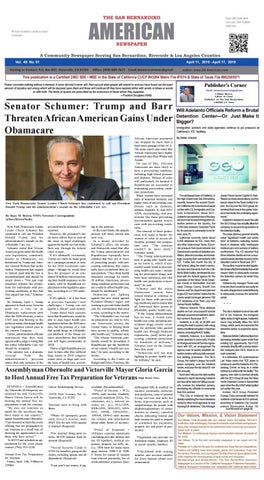
Senator Schumer: Trump and Barr Threaten African American Gains Under Obamacare
New York Democratic Senate Leader Chuck Schumer has continued to call out President Donald Trump and his administration’s assault on the Affordable Care Act. By Stacy M. Brown, NNPA Newswire Correspondent @StacyBrownMedia New York Democratic Senate Leader Chuck Schumer has continued to call out President Donald Trump and his administration’s assault on the Affordable Care Act. Schumer noted that African American gains under the health care legislation, commonly known as Obamacare, are threatened by Trump and Attorney General William Barr as the Justice Department has argued in federal court that the law is unconstitutional and should be struck down – “Not just vital insurance reforms like protections for individuals with preexisting conditions, as they had first argued last year,” Schumer said. By Monday, April 1, Trump appeared to back away from his push for a vote on an Obamacare replacement until after the 2020 elections, a move CNN said was bowing to the political reality that major health care legislation cannot pass in the current Congress. Earlier, administration officials announced that they now agreed with a judge’s ruling that the entire Affordable Care Act should be scrapped. The opinion was a dramatic reversal from the administration’s previous stance that only portions of the
act could not be defended, CNN reported. However, the president’s latest move allows him to wait on the issue as legal challenges against the health care law make their way through the federal court system. If it’s ultimately overturned, Trump can claim he made good on a campaign promise in time for his 2020 re-election campaign – though he would then face the prospect of an estimated 20 million Americans losing their health insurance on his watch, with no Republican replacement in the legislative pipeline, according to a CNN analysis. If it’s upheld – as it has been in previous Supreme Court challenges – Trump can rail against a ‘liberal’ court system. Trump dialed back expectations that Republicans would be able to pass major health care legislation before the 2020 election, but his promise of a vote that would hinge on a Republican takeback of the House ensures nonetheless that health care will figure prominently in 2020. That is a fight Republicans are wary to have after they suffered huge losses in 2018 congressional races in large part over the issue of health care, accord-
ing to the analysis. In the court battle, the appeals process will likely stretch into next year. In a memo provided by Schumer’s office, the senator and Democrats noted that after the Trump administration and Republicans repeatedly have claimed that they are in favor of protecting people with preexisting conditions, they essentially have crystallized their actual position: “They think health insurance coverage for nearly 20 million Americans, pre-existing condition protections and tax credits to afford health care, should be annihilated.” Democrats are fighting against this new attack against President Obama’s legacy and working to provide better health care for communities that need it most, according to the memo. “The Affordable Care Act and its protections are vital to African Americans across the United States in helping them have access to quality, affordable health care,” Schumer said. “The African American community would be devastated if Republicans gut the backbone of our country’s health care system,” he said, according to the memo. According to the Center on Budget and Policy Priorities, the
African American uninsured rate dropped by more than a third since passage of the ACA. The same report also noted that African Americans have higher uninsured rates than Whites and Asians. On top of this, Africans Americans are more likely to have a pre-existing condition, including high blood pressure and diabetes. Women of color will particularly be harmed if Republicans are successful in eliminating pre-existing condition protections. Black women have increased rates of maternal mortality and higher rates of pre-existing conditions such as diabetes, asthma, hepatitis B, and HIV/ AIDS, necessitating vital protections like those preventing discrimination against Americans with pre-existing conditions. The removal of these protections will make it harder for women of color to access affordable prenatal and postpartum care. “The contrast couldn’t be more stark,” Schumer noted. “The Trump administration now is going after health care as we know it, which if successful would result in skyrocketing health care costs – including for prescription drugs, millions more uninsured, and vital health care protections eviscerated,” he said. Schumer and the entire Democratic caucus have vowed instead to continue to fight for those with pre-existing conditions and to ensure that all Americans have access to affordable, quality health care. “If the Trump administration has its way, it would raise health care costs, including prescription drugs, revoke coverage for millions who gained health care through Medicaid expansions, [and] strike preexisting condition protections for hundreds of millions,” Schumer said on the Senate floor this week. “Democrats will not stop fighting to protect health care for millions,” he said.
Assemblyman Obernolte and Victorville Mayor Gloria Garcia to Host Annual Free Tax Preparation for Veterans High Desert News HESPERIA – Assemblyman Jay Obernolte (R-Hesperia) announced he and Victorville Mayor Gloria Garcia will be hosting the annual free tax preparation event for veterans. “We owe our veterans so much for the sacrifices they have made to our country,” stated Assemblyman Obernolte. “I am honored to host this event offering free tax preparation to our veterans as a small way of showing my appreciation to all those who have served.” To RSVP and schedule an appointment for the event please contact (760) 951-2238. Annual Free Tax Preparation for Veterans Friday, April 12th, 9:00am to 2:00pm
Garcia Bookkeeping Service 14450 Park Avenue, Ste. A, Victorville, CA 92392 Veterans need to bring with them: *Photo ID (passport, green card, driver’s license, state DMV ID) for self AND spouse if married (Required) *For married filing joint returns, BOTH spouses must be present (Required) *Social Security Cards or ITNS for members going on the return, including spouse and all dependents (Required) *Last year’s tax return, if any
available (Recommended) *Proof of Income – W2s, 1099s, cash income, disability year-end statement (SSA, VA, insurance, etc.), interest income, etc. (i.e. SSA-1099, RRB-1099, 1099-INT, 1099DIV, 1099R, 1099-MISC, 1099-B, 1099-G state income tax refund, and information about other forms of income) *Proof of Expenses – childcare expense statements (including provider address and tax ID number), medical expenses, property tax bills, etc. (i.e. 1098 form for home mortgage interest, 1098-T & 1098E forms for tuition & student loan interest payments, list of medical/dental expenses [doc-
tor/hospital bills & medical insurance premiums, prescription medicines, costs of assisted living services and bills for home improvements such as ramps/railings for people with disabilities]summary of contributions to charity, canceled checks indicating federal and state income tax paid or prepaid or estimated tax payments, property tax and proof of payments) *Dependent care provider information (name, employer ID or social security number) *Checkbook with routing number and account number for direct deposit refund (recommended)
Publisher’s Corner Email: sbamericannews@gmail.com Clifton Harris Editor in Chief Publisher of The San Bernardino AMERICAN News
Will Adelanto Officials Reform a Brutal Detention Center—Or Just Make It Bigger? Immigration activists and state agencies continue to put pressure on California’s ICE facilities. By Robin Urevich
The windswept town of Adelanto, in the High Desert near San Bernardino, recently became the second Southern California city to announce it would cut ties with U.S. Immigration and Customs Enforcement. Since 2011, Adelanto has operated one of the largest and most troubled immigration detention centers in the country, the 1,940-bed Adelanto Detention Facility. Its contract is scheduled to terminate June 25. California currently holds about 4,500 detainees for ICE, more than any other state except Texas. But under pressure from local activists and Sacramento’s scrutiny of detention conditions, cities and counties are increasingly severing their connections with ICE. Earlier last month the city of McFarland, citing the state’s sanctuary laws and demands from the California State Auditor, terminated its contract with the federal agency for the operation of the Mesa Verde Detention Center in Bakersfield. And last week Orange County Sheriff Don Barnes said his department planned to give ICE four months’ notice that the county would no longer jail some 700 ICE detainees at its Theo Lacy and James Musick facilities. Attorney General: Three detainee deaths and six unsuccessful suicide attempts occurred at Adelanto’s detention center in fiscal year 2017. Adelanto is a city of 34,000 and among the state’s poorest, with a long history of political corruption. It has three prisons, including the ICE facility. Adelanto, however, is a detention center operator in name only. It holds an Intergovernmental Service Agreement with ICE, an arrangement the agency uses to quickly establish detention centers without public competitive bidding processes. The GEO Group, the nation’s largest for-profit prison company, runs the Adelanto center, and pays the city about $1 million annually. But in late February the state auditor released a report slamming Adelanto and two other cities for failing to properly oversee the detention centers, prompting city officials to reconsider their ICE contract. “The City of Adelanto has been closely monitoring the recent decisions made by other local agencies to stop housing ICE detainees,” City Manager
Jessie Flores texted Capital & Main. “Based on those observations and the issues raised in the State Auditor’s report, the City and the GEO group determined that it was in the parties’ interest to terminate the underlying agreements.” Adelanto’s decision to sever ties with the GEO Group may actually allow the company to expand its operations at the detention facility. The state attorney general recently noted “significant health and safety risks” at Adelanto, including nooses found in detainee cells, inadequate medical care and overuse of solitary confinement. The AG reported that three detainee deaths and six unsuccessful suicide attempts occurred at the detention center in fiscal year 2017. The auditor recommended legislation to take effect immediately that would require cities to adequately oversee the detention centers for which they contract. Adelanto city manager Flores said in his text that it would be too costly for his cash-strapped and understaffed city to adequately oversee the detention center. * * * The city’s decision to sever ties with ICE is not, however, the immigrant rights victory it might appear. Adelanto’s move may actually allow the GEO Group, which owns and operates the detention center, to expand its operations. State law forbids California cities from increasing detention space under their existing ICE agreements. But if ICE contracts directly with a private detention company like GEO, there is no such constraint. In a statement, ICE spokeswoman Lori Haley wrote that “ICE plans to continue to use the Adelanto ICE Processing Center as long as a viable contract is in effect with the facility.” The agency was able to contract directly with the GEO Group to keep the Mesa Verde Detention Center in Bakersfield open when the city of McFarland pulled out earlier this year. Indeed, GEO Group President George Zoley personally lobbied for Adelanto to terminate its ICE contract, according to Adelanto City Councilwoman Stevevonna Evans. On (continued on page 8)
Our Values, Mission, & Vision Statement Our Values: Treat all people with care, respect, honor, and dignity. Tell it as it is with love, truth and integrity. Promote the interests of advertisers and sponsors along their strategic interest for the betterment of the community and beyond. Speak truth to power. Our Mission: To continuously improve communication between all people of the world. Our Vision: To be the best community newspaper in our region and the nation. Provider of: A voice for the poor, the underserved, those that are marginalized, Positive and edifying news about people, places and businesses. Keep San Bernardino, Riverside, and Los Angeles Counties informed about global trends while retaining the consciousness of local events and processes. Memberships and Associations: The San Bernardino American Newspaper is a member of the California Newspaper Publishers Association, National Newspaper Association and addociated with California Black Media.
Visit Us Online: www.SB-American.com
PAGE 2
April 11, 2019
COMMUNITY/EDUCATION/ADVERTISING
New NASA-funded program to train K-12 students in STEM fields Outreach components include public lectures, parent nights, and telescope viewing opportunities Iqbal Pittalwala
NASA has awarded the University of California, Riverside a grant of $320,000 to launch a research and training program in STEM fields aimed at enhancing K-12 students’ experiences outside school hours. Titled “Launch Pad from High School to NASA: A Research and Training Program in STEM Fields,” the program has received funding for two years. Its goal is to advance STEM education at high schools and beyond by developing a workforce pipeline and working collaboratively with other agencies and universities to train students and teachers in disciplines of interest to NASA. “There is a shortage of STEM-
literate individuals in today’s workforce, which we need to train,” said Bahram Mobasher, the project’s principal investigator and a professor of physics and observational astronomy at UCR. “By immersing high school students from an early age in state-of-the-art science and technology, we hope to show them the road to discovery and the excitement of finding something new. They need to know that the sky is not the limit, but the beginning.” For more information, please visit: https://news.ucr.edu/articles/2019/04/08/new-nasafunded-program-train-k-12-students-stem-fields
College on the spectrum A breakthrough documentary explores what it’s like to go to college with an autism diagnosis Tess Eyrich
RIVERSIDE, Calif. — Though it’s difficult to pinpoint an exact number, a growing number of young people with autism spectrum disorder are choosing to go to college. Some write about their diagnosis in their college application essays and immediately request services from on-campus disabled student services offices. But many others don’t. They enter college hoping for a fresh start — without a label, without asking for accommodations, and often without even telling their professors and peers about their diagnosis. The college experiences of students with autism are incredibly diverse, said autism researcher Jan Blacher, a distinguished professor in the Graduate School of Education at the University of California, Riverside. Until recently, however, those experiences have traditionally been under-studied, with limited data available to illustrate them or highlight how they might be improved. More than two years in the making, a new first-of-its-kind film explores how it’s going at colleges as more and more students with an autism spectrum diagnosis enroll. Premiering this month, “Autism Goes to College” follows five Southern California college students with autism: two at UC Riverside; one at California State University, Long Beach; one at Cal State, Fullerton; and one at Mt. San Jacinto College. The film is set to debut on April 17 at 7:30 p.m. at the Aero Theatre in Santa Monica. Tickets can
be purchased here. Follow-up screenings will take place on April 28 at 5:45 p.m. at the Lido Theater in Newport Beach (tickets here) and on June 6 at 7 p.m. at UCR’s Barbara and Art Culver Center of the Arts in downtown Riverside. Blacher, who served as the film’s executive producer, joined director Erik Linthorst and writer/producer Jody Becker, the filmmakers behind the award-winning PBS documentary “Autistic-Like: Graham’s Story,” which chronicled Lindhorst and his wife’s quest for a clear diagnosis for their young son. The concept for the film sprang from earlier research conducted by Blacher at UCR to discern how colleges are responding to increasing levels of neurodiversity on campus, and how they can do better. Blacher, who also serves as the founding director of UCR’s SEARCH Center, a free autism screening clinic for families, was especially curious about the campus community’s knowledge and acceptance of students with autism. “These students know there is no map for them, and we found that even if they feel lost for a while, they just keep moving forward,” said Linthorst. “We were blown away by the insights and advice these students were ready to share. College was working for them pretty much because they were making it work.”
tive branch that passes and funds budgets. What is in the best interest of the nation is supposed to be the guiding force in government budgets. But as Sportin’ Life sang in the folk opera Porgy and Bess, “It ain’t necessarily so”. The White House’s FY 2020 proposal cuts Education funding by $62 billion compared to that of FY 2019. Even worse, as the cost of higher education continues to climb, federal student aid would be seriously slashed while other programs would be totally eliminated. Some of the most disturbing college federal cuts affect programs that lessen the amount of student loans that need to be borrowed for every academic term. As rising college costs have worsened the financial challenge faced by many Black and other low-wealth families, the availability of grant programs that do not have to be repaid and/or workstudy programs are key sources for many college students and their families. Among its many revisions, the Trump Administration stands ready to risk a sizeable portion of the proposed $7.25 billion in Pell Grant funding next year. This program is the single largest source of grant aid for low-income households for post-secondary education. On March 26, the Fiscal Year (FY) 2020 Education budget was the focus of a hearing before the House Appropriations Subcommittee for Labor-Health and Human Services-Education. Secretary Betsy Devos delivered testimony that expanded upon previously released materials from the Trump Administration. “Since President Trump took office, Congressional appropriations for U.S. Department of Education programs have increased dramatically – in spite of the Administration’s call to slow spending,” said Secretary DeVos. “We are not doing our children any favors when we borrow from their future in order to invest in systems and policies that are not yielding better results.” In response, Connecticut’s Rep. Rosa DeLauro, the subcommittee chairwoman did not mince words. “This budget underfunds education at every turn”, said DeLauro who added “This budget inflicts harm.” Even Rep. Tom Cole from Oklahoma who serves as the subcommittee’s Ranking Member viewed the White House proposal as “short-sighted”. Representatives DeLauro and Cole were absolutely correct. The Work-Study program that brings campus-based jobs to stu-
dents would suffer a double blow. Its monies would be reduced by 55 percent and remaining funds would be shared with proposed pilot program that targeted to private sector employers for workforce development of nontraditional and low-income students. That’s the window dressing on these cuts. The Work-Study program that received over $1.2 billion in 2019 would be cut to $500.4 million. Secondly, instead of students working on campus, they would need to figure out how to reach employment at private business. Not every student has a car. Nor is public transit always available near college campuses. These businesses would supplement their revenue streams with public monies but the profits derived would still be private. Previously, Work-Study was jointly funded by the federal government paying 75 percent of hourly wages, with the remaining 25 percent paid by the college employer. What for-profit business wouldn’t want the government to pick up 75 percent of its labor costs? Seems that the private business – not the student – is the greater concern with this budget. “Betsy DeVos has some explaining to do – her disinterest in prioritizing quality and affordable education for students is disheartening and erodes the confidence the public has in the Department of Education,” said Debbie Goldstein, an EVP with the Center for Responsible Lending. Currently, the formula-based Pell Grant award averages $4,251 per participating student. Next year as proposed, the program’s average award will be slightly less at $4,149 and traditional grant recipient students would be forced to share those funds with others enrolled in workforce development training that does not accrue credit hours or traditional academic terms. Regular readers of this column may recall, many career and technical training institutions are also for-profit entities that in recent years have either failed to provide the training promised, or the earnings assured by admissions personnel – or both. In the worstcase scenarios, tens of thousands of students have been enrolled at the time of closures that came with little or no notice. The Supplemental Education Opportunity Grant is need-based and financially helps low-income, undergraduate students. For the past two fiscal years, this program was funded at $1.7 billion. If the Trump Administration’s proposal (continued in last 2 columns)
Jay-Z’s 2019 Shawn Carter Scholarship Program Now Open Educational News
Go here to learn more about the film: https://news.ucr.edu/articles/2019/04/08/college-spectrum
$62B Education Cuts Proposed, College Aid Could be Slashed By Charlene Crowell
Photo by: Pexels.com Every budget defines priorities and values. To put it another way, what’s really important in life gets supported financially. For many families, having a home, food, and utilities usually rank pretty high. Then there are other budgetary concerns like saving for college or having a ‘rainy day’ fund to
$62B Education Cuts Proposed, College Aid Could be Slashed...continued
cover less frequent costs that can be much higher than the size of the next paycheck. Government budgets, built on taxpayer dollars, also reveal priorities. At the federal level, budgets are proposed by the executive branch, but it is the legisla(continued in next 2 columns)
OneUnited Bank Announces 9th Annual "I Got Bank" Youth Financial Literacy Contest Ten Middle School Age Children Are Eligible to Win $1,000! Educational News
BOSTON, April 8, 2019 / PRNewswire/ -- For National Financial Literacy Month, OneUnited Bank, the nation's largest black-owned bank, is proud to announce its 9th Annual "I Got Bank!" Financial Literacy Contest where ten children will win a $1,000 savings account. The contest represents the best essays and art projects that embody the "I Got Bank!" theme. Meet Donnie Students from across the country between the ages of 8 and 12 are encouraged to read a financial literacy book of their choosing, and either write a 250-word essay or create an art project to show how they would apply what they learned from the book to their daily lives. Submissions must be emailed or postmarked by June 29, 2019. The Bank will choose ten winners and award each winner a $1,000 savings account at OneUnited Bank by August 31, 2019. For more information, please visit: www.oneunited.com/ book. Teri Williams, OneUnited Bank President and author of "I Got Bank!" wrote the book when she found that there weren't any books geared toward educating urban youth about finances. "We've seen our financial literacy efforts increase awareness through the #BankBlack and #BuyBlack movement. In 2019, we are celebrating the #Kings and #Queens in our community who are focusing on our treasure!"
The 2018 winners, whose essays will be published in April 2019, were: Dontaye Ball Jr., 11, San Francisco, CA, Ziontaye Ball, 11, San Francisco, CA, Evan Corgain, 10, Brockton MA, Jaedin Feaster, 8, Roxbury, MA, Layla Gaston, 8, Havre de Grace, MD, Ryder Noell, 11, Stuttgart, AR, Aaliyah Omitogun, 12, Suitland MD, Michelle Oppong, 9, Los Angeles, CA, Obi Owusu-Bonsu, 12, Los Angeles, CA and Cierra Yoakum, 10, Los Angeles, CA. "I Got Bank! What My Granddad Taught Me About Money" is published by The Beckham Publications Group, Inc. (Beckhamhouse). For more information about the official contest rules, please visit: www.oneunited.com/book. Media Contact: Suzan McDowell, Circle of One Marketi n g , suzan@circleofonemarketing.com, or 305-576-3790 About OneUnited Bank OneUnited Bank is the premier bank for urban communities, the largest Black-owned bank, the first Black internet bank and a Community Development Financial Institution (CDFI). Its mission is to provide affordable financial services to support economic development in urban communities and maintain superior financial performance to maximize shareholder value. OneUnited is an FDIC insured bank and an equal housing lender.
$62B Education Cuts Proposed, College Aid Could be Slashed...continued...continued holds, no monies will support this program next year. The Iraq and Afghanistan Service Grants are available to students whose parent or guardian was a member of the Armed Forces and died as a result of their military deployment in either Iraq or Afghanistan after September 11, 2001. In FY 2019, the average grant in this program was $5,293. In FY 2020, the White House would end it with no appropriation. These are only a few of the cuts proposed to higher education at a time when education is more important today than ever before. The global economy requires a highly-skilled and knowledgeable workforce. It seems so ironic that this White House keeps placing businesses before the needs of people. “Instead of punishing for-profit
institutions that have deceived students and encouraged them to take on unaffordable levels of student debt, Secretary DeVos will defend President Trump’s proposal to extend taxpayer money to finance unproven short-term programs, many of which will be offered by these very same forprofit college,” added Goldstein. Here’s hoping that Congress will hear a loud outcry on gutting federal financial aid. Enacting a budget that represents the needs of people should and must prevail. Charlene Crowell is the Communications Deputy Director at the Center for Responsible Lending. She can be reached at C h a r l e n e . c r o well@responsiblelending.org. This article originally appeared in the Precinct Reporter Group News.
RECEIVE YOUR NEWSPAPER WEEKLY!! Nationwide (BlackNews.com) - Created by rapper Jay-Z and his mother Gloria, the Shawn Carter Scholarship Fund (SCSF) was founded on the belief that any motivated individual in need should have the opportunity to further his or her education. By removing some of the financial burdens associated with going to, surviving in, and graduating from college, the SCSF plays a vital role in increasing college access and success for many motivated yet underserved youth and young adults. The SCSF provides individual grants, paid directly to the educational institution, to every student who qualifies and reapplies yearly, from admission to graduation. The grant can be used to cover tuition expenses and related supplemental educational expenses such as books, lab fees, travel and select costs of living. All Shawn Carter Scholars are required to "give back" by con-
ducting community service and by serving as mentors to younger, aspiring Shawn Carter Scholars.
CALL US TODAY @ 909-889-7677
Eligibility requirements: * High school seniors, students with GED diplomas, undergraduate (2 year or 4 year) college students, and students at vocational or trade schools * US citizen or Permanent Resident * 25 years old or younger * Minimum 2.0 GPA The deadline for this scholarship is usually in APRIL, and the award amount is usually up to $7,500. For more details and/or to apply, visit: h t t p : / / www.jayzscholarship.com
Email: msbamericannews@gmail.com Website: SB-American.com The San Bernardino AMERICAN News Staff Samuel Martin Sr.-Founder Clifton Harris/Editor in Chief/Investigative Reporter Mary Martin-Harris/Editor Clifton B. Harris/Audio Engineering Editor Legal /Display Advertising & Sales (909) 889-7677 The San Bernardino American News was established May 8,1969. A legally adjudicated newspaper of general circulation on September 30, 1971, case number 153913 by the Superior Court, of San Bernardino County. The San Bernardino AMERICAN News, a division of Don Roberto Group, Inc. is published every Thursday by Mary Martin-Harris and Clifton Harris P.O. Box 837 Victorville, CA 92393, Telephone (909)889-7677, Emails: msbamericannews@gmail.com sbamericannews@gmail.com The San Bernardino AMERICAN News subscription rate is $58.00 per year. The San Bernardino AMERICAN New is committed to serving its readers by presenting news, unbiased and objective, trusting in the mature judgment of the readers and, in so doing strive to achieve a united community. News releases appearing in the San Bernardino AMERICAN News do not necessarily express the policy nor the opinion of the publishers. The San Bernardino AMERICAN News reserves the right to edit or rewrite all news releases.
Visit Us Online: www.SB-American.com
PAGE 3
April 11, 2019
WORLD GOVERNMENT/BUSINESS/ADVERTISING
COMMENTARY: After 51 Years, Fair Housing Still an Unfinished Journey By Charlene Crowell, NNPA Newswire Contributor
“How do we ensure that future generations of all backgrounds live in neighborhoods rich with opportunity?” said Debby Goldberg, Vice President of Housing Policy and Special Project with the National Fair Housing Alliance (NFHA). “Fair housing. Fair housing can ultimately dismantle the housing discrimination and segregation that caused these inequities in the first place.” (Photo: iStockphoto / NNPA) Fifty-one years ago, this month, the Fair Housing Act (the Act) was enacted to ensure that housing discrimination was illegal. Yet, just days before the annual observance of Fair Housing Month began, headline news articles reminded the nation that housing discrimination still exists. For example, on March 19, the Office of the Comptroller of the Currency (OCC) fined Citibank $25 million for violations related to mortgage lending. At issue was Citibank’s “relationship pricing” program that afforded mortgage applicants either a credit on closing costs or a reduced interest rate. These cost breaks were intended to be offered to customers on the basis of their deposits and investment balances. According to OCC examination at Citibank, these ‘relationships” did not include all eligible customers – particularly people of color. The regulator’s conclusion was that the bank’s practices led to racial disparities. The settlement calls for all 24,000 consumers affected to receive $24 million in restitution. Days later on March 28, the federal department of Housing and Urban Development (HUD) charged Facebook with violating the Act by enabling its advertisers to discriminate on its social media platform. According to the lawsuit, Facebook enabled advertisers to exclude people based on their neighborhood – a high tech version of the historical redlining of neighborhoods where people of color lived. With 210 million Facebook users in the United States and Canada alone, the social media mogul took in $8.246 billion in advertising in just the last financial quarter of 2018. As April’s annual observance of Fair Housing Month began, the Chair of the House Financial Services Com-
Charlene Crowell is the Center for Responsible Lending’s Deputy Communications Director. She can be reached at Charlene.cr owell@responsiblelending.org. mittee used that leadership post to bring attention to the nagging challenges that deny fair housing for all. In her opening statement at the hearing held April 2, Chairwoman Maxine Waters set the tone and focus of the public forum. “According to the National Fair Housing Alliance, individuals filed 28,843 housing discrimination complaints in 2017,” said Waters. “Under the Trump Administration, fair housing protections are under attack…. According to news reports Secretary Carson proposed taking the words ‘free from discrimination’ out of HUD’s mission statement.” “He also reportedly halted fair housing investigations”, continued Waters, “and sidelined top advisors in HUD’s Office of Fair Housing and Equal Opportunity. These are unprecedented attacks on fair housing that must not go unanswered.” Several committee members posed similar concerns and offered comments that echoed those of Waters. Additional issues raised during the hearing spoke to a lack of enforcement, data collection, gentrification, racial redlining, restrictive zoning, and disparate impact. A panel of housing experts provided substantive testimony that responded to many of these issues, while also acknowledging how many fair housing goals have not yet been achieved. Cashauna Hill, the Executive Director of the Greater New Orleans Fair Housing Action Center provided additional information on delays encountered with HUD’s Fair Housing investigations. Although HUD set a standard for these complaints to be investigated within 100 days, many complaints go well beyond the agency’s own guidelines. Cases older than 100 days are categorized as “aged” in HUD parlance. “In 2017, HUD had 895 cases that became aged during that same year, and it had 941 cases that were already considered aged at the beginning of the fiscal year,” noted Hill. “During that same time period, Fair Housing Assistance Program agencies had 3,994 cases that became aged and 1,393 (continued on page 6)
South Lake Tahoe Groundwater Contamination Investigation Continues More than 150 Property Owners to Receive Questionnaires Business News
SOUTH LAKE TAHOE, Calif. – Amid continuing concern about the extent of Perchloroethylene (PCE) groundwater contamination in South Lake Tahoe, the Lahontan Regional Water Quality Control Board (Lahontan Water Board) is expanding its investigation into potential sources. Multiple drinking water supply wells in the South Y area (near intersection of State Route 89 and Interstate 50), including those operated by three different water suppliers, previously were found to be affected or threatened by PCE commonly used in dry cleaning businesses, printing, and auto body shops and used in products from other industries. Most recently, after a review of available records, more than 150 properties within the City of South Lake Tahoe were identified as sites where past or current businesses likely used, stored and/or disposed of PCE or PCEcontaining products. The Lahontan Water Board issued 233 investigative orders to identify potential source properties that may have contributed to the regional PCE groundwater contamination. Current and former property owners and operators of the more than 150 sites are being required to complete and return a combined 233 questionnaires that are being mailed to them and inquire about their use, storage and/or disposal of PCE and PCE-containing prod-
ucts on their properties. If a property is found to have a higher probability of contamination – for example, where PCE has been found in the soil – the owner or operator will be required to provide more extensive information and cooperate with Lahontan Water Board staff for onsite testing. Failure to comply with the investigative orders is subject to fines up to $1,000 per day of violation. “This critical step will help identify potential pollution sources of the regional PCE plume. With this knowledge we can protect our drinking water supplies and expedite the cleanup in South Lake Tahoe.” said Executive Officer Patty Kouyoumdjian. Information obtained from the Lahontan Water Board’s questionnaires will be used to further refine its regional PCE groundwater contamination characterization study that is being conducted this summer with funding from a $4.6 million grant award issued by the State Water Resources Control Board’s Site Cleanup Subaccount Program. PCE has been detected in recent groundwater samples as high as approximately 1,700 parts per billion (ppb) and in recent individual water supply well samples as high as an estimated 60 ppb. Any water wells with detections exceeding 5 ppb were shut down or treatment has been added to ensure customers continue receiving safe drinking water.
The Fight for Equal Pay, Gender Parity Heats Up By Barrington M. Salmon, Contributing Writer, Black Press USA Despite the United States touting itself as the bastion of freedom and equality, women in this country – despite comprising 50.8 percent of the population – have always found themselves in the position of having to fight for salary and wages comparable to men. A range of studies show some progress, but stubborn racial and gender wage gaps persist in the United States. Often, researchers point to disparities in education, the fact that many African-American women and other women of color are clustered at the lower end of the pay scale and that the minimum wage hasn’t been increased since 2007 as factors contributing to the wage gap. But what’s often downplayed or ignored is the racism and sexism that’s also at play. Black women sit at the nexus of race and gender and are buffeted by the twin spectres of these “isms”, and struggle upstream against a current of prejudice and bias which is compounded by gender and race. This intersectional discrimination exacerbates those gender and race gaps, stymies Black women’s ability to access educational opportunities, and has a pervasive and corrosive impact on their careers and career advancement, experts say. The wage gap has real-world consequences. Dr. Avis Jones-DeWeever said that over their lifetimes, Black women stand to lose between $800,000 and $1 million because of these disparities. “While the gender pay gap is an issue for all women, it is an especially wicked problem for black women,” said Dr. Jones-DeWeever, a women’s empowerment expert, international speaker and diversity consultant. “Black women are already economically disadvantaged and face double discrimination within the workforce. The additional burden of a 38 percent pay gap exacerbates the black wealth gap in America. It’s such an engrained problem. The typical Black woman will lose more than $800,000 over her lifetime, and in DC, the inequality means that Black women could lose more than $1 million.” “A black woman has to earn a B.A. to earn what a white man with a GED would earn. It’s huge and really hardwired into the system,” continued Dr. Jones-DeWeever, who, among her many portfolios, mentors and instructs black women on how to navigate the shoals of business and achieve career and financial success. “It’s devastating because with Black collegeeducated women making as much as 30 percent less than their white male counterparts, that’s a huge disadvantage. That means not being able to put food on the table, buy clothes for your children, not being able to have a better quality of life or diverting money to wealth-building.” According to the National Partnership for Women and Families (NPWF), median wages for black women in the United States are $36,227 per year, compared to median wages of $57,925 annually for white, non-Hispanic men. This amounts to a difference of $21,698 each year. In that same report, NPWF also highlighted that if the wage gap were eliminated, on average, a black woman working full time, year-round would have enough money for: Two and a half years of child care
Black women sit at the nexus of race and gender and are buffeted by the twin spectres of these “isms”, and struggle upstream against a current of prejudice and bias which is compounded by gender and race. (Photo: iStockphoto / NNPA) Nearly 2.5 additional years of tuition and fees for a four-year public university, or the full cost of tuition and fees for a two-year community college 159 more weeks of food for her family (three years’ worth) More than 14 additional months of mortgage and utilities payments 22 more months of rent. The National Women’s Law Center reports that women of every race are paid less than men, at all education levels – and it only gets worse as women’s careers progress. “Despite the fact that women have made enormous gains in educational attainment and labor force involvement in the last several decades, unequal pay remains pervasive in 97 percent of occupations, showing that no matter what their job, women are paid less than men doing the same job in nearly every sector of work,” an NWLC fact sheet noted. Women who work full time, yearround in the United States are paid just 80 cents for every dollar paid to their male counterparts. This gap, which amounts to a typical loss of $10,086 per year for a working woman – or $403,440 over a 40-year career – means that women have to work 15 months … to make what men did in the previous 12-month calendar year.” Studies by gender specialists, academics and women’s activists have statistics showing that the occupations African-American women have does not explain away the Black women’s wage gap, the NWLC said. For example, Black women working as physicians and surgeons—a traditionally male, high wage occupation—make 54 cents for every dollar paid to white, non-Hispanic men working as physicians and surgeons. Black women working as customer service representatives—a mid-wage, female dominated occupation—make 75 cents for every dollar paid to white, non-Hispanic men working as customer service representatives. Black women working as construction laborers—a traditionally male, midwage occupation—make 81 cents for every dollar paid to white, non-Hispanic men working as construction laborers. Black women working as personal care aides—a heavily female, low wage occupation—make 87 cents for every dollar paid to white, non-Hispanic men working as personal care aides. In addition, Black women experience a wage gap even in occupations where they are over-represented. More than two in five African-American women (44.8 percent) are employed in one of 10 occupations. In every one of those occupations, Black women are typi-
cally paid less than white, non-Hispanic men. Among the 10 most common occupations for Black women, two of those occupations – cashiers and retail salespeople and janitors, building cleaners, maids, and housekeepers – typically pay Black women a very low wage – less than $10 per hour – while they typically pay white, non-Hispanic men substantially more. Some solutions, NWLC experts say, include strengthening America’s pay discrimination laws, pushing harder to get Congress to pass the Paycheck Fairness Act, The Pregnant Workers Fairness Act, the Family Act and the Schedules That Work Act – all which would address the discrimination women face when they’re pregnant or caregiving and support those who need paid leave, predictable work schedules, and stability for themselves and their families. Raising the federal minimum wage is yet another way to move towards parity. So far, six states and the District of Columbia have increased the minimum wage to $15 over the next few years. Another solution is making the Earned Income Tax Credit more widely available to needy recipients. The EITC is a tax credit designed to offset payroll taxes and supplement wages for people working in low-wage jobs, providing the most benefits to low- to moderate-income families with children. The federal EITC lifted more than 1.2 million women 18 and older and nearly 3.5 million children out of poverty in 2017, and 28 states and the District of Columbia currently offer their own EITCs to provide an additional boost. Dalana A. Brand, vice president of Global Total Rewards at Electronic Arts, Inc., contends that Black women can’t afford to wait, arguing in an opinion piece last year for Blavity, an Internet media company, that in the midst of the flurry of publicity, tweets, posts, hashtags and calls for change, one important element is missing. “What often gets left out of that discussion is that the hallmark day in April does not apply to black women and other women of color,” she said. “… So, while white women caught up on April 10, black women must wait for over half the year to pass before our wages catch up to what men made a year ago.” Brand, a highly-sought after salary strategist and career transformation coach, said black women are paid 38 percent less than white men and 21 percent less than white women but “the sad fact is that most people are either unaware or don’t care about the appalling disparity black women face with respect pay equity.”
She added that a study by LeanIn.Org, which partnered with Survey Monkey and the National Urban League, indicates that a third of Americans aren’t aware of the pay gap between black women and white men, and half of them don’t know about a similar gap between black and white women. Much like the feminist movement, black women are being largely ignored by the equal pay movement,” she added. Dr. Jones-DeWeever and Brand said that as career strategists and salary consultants, there are a number of things that Black women can and need to do to fight back against wage disparities. The first action is for Black women to embrace their power and value and translate that into dollars and benefits during salary negotiations. “We don’t understand the basics of negotiating,” Dr. Jones-DeWeever said. “We have to understand our value and how to negotiate. When you’re first hired, that’s when you’re most powerful. I never accept the first offer. The first offer is only the beginning of negotiations. You’d be surprised how much money you can get. You have to negotiate for money, a package and vacation. Black communities must also take other tacks to confront and topple this problem, they said. “The reality of racism means that Black women will be offered less,” said Dr. Jones-DeWeever. “In terms of fixing it, we have to have conversations about financial literacy and we also have a responsibility to educate our children about their power, worth and value and empowering them.” Brand concurred. To date, she said, much of the equal pay movement has been focused on awareness building campaigns and encouraging women to effectively negotiate their salaries. “While these are important steps, this is only scratching the surface,” Brand explained. “Getting to pay parity must also involve addressing the corporate systems and state and federal laws that need to change. As black women we must unify and use our collective voices to push pay equality and the racial wealth gap to the top our agenda. Black women have always been at the forefront of the push for equality in our country, whether it was civil rights or social justice, we have been critical forces for change. The equal pay movement should be no different.” Brand and Dr. Jones-DeWeever are called in frequently to consult with Fortune 500 and other companies. They said Black women should also be actively engaged in tackling the equal pay issue within corporate America by participating in employee resource groups at work and collectively guaranteeing that the companies they work for are held accountable for addressing these issues. African American churches, sororities and fraternities and civil society and community organizations need to actively engage in the political process and pressure elected officials to advance additional laws designed to protect against gender discrimination and pay inequality, they said, and concerned people also need to organize efforts and/or sign petitions to demand to push the government to act.
Torres, Escobar Introduce Bill to Safeguard DREAMers’ Private Information from Use for Deportation There is currently no guarantee in place to prevent the Department of Homeland Security from using DACA applicant data for deportation purposes California’s 35th congressional district is home to 6,700 DREAMers; Texas’ 16th congressional district is home to nearly 9,000 DREAMers Government News
WASHINGTON, DC – U.S. Representatives Norma J. Torres (D-CA) and Veronica Escobar (D-TX) introduced the Protect DREAMers Confidentiality Act of 2019 to protect DREAMers’ private information, such as addresses and phone numbers, from being used by the U.S. Department of Homeland Security (DHS) for deportation purposes. The Trump administration ended the Deferred Action for Childhood Arrivals (DACA) program, effectively stripping recipients of their protective status, in September 2017. Judicial rulings have forced the administration to reinstate the program, but they could be overturned at any time, putting DREAMers in
limbo. “When we look at the Homeland Security Department’s actions throughout the Trump administration, it’s clear that Secretary Nielsen can’t be trusted to protect DREAMers’ personal information. These young people are teachers, doctors, and small businessowners— valuable members of our communities who pose no national security threat to our nation,” said Torres. “We should be affording them the same protections for their personal data as we would for any American citizen. I’m proud to join with Congresswoman Escobar to help provide DREAMers with the peace of mind that they won’t be uprooted from the only
country they’ve known as home.” “Dreamers are part of the rich and beautiful fabric of our nation. Congress has a duty to protect them against the Trump administration, and take real steps to ensure the confidential information they provided about themselves and their families is never used against them,” said Escobar. “That is why I’m proud to join Congresswoman Torres to introduce the Protect DREAMer Confidentiality Act and help thousands of Dreamers across the country, including the almost 9,000 from El Paso.” Specifically, the bill would safeguard the confidentiality of information submitted in re-
quests for the DACA program from disclosure to U.S. Immigration and Customs Enforcement or U.S. Customs and Border Protection for any purpose other than implementing the DACA program, unless there are national security concerns or other limited exceptions. The Protect DREAMer Confidentiality Act of 2019 was first introduced by U.S. Senator Martin Heinrich (D-NM) in January. The bill is co-sponsored by Representatives Adriano Espaillat (D-NY), James P. McGovern (D-MA), Ilhan Omar (D-MN), Eleanor Holmes Norton (D-DC), and Jan Schakowsky (D-IL).
Visit Us Online: www.SB-American.com
PAGE 4
April 11, 2019
HEALTH/FITNESS/SENIOR NEWS
African-Americans And Social Determinants Of Health: Is It Race? Or Is It Racism?
Glenn Ellis is a Research Bioethics Fellow at Harvard Medical School, and a health columnist and radio commentator who lectures, nationally and internationally on health-related topics By Glenn Ellis, The Seattle Medium (Trice Edney Wire) – There is no disagreement that AfricanAmericans have worse health outcomes across the board when compared to other races. Researchers, scientists, sociologists, and doctor all agree. Data and statistics reflect the dismal reality that if you are African-American, you will be more likely to die at birth, die giving birth, grow up sicker, be diagnosed of a life-threatening illness later, and die sooner. What is less known, and agreed upon, is the fact that the determining factors for all of these outcomes, is not because one is African-American, but because of what are known as social determinants of health. It’s true, research had concluded that medical care and is only responsible for 10-20 percent of a person’s health: regardless of what color they are. The remaining 80-90 percent is attributed to these social determinants of health. Doctors see this every day in their patient population. A recent survey by The Physician Foundation revealed that 90 percent of the doctors in this country say that most of their patients have a social condition that poses a serious threat to their health. Only 1 percent of the doctors surveyed felt that none of their patients were affected by SDOH. So, what exactly are social
determinants of health? According to the World Health Organization (WHO), these are the “conditions in which people are born, grow, live, work, and age”. In other words, the conditions of health are alarming in communities with poor SDOH such as unstable housing, low income, unsafe neighborhoods, and/or substandard education. One only has to look at every city (urban and rural) to see how this plays out in most of our lives. In the United States, it is SDOH, not race that accounts for the dismal health outcomes for African-Americans. In fact, the inequities in outcome are clear all the way down to the level of neighborhoods in the same city. Several years ago, The Robert Wood Johnson Foundation initiated a first of its kind initiative to look at life expectancy by neighborhood in respective cities around the country. Known as United States Small-Area Life Expectancy Estimate Project (USALEEP), the found shocking differences in life expectancy of as much as 20 years for residents in the same city, living just a few miles apart; in some cases, just a few blocks. Further examination of the data shows that, almost with exception, neighborhoods with the lowest life expectancy were
those with substantial AfricanAmerican or Latino populations. As the cities in this country become more gentrified, we are seeing the health outcomes for the Black and brown people in this country worsen. Are there other reasons that HVI/AIDs is a chronic condition for Whites, while it continues to be an epidemic in the African-American communities in this country? Or, Black women are two to six times more likely to die from complications of pregnancy than White women? And their babies almost three times the infant mortality rate as Whites? Is it due to the genetic makeup of African-Americans? I think not! Every human being on the planet is 99.99 percent identical. A difference of 0.01 percent is all that separates us from each other. That means that the 3 billion pairs of genes (human pairs) that make up our individual genetic code are equal to a book with 262,000 pages. The individual differences between us represents only 500 of those pages! Understanding this is what will allow us to stop using race, a totally social construct, in the concepts of medicine and healthcare. Instead, we must realize how much of our human and financial resources are “misused” applying race to issues of health. We can see it in how, even today doctors have been found to believe that there is something about being AfricanAmerican that results in not providing adequate pain medications due to the belief that we have a higher tolerance for pain, because of our skin color. The same phenomena were observed even in children at Emergency room with appendicitis; African American children were denied pain medication for the same reason. Most alarming to me are the implications as we move further into genomic medicine. If we are not careful, we can
see research from this endeavor to further engrain the notion that there are racial differences that justify our higher rates of high blood pressure; diabetes; and other diseases and conditions. Currently, policy, legislation, and funding are directed towards supporting the theory that African-Americans are more susceptible to poorer health outcomes, while SDOH are being largely ignored. Dr. Richard Cooper of Loyola University has done research on high blood pressure that has made an indisputable case for the dismissal of the fallacy of African-Americans being “predisposed” to poor health outcomes. In his research, Dr. Cooper studied high blood pressure in Nigerians, Jamaicans, and in African-Americans. His conclusions: Only African-Americans had the highest rates of high blood pressure. To further make the case, he found that Germans and Russians have rates that were significantly higher than African-Americans! Seems like it’s more about being African-American in this country, than it is about just being African-American. It begs the question: Is it Race or is it Racism? Remember, I’m not a doctor. I just sound like one. Take good care of yourself and live the best life possible! The information included in this column is for educational purposes only. It is not intended nor implied to be a substitute for professional medical advice. The reader should always consult his or her healthcare provider to determine the appropriateness of the information for their own situation or if they have any questions regarding a medical condition or treatment plan. The post African-Americans And Social Determinants Of Health: Is It Race? Or Is It Racism? appeared first on The Seattle Medium.
Vulnerable Seniors Remain at Risk, Waiting for State Legislators to Act S.E. Williams | Contributor
Photo by: Pexels.com On or about October 15, 2018, a patient with a chronic illness confined to the Legacy Post-Acute Rehabilitation facility in San Bernardino, was observed at about 8:30 am that morning with his/her feeding formula hung on a pole with tubing connected to the resident’s stomach through a feeding pump. The pump was beeping, and the screen indicated a “Hold Error,” i.e. the pump was set in the pause mode. Around 8:55 a.m., a Licensed Vocational Nurse (LVN) entered the room briefly, ignored the beeping of the feeding pump and then sat just outside the door charting. At 9:00 a.m., a Respiratory Therapist entered the patient’s room to check the ventilator settings again the beeping was ignored. At 9:04 a.m., a Certified Nursing Assistant (CNA) entered and repositioned the patient in bed, again ignoring the feeding pump. At 9:33 a.m., a second LVN entered the room to assist the CNA with the patient’s care—both ignored the beeping. At 10:01 a.m., the Housekeeping Supervisor entered the room, checked the brake under the patient’s bed ignored the beeping and left; at 10:05 a.m., an Occupational Therapist entered the room to apply a boot— once again the beeping was ignored. It was not until 10:07 a.m., when a third LVN entered the room, was there any attention paid to the patient’s feeding pump and the fact that it was paused and beeping. For more than an hour, six professionals entered and walked out of this patient’s room while the patient’s feeding tube beeped—a patient with a condition that required he/she be continu-
ously fed with formula via a tube directly into his/her stomach—yet, the feeding tube flow was in a hold status and the pump continued beeping throughout this period. Sadly, not a single employee who entered the room took any action to investigate, report or restart the pump. Only after a seventh individual (a third LVN), was asked by the inspector what the screen from the pump indicated and how long the feeding pump was beeping, did she confirm that the machine was—beeping. “The screen indicated ‘Hold Error,’” she promptly responded adding, “I am not sure how long the feeding pump was beeping and on hold—but,” she admitted, “the feeding was supposed to be continuous.” When the Director of Nursing at the facility was later asked by the investigator what her expectation was for licensed and unlicensed staff when they hear the feeding pump beeping, she replied, “Licensed nurses should check the pump prior to resuming it when the feeding pump is beeping…the unlicensed nurses cannot resume the feeding pump when it is beeping, but they should report it to the LVNs.” In another example, on or about September 29, 2018 an investigator made an unannounced visit to the Rialto Post Acute Center in Rialto. During the review of a resident’s file the investigator learned of an incident where the patient was found outside the facility. After reviewing the file, the investigator dug further and learned the resident in question at some point was
evaluated for his/her “Risk of Elopement” (unsupervised wandering) and was rated an 8 out of 10, with 10 posing the greatest risk. Within about four days of that assessment, a family member arrived at the Rialto Post Acute Center around 4:14 p.m. to visit and saw the resident outside by a bus stop located in front of the facility. When confronted, he was described as both “agitated and physically aggressive.” For his safety, the resident was brought back to the facility.” While bringing patient/resident back into the facility, he attempted to bite staff, “He grabbed my shirt, scratch my arm with his nails—when we got back to the facility, he hitting me on my side,” a staff member reported. Many question what might have happened to the patient if his family member had not happened by and found the resident on the street? According to the report, “This failure had the potential to result in the incident not being investigated, causing adverse reactions, affecting the overall health and safety of the resident…” The inspector determined that the facility had no documented evidence it ever reported the incident to the California Department of Public Health as required. These are only two examples of the dozens and dozens of care facility infractions identified through investigations by the California Department of Public Health through its state enforcement actions that often find patients at risk—at times leveling fines—at care facilities locally and up and down the state. Last May when the state auditor published findings in its report, “Skilled Nursing Facilities: Absent Effective State Oversight, Substandard Quality of Care,” about the quality of care, financial practices, and statewide oversight of California’s skilled nursing facilities concluded, “The state had failed to adequately address ongoing deficiencies related to the quality of care that nursing facilities provide.” The report found between the years 2006 and 2015, the number of sub-
standard care deficiencies documented at nursing facilities, increased by a stunning and sobering “31” percent. In addition, the report looked at the role of three companies up and down the state, Brius, Plum, and Longwood, who have increased their net incomes by tens of millions of dollars over the previous decades. “The net income of all three companies grew from less than $10 million in 2006 to between $35 million and $54 million by 2015.” These companies also earned additional income (collectively well over $330 million) from the government by what some call “double-dipping.” For example, either they or their family members owned many of the vendors from which many of the products, supplies, etc. needed to operate their care facilities were purchased. Related-party transactions according to the auditor’s office are common in the industry and legally allowable. Although Medi-Cal purportedly works to limit the possibility that it might pay for profits from related-party transactions, it appears it has fallen short as the audit found these companies paid between $37.2 million and $65.7 million to related parties between 2007 through 2015. In most instances, auditors found the companies properly disclosed the related-party transactions as required. Among other factors uncovered by state auditors was the Department of Health Care Services’ eligibility system for Medi-Cal which auditors found had paid billions in questionable MediCal premiums and claims because it failed to follow up on eligibility discrepancies between the state’s eligibility system and the counties’ eligibility systems. Auditors recommended the department resolve the discrepancies and recover erroneous payments where allowable. Auditors further noted the department could avoid paying $1.7 billion per year if it resolved the discrepancies. In February, the California State (continued in next 2 columns)
Vulnerable Seniors Remain at Risk, Waiting for State Legislators to Act...continued Auditor presented a special report summarizing audit investigation reports produced by the agency between January 2017 and December 2018 with the goal of assisting the Assembly Budget Committee in identifying issues it may want to explore in subcommittee hearings. “It is intended to provide transparency in what actions, if any, audited and investigated entities have taken in response to our specific findings and recommendations,” California Auditor Elaine Howle stated. Several recommendations were made to the state Assembly Subcommittee on Health and Human Services on issues ranging from the Mental Health Services Act funding to what Howle called, “questionable Medi-Cal payments made by the Department of Health Care Services.” In her communication to the members of the Assembly Budget Committee she stated, “Our audit efforts bring the greatest return when entities act upon our findings and recommendations.” She further shared how, “. . . the state’s budget process is a good opportunity for the Legislature to explore these issues in a public forum and, to the extent necessary, reinforce the need for corrective action.” During the initial report period while the number of substandard care deficiencies received at care facilities in California increased by 31 percent, at the same time, the number of state citations from the Department of Public Health decreased by 34 percent— auditors found the Department of Public Health responded slowly to potential patient care violations. Auditors also found deficiencies associated with noncompliance that caused or were likely to cause serious injury, harm, impairment, or death to residents increased by 35 percent between 2006 and 2015; that the Department of Public Health (DPH) had not fulfilled many of its oversight responsibilities meant to ensure that nursing facilities meet quality-of-care standards; that licensing decisions appeared inconsistent due to DPH’s poorly defined review processes and failures to adequately document rationale for approving or denying license applications. In addition, auditors determined DPH had not performed all the state inspections of nursing facilities required. The agency also failed to issue citations in a timely manner, among other determinations. In its initial report the auditor made several recommendations that ranged from calling on the Department of Health Care Service to revise and update the peer groups it uses to set Medi-Cal rates and in doing so to take into consideration the consolidation of the nursing facility industry; to calling on the legislature to reconsider current efforts to improve the quality of care through an existing financial incentive program determined to not be as effective as it could be because as noted, “the program’s budget is limited and only a small number of facilities receive the incentives.” The audit team recommended the state consider repurposing over $330 million in quality assurance fees to increase both the amount available for such incentives and the impact that financial incentives can have on quality of care. It also recommended the state modify its nursing facility quality assurance fee by requiring nursing facilities to dem-
onstrate quality-of-care improvements in order to receive reimbursements of all or some portion of their quality assurance fee payments. The purpose of this fee is to enhance federal financial participation in the Medi-Cal program, and to provide additional reimbursement and support for quality improvement efforts in licensed facilities that provide services for the Medi-Cal program. If nursing facilities do not show improvements, auditors recommended Health Care Services should redistribute their quality assurance fee payments to those nursing facilities that have improved. In an effort further aimed at improving the quality of patient care, the auditor recommended the department increase citation penalty amounts each year by—at minimum—the cost of inflation. In total, the audit team made 12 recommendations to the legislature and state departments on this issue. To date, the legislature has only enacted legislation on one issue, five are pending and to date the legislature has failed to act on half of them. Every day in the Inland Empire and across the state tens of thousands of elderly and disabled Californians rely on skilled nursing facilities to provide them 24 hour inpatient care yet the system appears fraught with patient risks, operational irregularities and waste. In California the oversight responsibilities for nursing facilities are spread across three state agencies. They include the California Department of Public Health (CDPH), the Department of Health Care Services, and the Office of Statewide Health Planning and Development. Auditors determined DPH had not fulfilled many of the oversight responsibilities meant to ensure nursing facilities meet quality of care standards. They further determined because all three state agencies failed to adequately coordinate their oversight efforts—it produced inefficiencies. In her February letter to the Assembly Budget Committee about this and other audited issues Howle expressed her team’s belief, “The State’s budget process is a good opportunity for the legislature to explore these issues in a public forum and, to the extent necessary, reinforce the need for corrective action.” Those with family members and/or friends in these facilities and/or who care passionately about the care and treatment of seniors and the disabled expect the legislature to take appropriate action on this important issue as the number of California seniors is expected to explode in the coming years placing increased demands on a system already struggling to provide adequate care. To view the 2018 report, Skilled Nursing Facilities: Absent Effective Oversight, Substandard Quality of Care Has Continued, visit https:// www.bsa.ca.gov/pdfs/reports/2017109.pdf. To view the February 2019 report, Implementation of State Auditor’s Recommendations: Special Report to Assembly Budget Subcommittees, visit https://www.auditor.ca.gov/pdfs/ sr2019/2019-406a.pdf. To research the status of long-term care facilities including their compliance history visit http://hfcis.cdph.ca.gov/. This article was originally posted to Voice news on March 28, 2019. This article originally appeared in Black Voice News.
Tackling Disparities in Business Ownership: AmeriHealth Caritas’ Diverse Business Investments Help Minority-Owned Businesses in PA Mentoring and Supplier Diversity programs support diverse businesses; investment increases 87% over five years Health/Fitness News
hiladelphia, Pa. — According to Pennsylvania’s 2018 Disparity Study, which includes analyses of the diverse businesses in prime contracts and subcontracts, the state is seeing an increase in total spend with diverse businesses. But despite the progress that minorities and women have made with regard to business ownership, the report points out that stubborn barriers remain in starting and expanding businesses. AmeriHealth Caritas, a national leader in Medicaid managed care and other health care solutions for those most in need, has experienced success from two programs that are targeted to help diverse businesses access education, capital, start-up resources, and the guidance of other successful business owners — the areas that the Disparity Report identifies as obstacles for minorities in starting businesses.
Its Mentor Protégé business coaching program, which began in 2010, and its Supplier Diversity program, which began in 1993, have increased AmeriHealth Caritas’ investment in Pennsylvania diverse businesses by 87 percent during a five-year period from 2013 to 2017, enabling many diverse firms in the Keystone state to grow and prosper. AmeriHealth Caritas’ increase in procurement trended at an ever higher rate in 2018. About 21 percent of the company’s $128 million investment in PA local goods and services in 2017 – more than $26 million – went to companies owned by minorities, women, veterans and people with disabilities. Since 2013, procurement from diverse businesses has grown at a faster rate, 87 percent, than overall procurement, which has grown by 20 percent. AmeriHealth Caritas Chairman and (continued on page 8)
Visit Us Online: www.SB-American.com
PAGE 5 FICTITIOUS BUSINESS NAME FICTITIOUS BUSINESS NAME STATEMENT FBN Number: 20190003504 Filing Type: FBN Filing Date Filed: 3/21/2019 Began Transacting Business: N/A Filing Expires On: 3/21/2024 Business is Conducted By: A Married Couple Fictitious Business Name(s): EL MONTECITO MEXICAN AMERICAN RESTAURANT Business Address: 11720 BARTLETT AVE. #C & D ADELANTO, CA 92301 County of Principal Place of Business: SAN BERNARDINO Mailing Address: 15794 DESERT ROCK ST. ADELANTO, CA 92301 Registrant(s)Address: MOISES A. MONTES ROBLES 15794 DESERT ROCK ST. ADELANTO, CA 92301 MARIA DEL ROSARIO BECERRA PELAYO 15794 DESERT ROCK ST. ADELANTO, CA 92301 Signature/Officer Title: Moises A. Montes Robles, Husband BY SIGNING, I DECLARE THAT ALL INFORMATION IN THIS STATEMENT IS TRUE AND CORRECT. (A registrant who declares as true any material matter pursuant to Section 17913 of Business and Professions Code that the registrant knows to be false is guilty of a misdemeanor punishable by a fine not to exceed one thousand dollars ($1,000).) NOTICE - IN ACCORDANCE WITH SUBDIVISION (a) OF SECTION 17920, A FICTITIOUS NAME STATEMENT GENERALLY EXPIRES AT THE END OF FIVE YEARS FROM THE DATE ON WHICH IT WAS FILED IN THE OFFICE OF THE COUNTY CLERK, EXCEPT, AS PROVIDED IN SUBDIVISION (b) OF SECTION 17920. WHERE IT EXPIRES 40 DAYS AFTER ANY CHANGE IN THE FACTS SET FORTH IN THE STATEMENT PURSUANT TO SECTION 17913 OTHER THAN A CHANGE IN THE RESIDENCE ADDRESS OF A REGISTERED OWNER. A NEW FICTITIOUS BUSINESS NAME STATEMENT MUST BE FILED BEFORE THE EXPIRATION. THE FILING OF THIS STATEMENT DOES NOT OF ITSELF AUTHORIZE THE USE IN THIS STATE OF A FICTITIOUS BUSINESS NAME IN VIOLATION OF THE RIGHTS OF ANOTHER UNDER FEDERAL, STATE, OR COMMON LAW (SEE SECTION 14411 ET. SEQ., BUSINESS AND PROFESSIONS CODE.) Published In The San Bernardino American Newspaper April 4, 11, 18, 25, 2019. FICTITIOUS BUSINESS NAME STATEMENT FBN Number: 20190003574 Filing Type: FBN Filing Date Filed: 3/22/2019 Began Transacting Business: N/A Filing Expires On: 3/22/2024 Business is Conducted By: An Individual Fictitious Business Name(s): DIVINITY WIGS Business Address: 14779 SENECA RD. APT 207 VICTORVILLE, CA 92392 County of Principal Place of Business: SAN BERNARDINO Registrant(s)Address: TAMARAH J. MYLES 14779 SENECA RD. APT. 207 VICTORVILLE, CA 92392 Signature/Officer Title: Tamarah J. Myles BY SIGNING, I DECLARE THAT ALL INFORMATION IN THIS STATEMENT IS TRUE AND CORRECT. (A registrant who declares as true any material matter pursuant to Section 17913 of Business and Professions Code that the registrant knows to be false is guilty of a misdemeanor punishable by a fine not to exceed one thousand dollars ($1,000).) NOTICE - IN ACCORDANCE WITH SUBDIVISION (a) OF SECTION 17920, A FICTITIOUS NAME STATEMENT GENERALLY EXPIRES AT THE END OF FIVE YEARS FROM THE DATE ON WHICH IT WAS FILED IN THE OFFICE OF THE COUNTY CLERK, EXCEPT, AS PROVIDED IN SUBDIVISION (b) OF SECTION 17920. WHERE IT EXPIRES 40 DAYS AFTER ANY CHANGE IN THE FACTS SET FORTH IN THE STATEMENT PURSUANT TO SECTION 17913 OTHER THAN A CHANGE IN THE RESIDENCE ADDRESS OF A REGISTERED OWNER. A NEW FICTITIOUS BUSINESS NAME STATEMENT MUST BE FILED BEFORE THE EXPIRATION. THE FILING OF THIS STATEMENT DOES NOT OF ITSELF AUTHORIZE THE USE IN THIS STATE OF A FICTITIOUS BUSINESS NAME IN VIOLATION OF THE RIGHTS OF ANOTHER UNDER FEDERAL, STATE, OR COMMON LAW (SEE SECTION 14411 ET. SEQ., BUSINESS AND PROFESSIONS CODE.) Published In The San Bernardino American Newspaper April 4, 11, 18, 25, 2019. FICTITIOUS BUSINESS NAME STATEMENT 20190003521 Date Filed: 3/21/2019 Filing Expires On: 3/21/2024 FICTITIOUS BUSINESS NAME (as shown in the Articles of Inc./Org./Reg.): HALO STAR BEAUTY County of Principal Place of Business: SAN BERNARDINO Street Address of Principal Place of Business: 1409 CORAL TREE LN. SAN BERNARDINO, CA 92408 Name of Individual Registrant: SAVANNAH RODRIGUEZ Name of corporation or limited liability company as shown in the Articles of Inc./Org./Reg.: State of Inc./Org./Reg.: Inc./Org./Reg. No.: Residence Street Address: 1409 CORAL TREE LN. SAN BERNARDINO, CA 92408 Name of Individual Registrant: JUSTUS SCOTT Residence Street Address:1409 CORAL TREE LN. SAN BERNARDINO, CA 92408 This business is/was conducted by: A Joint Venture Registrant has commenced to transact business under the fictitious business name or names listed above on: N/A Justus Scott, Co-Owner General Partner, declares that all information in this statement is true and correct. NOTICE - IN ACCORDANCE WITH SUBDIVISION (a) OF SECTION 17920, A FICTITIOUS NAME STATEMENT GENERALLY EXPIRES AT THE END OF FIVE YEARS FROM THE DATE ON WHICH IT WAS FILED IN THE OFFICE OF THE COUNTY CLERK, EXCEPT, AS PROVIDED IN SUBDIVISION (b) OF SECTION 17920. WHERE IT EXPIRES 40 DAYS AFTER ANY CHANGE IN THE FACTS SET FORT IN THE STATEMENT PURSUANT TO SECTION 17913 OTHER THAN A CHANGE IN THE RESIDENCE ADDRESS OF A REGISTERED OWNER. A NEW FICTITIOUS BUSINESS NAME STATEMENT MUST BE FILED BEFORE THE EXPIRATION. THE FILING OF THIS STATEMENT DOES NOT OF ITSELF AUTHORIZE THE USE IN THIS STATE OF A FICTITIOUS BUSINESS NAME IN VIOLATION OF THE RIGHTS OF ANOTHER UNDER FEDERAL, STATE, OR COMMON LAW (SEE SECTION 14411 ET. SEQ., BUSINESS AND PROFESSIONS CODE.) Published in the San Bernardino American Newspaper March 28, April 4, 11, 18, 2019. FICTITIOUS BUSINESS NAME STATEMENT FBN Number: 20190002302 Filing Type: FBN Filing Date Filed: 2/22/2019 Began Transacting Business: 11/03/2018 Filing Expires On: 2/22/2024 Business is Conducted By: A General Partnership Fictitious Business Name(s): ROUTE 66 AUTO SERVICES Business Address: 1897 N. MT. VERNON AVE. SAN BERNARDINO, CA 92405 County of Principal Place of Business: SAN BERNARDINO Mailing Address: 1142 S. DIAMOND BAR BLVD. 323 DIAMOND BAR, CA 91765 Registrant(s)Address: FRANCES C. ROBLES 1142 S. DIAMOND BAR BLVD. 323 DIAMOND BAR, CA 91765 DORA C. ROBLES 1142 S. DIAMOND BAR BLVD. 323 DIAMOND BAR, CA 91765 Signature/Officer Title: Frances C. Robles, General Partner BY SIGNING, I DECLARE THAT ALL INFORMATION IN THIS STATEMENT IS TRUE AND CORRECT. (A registrant who declares as true any material matter pursuant to Section 17913 of Business and Professions Code that the registrant knows to be false is guilty of a misdemeanor punishable by a fine not to exceed one thousand dollars ($1,000).) NOTICE - IN ACCORDANCE WITH SUBDIVISION (a) OF SECTION 17920, A FICTITIOUS NAME STATEMENT GENERALLY EXPIRES AT THE END OF FIVE YEARS FROM THE DATE ON WHICH IT WAS FILED IN THE OFFICE OF THE COUNTY CLERK, EXCEPT, AS PROVIDED IN SUBDIVISION (b) OF SECTION 17920. WHERE IT EXPIRES 40 DAYS AFTER ANY CHANGE IN THE FACTS SET FORTH IN THE STATEMENT PURSUANT TO SECTION 17913 OTHER THAN A CHANGE IN THE RESIDENCE ADDRESS OF A REGISTERED OWNER. A NEW FICTITIOUS BUSINESS NAME STATEMENT MUST BE FILED BEFORE THE EXPIRATION. THE FILING OF THIS STATEMENT DOES NOT OF ITSELF AUTHORIZE THE USE IN THIS STATE OF A FICTITIOUS BUSINESS NAME IN VIOLATION OF THE RIGHTS OF ANOTHER UNDER FEDERAL, STATE, OR COMMON LAW (SEE SECTION 14411 ET. SEQ., BUSINESS AND PROFESSIONS CODE.) Published In The San Bernardino American Newspaper March 21, 28, April 4, 11, 2019. FICTITIOUS BUSINESS NAME STATEMENT FBN Number: 20190003256 Filing Type: FBN Filing Date Filed: 3/18/2019 Began Transacting Business: N/A Filing Expires On: 3/18/2024 Business is Conducted By: An Individual
April 11, 2019
LEGALS/CLASSIFIEDS/NEWS
Fictitious Business Name(s): NARJES ENTERPRISES Business Address: 2060 N. RIVERSIDE AVE. STE C277 RIALTO, CA 92377 County of Principal Place of Business: SAN BERNARDINO Registrant(s)Address: AFAQ ALI 2064 W. SUMMERSET DR. RIALTO, CA 92377 Signature/Officer Title: Afaq Ali BY SIGNING, I DECLARE THAT ALL INFORMATION IN THIS STATEMENT IS TRUE AND CORRECT. (A registrant who declares as true any material matter pursuant to Section 17913 of Business and Professions Code that the registrant knows to be false is guilty of a misdemeanor punishable by a fine not to exceed one thousand dollars ($1,000).) NOTICE - IN ACCORDANCE WITH SUBDIVISION (a) OF SECTION 17920, A FICTITIOUS NAME STATEMENT GENERALLY EXPIRES AT THE END OF FIVE YEARS FROM THE DATE ON WHICH IT WAS FILED IN THE OFFICE OF THE COUNTY CLERK, EXCEPT, AS PROVIDED IN SUBDIVISION (b) OF SECTION 17920. WHERE IT EXPIRES 40 DAYS AFTER ANY CHANGE IN THE FACTS SET FORTH IN THE STATEMENT PURSUANT TO SECTION 17913 OTHER THAN A CHANGE IN THE RESIDENCE ADDRESS OF A REGISTERED OWNER. A NEW FICTITIOUS BUSINESS NAME STATEMENT MUST BE FILED BEFORE THE EXPIRATION. THE FILING OF THIS STATEMENT DOES NOT OF ITSELF AUTHORIZE THE USE IN THIS STATE OF A FICTITIOUS BUSINESS NAME IN VIOLATION OF THE RIGHTS OF ANOTHER UNDER FEDERAL, STATE, OR COMMON LAW (SEE SECTION 14411 ET. SEQ., BUSINESS AND PROFESSIONS CODE.) Published In The San Bernardino American Newspaper March 21, 28, April 4, 11, 2019. ORDER TO SHOW CAUSE FOR CHANGE OF NAME
ORDER TO SHOW CAUSE FOR CHANGE OF NAME CIVDS 1907636 TO ALL INTERESTED PERSONS: Petitioner: CYNTHIA RODRIGUEZ filed a petition with this court for a decree changing names as follows: Present name: a. STEVEN DANIEL YOUNG IV to Proposed name: DANIEL RODRIGUEZ THE COURT ORDERS that all persons interested in this matter shall appear before this court at the hearing indicated below to show cause, if any, why the petition for change of name should not be granted. Any person objecting to the name changes described above must file a written objection at least two court days before the matter is scheduled to be heard and must appear at the hearing to show cause why the petition should not be granted. If no written objection is timely filed, the court may grant the petition without a hearing. NOTICE OF HEARING Date: 04/23/19 Time: 8:30 a.m. Dept: S17 SUPERIOR COURT COUNTY OF SAN BERNARDINO, 247 W. 3rd Street San Bernardino, CA 92415 San Bernardino District A Copy of this Order to Show Cause shall be published at least once each week for four successive weeks prior to the date set for hearing on the petition in the following newspaper of general circulation, printed in this county: The San Bernardino American Newspaper P.O. Box 837 Victorville, CA 92393 Date: March 12, 2019 Michael A. Sachs Judge Of The Superior Court Published in the San Bernardino American Newspaper March 21, 28, April 4, 11, 2019
PETITION/PROBATE NOTICE OF PETITION TO ADMINISTER ESTATE (Probate-Decedents’ Estates) Notice Of Petition to Administer Estate Of: GERALD A. NIELSEN aka
GERALD ANDERS NIELSEN aka GERALD NIELSEN Case Number: PROPS 1900283 To all heirs, beneficiaries, creditors, contingent creditors, and persons who may otherwise be interested in the will or estate, or both, of: GERALD A.
NIELSEN aka GERALD ANDERS NIELSEN aka GERALD NIELSEN A Petition for Probate has been filed by: RANDY L. NIELSEN in the Superior Court of California, County of: SAN BERNARDINO The Petition for Probate requests that RANDY L. NIELSEN be appointed as personal representative to administer the estate of the decedent. The petition requests authority to administer the estate under the Independent Administration of Estates Act. (This authority will allow the personal representative to take many actions without obtaining court approval. Before taking certain very important actions, however, the personal representative will be required to give notice to interested persons unless they have waived notice or consented to the proposed action.) The independent administration authority will be granted unless an interested person files an objection to the petition and shows good cause why the court should not grant the authority. A hearing on the petition will be held in this court as follows: Date: May 16, 2019 Time: 8:30 a.m. Dept:: S-35 SUPERIOR COURT OF CALIFORNIA, COUNTY OF SAN BERNARDINO, 247 WEST THIRD STREET SAN BERNARDINO, CA 92415 SAN BERNARDINO JUSTICE CENTER-PROBATE DEPT. If you object to the granting of the petition, you should appear at the hearing and state your objections or file written objections with the court before the hearing. Your appearance may be in person or by your attorney. If you are a creditor or a contingent creditor of the decedent, you must file your claim with the court and mail a copy to the personal representative appointed by the court within the later of either (1) four months from the date of first issuance of letters to a general personal representative, as defined in section 58(b) of the California Probate Code, or (2) 60 days from the date of mailing or personal delivery to you of a notice under section 9052 of the California Probate Code. Other California statutes and legal authority may affect your rights as a creditor. You may want to consult with an attorney knowledgeable in California law. You may examine the file kept by the court. If you are a person interested in the estate, you may file with the court a Request for Special Notice (form DE-154) of the filing of an inventory and appraisal of estate assets or of any petition or account as provided in Probate Code section 1250. A Request for Special Notice form is available from the court clerk. Attorney for Petitioner: Bryan C. Hartnell, Esq., HARTNELL LAW GROUP, A Professional Corporation Telephone: (909)796-6881 Published in The San Bernardino American Newspaper April 11, 18, 25, 2019.
NOTICE OF PETITION TO ADMINISTER ESTATE (Probate-Decedents’ Estates) NOTICE OF PETITION TO ADMINISTER ESTATE OF: DAVID
J. KAUSAL aka DAVID JOHN KAUSAL aka DAVID KAUSAL
Case Number: PROPS 1900095 To all heirs, beneficiaries, creditors, contingent creditors, and persons who may otherwise be interested in the will or estate, or both, of DAVID J. KAUSAL
aka DAVID JOHN KAUSAL aka DAVID KAUSAL A Petition for Probate has been filed by: HOLLY A. RIESER in the Superior Court of California, County of: SAN BERNARDINO The Petition for Probate requests that HOLLY A. RIESER be appointed as personal representative to administer the estate of the decedent. The petition requests the decedent’s will and codicils, if any, be admitted to probate. The will and any codicils are available for examination in the file kept by the court. The petition requests authority to administer the estate under the Independent Administration of Estates act. (This authority will allow the personal representative to take many actions without obtaining court approval. Before taking certain very important actions, however, the personal representative will be required to give notice to interested persons unless they have waived notice or consented to the proposed action). The independent administration authority will be granted unless an interested person files an objection to the petition and shows good cause why, the court should not grant the authority. A hearing on the petition will be held in this court as follows: Date June 10, 2019 Time:8:30 a.m. Dept:: S-36 SUPERIOR COURT OF CALIFORNIA, County Of San Bernardino, 247 West Third Street San Bernardino, CA 92415 -0212 SAN BERNARDINO DISTRICT SAN BERNARDINO JUSTICE CENTER If you object to the granting of the petition, you should appear at the hearing and state your objections or file written objections with the court before the hearing. Your appearance may be in person or by your attorney. If you are a creditor or a contingent creditor of the decedent, you must file your claim with the court and mail a copy to the personal representative appointed by the court within the later of either (1) four months from the date of first issuance of letters to a general representative, as defined in section 58(b) of the California Probate Code, or (2) 60 days from the date of mailing or personal delivery to you of a notice under section 9052 of the California Probate Code. Other California statutes and legal authority may affect your rights as a creditor. You may want to consult with an attorney knowledgeable in California law. You may examine the file kept by the court. If you are a person interested in the estate, you may file with the court a Request for Special Notice (form DE154) of the filing of an inventory and appraisal of estate assets or of any petition or account as provided in Probate Code section 1250. A Request for Special Notice form is available from the court clerk. Attorney for Petitioner: Bryan C. Hartnell, Esq., HARTNELL LAW GROUP 25757 Redlands Boulevard Redlands, CA 92373-8453 ( 909) 796-6881 Published in The San Bernardino American Newspaper April 4, 11, 18, 2019
SUMMONS SUMMONS (CITACION JUDICIAL) CASE NUMBER (Número del Caso): CIVDS1824472 NOTICE TO DEFENDANT (AVISO AL DEMANDADO): ANTOLINO DORADO JR YOU ARE BEING SUED BY PLAINTIFF (LO ESTÁ DEMANDANDO EL DEMANDANTE): Wells Fargo Bank, N.A. NOTICE! You have been sued. The court may decide against you without your being heard unless you respond within 30 days. Read the information below. You have 30 CALENDAR DAYS after this summons and legal papers are served on you to file a written response at this court and have a copy served on the plaintiff. A letter or phone call will not protect you. Your written response must be in proper legal form if you want the court to hear your case. There may be a court form that you can use for your response. You can find these court forms and more information at the California Courts Online Self-Help Center (www.courtinfo.ca.gov/selfhelp), your county law library, or the courthouse nearest you. If you cannot pay the filing fee, ask the court clerk for a fee waiver form. If you do not file your response on time, you may lose the case by default, and your wages, money, and property may be taken without further warning from the court. There are other legal requirements. You may want to call an attorney right away. If you do not know an attorney, you may want to call an attorney referral service. If you cannot afford an attorney, you may be eligible for free legal services from a nonprofit legal services program. You can locate these nonprofit groups at the California Legal Services Web site (www.lawhelpcalifornia.org), the California Courts Online Self-Help Center (www.courtinfo.ca.gov/selfhelp), or by contacting your local court or county bar association. NOTE: The court has a statutory lien for waived fees and costs on any settlement or arbitration award of $10,000 or more in a civil case. The court's lien must be paid before the court will dismiss the case. ¡AVISO! Lo han demandado. Si no responde dentro de 30 días, la corte puede decidir en su contra sin escuchar su versión. Lea la información a continuación. Tiene 30 DÍAS DE CALENDARIO después de que le entreguen esta citación y papeles legales para presentar una respuesta por escrito en esta corte y hacer que se entregue una copia al demandante. Una carta o una llamada telefónica no lo protegen. Su respuesta por escrito tiene que estar en formato legal correcto si desea que procesen su caso en la corte. Es posible que haya un formulario que usted pueda usar para su respuesta. Puede encontrar estos formularios de la corte y más información en el Centro de Ayuda de las Cortes de California (www.sucorte.ca.gov), en la biblioteca de leyes de su condado o en la corte que le quede más cerca. Si no puede pagar la cuota de presentación, pida al secretario de la corte que le dé un formulario de exención de pago de cuotas. Si no presenta su respuesta a tiempo, puede perder el caso por incumplimiento y la corte le podrá quitar su sueldo, dinero y bienes sin más advertencia. Hay otros requisitos legales. Es recomendable que llame a un abogado inmediatamente. Si no conoce a un abogado, puede llamar a un servicio de
remisión a abogados. Si no puede pagar a un abogado, es posible que cumpla con los requisitos para obtener servicios legales gratuitos de un programa de servicios legales sin fines de lucro. Puede encontrar estos grupos sin fines de lucro en el sitio web de California Legal Services, (www.lawhelpcalifornia.org), en el Centro de Ayuda de las Cortes de California, (www.sucorte.ca.gov) o poniéndose en contacto con la corte o el colegio de abogados locales. AVISO: Por ley, la corte tiene derecho a reclamar las cuotas y los costos exentos por imponer un gravamen sobre cualquier recuperación de $10,000 ó más de valor recibida mediante un acuerdo o una concesión de arbitraje en un caso de derecho civil. Tiene que pagar el gravamen de la corte antes de que la corte pueda desechar el caso. The name and address of the court is (El nombre y dirección de la corte es): SUPERIOR COURT OF CALIFORNIA COUNTY OF SAN BERNARDINO, 247 West Third St, San Bernardino, CA 92415-0210 The name, address, and telephone number of plaintiff's attorney, or plaintiff without an attorney, is (El nombre, la dirección y el número de teléfono del abogado del demandante, o del demandante que no tiene abogado, es): REESE LAW GROUP, Shiv Samtani, Esq., (Bar #320822), 3168 Lionshead Avenue, Carlsbad, CA 92010; 760/8425850 (File No. 558049) DATE (Fecha): SEP 14 2018 Clerk (Secretario), by Danielle Paris, Deputy (Adjunto) (SEAL) NOTICE TO THE PERSON SERVED: You are served 1. as an individual defendant. 4/11, 4/18, 4/25, 5/2/19 CNS-3240831# THE SAN BERNARDINO AMERICAN SUMMONS (CITACION JUDICIAL) CASE NUMBER (Número del Caso): CIVDS1823290 NOTICE TO DEFENDANT (AVISO AL DEMANDADO): IRVING BERNARDO RAMIREZ ROXANNE CASS AND DOES 1 TO 10 YOU ARE BEING SUED BY PLAINTIFF (LO ESTÁ DEMANDANDO EL DEMANDANTE): STATE FARM MUTUAL AUTOMOBILE INSURANCE COMPANY NOTICE! You have been sued. The court may decide against you without your being heard unless you respond within 30 days. Read the information below. You have 30 CALENDAR DAYS after this summons and legal papers are served on you to file a written response at this court and have a copy served on the plaintiff. A letter or phone call will not protect you. Your written response must be in proper legal form if you want the court to hear your case. There may be a court form that you can use for your response. You can find these court forms and more information at the California Courts Online Self-Help Center (www.courtinfo.ca.gov/selfhelp), your county law library, or the courthouse nearest you. If you cannot pay the filing fee, ask the court clerk for a fee waiver form. If you do not file your response on time, you may lose the case by default, and your wages, money, and property may be taken without further warning from the court. There are other legal requirements. You may want to call an attorney right away. If you do not know an attorney, you may want to call an attorney referral service. If you cannot afford an attorney, you may be eligible for free legal services from a nonprofit legal services program. You can locate these nonprofit groups at the California Legal Services Web site (www.lawhelpcalifornia.org), the California Courts Online Self-Help Center (www.courtinfo.ca.gov/selfhelp), or by contacting your local court or county bar association. NOTE: The court has a statutory lien for waived fees and costs on any settlement or arbitration award of $10,000 or more in a civil case. The court's lien must be paid before the court will dismiss the case. ¡AVISO! Lo han demandado. Si no responde dentro de 30 días, la corte puede decidir en su contra sin escuchar su versión. Lea la información a continuación. Tiene 30 DÍAS DE CALENDARIO después de que le entreguen esta citación y papeles legales para presentar una respuesta por escrito en esta corte y hacer que se entregue una copia al demandante. Una carta o una llamada telefónica no lo protegen. Su respuesta por escrito tiene que estar en formato legal correcto si desea que procesen su caso en la corte. Es posible que haya un formulario que usted pueda usar para su respuesta. Puede encontrar estos formularios de la corte y más información en el Centro de Ayuda de las Cortes de California (www.sucorte.ca.gov), en la biblioteca de leyes de su condado o en la corte que le quede más cerca. Si no puede pagar la cuota de presentación, pida al secretario de la corte que le dé un formulario de exención de pago de cuotas. Si no presenta su respuesta a tiempo, puede perder el caso por incumplimiento y la corte le podrá quitar su sueldo, dinero y bienes sin más advertencia. Hay otros requisitos legales. Es recomendable que llame a un abogado inmediatamente. Si no conoce a un abogado, puede llamar a un servicio de remisión a abogados. Si no puede pagar a un abogado, es posible que cumpla con los requisitos para obtener servicios legales gratuitos de un programa de servicios legales sin fines de lucro. Puede encontrar estos grupos sin fines de lucro en el sitio web de California Legal Services, (www.lawhelpcalifornia.org), en el Centro de Ayuda de las Cortes de California, (www.sucorte.ca.gov) o poniéndose en contacto con la corte o el colegio de abogados locales. AVISO: Por ley, la corte tiene derecho a reclamar las cuotas y los costos exentos por imponer un gravamen sobre cualquier recuperación de $10,000 ó más de valor recibida mediante un acuerdo o una concesión de arbitraje en un caso de derecho civil. Tiene que pagar el gravamen de la corte antes de que la corte pueda desechar el caso. The name and address of the court is (El nombre y dirección de la corte es): SUPERIOR COURT OF CALIFORNIA COUNTY OF SAN BERNARDINO 247 WEST THIRD ST., SAN BERNARDINO CA 92415-0210 The name, address, and telephone number of plaintiff's attorney, or plaintiff without an attorney, is (El nombre, la dirección y el número de teléfono del abogado del demandante, o del demandante que no tiene abogado, es): REESE LAW GROUP, Jenny R. Louro, Esq., Bar #306535, 3168 LIONSHEAD AVE CARLSBAD CA 92010 760/8425850 (FILE NO. 284115) DATE (Fecha): SEP 05, 2018 Clerk (Secretario), by MARIA ROMO LOPEZ, Deputy (Adjunto)
(SEAL) NOTICE TO THE PERSON SERVED: You are served as an individual defendant STATEMENT OF DAMAGES (Personal Injury or Wrongful Death) CASE NUMBER: CIVDS1823290 Plaintiff: STATE FARM MUTUAL AUTOMOBILE INSURANCE COMPANY . Defendant: IRVING BERNARDO RAMIREZ, et al. To: IRVING BERNARDO RAMIREZ Plaintiff: STATE FARM MUTUAL AUTOMOBILE INSURANCE COMPNAY seeks damages in the above-entitled action, as follows: 1 General damages a. Pain, suffering, and inconvenience …….....$11,000.00 2. Special damages a. Medical expenses (to date) ……………………...$14,750.00 e. Property damage..…$26,088.13 Date: August 14, 2018 S/ Jenny R Louro, Esq. 3/28, 4/4, 4/11, 4/18/19 CNS-3234751# THE SAN BERNARDINO AMERICAN SUMMONS (CITACION JUDICIAL) CASE NUMBER (Número del Caso): CIVDS1830339 NOTICE TO DEFENDANT (AVISO AL DEMANDADO): ANTHONY VENTURA YOU ARE BEING SUED BY PLAINTIFF (LO ESTÁ DEMANDANDO EL DEMANDANTE): WELLS FARGO BANK, N.A. NOTICE! You have been sued. The court may decide against you without your being heard unless you respond within 30 days. Read the information below. You have 30 CALENDAR DAYS after this summons and legal papers are served on you to file a written response at this court and have a copy served on the plaintiff. A letter or phone call will not protect you. Your written response must be in proper legal form if you want the court to hear your case. There may be a court form that you can use for your response. You can find these court forms and more information at the California Courts Online Self-Help Center (www.courtinfo.ca.gov/selfhelp), your county law library, or the courthouse nearest you. If you cannot pay the filing fee, ask the court clerk for a fee waiver form. If you do not file your response on time, you may lose the case by default, and your wages, money, and property may be taken without further warning from the court. There are other legal requirements. You may want to call an attorney right away. If you do not know an attorney, you may want to call an attorney referral service. If you cannot afford an attorney, you may be eligible for free legal services from a nonprofit legal services program. You can locate these nonprofit groups at the California Legal Services Web site (www.lawhelpcalifornia.org), the California Courts Online Self-Help Center (www.courtinfo.ca.gov/selfhelp), or by contacting your local court or county bar association. NOTE: The court has a statutory lien for waived fees and costs on any settlement or arbitration award of $10,000 or more in a civil case. The court's lien must be paid before the court will dismiss the case. ¡AVISO! Lo han demandado. Si no responde dentro de 30 días, la corte puede decidir en su contra sin escuchar su versión. Lea la información a continuación. Tiene 30 DÍAS DE CALENDARIO después de que le entreguen esta citación y papeles legales para presentar una respuesta por escrito en esta corte y hacer que se entregue una copia al demandante. Una carta o una llamada telefónica no lo protegen. Su respuesta por escrito tiene que estar en formato legal correcto si desea que procesen su caso en la corte. Es posible que haya un formulario que usted pueda usar para su respuesta. Puede encontrar estos formularios de la corte y más información en el Centro de Ayuda de las Cortes de California (www.sucorte.ca.gov), en la biblioteca de leyes de su condado o en la corte que le quede más cerca. Si no puede pagar la cuota de presentación, pida al secretario de la corte que le dé un formulario de exención de pago de cuotas. Si no presenta su respuesta a tiempo, puede perder el caso por incumplimiento y la corte le podrá quitar su sueldo, dinero y bienes sin más advertencia. Hay otros requisitos legales. Es recomendable que llame a un abogado inmediatamente. Si no conoce a un abogado, puede llamar a un servicio de remisión a abogados. Si no puede pagar a un abogado, es posible que cumpla con los requisitos para obtener servicios legales gratuitos de un programa de servicios legales sin fines de lucro. Puede encontrar estos grupos sin fines de lucro en el sitio web de California Legal Services, (www.lawhelpcalifornia.org), en el Centro de Ayuda de las Cortes de California, (www.sucorte.ca.gov) o poniéndose en contacto con la corte o el colegio de abogados locales. AVISO: Por ley, la corte tiene derecho a reclamar las cuotas y los costos exentos por imponer un gravamen sobre cualquier recuperación de $10,000 ó más de valor recibida mediante un acuerdo o una concesión de arbitraje en un caso de derecho civil. Tiene que pagar el gravamen de la corte antes de que la corte pueda desechar el caso. The name and address of the court is (El nombre y dirección de la corte es): Superior Court of California, County of San Bernardino, 247 West Third St., San Bernardino, CA 92415-0210 The name, address, and telephone number of plaintiff's attorney, or plaintiff without an attorney, is (El nombre, la dirección y el número de teléfono del abogado del demandante, o del demandante que no tiene abogado, es): REESE LAW GROUP, Harlan M. Reese, (Bar #118226), 3168 Lionshead Avenue, Carlsbad, CA 92010 760/842-5850 (File No. 558663) DATE (Fecha): Nov. 19, 2018 Clerk (Secretario), by JACQUELINE HARNESS, Deputy (Adjunto) (SEAL) NOTICE TO THE PERSON SERVED: You are served as an individual defendant 3/21, 3/28, 4/4, 4/11/19 CNS-3231499# THE SAN BERNARDINO AMERICAN SUMMONS (CITACION JUDICIAL) CASE NUMBER (Número del Caso): CIVDS1830399 NOTICE TO DEFENDANT (AVISO AL DEMANDADO): PAUL RODAS AKA PAUL OSWALDO RODAS-HERRERA YOU ARE BEING SUED BY PLAINTIFF (LO ESTÁ DEMANDANDO EL DEMANDANTE): Wells Fargo Bank, N.A. NOTICE! You have been sued. The court may decide against you without your being heard unless you respond
within 30 days. Read the information below. You have 30 CALENDAR DAYS after this summons and legal papers are served on you to file a written response at this court and have a copy served on the plaintiff. A letter or phone call will not protect you. Your written response must be in proper legal form if you want the court to hear your case. There may be a court form that you can use for your response. You can find these court forms and more information at the California Courts Online Self-Help Center (www.courtinfo.ca.gov/selfhelp), your county law library, or the courthouse nearest you. If you cannot pay the filing fee, ask the court clerk for a fee waiver form. If you do not file your response on time, you may lose the case by default, and your wages, money, and property may be taken without further warning from the court. There are other legal requirements. You may want to call an attorney right away. If you do not know an attorney, you may want to call an attorney referral service. If you cannot afford an attorney, you may be eligible for free legal services from a nonprofit legal services program. You can locate these nonprofit groups at the California Legal Services Web site (www.lawhelpcalifornia.org), the California Courts Online Self-Help Center (www.courtinfo.ca.gov/selfhelp), or by contacting your local court or county bar association. NOTE: The court has a statutory lien for waived fees and costs on any settlement or arbitration award of $10,000 or more in a civil case. The court's lien must be paid before the court will dismiss the case. ¡AVISO! Lo han demandado. Si no responde dentro de 30 días, la corte puede decidir en su contra sin escuchar su versión. Lea la información a continuación. Tiene 30 DÍAS DE CALENDARIO después de que le entreguen esta citación y papeles legales para presentar una respuesta por escrito en esta corte y hacer que se entregue una copia al demandante. Una carta o una llamada telefónica no lo protegen. Su respuesta por escrito tiene que estar en formato legal correcto si desea que procesen su caso en la corte. Es posible que haya un formulario que usted pueda usar para su respuesta. Puede encontrar estos formularios de la corte y más información en el Centro de Ayuda de las Cortes de California (www.sucorte.ca.gov), en la biblioteca de leyes de su condado o en la corte que le quede más cerca. Si no puede pagar la cuota de presentación, pida al secretario de la corte que le dé un formulario de exención de pago de cuotas. Si no presenta su respuesta a tiempo, puede perder el caso por incumplimiento y la corte le podrá quitar su sueldo, dinero y bienes sin más advertencia. Hay otros requisitos legales. Es recomendable que llame a un abogado inmediatamente. Si no conoce a un abogado, puede llamar a un servicio de remisión a abogados. Si no puede pagar a un abogado, es posible que cumpla con los requisitos para obtener servicios legales gratuitos de un programa de servicios legales sin fines de lucro. Puede encontrar estos grupos sin fines de lucro en el sitio web de California Legal Services, (www.lawhelpcalifornia.org), en el Centro de Ayuda de las Cortes de California, (www.sucorte.ca.gov) o poniéndose en contacto con la corte o el colegio de abogados locales. AVISO: Por ley, la corte tiene derecho a reclamar las cuotas y los costos exentos por imponer un gravamen sobre cualquier recuperación de $10,000 ó más de valor recibida mediante un acuerdo o una concesión de arbitraje en un caso de derecho civil. Tiene que pagar el gravamen de la corte antes de que la corte pueda desechar el caso. The name and address of the court is (El nombre y dirección de la corte es): Superior Court of California, County of San Bernardino, 247 West Third St., San Bernardino, CA 92415-0210 The name, address, and telephone number of plaintiff's attorney, or plaintiff without an attorney, is (El nombre, la dirección y el número de teléfono del abogado del demandante, o del demandante que no tiene abogado, es): REESE LAW GROUP, Harlan M. Reese, (Bar #118226), 3168 Lionshead Avenue, Carlsbad, CA 92010 760/842-5850 (File No. 558761) DATE (Fecha): Nov. 19, 2018 Clerk (Secretario), by Karina Venegas, Deputy (Adjunto) (SEAL) NOTICE TO THE PERSON SERVED: You are served as an individual defendant 3/21, 3/28, 4/4, 4/11/19 CNS-3231505# THE SAN BERNARDINO AMERICAN
SUMMONS (CITACION JUDICIAL) NOTICE TO DEFENDANT (AVISO AL. DEMANDADO): TINA LOUISE ALLEN, an individual, and Does 1-10, inclusive YOU ARE BEING SUED BY PLAINTIFF: (LO ESTA DEMANDADO EL DEMANDANTE): MANUEL DE JESUS GUEVARA, an individual; MARCELINO REVELES, an individual; and JOSE ROBERTO GUEVARA, an individual NOTICE! You have been sued. The court may decide against you without you being heard unless you respond within 30 days. Read the information below. You have 30 CALENDAR DAYS after this summons and legal papers are served on you to file a written response at this court and have a copy served on the plaintiff. A letter or phone call will not protect you. Your written response must be in proper legal form if you want the court to hear your case. There may be a court form that you can use for your response. You can find these court forms and more information at the California Courts Online Self-Help Center (www.courtinfo.ca.gov/ selfhelp), your county law library, or the courthouse nearest you. If you cannot pay the filing fee, ask the court clerk for a fee waiver form. If you do not file your response on time, you may lose the case by default, and your wages, money, and property may be taken without further warning from the court. There are other legal requirements. You may want to call an attorney right away. If you do not know an attorney, you may want to call an attorney referral service. If you cannot afford an attorney, you may be eligible for free legal services from a nonprofit legal services program. You can locate these nonprofit groups at the California Legal Services Web site (www.lawhelpcalifornia.org), the California Courts Online Self-Help Center (www.courtinfo.ca.gov/ selfhelp), or by contacting your local court or county bar association. NOTE: The court has a statutory lien for waived fees and costs on any settlement or
arbitration award of $10,000 or more in a civil case. The court’s lien must be paid before the court will dismiss the case. AVISO! Lo han demandado. Si no responde dentro de 30 dias, la corte puede decidir en su contra sin escuchar su version. Lea la informacion a continuacion. Tiene 30 DIAS CALENDARIO despues de que le entreguen esta citacion y papeles legales para presentar una respuesta por escrito en esta corte y hacer que se entregue una copia al demandante. Una carta o una llamada telefonica no lo protegen. Su respuesta por escrito tiene que estar en formato legal correcto si desea que procesen su caso en la corte. Es posible que haya un formulario que usted pueda usar para su respuesta. Puede encontrar estos formularios de la corte y mas informacion en el Centro de Ayuda de las Cortes de California (www.courtinfo.ca.gov/selfhelp/ espanol/), en la biblioteca de leyes de su condado o en la corte que le quede mas cerca. Si no puede pagar la cuota de presentacion, pida al secretario de la corte que le de un formulario de exencion de pago de cuotas. Si no presenta su respuesta a tiempo, puede perder el caso por incumplimiento y la corte le podra quitar su sueldo, dinero y bienes sin mas advertencia. Hay otros requisitos legales. Es recomendable que llame a un abogado inmediatamente. Si no conoce a un abogado, puede llamar a un servicio de remision a abogados. Si no puede pagar a un abogado, es posible que cumpla con los requisitos para obtener servicios legales gratuitos de un programa de servicios legales sin fines de lucro. Puede encontrar estos grupos sin fines de lucro en el sitio web de California Legal Services, (www.lawhelpcalifornia.org), en el Centro de Ayuda de las Cortes de California, (www.sucorte.ca.gov) o poniendose en contacto con la corte o el colegio de abogados locales. AVISO: Por ley la corte tiene derecho a reclamar los coutas y los costos exentos por imponer un gravamen sobre cualquier recuperacion de $10,000 o mas de valor recibida mediante un acuerdo o una concesion de arbitraje en un caso de derecho civil. Tiene que pagar el gravamen de la corte antes de que la corte pueda desechar el caso. CASE NUMBER: CIVDS 1821500 (Numero del Caso) The name and address of the court is: (El nombre y direccion de la corte es): SUPERIOR COURT STATE OF CALIFORNIA COUNTY OF SAN BERNARDINO 247 WEST 3RD ST. SAN BERNARDINO, CA 92415 The name, address, and telephone number of plaintiff’s attorney, or plaintiff without an attorney, is: (El nombre, la direccion y el numero de telefono del abogado del demandante, o del demandante que no tiene abogado, es): H.G. Long, Esq. SBN: 127735, 474 W. Orange Show Road, San Bernardino, CA 90012 Phone: 909-889-5151 DATE: August 16, 2018 (Fecha) (Secretario)Clerk, by Daniela Vargas, Deputy (Adjunto) Published in the San Bernardino American Newspaper March 21, 28, April 4, 11, 2019.
New faculty awards Four faculty members from California universities have been selected by California Sea Grant in the 2019 Special Focus Award research competition. These projects total over $250,000 in federal funding, for one year, designated by Congress. The recipients of this award include faculty from San Francisco State University, UC Riverside, and the University of Southern California.
Wildlife Conservation Board Funds Stream Flow Enhancement Projects The Wildlife Conservation Board (WCB) has approved approximately $13 million in grants to help enhance flows in streams throughout California. A total of 11 stream flow enhancement projects were approved at an April 4 meeting of the Stream Flow Enhancement Program Board. The approved projects will provide or lead to a direct and measurable enhancement of the amount, timing and/or quality of water in streams for anadromous fish; special status, threatened, endangered or at-risk species; or to provide resilience to climate change. Funding for these projects comes from the Water Quality, Supply and Infrastructure Improvement Act of 2014 (Proposition 1). The Act authorized the Legislature to appropriate funds to address the objectives identified in the California Water Action Plan, including more reliable water supplies, the restoration of important species and habitat, and a more resilient and sustainably managed water infrastructure.
$40.00 TO PUBLISH YOUR FBN CALL TODAY! (909) 889-7677 Email: msbamericannews@gmail.com
Visit Us Online: www.SB-American.com
PAGE 6
April 11, 2019
LEGAL ADVERTISING/ LOCAL/NATIONAL NEWS
REPORT: Structural Racism Eliminated Black Farmers
The loss of black farmland has had a profound impact on rural black communities, which today suffer from severe economic challenges, among them a poverty rate twice that of rural white communities. (Photo: iStockphoto / NNPA) By Stacy M. Brown, NNPA Newswire Correspondent A new report from the Center for American Progress (CAP) provides insight on how decades of structural racism within the U.S. Department of Agriculture (USDA) has led to the virtual elimination of black farmers. A century ago, roughly 14 percent of farmers were black. By 2012, that number had shrunk to 1.58 percent, according to the report, “Progressive Governance Can Turn the Tide for Black Farmers,” by Abril Castro and Zoe Willingham. The study examined the ways in which discriminatory policies by the U.S. government, and especially the USDA, throughout the 20th century and up to the Trump era have led to the elimination of black farmers. The authors said they found that black farmers have had less access to credit and less access to extension programs than their white counterparts, preventing black farmers from modernizing and scaling up their farms as white farmers have done. The loss of black farmland has had a profound impact on rural black communities, which today suffer from severe economic challenges, among them a poverty rate twice that of rural white com-
munities. “This report illustrates the importance of understanding American history and the impact of systematic racism in our agricultural system,” Danyelle Solomon, vice president of Race and Ethnicity Policy at CAP, said in a news release. The report gives several policy recommendations for protecting the livelihoods of black farmers: Protecting inherited family farms Expanding research and technical assistance for farmers of color Regular oversight and audits of the USDA by the Government Accountability Office Expanding access to land for black farmers “As the report notes, black farmers were systematically removed from the farming industry through government policy and practices,” Solomon said. Between 1920 and 2007, black farmers lost 80 percent of their land, according to the report. “Moving forward, policymakers must ensure that agricultural policy includes targeted and intentional policies that correct these harms by expanding access to land and technical resources for black farmers,” Solomon said.
The Wharton School of the University of Pennsylvania Wins First Place in The Executive Leadership Council's 2019 National Business Case Competition Three Competing MBA Teams Participated in the Competition Sponsored by Exxon Mobil Corporation Local/National News
THE WOODLANDS, Texas, April 9, 2019 /PRNewswire/ -Four MBA candidates from the Wharton School won The Executive Leadership Council's (ELC) 2019 National Business Case Competition today, making a compelling case for attracting more members of the millennial/Generation Z populations to careers in the oil and gas industry. A team of MBA students from the Wharton School at the University of Pennsylvania took First Place in The Executive Leadership Council's 2019 National Business Case Competition, winning a $35,000 cash award. The team included (l-r) Angie Gonzales, Team Captain Oluwayimika (Yinka) Taiwo-Peters, Mallory Smith and Kaila Squires. Exxon Mobil Corporation has sponsored the competition for the last 10 years. The first-place team from Wharton included Oluwayimika (Yinka) Taiwo-Peters, team captain and a first-year MBA student; Angie Gonzalez, a first-year MBA student; Mallory Smith, a firstyear MBA student; and, Kaila Squires, a first-year MBA student at Wharton. They received a cash award of $35,000. A $20,000 check went to the second-place team from Duke Fuqua School of Business and the third-place team from Miami Business School won $15,000. David Rowe, a secondyear MBA student of the Miami Business School at the University of Miami was recognized as "Best Presenter." The annual competition, sponsored and hosted by Exxon Mobil Corporation for the tenth consecutive year, invites students
from the nation's top business schools to form teams, led by Black team leaders, to analyze a timely business issue that demonstrates the students' critical thinking, analytical and communications skills. "The petroleum industry offers a rich variety of career and leadership options that touch on nearly every aspect of business, from accounting to exploration to marketing and technology," said Skip Spriggs, president and CEO of The Executive Leadership Council, the preeminent membership organization for the development of global Black leaders. "These teams have helped identify effective ways to encourage the next generation to participate in an industry that is on the leading edge of climate-science research and seeking solutions for developing low-emissions technologies while serving the energy needs of society. Congratulations to the Wharton team on their winning case." The teams were challenged to research and identify factors, roadblocks, and other impediments to industry image, brand, recruitment and retention. The teams developed and presented viable solutions for attracting and retaining millennial/Generation Z employees. In addition to the cash award, the first-place team from Wharton will be introduced at The Executive Leadership Council's Annual Recognition Gala on October 10, 2019, at the Marriott Marquis in Washington, DC, attended by (continued in next 2 columns)
The Wharton School of the University of Pennsylvania Wins First Place in The Executive Leadership Council's 2019 National Business Case Competition...continued more than 2,200 leaders in business, public affairs, education and the arts. "ExxonMobil is committed to attracting, developing and retaining a premier workforce of talented men and women around the globe, particularly from among the millennial and Generation Z populations," said JoAnn Lee, Associate General Counsel for ExxonMobil. "We're proud to partner with The Executive Leadership Council in recognizing these future business leaders for their
academic excellence, dedication and creativity." For the last ten years, ExxonMobil has sponsored the National Business Case Competition on topics such as innovative science, technology, engineering and math (STEM) education initiatives, and devising energy plans to reduce greenhouse gas emissions. ExxonMobil and The Executive Leadership Council jointly developed this year's case.
Don’t Miss The 7th Annual Inland Prosperity Conference Local /National News ONTARIO, Calif. – The Inland Prosperity Conference is less than one week away. Don’t miss out on this great event! At the 7th annual Inland Prosperity Conference, you will get a chance to learn how to align with your business dreams, grow your business, become a sales expert and more! The day will be lead by “Mobile Mary” Barnett, CEO and Marketing Strategist of Another Brilliant Idea, Inc Our morning keynote speaker, Shameca Tankerson an expert on Sales Leadership and Defeating Doubt, will help teach you the best ways of “Getting Your Mind Aligned with your Dreams!” Our lunch keynote speaker, Ursula Mentjes an award-winning Entrepreneur and Sales Expert, will help you learn how to become a Sales Expert. Panels of accomplished women business owner will discuss topics such as: “Taking the Leap to Achieve your Dreams” and “Business Success in a Digital Age” CSUSB Alumnis Nicole Kinney, Owner of Logoing You Maritza Gomez, CEO of MG Custom Printing Brenda Lorenzi, co-owner of Sunwest Publishing which publishes Inland Empire Magazine La’Vonne Shields, CEO of Management Consultants of America Sonia Stewart, Owner of Sonia Stewart Photography Kim ‘ Kat’ Shepherd, CEO of the Ultimate Professional, Inc Janet Steiner, CEO of Throro Packaging Breakout sessions will cover topics such as: “Publishing to Grow Your Business”, “Options to Fund your Business” and “Contracting to Grow your Company” Whether you’re thinking about becoming an entrepreneur or are already an entrepreneur then this is the conference for you! Past participants have given glowing reviews about previous Inland Prosperity Conferences: Thank you, thank you, thank you. Walking in I was discouraged, walking out my soul is on fire. -Attalah Walker So well organized, tons of valuable content, everything, inspirational, warmth. -Evanne Levin The Inland Prosperity Confer-
ence will be held April 12th, 2019 from 8 a.m.-3 p.m. at the Ontario Airport Hotel and Conference Center, 700 N. Haven Ave. in Ontario. Attendee registration is $67 for the general public, $20 for students and $30 for non-profit entities. Vendor spaces and sponsorships are still available. For registration or additional information, visit the IEWBC website at www.iewbc.org or contact Joelle Passerello at (909) 890-1242 or jpasserello@iewbc.org. The 2019 Inland Prosperity Conference is sponsored by the Jack H. Brown College of Business and Public Administration at California State University San Bernardino, Bank of America, Mompreneur.buzz, and Hispanic Lifestyle and is presented by the Inland Empire and Coachella Valley Women's Business Centers. The Inland Empire and Coachella Valley Women’s Business Centers are programs of the Inland Empire Center for Entrepreneurship at Cal State San Bernardino. Housed in the Jack H. Brown College of Business and Public Administration, IECE, which administers the programs in collaboration with the U.S. Small Business Administration, is inland Southern California’s leading organization dedicated to supporting and promoting entrepreneurship. The WBCs provides business counseling, training and mentoring designed for women business owners. California State University, San Bernardino is a preeminent center of intellectual and cultural activity in Inland Southern California. Opened in 1965 and set at the foothills of the beautiful San Bernardino Mountains, the university serves more than 20,000 students each year and graduates about 4,000 students annually. The university offers more than 70 traditional baccalaureate and master’s degree programs, education credential and certificate programs, and a doctorate program in educational leadership. Every one of its academic programs that is eligible has earned national accreditation. CSUSB reflects the dynamic diversity of the region and has the most diverse student population of any university in the Inland Empire. More than 80 percent of those who graduate are the first in their families to do so. For more information on Cal State San Bernardino, contact the university’s Office of Strategic Communication at (909) 537-5007 and visit news.csusb.edu.
SBVC earns $50,000 grant to support its clean energy technician training program Local/National News
- The San Bernardino Valley College Foundation has been awarded a $50,000 grant from Edison International to benefit students looking to work in the automotive industry, specifically on electric vehicles. "The Edison Clean Energy grant will be used to develop stackable certificates for clean energy electric vehicle (EV) technician training," Karen Childers, San Bernardino Valley College Director of Development and Community Relations, said. "The certificates will be short-term (six to eight units each) and bring together the SBVC departments of Automotive, Electricity and Electronics, and Diesel." Much of the funding will be used to purchase equipment, including a vehicle trainer for instructional purposes. "Grant funds will also be used for curriculum development for the certificates, as well as outreach and student recruitment," Childers said. "The timeline for the grant
project is the Spring 2019 and Fall 2019 semesters." Grants given by Edison International go to help underserved groups, with more than half of the funding benefiting educational and environmental programs. By receiving such grants, San Bernardino Valley College is able to continue to offer important classes that teach students vital skills and prepare them for jobs. "San Bernardino Valley College has served this region since 1926 with quality, accessible college education," Childers said. "As a public community college, SBVC depends on state support for the majority of its programs. However, the needs of the community and the speed of technology often outpace the ability of taxpayers to bear the whole cost. Grants like this really help the college to continue to offer the most up-todate equipment and technology for our students to prepare for good jobs in the community."
COMMENTARY: After 51 Years, Fair Housing Still an Unfinished Journey...continued from page 3 cases that were already considered aged at the beginning of the fiscal year.” “Practically, what this means for groups like the Fair Housing Action Center,” continued Hall, “is a delay in making victims of discrimination whole, and a delay in correction of housing providers’ discriminatory behavior.” Speaking on behalf of the Zillow Group, Dr. Skylar Olsen, its Director of Economic Research cited additional data that underscored racial disparities and problems that continue with access to credit. “Homeownership is a key tool for building wealth, and more than half the overall wealth held by American households is represented by their primary residence,” said Olsen. “But access to homeownership is not shared equally. In 1900, the gap between black and white homeownership rate was 27.6 percentage points. Today it is 30.3 percentage points.” Further according to Olsen, the Home Mortgage Disclosure Act (HMDA) shows that “black borrowers are denied for conventional home loans 2.5 times more often than white borrowers.” Even among renters, Skylar noted racial disparities in major metro areas like Atlanta, Detroit, Houston and Oakland, California adding, “local establishments and amenities including banks, health institutions and recreational facilities are less prevalent in communities of color than white communities.” Debby Goldberg, Vice President of Housing Policy and Special Project with the National Fair Housing Alliance
(NFHA) was also a panelist. “Not all neighborhoods were created the same,” testified Goldberg. “The long history of housing discrimination and segregation in the U.S. has created neighborhoods that are unequal in their access to opportunities. They are not unequal because of the people who live there. They are unequal because of a series of public and private institutionalized practices that orchestrated a system of American apartheid in our neighborhoods and communities, placing us in separate and unequal spaces.” Goldberg also stated that racial discrimination included consumers of color with varying incomes. “While many low-income communities, no matter their racial composition, suffer from disinvestment and lack of resources, even wealthier, high-earning communities of color have fewer bank branches, grocery stores, healthy environments, and affordable credit than poorer white areas.” Ms. Goldberg also posed a core question that was as basic as it was direct. “How do we ensure that future generations of all backgrounds live in neighborhoods rich with opportunity?” said Goldberg. “Fair housing. Fair housing can ultimately dismantle the housing discrimination and segregation that caused these inequities in the first place.” Charlene Crowell is the Center for Responsible Lending’s Deputy Communications Director. She can be reached at Charlene.crowell@resp onsiblelending.org.
Chan Zuckerberg Initiative Launches $6.9 Million Effort to Increase Diversity of STEM Students on College Campuses Partnership between UMBC, UC San Diego and UC Berkeley to Increase Recruitment and Retention of Underrepresented Students Pursuing Studies in Science, Technology, Engineering and Mathematics Local/National News
Photo of Meyerhoff scholars by UMBC SAN DIEGO, April 9, 2019 / PRNewswire/ -- Today, the Chan Zuckerberg Initiative (CZI) announced that it has awarded $6.9 million to support a unique partnership to bring a University of Maryland, Baltimore County (UMBC) program to support
underrepresented students pursuing careers in science, technology, mathematics, and engineering (STEM) to two University of California campuses. The grants will enable the expansion of aspects of UMBC's successful Meyerhoff Scholars Program to both
UC San Diego and UC Berkeley. "The key to accelerating discoveries in science or the next tech breakthrough will be dependent on our ability to bring fresh perspectives to STEM fields," said Priscilla Chan, CoFounder & Co-CEO of CZI. "California's openness to new ways of thinking is what has made this state an innovation engine for the world, and the University of California has played a crucial role in that as one of the largest and most diverse public research universities in the country. With these new grants, we hope to help bring even more diversity of perspective and experience to our state — and to Silicon Valley." The Meyerhoff program is recognized as one of the most effective models in the country to help inspire, re-
cruit, and retain underrepresented students pursuing undergraduate and graduate degrees in STEM fields. Program participants have earned 300 Ph.D. degrees, 130 M.D. degrees, 54 M.D./Ph.D. degrees, and 253 master's degrees, not counting current enrollment numbers. UMBC is a diverse public research university whose largest demographic groups identify as white and Asian, but which also graduates more African-American students who go on to earn dual M.D.-Ph.D. degrees than any other college in the U.S. — a credit to the Meyerhoff program model. The University of California system, the world's largest public research university, is also one of the largest undergraduate and graduate educa(continued on page7)
Visit Us Online: www.SB-American.com
Page 7
April 11, 2019
LIFESTYLE NEWS/ENTERTAINMENT/RELIGION
The Music Center Celebrates Ailey’s 60th Anniversary
NCRF Hosts FREE Exclusive HBCU Basketball Showcase in California...continued
By The Precinct Reporter News
the world. They are so many student athletes who just need an opportunity to play while obtaining their degree", says Dr. Theresa Price The showcase will take place at Firebaugh High School (young men) and Lynwood Middle School (ladies) in Lynwood, CA on April 13thand 14th, 2019. La-
Robert Battle's Juba (Photo by: Paul Kolnik) The Music Center welcomes one of America’s most popular dance companies, Alvin Ailey American Dance Theater, back to Los Angeles with the dance company’s 60th anniversary celebration tour at The Music Center’s Dorothy Chandler Pavilion through April 7. Led by Artistic Director Robert Battle, Ailey’s remarkable dancers – including Danica Paulos of Huntington Beach and Rehearsal Director and Guest Artist Matthew Rushing of Los Angeles, who has been with the Company for more than 25 years – will perform four different programs of diverse repertory featuring West Coast premieres, new productions and returning classics. Part of the 2018/2019 season of Glorya Kaufman Presents Dance at The Music Center, which is curated by The Music Center’s artistic division The Music Center Arts (TMC Arts), the engagement includes four special programs: Trailblazers, featuring the West Coast premiere of Lazarus by Rennie Harris – the company’s first two-act ballet; Bold Visions, featuring West Coast premiere of Wayne McGregor’s Kairos and the Los Angeles premiere of The Call by Ronald K. Brown, alongside Jawole Willa Jo Zollar’s Shelter; a Timeless Ailey program with rarely seen gems by one of America’s greatest cultural leaders; and a Musical Inspirations program featuring the Los Angeles premiere of Ailey star Jamar Roberts’ Members
Don’t Get Weary, a new production of Robert Battle’s Juba, and his tour-deforce duet Ella. Each of the four programs will feature Alvin Ailey’s American masterpiece Revelations. Since its creation in 1960, Revelations has been seen by more audiences around the world than any other modern work, inspiring generations through its powerful storytelling and soul-stirring spirituals. Springing from Ailey’s childhood memories of growing up in the South and attending services at Mount Olive Baptist Church in Texas, Revelations pays homage to the rich African-American cultural heritage and explores the emotional spectrum of the human condition. “Alvin Ailey forever changed the American landscape by raising up the lives and cultural heritage of African Americans for all to see, opening the hearts and minds of people of every background and elevating the world of the performing arts,” said Robert Battle. “During this milestone season, we are thrilled to return to Los Angeles, the city that was home to Mr. Ailey for many years, and where he fell in love with dance and launched his career. We honor Alvin Ailey’s storied legacy with performances across North America, educational programs that enlighten young people and develop the next generation of performing artists. What Mr. Ailey gave us is more than a repertory and a tradition. It is a
movement, a direction, a desire, a conviction that if the spirit is to live it must rise. We dedicate our 60th anniversary to the next ascent.” Audiences will experience Ailey’s first ever two-act work with the West Coast premiere of Rennie Harris’ Lazarus. Inspired by the life and legacy of Alvin Ailey, and addressing the racial inequities America faced in 1958 when the company was founded and which continue to challenge today, Lazarus is an ensemble work featuring a soundtrack that melds Nina Simone, Terrence Trent D’Arby, Michael Kiwanuka, Odetta, original music by Darrin Ross, and the voice of Alvin Ailey. The New York Times said, “… Mr. Harris gives us something like heaven,” and “… the style has a spiritual force that’s uplifting, and the pleasure of it is mixed with a revelation of the past in the present, of black history in the body language.” Wayne McGregor’s Kairos, the second piece the choreographer set on the company following Chroma in 2013, is performed to a reimagined Vivaldi’s The Four Seasons by experimental composer Max Richter in the Bold Visions program. The Dance Enthusiast described the company’s performance of Kairos as “the dancers of Alvin Ailey American Dance Theater stay true to Wayne McGregor’s intellectual brilliance without sacrificing the trademark spirituality of Ailey.” The Music Center opened its current season of Glorya Kaufman Presents Dance at The Music Center with Company Wayne McGregor/Autobiography and will again present McGregor’s work during its upcoming presentation of Adès & McGregor: A Dance Collaboration this coming July. Richter was at the helm of another Music Center presentation, The Music Center Presents Max Richter’s SLEEP, this past summer in Grand Park. Ronald K. Brown’s seventh work for Ailey, The Call, will make its Los Angeles premiere at The Music Center and
is included in the Bold Visions program. Brown, a 2018 Dance Magazine Award recipient, describes the work, which seamlessly blends modern and West African dance idioms, as “a love letter to Mr. Ailey.” The music includes Johann Sebastian Bach (recorded by Chris Thile, Edgar Meyere & Yo-Yo Ma), Mary Lou Williams Trio, and Asase Yaa. Jawole Willa Jo Zollar’s Shelter, a passionate statement about the physical, is also featured on the Bold Visions program. Honoring Ailey’s 60th anniversary, the company will showcase Timeless Ailey, a program that brings treasures by the company’s iconic founder back to the stage. Excerpts from rarely seen gems, including Blues Suite, Streams, Mary Lou’s Mass, The Lark Ascending, Hidden Rites, Phases, Opus McShann, Pas de Duke, and For “Bird” – With Love, will be joined by perennial favorites such as Memoria, Night Creature, and Cry. The Musical Inspirations program includes Robert Battle’s first work for the company, Juba (2003), a quartet with a score by frequent collaborator John Mackey; Ailey dancer and 2016 “Bessie” Award recipient Jamar Roberts’ first work for Alvin Ailey American Dance Theater, Members Don’t Get Weary, set to the powerful music of the legendary American jazz saxophonist and composer John Coltrane; and Ella, a highenergy comical dance originally created as a solo and reinvented as a duet in anticipation of the legendary singer Ella Fitzgerald’s centennial in April 2017. One hour prior to each performance, The Music Center will host DANCETALKS featuring interviews with Ailey company members. Ticketed guests can join this fascinating behind-the-scenes pre-performance discussion and also have the opportunity to learn a segment from the famed Ailey masterpiece Revelations. This article originally appeared in the Precinct Reporter Group News.
Chan Zuckerberg Initiative Launches $6.9 Million Effort to Increase Diversity of STEM Students on College Campuses...continued from page 6 tor of underrepresented and low-income students in the country among peer institutions in the Association of American Universities (AAU). More than 50 percent of UC's undergraduates from the poorest families in the state surpass their parents' income within the first five years of graduating. The CZI grants allow UC San Diego and UC Berkeley to apply many of the models successfully used at UMBC, including outreach to high achieving underrepresented high school students, research experiences, team learning, peer counseling, advising, preparation in the summer before matriculation, and engagement with students' families. "Over three decades, UMBC has developed highly effective strategies to support student success and increase diversity in STEM fields," said Michael Summers, Robert E. Meyerhoff Chair for Excellence in Research and Mentoring and Distinguished University Professor at UMBC. "It is truly thrilling to think about the national and global impact the Meyerhoff Scholars Program will have through partnerships like this. UC Berkeley and UC San Diego are among the top U.S. producers of undergraduates who go on to earn STEM graduate degrees, and by working together we can help shape the future of our national Ph.D. pipeline, with inclusive excellence as a core shared value of our work." STEM employment has grown significantly in the U.S. — from 9.7 million to 17.3 million, or by 79 percent, in less than 30 years — but AfricanAmerican and Latinx workers continue to be underrepresented. According to the Pew Research Center, the majority of STEM workers in the U.S. are white (69 percent), followed by Asian (13 percent), African-American (9 percent), and Latinx (7 percent). While the typical STEM worker earns more than non-STEM workers on average, the median earnings of African-American and Latinx workers in STEM occupations are less than those of white and Asian workers. UC Berkeley and UC San Diego are major sources of top talent for Silicon Valley. Companies in Silicon Valley hire more alumni from UC Berkeley than any other school in the country, for example, and more of UC Berkeley's undergraduates go on to obtain Ph.D. degrees in STEM fields than any other U.S. university. The
new initiative at UC Berkeley — to be known as the STEM Scholars Program — is projected to serve in the range of 100 to 120 students in the next five years, with the goal of cultivating a cohort of extremely talented students who are passionate about science and pursuing a STEM career. "The STEM Scholars Program at Berkeley goes hand in hand with our commitment to a more diverse and inclusive culture across our campus, and thanks to the support of the Chan Zuckerberg Initiative, we are charting a clear path forward in the STEM fields," said UC Berkeley Chancellor Carol Christ. "This program will enable Berkeley's continued success as an engine of social mobility and a source for the next generation of top talent to such industries as Silicon Valley." "UC San Diego's new partnership with the Chan Zuckerberg Initiative is a welcomed addition to our existing efforts to increase the recruitment and retention of underrepresented students in science, technology, engineering and math," said UC San Diego Chancellor Pradeep K. Khosla. "This new collaboration will enhance our PATHS STEM scholarship program launched in 2017 by Professor Gentry Patrick, which created a new model of success for our students who come from underserved communities." Under Patrick's vision, based on his upbringing in South Central Los Angeles where access to quality education was challenging, UC San Diego launched the PATHways to STEM through Enhanced Access and Mentorship Program (PATHS). The program provides critical mentorship and financial support for undergraduate UC San Diego STEM students from under-resourced communities in San Diego. Throughout the grants' five-year duration, UC San Diego and UC Berkeley will provide rigorous quantitative and qualitative data to measure success, including specific metrics of retention, graduation, and professional outcomes, and also by continuing dialogue with students. By creating a more welcoming environment for underrepresented groups, this program aims to improve education in STEM fields for all. A long-term goal of these grants is to foster lasting improvement on the two UC campuses in ways that can be shared with other UC and interested colleges.
NCRF Hosts FREE Exclusive HBCU Basketball Showcase in California Lifestyle News
Dr. Theresa Price "We are excited to partner with Lynwood Unified School District National College Resources Foundation to host an exclusive HBCU Basketball Showcase for Men's and Women's Basketball Showcase to give unsigned student athletes an opportunity to play there sport in college," says NCRF Founder Dr. Theresa Price. MEDIA: 1. Please Feature in your Blogs, NewsPapers, Calendars 2. Please request interviews over the phone 3. Schedule In-Studio Interviews media@krprmedia.com 4. Attend email: media@krprmedia.com With Enrollment on the Rise at HBCUs
NCRF hosts an exclusive HBCU Basketball Showcase in California Saturday and Sunday April 13th and 14th, National College Resources Foundation (NCRF) will host close to 30 coaches from historically black college and universities to evaluate talent in California. The showcase is the only one of its kind in the country that is FREE and open to unsigned seniors and junior college athletes to get recruited to play at a four year college. All young men and women who are looking to play basketball at the next level will are invited to come to Firebaugh High School and Lynwood Middle School. Registration starts at 8am. The girls will have an additional opportunity to play in an Invitational All Star game in partnership with Coach Loyd Hooper Saturday at Compton Salvation Army. Last year 57 athletic scholarships were offered to young men ballers. This year will be the first of its kind in the country to also have an HBCU Girls Basketball Showcase. National College Resources Foundation has been making history increasing enrollment to colleges and especially HBCUs at a minimum of 20%. "We are on a mission to change (continued in next 2 columns)
dies open run is Sunday only. Registration begins at 8am. For additional information or to become a sponsor/partner, contact NCRF at 877-427-4100 or visit us at www.thecollegeexpo.org. Follow NCRF on social media @ncrfoundation
“You Got to Know… That If You Keep Doing What You’ve Alway Done –You Will Get What You’ve Always Got!” By: Lou Yeboah
Lou Yeboah It’s called the principle of sowing and reaping. The nation of Israel had to learn this in a very personal way. Their waywardness and failure to do what God instructed them to do often placed them in a position where they would not have His blessings. The Lord gives principles in Scripture to serve as warnings and as an encouragement. It is insane to do the same thing over and over again … knowing it has never worked out well before. It doesn’t work: never has, never will. To change the result you have to change the path. Different actions are required for different results. The premise of the quote is if you want something different out of your life you have to put something different into it. Because “If you always do what you’ve always done- you will always get what you always got.” I want you to know that God created us to succeed; you and I were made to win! And God has given us everything we need to succeed in life, but we need to understand today that Biblical success is different from the world’s definition of success, and Biblical success is not something we just stumble into. If you want success God’s way then you’ve got to go after success God’s way! What it comes down to is taking a risk, being bold, uninhibited, stepping out your comfort zone. I ask you, do you want to be this person who won’t jump, looking into the unknown, but turning around; Or, do you want to be the person taking a leap of faith and throwing caution to the wind. Because if you always do what you’ve always done, you will always get what you always got. I just want you to understand, that you and I will never possess what we will not pursue. If you
want a deeper relationship with the Lord, you’ve got to pursue it. If you want a happy marriage, you’ve got to pursue it. If you want a degree, you’ve got to pursue it. If you want to get out of debt; you’ve got to pursue it. If you want to own your own business; you’ve got to pursue it! If you want to lose weight, you’ve got to put down that candy bar, step away from those cookies and doughnuts and pursue it. If you want to live a successful life God’s way, then you’ve got to stop waiting for your ship to come in and get on board with God’s program and set sail towards the horizon of God’s destiny for your life! With the understanding that success is not having money, power, or avoiding criticism. Success is not having prestige, position or prominence. Success is not having your name up in lights and enjoying the applause and accolades of men. Success is discovering and doing the will of God for your life. Success is fulfilling the purpose for which God created you in the first place. Success is discovering your God-given gifts and using them to fulfill your God-given destiny. God’s Word is our blueprint, God’s Word is our road map, God’s Word is our play book, and God’s Word is the authoritative standard for every detail of our lives and in His Word He has given us all the information we need to start living a life of success. And the Lord said to Joshua, “This Book of the Law shall not depart from your mouth, but you shall meditate in it day and night, that you may observe to do according to all that is written in it. For then you will make your way prosperous, and then you will have good success.” If you’re going to have success God’s way then you’ve got to do things God’s way. Success starts with changing your perspectives and practices and embracing God’s perspectives and practices. Because “If You Keep Doing What You’ve always Done – You W ill Get What You’ve Always Got.”
Witness For Justice #939
The Green New Deal and Partisan Myths Brooks Berndt Minister for Environmental Justice According to a recent news article from NPR, “the partisan clash” over the Green New Deal “is likely to be a continuing theme ahead of the 2020 election.” But what if the “partisan” divide is largely a myth outside the halls of Congress? What if the Green New Deal is only “partisan” in the fun house mirror of the media and party ideologues? In a Yale survey, 81% of polled registered voters supported core elements of the Green New Deal. This image of our country’s overwhelming consensus on environmental policy issues becomes distorted by hype about a “partisan clash.” In this distortion, the importance of public opinion shrinks while the fossil fuel industry benefits from continued business as usual. Two factors are at play behind the warped mirror before us. Amy Westervelt and others have documented a long, intentional campaign by the fossil fuel industry to transform climate change from a non-partisan issue into a partisan one. In the 1990s, climate change became cast as a “liberal hoax,” while Republican politicians were cultivated as allies in opposition. In tracking contributions to elected officials , the Center for Responsive Politics notes that the oil and gas industry “regularly pumps the vast majority of its campaign contributions into Republican coffers.” Herein lies the source of the discon-
nect between public opinion and those who hold office: while the vast majority of voters hold environmentally green positions, their elected representatives bow to a different kind of green—the kind that finances their path to electoral victory. While politicians across the political spectrum are swayed by the green of money, on important environmental issues there is a clear strategy to divide the parties through the artificial creation of a “partisan” issue. It has been said that a polluted environment inevitably results from a polluted democracy. In the fight against climate change, the results have been disastrous. To repair this disaster, the terms of debate must be reversed from “partisan” back to “nonpartisan.” Who can’t grasp the common good of clean air for all to breathe? Who can’t find shared purpose in seeking a hospitable planet for our children to inherit? With his encyclical on climate change, Pope Francis astutely attached this subtitle: “On the Care of Our Common Home.” Caring for the place where we all live should be a uniting issue, not a dividing one. If we fail to see and recognize this simple truth, then our home becomes a house of horrors. If we come to our collective senses to address the environmental crisis, then a look into the mirror can make all of us proud of what we see.
Visit Us Online: www.SB-American.com
PAGE 8
Charter School CEO: Avoid Black Kids Becoming the New Cotton Harvested for Their Public School Funding By Manny Otiko | California Black Media
Tomorrow, the California Assembly Education Committee will hold its first public hearing on two pieces of legislation California Charter School founder Margaret Fortune says are designed to dismantle taxpayer-funded independent public schools in the state. If passed, 52,800 AfricanAmerican children enrolled in charter schools across California could be affected. “We have to be in a situation as Black families to hold everybody accountable for the performance of Black kids,” says Fortune. “We can’t get into a situation where Black kids are the new cotton and we’re har-
vesting them for their public school funding.” Fortune says the state’s traditional public schools have a record of failing Black kids. And when organizations like the California Teachers Association fight the existence of charter schools, they are basically saying, “We can’t teach Black kids and we will not let anybody else.” Fortune is calling on the public to join the fight for Black children’s education. Listen to the interview on the California Black Chamber Foundation radio station KDEE 97.5 https:// soundcloud.com/user361465061/avoid-black-kidsbecoming-the-new-cotton-harvested-for-their-public-schoolfunding The bills first hearing in Assembly Education Committee is April 10, and can be viewed on CalChannel.com
DSPS Specialist Awarded by State for Contributions to the SBVC Disabled Community Community News About 300 students turned out for the first of its kind Disabled Resources Fair at San Bernardino Valley College, which helped raise awareness of numerous available services both on and off campus. For the first time, many students at San Bernardino Valley College are breaking through barriers to learning as they independently navigate college campus life and onto successful adulthood. Alicia Hallex, Learning Disability Specialist at SBVC said incoming students may not realize all the help they can access with the adult version of services they received while in K-12. "What tends to happen is the students don't pay attention to what's available. Mom and dad always did it for them," she said. At the fair, students with intellectual disabilities learned about services they may not have known existed, such as work assistance, and the Vocational
Improvement Solutions. Guide dogs are available for those who have recently become blind, or with low vision. Some may not be aware they can receive audio versions of their books. "We had student club tables out so students could integrate and get used to campus life, and off-campus resources such as programs at the Inland Regional Center, Guide Dogs of the Desert, a floor hockey team for students that have mobility impairments," Hallex said. The Disabled Student Programs and Services (DSPS) office has resources across multiple intersections, including students with learning or intellectual disabilities, mental health impacts, acquired brain injury, physical disabilities, vision impairment or no vision, deaf or hard of hearing. Among the many accommodations (continued in next 2 columns)
April 11, 2019
NEWS/ AD VER TISING ADVER VERTISING
DSPS Specialist Awarded by State for Contributions to the SBVC Disabled Community...continued offered are a distraction-reduced testing environment, electronic text to listen to the reading as opposed to reading the printed word. They offer braille, interpreters for students that use sign language, as well as a number of adjacent resources and programming for students that need extra help. Autistic students or those with ADHD can receive support relative to their disability. Students served in high school with an IEP (Individualized Education Program) would most likely qualify for services with SBVC. For instance, the Inland Regional Center or Department of Rehabilitation also helps with work or educational assistance. "These are the programs that can have a continuity of service once they get here," she said. "We try to inform of that, and get them set up if they qualify." On campus, DSPS services about 900 to 1,000 students, or roughly 10% of SBVC student population. The fair was held within the campus center walkway, offering a one-stop shop of resources for all programs available on campus, such as EOPS and their Veteran Center. Students learned how to connect with student clubs, which offers a support system so they don't have to feel isolated. Particularly for students with learning disabilities, she said the clubs are important to the college experience to
foster campus engagement. Having that outlet provides the social component. "In K-12, they were just with Special Ed kids. Now, they're getting more exposed to diversity, and that's important to their whole life experience," she said. For her dedication to the field of service, Hallex has also been recognized with an award from the California Association in Post-Secondary Education and Disability, CAPED, a professional organization that she is a part of. Within that organization, she serves as the Southern Co-chair of Southern California Learning Disabilities Interest Groups (CIGs), primarily focused on community college, as well as university level practitioners. "All of the learning disability specialists within the state of California get together, exchange ideas, keep abreast of current legislation, and make decisions based on that, and recommendations to our larger organization, CAPED," she said. The first time fair was such a hit for the students, and she said they are excited by the strong buy-in from the Student Equity Office, which helped fund the fair. They are looking forward to growing and holding the event annually. "We are grateful, a lot of students enjoyed it, they really found it useful, they found the resources they need. Overall, they felt like they were part of something bigger," she said.
Tackling Disparities in Business Ownership: AmeriHealth Caritas’ Diverse Business Investments Help Minority-Owned Businesses in PA...continue from page 4 CEO Paul Tufano said diversity and inclusion is integral to the AmeriHealth Caritas procurement process because it strengthens the connection to the communities the company serves. “We are committed to working with diverse suppliers that reflect the diversity of our members,” he said. “Our Supplier Diversity program helps ensure that we invest the time to help businesses become stronger, more vibrant business partners. And, in turn, they invest in the local communities that we serve. This commitment to diversity is part of our DNA and is activated in other programs in our company, such as hiring and professional development.” Ronald Baldwin, AmeriHealth Caritas’ director of supplier manage-
ment and diversity, said the managed care organization understands the value of diverse businesses and the impact their success can have on the local economy. “Their growth translates to more jobs and puts them in a position to further support AmeriHealth Caritas and other businesses in the community,” Baldwin said. The managed care organization supports efforts by the Bureau of Diversity, Inclusion & Small Business Opportunities (BDISBO) to certify small businesses that wish to participate as Minority, Woman, Veteran, Service Disabled Veteran, LGBT, and Disability-Owned Business Enterprises through the state’s Small Diverse Businesses program.
Offering expert Real Estate Service! Please call me if you are looking to buy or sell. I offer excellent customer service! My name is Lorean Williamson. I am a real estate broker and am working as an associate-broker with Keller Williams in Riverside, CA. I have been in Real Estate since 2006 and a broker since 2010. I welcome referrals from your friends and family. I can be reached by phone @ (951) 217-5325 and by email: lorean.williamson@kw.com
Will Adelanto Officials Reform a Brutal Detention Center—Or Just Make It Bigger?...continued from page 1 March 27, Evans told Capital & Main, Zoley met with her and the city’s mayor, Gabriel Reyes. The GEO executive argued that opting out of the city contract would allow the detention center to expand. Evans said she was the only councilmember to oppose the city’s decision, contending that the city should take responsibility for the center it helped establish. (Attempts to reach Mayor Reyes for this article were unsuccessful.) “We said we’d take care of the detainees. We subcontracted to GEO and we were hands-off and that was wrong in my opinion,” Evans said. Evans said that Zoley assured her and the mayor that Adelanto would continue to receive the $1 million annual payment GEO has provided to the city, even though it would no longer act as intermediary. Flores said he wasn’t sure if the city would continue to receive the payment. The city council held no public discussion on the decision to terminate the contract, nor did it take a vote. Lawyers assured the council that city manager Flores could legally make the decision on his own, Evans said. Still, Evans said that city staff wanted the
city council’s informal approval. Adelanto is currently defending two lawsuits–one by National Public Radio that demands documents related to detention conditions; another suit, filed by former detainees, alleges that in 2017 eight of them were beaten, pepper sprayed and denied medical attention for their resulting injuries after engaging in a peaceful protest. In a statement, Freedom for Immigrants, a group that has monitored conditions at Adelanto for seven years, applauded the city’s decision to sever ties with ICE. It called for a “just and proper closure” of the facility and urged city officials to halt any expansion. “Adelanto ICE Processing Center uses prison tactics in order to violate the rights of immigrants detained there,” former Adelanto detainee Carlos Hidalgo said in the statement. “Their primary goal is to make money off our misfortune by holding us indefinitely. Nobody should ever have to endure this type of abuse. It’s time to shut down this prison once and for all.” GEO Group spokesman Pablo Paez did not respond to email and phone queries seeking comment.