Power concedes nothing without a demand. It never did and it never will. Find out just what people will submit to and you have found out the exact amount of injustice and wrong which will be imposed upon them and these will continue till they have resisted either with words or blows or with both. The limits of tyrants are prescribed by the endurance those of whom they suppress.
—Fredrick Douglass
(1849)
CALL TO ACTION
By Wallace Pate, Esq.
To: San Bernardino Board of Supervisors
Re: Citizens’ Demand for Immediate Investigation of Fraud, Waste, Corruption, by Law Firms Under Contracts with the Board That Systemically Violate the Contract, Public Contracts Code, Public Law 96272, CRC 5.534, CRC 5.660, CRC 5.682, WIC 317, WIC 355, and Title IVE of the SSA to Deny Children and Parents Due Process, & Impartial Tribunals to Keep Children in Foster Care, the Child Sex Trafficking Pipeline, to Collect More Legal Fees
Date: 6-24-2026
We, a coalition of parents, civil rights advocates, lawyers, grass roots organizers, and researchers, investigated and documented the decades-long fraud, scam, conspiracy, lying, cheating, and stealing perpetrated upon this Honorable Board, upon our children, mothers, fathers, and taxpayers by numerous law firms and lawyers with legal services contracts with the Board totaling millions each year.
This is unprecedented, ongoing fraud perpetrated upon this Board by law firms, leading to foster care of 6,000 children ordered by judges without due process, with devastating consequences - rampant and severe abuse and rape ten times greater than in the general population. Currently, this Board is facing a class action on behalf of raped foster children. This class action is one of many that will continue unabated, making many civil lawyers rich as they sue and drain San Bernardino dry, unless strategic and immediate action is taken as set forth in the Blueprint herein, with guaranteed success. The Board has the power and authority to end this
Humanitarian crisis by dismantling the source - the law firms that represent the children in the dependency proceedings, denied them due process, railroaded, and abandoned them, leaving them in harm’s way to be raped in the well-known foster child sex trafficking pipeline. The law firms cannot avoid accountability, leaving the Board to pay the damages caused by the lawyers. They continue to deny due process to 6,000 children and 12,000 parents each day, causing more children to enter the pipeline leading to more rape, more lawsuits, and more class actions if the law firms paid by the Board continue to run this “Kids for Cash” operation in dependency court. Currently, more than 6,000 children are in San Bernardino foster care in harm’s way, ordered by judges without trials/due process, under color of law. American foster care is the world’s largest child sex trafficking pipeline, according to at least 50 published articles
since 2024 on the connection between foster care and child sex trafficking. According to a recent article published by the San Bernardino American News as part of an unprecedented investigation into dependency court corruption, fraud, and waste, “Exposing and Dismantling the Supply Chain to Sex Traffickers – American Foster Care 2026” by veteran civil rights lawyer Wallace Pate, Esq., the common thread in the foster child sex trafficking pipeline nationwide and in the pending San Bernardino sex assault cases, are court appointed lawyers who represented the children in dependency cases for years.
The San Bernardino courtappointed lawyers deny children and parents due process/impartial tribunals, thereby depriving judges of jurisdiction, rendering all orders for foster care, guardianship, and adoption void when uttered. The passage of time does not cure void/lawless/ unconstitutional orders on 6,000
children and 12,000 parents that cost the Board $54 Million to run each year. That number would decrease by at least 85%, i.e., to $10 Million, when the rule of law is restored by removing the court-appointed contract lawyers who defrauded the Board. The lawyers cannot continue to represent 6,000 children whom they railroaded into the foster child sex trafficking pipeline/ supply chain without due process to collect legal fees. These children cannot remain in unlawful foster care in harm’s way and must be reunified with their families to prevent further damage.
Unbeknownst to the San Bernardino Board, the lawyers under contract are con artists with no intention of complying with the contract. They violated it 100 %, railroaded the children into foster care without due process, abandoned them in the foster child sex trafficking supply chain, appeared in court every six months making representations to the court that the children
were not safe at home and had to remain in foster care, where they were being raped, trafficked, and physically abused. The rape claims will keep coming until the supply chain is disabled by terminating the source – corrupt lawyers – and reunifying the children with their families.
Minor’s counsel are experts in child abuse and neglect. They know the signs of abuse and neglect, especially sexual abuse.
Regular contact with the child establishes a bond and a baseline to recognize abuse and neglect and remove the child. The fact that no lawyer removed a raped foster child proves the lawyers had no contact with the children after violating their rights to due process, impartial tribunals, WIC 317, CRC 5.660, and B & P 6069. Had the lawyers followed the law, the children would not be in foster care in the sex abuse supply chain in the first place. Had the lawyers followed the law, they would have had regular contact with the children, and immediately recognized the
child was abused, especially sex abuse, and removed the child from harm’s way. Given that foster care rape is highly foreseeable and given that the lawyers had little to no contact to ensure the children were not raped, the lawyers are clearly liable. They knew the children would be raped and abused when they violated the legal services contract and their civil rights and did it anyway.
With regard to pending foster care abuse litigation, the courtappointed lawyer for each raped/ abused child should be identified and audited by reviewing minute orders to verify whether the lawyers cross-examined the CSW in accordance with WIC 317 and CRC 5.660. These enactments require the children’s lawyers to cross-examine the CSW at the jurisdiction hearing, and CRC 5.534 requires them to do so at all subsequent review hearings every six months until the permanent plan is established. CRC 5.534 requires the parents’ lawyers to cross-examine the CSW at the jurisdiction hearing and all subsequent review hearings every six months until the permanent plan.
In addition, CRC 5.660 imposes a fiduciary duty on the children’s lawyer to protect the child from abuse by establishing a trust relationship necessary for the disclosure of foster care abuse and immediate removal. In addition, WIC 317 imposes a fiduciary duty on the children’s lawyer to report foster care abuse to the judge for assignment to outside counsel for investigation. The minute orders prove the lawyers failed to cross-examine the CSW in violation of WIC 317 and CRC 5.660, and failed to report, covered up the rape of their child clients, and allowed it to continue unabated for years.
Empowerment
Council (EEGC)
Photo: iStockphoto /NNPA
Thursday, June 25, 2026
California lawmakers look to settle turf war over community college bachelor’s degrees
By Michael Burke, EdSource
proposed bachelor's degree program was stuck in limbo for years because of objections from California
It soon could become much easier for California community colleges to create new bachelor’s degree programs.
The state’s community colleges, which primarily offer certificates and two-year associate degrees, are permitted to create bachelor’s degrees that fill workforce needs, but existing law allows them to do so only if they don’t duplicate what’s offered at California’s fouryear universities.
Debate over what is and isn’t duplication has created an ongoing turf war between the state’s two largest higher education systems, with California State University campuses often objecting to new community college degrees, claiming duplication of their own programs. Amid those objections, final approvals of several degree offerings have been delayed for years.
Now, California lawmakers are weighing legislation to clarify — and significantly restrict — when the state’s four-year universities can protest new community college bachelor’s degree programs.
Two separate bills, Senate Bill 960 and Assembly Bill 2694, would prohibit fouryear campuses from bringing objections if they aren’t located in the same geographic area as the community college proposing the degree. Both bills are opposed by CSU.
The change would address a major point of frustration for community colleges, which have argued that location should be a relevant factor when determining whether a program is duplicative. In some cases, degrees have been blocked because of objections
College
from CSU campuses located hundreds of miles away from the community college proposing the new program.
Supporters say the legislation would align California with other states, such as Washington and Florida, where duplication rules are much less strict for new community college bachelor’s degrees. Community college officials say many of their students are place bound, meaning they can’t leave their home area to attend college.
“The north star here is providing more access to bachelor’s degree programs to students who don’t have access to many of our CSUs up and down the state,” said Assemblymember David Alvarez, D-San Diego.
Alvarez is the author of AB 2694. SB 960 is authored by Sen. Christopher Cabaldon, D-West Sacramento.
Both proposals would also open the door to new community college bachelor’s degrees even if they are similar to what’s offered at a local CSU. The bills would prohibit colleges from claiming duplication if there is a workforce need not being filled by the fouryear university’s program.
Alvarez’s bill is endorsed by dozens of community college districts and campuses. That includes some of the largest districts in the state, such as the San Diego Community College District, and some of the state’s smallest and most remote colleges, including College of the Siskiyous.
“We’re trying to navigate this process, and there has not always been a clear and consistent definition of what constitutes
duplication. We just want some clear boundaries,” said Carole Goldsmith, chancellor of the State Center Community College District, which includes four colleges in the San Joaquin Valley.
CSU officials were not made available for an interview for this story. In a letter to lawmakers, the system argued that the state should focus on improving transfer pathways between community colleges and CSU campuses rather than expanding community college bachelor’s degrees.
“Existing pathways, particularly the Associate Degree for Transfer and the Transfer Success Pathway, are the most affordable, proven and scalable route to a bachelor’s degree, offering a clear two-year community college to two-year CSU pathway with guaranteed admission,” wrote Christopher Morales, a senior legislative advocate at CSU.
Alvarez’s bill cleared the Assembly last month and is scheduled to be heard by the Senate Education Committee on July 1. SB 960 similarly sailed through the Senate and will be heard on Tuesday in the Assembly Higher Education Committee.
It is likely that, at some point, the two bills will merge.
The biggest question is whether Gov. Gavin Newsom will sign whichever bill emerges from the Legislature. Newsom has previously vetoed other bills to expand community college bachelor’s degree programs.
Last year, he vetoed a bill, AB 1400, that would have authorized 10 community college districts to create bachelor’s degrees in nursing.
In his veto message, Newsom encouraged community colleges to “focus on implementing” degrees that existing law already permits.
AB 927, signed into law in 2021, allows community colleges to create up to 30 new bachelor’s degrees annually, provided they don’t duplicate what’s offered at CSU, the University of California or the state’s private four-year colleges.
Statewide, more than 60 community college bachelor’s degree programs have been created for majors such as respiratory care, cyberdefense and water resource management.
One of the most recently
approved programs is a physical therapy assistant degree at San Diego Mesa College. The program, which will be tailored to licensed physical therapist assistants who want to learn additional skills, is set to enroll its first cohort in fall 2027.
The degree was approved locally in 2023, but final statewide approval was delayed because of an objection by CSU San Bernardino, which offers a degree in kinesiology. It was one of more than a dozen degrees that were stuck in limbo, in some cases for years, because of CSU objections.
In San Diego Mesa’s case, officials argued that CSU San Bernardino did not have a genuine claim of duplication because the two campuses are located about 95 miles apart.
That argument was backed up by a WestEd report published last year. The community college system contracted WestEd, a nonprofit organization, to analyze CSU’s duplication objections to 16 proposed degrees.
In the case of Mesa’s program, the analysis found that very few students transfer from Mesa to San Bernardino, suggesting the two campuses aren’t competing for the same students.
CSU San Bernardino never formally dropped its objection to Mesa’s degree, but state community college officials approved the program anyway earlier this year.
Greg Smith, chancellor of the San Diego Community College District, which includes the Mesa campus, said he’s grateful the degree was finally approved, but he lamented how long it took.
“We could have been graduating our first cohort this year if we’d had a timely process for getting it approved,” he said. “The harm that was caused in the short term, for our students and for our local employers, you can’t go back and undo that.”
He said he’s hopeful one of the two bills under consideration will become law and prevent similar delays in the future.
“Making duplication a regional concern, not a statewide concern, makes a ton of policy sense and would accelerate the pace with which our colleges could propose and then actually implement degree programs to serve their area,” Smith said.
Harvard State of the Nation’s Housing Report: Federal fair housing retreat worsens an already troubled housing market
Beyond affordability, persistent discrimination burdens Blacks, other consumers of color
By Charlene Crowell
An annual research report, considered by many to be the country’s best barometer on housing issues, makes clear that in 2026, affordability is not the only housing crisis confronting Black America.
The State of the Nation’s Housing 2026, newly released by Harvard’s Joint Center on Housing Studies, makes clear that the financial anxiety nearly all consumers suffer from housing cost burdens is but one of many dimensions to a national crisis affecting consumers, business, and government alike. Over the past year, the future of fair housing has been the focus of increased advocacy. From federal funding and staff cutbacks to policy reversals, and lawsuits challenging these moves, Blacks and other people of color have sensed that many of the hard-fought battles of the 1960s face extinction.
“The US faces interlocking housing crises—affordability, homelessness, climate change, and discrimination— that demand coordinated action across federal, state, local, private, and nonprofit actors,” states the report. “Discrimination in the housing market persists, but the
tools to fight it are deteriorating. Obligations to “affirmatively further fair housing” (AFFH) have been weakened by recent federal rollbacks that replace structured planning requirements with general commitments.”
During the 2025 government shutdown, about a third of the 300 HUD employees laid off were people who investigated fair housing complaints. Combined with resignations earlier in the year, the remaining fair housing staff is estimated to have decreased by about two-thirds. But over the last 10 years, the number of fair housing complaints has risen 20 percent, according to the National Fair
Housing Alliance. While about one in five (22 percent) of white homeowners are cost burdened – each month spending more than 30 percent of their income on housingdisproportionately higher costs are borne by homeowners who are also people of color. Racially, Black homeowners suffer the largest burden at 32 percent, followed by Latinos (29 percent), Asians (27 percent), and Native American (25 percent).
The report also found that: For the fifth straight year, the median sales price for an existing single-family home hovered near five times the median household
Harvard State of the Nation’s Housing Report: Federal fair housing retreat worsens an already troubled housing market...continued housing inflation.
“The existing stock of lowrent housing is shrinking rapidly, and private markets are incapable of producing enough deeply affordable units,” said Alexander Hermann, senior research associate at the Center.
“The number of units renting for under $1,000 a month in real terms fell by more than 7 million between 2014 and 2024, while higher-rent units surged. Without significant new subsidies and stronger protections for at-risk properties, we risk losing even more of the limited affordable stock that remains.”
Other factors heighten overall housing costs while diminishing funds for other living needs. For example, the report cites the ICE Mortgage Monitor report for March 2026 that found property taxes rose 31 percent nationwide between 2019 and 2025. Also in 2025, 23 weather and climate-related
disasters affected more than 72 million homes nationwide. Additionally, between 2019 and 2025, increased insurance costs added on average $2,412 per year or $201 per month to family budgets.
“Across the country, we see governors, mayors, and local leaders stepping up with creative solutions to expand supply and support vulnerable households,” said Chris Herbert, managing director of the Center. “But these efforts are patchwork and often precariously funded.
“Only the federal government has the scale and staying power necessary to close the gap between what our housing system produces and what our lowest-income households can afford. Without a more robust national response, we risk deepening inequities and entrenching housing instability for millions,” concluded Herbert.
Military Child Care, a National Model, Faces Limitations
By Liz Bell, EdNC.org
Rachel Nelson has worked in child care since she was a 19-year-old college student at the University of North CarolinaCharlotte. She worked for two decades across multiple states, including several years in Onslow County, North Carolina, providing technical assistance to increase program quality. Nelson thought she had seen it all — a child care program in a warehouse without walls, a program in a converted auto repair shop, mom-and-pop programs, and large chains. Then she went onto a military base.
In 2013, Nelson took a child care job on Camp Lejeune, the largest Marine Corps base on the East Coast, in Onslow County. It was a whole new world. “I had a wish that all child care had the resources and supports that installation child care has,” said Nelson, now the deputy director of the Marine and Family Programs Division, which oversees eight child development centers (CDCs) on base.
The military child care model, established by Congress in 1989, is widely considered to be the best publicly supported system in the
income. Since 2020, home prices have increased by 54 percent nationwide and more than 50 percent in 73 of the nation’s 100 largest markets.
The median price of a new single-family home was $417,400 in 2025. At this price, a household needs an income of roughly $120,000 to meet the threshold, assuming a 30-year fixed-rate mortgage, 6.0 percent interest rate, and 3.5 percent downpayment.
Home prices are declining in an increasing number of markets. Prices fell year over year in 41 of the nation’s 100 largest markets in February 2026, compared with 9 markets in 2025.
Even so, the median age for owner-occupied homes rose to 42 in 2024, compared to 33 years of age in 2010.
These affordability challenges seep into the rental market as well. The median price for newly built units in 2025 was $1,900 per month. Additionally, by the first quarter of 2026, asking rents for professionally managed apartments had risen 29 percent since 2020, outpacing non-
country, with the Department of War (DoW) investing about $1.8 billion annually as of 2024. Even still, families’ needs are outpacing the model’s capacity.
In Onslow County — home to Camp Lejeune, Marine Corps Air Station New River, and several training schools — the on-base and off-base child care systems stand in stark contrast. A worsening offbase child care crisis, local leaders say, is threatening both the local community’s health and workforce and, as military families’ needs evolve, the country’s military readiness. The country’s biggest employer-sponsored model — amid a desert Since October, local Onslow County leaders, from business to education to government, have been meeting to explore solutions to their unique child care needs. One Place, the local Smart Start partnership, launched a task force to bring ideas across sectors to the table. “No one’s coming to save us,” said Dawn Rochelle, CEO of One Place, at a meeting in February. continued on page 4
Students walk on the campus of Moorpark College, one of several community collee campuses where a
State University campuses. Courtesy of Moorpark
Photo Credit: Joint Center for Housing Studies
Thursday, June 25, 2026
Fractional CFO Services Are Unlocking Capital for Black Businesses
By Amy Kang
As a Black-owned business, fractional CFO services can help you unlock capital by giving you the financial expertise, clean books, and investor-ready reports. These items are important, especially if you’re looking to impress lenders and investors. The right fractional CFO turns disorganized finances into reports that give you access to loans, grants, and investor funding.
According to the reports on The Black Business Exchange, Black-owned businesses generate about $183.3 billion in annual receipts across the United States. This economic engine is huge. However, it’s still far below where it could be because most Black-owned businesses lack the financial leadership needed to scale. With a fractional CFO, you can close that gap fast, without breaking your budget. This fractional controller will help unlock real capital for your Black-
owned business.
Who Is a Fractional CFO?
A fractional CFO is a senior financial executive who works with your business on a parttime, contract, or project basis. When you hire them, you get the strategic financial leadership of a full-time CFO without worrying about a six-figure salary to sustain them. If you own a black business, you can hire one when your revenue passes $250,000, and you can no longer manage the financials alone.
A bookkeeper will tell you how your funds were used last month. An outsourced CFO will tell you what will happen to your finances
in the next quarter and how to position your business for capital.
What Financial Reports Do Investors and Lenders Actually Require?
Investors and lenders demand financial reporting that your bookkeeper can’t deliver. If you’re applying for a loan with only basic tax returns and a profit-and-loss statement, you’re likely to get a rejection. Here are the reports your fractional CFO will build to increase your chances of success:
Investor pitch decks
Cash flow statements
Detailed profit and loss statements
Balance sheets showing assets, liabilities, and equity
Capital expenditure plans with clear ROI calculations
Three-year financial projections with monthly cash flow forecasts
Unit economics breakdowns showing customer acquisition cost and lifetime value
Your TX Controller & CFO uses these reports to tell your financial story. They give you credibility as the largest competitor in your industry.
When Should Your BlackOwned Business Hire a Fractional CFO?
Most Black businesses wait too long to hire financial leadership. You start to realize you need one when you’ve already lost funding or miscalculated your growth plans. Here are signs that you need
to hire a fractional CFO:
Your revenue reaches $250K to $500K
You’re hiring full-time employees for the first time
Your cash flow becomes unpredictable despite growing revenue
You’re preparing for acquisition, partnership, or expansion deals
When two or more of these signs show up, you should consider hiring. Knowing the right moment to hire a fractional CFO saves you months of costly mistakes. It allows you to scale smoothly.
How Does a Fractional CFO Help Your Black-Owned Business Access Capital?
If you’re a Black business owner, you’re likely to face documented funding challenges.
As per the reports on Lending Tree, black-owned businesses experience a 39% loan denial rate. You can counter these challenges by partnering with a small business CFO.
Bank Loans and SBA Funding
A fractional CFO will help you make investor-grade documentation that banks will need before they fund your Black-owned business. Their good business financial reporting can help neutralize the bias that has historically slowed the approval rates of Black businesses.
Venture Capital and Angel
continued on page 6
CALL TO ACTION...continued from page 1
Given that the vast majority of WIC petitions are perjured by social workers per the 1994 Legislative Digest, most of the WIC petitions filed in San Bernardino are perjured, subject to dismissal had the lawyers cross-examined the CSW at the jurisdiction hearing in accordance with WIC 317 and CRC 5.660. Otherwise, Judges are authorized to deem perjured petitions true when the lawyers don’t crossexamine the CSW in accordance with WIC 317 and CRC 5.660. It’s just a matter of time before the next civil action is filed for rape of a child, railroaded into foster care for years, forgotten, and abandoned by law firms paid by the Board. The foster care cost for 6,000 children is $5 million each year. That should be 1,000 children and $5 million each year. This is highway robbery. The sex abuse lawsuits will continue unabated, leading to financial ruin unless the Board destroys the root cause – corrupt lawyers who must be held accountable for the damage they caused. The law firms that represented the raped children must be audited. To the extent the minute orders prove no compliance with WIC 317 and CRC 5.660, the lawyers/firms must be removed from all cases pending a full investigation and the contract terminated to protect 6,000 railroaded children who must be released to their families to prevent foster care abuse and further damages.
The Board has the power and the Blueprint to hold corrupt lawyers accountable, terminate their contracts, restore the rule of law, release 6,000 children from the foster child sex trafficking pipeline, end the foster child sex trafficking pipeline in San Bernardino, and end a Humanitarian crisis created entirely by lawyers, and restore $54 million to the Board’s budget. We have hundreds of parents with minute orders that prove lawyers violated WIC 317 and CRC 5.660, who want to work with the Board to end this evil injustice and secure the release of their children.
Historic Perspective
The violation of civil rights by
lawyers and dependency judges has been going on for decades as documented in the 1994 Legislative Digest. Statewide hearings were held that found: 1) the vast majority of dependency petitions are perjured by social workers; 2) lawyers do not cross-examine social workers; 3) judges “rubber-stamped” the perjury; and 4) judges ordered foster care. The Legislature enacted Govt Code 820.21 to curb social worker perjury by removing absolute immunity from social workers who committed perjury, thereby allowing civil suits for damages. Nothing changed. At all times, judges and lawyers know lawyers are violating the civil rights of children and parents to due process/impartial tribunals, codified in WIC 317, WIC 355, CRC 5.534, CRC 5.660, CRC 5.682, and In re Malinda S. and judges are violating CRC 5.534, CRC 5.682, WIC 355, and In re Malinda S. that prevent jurisdiction from attaching leaving Judge without authority to make any orders except to continue the case and order the CSW to appear in court and testify under oath on cross examination. Instead, Judges order foster care for 6,000 children without legal authority, which costs the Board $54 Million annually. It cannot be overstated that this humanitarian crisis is created entirely by corrupt lawyers paid by this Board, that this Board has the power to end immediately by conducting an audit to prove the monthly invoices from the law firms falsely certified compliance with WIC 317, WIC 355, CRC 5.534, CRC 5.660, CRC 5.682, and In re Malinda S. to collect legal fees rendering the claims false. As stated above, these critical enactments codified due process and mandate lawyers to cross-examine the CSW at all hearings where a court report is filed until after the permanent placement order.
As stated above, the minute orders prove that the lawyers never cross-examined the CSW, the judges never asked the parents whether they waived their right to cross-examine the CSW, and
the parents never waived said rights. Consequently, jurisdiction never attached, rendering judges’ orders void when uttered. These critical facts documented in minute orders conclusively prove lawyers falsified monthly invoices, committed fraud and waste, denied 6,000 children and 12,000 parents due process/ impartial tribunals. When this Board restores the rule of law, foster care will be reduced by 85 %, and class actions against the Board for foster care abuse will not exist.
The corrupt law firms with legal services contracts with the San Bernardino Board of Supervisors include:
1) Inland Juvenile Panel
Attorneys, Inc. CEO Stacy Wolcott, Board of Directors;
2) Juvenile Defense Panel [JDP], Liseth Maria Robledo # 290256, 9991 County Farm Rd., Riverside, CA 92503, [Riverside Juvenile Courthouse] Certified Specialty Juvenile Law Child Welfare – National Assn/Counsel for Children;
3) Marina Camille White # 262975, 220 Haflinger Norco, CA 92860 marina.wht@gail.com;
4) Friedman & Cazares LLP
5) Juvenile Court
Attorneys of San Bernardino, 1585 S D Street, Suite 101, San Bernardino, CA, Gloria Sook Kim-Chung
6) Moore Assoc.
7) Children’s Advocacy Group, 685 East Carnegie Ste 200, San Bernardino, CA 92408
8) Denis Moore Inland Empire Juvenile & Criminal
Defense Panel
9) Denise Adigun, Esq.
10) David M. Levy, Esq.
Our strong parent-driven coalition includes parents represented by each firm, with minute orders that prove falsified certification of compliance on monthly invoices to collect legal fees for services not performed. Discussion
This Board paid the above law firms to comply with WIC 317, WIC 355, CRC 5.534, CRC 5.660, CRC 5.682, and In re Malinda S. Instead, the firms violated said laws in every case and then lied in monthly invoices to this Board to get paid for services they did not
Museum Display Asks California to See Black Women “in Full”...continued from page 1
collecting the family histories, traditions and milestones of Black Californians for preservation on the library's website.
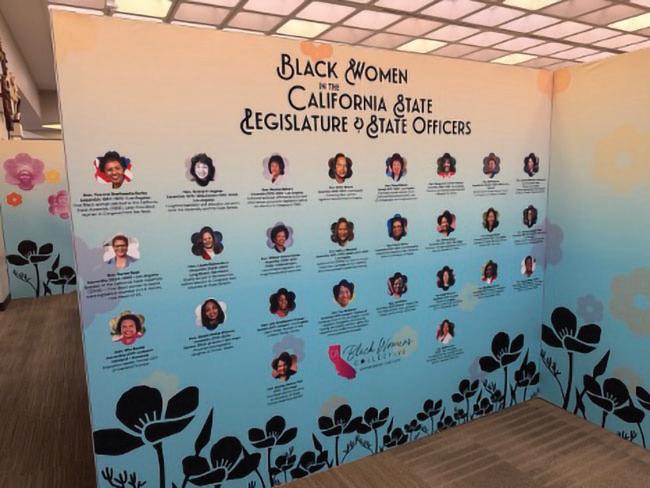
For the lawmakers who spoke, the wall was personal. State Sen. Lola Smallwood-Cuevas (D-Los Angeles) noted she is only the 21st Black woman elected to the Legislature in its 175-year history and the first to chair the Senate Labor Committee.
"Our ancestors didn't just survive history," she said. "They changed it."
Smallwood-Cuevas tied the exhibition to her push to build California's first designated Black historic cultural district, an effort she said could protect some 4,000 Black cultural assets across South Central Los Angeles.
“If we don't tell our stories, no one will,” she said. “If we don't claim our space, others will come and claim it for themselves.”
That theme of erasure and the work of resisting it anchored remarks by Dr. Donna Nichol, the first Black dean of the College of Liberal Arts at California State University, Long Beach.
perform to keep the gravy train moving. The judges intentionally order children into foster care, terminate parental rights, order guardianship and adoption without trials, impartial tribunals, due process, jurisdiction, or authority, rendering the orders void when uttered. The rule of law is gutted. No trials. No defense. No impartial tribunals. No due process. Under the Public Contracts Code and the express terms of the legal services contracts, the law firms are mandated to submit detailed monthly invoices on each case to the Board to document compliance. In addition, the law firms certify compliance with the contract and the above-cited law on each monthly invoice for each case, even when minute orders prove otherwise. The minute orders prove non-compliance with said law, which rendered hundreds of thousands of monthly invoices fake, sham, false, and fraudulent. It should be noted that violations of these laws not only breach the contract but also violate due process under the landmark 1923 US Supreme Court case, Meyer v. Nebraska. The Supreme Court held that violations of legislative enactments governing the court process to transfer child custody to the state constitute “due process” violations.
The judges have actual knowledge that the lawyers violate WIC 317, WIC 355, CRC 5.534, CRC 5.660, CRC 5.682, and In re Malinda S., denying the parties due process/ impartial tribunals. The judges know the lawyers’ violations are due process violations that prevent jurisdiction from attaching, leaving the judge with no authority to make any orders except to continue the case and order the CSW to appear in court and testify under oath on cross-examination. Instead, judges “rubber-stamp” unopposed perjured child abuse allegations and order foster care, as documented in 1994.
We’re back to Legal Slavery before the 14th Amendment, when Slave babies were ripped by the roots from their families
continued on page 4
She opened with the story of her grandmother, Catherine Tarpley, a USC-trained historian who helped open the first cooperative food market in Watts in 1980. When the Los Angeles Times covered the effort, Nichol said, every man in the room was named in the article. Her grandmother was not.
“My grandmother was not the exception,” Nichol said. “She was the rule.”
Nichol traced a lineage of California Black women who built institutions from nothing: Biddy Mason, who won her freedom in a Los Angeles courtroom and
became one of the city's wealthiest landowners; Mary Ellen Pleasant, who funded John Brown's raid on Harpers Ferry and sued to desegregate San Francisco's streetcars; newspaper publisher Charlotta Bass, the first Black woman nominated for U.S. vice president; and librarian Miriam Matthews, who assembled one of the most important archives of Black California history. The lesson, Nichol argued, is that records are never neutral. Historians, she said, are trained to read “against the archive” to ask not only what is preserved but what is missing and why.
“The archive is the foundation on which all future work rests,” she said. “If we do not build it, no one else will build it for us.” Los Angeles County Supervisor Holly Mitchell, the second Black woman to serve on the board after Yvonne Brathwaite Burke, said she took pride that the exhibition lives at a county facility in her district. She urged attendees to bring the next generation including young men reminding the crowd that honoring Black women is not work for women alone.
Black Resource Center librarian Cheryl Paul, a former history teacher, told visitors the collection belongs to them and pressed them not to keep it to themselves.
“We are the diaspora,” she said. “Every corner of it is represented in these four walls.” The center, established in 1978, has long worked to preserve African American history and culture. County Librarian Dr. Skye Patrick said the museum and accompanying oral history project ensure those stories “remain accessible for future generations.”
California’s News “Career Passport” Program Aims to Connect Workers to In-Demand Jobs
Bo Tefu and Antonio Ray Harvey| California Black Media
California is launching a pilot program for its new Career Passport, a digital tool designed to help workers connect with employers by highlighting their skills, training and work experience rather than relying solely on college degrees.
The pilot phase began June 17 and runs through Aug. 24 as the state evaluates four vendors competing to build the platform. Officials say the Career Passport will help qualified workers, including those without four-year degrees, gain access to in-demand jobs while making it easier for employers to identify talent.
The initiative is part of Gov. Gavin Newsom’s Master Plan for Career Education and reflects California’s broader effort to promote skills-based hiring. The digital tool will allow users to securely share verified records of their education, job training, military service, work experience and professional credentials with potential employers.
“We’re working to connect qualified Californians to employment opportunities they may have otherwise been overlooked for,” said Newsom. “California’s Career Passport will be a win-win for our workforce, ensuring that relevant skills, credentials and real-world experience are recognized, and that capable workers are not being filtered out simply because they
lack a four-year degree.” State officials say the Career Passport will combine traditional academic records, such as high school and college transcripts, with skills and credentials earned outside the classroom. The approach, known as a Learning and Employment Record, is intended to give employers a more complete picture of an applicant’s qualifications. Labor and Workforce Development Agency Secretary Stewart Knox said the platform will help create stronger links between education and career opportunities.
“The Career Passport will create connected pathways that help workers and students gain the skills and opportunities they need to thrive,” said Knox. “California is committed to ensuring every person has access to family sustaining careers by building a workforce system that starts with the realities of workers, no matter where they begin.”
The program is being developed in partnership with the California Community Colleges system and will involve collaboration among state agencies, educational institutions, workforce organizations and employers.
Officials say the Career Passport builds on California’s workforce development efforts, including registered apprenticeships and earn-and-learn programs.
From left: Angela L. Minniefield, chief operating officer of Charles R. Drew University of Medicine and Science; Sharol Caw; California Black Media Executive Director Regina Wilson; state Sen. Lola Smallwood-Cuevas; Lakewood Mayor Cassandra Chase; California Black Women’s Collective Empowerment Institute President and CEO Kellie Todd Griffin, who curated the exhibition; state Sen. Laura Richardson; Los Angeles County Supervisor Holly Mitchell; and Dr. Skye Patrick, director of the LA County Library, at the ribbon-cutting for the Museum of Black Women and Girls pop-up on June 20, 2026. (Photo by Karim Saafir Photography)
Photo: Shutterstock.
Alicia Keys: Girl from Hell’s Kitchen —
Tribeca Film Festival 2026
By Dwight Brown, Film Critic for DwightBrownInk.com and NNPA News Wire
“I’m just a kid from Hell’s Kitchen.” But many New Yorkers think of her as the city’s daughter. And now viewers of this dual-track documentary will know how that neighborhood influenced her and how she helped make it famous.
Two intertwining storylines bind this bio/doc that’s seasoned with Alicia Keys’ vibrant music. Her NYC background mingles with the making, staging, developing and opening of her Broadway musical Hell’s Kitchen. When one avenue gets a bit tiresome, the other half often perks up the footage and vice versa. Often but not always. So those who love Keys and her music or are curious how to develop a musical for Broadway may remain entertained and intrigued. Others might not.
Emmy-nominated executive producer, director, and multimedia artist One9 (né Michael Baluyut Silverman), a former street artist and muralist, is a Brooklynite steeped in hip hop culture. His filmography
includes docs (Nas: Time is Illmatic, 2014) and series (Hip Hop: The Songs That Shook America, 2019) and Prime Video docuseries (Allen Iverson, 2025). Knowing his background is essential to understanding the pros, cons and specifics of this Keys homage. This isn’t a traditional point-and-shoot doc. This feels like taking a subway ride while images of 1990s Times Square flash past on the tunnel walls. Its unique style leans toward viewers who came of age in the 1990s. The heart of Keys’ upbringing is the Manhattan Plaza, a building between 9th and 10th Avenues and 42nd Street and 43rd Street in NYC. It opened in 1977 in a gritty neighborhood filled with sex stores, hookers, drug addicts and Broadway theaters. These video clips have an edge to them and will be quite a shock to some viewers and tourists who had no idea that the Disneyfied Times Square they experience today
Military Child Care, a National Model, Faces Limitations...continued from page 2
Off-base, the community has lost 32% of its licensed child care sites in the last decade, according to One Place. In the time since the local child care task force started meeting, six programs have closed, with another center closure expected this summer, One Place staff said. Programs are serving about 3,000 children, 200 fewer since October. Licensed care in Onslow County is meeting roughly 45% of the potential need, according to a national analysis from the Buffett Early Childhood Institute at the University of Nebraska. The average annual cost for infant care in the county is $12,168, according to a task force presentation.
Providers, as is the case in the child care industry across the country, are stuck. They cannot pay their teachers competitive wages and keep care affordable for families. “This is not an issue that (we) can wait any longer to solve,” Rochelle said.
On-base, eight CDCs are serving about 1,452 children, according to a local meeting presentation. With the military’s investment, teachers receive higher pay than their off-base peers and are offered benefits, including free child care for their own children. Parents pay on a sliding scale based on their family’s total income. Priority is given to children based on their parents’ rank and working status.
The investment translates into kinds of access and quality that are often difficult to provide in private care, Nelson said. For example, CDCs can offer more care for infants and toddlers, which is particularly difficult to come by in the private industry because of its low ratio requirements. At one of the larger CDCs on base, Nelson said eight of its 24 classrooms serve infants. Twenty out of the 24 rooms are for children under 3 years old.
“You don’t see that (off-base) because the cost of care is so expensive when you have those smaller group sizes and ratios,” Nelson said.
Thursday, June 25, 2026
Military Child Care, a National Model, Faces Limitations...continued
through March of 2025.
“It’s much more challenging now — much more challenging,” said Gina Shepherd, director of New Beginnings Child Care, which owns three child care sites and one private K-12 school in the area. The program was able to raise base teacher pay by about $4 while receiving stabilization grants, Shepherd said, which administrators have maintained. Without that outside funding source, the budget is tight month to month, she said. And finding quality staff who will stay has gotten harder.
At the time of EdNC’s visit in March, Shepherd had an empty 2-year-old classroom and was waiting to find a qualified teacher to open another NC Pre-K classroom. “I can say with certainty that staffing has never quite been the same,” Shepherd said.
At Quality Childcare and Preschool, with locations in Sneads Ferry and Holly Ridge, owner and director Shannon Pope said she is balancing the same math problem. Pope is continuously looking for grants and extra funding to support and retain teachers. “The margins are tight,” Pope said. “If you want to treat your staff well and make sure that the morale is high and they stay with you, that is where your entire budget goes, is to your staff.”
The program participates in the TEACH scholarship program, which covers teachers’ tuition to go back to school. Pope also signed the centers up for the early childhood apprenticeship program to allow teachers to work while earning credentials. She, like Shepherd, also increased teachers’ wages with stabilization funds. She provides health insurance and paid time off, unique benefits in the field. It is a constant struggle to find the funding to support staff and not price out families, she said.
Shannon Pope, owner and director of Quality Childcare and Preschool, shares her workforce strategy at a January roundtable discussion for child care providers, convened by One Place. ‘We need to tap into community-based child care’ Despite consistent investment and high quality, the military has struggled to keep up with families’ demands for care, running out of space on installations. In recent years, branches have launched new programs that utilize communitybased providers to meet families’ needs.
In the last two years, commanders across North Carolina’s bases have raised child care as one of the top quality of life concerns, said Joseph Speranza, a retired senior chief corpsman and member of the North Carolina Military Affairs Commission. When Speranza was in the service, his spouse stayed home to take care of their children. They were able to survive on one income, which is not the case for most military families today.
“We always had issues; however, I think they’re getting worse,” said Speranza, a member of the local task force. In a 2025 survey from national nonprofit Blue Star Families, 68% of military family respondents said having two incomes is “vitally important to their family’s financial wellbeing.” Respondents listed child care as one of their main challenges, with 86% citing high costs, 67% citing long waitlists, and 52% citing concerns with the quality of care.
In Onslow County, a relatively low cost of living, older on-base facilities, and Hurricane Florence damage have all factored into many families’ decisions to live off base in recent years, Speranza said. That also impacts families’ care preferences. “So what … more of the military service members do is they end up flooding our local communities,” Speranza said.
CALL
TO
without due process, without impartial tribunals. In 1866, after the Civil War, Congress enacted the 14th Amendment to prevent the removal of children from families without due process.
In 1866, Congress enacted 18 U.S.C. § 242, Violation of Civil Rights Under Color of Law, to criminalize violations of the 14th Amendment by anyone acting under color of law [law enforcement]. In 1867, to defeat the rise of the KKK, Congress enacted 18 USC 241 Conspiracy to Violate the Civil Rights of a Person, to criminalize the conspiracy between two or more people, not acting under color of law like the KKK, to violate the 14th Amendment rights of another.
Consequently, the Board ends up with 85% more children in foster care due to fraud and corruption in courtrooms hidden behind walls of confidentiality.
That means 85% more legal fees, more judges, more social workers, more foster parents, more abused and raped foster children, all stemming from one root cause – the lawyers who violated due process to increase the number of children in foster care to collect more money –“Kids for Cash”.
San Bernardino Dependency court is nothing more than a crime scene, a criminal operation, another “Kids for Cash” scandal like the one in Luzerne County, Pennsylvania, in 2014. In the much-publicized Penn “Kids for Cash” scandal, featured on American Greed and a documentary, two delinquency judges ordered thousands of children detained without impartial tribunals for kickbacks from the detention centers. The US Attorney prosecuted the judges under 18 U.S.C. § 242 [1866], Violation of Civil Rights
With the military’s investment, CDCs are also able to hire personnel outside of classroom teachers to meet children’s needs. Centers have child care health consultants and behavioral health staff, for example, which helps serve children with special needs.
“Military child care is able to support, in many cases … children that programs out in town would really struggle with supporting — special medical needs or those emotional regulation needs — and not because the folks out in town care any less, but because they don’t have those additional supports that are so helpful,” Nelson said.
As of 2015, 97% of CDCs were nationally accredited, according to a 2020 report from the Congressional Research Service, compared to about 9% of civilian centers. Raising quality all comes back to fairly paying and investing in people, Nelson said. On top of higher pay and benefits, Nelson said the on-the-job training CDCs provide to teachers through online modules removes barriers to entering the profession.
“Quality doesn’t come from the store,” Nelson said. “Quality comes from the people. And so when you invest in the staff, in the workforce, that’s how you increase quality.” ‘I’m always conflicted. Do I do it for the staff? Do I do it for the families?’ In off-base community-based programs, providers are trying to do just that with limited resources. Without the kind of consistent and robust outside investment that military programs receive, they are often bending over backwards to pay teachers and keep care affordable for families. It’s a math problem that has become harder to solve since the end of pandemic stabilization funds, providers told EdNC. Stabilization grants were first provided to child care facilities by the American Rescue Plan Act of 2021 and then extended at a lower rate by the state legislature
“I’m always conflicted. Do I do it for the staff? Do I do it for the families?” she said. “Well, if we didn’t have families, I wouldn’t be able to pay my staff and wouldn’t have staff. But if I don’t have happy staff, then I have angry families. I don’t know what to do.” “I want us to thrive, and not just, you know, tread water all the time,” she said.
In some cases, a lack of child care leads to military families making tough decisions, like choosing for a spouse to juggle work and care or drop out of the workforce. When Shannen Downing’s husband was stationed as a pilot at Marine Corps Air continued on page 7
Alicia Keys: Girl from Hell’s Kitchen — Tribeca Film Festival 2026...continued
was a pit yesterday. In those days, the development couldn’t find tenants and became subsidized housing for artists.
One of the most interesting parts of the doc is finding out who Keys’ neighbors were and who worked there. The list is impressive from Philip Seymour Hoffman to Giancarlo Esposito and Larry David to Samuel L. Jackson, who once worked there as a doorman. A basement cabaret room, “Ellington,” is where Keys as a kid would play piano and dream of being an artist/musician. This was her nest. Her laboratory. Exploring Keys’ center of gravity helps audiences understand how she developed her contagious optimism, inclusive view of life and yearning to perform her own music.
The footage and its vivid array of photos, videos and interviews chronicle Keys’ life from childhood to adulthood. The film recounts her single mom’s challenges raising a kid in NYC. It follows her music lessons, first songs, early recording contracts, and eventual partnership with Clive Davis and Arista Records. Davis proclaims: “Not since Whitney had I seen a young talent…” Her feelings about the music world, family, friends and influences are duly noted. It’s all spiced up as she adds in her experiences with hip hop, partying at New York nightclubs and developing a style that’s won her multiple Grammy Awards.
The competing storyline to her bio follows Keys’ long-gestating Broadway musical Hell’s Kitchen. Writing, developing,
auditioning, hiring rehearsing and staging. Starting at the Public Theater, moving to the Great White Way. It’s a howto guide on turning a seed of an idea into a Tony-nominated and Tony-winning musical.
The casualness of Keys’ DIY mentality underlines her genius and ambition. However, some of this portion can be tedious and One9’s direction doesn’t find a way to make it more exciting. The footage is more suited for a behind-the-scenes trailer than a film.
The core of this story is a very spiritual human being who expresses herself in the most sensitive ways. You see it in how she treats all the people she encounters. The touching ways she helps the novice lead actress in the musical, Maleah Joi Moon, understand her role and gain the confidence to play the woman who’s her mentor, Alicia Keys at age 17. Touching as it is, it goes on for too long.
If editors Chris Iversen and Joseph Volpe had found ways to clip the film down from 96 minutes to 90 or less, it would run tighter. If they’d requested longer scenes and not so many short unsettling ones, audiences might be happier. Cinematographers Michael Koshkin and Snyder Derival’s work is perceptive but never astounding, either in its lighting or visual composition. What’s on view looks like lowbudget filmmaking. Guerrilla, grassroots, home-video-like. Never really visually attractive. Just bits and pieces for the eyes. Something feels off, from a
continued in last 2 columns
from page 3
Under Color of Law. The judges were convicted and sentenced to 29 and 17 years, respectively. The San Bernardino dependency judges also ordered thousands of children detained without impartial tribunals to collect Title IVE for foster care and legal fees. The San Bernardino dependency judges are as guilty of 18 USC 242 Violation of Civil Rights Under Color of Law as the two delinquency judges in Lucerne County, Penn. The consequences are catastrophic: mass separation of children from families to state-run foster care, where abuse and neglect are rampant and covered up by judges and lawyers, families destroyed forever, children and parents profoundly traumatized. The law firms are guilty under 18 U.S.C. § 241 [1867] of conspiracy to Violate Civil Rights for violating the due process rights of 6,000 children and 12,000 parents. The criminal penalties range from a fine to life in prison to death, depending on the severity of the crime. The Board has reached the Rubicon, the “point of no return”: follow this Blueprint, restore the rule of law, terminate the corrupt law firms, reunify 6,000 children with 12,000 parents, end the foster child sex trafficking pipeline, end future lawsuits, and save $ 50 million in foster care costs each year. This is our “Call to Action”! We will be heard! We will make “Good Trouble” until the rule of law is restored, the lawyers removed, and our Children released! We will attend every meeting and bring more voices and more media until this Board protects our families and answers this urgent and hopeful “Call to Action”! June 23, 2026
This Week’s Quote
“I’d rather regret the risks that didn’t work out than the chances I didn’t take at all -”Simone Biles
Alicia Keys: Girl from Hell’s Kitchen — Tribeca Film Festival 2026...continued
technical standpoint. Like an ambitious, eclectic approach to doc filmmaking was better on script than it was on screen. What’s on view makes you wonder how much more interesting this film might have been if it concentrated solely on Keys, her life, music and performances. While effectively
capturing Keys’ streetwise nature, this documentary never achieves the same polish and artistry she displays.
For more information about the Tribeca Film Festival go to: https://tribecafilm.com Visit Film Critic Dwight Brown at DwightBrownInk.com.
New Glendale Rental Assistance Program Application Period to Open July 6, 2026
Glendale, CA – A new rental assistance program in Glendale aims to address housing affordability and stability for Glendale renters experiencing a destabilizing financial event. On July 6, 2026, the City of Glendale will open a two-week application period for the new Glendale Rental Assistance and Stabilization Program (GRASP), which will provide eligible renters with targeted temporary financial support. Applications will be available online at Engage. GlendaleCA.gov/GRASP. The application period will close Monday, July 20, 2026, at 11:59 PM. The application will be used to determine whether a household qualifies for the program and will allow the City to create a ranked list of qualified households based on urgency of need and other vulnerability factors identified by the program. To qualify for GRASP, applicants must: Be Glendale residents at the time of application, award, and participation, Have a gross
Be prepared to provide verifying documents, and Be experiencing either a loss of housing, utility shutoff, rent eviction, job loss, or major medical expenses within the last 12 months. A more detailed listing of financial hardships can be found at Engage.GlendaleCA. gov/GRASP. Depending on the household’s circumstances and level of need, applicants may receive different types of assistance through GRASP. Assistance may include: Emergency rental assistance to prevent eviction Short-term income-support payments to help stabilize households experiencing temporary financial hardship Utility assistance to prevent shutoff or restore services
A one-time housing-related support necessary to help households remain housed or secure stable housing within Glendale Emergencies include being at risk of eviction, experiencing a utility shutoff, and/or a health or safety condition. In an emergency scenario, GRASP may cover up to six total months of rent and utilities continued on page 6
Alicia Keys stars in Alicia Keys: Girl from Hell’s Kitchen
Thursday, June 25, 2026
THE SAN BERNARDINO AMERICAN NEWS -HEALTH/LOCAL NEWS
The partnership aims to raise vital funds while inspiring other local businesses in the San Bernardino area to implement similar community-driven philanthropic programs.
SAN BERNARDINO, CA
—Wilson & Company, Inc.,
Engineers & Architects has launched a corporate fundraising campaign in partnership with The CARE Project, Inc., kicking off the initiative with an initial $2,000 corporate donation.
The campaign is open to Wilson & Company employees to drive additional community support. This collaborative effort is part of the firm's annual "Higher Giving" initiative, which pairs regional offices with
local nonprofits that reflect the passions of their workforce.
The partnership aims to raise vital funds while inspiring other local businesses in the Inland Empire area to implement similar community-driven philanthropic programs.
Expanding Employee Awareness and Education
A key focus of the partnership is raising awareness about breast cancer support resources among
local professionals. To deepen this connection, The CARE Project will host an upcoming educational "Lunch and Learn" presentation directly at the Wilson & Company facility. This session will educate employees about the challenges cancer patients face and explain how corporate giving directly impacts local families.
“We believe our responsibility extends beyond the projects we deliver. Through our partnership with The CARE Project and our Higher Giving program, we are investing in the well-being of the communities we serve. Giving back is not separate from our work. It is a reflection of who we are as a firm and our commitment to making a lasting, positive impact where our people live and work.” James Brady, PE, President and CEO at Wilson & Company.
"Wilson & Company has stepped up by putting their values into action," said Carrie Madrid, founder and president of The CARE Project, Inc.
"Their $2,000 corporate gift and active employee campaign ensure that our message reaches a brand-new audience of working professionals. We hope this partnership serves as a blueprint for other local businesses to invest in grassroots community
care."
How to Support the Campaign
Community members and local businesses looking to join Wilson & Company in supporting breast cancer patients can view live progress, read program updates, and make a direct contribution through the official Higher Giving Wilson Campaign Page: https://givebutter.com/highergiving-wilson.
What the CARE Projects Does The CARE Project, Inc. provides a range of essential services to breast cancer survivors, including: Financial support for treatment co-pays, rent, utilities, groceries and transportation.
Emotional support through peer mentoring and the Survivor Social Club.
Lymphedema care via a partnership with LymphaDivas, providing compression sleeves, gauntlets and gloves to survivors at no cost.
For more info on The CARE Project, contact Carrie Madrid, Founder and President, at CMadrid@TheCareProjectInc. org, TheCareProjectInc.org, or (951) 742-7405.
L. A. Care Association Secures $500,000 Grant to Unlock Licensed Beds for Homeless Angelenos With Mental Illness
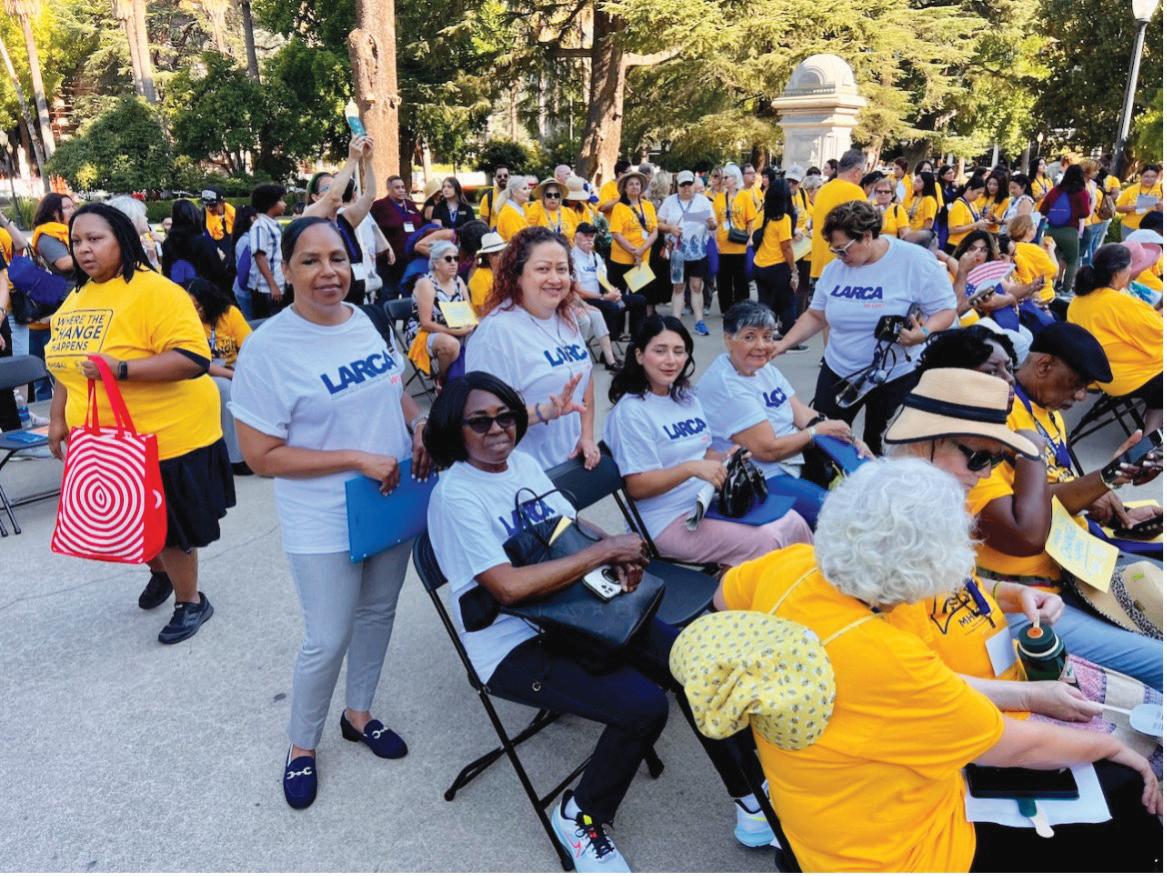
The Licensed Adult Residential Care Association (LARCA)members in Sacramento are asking for help for state-licensed Adult Residential Facility (ARF) and Residential Care Facility for the Elderly (RCFE) operators across
ANGELES
"Four years ago, I was hired with a mandate to organize and strengthen licensed care as a cornerstone of the county's housing and health systems," Tinson explains. "This funding gives us the resources to finally connect those dots, and to make a meaningful dent in one of the most urgent crises facing Los Angeles."
The initiative, called the Community Marketplace Hub, will provide coordinated
technical assistance to statelicensed Adult Residential Facilities (ARF) and Residential Care Facilities for the Elderly (RCFE) operators across Los Angeles County.
The Association’s goal is to activate available capacity, streamline placement referrals and align public funding streams (including Medi-Cal's CalAIM program) and the state's Assisted Living Waiver, in order to serve more low-income Angelenos living with serious mental illness, co-occurring substance abuse disorders and physical disabilities.
ABOUT THE PILOT PROJECT
LARCA represents more than 440 state-licensed ARF and RCFE providers across Los Angeles County. Together, these facilities house and care
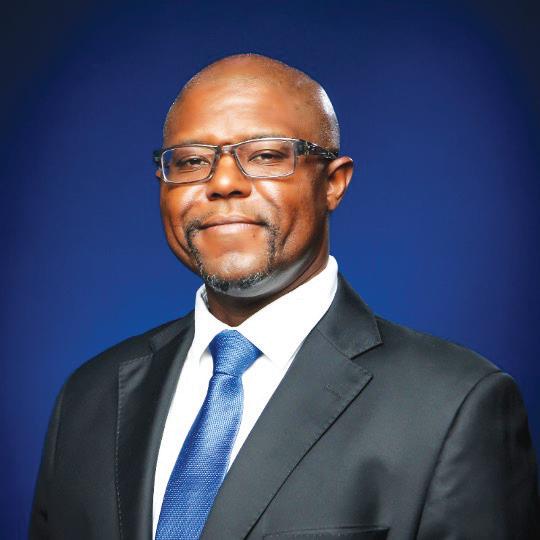
"I am grateful for this opportunity to improve housing and care for thousands of Angelenos and to contribute a meaningful solution to the County's response to the homelessness crisis," said Bennie Tinson, Executive Director of LARCA. He is running for a seat on the Compton City Council, District 2
LARCA Adult Residential Facility (ARF) and Residential Care Facility for the Elderly (RCFE) operators for thousands of low-income residents, a population comprised of disproportionately high risk homeless, who often cycle through hospitals, jails, and emergency shelters when stable housing is unavailable.
The Community Marketplace Hub will address that gap by:
• Activating underutilized licensed ARF/RCFE capacity and increasing placement rates across the county.
• Reducing discharges to the homeless from hospitals, county jails, and other institutions.
• Increasing facility
L. A. Care Association Secures $500,000 Grant to Unlock Licensed Beds for Homeless Angelenos With Mental Illness...continued represent state-licensed ARF and RCFE providers in Los Angeles County, facilities that serve adults with serious mental illness, developmental disabilities, physical health needs and co-occurring conditions. The Association has grown to more than 440 member facilities since its founding, making it one of the largest organized voices for licensed residential care in the region.
Los Angeles County continues to face one of the most severe homelessness crises in the United States, with a significant share of those experiencing homelessness living with untreated or undertreated behavioral health conditions.
ABOUT LARCA
The Licensed Adult Residential Care Association (LARCA) is the leading advocacy and support organization for statelicensed Adult Residential Facilities (ARF) and Residential Care Facilities for the Elderly (RCFE) in Los Angeles County. LARCA's 440+ member facilities provide housing and supportive care for thousands of low-income Angelenos living with serious mental illness, co-occurring disorders, developmental disabilities and physical health needs. For more information, visit LARCALA.org.
New Glendale Rental Assistance Program Application Period to Open July 6, 2026...continued from page 4 per household.
Cost of living and affordable housing are top concerns for many Glendale households, according to the 2025 City of Glendale Community Survey. In September 2025, the Glendale City Council established GRASP using funding through the Los Angeles County Affordable Housing Solutions Agency (LACAHSA) Renter Protection & Homelessness Prevention (RPHP) allocation. The Council provided additional direction on the program’s structure in December. Additional application periods will depend on the availability of funds after assisting eligible applicants with the highest level of need. To learn more about GRASP, visit Engage.GlendaleCA. gov/GRASP. The public may also contact the program at GRASP@ GlendaleCA.gov or (818) 550-4727. Free language assistance, interpreters, and reasonable accommodations for people with disabilities are available upon request.
Because GRASP is exclusively a homelessness prevention program designed to keep active renters in their homes, homeowners, mortgage holders, and individuals who are currently experiencing homelessness are not eligible to apply. GRASP
participation in Medi-Cal (CalAIM), the Assisted Living Waiver (ALW) and other state and federally funded programs.
• Establish a scalable, replicable model for coordinated housing access that can be adopted by other counties.
The pilot program is designed to develop a model that can be replicated across California, addressing a gap long identified by housing advocates.
BACKGROUND
LARCA was founded to
Investors
If you want to impress your investors, you need clean unit economics, scalable growth models, and clear use-of-funds plans. You won’t get a call for a second meeting if you lack these features. A fractional controller will help you with these to keep you investor-ready.
Grants and Government
Contracts
Federal minority business grants have strict financial compliance requirements. From the Minority Business Development Agency to the SBA 8(a) program, all these programs need you to produce quarterly financial reporting. With CFO consulting, you’ll always have the right paperwork to keep you compliant so that you can easily access funds.
Frequently Asked Questions
What Are the Biggest Financial Mistakes Black Business Owners
Make?
Growing a Black business is one way to start building generational wealth. However, some financial mistakes may be holding you back.
These errors include:
Mixing personal and business
finances
Failing to perform cash flow
forecasting
Trusting only family members for financial advice
Hiring a bookkeeper and calling it accounting
Waiting for your business to be ready before hiring help
You can fix these issues by bringing a fractional CFO on board. They have the financial expertise to make your small business gain generational returns.
How Does a Fractional CFO
from page 3
Differ from a Full-Time CFO?
If you hire a full-time CFO, you’ll need to budget for a salary of $250K+ annually, plus benefits and equity. On the other hand, a fractional CFO offers their expertise at a fraction of that cost, usually 25-50%. The reduced costs allow you to get the financial advice you need without wasting capital you would have spent on growth.
Since they work in different industries, an outsourced CFO brings a lot of creative ideas and insights to your company. With a fractional CFO,
strategies. To be an expert in tax reduction, you need to have in-depth knowledge of tax law. As a result, you should hire a CPA for tax planning. However, you can reduce costs if you vet candidates and ensure you hire a CFO with extensive expertise in tax planning. This process allows you to
Partner With a Fractional CFO and Grow to Scale As a Black business
you should be sensitive about your finances. Hiring a fractional CFO is a cost-effective way to ensure your finances are in order without incurring the
costs of a full-time salary and benefits. For more business tips, subscribe to our newsletter.
The CARE Project, survivors, and Wilson & Company, Inc., Engineers & Architects celebrate their $2,000 donation to support women and men battling breast cancer in the IE. Diana Jaurigue, Christina Villanueva, Gina Fitzsimmons and Elsa Napole.)
Los Angeles County
Thursday, June 25, 2026
Up to Ten Thousand Attendees Pack Ferguson Park: Juneteenth Jam In Rialto Becomes
One Of The Biggest Community Celebrations Of The Year
RIALTO, CALIFORNIA — June 19, 2026 — What happened at Fergusson Park on Juneteenth was more than just an event — it was a movement.
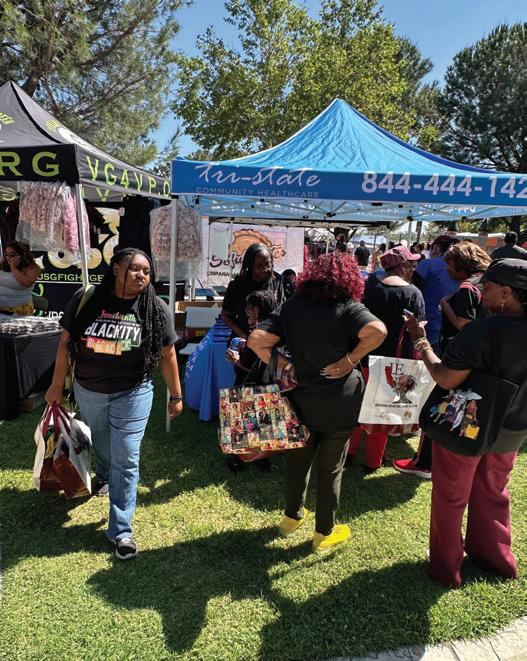
From 3 PM to 9 PM, thousands poured into Fergusson Park in Rialto, transforming the park into a sea of joy, celebration, unity, and hope. Families arrived from across the Inland Empire to experience what many are now calling one of the most impactful Juneteenth celebrations Southern California has seen in years.
The numbers alone are staggering:
10,000+ attendees
740 children received brandnew outfits
Hundreds of kids received essential supplies and toys
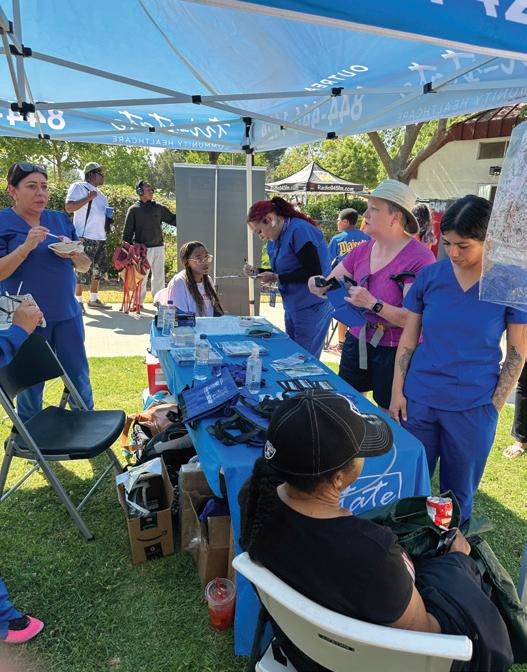
180 adults received FREE medical check-ups
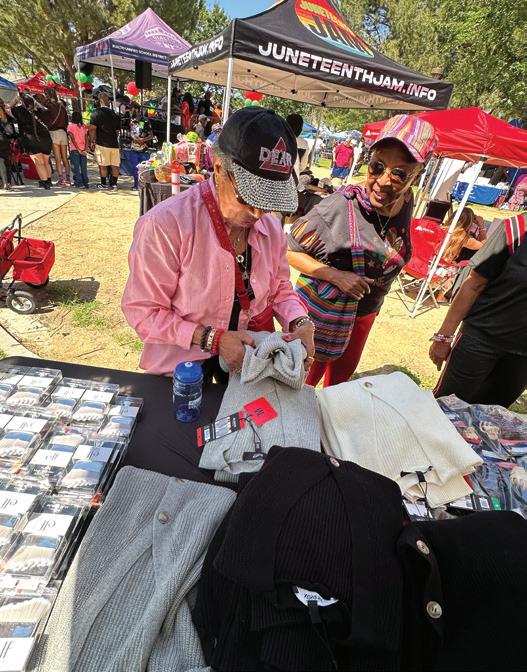
160 women received luxurious Cashmere sweaters from Macy’s
1,000 men received Father’s Day gifts
But beyond the numbers was something even more powerful: love in action.
Children ran through the park smiling with excitement as they
received new clothes and toys. Parents expressed gratitude with tears in their eyes, overwhelmed by the generosity shown to their families. Fathers proudly accepted Father’s Day gifts, many saying it was the first time anyone had celebrated them in such a meaningful way.
The event delivered everything a community could hope for: fun, food, entertainment, family activities, music, health services, and life-changing resources.
The energy was electric.
Laughter filled the air. Music echoed throughout the park.
Families danced, ate, connected, and celebrated freedom, culture, and community.
At the center of this extraordinary effort were Vickie Davis and Eugene Weems, whose commitment to serving underserved communities continues to make a lasting impact across the Inland Empire.
This wasn’t charity for cameras.
This was real community leadership.
For Eugene Weems—world champion kickboxer, community activist, CEO of VG4VP, and congressional candidate
reflect
events like
he
for years: bringing resources directly to the people.
“Juneteenth is about freedom, resilience, and progress,” Weems said.
“But freedom means little if families are still struggling to eat, access healthcare, or provide for their children. We believe in action. We believe in showing up. We believe in serving people. Vickie and I been doing that for many years. Her profession as a licensed therapist has helped so many at risk kids and families That I come across. The Work that we do not publicize. This Juneteenth thing was her Vision, her dedication and hard work.
Slow Walking DACA Renewals Hurts Dreamers and the Economy
By Edward Kissam
Andres (we are only using his first name because of the sensitivities of his case) is an emergency room doctor in the first year of his residency. He works in an urban hospital in the San Francisco Bay area which, like most, is chronically understaffed.
He is also among a growing number of DACA recipients across the country whose renewal applications are being delayed — some say intentionally.
“At first I thought it would come through,” said Andres, who submitted his DACA renewal application soon after Thanksgiving last year. “After 2 weeks I began to realize that it might not come through. The more time you have to think things over the worse it gets. I forgot who I was.”
United States Citizenship and Immigration Services (USCIS), the federal agency that oversees DACA, advises beneficiaries to submit their renewal applications 4-5 months before expiration. But the routine renewals that once took just 2 months to process are now taking as long as 6-7 months. Any application submitted more than 5 months before expiration, moreover, may be rejected.
For people with DACA, the delays are more than just a bureaucratic hiccup. They threaten their status in the country, and with it, their ability to work and earn a living.
In Andres’ case, he did everything right, filing for extension as advised and paying the $555 extension fee. Seven months later he’s still waiting for a response from USCIS. In the meantime, his work authorization expired in early March, prompting his employer, a major health care institution, to suspend him from work.
The experience has disrupted his life. “Even though they give us a chance to be someone, they can still take it away,” he said. While the administration attributes the delays to stricter screening and background checks, advocates argue the White House is intentionally slow walking processing of DACA renewals.
The move, they argue, is part of a broader strategy aimed at detaining and deporting immigrants without generating the kinds of public outcry seen in cities like Minneapolis, where two U.S. citizens were killed by federal immigration agents during Operation Metro Surge
in late 2025.
The president’s approval on immigration — long his strongest issue alongside the economy — has steadily eroded since the events in Minneapolis. A Gallup poll last year also found that an overwhelming majority (85%) of Americans, including 71% of Republicans, support legislation to provide DACA recipients a pathway to citizenship.
“I can’t see how it’s not intentional,” Sen. Alex Padilla (D-Calif.) told Politico. “In previous years, we’d get maybe a dozen cases” of DACA recipients left waiting for their renewals. Now “it’s in the hundreds.”
The consequences for individual DACA recipients are severe. An immigrant who works without authorization can be deported and may even face a permanent bar to securing legal status. Employers, meanwhile, face both civil and criminal charges for keeping someone without work authorization on payroll.
The consequences for the U.S. labor market are equally dire. Among the more than half a million DACA recipients, around half are college educated, often working in key positions in health care, agriculture, construction, the hospitality industry, scientific research, and the U.S. military.
Marking the 14th anniversary of DACA, the American Business Immigration Coalition (ABIC) — a bipartisan coalition of more than 1,700 employers — sent a letter to Congress and the Trump administration highlighting the renewal delays.
“The administration is quietly but deliberately forcing highly vetted, highly skilled, and longterm DACA holders out of the workforce,” said ABIC CEO Rebecca Shi during a recent
press conference. “This is not only cruel, but it hurts American businesses and drives up prices for everyday Americans.”
The costs to the country’s health care system are no less damaging. The American Medical Association estimates that about 27,000 health care workers are DACA recipients. Among these, at least 200 are medical residents working very long hours in hospitals across the country. Even a brief lapse in these physicians’ work authorization can wreak havoc in already-understaffed hospitals.
“About 10% of our staff are DACA recipients,” said Deborah Herbert of Monte Vista Grove Homes, an assisted living center in Pasadena, CA. She was among 140 CEO’s who wrote a letter to Congress earlier this month explaining how DACA authorization delays hurt her business.
“Delays in approving DACA work authorizations are forcing us to remove DACA recipients from the work schedule,” Herbert continued. “We are finding it extremely difficult and often impossible to hire new employees fast enough to fill the gaps. So care for older adults is being directly affected and current employees are working double shifts.”
She concluded, “This level of strain is not sustainable for caregivers, residents, and the organization.”
Then there is the personal toll.
“You don’t want to drive anywhere because things might escalate,” said Andres, who has lived in the US since first arriving here with his parents
i’m just part of the foundation that keeps everything solid when she needs someone she can count on and trust.”
Vickie Davis the founder of Juneteenth Jam echoed that same spirit, emphasizing that the event was about uplifting families and restoring dignity. Together, they helped create an unforgettable experience where thousands felt seen, valued, and supported.
In a time when many communities feel forgotten, Juneteenth Jam proved what is possible when leaders stop talking and start doing.
This event wasn’t just about celebration.
It was about impact.
It was about healing.
It was about giving back. And above all, it was about reminding the people of Rialto and the Inland Empire of one powerful truth:
Community is strongest when we take care of each other.
As the sun set over Fergusson Park, one thing became clear: Juneteenth Jam 2026 wasn’t just a success—it was history in the making.
Slow Walking DACA Renewals Hurts Dreamers and the Economy...continued
from Mexico at two years old.
“You always have to look around over your shoulder to see who’s behind you.”
Andres knows he isn’t the only one in his family impacted. His brother, also a health care worker, submitted his own DACA renewal application one week after Andres, in mid-December.
Four months later he, too, was laid off. While his renewal finally arrived in June, he remains out of work.
Andres says the experience brought him back to when he was graduating high school.
“I needed financial aid to go to college,” he recalled.
“My mother told me I couldn’t because I didn’t have an SSN (Social Security Number) … I got depressed and had no energy to do anything.”
Edward Kissam is a leading researcher and advocate for strategies to deal with health issues impacting immigrant communities. He has led research on farmworker and immigrant issues sponsored by the Department of Labor, the Commission on Agricultural Workers, and the National Institute for Food and Agriculture, among others.
City/ Inland Empire News
for California’s 33rd District—
this
a mission
has lived
Image Credit: Victoria Pickering. Via Flickr CC License 2.0