Power concedes nothing without a demand. It never did and it never will. Find out just what people will submit to and you have found out the exact amount of injustice and wrong which will be imposed upon them and these will continue till they have resisted either with words or blows or with both. The limits of tyrants are prescribed by the endurance those of whom they suppress.
—Fredrick Douglass
(1849)
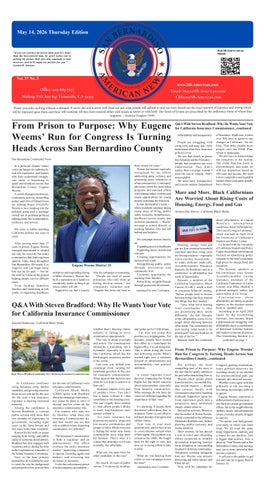
From Prison to Purpose: Why Eugene Weems’ Run for Congress Is Turning Heads Across San Bernardino County
In a political climate where voters are hungry for authenticity, real-life experience, and leaders who truly understand struggle, one name is beginning to spark conversations across San Bernardino County: Eugene Weems.
A world champion kickboxer, community activist, bestselling author, and CEO of Vibrant Green for Vibrant Peace (VG4VP), Weems is now stepping into the political arena with a message rooted not in polished political talking points, but in redemption, resilience, and service.
His story is unlike anything California politics has seen in years.
After serving more than 17 years in prison, Eugene Weems emerged determined to rebuild not only his own life, but entire communities that had long been ignored. Today, many throughout San Bernardino, Riverside, Los Angeles, and Las Vegas know him not for his past — but for the work he’s done on the ground helping people survive difficult times.
From feeding homeless families and mentoring at-risk youth, to organizing healthcare
initiatives and responding during wildfire disasters, Weems has built a reputation as a hands-on community leader willing to go where others will not.
Supporters say that’s exactly
why his campaign is resonating.
“People are tired of career politicians who only show up during election season,” one community volunteer said.
“Eugene has been out here in
these streets for years.”
Weems has become especially recognized for his efforts addressing gang violence and promoting peace initiatives in urban communities. Community advocates credit his mentorship programs and outreach efforts with helping reduce violence and create opportunities for young people searching for direction.
In San Bernardino County — where residents continue facing rising costs of living, public safety concerns, homelessness, healthcare access issues, and economic uncertainty — Weems’ message is aimed directly at working families who feel left behind and helpless.
His campaign focuses heavily on:
Expanding access to healthcare
Supporting senior citizens and veterans
Creating opportunities for underserved youth
Strengthening public safety through prevention and community trust
Economic opportunity for working-class families
Rebuilding neighborhoods through grassroots investment
Q&A With Steven Bradford: Why He Wants Your Vote for California Insurance Commissioner
Edward Henderson | California Black Media
As California confronts rising insurance costs, market instability, and growing concerns about access and equity, the race for the state’s top insurance regulator is drawing increased attention.
Among the candidates is Steven Bradford, a veteran public servant with more than two decades of experience in government, including eight years in the State Senate and five years in the State Assembly. Known for his work on issues ranging from energy and public safety to economic development, Bradford has also engaged with insurance policy during his time in the Legislature as a member of the Senate Insurance Committee.
Now, as the June primary approaches, he is making his case to voters for why his background and perspective best position him
for the role of California’s next insurance commissioner.
California Black Media (CBM) spoke with Bradford about his campaign experiences, key issues he plans to solve if elected, and his vision for the insurance commissioner role. For readers who may not be familiar, what does the Insurance Commissioner do, and how would you use that role to address issues impacting communities in California?
The Insurance Commissioner is both a regulator and an administrator. The office oversees the entire insurance market—approving companies to operate, licensing agents and brokers, and reviewing rate increases or decreases. It also has enforcement power to hold companies accountable—
whether that’s denying claims unfairly or failing to serve communities appropriately.
This role is about oversight and action. The commissioner should be a watchdog, not a bystander, especially in a state like California, which has the third-largest insurance market in the world.
Last year, you shifted your campaign from running for lieutenant governor to the race for insurance commissioner. What spurred that decision and what do you hope to achieve in that role?
Insurance impacts every part of people’s lives. You can’t buy a home without it—that contributes to the housing crisis. You can’t legally drive without it—that affects people’s ability to work. And businesses can’t operate without it. For years, insurance has disproportionately impacted low-income communities and people of color. While everyone is feeling the strain now, those communities have long been hit hardest. That’s why it’s critical that insurance is not just available, but affordable.
What sets you apart from the other candidates in this race?
My record: 26 years of public service. I’ve shown up, stood up,
and spoke up for Californians. I’m also not using this position as a steppingstone. For decades, people have treated this office as a launchpad for higher office. I’m not doing that. This is about doing the work and delivering results. What’s needed right now is someone focused on administration and accountability—not political ambition.
A recent Supreme Court decision impacting the Voting Rights Act has raised concerns about representation, especially from minority communities. What message do you have for voters in California regarding the importance of their vote?
It’s alarming. If people think this doesn’t affect them, they’re mistaken. There’s a real effort to roll back decades of progress and silence voters.
Your vote is your most powerful tool, and we have to use it—every election, not just when it feels urgent. This moment is as critical as the 1960s. We fought hard for the right to vote, and now we’re seeing efforts to take it away.
What are you hearing from voters as you campaign across the state?
Affordability and transparency.
People are struggling with rising costs, and many don’t fully understand what their insurance policies cover.
We saw that clearly in places like Altadena and the Palisades— people had insurance but were underinsured. They didn’t realize their coverage wouldn’t meet the cost to rebuild. That’s unacceptable.
We need more transparency and a more modern Department
Q&A With Steven Bradford: Why He Wants Your Vote for California Insurance Commissioner...continued of Insurance. Right now, it takes over 300 days to approve rate changes in California—far too long. That delay pushes more people onto the FAIR Plan, which is inadequate. We also have to acknowledge the inequities in the system. The FAIR Plan has roots in discrimination, and today we still see disparities based on ZIP code and income. We need a more competitive and equitable market where consumers actually have choices.
More and More, Black Californians Are Worried About Rising Costs of Housing, Energy, Food and Gas
Antonio Ray Harvey | California Black Media
Housing, energy, food and gas are four essential household expenses, and their rising costs are forcing residents—especially lower-income households— to make difficult trade-offs, Assemblymember Rhodesia Ransom (D-Stockton) said at a conference on affordability last week in Sacramento.
Ransom, a member of the California Legislative Black Caucus (CLBC), noted a shift in consumer behavior, stating, “Before people used to choose between things that they wanted and things that they needed.”
“Now, what we're hearing from constituents is they are prioritizing their needs differently,” she said. “Because of the affordability crisis, it's no longer about choosing between other needs. Our constituents are now saying ‘what needs to be prioritized?’ Gas and food are at the top of the list.”
Ransom made the comments
about affordability at Capitol Weekly’s informational conference titled “Affordability: The Cost of Living in California,” which was held on April 30 at the University of California’s Student and Policy Center. Co-hosted with the University of California Student and Policy Center, the political conversations focused on identifying policy solutions to the state’s extremely high prices for energy, food, and essentials.
The keynote speakers at the conference were former Assemblymember Lorena Gonzalez, president of the California Federation of Labor Unions, and Mike Madrid, a political strategist, author, and senior fellow at UC Irvine.
Conversations about affordability are taking on greater urgency as the election season kicks in, speakers said.
According to an April 2024 report by the Greenlining Institute, low-income Black Californians are struggling with affordability due to a combination of historical systemic barriers and modern economic pressures. The Greenlining Institute is a
From Prison to Purpose: Why Eugene
Weems’ Run for Congress Is Turning Heads Across San Bernardino County...continued
But perhaps the most compelling part of his story is the fact that he openly embraces his past rather than hiding from it.
Weems often speaks about transformation, accountability, and second chances — themes that connect deeply with communities that know hardship firsthand. Supporters argue his lived experience gives him a perspective many politicians simply cannot relate to.
Beyond his activism, Weems is also the author of Prison Secrets, a book connected to the infamous Menendez Brothers case, further drawing public curiosity and media attention.
More recently, he has played a role in relief and rebuilding efforts connected to wildfire devastation impacting families from Altadena to surrounding Southern California communities.
Volunteers working alongside him say Weems was present delivering aid while smoke still filled the air.
Now, with his campaign for
Congress gaining momentum, many political observers are watching closely to see whether his unconventional path can translate into electoral success. Whether voters agree with him politically or not, one thing is becoming increasingly difficult to ignore:
Eugene Weems represents a different kind of political story — one built not inside government offices, but in the neighborhoods, shelters, streets, and communities where everyday people struggle to survive.
”No matter your background, your party, or where you come from. We all want the same thing. Opportunity, stability, and a future for our families. This is bigger than politics. This is about us” Said Weems and in San Bernardino County, that message may prove more powerful than anyone expected.
A call out to the public to get out and vote for Eugene Weems District 33.
Eugene Weems District 33
Thursday, May 14, 2026
California must step up to protect programs that engage and support students
California students need more than instruction to succeed. They need consistent support from trusted adults who can help them stay engaged, attend school regularly and navigate the challenges that can interfere with learning.
That is why California should continue funding the Student Success Coach Learning Network in the 2026-27 state budget. Without action from the state Legislature and the governor, this statewide effort could cease to exist, and schools could lose a valuable support system at a time when many students are still struggling with absenteeism, academic disengagement and emotional stress.
That would be a serious mistake. California has already invested in a model that reflects what educators, families and school communities have long understood: Students do better when they are seen, supported and encouraged by caring adults who are present in their lives every day. Student Success Coaches work alongside teachers, counselors and administrators to identify students who are beginning to disengage, check in early and help address academic, emotional and practical barriers before they become more serious. Strong, positive relationships are critical to academic success.
Test scores, attendance, graduation rates and other indicators matter, but they are only part of the picture. When students talk about how they feel about school, they often point to the culture of their school and the quality of the relationships they have there.
The good news is that California has a statewide program showing how to put that understanding into practice. The Student Success Coach Learning Network is a cost-effective strategy for reducing chronic absenteeism and academic disengagement while helping address the social and emotional needs that can interfere with learning.
In Los Angeles, City Year corps members, many of whom were raised in the communities where they work, are helping produce strong results in the schools they partner with. National City Year research shows that schools partnering with City Year are up to two to three times more likely to improve in English and math assessments.
In other communities, student success coaches work in tandem with teachers, counselors and administrators to support students at risk of slipping through the cracks. They build trust. They notice when a student begins to withdraw. They check in before
a small problem becomes a larger one. They help students navigate barriers that can interfere with learning, whether those barriers are academic, emotional or practical.
A long-standing body of research, including from the American Psychological Association, has shown that schools function best when they are built on strong relationships. Learning is more than an intellectual process; it has social and emotional dimensions as well. Students who feel known and supported are more likely to stay motivated and persevere. That is especially true in communities that have long been underserved and where outside pressures often make it harder to focus on school. Without action from the state Legislature and the governor, this statewide effort could cease to exist, and schools could lose a valuable support system at a time when many students are still struggling with absenteeism, academic disengagement and emotional stress.
More than 1,100 Student Success Coaches now serve nearly 76,000 students at more than 215 sites across more than 30 communities in California. But the true value of the program cannot be measured by scale alone. Its real impact can be seen
in students who start showing up again because someone noticed they were missing; in students who begin gaining confidence because someone took the time to listen; in students who stay connected to school because there is finally an adult who knows their name, and who sees beyond their struggles and recognizes their potential.
What is at risk is not just a general commitment to student support, but the continuation of the Student Success Coach Learning Network itself. As federal support tied to AmeriCorps and similar national service pathways becomes less certain, California should make clear that it will continue funding this work in the 2026-27 state budget rather than allowing schools to lose a program that is already helping students stay engaged and succeed.
California has an opportunity to lead by recognizing that helping students succeed requires investing not only in what they are taught, but also in the people who help them stay ready to learn.
Our future depends on preparing today’s students to meet the challenges ahead. That requires more than good instruction alone. It requires trusted adults who can guide, encourage and keep students connected to learning. California should build on the success of this program, not allow it to disappear.
Pedro Noguera, Ph.D., is the dean of the Rossier School of Education at the University of Southern California and a board member for City Year Los Angeles.
The opinions expressed in this commentary are those of the author. EdSource welcomes commentaries representing diverse points of view. If you would like to submit a commentary, please review our guidelines and contact us at commentary@edsource.org.
Inland Empire Mayors Cyber Cup Crowns 2026 Champions and Launches Year-Round Cybersecurity Pathway for Regional Students
538 students. 53 teams. 7,861 challenges solved. The marquee event of a continuous, year-long pipeline now connecting Inland Empire students directly to the region’s top cybersecurity employers.
INLAND EMPIRE, CA. April
27, 2026. The 8th annual Inland Empire Mayors Cyber Cup, hosted by the Inland Economic Growth & Opportunity Collaborative (IEGO), wrapped today with a region-wide awards ceremony marking the start of something bigger: a year-round cybersecurity pathway for Inland Empire students and educators. Curriculum, practice platforms, mentorship, and direct exposure to regional employers now run continuously from September through May, with the Mayors Cup as the marquee event in a yearlong cycle of skill-building. This year’s competition drew 538 students across 53 teams, supported by 35 coaches. Together they logged 7,861 cybersecurity challenges on the program’s training platform, including more than 4,000 solved outside the school day. And 67% of all participants were brand new to cybersecurity. “This isn’t just an event anymore. It’s an ecosystem, designed to continuously build skills, confidence, and connections to real opportunity. Talent is everywhere. Opportunity should be too.” Reg Javier, Interim CEO, IEGO A Year-Round Pathway Educators and students now have continuous access to MetaCTF training, learning labs, and curriculum-aligned resources throughout the entire school year, with on-ramps to nationally recognized competitions,
including Hack The Box and CyberPatriot. The shift is backed by infrastructure: in November 2025, IEGO launched the Inland Empire Cybersecurity Awareness Fund in partnership with the Inland Empire Community Foundation to sustain training, expand awareness across schools and small businesses, and give the broader community a direct way to invest in the regional talent pipeline. Meeting the Region’s Future Employers Before the trophies were awarded, students sat in on a fireside chat with three of the Inland Empire’s most senior cybersecurity decisionmakers, the people who will be reviewing their résumés in three to five years: Kenneth Buerchele, VP and CIO of Eisenhower Health; Patrick Voon, CISO of Loma Linda University Health; and Gabriel Sirlopu, Professor of Computer Information Systems at Chaffey College, U.S. Air Force veteran, and founder of TechCatalyst. Hosted by Michael Contreras, the panel pulled directly from the realities of regional defense work.
“Cybersecurity is not just for tech people. It’s not about being technical; it’s about being curious and having that critical thinking, that analytical mentality.”
Gabriel Sirlopu, Chaffey College and TechCatalyst “I am an educator, and I’m a lifelong learner. I never stop learning, and you have to.
Otherwise, you’re going to be left behind.” Patrick Voon, CISO, Loma Linda University Health “Eisenhower receives millions of emails a month from outside the organization. Ninety-six percent of everything that comes in the door is a threat in one way or another. The students competing today are the ones we’ll need on the wall tomorrow.”
Kenneth Buerchele, VP and CIO, Eisenhower Health 2026 Champions
• High School (1st): The Final Christian Meglio, Great Oak High School (Temecula), back-to-back champions; perpetual trophy returns to the City of Temecula. 2nd: DogBytes (Oak Hills HS); 3rd: Team 2 (Chaparral HS).
• College (1st): Chaffey Computers (Chaffey College); 2nd: SBVC (San Bernardino Valley College); 3rd: RCC TechnoNecromancers (Riverside City College).
• Best New Teams: Chaffey College Cybercats (College), BVMS
127.0.0.1 boys (Middle School), TC CyberStorm (High School).
• Cyber Champion Award: Vertical IT Solutions (accepted by CEO Kody Bakos). Cyber Aware Company of the Year: TechCatalyst
Creating a Brighter Future for Black Children and Families
Black Californians United for Early Care and Education (BlackECE) is a powerful coalition of advocates, policyinfluencers, civil rights organizations, researchers, university faculty, non-profit leaders, early educators, caregivers, providers, families, and community-based organizations.
BlackECE members have intentionally organized our influence around a 10-point policy plan to serve over 490,000 of California’s Black children (Kids Data, 2020). BlackECE intends to create bridges to previous work and create equityminded policies that focus on Black children, families, and the ECE workforce.
National Newspaper Publishers Association interviewed Tonia McMillian, one of the leaders of the initiative.
NNPA: Please describe Black Californians United for ECE? What are its mission and goals?
Tonia McMillian: BlackECE is a collective of Black early learning and care providers and advocates united to fight against social hierarchies and biases in the early education system. Our mission and goals include removing barriers and racial compensation gaps between Black educators and their counterparts, ensuring that Black early educators are not excluded from the reparations fight, language justice, and culturally affirming spaces in the early care and education environment.
NNPA: How are the issues and concerns of Black Californians relating to ECE different or unique from those of the majority population?
Tonia: It is our purpose to assist workers in the early learning and care fields in “unlearning” some of the implicitly biased and negative stereotypes placed on Black people as a whole. At the
(accepted by Gabriel Sirlopu).
Get Involved
Every competitor receives the 2026 Mayors Cup Challenge Coin. Learning labs remain open through the end of May. Businesses, civic leaders, and community members who want to support the next cohort can contribute to the Inland Empire Cybersecurity Awareness Fund, sponsor a school, or host a student through work-based learning. Talent is everywhere. With this program, opportunity is too. About the Inland Empire Mayors Cyber Cup
The Mayors Cyber Cup is a regional cybersecurity competition and year-round talent development program produced by the Inland Economic Growth & Opportunity Collaborative (IEGO) in partnership with synED, regional community colleges, K–12 districts, chambers of commerce, and industry leaders across the Inland Empire. The program aligns with the California Department of Education’s vision to expand computer science access in every classroom. Website: https:// iemayourscup.com Fund: https:// inlandempire.fcsuite.com/erp/ donate/list/event?event_date_ id=2848
Media Contact: Inland Economic Growth & Opportunity Collaborative (IEGO). Suzanna Sotelo, Special Projects Coordinator ssotelo@iegocollaborative.org
same time, our team is learning and growing in our own spaces, in our history, and in the roles that those who came before us played, ensuring that we will be able to thrive and grow generationally.
NNPA: Do you see this movement spreading to other states and parts of the country?
Tonia: Currently, we are covering California. However, other states have reached out and are anxiously awaiting the day we can expand into their home states.
NNPA: What is the Book Club? What’s included?
Tonia: The Book Club is a list of books that BlackECE recommends as good representations for Black children and non-Black children to see themselves in a positive, familiar light. The details are at https://blackece.org/bookclub/.
NNPA: Please describe the Black Family Culture Kit.
Tonia: Our Culture Kits are a subscription-based offer that celebrates unique aspects of Black culture and our historical roots in this country.
NNPA: How does your organization support professional development?
Tonia: Our professional development institute is beginning our second cohort, targeting non-Black early educators and professionals to equip them with tools that will create an enriching, supportive, and inclusive learning environment where Black children can thrive. However, the institute is open to anyone interested in learning how to address the historical harms inflicted on the education system.
NNPA: Where can people learn more and get involved?
Weekly Quote:
“Success is to be measured not so much by the position that one has reached in life as by the obstacles which he has overcome while trying to succeed.” Booker T. Washington
Pedro Noguera
The Reality of Financial Emergencies: Why
Access to Responsible Lending Matters
By April D. Lee
Financial emergencies can happen when a household faces a sudden expense, income loss, medical bill, car repair, housing issue, or family crisis. Access to responsible lending matters because it can provide a safer bridge when savings, insurance, or community help are not enough.
A broken transmission, surprise medical bill, job loss, or urgent home repair can change a family’s budget in one day. Many people plan carefully, yet one crisis can still place pressure on rent, food, utilities, and transportation. Savings are the first line of defense, but not every household has enough cash ready when life turns stressful.
Responsible borrowing can help people solve an urgent problem without creating a larger one. Better access to fair loans gives consumers room to compare terms, review payments, and avoid rushed decisions. In a crisis, that kind of structure can protect both short-term stability and long-term financial health.
What Qualifies as a Financial Emergency?
A financial emergency is an urgent money problem that affects basic needs, safety, health, housing, or income. Common examples include:
Major car repair
Sudden job loss
Emergency travel
Medical expense
Funeral cost
Needed home repair
Routine bills are not usually emergencies. A planned insurance premium, holiday expense, or yearly fee should be part of a regular budget.
Emergencies are different because they are:
Unexpected Time-sensitive
Hard to delay
A strong response starts with sorting the problem by urgency.
Ask whether the expense protects:
Housing Health
Transportation
Income
Basic family needs
A car repair may be urgent if the vehicle is needed for work.
A medical bill may need fast attention if care, medication, or treatment is at risk.
A utility issue may become urgent if service is disconnected. Clear priorities make managing unexpected expenses less overwhelming.
How Can Responsible Lending Help During an Emergency?
Responsible lending can help when a person needs money fast but still needs clear terms and a realistic repayment path. A responsible loan should never depend on:
continued in last 2 columns
Political Playback: California Capitol News You Might Have
Missed
Bo Tefu, Antonio Harvey and Edward Henderson | California Black Media California Launches Free Diaper Program for Newborns Statewide
Gov. Gavin Newsom
announced Friday that California will launch a first-in-the-nation programproviding free diapers to families with newborns, part of a broader effort to lower costs for parents and improve infant health outcomes.
The initiative, called Golden State Start, will provide 400 free diapers to every newborn delivered at participating California hospitals beginning this summer. The state is partnering with Baby2Baby, a California-based nonprofit that distributes essential items to children in need nationwide.
State officials said hospitals participating in the program will give families the diapers when they are discharged after birth, helping parents leave with an immediate supply of newborn essentials.
“Every baby born in California deserves a healthy start in life,” Newsom said in a statement. He said the program is part of California’s broader affordability efforts, which also include free school meals, universal preschool for four-year-olds and expanded after-school programs.
The announcement comes ahead of Mother’s Day and is tied to the administration’s broader CalRx initiative, which aims to reduce costs for essential products and medications. State officials said California is also
Thursday, May 14, 2026
How Is AI Affecting California? The State Wants You to Share Your Story...continued on jobs and the economy.
The program marks the first time the state has opened the platform to all Californians. State officials said the effort is designed to give residents a direct role in discussions about how AI should be regulated and used as the technology rapidly expands across industries.
“We’ve got to be cleareyed about this moment: AI is moving fast, bringing enormous opportunity, but also real risks,” Newsom said in a statement. “Californians deserve a seat at the table as we shape what’s to come.”
The initiative will roll out in two phases. Beginning immediately, Californians can sign up online to share how AI is affecting their work and communities and provide ideas for possible government action. Later this summer, a smaller group reflecting the state’s workforce demographics will participate in live discussions focused on developing policy recommendations.
State officials said the goal is to identify areas of agreement among Californians and provide policymakers with public feedback as the state develops future AI regulations and workforce strategies.
Engaged California is modeled after digital democracy programs used in Taiwan and is intended to encourage structured public
discussion rather than social media-style debate. Officials described the effort as a form of “deliberative democracy” aimed at helping residents engage directly in state decision-making.
“The more Californians are engaged in the democratic process, the better able we’ll be to confront the challenges we face together,” said Nick Maduros, California Secretary of Government Operations, in a statement.
The statewide launch builds on two earlier pilot programs.
One pilot gathered public input following the Los Angeles firestorms to help guide recovery efforts, while another collected ideas from state employees about improving government operations.
California has positioned itself as a national leader in AI policy and development. Since 2023, the Newsom administration has introduced initiatives focused on responsible AI use in government, cybersecurity protections, workforce training and regulations targeting risks such as deepfakes and AIgenerated robocalls.
The state has also partnered with companies in Silicon Valley -- including NVIDIA, Google, Adobe, IBM and Microsoft -- to expand AI education and workforce training programs across California schools and universities.
Black History Facts
Did You Know: Madame C.J. Walker created a line of haircare products for African American women, leading her to later become the first female African American self-made millionaire. There is now a Netflix series based upon her journey, titled Self Made.
Did You Know: Computer scientist Lisa Gelobter assisted with the 1995 creation of Shockwave, essential technology that led to the development of web animation. (So we have her to thank for GIFs.)
Did You Know: Agricultural scientist George Carver was responsible for creating over 500 new products made from peanuts and sweet potatoes, including cooking oils, paint, and soap.
Rep. Kamlager-Dove Introduces Bill to Protect Women in Custody After Reports Detailing Miscarriages and Neglect
More and More, Black Californians Are Worried About Rising Costs of Housing, Energy, Food and Gas ...continued from page 1
California-based policy, research, and advocacy nonprofit founded in 1993 to fight systemic racism and economic injustice.
Black households in California experience the highest levels of rent burden; approximately 65% of Black renters, according to the Greenlining report. Historical “redlining” and ongoing discrimination have restricted homeownership. Black families also pay 43% more for energy than White households, partly because they are more likely to live in older, less energy-efficient rentals.
In addition, roughly 1 in 3 Black adults (36.5%) reported household food insecurity in late 2025, more than double the rate for White adults. This is often exacerbated by “food deserts” in predominantly Black neighborhoods.
In March, Assembly Minority Leader Heath Flora (R-Ripon) expressed concerns about affordability in California, describing it as a crisis where families are being “pushed to the edge.”
Flora criticized the state government for delaying action while living expenses continue to rise. He noted that affordability issues vary by region, but particularly cited gas prices as a major expense draining family budgets in his district.
“Californians should not have to choose between putting food on the table or filling up their car,” Flora stated. “We need to cut costs now. Not tomorrow, not next week, not next month. Now.”
Cuts to the federal Supplemental Nutrition Assistance Program (SNAP) funding are being driven by the Trump Administration’s One Big Beautiful Bill Act (H.R. 1), which is reducing federal
spending by approximately $187 billion through 2034. Those reductions are putting more pressure on the state to help, Ransom said. “At the end of the day, we’re trying to figure out where we can backfill, and that means we have to make changes to our budget,” Ransom said at the conference. “Just like families are choosing what they have to prioritize, as a state, we’re asking agencies to figure out what we need to prioritize.”
According to the AAA Gas Prices website, as of May 8, California’s gasoline prices averaged over $6 per gallon in some areas, with various locations experiencing spikes of $7 to $8 per gallon. In California, fuel prices are driven by refinery maintenance and market volatility, while high food prices are linked to rising transportation costs, experts say.
Last month, Gov. Gavin Newsom announced that the state was stepping in to offer Californians some relief with their energy bills via the California Climate Credit program, which offered over $1.4 billion in residential credits distributed in April —$894 million for electricity and $520 million for natural gas.
The credits are not taxpayer money, but rather a rebate from the state’s Cap-andInvest program, which requires large emitters to pay for their greenhouse gas emissions. The program is managed by the California Air Resources Board.
“Thanks to the Legislature’s partnership, the Golden State is delivering on its promise to put money back in Californians’ pockets, and we’re making it work smarter and harder for households across the state,” Newsom stated.
The Reality of Financial Emergencies: Why Access to Responsible Lending Matters...continued
Confusion
Pressure
Hidden costs
Responsible loans should support stability, not dependency.
Borrowers should review whether the payment fits after:
exploring ways to lower diaper prices by challenging high costs from major brands.
The first year of the program will prioritize hospitals serving large numbers of Medi-Cal patients, with plans to expand to additional hospitals and birthing centers over time. Officials said the effort is intended to reduce financial pressure on lowincome families and improve infant and maternal health by ensuring parents have access to clean diapers.
“California families deserve to feel supported during one of life’s more exciting, yet vulnerable transitions,” First Partner Jennifer Siebel Newsom said in a statement. She said the program would allow parents to focus on caring for their newborns instead of worrying about basic supplies.
According to Baby2Baby, one in two families in the United States struggles to afford diapers. The organization has distributed more than half a billion items to children over the past 15 years through partnerships with shelters, hospitals, foster care programs and schools.
State officials said Baby2Baby will oversee diaper purchasing, warehousing and distribution through its existing hospital and community partnerships across California.
How Is AI Affecting California? The State Wants You to Share Your Story
continued in next 2 columns
Congresswoman Sydney Kamlager-Dove (D-CA37) on May 7, reintroduced updated legislation aimed at strengthening protections and healthcare standards for pregnant and postpartum women held in federal custody, including in immigration detention facilities.
The Pregnant Women in Custody Act would expand safeguards beyond the federal prison system to include women detained by U.S. Immigration and Customs Enforcement, U.S. Customs and Border Protection and the Office of Refugee Resettlement. The proposal follows reports of pregnant womenbeing shackled, denied medical care and suffering miscarriages while in immigration detention.
The legislation builds on a bipartisan version previously passed by the House during the 117th Congress. The updated bill includes new standards for healthcare access, mental health and substance use treatment, high-risk pregnancy care, family unity protections and increased federal oversight.
“Proper pregnancy care is a human right, regardless of your immigration or incarceration status,” Kamlager-Dove said in a statement. “It’s unacceptable that there are virtually no legal safeguards for pregnant women in federal custody.”
The bill would also limit the use of restraints and restrictive housing for pregnant women, improve data collection on maternal health in custody and require additional staff training and enforcement measures.
Supporters of the measure
said the legislation is intended to address long-standing concerns about maternal healthcare and safety in detention settings, particularly for Black women and low-income women who are disproportionately impacted by incarceration and health disparities.
“Pregnant women in custody should never be subjected to dangerous and inhumane treatment that threatens their health, dignity, or the well-being of their babies,” said Patrice Willoughby, chief of policy and legislative affairs for the NAACP and a longtime public policy and government affairs strategist, in a statement.
A 2021 report estimated there are about 58,000 admissions of pregnant women into U.S. jails and prisons each year.
Kamlager’s statement also cited a recent investigation by NBC News and Bloomberg Law that identified allegations of severe mistreatment or medical neglect involving at least 54 pregnant women or families in county jails between 2017 and 2024.
Federal policy under the Department of Homeland Security restricts the detention of pregnant, postpartum and nursing immigrants except in extreme cases. However, the agency reported that ICE deported 363 pregnant, postpartum or nursing women between January 2025 and February 2026, including 16 recorded miscarriages during that period.
The bill is cosponsored by several House Democrats and backed by organizations including the NAACP and the Vera Institute of Justice.
Federal lending principles for small-dollar loans point to fair access, fair treatment, and compliance with consumer protection laws as key parts of responsible credit. Those ideas matter during financial emergencies because stress can make people accept terms they would reject in calmer moments.
A responsible lender should make the loan easier to understand before a borrower commits. The borrower should know:
Total amount borrowed
Payment amount
Payment dates
Fees and interest
Repayment length
Late-payment rules
Clear loan terms help borrowers make decisions based on facts, not fear. During a crisis, speed matters, but transparency matters just as much.
The Importance of Responsible Loans
The importance of responsible loans becomes clear when comparing two outcomes. One
borrower:
Gets clear terms
Borrows only what is needed
Pays through a fixed plan
Another borrower:
Accepts confusing terms
Misses payments
Falls deeper into debt
The difference can shape a family’s next several months. A loan used well may:
Protect a job by fixing
transportation
Stop a housing issue from
loan that solves today’s problem but breaks next month’s budget is not a safe solution.
People comparing
systems lower the chance that one expense becomes a longterm setback. Families can begin with simple steps that create more control.
Start by listing essential monthly costs.
Thursday, May 14, 2026 THE SAN BERNARDINO AMERICAN
Marketing Strategies for Service-Based Businesses Looking for More Leads
By Amy Kang
To compete and grow, service-based businesses need a consistent flow of potential clients. Quality marketing attracts the correct customer base and generates inquiries from potential clients. Through wellstructured marketing strategies, service-based companies can build trust with their clients and turn curiosity into booked appointments.
The most recent Small Business Check Up Survey shows that less than half of small business owners (48%) have a positive outlook on the U.S. business climate.
Over a quarter (28%) view it as average, while nearly as many (23%) consider it adverse. As such, developing marketing strategies that identify, attract, and win clients is critical for business growth and success.
Creating leads is no longer just about achieving visibility. It is about finding the right people (the audience) with the right message at the right time. To be successful as a service-based company, you need to build trust and deliver a consistent client experience.
How Do Businesses Apply Marketing Strategies to Services?
Identifying your company’s marketing strategy is crucial to developing an effective business plan. There are many different types of marketing.
Here are four main categories that all businesses should focus on:
Product: What you offer
customers.
Price: The cost associated with the products or services offered.
Place: Where the customer can purchase the products or services offered.
Promotion: Advertising the products or services. It is essential to understand your targeting audience – who you are trying to reach with your message. You should then define what makes your brand unique.
What Does the Marketing Funnel Represent?
The marketing funnel is the path a client follows from the moment they discover your company until they become an active, paying customer. This understanding enables better guidance of sales leads through each phase of the marketing funnel. The typical phases in which this occurs include:
Awareness Interest Decision
Action
Creating Trust that Converts People’s Interest Into Action
Gaining trust comes from making clear communication about your service and evidence of successful results. The more people trust you can deliver quality service, the higher the chances they will inquire.
Social Proof That Actually Results in Actionable Decisions
Potential clients often consider your past clients’ experiences
to determine if they should contact your business. Positive testimonials, reviews, and case studies serve as evidence of real success stories.
Positioning Yourself as the Go-
To Expert in Your Industry
When you position your company with a strong message, you may gain a competitive edge.
Brand positioning — establishing authority in your area of expertise — makes it more likely for a consumer to choose your service.
Creating Clear Messages
Focused On Outcomes
Many businesses describe what they do (the process) rather than what their clients achieve (results). Clearly defined messaging focuses on the benefits or results that your clients will experience.
Here are some examples:
Focusing on specific outcomes versus general service offerings
Using direct and concise language
Clearly addressing common client concerns
Showing how your service addresses each concern
When your potential customers easily see the benefit you bring to the table, it eliminates unnecessary confusion. It also makes it easier for them to move forward and start using your service.
How to Convert High-Intent Leads
Not all of the potential clients are ready to commit to a service immediately. Your high-intent leads need a pathway that moves them from interest to action.
Optimize Lead Capture Points
Lead capture points are when an individual takes action after developing an interest in your services. These often include:
Landing pages Contact forms
Calls-to-action
Digital media represent the
majority of advertising options.
However, utilizing both digital and offline methods, such as EDDM direct mail for local marketing, is important.
A blended strategy can maximize your efforts to reach local consumers. These consumers are interested in making a purchase but may not be actively researching online.
If your lead capture points are simple and user-friendly, your chance of converting those leads to customers will be higher. The key is to provide clear direction or instruction and utilize strong calls to action. This reduces the likelihood that leads will be lost in your content marketing strategy.
Follow Up Strategically
Once you receive an inquiry, it’s just the beginning of the marketing plan. To transform that inquiry into a paying customer, there must be consistent, thoughtful follow-ups. Examples of this could be:
Respond quickly to a new inquiry
Send useful information to the client post initial contact
Personalize communications to meet the client’s specific needs
Provide the client with clear next steps to take for booking
Follow-up builds confidence with potential customers. It encourages them to proceed with purchasing.
Frequently Asked Questions
How Frequently Do I Need to Review My Company’s Marketing Performance?
You will benefit from reviewing your performance frequently (at least every month or quarter). Do this so you may observe trends and identify problems before they become too severe.
How Does Competitor Analysis Relate to Marketing Strategies? Analyzing your competitors
continued on page 7
Hantavirus: The Rare But Dangerous Disease Making Headlines
By Aria Ellise, BDO Special Contributor
It seems like everyone is talking about the Hantavirus. There have been people questioning if it’s like the coronavirus that plagued us years back. Some say it’s just an over-hyped flu. But what’s the truth? Luckily, BlackDoctor has you covered.
Hantavirus is a rare but potentially deadly virus that is primarily spread by rodents, especially mice and rats. While infections are uncommon, health experts are paying closer attention after a recent international outbreak linked to a cruise ship raised concerns about possible imported cases in the United States.
The virus can cause a severe illness known as Hantavirus Pulmonary Syndrome (HPS), which attacks the lungs and can quickly become life-threatening if not treated early. Some forms of hantavirus found in Europe and Asia can also affect the kidneys.
How Hantavirus Spreads Hantavirus is most commonly spread through contact with infected rodent urine, droppings, or saliva. According to the CDC, people usually become infected when tiny virus particles become airborne and are inhaled. This often happens when cleaning areas where rodents have nested, such as garages, sheds, attics, cabins, barns, or old storage spaces.
Other possible ways the virus can spread include:
Touching contaminated surfaces and then touching your mouth,
nose, or eyes
Eating food contaminated by rodents
Rodent bites or scratches, though this is less common
Most hantaviruses do not spread from person to person. However, the Andes virus strain — primarily found in South America — has shown rare human-to-human transmission through prolonged close contact.
Symptoms to Watch For
One of the biggest dangers of hantavirus is that early symptoms can look like the flu, COVID-19, pneumonia, or even a bad stomach virus. Symptoms usually appear one to eight weeks after exposure.
Early symptoms often include:
Fever
Fatigue
Severe muscle aches, especially in the thighs, hips, back, and shoulders
Headaches
Chills
Dizziness
Nausea and vomiting
Diarrhea or abdominal pain
As the disease progresses, symptoms can suddenly become much more severe, including:
Shortness of breath
Persistent coughing
Tightness in the chest
Fluid buildup in the lungs
Rapid heartbeat
Difficulty breathing
Doctors warn that hantavirus is often confused with:
Influenza (flu)
COVID-19
RSV
Pneumonia
Bronchitis
Food poisoning or stomach viruses in the early stages
Because symptoms can escalate rapidly, early diagnosis is critical.
Why Hantavirus Can Be So
Dangerous
Hantavirus Pulmonary
Syndrome can become severe within days. In some cases, patients go from feeling flu-like symptoms to respiratory failure very quickly. The CDC notes that the disease can be fatal, especially if treatment is delayed.
There is currently no specific antiviral cure for hantavirus. Treatment mainly involves supportive hospital care, including oxygen therapy and intensive respiratory support.
The Latest Hantavirus Outbreaks
Recent attention around hantavirus intensified after an outbreak aboard the cruise ship MV Hondius in May 2026. The outbreak involved the Andes virus strain and resulted in multiple deaths and quarantines involving passengers from several countries, including the United States.
According to reports:
Multiple passengers aboard the ship became infected At least three deaths were reported
Several Americans were quarantined upon returning to
The Reality of Financial Emergencies: Why Access to Responsible Lending Matters... continued from page 3
money.
Automate savings when possible.
Review insurance coverage each year.
Track upcoming bills before they become urgent.
Compare loan terms before borrowing.
Ask about hardship programs early.
A good plan does not require perfection. Consistent small steps can create breathing room before the next emergency arrives.
Warning Signs of Unsafe Emergency Borrowing
Not every lending option supports long-term stability. Some offers can look helpful at first, but create deeper pressure later.
Warning signs include:
Vague fees
Unclear payment schedules
Pressure to sign fast
Promises without written terms
Payments that do not fit the budget
Borrowers should slow down when a lender avoids direct questions. A safe borrowing decision should answer three questions:
Can the expense wait?
Is there a lower-cost option?
Can the household repay without missing essentials?
Honest answers can prevent a quick fix from becoming a larger financial problem.
Frequently Asked Questions What Should Someone Do Before Applying for an Emergency Loan?
Review the full expense first. Confirm the exact amount needed, the deadline, and whether any part can be delayed, reduced, or covered another way.
Then review:
Income Bills
the U.S.
The CDC activated a Level 3 emergency response, though officials stressed the public risk remains low
The World Health Organization has urged countries to monitor for additional cases because the Andes virus strain has limited personto-person transmission potential.
Although headlines may sound alarming, health officials emphasize that hantavirus is far less contagious than viruses like COVID-19 and usually requires close or prolonged exposure for transmission.
How to Protect Yourself
Health experts recommend reducing exposure to rodents and rodent-infested areas. Key prevention tips include:
Seal holes and entry points in homes and garages
Store food in rodent-proof containers
Avoid sweeping or vacuuming rodent droppings, which can send virus particles into the air
Use disinfectant sprays and gloves when cleaning rodentinfested spaces
Air out enclosed areas before cleaning
Anyone who develops flu-like symptoms after potential rodent exposure should seek medical attention immediately, especially if breathing problems begin.
Current debts
A borrower should know the highest payment they can afford before comparing lenders.
How Can Borrowers Compare Emergency Lending Options?
Borrowers should compare more than approval speed.
Review:
The interest rate Fees
Payment amount
Loan length
Late-payment rules
Total repayment amount
Written terms should be easy to understand. Borrowers should also check whether the lender is licensed in their state.
Fair offers explain costs before the borrower signs. Confusing offers deserve extra caution.
Can Responsible Lending Improve Long-Term Financial Stability?
Responsible borrowing can support stability when used for a clear need and paired with a repayment plan. A borrower may protect income, housing, or transportation during a difficult period.
Long-term stability still requires rebuilding savings after the emergency passes. Budget reviews, automatic transfers, and financial education can help reduce the chance of repeat borrowing.
Handle Financial Emergencies With Clear Choices
Financial emergencies are stressful because they often arrive without warning. A strong emergency fund, careful budget, and practical support network can reduce the damage. Responsible loan access can also help when an urgent expense cannot wait, and savings are not enough.
Explore more guides and articles on our website for practical insight on money, families, housing, business, and everyday financial decisions.
Creating a Brighter Future for Black Children and Families...continued from page 2
Tonia: We encourage folks to check out our website at www. blackece.org. There, they can find contact information for any of our team and check out our 10-point plan policy initiatives.
Tonia McMillian was a licensed Early Care and Education provider for over 29 years who retired on December 8th, 2023. She primarily served low-income children and their working families. She helped educate and “raise up” hundreds of children, ages 6 weeks through 13 years old, ensuring that every child has a fair shot at achieving the “California Dream.”
Following her retirement from the practice of family childcare, she accepted the position of “Woman Who Shakes Things Up” in the Black Californians for Early Childhood Education organization. Ms. McMillian is responsible for directing the Lift Every Voice Campaign, which is comprised of black early educators from across the state of California. She now takes pride in uplifting, educating, and celebrating the roles that black early educators play as key figures in the lives of the children they serve in their learning environments.
She was a proud member of the California State Assembly Blue Ribbon Commission and in 2019 was appointed by Governor Gavin Newsom to the California Early Childhood Workforce Policy Advisory Subcommittee. She was later appointed the Chair of the Subcommittee and, most recently, she was voted in to the Governor’s full Early Childhood Policy Council.
Tonia is serving her second
term appointment as the Public Member and was recently voted President of the Physical Therapy Board of California. She is an appointed Delegate for the CA Democratic Party under Betty Yee, former California State Controller, and current CADEM Vice Chair. She is serving her 2nd term as the elected National Secretary to the SEIU National African American Caucus (AFRAM) and is a retired member of Child Care Providers United. Ms. McMillian is a member of the Advisory Council with Parent Voices CA and the Child Care Next Advisory National Board.
Tonia is a staunch advocate promoting pay equity, exposing institutional and systemic racism, sexism, caste references, and fighting biases within the ECE field. Since 2007, she has worked tirelessly for family childcare professionals, mostly women of color, to win the right to collective bargaining.
She published her first children’s book, “Ducky Duck Wears Boots” on Amazon in December 2023 and is currently working on her book of poetry to be released later this year. Tonia has been an authorized instructor with the American Red Cross for over 15 years. She teaches BLS and Adult and Pediatric CPR, First Aid, and AED. Last, but certainly not least, Ms. McMillian danced on Soul Train from 1979 to 1983. But her proudest moments are the time spent with her grandson, Amari Washington, and granddaughter, Alina Noelle McKnight. Her grands are her pride and joy.
Photo: Pexels.com / NNPA.
Thursday, May 14, 2026
Retirement Income Planning Mistakes That Leave Seniors Scrambling in Their Golden Years
By Amy Kang
Pexels.com royalty-free image #159804, uploaded by user Pixabay, retrieved from https://www.pexels.com/photo/white-and-black-desk-calculator-on-white-graphingpaper-159804/ on November 5th, 2018. License details available at https://www. pexels.com/photo-license/ - image is licensed under the Pexels License move, you’ll lose a lot of money. Here are some retirement income planning mistakes that can take you many steps backward.
As you enjoy your youth, you should think about retirement income planning. Many retirees face financial suffering because of some planning errors they made in their younger years, such as not considering longevity, ignoring inflation, or claiming Social Security too early. If you aren’t too careful, these mistakes can make it hard for you to enjoy your senior years.
Pew Research Center reports that four in ten Americans (40%) aren’t confident they’ll have enough income to last throughout their retirement years. These fears are common, especially if you don’t prioritize senior financial planning early enough.
Some common missteps, like skipping contributions, can shrink your nest egg faster as you’re older. If you start to plan now, you can avoid desperate struggles in your golden years.
What Are the 3 Rs of Retirement?
As you think about your retirement years, you should be proactive about retirement income planning. One way you can do that is through the 3 Rs of retirement.
Resilience: Helps you adjust your spending habits based on market changes.
Resourcefulness: Shows up when you adopt retirement budget tips and learn how to enjoy life at low costs.
Renaissance: Reflects when you’re always willing to find different ways to make money, even as you age. During your golden years, you should regularly nurture your own resiliency, resourcefulness, and renaissance spirit. It’ll help you make the most out of your life.
What Are the Retirement Income Planning Mistakes Seniors Make? Retirement income planning is complex. If you make one wrong
Starting Retirement Planning Too Late
When you’re young, time is your best friend. You should take advantage of compound interest while you’re young. However, most people put off saving until they reach their 40s or 50s.
If you delay making contributions, it becomes hard to catch up. Starting to let means you can make modest contributions. You’ll have to increase your savings rate to meet your retirement lifestyle expectations.
Underestimating Medical and Long-Term Care Expenses
As per NCOA reports, nearly all seniors (93%) have at least one chronic condition. This statistic shows that a lot of your income may be spent on healthcare when you retire.
The expenses you incur are a lot, even if you have Medicare coverage. Unfortunately, most people don’t save up for longterm care.
Ignoring Inflation’s Impact on Savings
A lot of people ignore inflation, yet it will take a huge share of your retirement savings. For example, if inflation is 6% annually, things that cost $100 today will cost approximately $179 in ten years. If you don’t plan for this situation, your money may not stretch as far into your senior years.
Failing to Diversify Investments
Putting all your retirement income in one basket is risky. This strategy can make you lose a lot of money if your investment performs poorly. As part of your retirement income strategies, you should diversify your portfolio.
Claiming Social Security Benefits Too Early
If you start claiming your Social Security too early, say at 62, you can significantly decrease your lifetime income. This decision can permanently reduce your monthly payments for the rest of your life.
Neglecting Tax Implications
Tax implications matter. You should know that different accounts have special tax rules. If you fail to consider the tax rules, you’ll lose a lot of money in penalties.
How Can Seniors Maximize Retirement Income?
Once you’re aware of the mistakes, the focus goes on how to do things right. So, how can seniors maximize retirement income?
Here are retirement savings tips you can implement:
Adjust Your Spending and Budget
One of the first steps to increase your retirement income is how you spend your money. Having a budget will give you clarity and control.
Here are some retirement budget tips:
Focus your spending on necessities like healthcare
Make room for rising costs in your budget
Use digital budgeting tools for efficiency
Control lifestyle creep in retirement
A proactive approach to managing your income helps preserve your retirement savings for a long time. You won’t have to worry about going broke.
Consider Maximizing Social Security and Making Cost-ofLiving Adjustments
Social Security is your cornerstone during retirement. Luckily, the government adjusts these benefits each year to keep up with inflation through Cost of Living Adjustments (COLAs).
Aside from this, you should delay collecting Social Security benefits. Each year you delay up to age 70, your benefits can grow at about 8%.
Frequently Asked Questions
What Is the 30-30-30-10 Rule for Retirement?
The rule suggests that you
should put 30% of your income into living expenses. Next, place the other 30% to your investments and another 30% to retirement savings. You’ll later remain with 10% for unforeseen financial issues that can come up.
If you follow this rule, you can easily create disciplined savings habits. With more savings in your account, you get to boost your retirement security.
How Can I Diversify My Investments
Don’t just have one investment; you can diversify into different money-making portfolios. Here’s how you can diversify:
Get into real estate
Try dividend-paying stocks
Explore alternative assets, such as precious metals like gold
Opt for investments like Treasury Inflation-Protected Securities (TIPS)
Make sure you partner with a trusted financial advisor. They will guide you appropriately, ensuring your investments align with your income goals and risk tolerance.
How Can Seniors Be Protected from Financial Scams?
As a retiree, make sure you consult an advisor before making any investment or paying a lot of money for an item. Scammers often prey on your desire to save money and your naivety in navigating the financial world.
Don’t make investment decisions alone. Additionally, always have a bit of skepticism when it comes to the investments you’re told to consider. Do your research first, before you make a choice.
Elevate Your Retirement Income Planning Tactics Retirement income planning will tell you whether you’ll have a comfortable or stressful life as you age. If you want comfort, it’s important to avoid starting late, using Social Security benefits early, and only using one investment channel. With the help of financial experts, build comprehensive retirement income strategies.
Subscribe to our newsletter to learn more investment tips.
This article was prepared by an independent contributor and helps us continue to deliver quality news and information.
Asm. Jackson Bill Requiring Anti-Hate Speech Training for Calif. Public Officials Sent to “Suspense File”
Bo Tefu, Antonio Harvey and Edward Henderson | California Black Media
After a hearing on May 6, the Assembly Appropriations Committee ordered Assembly Bill (AB) 1578to the Suspense File, delaying action on legislation that would require California public officials to complete anti-hate speech training.
BLACK
HISTORY
TRIVIA
(5/07/26) Answers
A. Dr. Martin Luther King Jr.
A. John Lewis
A. James Farmer
A. Seamstress
A. Thurgood Marshall
A. “By any means necessary”
A. Huey P. Newton (with Bobby Seale)
A. Elizabeth Eckford (of the Little Rock Nine)
The bill, authored by Assemblymember Corey Jackson (D-Moreno Valley), would add one hour of anti-hate speech instruction to the sexual harassment prevention training already required for state and local officials. The proposal applies to legislators, constitutional officers, city council members, county supervisors and school board trustees statewide and would take effect in 2028 if approved.
“It's time for us to continue to work on and finally go on the offense when it comes to hate racism and xenophobia to make sure that all people are able to live in the state of California with the dignity and honor that they deserve,” said Jackson, who also chairs the Assembly Select Committee on Racism, Hate and Xenophobia.
On April 16, the Assembly Committee on Governmental Organization voted 16-5 to advance the measure to Appropriations. Jackson has said the bill is part of a broader legislative package informed by findings from the Commission on the State of Hate and aimed at addressing hate in public spaces, workplaces and institutions.
Highland Branch Library Farmers Market Celebrates Successful Launch, Continues as Weekly Community Tradition
Following a highly successful debut, the San Bernardino County Library (SBCL) Highland Branch Farmers Market is set to continue as a weekly event, bringing fresh produce, local vendors, and community engagement to residents every Wednesday from 2 to 7 p.m.
Launched in partnership with the California Farmers Market Collective (CFMC), the market has quickly established itself as a vibrant hub where fresh food and community connection meet. The inaugural event drew strong attendance and enthusiastic participation, underscoring the demand for accessible, locally sourced goods and shared public spaces in the Highland community.
Held at the Highland Branch Library, the weekly market features a curated lineup of regional farmers, artisans, and food vendors. Guests can enjoy offerings from favorites such as Bon Jour Yogurt, Native Farms Hummus, Nicky’s Pizza, Grateful Dough Sourdough, Good Juju Coffee, and Great Day Farms, alongside a rotating selection of seasonal fruits, vegetables, and handcrafted products.
Importantly, the market accepts SNAP/EBT benefits, helping ensure that all community members have access to fresh, nutritious food options.
“This is more than just a market—it’s a gathering place,” said Branch Manager Sarah Bartlett. “We’re proud to see such a strong response from the community and look forward to continuing this partnership to provide both fresh food and valuable library resources in one welcoming space.”
The grand opening also introduced a unique incentive program encouraging library
use: patrons who check out 15 items receive a ticket redeemable for a custom tote bag—perfect for carrying both books and market finds. The program has already generated excitement among attendees and reinforces the library’s mission to connect literacy with everyday life.
“The Highland Farmers Market isn’t just about buying produce— it’s about building community,” said CFMC Founder Alexander Vallejos. “We’re excited to see this become a weekly tradition where local farmers, small businesses, and families can come together and support one another.”
With spring underway and momentum building, organizers anticipate continued growth as the market becomes a staple weekly event for Highland residents of all ages.
The Highland Farmers Market is free to attend and open to the public.
Farmers Market Details: Weekly on Wednesdays | 2–7 p.m.
Highland Sam J. Racadio Library and Environmental Learning Center 7863 Central Ave., Highland
For more information about the San Bernardino County Library system, visit library.sbcounty. gov, call 909-387-2220 or follow us on Facebook or Instagram.
The San Bernardino County Library system is a dynamic network of 32 branch libraries serving a diverse population across a vast geographic area. The library strives to provide equal access to information, technology, programs, and services for all residents.
Victorville Senior Citizens Club 14874 S. Mojave Dr., Victorville, CA 92395
We offer three free visits to participate in club activities such as: Soul/Country Line Dance, Exercise Class, Card Games, Crafts, Billiard, etc. Events – Open to the Public Bingo: Sat. May 9 & 23, Buy‑In $25 • Power Ball $2 • Payout $75–$200 Doors Open @ 10:15 AM Game starts @ 11:00 AM
Family Night: Fri. May 15 @ 5:30pm, $5 (Different games) ADULTS ONLY. Lite Refreshment
Bid Whist: Sat. May 30 @ 12:30pm, $15 in advance or $20 at the door. Lite Refreshment
In the California Legislature, a bill is placed on the “Suspense File” when it has a significant fiscal impact on the state budget — generally costing the state $150,000 or more from the General Fund or $50,000 or more from a special fund. Bills sent to suspense are held by the Assembly or Senate Appropriations Committee and reviewed later in a single batch hearing, where lawmakers decide which measures move forward, are amended, or quietly die without a vote.
Jackson said the training would focus on the real-world consequences of inflammatory rhetoric.
Supporters, including the Alameda County Office of Education, say the training would help elected officials better understand how language can perpetuate bias.
“In the current political climate, where discourse can often become polarized and inflammatory, it is more important than ever for elected officials to receive specialized anti-hate speech training,” wrote Lucy Carter, director of policy and governance for the Alameda County Office of Education, in a letter supporting the bill.
Opponents, including the California Family Council, argue the term “hate speech” is too subjective and could suppress political disagreement.
Yales Sale: Sat. June 6 @ 8am 3pm, $25 for 2 Space, Sell Out of Your Car. Need to register at Victorville Senior Citizens Club, Contact: Brenda Lasley ***Need Vendor*** Daily, Weekly or Monthly, Hall Rentals Available! For membership info or hall rentals for banquets, special events and more, call 760 245 5018
Yes. Satisfied customers will
to refer your business to others. This can produce consistent long-term growth for your business.
Develop
That
and pursuing leads.
Thursday, May 14, 2026
California schools could get billions more in Newsom’s May budget revision
By John Fensterwald, EdSource
Look for three key numbers affecting TK-12 funding when Gov. Gavin Newsom releases a much-anticipated revision of 2026-27 state budget on Thursday, known as the “May revision.” One big, one small and one huge.
$5.6 billion: In his initial January budget, Newsom said he planned to withhold $5.6 billion from TK-12 and community colleges, even though state revenue forecasts show there would likely be enough to fund education in the 2026-27 budget. Newsom said he’d wait and see. Given the volatility in state tax receipts, he indicated he didn’t want to over promise.
Last week, school board members and teachers union leaders held press conferences and banged on legislators’ doors in Sacramento, demanding the money in the May revision. They said Proposition 98, which determines the portion of state revenues that must go to schools and community colleges, requires it.
“We cannot allow budget maneuvers to undermine that promise when we need to concentrate resources in the service of improved student performance and closure of persistent achievement gaps,” said California School Boards Association President Debra Schade.
“Diverting $5.6 billion dollars from our students isn’t
some maneuver or adjustment, it’s a violation of our state constitution,” said United Teachers Los Angeles President Cecily Myart-Cruz.
The odds are good they’ll get at least most of it – and maybe more – if not in the May revision, then after final closeddoor negotiations between legislative leaders and Newsom by mid-June. That’s when the Legislature must send a budget to the governor.
2.87%. The state uses a federal formula-driven cost-of-living adjustment (COLA) based on the cost of a basket of goods.
The revised calculation for 202627 for school districts’ general operating budgets is nearly a half-percent higher – equal to about an additional $500 million – than Newsom included in January.
The formula doesn’t come close to covering districts’ actual expenses. These include rising employee health care premiums and pay raises, and special education expenses, plus countering the negative impact on most school districts’ state revenue because of declining enrollment.
Governors and the Legislature usually include only what the formula calls for, but districts are clamoring for a higher COLA.
$10 billion. That potential 2026-27 budget surplus for schools and community colleges
is a huge bonanza. It’s beyond what Newsom projected in January. The Legislative Analyst’s Office last week said the surplus has either already been collected or could be counted on in the coming months. The projected state general fund surplus is $25 billion, so under the Prop. 98 formula, 40% of the total is allotted to education spending.
Throw in the $5.6 billion that Newsom withheld for a gamechanging $15.6 billion.
How that money – or a lower amount if the Department of Finance’s revised budget projections are lower – will be spent is the question that the May revision will begin to answer.
“To get $5.6 billion would be a stunning victory if you’re looking at the budget in January terms. But if you look at the budget today, well, would $5.6 billion be a consolation prize?” asked Kevin Gordon, president of Capitol Advisers, a Sacramentobased school consulting firm.
Leaders in both the Senate and the Assembly pledged in separate budget blueprints that schools and community colleges will get the $5.6 billion. The Assembly’s statement was blunt: “The Governor’s January proposal shortchanged schools by billions. The state Constitution requires those dollars to flow — and they will. This will also be the highest per-pupil funding in California history.”
Saving for a rainy day
The Senate’s version proposes to put nearly $6 billion into the Prop. 98 budget reserve, bringing it close to the goal for a potential downturn. The Assembly’s version isn’t specific but appears to endorse the strategy. It says, “With more Proposition 98 state reserves, we can help our education system prepare for more uncertain budget terrain, ongoing enrollment fluctuations and additional rising costs under
San Bernardino County Museum to Host Mahjong Game
San Bernardino County Museum invites residents to participate in guided Mahjong sessions on May 26, held in conjunction with the Chinese Pioneers exhibition. Two sessions will be offered in the Fisk Gallery from 10 a.m. to 12 p.m. and 6 to 8 p.m.
These two-hour, instructorled experiences introduce participants to the modern American style of Mahjong while exploring the game’s cultural origins and historical significance. Designed for beginners, the sessions provide a structured and accessible way to learn the fundamentals of gameplay.
Before Mahjong became widely popular in the United States during the early 20th century, it traveled across the Pacific with Chinese immigrants who established communities throughout the American West, including in the greater San Bernardino County region. The game served as a meaningful way
to maintain cultural traditions and foster social connection in a new environment.
Instructor Brenna Gibbs will lead both sessions, guiding participants through the history and symbolism of the tiles, the structure of gameplay and basic strategies for building a winning hand. All materials will be provided, including a temporary Mahjong card for use during the class.
Presented in connection with the Chinese Pioneers exhibition, on view at the County Museum through July 26, the program offers visitors an opportunity to engage more deeply with the stories and histories represented in the galleries through hands-on participation.
The cost to attend is $60 per person and includes museum admission, instruction and materials. Space is limited to ensure a personalized experience, and advance registration is required.
California schools could get billions more in Newsom’s May budget revision...continued
Trump.”
Even with funding the reserve, that still could leave $9 billion more revenue for 2026-27 for schools and community schools than in the January budget. The LAO and the Senate would treat nearly all of it as a onetime spending gift from surging income tax and capital gains receipts from investments in AI that are too unpredictable to assume moving forward.
Newsom will likely agree, and the May revision will lay out how to spend it. The January projected budget included money to continue some of the new programs he established over the past half-dozen years, including community schools and financial incentives to pursue teacher credentials.
That’s where the 2.87% COLA enters the picture. Teachers
unions and school districts argue the priority should be shoring up districts’ base spending by giving a larger COLA to the Local Control Funding Formula, which funds about 80% of districts’ spending. And unions and district leaders want this to be ongoing.
Sen. John Laird, D-Santa Cruz, who chairs the Senate Budget Committee, said about $2 billion of the $10 billion projected new Prop. 98 funding could be counted as ongoing. Rob Manwaring, senior adviser to the nonprofit advocacy group Children Now, agreed that’s reasonable.
An additional 2% ongoing COLA, on top of 2.87%, would translate to about an additional $2 billion for the funding formula. Another option would be to increase funding for special education, which would have the same effect since a fast-
increasing portion of district operating budgets fills in what the state and federal government fail to fund.
One other number to watch –coincidentally $2 billion – will also be in play. That’s how much the state is not allocating to the funding formula because of districts’ declining enrollment. Those savings, euphemistically called the “declining enrollment dividend,” will provide an ongoing pot of money and will increase annually over the next decade.
There are lots of ideas for using it, such as easing the burden on districts due to lost enrollment, phasing in a regional cost adjustment to the funding formula or permanently funding teacher training in math or literacy instruction.
Let the debate begin.
There are several styles of sake you can enjoy!
To reserve a seat, visit https://www.mrsmahjong.com/ collections/lessons-parties
About the San Bernardino County Museum The San Bernardino County Museum interprets the region’s cultural and natural history to inspire curiosity, encourage inquiry and strengthen understanding of our diverse regional identity.
General admission rates apply. Admission rates are $10 for adults, $8 for military and seniors, $7 for students and $5 for children ages 6–12. Children ages 5 and under are free. San Bernardino County Museum Foundation members receive 50% off admission.
Parking is free, and the museum is accessible to people with disabilities.
The San Bernardino County Museum is located at 2024 Orange Tree Lane, Redlands.
The County Museum’s exhibitions and programs of regional, cultural and natural history reflect the Board of Supervisors’ commitment to the Countywide Vision—celebrating arts, culture and education to create a high quality of life for residents and visitors alike.
For more information, visit museum.sbcounty.gov/events for event updates.
If a sake has an RPR of 60 percent, then 40 percent of the rice’s outer layer was polished away.
sake is made with rice polished down 50 percent or more. With the bran, proteins, and fat removed the sake is lighter and more fragrant.
Styles of sake
There are several styles of sake, and the quality depends on the polished rice.
Junmai: has no regulation of RPR with added brewer’s alcohol and varies in flavor.
Daiginjo: is at least 50 percent RPR, fruity and light in flavor. Ginjo: at least 60 percent RPR, slightly fruity in flavor.
Honjozo: 70 percent RPR with added brewer’s alcohol, earthy in flavor.
Futsushu: means “ordinary sake” the table wine has no regulations.
Nigori: called “cloudy sake” and has particles of rice in the sake.
Komyo: a sake polished down to 1% and is a rare jewel.
Drinking sake
Sake can be served warm or cold in cups called “ochoko”. Originally, the ochoko were used to hold vinegars and sauces during dinner. The name’s roots come from a word meaning small thing.
Paring sake
Light and dry sake pairs with sashimi and sushi. Sweet and light sake pairs lovely with seafood and tempura. Rich and dry sake pairs with hearty meat dishes. Sweet sake pairs with soy-based dishes. A New Way to Enjoy Sake An American produced sake has made its debut from Arkansas. Located in Hot Springs, Arkansas. Using 100% Arkansas-grown rice varieties selected for quality and character. The owner studied sake production in Japan for several years. Over 48% of US rice comes from the state of Arkansas and grown with pride.