
Power concedes nothing without a demand. It never did and
will be imposed upon them and these will
Power concedes nothing without a demand. It never did and
will be imposed upon them and these will
by Megan Sayles AFRO Staff Writer
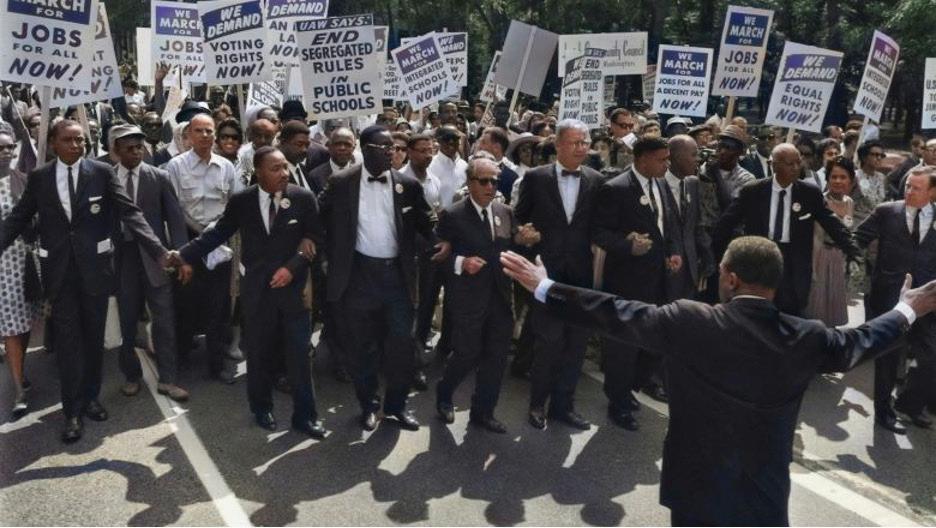
When examining Dr. Martin Luther King Jr.’s strongest champions, the Black Press stands out as a loyal messenger on the frontlines of the Civil Rights Movement.
During the 1950s and ‘60s, Black newspapers across the country dedicated their pages to broadcasting the AfricanAmerican struggle for equality. From documenting racial terror and amplifying boycotts to educating voters and holding
institutions accountable, the Black Press was a witness, as well as a weapon.
“The Black Press played a very important, strategic role in the Civil Rights Movement, in particular, getting the messaging out from the Rev. Dr. Martin Luther King Jr. and the Southern Christian Leadership Conference,” said Dr. Benjamin Chavis, president and CEO of the National Newspaper Publishers Association (NNPA).
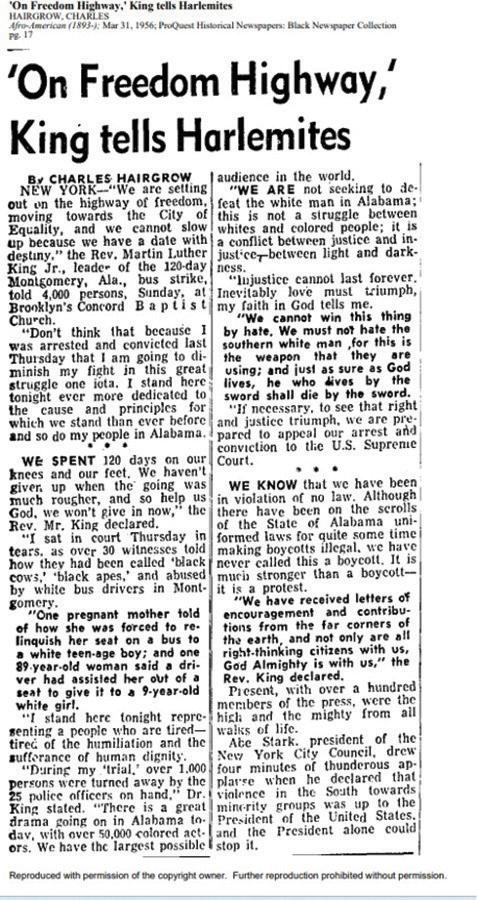
In the Mar. 31, 1956, edition of the AFRO, Dr. Martin Luther King Jr. uses the pages of the Black Press to reach beyond the Harlem, N.Y., pulpit from which he spoke, inspiring the masses to keep pressing toward a “City of Equality” as they travel along the “Highway to Freedom.” At the time, the Montgomery Bus Boycott had just surpassed 120 days. In the end, the boycott would go on for 381 days.
“The
Chavis
“Dr.
the Black Press,” said Chavis. “He wrote columns for the NNPA during the 1960s.”
Chavis saw this support firsthand. As a young person, he served as a youth coordinator for the Southern Christian Leadership Conference (SCLC) during the 1960s, working closely with King.
He said the role the Black Press played was transformational, especially in standing firm in the face of threats.
“During the Civil Rights Movement, a lot of our newspapers were firebombed or dynamited to suppress the Black Press as a means of suppressing the Black freedom movement,” said Chavis. “But, I saw firsthand the courage of African-American publishers, who were vigilant and refused to be intimidated by racist repressive forces.”
In his own words, King
described the Black Press as a force that helped to develop the consciousness and dignity of the Black community. During Negro Press Week in 1958, Black radio stations aired a prerecorded speech by King on the importance of Black news organizations.
“Perhaps, more than any other single force, it has devoted itself to the achievements, ambitions, hopes and even failures of the Negro people. It has interpreted the Negro to the American people and to the world,” said King, of the Black Press, in the speech.
“It has brought the American people and the world to Negroes in cities, towns, plantations and cotton fields.”
The AFRO Archives details the Civil Rights Movement on a local, national and international level. Reporting legends, like
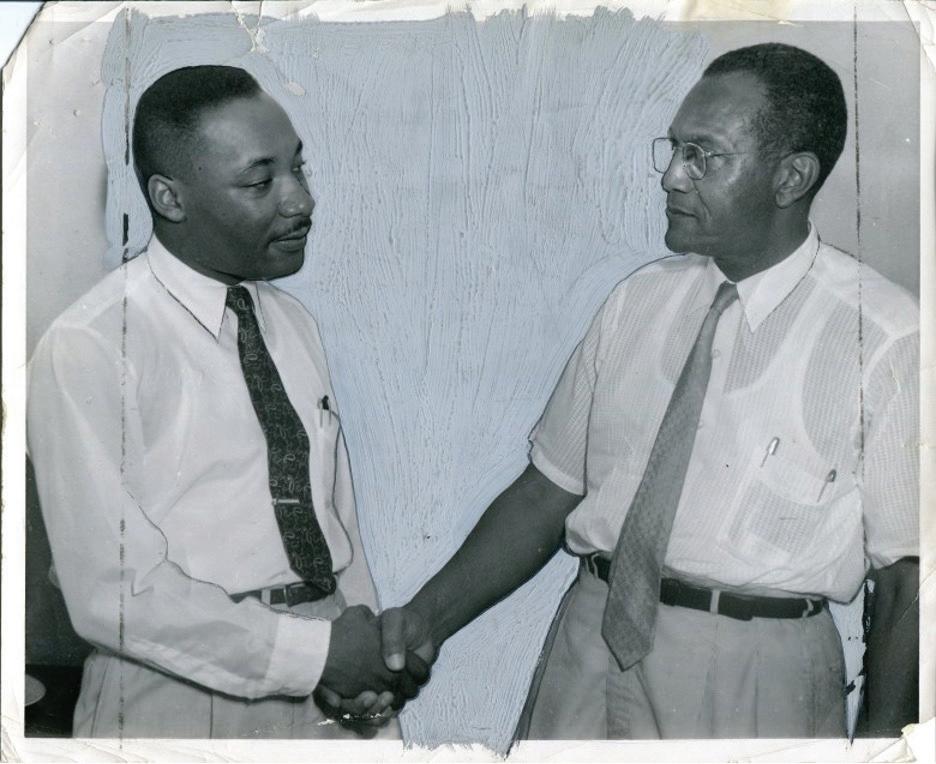
July 1957 King fights voter suppression and redistricting efforts to push out Black voters
Dr. Rev. M. L. King (left), president of the Montgomery Improvement Association (MIA), shakes hands with Dean G. C. Gomillion, of the Tuskegee Institute. Gomillion was president of the Tuskegee Civic Association and fighting against redistricting in his area that would disenfranchise Black voters. King informed Gomillion that 50,000 Montgomerians and MIA had voted to assist and support the Tuskegeans’ fight for the ballot and against disenfranchisement led by Alabama state Sen. Sam Engelhardt. Gomillion and King started a boycott after Tuskegee leaders successfully changed its boundaries from a four-sided square to a 28-sided, seahorse-shaped boundary to cut out a majority of its Black population.
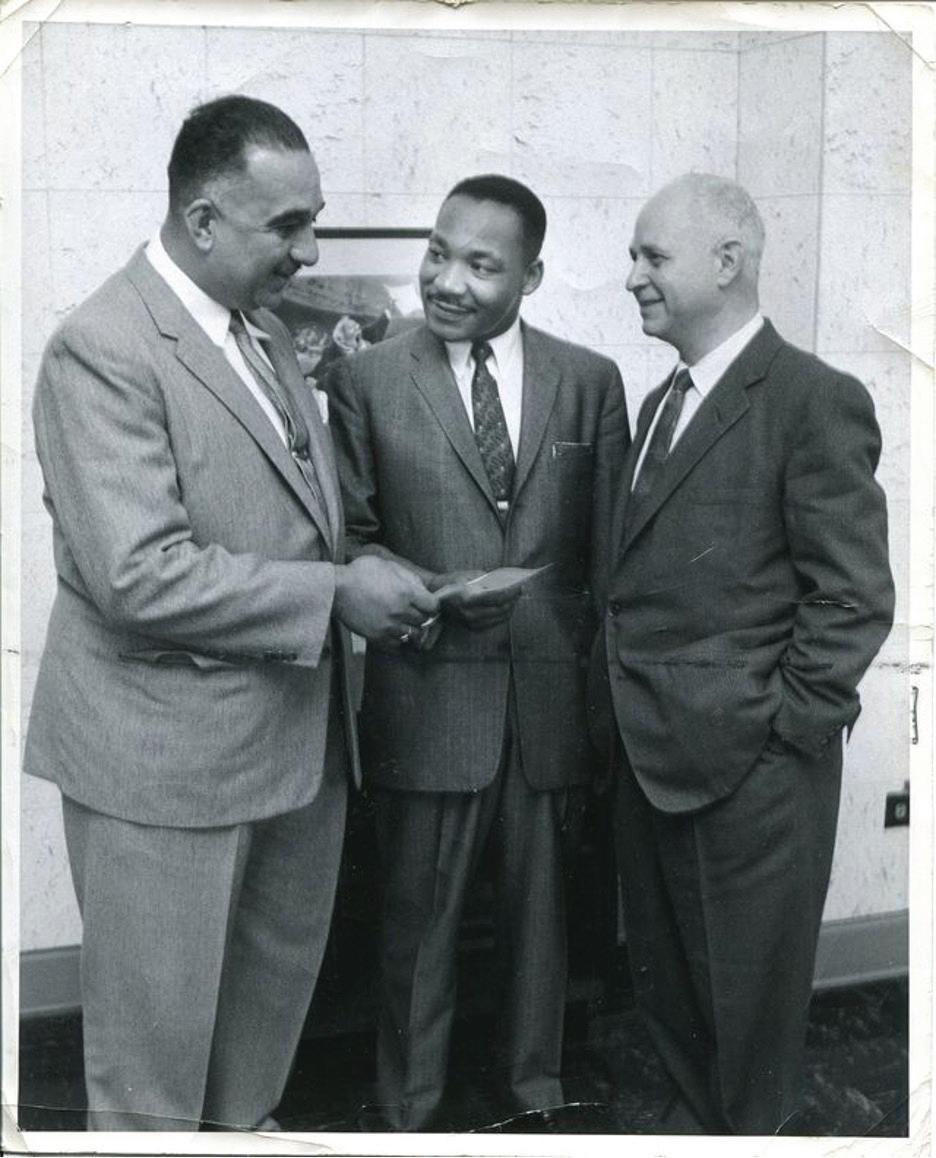
October 1957 Labor unions support the cause
The United Packinghouse Workers of America (UPWA), a precursor to today’s United Food and Commercial Workers International Union (UFCW, was an early supporter of the Civil Rights Movement. The labor union was known for paying fair wages regardless of race, gender or immigration status. Shown here, Russell R. Lasley (left), international vice president for the UPWA, giving Dr. Martin Luther King Jr. a check for $11,000 to support his voter rights crusade.
Moses Newson and William Worthy, risked their lives to keep their communities informed.
“The Black press has always been an integral part of the Black social movements, like the Civil Rights Movement,” said Savannah Wood, executive director of Afro Charities, the sister organization that cares for and curates the archive collection for AFRO News. “In the archives, we see the press used as a tool to
inform and organize the public and to document its successes and setbacks from within the movement.”
This Martin Luther King Jr. Day, take a look below at some of the content from the AFRO Archives, where more than three million articles, photos and ephemera prove just how vital Black journalists have been in documenting and advancing human and civil rights.
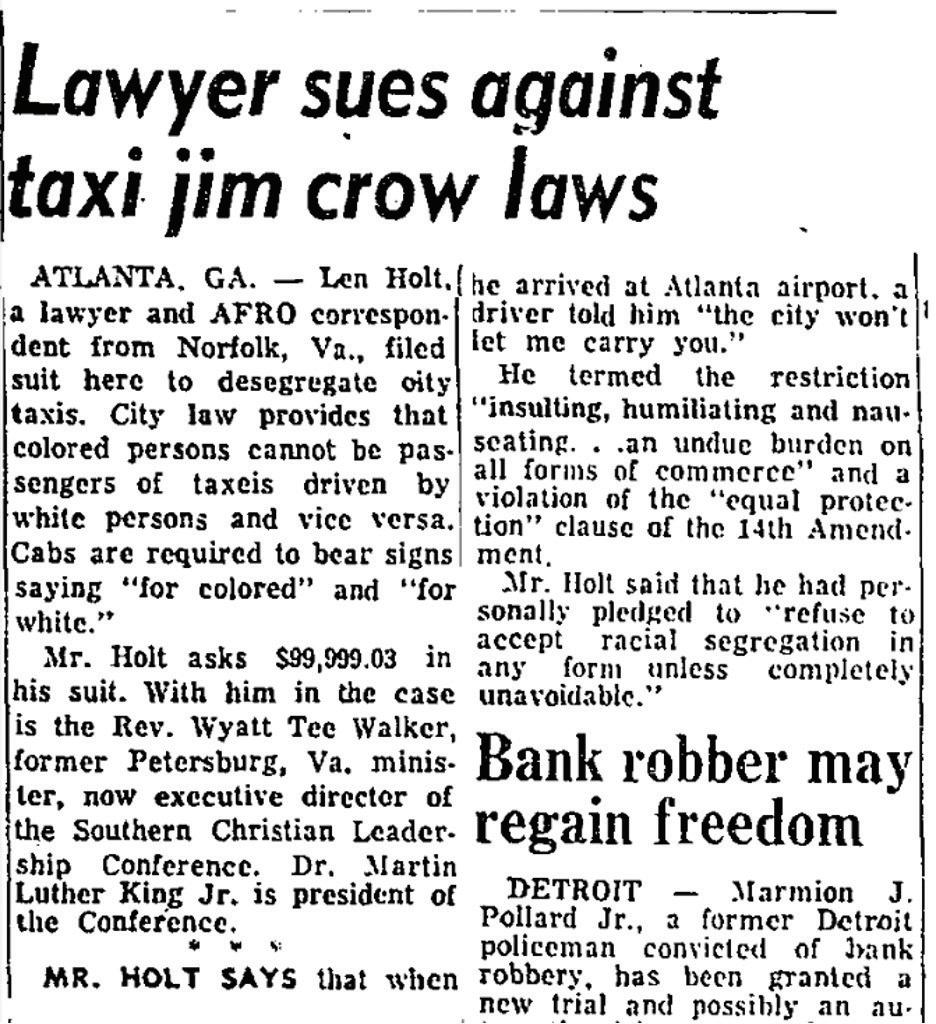
September 1960
AFRO correspondent, SCLC fight Jim Crow in court
AFRO reporters and other employees were known for taking an active part in the struggle for change. In the Sept. 24, 1960, edition of the publication, Len Holt, a lawyer and AFRO correspondent, leads the fight to desegregate the taxi services offered in Atlanta. The Southern Christian Leadership Conference (SCLC), led by Dr. Martin Luther King at the time, worked with Holt on the case.
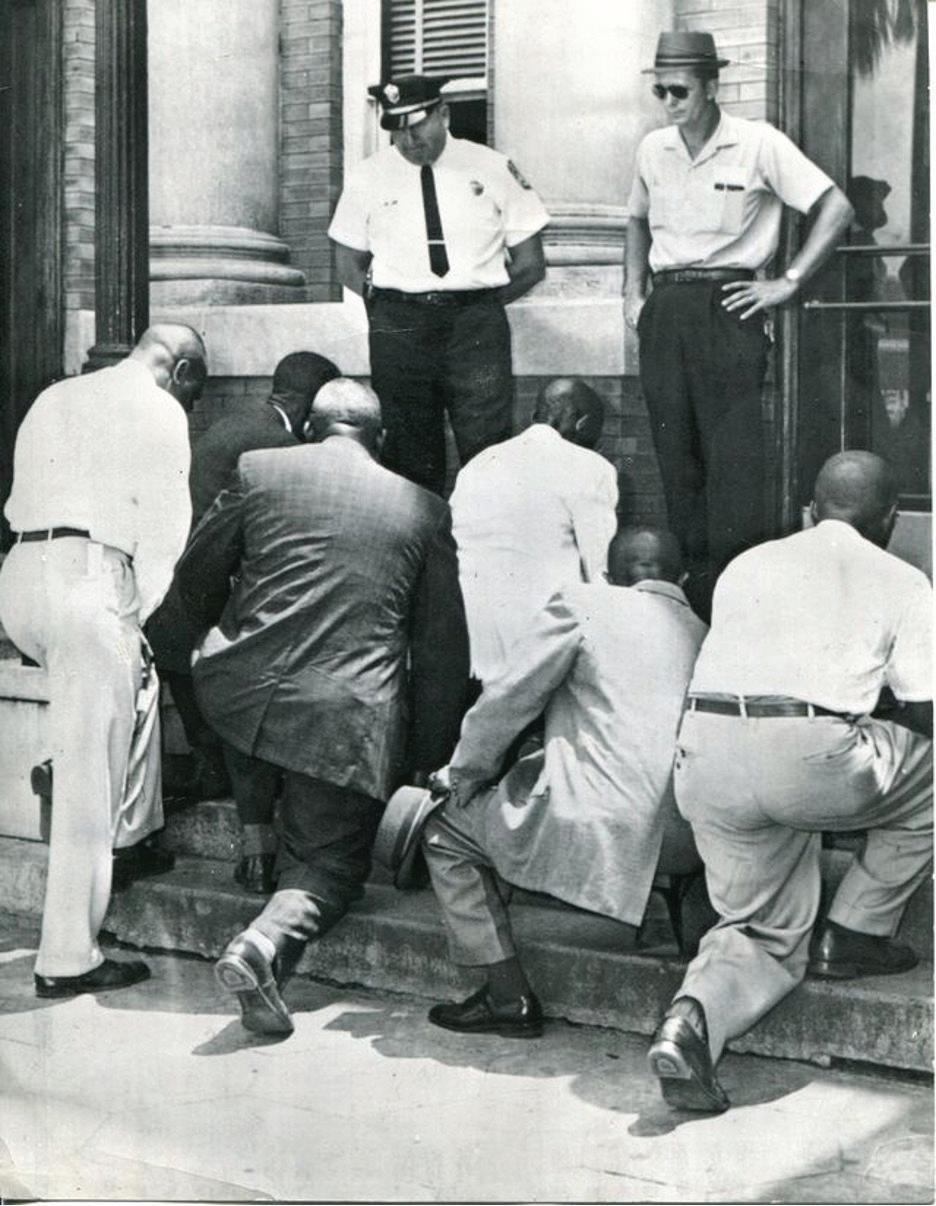
1962
Thursday, January 22, 2026
THE SAN BERNARDINO AMERICAN NEWS - COMMUNITY/EDUCATION/BLACK HISTORY
By Dr. Frances “Toni” Murphy Draper AFRO CEO and Publisher
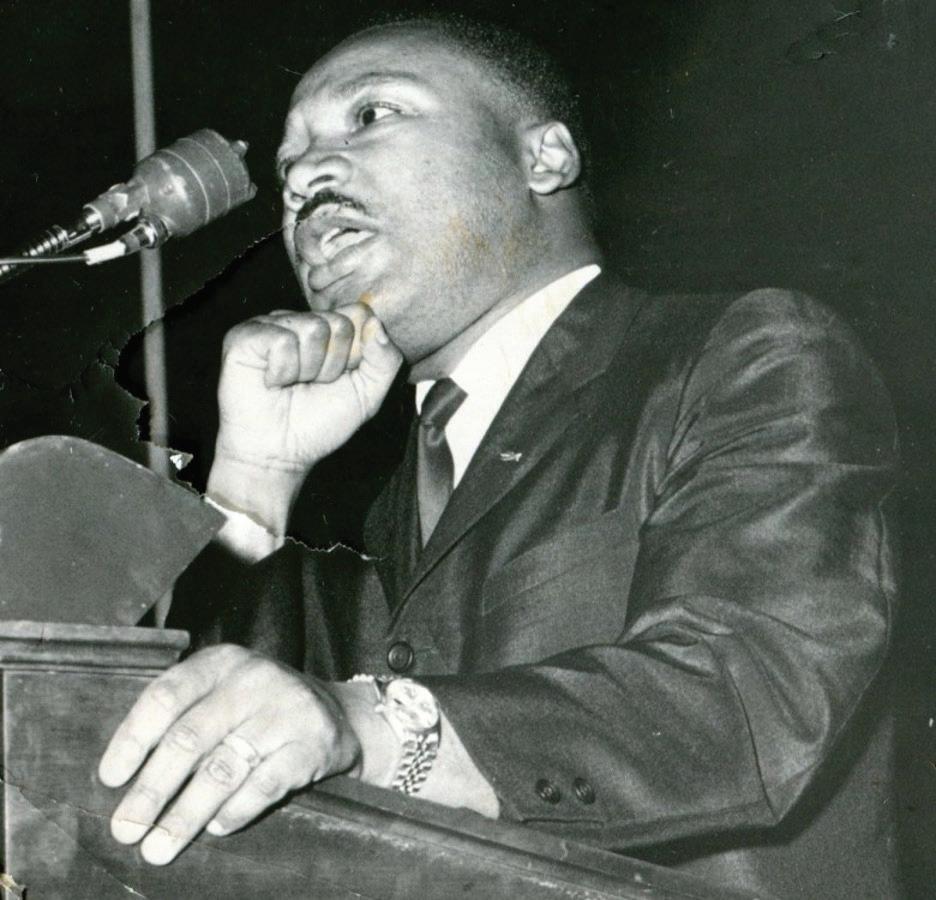
As the nation marks Martin Luther King Jr. Day, the real question is not how loudly we celebrate — but whether we are willing to live by the values Dr. King demanded.
Each January, the nation knows how to celebrate. We mark the day. We replay the speeches. We share the quotes. The music plays, the tributes roll and for a moment, it can feel settled — as if remembrance was the same as responsibility.
It is not.
We live in a country that knows how to enjoy Black culture without fully reckoning with Black reality. That truth frames how Martin Luther King Jr. Day is observed — and too often, misunderstood.
When Martin Luther King Jr. finally received a holiday in his name, celebration was never the finish line. The day was meant to be a reckoning — a reminder that honoring Dr. King requires more than words, more than
symbols, more than a once-ayear pause. Repetition is not the same as aligning our actions with the values he stood for — and remembrance alone does not equal responsibility.
For Black America, Martin Luther King Jr. Day has never been abstract. It has always been personal. It has always been earned. In today’s political climate, it is once again instructive.
A holiday can be officially recognized and still quietly diminished. Not by removing it from the calendar, but by draining it of meaning. Not by denying the man, but by reshaping the message. This day matters only if the principles behind it are taken seriously. Right now, those principles are under pressure. Black creativity is celebrated. Black language is borrowed. Black style is marketed. But when Black history tells the truth about power, exclusion and inequality — when it becomes instructional
rather than inspirational — the mood changes. Admiration gives way to discomfort. Celebration gives way to resistance.
That tension is not new.
Dr. King was not opposed in his lifetime because he lacked vision. He was opposed because he refused to dilute the truth. He challenged a nation that wanted harmony without justice and unity without sacrifice. He understood what history keeps confirming: progress does not sustain itself. Rights do not protect themselves. Democracy does not run on autopilot. What is gained through struggle can be weakened through neglect.
That reality helps explain why honoring Dr. King was never easy. Establishing a holiday in his name took years of organizing and persistence. Even after federal recognition, full observance across the states came slowly. The resistance was never about logistics. It was about discomfort — about whether the nation was prepared to honor a Black man who demanded accountability rather than applause.
That discomfort has not disappeared.
Today, Dr. King is quoted often, but selectively. His calls for justice are softened into calls for civility. His critique of economic inequality is pushed aside. His warnings about the misuse of power and the danger of moral complacency are frequently left out. What remains is a version of Dr. King that reassures rather than challenges. But reassurance was never his assignment.
For Black America, protecting this holiday is not about nostalgia. It is about stewardship — of memory, truth and agency. It is about ensuring our children inherit the full story, not a polished version that skips the cost of progress. It is about defending the right to speak plainly about injustice without
being told to lower our voices or soften our language. It is about remembering that the beloved community Dr. King envisioned required change, not comfort.
This is also a season of fatigue. Many are tired — tired of explaining, tired of organizing, tired of pushing back against familiar resistance. That weariness is real. But history shows that fatigue is often when progress slips backward. A people worn down are easier to distract, easier to divide and easier to dismiss.
Martin Luther King Jr. Day should therefore be more than a moment of reflection. It should serve as a reminder of what is required.
It asks Black America to take stock. Are we strengthening institutions that tell our story truthfully and consistently? Are we supporting Black-owned media, businesses and civic organizations that help shape public understanding rather than merely react to it? Are we preparing the next generation not only to admire the movement, but to carry its responsibility forward?
For those who claim allyship, this day calls for more than symbolic gestures. Dr. King did not need agreement once a year. He needed commitment when the work was difficult and the consequences real.
Martin Luther King Jr. Day is not a pause in the national calendar. It is a checkpoint.
To protect the day is to protect the witness—to insist that Dr. King’s legacy remain honest, challenging and alive. It is to resist selective memory and easy narratives. It is to measure the nation not by what it says on this day, but by what it chooses to do after it passes.
Because when the meaning of this holiday is thinned out, the danger is not simply forgetting history.
The danger is losing our way.
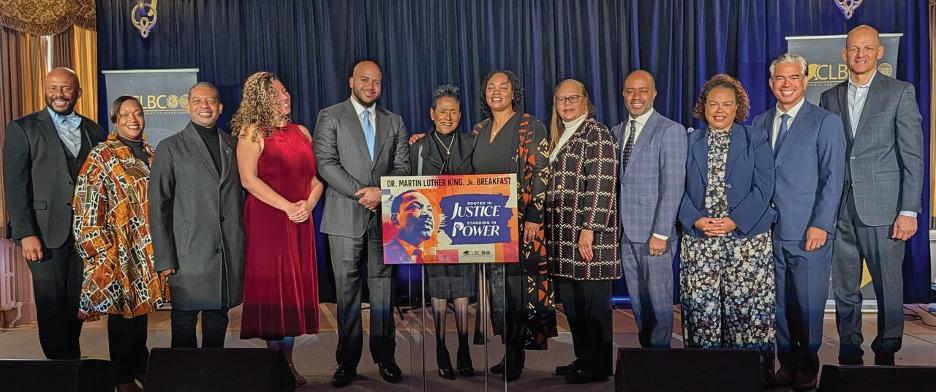
at Black Caucus MLK Breakfast
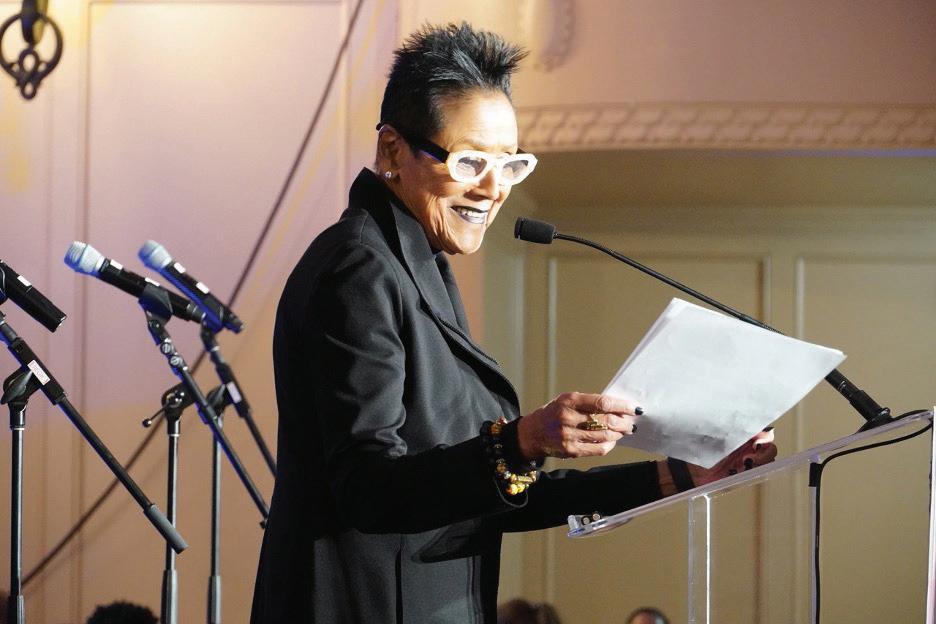
Former Black Panther leader Elaine Brown was the keynote speaker at the annual California Legislative Black Caucus (CLBC) Dr. Martin Luther King, Jr., Breakfast held at the Sacramento Masonic Temple on Jan. 15. Introduced by CLBC Chair Sen. Akilah Weber Pierson (D-San Diego), Brown delivered a powerful message emphasizing responsibility, activism, the ongoing fight for justice, and the need for sustained action to achieve equity. Brown reminded the audience of the harsh realities of Jim Crow, including the physical signs and rigid social codes used to attempt to enforce the second-class status of Black Americans. She also
highlighted the long struggle to dismantle segregation, political disenfranchisement, and racial terror.
“So much blood was shed in those fights just to integrate ourselves into a society that didn’t want us in the first place,” Brown said. “We were no longer valuable. We were only valuable when we were enslaved.”
Brown also spoke about Dr. King’s vision of a just society – one where systemic racism, poverty, and economic exploitation are no longer tolerated.
The Black Panther Party (BPP) was founded in Oakland in 1966 to make “revolutionary” changes for the betterment of the Black community, Brown said.
From the AFRO Archives: A look at Dr. Martin Luther King Jr. and the Black Press...continued from page 1
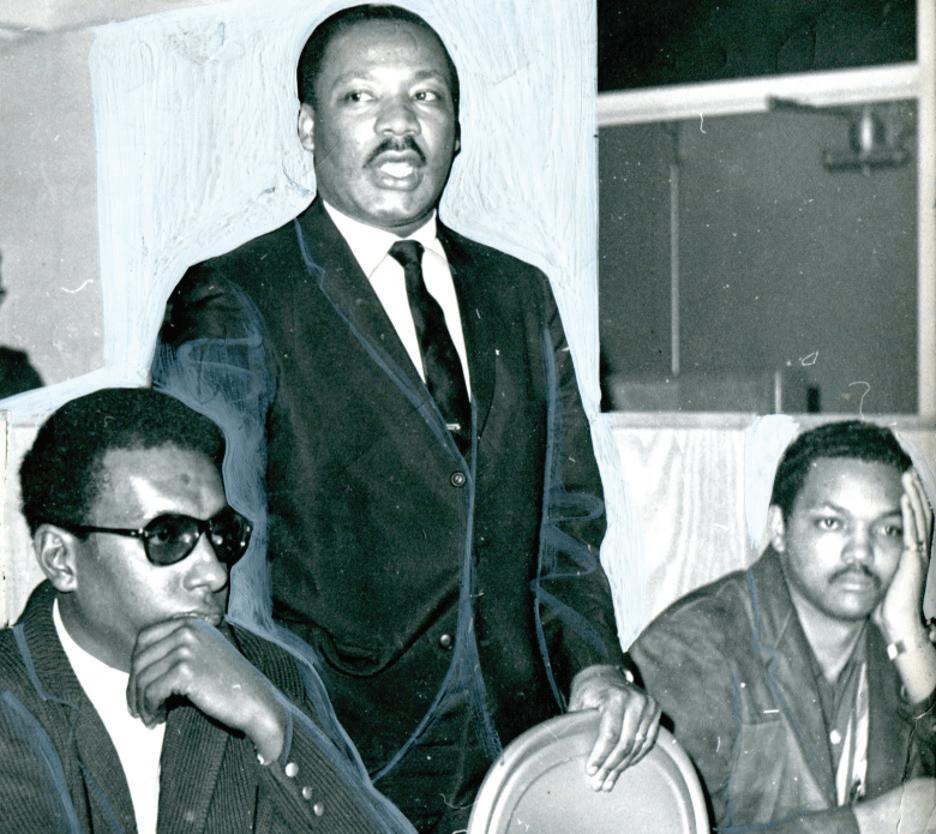
February 1968 King protests Vietnam War, plans Poor People’s March
In the Feb. 10, 1968, edition of the AFRO, Dr. Martin Luther King is seen supporting the Black United Front, a leadership group formed by Stokely Carmichael, in Washington, D.C. Rev. King was in the city to protest the Vietnam War and to also confer on the Poor People’s March, which was slated for April 1968. He would be shot and killed on April 4, 1968. Shown here, Carmichael (left), King and civil rights leader the Rev. Jesse Jackson.
Former Black Panther Leader Elaine Brown Delivers Keynote at Black Caucus MLK Breakfast...continued
event organized by the CLBC and held in Sacramento to honor the life and legacy of Dr. Martin Luther King, Jr., CLBC members, California
state leaders, city government officials, professional sports figures, constitutional officers, law enforcement, and community members all attended the event.
By Ben Crump
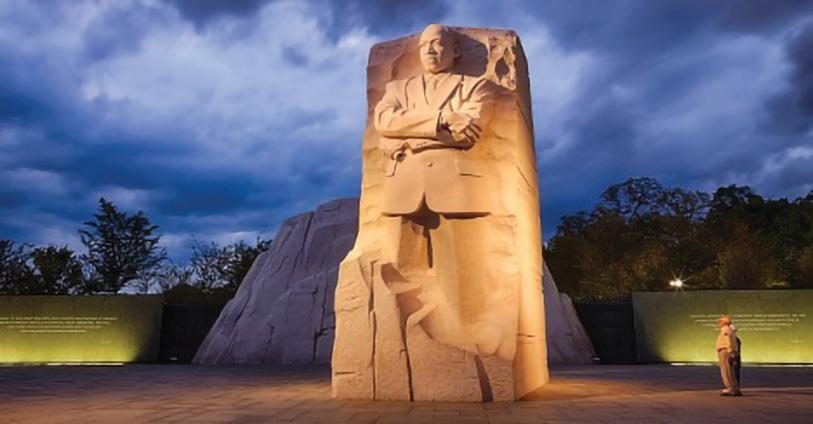
We honor Dr. Martin Luther King Jr. each January with speeches, service projects, and by reciting powerful quotes we know by heart.
But too many Black families will spend much of MLK Day the same way they spend most Mondays.
With the gas tank hovering near empty, hoping the car can go until the next paycheck arrives.
With a prescription waiting at the pharmacy counter because they cannot afford the cost.
With a paycheck that has to stretch further than what seems possible.
have become an increased burden. And many families go from stable to scrambling with just one unexpected expense. These realities are on display in a recent national survey commissioned by DreamFi, echoing what so many families already feel so deeply. More than one in four respondents told us they used check-cashing services in the past year. This finding makes it clear that too many households still need simpler and more accessible options for moving money.
and Sacramento
However, the organization was infiltrated by the Federal Bureau of Investigation, she shared. Brown was a pivotal and trailblazing figure in the BPP, becoming the first and only woman to lead the organization as its chairwoman from 1974 to 1977.
Under her guidance, she expanded community services like the Free Breakfast for Children program, and later became an author, musician, and social justice activist known for her work in prison reform and Black liberation.
Brown led the development of a major affordable housing project in Oakland called “The Black Panther Apartments.”
Fully leased by December 2024, the 79-unit building provides 100% affordable housing for low-income and formerly incarcerated individuals with incomes at or below 30% of the Area Median Income (AMI).
“When I think about Dr. King, I think of the work we did with the Black Panther Party,” Brown said. “There was a leader of our party named Fred Hampton. Fred Hampton would say, ‘I ain't going to die slipping on ice. I ain't going to die in no airplane crash. I’m gonna die for the people because I live for the people. I love the people. Power to the people.’”
The breakfast is an annual
Dr. King understood that true dignity means being able to afford and build a good life. In one of his clearest reminders, he asked what it means to “eat at an integrated lunch counter” if you cannot “buy a hamburger and a cup of coffee.”
That question still carries weight for many. Personal freedom will not be achieved without financial freedom.
Dr. King spent the final chapter of his life pushing the country to face economic injustice. The day before he was tragically assassinated, Dr. King stood with sanitation workers in Memphis to call for economic equality. He helped launch the Poor People’s Campaign because he knew freedom hollowed out by poverty is not freedom at all. Dr. King kept pushing America to match its promises with practical pathways.
That is the part of his legacy we should sit with this MLK Day.
This work has never been more important or needed. The cost of groceries, rent, and childcare
The survey also shows how unexpected expenses impact families. Only 41% of Black respondents said they could cover a $1,000 emergency, compared with 56% of white respondents. When a tire blows out, when a child gets sick, when hours get cut, the question is not theoretical. The question is immediate and the impact is real. We must shine a light on this struggle and work to equip families with tools to build better futures. We must recognize Dr. King’s wisdom and acknowledge that financial stability is a civil rights issue, because financial instability limits the ability to have choices.
The survey also found hope that can guide how we move forward.
Black families are not turning away from the idea of building stability. In fact, they are reaching for it. In the survey, 79% of Black respondents said they sought out financial education in the past six months. Ours is a community hungry for tools and a fair shot
Thursday, January 22, 2026
By TotallyRandie Social Media Correspondent, BlackPressUSA
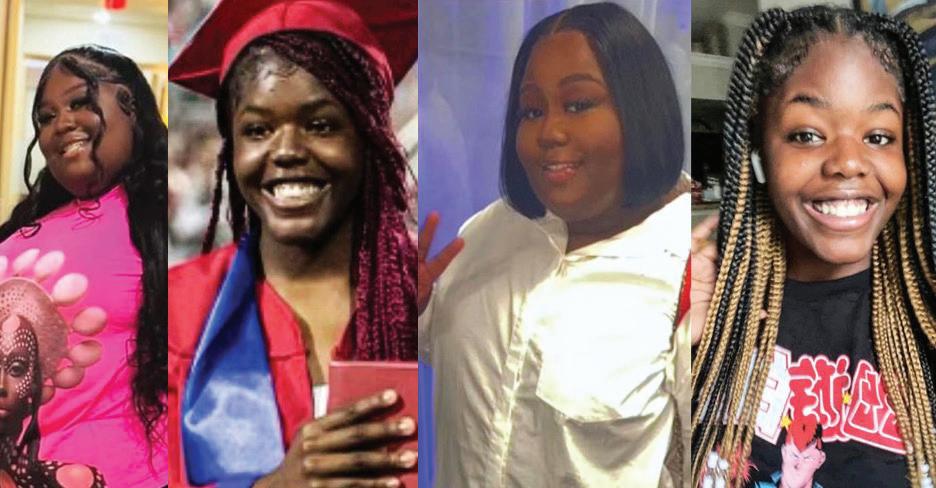
Eighty thousand pounds of steel doesn’t just collide—it obliterates. While corporate lawyers hide behind the sterile jargon of liability and subsidiaries, four Houston families are left haunted by viral footage of a tragedy that should never have happened. On November 5, 2025, a stretch of US 87 became a crime scene of corporate negligence, claiming four vibrant Texan futures in a heartbeat.
The dashcam footage is a nightmare in real-time. A black Nissan Altima, hazards blinking in a desperate plea for space, crawls along the right lane near Dalhart. The four young women inside did exactly what we are taught to do during an emergency: slowed down and put on hazards. They were then met by an 18-wheeler hauling H-E-B merchandise. The truck plowed into them at full speed— no brakes, no swerve, no mercy.
The lives of Breanna Brantley, Taylor White, Myunique Johnson, and Lakeisha Brown were not just lost; they were stolen. To understand the gravity of this loss, you have to realize these women were just starting
their lives.
Breanna Brantley (30): A woman entering the prime of her life, a new chapter of wisdom and growth.
Taylor White (27): A wanderlust traveler and the “glue” for her younger siblings; she was their primary mother figure.
Myunique Johnson (20): Affectionately known as Mimi. Her life was just starting to bloom
Lakeisha Brown (19): A basketball standout set for Blinn College this spring—the beacon of hope meant to rewrite her family’s financial history. In Texas, political math often attempts to cap the value of a human life, but the $250,000 ceiling suggested by current tort reform is an insult to these families. Breanna, Taylor, Myunique, and Lakeisha were more than just Black women; they were daughters, sisters, and athletes whose lives were abruptly taken away. They deserved milestones—


graduations, weddings, and the simple right to grow old—not to be reduced to an apology for a “tragic loss.”
While the dashcam footage suggests an open-and-shut case, Attorney Rodney Jones of Rodney Jones Law Group P.C. revealed in our exclusive interview that reality is far more tangled. The road to justice could be a long, drawn-out process depending on how HEB decides to handle the case.
“This is a senseless accident that could have easily been prevented,” Jones says. “They had the right to possess that lane, and that truck driver had the responsibility to pay attention”.
H-E-B is a Texas institution, but its response has triggered deep public outcry. While issuing an apology, the company quickly distanced itself, claiming the carrier wasn’t a “direct” H-E-B truck—despite hauling H-E-B products and being operated by Parkway, a known H-E-B subsidiary.
The driver, Guadalupe

Villarreal, reportedly has a history of speeding and prior rear-end accidents. Jones is firm: “I’m looking strictly at his ability to be behind that 18-wheeler. This is a simple matter of a grossly negligent driver and the companies that put him on the road being held accountable.”
“H-E-B can’t bring them back, but they can make sure this never happens again,” Jones argues.
“There is no price for a life, but there must be a price for negligence. It’s time for H-E-B to stop pointing fingers and start vetting their drivers properly to protect the public.”
While the public demands criminal charges, Jones notes that the legal wheel turns slowly. However, in the civil arena, H-EB’s silence is deafening; the company has yet to contact the families directly.
“We desire a speedy resolution so we don’t have to drag this out,” Jones concluded. “H-E-B is a beloved chain here in Texas. Hopefully, they come to the table to resolve this fast. I feel like the longer they make these families wait for closure, the more it should cost.”
The ball is in H-E-B’s court. Will they live up to the Texasstrong values they advertise, or will they let a legal loophole define their legacy?
By Raymar Hampshire and Hassanatu Blake
Generative AI has dominated our conversations and reshaped how we work, learn, and create. In a recent article published in the Afro American Newspaper titled "Shaping the Future: Black Leadership in Tech Regulation", Hussainatu Blake and Symone Campbell’s central argument isn't about AI's technical capabilities. It's about safeguarding intellectual property and building regulatory infrastructure that protects Black technologists' ideas, stories, and data. Their argument reveals what truly matters: our lack of infrastructure to prepare people for tech-enabled futures. Organizations like ED2Tech, a global EdTech and workforce development firm, and platforms like Braid, an open-access vocational storytelling network, demonstrate that preparing people for tech-enabled futures requires investing in inclusive infrastructure through foundational systems, relationships, and processes. Without intentional investment in inclusive digital infrastructure, we enable the exclusive few who are architecting our technological future. We need infrastructure that serves us. Why Inclusive Digital Infrastructure Matters Inclusive digital infrastructure is not simply about access to devices or internet connectivity. It's about creating the conditions for communities to participate as creators, decision-makers, and beneficiaries of technology. This infrastructure is essential for three reasons: survival, growth, and sustainability.
First, communities need inclusive digital infrastructure to survive in a digital world. Digital systems now mediate access to essential services in education, health, employment, and civic participation.
Without intentional design that centers the needs of marginalized communities, these
systems replicate, amplify, and deepen existing inequities, and benefit only a privileged few. Second, infrastructure enables growth. When communities have meaningful input into how technology is designed and deployed, they develop agency and capacity.
Communities become innovators and leaders that shift technological development toward solutions that serve its people.
The open-access vocational storytelling Braid platform demonstrates this through its 650+ beta testers and student cohorts called Braid Camp. The students co-own project management, research, design, and development. The innovation is the infrastructure of values and co-creation processes.
As Jeanette Ahn (2025 Braid Camp) shared, "Braid gave me the space to innovate...I grew as a UX designer and collaborator," while Roshni Raisinghani noted it "helped me discover my own path in tech."
This inclusive infrastructure produces confidence, belonging, vocational pathways, and innovation for communities.
This leads us to the last reason: sustainability. Technologies built in isolation from community input often fail because they don't address real needs or respect cultural contexts. Infrastructure rooted in co-creation, partnership, and authentic participation is more resilient, adaptable,and impactful over time.
ED2Tech exemplifies this when partnering with Blossom Academy on public service leadership training. ED2Tech brought public servants together to co-design governance frameworks addressing real challenges. By breaking down silos and translating concepts into culturally relevant applications, ED2Tech's collaborative networks approach
creates sustainable systems built with and for the communities they serve, ensuring long-term relevance and adoption. The Three Pillars of Inclusive Digital Infrastructure To build an inclusive digital infrastructure, we must have intentional work across three interconnected areas: Research for Policy Impact.
We need rigorous investigation into how technology affects marginalized communities to inform and influence policy. Too often, research exists in academic silos, disconnected from decisionmakers and practitioners. Inclusive infrastructure bridges this gap, ensuring the evidence collected shapes the policies and practices governing technology development and deployment. The goal is to design with communities from the outset to generate actionable insights that drive systemic change. For example, Nicole Lee Turner's work at the Brookings Institution demonstrates how rigorous, community-centered research on digital infrastructure and equity directly shapes policy frameworks proving evidence grounded in community lived experiences can redirect institutional power and resources.
Convening
Practitioners for Thought Leadership.
We need intentional spaces where technologists, educators, policymakers, and community members establish knowledge infrastructure through networks, norms, and shared frameworks. Innovation for Equity (IFE) creates structured convenings where educators, technologists, and community leaders build sustained networks to move collective wisdom into practical frameworks that shift how entire systems approach digital inclusion. Development Pipelines: Training and Incubators. We need intentional pathways for people from
Moving Beyond the AI Hype: Let's Build Inclusive Digital Infrastructures...continued to include decision-making authority with communities. Create revenue-sharing models where communities benefit financially from platforms built with their knowledge.
Cooperation Jackson exemplifies this vision by building cooperative economic structures where communities collectively own and govern the technologies and platforms that shape their futures. Inclusive infrastructure is iterative, purposeful, and collaborative. It ensures the future is shaped by community wisdom and intentionality rooted in values, cultivated through relationships, and sustained through practice. We have a choice: build the infrastructure that serves us all or continue to build technology for the few.
Raymar Hampshire, MPP is a founder of Braid, an open-access vocational storytelling platform and knowledge network. His work focuses on learning and education, career development and healthy public discourse. Braid is an open source project and engages a growing community of students as cocreators.
Hassanatu Blake, PhD, MPH, MBA is Co-Founder/President at ED2Tech, and Associate Clinical Professor and Inaugural Director of Global Health Undergraduate Program at University of Maryland School of Public Health. She advises and leads digital innovation and integration in education and health, global learning, workforce development, and policy.
OP-ED: The Dream Cannot be Realized Without Financial Freedom...continued from page 2 at creating a better tomorrow.
So, what does it mean to honor Dr. King right now?
It means we get practical. It means we expand access to clear, trustworthy financial education that respects people’s time and speaks to real solutions. It means we support savings pathways that help families prepare for emergencies before emergencies arrive. It means we encourage options that make routine transactions easier and less costly, so a family is not paying extra simply to manage their own money. Most of all, it means we stop treating financial instability as normal. Because normal is not the same as acceptable.
marginalized communities to enter technology fields as creators, not just consumers. Goodie Nation pairs hands-on skills development in design and coding with community accountability and cultural grounding. This model creates pathways where emerging technologists from underrepresented backgrounds enter the field as changemakers equipped to build technology that serves their communities.
Starting Now These three pillars form the foundation for inclusive digital infrastructure, but foundation alone isn't enough. What's required now is intentional investment and scale.
Here's how we all contribute:
● Centering community voices in every decision about technology design, development, and deployment by including marginalized communities from the beginning, as the primary asset in tech innovation. Host co-design workshops where community members shape product requirements or conduct participatory research that positions communities as knowledge producers.
● Executing effective feedback loops where research truly informs policy, practitioners shape practice, and developers remain accountable to communities. Create regular convenings where developers report back to communities on how their feedback shaped product changes. Build transparent mechanisms where communities can flag harms and track how issues are resolved.
● Building partnership ecosystems that create genuine power-sharing and dismantle power structures that dishonor different forms of expertise. Share strategic plans and budgets
Dr. King asked America to make its promises real. The best way to honor him now is to provide opportunities for everyone to achieve Dr. King’s dream. Ben Crump is a nationally renowned civil rights attorney and founder of Ben Crump Law. Known as “Black America’s attorney general,” he has represented families in some of the most high-profile civil rights cases of our time, including those of George Floyd, Breonna Taylor, Tyre Nichols, and Ahmaud Arbery. He is also co-founder of DreamFi, a financial empowerment platform focused on helping everyday people build stability through practical resources.
CDPH: Super Flu Cases on the Rise in California
Bo Tefu and Antonio Ray Harvey | California Black Media
California health officials have confirmed the spread of a mutated influenza strain known as the “super flu,” as flu-related hospitalizations across the state reach their highest level of the season.
The California Department of Public Health (CDPH) said Jan.15 that the strain, a mutated form of seasonal influenza A known as H3N2 subclade K, is present in the state. The announcement comes as the department confirmed a second pediatric death linked to the flu since the start of the current respiratory virus season.
State data show flu activity has eased slightly from a lateDecember peak. As of Jan. 3, about 15% of flu tests statewide were positive, down from 17% recorded through Dec. 27. Despite the modest decline, hospitalizations have continued to rise.
Flu-related hospital admissions reached a season high of approximately 3.8 per 100,000
people statewide as of Jan. 3, according to CDPH figures. Public health officials continue to emphasize vaccination as the most effective way to reduce the risk of severe illness, even when circulating strains differ from those targeted by the vaccine.
“Current seasonal flu vaccines remain effective at reducing severe illness and hospitalization, including the currently circulating viruses,” said Dr. Erica Pan, CDPH director and state public health officer, said in a statement. Pan added that “it is important for families to know that flu vaccines, tests, and treatments remain widely available for all Californians and that it is not too late to get a flu vaccine.” Health officials urge residents to seek medical care if flu symptoms worsen and to take preventive measures as flu season continues across California. Track statewide and regional weekly respiratory virus data.
Thursday, January 22, 2026
By Hazel Trice Edney

(TriceEdneyWire.com) - In the new year, many AfricanAmerican families are bracing for the consequences of a housing law that threatens to destabilize communities that have fought for decades to remain intact.
Texas’s House Bill 21 (HB21), passed by the Legislature last session, is already reshaping the state’s affordable housing system, and African-American neighborhoods are likely to bear a disproportionate share of the harm.
For generations, AfricanAmerican Texans have relied on affordable housing to stay rooted in communities built through resilience, faith, and shared history. In cities across the state, income-restricted housing has helped working families remain near jobs, schools, churches, and family networks even as rents have risen and wages have failed to keep pace. These neighborhoods are not accidental. They are the result of intentional effort to hold ground in a state where displacement has too often been driven by policy decisions.
HB21 threatens to undo that work.
The law changes how affordable housing developments qualify for tax exemptions,
targeting partnerships with housing finance corporations (HFCs) that have long helped bring affordable units to working families. While the legislation was presented as a technical correction, its final version goes far beyond that claim. HB21 will be retroactively applied, stripping tax exemptions from hundreds of housing developments that were approved and built years ago under existing law.
Retroactive policy changes carry real consequences.
Affordable housing properties that currently serve working-class tenants will now face unexpected tax burdens. Developers have warned that those costs could force rent increases, foreclosures, or evictions. For renters who already experience higher rates of housing instability and have fewer financial buffers, the impact could be severe and longlasting.
In Texas cities where affordable housing is already limited, including Houston and Dallas, HB21 risks accelerating displacement that many AfricanAmerican communities know all too well. Families pushed out of their neighborhoods are often forced farther from jobs, increasing commute times and expenses while weakening ties to schools, churches, and
community institutions that have anchored African-American life for generations.
This is not just a housing issue. It is a community survival issue.
Texas depends on a workforce that includes educators, healthcare workers, first responders, and service employees, many of whom live in affordable housing developments affected by HB21. When these workers are displaced, the consequences ripple outward. Employers struggle to retain staff, schools lose students, and neighborhoods lose stability. The cost of displacement is shared by everyone, but it falls hardest on those with the least.
These concerns about the law are compounded by ethical questions surrounding its chief sponsor, Representative Gary Gates. Critics have raised alarms about potential conflicts of interest, pointing to how changes in tax incentives and appraisal rules could benefit Gates’s own sprawling real estate portfolio. Gates has since created an entity connected to his properties to intervene in a lawsuit challenging HB21’s constitutionality, further intensifying scrutiny. Our communities have historically suffered from policies shaped
without transparency or accountability, these concerns resonate deeply.
Housing advocates have turned to the courts. The Texas Workforce Housing Coalition has filed suit, arguing that HB21 unlawfully retroactively revokes tax exemptions that were legally granted under prior law. While full implementation was not scheduled until 2027, county appraisal districts are already rescinding approvals and exemptions, meaning the law’s effects are being felt now.
As this new year begins, Texas lawmakers should pause the enforcement of HB21 and commit to an independent, datadriven study of its economic and displacement impactsparticularly on African-American communities. Decisions with consequences this sweeping demand evidence, transparency, and accountability.
Texans understand that strong communities do not happen by chance. They are built and preserved through policy choices that value stability, opportunity, and fairness. Affordable housing is one of those choices. It allows families to stay, to invest, and to pass something on to the next generation.
HB21 moves Texas in the opposite direction.
At the start of this year, lawmakers still have a chance to change course. Protecting affordable housing is not about special treatment, it is about preserving the communities that keep Texas alive, working, and whole. African-American neighborhoods have carried this state through generations. They should not be displaced now.
Hazel Trice Edney is editor-inchief of the Trice Edney News Wire. This article first appeared at ForwardTimes.com
by Tashi McQueen AFRO Staff Writer
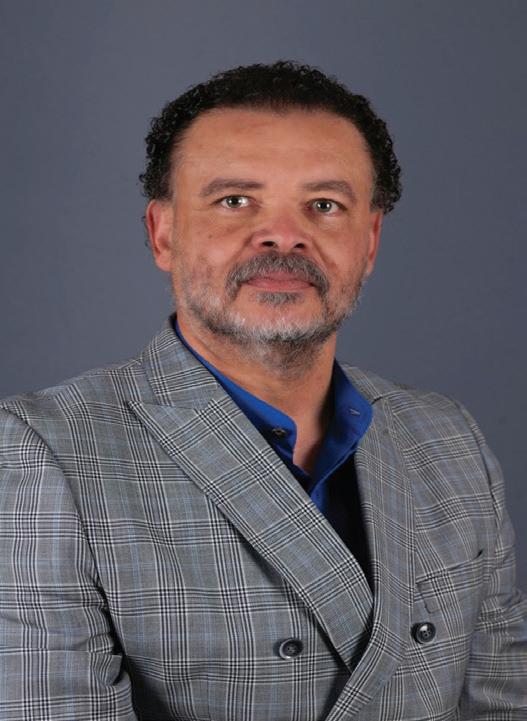
Cooper, director of the Bachelor of Social Work Program and co-coordinator of African American Studies at Widener University, sees the fight for civil rights as an inherently ongoing one.
As the fight for civil rights continues to evolve, activists of today are raising questions about how far the nation has come since the era of Dr. Martin Luther King Jr. and where progress has stalled.
Advocates, scholars and policymakers are assessing voting access, economic equity, education and criminal justice
decades after the Civil Rights Movement. This Martin Luther King Jr. Day, the AFRO took a look at how the fight for equal rights has progressed, where have we regressed and where can we go from here.
“The movement of African Americans articulated through the vision of Rev. Dr. Martin Luther King Jr., in my humble opinion, is one of the most significant social justice movements of all time,” said Dr. Richard Cooper, director of the Bachelor of Social Work Program and cocoordinator of African American Studies at Widener University.
“We were looking for, in that era, more precise equality which included, voting rights, housing, opportunities for employment, access to education–the total package of African Americans having access to what was once referred to as the American Dream.”
All those ideas envisioned a future where legislative and systemic roadblocks would be removed, allowing full and equitable access at last, said Cooper. From the success of the movement in the 1960s, African
Americans were being employed in previously excluded sectors, with national gains in access to education and upward mobility within the military.
“ not perfect–didn’t achieve all that had been hoped for–but when you compare it to the Jim Crow South or the world before that in terms of America, it’s amazing,” said Cooper.
Cooper also acknowledged that certain advancements were still not fully realized and faced significant pushback.
“I think what was underestimated is how vile this system is,” said Cooper. “Any overt gains, any clear access that Black people have earned and achieved, they continue to construct roadblocks. They continue that vitriol, that hatred systemically and on the individual level.”
Policies continue to deny Black people access to historical opportunities, jobs and education. Cooper said what’s happening now reflects long-standing beliefs the 47th president didn’t create; it existed in the South’s refusal to dismantle statues, emblems and symbols rooted in a bigoted past and preserved to uphold false histories.
“We underestimated the vitriol and the ability for them to rally again to take things back,” said Cooper. “We underestimated that, and that’s where we are now. I think this era shows us how you can paint things over and tear things down.”
Cooper described the fight for civil rights as a pendulum that continues to swing back and forth, but said history shows Black people remain resilient and committed to pushing the struggle forward. Despite
By Gwendolyn Carole Tipton, The Cincinnati Herald
Here in 2026, we must not forget His benefits from 2025.
We have already received and continue to receive Spiritual Blessings. Apostle Paul declares that God has blessed believers with “every spiritual blessing.” They encompass gifts of redemption, including forgiveness, grace, and the promise of eternal life. These blessings are not based on human merit but are freely given by God’s grace.
The timeless nature of these spiritual blessings goes beyond our everyday needs, offering comfort and purpose in a world often filled with chaos and uncertainty.
Understanding our identity in Christ can bring hope and transformation, allowing us to shape our perspective and actions. We should pray for a deeper understanding and appreciation of these spiritual blessings, that we may walk in the fullness of God’s grace and purpose.
Look back on 2025. Remember His forgiveness when we did not follow Him, the grace that carried us through, and the ultimate promise of eternal life. The book of Ephesians invites believers to reflect on their new creation in Christ and the immense blessings they have received. They are chosen, redeemed, and sealed by the Holy Spirit. These verses encourage believers to live in gratitude and glorify God for His grace and purpose in our lives.
Prayer: With Gratitude and Praise for 2026, we come before You, Lord, praying that we may continue receiving Your spiritual blessings, Your forgiveness, Your choosing us, and bringing us to this place in our lives. Lord, in this new year, we are asking You to direct our paths. We will not lean on our own understanding but look toward you for direction. We commit ourselves to do more, be more, and act more like Christ. Please show us the way. Amen.
by Seth Wispelwey
Abolishing ICE, defunding and abolishing the police…this is the *moderate* position.
growing pushback, some federal legislators remain vigilant, continuing to advocate for civil liberties and equal opportunity as resistance intensifies nationally and within certain states.
In 2026, there are new fronts in the war for racial equality.
On Dec. 2, 2025, U.S. Rep. Yvette Clark, (D-N.Y.-09), and U.S. Sen. Edward J. Markey, (D-Mass.), reintroduced the “Artificial Intelligence Civil Rights Act,” a bill aimed at stopping discrimination in AI.
“It is no secret that as we speak today, our nation has found itself in the heart of a new technological revolution, the age of AI,” said Clark, chair of the Congressional Black Caucus. “As we seek to innovate and drive this country forward, we have a duty to ensure that discrimination that has no place but in the past, does not become irreversibly entrenched in the technology of the future.”
The bill would prohibit AI developers and users from offering or using algorithms that discriminate or have unjustified disparate impacts based on race, sex, religion, disability, or other characteristics. It also requires developers to analyze AI systems and create federal algorithm auditors.
“We need to be able to trust that when we as Black Americans go to apply for a bank loan, secure employment, or even enter our own homes, we will not be denied on the basis of algorithmic bias,” Clark said.
The bill was first introduced on Sept. 24, 2024, by Markey and co-sponsored by Sen. Mazie Hirono, (D-Hawaii), but died in committee. The 2025 Senate and House versions await hearings in their respective committees
Whether it’s ICE, Border Patrol, the city, county or state police or your local sheriff, their purpose is to be the violent, front-line stranglehold on a wholly unsustainable status quo that protects the few (white and wealthy) at the expense of the many. The support they have from our elected legislators is enthusiastically bipartisan.
From the grotesque amounts of new funding for all kinds of cops after the George Floyd Uprising of 2020 through the fascist crackdown on anti-genocide protests from 2023 ongoing, *our* money is being used to fortify and tighten the reins on a national police state that has always existed and terrorized Black and Brown communities AND is operating with apparent newly brazen vigor.
Renee Nicole Good was just murdered by an ICE agent in broad daylight, mere blocks from where George Floyd’s life was so brutally taken. She was not the first to be killed by ICE, and, tragically, she will not be the last without radical, urgent changes. What shocks many, I know, is that it was a white woman who was shot multiple times in the face, with the agents well-aware of the multiple bystanders there videotaping.
And yet, same as 2020, the Democrat Governor of Minnesota is activating the National Guard, when he used them to violently “control” those protesting George Floyd’s murder and police brutality. He and the Minneapolis mayor are claiming they are equally outraged by this public execution, but are calling for their constituents to “not give the Administration what it wants” while preparing to police those who dare to demand justice while fighting to do the work we’re gaslighted into believing the police do: protect their communities.
I can’t stop thinking about the picture of Renee Good’s glove box taken after her death. It’s overflowing with stuffed animals. I think of her dog and spouse who were in the car, and her kids who lost their mom. As a parent of both a teenager and a toddler myself, I am haunted. I know I’m not alone. As one who’s recently been to an antiICE protest where agents deployed bear spray on us without a moment’s
hesitation, it’s clear that the “front lines” are coming for all of us, whether you’re already bearing prophetic protest witness or not. Abolishing the polICE is the *moderate* position because it’s a starting point. For those churches and individuals claiming a “progressive” identity—is that word meant comparatively, or as a destination towards the world we need? In other words, are we “progressive” insomuch as we love and accept others somewhat more than this violent, white supremacist, xenophobic, homophobic, transphobic governing system? Or are we “progressive” in that we are actively moving to build the train tracks of progress towards a world where none need to live in fear, where all know embodied love, and no one needs to worry about finding sanctuary, a solid roof, abundant groceries, universal health care, and more? Because we DO have the people, power, money to make that happen! If we are to have elected leaders in this so-called democracy, the bar if they want to take office is there, because it’s our money: no money for genocide, war, ICE, police, and climate-shattering destruction and extraction of fossil fuels. We literally cannot afford it if our children are to have the world we truly want for them. We people of “progressive” faith and conscience seek abolition of death-dealing systems because we desire abundant life for all. Manifesting that will be another story: one where we aren’t building “good enough” in comparison to this irredeemable reality, but one where we are woven into the interdependent fabric of communities protecting one another and providing for our needs until those who currently hold power and money sow into that or are rendered obsolete.
This all requires not just difficult conversations, but difficult conversions. Let us be people willing to be challenged and changed. It’s the only way forward if we are to realize not only abolition, but abundance!
Thursday, January 22, 2026
by California Black Media

Taking care of your health shouldn’t wait until you’re already sick. Medi-Cal gives California adults — including Black families, seniors, parents, and caregivers — access to free or low-cost care designed to help people stay healthy, not just treat illness. However, many MediCal members are not using benefits they already qualify for, including dental checkups, vision exams, medications, and preventive screenings for diabetes, high blood pressure, and cancer.
Medi-Cal is one of California’s most dependable health programs. And there’s never been a better time to take advantage of these benefits. The California Department of Health Care Services (DHCS), which oversees Medi-Cal, confirms that most members will keep all of their benefits in 2025–26, including preventive care, dental and vision services, mental health support, and prescription coverage.
Medi-Cal provides health coverage to more than 14 million Californians, more than one-third of the state’s population. Over the past decade, eligibility has expanded, strengthening one of the nation’s largest health safety nets.
Why Preventive Care Matters — Especially for Black Adults
Black Californians are more likely to live with chronic conditions such as high blood pressure, diabetes, asthma, kidney disease, or vision loss, yet are less likely to schedule regular checkups or use dental and vision benefits — even when those services are fully covered by Medi-Cal.
State data show that only about 40% of adults on Medi-Cal had a dental visit last year, and fewer than 30% used vision benefits for eye exams or glasses. Many adults delay care until pain, infection, or vision loss occurs, when treatment can become more complicated. Preventive care protects longterm health, independence, and family stability. Using Medi-Cal benefits early can help people manage conditions before they become emergencies.
What Medi-Cal Covers for Adults
Medi-Cal covers a full range of services, including annual checkups and screenings; vision exams and medically necessary glasses or contact lenses; dental care such as cleanings, X-rays, fillings, root canals, and dentures; mental health services; prescription medications; and hospital and emergency care. Most services are free or have no copayments for adults who meet income requirements.
How to Use Dental and Vision Benefits
Adults can access dental care through Medi-Cal Dental, which covers cleanings, exams, X-rays, fillings, and dentures at little or no cost. To find a dentist, visit SmileCalifornia.org or call 1-800-322-6384.
Vision care is just as easy to access. Medi-Cal health plan members can schedule eye exams and glasses by calling the number on the back of their Medi-Cal ID card or by contacting the MediCal Member Help Line at 1-800541-5555.
CalAIM is Transforming How Care Works for Medi-Cal Members
Through CalAIM (California Advancing and Innovating MediCal), the state is improving how medical, mental health, and social services work together. Two major CalAIM programs are helping make better care. Enhanced Care Management (ECM) provides a personal care manager who helps coordinate appointments, medications, and follow-up care. Community Supports offer services such as asthma home visits, medically tailored meals, and assistance transitioning from homelessness. These programs are designed to keep you healthy and supported—body, mind, and home. Ask your health plan to find out if you qualify.
Important Changes Coming in 2026
For most Medi-Cal members, nothing will change in 2026. However, starting in January 2026, undocumented adults and certain adult immigrants will no longer be able to newly apply for full-scope Medi-Cal based on
immigration status. Beginning in July 2026, undocumented adults and some adults with certain immigration statuses will lose their dental benefits, people affected by those changes can continue to use their benefits until July. Emergency services and pregnancy-related care will remain available, regardless of immigration status. Youth under age 19 and pregnant people (and up to 12 months after their pregnancy ends) remain eligible for full-scope Medi-Cal, including dental.
Current Medi-Cal members will keep their coverage as long as they continue to meet eligibility requirements, including income and California residency. More information is available at www. dhcs.ca.gov/Medi-Cal/Pages/ changes.aspx.
How to Get Care — Today
If you already have Medi-Cal, call your health plan to schedule a checkup or ask about dental, vision, or specialist care. For a full list of plans, visit the MediCal Health Plan Directory at dhcs.ca.gov.
If you are unsure which plan you have, call 1-800-541-5555. If you do not have Medi-Cal, you can apply at BenefitsCal. com or contact the Riverside County Medi-Cal office at (877) 410-8827 or the San Bernardino County Medi-Cal office at (877) 410-8829.
Ready to Take the Next Step?
If you have Medi-Cal, now is a good time to use the benefits you already have. Schedule a checkup, dental cleaning, or eye exam, and contact your MediCal health plan or the Medi-Cal Member Help Line at 1-800-5415555 if you need help getting started.
by Megan Sayles AFRO Staff Writer
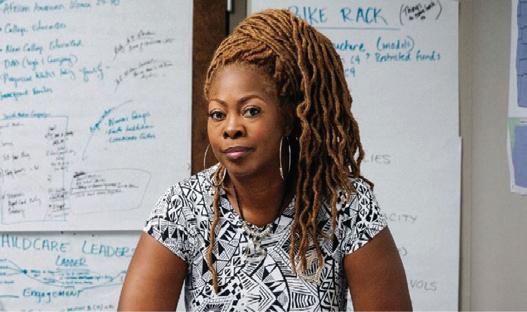
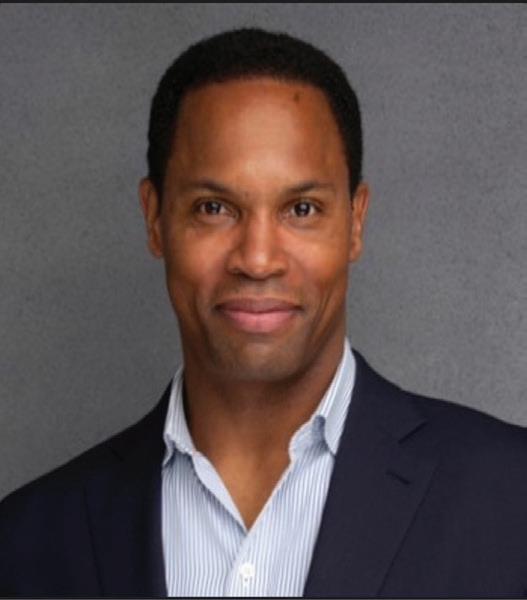
More than five decades after his assassination, King’s words still shape how the nation talks about justice and equality. Three activists shared how they believe King would respond to the challenges confronting Black Americans today.
“It’s important to remember that Dr. King spoke of the three evils: racism, militarism and poverty. These weren’t separate problems to him, they were interconnected expressions of the same moral crisis,” said LaTosha Brown, co-founder of Black Voters Matter (BVM). “What we’re witnessing today—DEI rollbacks, the erasure of Black history, the racial wealth gap and police violence—are not disconnected issues. They are the same system expressing itself through different mechanisms.”
Brown is an award-winning organizer, political strategist and philanthropic consultant with more than 20 years of experience working on social justice issues. With BVM, she works to expand Black political participation and power in underserved communities. Brown emphasized that
voting rights remain central to addressing every issue facing the Black community.
“Dr. King fought for the Voting Rights Act because he knew the ballot is the foundation of all other power,” said Brown. She recalled King’s own words during a 1957 speech given at the Prayer Pilgrimage for Freedom: “Give us the ballot, and we will transform the salient misdeeds of bloodthirsty mobs into calculated good deeds of orderly citizens.”
Today, that struggle continues. Brown noted that cases like Louisiana v. Callais—now before the Supreme Court—challenge key provisions of the Voting Rights Act designed to protect Black voters from discriminatory practices.
“These current attacks aren’t about election integrity,” said Brown. “They’re about preventing the transformation of power from the few to the many.” Beyond voting rights,
Brown said the same systems drive economic inequality, the rollback of diversity initiatives, censorship of Black history and police brutality. She noted that these issues reflect ongoing structural injustices that require coordinated action alongside defending the vote.
“I believe Dr. King would tell us that this is our moment not to despair, but to organize, to use every tool we have: our votes, our voices, our dollars and our collective power,” said Brown. “The concentration of power in the hands of the few depends on our fragmentation. But, when we look out for each other and move as one, we become ungovernable to those who would oppress us and unstoppable in our pursuit of justice.”
Yusef Jackson, chief operating officer of the Rainbow Push Coalition and son of the civil rights leader Rev. Jesse Jackson, also offered his take on how King might view the state of the nation today.
“Dr King recognized that our great nation has the wealth and ingenuity for every American
By Dr. Dinelli Monson, Chief Medical Officer, UnitedHealthcare of California
California moved up two slots from 26 to 24 in this year’s America’s Health Ranking Report produced by the United Health Foundation. America’s Health Rankings is the longest running state-by-state analysis of our nation’s health. The report provides actionable, data-driven insights to inform public policy, research, and news reporting. For 36 years, the America’s Health Rankings model has evolved alongside the changing public health landscape, adapting in ways that help better guide action to improve health outcomes.
Nationally, the America’s Health Rankings 2025 Annual Report shows recent progress, including improvements in premature and drug death rates as well as breast and colorectal cancer screenings. However, the percentage of adults living with multiple chronic conditions increased, and the data show challenges in social and economic factors that shape health.
This year’s national report highlights several notable improvements:
· Premature death rates fell 8% between 2022 and 2023, marking a significant reversal after pandemic-related increases.
· Drug-related deaths decreased 3%, the first improvement since 2018.
· While cancer screenings rose 15%
· Physical inactivity has reached its healthiest level since tracking began.
to have access to healthcare, housing, education and a fair wage,” he said. “Yet, we continue to lack the political will some six decades after his passing.”
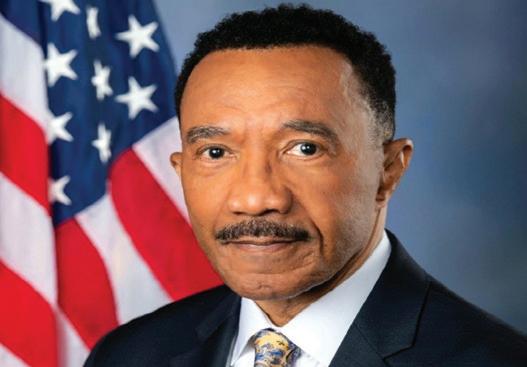
U.S. Congressman Kweisi Mfume (D-MD-07) underscored Jackson’s statement, noting that the challenges today are merely known by different names than those King confronted decades ago. In 2025, Mfume was on the frontlines of demonstrations, protesting the 47th president’s executive actions.
He said he’s called on King’s playbook in his political work.
“My inspiration comes from the fact that he often reminded us that no lie lives forever, that God is still providential and that the arc of the universe always bends toward justice. I use that in my day-to-day work,” said Mfume. “Donald Trump will test that every day – trust me –but even his anger, viciousness, vindictiveness and his wicked ways of doing things can’t stop me or anyone else that holds on to those values.”
Drawing on King’s example, Mfume described how the late civil rights leader might advise Black Americans who are grappling with today’s political and social pressures:
“When times are dark and bleak and when hope and despair are overtaking our community, he said, ‘resist,’” said Mfume. “He would remind us to fight back as he would do, to organize our communities as was done many years ago, to protest indifferences in this society, to vote and to pray to keep our humanity together.”
community engagement, but still lower than pre-pandemic levels, but approaching 2019 (30.0%).
Key findings for California show that cancer screenings have gone up 24%, homicides have gone down 16% and drug deaths have decreased 6%. This year’s strengths include:
· A low prevalence of multiple chronic conditions
· A low prevalence of cigarette smoking, and, · A high number of mental health providers per 100,000 population.
The report also shows California’s challenges, which include:
· A low prevalence of high school completion
· Low number of primary care providers per 100,000 population, and, · High levels of air pollution.
Health outcomes are influenced by a wide range of factors, including access to care, socioeconomic status, education, environment and health behaviors.
The objective of the United Health Foundation's America's Health Rankings Annual Report is to provide a comprehensive analysis of publicly available data of the nation's health on a state-by-state basis. By evaluating a wide range of measures encompassing health outcomes, clinical care, behaviors, environmental and socioeconomic data, the reports aim to illuminate health challenges and successes, determine national and state health benchmarks and enable stakeholders to take action to improve health through datadriven insights.
· Volunteerism also surged 22%, reflecting increased
For the last 36 years, the America’s Health Rankings has provided analysis on data to deliver a holistic picture of health across the nation. To read the full report, go to www. AmericasHealthRankings.org.
New Ballot Push: Initiative Would End Prop 50 Temporary Congressional Maps After 2026
A proposed constitutional amendment that would end the use of temporary congressional district maps after the 2026 election has officially entered circulation, according to the California Secretary of State’s office.
California Secretary of State Shirley N. Weber announced that “the proponent of a new initiative was cleared to begin collecting petition signatures on Jan. 12, 2026,” allowing supporters to start gathering voter signatures statewide.
The measure responds to mid-decade redistricting actions taken in Texas and California voters’ subsequent approval of temporary maps in 2025.
The initiative, formally titled “Prohibits Use After 2026 of Temporary Congressional District Maps Adopted by Voters in 2025 in Response to Texas’ Partisan Redistricting,” would reverse part of Proposition 50, which required California to use new temporary congressional maps through 2030.
According to the Attorney General’s official summary, the measure “would instead allow use of the Proposition 50 voter-
approved maps only in the 2026 congressional election,” and would require that the 2028 and 2030 elections use the maps adopted in 2021 by the California Citizens Redistricting Commission.
Under California law, the Attorney General prepares the legal title and summary that appears on initiative petitions. Once finalized, “the initiative may be circulated for signatures,” and the Secretary of State provides deadlines to proponents and county elections officials, the Secretary of State’s office said. Fiscal impacts are expected to be limited. The Legislative Analyst and the Director of Finance estimate “likely minimal one-time costs to counties of less than a few hundred thousand dollars statewide” to revert to the commission’s 2021 maps beginning in 2028.
The proponent, James V. Lacy, must collect 874,641 valid signatures --equal to eight percent of the votes cast for governor in 2022 -- by July 13, 2026, for the measure to qualify for the statewide ballot.
Thursday, January 22, 2026
Antonio Ray Harvey | California Black Media
Authored by
Assemblymembers Ash Kalra (D–San Jose) and Lola Smallwood-Cuevas (D–Los Angeles), Assembly Bill (AB) 1157 -- known as the Affordable Rent Act -- failed last week to advance out of the Assembly Judiciary Committee, marking the second consecutive year the rent control proposal has been halted in the Legislature.
The bill received four “yes” votes from Democrats and three “no” votes from Republican members, while five other Democrats on the committee abstained. The legislation required seven votes to advance out of committee.
Had AB 1157 passed, the bill would have expanded tenant protections under the California Tenant Protection Act of 2019, also known as AB 1482.
“This is a cost to humanity,”
Kalra told the Assembly Judiciary Committee on Jan. 13. “I think there’s a far greater cost for our humanity and for us not understanding that we need to do more to help those struggling the most.”
Assemblymember and member of the California Legislative Black Caucus Isaac Bryan (D-Ladera Heights) voted in favor of AB 1157. Assemblymembers Kalra, Damon Connolly (D-San Rafael), and John Harabedian (D-Pasadena) also voted “yes.”
Assemblymembers Rebecca Bauer-Kahan (D–Orinda), Blanca Pacheco (D–Downey), Diane Papan (D–San Mateo), Catherine Stefani (D–San Francisco), and Rick Chavez Zbur (D–West Hollywood) abstained from voting, preventing AB 1157 from reaching the seven-vote threshold required for passage.
Diane Dixon (R-Newport
Read the latest stories on our website: sb-american.com Questions? Call us @ 909-889-7677 or email mary@sb-american.com
California Attorney General Rob Bonta helped secure a $425 million settlement with Capital One that would provide restitution and improved interest rates for customers who were allegedly misled about their savings accounts, state officials announced Jan. 13.
The settlement, which received preliminary court approval last week, resolves claims that Capital One unfairly kept interest rates artificially low for holders of its 360 Savings accounts while offering significantly higher rates through a nearly identical product. If finalized, the agreement will require Capital One to pay $425 million in restitution and eliminate what regulators described as a misleading two-tiered savings system.
Bonta joined a bipartisan coalition of attorneys general last year in opposing an earlier proposed class action settlement that state officials said failed to adequately compensate consumers. The revised agreement more than doubles the value of that initial proposal and grants multiple states enforcement authority.
“Capital One misled consumers through false marketing and a lack of transparency regarding its savings account system, cheating consumers nationwide,” said Bonta. He added that the earlier proposal was “unacceptable and hopelessly inadequate,” saying California consumers “deserve a fair deal and someone fighting in their corner.”
According to state officials, Capital One marketed its 360 Savings accounts as “high interest” products that would
Beach), Alexandra Macedo (R-Tulare), and Kate Sanchez (R-Rancho Santa Margarita) voted against the bill.
Without further hearings scheduled, AB 1157 is considered dead for the current legislative push.
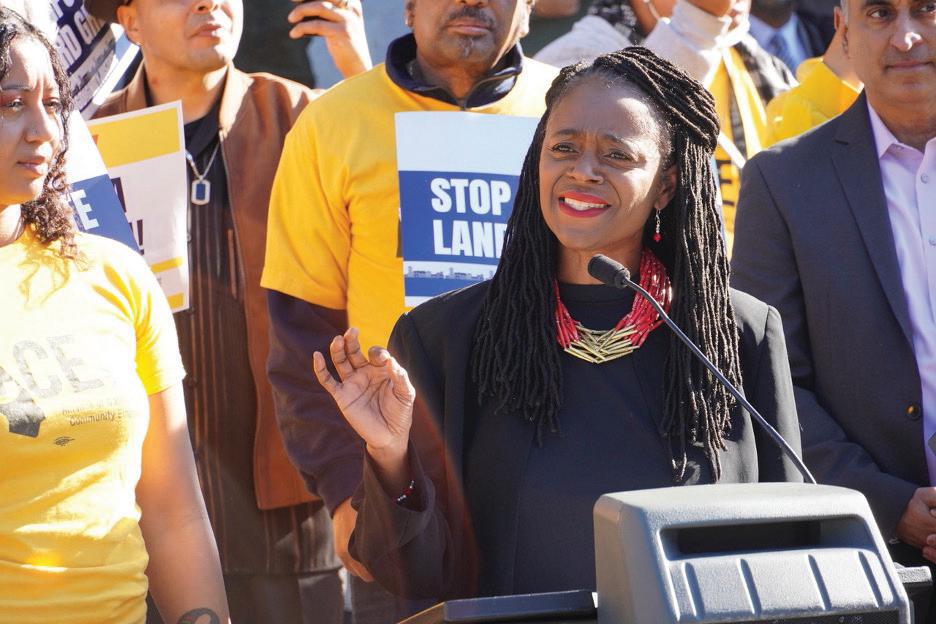
A day before the vote, a rally was held on the West Steps of the State Capitol in Sacramento with a crowd that included tenants and advocates who shared personal stories and urged lawmakers to pass the measure.
Smallwood-Cuevas and Kalra joined supporters from the Alliance of Californians for Community Empowerment (ACCE), People Improving Communities through Organizing (PICO), landlords of apartment complexes, and other low-rent housing advocates at the event.
Smallwood-Cuevas, a member of CLBC, argued the bill would strengthen statewide protections to prevent the "excessive rent hikes" currently impacting millions of California renters. She shared that she is a renter of a two-bedroom apartment in Sacramento, where she started paying $2,100 per month last year. She now pays $800 more each month.
“No one should be forced to choose between paying rent and meeting basic needs,” Smallwood-Cuevas said. “Protecting people means protecting our housing. Capping rent means the bottom line of every Californian: Human rights is housing.”
According to the California Housing Partnership, California remains one of the most expensive and least “renterfriendly” states in the U.S. due to cost and availability. Median rents in the state are approximately 38% higher than the national average. Four of the 10 most expensive large cities for tenants in the country are located in California.
According to the Bay Area Equity Atlas (BAEA), the Bay Area’s regionwide housing crisis affects the majority of residents but is especially detrimental to Black homeowners, renters, and prospective homebuyers.
According to BAEA, between 2010 and 2020, the Bay Area lost over 5,000 Black owneroccupied households. During that period, many Black renters and homeowners were displaced from historically Black communities to other parts of the region, particularly the inland East Bay and Solano County.
Real estate owner advocates such as the California Apartment Association (CAA), California Association of Realtors (C.A.R.), and other housing industry associations opposed AB 1157. They argued it would increase costs, deter investment, reduce housing supply, and hurt small landlords. The opponents explained that California voters have consistently rejected similar rent control policies at the ballot box, most recently with Proposition (Prop) 33 in 2024.
CSUN’s Spring Salon Series to Feature Conversation with Cedric the Entertainer
CSUN’s Spring Salon Series to Feature Conversation with Cedric the Entertainer...continued
Professorship in Africana Studies is designed to serve as an academic liaison with dedicated office hours to meet the needs of students as well as to become a role model and resource for members of the community at large.
The Salon Series was created in the spirit of this position, Searcy said. “I think some our best college experiences come from being exposed to different ideas and different people that we can learn and benefit from,” he said. For more information about The Salon Series or to purchase tickets, visit the event’s website.
outperform average savings accounts. However, while interest rates rose nationwide beginning in 2022, the bank kept rates on those accounts low. At the same time, it introduced 360 Performance Savings accounts that offered much higher interest rates, at one point more than 14 times higher than the original product.
Regulators said the practice allowed Capital One to save nearly $3 billion in interest payments. Under the new settlement, the bank must align interest rates between the two savings products, ending the twotier structure. The agreement is expected to deliver an estimated $530 million in additional future interest to consumers nationwide. The settlement also resolves related claims brought by attorneys general in California, Maryland, Massachusetts, Minnesota, Nevada, New York, Ohio, and Rhode Island. The resolution prohibits Capital One from making false or deceptive statements about interest rates on deposit accounts and allows states to enforce consumer relief provisions.
Bonta credited New York Attorney General Letitia James for leading the multistate effort and said the outcome highlights the importance of state enforcement actions, particularly after the Consumer Financial Protection Bureau dismissed a related case.
Final approval of the settlement will be determined by the court at a later date. If approved, the agreement would mark one of the largest consumer restitution settlements involving savings account interest practices.

Joy is the one word that comes to top of mind when Yan Searcy, dean of California State University, Northridge’s College of Social and Behavioral Sciences, thinks about comedian, actor and entrepreneur Cedric the Entertainer
“He’s one of the rare comedians who operates from a disposition of joy. Not trauma. Not tragedy. Joy,” Searcy said, explaining why he invited Cedric the Entertainer to be the featured speaker for this semester’s Salon Series. “He’s a person whose work seems to just come from joy. He finds joy in so many unexpected places and, in this particular time in U.S. history, I think it’s very important for us to talk about joy.”
The Salon Series is scheduled to take place from 6 to 8 p.m. on Thursday, Feb. 5, in the Orchard Conference and Catering Center near the southern end of the campus located at 18111 Nordhoff St. in Northridge.
The series is modeled after the Harlem Renaissance Salons of the 1920s and 1930s, which celebrated African American creativity in literature, music, art and social thought. The gatherings provided intimate settings for conversations on the arts, the future and racial solidarity.
The College of Social and Behavioral Sciences’ Salon Series is designed to bring together friends, communities, alumni, faculty, staff and students for informative and sometimes provocative conversations and to support the creation of the Community Endowed Professorship in Africana
Studies.
Cedric the Entertainer, whose real name is Cedric Antonio Kyles, traveled the country as one of the “Kings of Comedy” headliners with Steve Harvey, D.L. Hughley and Bernie Mac. That act was later made into a Spike Lee film, “The Original Kings of Comedy.” He also has had starring roles in the “Barbershop” trilogy movie series, the “Madagascar” animated movie series, “The Steve Harvey Show” and “The Soul Man.” He is currently one of the stars of the television comedy series “The Neighborhood.”
Cedric the Entertainer has also launched a successful business enterprise. He has partnered with actor Anthony Anderson to create AC Barbeque, a BBQ brand that started with sauces and rubs and has since expanded to a restaurant in Westfield Century City, food trucks at HBCUs and collaborations with the fast-food chain Arby’s.
Searcy said one of the reason’s Cedric the Entertainer, who graduated from Southeast Missouri State University with a bachelor’s degree in mass communications, was invited to take part in The Salon Series was because of his strong commitment to education and his success as an entrepreneur and businessman.
“Cedric truly supports higher education. He’s a college graduate and understands the importance of an education,” Searcy said. “Humor is only one side of Cedric the Entertainer.
With the Salon Series, we have an opportunity to have interesting conversations with interesting people and expose the campus community, alumni and the community at large to positive people who are making a difference.”
Searcy noted that the Community Endowed
Inaugural HBCU Week NOW Student Film Festival premieres January 27
Lifestyle News

The Hale Academy
Hi ! Client Black Public Media and Maryland Public Television have joined forces to present the inaugural HBCU Week NOW Student Film Festival. Ten films were selected and winners, each receiving a $5,000 award and a slot in the streaming festival, were students or recent graduates of Hampton University, Howard University and Spelman College. Films will begin streaming on January 27 on the HBCU Week NOW YouTube channel.
TEN FILMS SELECTED FOR INAUGURAL HBCU WEEK NOW STUDENT FILM FESTIVAL
Original short films spanning multiple genres will begin streaming January 27
BALTIMORE (January 20, 2026) — Ten award-winning films by students and recent graduates of Historically Black Colleges and Universities (HBCUs) will premiere on January 27 as part of the inaugural HBCU Week NOW Student Film Festival.
The winning shorts will stream on the HBCU Week NOW YouTube channel. They were selected from a pool of 36 submissions from across the nation. Each winning project receives a $5,000 award and inclusion in the festival produced by HBCU Week NOW, a public media partnership spearheaded by Maryland Public Television (MPT), and Black Public Media (BPM), the Harlem-based national media arts nonprofit.
The winning films run the gamut of genres, from documentary and experimental to animation and scifi. They were directed by students and recent graduates of Hampton University, Howard University and Spelman College. The shorts are:
For Me, By Me by Hannah Koonce (Spelman College ’28); From Rodeo to Polo: The First HBCU Polo Team by Kendi King (Spelman College ’25); The Hale Academy by Audra Davison (Spelman College ’22); Lady T by Nia Lambert (Spelman College ’25); One and Only by Zachary Ramseur (Hampton University ’28); Paralysis by Analysis by Jolene Carter (Howard University ’25); Shotgun by Quaran Ahmad (Howard University ’25); StarChild by Miya Scaggs (Spelman College ’25); What Is The Black Body? by Amira Barrett (Spelman College ‘25); and Whispers of White by Kennedy Rome (Spelman College ’26). The festival slate includes true stories of the first HBCU polo and lacrosse teams, fictional stories about environmental justice and the dangers of AI, explorations of femininity and the Black body, and more.
Black Public Media issued an open call for submissions in the spring of 2025. Eligible applicants were current HBCU students and recent graduates (within the last three years). Enrollment in a film or media program was not required.
“HBCU Week NOW honors the enduring history, legacy and cultural heritage of HBCUs. Our new film festival gives emerging filmmakers from these institutions a national stage and the momentum to turn student work into the next wave of public media,” said Travis E. Mitchell, MPT senior vice president and chief content officer.
“These films prove the pipeline is strong for Black stories of our past, present and future,” said Leslie Fields-Cruz, BPM executive director. “From intimate docs to audacious sci-fi projects, these artists are prepared to lead the next wave of storytelling.”
HBCU Week NOW is a public media partnership comprised of Maryland Public Television, PBS North Carolina, South Carolina Educational Television, WXXI Rochester, Louisiana Public Broadcasting, WABE Atlanta, Howard University Television, and WORLD, a leading public media digital channel.
Beyond launching the student film festival — a cornerstone initiative celebrating HBCU culture through authentic storytelling — HBCU Week NOW is amplifying its reach during Black History Month in February. The acclaimed MPT documentary Becoming Thurgood: America’s Social Architect returns to PBS stations nationwide (check local listings), while two new compelling short films, Bayou Magic: The Alvin Jazz Institute from Louisiana Public Broadcasting and Wall of Sound by Alabama Public Broadcasting, will premiere on the HBCU Week NOW YouTube channel, extending HBCU Week NOW’s mission to honor Black excellence across multiple platforms and audiences.
Thursday, January 22, 2026
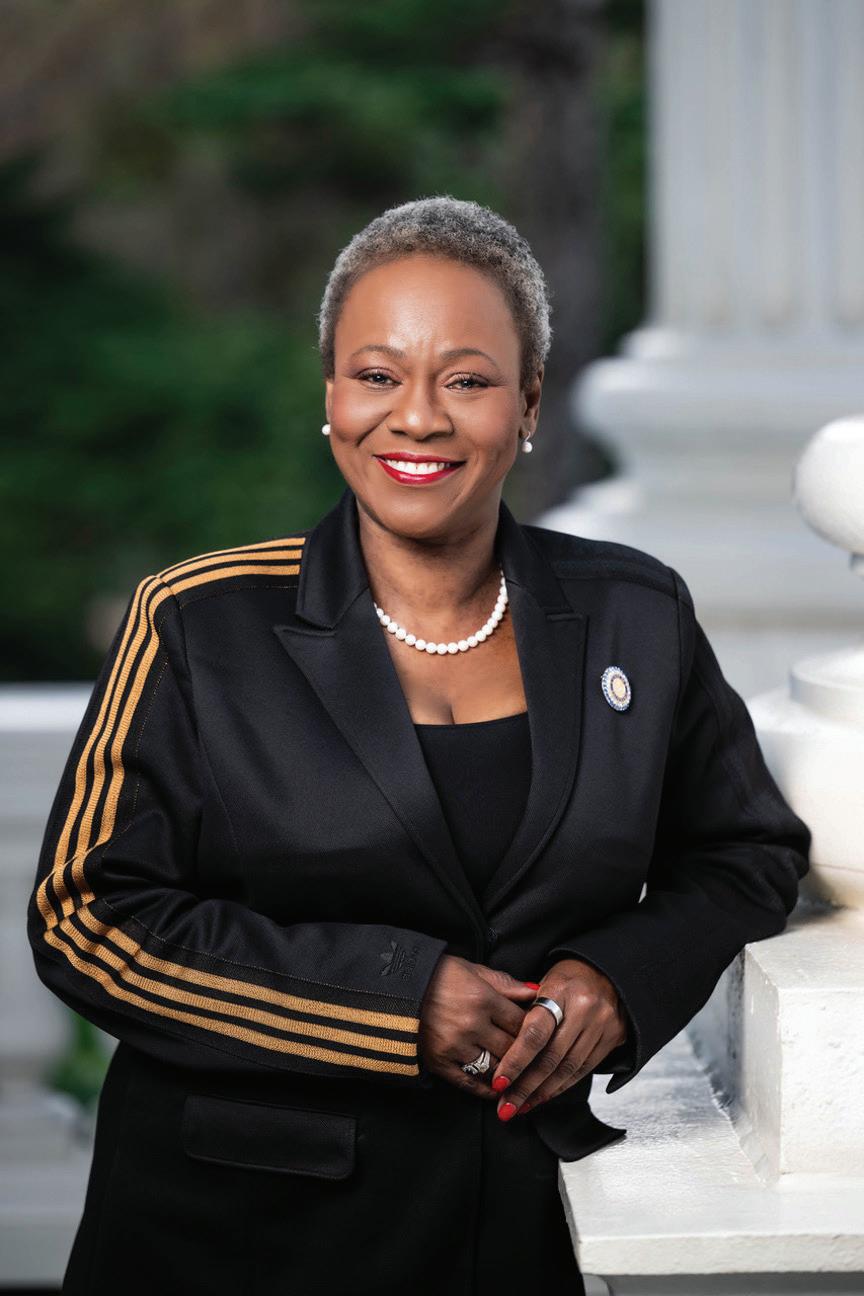
A question recently emailed to the office of Assemblymember Tina McKinnor (D-Inglewood) was not about legislation, policy, or governance.
Instead, it asked whether the “Louis Vuitton bag McKinnor was wearing last night “real or fake?”
This wasn’t just a casual inquiry. Stella Yu, the CalMatters reporter who asked the question, told McKinnor’s chief of staff, Terry Schanz, that it came from an editor. That detail matters because it shows the question was a deliberate editorial decision.
The question arose after McKinnor attended the California Tribal Business Alliance’s 21st Annual Back to Session Bash, a Capitol event held every January as lawmakers return from recess.
Funded by lobbying interests -including tribal gaming groups, tobacco and slot-machine companies, and trade unions -the event is designed to foster relationships between lawmakers and stakeholders. If journalists want to examine lobbying culture, there’s a real story to pursue. But the question sent to McKinnor’s office wasn’t about influence or access.
California Black Media (CBM) asked CalMatters to explain the editorial reasoning behind the question -- how it served the public interest and how it aligned with responsible journalism, especially given the racial and gendered history of questioning Black women’s
legitimacy and status.
CalMatters CEO Neil Chase told CBM he would talk with his team.
Later, he said editors had discussed the matter with McKinnor’s staff, that he had reached out to McKinnor personally, and that the newsroom was reviewing whether the inquiry aligned with its standards and avoided bias.
While Chase acknowledged concerns, he did not explain why the question was asked in the first place.
McKinnor made the inquiry public. On social media, she posted:
“While Rome burns and American democracy is hanging on by a thread, I have to deal with racist bulls**t like this from CalMatters.org.”
Her post quickly spread through political and media circles, shared through texts, group chats, and social feeds. The reactions were not about fashion. They were about relevance, bias, and journalistic judgment.
Many who responded to the post questioned why a political newsroom would focus on a woman’s handbag instead of her legislative work.
A number of commenters questioned whether male legislators are ever questioned about their watches, shoes, or suits. Commenters described the inquiry as “unprofessional,” “ridiculous,” and “disgusting,” and said the question implied
McKinnor either could not afford nice things or should not have them.
“When a Black woman in elected office wears something nice, the first instinct is to question if it's real. That reflex says everything. Women of color are constantly boxed into this narrative of scarcity, like success is supposed to look modest, apologetic, or invisible,” wrote Astine Suleimanyan, a commenter on McKinnor’s post.
“It's about respect. It's about who society believes is allowed to prosper and who isn't,” she continued. “You don't owe anyone an explanation for your success. The worst part is that it's women beating other women down.”
Others focused on newsroom accountability, asking why an editor would direct such a question and what story could possibly justify it.
Schanz confirmed to CBM that Chase did reach out. He said CalMatters’ political editor, Juliet Williams, contacted him after McKinnor’s post, and that Chase later emailed requesting a meeting with McKinnor.
Schanz said McKinnor had not responded yet because the inquiry came over MLK weekend, while she was attending community events honoring Dr. Martin Luther King Jr. He said she planned to assess whether to respond after returning to the office.
“She’s not going to let this nonsense take away her joy from celebrating Dr. King,” Schanz said. “The priority this weekend was being with her community.”
Schanz said he told CalMatters’ editor directly that asking whether a Black woman’s accessory is “real or fake” is racist because it draws on stereotypes that Black women do not belong, are pretending, or are undeserving. He said the editor told him she did not know McKinnor was Black -- a claim Schanz said was not credible given McKinnor’s public profile and the small number of Black women ever elected to the California Legislature.
To examine what ethical journalism demands in moments like this, CBM consulted Martin G. Reynolds, co-executive director of the Robert C.
Maynard Institute for Journalism Education.
“Unless a question like this is clearly tied to a public-interest purpose—such as misuse of public funds or an ethics investigation -- it isn’t neutral,” Reynolds said. “When directed at a Black woman, it also intersects with racialized and gendered tropes around appearance, suspicion, and legitimacy.”
Reynolds added that journalism must also examine how race, gender, class, and history shape who gets questioned and how -and whether the same question would be asked of someone in the same role with a different background.
That brings the focus back to CalMatters. While Chase has said the newsroom is reviewing the matter internally, he has not clarified whether the question met their editorial standards.
Key questions remain unanswered: What story was this question supposed to support? What would the answer have proved? Why focus on appearance instead of political substance? And why was McKinnor singled out?
These are not rhetorical questions. They go to the heart of how journalism defines “public interest.” When scrutiny falls on appearance instead of power, something has gone wrong.
This isn’t about attacking a reporter. It is about challenging editorial judgment.
Newsrooms decide who is questioned, how, and about what. Those decisions shape public perception -- and they are never neutral.
CBM considers it important to challenge these decisions as part of its mission to hold power accountable -- including media power. When political reporting centers on whether a Black woman’s purse is “real,” the public deserves to know who made that call and why.
CalMatters has said it is reviewing the matter internally. But as Reynolds pointed out, real accountability requires journalism to question itself as rigorously as it questions others --- and that means being transparent with the public about the story it believed it was telling, and why it chose to tell it that way.

Responding to recent fatal shootings and an uptick in misconduct and excessive use-of-force incidents by federal policing agencies like Immigration and Customs Enforcement (ICE), California lawmakers are proposing some legal guardrails to prevent them and hold officers accountable.
Assemblymember Isaac Bryan (D-Ladera Heights) recently authored legislation to place limits on federal officers operating in the Golden State. Bryan is highlighting two recent killings by ICE agents in Minnesota and California.
“If you were out in the streets protesting the murder of Renee
Good and the murder of Keith Porter,” said Bryan in a TikTok video, “I’ve got a piece of legislation for you.”
In his message, Bryan was referring to Renee Good, a 37-year-old Minneapolis woman who was fatally shot by an ICE agent on Jan. 7, and Keith Porter, 43, a Los Angeles resident and father of two who was also fatally shot on New Year’s Eve by Brian Palacios, an off-duty ICE officer. “His heart was big. He had big heart. He loved so deep, he loved so deep,” said Porter’s mother Franceola Armstrong at an L.A. City Council meeting. “He was a joy. He was my baby. He was a father.”
Last week, Palacios was publicly identified after his name surfaced in a custodyrelatedcourt filing, according to reporting by the Los Angeles Times.
AB 1537, the legislation Bryan authored and introduced would prohibit state and local law enforcement officers from moonlighting for the U.S. Department of Homeland Security, its contractors, or any other entity involved in immigration enforcement.
The push for AB 1537 responds to a number of recent clashes between protesters and ICE in major cities across the country. Thousands of ICE officers have been deployed in Minneapolis, and in California violent conflicts between ICE and protesters have resulted in major injuries.
Authorities allege that Porter was firing a gun to mark the New Year, an activity his cousin, Jsane Tyler, said was not uncommon in the neighborhood where he lived in Northridge.
According to the Department of Homeland Security’s assistant secretary of homeland affairs, Tricia McLaughlin, Palacios
California Lawmakers Propose Bills Responding to Fatal Shootings by ICE Agent...continued knocking on doors,” said Tyler.
Porter’s family has hired a lawyer, Jamal Tooson, and has held press briefings, with the help of Black Lives Matter L.A., where they continue to challenge authorities in L.A. to arrest Palacios.
Aided by Black Lives Matter
L.A. the family met with Los Angeles County District Attorney Nathan Hochman. Activists, educators and lawyers faced off with Hochman in a tense hourlong discussion demanding a more critical investigation and charges against the ICE agent.
In nearby Orange County, a 21-year-old protester, Kaden Rummler, was shot point-blank in the face with a less-thanlethal round by federal officers. Rummler lost an eye and was dragged across the courtyard by ICE agents, according to an interview on CBS LA and video from the scene.
Responding to the escalating anti-ICE protests, President
Trump threatened [SS1] to invoke the Insurrection Act on the official White House X account.
In addition to Bryan’s bill, California State Sen. Scott Wiener (D-San Francisco) proposing Senate Bill (SB) 747, The No Kings Act, a bill designed to hold federal, state and local police accountable for violating individual constitutional rights. The bill, if passed, would only affect California. For the family the ordeal has taken a toll, Tyler says.
Family members say they want the public to see Porter as a person and not a suspect.
“From day one when he was born people looked for him, he was a joy to be around,” said Armstrong. “My son had the biggest heart. He was sympathetic, and he had so much gratitude.”
claimed to have heard the gunshot Porter allegedly fired and confronted him.
“On Dec. 31, an off-duty ICE officer bravely responded to an active shooter situation at his apartment complex,” reads McLaughlin’s statement.
The district attorney’s Justice System Integrity Division is running a parallel investigation with the LAPD Robbery and Homicide Division, according to a communications officer at the LAPD.
Tyler told California Black Media (CBM) that the family has been stonewalled by authorities, which has led them to seek evidence themselves. She says her family heard about bullet holes at the complex and that they are asking neighbors for any video they may have.
Both the LAPD and the U.S. Department of Justice declined to comment on an active investigation but referred CBM to older published statements about the shooting and the ongoing investigation.
“We may just have to go

Caucus Chair Akilah Weber Pierson Applauds California Ban on Police Officers Wearing Face Masks
Sen. Akilah Weber Pierson (D-San Diego), chair of the California Legislative Black Caucus (CLBC) last week praised California’s new law limiting when law enforcement officers may wear face coverings, calling it a critical step toward accountability and public trust in policing.
The measure, SB 627 -- also known as the No Secret Police Act -- was signed by Gov. Gavin Newsom last year and took effect on Jan. 1.
It restricts law enforcement officers from wearing facial coverings while performing public duties, except under limited operational circumstances. The law applies to local, state, and federal agencies operating in California and requires departments to adopt and publicly post maskuse policies by July 1, 2026.
Weber Pierson, a co-author of the legislation, said the law affirms the public’s right to transparency.
“The public has a right to know who is enforcing the law in our communities,” Weber Pierson posted on Facebook on Jan. 14.
Framing the issue as more than administrative oversight, Weber Pierson stated that visibility and accountability are essential to community well-being.
“Transparency in policing is a public health issue,” she added, noting that communities cannot heal from historical trauma when officers wield authority
Donations to the Porter family to support his children can be made at this GoFundMe site. anonymously.
Despite support from civil rights advocates, the law is facing a federal court challenge. The U.S. Department of Justice is seeking to pause its application to federal agents, arguing that the measure interferes with federal law enforcement operations, particularly immigration enforcement.
Federal attorneys told the court on Jan. 14 that the law improperly regulates federal officers and exposes them to increased safety risks.
First Assistant U.S. Attorney Bill Essayli said officers are increasingly targeted through facial recognition and AI tools, claiming an “8,000% increase in threats” against Immigration and Customs Enforcement (ICE) agents. He also cited instances of agents being tracked to their homes and harassed.
During the hearing, the judge raised concerns about potential unequal treatment if exemptions apply differently to state and federal officers. A decision on the request to pause enforcement is expected soon.
Supporters of SB 627 argue the law advances civil rights by ensuring officers are identifiable during public interactions, while opponents contend it endangers officer safety and undermines federal enforcement
with
and