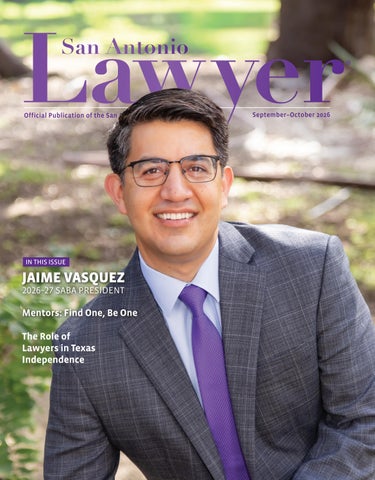
Official Publication of the San Antonio Bar Association
IN THIS ISSUE
JAIME VASQUEZ 2026–27 SABA PRESIDENT
Mentors: Find One, Be One The Role of Lawyers in Texas Independence
September–October 2026
LawPay is a trusted Member Benefit of the San Antonio Bar Association lawpay.com/saba
Run your business. Power your practice. 2 San Antonio Lawyer® | sabar.org
+
contents ON THE COVER 8 Jaime Vasquez: Where He Is By June Moynihan
FEATURES 18 Mentors: Find One, Be One By Cassidy Daniels
20 The Role of Lawyers in Texas Independence By Fred Riley Jones
8 Jaime Vasquez Photo by Mewborne Photography at Vasquez residence
DEPARTMENTS
ASSOCIATION & COMMUNITY
5
7
Feedback
Updates
26 Dinner Party Law
28 Briefly
By Tiffanie Clausewitz and Bailey Ratner
By SABA Staff
34 Fourth Court Update
30 Bar Business
By Justice Lori I. Valenzuela and Shannon Dunn
By SABA Staff
36 Federal Court Update
31 Bar Community: Affinity Bars and SABA Sections/Committees
By Soledad Valenciano, Sabrina Salazar, and Clarissa Valenciano
By SABA Staff
38 Endnotes
September–October 2026 | San Antonio Lawyer® 3
®
Official Publication of the San Antonio Bar Association San Antonio Lawyer ® is published bimonthly. Copyright ©2026 San Antonio Bar Association. All rights reserved. Republication of San Antonio Lawyer content, in whole or in part, is prohibited without the express written permission of the San Antonio Bar Association. Please contact Editor in Chief regarding republication permission. Views expressed in San Antonio Lawyer are those of the authors and do not necessarily reflect the views of the San Antonio Bar Association. Publication of an advertisement does not imply endorsement of any product or service. San Antonio Lawyer, the San Antonio Bar Association, and the Publisher reserve the right to edit all materials and assume no responsibility for accuracy, errors, or omissions. San Antonio Lawyer and the Publisher do not knowingly accept false or misleading advertisements or editorials, and do not assume any responsibility should such advertising or editorials appear. Contributions to San Antonio Lawyer are welcome, but the right is reserved to select materials to be published. Please send all correspondence to info@sabar.org. Archives of San Antonio Lawyer are available at sabar.org. Send address changes to the San Antonio Bar Association.
EDITORS
“His grasp of the forces that drive a successful mediation is always spot on. There is not a mediator working today that I would trust more in bringing a case to resolution.” (Who’s Who Legal 2017)
“Donald is a very quick study and understands complex financial cases very quickly. He is thorough, intelligent and hard-working.” (Chambers 2025)
Editor in Chief Leslie Sara Hyman
BOARD OF EDITORS Leslie Sara Hyman, Chair Pat H. Autry, Vice-Chair Mary Adair Todd Marquardt Naveen Adusumilli Lauren Miller Barry Beer Curt Moy Amy E. Bitter Sara Murray Linda Brandmiller Chinoso Osonma Billy Calve Ricardo Aponte Parsi Paul T. Curl Steve Peirce Cassidy Daniels Kerry Simmons Hayley Ellison Regina Stone-Harris Stephen H. Gordon ileta! Sumner Per Hardy Soledad Valenciano Casey Lee Natalie Wilson
Articles Editor Natalie Wilson
Departments Editor Cassidy Daniels Managing Editor Brittni Schuster
PUBLISHING PARTNER Monarch Media & Consulting, Inc. 512.293.9277 | monarchmediainc.com Design Direction Andrea Exter
Design Sabrina Blackwell
Advertising Sales Chellie Thompson
Ex Officio Nick Guinn
For advertising information, contact: Chellie Thompson, Monarch Media & Consulting, Inc. chellie@monarchmediainc.com
“He’s very charming, very professional, very understanding and empathetic to what’s going on.” (Chambers 2023) “An extremely effective mediator in a wide variety of situations.” (Best Lawyers 2021)
126 E. Nueva, 3rd Floor, San Antonio, Texas 78204 210.227.8822 | sabar.org
OFFICERS / DIRECTORS EFFECTIVE AUGUST 1, 2026
“An outstanding and innovative mediator.” (Super Lawyers)
President Jaime Vasquez President-Elect Emma Cano Treasurer Elizabeth “Liz” Provencio Secretary Jorge Herrera
Booking: www.donphilbin.com/book-a-mediation/
4 San Antonio Lawyer® | sabar.org
Immediate Past President Nick Guinn
Directors (2025–2027) Krishna Reddy Michael Ritter Elena Villaseñor Sullivan Collanne West Directors (2026–2028) Abel Martinez Cynthia Orr Kristal Thomson Soledad Valenciana Executive Director June Moynihan
STATE BAR / SA BAR FOUNDATION State Bar of Texas Directors Patricia "Patty" Rouse Vargas Steve Chiscano
San Antonio Bar Foundation Chair Nick Guinn
LOCAL BAR ASSOCIATIONS Association of Corporate Counsel South/Central TX Bexar County Women’s Bar Association Christian Legal Society Defense Counsel of San Antonio Federal Bar Association—San Antonio Mexican-American Bar Association—San Antonio San Antonio Black Lawyers Association San Antonio Criminal Defense Lawyers Association San Antonio Trial Lawyers Association San Antonio Young Lawyers Association TEX-ABOTA, American Board of Trial Advocates—San Antonio William S. Sessions Inn of Court
feedback
July–August 2026 Good morning, Leslie, You and your staff continue the grand tradition of excellence following in the footsteps of Sara. The art work and layout employed with my essay was a brilliant touch. Please convey my appreciation to those who did the work. Thank you for providing the platform for publication!
Paul Girardet, after Emmanuel Leutze, Washington Crossing the Delaware, (1898).
Kind regards, Will Our Republic Celebrate Its 500th Anniversary?
Judge Fred Biery
By Fred Biery, United States District Judge
18
WE LOVE FEEDBACK! Please send letters to the editor to Leslie Sara Hyman, Editor in Chief, at info@sabar.org. The San Antonio Bar Association thanks our editors, board of editors, and contributing volunteer writers for bringing an unparalleled quality of editorial content to our valued readers.
W
ith the help of our French and Spanish allies and the assistance of some First American tribal people seeking to protect their territories and AfricanAmerican patriots hoping for their freedom, plus the luck of a fog in Brooklyn helping General Washington to early victories, the patriots prevailed against overwhelming odds. Our national birth story had its philosophical gestational roots with the enlightenment writings of John Locke, JeanJacques Rousseau, and others, which persuaded and led the founders to the radical idea of a democratic republic being the preferred form of government and that “all men are created equal” and to revolt against the concept of the divine right of kings, primogeniture, and taxes, tariffs and fees imposed without representation. Those rights fought for by the patriots did not provide the right to vote for white males without property until some years after their service in the Revolutionary War. One of them was my fourth great-grandfather, Walter Waller Brown, who as far as we know owned no property.
San Antonio Lawyer® | sabar.org
Page 18 of the July-August 2026 issue of San Antonio Lawyer.
September–October 2026 | San Antonio Lawyer® 5
Building Healthier Lives and Stronger Communities Prevention • Intervention • Treatment • Medication-Assisted Treatment (MAT) • Recovery Support
OUR SERVICES Prevention & Education Programs Youth & Family Services
Substance Use Assessments Outpatient Treatment Services Recovery Coaching & Support
DWI & Offender Education Classes Mental Health Awareness Program Community Outreach & Training MISSION STATEMENT
Empowering our community to live healthy lives; by providing prevention, intervention, and recovery support services for children and adults.
OUR VALUES
Excellence | Growth | Impact | Integrity | Leadership | Respect | Work-Life Balance We are committed to accessibility. Most of our services are provided free of charge or at low cost.
7500 U.S. Highway 90 West, Suite 201 San Antonio, Texas 78227
HCCADA 102 Business Drive West Kerrville, Texas 78028
(210) 225-4741
(830) 367-4667
SACADA
6 San Antonio Lawyer® | sabar.org
www.sacada.org
www.hccada.org
Updates
Join SABA Unplugged: Plot Twist in October for Solito: A Memoir by Javier Zamora By Natalie Wilson If ever I am asked what advice I have for students about to graduate, I wouldn’t mention wearing sunscreen or making one’s bed. I would advise selecting a poet as the class speaker. I was incredibly fortunate to have such class speakers at both my undergraduate and law school graduation ceremonies.1 For a lover of language, there is nothing more evocative than a poet engaging in prose, whether you are listening or reading. And if you have to listen to someone else talk for an extended period, who better than a person obsessed with the rhythm of sentences and the wielding of words like a paintbrush? That is one reason why I am so excited for the next meeting of SABA Unplugged: Plot Twist, the bar association’s book club. In October, in recognition of Hispanic Heritage Month, the group will read Solito: A Memoir by Javier Zamora. Zamora was born in El Salvador and is now an activist and award-winning poet who writes in English, Spanish, and Salvadoran Caliche (a particular dialect of South American Spanish). Zamora’s parents fled the violence of the Salvadoran Civil War in the early 1990s. His father left when he was one and his mother left when he was five. Zamora lived with his grandparents until he was nine, when he migrated to the United States through Guatemala, Mexico, and eventually, Arizona. Solito tells the story of that odyssey. The memoir touches on subject matter that is so important for our region and I expect that Zamora’s talents as a poet will lend themselves to intense, emotional prose.
Solito was a critical and commercial standout. It was a New York Times Bestseller and was selected for the Today show’s “Read with Jenna” book club. It was one of the New York Public Library’s Ten Best Books of the Year, a finalist for the PEN/John Kenneth Galbraith Award for Nonfiction and was longlisted for the Andrew Carnegie Medal for Excellence and the PEN/ Open Book Award. Definitely a book worth adding to your “to be read” pile, even if you can’t make it to the October meeting. Please stay tuned to the SABA calendar and the SABA Weekly for details about the October meeting and the registration link.
Solito: A Memoir, Javier Zamora, Hogarth, 2023, 416 pages, ISBN-10: 0593498089, ISBN-13: 978-0593498088
ENDNOTES For anyone curious, my undergraduate class speaker was Joe Hall, who has published six books (my favorite of which is 2023’s Fugue and Strike) and teaches at SUNY Buffalo. The class speaker at my law school graduation was Liam Skilling, who is now the Director of Academic Success at the University of Hawaiʻi Richardson School of Law and was the 2012 Hawaiʻi Poetry Grand Slam Champion. 1
September–October 2026 | San Antonio Lawyer® 7
Photo by Mewborne Photography atVasquez residence
8 San Antonio Lawyer® | sabar.org
JAIME VASQUEZ
W here He Is Jaime Vasquez has built a life by paying attention to the question in front of him, the people beside him, and the road ahead. By June Moynihan
J
aime Vasquez had no idea he was about to crash another man’s date. Two weeks before law school began, Jaime did not know a soul in Austin. Rather than wait for classes to start and hope friendships formed on their own, he organized a happy hour near campus for the students in his section. It was a practical solution to arriving in a new city alone: put everyone in one place and start getting acquainted. Incoming 1L Veronica Leal (Jaime’s future wife) planned to stay only briefly because she was meeting up for dinner with an out-of-town girlfriend. As the happy hour progressed, the table of new students kept reforming into a smaller group until only a few people remained. Veronica got up to leave, announcing that she was meeting a girlfriend for dinner. Jaime, still hoping to make friends, asked if he could join them. Veronica quickly calculated that she was about to spend three years with this new section mate and did not want things to
Above: Jaime Vasquez’s family at his home in San Antonio, TX.; Right: Jaime and his wife, Judge Veronica Vasquez, during their engagement photo shoot.
become awkward before classes had even started. So, she agreed. Jaime walked her to her car. But when they reached it, he opened the passenger door and climbed in. Veronica looked across the console and thought, “What is this boy doing?” Apparently, he really was coming to dinner, and she was giving him a ride. The dinner was going great, and the three were enjoying drinks and laughing when a fourth guest arrived. He was a local man Veronica had been casually dating, and he also was friendly with her visiting pal. Jaime knew none of this. He only noticed that the newcomer seemed irritated, and Jaime later remarked that the man had been rather rude. Years afterward, Veronica finally explained the situation. “You were the interloper,” she told him. The story is amusing primarily because it is so unlike the Jaime everyone knows. Veronica will readily tell you that her husband can take a very long time to make a decision. He wants information. He considers the alternatives.
A purchase, a household project, or a travel plan can remain under review long after everyone else is ready to move. With Veronica, there was almost none of that hesitation. When classes began, Jaime saved her a seat beside him in the front row, effectively choosing her seatmate for the year. By the second week, he asked, “What’s it gonna be?” He liked her. He was fairly sure she liked him. They should date. Veronica warned that dating someone in their study group could become the worst decision they made in law school. “Or,” Jaime countered, “this could be the best thing that ever happened to us.” By the end of the first month, he told her he was going to marry her. For a man who usually studies a decision from every angle, Jaime’s certainty about Veronica was striking. He had arrived in Austin knowing no one, organized a gathering to solve that problem, and, within weeks, found the person around whom he would build the rest of his life.
September–October 2026 | San Antonio Lawyer® 9
A young Jaime Vasquez
Jaime’s parents, the late Terry Vasquez and Judge Juan Vasquez, at the 2025 SA Bar Foundation Gala.
FINANCIAL CLARITY. STRONGER CASES. When financial issues become central to a legal case, clarity can make all the difference. Attorneys have trusted theKFORDgroup for more than 50 years to provide forensic accounting and litigation support that transforms complex financial information into clear, credible insight. From tracing assets and calculating damages to expert testimony, we deliver the financial intelligence attorneys need to prepare with confidence for mediation, arbitration, and trial. Schedule a consultation today.
8620 N. New Braunfels, Suite 300 I San Antonio, TX 78217 210-340-8351 I Fax 210-340-8359 I KFG26_049_SALawyer_SeptOct_070726.indd 1
10 San Antonio Lawyer® | sabar.org
7/7/26 6:16 PM
Friends describe Jaime as thoughtful, steady, and deeply intelligent, but Austinbased attorney Wesley Watts, one of Jaime’s law school classmates, offers a more revealing description. “He’s always where he is,” Watts says. If exams were approaching, Jaime studied. If there was time to relax, he relaxed. When he was talking with a friend, that friend did not have to compete with a phone or the next appointment. In meetings today, Jaime does the same thing. If a call requires his attention, he asks for a pause, steps away, and handles it. When he returns, he is fully back in the conversation. That focus may be easier because Jaime plans far ahead. He sees what is coming and starts working when others still assume there will be plenty of time. Preparation gives him room to attend to the person or problem in front of him without appearing hurried by everything waiting beyond it. The habit has roots in a family that understood work as both obligation and opportunity. Jaime’s father, Judge Juan Vasquez, learned his own standard from a grandfather who picked cotton and expected every task to be completed well. A man might persuade others that he had done his best, his grandfather taught him, but he could not fool himself. Juan carried that lesson through school, government service, and private practice. He and his wife, Terry, built careers while raising two sons. Neither treated professional success as a family script. Judge Vasquez says he placed no pressure on either son to become a lawyer, but they both ended up practicing tax law: Juan Vasquez, Jr. in Houston and Jaime in San Antonio. While Jaime’s mother practiced nursing for more than five decades, Juan was a tax lawyer. In 1995, Juan was appointed to the United States Tax Court. Jaime was preparing to begin high school when the family left San Antonio for Washington, D.C. Washington presented one immediate problem: the weather. Scott Stilmar, one of Jaime’s classmates at Gonzaga College High School, remembers the first time the temperature slipped just below 70 degrees during their freshman fall. No one expected the new kid from San Antonio to arrive in a down-filled Dallas Cowboys Starter® parka. The confusion was immediate. Why was anyone wearing a parka? And why, in the heart
UVA classmate Adam Shartzer met Jaime during their third year in the Virginia Glee Club. Shartzer remembers Jaime as reserved but with a natural ability to bring people into his circle and make them feel included. After graduation, both men returned to northern Virginia, worked in the Washington area, and stayed close. Jaime later stood as a groomsman in Shartzer’s wedding. Their careers eventually took them in different directions,
with Shartzer becoming a patent litigator in Washington, D.C. and Jaime returning to Texas for law school. They still make a point of meeting when one is in the other’s city. Shartzer also remembers Jaime as someone who gives himself freely. “He’ll do anything in his power if you ask him to do it,” Shartzer says. He has watched that instinct carry into Jaime’s professional life, where people around him are encouraged, trusted, and given room to grow.
Jaime in his Dallas Cowboy’s parka in front of the United States Capital in Washington, D.C.
of Washington football country, was the new kid wearing the gear of its most hated rival? Jaime’s San Antonio blood was still unaccustomed to the chill, and he apparently considered the dropped temperature to be winter weather. He wore the jacket everywhere. “He definitely had fan allegiance,” Stilmar says dryly. The coat remains Stilmar’s favorite memory of Jaime, but he also recalls a diligent, academically capable friend who stayed on top of his responsibilities. Jaime’s later success did not surprise the classmates who knew him then. Gonzaga’s Jesuit culture gave those responsibilities a framework. Education was tied to faith, ethics, and service, with the expectation that students would use what they learned for others. The school’s Kairos retreats reinforced the motto “God first, others second, and I am third.” The final charge was to “live the Fourth”: to carry those principles into the fourth day, meaning tomorrow and every day after the retreat. Service was not the only part of Gonzaga that followed Jaime to college. Jaime sang in the school’s a cappella group and continued singing at the University of Virginia. A high school recording captured him singing a solo of “Danny Boy,” a complication for anyone inclined to picture the reserved tax lawyer as entirely predictable. September–October 2026 | San Antonio Lawyer® 11
Chris Johnson, Jaime Vasquez, and Adam Shartzer. The photo is taken at Chris’ wedding. At Right: Rowing Crew at UVA
12 San Antonio Lawyer® | sabar.org
At UVA, Jaime initially considered medicine, a natural possibility for the son of a nurse who loved her profession. Then came organic chemistry, Jaime’s academic Achilles’ heel, which forced him to reconsider the plan. Accounting offered a different kind of challenge, one that fit the way Jaime’s mind worked. He discovered an affinity for it, earned his degree, completed a master’s program, and passed the CPA exam, all while working full time for Ernst & Young in Washington, D.C. Jaime first worked in tax accounting but noticed that the tax lawyers handling similar problems were paid more. He made a practical assessment of the opportunities. Washington had given him education and experience, but Texas still felt like home. So Jaime returned to Austin for law school with accounting expertise, a CPA license, and the willingness to change course when another route made more sense. In law school, Jaime’s knowledge was apparent but not performative. Classmate Wesley Watts preferred studying with one or two people instead of a large group, and Jaime was an ideal partner. When they encountered a difficult question, Jaime did not fill the silence with guesses. The study partners talked through the issue, studied it, and figured it out. Watts remembers Jaime as someone who chose his words carefully, listened without defensiveness, and usually had a wry smile that allowed a serious conversation to remain enjoyable. Victor Villarreal, Judge of Webb County Court at Law No. 2, met Jaime and Veronica through the Chicano/Hispanic/Latino Law Students Association. Villarreal was a thirdyear student when Jaime and Veronica were first-years, and he remembers them as a team almost immediately. Both were intellectually serious and committed to service. They also seemed comfortable together, more like an established couple than two people who had only met at the beginning of the year. Villarreal later worked with Jaime through the State Bar of Texas Hispanic Issues Section, for which Jaime served as chair. Villarreal observed the same self-assurance that Jaime had exhibited in law school. Jaime could lead without staging a display or making every decision about himself. “If anybody embodies the phrase ‘It’s not what you say but how you say it,’ it’s Jaime,” Villarreal says. Jaime can deliver difficult news without humiliating the person receiving it. He does not need volume to communicate certainty. Villarreal describes his friend as approachable, stable, and softly strong.
That temperament suits tax law. The work is technical and consequential. It rewards exact knowledge, patient analysis, and the ability to explain a complicated answer to someone who must make a real decision. At Chamberlain Hrdlicka, Jaime built a successful practice and became managing partner of the firm’s San Antonio office. During the pandemic, Veronica gained a new appreciation for the professionalism Jaime brought to his work. Their home became an
office, giving her a glimpse of how he carried himself at work. As judge of Probate Court No. 2, she had encountered attorneys with a wide range of professional styles and recognized the qualities that distinguished him. Jaime invested genuine care in professional relationships: he remembered the names of IRS agents’ family members and always asked about them. Even a difficult conversation could feel collaborative. People trusted that he understood the issue and that he understood them.
Help clients protect every member of the family. For many clients, pets are family. A pet trust can add value to a comprehensive estate plan, helping clients ensure their pets are cared for according to their wishes. • Appoint a caregiver • Allocate funds for expenses and care • Provide peace of mind for your clients Contact us to learn more about our experience with pet trusts.
JeffersonBank.com/Trust | (210) 736-7600 Non-Deposit Products: are not FDIC insured; are not deposits; may lose value.
September–October 2026 | San Antonio Lawyer® 13
Jaime Vasquez’s family at his home in San Antonio, TX.
14 San Antonio Lawyer® | sabar.org
Jaime and his wife, Judge Veronica Vasquez
Veronica has also seen the steel beneath Jaime’s congeniality. When someone oversteps, Jaime can become fierce. He gathers information, decides what matters, and responds at the level the situation requires. Jaime’s warmth does not make him passive. It makes people notice when his tone changes. At home, however, professional authority has limited jurisdiction. Jaime’s daughters offer a more direct evaluation. His oldest daugher says her father is nice, honest, and very good at his job. She knows because she has heard people talk about him, including her mother. His younger daughter reports that Jaime makes the best pancakes and waffles. Jaime is also, according to his own father, a good dishwasher, a very good handyman, and a man who would rather work late into the evening after dinner than sacrifice family dinner time. Jaime is handy for reasons that are partly admirable and partly financial. A ceiling fan or household repair becomes a research project. Jaime watches a YouTube video, studies the process, and does the work himself. Veronica acknowledges that a professional might finish faster. But Jaime does the work correctly and saves money. Everyone wins, especially Jaime. Family friend and TRLA attorney Richard Loza reports that Jaime is the balance for the family dreamer, Veronica, who tends to plan three hours of activity within a onehour window. Veronica sees the restaurant, the museum, the stop along the way, and the experience no one should miss. Jaime sees travel time, parking, and the hour the museum closes. Their friends know what happens next. When Jaime begins to explain the logistics, someone raises a finger, slowly raises it up to an imaginary bubble, and pretends to burst the bubble. Pop. The joke only works because the dream usually survives. Jaime studies timing and finds a route that allows the group to do most of what Veronica imagined without spending the final hour running through a parking garage. Veronica sees the possibilities. Jaime figures out how to make them happen. Jaime’s desire to give his family everything they want within reason comes, Veronica believes, from both his parents. Jaime has his mother’s warmth, protectiveness, and devotion to family. From his father, Jaime inherited a methodical mind and a preference for information before action. Together, the elder Vasquezes created a family in which ambition did not require distance from loved ones.
SPONSORED CONTENT
AVOIDING MALPRACTICE IN TAXABLE DAMAGES The 2025 Tax Law made permanent the loss of ‘personal exemptions’, which means an individual can no longer deduct Attorney Fees and Expenses from their ‘taxable’ litigation settlements; they must pay taxes on the GROSS recovery. Congress carved out “unlawful discrimination, ” and ’pure employment’ settlements, with few other exceptions. Attorneys can no longer deal with Taxable damages of ‘non-physical injury’ and ‘punitive damages-Gross Negligence’ after an agreed settlement/mediation or before funds are distributed. The remedy on ‘contingency fee’ cases is to create a Plaintiff Recovery Trust (PRT), but it must be created BEFORE the mediated settlement; the litigation must be transferred to the trust prior to an agreed settlement so the plaintiff can avoid taxation on the fee/expense portion of the recovery, receiving tax reporting (an IRS Form K-1) only on the net recovery. Structured settlements also have a role to play: Tax savings occur when structuring client proceeds to lower tax brackets! (Use in conjunction with the PRT to maximize tax savings, for non-contingency fee cases, and as the only rememdy if it is too late for the PRT.) Now wrongful death cases in Texas under the 408 statute are not only taxable, but paying taxes on the GROSS settlement has a devastating effect for widows and orphans, and serious implications for attorney malpractice. WITHOUT USING ONE OF THESE REMEDIES, THE ATTORNEY’S FEES EXCEED THE NET DOLLARS TO CLIENT, and IGNORING TAX ISSUES CAN CREATE LIABILITY! Plaintiff attorneys: Beware! Malpractice trap is waiting, and you will have a difficult time justifying your fees that exceed the net to clients! These cases require extra-care, planning and action. Create a PRT before mediation! There are no up-front costs in doing so… but plenty of problems if you do not. Defer finalizing the mediated settlement until the PRT is in place (more time is allowed if any Court orders are required, or if case is Appealed) Appellate attorneys: Interest accumulations on appeal should be considered for amounts of $100,000 or greater. Punitive damages is a must do. Mediator/Arbitrators: Alert plaintiff attorneys to this issue; consider a means for parties to finalize the settlement agreement after a PRT is in place. TRIAL VERDICT STRATEGIES: A PRT works as long as (1) there is no binding release, or binding agreement to enter into a release. Get busy creating a PRT before the verdict is final for any taxable damages (Non-physical injuries, Defamation, Contract disputes, Punitive damages, etc.)
DAVIS SETTLEMENT PARTNERS
The Attorney’s Indispensable Partner in Settlement Planning
830.609.5555 • cmdavis388@gmail.com www.DavisSettlementPartners.com Carola M. Davis, CFS
September–October 2026 | San Antonio Lawyer® 15
Gallant Computer Investigative Services, LLC David T. Gallant Digital Forensics/Cell Tower Geolocation Mapping Cell Phone Records Analysis for MVAs Licensed Texas Private Investigator (A15633) Retired Federal Agent (AFOSI) Court Certified Expert Witness (Federal/State/Military)
(210) 271-2999 Titan Building 2700 NE Loop 410, Ste. 301, San Antonio, TX 78217
www.WhatsOnThePhone.com The Proof is in the Data™
• Experienced, having conducted more than 25,000 mediations since 1989 with more than 850 years’ experience practicing law • Committed to the mediation process and devoted to the ethical practice of law • Covered by the AAM Member Insurance Group Policy, an arbitrator and mediator professional liability insurance Areas of Practice Appellate Bankruptcy Business/Commercial Civil Rights Condemnation Construction Consumer Education Employment & Labor Entertainment Family Farm & Ranch Health Care Insurance Intellectual Property International Medical Oil & Gas Personal Injury Professional Liability Real Estate Securities Taxation Title Insurance Wills, Trusts & Estates For more information, contact the local San Antonio Chapter. www.attorney-mediators.org/SanAntonioChapter Gary Javore - gary@jcjclaw.com Patricia O. Alvarez 888.413.6630 patricia@alvarezdr.com Michael Black 210.829.2020 mblack@burnsandblack.com Paul Bowers 713.907.7680 paul@ptbfirm.com John K. Boyce, III 210.736.2224 jkbiii@boyceadr.com Leslie Byrd 210.229.3460 leslie.byrd@bracewell.com Kevin Chaney 210.889.4479 kevin@kevinchaneylaw.com Dori Contreras 956.655.9206 dori@justicedori.com Debbie Cotton 210.338.1034 info@cottonlawfirm.net Aric J. Garza 210.225.2961 aric@sabusinessattorney.com Charles Hanor 210.829.2002 chanor@hanor.com
Recommended by Judges and Attorneys Gary Javore 210.733.6235 gary@jcjclaw.com Alex Katzman 210.979.7300 alex@katzmanandkatzman.com Daniel Kustoff 210.614.9444 dkustoff@salegal.com J.K. Leonard 210.445.8817 jk@jkladr.com Cheryl McMullan, Emeritus 210.824.8120 attyelder@aol.com Dan Naranjo 210.710.4198 dan@naranjolaw.com Jamie Patterson 210.828.2058 jamie@braychappell.com Diego J. Peña 817.575.9854 diego@thepenalawgroup.com Don Philbin 210.212.7100 don.philbin@adrtoolbox.com Edward Pina 210.614.6400 epina@arielhouse.com
16 San Antonio Lawyer® | sabar.org
Elizabeth “Sissy” Preston 713.412.1458 epreston@advmediation.com Richard L. Reed, Sr. 210.953.0172 rick.reed@steptoe-johnson.com Wade Shelton 210.219.6300 wadebshelton@gmail.com Richard Sparr 210.828.6500
rsparr@sparrlaw.net
John Specia 210.734.7092 jspecia@macwlaw.com Phylis Speedlin 210.405.4149 phylis@justicespeedlin.com Mark Stein 210.385.4771 mstein@asdh.com Lisa Tatum 210.249.2981 ltatum@tatum-law.com James Upton 361.884.0616 jupton@umhlaw.com
Terry’s sudden death last year in a car accident left an unfillable void. She supported the careers of her husband and sons while building her own five decades in nursing. At her wake, someone observed that Terry had created the life she wanted, one organized around family, purpose, and the expectation that the people she loved would use their abilities fully. Jaime carries that expectation without turning it into a speech. It appears in smaller choices: the saved seat, the late-night work, the remembered family name, and the breakfast made to order. By the time Jaime takes office as president of the San Antonio Bar Association in September 2026, much of the work of his transition will already be underway. Months before his installation, Jaime established a rhythm of weekly planning meetings with SABA staff. He began studying the year ahead, learning how the staff operates and identifying pressure points that would require early decisions. The planning cycle is long because he wants decisions to be thoughtful and the people responsible for executing them to have a fair chance to succeed. It is the same method Jaime’s friends and family recognize elsewhere in his life. Jaime would rather give a decision room to develop than force an answer for the sake of speed. Once he commits, he is fully invested. Veronica has known that combination since the evening a near-stranger climbed into her passenger seat and accidentally joined her date. Jaime got in on instinct and won over the table. Then he kept showing up, first by saving Veroncia a seat and eventually by building a life beside her. Getting in for a ride with Jaime is likely to be safe and well-organized. He will have considered the route. He will know when the doors close and how long it takes to park. When an ambitious plan meets the limits of the clock, someone may raise a finger and pop the imaginary bubble. Then Jaime will study the timing and find another way. He will help the people beside him get as close to the dream as possible, keep the destination in view, and make room for the parts of the journey worth remembering. And everyone is likely to arrive with a good story.
September–October 2026 | San Antonio Lawyer® 17
a new technology; a referral down the road; or a tip on dealing with a colleague of another generation. Above all, mentoring is a form of giving back and offering the kind of support you received (or wish you had received) as a law student or young lawyer.
How to Find a Mentor
MENTORS: Find One, Be One By Cassidy Daniels
W
hat should you bring to your first hearing? How do you deal with difficult opposing counsel? When should you consider pivoting to a new role or practice area? All questions that are not answered in law school or in any rulebook. They can, however, be answered by a trusted mentor. Some of us are lucky to have a mentorship program at our organization or built-in mentors who make themselves available to answer questions like these. Others learn through trial and error. And though we all have learned lessons the hard way at some point or another, a mentor can help a less experienced lawyer avoid pitfalls, grow, and find purpose. 18 San Antonio Lawyer® | sabar.org
The Value of Mentorship A mentor can demonstrate leadership, professionalism, and respect; provide candid feedback and encouragement; help avoid mistakes; and, when mistakes are inevitably made, offer reassurance that they are rarely fatal. A mentor can act as a sounding board and support a younger lawyer who is trying to navigate a new work culture. A mentor can be a resource for developing strategies for career advancement and satisfaction. And a mentor can explain unwritten rules and norms within an organization, a court, or the legal community. As any experienced mentor will tell you, mentorship is a two-way street. Mentors almost always gain something from the relationship. It may be a different perspective;
Keep an open mind. Mentorship comes in all shapes and sizes. It might take the form of a one-time conversation or a years-long relationship. Both are valuable. Don’t limit yourself to mentors in your practice area. Robin Thorner, Assistant Dean for Career Strategy at St. Mary’s University School of Law, encourages law students to focus on finding a mentor who is wise and thoughtful, even if that person does not practice the type of law the student is interested in. A mentor does not need to be an expert in your practice area in order to give shrewd advice. Compatibility and availability are more important. Engage multiple mentors. Don’t limit yourself to one mentor. Cultivate relationships with many mentors, both inside and outside of your organization, and in different stages of their lives and careers. They each will bring a different perspective and expertise. Look out for potential mentors within your organization; at CLE and bar events; at pro bono or other volunteer activities; and within your social circles. Don’t rely solely on a mentor within your organization—that person may be an invaluable resource for some questions, but may not be someone you can speak freely and candidly with when it comes to other jobrelated dilemmas. The answer is always no if you don’t ask. When Mary Brennan Stich, now a mentor to many, was learning to adapt to a new organization with an unfamiliar culture, she knew she needed advice on how to navigate the unwritten rules and build credibility. She identified a handful of colleagues outside of her team who were successful and wellregarded within the organization, told them she was struggling, and asked them for help. What was the worst that could happen? A potential mentor isn’t a mind reader and doesn’t know you are looking for guidance unless you say so. And, Dean Thorner points out, the onus to initiate a mentorship relationship must be on the mentee—it would be a bit bold to go around asking colleagues if they would like a mentor. But don’t ask, “Will you be my mentor?” Dean Thorner advises against immediately labeling the relationship. Instead, she
encourages mentees to focus on whether or not they have found a good fit. Let the relationship develop organically and gradually. Don’t expect the mentor to do all of the work. Make the first move by inviting a potential mentor to lunch or coffee. Come with an agenda: approach with questions and topics you’d like to discuss. Ask your mentor about his or her career path. Show gratitude. Be genuine. Follow up. Leslie Hyman, recipient of the 2026 SAYLA Mentor of the Year Award, has often been asked to meet complete strangers for coffee. For her, whether a longer-term relationship grows out of that first meeting is often tied to whether the discussion feels like a formal job interview or a conversation. “Be a seeker,” says Stich. No matter your level of experience or seniority, we should all be looking for our “community of encouragers,” as she calls it. You are never too old to have a mentor.
Make the first move by inviting a potential mentor to lunch or coffee.
How to Be a Mentor Share your own challenges and failures. When Stich helped design a structure for mentorship circles, she encouraged each mentor to start with a story of his or her own failure. Sharing a mistake at the outset created a foundation of trust, confidentiality, and vulnerability; made mentees feel comfortable; and allowed both mentors and mentees to speak openly. We learn more from failure than from success. Offer guidance. In addition to a mentee’s questions, consider what you learned outside of law school and what advice you want to pass on about the importance of integrity; professionalism; confidentiality; communication; reputation; attention to detail; wellness; and initiative. Give grace. A mentee may not enter the practice of law or a new role with the same knowledge and experience that you had. Be understanding and recall how clueless you felt when you were a baby lawyer. Norms have also changed. Between the Covid-19 pandemic, remote work, and artificial intelligence, the practice of law does not look the same as it did ten, twenty, or thirty years ago.
Connect and introduce. You may not have the right expertise to answer another lawyer’s question. Do you know someone who does? Introduce them. Stich’s role as a mentor often means being a connector. Learn from less experienced attorneys. Mentors almost always find that the mentorship relationship is reciprocal, and that they get just as much out of it as their mentees. Hyman points to Tiffanie Clausewitz as the person, then a younger lawyer at Hyman’s firm, who got her more involved in Bexar County Women’s Bar and eventually the LEAD Academy. As a result, Hyman has held several leadership positions, including Board Member of the Bexar County Women’s Bar Association and Founding Steering Committee Member of the LEAD Academy. Cassidy Daniels practices commercial litigation at Rosenthal Pauerstein Sandoloski Agather LLP.
Make IT work for your law firm BELL
�
Extraordinary service
Dedicated expertise
�
�
Enterprise-level resources
Flexible solutions
�
�
Support for legal applications
Cost transparency
September–October 2026 | San Antonio Lawyer® 19
The Role of Lawyers
in Texas Independence By Fred Riley Jones
Lawyers have always stood at the center of conflict, in the midst of revolution, and at the forefront of changes in sovereignty. Texas lawyers are no different, and they have played an important role in shaping Texas history. Lawyers helped frame revolutions, draft declarations of independence and constitutions, fought on the battlefield, and created a judicial system. This article traces the roles of lawyers in the unsettled political and economic environment of early Texas and their roles in Texas’s independence. Mexican Independence from Spain
The 1810–21 Mexican struggle for independence from Spain was one of many attempted rebellions to overthrow Spanish colonial rule. After winning the rebellion against Spain in 1821, Mexico found itself with a vast amount of land and an array of problems. Ultimately, Mexico was unable to control and govern its far northern province‒ an area that became known as “Spanish Texas” or the “Mexican State of Texas.” Economically, Mexico faced devastation. 20 San Antonio Lawyer® | sabar.org
In January 1821, prior to Mexico’s independence from Spain, Moses Austin of Missouri received a contract from the Spanish government to establish a colony of three hundred Catholic families in the Mexican province of Texas. Referred to as the “Texas Venture,” Spain hoped to open Texas to Catholic foreigners who were “willing to become Spanish citizens in return for generous land grants.”1 Although Moses Austin died shortly after receiving the contract, his son— Stephen F. Austin—continued with the “Texas Venture.” Stephen Austin studied law but never
held himself out as a lawyer. By the end of 1821, American colonists reached the Mexican province of Texas, finding land in Texas attractive compared to land in the United States ($0.04 per acre of undeveloped land vs. $1.25 per acre for similar land in the United States). Texas land also offered adventure and the possibility for settlers to avoid problems back home in the United States.
The Constitution of the United Mexican States
In 1824, Mexico enacted the Constitution of the United Mexican States, creating a representative federal republic. Modeled on the Spanish Constitution of 1812,2 the Constitution of 1824 had many features of a democracy, but the office of president was subordinate to the Congress. The Congress was also the final interpreter of the Constitution. The “law applicable in Texas during nearly all of Spanish and Mexican rule was based on the civil law system, traced to early Roman law, including the Justinian Code (AD 52934).”3 Spanish and Mexican governments had established municipalities, courts, public
offices, land systems, and rules governing marriage and property. The Constitution of 1824 placed the Mexican State of Texas within a Mexican federal system in which state and local authority mattered.
American Immigration to the Mexican State of Texas
In 1829, Andrew Jackson—a Tennessee lawyer and frontiersman—became the President of the United States. Jackson, an expansionist, renewed the United States’s earlier offer to purchase the Mexican State of Texas from Mexico. By then, the American population of the Mexican State of Texas had grown to 25,000. Mexico not only had no plan to sell its northern province, but it had decided to forbid further immigration from the United States. In an effort to retain Texas, Mexico enacted new laws and entitlements to encourage Mexican settlement and European immigration. Mexico strengthened its military presence in Texas, promoted more trade along the Texas coast, banned slavery, and prohibited immigration from the United States. Mexico, however, was unprepared to enforce these new initiatives, angering both Tejano and American settlers. The settlers complained about the lack
of protection from Native Americans and the lack of government services.
The End of Local Authority
In the early 1830s, Antonio López de Santa Anna was elected President of Mexico. In 1835-36, President Santa Anna succeeded in maneuvers to replace the 1824 federalist constitution with a centralist constitution called the “Siete Leyes” (The Seven Laws).4 The new constitution abolished the Congress and all local governmental units, including those in the Mexican province of Texas, and established a subordinate Congress. This effectively placed all power in a central government, with Santa Anna as the supreme ruler of Mexico. Despite being the supreme ruler, Santa Anna grew bored with being President and wanted to return to being the commander of an army. All of this led to an era of political instability and unleashed conflicts between the central government and the former states, including the Mexican State of Texas. Hostilities between Mexico and the Mexican State of Texas began as early as 1832. Opposition came from both Tejanos and Anglo settlers. Their reasons varied, but the legal stakes were plain.
The Groundwork for Texas Independence
In 1832, reports spread to Texas that Mexico had ordered troops into the North. A new military and customs post was established in Anahuac, on the northeast bank of Trinity Bay on the Gulf Coast. Mexican officials withheld land titles from those who had squatted in unauthorized areas, attempted to enforce mostly-ignored customs laws, and refused to return so-called “runaway slaves.” William Barret Travis, a brash 25-year-old lawyer who had recently immigrated to Mexico from Alabama, was arrested by Mexican officials after sending a prank letter suggesting that armed men were fast approaching to retrieve the “runaway slaves.” His law partner, Patrick Churchill Jack, was also arrested. The arrests angered settlers, and fighting erupted, ending with the surrender of the Mexican officials. Afterward, Travis “moved to San Felipe, where, because everyone now knew his name, his law practice boomed.”5 A couple of years later, there was another clash between settlers and Mexican officials at Anahuac. These two events became known as the Anahuac Disturbances, events that “upset those who wanted to maintain the status quo
September–October 2026 | San Antonio Lawyer® 21
Mexico enacted the Constitution of the United Mexican States.
Andrew Jackson became the President of the United States.
Reports spread to Texas that Mexico had ordered troops into the North.
The Consultation endorsed establishment of a government upon the principles of the Constitution of 1824.
The delegates signed the Texas Declaration of Independence on March 2.
1824
1829
1832
1835
1836
with Mexican authorities and thus helped to precipitate the Texas Revolution.”6
The Texas Declaration of Independence
In the years leading up to 1835, American settlers and Tejanos held a series of “conventions” and “consultations.” On November 7, 1835, the Consultation endorsed establishment of a provisional government upon the principles of the Constitution of 1824.7 The “Delegates of the People of Texas in General Convention” declared that Santa Anna had dissolved the social compact between Mexico and the People of Texas,8 and that Texas had the right to declare its independence, although it stopped short of actually declaring independence. Instead, the declaration supported the Constitution of 1824, and implied that Texans would support a Mexican revolution to unseat Santa Anna.9 The delegates appointed Henry Smith as an interim governor, and James Robinson—a lawyer—as provisional lieutenant governor. They appointed Sam Houston—a lawyer and former Tennessee governor—as Commander of the Texas Army, despite having no official Army.10 The delegates signed the Texas Declaration of Independence on March 2, 1836, making Texan claims in legal terms.11 Written primarily by lawyer George Campbell Childress, the Declaration accused the Mexican government of failing to protect “the lives, liberty and property of the people, from whom its legitimate powers are derived.”12 It charged Santa Anna with overthrowing constitutional government and leaving Texans to choose between abandoning their homes and submitting to centralized rule.13 Fifty-nine delegates approved the Declaration. Many were lawyers or men with substantial experience in government and public affairs. They knew how to gather grievances and shape those grievances into a claim of just cause for separation. José Antonio Navarro,14 one of three Mexican-born signers of the Declaration, also helped draft the Constitution 22 San Antonio Lawyer® | sabar.org
of the Republic of Texas. With the declaration, the delegates asked the United States, England, and France to recognize Texas as a new sovereign, explaining how Mexico’s new conditions and political instability had led to this point.
The Lawyers Who Went to War
With the legal arguments for independence set out in the Declaration, lawyers joined the fighting. Six lawyers died at the Alamo: Micajah Autry, Peter James Bailey, James Butler Bonham, Daniel William Cloud, Green Berry Jameson, and William Barret Travis.15 Only one of them earned a formal law degree. The others read law or apprenticed under the period’s loose professional arrangements. At the Alamo, Travis’s final letters were appeals for military aid, but in some ways, sounded like legal briefs. Travis wrote about duty, authority, sacrifice, and the consequences of allowing the Alamo to fall. Samuel Maverick— another lawyer and Delegate of the Convention—was also part of the Alamo garrison but did not join the fight; he left to sign the Texas Declaration of Independence just days before the Alamo fell. Lawyers and future judges also fought at San Jacinto. Seven men who fought at San Jacinto served as jurists for the new Republic of Texas, including members of its Supreme Court.16 Although the battle itself lasted only eighteen minutes, creating rules of law, procedure, and evidence needed to succeed as a republic took much longer.
Lawyers Rebuilt a Justice System
After San Jacinto and the surrender of Santa Anna, the Republic needed to re-start the justice system’s machinery, including the need for maintaining records and hiring clerks, sheriffs, and judges. The Republic needed courts whose judgments people would obey, even when the result went against them. Lawyers trained in the Southern states of the United States and elsewhere arrived with ideas drawn from American and English common law and constitutional practice. Tejano leaders brought their experience with Spanish and Mexican law, local government, landholding, language, and diplomacy. The rich history of Spanish and Mexican law was deeply rooted in Texas. Lawyers arriving from other American jurisdictions brought common-law habits and constitutional ideas. The legal system that emerged during the Republic of Texas carried pieces of all these systems. From a legal standpoint, Texas became a melting pot, combining established
Curated banking from a trusted local partner. At Broadway Bank, our Private Banking and Wealth Management teams offer comprehensive, integrated financial solutions tailored to your unique goals. Rooted in the communities we serve, our entire in-house team of highly credentialed professionals brings specialized expertise to help you move forward with confidence. P R I V A T E B A N K I N G • W E A LT H M A N A G E M E N T ( 2 1 0 ) 6 8 1 - 0 7 4 7 • B R O A D W AY. B A N K / P R I V AT E
Investments and Insurance products are: Not FDIC insured Not guaranteed by the bank or any bank affiliate Not a deposit Not insured by a federal government agency May lose value
Private Banking at Broadway Bank is subject to eligibility qualifications. Eligibility criteria may include financial, professional, and/or account verification and evaluation. Subject to change without notice. Member FDIC. #4441176777/05/26
September–October 2026 | San Antonio Lawyer® 23
Spanish and Mexican law, as well as the English common law as rules of decision. At the same time, immigrant lawyers from the United States brought little-known laws and rules. For example, Texas homestead laws flowed from laws enacted by lawyers and people who feared dispossession from their homes. Community property, the homestead law, and some elements of property and water law are the clearest surviving examples. Many of these doctrines came to Texas through Spanish and Castilian law, including Las Siete Partidas, with deeper roots in Visigothic law.
Other Spanish and Mexican influences also survived. The 1836 constitutional order borrowed heavily from American models while preserving concepts involving marital property, homesteads, and protection from certain debts. Texas became a hybrid legal jurisdiction because the lawyers and lawmakers building the new Republic worked with more than one inheritance. They kept some rules, adapted others, and adopted institutions from elsewhere. Those choices became part of Texas law long after the political struggles that produced them had faded from public memory.
Protect your practice with insurance that pays you back. As a Member-owned organization, we answer to our policyholders, not shareholders. That’s why we return a portion of our profits to Members each year — more than $81 million to date, averaging 20% annually.
Conclusion
The Texas courtroom, council chamber, legislature, and battlefield often shared the same cast of characters. Within the same season, a lawyer might argue a case, attend the legislature, teach school, buy and sell real estate, publish a newspaper, or take up arms. Despite varied backgrounds, early Texas lawyers had a profound and lasting impact on the development of Texas as part of the United States. Today, most Texas lawyers do not move routinely between the courtroom and the battlefield. Instead, their public roles continue in settings that are usually more peaceful: mediation and arbitration, advising clients on a myriad of real estate and business, serving in public office, such as on school boards, city councils, commissioners’ courts, legislatures and Congress, and in all levels of management in banks, for-profit and nonprofit organizations, publicly-held companies, boards and commissions, and the media. Although their roles have evolved, lawyers continue to play a critical role in promoting the rule of law in Texas. Indeed, in adopting the Texas Lawyer’s Creed in 1989, some 153 years after the Texas Revolution, the Texas Supreme Court and the Texas Court of Criminal Appeals observed that “[a]s members of a learned art we pursue a common calling in the spirit of public service. We have a proud tradition. Throughout the history of our nation, the members of our citizenry have looked to the ranks of our profession for leadership and guidance.” F red Riley Jones has practiced law since 1979. His practice includes complex claims and litigation in the areas of real estate, land use, municipality, title insurance, and business. He has received two State Bar of Texas awards for Best Feature Story.
This isn’t just insurance. It’s a professional partnership.
ENDNOTES 1
DISCOVER THE TLI DIFFERENCE, VISIT TLIE.ORG OR CALL 800-252-9332. ©2026 Texas Lawyer’s Insurance Exchange
24 San Antonio Lawyer® | sabar.org
Anglo-Am. Colonization Efforts, Tex. St. Library & Archives Div., https://www.tsl.texas.gov/lobbyexhibits/struggles-anglo. 2 Constitutions of Tex. 1824- 1976, Tarlton Law Library, https://tarlton.law.utexas.edu/constitutions/federal-mexican-1824-en/introduction. 3 Michael Ariens, Lone Star Law: A Legal History of Tex. 5 (Tex. Tech Univ. Press 2011). ). See generally, Hans W. Baade, Law & Lawyers in Pre-Independence Tex., Centennial History of The Tex. Bar 18821982, Committee on History & Tradition of the St. Bar of Tex. (1981).
Siete Leyes, Wikipedia, https://en.wikipedia.org/ wiki/Siete_Leyes. 5 Joshua J. Mark, Anahuac Disturbances: The Actual Beginning of the Tex. Revolution, https://www.worldhistory.org/article/2795/anahuac-disturbances/. 6 The Events Leading to the Tex. Revolution: Anahuac 1832 and 1835, Tex. St. Hist. Ass’n, https://www. tshaonline.org/handbook/entries/anahuac-disturbances. 7 Texas Declaration of Indep. of 1836, Tex. St. Library & Archives Comm’n, https://www.tsl.texas.gov/exhibits/texas175/declaration. 8 Id. (“General Antonio Lopez de Santa Anna, who after overturning the constitution of his country, now offers us the cruel alternative, either to abandon our homes, acquired by so many privations, or submit to most intolerable of all tyranny). 9 Donald W. Whisenhunt, Tex.: A Sesquicentennial Celebration 69 (1984). 10 Id. 11 Tex. Decl. of Indep. of 1836. 4
Id. Id. 14 José Antonio Navarro, Tex. St. Library & Archives Comm’n (noting that Navarro was one of three Mexican-born signers and helped draft Constitution of Republic of Texas), https://www.tsl.texas.gov/treasures/giants/navarro/navarro-01. 15 Dylan O. Drummond, “The Toughest Bar in Tex.: The Alamo Bar Ass’n,” 27 App. Advoc. 484, 484 (Spr. 2015). 16 Dylan O. Drummond, “San Jacinto Justice: The Republic S. Ct. Jurists Who Won Tex. Indep.,” 29 App. Advoc. 319, 321 (Spr. 2017). 12 13
It’s settled Alex Katzman Resolving Cases Delivering Results
Mediating all types of civil litigation cases from pre-lit to post verdict since 2007. Board Certified in Civil Trial Law* ** *Texas Board of Legal Specialization (TBLS) **National Board of Trial Advocacy (NBTA)
AV Rated Texas Super Lawyer: every year since 2009 To schedule an in-person or virtual mediation, visit
www.KatzmanAndKatzman.com/adr-mediation/ or call
210.979.7300
September–October 2026 | San Antonio Lawyer® 25
Dinner Party Law
“So, you're at a dinner party and your friend asks...”
What Legal Documents Do I Need for my College-Bound Student? By Tiffanie Clausewitz and Bailey Ratner
E
very parent sending a kid off to college obsesses over the dorm fridge and the meal plan (and, for many, the adorable dorm room set-ups flooding Instagram during move-in months). Almost none of them think about what happens if that eighteen-year-old ends up in an emergency room and the hospital won’t talk to them. Once a student turns eighteen, parents lose the automatic legal authority to make medical decisions or access their child’s educational and financial information. In an emergency, that lack of authority can create real barriers for a parent or trusted adult trying to act. Advance planning solves this. It also gives families peace of mind. This milestone is an easy, low-stakes opportunity for attorneys to add value for existing clients—and assist anxious family and friends—by flagging a handful of straightforward documents every college-bound student should have in place.
Medical Power of Attorney A Medical Power of Attorney authorizes a designated parent or trusted adult to make health care decisions if the student becomes incapacitated and unable to communicate. Without one, parents have no automatic authority to make medical decisions for their adult child. Depending on the circumstances, they may be forced to seek guardianship through the courts during a medical emergency. Executing a Medical POA in advance eliminates that uncertainty by clearly identifying who is authorized to act. Texas recognizes Medical POAs validly executed in other states. Even so, students attending school out of state should consider also executing that state’s own statutory form. It ensures statutory compliance and minimizes delays or questions from health care providers unfamiliar with another state’s documents.
Living Will A Living Will allows students to express their wishes regarding life-sustaining treatment and end-of-life care if they become incapacitated, including guidance on life support and artificial 26 San Antonio Lawyer® | sabar.org
nutrition and hydration. This clarity can prevent uncertainty and family conflict during a medical crisis. Note that this document goes by several names depending on the state and the drafter— Physician’s Directive, Medical Directive, and Advance Directive are all common alternate terms for the same core document. While the Living Will communicates the student’s treatment preferences, the Medical POA appoints the person responsible for carrying out those wishes and making decisions the directive doesn’t address.
HIPAA Authorization A HIPAA Authorization complements, but does not replace, a Medical POA. A Medical POA authorizes health care decision-making; a HIPAA Authorization permits physicians, hospitals, pharmacies, insurers, and other covered providers to disclose the student’s protected health information to designated individuals. The HIPAA Privacy Rule governs the requirements for a valid authorization, and practitioners can use it to draft a broad authorization that covers current and future providers. Because the authorization isn’t filed with any government agency, students should keep the executed copy with their other legal
documents and provide copies to designated individuals. It’s also worth providing copies to regular physicians or campus health centers directly—many providers will honor a properly drafted authorization, but some health systems still require their own institution-specific form before releasing records.
Durable Power of Attorney A Durable Power of Attorney authorizes a designated agent to manage the student’s financial affairs if the student becomes incapacitated—accessing bank accounts, paying bills, managing student loans, communicating with financial institutions, and handling other matters that can’t be postponed. Without one, parents may need to pursue guardianship before they can manage their adult child’s finances.
FERPA Consent The Family Educational Rights and Privacy Act generally prohibits colleges and universities from disclosing a student’s educational records without the student’s consent. An executed FERPA Consent form allows a student to designate a parent or other trusted individual to access records such as transcripts, disciplinary information, financial aid records,
and, in some cases, campus health records. Remind clients that many colleges also require students to complete their institution-specific FERPA authorization through the school’s online portal—your form alone may not be sufficient. Families put enormous energy into the logistics of move-in day and almost none into the legal side of turning eighteen. None of this requires a specialty practice—just five documents and one conversation. Advising families to execute these foundational documents before move-in day can help ensure that, should an emergency arise, trusted individuals have the authority and confidence necessary to assist without unnecessary legal obstacles.
DBC
D U B O I S B RYA N T & C A M P B E L L
EXPERIENCE MEETS RESOLUTION Mediating all types of cases • 39 years of trial experience
T iffanie Clausewitz is Managing Partner at Clausewitz Reyes, a business law firm that also provides estate planning and probate services. She’s also sent two of her own off to college with the appropriate documents in hand, with another to follow next year!
Bailey Ratner is a rising 2L at St. Mary’s University School of Law and a law clerk at Clausewitz Reyes.
Bill Rhea brhea@dbcllp.com • 512-470-6583 offering video conference mediations primary practice location in austin, tx
September–October 2026 | San Antonio Lawyer® 27
Briefly
SAN ANTONIO B A R A S S O C I AT ION
Alicia Grant, a partner at Norton Rose Fulbright, has been named a 2026 Women’s Leadership Award honoree by the San Antonio Business Journal. The annual awards recognize businesswomen who are leading, innovating, and making a meaningful impact in the San Antonio community. The San Antonio Young Lawyers Association has announced its 2026–2027 Board of Directors, led by President Chelsea A. Mikulencak. Robin Thorner, assistant dean for career strategy at St. Mary’s University School of Law, received the National Association for Law Placement’s Service Excellence Award. Thorner was recognized for her leadership as co-chair of the Law School Career Chief Officers Interest Group and her contributions to legal career services. Aaron Lozano has joined Dykema Gossett PLLC as an associate in the firm’s Restructuring & Bankruptcy Group in San Antonio.
28 San Antonio Lawyer® | sabar.org
Briefly will now be included in San Antonio Lawyer! Briefly is a column that features SABA members and firm updates, new hires, awards and other professional news. Submit Briefly notices to comm@sabar.org.
Judge Michael M. Parker has been named Chief Judge of the U.S. Bankruptcy Court for the Western District of Texas. Aubrey L. Thomas has also been sworn in as a U.S. Bankruptcy Judge for the Western District of Texas. Kelly G. Stephenson has been appointed a U.S. Magistrate Judge for the Western District of Texas. Stephenson previously served as an Assistant U.S. Attorney for the Western District of Texas and brings experience in both public service and private practice.
JCA Law, PLLC announces the addition of three new associates: Jose De Luna, Mia De Llano, and Chris Cabrera. The new associates bring experience in labor and employment law, education law, civil litigation, real estate law, and government entity defense.
Langley & Banack has expanded its San Antonio office with the addition of three attorneys. Gayla Corley has joined the firm as a shareholder, Jessica Mann as of counsel, and Uzo Okonkwo as an associate. Steve Chiscano was sworn in as chair of the State Bar of Texas Board of Directors during the SBOT Annual Meeting. He will lead the board in supporting the State Bar’s mission to serve its members and the administration of justice throughout Texas. Clausewitz Reyes has welcomed Christopher Lowry as Senior Counsel in its Business Law Practice. Lowry brings more than 12 years of experience advising businesses on a wide range of legal matters.
Bobby Barrera
Scan the QR Code for links to the full online Briefly posts, which often include additonal details.
The Hon. Beth Watkins, past president of SABA and partner at Kelly Watkins McPheeters LLP, was elected to the Texas Bar Foundation Board of Trustees and took office June 1, 2026. Aric J. Garza was honored during the State Bar of Texas Annual Meeting for his service as the 2025–2026 Chair of the SBOT Alternative Dispute Resolution Section. During his term, the section expanded MCLE offerings, modernized member services, and led its first statewide flood relief donation initiative. Davis & Santos welcomed Lauren Castaldi as a partner. Castaldi brings nearly two decades of experience in complex litigation, federal prosecution, government enforcement, financial crimes, and corporate investigations. Gamez Law Firm welcomed TJ Mayes to the firm. Mayes is an experienced trial attorney whose practice includes complex personal injury and criminal defense matters. He brings extensive litigation experience and a background in legislative advocacy and public service.
Past President of the san antonio Bar association
Judge Veronica Vasquez received the Public Servant of the Year Award from San Antonio Independent Living Services in recognition of her efforts to make the Bexar County Courthouse more accessible for individuals with disabilities. The award honors elected officials and government employees who advance independence and inclusion for the disability community. J udges Marialyn Barnard and Stacy Sharp were reappointed to the Texas Business Court Fourth Division for new two-year terms beginning September 1, 2026. Chiscano Hossa & Calve welcomed Hannah Mery as an appellate attorney. Before joining the firm, she clerked for Justice John P. Devine at the Texas Supreme Court. She brings extensive experience in appellate and commercial litigation. The July/August issue of San Antonio Woman features several SABA members in its Women in the Law section, recognizing women making an impact across San Antonio’s legal community. Highlighted Members are Judge Rosie Alvarado, Judge Angélica Jiménez, Judge Nadine Nieto, Olga Brown, Tiffanie Clausewitz, Beth Janicek, Jane Macon, Caroline McDonald, Nadeen Hossa Montagnino, Cynthia Orr, Shellie Reyes, and Hella Scheuerman.
Available for Criminal Case Consultation and Referrals
2016 to 2026 CRIMINAL LAW Areas of Consultation • Invoking the 5th Amendment in Civil Cases?
• Protective Orders in Family Law Cases? • Parallel Civil/Criminal Fraud Allegations? • DWI/Manslaughter Civil Personal Injury Defenses? • CPS Child Abuse Investigations?
Law Office of Bobby Barrera PC 408 Dwyer Ave. San Antonio, TX 78204
bobby@bobbybarrera.com (210) 227-7372 www.bobbybarrera.com
September–October 2026 | San Antonio Lawyer® 29
Bar Business
A Busy SABA Summer All photos courtesy of SABA
SABA’s Annual Meeting SABA’s 2026 Annual Meeting and Past Presidents Reception brought together our members to celebrate leadership and service. SABA was proud to honor its past presidents and formally install the 2026–2027 Board of Directors. Congratulations to this year’s recipients of SABA’s President’s Award, Austin Reyna and Aric J. Garza, for their continued dedication and contributions to the bar.
SABA Immediate Past President Nick Guinn with 2026–2027 SABA President Jaime Vasquez
Annual photo of past and present presidents of the San Antonio Bar Association
Annual Meeting keynote speaker Cindy Tisdale, 2023–2024 State Bar of Texas President with Santos Vargas, 2025–2026 State Bar of Texas President
SABA Immediate Past President Nick Guinn and Austin Reyna receiving the 2026 President’s Award
SABA’s SuperBar Event
SABA Courthouse Tour
The San Antonio Bar Association’s 8th Annual SuperBar brought together San Antonio’s legal community for a fun evening of connection.
On August 14, the San Antonio Bar Association welcomed St. Mary’s University School of Law students to the Bexar County Courthouse for an up-close tour of the civil, criminal and probate courts.
30 San Antonio Lawyer® | sabar.org
Bar Community
Affinity Bars and SABA Sections/Committees Bexar County Women’s Bar Association (BCWB) July Wills Clinic
BCWB Representatives at the Local Bar Leaders Conference
San Antonio Black Lawyers Association (SABLA) Membership Meetings This Past Year
All photos courtesy of SABLA
All photos courtesy of BCWB
September–October 2026 | San Antonio Lawyer® 31
Bar Community
Affinity Bars and SABA Sections/Committees (cont.) San Antonio Young Lawyers Association (SAYLA) SAYLA 2026 Past Presidents’ Luncheon & Board Swearing-In Ceremony
All photos courtesy of SAYLA
TEXAS CHAPTER MEMBERS IN SAN ANTONIO
Hon. Patricia ALVAREZ
Dan POZZA
Scott BAGE
John BOYCE
Hon. Karen POZZA
Roger BRESNAHAN
Krishna REDDY
Joseph CASSEB
Roberto RIOS
Aric GARZA
Wade SHELTON
Gary JAVORE
Hon. John SPECIA, Jr.
Kevin MICKITS
Hon. Phylis SPEEDLIN
Don PHILBIN
Hon. Catherine STONE
Check preferred available dates & schedule online in seconds - for FREE
Visit our TX Chapter at www.TexasNeutrals.org Visit our National Database of over 1000 top litigator-rated mediators & arbitrators at www.NADN.org
32 San Antonio Lawyer® | sabar.org
See yourself in San Antonio Lawyer! San Antonio Lawyer is proud to feature moments of the San Antonio legal community serving others, networking, educating, and celebrating. Submit your affinity bar and section gathering photos and recaps to comm@sabar.org to be featured in our next issue.
ad index 8am. . . . . . . . . . . . . . . . . . . . . . . . . . . . . . . . . . . . . . . . . . . . . . . . . . . . 2 Alvarez Dispute Resolutions, PLLC. . . . . . . . . . . . . . . . . . . . 11 ATKG Advisors, LLC. . . . . . . . . . . . . . . . . . . . . . . . . . . . . . . . . . . . . 5 Bankler Partners. . . . . . . . . . . . . . . . . . . . . . . . . . . . . . . . . . . . . . 37 Broadway Bank. . . . . . . . . . . . . . . . . . . . . . . . . . . . . . . . . . . . . . . 23 Brusniak Turner. . . . . . . . . . . . . . . . . . . . . . . . . . . . . . . . . . . . . . . 39 Davis Settlement Partners. . . . . . . . . . . . . . . . . . . . . . . . . . . . 15 Donald R. Philbin, Jr. P.C. . . . . . . . . . . . . . . . . . . . . . . . . . . . . . . . 4 Dubois Bryant & Campbell. . . . . . . . . . . . . . . . . . . . . . . . . . . . 27 EmployStats . . . . . . . . . . . . . . . . . . . . . . . . . . . . . . . . . . . . . . . . . . 21 Gallant Computer Investigative Services, LLC. . . . . . . . . 16 Gunn, Lee & Cave, P.C.. . . . . . . . . . . . . . . . . . . . . . . . . . . . . . . . . 40 Injan Legal Funding. . . . . . . . . . . . . . . . . . . . . . . . . . . . . . . . . . . 27 Integris . . . . . . . . . . . . . . . . . . . . . . . . . . . . . . . . . . . . . . . . . . . . . . . 19 Jefferson Bank. . . . . . . . . . . . . . . . . . . . . . . . . . . . . . . . . . . . . . . . 13 Katzman & Katzman, PLLC . . . . . . . . . . . . . . . . . . . . . . . . . . . . 25 Kelmar Global. . . . . . . . . . . . . . . . . . . . . . . . . . . . . . . . . . . . . . . . . 25 National Academy of Distinguished Neutrals. . . . . . . . . 32 Rev. . . . . . . . . . . . . . . . . . . . . . . . . . . . . . . . . . . . . . . . . . . . . . . . . . . . 12 Rio Bank . . . . . . . . . . . . . . . . . . . . . . . . . . . . . . . . . . . . . . . . . . . . . . 33 Robert J Barrera PC. . . . . . . . . . . . . . . . . . . . . . . . . . . . . . . . . . . . 29 SACADA . . . . . . . . . . . . . . . . . . . . . . . . . . . . . . . . . . . . . . . . . . . . . . . . 6 Scott Baker Mediation, LLC. . . . . . . . . . . . . . . . . . . . . . . . . . . . 35 Spivey Valenciano, PLLC. . . . . . . . . . . . . . . . . . . . . . . . . . . . . . . 14 Texas Lawyers Insurance. . . . . . . . . . . . . . . . . . . . . . . . . . . . . . 24 The Association of Attorney-Mediators . . . . . . . . . . . . . . . 16 The Law Office of Brian C. Steward P.L.L.C. . . . . . . . . . . . . 22 theKFORDgroup . . . . . . . . . . . . . . . . . . . . . . . . . . . . . . . . . . . . . . 10 United Record Services, LLC. . . . . . . . . . . . . . . . . . . . . . . . . . . 22
Building Wealth, Backed By Trust. www.rio.bank/trust Rio Grande Valley San Antonio
Hill Country
September–October 2026 | San Antonio Lawyer® 33
Fourth Court Update
“On the Road Again . . .” By Justice Lori I. Valenzuela and Shannon Dunn
I
n early 2025, the seven justices of the Fourth Court of Appeals committed to increasing the number of cases that our Court decides on oral argument, as opposed to solely on the written arguments in the parties’ briefs. Between September 1, 2025 and May 29, 2026, our Court heard oral argument in seventeen civil cases and three criminal cases, and nearly all of those arguments took place in our courtroom on the third floor of the Cadena-Reeves Justice Center in San Antonio. However, the Texas Government Code permits the court to “transact its business at the county seat of any of the counties within its district, as the court determines is necessary and convenient[.]”1 Accordingly, in the interest of transparency and community access to the justice system, we occasionally hear oral argument in other locations throughout our thirty-two-county district. These road trips have long been part of our court culture; in fact, historically, the Court heard at least one oral argument each year in Webb County. On May 15, 2025, Justice Lori Massey Brissette, Justice Adrian A. Spears II, and Justice Velia J. Meza heard oral argument in the Kerr County Commissioners’ Courtroom in cause number 04-20-00486-CR, Williams v. State. The Court originally issued an opinion in Williams in 2022, holding that the indictment did not provide the appellant with sufficient notice “of the specific acts on which the State intended to rely” to prove the charged offense.2 After the State filed a petition for discretionary review, the Texas Court of Criminal Appeals reversed our 2022 judgment and remanded the matter to us with instructions to consider issues not addressed in the original opinion.3 On remand, we again concluded that defects in the indictment required a reversal of the judgment of conviction, and we remanded the case to the trial court “for proceedings consistent with this opinion, including the quashing of the indictment.”4 On January 29, 2026, the Court of Criminal Appeals granted the State’s second petition for discretionary review. On December 5, 2025, I, along with Justice Brissette and Justice H. Todd McCray, traveled to the 38th Judicial District Court 34 San Antonio Lawyer® | sabar.org
Uvalde County Courthouse, Uvalde, Texas
The Texas Government Code permits the court to “transact its business at the county seat of any of the counties within its district, as the court determines is necessary and convenient[.]”1 Accordingly, in the interest of transparency and community access to the justice system, we occasionally hear oral argument in other locations throughout our thirtytwo-county district. These road trips have long been part of our court culture. of Uvalde County to hear oral argument in cause number 04-24-00461-CV, Barrera v. Uvalde County. Barrera turned on whether the Texas Tort Claims Act permitted five teachers and twenty students who survived the May 24, 2022 mass shooting at Robb Elementary School to bring negligence claims against two of the law enforcement agencies that responded to the tragedy.5 In our eventual opinion, we concluded that “[u]nder the current version of the Texas Tort Claims Act, the trial court had no choice but to conclude that Uvalde
County and the Texas Department of Public Safety cannot be sued in this case,” and we affirmed the trial court’s order dismissing the lawsuit for lack of subject-matter jurisdiction.6 On June 26, 2026, the Texas Supreme Court denied the appellants’ petition for review. Our most recent “off-campus” oral argument occurred on April 14, 2026, when the Court heard argument in cause number 04-25-00107-CR, Contreras v. State, in the Joe A. Gamez Courtroom at St. Mary’s University School of Law. It was attended
by members of the law school community, including law students taking advantage of their first opportunity to view an appellate proceeding. The panel, consisting of Chief Justice Rebeca C. Martinez, Justice Spears, and Justice McCray, considered three issues: (1) whether the trial court erred by refusing to suppress evidence that the appellant contended was obtained without a warrant and without effective consent to conduct a warrantless search; (2) whether the evidence was sufficient to support the appellant’s murder conviction; and (3) whether the trial court erred by denying the appellant’s motion to suppress statements he made before he was Mirandized. Immediately after the threejudge panel heard argument in Contreras, the en banc court gathered to judge the law school’s first-year moot court competition. On July 1, 2026, the panel affirmed the appellant’s conviction. While holding oral argument in our own courtroom is relatively straightforward, conducting argument away from home presents unique logistical challenges. Because these proceedings must be scheduled around the remote location’s day-to-day business, they require extensive coordination between the remote location, our justices and staff, and the parties. Then, after a suitable date is selected, Clerk of Court Caitlin A. McCamish, Network Specialist Del Merritt, and occasionally one or more of the panel members visit the remote location several weeks before the scheduled argument to view the facilities and discuss the court’s technology, courtroom setup, and security requirements with local judges, staff, and law enforcement.7 The host counties have consistently been accommodating, gracious, and willing to assist with all of these logistical concerns. While oral arguments held away from our courtroom can be challenging, they offer the Fourth Court’s justices and staff a chance to share an important part of the appellate process with a broader section of our community. We always enjoy these visits to other parts of our district, and we look forward to being on the road again in the future.
Justice Lori I. Valenzuela has served on the Fourth Court of Appeals since 2021. Her prior judicial service includes presiding over the 437th Criminal District Court from 2009 until 2021 and cofounding a Felony Veteran’s Treatment Court. Prior to her tenure on the bench, she prosecuted at the Bexar County District Attorney’s Office, established a criminal defense law practice, and worked as a county magistrate. Justice Valenzuela currently serves on the Pattern Jury Charge Oversight Committee and is a Life Fellow of the San Antonio Bar Foundation and the Texas Bar Foundation. S hannon Dunn is a staff attorney for Justice Lori I. Valenzuela. Before joining the Fourth Court of Appeals, she practiced civil appellate law with Watkins Appeals for eight years. She is Board Certified in Civil Appellate Law.
ENDNOTES 1
Tex. Gov’t Code § 22.205(b). The Government Code specifically provides, however, “that all cases originating in Bexar County that the court hears shall be heard and transacted in that county.” Id. 2
Williams v. State, 668 S.W.3d 59, 62, 65–69 (Tex. App.—San Antonio 2022) (op. on reh’g), rev’d, 685 S.W.3d 110 (Tex. Crim. App. 2024). 3
Williams v. State, 685 S.W.3d 110, 115 (Tex. Crim. App. 2024). 4
Williams v. State, 720 S.W.3d 454, 463–66 (Tex. App.—San Antonio 2025, pet. granted). 5
Barrera v. Uvalde County, No. 04-24-00461-CV, 2026 WL 517516, at *1 (Tex. App.—San Antonio Feb. 25, 2026, pet. denied) (mem. op.). 6
Id. at *7.
7
For example, because all of our oral arguments are livestreamed and archived on the court’s YouTube page, we must ensure that the remote location has the necessary audio and video equipment. See The Texas Fourth Court of Appeals, https://www.youtube.com/@thetexasfourthcourtofappea1404.
September–October 2026 | San Antonio Lawyer® 35
Federal Court Update
Western District of Texas Court Summaries By Soledad Valenciano, Sabrina Salazar, and Clarissa Valenciano
If you are aware of a Western District of Texas order that you believe would be of interest to the local bar and should be summarized in this column, please contact Soledad Valenciano (svalenciano@svtxlaw.com, 210-787-4654) with the style and cause number of the case, and the entry date and docket number of the order.
Sua Sponte Dismissal; Joint Tortfeasor Liability; IOLTA; Fraud Verstuyft v. Wells Fargo Bank N.A., No. SA24-CV-00229-JKP (Pulliam, J., May 18, 2026). The court stated its intention to dismiss sua sponte plaintiffs’ cause of action for joint tortfeasor liability for Defendant Wells Fargo’s alleged knowing participation in the perpetration of fraud, finding that this cause of action has yet to be recognized by a Texas court. The plaintiffs alleged that Wells Fargo acquiesced in lawyer Chris Pettit’s scheme to defraud his clients out of millions of dollars. Specifically, Pettit opened an Interest on Lawyers’ Trust Account with Wells Fargo in New Mexico, despite not being licensed to practice law in New Mexico. In so doing, according to the plaintiffs, Wells Fargo allowed Pettit to steal nearly $34,000,000.00 from the account, including approximately $5,200,000.00 that belonged to the plaintiffs. In ordering the plaintiffs to explain why the court should not dismiss their cause of action, the court adopted the reasoning of its sister court, the United States District Court for the Northern District of Texas, which similarly declined to recognize a cause of action for aiding and abetting fraud, holding that in order for a “plaintiff to adequately plead the defendant is jointly liable for alleged fraud by participating in a fraudulent scheme, the plaintiff must plausibly plead the defendant itself engaged in the fraud . . . . ” In other words, as with all fraud claims brought in federal court, “the plaintiff must satisfy 36 San Antonio Lawyer® | sabar.org
the requirements of Federal Rule of Civil Procedure 9(b) as to the defendant directly, and not merely as an alleged joint tortfeasor.”
Habeas Corpus; Due Process; post-Buenrostro-Mendez v. Bondi Gusman v. Warden, Karnes Cnty. Immigr. Processing Ctr., No. SA-26-CA-01980-XR (Rodriguez, X., June 17, 2026). The court granted plaintiff Gusman’s habeas petition, finding that his detention violated his right to procedural due process. Gusman, a citizen of Honduras, entered the United States in 2024 without inspection or apprehension. Over a year later, he was arrested at an immigration check-in. After his arrest, Gusman filed a habeas petition alleging that mandatory detention under 8 U.S.C. § 1225(b)(2) violated his Fifth Amendment right to due process. The court, applying the Fifth Circuit’s recent precedential holding in Buenrostro-Mendez v. Bondi, held that § 1225(b)(2)’s mandatory detention requirement applies to both recent noncitizen arrivers and noncitizens like Gusman, foreclosing any statutory challenges to mandatory detention. The court, noting that Buenrostro-Mendez only addressed statutory interpretation and not whether a plaintiff’s ongoing detention violates his right to due process, engaged in a due process analysis. Finding Gusman’s detention violated his Fifth Amendment right to due process, the court applied the Supreme Court’s due process factors set forth in Mathews v. Eldridge, finding: (1) Gusman
possessed a cognizable interest in his freedom from detention; (2) there was a high risk of erroneous deprivation of his freedom; and (3) that an individualized hearing would minimize any risk of Gusman failing to appear for removal hearings and any generalized risk to the public. As such, the court ordered Gusman’s release and mandated that he be afforded, at a minimum, a bond hearing in connection with any re-detainment.
Bankruptcy; Automatic Stay PNC Bank, N.A. v. Hopscotch Properties, LLC, No. SA-25-CV-00912-JKP (Pulliam, J., June 16, 2026). The court administratively closed a contract dispute between a lender, borrowers, and a guarantor when one of the borrowers filed a suggestion of bankruptcy. The district court required the parties to brief whether the action should be stayed as to the remaining defendants pending the resolution of the bankruptcy proceedings. Under 11 USC § 362, the automatic stay created by the filing of a bankruptcy petition generally protects only the debtor and does not stay proceedings against the debtor’s co-defendants, although there are some exceptions. Courts other than a bankruptcy court have discretion to stay a proceeding against the non-bankrupt codefendants “in the interests of justice” and to control their dockets. Here, the note at issue could be restructured or modified by the bankruptcy court, which could result in conflicting findings with respect to the matter proceeding in the district court. Therefore,
the court found that staying the proceeding against the remaining borrowers and the guarantor to be justified because it would be in the interests of justice and would facilitate efficient control of the court’s docket.
Removal and Remand; Binding Stipulation Mitchell v. Western Mut. Ins. Co., No. SA-26CV-02719-JKP (Pulliam, J., June 10, 2026). Plaintiff Mitchell filed suit in state court, including with her petition a “Binding Stipulation of Damages.” This stipulation stated that she would not seek, accept, or amend her lawsuit to seek, more than $75,000.00. Approximately six months later, Mitchell amended her petition, omitting the binding stipulation and pleading damages of “up to $250,000.” Defendant Western Mutual promptly removed the action. Three days later, Western Mutual asked the court to enforce Mitchell’s binding stipulation and remand the case. Because the stipulation could not be revoked and was “binding and conclusive,” it created a legal certainty that the amount in controversy did not exceed $75,000. The court lacked diversity jurisdiction and granted remand.
defendants removed the action, and Tafoya sought remand. The court denied remand, finding that Tafoya acted in bad faith to avoid federal jurisdiction. Under 28 U.S.C. § 1446(c)(1), a defendant may not remove a case on the basis of diversity jurisdiction more than one year after commencement of the action unless the district court finds that the plaintiff has acted in bad faith in order to prevent a defendant from removing the action. The focus is on the plaintiff’s actions. Here, Tafoya’s failure to provide the damages disclosure required by Texas Rule of Civil Procedure 194.2(b)(4); failure to respond to interrogatories regarding damages sought; incomplete responses after being compelled by the court to respond; and late amendment were all evidence of bad faith. The court also found the 2023 pleading amendment did not trigger removal because Tafoya’s amended petition followed Texas Rule of Civil Procedure 47(c)’s pleading requirements and was not tantamount to a claim that she sought at least $75,000 in damages.
Soledad Valenciano practices commercial and real estate litigation with Spivey Valenciano, PLLC.
Sabrina Salazar practices commercial litigation with Dykema Gossett PLLC.
Clarissa Valenciano is a graduate of Texas Tech University School of Law. She is awaiting the results of the July 2026 UBE Bar Exam for admission in Texas.
Removal and Remand; Bad Faith
Steven Bankler CPA, PFS, Cr.FA, CFF, CGMA Founding Partner
Trusted Expertise. Dedicated Team. Qualified Settlement Plans Tax Planning IRS Representation Forensic Accounting Expert Witness (business damages, AN
TO N I O
ED
SED
LY T R U S
T
AL
N
210.691.3133 | 9901 IH-10 West, Ste. 501, San Antonio, TX 78230
N
BA
D I S C O V E R W H AT ’ S N E W AT B A N K L E R . C O M
SA
bankruptcy, business divorce, etc.)
N AT I O
Tafoya v. PHH Mort. Corp., No. SA-26-CA02356-XR (Rodriguez, X., June 3, 2026). In 2021, Tafoya, the administratrix of her father’s estate, sued two loan servicing companies in state court alleging improper foreclosure and conversion due to the alleged failure to apply insurance proceeds to the balance of the note at issue. The loan servicers removed the action stating that the value of the property exceeded the amount in controversy necessary for diversity jurisdiction, while the administratrix stated she only sought to recover $37,418.10, the amount of the insurance proceeds. The court remanded. Approximately 18 months later, Tafoya amended her petition and pled “monetary relief of $250,000 or less and non-monetary relief.” Almost two years later, one defendant sought discovery regarding these damage amounts. In March of 2026, after she was compelled to respond to this discovery, Tafoya stated she intended to ask the jury to award the jurisdictional limits of the court but did not state a specific dollar amount. Given that the jurisdictional limits were $325,000,
September–October 2026 | San Antonio Lawyer® 37
Endnotes
Great-tailed grackle, San Antonio. Photo by Kelly Moynihan.
“We must not make a scarecrow of the law, Setting it up to fear the birds of prey” —William Shakespeare, Measure for Measure 2.1.1-2.
38 San Antonio Lawyer® | sabar.org
Where Can I Find A Property Tax Lawyer?
COMPREHENSIVE STATEWIDE PROPERTY TAX REPRESENTATION Trusted by Lawyers, Tax Consultants and Taxpayers Since 1981 17480 DALLAS PARKWAY, SUITE 210 DALLAS, TEXAS 75287 214.506.1073 JOHN@TEXASPROPERTYTAXATTORNEYS.COM
WWW.TEXASPROPERTYTAXATTORNEYS.COM
September–October 2026 | San Antonio Lawyer® 39