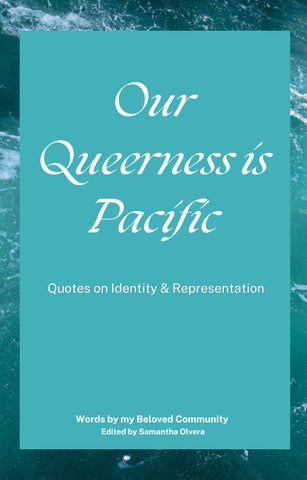
Our Queerness is Pacific
Quotes on Identity & Representation Quotes on Identity & Representation
 Words by my Beloved Community
Edited by Samantha Olvera
Words by my Beloved Community
Edited by Samantha Olvera
AboutOur Queerness is Pacific was born from the love I hold for the Queer Pasifika in my life and the individual unraveling of my own queerness in real-time. This brief three-month research project sought to create an intentional, safe, and collective space for LGBTQ+ Pacific Islanders in Southern California to flesh out conceptions of identity, representation, and belonging from their own lived realities within the diaspora. Experiences shared were gathered into one undergraduate capstone report as an effort to honor indigenous storytelling methods in an academic setting. I am immensely grateful for our evenings together, the meals we shared, and the passage of our laughter around my tiny living room. These quotes are but a slim window into the dialogue we exchanged throughout our storycircles, and allow us to continue scratching the surface of what it means to be a multiplicitous being in a colonial world.
On Terms
Most commonly employed in American and Western contexts, “Pacific Islander” (aka Native Hawaiian & Pacific Islander (NHPI) is a categorical term to represent peoples with ethnic origins from one or multiple islands from Micronesia, Melanesia, and/or Polynesia. Colloquially referred to as “Pasifika,” Oceanic peoples are rarely represented in data, media, and academic spaces. We are often spoken FOR rather than given centerstage (including during America’s lucrative “AAPI” month). This work intends to disrupt this long-patterned erasure by directly recentering queer Pacific Islander storytellers and practices. I employ “queer” to articulate experiences of gender and sexuality that diverge from cis-hetero patriarchal expectations; it should be recognized that identities under this umbrella are prolifically nuanced. While “Queer” does have a history of pejorative usage, its recent reclamation across LGBTQ+ spaces has made it a newfound vehicle of belonging for folks who haven’t always felt represented by pre-existing identity labels. Indigenous gender and sexual identities that would be considered “queer” across Western conception have typically long pre-dated the invention of the very word and are not often translated into English to the fullness of their practiced reality. Indigenous “queer” peoples historically and presently have been vilified by colonial enterprises to maintain social hegemony. Additional research is deeply encouraged.
?
W H A T D O E S Q U E E R N E S S M E A N T O Y O U ?
A R E T H E S E S E P A R A T E Q U E S T I O N S ?
W H A T D O E S P A C I F I C N E S
M E A
S
N
On Identity
“So what it means to be queer and Pasifika is a constant battle to fit myself in other people's languages when I know that inside there was always a place for people like us and we were just Hawaiians, or just Samoans”
“My queerness is pacific. My Pacific is queer.
They are together. All in one body because I'm in one body. I don't have another body, another backup. This is the one.
If our spirits are ancient and our people are ancient, then it's not new; we’ve been here. Whatever you wanna call it, it's been here. So strongly. It's just those barriers of language that people get a little tripped up, they got lost.”
“My Tongan family is very religious. Very love the sinner, hate the sin, ya know? Figuring it out [queerness] has been very lonely to not have a family to guide me.I’ve finally brought myself here to be close to the ocean and be around other Pasifika people. ”
“Being a pacific person is having that connection to that fluidity that makes me able to see it so clearly without having a beat or laser eyes on it, and I can see it, and I can feel it with all the people that I meet.”
“It's interesting because with Pasifika identity, the more I learn, it's intersected with queer identity. The valuing of a third gender. Mahu, Fa'afafine, Fakaleiti, Maamflorita, healers, teachers, givers, educators. I was confused about my queer identity at first. I thought it was unnatural because my elders would talk about it as sinful. But after being in my relationship with my partner for the last two years, I feel loved and supported for who I am. It's so good to navigate this with other folks, to do this together”.
Identity
“Our
ancestors were master navigators. So when we find ourselves lost in this journey, we have the power to navigate ourselves toward where we want to go. I’m appreciative to share space with queer and pasifika voices. No better than our own to heal our own people.”
ON CU
ON CULTURAL LABO
RAL LABOR
Cultural labor
“I feel like it's not our job to educate people and I always find myself doing it. People do not know what the ”PI” is. Sometimes it's a basic geography lesson so I feel like why do I have to tell you this? But it must be done.”
“I think a lot about the term ’AAPI’ I think it's very taxing when you are the only Pasifika person in the room, who’s trying to advocate for themselves, their community, against a bigger demographic that's included you under an umbrella but you are still marginalized within that umbrella”
“I feel conflicted. Growing up Everytime i told people Guam they were like “Rome?” they can't even wrap their head around a place they don't know exists. And on hand i’m like ‘Fuck you’ and on the flip side if I’m not telling you about my culture a white person is gonna be telling you about my culture and I dont want that shit.”
“I've found myself in a lot of PR situations where there’s this expectation to represent the entire ocean in just my body”
WHAT DOES REPRESENTATION MEAN TO YOU?
WHAT CAN IT LOOK LIKE?
Representation
“When we think about Pasifika in general we are so segregated. It's Polynesia, Melanesia, and Micronesia and when talking about it, even with that triangle, our communities are segregated. when you're around pacific islander communities you only hear the term poly. That further segregates us from [Melanesian & Micronesian] people who identify as Pasifika.”
“I think it is very much about being yourself and inserting yourself in these colonized spaces and being like ’I’m this culture and this is what i can look like and we aren't all the same.’ For the kids, the future generation, and other community out there that does not see themselves”
“In middle school I met a friend. We went to a predominantly Filipino school and we sought each other out because we were like the darkest at the school and then it turns out we were both Samoan and then that we were both queer. Yeah, it's very healing to speak with her. I feel like she's the only person I can truly relate to and it makes me happy because it feels so good.”
“Representation really does change your whole life. Like, who knows where I would have been right now if I had seen a queer Samoan person growing up. So I try to be the person I would have seen.”
“I no longer look for representation in very white spaces. I think that's how I viewed that word for so long as like I see all these people doing this one thing so why am i not in it?
In my experiences, I've forced my way in and it's so unbearable that I don't want that for myself or for anyone.
Representation for me now is community building. This is the representation I'm looking for. I see so much of us in each other and that's what I want out of that word.”
Representation
WHAT DOES HOME LOOK LIKE?
Navigating Home(s)
“I don’t think there’s ever one home. And maybe that’s something we carry from the ocean. There’s no one home, we are each other’s homes.”
“Home to me, truthfully and authentically, is where the good food is at, it's where love is present-and that could be with family, that could be with communty, that could be with loved ones-But for me, home is where you have that sense of belonging, which can be anywhere, as long as you have that feeling of inclusivity.“
“Home and community are very connected to me. ’Home’ was very emotionally damaging to me, and as soon as I turned 18. I moved out of there. Now, home is where I feel held. It’s in people and specific community spaces. It’s where I can show up as myself on whichever day and exist comfortably. “
I grew up religious. So to quote Paul, ‘become all things to all people’. At home I feel like I’ve become all things to all people, so I’d like to be in my own space, in solitude. Unfortunately, I don't find myself able to have that time a lot. So I’m literally in a coffee shop with my partner because of the situation that my immediate family creates which is unfortunate but it is reality. I’m still at a point where I’d like to help my family understand things, and having community and other friends definitely helps.
“I think about it in my art, like having a physical and mental space and moments that can be shared.”
“Home and community are very connected to me. ’Home’ was very emotionally damaging to me, and as soon as I turned 18. I moved out of there. Now, home is where I feel held. It’s in people and specific community spaces. It’s where I can show up as myself on whichever day and exist comfortably. “
Note: This short quote book features experiences from Queer Pacific Islanders in the diaspora (based in the continental “United States”). This short collection cannot and does not represent the whole of Queer Pasifika experiences or thoughts. We uplift the Queer Pasifika elders who have been a shining light in this big world. Please read their works and continue to uplift Queer Pasifika stories. Corrections from community are appreciated.
Saina Ma’åse’
Relatives in this book will remain anonymous to maintain community safety.