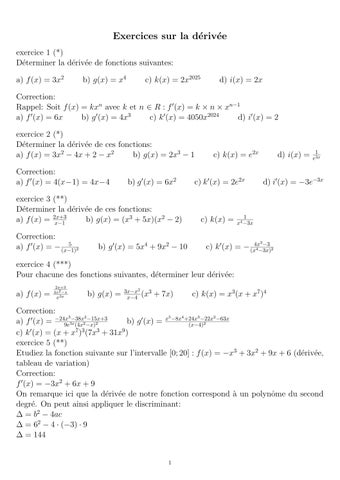
Exercices sur la dérivée exercice 1 (*) Déterminer la dérivée de fonctions suivantes: a) f (x) = 3x2
b) g(x) = x4
c) k(x) = 2x2025
d) i(x) = 2x
Correction: Rappel: Soit f (x) = kxn avec k et n ∈ R : f ′ (x) = k × n × xn−1 a) f ′ (x) = 6x b) g ′ (x) = 4x3 c) k ′ (x) = 4050x2024 d) i′ (x) = 2 exercice 2 (*) Déterminer la dérivée de ces fonctions: a) f (x) = 3x2 − 4x + 2 − x2 b) g(x) = 2x3 − 1 Correction: a) f ′ (x) = 4(x−1) = 4x−4
b) g ′ (x) = 6x2
exercice 3 (**) Déterminer la dérivée de ces fonctions: a) f (x) = 2x+3 b) g(x) = (x3 + 5x)(x2 − 2) x−1 Correction: 5 a) f ′ (x) = − (x−1) 2
b) g ′ (x) = 5x4 + 9x2 − 10
d) i(x) = e13x
c) k(x) = e2x
c) k ′ (x) = 2e2x
d) i′ (x) = −3e−3x
1 c) k(x) = x4 −3x
3
−3 c) k ′ (x) = − (x4x 4 −3x)2
exercice 4 (***) Pour chacune des fonctions suivantes, déterminer leur dérivée: a) f (x) =
2x+3 4x2 −x e3x
2
3 b) g(x) = 3x−x x−4 (x + 7x)
c) k(x) = x3 (x + x7 )4
Correction: 3 2 −15x+3 x5 −8x4 +24x3 −22x2 −63x ′ b) g (x) = a) f ′ (x) = −24x9e3x−38x 2 2 (4x −x) (x−4)2 ′ 7 3 3 9 c) k (x) = (x + x ) (7x + 31x ) exercice 5 (**) Etudiez la fonction suivante sur l’intervalle [0; 20] : f (x) = −x3 + 3x2 + 9x + 6 (dérivée, tableau de variation) Correction: f ′ (x) = −3x2 + 6x + 9 On remarque ici que la dérivée de notre fonction correspond à un polynôme du second degré. On peut ainsi appliquer le discriminant: ∆ = b2 − 4ac ∆ = 62 − 4 · (−3) · 9 ∆ = 144
1