P U B L I C S E CTO R S T R AT EGY N E T WO R K
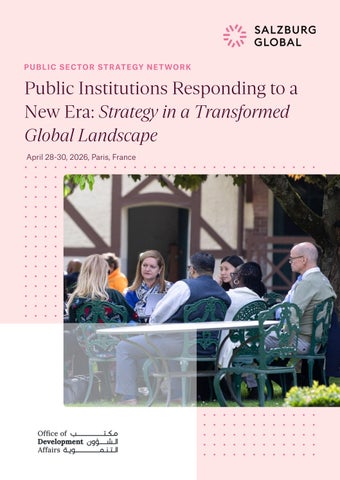
Public Institutions Responding to a New Era: Strategy in a Transformed Global Landscape April 28-30, 2026, Paris, France
While the post-WWII international order was premised on the idea that shared rules generate mutual benefit, many powerful states have shifted toward a transactional approach aimed at extracting maximum advantage from every relationship. Many developing countries, in response, are increasingly diversifying away from Western‑centric frameworks and forging new alliances. Western governments, meanwhile, have eroded core state capacity through decades of disinvestment, resulting in reduced in-house expertise and greater dependence on private actors. Against this backdrop, the 2026 Public Sector Strategy Network retreat convened senior public sector leaders, strategic advisors, and policy experts at Château de Romainville, France to explore how governments should respond to the challenges of this new era. Building on the 2025 diagnosis of the Durability Trap, widening Adaptation Gaps, and the intensifying pressures of Critical Transitions, Fellows turned to a harder question: Where does strategic opportunity exist within constraint, and what makes change endure? What follows distils these conversations into seven consequential insights that carried weight across regional contexts, challenged Fellows’ assumptions, and pointed toward the capabilities and choices the current moment demands.
1
Economic models should measure well-being and economic complexity more holistically. The market-growth model that has defined economic policy across much of the world for four decades has generated performance without progress: it delivers material wealth while equity, sustainability, and well-being fall outside the account. The defining challenge of this generation is to agree on what constitutes a good society and reorient institutions accordingly. Yet structural roadblocks, such as fragmented markets and regulatory burdens, prevent different capabilities from connecting and being deployed toward shared goals. What’s Needed: • Redesign national accounts, metrics by which governments measure economic success, around well-being before the distance between performance and progress becomes structurally irreversible • Measure economic complexity, which is a stronger predictor of longrun prosperity than output growth alone and opens a fundamentally different strategic lens • Map what existing capabilities make possible, rather than investing more in what is already present, so that economic strategy has leverage
2
AI investment needs to prioritize substantive literacy. The prevailing investment in AI favors operational fluency over substantive literacy. Without a rigorous understanding of what these systems can and cannot do, neither effective governance nor a sustainable competitive advantage is possible. AI's productivity gains are real, but they are constrained by limitations and cannot produce the paradigm shifts the current moment requires. Governance, however, has not absorbed this distinction. Regulatory frameworks have generated an illusion of oversight: they are well-intentioned but structurally misaligned, consuming resources without addressing underlying risk. What’s Needed: • Ensure institutional AI strategies measure decision quality and risk exposure, not just tool deployment and operational fluency • Invest in AI literacy at the decision-making level, where responsibility is highest and literacy is often lowest
Lack of AI literacy costs billions.
EX
L
E
CUTI ON
ALEN T
60 - 65% of Chief AI Officers “fail” in the first 18 months, meaning they resign, are removed, or the role is dissolved after pilots don’t translate into value.
T
Talent
UATI
ON
VA
Valuation “AI valuation premium”: companies (and especially startups) that convincingly adopt or build AI tend to be valued roughly 20 - 40% higher than otherwise similar peers, with some tech segments showing even larger gaps. Execution 80 - 95% of AI pilots fail to reach production or deliver measurable business value. Source: AI EdutAInment GmbH, Anastassia Lauterbach, 2026
3
Strategic foresight needs to become a distributed societal capacity. When strategic foresight is centralized, it is both structurally fragile and easily weaponized as a deferral mechanism. Its value is realized only when it is distributed throughout society. Yet a lack of political will poses a barrier to acting on this foresight: no amount of scenario planning can substitute for a leader prepared to choose a long-term path and absorb immediate political costs for benefits that will only materialize long after they leave office. What’s Needed: • Distribute foresight throughout society: embed it in education as futures literacy, cultivate it in civil society, and practice it at the municipal level • Generate signals from foresight which are so clear and credible that the political cost of ignoring them exceeds the cost of acting Strategic Foresight’s 3 Main Functions in the Government Developed by the Centre for Strategic Futures, Singapore
Scout
Challenge
Grow
Identify emerging trends and issues to inform national priorities
Stress-test strategies against changing operating environment
Build system capability and capacity in strategic foresight
•
•
•
•
•
Scan for longer term trends & emerging “weak signals” Seek new insights & “outsidein” perspective through networks Conduct deep dives to understand key issues
Pushing the envelope and raising the level of ambition
4
•
Scenario planning to challenge prevailing assumptions Convene and facilitate conversations to set context for strategic discussions, sharpen existing strategies, develop new strategies for changing landscapes
Communicating & translating insights to foster alignment
•
Targeted at various levels of officers, whether entry-level or leadership Consistent community building via different platforms for staff and leadership
Building capacities in the wider system to enable action
Sustained change requires long-term commitments. The limiting factor in institutional transformation is not the quality of design but the durability of implementation. Lasting institutional change requires embedding practitioners who protect sound practice across shifts in leadership. It further demands polarity management: holding centralized direction alongside frontline connection, quantitative data alongside deep qualitative insights, institutional confidence alongside the humility to be corrected, and urgency alongside patience. Global demographic shifts make a longterm orientation structurally necessary, as the decisions made today will shape how these transitions are managed. What’s Needed: • Practitioners and leaders skilled in polarity management: the ability to manage conflicting tensions and hold them productively • Leaders who act on behalf of futures that cannot yet advocate for themselves, as the reforms that matter most have immediate costs and distant returns that play out across generations
5
Leadership character is the fundamental prerequisite for consequential change. In many cases, the persistent failure of governance is a failure of will, as the character of leaders determines how power is exercised. Although the evidence, analysis, and understanding needed for good decision making are often available, leaders frequently lack the courage to absorb costs when benefits may only appear later. In a fast-moving world, delaying a choice cedes control to circumstance, and the cost of inaction routinely outweighs the cost of a flawed decision. Courage, however, is not instinctive, as it depends on the metacognitive and synthesis skills required to reason across disciplines under uncertainty – skills currently underemphasized in the formation of institutional leaders. What’s Needed: • Build accountability mechanisms for decisions avoided, not only for decisions made by those in office • Develop courage in leaders by investing in their metacognitive and synthesis skills –the highest-leverage intervention available
6
Education systems must evolve to support human flourishing (optimal well-being, growth, and fulfilment across all dimensions of human life). The dominant model of education, premised on the passive reception of instrumentally measurable knowledge, is increasingly misaligned with present demands and requires fundamental rethinking. The most consequential emerging inequality is cognitive: the gap between those who can navigate complexity and those dependent on systems and narratives they cannot evaluate. Education systems built around passive knowledge accumulation and narrowly measurable outputs are generating this gap. Governments retreating to basic-skills-only curricula risk falling behind those investing in education for human flourishing. What’s Needed: •
Fundamentally rethink dominant models of education
• Redesign education around agency, technological, human and futures literacy, systems thinking, and the capability to act on values across an unpredictable range of contexts •
Invest in education systems that support human flourishing
7
Trust in public institutions must be restored through actionable inclusion and solid evidence. A central institutional design error is building systems around bureaucracy and the way government is organized, rather than around the way people live. Systems built in this way find it difficult to earn trust. Trust forms through direct experience, and restoring it requires actionable inclusion and robust evidence. Governments must rigorously assess whether an intervention has worked, but they face significant hurdles, including weak data infrastructure and an over-reliance on data from wealthy Western nations that may not apply elsewhere. Closing that gap requires investing in locally generated evidence and data systems designed for the populations they are meant to serve. What’s Needed: • Restore trust in institutions by demonstrating their capacity to deliver, consistent ethical conduct, and a credible commitment to those governed • Ensure substantive inclusion before intervention, supported by a rigorous evidence base that tracks who benefits and under what conditions • Invest in locally generated evidence and data systems built for the populations they are meant to serve
Addressing a Widening Gap
The gap between what the current moment requires and what existing institutions are structured to provide is, at its core, a gap in purpose, character, and the willingness to choose. Evidence can be commissioned, and frameworks designed, but what governments cannot produce through procurement or reorganization is the clarity that determines which frameworks are built and used, which analysis is acted on, and which choices are made. That clarity is ultimately a property of leadership. Fellows agreed that this leadership challenge is not uniformly distributed. A widening gap is emerging between governments that are rethinking strategic assumptions and rebuilding institutional capacity, and those that continue to operate within increasingly outdated frameworks. The retreat’s most significant value lies not in resolution but in the precision with which consequential questions can be identified, framed, and made productive.
Future Strategic Questions
• Theory of informal networks: How do they form, function, and fail, and why has so little deliberate effort been made to construct them? • Design question: How can differentiation and decentralization be balanced against alignment and coherence? • How can significant public and philanthropic resources be redirected from the institutions least suited to present conditions without destroying what those institutions still contribute? • What would it take to build the evidence and governance infrastructure for intelligent AI adoption at a pace that matches deployment? • How can institutional conditions be built to produce sound decisions under pressure consistently, not only when an exceptional individual is in place? • The foresight credibility problem: How can genuine foresight be distinguished from sophisticated deferral, and how can intellectual honesty be sustained without the repeated acknowledgement of error that erodes institutional authority? • Mutual infantilization: If governments assume citizens cannot process complexity and citizens assume governments use complexity to obscure, how can this cycle be broken when each assumption generates the behavior that confirms it? The next phase of the Public Sector Strategy Network’s work will explore these questions through an in-person meeting planned for 2027 . The network continues to build the partnerships and leadership needed to turn these insights into durable institutional change.
Learn more about the continuing work of the Public Sector Strategy Network
Credits RAPPORTEUR Kateryna Anselmi EDITORS Audrey Plimpton and Lethu Zulu PHOTOGRAPHY Ksenia Luron
WWW.SALZBURGGLOBAL.ORG
Salzburg, Austria
Washington, D.C., USA
Salzburg Global Seminar, Inc.
Salzburg Global Seminar, Inc.
Schloss Leopoldskron
1541 14th Street NW
Leopoldskronstrasse 56-58
Suite 2 West
A-5020 Salzburg, Austria
Washington, D.C. 20005
+43 (662) 83 9 830
+1 (202) 637 7683
info@salzburgglobal.org
info@salzburgglobal.org