FINANCE & GOVERNANCE
P H I L A N T H R O P Y A N D S O C I A L I N V EST M E N T
From Crisis to Catalyst: Strengthening Philanthropic Infrastructure in Europe and Beyond
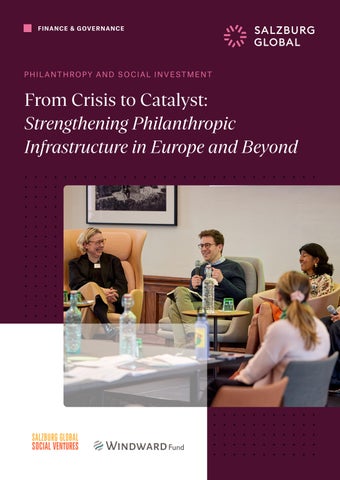
Leading donors, intermediaries, and representatives from the philanthropic sectors in Europe and the United States gathered at Salzburg Global from April 28 to May 1, 20261, to better understand the state of fiscal sponsorship and philanthropic infrastructure in Europe, its current capacity, and opportunities to innovate across the sector. Together, these 40 Fellows identified opportunities for growth and examined ways to sustainably expand the sector. This initial gathering began the conversation by focusing on a handful of jurisdictions in Europe, while subsequent analysis will widen the aperture to assess the European landscape more broadly. Although the convening was informed by the experiences of European and U.S. intermediaries, the primary goal was to provide support for actors that work on projects operating beyond the TransAtlantic context. Turbulent times present both challenges and opportunities for the philanthropic sector. Across the discussions, Fellows spoke transparently about the pressures they face, including shrinking civic space, political volatility, evolving regulatory frameworks, international hiring challenges, changing payment systems, and the implications of emerging technologies such as artificial intelligence. Yet these same challenges create opportunities for intermediaries to collaborate, innovate, and build more resilient infrastructure that can expand their impact. Fellows examined the European landscape, with a particular focus on fiscal hosting, to understand the limitations and capacity needs of infrastructure already in place, and what is needed to evolve and innovate a more robust ecosystem of intermediaries. The exchange among experienced representatives and emerging influencers in the fields of European and U.S. philanthropy and fiscal hosting underscored the immediate need to learn from each other’s approaches, identify opportunities for increased collaboration, and name areas for innovation across the field. The Salzburg Global session was held under the title “Expanding Philanthropic Infrastructure in Turbulent Times: The Need for More European Intermediaries”. The report title more accurately reflects the discussions, which emphasized the need for increased cooperation and collaboration.
1
1
The shifting and fraught terrain of philanthropy may be driven by short-term challenges, but holds meaningful long-term opportunities to increase resilience. The current political challenges and pressures in the U.S. have caused many philanthropies and intermediaries to consider moving assets and operations out of the country. While some view this as a short-term crisis, the reality is that it has highlighted new opportunities to expand infrastructure in Europe, and elsewhere, and to create a more robust and resilient integrated ecosystem for the long-term. This shifting terrain is expanding avenues for collaboration both across Europe and with U.S. partners, revealing opportunities that many stakeholders already identified as they look to expand and grow the field for the long-term. What’s Needed: • Close collaboration between intermediaries in different geographies, particularly the U.S. and Europe, to address short-term exigent needs without causing undue pressure, or potential harm, to the existing infrastructure within Europe and the U.S. • Trust-building and transparency between donors, intermediaries, and implementors on the ground to combat the real challenges they are facing. • Operational tools to support the evolving infrastructure of fiscal hosting and common taxonomy.
2
Europe has strong and long-standing infrastructure that can expand to meet stakeholder desires and needs, but that expansion must be deliberate and proactive. The existing European infrastructure is more developed than many may assume, operating in both formal and informal spaces while often being deliberately less visible as a protective measure. The continent offers a strong regulatory environment, with distinctions across the varied jurisdictions, and a long history of organized philanthropy for donors, intermediaries, and implementors. Reactive, demand-driven expansion risks overlook existing entities with proven track records who would benefit from increased resources and capacity. What's Needed: • Continued mapping of existing European fiscal hosts, including informal networks, that assesses absorptive capacity and gaps before new infrastructure is designed. • Clear assessment of which jurisdictions in Europe offer advantages and which present significant legal or regulatory barriers. • A commitment from new and existing stakeholders, especially donors, to approach expansion with a mindset of mutual learning across geographies and sectors, adapting them to the existing European context without replicating pain points or misaligned strategies.
3
The stakes on the ground are high, and the sector must rise to match them. The structural conversation about infrastructure is inseparable from lived reality. During the convening, Fellows cited concrete examples of operating environments becoming increasingly dangerous: project leaders facing both persecution and prosecution; capital flows decreasing, forcing intermediaries and their hosted projects to cut costs; staff in multiple countries needing emergency security measures ahead of contentious electoral outcomes; and more. The infrastructure being built and/or expanded must be able to meet these conditions. What's Needed: • Governance and legal structures designed from the outset to protect both hosted projects and fiscal hosts in high-risk and politically volatile environments. • Shared legal defense capacity and coordinated risk management across intermediaries to prevent the isolation that makes individual organizations more vulnerable. • Explicit funder commitment to sustaining intermediaries through crises, not just the programs they host, including adequate overhead, emergency reserves, and long-term core support.
4
From money-movers to ecosystem catalysts, intermediaries must reimagine their purpose. Most fiscal hosts are still defined by how they move money rather than the role they play in the civil social ecosystem. Fellows surfaced a more ambitious vision: intermediaries as the connective tissue in a robust ecosystem — coordinating capital and capacity2, facilitating learning, absorbing and navigating fundamental risks, sharing knowledge and expertise, and enabling collective action that no single organization could achieve alone. This requires fundamentally different infrastructure and governance than what exists today. What's Needed: • Investments from donors should prioritize long-term systems change and allow the sector to move beyond transaction management of individual grant outputs. • Investments in shared infrastructure for collective action: coordinated legal defense, pooled due diligence, shared HR and insurance services, technology tools, and cooperative frameworks that reduce duplication. • Power-sharing and legitimacy frameworks that define how intermediaries coordinate and collaborate, how transparency serves rather than hinders connection, and how accountability flows toward communities rather than only funders.
2
I t was acknowledged that, while a broader understanding of the role of intermediaries is welcome, some hosted projects are likely still to emphasize the core need for reliable fiscal and administrative support.
While philanthropy in the U.S. and Europe was well represented, Fellows acknowledged that building a truly global ecosystem requires deeper engagement with actors in Africa, Asia, Latin America, and the Middle East as co-designers.
5
Donors must recognize the value and strengthen the impact of fiscal hosts and philanthropic intermediaries by investing in them. Intermediaries absorb real risks on behalf of funders and projects, which is critical for stable philanthropic infrastructure and a flourishing civil society. Too often, the competitive environment in which many intermediaries operate forces them to frame costs and undercharge in ways designed to respond to funders’ bottom line rather than reality. Existing terminology, such as the distinction between “fees” and “indirect costs”, exacerbates this by obscuring the true extent of intermediaries’ roles. Donors routinely accept high indirect cost rates, while viewing fees up to 15% for identical expenditures as excessive. For fiscal hosting and intermediaries to grow sustainably, these patterns from donors must be addressed. What's Needed: • A shift from structural and legal definitions toward terminology rooted in outcomes, value, and purpose. • A shared global glossary or taxonomy, built with specific audiences in mind including regulators, funders, and projects, and designed to accommodate regional and linguistic variation. • Actual costs and increases disclosed to funders and projects at the outset, not absorbed silently over time. • A shift among donors from “paying fees” to investing in essential infrastructure and services in an intentional and coordinated manner.
What Comes Next? Building a Truly Global Ecosystem The convening at Salzburg Global was intentionally centered on Europe, both as a geographic focus and a starting point for broader global conversations about the future of philanthropic infrastructure.
While philanthropy in the U.S. and Europe was well represented, Fellows acknowledged that building a truly global ecosystem requires deeper engagement with actors in Africa, Asia, Latin America, and the Middle East as co-designers. Conversations throughout the session reinforced the importance of connecting with stakeholders across geographies and sectors to build infrastructure that reflects the realities of the broader ecosystem. This moment provides intermediaries with an opportunity for unique infrastructure expansion and development rather than replication; it is also an opportunity for donors to invest further in Europe as a global hub for fiscal hosting and intermediary infrastructure, with a view to further geographic expansion over time to create a truly global ecosystem. Fellows noted that organizations across the Global Majority have functioned as an effective regranting infrastructure for decades and may have a role to play in the evolution of philanthropic intermediaries. There are also fiscal hosting services being developed or expanded in diverse countries across the Global Majority. The provision of new capacity and resources should be done thoughtfully and equitably, requiring that those participating in the sector’s expansion reflect more of the ecosystem they are building for. Philanthropy is already expanding rapidly in Europe through vehicles such as donoradvised funds. Therefore, a proactive strategy with and from donors is needed to engage such entities and ensure that capital flows toward infrastructure and projects rather than developing without sector input. Coordinated outreach to existing fiscal host networks across regions is required to create deeper networks, build a shared directory, and enable collective advocacy. Donors are essential partners in the work of investing in field-building and ecosystem development to facilitate deeper, lasting impact. Fellows concluded with a firm and urgent sense of shared purpose. They implored a call to action for collective advocacy to expand and fortify intermediaries and their partners operating across Europe. New and recurring challenges demand investment into innovative solutions that can only come from harnessing the diverse experience and expertise which already exists but is not often shared across barriers. Such collective actions can have meaningful short- and long-term impacts and enable the sustainable and effective expansion of the philanthropic intermediary field in Europe and, in tandem, globally.
How You Can Help Us Spread the Word We want to change the conversation on the world’s most pressing issues. Your voice is a powerful way to do this. Help us broaden the conversation by highlighting Salzburg Global and the perspectives of our Fellows visible on social media.
Share our social media content We regularly post insights and conversation starters on important topics across LinkedIn, Facebook, Instagram, Threads and X - please follow us. Feel free to repost, share or forward our content as appropriate to others in your network. Share our newsletter Our monthly newsletter features updates, interviews, diverse opinion pieces on pressing global issues. You can share the newsletter with your network by clicking “View email in browser” at the bottom of the email) or by forwarding it to your contacts via email. Tag us in your conversations If you are posting content relevant to Salzburg Global on social media, tag us! You can do that by typing @SalzburgGlobal into your post. We will engage wherever possible.
Credits RAPPORTEUR Liuben Chipev EDITORS Nancy Smith and Audrey Plimpton PHOTOGRAPHY Christian Streili
WWW.SALZBURGGLOBAL.ORG
Salzburg, Austria
Washington, D.C., USA
Salzburg Global Seminar, Inc.
Salzburg Global Seminar, Inc.
Schloss Leopoldskron
1541 14th Street NW
Leopoldskronstrasse 56-58
Suite 2 West
A-5020 Salzburg, Austria
Washington, D.C. 20005
+43 (662) 83 9 830
+1 (202) 637 7683
info@salzburgglobal.org
info@salzburgglobal.org