PEACE & JUSTICE FINANCE & GOVERNANCE
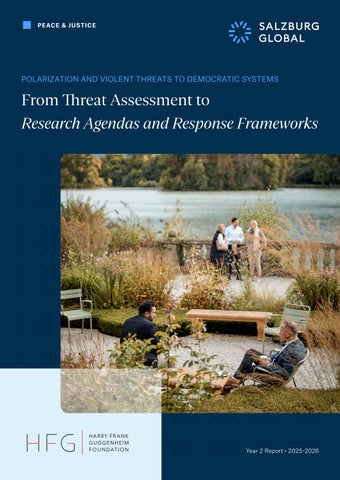
POLARIZATION AND VIOLENT THREATS TO DEMOCRATIC SYSTEMS
From Threat Assessment to Research Agendas and Response Frameworks
Year 2 Report • 2025-2026 1
Democratic systems are under pressure Across many democracies, a disturbing pattern has emerged: polarization increasingly shapes political behavior, so that the line between democratic competition and political violence has begun to blur. Deepening identity conflicts, rising authoritarian tendencies, and the erosion of civic norms, not only at the edges of societies but increasingly within their core institutions have undermined the democratic promise of participation, accountability, and peaceful transfer of power. In a growing number of democratic societies, state-sponsored or tolerated political violence has become a visible and dangerous feature of political life.
2
Salzburg Global and the Harry Frank Guggenheim Foundation respond The Violent Threats to Democratic Systems program, launched in 2024 by Salzburg Global in partnership with the Harry Frank Guggenheim Foundation, is developing an international, interdisciplinary network of researchers and stakeholders working on understanding and addressing rising polarization and political violence in a range of mature democratic systems. This program responds to a growing global concern - the increasing use of violence, intimidation, and recrimination as political tools in systems once thought to be resistant to such pressures. This program seeks to understand these evolving risks by investigating how and when democratic systems shift into "hybrid democracies"—systems that retain the formal structures of democracy while exhibiting the dysfunction and coercive practices more often associated with authoritarian regimes. These hybrid systems are especially vulnerable to violence as a means of resolving political disputes, consolidating power, and marginalizing opposition. Through cross-national research, interdisciplinary collaboration, and ongoing dialogue, this program creates space for deep, cross-national dialogue that explores not only what drives political violence but also how democratic societies can strengthen their capacity to uphold democratic norms, ensure accountability, and protect open civic space in the face of these challenges.
Year One Assessing the Risks and What Can Be Done About Them Discussions begun in 2024, the program’s first year, highlighted how political violence could be a feature of polarization and competition in democratic societies, not an anomaly. The question arose as to when political violence threatens democracy itself, and whether there are ways to develop new research and evidence for assessing these existential risks to democratic systems, and what to do about them.
Year Two From Threat Assessment to Research Agendas and Response Frameworks Building on this, the second year investigated when and how political violence evolves from isolated incidents into a more fundamental threat to democracy itself, particularly when governments or ruling parties use it as a deliberate political strategy to leverage or maintain power. We asked how dangerous speech, misinformation, and elite threat construction can shift societies from heightened emotional division to political environments where violence is seen as necessary or legitimate. We highlighted existing research and knowledge from other current and historic examples of where “hybrid democracies” and “competitive authoritarianism” have become especially prone to political violence and democratic decline. This report highlights how Fellows have engaged in cross-national and cross-sectoral dialogue to propose and develop frameworks, indicators, and potential responses.
3
1 The danger of violent threats to democracy has already begun This moment is not about waiting for escalation, because significant change is already underway. In 2024, there were more democratic elections held around the world than at any other time in human history. Many of those elections moved away from incumbents and towards populist parties, with a more polarized political spectrum and political violence. Meanwhile, the world is shifting toward a new order marked by increasing regionalization, more likely to intra-regional competition. With massive levels of defense spending already in place, the expectation is high levels of state violence, very high levels of police violence, and possibly the emergence of new civil wars. Recognition of human rights is likely to decline sharply, partly due to the perception that rights-based frameworks have become excessive. Globalization and trade are weakening, while alliances are increasingly transactional and power-driven. In such a context, polarization is likely to become a secondary concern, overshadowed by the assertion of state authority and the use of violence as instruments of power. The broader issue is that militias and paramilitary actors remain prolific in many democracies worldwide. They move fluidly in and out of government structures, positioning themselves around elections, intimidating voters, or deterring participation through harassment. While such practices have not yet become entrenched features of established democracies like the United States or the United Kingdom, concerns about their potential emergence persist. The 2020 U.S. election already raised alarms about armed groups monitoring polling places, though these did not become systemic. Lessons can be drawn from other regions. The experiences of the Philippines, India, and numerous Latin American countries show clear warning signs
of how paramilitarism erodes democratic legitimacy. Once security forces or militias become normalized as political actors, trust in democratic institutions collapses, and violence becomes an accepted feature of political life. These cases highlight the importance of recognizing and addressing the risks early, before they solidify into enduring structures of partisan coercion.
Polarization and Disorder In contexts such as the United States and the United Kingdom, polarization is unlikely to escalate directly into widespread violence. What is far more likely is growing frustration, followed by the election of governments that are themselves extreme but do not necessarily rely on large-scale violence against their own citizens. The real challenge lies in whether security services can contain rising extremism, and whether governments can address public demands that diverge from the rationalist perspectives of late liberal governance. Two core components stand out. The first is distance — the widening gap between poles in a society. Distance alone is not inherently dangerous, however. It needs the second — radicalization — the internal hardening of positions within each pole. When these two dynamics combine, they produce a centrifugal effect. Polarization is not static; it accelerates. For this reason, polarization is understood not as something that may or may not be harmful, but as a hyper-problem. It is a structural impediment to addressing almost any other social or political issue. Left unresolved, it blocks progress across the board. This way of understanding polarization also reshapes how it is seen in relation to violence. Radicalized
In 2024, there were more democratic elections held around the world than at any other time in human history. Many of those elections moved away from incumbents and towards populist parties, with a more polarized political spectrum and political violence. 4
poles moving further apart are not calm or passive; they intensify internally as they diverge externally. The paradox is that the violence this generates does not always appear as direct confrontation across a divide. At its worst, it can resemble an implosion, a collapse inward rather than a clash outward, though direct confrontation can also occur. This shift toward hybridity has important implications. Rising violence is not only linked to political contestation but also to the management of disorder and chaos. In many contexts, governments justify stronger, more repressive measures as necessary to restore order. This is particularly visible in Latin America and the Caribbean, where despite widespread democratic governance, voting behavior is increasingly shaped by fears of criminal violence rather than political violence. Citizens are choosing leaders who promise protection from gangs and criminal networks. Disorder itself acts as an accelerant of polarization. In chaotic contexts, people retreat inward, reinforcing their trust in in-groups rather than reaching outward. Disorder drives communities to seek security through cohesion with their own group, which deepens divides rather than bridging them. There is also a deepening correlation between polarization and the spread of illiberal values and narratives. A growing reliance on simplistic binaries of good and evil has taken hold in political and social discourse. These binaries strip away complexity and nuance. Paradoxically, ordinary citizens often demonstrate more nuance in their views than elite institutions, including top universities and leading academic bodies, which have themselves become increasingly polarized and brittle. This collapse in the ability of institutions to sustain nuanced positions is deeply worrying. Compounding this is the erosion of honorable debate and disagreement. Where once disagreement
was part of constructive democratic discourse, it is now increasingly characterized by hostility, delegitimization, and an unwillingness to engage across divides. The result is a toxic cocktail: technological acceleration, rising antisemitism, entrenched illiberal narratives, and the collapse of meaningful debate all combine to heighten risks of polarization and violence.
Warning Signs of Escalation One of the most important indicators is violence against marginalized groups. When polarization begins to manifest as targeted violence — whether anti-immigrant attacks, antisemitic violence, or forms of sexual or identity-based violence — this is often a profound signal that broader forms of political violence are on the horizon. These acts are not isolated; they represent warning signs that the threshold between polarized discourse and violent conflict is being crossed. One such current example is the alarming rise in antisemitism. Evidence is abundant: thousands of data points and staggering statistics highlight the surge in violent antisemitism and the increasingly hostile language surrounding Jewish communities. The patterns are stark and trackable — online hate speech, coded language, incitement, and direct attacks. The historical lesson is clear: antisemitism may begin with Jews, but it never ends with Jews. The statistics from the most recent years make this trend impossible to ignore, raising profound concerns about where such hatred may lead. This perspective highlights a critical distinction. Democracy can coexist with low levels of polarization and violence, and societies can continue functioning within those parameters. But when violence is oriented toward domination — when its end is to subjugate — the political order shifts into a fundamentally different realm. At that point, it is no longer a democracy, but something else entirely.
5
2 The role of the state has shifted to an instrument of domination By current trends, the role of the state – with the legitimacy for violence – has shifted from a neutral arbiter to something more politicized and willing to employ or condone violence. The state possesses not only immense capacity for violence but also the legitimacy to wield it, including at industrial scale. When the state uses violence, is the objective order, safety, and security, or is the objective domination, control, or the construction of single-party systems? Patterns across different countries and historical periods suggest that the answer carries profound implications for democratic governance and social stability.
The State as Political Actor The relationship between polarization, political violence, and the state has traditionally been viewed through the lens of political competition. Politics involves contestation, with opposing sides engaging in clashes that can escalate into violence, particularly around elections. In this view, the state functions as referee, tasked with managing violence and maintaining order so that conflict does not become system-destroying and does not undermine the conditions for human flourishing. What marks a more profound change is when the logic of contestation gives way to the logic of domination. When political parties or ethnic groups capture the state, competition no longer revolves around alternation in power but around entrenchment. Elections become existential zerosum battles: losing office may mean imprisonment or political annihilation. Under such conditions, state institutions are subverted, neutrality erodes, and the party in power fuses with the state and national identity. Opposition is no longer treated as political rivalry but as anti-national activity.
Delegating and Politicizing Violence In these contexts, violence is not carried out solely by state institutions. Social mobilization plays a parallel role, with militias, vigilante groups, or violent party wings permitted to operate as long as they align with governing structures. Much of the “wet work” — killings, lynchings, intimidation — is delegated to such actors, while the state provides tacit support or cover. An additional and often overlooked danger arises from the erosion of norms of apolitical professionalism within state security forces. In 6
functioning democracies, military and security personnel are trained to remain politically neutral even after retirement. When that boundary collapses, highly trained individuals can join state-supported or state-aligned groups, transferring expertise in organized violence to new arenas. This significantly amplifies the capacity for coercion and instability. Such systems may produce a paradoxical outcome: violence itself may diminish, but domination and fear intensify. The absence of open violence does not mean the absence of coercion. In such environments, pervasive fear becomes the defining feature, leaving societies deeply traumatized even in the absence of visible conflict. The trajectory in India demonstrates how such a process develops and consolidates. The emerging signs in the United States suggest similar risks: once norms are eroded, accountability weakens, and state institutions are repurposed for partisan objectives, the shift from contestation to domination becomes increasingly difficult to reverse. The danger extends further when the monopoly of violence is shared with private actors. In settings where authority is decentralized and narratives can emerge from any source beyond state control, the risks intensify. Relinquishing control over violence or over the narrative — often under the belief that allied groups will remain loyal — is an especially hazardous strategy. This decentralization may serve short-term political purposes, but it is a profoundly unstable arrangement. The personalization of security services is also dangerous. When police or security forces are used as political tools, good officers often leave, while those attracted to brutality or patronage — rather than merit — are more likely to join. India faced this repeatedly in its police services in the 1970s and 1990s, struggling to reverse politicization. Similar risks may now be emerging elsewhere.
Political Restraint and Opposition In today’s trends (if not historically), many groups on the left are acutely aware of this danger. They avoid national demonstrations, believing their members
are not trained enough in nonviolent discipline and fearing that protests would hand the state an excuse to crack down. Instead, they focus on local organizing and capacity building. The question, then, is whether large, responsible groups’ restraint opens space for more fringe groups to emerge, ones willing to embrace violence under the banner of “fighting the power.” What is particularly interesting is that the justification of violence is now showing up more on the left than on the right. Polling suggests that, in the United States, young Democrats — those who are highly politically active, who already have some agency and are seeking more — are among the groups most willing to justify political violence. This is not the same as committing violence, but it marks a notable shift in attitudes. The United States represents a current laboratory for these dynamics, where many techniques of executive takeover are visible. Two blind spots are particularly salient. The first concerns the role of the opposition. Analysis often highlights legal manipulations by those in power, but many of the opposition’s weaknesses are self-inflicted, stemming from organizational incapacity or low quality of leadership rather than only from external constraints. Understanding why opposition forces fail to rise to the challenge is critical. The second blind spot is the significance of single events. As Ivan Moff’s work on the fall of the Weimar Republic shows, rare and emotionally charged events can trigger cascades of perception and decision-making that produce irreversible outcomes. These events are not structurally determined but contingent, making them extremely difficult to predict. Violence often plays a catalytic role in such turning points, which are then weaponized by actors seeking to consolidate power. But it is critical for the U.S. not to project its problems onto the rest of the world as though they were universal. The U.S. faces unique challenges, some mirrored elsewhere but not universally applicable. The U.S. has much to learn from other countries, but the reverse is not necessarily true.
The relationship between polarization, political violence, and the state has traditionally been viewed through the lens of political competition.
What Determines State Resilience? The discussion of strong and weak states raises an important point connected to recent cases such as Nepal, Sri Lanka, and Bangladesh, where governments in recent years have succumbed to mass protest movements rather than to violence initiated either by the state or from below. The success of such protest movements is striking, given that they are more often unsuccessful. Retrospectively, it is easy to categorize these states as “weak” because they yielded to protest, yet at T minus one it is not clear that they would have been widely regarded as particularly weak. This highlights the retrospective clarity that emerges after such events, contrasted with the uncertainty present beforehand regarding the capacity of states to withstand public threats. The Bangladeshi case is especially notable: the fall of the government was not directly connected to the very active militias operating within the country. Instead, it was driven by forces entirely separate from those groups. This suggests that while much attention is often devoted to the electoral or elite functions of organized groups and militias, they may ultimately play no role in determining regime survival or collapse when decisive moments arrive. A factor uniting the recent cases of Nepal, Sri Lanka, and Bangladesh is the absence of foreign intervention. In each case, security services either refrained from firing on the public or eventually ceased doing so, although in Bangladesh state violence did occur in response to protest (in Nepal, the protests themselves turned violent). This absence of external actors differentiates these examples from cases such as Belarus or Venezuela, where foreign intervention has played a decisive role in suppressing protest movements or blocking peaceful electoral transitions. The role of interveners in either halting or reshaping domestic protest outcomes is a dimension that requires greater attention. 7
3 Populist movements are gaining momentum in Europe While non-democratic populist movements are in the ascent across Europe, the actual threat to democracy is less clear. Radical populism is built on the notion of an irreconcilable antagonism between the “pure people” and “corrupt elites,” with the latter portrayed as nefarious actors who must be removed from power in order to restore sovereignty and dignity. Both categories are deliberately constructed with ambiguity, allowing populist movements to adapt and broaden their appeal. For radical right movements with narrow ethnic agendas, this ambiguity enables linkage to broader concerns. For example, in Germany, voters for the Alternative for Germany (AfD) are not motivated by restoring a vision of blond, blue-eyed Aryans, but rather by narratives connecting aloof elites and corruption to immigration or other grievances. The danger lies in how populism is used strategically to expand legitimacy and reach. Populists claim to be the “real democrats,” more democratic than liberal democracy itself, arguing that liberal systems are inherently anti-majoritarian because they limit government power and thus limit the majority’s authority. Liberal democracy is portrayed as having surrendered power to unaccountable elites. Populist hostility is therefore directed toward institutions such as media, courts, civil society, and
even certain businesses. Radical right populists add an identity dimension, promising a future that resembles an imagined past, framed as a resolution of belonging that will resolve all other issues.
Political Systems and Party Strategy This stands in contrast to presidential or two-party systems, where populist parties may gain control more directly. Earlier assessments suggested that two-party systems were safer against radical-right takeovers and that multi-party systems posed greater risks, since smaller parties could gain footholds more easily. However, developments in Austria suggest the opposite: multi-party systems can contain radicalright parties more effectively by forcing moderation and diluting control, even as such parties remain consistently present and influential. A recent study has found that when conservative parties engage with the radical right—either by adopting elements of their agenda or by entering into coalition partnerships—the effect is to strengthen the radical right. Such engagement validates their positions, leading voters to shift their support directly to radical-right parties. The Austrian conservative party provides a clear example of this dynamic. At the same time, Austria is one of the countries where immigrants cannot easily become citizens. Vienna’s population of 2 million includes almost 400,000 residents without citizenship status. This disenfranchised group can be ignored politically, as parties would jeopardize electoral prospects by adopting immigrant-centered agendas. The absence of voting rights fosters marginalization and can contribute to radicalization.
8
The danger lies in how populism is used strategically to expand legitimacy and reach.
Demographic pressures add further complexity. Austria is under EU supervision due to high levels of public debt, the largest driver being pension contributions required in an aging society. Immigrants are essential to sustaining the pension system through their contributions. Despite this, public and political discourse often centers on fear of diversity, rather than framing immigration as a solution to long-term economic and demographic challenges. This raises the question of why political parties are unable or unwilling to address these issues more directly. Instead of reinforcing fear, it would be possible to counter fear with alternative narratives—either with warnings about the risks of inaction or with forward-looking visions of a shared future. Current political strategies, however, have largely failed to articulate such alternatives. One practical recommendation is that conservative parties should emphasize their own core strengths rather than adopting radical-right agendas. For example, parties with established credibility in economic management should lead with that brand identity, reframing their strengths while also addressing voter concerns about security and complexity, rather than attempting to outflank the radical right on its own terms.
Conspiracy Theories and Tribalism Tribalism correlates with conspiracy thinking. Conspiracy theories function to paint elites or other groups as evil, justifying the use of extraordinary means. U.S. research similarly shows that conspiracy mentalities correlate with support for political violence. The concept of “apocalyptic aggression” further illustrates the danger: conspiracy theories suggesting that failure to act immediately will result in extermination the next day create a sense of existential urgency. Nazi propaganda during the Holocaust is cited as an example. The most dangerous conspiracy theories combine apocalyptic elements, clear assignment of moral transgressions (such as pedophilia), and specific identification of perpetrators, as seen in “Pizzagate.”
When governments are perceived as unresponsive to non-extremist opinions, and when individuals feel there is no legitimate space to voice concerns, the result is often an intensification of polarization. This sequence has created a spiral effect. Citizens who felt their questions had been prematurely dismissed began to wonder what else might be concealed or misrepresented, deepening their distrust. What begins as a legitimate grievance can quickly transform under the weight of labelling, pushback, and rigid narratives. Governments and experts, in attempting to project certainty during moments of uncertainty, can inadvertently amplify this effect. The outcome is a feedback loop that pushes individuals further into polarized positions. In such an environment, the perception that institutions cannot be trusted to address legitimate concerns creates space where certain forms of political violence may come to be viewed as acceptable responses.
Resistance and Apathy Hungary presents a paradox: all the ingredients for political violence—polarization, conspiracy theories, and tribal attitudes—are present, but actual violence remains low. In Poland, the pattern differs. Higher politicization and stronger civic resistance have led to higher levels of political violence, including the assassination of the mayor of Gdańsk in 2019. Hungary’s lower levels of civic resistance appear linked to lower levels of violence, while Poland shows the opposite pattern. The most significant reason for the absence of political violence in Hungary so far has been apathy. Until Fidesz consolidated control, the regime—described as the only true hybrid regime within the European Union—expanded continuously. Because resistance was minimal, each step emboldened further moves, with no effective pushback encountered. At present, the situation is shifting. Fear of those in power appears to have diminished, while levels of civic courage among voters willing to stand against an illiberal regime have increased. This creates conditions where the likelihood of political violence may rise, since greater willingness to confront the regime introduces the possibility of more direct conflict. On the other hand, despite pessimistic forecasts of violence, Fidesz peacefully exited from power when it lost the 2026 election in Hungary.
9
4 When does political violence threaten democracy? The United States has historically had periods of extreme political violence, yet its democracy has endured. It has been noted that most Americans are less polarized than the extremes of either party. How should we understand the positioning of this broader group? Where do the majority of citizens stand in relation to the highly polarized ends of the spectrum, and how does their role shape the overall dynamics of polarization and political conflict in the United States? Polarization in the United States looks different depending on how it is measured. If polarization is defined as holding a consistent and extreme set of policy preferences, Americans are not polarized. Most individuals do not even know which positions are considered left or right. Asked about several issues, many will endorse a mix—for example, two liberal positions and three conservative positions. This measure does little to explain the intensity of partisan hostility. The question to be explored is how polarization should be understood when looking at public opinion on key policy issues. Over time, surveys on topics such as abortion and gun control have shown remarkable stability, with a consistent pattern in which 60–70% of Americans hold similar views. This continuity suggests that, on many core issues, broad alignment persists across the population.
Democratic Tipping Points The question of whether political violence is leading to a tipping point must be separated from other forms of democratic erosion. Historically, every realignment period in the United States has been marked by violence, as the incentive structure pushes actors to use intimidation or coercion to sway marginal votes.
Yet the United States has historically withstood significant levels of political violence, and the democracy has endured. Violence is therefore part of the process, but it is not necessarily the central driver of democratic decline. Other nonviolent factors are also weakening the system. Over the last several decades, the two major political parties have undergone what can be described as a process of social sorting. The Republican Party increasingly became dominated by white, Christian, rural voters, with a modest gender imbalance leaning more male. The Democratic Party evolved into a diverse coalition encompassing those outside those categories, with greater internal fissures. Patterns of moral disengagement further intensify the conflict. Republicans high in racial resentment are most likely to vilify and dehumanize Democrats, while Democrats low in racial resentment are most likely to vilify and dehumanize Republicans. For Republicans, Democrats are seen as subhuman, possibly linked to race. For Democrats, Republicans are seen as evil for being racist. Similar reciprocal vilification occurs around hostile sexism. Leadership has amplified these dynamics. Donald Trump, in particular, consistently uses violent metaphors, encourages physical aggression against opponents at rallies, and employs dehumanizing language toward political adversaries. Such rhetoric from the highest levels legitimizes and normalizes antagonism and violence. The concern is that as democratic erosion proceeds, weakened institutions, personalistic executive dominance, disillusioned voters, and reconfigured security services may converge. In that scenario, violence could shift from being an accompaniment to democratic erosion to becoming a force that undermines democracy itself. At that point, the threshold or tipping point would be reached, with the “genie out of the bottle.”
Mass Mobilization Against this backdrop, a pressing question arises: why have there not been mass mobilizations in the United States to counteract these developments? Why were the large-scale marches that followed the 2016 election not replicated after subsequent events? 10
Why were some protests in Europe larger than those in parts of the United States itself? Is this the result of disillusionment, discouragement, or a sense of resignation among the public? Mass mobilization has historically tempered authoritarian momentum by signaling broad-based resistance. For example, Pride Week demonstrations in Budapest, when visibly supported, sent a clear message of opposition and resilience. Collective action of this kind can have a tangible effect. Why, then, has there been so little sustained presence on the streets in the United States, given the scale of the challenges now unfolding? This dynamic connects to insights from the sociology of cults. Extremist groups, including cults, often attract individuals experiencing uncertainty about their place in society or their future. Within such groups, boundaries and rules are sharply defined, creating a sense of clarity and order that can be highly appealing to those navigating uncertainty. At the same time, these groups frequently require members to break the norms of mainstream society as part of adopting the norms of the extremist group. This practice has two consequences: first, it generates excitement by allowing members to transgress rules; second, it makes it difficult to return to mainstream society, since leaving would require acknowledging wrongdoing. In this way, the act of transgression helps bind members to the group and discourages exit.
Mass mobilization has historically tempered authoritarian momentum by signaling broad-based resistance.
These mechanisms provide a useful contrast with political strategies centered on normalcy and restraint. The Democratic Party, for example, has generally emphasized civility and institutional responsibility rather than deliberately cultivating transgressive behavior. The emphasis has been on maintaining an image of acting responsibly and “like adults,” in the hope that broader society will eventually recognize this distinction. The result, however, is an asymmetry: one side operating with the tools of extremism and transgression, and the other side emphasizing normalcy and restraint. This imbalance creates difficulties in competing on equal terms within the political arena.
Group Identity One notable feature of polarization in the United States is the way group identity has become more all-encompassing and detached from specific ideas or ideologies. Survey data shows that while Americans may diverge on specific issues such as abortion or gun rights, they still strongly attach themselves to groups whose leaders may not even share those exact positions. The phenomenon has been described as “team over belief,” a formulation by Kathy Blee. Rather than issue-based alignment, individuals choose a leader or group, and loyalty binds them irrespective of the leader’s accuracy or consistency. This distinction raises further questions about how violence may be held at bay. When violence is framed in terms of punishment or revenge, it functions differently from violence framed as self-defense. Illiberal glorification or celebration of violence—described as distinct phenomena in earlier exchanges—belongs to a separate category altogether. Self-defense, by contrast, requires both intent and capacity to be ascribed to the other group. For example, even if one side is in power, violence may not erupt unless it is believed that the weaker side has acquired the capacity to harm, perhaps through visible participation in public events or demonstrations. 11
5 Psychological frameworks provide explanations and potential opportunities. Scientific questions about behavioral science and the psychology of violence are often missing from political science analyses. What can neuroscience, behavioral science, and the psychology of violence reveal about the trajectory of political violence in democratic societies? What is currently known about processes of radicalization, about the ways in which individuals and groups are activated toward violence? Where are the gaps in understanding, and how might disciplinary divides be bridged to form a more complete picture of what is taking place? These questions also connect to broader themes including political realignment and the possibility of entering a new historical era. Such framing underscores the need to understand group dynamics in a shifting social, psychological, and technological context, and to explore how these disciplines might illuminate the changes now underway.
Radicalization of Group Identity Both psychological theory and empirical evidence indicate that categorization—and the bases on which people categorize—is flexible. Self-categorization theory provides the conceptual framework, while research such as the common in-group identity model demonstrates the empirical basis. Findings show that it is possible to shift the categories people use, encouraging them to include a wider set of individuals within their sense of “us.” This flexibility suggests that perceptions of similarity and group belonging can be broadened, creating opportunities to mitigate divisions. Where the model does succeed, it is frequently due to the presence of a third group that poses a threat to both parties, creating the conditions for a shared superordinate identity. While this outcome does produce binding, it raises concerns since the
12
common identity is forged primarily through the perception of a common enemy. The question then is whether there are other, more hopeful pathways for creating shared identity that do not depend on external threat.
Managing Differences Possible solutions must therefore address how to manage diversity. Experience in Iran highlighted this challenge, and subsequent work in Canada— the first country to adopt multiculturalism as official policy—showed both the potential and the limitations of multiculturalism. Research indicates that celebrating differences often leads to exaggerating or manufacturing them. Studies such as the minimal group paradigm demonstrate that even trivial differences can generate discrimination and conflict. Historical examples, including divisions between Hutu and Tutsi or Shi’a and Sunni, illustrate how small differences can be amplified into major conflicts. The premise of the multiculturalism hypothesis was that by fostering confidence and pride in one’s heritage, individuals would become more open and accepting toward others. Empirical testing has shown this to be shaky. For example, Islamic fundamentalists in Iran displayed both high pride and high confidence in their heritage, but were not open toward those outside it. The hypothesis itself is therefore problematic. The difficulty does not lie primarily in its implementation, but rather in the concept itself. A key example is the expectation that minorities should maintain pride in their heritage. For an Islamic woman fleeing Iran’s mullahs, the desire may be precisely to escape that heritage. In practice, multiculturalism has often benefited elites within minority groups, while offering far less to the general population of minorities.
Algorithms and the Political Information Environment This has particular urgency in the contemporary information environment. Political information is now primarily consumed through social media platforms governed by algorithms that amplify risk factors. These systems deliver binary, rigid framings and emotionally negative, destabilizing content, which aligns precisely with cognitive and emotional traits linked to ideological vulnerability. The result is that already susceptible individuals are placed into environments designed to exacerbate rigidity and polarization. This raises a question about how such mechanisms align with psychological frameworks. While radicalization through algorithms has been discussed, it seems equally relevant to view these processes through the lens of addiction behavior. The pull appears to come from attention capture and reinforcement loops rather than an intentional drive to reduce nuance. The question, then, is how this maps onto psychological processes: is the effect of algorithms better understood as fostering rigidity and binary thinking, or as promoting addictive behaviors that keep individuals locked into particular patterns of engagement? And how do these dynamics overlap with or diverge from one another?
The conclusion drawn by Fellows was that what remains missing in violence research is an overarching interdisciplinary vision of the kind that once guided the field. By 2015, after the release of global data showing reductions in violence, optimism was high, and the findings strongly challenged notions that violence is biologically fixed or evolutionary in origin. Further comparative research, examining violent death rates in democracies and autocracies across more than 40 countries and 48 years, reinforced this view. While democracies generally demonstrated lower violence, an offsetting factor emerged: economic inequality. Rising structural violence has fueled extremist violence, wars, homicides, suicides, and mass shootings alike. The further upstream prevention is placed, the greater the benefits—not only preventing violence in multiple forms but also improving societal well-being.
13
6 Artificial Intelligence can either reinforce malformed publics or help create democratic publics. Questions and concerns remain open regarding how the advent of Artificial Intelligence affects the information space, which is already contributing to polarization and increasing the capacity of leaders to generate both real and perceived threats. Collective action and resistance may become more important in such an environment, yet those responses carry particular risks of violence. Understanding this dynamic is critical not only at a societal level but also at an individual level.
population endorses conspiratorial predispositions. In environments where a large share of the public subscribes to such mindsets, maintaining effective democratic legitimacy becomes markedly more difficult.
An Accelerating Information Environment
Conspiracy Thinking
The novelty today lies primarily in speed and volume. Social media and algorithmic amplification have intensified these dynamics. Falsehoods, rumors, and selective information bubbles are not new phenomena, but their circulation has accelerated.
Broadly, belief in conspiracy theories has actually declined slightly since the 1960s and has remained relatively stable overall. The same research indicates that belief in conspiracy theories in the United States has not tripled between 2012 and 2024. Instead, what has tripled during this period is the correlation between conspiracy-theory-minded individuals and support for violence. What has changed is not the prevalence of conspiracy thinking, but the content of the conspiracies themselves—and the fact that certain conspiratorial narratives, especially antisemitic ones, are more strongly associated with violent outcomes. In this, it is important to distinguish between overall belief in conspiracy theories and the correlation of such beliefs with violent predispositions.
Research often focuses on statistical averages while neglecting outliers who may be disproportionately affected. The same technologies that enable harmful manipulation can also empower liberation—social media was once widely hailed as a liberation technology, and restrictions on internet access in countries such as Cuba highlight its potential. Policymakers, researchers, and companies emphasize different aspects of these technologies depending on their interests, underscoring the deeply politicized nature of the debate.
Malformed Publics The architecture and affordances of AI systems can either reinforce what have been termed "malformed publics" or help create democratic publics. Democratic publics are more enduring and problem-focused. They are sustained by living relationships supported by healthy feedback loops such as meetings and rituals. Members see each other with greater accuracy, make decisions together, deliberate—sometimes even with evidence— negotiate trade-offs, and return to repeat the process. Cross-national patterns show that societies with more robust democratic institutions and longer democratic traditions (e.g., Scandinavia and much of Western Europe) display greater resilience, while parts of eastern and southern Europe show substantially less; in some cases, more than half of a
14
The discussion of conspiracy theories connects to the idea that they can serve as markers of group membership, much like coded language. Such narratives bind individuals to one another and to leaders, often by constructing a villain that is unquestionable in its malevolence. In the subcontinent, for example, conspiracy theories around kidnappers of children or narratives about Hindus accusing Muslims of eating beef serve as ways to demonize out-groups. These collective acts of demonization illustrate how conspiracy theories are simultaneously psychological and political phenomena. Turning to artificial intelligence, it is increasingly difficult for people to determine what is true and what is false, even when they are motivated to try. Over time, this difficulty risks reducing people’s willingness to expend effort in verifying truth.
Next Steps: Equipping Democratic Societies to Respond to Increasing State Violence Building on the critical findings from the first two years, the third year of this project will address the urgent question of how democratic societies can best respond to systemic, long-term threats from polarization and political violence, particularly in the context of the changing role of the state. We will examine the structural transformations threatening the foundations of democratic systems themselves and what can be done to protect democracies from rising levels of political violence at a time when civic engagement, protest, and collective action is becoming more important, but also more dangerous.
The Collective Action Problem: How Should Democratic Societies Respond to Increasing State Violence without Exacerbating Polarization and Political Violence? October 19 to 22, 2026 • Salzburg, Austria Stay updated with the upcoming session.
15
PROGRAM Kateryna Anselmi Charles Ehrlich Benjamin Glahn Nancy Smith EDITING AND DESIGN Zelpha Marie Bombais Katarzyna Marszałek Audrey Plimpton Suryamol Sundaran Vadakkethara PHOTOGRAPHY Christian Streili In partnership with Harry Frank Guggenheim Foundation www.hfg.org
WWW.SALZBURGGLOBAL.ORG
Salzburg, Austria
Washington, D.C., USA
Salzburg Global Seminar, Inc.
Salzburg Global Seminar, Inc.
Schloss Leopoldskron
1541 14th Street NW
Leopoldskronstrasse 56-58
Suite 2 West
A-5020 Salzburg, Austria
Washington, D.C. 20005
+43 (662) 83 9 830
+1 (202) 637 7683
info@salzburgglobal.org
info@salzburgglobal.org 16