Homelessness Report 2026

Understanding the drivers, communities at risk, and pathways to lasting change
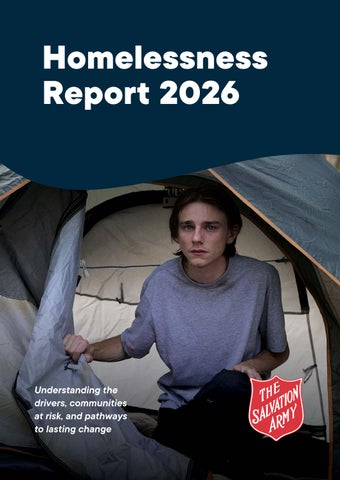
Understanding the drivers, communities at risk, and pathways to lasting change
Housing is a basic human right, yet homelessness remains a national crisis in Australia Safe, secure and affordable housing is essential for health and wellbeing, community connection, identity and a sense of belonging Housing provides the foundation from which people can create and live a safe and fulfilling life.
Without a stable home, a person’s ability to access and sustain employment, education, health care, family and social networks is significantly compromised. Homelessness can affect anyone. Experiences range from unstable and unsafe housing to distressing and dangerous situations
Despite this, many Australians experience homelessness or are at risk of losing their home. On Census night in 2021, 122,494 people were estimated to be experiencing homelessness in Australia1, an increase of 5.2% since 2016, according to ABS analysis.²
While Census data provides the most recent national prevalence estimate, service data shows demand for homelessness services continue to grow Government-funded Specialist Homelessness Services (SHS) provide services to people experiencing homelessness or at imminent risk� In 2024–25, SHS supported about 289,000 people, with around 49% experiencing homelessness at presentation (and 51% at risk).3 Rising housing costs, constrained supply and broader cost-of-living pressures continue to drive demand
Having safe, secure and affordable housing is a human right Homelessness services like The Salvation Army support people experiencing homelessness to find stable housing, build positive community connections, and address the underlying causes of homelessness
289,000
people supported by Specialist Homelessness Services including The Salvation Army
People experiencing homelessness died an average of 22 - 33 years younger than those who are housed4
Women and children together account for almost three quarters of people seeking SHS assistance5
Sleeping rough
Supported accommodation
Homelessness takes many forms and is often hidden from view� Most people experiencing homelessness are not sleeping rough but are living in temporary accommodation, cars, motels, couch surfing, or in severely overcrowded housing.
For this reason, the Australian Bureau of Statistics defines homelessness as living in housing that:
• Is inadequate
• Has no tenure, or only short-term, non-extendable tenure
• Does not allow control over, or access to, space for social relations
Severe overcrowding is the most common form of homelessness in Australia and often remains unseen, despite its significant impacts on health, safety and wellbeing
Staying in other households
On Census night 2021 (ABS):
Boarding houses
Temporary lodgings
Overcrowded dwellings
39%
20% 6.2% of people experiencing homelessness were living in severely overcrowded dwellings
were in supported accommodation were living in improvised dwellings, tents or sleeping rough
Children make up more than one quarter of all SHS clients6
58% were under 35 years of age8
20% identified as Aboriginal and Torres Strait Islander9
Homelessness can affect anyone, but some groups face much higher risk due to structural disadvantage and systemic inequality� These include Aboriginal and Torres Strait Islander peoples, women and children, young people, older women, LGBTIQA+ communities, culturally and linguistically diverse communities, people with disabilities, and veterans
Specialist Homelessness Services (SHS) data shows that people who seek homelessness support are more likely to be female, often reflecting the high proportion of women and children escaping family and domestic violence�11 SHS clients are also more likely to be living alone or single parents with children, aged 25–44, and often experiencing intersecting challenges such as mental ill-health or problematic alcohol or other drug use
Women and children together account for almost three-quarters of people seeking SHS assistance7
56% of people experiencing homelessness were male10
Patterns of homelessness have shifted over time� Older women have emerged as a growing and increasingly vulnerable cohort� ABS Census reporting between 2011 and 2021 shows that the number of people experiencing homelessness aged 55 years and over increased from 14,581 in 2011 to 19,378 in 2021 In addition, the Australian Human Rights Commission has highlighted a marked increase in homelessness among older women (55+) between 2011 and 2016, and warned this trend is likely to continue without structural reform.12
More recent Specialist Homelessness Services reporting also indicates growth in demand among older people, with clients aged 55+ rising from 6 1% of SHS clients in 2011–12 to 11% in 2024–25.13 This reflects structural factors including lifetime income inequality, lower superannuation balances, insecure or low-paid employment histories, relationship breakdown, family and domestic violence, and limited access to affordable rental housing later in life.14
Certain experiences and individual characteristics can also place individuals at greater risk of homelessness and/or compound the trauma of homelessness, requiring skilled, ongoing and wraparound support
These may include experiences such as:
Intergenerational and/or complex trauma
Child abuse and disrupted attachment relationships
Grief and loss Poverty
Time spent in institutional settings such as out-of-home care, prison or hospital War, violence and persecution
While homelessness can affect anyone, these groups experience disproportionately high risk and harm, highlighting the need for targeted, inclusive and culturally safe responses:
Youth homelessness remains at alarming levels� In 2024–25, more than 50,000 young people aged 15–24 were assisted by SHS agencies, many presenting alone without a parent or guardian.15 Housing affordability stress is increasingly cited as a primary reason for seeking assistance
There are almost no affordable private rental options for a single person on Youth Allowance in most parts of Australia, significantly increasing the risk of homelessness for young people.16
Family and domestic violence (FDV) continues to be a leading driver of homelessness In 2024–25, people who had experienced FDV accounted for around 40% of all SHS clients17, the largest single cohort seeking assistance� Women experience higher rates of violence and are more likely to face severe financial stress following violence.18,19
Homelessness is not caused by individual failure It is fundamentally driven by structural factors, including poverty, low incomes, housing shortages and unaffordable rents.20
Individual factors such as mental ill-health, trauma, family breakdown, alcohol and other drug use, or justice involvement can increase vulnerability, but are not root causes in isolation These factors intersect with structural barriers, compounding risk
Housing supply is a key determinant of rents and prices Australia has one of the lower levels of housing supply per capita among OECD countries, and social housing stock has declined as a proportion of total housing for decades.21 Rental vacancy rates remain extremely low, while rents continue to rise.22
Rental stress – spending 30% or more of income on housing – affects a substantial proportion of low-income renters.23 Rising food, energy and transport costs further reduce household resilience, increasing homelessness risk.24
The success of homelessness services relies on being able to help people out of homelessness support into affordable and secure long-term housing
At June 2024, 169,000 households were waiting to be allocated public housing (up from 155,000 at June 2014).25
• Land availability and planning
• Construction costs and regulation
• Availability and costs of financing
• Housing-related infrastructure costs
• Taxes, levies and charges
policy and regulation
• Income and employment
• Availability and costs of financing
• Demographic changes
• Household preferences
Structural/Systemic drivers
• Housing affordability
• Lack of social housing
• Labour market trends such as increased casualisation and stagnating wage growth
• Shrinking welfare state
• Income inequality
• Housing and homelessness policy mechanisms

Individual/biography, including:
• Intergenerational and/or complex trauma
• Child abuse and disrupted attachment
• Time spent in institutional settings such as out-of-home care, prison or hospital War, violence and persecution Grief and loss


• Lack of affordable housing options
• Extended social housing waitlists
• Stigma and discrimination
• Issues sustaining tenancy
• Lack of suitable housing options (size, location, amenity, cost)
• Inflexible tenancy conditions (adapting to changes in family structure; maintaining tenancy during absence such as hospital stays, prison)
Safe,
Homelessness is closely linked to poorer health outcomes, reduced workforce participation and ongoing disadvantage. These outcomes affect individuals, families, communities and local economies alike. Doing nothing comes at a high cost: to people’s lives and potential, to public systems, and to the strength and cohesion of our society
Homelessness has profound and long-lasting impacts on individuals, families and communities It is associated with poorer physical and mental health, exposure to violence, disrupted education and employment, and social isolation
People experiencing homelessness generally have worse health outcomes, higher hospitalisation rates and increased use of emergency services.26 Severe overcrowding increases infectious disease transmission and psychological stress, while rough sleeping carries acute risks from exposure and injury.27, 28
People experiencing homelessness died an average of 22 - 33 years younger than those who are housed.29
In 2023–24, around 1 in 4 (24% or 66,500) people accessing services from SHS identified health-related reasons for seeking support.30
People with a current mental health issue were the second largest group of SHS clients, making up around a third (31%) of all SHS clients.31
According to ABS data from 2015, 13% of people who experienced homelessness at least once in the previous 10 years were more likely to report experiencing a barrier to accessing health care, compared with 4 4% who had not experienced homelessness.32
Homelessness is first and foremost a humanitarian issue, with profound impacts on people’s health, wellbeing and opportunity When it goes unaddressed, those impacts ripple outward, placing additional pressure on health, justice, housing and social support systems
Without stable housing, people are more likely to experience preventable hospital admissions, interactions with the justice system and disruptions to education and employment These outcomes carry real costs for governments and communities, while also limiting people’s ability to participate fully in society For children, experiences of homelessness can increase the risk of poor health, interrupted schooling and ongoing housing insecurity later in life, reinforcing cycles of disadvantage across generations� When systems are stretched responding to crisis, fewer resources remain available to meet other community needs
In 2024-25, governments invested approximately $1 8 billion in specialist homelessness services, yet demand continued to exceed available support.33
People experiencing homelessness face higher rates of hospitalisation and emergency care than the general population.34
People without stable housing are disproportionately represented in the justice system.35 Youth homelessness alone is associated with an estimated $747 million each year in additional health and justice costs.36
Around 9% of SHS clients experiencing homelessness report alcohol or other drug issues.37 Across broader Australian society, the estimated social cost of alcohol use exceeds $72 9 billion annually.38
Prevention, early intervention and access to secure housing are proven, effective ways to address the long-term costs associated with homelessness� Homelessness services, together with the individuals, communities and funders who support them, play a critical role in reducing these impacts Early intervention, skilled, dedicated case workers and fit-for-purpose transitional housing are already helping people move toward stability, safety and independence
Lasting progress depends on supporting people beyond crisis responses and into affordable, secure, long-term housing Evidence shows that investment in housing and homelessness services delivers strong social and economic returns, including reduced pressure on hospitals, justice systems and emergency services
Investment in social and affordable housing leads to better health outcomes, increased workforce participation, reduced violence and stronger community connections
Long-term modelling indicates that sustained national investment in affordable housing could deliver up to $110 billion in present value terms in social and economic benefits over the next 30 years.39
Addressing homelessness is not only the right thing to do — it is a practical, evidence-based investment in healthier people, stronger communities and a more resilient society.
ENDING HOMELESSNESS REQUIRES COORDINATED ACTION ACROSS MULTIPLE LAYERS OF THE SYSTEM, INCLUDING:
Prevention and early intervention, including tenancy sustainment
Timely access to appropriate housing
Housing First approaches for people experiencing homelessness
Long-term investment in social and affordable housing supply
Integrated systems across housing, health, family violence and income support
The Salvation Army’s approach to homelessness is guided by the following statements
Ending homelessness is possible
Ending homelessness in Australia is achievable through addressing structural drivers and strengthening prevention, early intervention and Housing First responses.
Housing is a human right
Housing is recognised as a human right under Article 25 of the Universal Declaration of Human Rights.40
Homelessness can affect anyone
Its impacts are far-reaching and long-lasting, affecting individuals, families and communities.
Homelessness is everybody’s business
Whole-of-community collaboration and lived experience leadership are essential to systemic change.
Lived experience should inform all that we do
People who have experienced homelessness are best placed to speak about the impacts of homelessness and how services and systems can be improved.
Everyone has a right to dignity and respect
All people have intrinsic value and must be treated with dignity, respect and cultural safety.
Inadequate systems perpetuate homelessness
Homelessness is not a choice and is often a result of inadequate and/ or failed social structures and welfare supports.
Experiences of homelessness are complex and dynamic
Experiences of homelessness are varied and complex and therefore require tailored and flexible responses.
We believe homelessness can be solved Ending it requires coordinated, person-centred responses that prioritise safe, affordable and secure housing, alongside the right supports at the right time� Evidence shows that when people are treated with dignity, offered choice, and supported to address barriers to housing stability, long-term outcomes improve for individuals, families and communities
Effective homelessness responses are built on partnership - across government, community services and specialist providers - and recognise that people’s needs are diverse and change over time A comprehensive approach includes access to housing and accommodation, skilled case management, assertive outreach, financial assistance, and strong connections to health, justice, family violence, and other specialist services Support must be available at the point of need and continue for as long as it is required to help people regain stability and independence
Across Australia, homelessness services support adults, families and children experiencing housing insecurity, family and domestic violence, financial hardship and other intersecting challenges� This includes providing safe accommodation and refuges, emergency relief and financial assistance, food and material aid, addiction recovery services, advocacy and referrals, as well as place-based community programs that strengthen connection and belonging
Investment in these responses delivers tangible results In 2024–25 alone, The Salvation Army’s homelessness and social support services provided over one million nights of accommodation, millions of dollars in direct financial assistance, and extensive sessions of care across community programs 41 These outcomes are made possible through sustained public investment and the generosity of supporters, and they demonstrate the impact of walking alongside people in crisis and supporting them to move forward
Strong homelessness responses are grounded in evidencebased frameworks and a shared commitment to quality practice
The Salvation Army’s model of care is informed by the following principles:
Together, these principles form a toolkit for good practice in responding to people who are experiencing, or at risk of, homelessness.
Housing First is widely recognised as best practice in addressing homelessness It is based on the principle that housing is a fundamental human right and that people do not need to resolve other challenges before accessing stable housing
Ending homelessness requires a strong focus on helping people obtain and keep safe, suitable and affordable housing, not simply expanding crisis or emergency responses. Different housing pathways are needed to reflect the diversity of circumstances people face, with services working to match individuals and families to the most appropriate and sustainable outcomes
For families, effective responses are family-focused and incorporate children’s and parenting supports, while linking households to community resources that help sustain housing, strengthen wellbeing and build social connection
Evidence, research and lived experience must guide homelessness responses This includes safely collecting and analysing data, listening to people accessing services, and continually refining systems and practice. Programs are most effective when they are evaluated against the goals people set for themselves, using this learning to strengthen responses over time and improve outcomes
By investing in proven approaches, strengthening partnerships and keeping people at the centre of solutions, homelessness can be prevented, reduced and ultimately ended
Immediate access to housing without conditions
Separation of housing and support
Flexible, long-term, individualised support
Choice and selfdetermination
Harm-reduction and recovery-oriented practice
Active, non-coercive engagement
A focus on sustaining tenancies and supporting community inclusion
The Salvation Army is guided by our Vision Statement:
Wherever there is hardship or injustice, Salvos will live, love and fight, alongside others, to transform Australia one life at a time with the love of Jesus.”
Homelessness is a national issue that requires a coordinated national response�
Together, through considered and collective action, we can change the tide and end homelessness�
To find out more, contact 13SALVOS