The Salvation Army, an international movement, is an evangelical part of the universal Christian Church.
Vision Statement
Wherever there is hardship or injustice, Salvos will live, love and fight alongside others to transform Australia one life at a time with the love of Jesus.
Mission Statement
The Salvation Army is a Christian movement dedicated to sharing the love of Jesus by:
• Caring for people
• Creating faith pathways
• Building healthy communities
• Working for justice
The Salvation Army Australia acknowledges the Traditional Owners of the land on which we meet and work and pay our respect to Elders, past, present, and future. We value and include people of all cultures, languages, abilities, sexual orientations, gender identities, gender expressions, and intersex status. We are committed to providing programs that are fully inclusive. We are committed to the safety and wellbeing of people of all ages, particularly children.
Still seeking equality
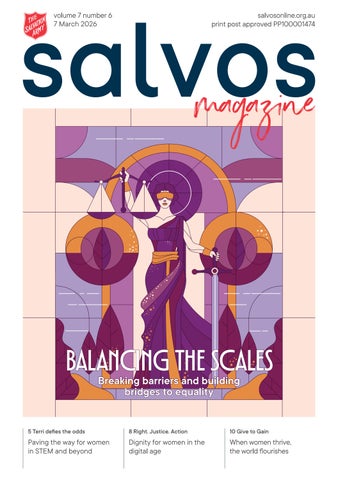
‘Balance the scales’, ‘Rights. Justice. Action.’, and ‘Give to Gain’ are three of the different themes and focus areas for this year’s International Women’s Day on 8 March.
In this edition we focus on all three, exploring issues that, almost unbelievably, continue to impact a growing number of women and girls around the world.
Scan here to connect with The Salvation Army services
Founders: William and Catherine Booth
Scan here to subscribe to Salvos Magazine
Salvation Army World Leaders: General Lyndon and Commissioner Bronwyn
Buckingham
Territorial Leader: Commissioner Miriam Gluyas
Secretary for Communications and Editor-In-Chief: Lieutenant-Colonel Paul Hateley
Printed and published for The Salvation Army by Commissioner Miriam Gluyas at Focus Print Group, Chester Hill, NSW, Darug Nation lands.
Star Conliffe writes about the explosion in usage of the Grok chatbot, the AI deepfakes that disproportionally target and harm women, and the dire need to uphold women’s dignity and safety both on and offline; Kirralee Nicolle provides insight into financial inequality and exclusion; and we share the story of Salvos employee Terri Dentry – her personal achievements in STEM, film production, motherhood and project management, and her fight for the equality of women and those on the margins.
When Jesus walked the Earth, he challenged the cultural and religious norms of the day by including and empowering women. There is no doubt that everyone is equal in the eyes of the great God who created us all.
For these stories and more, go to salvosonline.org.au
Simone Worthing Editor
Balancing the scales – together!
International Women’s Day is celebrated globally each year on 8 March.
This year, the United Nations (UN) Women Australia theme for the day is ‘Balance the Scales’. This theme brings attention to the urgent need for a fairer, more inclusive and accessible justice system for women and girls.
Discriminatory laws, harmful practices and gender-based violence remain widespread, while structural barriers continue to block women and girls from accessing justice. While these structural barriers have been in place for generations, it is possible for us to dismantle them.
Globally, one in three women experience violence, and most never seek formal support or justice through the legal system.
In Australia, sexual assault conviction rates remain incredibly and stubbornly low.
UN Women also notes that marginalised communities of women are the most likely to be failed by the justice system. For example, First Nations women are 34 per cent more likely to be hospitalised due to family violence than non-Indigenous women.
“Balance the Scales is a promise for every woman and girl to be safe, heard and free to shape her own future,” UN Women Australia CEO Simone Clarke said.
“This International Women’s Day, we are calling on Australians to join a movement for real action – to transform our justice systems, amplify marginalised voices, and ensure equality is not the exception, but the rule.”
Climate change
Climate change is an ever-growing threat that disproportionately impacts women and girls, especially across the Pacific region. Displacement from disasters is also a concern and will deepen existing inequalities.
UN Women estimates that by 2050, climate change may push up to 158 million more women and girls into extreme poverty. This figure is 16 million more than men and boys and highlights why a climate justice approach is critical.
Australia has a pivotal role to play in elevating women’s voices and leadership, as well as working towards climate justice.
“True progress takes more than words. Together, we have the power to dismantle discriminatory systems, unlock transformation, and deliver justice, safety and dignity for all women and girls,” Clarke said.
For more information, go to iwd.net.au
Breaking barriers and building bridges
Paving the way for women in STEM and beyond
With International Women’s Day approaching, Kirralee Nicolle spoke with Terri Dentry, The Salvation Army’s IT Project Management Office Manager, about what drives her, the challenges she has faced, and why encouraging women into science, technology, engineering and mathematics (STEM) is essential.
In her IT role at The Salvation Army, Terri works to ensure the women in her team feel as entitled as their male counterparts to advancement, pay equity and respect. That conviction was hard-won.
When Terri was 21, she discovered she was pregnant with her first child. While the circumstances were positive, she was also an undergraduate science student in 1980s Melbourne — a situation she describes as “really rare”.
“Everyone was saying to me, ‘You must be joking,’” she says. “[But] I just decided I was going to do it all.”
Women and men
bring a different way of seeing things to the table. They have to really understand that from each other. You need women, because they think about things in a different way.
Terri completed her undergraduate degree and began an honours year while pregnant with her second child. She found a supportive supervisor who allowed her to bring her newborn onto campus and access affordable childcare during classes and research.
“Honestly, it was rough,” she says. “I had to have quite a few run-ins with people. People weren’t very happy with the fact that I was a mother and working hard to get a scholarship to do a PhD.”
She recalls feeling isolated and unwelcome, with some believing she was taking a place from someone without children.
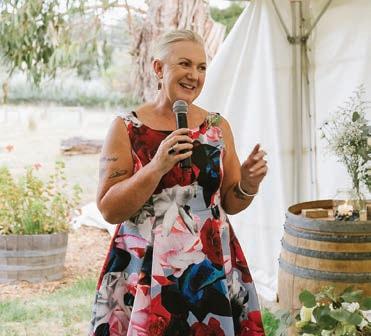
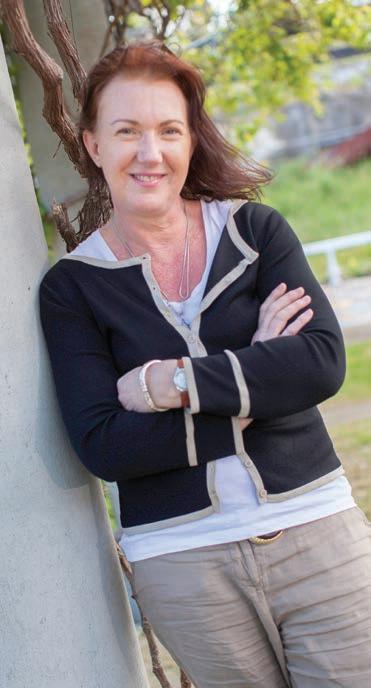
Terri Dentry. All images supplied
Terri has constantly reinvented herself throughout her life.
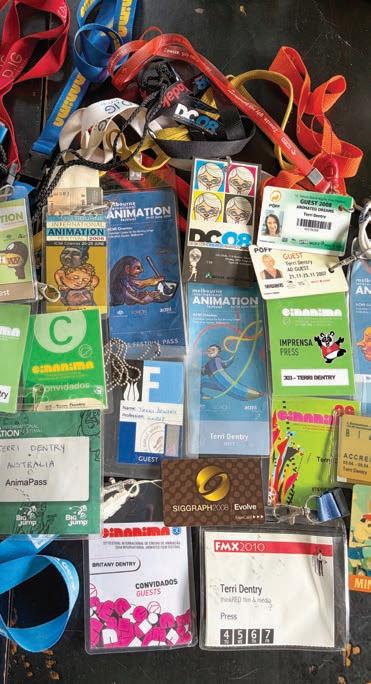
Lanyards from the many film festivals Terri has attended as part of her production, media and film judging career.
“I’d walk through the corridors and have senior academic staff – and people who didn’t even know me – saying, ‘Why are you even here? Why aren’t you at home with your children?’”
The experience became so difficult that Terri initiated legal action after missing out on a Commonwealth PhD scholarship despite consistently high results.
“They marked me down so that I wouldn’t get a scholarship,” she says. “Only the top five out of 20 were funded. I believed
I was one of them, but I was ranked seventh. I had to fight my way for it.”
Terri took the matter to the Equal Opportunity Commission and won, proving she had been deliberately marked down because she was a woman with children. Although she was awarded First Class Honours, the scholarship was no longer available.
Instead, she pursued a more competitive fellowship, vying for funding to undertake a PhD.
“I was really lucky to get a fellowship at the Ludwig Institute for Cancer Research,” she says. “They had access to my actual results, and I explained what had happened. I ended up getting one of the two fellowships offered that year.”
During her PhD, Terri became pregnant with her third child. Combined with a marriage breakdown and the demands of research – including 18-hour days – she stepped away from ‘the bench’ for a while.
New interests
She moved into a project officer role at RMIT University, later progressing into senior project management roles across industries. At Victoria University, she led a large program supporting interprofessional practice across ten health disciplines. This area sparked her interest and she returned to her PhD, this time working with refugees and asylum seekers facing chronic pain and PTSD symptoms.
Her team trialled placing physiotherapists and psychologists together with clients, producing outcomes that helped reshape care for vulnerable populations.
“Having multiple people working with them really helped them feel cared for,” she says. “Seeing people so happy and free of pain at the end was joyous.”
Alongside her full-time role at The Salvation Army, Terri continues postdoctoral research and holds grants across institutions. She says her academic skills translate directly into IT leadership.
“What we do in my team is ask questions and solve problems,” she says. “That’s exactly what I did in research. I teach my teams how to work together, how to talk the same language and understand each
other, and understand each other’s way of working. It makes a huge difference to the way they work.”
She says her focus is to assist team members to “lean in” and help each other fulfil their roles, ensuring there are no gaps in IT service delivery.
Terri is one of a small number of women in IT leadership, and she encourages women in her team to see themselves as equals.
“Women and men bring different ways of seeing things,” she says. “You need both.”
Creativity
Beyond STEM, Terri has worked as a producer on independent and Australianfunded films. These include short animations, one of which was nominated for an Oscar in 2015. She has served as a film judge, worked as a journalist in the film industry and continues to write. Terri is currently working on a novel that draws on her research.
Her creative work, she says, has been essential during periods of reinvention.
“Stories help you re-evaluate,” she says. “They help you work out where you need to be next and to actually make the change.”
Now the mother of four daughters and grandmother of five, Terri says her children have been part of her journey –attending film festivals, visiting labs and learning firsthand what is possible.
“Showing them they can do whatever they want has always been important,” she says. “They need to see all the things that you do and be part of that, so you can show them what they can imagine [for] themselves.”
For the full story, go to salvosonline.org.au
Rights. Justice. Action.
Upholding women’s dignity in the digital age
by Star Conliffe
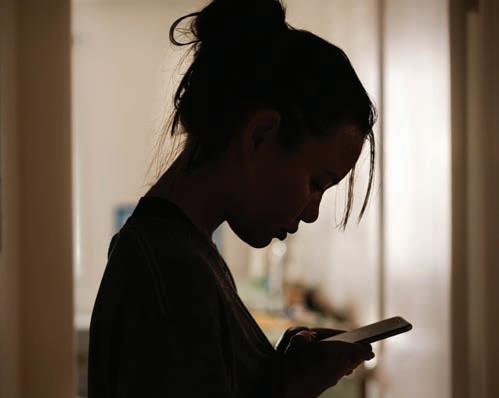
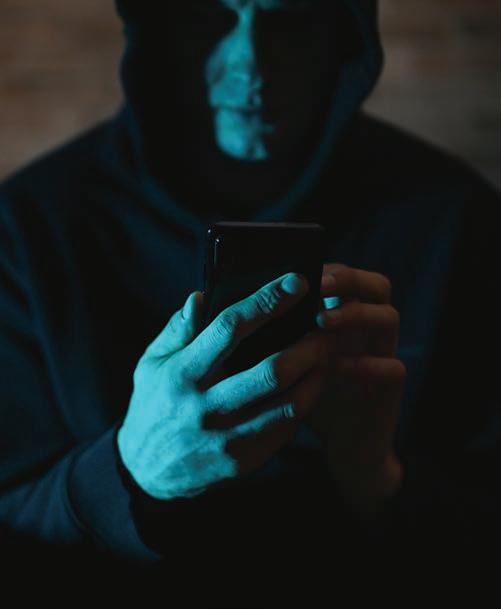
Imagine waking up one morning to find that someone has posted pictures of you all over the internet – without your clothes on. This is exactly what happened a few months ago to thousands of women. They went online to find that their photographs had been used by Elon Musk’s Grok chatbot to generate sexualised images of them which were then posted
publicly on the X platform. The New York Times reports that between 31 December 2025 and 8 January 2026 (just nine days), Grok generated and “posted more than 4.4 million images, of which at least 41 percent were sexualised images of women and children”. These were all non-consensual images which Grok had been asked to create and post to the X platform, mostly by men.
The public was rightly outraged and governments around the world opened investigations. Some have announced new laws designed to protect people from artificial intelligence (AI) image abuse. Musk responded to the scandal by stating that Grok would block users from making illegal images. However, journalists report that paid subscribers can still use Grok to create them.
Targeting women AI deepfakes disproportionately harm women, especially women with public profiles such as politicians, journalists and celebrities. One of the women who was targeted by AI image abuse is Paris Hilton. She is a vocal activist and advocate for better laws that protect everyone from AI image abuse. In a recent press conference, Hilton talked about how this abuse affected her and other victims: “Too many girls are afraid to exist online, or sometimes to exist at all. And I know how that feels because I’ve lived it … This isn’t about just technology, it’s about power. It’s about someone using someone’s likeness to humiliate, silence and strip them of dignity.”
The Grok scandal is just one example of how all forms of online violence towards women are escalating around the world. And it leaves me wondering, how is it possible that this kind of public abuse of women is still so common in 2026? Why are governments still struggling to regulate technology companies and make them accountable for how their platforms facilitate online violence?
The issue is twofold. Not only is there a lack of women and other minorities working in tech companies, but governments and companies simply do not listen to women. Their warnings – that there are not enough safeguards in place to stop AI being used as a tool to abuse women – were ignored until it was too late.
Close the gap
Ironically, the purpose of online abuse is to frighten women into silence. When the online abuse is not effective at shutting women up, perpetrators will then move to offline violence (primarily stalking), to frighten victims out of the public conversation.
The online to offline violence connection is so serious that some women
journalists have increased their physical security measures. Adding to the distress that women experience from online violence, they are often blamed for their own abuse and expected to moderate their online presence to prevent the abuse from happening – an impossible and unfair task.
The theme of this year’s UN International Women’s Day is ‘Rights. Justice. Action.’ It highlights the reality that around the world, women hold only
64 per cent of the legal rights that men have, and that countries are failing to close these legal gaps. I hope for a world in which governments and tech companies listen to women’s concerns and experiences before even more harm is done. And I dream of an online world that is safe for the equal participation of all women and girls.
Captain Star Conliffe is an Australian Salvation Army officer (pastor) currently serving in South Korea
Give so the world can Gain
When women thrive, the world flourishes
by Rosy Keane
Give to Gain, the International Women’s Day 2026 theme (internationalwomensday.com), highlights the power of collaboration and generosity. It emphasises that when people, organisations and communities give generously, opportunities and support for women increase.
The United Nations consistently affirms that educating girls and advancing gender equality are among the most significant contributors to global peace and prosperity.
For people of faith, this idea is not new. It sits at the heart of Christian community.
Recently, I visited The Salvation Army Auburn Corps (church) in Sydney. As we gathered for worship, I was struck by the beauty of what I saw. A richly multicultural, intergenerational community. People of different ages, languages and cultural backgrounds worshipping side by side. Each person was welcomed, seen and valued for who they were and for the part they played in the body of Christ.
It felt like a glimpse of what the Church is meant to be.
In the Christian faith, we do not give in order to get something in return. We offer what we have – our skills, time, money,
wisdom and compassion, to serve one another. We are called by God to give in times of need, as well as in times of plenty, and to bless the lives of both our friends and enemies. In doing so, we see the love of Jesus through ‘loving our neighbour as ourselves’ (Matthew chapter 22, verse 39).
So, the question for all of us is this – what might Give to Gain look like in our own lives?
As The Salvation Army, we believe in meeting human need without discrimination, motivated by the love of Jesus. Jesus himself is the ultimate example of Give to Gain. He gave his life so that women and men, young and old, might find peace, salvation and hope.
We know that women across the world continue to be disproportionately affected by intimate partner violence, poverty, lack of access to education, medical bias, climate-related vulnerability, and discrimination shaped by gender, culture and religion. But we also know that women continue to give themselves to the flourishing of environments, families, communities, enterprise, churches and nations.
This International Women’s Day, would you pray with us for women around the world? Pray for safety, dignity, opportunity and new life? Perhaps pause and consider this
question: What could it look like for you today to give something that helps women in your world gain life in all its fullness? When women thrive, we all gain together. This is the Jesus way.
To read the full version of this story, go to salvosonline.org.au
Aux-Lieutenant Rosy Keane is the Spiritual Life Secretary for The Salvation Army Australia
‘Can’t work any harder’: Women scrimping to survive
Women in Australia are bearing the burden of cost-cutting, while more men are growing their investments.
by Kirralee Nicolle
When it comes to financial inequality in Australia, we tend to think of the income disparity between men and women, the superannuation gap, and the rising rate of homelessness among women over 55.
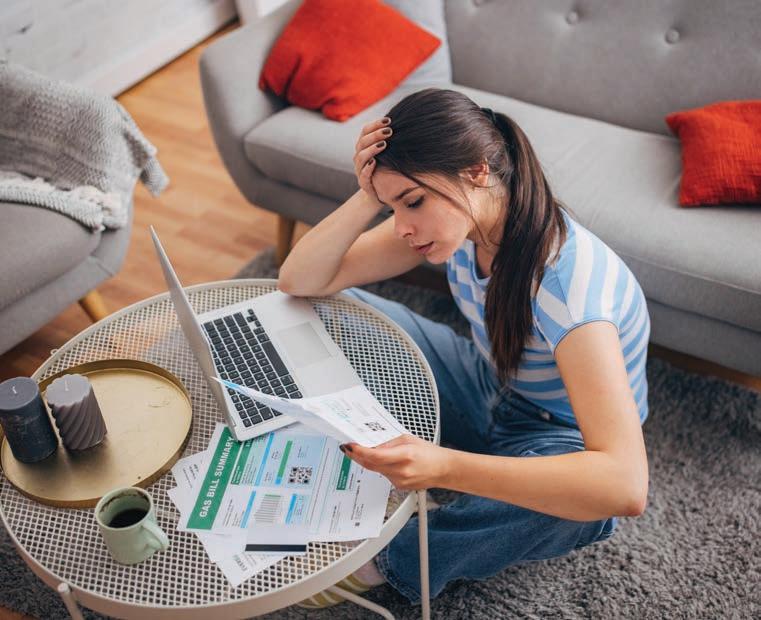
But these inequalities do not tell the whole story. On a daily basis, women are facing the toll of trying to survive in a cost-of-living and housing crisis which disproportionately affects them.
November research from AustraliaNOW showed that women were overrepresented on almost every financial management action, including shopping around, cutting expenses and budgeting, while more men invest than women.
Investing was also more associated with higher income earners who earned more than $100,000 per year, while cost-cutting was primarily the concern of lower-income households, with yearly incomes of under $50,000.
Clear disparity
State Manager for the Salvos’ Moneycare service in Queensland, Lucy Jones, says the disparity between men and women seeking assistance with their finances is clear from Gold Coast and Lockyer Valley data, where caseloads typically comprise at least 60 per cent women.
Lucy says she believes this speaks to the fact that more primary carers are
women, and more women experience higher living costs with dependants. She says many of these women are accessing “little to no” child support and have experienced some form of family and domestic violence (FDV).
She says one client, who was employed full-time in a professional role, had left an FDV relationship and was in temporary housing while looking for a two-bedroom rental, which would just be sufficient for both her and her children. Despite her full-time wage, she was unable to qualify for any rentals in the area, because real estate agents require that rent is no more than 30 per cent of an applicant’s income.
“Not being able to afford any rentals in the entire rental market of your area can leave people and families in crisis,” Lucy says.
“I find that working with women on lower incomes, more often than not, they know exactly where every cent goes. They just don’t have enough coming in.”
Entrenched disadvantage
ANZ research released in March 2023 showed that across all age groups, women demonstrated lower financial wellbeing than men, even though, when comparing men and women between the ages of 25-34, women typically showed stronger savings mindsets than men.
Salvos’ General Manager for Diversity, Equity and Inclusion and single mother of three, Amanda Brummell Lennestaal, concurs with Lucy that many women are simply not making enough money. She says many women cannot work extra hours because of caretaking responsibilities, especially with children who have disabilities or complex care needs. Not only is this an issue for women’s immediate needs, but also those facing retirement with what she describes as “grossly inadequate superannuation balances”.
“There are only so many ways you can educate a woman in how she can stretch her money,” Amanda says.
“I know how to scrimp and save and how to cut corners, but you can only do that so far. The challenge is how we move beyond seeing entrenched disadvantage as a lack of female capacity or skill … that becomes another active form of discrimination that says, ‘You can get yourself out of it if you just work a little harder’.
“Sometimes women can’t work any harder.”
“There are lots of practical things we can be doing,” Amanda says. “Ultimately over time, it’s about how we think about the government contracts, tenders and services we deliver [and] how we see women as strong, resilient and competent, and understand where their unique needs might be.”