The Salvation Army, an international movement, is an evangelical part of the universal Christian Church.
Vision Statement
Wherever there is hardship or injustice, Salvos will live, love and fight alongside others to transform Australia one life at a time with the love of Jesus.
Mission Statement
The Salvation Army is a Christian movement dedicated to sharing the love of Jesus by:
• Caring for people
• Creating faith pathways
• Building healthy communities
• Working for justice
The Salvation Army Australia acknowledges the Traditional Owners of the land on which we meet and work and pay our respect to Elders, past, present, and future. We value and include people of all cultures, languages, abilities, sexual orientations, gender identities, gender expressions, and intersex status. We are committed to providing programs that are fully inclusive. We are committed to the safety and wellbeing of people of all ages, particularly children.
A love for all seasons
We’ve only just hit February, and already life for most of us is back in full swing. Traffic delays have resumed, summer vibes are a thing of the past, and Valentine’s Day chocolates have replaced January bargains, with sales again expected to be in the hundreds of millions.
Traditionally, Valentine’s Day celebrates romantic love. Times are changing though, and more and more people are consciously expressing love and care to a range of close friends and family –even extending kindness and attention to neighbours, colleagues or fellow community members.
As humans, we are social beings designed for connection and community, so we need a range of friendships in our lives.
Scan here to connect with The Salvation Army services
Scan here to subscribe to Salvos Magazine
Founders: William and Catherine Booth
Salvation Army World Leaders: General Lyndon and Commissioner Bronwyn
Buckingham
Territorial Leader: Commissioner Miriam Gluyas
Secretary for Communications and Editor-In-Chief: Lieutenant-Colonel Paul Hateley
Printed and published for The Salvation Army by Commissioner Miriam Gluyas at Focus Print Group, Chester Hill, NSW, Darug Nation lands.
For many of us, a relationship with God is our most important focus. As this week’s feature shares, God’s love is steady, solid and everpresent, regardless of our circumstances. He is there through good times and bad, the highs and lows of life. His love never lets go.
Perhaps 2026 is the year to explore and experience that love?
Simone Worthing Editor
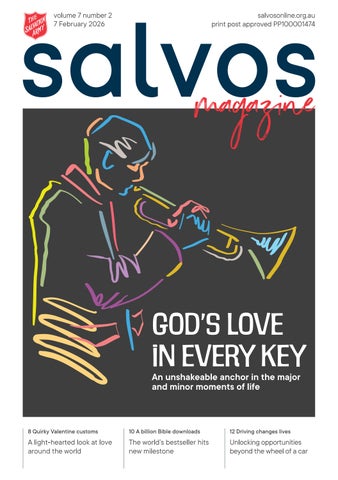
God’s love, in every key
An unshakeable anchor in the major and minor moments of life
by Amanda Hart
There’s something about jazz that feels alive.
Jazz can hold joy and sorrow in the same song, swinging between playfulness and lament in a way that feels deeply human.
And in that way, jazz mirrors life.
Life moves through seasons – some bright, some heavy. And sometimes, like in jazz, the beauty comes not from perfection but from honesty – from playing what’s real in the moment.
The Bible book of Romans, chapter 8, verses 31-39, speaks into that same reality. The author, Paul, is writing to people living through hardship and uncertainty.
And to them – and to us – Paul says: there is something that holds steady. Something that does not let go, no matter the key you find yourself in.
Major and minor keys
There are seasons that feel like they’re written in a major key – days that are lighter,
when laughter comes easily and joy feels close.
In those moments, faith – if we have it –often feels simple.
But Paul’s words aren’t just for the good seasons. They’re for when life shifts into the minor keys – something harder to sing along to.
We all know what that feels like when life turns – the phone call you didn’t expect; the diagnosis; the loss; the relationship that breaks down.
Or maybe it’s just the slow ache of exhaustion, anxiety or isolation – days that blur together, the quiet thought that whispers: Is this all there is?
Paul doesn’t shy away from that reality. He acknowledges life can be brutal.
What we need in those moments isn’t someone telling us to cheer up or have more faith. We need something solid.
A love that meets us where we are – in the middle of the mess – and stays with us there.
A groove that holds it all together
If you’ve ever listened closely to jazz, you’ll hear something subtle under the melody – a bassline, a groove that anchors everything, even as the notes on top wander and change.
That’s the picture I get when I read Paul’s words here.
Life’s melody moves – sometimes smooth, sometimes jagged. But underneath it all, there is something steady. A love that does not let go.
This love doesn’t wait until we’re sorted out or faithful enough. It doesn’t disappear when we’re angry, doubting, or at the end of ourselves … It goes with us into the hardest places and refuses to abandon us there.
I know this because I’ve lived it.
My story
For a long time, I lived like I had to prove myself to God.
I thought if I could just be good enough, maybe I’d finally earn his love. But living
that way eventually left me in the deepest pits of depression.
I was exhausted, ashamed, and convinced I’d failed at life and faith.
And it was in that place – when I was still a mess, when I had nothing to give – that I encountered God’s love in a way I never had before. Quiet. Steady. Real.
And I realised that this love wasn’t something I had to earn. It was already reaching out to me. It stayed when I couldn’t hold on. It refused to let go.
Improvising our way forward
One of the beautiful things about jazz is that it makes space for improvisation. There’s structure, yes – but there’s also freedom.
Faith can look like that, too. For some of us, faith isn’t neat or scripted. Sometimes it’s halting, questioning, slowly finding its way forward.
If you’re unsure what you believe, if you’ve walked away from faith for a while – that’s okay. You don’t need to have everything figured out.
Love in every key
Paul’s words reach a crescendo at the end:
“For I am convinced that neither death nor life, neither angels nor demons, neither the present nor the future, nor any powers, neither height nor depth, nor anything else in all creation, will be able to separate us from the love of God that is in Christ Jesus our Lord” (verses 38-39).
It’s as if Paul is saying: Name anything you can think of – the worst, the hardest, the most impossible – and God’s love is still bigger.
Why this matters
This isn’t just theory. It matters.
Because if what Paul says is true – that nothing can separate us from God’s love – we can stop pretending.
We can bring the real version of ourselves: the one that laughs, the one that doubts, the one that cries in the car on the way home – and trust we’re already loved.
That gives us courage. It means we can face the unknown, not because we have everything under control, but because we’re not alone in it.
There is a love that holds steady beneath it all. You may not always feel it. You may not always believe it. But it’s there. It’s for you.
You don’t have to earn it. You don’t have to fix yourself first. You are already loved, with a love that will not let you go. A love that has a name: Jesus.
So, may you leave here today with this promise echoing in your heart:
“Nothing – no height, no depth, no present, no future – nothing in all creation can separate you from the love of God that is yours in Christ Jesus.”
And may that love, steady in every key, lead you forward from here.
Captain Amanda Hart is a Salvation Army Officer (pastor) in Victoria. This article was first delivered by Amanda as a message at the 2025 Inverloch Jazz Festival, Victoria. Scan here for the full version of this article.
Spreading the love on Valentine’s Day
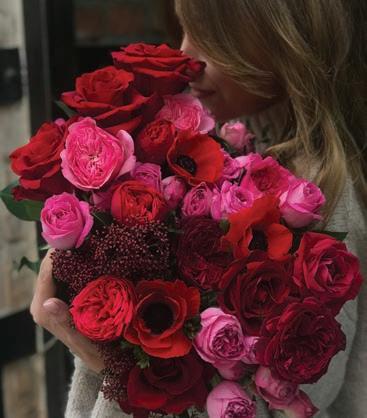
We can include friends of all descriptions, family and others, in spreading the love on Valentine’s Day.
Some of us have a special person with whom we celebrate on Valentine’s Day. Lunch or dinner, chocolates or flowers, a drive or walk to a special place can make this a very romantic and memorable day.
For those of us who don’t, or who would like to include others in our activities, we can still celebrate love in many different ways.
Family and friends can get together at the park, the beach, or one another’s homes. Talking and laughing together makes any day great!
Maybe there is someone in your life who, although not a romantic interest, would love to receive flowers or chocolates –and even more so, a visit. Grandparents, neighbours, or a friend who’s moved into aged care would love a surprise on this special day.
Who are you grateful for? A thank-you note or card to a teacher, bus driver or cleaner – maybe with some chocolate as well – could be a great morale booster.
Today might also be the day to celebrate with the little people in your life. A daddy-daughter date, a visit to the museum or local pool, or a playdate with a friend can make your little person feel very loved.
And let’s not forget our animal friends! Taking Woofy (maybe not the cat!) for a swim, or a play in the park, will make his or her day. Then perhaps a new toy, or a snuggle on the lounge while you watch a pet-themed movie.
One way to share love this Valentine’s Day is to serve whoever you meet. Let someone else go first in the queue; chat with someone who looks lonely; help someone reach the high shelf in the supermarket; tell someone at home or work what you appreciate about them.
However you spend it, we wish you a very happy Valentine’s Day!
– Fay Foster
PHOTO BY VITALY GARIEV ON UNSPLASH
Quirky customs, unexpected treats and romantic rituals
A light-hearted look at love around the world
by Fay Foster
Hearts, flowers and romantic dinners.
Who doesn’t love Valentine’s Day?
But, in some countries, Valentine’s Day celebrations look very different to our own.
Pigs and poets
In Germany, for example, the symbol for this romantic day is not a heart, but a pig. Pig-shaped gifts, such as soft toys and statues, are given as symbols of both love and physical attraction. Ginger cookies with loving phrases etched onto icing are also shared, along with flowers and chocolates.
In England, you could be surprised on Valentine’s Day by the sound of children
singing. Of course, this is not a free concert – you are expected to reward the children with gifts of fruit, lollies or money. Buns known as ‘plum shuttles’ – baked with raisins, plums or caraway seeds – are also exchanged to celebrate the day.
In Italy, beware where you look on the morning of Valentine’s Day! Tradition has it that the first man a single woman sees on 14 February will become her husband (or at least will look like him). Meanwhile, in the city of Verona, home of Romeo and Juliet, Valentine’s Day festivities last for four days, with free concerts, heart lanterns, dinner specials in restaurants and a love-letter writing contest.
In South Africa, where Valentine’s Day is celebrated on 15 February, women will sometimes write the name of the object of their affection on a slip of paper and pin it to their sleeve. Wearing their heart on their sleeves?
The ‘Day of Love’, celebrated on 1 May, is the Czech Republic’s answer to Valentine’s Day. It’s become a tradition for couples to visit the statue of Czech poet Karel Hynek Macha in Prague. The statue Macha holds his pen and paper in one hand, and a bouquet of flowers in the other. The lovers kiss under the boughs of the nearby cherry trees for good luck.
In the Philippines, governments, churches and non-government organisations host huge marriage ceremonies where hundreds of couples marry at the same time. The ceremony is often provided free of charge – including the loan of wedding clothes – and is a huge blessing to those couples who can’t afford a private ceremony.
A day for all
In some countries – including Denmark, Finland, Norway, Mexico and Japan –it’s not just romantic couples who are celebrated on this day. Friends and family swap cards and letters, sometimes anonymous and often light-hearted. In Denmark, if the recipient of an anonymous letter guesses the identify of the sender, they are owed an egg at Easter; if they guess incorrectly, they must give the sender an Easter egg (once they find out who that is!).
In Japan, chocolate is the way to go on Valentine’s Day – and it’s usually the women giving chocolate to the men! There
are three types of chocolate a girl can give: Giri-Choco (obligatory chocolate, given to friends, family, work colleagues and bosses, with no romantic feelings attached); TomoChoco, given to other girls or women; and Honmei-Choco, the chocolate of true love, often handmade and given to a boyfriend or crush.
Across East Asia, Valentine’s Day is often followed by White Day, when the men repay the ladies who gave them gifts. Two months later, in South Korea, people who didn’t receive gifts on Valentine’s Day or White Day gather to share their misery and vent their love problems over a dish of jajangmyeon, a noodle dish with black sauce.
If you’re looking for a marriage proposal, you might want to get to know some people in Taiwan in the lead-up to Valentine’s Day. You will very likely be given a huge bouquet as a token of love. And if you receive a bouquet with exactly 108 roses – the giver is asking you to marry them!
PHOTO BY VIKA FLEYSHER ON UNSPLASH
The Bible. There’s an app for that
The world’s bestseller downloaded for the billionth time
by Barney Zwartz
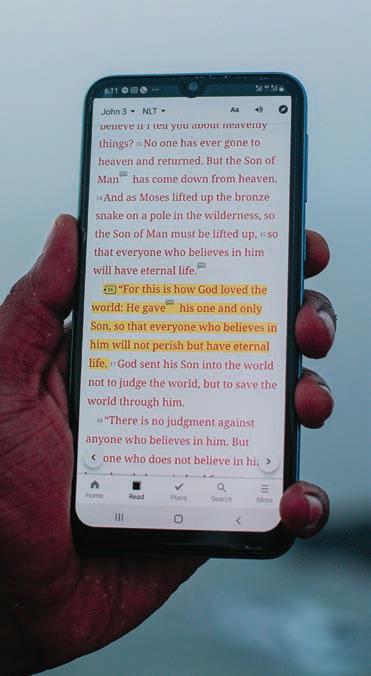
A couple of decades ago, young American Bobby Gruenewald, standing in an airport security queue, wondered whether technology could help him read the Bible more consistently. He launched a website, then in 2008, an app for mobile phones. Recently, that free Bible app, YouVersion – now offering more than 3500 translations in 2300 languages, including
89 in English – was downloaded for the billionth time, an extraordinary figure, even if many people have downloaded it more than once. In Australia, it has been downloaded 7.4 million times.
According to YouVersion, the app is opened a billion times around the world every 39 days, and daily engagement was up 14 per cent last year.
PHOTO COURTESY KAREN MASTERS
Search topics
The searches people are doing are particularly interesting, with a marked difference between Asia- Pacific (including Australia) and Europe. In the Asia-Pacific region, people search most for ‘love’ and ‘anxiety’, followed by ‘anger’, ‘hope’ and ‘healing’. In Europe, clearly a more pessimistic part of the world right now, people search most for ‘stress’, ‘hope’ (especially Psalm 91), ‘love’, ‘anxiety’ and ‘depression’.
What does this thirst for the Bible signify? Above all, it seems to me, it is a search for meaning, for understanding in broader spiritual terms, for belonging.
Christianity in the West is experiencing something of a resurgence, especially among young men. This partly reflects a more unsettled world, a vastly more isolated, atomistic society – thanks not least to social media – and a rejection of the idea that we are merely the hapless products of time and chance (along with several other factors).
Spiritual beings
These are all sociological explanations, but the spiritual explanation is more fundamental still: we are inescapably spiritual beings. Materialism – the idea that only matter is real, which adherents of scientism (not the same thing as science) advocate – just doesn’t satisfy, because it can’t explain to us the most important things, such as love, loyalty, justice, wisdom, commitment or, indeed, the human will.
We are spiritual beings, the Bible says, because we were designed that way. We are also moral beings, relational beings and thinking beings, which together amount to being created, as Genesis puts it, in the image of God.
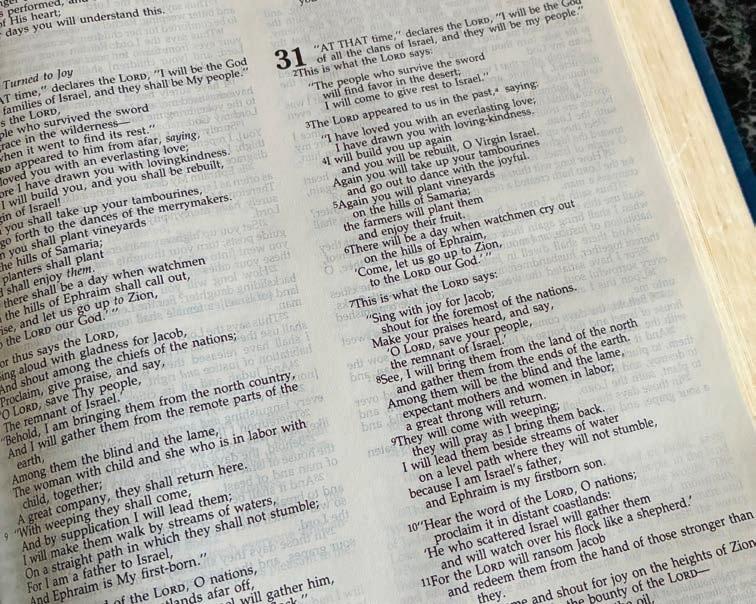
God, after all, created our inmost being and knit us together in our mothers’ wombs (Psalm 139), has numbered every hair on our heads (Matthew, chapter 10), and loves us with an everlasting love (Jeremiah 31), for God IS love (1 John).
Saint Augustine put it both simply and profoundly, in his great work The Confessions: “You have made us for yourself, O Lord,” he wrote. “Our hearts are restless until they rest in you.”
Barney Zwartz is a Senior Fellow of the Centre for Public Christianity. This article first appeared in The Age and can be read at centreforpublicchristianity.org
PHOTO BY DANIEL DARA ON UNSPLASH
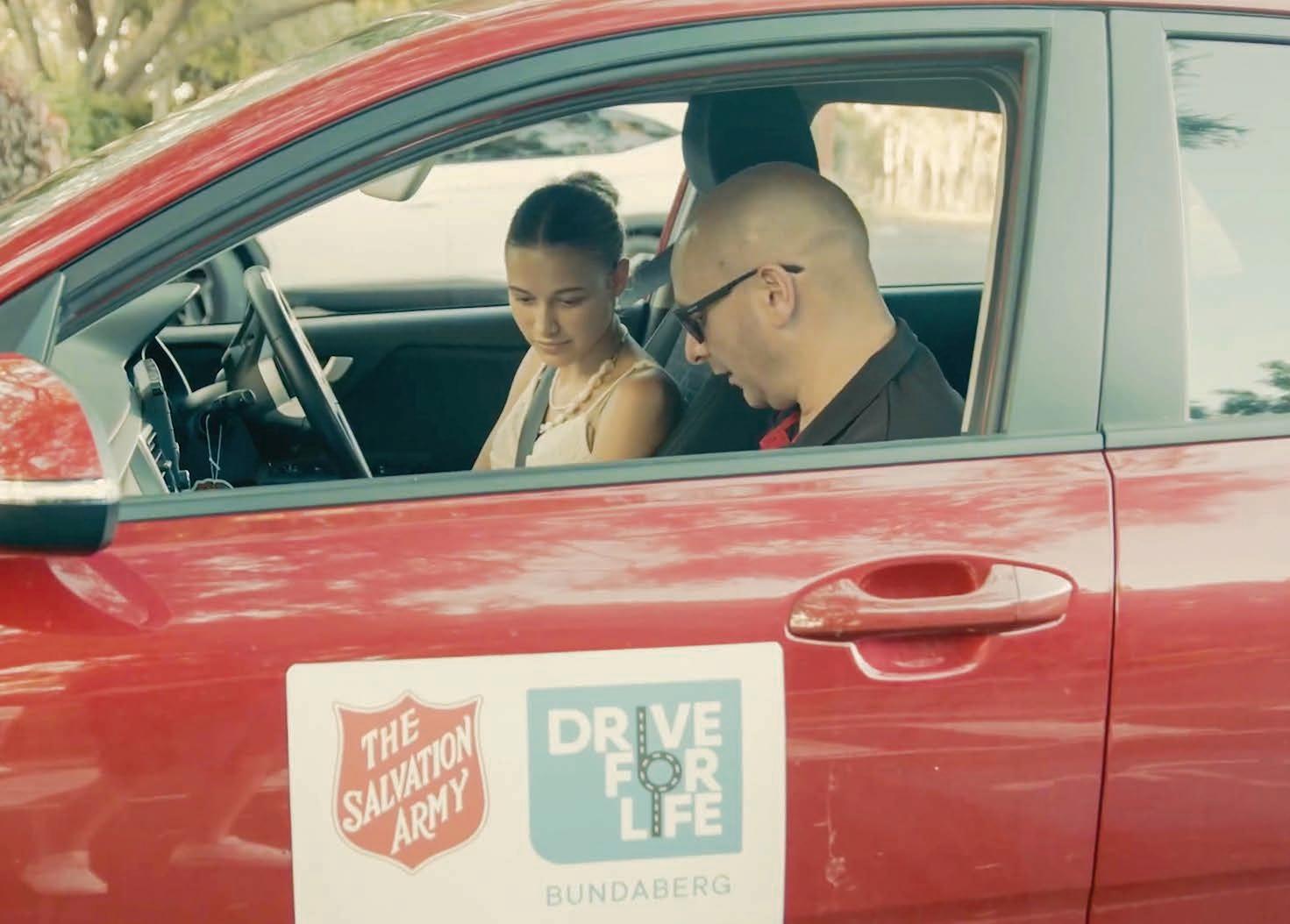
Driving changes lives in Bundaberg
Unlocking opportunities beyond the wheel of a car
The Drive for Life program in Bundaberg doesn’t just help young people earn their driver’s licence; it also helps unlock opportunities in employment, social activities and community.
Since 2008, the Salvos have been helping young people access driving lessons, log the required number of supervised driving hours, and get their driver’s licence.
The programs have expanded from a single location to 15 different sites, and a team of over 100 staff and volunteers across the eastern seaboard of Australia.
Drive for Life – a program that primarily supports young people aged between 16-25 and is designed to meet the needs of those who may find it difficult to achieve their driver’s licence – has supported many young people to achieve their learner and provisional licence, establish positive relationships, broaden employment pathways and develop future goals and aspirations.
It is estimated that over 10,000 young people have passed through the program and moved into further education or employment. Approximately 75 per cent of young people enrolled in the program achieve their learner licence, and 68 per cent go on to achieve their full driver’s licence.
Participants receive road safety education to become safe and responsible road users. They receive support to help them obtain their learner permit, including
help to obtain valid ID where needed; a safe, maintained and insured vehicle to learn in; driving lessons with professional instructors; and road safety sessions.
First anniversary
For over 12 months, the Salvos at Bundaberg in Central Queensland have been operating Drive for Life. “It’s a start to finish type program,” says Ian, Bundaberg Drive for Life Co-ordinator.
“That just means that even before they get their learner’s licence, we’re helping them. We’re helping them get their 100 hours up. And then once they’ve got their 100 hours up, we can assist them going for their tests.”
Terry, who mentors the young learners, is very aware of the benefits of the program to participants. “Giving the young people at Bundaberg the opportunity to gain their licence, that opens up a lot of doors that may not have been open to them,” he shares.
Ian explains that many of those who come through the program are facing challenging circumstances and are quite vulnerable. “A lot of the time, they may not have a chance to come into town and have a drive,” he says.
Both mentors and qualified driving instructors are an integral part of Drive for Life.
“Being a mentor, it’s just a very rewarding role to give back to the community, in particular young people”, says Terry. “Some young people have had probably harder starts to life. So, [it’s great] just talking about that and trying to guide them, to see their confidence grow, and obviously gain the end result of getting their licence and opening up possibilities, both employment-wise and socially as well.
Besides the mentors, the program has qualified driving instructors.
Finding support
Blake, who participated in the program, now has his driver’s licence. “I came to Drive for Life because I wasn’t getting many lessons,” says Blake. “It was very, like, troubling to get my hours up.
“My mentor and instructor, they both
believed in me. You know, like they both told me that I was good at general driving.
“Driving on my own, it’s given me freedom. And on my first day of having my Ps, it felt really, really weird not having someone there. But now, I just love driving by myself ‘cause I can just relax.”
Ian says that having your licence can improve your life in many ways. “Drive for Life is probably named for that reason, because driving does actually lead to a better life for the young people.”
Scan here to watch the Drive for Life video
�� Chocolate truffles
Ingredients
285g dark chocolate, 2 tbsp butter, ½ cup cream, ½ tsp vanilla extract
Place chocolate, cream and butter in a microwaveproof bowl. Heat on high for 30 seconds. Stir and repeat three times.
Stir through vanilla extract and sit for 5 minutes. Stir until all chocolate is melted and the mixture is smooth.
Place the bowl into the refrigerator for 6 hours. When the chocolate is firm, roll tablespoons of the mixture into balls; keep hands cold while rolling.
Roll the balls through your choice of coating. Serve at room temperature.
Can be stored in the refrigerator for 2 weeks.
☺ Believe in Good: Tips
“Love is not love
Which alters when it alteration finds, Or bends with the remover to remove:
O no! it is an ever-fixèd mark
That looks on tempests and is never shaken.”
– William Shakespeare
1. Approximately how many roses are sent in Australia for Valentine’s Day each year?
2. Who invented the first Valentine’s Day candy box?
3. Approximately how many weddings are held on Valentine’s Day in Australia?
4. Letters to Juliet are sent to which city every year?
5. In which play does William Shakespeare mention Valentine’s Day?
Tum-Tum
On which page of this week’s Salvos Magazine is Tum-Tum hiding?
On this day
9 February 1964
The Beatles embark on their first tour in the United States. Their appearance in the Ed Sullivan Show was marked as the beginning of the ‘British Invasion’.
10 February 1964
Bob Dylan’s album The Times They Are A-Changin’ is released. The title track became one of Dylan’s best-known songs.
11 February 1938
The Czech play, Rossum’s Universal Robots introduced the word ‘robot’ to the English language.
12 February 1924
George Gershwin’s Rhapsody in Blue premieres.
✏Answers
Quiz: 1. 5-6 million 2. Richard Cadbury 3. 800 4. Verona, Italy 5. Hamlet Tum-Tum: is in the car window on page 7.
�� Sudoku
Fill in the grid so that every row, every column and every 3x3 box contains the digits 1 to 9. ��
Have a laugh
What did the paper clip say to the magnet?
What does a bird couple call each other?
How does one rose propose to another?
How did I know my new partner worked at the zoo?
I find you very attractive. Tweetheart. Will you be my forever bud? I could tell they were a keeper.
“Show love in everything you do.”
1 Corinthians chapter 16, verse 14 Contemporary English Version