
Beyond the bad news

“We don’t need to be the sun to illuminate the world; even the faintest light of kindness can make it shine.”
- Bhuwan Thapaliya
What is The Salvation Army?
The Salvation Army, an international movement, is an evangelical part of the universal Christian Church.
Vision Statement
Wherever there is hardship or injustice, Salvos will live, love and fight alongside others to transform Australia one life at a time with the love of Jesus.
Mission Statement
The Salvation Army is a Christian movement dedicated to sharing the love of Jesus by:
• Caring for people
• Creating faith pathways
• Building healthy communities
• Working for justice
The Salvation Army Australia acknowledges the Traditional Owners of the land on which we meet and work and pay our respect to Elders, past, present, and future. We value and include people of all cultures, languages, abilities, sexual orientations, gender identities, gender expressions, and intersex status. We are committed to providing programs that are fully inclusive. We are committed to the safety and wellbeing of people of all ages, particularly children.

Glimpses of good
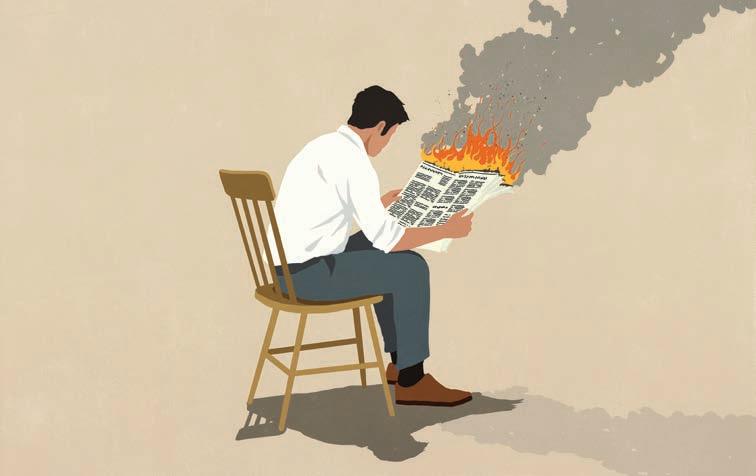
We don’t have to go far to be bombarded with negative, sad, traumatic and disturbing news headlines. International, national and local news and updates are broadcast 24/7 through our screens and devices – it seems into every corner of our lives.
This can trigger a range of reactions in many of us, including anxiety, fear, helplessness and loss of hope.
In our feature this week, Justine Toh writes about ways to cope with the media onslaught and how to change our focus to rediscover good news, positive outcomes and hope.
As the World Day of Social Justice is observed on 20 February, The Salvation Army’s Policy and Advocacy team looks back at 2025 and the work they have done to help change the lives of vulnerable people, local communities, and beyond.
Scan here to connect with The Salvation Army services
Scan here to subscribe to Salvos Magazine
Founders: William and Catherine Booth
Salvation Army World Leaders: General Lyndon and Commissioner Bronwyn
Buckingham
Territorial Leader: Commissioner Miriam Gluyas
Secretary for Communications and Editor-In-Chief: Lieutenant-Colonel Paul Hateley
Publications Manager: Cheryl Tinker Editor: Simone Worthing
Graphic Designer: Ryan Harrison
Enquiry email: publications@salvationarmy.org.au
All other Salvation Army enquiries 13 72 58
Press date: 30 January 2025
Printed and published for The Salvation Army by Commissioner Miriam Gluyas at Focus Print Group, Chester Hill, NSW, Darug Nation lands.
The theme for the day this year is ‘Promoting equality, inclusion, and human rights’. Anthony Castle tackles these themes from a different angle in Faith Talk, exploring the little-known topic of meekness and God’s plan for a better world.
For these stories and more, go to salvosonline.org.au
Simone Worthing Editor
Beyond the bad news
Changing our focus to rediscover hope
by Justine Toh
How do you cope with a 24/7 media cycle of non-stop negative headlines – by avoiding the news entirely or numbing out to mindless reels? We need a better way to cope. As a new year of news begins, Justine Toh writes about honing our attention and lifting our gaze above all the bad news we can see.
I once heard that a journalist, stunned by the horrors they’d witnessed while on assignment as a foreign correspondent, was almost equally shocked to find themselves seeking solace in the strangest of places: a church. Not to pray; that wasn’t their thing. But to sit and take stock in silence – perhaps the most appropriate response when processing history’s bloody body count.
If we’re news junkies, or just extremely online, we’re a little like that traumatised

journalist. A little. More removed from frontline carnage, sure, but subject to a similar onslaught of non-stop bad news: polarisation, the climate crisis, grim domestic violence statistics. The rising cost-of-living, the rise of the far-right, and AI threatening to upend our livelihoods.
What to do with all the angst stirred up by negative headlines? (Check out tinyurl.com/mv6kfdbe)

New perspective
We need a better way to cope than avoiding the news (that’s 40 per cent of us around the world, according to a 2025 Reuters study) or numbing out to mindless reels.
So, as a new year of news begins, I’m counting on spiritual habits to survive the bad headlines of 2026. Not by looking away – I can’t – but by looking better and deeper, which is why I’m asking for new eyes to see. A fragile hope, perhaps. But I’ve a hunch that that shift in perspective will prove transformative. After all, as British psychiatrist Iain McGilchrist writes, “Attention changes the world. How you attend to it changes what it is you find there.”
When I’m in a doomscrolling death spiral, I’m not conscious of how that constant stream of negativity constricts my view of what’s possible and primes me to keep noticing all the terrible things. An online diet high in apocalyptic forecasts and conflict has a way of screening out everything else. Especially a cornerstone of religious belief that doubles as basic common sense: I don’t know the full story, so more might be going on than the bad headlines make immediately apparent.
If I forget that, it starts to seem sensible – as opposed to highly anxious and catastrophic – to war-game the worst that can happen. Anxiety is already the background hum of my life; my smartphone threatens to make it a full-blown addiction.
I’m sensing, increasingly, that a human being is (certainly more, but no less than) a limited amount of attention, and what we pay attention to forms (or deforms) us. But changing our focus is less a matter of mindset than you might think.
Spiritual habits
Rather than counting on willpower to exit the endless scroll on my phone, I need other habits to muscle their way into my life.
A pathetic first step, but one that might be a giant leap for 21st century humankind: rather than a glowing screen, I want the first thing I see in the morning to be another human face, the outside world, or a book of sacred texts. These are the handholds of the immediate reality requiring my attention. Aside from being life-giving in themselves, they decentre my focus from all that I fear and remind me of all there is to love and give myself to, even amid so much sadness and struggle. How other people or the natural world might shift our perspective seems self-evident. But devotional material – prayers, reflections, or Bible verses – adds something unique to the mix, especially texts written in another era.
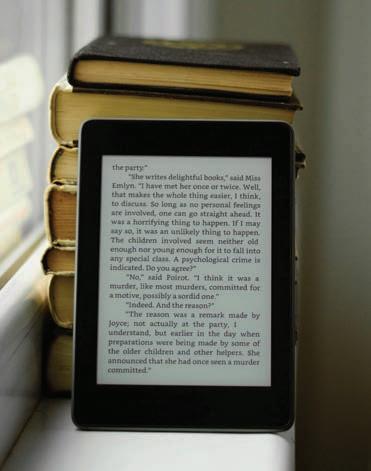
PHOTO BY IRINA RYBCKO ON UNSPLASH
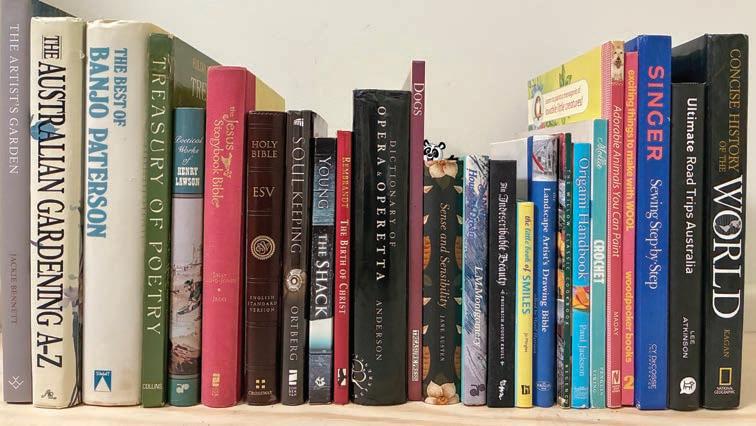
A prayer written by William Wilberforce, for instance, asks God for “more love, more humility, more faith, more hope, more peace and joy”. We remember him as instrumental in the abolition of slavery, but he was also an ordinary person seeking grace upon grace. It’s a welcome reminder that previous generations faced their own seemingly insurmountable struggles but, in Wilberforce’s case at least, placed their hopes in more than human effort to save the day.
In the eyes of the believer, Wilberforce’s story is also a clue that all the havoc that fills our vision might blind us to how God is working for good in hidden ways that might elude human (or headline) notice. That’s why it’s so important to cultivate a fresh way of seeing alongside, and through, all the crisis that surrounds us. One that isn’t blind to harsh realities, but that refuses to be cowed by them.
Scanning for good
Some will say this is just whistling in the dark. Some days it does feel like that. But
showing up with eyes that scan for the good is what counts. It’s a determined, persistent effort to hone our attention, to lift our gaze above all the bad news we can see, and remember that the headlines, though grim, can’t fully capture the complexity of the bigger picture.
J.R.R. Tolkien once said that as a Christian, he was a realist inasmuch as he expected history to be a “long defeat”, though one that contained “some samples or glimpses of final victory”. A perspective that scans for those glimpses: that’s the kind of vision that 2026 calls for.
Justine Toh is Senior Research Fellow at the Centre for Public Christianity. This article first appeared in The Guardian and is reprinted with permission.
Scan here for the full version of this article.
PHOTO COURTESY KAREN MASTERS
Community Connect, Mandurah –a space for everyone
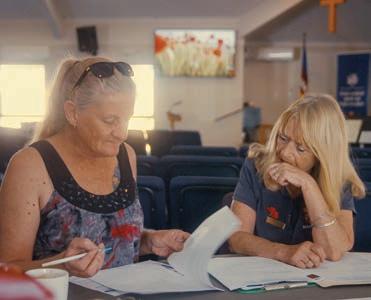
Community Connect is a safe space for people to receive support and assistance.
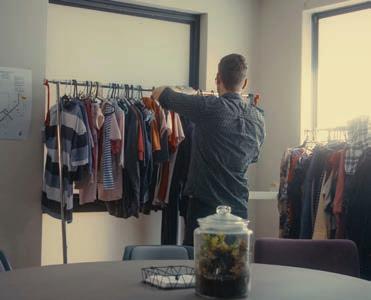
Racks of free clothing are available for people to shop from.
In the seaside town of Mandurah, 45km south of Perth, Salvos Community Connect provides a space for community members to build relationships while receiving the support they need.
Besides accessing food relief, free clothing and showers, community members can chat over breakfast and participate in group activities. “It’s really a place for people to find a place of safety,” said Salvos pastor Major Karina Wood.
Case worker Miriam Batson leads group activities that help people find closer connection and build friendships.
“I do one-to-one case management with individuals that are experiencing difficulties,” said Miriam, “but I also then work on focusing on their strengths [and] developing skills for them to be able to cope with today’s life.
“Homelessness is huge here. Community
Connect has just got busier and busier, and with that, we’ve then looked at increasing the services that we provide here.”
Third space
Ministry worker Drew Castle describes Community Connect as “the community’s ‘third space’. So, it’s not your work and it’s not home. It’s kind of in lieu of your coffee shop.
“It’s about creating a safe environment to create good relationships and positive outcomes for community members.”
Vicki, who volunteers at Community Connect, said, “I look forward to coming to the Salvos to do my bit for volunteering ‘cause I like interacting with the people. I feel special, important. I feel wanted. It’s very rewarding.
“People are lovely, and I love it. I’m grateful for what they’ve done for me, so I just want to give back to them.”
Working for justice
Getting to the heart of local communities
“Working for justice is at the heart of what The Salvation Army does in Australia,” said Jennifer Kirkaldy, General Manager Policy and Advocacy, for The Salvation Army Australia. “It is integral to our ethos, our mission and our vision.”
As nations globally observe World Day of Social Justice on 20 February, the Policy and Advocacy team reflect on their work and achievements through 2025. Focus areas for 2026 and beyond will be published in next week’s Salvos Magazine, 28 February edition.
2025: A year in review
1. The Social Justice Stocktake
Throughout 2024, people across every state and territory were invited to share their experiences of social justice issues in their local communities through a Salvation Army survey. Participants were asked to identify the top five issues they were seeing and living with, to suggest what could be done to address them, and what they wanted decision-makers to understand.
The national results, released through the Stocktake in February 2025, revealed a clear picture of the challenges facing communities.
2. Federal Elections
Throughout the 2025 federal election campaign period, the Policy and Advocacy team aimed to equip communities, candidates, political staffers and community leaders with electorate-specific insights that reflected the real-world concerns of their constituents.
A total of 779 emails were sent to election candidates, each providing tailored reports that highlighted the key social justice issues identified
in their electorates. This proactive outreach generated significant interest, and the team successfully completed 49 meetings with election candidates.
3. Financial Hardship
The team worked with governments and parliaments to highlight and improve the experience of our community members in interacting with governments and government departments.
In March, we worked with the Australian Energy Market Commission (AEMC) to improve the application of concessions to energy bills for eligible consumers. We shared the experience of consumers, as well as how the current system and processes are not intuitive and prevent people in hardship from accessing the support for which they are eligible.
In August, we provided feedback on the administration of the ACT Home Buyer Concession Scheme, which allowed people who were experiencing risks and compounding factors, to pay lower conveyancing duty on buying their home.

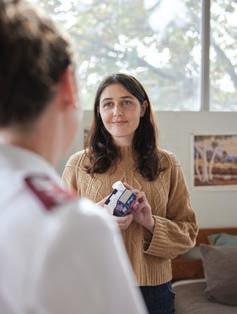
We urged the Revenue Office and the Committee to ensure community members facing debt repayment are properly supported and referred to financial counselling services such as The Salvation Army’s Moneycare.
4. Family and Domestic Violence
The team strengthened The Salvation Army’s position as a leading voice in shaping a high-quality domestic violence system that responds to the needs of the whole family.
Through targeted submissions and direct engagement with key decision-makers, we showcased the proven impact of our Alexis Family Violence Response Model. This contributed to the Victorian Government’s announcement of a $1.5 million investment to extend Alexis to two additional sites.
Following our submission in 2024 to the South Australian Royal Commission into Domestic, Family and Sexual Violence, we were encouraged to see several of our recommendations reflected in the Royal Commission’s final report, released in August 2025.
5. Housing and Homelessness
The team delivered high-quality submissions to Commonwealth, state and territory consultations and inquiries. This ensured that the voices of people experiencing housing stress and homelessness, and the insights of our frontline services, were consistently represented at every level of government.
A significant achievement was the reform of the Territory Planning laws in the ACT.
Nationally, The Salvation Army continued to play a key role in the Everybody’s Home campaign, contributing expertise, amplifying community voices, and advocating to government. We helped secure:
• Commitments to expanding social and affordable housing supply across the country.
• Stronger recognition of housing as a foundational element of family violence prevention.
• Increased federal investment in homelessness services and reforms to rental assistance.
Society at the crossroads
A better way to make the world
by Anthony Castle
“Blessed are the meek, for they shall inherit the earth.”
Matthew chapter 5, verse 5
I find myself on a street corner from time to time. It sits between an op shop and a fast-food joint. It’s not far from the train station, on the wrong side of the tracks, and near a crossroads. To the east sits the prettier suburban sprawl, to the west the factories and warehouses. Traffic pours past. Only some stop there.
I go to donate the overflow of stuff from our house and watch the people come and go; students, migrant families, barefoot
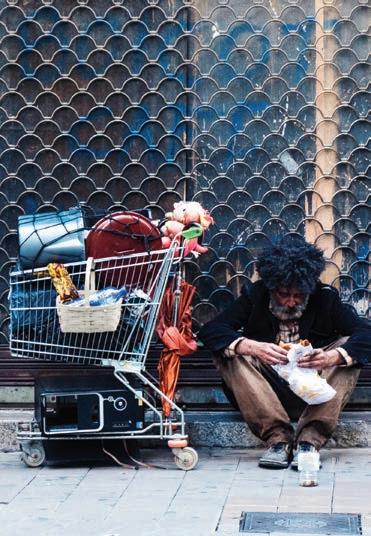
children. Some will come to sit out the front, asking for change. Young couples with prams eat fast food on the kerb.
Most people don’t find themselves here. Not everyone. Certainly not the people who live to the east. The people who come here need things. Cheap things. Things that are quick or feel good.
I notice the things people have; used stuffed toys, burgers in wrappers, a puddle of coins in someone’s lap. I find myself in this strange, ugly place and a phrase comes to mind; the meek will inherit the Earth.
Meekness
I don’t know what to make of meekness. When we speak of someone being meek, we often just mean quiet, or passive perhaps. There’s something about it that seems dissatisfying.
The idea that the meek will inherit the Earth originates in the Sermon on the Mount. Christ declares blessings over the poor, over those who mourn, who are kind, who want justice and peace. Most would consider these traits valuable, but we don’t always see meekness in the same way. The word isn’t used as a compliment.
Scripture speaks of meekness often, attaching its meaning to suffering (Ephesians chapter 4, verse 2; Colossians chapter 3, verse 12), gentleness (1 Corinthians chapter 4, verse 21; 2 Corinthians chapter 10, verse 1; Titus chapter 3, verse 2), or with
compliance (Titus chapter 3, verses 1-2). Some interpret meekness as being easy to control, submissive, even in the face of mistreatment. For many, to be meek is to be weak.
Wealth inequality
It seems strange to think that the quiet and compliant would inherit much of anything today. Wealthier households receive larger inheritances, poorer households receive less, and inequality grows. Wealth inequality has never been worse. Some suggest that inheritance may be the only way to guarantee security or housing in future, creating a class known as ‘inheritocracy’.
We might hear that ‘the meek will inherit the Earth’, but it feels as if the world is already taken, and it isn’t being given to those on that street corner.
I think of the cheap things those people received; burgers, spare change. Those people are on welfare, needing visa permanency, needing secure housing and proper work, some way to raise their kids. In a world where 91 people have become billionaires through inheritance in the last year, being quiet and compliant may not be enough.
Some may say the inheritance Jesus speaks of is an afterlife, or that it will be established by some future divine rule. For an inheritance to be passed down, something must die, after all. It is almost as if some expect the meek to die before having their needs met, and to be quiet about it as they do.
Equity and justice
Some may interpret meek as compliant, but the word is also interchangeable with the poor and afflicted in Scripture (Job chapter

verse 4; Psalm 22, verse 6; Luke chapter 4, verse 18). The word can refer to those living with illness, in poverty, on the margins. God wants equity and justice for the meek (Isaiah chapter 11, verse 4; Psalm 37, verse 11) and we are instructed to defend these people right now (Psalm 82, verse 3).
Society is at a crossroads. Some are inheriting everything while more are finding themselves with little. Perhaps it is this version of the world that needs to die for an inheritance to come, these systems and structures.
I don’t quite know what to make of meekness, but Jesus offers a better way to make the world. That street corner is a reminder of this, those students, workers, migrants, the disabled, those on the poverty line. They should be blessed, with equity, with justice; things they really need.
24,
PHOTO BY NIKOLA JOVANOVIC ON UNSPLASH
Painting the power of community
Nikita’s art captures ‘many colours’ of ongoing Salvo ministry
by Kirralee Nicolle
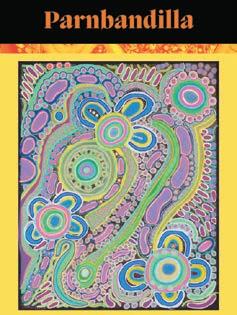
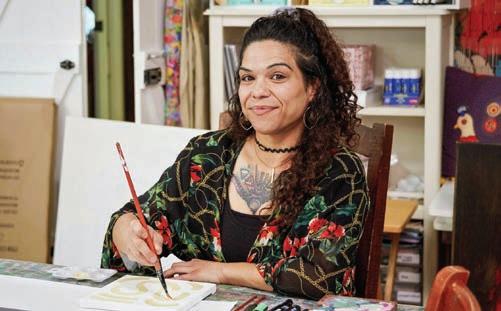
Australian Aboriginal artist Nikita Moore, who lives on Wamba Wamba and Wadi Wadi country in Swan Hill, Victoria, is the creator of the artwork adorning The Salvation Army’s new Emergency Services truck. Nikita titled the artwork ‘Parnbandilla’, or ‘shine in many colours’.
The truck, named ‘Allira’, is set to service the region around Swan Hill.
Nikita is the artist behind Yemurraki Art. Yemurraki (ye-mur-raki) means Dreamtime. Nikita was raised with involvement in The Salvation Army, which she says was an overwhelmingly positive part of her life and that of the local community.
The truck is named in honour of Allira Fry, Aboriginal and Torres Islander Engagement Worker at Swan Hill Corps (Salvos church), who Nikita says has built a great deal of trust and connection in the community since her appointment.
Light in loss
Nikita says the painting was inspired by the care shown by the Salvos towards her and her family in the wake of her father’s recent death. She says Allira, as well as pastor Major Robert Champion and wife Wendy, all supported her family through their grief, even giving the eulogy at her father’s funeral.
She says she wanted to offer a gift as a way of thanking them, and so she
donated some posters of her art to display at the church.
One of these posters was of ‘Parnbandilla’, which she had painted as a way to process her father’s death. With Salvation Army grandparents, the church was a core part of Nikita’s early life. Her nieces and nephews still attend Salvo events, and growing up, Nikita herself attended church meetings, Sunday school and Salvo-run youth activities. Her aunt also worked alongside The Salvation Army as part of the Wamba Wamba Local Aboriginal Land Council (LALC).
“They would collaborate [on] a lot of youth stuff in the Indigenous community,” Nikita says. “It was really lovely. It was a good childhood.”
She says the Salvos and the Wamba Wamba LALC organised swimming days, youth camps and other activities for young people in her community.
Bridging the gap
“When I was growing up, even though it was hard back in the 80s and 90s –boring town, not much to do, still a lot of different stigmas around Indigenous people – [the Salvos ran] activities and they were speaking about the Lord,” she says. “The [painting] I gifted and chose for the truck was to bring back that memory of the community always shining.
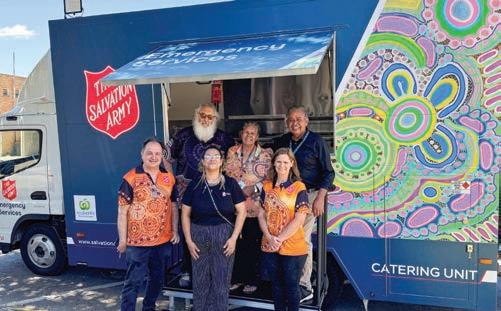
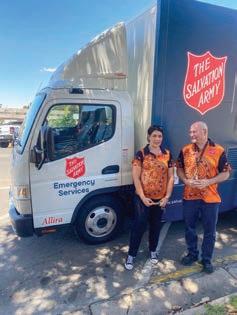
Nikita Moore (front centre) with Uncle Rob Johnson (back left), Aunty Deborah Chaplin (back centre) and Salvos personnel.
The original ‘Parnbandilla’.
Allira Fry with Major Robert Champion, Swan Hill Salvos officer (pastor).
Nikita Moore, Australian Aboriginal artist.
“That was only due to having an Aboriginal worker alongside the Salvos, I believe, because they bridged that gap.”
Nikita says now in the community, lots of people are still facing hard times, and the presence of Allira, Robert and Wendy is bringing the light reflected in ‘Parnbandilla’ to the community. She says she often hears community members refer one another to the Salvos for food assistance or care.
“People are speaking about [them],” she says. “They have done magnificent work to support everyone in need. They do what they can to help and support, even if it’s just a check in or a stop in the street to speak to you. Their hearts are big, and they are a great team.”
Scan the QR code to find more of Nikita’s work.
Lemon cheese dip

Ingredients
200g cream cheese; 1½ tbsp oil; 1 tsp lemon rind, finely grated; 2 tbsp lemon juice; ½ tsp garlic powder; pinch of paprika
Method
Mix together until smooth.
Serve with tortilla chips* and vegetable sticks.
*21 February is Tortilla Chip Day!
☺ Believe in Good: Tips
22 February – Be Humble Day
“Be humble. Be gentle. Be patient. Tolerate one another in an atmosphere thick with love.”
Ephesians chapter 4, verse 2
The Voice translation
Take time this week to appreciate other people and their achievements.

1. What colour is a polar bear’s skin?
2. What colour is a polar bear’s fur?
3. What colour is an adult polar bear’s tongue?
4. Where do polar bears live?
5. How much does a polar bear cub weigh at birth?
6. How much does an adult male polar bear weigh?

On which page of this week’s Salvos Magazine is Tum-Tum hiding?
Did you know?

The story of Cinderella is at least 2000 years old. The story first began as an oral tale, told from person to person, resulting in many variations. In Europe alone there are over 500 variations.
The earliest recorded version dates back to Greece in the 6th Century.
There have been over 40 different films
on the story of Cinderella.
In the 1950 animation, the prince has no name.
✏ Answers
Tum-Tum: hiding behind the books on page 6.
6. 350 – 600 kg
4. Greenland, Norway, Russia, USA, Canada 5. 0.6 kg
3. Dark blue or black
Quiz: 1. Black 2. Their hair is hollow and transparent.
�� Sudoku
Fill in the grid so that every row, every column and every 3x3 box contains the digits 1 to 9. �� Have a laugh
Why was Cinderella terrible at dancing?
She kept losing her shoes.
Why is Peter Pan always flying?
Why does Snow White hate TikTok?
There is a new Beauty and the Beast film starring Cogsworth.
Bible byte
He Neverlands.. She only had 7 followers. It’s about time.
“Learn to do good. Seek justice. Help the oppressed.”
Isaiah chapter 1, verse 17a New Living translation