“You are not here in the world for yourself. You have been sent here for others. The world is waiting for you!”
~ Salvation Army co-founder
Catherine Booth
I nternational Headquarters
101 Queen Victoria Street, London
EC4V 4EH
United Kingdom
Australia Headquarters 95-99 Railway Road, Blackburn VIC 3130
Ph: 13 72 58
New South Wales/Australian Capital Territory Division 261-265 Chalmers Street, Redfern NSW 2016
Ph: (02) 9264 1711
Queensland Division
GPO Box 2210, Brisbane QLD 4001
Ph: (07) 3222 6666
South Australia/Northern Territory Division PO Box 300, Fullarton SA 5063
Ph: (08) 8408 6900
Tasmania Division PO Box 219, Moonah TAS 7009 Ph: (03) 6228 8400
Victoria Division PO Box 220, Mitcham VIC 3132 Ph: (03) 8872 6400
Western Australia Division PO Box 8498, Perth Business Centre WA 6849
Ph: (08) 9260 9500
Our Vision and Mission
Our Vision
Wherever there is hardship or injustice, Salvos will live, love and fight, alongside others, to transform Australia one life at a time with the love of Jesus.
Our Mission
The Salvation Army (TSA) Australia is a Christian movement dedicated to sharing the love of Jesus.
We share the love of Jesus by:
• Caring for people
• Creating faith pathways
• Building healthy communities
• Working for justice
The Salvation Army Foundations – Our Vision and Mission
Click or scan to view a video about TSA’s vision and mission.
Our Values and Commitment to Inclusion and Reconciliation
Values
Recognising that God is already at work in the world we value:
• Integrity
• Respect
• Collaboration
• Compassion
• Diversity
Our Commitment to Inclusion
The Salvation Army Australia acknowledges the Traditional Owners of the land on which we meet and work and pay our respect to Elders past, present and future.
We value and include people of all cultures, languages, abilities, sexual orientations, gender
The Salvation Army Foundations
- Our Values and Commitment to Inclusion
Click or scan to view a video about TSA’s values and commitment to inclusion.
identities, gender expressions and intersex status. We are committed to providing programs that are fully inclusive. We are committed to the safety and wellbeing of people of all ages, particularly children.
As a movement, we believe inclusivity is achieved by treating all people with dignity, compassion and respect. We deliver programs with cultural sensitivity and work with diverse groups to best understand their needs. This includes people of all cultures, languages, capacities, sexual orientations, gender identities and/or expressions.
This year’s National Reconciliation Week theme: Be a Voice for Generations
Colonel Winsome Merrett, Chief Secretary, reiterated The Salvation Army’s ongoing commitment to reconciliation through our Innovate Reconciliation Action Plan. Since its launch in December 2020, the Army has now completed all 89 deliverables of the plan.
National Reconciliation Week 2025: Bridging Now to Next
Click or scan to view the video from Reconciliation Australia.
Message from the Territorial Commander
What an incredible time it was when General Lyndon Buckingham and Commissioner Bronwyn Buckingham visited Australia in August 2024. The Salvation Army’s world leaders toured six states in seven days, taking the theme of ‘Preeminence’ (that in everything Jesus would have pre-eminence). Their messages built strongly on the rallying cry of the Australia Territory – ‘Jesuscentred, Spirit-led, hope revealed’.
This rallying cry has also set a foundational tone for the Australia Territory’s Spiritual Life Committee, Board and management. The desire is that Jesus would be the centre of all that we are and do, that we would be a missional movement that is faithful to him, and that in all that we do and all that we are, he has the pre-eminence.
The Spiritual Life Committee has been working on key projects to shape the strategy we will use to guide us into the future, remaining organisationally faithful and true to who God called us to be.
We believe that we are at our best when people are transformed – body, mind, and soul; when we have services that wrap around the person; when we can take people on a journey of discipleship; and when we cover everything in prayer.
We’re about people discovering life in all its fullness, and we believe this happens best when they undertake the journey with Jesus.
I could share many stories of this kind of transformation: a woman who experienced domestic violence and was supported by two Salvation Army ‘angels’ to achieve full recovery;
a young girl who dropped out of school but later joined one of our schools, found hope and a future, and now sings in a church worship group; and a young man who had lost all hope and was about to take his own life, when one of our officers felt compelled to visit him and saved his life. That’s why we do what we do.
I want to thank each of you for the part you play in being a hope-giver and a hope-bringer. From the person who volunteers to our employees, members, supporters, teams, partners and donors – a huge thank you.
To management, led by the Chief Secretary Colonel Winsome Merrett; to our Board, who are also passionate about the mission and strategic direction; to our Spiritual Life Team, who keep Jesus central; and to all who serve – thank you.
With you, we stride towards an incredible future, bringing life and hope to a world that desperately needs it.
Grateful to you and for you.
Bless you,
Miriam Gluyas (Commissioner) Territorial Commander Chair of the Board
Message from the Chief Secretary
In the early morning of Christmas Day 1974, Cyclone Tracy hit Darwin and in its damaging wake, left fear, sadness, deprivation and uncertainty in the community. As a resident of Darwin at that time, I experienced for myself the resilience of the people of Darwin, and the immediate and desperately needed support of The Salvation Army to that community.
In late 2024, as The Salvation Army commemorated the 50th anniversary of these events, and the lives impacted by them, we recognised that our response at that time was the beginning of a strengthened and more organised approach to assisting those in need, through natural disasters and other events that create fear, insecurity, and both material and spiritual need.
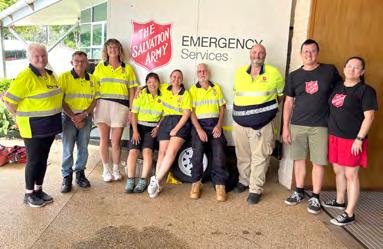
This approach is exemplified in the ongoing work of The Salvation Army Emergency Services, which in 2025 have provided immediate financial and practical assistance in response to natural disasters including major flooding in the New South Wales mid-north and Hunter regions, extensive bushfires in South Australia and Victoria, and Cyclone Alfred in Queensland.
Throughout Australia, Salvation Army workers have provided food, financial support, financial counselling, chaplaincy, and importantly, friendship and community to thousands of people. They have provided aged care, employment services, funerals and support to victims of domestic violence and members of our defence forces. Together, through our holistic approach to those we support and assist, we are helping to bring about spiritual and social transformation to individuals and families throughout our land.
I am grateful to those who so willingly perform these acts of service, as well as to those who support the work of The Salvation Army in order to make this possible. I would like to thank the Territorial Commander, Chair of the Board, Commissioner Miriam Gluyas, and the Board
members whose support and advice has been crucial to our thinking and operations.
To our management team, I give my sincere thanks for your hard work and support. Also to our officers, employees and volunteers: our organisation depends on your loyal service and we are grateful for you.
To those government departments who see our work and collaborate in enabling it, and to our wonderful donors who continue to recognise the worth of our mission and generously support it: without you, we would be unable to pursue our vision of transforming Australia, one life at a time, with the love of Jesus. We are so grateful to you each.
Finally, I want to reaffirm our commitment to reconciliation through our Stretch RAP (Reconciliation Action Plan), which expands on our initial RAP plan to guide our ongoing engagement with Aboriginal and Torres Strait Islander people as we develop and implement new and continuous reconciliation initiatives.
This will be my last Annual Report as Chief Secretary of The Salvation Army Australia Territory. I want to acknowledge and welcome my successor, Colonel John Chamness, and again express my deep appreciation to our personnel and supporters who have regularly inspired and encouraged me with their passion and commitment to our mission and to those we serve.
God bless you,
Winsome Merrett (Colonel) B.Sp.Thy., MA Arts (Theological studies) A.Mus.A Chief Secretary Chair of the Executive Mission Council Australia Territory
Our Governance
2024-25 Territory Board
The Board is responsible for providing governance oversight to the Australia Territory in accordance with Australian law, all requirements under International Headquarters’ Orders and Regulations, and the principles of theology, mission, integrity and compliance.
The Board is also responsible for strategically positioning the Australia Territory so that it has a sustainable, major influence on Australian society, and to provide advice and assistance to the Trustees.
The Board is chaired by the Territorial Commander and is accountable to the General for its responsibilities.
Board membership for the period 1 July 2024 to 30 June 2025 is as listed:
• Commissioner Miriam Gluyas, Chair
• Major Kevin Lumb, Alternate Chair
• Mr Richard Grellman AM, Lead Independent
• Mr Greg Couttas, Chair, Audit and Risk Committee
• Ms Desley Hargreaves PSM, Chair, Quality and Safety Committee
• Ms Felicity Natoli, Chair, Professional Standards Committee
• Mr Adrian Appo OAM
• Dr Ian Brown
• Colonel Winsome Merrett
• Captain Colin Reynolds
• Captain Leisa Humbley
• Auxiliary-Lieutenant Rosy Keane
Board visits
In August 2024, the Board travelled to the South Australia Division to visit different expressions of The Salvation Army. In April 2025, the Board visited the Victoria Division.
Ms Desley Hargreaves PSM (Chair, Quality and Safety Committee)
Ms Felicity Natoli (Chair, Professional Standards Committee)
Mr Adrian Appo OAM
Colonel Winsome Merrett
Captain Colin Reynolds
Board Committees
Audit and Risk Committee
The purpose of this committee is to ensure the integrity of the financial statements, the risk management framework and the system of internal controls, such that these align with The Salvation Army’s values and meet its legislative and regulatory obligations.
Nominations Committee
The purpose of this committee is to fairly and objectively identify and nominate suitably qualified candidates for appointment to the Board.
Professional Standards Committee
The purpose of this committee is to define and promote within The Salvation Army a world’s bestpractice response to allegations of abuse and ensure The Salvation Army is actively enhancing child safety within the Australian community.
Quality and Safety Committee
The purpose of this committee is to define and promote a culture of continuous quality improvement and consumer safety that aligns with The Salvation Army’s values and meets its legislative and regulatory obligations.
Remuneration Committee
The purpose of this committee is to assist and advise the Board on matters relating to remuneration for employees in senior roles as described in the Committee’s Terms of Reference.
Spiritual Life Committee
The purpose of this committee is to improve the depth and breadth of the spiritual life of The Salvation Army in Australia; and to guide the movement so that it operates in accordance with its God-given mission – ‘Share the love of Jesus by caring for people, creating faith pathways, building healthy communities and working for justice.’
The Under-35 Board Participant Program
In April 2021, the Board approved the concept of an Under-35 Board Participant Program. This initiative ensures that the under-35 cohort of Salvationists is able to participate in the governance of The Salvation Army in Australia.
Dr Britta Lacey, a General Practitioner based in Brisbane and a senior soldier at the North Brisbane Corps, was appointed to the Board in August 2024 as part of the Under-35 Board Participant Program.
As participating observers, the Under-35 Board Participants attend all Board meetings with full access to the information being considered at each meeting and any additional communications provided to the Board. This position does not carry a Board vote. However, full participation in all Board discussions is encouraged.
Dr Britta Lacey
The Salvation Army Australia Highlights
2024 - 25
Nearly 1.75M sessions of care provided
228,500+ people assisted ACROSS ALL OUR SOCIAL PROGRAMS
22,600+ people supported through chaplaincy
11% increase in number of church attendances compared to last year
EMERGENCY RELIEF & COMMUNITY SERVICES
$18.3M+ of financial assistance provided
136,700 people assisted
1.05M+ nights of accommodation were provided across all our social programs
$24.1M+ of financial assistance provided in cash, gift cards, vouchers, bill payment and disaster relief
548,000+ of church attendances on Sundays and weekdays
266,000+ meals provided by corps (church/faith communities)
52,000+ people received food parcels
29,000+ people received material aid
MONEYCARE
Nearly 11,000 people provided financial counselling
FAMILY & DOMESTIC VIOLENCE
12,600+ people supported who experienced family violence
YOUTH
59,500+ bed nights provided to young people at risk of, or experienced homelessness
Nearly 1050 young people assisted with learning how to drive
HOMELESSNESS
38,000+ people assisted who were homeless or at risk of homelessness
1.4M+ meals provided to people who accessed homelessness services
EPLUS
More than 42,000 job seekers assisted to look for employment
10,300+ job seekers gained employment
AGED CARE
More than 157,700 visits to people who received in-home care
ADDICTION
More than 220,000 sessions of care provided to people impacted by addiction
SALVOS STORES
52M items kept in circulation and out of landfill
EMERGENCY SERVICES
650 responses to disasters such as fires, floods or power outages.
46% increase in the number of volunteers
SALVOS FUNERALS
600 families served with ‘at-need’ funeral services
The Salvation Army Australia Territory
6223
9657
649
2102
2868
Living our mission
Across all expressions of The Salvation Army in Australia, from our corps and faith communities to our social programs, community services and mission enterprises, we are united in sharing the love of Jesus by:
• Caring for people
• Creating faith pathways
• Building healthy communities
• Working for justice
This is our Mission, and it shapes everything we do. The examples shared here offer a glimpse into how these four elements are brought to life in local communities. While each story may highlight a specific aspect, every expression of The Salvation Army incorporates all parts of our Mission.
Caring for people
Supporting those experiencing hardship, through practical assistance and providing a listening ear, we create space for hope and positive change.
Social Mission | Aged Care | Salvos Funerals
Caring for people: Social Mission
The Salvation Army’s Social Mission programs are committed to delivering inclusive, high-quality social services that reflect the love of Jesus. Through this care, we aim to walk alongside individuals as they embrace transformation and build hope for a brighter future.
Our Social Mission work focuses on four key areas of need:
• Reducing the harm caused by alcohol and other drugs
• Addressing homelessness
• Supporting those impacted by family and domestic violence
• Empowering and supporting young people
12,600+ people supported who experienced family and domestic violence
Nearly 116,500 of sessions of care provided to people experiencing family and domestic violence
FAMILY AND DOMESTIC VIOLENCE
Award-winning Alexis Model leading family violence prevention
In 2024, The Salvation Army’s Alexis Family Violence Response Model, delivered in partnership with Victoria Police, won a national Silver Award at the Australian Crime and Violence Prevention Awards. Supporting around 160 victim-survivors and 160 perpetrators each year, Alexis embeds specialist practitioners in police stations to provide early, coordinated and trauma-informed responses. Independent research shows an 85 per cent reduction in family violence recidivism for clients, demonstrating the model’s effectiveness in keeping families safe and building trust between victim-survivors and police. Click or scan to read
Seeing change in Helensburgh, NSW
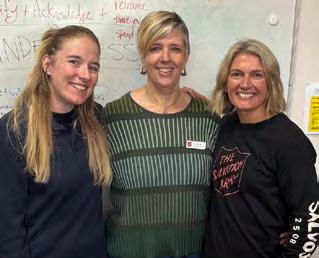
In the small town of Helensburgh (NSW), lives are being transformed through the See Change program. See Change is a six-week course developed by The Salvation Army and the University of Wollongong to help people navigate personal and family challenges. Since 2022, Helensburgh’s 2508 Salvos have run five courses, creating a safe space where participants can be “totally authentic and vulnerable,” says Mission Leader Lauren Martin.
“We’ve had people come through who struggle with anger, chronic health issues, or unhealthy coping mechanisms,” she shares. “But what we see most often is what I call a ‘self-worth deficit’. If we can help people truly see their value, powerful change starts to happen.”
Every participant has reported an increase in self-worth, with one woman saying the course “probably saved my life”. In 2025, the program expanded with the Family Empowerment Program, offering 12 months of mentorship and support to help families build a better future, even in the face of ongoing challenges. “It’s about holistic support for as long as it’s needed,” Lauren says. “We want to see individuals and families in 2508 thrive.”
125,200+ nights provided for refuge or emergency accommodation due to family and domestic violence
more about how the Alexis team helped Sarah* build trust in the police and open up about her experience.
h stock photo
h Family Empowerment facilitators Zoe Lang (2508 Salvos), Lisa Clancy (First Floor Program) and Lauren Martin (2508 Salvos).
HOMELESSNESS
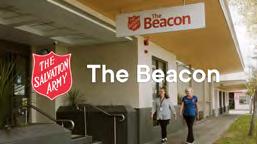
The Beacon Homelessness Centre in Perth
The Beacon stands as a lighthouse of hope for people experiencing homelessness. As The Salvation Army’s largest homelessness facility in Australia, they are committed to offering more than just a bed but a pathway forward.
Through case management, crisis intervention, allied health services and personal development programs, The Beacon helps individuals leave stronger and more capable than when they arrived. It’s a place where dignity is restored and futures are rebuilt.
“We want people to walk out with more than they came in with – more confidence, more support and more hope,” says a team member. At The Beacon, every person is seen, supported and reminded that change is possible.
Salvos partner with ABC to keep Tasmanians rugged up over winter
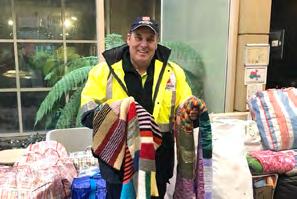
Each winter, The Salvation Army teams up with ABC Hobart to deliver warmth and care through the Rug Up Tassie blanket drive. With a goal of 500 hand-knitted blankets, Tasmanians from all walks of life contribute 20cm squares, some just one, others entire blankets, to wrap those doing it tough in comfort and community.
“It’s freezing in Tasmania (over winter), so there’s a practical element,” says Amelia Natoli, The Salvation Army’s External Communications Manager. “But it’s also a message: ‘You mean a lot to someone. You are worth hours of their time.’”
Click or scan to view the video from this story.
Nearly 357,000 sessions of care provided
to people who were at risk of or experiencing homelessness
Nearly 702,900 crises’ beds provided to people who experienced homelessness
Blankets are thoughtfully matched to recipients, with frontline workers selecting colours and patterns that reflect personal stories, even favourite footy teams. For those rebuilding after family violence or hardship, these blankets offer more than warmth; they offer hope.
ABC Hobart Manager Samantha Stayner calls the drive “a beautiful expression of what a community can do,” and praises the Salvos’ presence across Tasmania: “It’s literally a beautiful, warm and fuzzy feeling.”
h Amelia Natoli (right) with TSA Tasmanian Schools Engagement Program Leader Ashleigh Cowell and blankets from the drive.
h Michael West, Salvation Army Emergency Services Response Coordinator for Tasmania, with Rug Up Tassie blankets.
YOUTH SERVICES
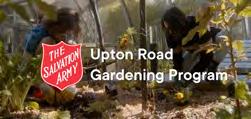
Gardening transforming young lives at Upton Road
One of the many goals of The Salvation Army Youth Services Upton Road program (Vic.) is to provide a beautiful space and lowpressure environment for young people to thrive. The refuge offers gardening activities that allow participants who have experienced homelessness to learn new skills, build confidence and connect with the community. The program not only enhances their wellbeing but also supports them in achieving sustainable housing and a brighter future.
Click or scan to view the video from this story.
ALCOHOL AND OTHER DRUGS
Faith, love and second chances
Eric’s story is one of survival, surrender and slow rebuilding. Removed from a family marked by addiction and violence, Eric was adopted into a loving home, but the trauma lingered. Addiction followed him into adulthood, leading to crime, broken relationships and years of trying to quit substances that kept pulling him back.
“I hit many rock-bottom points before the heart attack,” Eric says. “As people say in recovery groups, you hit rock bottom then you find a trapdoor and keep going.”
Minutes from death, wheeled into emergency surgery, Eric prayed his first real prayer. “Please, Lord, if you save me, I will change my life.” That moment marked a turning point. Recovery wasn’t instant, but it was real. Through support groups, volunteering and eventually employment with The
Perth partnership having an impact
In Armadale (WA), a new partnership between The Salvation Army and alternative education provider Alta-1 is changing lives. With shared visions of transformation “one life at a time”, this collaboration brings together vocational training, mental health support, and hands-on experience in places like the Garden of Hope.
Young people are learning barista skills, horticulture, and hospitality but more importantly, they’re finding purpose and connection.
“There’s a lot of material aid available,” says Major Nikki Curtis, “but how can we make a significant difference to families? Maybe it’s one family at a time and that will be systemic change.”
From coffee vans to aged care partnerships, this hub is becoming a model for how community, education and mission can work together to create generational impact.
Nearly 4800+ young Australians supported
Salvation Army, Eric found purpose and community.
Today, he helps serve hundreds of meals each week, mentors others and openly shares his story. “Every morning, I thank God for granting me another day,” he says. “I want others to know God and to realise that God really can change lives for good.”
Assisted 11,700+ people with addiction to alcohol, other drugs, or gambling at rehabilitation services
h Eric is soon to be married and now works for The Salvation Army.
Caring for people:
Aged Care *
The Salvation Army Aged Care’s approach to delivering holistic services to older Australians across the country includes the strategic aspiration of increasingly supporting older people who are the most vulnerable to more closely align with The Salvation Army’s Mission and Vision. This work continues in the context of the new Aged Care Act 2024 (Cth), which regulates aged care services funded by the Commonwealth Government.
Successes for Salvos Home Care
Salvos Home Care successfully won a tender to extend the ACT Health contract to operate Burrangiri Aged Care Respite Centre in Rivett for another two years, to provide much-needed care and support to both day and overnight respite clients and their carers. The Salvos Home Care team also started offering in-home care services in South Australia.
In addition to supporting older Australians though its Commonwealth Home Support funded Allied Health clinic in Modbury, Salvos Healthlink.
The New South Wales Home Care service successfully underwent an accreditation audit by the Aged Care Quality and Safety Commission, with no areas of concern identified. The audit covered all NSW locations – Port Macquarie, Central Coast and metropolitan Sydney.
2500+ people cared for in residential aged care facilities
nearly 1825 people received in-home care
280 low cost units provided to elderly Australians in need
Salvos Home Care’s in-home care services continue to operate in Queensland, Victoria, Tasmania and the Australian Capital Territory, serving approximately 1800 people. In addition, the National Disability Insurance Scheme (NDIS) services, supported by Salvos Home Care, provided 19,647 visits to support clients across the country, most of whom live in one of The Salvation Army Aged Care’s residential aged care centres. With 58 participants receiving such a high volume of oneon-one support, this reflects a strong commitment to helping participants feel connected with their communities, supported and cared for.
A life transformed
Brian, a resident of Gill Waminda Aged Care Centre in Goulburn (NSW), has continued to develop his confidence and skills with the support of his NDIS Support Workers. “Life before I came in here was a mess,” he says. “It was my own fault to let it get that way, but it got that far, and I couldn’t do anything about it.” Today, five years since he first arrived at the centre, his NDIS Support Worker, Amy, proudly reflects on Brian’s transformation. “Brian has been fully rehabilitated in the five years he’s been here,” she says. “He is very proud of the man he is today.”
Inspiring lives
Kate, a Care Manager at Macquarie Lodge Aged Care Centre in Arncliffe (NSW), began her Salvation Army journey when she was 21 years old. Last year, she celebrated 10 years of work and, throughout her time, has progressed in her role, first starting as a Care Service Employee in 2013 before becoming a Registered Nurse in 2017 and the Clinical Coordinator in 2019. She has been the Care Manager since 2021.
Click or scan to read more on Brian’s story.
Reviewing and revitalising Residential Services
While The Salvation Army divested two of its residential aged care centres in Central West NSW, and one co-located retirement village, it continues to support NDIS participants in this region to ensure continuity of care.
The Salvation Army Aged Care was also successful in its application for two Federal Australian Government Aged Care Capital Assistance Program capital grants under the specialist homeless scheme.
Montrose Aged Care Centre, a specialised 44-bed centre catering to vulnerable men in Balmain, in inner Sydney, was awarded $1,580,191 and James Barker House Aged Care Centre a centre supporting vulnerable older Australians in Footscray, Melbourne’s west, was awarded $5,025,001. Both centres will undertake capital works to revitalise resident rooms and wings.
The number of people served through The Salvation Army’s nineteen Aged Care centres was 2544. These residents, and Salvos Home Care participants, were supported by 2468 of staff members, with a 6.4 per cent increase in the number of people joining the team over the last financial year.
“What I find most rewarding working in the aged care industry is the deep connection I form with residents and their loved ones, right from the moment they arrive at the centre,” she says. “I pay close attention to their likes, dislikes and what gives meaning to their lives. As I build these relationships, I am there for them during their most vulnerable moments, offering them comfort and reassurance.”
Supporting the Salvos
Click or scan to read more on Kate’s story.
The Salvation Army Aged Care’s retirement villages, located in Queensland and New South Wales, consist of 364 individual apartments supporting older Australians to live life at their own pace and on their own terms. Of these, there are 280 low-cost units nationally. Residents of Collaroy’s Warringah Place Retirement Village (NSW), supported a Red Shield Appeal promotional event at Salvos Ambassador Jamie Durie’s house, with live weather crosses on Weekend Sunrise The residents reported having a great morning to support this important Salvos event.
* The Salvation Army’s Mission Enterprises deliver Mission and use commerce to generate surpluses for other Salvation Army mission expressions or to maximise enterprise sustainability and impact. These enterprises include: Aged Care, Employment Plus, Salvos Stores, Salvos Funerals, Salvation Army Housing.
Caring for people: Salvos Funerals *
2024-25 Salvos Funerals highlights:
Served 600 families with ‘at-need’ funeral services 5 site locations throughout Australia
Extending hope and honour across generations
In 2025, Salvos Funerals continued its mission of compassion, dignity and affordability, serving approximately 600 families with at-need funeral services. Since launching in Sydney in March 2017, we have now supported over 4000 families, offering solace and practical help during life’s most difficult moments.
This year marked a significant milestone with our successful expansion into South East Queensland, where we began offering affordable cremation services from late February 2025. This strategic move allows us to reach more Australians in need, particularly those facing financial hardship and reinforces our commitment to national accessibility.
We continue to build trust through our prepaid funeral services, now holding over $2.5 million in contracts in trust. These figures reflect not just financial growth, but the deepening impact of our work in communities across the country.
Salvos Funerals remains a vital expression of The Salvation Army’s mission - bringing dignity, hope and care to every farewell. As we grow and evolve, we carry forward the legacy of those who came before us, ensuring that every life is honoured with respect and love.
Legacy of compassion: The Harris family
One of the most moving moments this year came through our service to the Harris family, who entrusted Salvos Funerals with the farewell of their beloved patriarch.
During the arrangement, the family shared a poignant memory: the father of the deceased often spoke of the Salvos chaplains who would appear in the trenches during the darkest nights, when he served on the frontline as an infantryman on the North African front in World War Two, bringing hot cocoa, snacks and a spirit of hope. These simple acts of kindness left a lasting impression, lifting spirits in times of fear and uncertainty, and as cherished stories passed down to future generations.
That legacy endured. The Harris family became generous long-time supporters of The Salvation Army, and when they learned about Salvos Funerals, they knew it was the right choice. Their story is a powerful reminder of how acts of compassion ripple across generations, and how the work of The Salvation Army continues to honour the past while serving the present.
* The Salvation Army’s Mission Enterprises deliver Mission and use commerce to generate surpluses for other Salvation Army mission expressions or to maximise enterprise sustainability and impact. These enterprises include: Aged Care, Employment Plus, Salvos Stores, Salvos Funerals, Salvation Army Housing.
Creating Faith Pathways
We joyfully share the message of Jesus and are committed to growing together in faith as a community.
Anyone seeking connection, affirmation and a sense of belonging will always be welcome at The Salvation Army.
Faith Communities | Local Mission Delivery | Mission Support | Reconciliation Action Plan
Creating Faith Pathways:
Faith Communities
Movement Renewal Initiative – finding a way in the fiery chaos
The Salvation Army is investing in the future health of its faith communities through the Movement Renewal Initiative (MRI).
Participants in the first 2024 cohort said the training shifted ingrained mindsets and provided a framework for fresh mission and ministry, with a central focus on growing God’s Kingdom.
Nearly 39,000 women’s ministries group and activities attendances 5% increase from 2023-24
2300+ parent and toddler group activities attendances
“There’s hope rising again for our corps and for the movement to flourish. I’m learning that some of what I’ve learnt I need to unlearn to embrace what God is revealing,” said Major Pete Brookshaw from Morley Corps (WA).
Delivered by the Movement Leaders Collective, including Alan Hirsch and Rich Robinson, MRI brought faith expression leaders together from across Australia for fortnightly online training with a view to gaining a deeper understanding of how to birth a Jesus movement, how to develop culture, and how to implement key ideas and practices to release movement potential and multiply.
Major Dianne Jarvey, Secretary for Faith Communities Development, stated that the primary goal of the training is to revitalise The Salvation Army through local mission and systemic change. “MRI is more than a course, it’s an opportunity for the entire organisation to seek Jesus and rediscover fresh, innovative ways to engage with our mission, renew our purpose and inspire lasting impact across every level.”
Major John Viles, from Tweed Heads Corps (NSW), said “MRI reminds frontline ministry that change toward God’s preferred future for the Army is not just possible ... but actually within their grasp.”
He said the key for Salvation Army leaders undertaking the initiative is to intentionally set aside time to seek and pray for God’s direction and act on it.
Captain Paul Trotter, from Hobsons Bay Corps (Vic.), said, “I keep hearing you have permission to do something new ... but the ‘what’ and ‘how’ are often missing. MRI has given me a framework to do the new and explore, and I am seeing results.” Paul said he’s now using the MRI principles and through discipleship studies exploring and discovering where God is already at work.
The 2025 Movement Renewal Initiative cohort included a diverse group of individuals, including those from social programs, Salvos and Family Stores, chaplains, corps leaders, lay leaders, ministry workers, employees and Area Officers.
“We gathered as a united community to dive into discussions about our mission and explore how we can work together more effectively. It was a fantastic opportunity to connect and collaborate!” said Dianne.
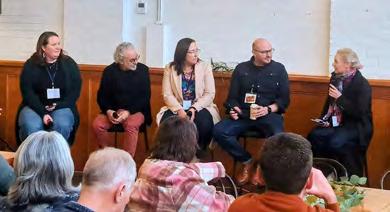
h Dianne Jarvey (right) speaks to the panel during the MRI Conference (from left) Narelle Unicomb, Alan Hirsch, Bree Mills and Rich Robinson.
No one paddles alone – building hope and community on the water
“Paddlers Against Poverty is a ‘Community of Hope’ (an open, inclusive group) based around kayaking and standup paddle-boarding and being on the water,” said Major Joel Clifford, who leads the group in Hobart, Tasmania.
The paddlers meet for a monthly paddle, canoe or kayak together, often followed by afternoon tea. The event is a place for connection and support within the community.
“Paddle-boarding is a passion of mine,” shares Joel. “I really love it. And I’m like, what if I use that and turn that into something that other people could join with, and we could create a community based on that, on the water? It could be a place where people could [also] find a place to give back, service, find faith and develop their faith, that doesn’t look like church on a Sunday morning.”
Breaking down walls
For group member Dee, the whole paddleboarding journey has been transformational. “Everybody has been so welcoming,” she said, “and also really accepting of where I’m at.”
Find your place at Katherine Corps
In Katherine (NT), The Salvation Army is offering more than just services; it’s offering a place to belong. The Katherine Corps operates as a vibrant community hub, providing showers, toilets, case management and creative activities like weaving and boomerang making. For those navigating addiction, homelessness, or hardship, it’s a space where dignity is restored and healing begins.
Recognised as an A-grade service, the centre meets critical needs with compassion and cultural sensitivity. Whether someone is accessing support or simply sharing a cuppa, the message is clear: you are welcome here and you are not alone.
Click or scan to view the video from this story.
Joel has seen the positive impact of the group on its members. “It has been really amazing to see how God has moved in and through our group,” he said. “Slowly [people’s] walls have been broken down just because they have somebody to talk to, people who validate their feelings, people who care about them, people who show the practical love of God to them no matter what.
For Joel, and for Paddlers Against Poverty, “creating faith pathways and creating community and caring for people is really important for us.
“We have this pathway where people can come and find a sense of belonging, and then as we go paddling, we encourage people to look and see where God is at work around them.
“Being out in a place like this is just an incredible opportunity to see God in a different way.”
Click or scan to view the video from this story.
Creating Faith Pathways: Local Mission
Delivery
Coffeetunity – hospitality training in southern Tasmania
Coffeetunity began three years ago when The Salvation Army received an unused coffee trailer. Captains Jess Ffrost-Boyd and Craig Boyd turned it into a free oneon-one barista training program, offering volunteer work experience to help participants build skills, confidence and stronger resumes.
Partnering with Business Employment Southeast TAS (BEST), the program provides wraparound support including career coaching, resume help, and interview prep, allowing participants to leave with more than just a certificate.
After being invited by Sorell Council to operate at the local basketball stadium, Coffeetunity expanded into food service, giving trainees experience in cooking,
More than 153,700 sessions of care
Nearly 48,000 people with food parcels
Click or scan to view the video from this story.
prep and kitchen operations. As a result it seems young people are gaining confidence, discovering their value, and stepping into new opportunities.
Rockingham car ministry putting the rev back into people’s lives
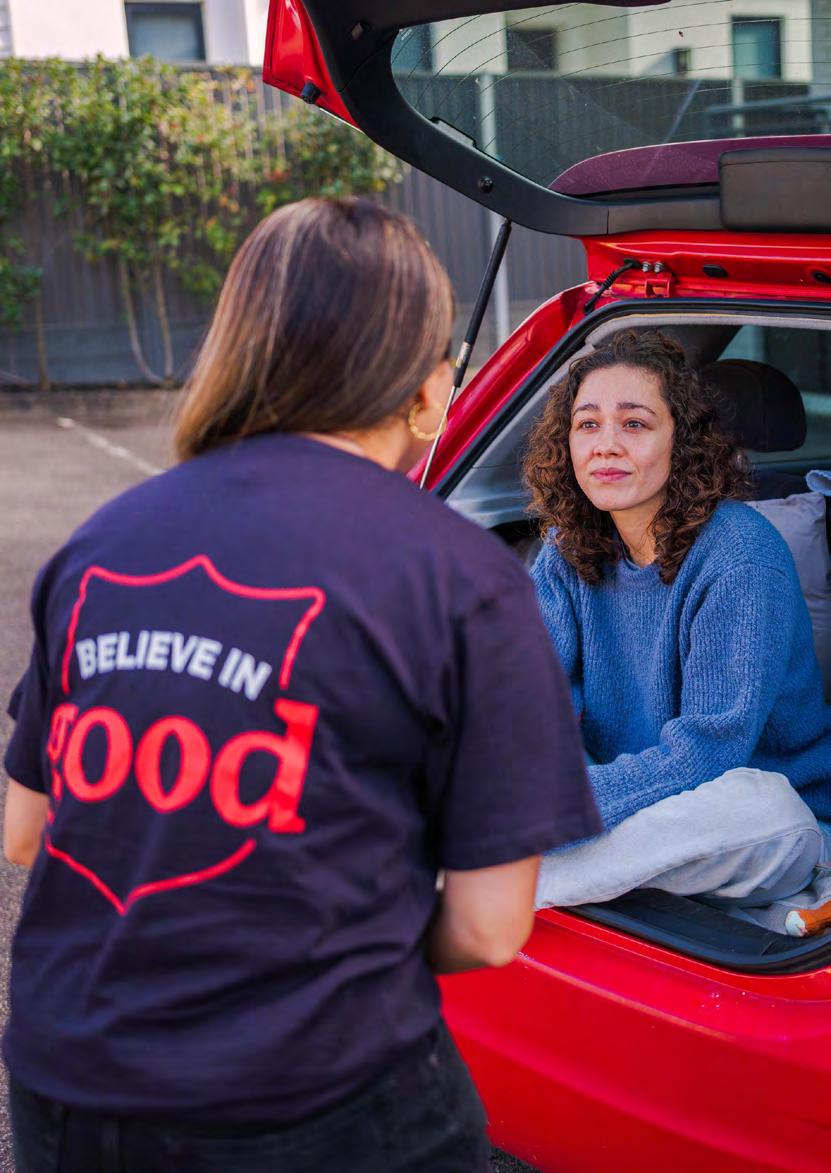
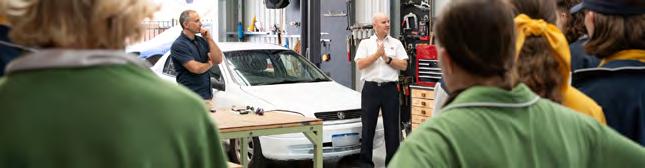
In Rockingham (WA), The Salvation Army is helping people rebuild their lives through a unique partnership with South Coast Baptist College’s Rev Shed mentoring program. Donated second-hand cars are repaired by students and then gifted to individuals and families who need reliable transport. The program gives students hands-on experience while offering practical support to those facing financial hardship, housing instability or barriers to employment. Captain Darrell Wilson recalls gifting
a restored car to a single mother whose vehicle had broken down, leaving her unable to get her children to school or appointments. “She was really grateful,” he says.
The initiative is supported through the Centre of Hope, Rockingham’s drop-in centre offering wraparound services and referrals. Relaunched after COVID-19, the program continues to grow despite rising costs and demand for second-hand vehicles.
As Darrell puts it, “A car isn’t a house, but it can be somewhere safe, a way to get around, a way to get back into work. It can be the start of something.”
h Captain Darrell Wilson speaking at the Rev Shed at the ‘key handover’ of a repaired vehicle that was donated to a community member.
Creating Faith Pathways:
Mission Support
260 corps (churches/ faith communities) run community support activities
Mornington Salvos get into the groove with disco for NDIS participants
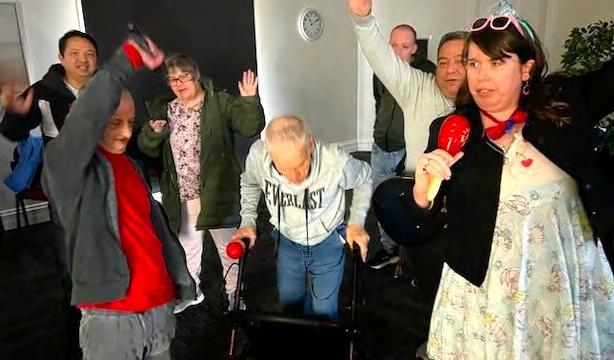
At Mornington Salvos (Vic.), the VAMP Music Disco is more than just a weekly dance party, it’s a space where people of varied abilities are free to express themselves, connect and feel joy. Created by Dave Parker, a former music teacher and wellbeing coordinator, VAMP blends interactive percussion, singing, dancing and DJ-led music into a sensoryrich experience for NDIS participants.
But behind the music is something deeper. “As a person of faith,” Dave says, “I try to create some experience for people who are normally excluded that resembles or could simulate what it might be like to be in the presence of the kingdom of God.”
From tambourines to Djembe drums, from Abba to Ghostbusters music, participants bring their song requests, their energy, and their whole selves. It’s a place where everyone is welcome, where no one is left out, and where the joy of music is shared in every beat.
h The VAMP team – Mornington Corps Officer Major Debbie Taylor, DJ David Williamson and Dave Parker, Community Music Activities Coordinator.
h Artwork artists: Sue Hodges, Glenn Westwood, James Algeo
Creating Faith Pathways: Reconciliation
Action Plan
Stretch RAP launch marks ‘courageous and essential’ progress towards reconciliation
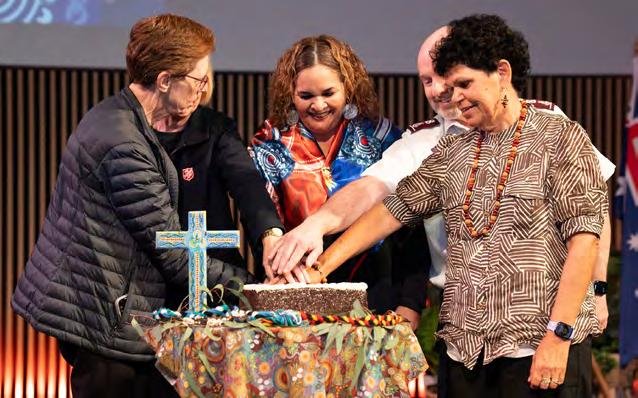
In June 2025, The Salvation Army launched its Stretch Reconciliation Action Plan (RAP), marking a significant step forward in its reconciliation journey. Joining only a small number of nonprofits at this advanced stage, the Stretch RAP embeds reconciliation initiatives into core business practices with six key commitments including Truth-Telling, Cultural Safety and Social Justice Advocacy. Reconciliation Australia praised the Army’s truth-telling as “courageous and essential,” positioning the organisation as a leader in driving meaningful change alongside First Nations peoples.
View the Reconciliation Action Plan 2025 Artwork Animation on YouTube.
h The cutting of the cake ceremony at the Stretch RAP launch.
Building Healthy Communities
Building meaningful connections that foster growth allows us to experience the unity of being part of a community aligned with God’s purpose.
Community Engagement | Salvation Army Emergency Services | Salvos Stores | Employment Plus
Building Healthy Communities: Community Engagement
The Salvation Army is committed to building thriving communities for the future through its community engagement services. Across Australia, we offer a wide range of initiatives and programs that provide practical help, emotional care and spiritual support – transforming lives and strengthening communities.
Through the Community Engagement department, we support mission expressions and local communities via Chaplaincy, Salvation Army Emergency Services, Red Shield Defence Services, and Community Services. Community Services includes programs such as Moneycare, national corps-based social initiatives, and Doorways.
DOORWAYS EMERGENCY RELIEF
Opening the door to better holistic care for a community in need
Asking for help isn’t easy. For many who walk through the doors of a Salvation Army centre, it takes immense courage to admit they’re struggling –whether with addiction, financial hardship or simply trying to get through the day. That’s why Doorways exists: to offer emergency relief and holistic case management with dignity, compassion and respect.
In 2022, a national model was introduced to strengthen Doorways’ reach and consistency. A recent evaluation, led by Research Analyst Belinda Hendrickson, involved site visits to 22 locations and conversations with over 70 individuals, including people with disabilities, First Nations community members, refugees and those facing complex challenges.
“We saw how much strength it takes to ask for help,” Belinda says. “And how connection through
COMMUNITY SERVICES
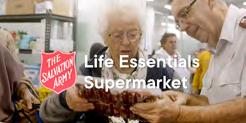
Dignity in shopping – Salvos Life Essentials Supermarket at St Marys
In the midst of a cost-of-living crisis, access to basic essentials can be the difference between surviving and slipping further into hardship. At St Marys Corps (NSW), the Life Essentials Supermarket is offering more than just groceries, it’s restoring dignity and choice to individuals and families doing it tough.
With shelves stocked with fresh produce, meat, toiletries and household items, the supermarket is designed to feel like a regular shopping experience, not a handout. For many, especially those navigating addiction recovery or financial instability, this kind of
RED SHIELD DEFENCE SERVICES
Standing with veterans
Across Australia, The Salvation Army continues to walk alongside veterans facing homelessness, mental health challenges, and the complex transition to civilian life.
Guided by the Royal Commission into Defence and Veteran Suicide, we’re strengthening partnerships, enhancing chaplain training and adapting programs to better support those who have served our nation.
programs, case management, or simply being seen can change someone’s outlook and wellbeing.”
The evaluation revealed that when corps and Doorways teams collaborate effectively, the impact is transformative. People feel less alone, more confident and better equipped to face the future. The findings will guide ongoing improvements, ensuring that every person who reaches out is met with understanding, not judgment.
Click or scan to view the video from this story.
support helps stabilise life and rebuild confidence.
“It’s not just about food,” says a team member.
“It’s about creating a space where people feel respected and empowered.”
Read more on how Captain Ali McKeand (right) is leading this mission of hope and practical support.
h In Alice Springs: (Back row from left) Paul Tanner, Mel Birch, Maria Anderson, Belinda Hendrickson, Andy Head. (Middle row from left) Lee Quan, Emma Scott, Emmanuel Migi, Anne Dunn. (Front row from left) Minn Sultan, Netty Sultan.
Building Healthy Communities: Salvation Army
Emergency Services (SAES)
From emergency response to early recovery, we stand with communities to provide financial, material, emotional and spiritual support so lives can be re-established after disaster.
In the aftermath of a disaster, it’s easy to feel overwhelmed by the enormity of what needs to be done. You don’t have to take that journey alone. The Salvation Army is available to provide advice and clarity, to make sense of what the next steps are and to help you regain some control over the situation. The Salvos are here to support you for as long as it takes to recover.
As Cyclone Alfred hovered near the Australian east coast in early March 2025, Salvation Army Emergency Services (SAES) teams were preparing to respond to the Category 2 system due to hit landfall. At the same time, The Salvation Army launched the Cyclone Alfred Appeal and released $600,000 from Red Shield Appeal funds, along with an extra $400,000 pledged by Woolworths and the NAB Foundation to fund the recovery.
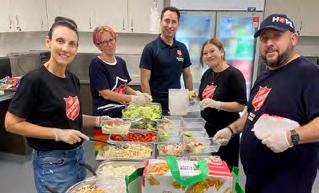
Although the cyclone was downgraded, almost 250,000 properties were left without power. At the cyclone’s peak, SAES supported up to 13 evacuation centres across South East Queensland and the Northern Rivers region of New South Wales. Thanks to the generosity of our donors, supporters and 95 volunteers, SAES provided 8924 hearty meals and refreshments, as well as psychological first aid and a friendly chat, to first responders and residents displaced by the cyclone and subsequent flooding.
Lismore Corps Officer Captain Phil Sutcliffe noted that, although community members had more time to prepare for this emergency, stress levels were significantly higher than in previous events, as many in the area were still recovering
from the record-breaking floods of 2022 that caused extensive damage.
“In Lismore, there is a huge sense of relief that the river didn’t peak,” he said. “Our biggest issue is that this has brought up a whole fresh sense of trauma from 2022 and that will be our continued ongoing work after the evacuation centres close – to support communities to get back to normality.”
As the evacuation centres closed, The Salvation Army supported eight state government recovery hubs in New South Wales and managed an online and phone application process in Queensland to provide hardship grants to community members.
During the recovery phase:
$1.77M distributed in financial assistance 5614 grants issued 7018 adults and 3871 children had been supported
h Northern Rivers Team Leaders Captains Phil and Donna Sutcliffe (right) with volunteers who travelled from Sydney and Canberra to assist with relief efforts.
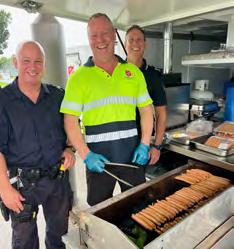
h Volunteer Kevin Lawler serves two policemen.
h The Pine Rivers team (from left) Major Donna Todd, Renee Thompson, Chris Brindley, and Aux-Lieuts Alli and Liam Holland.
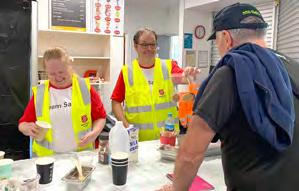
h SAES volunteers Michelle and John Ault serving hot drinks at Runaway Bay Indoor Stadium on the Gold Coast.
NORTH EAST QUEENSLAND MONSOON
In February 2025, a once-in-a-lifetime flood crisis loomed over northern Queensland and after days of heavy rain, Townsville, Innisfail, Ingham, Gordonvale, Cardwell and many surrounding areas of the Hinchinbrook Region were inundated with floodwater.
Queensland Premier David Crisafulli warned North Queensland residents that rain, flooding, power outages and critical infrastructure damage could get worse.
“This is a serious event,” he said, describing the flooding as monsoonal and a “once-in-a-century occurrence”.
SAES General Manager Daryl Crowden said the Salvos were “bringing people, support and resources” to Townsville and would remain engaged with Queensland and the local governments for as long as necessary.
“Many of those sitting in an evacuation centre, or staying with friends or family, are wondering what they will return to.”
SAES emergency response teams supported four evacuation centres in Townsville and Ingham, providing 3105 hot meals and refreshments in the first two weeks of the floods.
Thanks to over 60 officers, employees and volunteers from across four states – and the SAES team - over $940,000 in hardship grants were distributed and 5349 people were supported by the Salvos. The Salvation Army supported 13 recovery hubs where 3124 individual assessments were processed and 435 people received psychological first aid.
NSW MID NORTH COAST FLOODS
In response to devastating floods across the NSW Mid North Coast in late May, SAES teams provided vital support to evacuees and emergency personnel. Operating across 16 evacuation centres, SAES served 3105 hot meals and refreshments in the first two weeks, despite road closures and difficult conditions.
Volunteers from five states contributed 2659 hours to both response and recovery efforts. SAES distributed $1,148,900 in hardship grants and facilitated psychological first aid for 535 people in
h “Joe’s spirit is one of resilience and unwavering optimism,” said Territorial Envoy Margaret Coombridge, Recovery Coordinator Vic/ Tas, pictured with Joe.
Joe steps up
In Crystal Creek, Joe, a proud farmer, saw his home spared from the worst of the floods, losing only a kilometre of fencing. While others around him faced immense hardship, he stepped up to support his neighbours. However, when access roads were cut off, he, too, needed help. The Salvation Army Response Team ensured that food and essential supplies reached him and his community, carrying boxes over a rail bridge in the rain to ensure the Crystal Creek Community Hall, a refuge for locals, was well stocked with essential supplies.
“They didn’t let a little rain stop them,” Joe said with a grin, full of gratitude for the efforts made on his community’s behalf. At 70, his spirit of resilience and unwavering optimism was a reminder of the strength found in small communities during crisis. His story, like so many others, highlights the privilege of coming alongside those impacted by disasters and offering hope where it is needed most.
“I want to pass on my thanks to the team, they went above and beyond, and we’re all so grateful for it,” Joe said.
h Norm Archer from SAES NSW says the Salvos worked hard to support those affected by flooding on the NSW Mid North Coast.
eight recovery hubs. During the recovery phase, 7769 adults and 2219 children were supported by the Salvos.
Victorian SAES volunteers from across the state joined forces to feed the many community members displaced by the Grampians National Park bushfire crisis in December 2024.
The team provided more than 1400 meals to residents affected by the major bushfire that began on 17 December in the national park. Dry lightning started multiple fires in the southern part of the park. Additionally, the Salvos distributed a large amount of material aid to hundreds of people residing at council-run relief centres during the crisis.
More than 76,000 hectares of national park and agricultural land burned during a three-week period before the fire was contained, and four homes were lost.
“Boxing Day was very scary,” said Adam Clark, Assistant Coordinator of the Victorian SAES.
“We didn’t really know what was going to happen on Boxing Day. It was scary because all the intel (intelligence information supplied by local authorities) that was coming in from the government was that it was going to be like Black Saturday. That is what they were expecting in terms of the impact and certainly the weather. But they were very lucky that they could contain it pretty much within the national park, and when it came out onto private land, they could really tackle it.”
During the recovery phase, SAES teams conducted 72 hours of phone assessments, resulting in a total of 57 combined council and service referrals of 85 adults and 38 children and $22,900 in community grants distributed.
Ongoing, The Salvation Army continues to work with the local communities through local corps (churches), Doorways (financial emergency services) and other Salvation Army services embedded in the region.
h Secretary for Mission Lieutenant-Colonel Gregory Morgan (left) visited SAES teams working on the Grampians fires to offer encouragement.
h SAES crews working hard to serve people affected by the Grampians bushfire crisis in December 2024.
SOUTH AUSTRALIA BUSHFIRES
The SAES provided 6639 meals to first responders and community members impacted by bushfires in the lower Flinders Ranges, South Australia, over 10 days in February 2024.
A South Australia Country Fire Service (CFS) spokesperson said the fires had burnt 3850 hectares of hard-to-access terrain, which was at least 20 per cent of Mount Remarkable National Park.
“The deployment has only been able to occur because of the amazing volunteers that have given so much time and effort,” said Response Coordinator Major Reno Elms.
A fire fighter from the Willunga Brigade, Heath L’Estrange, was full of praise for The Salvation Army’s presence at Wilmington.
“As a CFS firefighter who was at Wilmington earlier this week, I really want to express my gratitude and
WESTERN AUSTRALIA BUSHFIRES
As several fires destroyed bushland and threatened homes in Western Australia over the Christmas and New Year period, the SAES were on the ground catering to fire response teams.
The Lakes bushfire destroyed over 700 hectares of bush and one home. In four days, the WA SAES team supplied 1875 meals to firefighters The Country Women’s Association also generously assisted SAES teams with catering.
WA Response Coordinator Benjamin Day said his teams were made up of great volunteers, staff and
admiration for what all of the Salvos are doing up there,” he said.
“All the Salvos I saw up there were run off their feet. They were working so hard, and likely not getting the gratitude that they deserve. I came home from Wilmington heavier than before I went up. The food was amazing, and you all seemed to care so much for our welfare. All that what you do doesn’t go unnoticed, and you guys are the cogs keeping it all going up there. I think you are all extraordinary people.”
community groups who pitched in to help when called on.
“We’ve got our volunteers all chipping in in various different ways,” he said. “It’s not just emergency response; it’s all the behind-the-scenes stuff that people don’t see that happens on a daily basis that’s really vital to ensure that we can have that really professional response.”
In the past year, the WA SAES team supported a total of 114 incidents, including the search for seven missing people, providing 19,759 meals with 1056 volunteer shifts.
h Volunteers are the backbone of the SAES crews.
h The Salvation Army Emergency Services crew on duty at the fires in the lower Flinders Ranges.
Woolworths Group stands with the Salvos
Support Through Australian Natural Disasters (S.T.A.N.D) is a Woolworths Group program that raises vital funds for Australian charities that provide relief to communities in times of natural disaster. As The Salvation Army’s principal disaster partner, Woolworths Group has actively and generously contributed to the Salvos emergency and disaster services since 2016.
In the 2025 financial year, the Woolworths community generously donated $2,019,436 to The Salvation Army Emergency Services. In the past nine years, the Woolworths community has donated an incredible $18,540,168.
Woolworths Group’s support contributed to recovery grants distributed to individuals impacted by major events including the Bunbury
Tornado in Western Australia, North Queensland Monsoon, Ex-Tropical Cyclone Alfred, Western Queensland Floods, and the Mid North Coast and Hunter Floods in New South Wales.
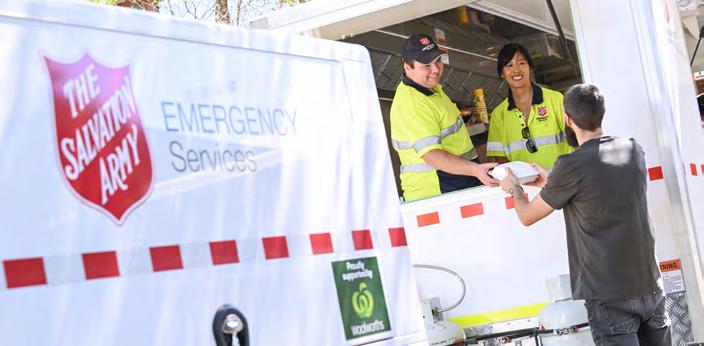
Their support also contributed to critical response improvements: four new mid-size catering trucks were deployed to Tasmania, Townsville, Cairns and South Australia; effective response times have been improved thanks to depot upgrades in Western Australia; and the Rockhampton depot rebuild has commenced. Additional improvements included new catering equipment in Tasmania and coffee machines installed in trucks across South Australia and Victoria. These enhancements strengthened our ability to serve communities with care, speed and dignity.
A pearl of a truck – honouring 30 years of service
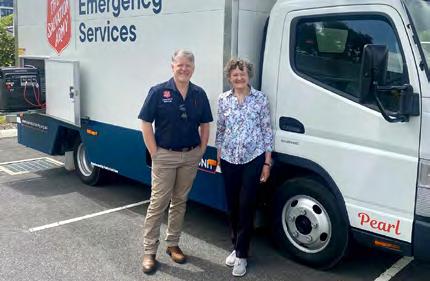
Surprised and honoured, longtime SAES volunteer Pearl Dunn had a new emergency services truck named after her in recognition of over 30 years of service. Funded by Woolworths, ‘Pearl’ was unveiled at Pearl’s retirement village in Melbourne, celebrating her enduring care for communities and first responders across emergency responses with The Salvation Army.
Building Healthy Communities: Salvos
Stores *
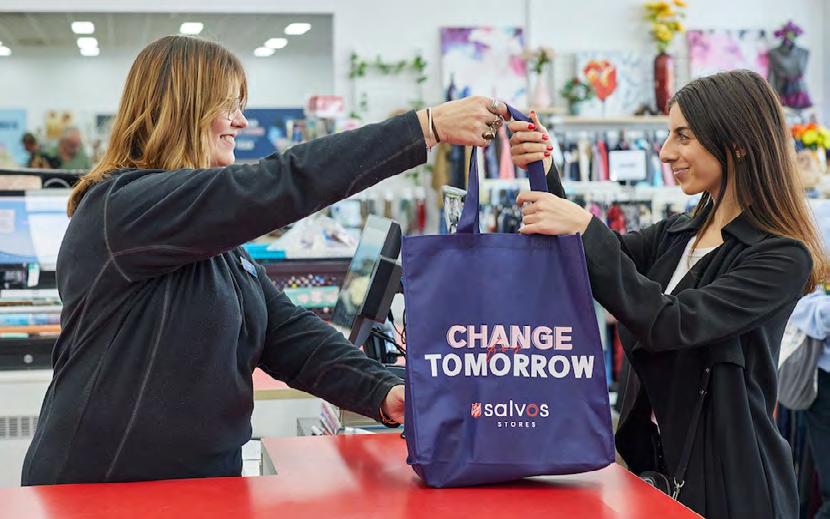
Doing ‘good’ better at Salvos Stores
In 2024-25, Salvos Stores continued to serve communities across Australia with purpose, resilience and innovation. While navigating tough retail conditions, our national network of stores delivered missional impact, advanced sustainability goals and deepened community connection – one life at a time.
Staying true to mission
We sold 52.86 million items in 2024-25, a 5.7 per cent increase on 2023-24 actuals, demonstrating continued growth in reuse and customer demand. This activity was supported by an estimated 120,000 home collections, helping Australians donate and shop more sustainably.
Our dedicated volunteer base contributed over 2.23 million hours across 471,437 sessions, with the national volunteer headcount reaching 9739 in June 2025. In a year of change and challenge, the generosity of our volunteers remained a cornerstone of our impact.
Chaplains completed an estimated 10,368 store visits in 2024-25 – nearly double the number from the year prior – offering pastoral care, encouragement and connection across our network. At the same time, our Contact Centres responded to 301,568 calls, ensuring customers,
donors and those in need received timely and compassionate support.
Every donation sorted, item sold and volunteer hour contributed helps fund the broader work of The Salvation Army. In 2024-25, Salvos Stores generated a total surplus of $28.65 million, which was directed to support the wider work of The Salvation Army across Australia.
Customer and donor experience
2024-25 marked a major milestone in our retail transformation with the completion of the Charity Store system rollout to every Salvos Store across Australia. This achievement unified our operations under one retail platform for the first time since the Australia One transition, delivering better data around pricing and inventory management, plus consistency in back-of-house operations, reporting and customer service.
In 2024–25, we also launched Full Circle Rewards, a national customer loyalty program celebrating customers who give back to their community. By year end, over 300,000 new customers had joined the program, helping to build stronger customer relationships while reinforcing the values that underpin our work.
Investing in our people
This year also marked a leadership transition, with Nic Baldwin appointed as the new Head of Salvos Stores in May 2025. Nic brings a strong background in operations and team leadership, following the departure of long-standing National Director Matt Davis. Under Nic’s guidance, Salvos Stores continues to build on Matt’s legacy while navigating a dynamic and competitive retail landscape.
We deepened investment in our people through the national rollout of GIFTS training (Greet, Inform, Find, Thank, Salvos Style), our customer service framework designed to embed warmth, respect and care in every store interaction. Over the year, we also delivered 211 training sessions to more than 1399 team members, totalling 802 hours of learning, alongside 9564 online modules completed via Learn, our internal e-learning platform.
Staying focused on what matters
In the face of rising cost-of-living pressures, increased discount retail competition and changing customer expectations, Salvos Stores remained focused on three priorities: delivering strong funding for mission, growing our volunteer base and operating sustainably. These priorities guided store activity throughout 2024-25, bringing clarity to leadership and helping teams stay centred on what makes the greatest impact.
Refreshing our store network
Despite a soft first half, 2024-25 showed a positive turnaround in the latter part of the year. By returning to the basics and executing with discipline, stores began to regain traction – a trend continuing into 2025-26.
Over the year, 30 store projects were completed, including:
• 14 stores transitioned from corps (church) to Salvos Stores management
• 8 store relocations
• 5 new sites
• 2 expansions
• 1 rebuild
These projects not only enhanced our footprint but also refreshed how we show up in communities. At the same time, new in-store signage was rolled out to more than 30 stores, amplifying the mission and vision of The Salvation Army in our retail environments.
$28.6M+ surplus generated back to The Salvation Army
Generous volunteers have contributed 2.2M+ hours to Salvos Stores
Online retail continued to grow, with $10.75 million in sales across digital platforms – $7.07 million via our online store and $3.68 million through eBay. Together, these channels saw 319,800 items sold, helping us extend the life of quality goods while generating vital funding for mission.
Leading the way in textile recycling
In 2024-25, we began developing Australia’s first fibre sorting facility, located at Carole Park, Queensland. Funded in partnership with the Queensland Government and due for completion in early 2026, the facility will enable advanced textile sorting and reuse at scale, positioning Salvos Stores at the forefront of the circular economy in Australia.
As the only national retailer operating at the intersection of sustainability, community service and commerce, Salvos Stores is uniquely placed to meet future challenges and opportunities. Whether it is offering affordable fashion with purpose, creating meaningful pathways to work or delivering financial support to life-changing programs, we remain a retailer with heart.
One life at a time
From our customers and donors to our volunteers and store teams, what we do matters – because every garment, every connection and every act of service supports someone in need.
In 2024-25, Salvos Stores continued to live out
The Salvation Army’s mission in practical, powerful ways. The year ahead will bring its own challenges, but with clear strategy, committed people and community at our core, we remain focused on what matters most: changing lives, one life at a time.
* The Salvation Army’s Mission Enterprises deliver Mission and use commerce to generate surpluses for other Salvation Army mission expressions or to maximise enterprise sustainability and impact. These enterprises include: Aged Care, Employment Plus, Salvos Stores, Salvos Funerals, Salvation Army Housing.
Building Healthy Communities: Employment Plus *
Employment Plus began the 2024-25 financial year with a firm resolve to make the most of the opportunities our evolving industry presents. By branching out and expanding upon our services and reach, this year has seen us support more people in more areas of Australia.
In November, we launched our newest program, Parent Pathways. This program offers personalised and financial support to parents who are considering their next step, be it training, education or reentering the workforce.
As the largest provider of the Parent Pathways program, Employment Plus is delivering the program from more than 50 locations across Victoria, SA and NSW. A voluntary program, Parent Pathways affords us the flexibility to support participants in a way that suits them and their families. And with 13 of our offices co-located with other Salvation Army programs, we have a unique ability to connect these parents with wrap-around support offered by the Salvos, ensuring the program is strongly aligned with our mission and vision to transform lives.
This year, our Disability Employment Services (DES) teams strengthened their ability to provide participants with holistic, wrap-around support by continuing to work closely with other Salvation Army services. DES teams partnered with local corps (churches) to host community expos, where individuals could access a wide range of support and resources locally. Our DES program is now
562,000+ appointments scheduled with participants
more deeply embedded within The Salvation Army’s national footprint, with 14 DES offices co-located at corps sites as of June 2025. This number is expected to grow to 21, reflecting our commitment to ensuring people with disability can more easily access the full breadth of services The Salvation Army offers, including housing support, financial assistance, community connection and spiritual care.
Our Workforce Australia (WfA) team’s quality of service was recognised by the Department of Employment and Workplace Relations in February, after they undertook a mid-contract review of all WfA providers. Of the seven regions where Employment Plus delivers the WfA program, six received a contract extension of two years – the maximum extension available – and one was extended for another year. This ensures we will continue to deliver the WfA program until at least June 2027.
Supporting those who need it most
Driven by our vision of ‘Work for all’, Employment Plus has continued its efforts this year to seek and seize opportunities to assist more people, particularly those in hard-to-reach-groups, in more locations.
Our EPlus Local humanitarian initiative, which provides holistic and employment support to refugees and those seeking asylum, continues to
thrive. Delivered in partnership with the broader Salvation Army network, EPlus Local has grown from one location in 2018 to 10 sites in 202425. We also began piloting online delivery of the program, with the aim of making the program more accessible. The Employment Plus staff and Salvation Army volunteers who work together to deliver the EPlus Local service, supported 582 participants in the past 12 months.
Employment Plus has also built upon the existing support it provides to marginalised job seekers, through its work with correctional facilities in Queensland. What began with an invitation to present to staff at the Ipswich Parole Office in October 2024 has evolved into a growing partnership with Queensland Corrections that addresses the need to help inmates prepare for life after prison, with skills such as budgeting and employment support. The Steps of Freedom Initiative has already seen our teams meet with more than 900 pre-release prisoners.
This initiative builds upon the success of a partnership that was established in 2023 with the Alexander Maconochie Centre in the ACT, where Caitlin O’Connor, from our team in Canberra, has attended regularly since. Through Caitlin’s work with the participants, she has demonstrated the transformative impact that we can make in the lives of these prisoners, by providing consistent support and encouragement.
The value of the work we are doing is not only in delivering services that no other providers are – it is in the acceptance, commitment and open arms that we bring to each of these interactions.
Looking ahead
In the final months of 2024-25, we turned our attention to the future, as we prepare for the launch of two new programs.
Employment Plus participated in the tender process for the Inclusive Employment Australia (IEA) service, which replaces the current DES program. Employment Plus was one of the few current DES providers to receive an increased caseload under the IEA program, with our number of participants set to quadruple when the program opens on 1 November 2025. This incredible growth in our program enables us to provide greater support to thousands more disadvantaged job seekers living with disability. With an estimated 175 sites to procure and set up, and approximately
100 new staff to hire and train, we look forward to embracing the considerable job ahead of us to ensure we are ready to open our doors on day one.
Launching on 1 November, Remote Australia Employment Services (RAES) will enable us to extend our footprint and expand upon the range of support already delivered by The Salvation Army in remote communities across Australia, by providing specialist and personalised employment support. With 86 per cent of RAES participants identifying as Aboriginal or Torres Strait Islander, the program also supports The Salvation Army’s commitment to Closing the Gap and our Reconciliation Action Plan.
EISLA’S* STORY
Eisla struggled with addiction recovery and severe mental health barriers, all while trying to care for her five children as a single mother. She had been unemployed for 10 years before registering with Employment Plus and had little confidence that things would improve.
After a few months of working with Employment Plus, a housekeeping opportunity arose. Although this job was only temporary, it provided Eisla with the motivation and confidence she needed to look towards establishing a career.
Eisla and her employment consultant discussed possible career paths, and they developed a plan for her to pursue a career in aged care. He recognised that Eisla’s lack of confidence needed to be addressed. He helped her arrange for dental work and assisted with the cost. They then arranged support with her reading and writing skills, helped her access counselling sessions and enrolled her in the Salvos’ Positive Lifestyle Program. Once Eisla felt confident enough, her consultant referred her to a pre-employment program, which covered skills such as first aid, administering medication and compassionate care. Three months later, Eisla was accepted into an Aged Care Traineeship and has set herself a new goal of becoming a registered nurse.
*Name has been changed
* The Salvation Army’s Mission Enterprises deliver Mission and use commerce to generate surpluses for other Salvation Army mission expressions or to maximise enterprise sustainability and impact. These enterprises include: Aged Care, Employment Plus, Salvos Stores, Salvos Funerals, Salvation Army Housing.
Building Healthy Communities: Salvation Army Housing (SAH)
Salvation Army Housing operates nationally as a community housing organisation that provides homes for individuals and families experiencing or at risk of homelessness, on low incomes, and people with specific support needs.
As of 30 June 2025, Salvation Army Housing managed nearly 2000 properties throughout Australia, providing long-term housing, transition housing as well as crisis and rooming house tenancies, supporting nearly 3000 people.
Salvation Army Housing sits under both the National Regulatory System, (NRSCH), and the Victorian Regulatory System, (VHR), with properties in all states and one territory, the ACT. Salvation Army Housing is fully compliant under both regulatory schemes.
As a not-for-profit organisation, registered charity and a public company limited by guarantee, Salvation Army Housing operates under the auspices of The Salvation Army to address the needs of people at all stages of their life, as well as their housing requirements. This includes early intervention – to address the risk of homelessness, emergency accommodation and crisis response, transition to more stable accommodation and supporting a move to independence.
Salvation Army Housing is in the unique position of having the support of The Salvation Army in all aspects, that helps us provide holistic assistance to our tenants. This wrap-around support for people in our care includes financial assistance and counselling, spiritual support, case management, rehabilitation services, family and domestic violence support services, youth services and employment assistance.
We are especially proud of the partnerships we have built with governments, councils and our local mission delivery partners across The Salvation
Nearly 3000
people provided with housing who were experiencing or at risk homelessness
Army. These relationships are vital in delivering integrated, holistic mission for spiritual and social transformation, while shaping communities grounded in love, respect and justice.
A home brings hope
Salvation Army Housing seeks to transform the lives of those experiencing housing hardship and injustice by providing low-cost accommodation, supporting those experiencing or at risk of homelessness, as well as socially disadvantaged members of our communities.
As a national provider, we have expanded our housing portfolio and strengthened our wraparound support services to ensure tenants are not only housed but supported to thrive. We have opened new developments across Australia, which reflect our commitment to quality, sustainability, and community connection – places that are more than just buildings, but homes and Salvos communities where people belong.
2025 represented another significant step forward in both growth and maturity for Salvation Army Housing Property and Infrastructure. This past year demonstrated our commitment to growth with the delivery of:
• 16 apartments in Yarraville (Vic.);
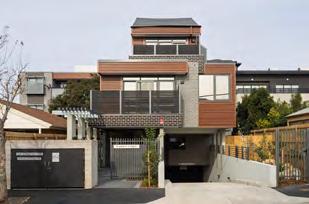
• 2 townhouses in Maidstone (Vic.);
• 6 units in Cobden (Vic.);
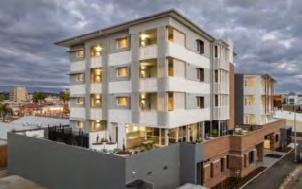
• 23 apartments in Toowoomba (Qld); and
• 38 apartment refurbishment in Narrabundah (ACT)
We have executed construction contracts for:
• 21 townhouses in Warrnambool (Vic.);
• 40 apartments in Cairns (Qld); and
• 9 apartments in Warrawong, (NSW.
And we have new construction and housing projects in the pipeline for 13 suburbs across Australia.
Nearly 2000 properties were managed to support SAH tenants
Graham* thanks God for Salvos
Our new tenant Graham recently completed the alcohol and other drugs rehabilitation program at the Harry Hunter Rehabilitation Centre in Perth and is now transitioning into a supportive living environment with SAH.
For Graham, this transition marks a significant milestone. Rather than confronting everyday life without support, he is now integrated into a stable living arrangement, offering him structured independence alongside access to essential wraparound services. The accommodation is
Social Housing transformation in Yarraville
Salvos Housing transformed its Yarraville (Vic.) site by converting an ageing apartment block into 16 modern two-bedroom units. Thanks to funding from Homes Victoria, the new complex offers long-term housing to a diverse range of tenants, including single parents, mature-aged couples, and those requiring special care or carer support. Previously, the building housed only eight to 10 older units, but it now serves a wider and more flexible community through the Victorian Housing Register. A celebratory event marked the transformation, attended by The Salvation
Social Housing breaks new ground in Toowoomba
Salvation Army Housing opened its first social housing partnership development in Toowoomba (Qld), providing long-term housing for 23 families. Completed in June, the project addresses housing shortages by encouraging downsizing, freeing larger
Women made up most of SAH tenants at 55%, followed by men at 44% and other genders at 1%
designed to help individuals maintain their recovery while fostering a sense of self-worth and stability. Expressing his gratitude, Graham shared, “I usually say thank God for the Salvos, and I do really mean that.”
These words reflect the impact of comprehensive care on his life. His journey highlights Salvation Army Housing’s commitment to providing not just housing, but a foundation that upholds human dignity and equips individuals with the resources and assistance to successfully reintegrate into society and start afresh.
homes, and offering suitable housing for ageing Australians. The development includes communal spaces and wrap-around services, highlighting The Salvation Army’s commitment to tenant care and community building. Funded by Queensland Government’s QHIGI program and The Salvation Army philanthropic donations, it was inaugurated by Minister for Housing and Public Works and Minister for Youth Hon. Sam O’Connor and Territorial Commander Commissioner Miriam Gluyas.
Resident Simon* expressed gratitude for the opportunity to live securely saying, “I hope to be in Snell Street for the near future with mum and dad and live happily.”
*All names have been changed
Army’s Commissioner Miriam Gluyas, the Minister for Housing and Building Hon. Harriet Shing and Parliamentary Member for Footscray Ms Katie Hall.
Building Healthy Communities: Salvation Army
International Development (SAID)
Reach and impact in FY2024-25
70,742 people reached* 72% adu lts 28% children women and girls 61% men and boys 39%
Who benefitted from SAID’s projects in 2024-25?
In 2024-25, SAID’s community development projects directly impacted 70,742 people.** These people were all directly involved in project activities and benefitted from their participation in these activities. Outside of these beneficiaries, many other individuals were aided by SAID’s community development projects, including family members of direct participants and community members.
Most people who benefitted directly from SAID’s projects were adults, who made up 72 per cent of direct participants, while children made up 28 per cent of direct participants. More females than males benefitted directly from SAID’s projects: 61 per cent of direct project participants were women and girls, while 39 per cent of direct project participants were men and boys.
5665
people with disability reached 66% 34% women men
People with disability
SAID is committed to working with our partners on increasing direct participation of people with disability in our projects. In 2024-25, 5665 (8 per cent) who directly participated in and benefitted from SAID community development projects had a disability. This is one per cent less than 2023-24 (9 per cent). Of the 5665 participants in 2024-25 who had a disability, 66 per cent were women and 34 per cent were men.
Project
location
91% of people reached
(64,329 – 60 per cent women and girls) lived in Africa (Kenya, Malawi, Rwanda, Tanzania and Uganda).
9% of people reached with a total of (6413 – 64 per cent women and girls) lived in the South Pacific and Asia (Indonesia, Papua New Guinea, the Philippines and Pakistan).
* Including 8 people (3 adults, 5 people under 18 years of age) who identified as non-binary.
** Please note: SAID works with The Salvation Army Sweden and Latvia; Norway, Iceland and The Faeroes; Switzerland, Austria and Hungary, United Kingdom and Ireland; Canada and Bermuda; New Zealand, Fiji, Tonga and Samoa Territories, as well as the Salvation Army World Service Office to support our projects.
SAID’s impact and commitment to learning
SAID collaborates closely with implementing partners and local consultants to conduct rigorous evaluations of our community development projects. Through external mid-term and endterm evaluations, we gain valuable insights into the impact of projects we support and apply lessons learned to enhance future initiatives. This commitment ensures we maximise benefits for the people and communities we serve. In 2024-25, SAID undertook eight evaluations. In Africa Zone, this included two mid-term evaluations, three endterm evaluations, and a synthesis report evaluating eight agriculture projects, while in South Pacific and East Asia Zone, two effectiveness reviews were conducted.
Agriculture Evaluation Synthesis
SAID’s agricultural projects aim to empower vulnerable communities to realise their human rights and prosper economically and socially. These initiatives contribute to individual and community wellbeing, including through improvements in farming techniques, increased crop yields, reduced environmental impacts and increased sustainability, and supporting sustainable livelihoods.
In 2024, SAID commissioned an Agriculture Evaluation Synthesis to strengthen impact and learning across its agricultural portfolio. The study, completed in January 2025, reviewed eight projects implemented over five years in Kenya, Tanzania and Malawi, reaching over 12,000 farmers through investments of more than US$3.5 million.
Drawing on evaluations, partner consultations and food systems analysis, the synthesis explored outcomes in food security, livelihoods, inclusion and climate resilience. Findings were shared in a webinar with implementing and support partners, sparking dialogue and reflection. Importantly, the insights have already informed the design of two new agriculture projects. The synthesis marks a key step in strengthening the effectiveness and sustainability of SAID’s agricultural programming.
Program Effectiveness Report
SAID’s latest Program Effectiveness Report (released in November 2024) is SAID’s second Effectiveness Report and is representative of our continuing commitment to transparency, quality improvement and community empowerment. This report draws on SAID’s Theory of Change and the SAID Effectiveness Framework, which shape our programming portfolio. The report is datadriven and focused on learning and improvement, both of which are central to enhancing SAID’s development effectiveness. The report examines quantitative and qualitative data from a range of sources to determine SAID’s development effectiveness in 2023-24. The data focuses on project level results and, to a lesser extent, SAID’s contributions to these results in supporting partners and projects. SAID’s Effectiveness Reports contribute to organisational monitoring, evaluation and learning efforts by strengthening the information available about SAID’s program outcomes. SAID is committed to continuous learning and improvement, using data and associated insights to bring positive change in the lives of individuals and communities we serve.
Working for justice
The Salvation Army actively works to address the social systems and structures that diminish people’s dignity, striving to build a fairer society where everyone has the chance to flourish.
The Salvation Army works with governments at all levels to seek solutions to the disadvantage and hardship we see across Australia and address the drivers of injustice. The Policy and Advocacy and Government Relations teams work with state and territory-based External Communications teams and our service areas to provide consistent and compelling advice to decision-makers at every level.
Working for justice: Policy, Advocacy and Government Relations
Social justice and the election of the 48th Australian Parliament
In February 2025, The Salvation Army launched its second National Social Justice Stocktake. Building on the success of the 2022 Stocktake, the 2025 Stocktake provides a comprehensive picture of the issues Australians are concerned about nationally, for each state and territory and in every single federal electorate.
The Social Justice Stocktake demonstrated the extraordinary consistency in the social justice issues identified throughout Australia. An enormous 71 per cent of survey respondents reported that housing affordability and homelessness was a key issue in their community, demonstrating the widespread impact of the current housing crisis. The majority of respondents also agreed that mental health, financial hardship and access to health care were in the top five issues facing their communities. There was also an overwhelming sense of urgency in response to perceived governmental inaction – many respondents called on decision-makers to put politics aside and prioritise action.
Click or scan to view The Social Justice Stocktake 2025 report.
h Jennifer Kirkaldy, General Manager Policy and Advocacy, presenting the South Australian Stocktake findings to a candidate and community meeting in Adelaide.
Government engagement in 2024-25:
400+ meetings, site visits and conversations
To ensure that these findings, and social justice more generally, were recognised as key issues in the election, we provided the reports to every current MP and Senator and every candidate seeking election with a published e-mail address. Crucially, we were not seeking to influence how anyone voted. We were ensuring that every person seeking to represent their community had access to what their community felt about social justice. Around 20 per cent of candidates and sitting members sought additional briefings, showing again how important social justice issues are to our community and our leaders.
Championing caring for people and communities
Caring for people is central to The Salvation Army’s mission and we build relationships with those who are committed to amplifying care. This is just one of the reasons we were delighted to welcome Her Excellency the Honourable Ms Sam Mostyn AC, Governor-General of the Commonwealth of Australia, as Patron of The Salvation Army in November 2024.
It was wonderful to have Her Excellency launch the Red Shield Appeal in Canberra. Her address inspired a full house to reflect on the incredible importance of care, kindness and respect, and celebrated the enduring presence and work of The Salvation Army in communities right around Australia.
We look forward to continuing to work with the Governor-General as Patron in areas of mutual interest, including the important work we do which contributes to breaking cycles of family and domestic
2000+ emails and letters exchanged
violence and uplifting the stories of care and compassion which transform lives and communities.
Assisting the South Australian Royal Commission
The South Australian Government is conducting a Royal Commission into Domestic, Family and Sexual Violence (the Royal Commission). The Salvation Army was able to feed into this inquiry based on our experience as a national provider of services for victim-survivors of family and domestic violence both nationally and in South Australia, and brought to the Commission’s attention knowledge and reforms that our services have found to be effective in other jurisdictions in preventing and responding to family and domestic violence.
The Commissioner visited our South Australian services to see these practices in action, and learn first-hand our experience and approach to supporting victim-survivors. We were also able to share our insights into The Salvation Amy’s models including our children’s specialists and our Alexis Family Violence Response Model.
The Royal Commission released their report in August 2025 – With Courage: South Australia’s vision beyond violence. We were encouraged to see many of our recommendations reflected in those made by the Royal Commission to the South Australian Government, and are hopeful that these recommendations will lead to improved outcomes for those impacted by family and domestic violence in South Australia.
Thank You Australia!
Red Shield Appeal: Thank you Australia!
With the theme, ‘Be the Hope People Need’, the 2025 Red Shield Appeal, The Salvation Army’s main fundraising event, was launched at various events across the country, attended by dignitaries, corporate leaders, prominent philanthropists and senior Salvation Army personnel.
These events included several testimonial speakers, the presentation of awards for dedicated support and exceptional contributions to the work of The Salvation Army – the Others Award and the Eva Burrows Award – and raised essential funds to assist those in need.
Across Australia, many people are experiencing crises that most of us can’t even imagine –extreme poverty, mental illness, domestic violence, homelessness, addiction, and more. The cost of living continues to be a pressing issue for many Australian households, especially those with low incomes. Over the past year, the price of essential items, such as food, transport and utilities has increased, further straining household finances. Housing prices and rental payments have surged, putting additional pressure on many households.
For those already facing financial hardship, the
situation is even more precarious. Vulnerable groups, including low-income households, government support recipients, single-parent families and older Australians are struggling to make ends meet. Many are living on limited disposable income and can barely afford necessities such as food and healthcare. The rising costs are not just a financial burden but also a source of considerable stress and anxiety for many Australians.
Last year alone, The Salvation Army was able to distribute nearly $25 million in financial support and assist over 225,000 people across all our social programs. Over 350,000 sessions of care were provided to people who were at risk of or experienced homelessness, more than 25,000 people impacted by disaster received support, and 125,000+ nights of emergency accommodation were provided for those impacted by violence.
The 2025 Red Shield Appeal campaign brought to life the struggles of everyday Australians and in response, we set an ambitious Red Shield Appeal target of $38 million and asked all Australians to donate – to bring hope to people who thought things could never get better. This year the
Red Shield Appeal raised $45 million to provide assistance and care to people in need.
It was moving to see individual donors, corporate partners, celebrities, community members, first-time donors, faithful regulars, volunteers and employees come together during the Red Shield Appeal to provide support through events, volunteering and donations to help those in need.
Donations made to the appeal provide vitally needed funding for services and programs, enabling The Salvation Army to deliver on its mission across rural communities, cities and suburbs. Whether through accommodation and housing services, financial assistance, food vouchers, case management, emergency relief, addiction recovery services, advocacy and referrals, or local Salvation Army corps and community offerings, support of the appeal welcomes the lonely into a caring community, brings hope to people who thought things could never get better and makes new beginnings possible for people facing hardship and crisis right across Australia.
An example of this is a pioneering Women’s Shed program breaking new ground at Bendigo Corps’ Community Services causing much excitement among the local community. The program aimed at local women to enjoy the art of woodworking in a workshop group setting, plus be a focal point for social connection, has been the fulfilment of a longterm vision for the community hub.
Belinda Smith, Community Services Manager, said she had been asked by the local community to establish a women’s workshop group for quite some time, but funding or the capacity to cater for such a group had not been available.
However, thanks to Red Shield Appeal funds, the Women’s Shed program has now come to fruition with women meeting every Thursday morning to be part of the workshop group and learn woodworking skills. It’s based at the Services’ Community Shed premises, fondly known as ‘The Shed’, that offers an array of programs to the local community plus a fully equipped woodwork studio complete with machinery of all sorts and tools.
“The shed has met a critical need in the community. The feedback we’re getting from their counsellors is the workshop stuff is just such a release for them,” Belinda reports.
Cashless giving continues to grow year on year increasing by 9% this year
$45 million was raised during Red Shield Appeal campaign
20,000+ volunteers were involved
Thanks to our generous donors and supporters this year, in total, the Red Shield Appeal raised an amazing $110.8 million to provide support and care to people in need. Your support of the Red Shield Appeal provides the necessary resources to enable us to continue meeting vulnerable people at their point of need and providing life-changing care to those who seek the Salvos every day for assistance.
I can’t thank you enough for your continuing support, as well as the wonderful compassion you show towards fellow Australians in times of crisis –your support is a beacon of hope when they need it most.
Thank you for being part of the Salvos community and for your continued belief in our mission –together we will be the hope people need.
God bless you,
Rodney Walters (Colonel) The Salvation Army Secretary for Communications
Key Supporter Acknowledgement
Thank you so much to every individual, family, company, organisation, community group, charitable trust and foundation that has helped us meet great human need in the Australian community. So many suffering people have experienced the transformation and new hope that has been made possible by your kindness and generosity.
We would also like to acknowledge and give thanks to all those donors who have given anonymously or made the powerful decisions to invest for generations to come via a gift in their Will. We can’t honour you with a mention here, but we do extend our heartfelt thanks for your contribution and its impact.
Companies
and Organisations
7-Eleven Australia
ADCO Constructions
AGL Energy Limited
Alinta Energy
Aurora Energy Pty Ltd
Bellrock Specialty Pty Limited
Blundstone Australia Pty Ltd
Cherry Collectables
Coca-Cola South Pacific Pty Ltd
Crown Resorts
Design Group Australia
Downer Group
Electel Resources Pty Ltd
Endes Pty Limited
Fortescue
HopgoodGanim Lawyers
Individuals and Families
Dallas and Margaret Finney
Dr Bryant and Louise Macfie
Dr Michael Burgess
Henry F Foster
Hilary Wallace
Jean M Williamson
John Brett
Kate and Tony Robinson
Kathryn Greiner AO
Hytek Framing Pty Ltd
Infinity Group
Jayleaf Holdings Pty Ltd
Kmart Australia Ltd
Lumo Energy Australia Pty Ltd
Macquarie Bank Limited
McCosker Contracting Pty Ltd
Mercer Investments (Australia)
Limited
Myer
National Australia Bank
NSW GovernmentDepartment of Premier & Cabinet
Programmed Facility
Management
Queenscliffe Holdings Pty Ltd
Queensland Government - Department of Families, Seniors, Disability Services & Child Safety
Queensland GovernmentDepartment of The Premier And Cabinet
Real Estate Institute of WA
Rotary Club of Perth Inc
SSJG Ministries Inc
State Government of Victoria, Department of Families, Fairness & Housing
Tasmanian Government, Department of Premier and Cabinet
Technology One Ltd
The Spiritual Kinship Society
Woolworths Limited
Kaye Eichhorn
Mrs Everdina Gaemers
Mrs Wendy Stanford
Peter Routley
Phillip and Judy Paull
Rob Harding and Barbara Warhurst
Robert Rich
Roger Massy-Greene AM and Belinda Hutchinson AC
Russell J. Patterson
Shirley Uhrig and John A. Uhrig AC
Steve Mossman
Susan Scotford
Suzanne and Angus Cameron
Tim Fairfax AC and Gina Fairfax AC
Trusts and Foundations
A I Chapman Trust
ABC Giving Tree Committee
Andrew Pratten Charitable Trust
Australian Chinese Charity Foundation Inc
Australian Philanthropic Services Foundation
Brazil Family Foundation
Brinsmead Hill Family Foundation
Burrows Family Foundation
Centenary Foundation - Warren Read Endowment
Colin Bisdee Trust
Collier Charitable Fund
Crown Resorts Foundation
Ebert Family Charitable Fund
Ennis Corporation Pty Ltd as trustee for The Inagh Foundation
Equity Trustees
Estate Melvie Mary Bennett
Ficus Foundation
Fitzpatrick Family Charitable Trust
Goldburg Family Foundation
Janice Spedding Testamentary Trust
Jones Day Foundation
Matana Foundation For Young People
Minderoo Foundation Trust
Myer Community Fund Ltd
NAB Foundation
Nigel & Patricia Peck Foundation
Patterson Legacy Foundation
Perpetual as trustee for The Lionel & Yvonne Spencer Trust
Perpetual Foundation
Perpetual FoundationEddy Dunn Endowment
Perpetual FoundationJack Tilburn Endowment
Perpetual FoundationThe Gloria McKerrow Endowment
Philandron Foundation
Property Industry Foundation
Sydney Queensland Gives By Queensland Community Foundation
Sargents Charity Limited
Sony Foundation Australia
Stan Perron Charitable Foundation
The Alcock Family Foundation
The Belinda & Adam MacDougall Foundation
The Channel 7 Telethon Trust
The D & X Williamson Family Charitable Fund
The Dick and Pip Smith Foundation
The Donald & Joan Wilson Foundation
The Eleanor Reeve Dailey Charitable Trust
The George W Vowell Foundation Ltd
The Gladstone Foundation
The Gray Family Trust
The Hugh D T Williamson Foundation
The John & Margaret Schneider Charitable Trust
The Manildra Foundation
The Maple-Brown Family Foundation
The MAST Foundation
The O’Halloran Foundation
The Orloff Family Foundation
The Ragdoll Foundation Pty Ltd
The Rock Private Ancillary Fund
The Select Foundation
The Stan and Maureen Duke Foundation
The Sun Foundation Pty Ltd
The Sylvia & Charles Viertel Charitable Foundation
The Theodore & Isabella Wearne Charitable Trust
The Trustee For National Press Gallery Midwinter Ball Foundation
The Wheeler Family (NQ) Charitable Endowment
The William Angliss Charitable Fund
The Woolworths Group Foundation Pty Ltd
Wythenshawe Pty Ltd as trustee for Wythenshawe Foundation
The Salvation Army Australia
William and Catherine Booth – Co-Founders
Lyndon Buckingham – General
Miriam Gluyas – Territorial Commander
International Headquarters 101 Queen Victoria Street, London, EC4V 4EH
Australia Headquarters 95–99 Railway Road, Blackburn 3130
Telephone (03) 8878 4500 salvationarmy.org.au
Trustees’ Report
The Trustees of The Salvation Army Australia Social Fund (“Social Fund”) submit the following report, together with the financial statements, on the operations of the Social Fund for the financial year ended 30 June 2025 and the independent auditor’s report thereon.
TRUSTEES
The Trustees of the entities which comprise the Social Fund at any time during or since the end of the financial year are:
Title Full Name Position
Commissioner Miriam Joy Gluyas Territorial Commander 21 February 2023
Aux-Lieut Rosemary Margaret Keane Secretary for Spiritual Life Development 21 February 2023
Colonel Winsome Joy Merrett Chief Secretary 11 January 2017 1 October 2025
Lieut-Colonel Winsome May Mason Assistant Chief Secretary 1 July 2020 15 January 2025
Captain Colin Leslie Francis Reynolds Board Member 1 July 2020
Major Stuart Norman
Assistant Chief Secretary McGregor Glover - Business 20 September 2021
Lieut-Colonel Gregory Mark Morgan Secretary for Mission 1 July 2023
Major Kim Maree Haworth
PRINCIPAL ACTIVITIES AND OBJECTIVES
Assistant Chief Secretary - Mission 15 January 2025
During the year, the principal continuing activities of the Social Fund comprised of:
• Aged Care
• Employment, education and training services
• Housing and homelessness programs
• Family and domestic violence programs
• Community support services
• Humanitarian services
• Overseas aid
• Chaplaincy programs
• Addiction, alcohol and other drugs programs
• Salvos Stores
The Social Fund provides welfare and social support services across Australia and overseas – in cities, country towns and rural communities. Our work touches every demographic and age group. The Social Fund is involved in national issues while also bringing hope to people who may be experiencing hardship or injustice. We speak about justice, compassion and other issues that support the welfare of others and view them as a whole person – body, mind and spirit.
REVIEW OF OPERATIONS
The Social Fund’s operating result was net income of $5.9m (2024: $54.7m net expenditure).
1,294,783 1,261,877
(1,288,907) (1,316,615)
5,876 (54,738)
SOURCES OF INCOME
The following is a summary of the main sources of income for the Social Fund.
SOURCES OF EXPENDITURE
The following is a summary of expenditure including Redress and from within social program categories, in relation to social services provided by the various centres operating within the Social Fund.
The 2025 result included the following:
• Red Shield Appeal recorded income of $110.8m (2024: $102.9m) before fundraising expenses for the year ended 30 June 2025. Recorded within Red Shield Appeal income was $16.1m donor designated gifts including emergency appeals and disaster relief (2024: $16.3m). Fundraising expenses incurred were $28.2m (2024: $26.2m). The majority of expenditure was related to media, advertising, marketing and technology $17.2m (2024: $16.6m) (contained within ‘Other expenses from ordinary activities’, ‘Professional fees expenses’ and ‘Information technology expenses’) and Employee benefits expense $10.3m (2024: $9.6m). No Red Shield Appeal funds are used to cover Redress claims.
• Legacy income of $17.3m (2024: $19.9m) was received during the year. Legacy income received from one year to the next can fluctuate considerably, given the uncertain nature of this type of income. Apart from those bequests that specified particular programs or activities for which the funds have been set aside in reserves until able to be used, additional funding was able to be allocated towards the operational costs, as well as further funds being set aside for future capital expenditure requirements.
• Salvos Stores delivered modest sales growth compared to prior year noting challenging trading conditions due to continued pressure from cost of living.
• Government grants, funding and resident contributions of $732.5m (2024: $679.8m) has remained a strong funding source to continue to provide social support to the community.
• Included above in the summary expenditure table is $17.7m relating to Redress which includes $7.8m pertaining to the unwinding of discounting. The Salvation Army Australia Territory has publicly expressed it is deeply regretful of any incident of abuse perpetuated. The Salvation Army has engaged an independent third-party expert to assist in the determination of the provision having regard to developments during the year. For more details, refer to Note 11.
DEVELOPMENTS
The Salvation Army continues to provide community services, assistance and support to the community and its members ensuring care is provided to the most vulnerable in our communities. Many people in the community continue to experience hardships as a result of the instability and uncertainty driven by the rising costs of living.
Whilst there are no significant developments or changes to the overall operations of The Salvation Army, there is continued effort toward new initiatives to provide the best support to the community whilst also prioritising the importance of sustainable operations.
EVENTS SUBSEQUENT TO REPORTING DATE
There has not arisen in the interval between the end of the financial year and the date of this report any item, transaction or event of a material and unusual nature likely, in the opinion of the Trustees of the entities which comprise the Social Fund, to affect significantly the operations of the Social Fund, the results of those operations, or the state of affairs of the Social Fund, in future financial years.
ENVIRONMENTAL ISSUES
The Social Fund is subject to environmental regulations under the law of the Commonwealth and of the States. However, the governing body of the Social Fund believes that adequate systems are in place for the management of its environmental requirements and is not aware of any breach of those environmental requirements as they apply to the Social Fund.
INSURANCE OF OFFICERS
The Social Fund has, during the financial year, paid an insurance premium in respect of an insurance policy for the benefit of the Trustees and Officers of the Social Fund. The insurance is in the normal course of business and grants indemnity for liabilities permitted to be indemnified by The Salvation Army Australia Territory under Section 199 of the Corporations Act 2001 (Cth). In accordance with commercial practice, the insurance policy prohibits disclosure of the terms of the policy including the nature of the liability insured against and the amount of the premium.
ROUNDING OF AMOUNTS
Amounts in this report have been rounded off to the nearest thousand dollars except where otherwise indicated.
AUDITOR
KPMG continues as the Social Fund’s auditor at the date of this report.
LEAD AUDITOR’S INDEPENDENCE DECLARATION
The Lead auditor’s independence declaration is set out on page 99 and forms part of the Trustees’ report for the financial year ended 30 June 2025.
Signed in accordance with a resolution of the Trustees:
Stuart Glover Assistant Chief Secretary - Business TRUSTEE
Dated at Melbourne this 24th day of November 2025
Kim Haworth Assistant Chief Secretary - Mission TRUSTEE
Aggregated Statement of Profit or Loss and Other Comprehensive Income
the year ended 30 June 2025
Aggregated Statement of Financial Position
As at 30 June 2025
The accompanying notes on pages 74 – 97 form part of these financial statements.
Aggregated Statement of Cash Flows
For the year ended 30 June 2025
Aggregated Statement of Changes in Funds
For the year ended 30 June 2025
Social Fund has revised the presentation of the Aggregated Statement of Changes in Funds by combining ‘Reserves’ and ‘Working Capital Fund’ into one category ‘Working Capital and Reserves Fund’ to reduce complexity of presentation for users of this Aggregated Financial Report as both funds represent unrestricted funds.
Notes to the Financial Statements
For the year ended 30 June 2025
1. MATERIAL ACCOUNTING POLICIES
The Salvation Army is a not-for-profit organisation and has been operating in Australia since 1880.
The Salvation Army Australia is domiciled in Australia and the address of the organisation’s registered office is:
The Salvation Army Australia 95-99 Railway Rd, Blackburn VIC 3130
The Salvation Army Australia Social Fund (‘Social Fund’) includes the following operations:
• The Salvation Army (Victoria) Property Trust (ABN 64 472 238 844) established pursuant to The Salvation Army (Victoria) Property Trust Act 1930;
• The Salvation Army (Tasmania) Property Trust (ABN 94 917 169 560) established pursuant to the Salvation Army (Tasmania) Property Trust Act 1930;
• The Salvation Army (South Australia) Property Trust (ABN 13 320 346 330) established pursuant to The Salvation Army (South Australia) Property Trust Act 1931;
• The Salvation Army (Western Australia) Property Trust (ABN 25 878 329 270) established pursuant to The Salvation Army (Western Australia) Property Trust Act 1931;
• The Salvation Army (Northern Territory) Property Trust (ABN 65 906 613 779) established pursuant to the Salvation Army (Northern Territory) Property Trust Act 1976;
• The Salvation Army (New South Wales) Property Trust (ABN 57 507 607 457) established pursuant to The Salvation Army (New South Wales) Property Trust Act 1929;
• The Salvation Army (Queensland) Property Trust (ABN 32 234 126 186) established pursuant to the Salvation Army (Queensland) Property Trust Act 1930;
• The Salvation Army (Victoria) Property Trust atf The Salvation Army (VIC) Social Work (ABN 18 730 899 453);
• The Salvation Army (Tasmania) Property Trust atf The Salvation Army (TAS) Social Work (ABN 23 860 168 024);
• The Salvation Army (South Australia) Property Trust atf The Salvation Army (SA) Social Work (ABN 45 781 882 681);
• The Salvation Army (Western Australia) Property Trust atf The Salvation Army (WA) Social Work (ABN 92 646 174 644);
• The Salvation Army (Northern Territory) Property Trust atf The Salvation Army (NT) Social Work (ABN 34 413 960 392);
• The Salvation Army (New South Wales) Property Trust atf The Salvation Army (NSW) Social Work (ABN 46 891 896 885);
• The Salvation Army (Queensland) Property Trust atf The Salvation Army (QLD) Social Work (ABN 22 035 976 360);
• The Salvation Army (Australia) Redress Limited (ABN 94 628 594 294);
• The trustee for The Salvation Army (Australia) Self Denial Fund (For Overseas Aid) (ABN 52 609 689 893);
• The trustee for The Salvation Army Aust Self Denial Fund (for Overseas Aid) (ABN 15 562 601 404);
• The Salvation Army Community Housing Service (ABN 47 152 257 728);
• Salvation Army Housing (ABN 59 608 346 934); and
• Salvation Army Housing (Victoria) (ABN 85 133 724 651).
(a) Basis of preparation
These special purpose aggregated financial statements are prepared for the purposes of fulfilling the financial reporting requirements of the Australian Charities and Not-for-profit Commission and comply with all of the recognition and measurement principles of Australian Accounting Standards except that the aggregated operations that comprise the Social Fund do not constitute a group for the purpose of AASB 10 Consolidated Financial Statements. The financial statement disclosures comply with the requirements of 'GPFS-Tier 2 SD' in accordance with ‘AASB 1060 General Purpose Financial Statements - Simplified Disclosures for For-Profit and Not-for-Profit Tier 2 Entities’ adopted by the Australian Accounting Standards Board (AASB).
(a) Basis of preparation (continued)
The aggregated financial statements comply with all the recognition and measurement requirements in Australian Accounting Standards, except for AASB 10 Consolidated Financial Statements. This aggregration does not meet the definition of a group as defined by AASB 10. See basis of aggregration in Note 1a 'Basis of aggregration'. In all other respects the aggregated financial statements have been prepared in accordance with the recognition and measurement requirements of Australian Accounting Standards.
These aggregated financial statements were authorised for issue by the Trustees on 24th November 2025.
Detail of the material accounting policies used in these aggregated financial statements are included in Note 1(b) - 1(q).
The financial report is presented in Australian dollars which is the functional currency of all operations. The financial statements have been prepared on the historical cost basis except for financial instruments and loans receivable which are measured at fair value.
All amounts in the financial report have been rounded to the nearest thousand dollars except where otherwise indicated.
In preparing these aggregated financial statements, management has made judgements, estimates and assumptions that affect the application of the Social Fund’s accounting policies and reported amounts of assets and liabilities, income and expenses. The estimates and associated assumptions are based on historical experience and various other factors that are believed to be reasonable under the circumstances, the results of which form the basis of making the judgements about carrying values of assets and liabilities that are not readily apparent from other sources. Actual results may differ from these estimates.
The estimates and underlying assumptions are reviewed on an ongoing basis. Revisions to estimates are recognised prospectively.
Going concern
Notwithstanding a ‘current asset versus current liabilities’ deficiency of $386,099k, the financial statements have been prepared on a going concern basis. The deficiency is mainly caused by the requirement under Australian Accounting Standards to classify all accommodation bonds ($284,715k) as current liabilities, as there is no unconditional right to defer payment for 12 months if residents were to depart an aged care centre. Based on past experience, the Social Fund believes that not all accommodation bonds will need to be refunded within the next 12 months. The Social Fund has a large investment portfolio which is classified as non-current however is highly liquid and can be called upon if required. Accordingly the financial statements have been prepared on a going concern basis, as the Trustees of the governing body expect to have sufficient funding available for the foreseeable future.
Basis of aggregation
The aggregated financial statements are prepared by aggregating the assets, liabilities, income and expenses and cash flows of the entities that comprise the Social Fund listed in Note 1. This aggregation includes entities where control has not been established. This aggregation does not meet the definition of a group as defined by AASB 10 Consolidated Financial Statements
All intragroup balances (between the aggregated entities), and any unrealised gains and losses or income and expenses arising from intragroup transactions, are eliminated in preparing the aggregated financial statements. The aggregation has not resulted in any additional goodwill being recognised. The Social Fund has applied consistent accounting policies in the preparation and presentation of the aggregated financial statements.
(b) Property, plant and equipment
(i) Property, plant and equipment at cost
Items of property, plant and equipment are stated at cost, or if donated, at fair value of the asset on the date received less accumulated depreciation.
Property that is being constructed for future use is classified as ‘Buildings under construction’ and stated at cost until construction is complete, at which time it is reclassified as ‘freehold buildings’ or ‘leasehold property’.
Upon disposal of freehold properties, the gain or loss on disposal is recorded in the Aggregated Statement of Profit and Loss and Other Comprehensive Income.
Notes to the Financial Statements
For the year ended 30 June 2025
1. MATERIAL ACCOUNTING POLICIES (CONTINUED)
(b) Property, plant and equipment (continued)
(ii) Depreciation
With the exception of freehold land, depreciation is charged to the Aggregated Statement of Profit or Loss and Other Comprehensive Income on a straight-line basis over the estimated useful lives of each part of an item of property, plant and equipment. Land is not depreciated. Depreciation commences from the date of acquisition or, in respect of constructed assets, from the time an asset is completed and ready for use.
The estimated useful lives in the current and comparative periods are as follows:
• Buildings 50 years
• Plant and Equipment (excluding motor vehicles) 4 years
• Motor Vehicles/Trucks/Airplanes/Helicopters 4 to 20 years
• Leasehold Improvements Term of the lease
The residual value, the useful life and the depreciation method applied to an asset are reassessed annually.
(iii) Non-current assets held for sale
Non-current assets, or disposal groups, are classified as held-for sale if it is highly probable that they will be recovered primarily through sale rather than through continuing use.
Such assets, or disposal groups, are generally measured at the lower of their carrying amount and fair value less costs to dispose. Any impairment loss on a disposal group is allocated to the remaining assets on a pro rata basis, except that no loss is allocated to inventories, financial assets or employee benefit assets which continue to be measured in accordance with the Social Fund’s other accounting policies. Impairment losses on initial classification as held-for-sale or held-for distribution and subsequent gains and losses on remeasurement are recognised in the Aggregated Statement of Profit or Loss and Other Comprehensive Income.
Once classified as held-for-sale, intangible assets and property, plant and equipment are no longer amortised or depreciated.
(iv) Asset sales
The gain or loss on disposal of all property, plant and equipment is determined as the difference between the carrying value of the asset at time of disposal and the net proceeds on disposal.
(c) Financial instruments
(i) Financial assets
Financial instruments are recognised initially on the date that the Social Fund becomes party to the contractual provisions of the instrument. All recognised financial assets are subsequently measured in their entirety at either amortised cost or fair value, depending on the classification of the financial assets.
On initial recognition, the Social Fund classifies its financial assets into the following categories, those measured at:
• amortised cost
• fair value through profit or loss - FVTPL
Financial assets are not reclassified subsequent to their initial recognition unless the Social Fund changes its business model for managing financial assets.
Amortised cost
The Social Fund’s financial assets measured at amortised cost comprise trade and other receivables and cash and cash equivalents in the Aggregated Statement of Financial Position.
1. MATERIAL ACCOUNTING POLICIES (CONTINUED)
(c) Financial instruments (continued)
Subsequent to initial recognition, these assets are carried at amortised cost using the effective interest rate method less provision for impairment.
Interest income, foreign exchange gains or losses and impairment are recognised in profit or loss. Gain or loss on derecognition is recognised in profit or loss.
Financial assets at fair value through profit or loss (FVTPL)
All financial assets not classified as measured at amortised cost as described above are measured at FVTPL.
Net gains or losses, including any interest or dividend income are recognised in profit or loss.
The Social Fund’s financial assets measured at FVTPL comprise of managed funds and loan receivables in the Aggregated Statement of Financial Position.
Impairment of financial assets
Impairment of financial assets, held at amortised cost, is determined using the simplified approach in AASB 9 which uses an estimation of lifetime expected credit losses. The Social Fund has determined the probability of non-payment of these financial assets and multiplied this by the amount of the expected loss arising from default.
The amount of any impairment is recorded in a separate allowance account with the loss being recognised in financing expenses. Once these financial assets are determined to be uncollectable then the gross carrying amount is written off against the associated allowance.
(ii) Financial liabilities
The Social Fund measures all financial liabilities initially at fair value less transaction costs, and subsequently, financial liabilities are measured at amortised cost using the effective interest rate method.
The financial liabilities of the Social Fund comprise trade payables, loans and borrowings and lease liabilities.
(d) Measurement of fair values
A number of the Social Fund’s accounting policies and disclosures require the measurement of fair values, for both financial and non-financial assets and liabilities.
The Social Fund has an established control framework with respect to the measurement and disclosure of fair values. This includes management that has overall responsibilities for all significant fair value measurements, including Level 3 fair values, and reports directly to the Trustees.
The carrying amounts and fair value of the Social Fund financial assets, measured or disclosed at fair value are determined using a 3-level hierarchy, being:
• Level 1: Quoted prices (unadjusted) in active markets for identical assets that the entity can access at the measurement date
• Level 2: Inputs other than quoted prices included within level 1 that are observable for the assets either directly or indirectly
• Level 3: Unobservable inputs for the assets
The unlisted units in managed investment funds are level 2 financial assets and their carrying value approximates their fair market value.
Loan receivables include loans from 99 year leases that The Salvation Army purchased from independent living units to accommodate residents from one of its Independent Living Units to make way for an aged care development. The loan receivables are recognised at fair value net of a management fee payable over a maximum of 10 years and incorporate any fair value adjustment in relation to a terminal value. The terminal value results in The Salvation Army sharing in any capital gain or loss.
Notes to the Financial Statements
For the year ended 30 June 2025
1. MATERIAL ACCOUNTING POLICIES (CONTINUED)
(e) Cash and cash equivalents
Cash and cash equivalents comprise cash on hand, cash at bank and cash in transit balances with an original maturity of 3 months or less from the acquisition date that are subject to an insignificant risk of change in their fair value.
(f) Accommodation Bonds
Many residents of aged care centres pay a refundable and amortisable accommodation bond to the Social Fund. The refundable portion is in the form of an interest free loan repayable in full.
Resident loans are non-interest bearing liabilities to residents of independent living units (ILUs). The loans represent the initial payments made by residents to The Salvation Army to gain entry to an independent living unit net of the accrued deferred management fee. The loans are payable to a resident on the termination of the resident’s occupation rights to the independent living unit.
Notwithstanding the expected term of an occupany is several years, the resident has the option to cancel the residency agreement at any time. As this option consitutes a demand feature, the liability is not discounted. Liabilities to ILU residents are stated net of deferred management fees recoverable.
(g) Inventories
Inventories are stated at the lower of cost and net realisable value. Net realisable value is the estimated selling price in the ordinary course of business, less the estimated costs of completion and selling expenses. No value is assigned to donated goods where the value of the item is of nominal or low value.
Inventory is assessed on a regular basis, and slow moving or damaged items are provided for within a provision for stock obsolescence.
(h) Impairment of non-financial assets
The carrying amounts of the Social Fund’s assets, other than inventories and financial instruments, are reviewed at each balance sheet date to determine whether there is any indication of impairment. If any such indication exists the asset’s recoverable amount is estimated and is compared to the assets carrying value. An impairment loss is recognised if the carrying value of the asset exceeds the recoverable amount.
(i) Employee benefits
(i) Defined contribution superannuation funds
Obligations for contributions to defined contribution superannuation funds are recognised as an expense in the Aggregated Statement of Profit or Loss and Other Comprehensive Income as incurred.
(ii) Wages, salaries, annual leave and non-monetary benefits
Liabilities for employee benefits for wages, salaries and annual leave that are expected to be settled within 12 months of the reporting date represent present obligations resulting from employees’ services provided to reporting date, are calculated at undiscounted amounts based on remuneration wage and salary rates that the Social Fund expects to pay as at reporting date including related on-costs.
(iii) Long-term service benefits
The Social Fund’s net obligation in respect of long-term service benefits, is the amount of future benefit that employees have earned in return for their service in the current and prior periods. The obligation is calculated using expected future increases in wage and salary rates including related on-costs and expected settlement dates, and is discounted using the rates attached to high quality corporate bonds at the reporting date which have maturity dates approximating the term of the Social Fund’s obligations. Remeasurements are recognised as income or expenditure in the Aggregated Statement of Profit and Loss and Other Comprehensive Income as incurred.
1. MATERIAL ACCOUNTING POLICIES (CONTINUED)
(j) Provisions
A provision is recognised in the Aggregated Statement of Financial Position when the Social Fund has a present legal or constructive obligation as a result of a past event, and it is probable that an outflow of economic benefits will be required to settle the obligation. Provisions are determined by discounting the expected future cash flows at a rate that reflects current market assessments of the time value of money and, where appropriate, the risks specific to the liability.
(k) Goods and services tax (GST)
Revenue, expenses and assets are recognised net of the amount of goods and services tax (GST), except where the amount of GST incurred is not recoverable from the Australian Taxation Office (ATO).
Receivables and payables are stated inclusive of GST.
Cash flows in the Aggregated Statement of Cash Flows are included on a gross basis and the GST component of cash flows arising from investing and financing activities which is recoverable from, or payable to, the taxation authority is classified as operating cash flows.
(l) Revenue and other income
(i) Other donations
Donations are recognised as revenue in the Social Fund to allow it to further its objectives. Where donations contain specific performance obligations, the revenue is recognised over time as work is performed. Where a donation does not have a specific condition, it is recognised as income when received.
(ii) Legacies income
Legacies are recognised when the Social Fund receives the legacy. Revenue from legacies comprising bequests of shares or other property are recognised at fair value, being the market value of the shares or property, at a point in time, when the Social Fund becomes legally entitled to the shares or property.
(iii) Red Shield Appeal donations
The Salvation Army Red Shield Appeal is an annual appeal. The amounts received and corresponding fundraising expenses are reflected in the financial report in the same year as the appeal. Red Shield Appeal monies are recognised as revenue where the Social Fund acquires or receives an asset (including cash) in exchange for no consideration, in order to further its objectives. In circumstances where there are sufficiently enforceable rights and/or sufficiently specific performance obligations, revenue is deferred initially as a liability and is then recognised when obligations or conditions are fulfilled.
(iv) Government grants
The Social Fund’s social program activity is supported by grants received from the federal, state and local governments. Grants can be received on the condition of specified services being delivered, or conditions being fulfilled. Such grants are initially recognised as a liability called prepaid government funding and revenue is recognised as services are performed or conditions fulfilled. Revenue from grants, where there is a lack of enforceable rights and obligations and/or sufficiently specific performance obligations, is recognised when the organisation obtains control of the funds.
(v) Resident contributions and patient fees
Resident fee income is recognised over time as the service is delivered to the resident. Accrued resident income represents an estimate of fees due from residents not billed at balance date.
(vi) Government funding - fee for service
Revenue from employment administration services is recognised on a percentage completion basis over time. Revenue from employment outcomes is recognised at a point in time when the unconditional right to receive the outcome fee is earned.
(vii) Revenue from trading activities
Revenue from the sale of goods comprises revenue earned (net of returns, discounts and allowances) from the sale of goods for resale and gifts donated for resale. Sales revenue is recognised when the control of goods passes to the customer.
Notes to the Financial Statements
For the year ended 30 June 2025
1. MATERIAL ACCOUNTING POLICIES (CONTINUED)
(l) Revenue and other income (continued)
(viii) Distribution income and Financial assets at FVTPL - net change in fair value
Distribution income comprises interest and dividends. Financial assets at FVTPL comprises the fair value (loss)/gain. The ‘effective interest rate’ is the rate that exactly discounts estimated future cash receipts through the expected life of the financial instrument to the gross carrying amount of the financial asset.
Interest income is recognised using the effective interest method. Dividend income is recognised in the Aggregated Statement of Profit and Loss and Other Comprehensive Income on the date on which the Social Fund’s right to receive payment is established.
(ix) Contributions in Kind
No amounts are included in the aggregated financial statements for services donated by volunteers, or donated goods that have a low or nominal value.
(m) Expenses
Borrowing costs are expensed as incurred, and lease interest expense associated with lease liabilities, is included in financing expenses.
(n) Accounting estimate and judgments
The estimates and judgements that have a significant risk of causing a material adjustment to the carrying amounts of assets and liabilities within the next financial year are discussed below. Estimates and underlying assumptions are reviewed on an ongoing basis. Revisions to accounting estimates are recognised prospectively.
(i) Key sources of estimation uncertainty
a) Note 11 contains information pertaining to the assumptions and inputs which underpin the Redress provision (including the unwinding of discounting).
b) Right of use assets and lease liability balances are subject to risk as the execution of lease extension options is uncertain and incremental borrowing rates are judgmental given the lessee assesses what the equivalent borrowing rate ought to be. Note 1(o) contains information about inputs required in formulating both right of use assets and lease liabilities.
(o) Leases
(i) Determining whether an arrangement contains a lease
At inception of a contract, the Social Fund assesses whether a contract is, or contains, a lease. A contract is, or contains, a lease if the contract conveys the right to control the use of an identified asset for a period of time in exchange for consideration. To assess whether a contract conveys the right to control the use of an identified asset, the Social Fund uses the definition of a lease in AASB 16 Leases along with the application guidance provided in the Standard.
(ii) Recognition Lease terms
Property leases that are not peppercorn arrangements typically have a maximum term of up to 10 years from commencement, including the first renewal option. Property leases normally include provisions for annual increases in rental payments to reflect changes in fixed percentage increases and/or changes in the consumer price index (CPI)..
Motor vehicle leases are typically for a maximum period of 5 years, and are expected to run their full terms.
1. MATERIAL ACCOUNTING POLICIES (CONTINUED)
(o)
Leases
(continued)
(iii)
Right-of-use assets
A right-of-use asset is recognised at the commencement date of a lease, which is the date on which the lessor makes the leased asset available to the Social Fund. The right-of-use asset is measured at cost, which comprises the initial present value amount of the lease liability, adjusted for, as applicable, any lease payments made at or before the commencement date net of any lease incentives received, any initial direct costs incurred, and an estimate of costs expected to be incurred for dismantling and removing the underlying asset, and restoring the site or asset..
Where the Social Fund does not expect to obtain ownership of the leased asset at the end of the lease term, right-of-use assets are depreciated on a straight-line basis over the unexpired period of the lease or the estimated useful life of the asset, whichever is shorter. Where the Social Fund expects to obtain ownership of the leased asset at the end of the lease term, the depreciation is recognised over its estimated useful life. Right-of-use assets are subject to impairment. In addition, the right-of-use asset is periodically adjusted for any reassessments and modifications of the lease liability.
(iv)
Lease liabilities
A lease liability is recognised at the commencement date of a lease. The lease liability is initially recognised at the present value of the lease payments that are not paid at the commencement date and are to be made over the term of the lease, discounted using the interest rate implicit in the lease or, if that rate cannot be readily determined, the Social Fund’s incremental borrowing rate. Lease payments comprise fixed payments (including any in-substance fixed payments), plus any variable lease payments that depend on an index or rate (initially measured using the index or rate as at the commencement date), less any lease incentives received, plus any amounts expected to be paid under residual value guarantees, plus the exercise price of a purchase option when the exercise of the option is reasonably certain to occur, plus any anticipated termination penalties.
The Social Fund has determined its incremental borrowing rates based on rates it would otherwise currently pay in respect to debt facilities for similar assets, adjusted to reflect the terms of the particular lease and the nature of the underlying leased asset.
Lease liabilities are measured at amortised cost using the effective interest method. The carrying amounts are remeasured if there is a change in one or more of the following: future lease payments arising from a change in an index or a rate used; residual guarantee; lease term; certainty of a purchase option and termination penalties. When a lease liability is remeasured, an adjustment is made to the corresponding right-of-use asset, and/or to income or expenditure if the carrying amount of the rightof-use asset is fully written down.
Variable lease payments are only included in the measurement of the lease liability if they depend on an index or rate. In such cases, the initial measurement of the lease liability assumes the variable element will remain unchanged throughout the lease term. Other variable lease payments are expensed in the period to which they relate.
Extension and termination options are a feature of most of the property leases agreements that the Social Fund is a lessee party to. All extension and termination options held are exercisable only by the Social Fund and not by the respective lessor. In determining the lease term, management considers all facts and circumstances that create an economic incentive to exercise an extension and termination option. Extension options are only included in the lease term if the lease is reasonably certain to be extended. Decisions around lease term and the likelihood of extending a lease (where an extension option is available) are based on the class of asset, nature of the lease and the number of years remaining on the initial lease term. The assessment is reviewed if a significant event or a significant change in circumstances occurs which affects this assessment and that is within the control of the Social Fund as lessee.
Notes to the Financial Statements
For the year ended 30 June 2025
1. MATERIAL ACCOUNTING POLICIES (CONTINUED)
(c) Leases (continued)
(iv) Lease liabilities (continued)
When the Social Fund renegotiates the contractual terms of a lease with the lessor, the accounting depends on the nature of the modification:
• if the renegotiation results in one or more additional assets being leased for an amount commensurate with the standalone price for the additional rights-of-use obtained, the modification is accounted for as a separate lease in accordance with the above policy;
• in all other cases where the renegotiations increase the scope of the lease, the lease liability is remeasured using the discount rate applicable on the modification date, with the right-of-use asset being adjusted by the same amount; and
• if the renegotiation results in a decrease in the scope of the lease, both the carrying amount of the lease liability and right-of-use asset are reduced by the same proportion to reflect the partial or full termination of the lease with any difference immediately recognised in income or expenditure. The lease liability is then further adjusted to ensure its carrying amount reflects the amount of the renegotiated payments over the renegotiated term, with the modified lease payments discounted at the rate applicable on the modification date. The right-of-use asset is adjusted by the same amount.
(v) Lease exemptions and elections
The Social Fund apply the practical expedient available under AASB 16 to exclude short-term and low value leases from recognition as right-of-use assets and lease liabilities in their financial statements. Short-term leases are those which have a lease term of 12 months or less and do not provide the Social Fund with an option to purchase the leased asset. Low value leases are those whereby the underlying asset is valued less than or equal to $10,000 on an ‘as new’ basis as at the lease commencement date. Low value assets typically include computer equipment, small items of office furniture and mobile phones.
AASB 16 provides the option to elect, on an asset class-by-asset class basis, not to separate payments in respect to non-lease components (such as outgoings) from lease component payments, and measure the associated right-of-use asset and lease liability based on all of the payments under the agreement. The Social Fund has not applied this practical expedient and therefore has excluded any material non-lease component payments from the measurement of its right-of-use assets and lease liabilities.
The Social Fund has elected to apply incremental borrowing rates by class of asset. Classes include property and vehicles.
Peppercorn leases principally enable the Social Fund to further its objectives where a ‘peppercorn’ amount is paid as consideration to a lessor. The AASB issued AASB 2018-8 Amendments to Australian Accounting Standards – Right-of-Use Assets of Not-for-Profit Entities, which allows not-for-profit entities to elect to measure ‘peppercorn’ or concessionary leases at cost, rather than fair value.
Peppercorn leases are incorporated within the ‘Property’ class of right-of-use lease assets.
(p) New Accounting Standards and Interpretations
New standards adopted during the year
A number of new standards, amendments to standards and interpretations are effective from 1 July 2024 but they do not have a material effect on the Social Fund.
New standards not yet adopted
A number of new standards are effective for annual periods beginning on or after 1 July 2025 and earlier application is permitted, however, the Social Fund has not early adopted the new or amended standards in preparing these aggregated financial statements..
None of these are expected to have a significant effect on the financial statements of the Social Fund.
(q) Income Tax
The Social Fund is exempt from income tax under Division 50 of the Income Tax Assessment Act 1997 (Cth).
2. REVENUE
3. AUDITORS’ REMUNERATION
4. TRADE AND OTHER RECEIVABLES
Notes to the Financial Statements
For the year ended 30 June 2025
6. PROPERTY, PLANT AND EQUIPMENT
6. PROPERTY, PLANT AND EQUIPMENT (CONTINUED)
Movements in carrying amounts
Movement in the carrying amounts for each class of property, plant and equipment between the beginning and the end of the current financial year.
Year ended 30 June
7. COMMITMENTS
The Social Fund is constantly engaged in planned and ongoing construction projects requiring the commitment of significant funds.
Notes to the Financial Statements
For the year ended 30 June 2025
8. LEASES
8. LEASES (CONTINUED)
Amounts recognised in Cash Flows from Financing Activities in Aggregated Statement of Cash Flows:
30 June 2025
Notes to the Financial Statements
For the year ended 30 June 2025
8. LEASES (CONTINUED)
Amounts recognised in Cash Flows from Operating Activities in Aggregated Statement of Cash Flows:
30 June 2024
June 2025
(450)
(787)
Refer to Note 16 for further information on financial risk management, and maturity analysis covering contractual maturities representing undiscounted contractual cash flows of all lease liabilities recognised.
Other amounts recognised in the Aggregated Statement of Profit or Loss and Other Comprehensive Income
Amounts recognised in the Aggregated Statement of Profit or Loss and Other Comprehensive Income pertaining to short-term and low value leases under the practical expedient are:
Leases with significantly below-market terms and conditions (‘Peppercorn’)
The Social Fund has the right to use a number of properties for no or nominal rental payments in order to further the entity’s not-for-profit objectives. The lease terms for these properties range from 1 - 92 years. The Social Fund is permitted to continue to use the properties provided that The Salvation Army’s status as a not-for-profit entity does not change and that it continues to operate for the benefit of the community.
The Social Fund elected to measure the right of use asset arising from these leases at cost, which is based on the associated lease liability. The carrying amounts attributable to Peppercorn leases were as follows:
9. TRADE AND OTHER PAYABLES
10. EMPLOYEE BENEFITS
The Social Fund contributed $69,958k (2024: $61,704k) on behalf of employees to the superannuation plans of their choice, in accordance with superannuation guarantee legislation.
11. PROVISIONS
Included in the financial statements
Notes to the Financial Statements
For the year ended 30 June 2025
11. PROVISIONS (CONTINUED)
Provision
Redress
The Salvation Army Australia Territory has publicly expressed it is deeply regretful of any incident of historical abuse perpetrated.
The Salvation Army has engaged an independent third-party expert to assist in the determination of the Redress provision. Factors that were considered were:
• Historical exposure to abuse and known cases of abuse
• Number of anticipated future claims and reopened cases
• Average settlement per claim
• Future inflation and current discount rates
In addition, the expert also had regard to industry experience and data observed from other comparable organisations.
The estimation of the total future cost included an allowance for the costs of open claims, claims handling costs, reopened claims and future reported claims received through legal representatives, or via the National Redress Scheme and those through The Salvation Army’s internal redress scheme.
The Salvation Army acknowledges that the provision estimate is inherently judgemental, involves a degree of uncertainty and the assumptions used could vary as more claims are processed and new information becomes available. The provision therefore represents a ‘best estimate’ at reporting date based on the expert’s advice. Future revisions to the estimate may occur as additional data is received and any unfavourable change in the assumptions underlying the determination of the provision, absent any other factors, will result in additional settlement payments beyond that which is currently provided.
Claims settled during the year amounted to $18,315k (2024: $14,672k). Provisions made during the year amounted to $9,937k which was expensed through ‘Redress provision expense’ and discount unwinding amounted to $7,800k which was expensed through ‘Financing expenses’.
12. LOANS AND BORROWINGS
Accommodation Bonds
Accommodation Bonds are repayable to residents of aged care centres upon their vacating of the centres. When taking up residence at aged care centres, government legislation allows for residents to pay a refundable and an amortisable entry contribution to the Social Fund.
The refundable portion is in the form of an interest-free loan repayable in full, while the amortisable portion is amortised over five years and recognised as income.
These balances are required to be used for the benefit of aged care residents. The Salvation Army is required to ensure sufficient liquidity to enable it to repay the bonds as required.
As there is no unconditional right to defer payment for 12 months, these liabilities are recorded as current liabilities. Based on past experience, the Social Fund believes that not all accommodation bonds may need to be refunded within a given year.
No Interest Loan Scheme
The Salvation Army is an accredited provider of the No Interest Loan Scheme by Good Shepherd Australia New Zealand. The facility is offered by National Australia Bank and is payable on demand. The Scheme provides interest free loans for low-income earners to buy essential household items for terms of 12 to 18 months. The loan receivable is disclosed under ‘Trade and other receivables’. Refer to Note 4.
Secured Loan
Secured Loan represents loans provided by government bodies towards the construction/purchase of social centres, secured against the properties. The loans are only repayable to the government bodies under certain default or closure circumstances. It is not foreseen that such circumstances will exist within the next 12 months.
Unsecured Loan
Unsecured Loan represents loans provided by government bodies towards the construction of aged care centres and Salvation Army Housing sites. The loans are only repayable to the government bodies under certain default or closure circumstances. It is not foreseen that such circumstances will exist within the next 12 months.
Notes to the Financial Statements
For the year ended 30 June 2025
13. RECONCILIATION OF NET INCOME TO CASH FLOWS FROM OPERATING ACTIVITIES
Adjustments for non-cash income and expenditure items contained within operating activities:
Changes in assets and liabilities: -
Compensation of the Social Fund’s key management personnel includes salaries, allowances and contributions to superannuation or a post-employment defined benefit plan.
Key management personnel include officers of the Social Fund who receive remuneration in accordance with established Salvation Army guidelines. In addition, officers also receive medical benefits, accommodation and use of a motor vehicle at no cost as part of their officership, in accordance with established Salvation Army guidelines. No additional remuneration is received by these officers for acting in their capacity as key management personnel, within the Social Fund. There are no other transactions with key management personnel.
14. RELATED PARTIES (CONTINUED)
Related party transactions with General Fund
The Australian operations of The Salvation Army are part of an international Christian movement and have been operating since 1880. The Salvation Army’s International Headquarters are located in London, England with The General as its head. In order for the movement to operate in Australia and hold property, seven State and Territory based statutory bodies corporate (“Property Trusts”) were established. The corporate officers of the Property Trusts (“Trustees”) are residents in Australia and are appointed by the General.
The Salvation Army Australia comprises two aggregated entities known as:
- The Salvation Army Australia Social Fund; and
- The Salvation Army Australia General Fund
Both entities are under common management of The Salvation Army Australia.
As set out in Note 1, the Social Fund is an aggregation of operations identified by their unique ABN. The General Fund is also an aggregation of operations identified by their ABN which are different to those of the Social Fund but remain under the common management of the The Salvation Army Australia.
The Social Fund’s operation are supported by General Fund’s treasury. General Fund also incorporates a portion of Social Fund’s head office and departmental costs which, by way of transfer pricing, are charged to Social Fund. Social Fund bears eighty-five percent of General Fund’s head office and departmental costs, and benefits from other income sources contained within General Fund. Social Fund’s purchase of goods, services and contributions to projects from other income sources contained within General Fund are as follows:
Amounts owed by The Salvation Army Social Fund to:
The Salvation Army Australia General Fund - -
Amounts owed to The Salvation Army Social Fund by:
The Salvation Army Australia General Fund - -
Notes to the Financial Statements
For the year ended 30 June 2025
14. RELATED PARTIES (CONTINUED)
Related party transactions with other Salvation Army Territories
The Salvation Army Social Fund provides and receives funds for goods, services and contributions for projects, with other Salvation Army Territories across the world:
14. RELATED PARTIES
Amounts owed by The Salvation Army Social Fund
15. CONTINGENT LIABILITIES
Sale of aged care centres on 1 July 2005
On 1 July 2005, the Social Fund completed the sale of 19 sites catering for aged care hostels and nursing homes, as well as retirement living units to Retirement Care Australia (RCA). In addition, TriCare acquired the Hayville Retirement Village in Box Hill, Melbourne. The business sale agreements included various warranties from the Social Fund to the purchasers, whereby under certain circumstances, they may seek financial compensation from the Social Fund.
At 30 June 2025, the Trustees are of the opinion that provisions are not required in respect of these matters, as it is not probable that a future sacrifice of economic benefits will be required.
Capital grant funding
The Social Fund received $16,209k from the Housing Authority in Western Australia between 2012-2015 as part capital funding towards the provision of a homeless accommodation and support facility in Northbridge, Perth, Western Australia.
Under certain default or closure circumstances, the project agreement requires the Social Fund to repay these capital funds to the Housing Authority over a 30-year term, with the amount repayable reducing by 3.33% per annum upon the anniversary of the date of the project commissioning. As at 30 June 2025, the amount repayable would have been $11,024k (2024: $11,404k) and there were no events that required any repayment.
16. FINANCIAL RISK MANAGEMENT
The Social Fund has exposure to the following risks from their use of financial instruments.
- Credit risk
- Market risk
- Liquidity risk
This note presents information about the Social Fund’s exposure to each of the above risks, their objectives, policies and processes for measuring and managing risk, and the management of capital. The Trustees of the entities which comprise the Social Fund consider the Social Fund’s risk exposure to be within the risk appetite set by the Trustees, from their use of financial instruments. Further quantitative disclosures are included throughout this financial report.
The Social Fund has a proportion of its total assets in cash at bank and deposits at call. Management of the Social Fund regularly monitor the returns obtained on interest bearing deposits.
Credit risk
Credit risk is the risk of financial loss to the Social Fund if a customer or counterparty to a financial instrument fails to meet its contractual obligations, and arises principally from the Social Fund’s receivables and cash and cash equivalents.
Notes to the Financial Statements
For the year ended 30 June 2025
16. FINANCIAL RISK MANAGEMENT (CONTINUED)
Financial Assets
The Social Fund's cash and cash equivalents are held with major financial institutions that have a high credit rating. The majority of the Social Fund's other financial assets are comprised of investment funds with major financial institutions. Mercer manages these investments on behalf of the Social Fund and is responsible for the custodianship of these investments.
Trade receivables
The Social Fund’s exposure to credit risk is influenced mainly by the individual characteristics of each counterparty. The Social Fund operates in the Australian region. The Social Fund has a concentration of transactions with reputable organisations, financial institutions and the Australian government, including the various Commonwealth and State departments, accordingly limiting its credit risk.
The Social Fund has established a credit policy under which the exposure to credit risk is monitored on an ongoing basis. Credit evaluations are performed on all counterparties requiring credit over a certain amount. The Social Fund does not require collateral in respect of financial assets.
The Social Fund has established an allowance for impairment that represents an estimate of expected credit losses not incurred in respect of trade and other receivables and investments. The main component of this allowance are a specific loss component that related to individually significant exposures, and a collective loss component established for groups of similar assets in respect of losses that have been incurred but not yet identified. The collective loss allowance is determined based on historical data of payment statistics for similar financial assets.
Exposure to credit risk
The carrying amount of the Social Fund’s financial assets represents the maximum credit exposure. The Social Fund’s maximum exposure to credit risk at balance date was as follows:
Trade and other receivables
The ageing of the Social Fund’s receivables at the reporting date was:
16. FINANCIAL RISK MANAGEMENT
Market risk
Interest rate risk
Management of the Social Fund ensures that a portion of its interest rate risk exposure is at fixed-rates.
Other market price risk
The Social Fund is exposed to market price risk which arises from unlisted units in managed investment funds. The primary goal of the Social Fund's investment strategy is to maximise investment returns whilst preserving investment capital and as such, manages the investments with regard to this approach and closely monitors market indices.
During the financial year management was assisted by Mercer.
Exposure to market risk
Management monitors movements in rates of return on a regular basis and ensures that returns are at market levels. No derivative contracts are used to manage market risk.
Profile
At the reporting date, the market profile of the Social Fund's financial instruments includes 29% Australian equities (2024: 27%), 27% Global equities (2024: 26%), 33% Fixed income (2024: 35%) and 11% Diversified debt (2024: 12%).
Liquidity risk
The Social Fund’s approach to managing liquidity is to ensure, as far as possible, that it will have sufficient liquid assets to meet its liabilities when they are due, under both normal and stressed conditions, without incurring unacceptable losses or risking damage to the Social Fund’s reputation. Management of the Social Fund aims to maintain the level of its cash and cash equivalents at an amount in excess of expected cash outflows on financial liabilities over the succeeding 60 days. The Social Fund’s investments in unlisted unit trusts are readily convertible to cash within acceptable notice periods.
Exposure to liquidity risk
Management of the Social Fund monitors its cash flow requirements and ensures that it has sufficient cash on demand to meet expected operational expenses.
The following are the contractual maturities of financial liabilities, including estimated interest payments and excluding the impact of netting agreements:
30 June 2024
30 June 2025
17. EVENTS AFTER THE END OF THE REPORTING PERIOD
There has not arisen in the interval between the end of the financial year and the date of this report any item, transaction or event of a material and unusual nature likely, in the opinion of the Trustees of the entities which comprise the Social Fund, to affect significantly the operations of the Social Fund, the results of those operations, or the state of affairs of the Social Fund, in future financial years.
Trusteesʼ Declaration
In the opinion of the Trustees of the entities which comprise The Salvation Army Australia Social Fund (“Social Fund”):
(i) The accompanying aggregated financial statements and notes set out on pages 70 - 97 are drawn up so as to present fairly the financial position of the Social Fund as at 30 June 2025 and the results of its operations and its cash flows for the year then ended;
(ii) The aggregated financial statements and notes set out on pages 70 - 97 are in accordance with the Australian Charities and Not-for-profits Commission Act 2012 (Cth), including:
(i) presenting fairly in all material respects the Social Fund’s financial position as at 30 June 2025 and of its performance, for the financial year ended on that date.
(ii) comply with Australian Accounting Standards - Simplified Disclosure Requirements except that the aggregated entities that comprise the Social Fund do not consitute a group for the purposes of AASB 10 Consolidated Financial Statements, and the Australian Charities and Not-for-profits Commission Regulation 2022 (Cth); and
(iii) There are reasonable grounds to believe that the Social Fund will be able to pay its debts as and when they become due and payable.
Signed in accordance with a resolution of the Trustees:
Stuart Glover Assistant Chief Secretary - Business TRUSTEE
Kim Haworth Assistant Chief Secretary - Mission TRUSTEE
Dated at Melbourne this 24th day of November 2025
Auditor’s Independence Declaration under subdivision 60-C
section 60-40 of Australian Charities and Not-for-profits Commission Act 2012
To the Trustees of The Salvation Army Australia Social Fund
I declare that, to the best of my knowledge and belief, in relation to the audit for the financial year ended 30 June 2025 here have been:
i. no contraventions of the auditor independence requirements as set out in the Australian Charities and Not-for-profits Commission Act 2012 in relation to the audit; and
ii. no contraventions of any applicable code of professional conduct in relation to the audit.
KPMG, an Australian partnership and a member firm of the KPMG global organisation of independent member firms affiliated with KPMG International Limited, a private English company limited by guarantee. All rights reserved. The KPMG name and logo are trademarks used under license by the independent member firms of the KPMG global organisation. Liability limited by a scheme approved under Professional Standards Legislation.
KPMG Chris Sargent
Independent Auditor’s Report
To the Trustees of The Salvation Army Australia Social Fund
Opinion
We have audited the Aggregated Financial Report of The Salvation Army Australia Social Fund (the Aggregated Entity).
In our opinion, the accompanying Aggregated Financial Report of the Aggregated Entity is in accordance with Division 60 of the Australian Charities and Not-for-profits Commission (ACNC) Act 2012, including:
• giving a true and fair view of the Aggregated Entity’s financial position as at 30 June 2025, and of its financial performance and its cash flows for the year ended on that date; and
• complying with Australian Accounting Standards to the extent described in Note 1 and Division 60 of the Australian Charities and Not-for-profits Commission Regulations 2022 (ACNCR).
The Aggregated Financial Report comprises:
• Aggregated statement of financial position as at 30 June 2025.
• Aggregated statement of profit or loss and other comprehensive income, aggregated statement of changes in funds, and aggregated statement of cash flows for the year then ended.
• Notes, including material accounting policies.
• Trustees’ Declaration.
The Aggregated Entity consists of the Registered Entities being:
• The Salvation Army (Victoria) Property Trust,
• The Salvation Army (Tasmania) Property Trust,
• The Salvation Army (South Australia) Property Trust,
• The Salvation Army (Western Australia) Property Trust,
• The Salvation Army (Northern Territory) Property Trust,
• The Salvation Army (New South Wales) Property Trust,
• The Salvation Army (Queensland) Property Trust,
• The Salvation Army (Victoria) Property Trust atf The Salvation Army (VIC) Social Work,
• The Salvation Army (Tasmania) Property Trust atf The Salvation Army (TAS) Social Work,
• The Salvation Army (South Australia) Property Trust atf The Salvation Army (SA) Social Work,
• The Salvation Army (Western Australia) Property Trust atf The Salvation Army (WA) Social Work,
• The Salvation Army (Northern Territory) Property Trust atf The Salvation Army (NT) Social Work,
• The Salvation Army (New South Wales) Trust atf The Salvation Army (NSW) Social Work,
• The Salvation Army (Queensland) Property Trust atf The Salvation Army (QLD) Social Work,
• The Salvation Army (Australia) Redress Limited,
• The Salvation Army (Australia) Self Denial Fund (for Overseas Aid),
• The Salvation Army Aust Self Denial Fund (for Overseas Aid),
• The Salvation Army Community Housing Service,
• Salvation Army Housing,
• Salvation Army Housing (Victoria).
We conducted our audit in accordance with Australian Auditing Standards. We believe that the audit evidence we have obtained is sufficient and appropriate to provide a basis for our opinion.
Our responsibilities under those standards are further described in the Auditor’s responsibilities for the audit of the Financial Report section of our report.
We are independent of the Aggregated Entity in accordance with the auditor independence requirements of the ACNC Act 2012 and the ethical requirements of the Accounting Professional and Ethical Standards Board’s APES 110 Code of Ethics for Professional Accountants (including Independence Standards) (the Code) that are relevant to our audit of the Financial Report in Australia. We have fulfilled our other ethical responsibilities in accordance with these requirements.
We draw attention to Note 1 to the Aggregated Financial Report, which describes the basis of preparation.
The Aggregated Financial Report has been prepared for the purpose of fulfilling the Trustees’ financial reporting responsibilities under the ACNC Act 2012. As a result, the Aggregated Financial Report and this Auditor’s Report may not be suitable for another purpose. Our opinion is not modified in respect of this matter.
Our report is intended solely for the Trustees of the Aggregated Entity and should not be used by parties other than the Trustees of the Aggregated Entity. We disclaim any assumption of responsibility for any reliance on this report, or on the Aggregated Financial Report to which it relates, to any person other than the Trustees of the Aggregated Entity or for any other purpose than that for which it was prepared.
Other Information is financial and non-financial information in The Salvation Army Australia Social Fund’s annual report which is provided in addition to the Aggregated Financial Report and the Auditor’s Report. The Trustees are responsible for the Other Information.
The Other Information we obtained prior to the date of this Auditor’s Report was the Trustees’ report
Our opinion on the Aggregated Financial Report does not cover the Other Information and, accordingly, we do not express any form of assurance conclusion thereon.
In connection with our audit of the Aggregated Financial Report, our responsibility is to read the Other Information. In doing so, we consider whether the Other Information is materially inconsistent with the Aggregated Financial Report or our knowledge obtained in the audit, or otherwise appears to be materially misstated.
We are required to report if we conclude that there is a material misstatement of this Other Information, and based on the work we have performed on the Other Information that we obtained prior to the date of this Auditor’s Report we have nothing to report
Basis for opinion
Emphasis of matter – basis of preparation and restriction on use
Other Information
Responsibilities of Management for the Aggregated Financial Report
Management are responsible for:
• Preparing the Aggregated Financial Report that gives a true and fair view in accordance with Australian Accounting Standards, the ACNC and ACNCR.
• Determining that the basis of preparation described in Note 1 to the Aggregated Financial Report is appropriate to meet the requirements of the ACNC. The basis of preparation is appropriate to meet the needs of the Trustees.
• Implementing necessary internal control to enable the preparation of an Aggregated Financial Report that gives a true and fair view and is free from material misstatement, whether due to fraud or error.
• Assessing the Aggregated Entity’s ability to continue as a going concern and whether the use of the going concern basis of accounting is appropriate. This includes disclosing, as applicable, matters related to going concern and using the going concern basis of accounting unless they either intend to liquidate the Aggregated Entity and Registered Entities or to cease operations, or have no realistic alternative but to do so.
Those charged with governance are responsible for overseeing the Aggregated Entity’s financial reporting process.
Auditor’s responsibilities for the audit of the Aggregated Financial Report
Our objective is:
• to obtain reasonable assurance about whether the Aggregated Financial Report as a whole is free from material misstatement, whether due to fraud or error; and
• to issue an Auditor’s Report that includes our opinion.
Reasonable assurance is a high level of assurance, but is not a guarantee that an audit conducted in accordance with Australian Auditing Standards will always detect a material misstatement when it exists.
Misstatements can arise from fraud or error. They are considered material if, individually or in the aggregate, they could reasonably be expected to influence the economic decisions of users taken on the basis of the Aggregated Financial Report.
As part of an audit in accordance with Australian Auditing Standards, we exercise professional judgement and maintain professional scepticism throughout the audit.
We also:
• Identify and assess the risks of material misstatement of the Aggregated Financial Report, whether due to fraud or error, design and perform audit procedures responsive to those risks, and obtain audit evidence that is sufficient and appropriate to provide a basis for our opinion. The risk of not detecting a material misstatement resulting from fraud is higher than for one resulting from error, as fraud may involve collusion, forgery, intentional omissions, misrepresentations, or the override of internal control.
• Obtain an understanding of internal control relevant to the Audit in order to design audit procedures that are appropriate in the circumstances, but not for the purpose of expressing an opinion on the effectiveness of the Aggregated Entity’s internal control.
• Evaluate the appropriateness of accounting policies used and the reasonableness of accounting estimates and related disclosures made by the Trustees.
• Conclude on the appropriateness of the Trustees’ use of the going concern basis of accounting and, based on the audit evidence obtained, whether a material uncertainty exists related to events or
conditions that may cast significant doubt on the Aggregated Entity and Registered Entities’ ability to continue as a going concern. If we conclude that a material uncertainty exists, we are required to draw attention in our Auditor’s Report to the related disclosures in the Aggregated Financial Report or, if such disclosures are inadequate, to modify our opinion. Our conclusions are based on the audit evidence obtained up to the date of our Auditor’s Report. However, future events or conditions may cause the Aggregated Entity and Registered Entities to cease to continue as a going concern.
• Evaluate the overall presentation, structure and content of the Aggregated Financial Report, including the disclosures, and whether the Aggregated Financial Report represents the underlying transactions and events in a manner that achieves fair presentation.
We communicate with the Trustees of the Aggregated Entity regarding, among other matters, the planned scope and timing of the audit and significant audit findings, including any significant deficiencies in internal control that we identify during our audit