“To be yourself in a world that is constantly trying to make you something else is the greatest accomplishment.”
- Ralph Waldo Emerson
PHOTO BY RODERICK SIA ON UNSPLASH
What is The Salvation Army?
The Salvation Army, an international movement, is an evangelical part of the universal Christian Church.
Vision Statement
Wherever there is hardship or injustice, Salvos will live, love and fight alongside others to transform Australia one life at a time with the love of Jesus.
Mission Statement
The Salvation Army is a Christian movement dedicated to sharing the love of Jesus by:
• Caring for people
• Creating faith pathways
• Building healthy communities
• Working for justice
The Salvation Army Australia acknowledges the Traditional Owners of the land on which we meet and work and pay our respect to Elders, past, present, and future. We value and include people of all cultures, languages, abilities, sexual orientations, gender identities, gender expressions, and intersex status. We are committed to providing programs that are fully inclusive. We are committed to the safety and wellbeing of people of all ages, particularly children.
We all belong
We are approaching Neurodiversity Celebration Week 2026 (16-20 March). The theme for the week is ‘Celebrating different minds’.
In this edition, Anthony Hunt explores his journey of learning to support the developing minds of neurodivergent children, while, as an adult who has recently discovered his own neurodivergence, also beginning to understand his own.
Anthony writes about the strengths that neurodiversity brings, as well as the challenges, and the importance of seeing the whole person, and making room for everyone to belong.
Scan here to connect with The Salvation Army services
Founders: William and Catherine Booth
Scan here to subscribe to Salvos Magazine
Salvation Army World Leaders: General Lyndon and Commissioner Bronwyn
Buckingham
Territorial Leader: Commissioner Miriam Gluyas
Secretary for Communications and Editor-In-Chief: Lieutenant-Colonel Paul Hateley
Printed and published for The Salvation Army by Commissioner Miriam Gluyas at Focus Print Group, Chester Hill, NSW, Darug Nation lands.
Without fully including and respecting the value of neurodivergent people, the world will remain a poorer and more fractured place. This also applies to all people of different backgrounds, as we celebrate Harmony Week (16-22 March).
This week highlights Australia’s rich cultural diversity and also focuses on the urgency of combating racism – whenever and wherever it arises. These celebrations are all about inclusiveness, respect, dignity and a sense of belonging for everyone.
What can we do to contribute to that?
Simone Worthing Editor
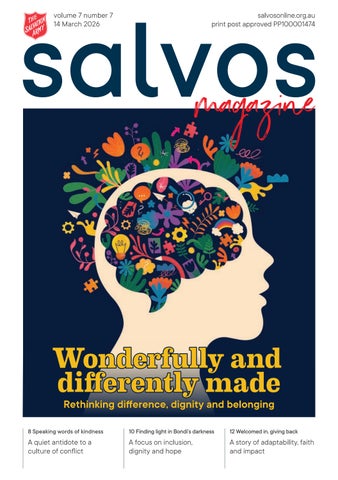
Wonderfully … and differently made
Making room for everyone to belong
by Anthony Hunt
It began, as these journeys often do, not with me, but with my children.
As we tried to understand why school days left them exhausted, why emotional regulation required so much effort, or why focus seemed to come and go, I recognised something familiar. Their experiences echoed my own childhood –only now there were words for it.
In learning how to support their developing minds, I began to understand my own.
Many adults who discover they are neurodivergent later in life share similar memories. School report cards that praised potential but questioned consistency. Teachers writing comments like, ‘If only they applied themselves,’ or ‘Bright, but easily distracted’. A familiar contradiction often appears early: being capable of complex thinking, creativity or handling pressure, while struggling with everyday organisation and follow-through.
Labels
These experiences are rarely understood as difference. Instead, they become character judgments. Lazy. Disorganised. Too sensitive. Over time, those labels settle in and quietly shape how people see themselves.
For people of faith, this internal story can carry extra weight. When self-discipline, order and consistency are closely linked
to faithfulness, difficulty managing time, attention or energy can feel like a moral or spiritual failure. You pray harder, try new systems and promise yourself you will do better next time. When change does not come, shame often takes root.
A different lens
Neurodiversity offers another lens.
Neurodiversity recognises the natural variation in how human brains work. It includes experiences such as ADHD, autism, dyslexia and sensory processing differences. These are not new realities, but newly named ones. Many adults grew up without language to describe their experience or systems designed to support it. Difference was often corrected rather than understood.
For parents raising neurodivergent children, this can be confronting. As you learn to advocate for your child, to recognise sensory overload or emotional exhaustion, you may also begin to see how little understanding you were offered yourself.
That recognition often brings both relief and grief. Relief, because there is finally an explanation not rooted in failure. Grief, because of the years spent believing you were the problem.
Neurodivergent people often carry a particular mix of challenges and strengths. While everyday tasks can
feel overwhelming, many are calm in moments of crisis. While organisation may be difficult, their sense of justice is often strong. While attention drifts in some settings, it can lock deeply onto what matters. Many notice subtle shifts in mood or atmosphere, carrying deep empathy and emotional awareness.
These qualities are often the traits that draw people toward advocacy, creativity and justice.
Strengths of difference
Scripture affirms that God works through difference. The biblical story is not one of uniform personalities or abilities, but of diverse lives called into faithful service.
Within The Salvation Army in Australia, faith is often described through the vision of living, loving and fighting alongside others. This language reflects the heart of the gospel: a faith that is active, relational, and grounded in compassion and justice.
Living alongside others means telling the truth about who we are, including how our minds work. Loving means extending grace, patience and understanding,
PHOTO BY HIKI APP ON UNSPLASH
not only outward but inward as well. Fighting means standing against shame, exclusion and systems that overlook or misunderstand difference.
The whole person
Seen this way, accepting the brain you have is not self-focused. It is formative. As we grow in understanding and accepting ourselves, we are better positioned to understand and accept others. We become less quick to judge, more willing to listen, and more able to walk with people whose experiences differ from our own.
For parents, discovering neurodiversity invites grace in two directions: towards children navigating a world not always designed for how their minds work, and towards yourself, as you unlearn old narratives and relearn your story.
There are still days of exhaustion, frustration and uncertainty. But there is freedom in naming what is true, adjusting expectations, seeking support and celebrating unique progress.
Within Salvation Army communities, there has long been a commitment to
seeing the whole person. Body, mind and spirit belong together. Dignity is not earned through performance. Justice is not reserved for those who conform. Compassion begins with listening.
Room for all
For churches and communities, neurodiversity invites gentle reflection. Who feels safe to be themselves here? Whose ways of engaging are assumed to be ‘normal’? Who may be present, faithful and committed, yet quietly overwhelmed?
Making room for difference does not require complex programs. It begins with curiosity instead of correction, patience instead of pressure, and the belief that faithfulness wears many faces.
Perhaps one of the quiet gifts of discovering neurodiversity is learning to see ourselves and those we love with greater grace. It invites us to release shame that was never ours to carry and to recognise difference, not as failure, but as part of how God has shaped us.
To say we are fearfully and wonderfully made is not to deny struggle or complexity. It is to affirm dignity. We are fearfully, wonderfully … and differently made. Our minds are not barriers to faith, but part of how we are formed for life with others.
As we grow in understanding and accepting ourselves, we are better able to live, love and fight alongside others. This is faith expressed in everyday ways: walking together, standing for dignity, and making room for every person to belong.
Captain Anthony Hunt is a Salvation Army officer (pastor) in Queensland
To read the full version of this story, go to salvosonline.org.au
PHOTO
Everyone belongs
Celebrating Harmony Week 2026
Harmony Week (17-23 March) is an annual celebration of Australia’s cultural diversity and the benefits it brings to the Australian community. The week includes the United Nations International Day for the Elimination of Racial Discrimination on Friday 21 March (harmony.gov.au).
Harmony Week is a time to celebrate that Australia is one of the most successful multicultural societies in the world. It is about inclusiveness, respect and belonging for all Australians, regardless of cultural or linguistic background, united by a set of core Australian values.
Our cultural diversity
Building on over 65,000 years of First Nations cultures, Australia has become home to migrants from nearly 300 different ancestries.
All people who migrate to Australia bring with them some of their own cultural and religious traditions. They also take on many new traditions. Collectively, these traditions have enriched our nation.
Facts and figures
The Australian Bureau of Statistics 2021 Census showed the following:
• More than half (51.5 per cent) of Australian residents were born overseas or have at least one parent who was.
• Nearly every single country from around the world was represented in Australia’s population in 2020.
• More than 150 Aboriginal or Torres
Strait Islander languages are spoken in Australia.
• Apart from English, the most common languages spoken in Australia are Mandarin, Arabic, Vietnamese, Cantonese and Punjabi.
During Harmony Week, let’s come together with friends and family and through schools, workplaces and our wider communities to celebrate our diversity. Check your local news or social media for details of events near you.
To show your support for cultural diversity and an inclusive Australia, you can also wear something orange, the official colour of Harmony Week.
Traditionally, orange signifies social communication and meaningful conversations. It also relates to the freedom of ideas and encouragement of mutual respect.
Speaking words of kindness
A quiet antidote to a culture of conflict
by Jo-anne Brown
It seems I’ve been unintentionally surrounding myself with words lately. ‘Grace’ and ‘peace’ have always welcomed people into our front yard.
Now, guests walk past another ‘peace’ as they come into the house. ‘hope’ greets them as they sit down, and ‘beloved’ reminds us all that we are deeply loved.
I look around at my words and recognise that this is truly what I wish for all who come into my home: grace, peace, hope, and the knowledge they are deeply loved. I hadn’t really planned to surround myself with these words, it simply evolved as I had time to create and decorate my home over the summer holidays.
These words reflect how I want to live my life – not just how I speak, but how I do everything. There’s currently a lot of public awareness around hate speech – a very
necessary focus on doing all we can to change a culture that leans so quickly into speaking hate-filled words and acting in hate-filled ways. One focus is on passing legislation that criminalises hate speech.
Something deeper
There is, however, something deeper and more intrinsic for us all to think about. This is a deep, complex issue that’s not just about what comes out of mouths. The loud and conflicting voices that contribute to the debate seem to evoke even more anger and hatred, rather than bringing calm. What drives hate speech, and what is the antidote? Legislation is only one way and doesn’t necessarily deal with the underlying cause.
We need to dive deep within ourselves to discern what drives hate speech before we can work out how to respond to it. Hatred
PHOTO BY CARL HUNLEY JR ON UNSPLASH
often arises out of fear: fear of differences, fear of being pushed out of our comfort zone, of not being in control, of being hurt. We all have parts of ourselves that harbour these fears and hurts, that cause us to lash out in anger, seeking to pull others down. When we have been hurt or badly treated in the past, we may become more sensitive to criticism, and more defensive. Hating ‘the other’ becomes easier than acknowledging our own pain.
Perhaps we have grown up hearing more hate speech than any other kind of speech, and don’t even know that a different kind of language exists. There are many resources available to help us deal with the fearful, angry, or wounded parts of ourselves and to lead us into a deeper experience of kindness and compassion.
Connection with others and getting to know those we have negative feelings about helps us overcome fear. When we realise that everyone has a story and we discover some common ground, we find that hatred or distrust is replaced with kindness and compassion.
Love or grace?
I wonder what the opposite to hate speech might be. We can’t really talk about love speech! Love is a word that is overused, frequently misused, and often watered down. And very prone to misinterpretation!
Perhaps the opposite is … grace speech?
Whatever the term, the opposite of hate speech is language that uplifts, encourages, inspires, welcomes, and includes. It’s language that inclines people toward kindness and hospitality, towards seeing the best in people and finding common ground. It’s also language that knows how to celebrate and learn from difference.
The language we speak is a verbal expression of what is within our hearts or souls. When we choose to overcome fear and distrust (and we might need help with that), we find that we all have a source of kindness and compassion within us for all of humanity. As we open our hearts toward others, then the words that flow from us are more likely to be uplifting, encouraging and affirming.
PHOTO BY BRADY JORDAN ON UNSPLASH
PHOTO BY JUNIOR USUANLELE-OSHODI ON UNSPLASH
Finding light in the darkness
A focus on inclusion, dignity and hope
by Mitchell Evans
Like many, I sat in disbelief that Sunday night as images of Bondi Beach flashed across the screen.
Seeing these familiar spaces associated with violence felt surreal and heartbreaking.
Reaching the community
When I received a call on the next day asking me to be part of The Salvation Army’s presence in the aftermath of the Bondi terror incident, I didn’t hesitate and made my way there.
As we walked along the promenade and made ourselves available to the community, the atmosphere was heavy with stunned silence. Beneath Bondi’s reputation for glitz and glamour lies a deeply connected community – a network of care and friendship.
This tragedy has shaken the community to its very core.
Throughout the day, I spoke with people from all walks of life, simply checking in and offering a listening ear. Some needed solitude, while others poured out their grief and fear. A few conversations from Monday have stayed with me, and I’m sure they’ll stay with me for some time to come.
One in particular was a lady I noticed not long after I arrived, a little way up the path, sitting by herself with tears in her eyes. I slowly made my way over to where she was and introduced myself before
asking if she needed to talk. Before long, we were sitting side by side on the wall overlooking an almost-empty beach. Then, through her tears, she shared, “The world has no humanity anymore.”
While her words were few, the pain she felt was heavy and very real. We sat quietly together, gazing at the vast ocean and the waves rolling in.
Sacred space
The ocean has always been a sacred space for me – a place where creation speaks loudly of our Creator. Its vastness reminds me of God’s greatness, his ‘big-ness’, and the rhythm of the waves whispers of his constant, unshakable character. No matter what storms rage in life, the waves keep rolling in – steady, relentless, like his love.
In seasons of difficulty, I often find myself drawn to the shoreline. There, with the horizon stretching endlessly before me, I try to block out the world’s unrelenting noise and focus on the One who holds it all together. For me, the ocean becomes a sermon without words: its depth points to God’s mercy, its power to his strength, its constancy to his faithfulness. I can’t stop the waves, and I wouldn’t want to – they remind me that his grace never ceases.
I was reminded that even when the world feels broken, God is still present.
And now, in the wake of tragedy, I found myself there again. The same
darkness of Bondi
ocean, the same waves, the same God. This time, I was not alone. Around me were others – neighbours, strangers, friends – each carrying their own grief, questions and fears from the night before. Yet there we sat – some together, some alone, just looking out at the water. I was reminded that even when the world feels broken, God is still present. His love is still relentless. His character is still unshaken.
Avalanche of love
After sitting in silence together for some time, I shared what had been stirring in my heart as we gazed out across the beautiful sands of Bondi Beach: these two men showed the worst of humanity, but they do not define it. Even in the face of hate, we witnessed an avalanche of love –people stepping into danger to help strangers, choosing compassion and love for others – over fear.
After a while, I said goodbye and went on my way to continue connecting with people. As I walked, I reflected that for those of us who follow Jesus, this is the call – to be light in darkness, to reflect his love when the world feels broken. Because even when evil tries to speak the loudest, goodness and grace still have the final word.
Mitchell Evans is the Sydney City Salvos Mission Team Leader
Welcomed in, giving back
Sam Tam Pho Liu recognised for lifelong service to multicultural communities
by Kirralee Nicolle
A retired Salvation Army officer (pastor) who arrived in Australia as a refugee has recently been awarded for his contributions to the community.
Lieutenant-Colonel Xuyen (Sam) Tam Pho Liu, who served for more than 30 years in both corps (Salvos church) and executive roles throughout Australia, was awarded the Chinese Australian Achievers Award 2025 for Community Service.
The awards are presented biennially by the Museum of Chinese Australian History in Melbourne, and celebrate the ingenuity, talent, creativity and contributions of Chinese Australians.
Sam, who has both Chinese and Vietnamese heritage, recently shared that he arrived in Melbourne as a refugee from Vietnam via Malaysia somewhat by fluke, as he was originally set to be placed on a boat to Brisbane, but a slip-up on a medical exam had led to him being sent south instead.
It was through his settling in Melbourne that he encountered The Salvation Army, attended training college and later became an officer.
He has since held a number of Salvation Army appointments, including church pastor, Media and Information Officer, Officer Commanding for The Salvation Army in Hong Kong and Macau, Canberrabased National Secretary, National Director for Multicultural Ministry, and
Executive Manager for Indigenous and Multicultural Media and Community.
Additionally, Sam has championed the cause of migrants and refugees in Australia and sought to bring issues faced by those of diverse backgrounds into public discussion.
Welcome and acceptance
In 2020, he wrote a reflection for Common Grace’s* Refugee Week campaign about his own story, and what he had learnt through his experience as a refugee.
“I have always been grateful for the provision the Australian Government afforded me when I arrived in Melbourne, 42 years ago, as a refugee from war-torn Vietnam,” he wrote. “Accommodation, food and financial support in the initial settlement made it easier for me to start a new life. These practical means were the essential ways to welcome me into the country.
“However, connecting with people required a different approach. It could not be ordered by government regulations. It could only rely on the goodwill of the community. I found when I opened myself to others, a genuine acceptance will surely be given in return. I too have learned to welcome others as a result.”
*Common Grace is “a movement of individuals, churches and communities pursuing Jesus and justice together for the flourishing of all people and all creation.”
Sam Pho speaks to media at the Red Shield Appeal Multicultural launch in May 2024.
Sam Pho with MultiConnexions CEO Sheba Nandkeolya at the Red Shield Appeal Multicultural launch.
�� Baked frankfurts and potatoes
Ingredients
Cooking spray; 350g frankfurt/precooked sausage, sliced; 43g baby potatoes, cubed; 2 capsicums, cored, seeded, sliced; optional: squash, carrots, onion, sliced; 2 tbsp oil; salt and pepper to taste
Method
Preheat oven to 200°C.
Prepare a large baking pan with cooking spray.
Arrange frankfurts, potatoes and vegetables in the pan; mix together or keep separate depending on preference.
Drizzle with oil and season. Mix lightly.
Bake 30 minutes, turning at 15 minutes.
Serve while hot.
Tip: keep all vegetable/frankfurt pieces to approximately the same size.
☺ Believe in Good: Tips
Dear friends: “Lead with your ears, follow up with your tongue, and let anger straggle along in the rear. In simple humility, let our gardener, God, landscape you with the Word, making a salvation-garden of your life.”
James chapter 1, verses 19, 21
The Message Bible translation
1. What do sparrows eat?
2. How can you tell a female from a male sparrow?
3. Can sparrows swim?
4. How long is the incubation time for a sparrow?
5. Do sparrows engage in dust bathing?
In 1598, Shakespeare’s acting troupe, the Lord Chamberlain’s Men, took apart their theatre (called ‘The Theatre’) piece by piece on Christmas night and transported it across the River Thames to build The Globe, where Shakespeare’s plays are still performed.
Whistling backstage is forbidden because, historically, sailors were hired as stagehands and used whistling to communicate rigging cues. An accidental whistle could cause a sandbag to drop on an actor’s head. ❓Did you know?
Have a laugh
What kind of birds heckle comedians?
Why don’t birds ever get speeding tickets?
Mockingbirds. Because they always fly under the radar.
What kind of birds make the best construction workers?
What do you call a bird that’s afraid of heights?
Which bird is always out of breath?
Cranes. A chicken. A puffin.
Tum-Tum
On which page of this week’s Salvos Magazine is Tum-Tum hiding?
✏ Answers
Tum-Tum: is hiding behind Sam on page 13.
3. Yes, they can swim fast when in danger. 4. Between 10-17 days. 5. Yes, as well as in water and snow.
Quiz: 1. Small insects, seeds, fruits and berries. 2. By the colours of their feathers.
�� Word
search
Words are hidden vertically, horizontally, diagonally, forwards and backwards. Enjoy!
Addition
Analytical Angle
Bible byte
“I already knew you before I made you inside your mother’s body. I chose you to be special before you were born.”