THE VOICE OF THE ARMY
SALVATIONIST SEPTEMBER/OCTOBER 2026
n
SALVATIONIST.CA
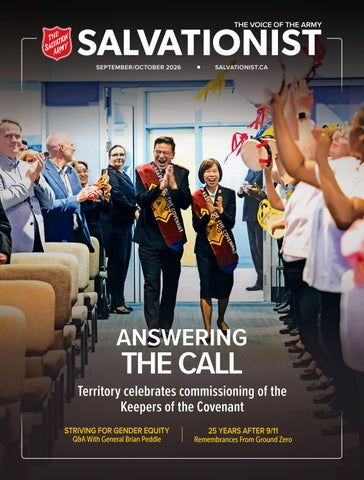
ANSWERING
THE CALL
Territory celebrates commissioning of the Keepers of the Covenant STRIVING FOR GENDER EQUITY Q&A With General Brian Peddle
25 YEARS AFTER 9/11
Remembrances From Ground Zero
Thank you for helping create brighter futures around the world. Because of your support, children are learning and growing in safe and nurturing environments.
AFRICA Schools Supported: 8
Children Supported Through Preschools: 490
Students Supported: 2,245 Preschools Supported: 4
Children Supported Through Community Programs: 560
SOUTH PACIFIC AND EAST ASIA Schools Supported: 1
Children’s Homes Supported: 4
Students Supported: 185
Children Supported: 108
AMERICAS AND CARIBBEAN Schools Supported: 1 Children Supported: 810 Educational and Community Programs: 7
SOUTH ASIA Children’s Homes Supported: 7 Children Supported: 265
EUROPE Children Supported Through Community Programs: 15 Children’s Homes Supported: 1
To learn more or make a donation, scan or visit salvationist.ca/brighterfutures
SEPTEMBER/OCTOBER 2026 Volume 21, Number 5
9
FEATURES 9 / Celebrating the Ordination and Commissioning of the
Keepers of the Covenant Five cadets and auxiliary-captains answer God’s call to become Salvation Army officers. by Abbigail Oliver
20
12 / Where God Leads
Others Award recipient Bruce Finkel serves The Salvation Army with a grateful heart. by Abbigail Oliver
14 / Closing the Gap
A conversation with General Brian Peddle (Rtd) on gender equity in The Salvation Army. Interview by Captain Laura Van Schaick
16 / Committed to the Climb
Ten years after Call to Action #48, how far have we come? by Captain Crystal Porter
16
18 / Taking the Next Step … Forward Together
From shared direction to meaningful action.
20 / May Our Love Be Confounding
What does it mean to share the love of Jesus in our social mission units today? by Jonathan Hopkins
DEPARTMENTS 5 / Frontlines 23 / Articles of Faith
Our God Who Is Never Alone by Lieutenant Zach Marshall
24 / Knowing Christ
I Am the Resurrection and the Life by Major Corinne Cameron
“
What God has promised, he will accomplish. So, as we step into the world that often feels uncertain, we do not go in fear, but in faith.
”
—LT-COLONEL LES MARSHALL, PAGE 9
25 / Perspectives
Leaving a Legacy by Graham Moore
CONNECT ONLINE
26 / Living History
Visit Salvationist.ca to add your comments and read web-exclusive articles
27 / People & Places
@salvationistmagazine Follow us on Instagram for the latest and best Army photos and Reels
Compassion Under Fire
30 / Q&A
Becoming Kin Interview with Mackenzie Griffin
COLUMNS 4 / Editorial
The Empty Chair by Geoff Moulton
8 / Onward
The Point of It All by Commissioner Lee Graves
READ AND SHARE IT! 2026 SEPTEMBER/ OCTOBER
Faith Friends I N S P I R AT I O N F
faithandfriends.ca
STUART WALTER Hometown Hero P.8
OR LIVING
HELPING THE ARMY A Model Idea P.10
/salvationistmagazine Like us on Facebook for photos, live streams and updates. Interact with our community of 47,000+ followers @salvationistmagazine Subscribe to our YouTube channel and get notified when new videos are posted issuu.com/salvationist Read current and past issues of Salvationist, Faith & Friends and Just for Kids on your tablet, desktop or smartphone
BUILDING A FUTURE Bali Boys Home P.24
9/11
Memories When tragedy struck New York City’s Twin Towers 25 years ago, The Salvation Army was there.
P.16
Cover photo: Steve Nelson
SALVATIONIST SEPTEMBER/OCTOBER 2026
3
EDITORIAL
THE EMPTY CHAIR SALVATIONIST
is a bimonthly publication of The Salvation Army Canada and Bermuda Territory Lyndon Buckingham General Commissioner Lee Graves Territorial Commander Graham Moore Chief External Relations Officer Geoff Moulton Director of Communications, Editor-in-Chief and Literary Secretary Pamela Richardson Assistant Editor-in-Chief Kristin Ostensen Managing Editor of Salvationist and Salvationist.ca Giselle Randall Senior Editor of Salvationist Abbigail Oliver Editor of Just for Kids and Staff Writer Ken Ramstead Editor of Faith & Friends Lisa Suroso Graphic Design Specialist Rivonny Luchas Digital Media Specialist Emily Pedlar Junior Graphic Designer Logan Graves Circulation Co-ordinator Agreement No. 40064794, ISSN 1718-5769. Member, The Canadian Christian Communicators Association. All Scripture references from the Holy Bible, New International Version (NIV) © 2011. All articles are copyright The Salvation Army Canada and Bermuda Territory and can be reprinted only with written permission.
Subscriptions
Annual: Canada $30 (includes GST/HST); U.S. $36; foreign $41. Available from: The Salvation Army, 2 Overlea Blvd, Toronto ON M4H 1P4. Phone: 416-422-6153; fax: 416-422-6217; email: circulation@salvationarmy.ca.
Advertising
Inquire by email for rates at salvationist@salvationarmy.ca.
News, Events and Submissions
Editorial lead time is seven weeks prior to an issue’s publication date. No responsibility is assumed to publish, preserve or return unsolicited material. Write to salvationist@salvationarmy.ca or Salvationist, 2 Overlea Blvd, Toronto ON M4H 1P4.
Mission
The Salvation Army exists to share the love of Jesus Christ, meet human needs and be a transforming influence in the communities of our world. Salvationist informs readers about the mission and ministry of The Salvation Army in Canada and Bermuda.
Salvationist.ca Facebook: /salvationistmagazine Threads: @salvationistmagazine YouTube: /salvationistmagazine Instagram: @salvationistmagazine 4
SEPTEMBER/OCTOBER 2026 SALVATIONIST
E
very church has one. An empty chair. An empty pew. A place waiting for someone who hasn’t walked through the doors yet. Many corps are settling back into the familiar rhythm of September. Summer camps have wrapped up, bands and songsters are back in rehearsal, Sunday school classrooms are buzzing again, and corps calendars are filling quickly. It feels good to be back. But as I looked around recently, I found myself thinking less about the seats that were filled and more about the ones that weren’t. Every empty chair represents a story that hasn’t been written yet. It could belong to a neighbour looking for community, a co-worker wrestling with life’s big questions or a family searching for hope. Over the past year, I had the opportunity to participate in two Alpha courses at territorial headquarters. If you’re not familiar with Alpha, it was created by Nicky and Pippa Gumbel at Holy Trinity Brompton in London, England, as a place where anyone could explore the Christian faith, ask honest questions and have meaningful conversations. Recently refreshed for a new generation, the course combines engaging films with open discussion. Today, Alpha is being offered in dozens of Salvation Army corps across Canada and Bermuda. Nicky Gumbel has said, “The church exists for those who are not yet members.” That’s both a challenging and an encouraging thought. What surprised me most about Alpha wasn’t just the content. It was where we were having it. Territorial headquarters is a busy place. Most days revolve around meetings, deadlines, budgets and the details that keep ministry moving forward. But once a week, we gathered around tables to talk about faith instead of finances, hope instead of schedules and Jesus instead of job descriptions. People listened. They shared their questions, experiences and hopes. Different perspectives were welcomed, and everyone had the opportunity to be heard. It was a reminder that some of the most meaningful ministry happens through simple conversations where people feel valued and cared for. As our corps settle back into their September routines, we will once again enjoy seeing familiar faces. But let’s not forget those who are still searching for a place to belong. Someone could be sitting in that empty chair next Sunday. Perhaps they’re new to the neighbourhood. Perhaps they’ve been thinking about church for months but haven’t had the courage to walk through the doors. Perhaps they’re simply waiting for an invitation. Every corps has its own way of extending that welcome. For some, it might be Alpha. For others, it could be a community meal, a music program, a Bible study, children’s ministry or simply a warm welcome at the door. The methods may look different, but the purpose remains the same: creating opportunities for people to encounter the love of Jesus. Christ’s command to proclaim the gospel continues to shape who we are. Serving people in practical ways and sharing the hope of Christ have always been at the heart of The Salvation Army. We must continue looking beyond the people already in the room. As another ministry season begins, may we be willing to make room— for the person who is searching, the neighbour who needs hope and the friend who has yet to discover the joy of belonging to a church family and, most importantly, to Jesus. GEOFF MOULTON EDITOR-IN-CHIEF
FRONTLINES
ALBERTA
:G eo ff M oul ton
Major (Dr.) James Watt Receives Order of the Founder Award
o ot Ph
Mjr (Dr.) James Watt shares a moment with General Lyndon Buckingham and Commissioner Bronwyn Buckingham as he receives the Order of the Founder
Mjr Watt cares for a severely dehydrated child while serving in Zimbabwe
Major (Dr.) James Watt, a retired officer and physician from the Canada and Bermuda Territory, has received the Order of the Founder, The Salvation Army’s highest honour. Renowned for his medical work at Howard Hospital in Zimbabwe, where he faithfully served those in need and established critical health-care infrastructure, Major Watt was presented with the award by General Lyndon Buckingham in April in Calgary during the Jesus Our Compass cross-Canada tour of the General and Commissioner Bronwyn Buckingham, World President of Women’s Ministries. Major Watt graduated from the University of British Columbia Medical School in 1967. Sensing the call of God on his life for full-time ministry as an officer, he spent one year in the Toronto College for Officer Training, together with his wife, Major Bette Watt, before they were commissioned in 1970 with the rank of captain. Their first appointment took them to Howard Hospital in the then Rhodesia Territory in south-central Africa. Serving during a period of civil war and political unrest, Major Watt’s responsibilities at Howard Hospital included medicine, pediatrics, obstetrics, psychiatry,
infectious diseases, nurses’ training and community health. “Due to the seven-year-long War of Independence, I was the only doctor there for half this time, starting mobile clinics on land-mined roads to serve the ‘protected villages’ (concentration camps),” he shared on the UBC Medical Alumni Association’s website when he received their Wallace Wilson Leadership Award in 2018. “We opposed torture and treated both sides in the conflict, resulting in threats of detention, expulsion and death.” Major Watt was encouraged to leave the country as a safety precaution, but he refused and remained at the hospital to help those in need. Surviving several attempts on his life with the help of God, he worked with other missionary doctors to prepare Zimbabwe (formerly Rhodesia) for the future of medical work after the civil war. Thanks to their efforts, a plan was put in place for rebuilding and restructuring, which gained government acceptance and was implemented on a national level. The Watts returned to Canada where he served at Calgary Children’s Village and helped establish the Calgary Urban
Projects Society/CUPS Clinic, an HIVAIDS clinic in downtown Calgary. They were again appointed to Zimbabwe, first to support the work at Tshelanyemba Hospital and then again at Howard Hospital. Majors Watt retired in 2000 in Calgary, where they attend Berkshire Citadel Community Church.
Surviving several attempts on his life with the help of God, he worked with other missionary doctors to prepare Zimbabwe for the future of medical work after the civil war.
The Order of the Founder was instituted by General Bramwell Booth in 1917 to mark “outstanding service rendered by officers and soldiers such as would in spirit or achievement have been specially commended by the Founder.” SALVATIONIST SEPTEMBER/OCTOBER 2026
5
FRONTLINES
NEWFOUNDLAND & LABRADOR
“I’d like to recognize the volunteers who came out that day. I asked them to give up a Saturday morning, and they ended up giving the entire day,” says Mjr Pam Goodyear
The Salvation Army appears in a new episode of Historica Canada’s iconic Heritage Minute series, highlighting the generous response of Gander, N.L., in the aftermath of the terrorist attacks on September 11, 2001. In the wake of the tragedy, American airspace was promptly closed, leaving thousands of airline passengers stranded in Gander. The Salvation Army played a significant and compassionate role in this response, helping distribute meals and
6
SEPTEMBER/OCTOBER 2026 SALVATIONIST
Salvation Army Participates in 9/11 Heritage Minute organize food storage at a local hockey rink, shelter passengers at the corps, hand out clothes and other necessities, and provide pastoral care to those in need. To recreate the 2001 events, 12 members of Gander Citadel gathered at the airport for a full day of filming in March. They filmed scenes including the lines of passengers receiving assistance from The Salvation Army and the Red Cross, as well as shelter spaces with cots, food distribution and clothing donations. Other scenes featured children helping distribute sandwiches and passengers watching news coverage as the attacks unfolded on TV. Among the cast was Rick Mercer, comedian, author and native Newfoundlander, who portrayed Claude Elliott, the mayor of Gander at the time, who also happened to be a Salvationist. He walked among the passengers, comforting them as they waited. Salvation Army volunteers interacted with passengers as they would have during the actual emergency response, offering support and assistance. Army volunteers were dressed in full Salvation Army uniforms, branded cloth-
ing and aprons. Some in the cast had personally assisted during the original 9/11 response and were keen to play a role in the re-enactment. Producers also conducted interviews with several of the individuals who were on the ground in Gander during 9/11. “During filming, we even had people coming up and thanking us for our work during 9/11,” says Major Pam Goodyear, then divisional secretary for public relations for the Atlantic Division, who also participated in filming. For Major Goodyear, the project highlights a turning point in the history of Salvation Army emergency disaster services in Canada. “I think 9/11 was where much of our emergency response work really became organized and developed into what it is today,” she says. “A project like this also helps show that while The Salvation Army is a church, what we do extends well beyond what people might traditionally associate with church life.” Watch the Heritage Minute online at youtube.com/HistoricaCanada.
FRONTLINES
TERRITORIAL NEWS
Salvation Army Media Wins 20 Awards
In May, The Salvation Army’s territorial magazines and digital/other media won 20 awards from the Canadian Christian Communicators Association (CCCA) during a conference held in Toronto, with 10 awards being first-place wins. Overall, Salvationist took home seven awards, Faith & Friends received five and digital/other media garnered eight. Award categories ranged from News Story to Photo Essay to Original Song. The awards were given for work published in the 2025 calendar year. Salvationist.ca took top honours in the General Excellence—Website category, as did the Salvationist podcast in its category. Dr. Isaiah Allen’s reflection on Joseph, the
father of Jesus, received two awards—a first place for Biblical/Theological Reflection and a third place for its accompanying illustration, by Rivonny Luchas. Both magazines were honoured in the From the Editor category, with Geoff Moulton, director of communications and editor-in-chief, taking first place for “I Was in Prison ... ” in Salvationist and Ken Ramstead, editor of Faith & Friends, securing third for “Teachable Moment.” Reflecting on the conference as a whole, Moulton notes, “It was inspiring to gather with Christian communicators from across denominations, united by a shared calling to point people to the gospel. “I’m grateful for the remarkable work
being done across The Salvation Army— from our editorial team to video production, photography, music and arts, and digital communications,” he adds. “The awards reflect creative excellence and a commitment to ministry through storytelling.” The CCCA (formerly the Canadian Church Press) has 60 members, including individual writers, musicians and representatives from publications of mainline, Catholic and evangelical churches. The awards are judged by accomplished secular journalists, writers and academics. To view a full list of awards, visit salvationist.ca/cccaawards2026. TERRITORIAL NEWS
Supplies and Purchasing Launches New Online Trade Store After many months of planning, a new online Trade Store has been launched to meet the needs of Salvationists in the Canada and Bermuda Territory and beyond. This new e-commerce platform provides an enhanced customer experience that allows shoppers to complete orders directly online. In real time, shoppers are now able to see all items in stock, including sizes and colours, so they know what is available at the time of purchase. A seamless check-out experience provides a secure method of payment and a selection of available shipping options. Automatic receipting and the ability to track the status of any order is easily accessible. The orderdesk@salvationarmy.ca email address has been discontinued and replaced by tradestore@salvationarmy.ca to address any customer enquiries, such as navigating the new online store and placing custom orders for uniforms, corps flags and custom brand wear. Enhanced security features in the account set-up process allow The Salvation Army to protect the brand while providing full access to the public for all giftware, books and novelty items available for sale. Group pricing remains available to all musical sections and ministry units requiring uniform and brand-wear supplies. In addition, an entire landing page and catalogue has been established to promote and sell items produced through our partnership with Others: Trade for Hope, The Salvation Army’s international responsible trade initiative. This vital global ministry supports the Army’s efforts in its ongoing fight against human trafficking by providing job skills training and employment opportunities in Bangladesh, Kenya, Indonesia and other countries around the world. Visit the website at tradestore.ca. (Top) The new Trade Canada e-commerce site provides access to the same goods as the physical store, including brand wear, books, giftware and novelty items
VISIT OUR
NEW ONLINE STORE SALVATIONIST SEPTEMBER/OCTOBER 2026
7
ONWARD
THE POINT OF IT ALL Six ways William Booth modelled how to keep Jesus at the centre. BY COMMISSIONER LEE GRAVES
I
n Christ-centred work, Jesus is not an appendage or an afterthought. He is the core, the root, the source, the origin, the power, the point of it all: “For from him and through him and to him are all things. To him be the glory forever. Amen” (Romans 11:36 NRSVUE). Our territorial strategic plan calls us to hold all things—people, mission, leadership and administration—as spiritual undertakings. Holy winds are blowing across our movement, and the longing for a deeper spiritual life must be our priority. God is moving and working. Hopefilled days have returned, even though we have hard realities to face. We are no longer prepared to accept the status quo. Mediocrity no longer has a hold. Our movement, from bottom to top, expects more because the Lord himself expects more. Souls are being saved, members are being made, engagement is on the rise. Let us not hold an administrative-centric agenda but be guided by a strong spiritual agenda. The work must be done, but all work must find its point and purpose in the spiritual underpinnings of our movement. Our primary reason for being is to draw people to Jesus. Our Salvation Army theology directly teaches that even administrative duty is to be practised as a spiritual discipline. William Booth, co-Founder of The Salvation Army, masterfully harmonized intense spiritual leadership with rigorous administrative responsibilities. He famously instructed Salvationists to balance spiritual fervour with practical operations, teaching that administrative duties were simply the machinery needed to effectively “save sinners and serve others.” Booth’s approach to leading an orga-
8
SEPTEMBER/OCTOBER 2026 SALVATIONIST
nization required that spiritual vitality and administrative action be two sides of the same coin. This is often summarized by his philosophy: “Work as if everything depended upon work and pray as if everything depended upon prayer.” Territorial headquarters exists to support the territory in serving the mission of the movement. All who share in roles and responsibilities, from the local to the most senior levels, are first and foremost spiritual leaders equipped with gifts and skills to perform administrative tasks. At every level of the movement, spiritual leaders must give priority to personal devotion. Booth warned: “You cannot warm the hearts of people with God’s love if you have an icy altar yourself.” He practised strict routines of daily prayer and Scripture reading, viewing personal surrender to God as the true measure of a leader’s power. On December 6, 1849, William Booth wrote a set of six resolutions, found among his papers after his death, with the title: “I do promise—my God helping.” 1. He committed to early morning prayer. 2. He pledged to guard his speech and avoid gossip. He referred to this as avoiding “babbling and idle talk.” He sought mastery over his tongue, recognizing that careless conversation, gossip and vanity sap a leader’s moral authority and distract from spiritual focus. 3. He pledged to model Christlike conduct and bold evangelism. Booth committed to a public witness of humility and zeal, actively steering conversations toward eternal matters.
4. He committed to a careful discipline for Bible study to ensure his life was anchored in Scripture. 5. He pledged to pursue a personal holiness and trusting providence. This combined a focus on personal purity with the decision to trust God with the outcomes of his work. 6. And finally, he pledged to enforce personal accountability. Booth ensured his commitment to these rules by building in a regular, personal review process. All Salvationists would do well to adopt these same resolutions. Let us always be mindful that the chief credential of a Christ-centred movement and leader is Christ. Christ is for us in carrying out his plan. His enabling grace is more crucial than our own credentials or experience, as important as those are. A Christ-centred movement with Christcentred leaders are resourced continually from the Scriptures and prayer. May our hunger and thirst for a deeper spiritual life keep us Christ-centred, others-focused and moving forward, “For from him and through him and to him are all things. To him be the glory forever. Amen” (Romans 11:36 NRSVUE).
COMMISSIONER LEE GRAVES
is the territorial commander of the Canada and Bermuda Territory.
Photos: Steve Nelson
(Above) Lts Steve and Florence Yau re-enter the sanctuary in officers’ trim
(Inset) Aux-Cpt Arthur Heathcote is ordained and commissioned by the territorial leaders
(Above) Aux-Cpt Florence Yau and Cdt Mariciel Nuyda share a moment before the service
(Left) Commissioner Lee Graves shares from the Word
(Above) Lt Alberto Theola is appointed to Moncton Citadel CC, N.B. (Right) Members of the London Citadel Timbrels
CELEBRATING THE ORDINATION AND COMMISSIONING OF
THE KEEPERS OF THE COVENANT Five cadets and auxiliary-captains answer God’s call to become Salvation Army officers. BY ABBIGAIL OLIVER SALVATIONIST SEPTEMBER/OCTOBER 2026
9
Lt Alberto Theola with Mjr Mark Crabb, his Silver Star recipient
The Keepers of the Covenant
he Canada and Bermuda Territory celebrated the ordination and commissioning of the Keepers of the Covenant in June, gathering for joyful praise, grateful prayer and powerful moments of testimony. After years of spiritual formation, ministry training and discernment, cadets and auxiliary-captains stepped forward into officership surrounded by family, friends, colleagues and leaders. The weekend focused on what it means to be a keeper of the covenant— not just for the newly commissioned session, but for each Salvation Army officer who has taken the sacred oath before them and for Salvationists and soldiers who have made the decision to give their lives and hearts to the Lord. A SACRED OATH The festivities began on Saturday afternoon for the ordination and commissioning service at Mississauga Community Church, Ont. The Canadian Staff Songsters (CSS), led by Songster Leader Cathie Koehnen, and the Canadian Staff Band (CSB), led by Bandmaster Andrew Burditt, opened the service with a soulful prelude. “We gather as God’s people to witness the ordination and commissioning of the Keepers of the Covenant in the Canada and Bermuda Territory. Today is not simply a formal occasion; it’s a sacred moment of worship and testimony,” said Lt-Colonel Shona Pike, then
10 SEPTEMBER/OCTOBER 2026 SALVATIONIST
assistant training principal, in greeting. She welcomed Commissioners Lee and Debbie Graves, territorial leaders; Colonel Margaret McLeod, chief secretary; former territorial leaders; College for Officer Training (CFOT) faculty; and retired international leaders, General Brian and Commissioner Rosalie Peddle and General Linda Bond. Also present were cadets of the Proclaimers of Transformation Session, and officers of the Messengers of the Kingdom and Messengers of Grace sessions that had been virtually commissioned in 2020 and 2021. As the CSS sang My Covenant, the Keepers of the Covenant entered the sanctuary, led by Cadet Alberto Theola, sessional flagbearer. Each cadet and auxiliary-captain was greeted on the platform by Commissioners Graves, sharing a Salvation Army salute. Major Deana Zelinsky, then training principal, welcomed the session. “We gather to recognize what has been accomplished but also to acknowledge what God has done and what he is about to do in the lives of the Keepers of the Covenant,” said Major Zelinsky. “These cadets and auxiliary-captains have been assessed not only in knowledge and skill, but in character, calling, spiritual maturity, leadership and commitment to Christ’s mission.” In a sacred and emotional expression of commitment, Aux-Captain Arthur
Heathcote, Aux-Captain Florence Yau and Cadet Theola recited the Officer’s Covenant in French and English. Then, all five Keepers of the Covenant presented their Affirmation of Faith in unison, led by Colonel McLeod. The cadets and auxiliary-captains stood before Commissioners Graves for their ordination and commissioning, each receiving a Scripture verse chosen for them by their training officers and territorial leaders. As the congregation sang and clapped to Stand Up, Stand Up for Jesus, the Keepers of the Covenant and the Proclaimers of Transformation exited the sanctuary behind their sessional flags. A LIFELONG COMMITMENT During a brief musical interlude, a timbrel brigade from London Citadel, Ont., marched to the front of the sanctuary accompanied by the staff band’s Jubilee! The timbrels then lined the aisles to help welcome the sessions back into the sanctuary. The Proclaimers of Transformation walked to the front followed by officers of the Messengers of the Kingdom and the Messengers of Grace sessions with their respective families and children. In an atmosphere of celebration, the officers that had been commissioned under pandemic restrictions had the chance to experience their commissioning march and salute in person.
Photos: Steve Nelson
T
Finally, the congregation cheered as the Keepers of the Covenant marched into the sanctuary as newly commissioned lieutenants and a captain. They saluted the territorial leaders on the platform and Salvationists, friends and loved ones applauded. Each lieutenant and captain then stood before Commissioners Graves to receive their appointments. “You’re here today because God called you—not to a role, not to a position, not to a program; he called you by name, and you said yes,” said Lt-Colonel Roxanne Jennings, territorial secretary for personnel, in congratulations. “Officership is a lifelong response to God’s call—lived wherever you’re sent, among whomever you serve and sustained in grace alone.” GO IN FAITH NEON, led by Simon Gough, provided music for the service, leading the congregation in energetic worship to House of the Lord, followed by a prayerful rendition of Holy Forever. Newly commissioned Lieutenant Mariciel Nuyda read from Psalm 89, and Commissioner Lee Graves gave the message, reflecting on his own experience training as a Salvation Army officer. “We are asking you to carry a heavy mantle and to assume a weighty responsibility as you go forward to be Keepers of the Covenant. But you don’t bear that alone, because we bear that with you,” said Commissioner Graves. “Every individual who has said yes to the Lord assumes that mantle.
“IT IS AN ANOINTED PRIVILEGE TO BE THE CUSTODIAN OF THE GREATEST STORY EVER TOLD …. IT’S THE KEEPER OF THE COVENANT’S RESPONSIBILITY TO TELL THE STORY.” —COMMISSIONER LEE GRAVES
“It is a divine burden, and it is an anointed privilege to be the custodian of the greatest story ever told …. It’s the keeper of the covenant’s responsibility to tell the story,” he continued. As the congregation sang All That I Am, Commissioner Graves invited the Keepers of the Covenant to kneel at the mercy seat in prayer. Families, friends, colleagues and officers joined to pray God’s blessing over them. After a time of prayer, accepted candidate Elizabeth Borgela shared a testimony about her own calling—reluctant at first, she now eagerly anticipates the journey toward officership and the ministry opportunities that will unfold as part of God’s plan for her life. In closing, Major Carson Decker, territorial candidates secretary, offered a prayer for candidates, and Bandmaster Burditt led the CSB in Storm the Forts of Darkness, joined by the clapping of the crowd. “What God has promised, he will accomplish. So, as we step into the world that often feels uncertain, we do not go in fear, but in faith,” said Lt-Colonel Les Marshall, then territorial secretary for mission, in benediction. “The God whose faithfulness endures throughout every generation goes before us, walks beside us and remains with us.” The CSB and the London Citadel Timbrels closed the service with a cheerful postlude as the platform party exited the sanctuary, followed by Canada and Bermuda’s newest officers. KEEPING THE COVENANT The celebrations continued Sunday morning at territorial headquarters in Toronto where officers and loved ones gathered for a family service and Silver Star luncheon. Colonel McLeod welcomed attendees, including retired international leaders, current and former territorial leaders, representatives from CFOT and officers from across the territory. Lt-Colonel Pike called the chapel to worship, singing To God Be the Glory and How Great Is Our God. As the piano continued to play, she invited those in the audience to speak out in prayer and grateful thanks to God for his many favours. Captain Rebecca Hewson, corps officer at Victoria Citadel and a Messenger of Grace, shared her testimony of God’s
work in her life and ministry. Captain Chad Cole, then mission and ministry formation co-ordinator, CFOT, led worship with Blessed Be Your Name and Goodness of God, and Commissioner Lee Graves offered a prayer. Lieutenant Nuyda, representative speaker for the Keepers of the Covenant, reflected on her session and the people she trained with, who hail from different countries across the globe, but whose God-led journeys have brought them to Canada and Bermuda to be ordained and commissioned. She also spoke about her Silver Star recipients—individuals who sowed the seeds of ministry in her, and whose presence and grace guided her toward a life lived for God. “The Order of the Silver Star was established by Evangeline Booth to recognize mothers who had given a son or daughter to full-time officership in The Salvation Army,” explained Commissioner Debbie Graves. “Changed to the Fellowship of the Silver Star, it now includes fathers, guardians and others who have played a significant role in supporting a candidate’s call to officership.” Each of the Keepers of the Covenant went out into the audience to give their Silver Star recipients a gift and ceremonial pin to thank them for their role as a spiritual mentor. The message came from Lieutenant Steve Yau, who is appointed to Richmond Corps, B.C., where he has served during his training. He reflected on his path to officership and trust in God’s timing. “Keeping the covenant is so easy when everything is going right—when you agree with everything God is doing and when you see the destination he’s bringing you to,” Lieutenant Yau said. “It’s only when you go uphill, when there are decisions you don’t agree with, when you can’t see God’s promises being fulfilled, that it’s easy to quit. But you have a choice. You can be a keeper of the covenant, or you can quit. “God uses these pressure points to drive us to our knees,” he continued. “And in prayer, I met God.” The service was followed by a luncheon in honour of the Silver Star recipients, and fellowship time with colleagues and loved ones. The newly commissioned captain and lieutenants left the weekend with hearts full, energized for mission and the journey ahead as Salvation Army officers. SALVATIONIST SEPTEMBER/OCTOBER 2026 11
WHERE
GOD LEADS Others Award recipient Bruce Finkel serves The Salvation Army with a grateful heart. Photo: Geoff Moulton
BY ABBIGAIL OLIVER
(Above) Bruce Finkel receives the Others Award during a service at Calgary’s Glenmore Temple. From left, Commissioner Debbie Graves, territorial leader for spiritual life development; Commissioner Bronwyn Buckingham, World President of Women’s Ministries; General Lyndon Buckingham; Finkel; and Lt-Col Donna Bladen, divisional officer personnel and divisional spiritual life development secretary, Prairies and Northern Territories Div (Right) Irene and Bruce Finkel
F
or more than 40 years, Bruce Finkel has quietly served The Salvation Army wherever there was a need. As a first-generation Salvationist, Finkel came to the Army through a volunteer opportunity at a seniors’ lodge when he was just 14 years old, and it turned into a lifelong journey of faith, service and soldiership. In April 2026, during the General’s Jesus Our Compass tour, Finkel received an Others Award, meant to recognize people who live out love through selfless service and dedication to helping others. He didn’t know that he would be receiving the award until his name was announced, and he was shocked but blessed to have received the recognition. “People showed unconditional love to me, giving me opportunities and welcoming me into The Salvation Army,” says Finkel. “I experienced the unconditional love of Jesus Christ when I was saved. If I can do something that shows unconditional love to others, then I believe that’s what I’m called to do.” AN UNEXPECTED JOURNEY Finkel’s first contact with The Salvation Army was through volunteer work at
12 SEPTEMBER/OCTOBER 2026 SALVATIONIST
Sunset Lodge in Winnipeg. At the time, the officers at Sunset Lodge took a chance on Finkel by letting him volunteer as a young teenager. “I’d read to the residents, take them out for walks and do all sorts of things,” says Finkel. “That was my first real exposure to The Salvation Army.” Only two years later, he attended his first Salvation Army church meeting at Winnipeg Citadel. Finkel came from a family of mixed Jewish and Christian backgrounds, but they didn’t practise religion, though Finkel’s exposure to The Salvation Army made him curious. His interest in The Salvation Army was not well received by his parents at first. The words of Matthew 19:29 spoke to him: “And everyone who has left houses or brothers or sisters or father or mother or wife or children or fields for my sake will receive a hundred times as much and will inherit eternal life.” “I almost used that verse with my parents to say that if becoming part of The Salvation Army meant making those sacrifices, then that’s what I had to do,” he says. His first service at the corps was during the Self-Denial campaign, and he recalls
a missionary showing images of his time in India. “I went because of the band—I liked the band and the atmosphere. I kept coming back week after week, learned more about the Lord and made a decision for Jesus on the August long weekend of 1965.” Later, he met his wife, Irene, and the two began attending North Winnipeg Corps. “Further education and employment took us to Northern Ontario, Manitoba and Alberta, and wherever we went, we were involved in the corps,” he says. TAKING A CHANCE Finkel’s vocational background is nursing. He worked as a nurse for a few years, spending the rest of his career in hospital administration in both Manitoba and Alberta. “Because of my health-care background, I was asked to step in as interim executive director at Grace Manor in Edmonton for a year while they were going through some changes,” he explains. “So, I started my exposure to the Army at Sunset Lodge and ended it at Grace Manor. It was a wonderful opportunity.”
Finkel has been involved in The Salvation Army in many ways, but his longest role has been as corps treasurer in Wetaskiwin, Alta., for more than 40 years. “Wherever we were, we served as Sunday school teachers, league of mercy workers and, in those days, we also did War Cry distribution in the pubs. Wherever there was an opportunity to serve, we served,” he says. A DAILY WALK “My faith journey has been one of growth, thankfully,” says Finkel. “I’m certainly more mature than I was when I first came to faith as a young person.” Throughout it all, Finkel has always understood the importance of the mission of The Salvation Army and that the source of his strength is Jesus Christ. And being a first-generation Salvationist has enriched his life in ways he never expected. “What Scripture says about the blessings that come from following the Lord Jesus Christ is true,” he says. “Whatever difficulties my wife and I have experienced have been outweighed by the blessings we’ve received from relying on a daily walk with Jesus.” For Finkel, the consistency of the love of Jesus has been evident throughout his
life. He prayed for his family faithfully, and when his father was 85 years old, he finally accepted the Lord and became a soldier. “We’ve seen tremendous blessing,” he says. ACTS OF KINDNESS One experience that has stayed with Finkel over the years involved a man in Edmonton who was experiencing homelessness. His name was Richard, and the Finkels would invite him into their home occasionally, offering him a safe place to shower, wash his clothes and take a break from being on the streets. Today, the Finkels have been in touch with Richard for more than 15 years. “We’ve watched him go from living on the streets to having a place of his own. We’ve seen such a change in his life through consistent love and support. “Commissioner Christine MacMillan once encouraged people that, if they chose to give money to someone experiencing homelessness, not to toss it to them, but to get down to their level and look into their eyes, because when you look into their eyes, you’ll see their soul,” he says. “We had the experience of seeing Richard’s soul, and that’s something that has stayed with us forever.”
At one point, Richard fell into trouble and ended up in remand, and he had a cat that needed looking after, so Finkel fed the cat for him. It was a small gesture, but one that mattered deeply to Richard. These small acts of kindness are important to Finkel, whose life has been shaped by the words of Lord, I Pray That I May Know Thee and The Saviour of Men Came to Seek and to Save—songs from the Song Book of The Salvation Army with lyrics about showing God’s love and compassion to others in word and deed. MANY BLESSINGS As Finkel reflects on his years serving in The Salvation Army, he expresses gratitude for the officers and corps members who have supported him and Irene through their faith journey. Because of the support they’ve received, they’re inspired to give the same to others. “All we can hope to do is give back for the wonderful experiences we’ve had,” says Finkel. “I am where I am today because people chose to take a risk on me and give me opportunities to serve,” he continues. “As a result, my wife and I have had the most wonderful experience serving God through The Salvation Army. For that, I’m eternally grateful.”
FALL INTO
PREPAREDNESS
SALVATIONIST SEPTEMBER/OCTOBER 2026 13
CLOSING THE
GAP
early directive, he stated, “A woman officer can hold any rank within The Salvation Army, up to and including the rank of General.” A bold statement, but one that came true in three women: General Evangeline Booth, General Eva Burrows and General Linda Bond (Rtd). And yet, it is important to acknowledge the gap. Phrases like systemic gender issues, default appointments, cultural norms and “it’s a man’s Army” bothered me. I recall declaring “enough is enough” in an article in The Officer magazine. The focus from the General’s office was on the 300-plus officers needed to lead at the executive level. Some of our single women officers were recognized, but nearly 50 percent of our 16,000-plus contingent were married women and they were not visible in the appointment process. To progress this agenda, steps needed to be taken. LVS: What did those steps look like?
A conversation with General Brian Peddle (Rtd) on gender equity in The Salvation Army.
C
aptain Laura Van Schaick, territorial gender equity officer, recently sat down with General Brian Peddle (Rtd) to discuss the ongoing work of gender equity within The Salvation Army—both internationally and here at home. Their conversation reflects on the progress made, challenges encountered and their hopes for the future, and highlights the importance of recognizing and empowering the gifts and leadership of women and men across the Army. Captain Laura Van Schaick: General Peddle, before your retirement
as international leader of The Salvation Army in 2023, one of your key concerns was gender equity. How did this come about, and how did you feel taking on such an important issue? General Brian Peddle: I became General after serving as the Chief
of the Staff with General André Cox. In one sense, I knew of my inheritance regarding this matter. The gap between theology and practice was already lurking in the shadows and in my commencement as General, gender equity was one of my declared priorities. In a time when women were not commonly accepted as church leaders, William Booth was countercultural. In an 14 SEPTEMBER/OCTOBER 2026 SALVATIONIST
BP: We established a gender equity task force at International Headquarters (IHQ), led by Commissioner Lisbeth Wellander and Commissioner Mark Tillsley. The team was composed of officers from each zone of The Salvation Army. It was shortly after the commencement of our journey that we heard about what was happening in the Canada and Bermuda Territory, and I recall asking the chairs to reach out with the hope we could learn from each other. LVS: Many of us in Canada and Bermuda were likewise paying close attention to the gender equity work at IHQ. Here, the
work began formally around the same time, in 2020, with the appointment of a gender equity advocate. The role was tasked with conducting interviews with women officers across the territory to assess the presence of any gaps in gender equity. While The Salvation Army has historically affirmed gender equality in principle, and both Canada and Bermuda are generally regarded as progressive in advancing women’s rights, the experiences shared by women officers revealed a persistent gap between our stated theology and lived practice, one that aligned with the challenges being addressed at the international level. Specifically, we heard about concerns related to default appointments and entrenched domestic stereotypes, particularly affecting married officers. Additionally, concerns were raised regarding limited access to leadership development and training opportunities for all women, as well as the underrepresentation of women in senior leadership roles, resulting in fewer visible role models. As you conversed with officers around the world, what were you seeing at the time with respect to the lived experience of women officers? BP: I saw two things, particularly as it pertains to the subject of
default appointments to women’s ministries. On one side, when default appointments are the wrong appointment, no one wins. It is mean, derogatory, fails in honouring equity in our ranks and ignores a person’s gifts.
On the other side, ministry to women should not be considered something negative. If we look at the male/female demographics in the Army, women easily outdistance men in their membership, engagement and overall resourcefulness. When women are led well, it makes a difference for the kingdom. In Africa and Southeast Asia, men took leadership roles and often women took default appointments connected with ministry to women. At the end of the day, there was nothing “default” about it. Women led a larger part of membership, their ministry made an impact, and it gave them a place at the table and a voice in the meeting. Still, I remain confident that the changes are moving in the right direction.
Here in the Canada and Bermuda Territory, I am also observing a growing commitment to addressing gaps in gender equity in meaningful and tangible ways. More women are being appointed to senior leadership roles, including positions such as territorial commander, chief secretary, divisional commander and area commander. These appointments provide visible and credible role models for emerging leaders across the territory. We are also placing a strong emphasis on early formation. Intentional conversations about the importance of gender equity are taking place with cadets and lieutenants at the outset of their officership. By establishing this foundation early, we are reinforcing a culture in which both women and men are recognized, valued and affirmed in their gifts and capacities.
LVS: What changes are you referring to?
BP: I celebrate this with you, and I sense that the generations to
BP: With the support of the gender equity task force, we began
poking at systemic issues. Despite what I’ve just shared about ministry to women, it was obvious that default appointments were an issue. The IHQ appointments board started to ask questions such as, “If officer A is given a specific appointment, then is it necessary for officer B to receive a traditionally linked appointment?” Another thing we did was to talk about the leadership of a territory in the context of perceived needs, and then secondarily ask the question, “Which one in the couple is best suited to lead?” Sadly, our women were not always ready, despite exhibiting the right gifting. A further response was needed, and that meant more exposure to board rooms and decision-making, and an improved understanding of business and finance. The hardest realization for me was that I would not likely see a lot of results in my term as General. Fortunately, there were runs on the board: married women officers were appointed to lead the Pakistan Territory and the Denmark and Greenland Territory. We could do it. I celebrate the fact that since my term, more married women are being recognized and appointed. We modelled it at IHQ first and then encouraged territories and divisions to do the same. Other heart-wrenching realities existed in forms that were harder to deal with. Within the wider equity challenge were issues of lack of opportunity, including the availability of education, training and the money needed to participate. Often men were given preferential treatment. I recall arriving in a territory to discover several women officers sharing an office and a single laptop, while each husband had his own. We made efforts to remove those barriers for all officers. Another barrier we tried to tackle was culture. There were places where our attitudes and actions were culturally OK, but they were not Christian and did not honour all those who were called, trained and ordained. I called out the Army culture when it seemed to be behind the country’s culture where we served. I recall a country where it was hard to appoint a woman, and yet there had been a woman prime minister. We were holding on to our created Army culture. LVS: I commend you for your efforts, and the efforts of the
gender equity committee of the day. This progress is indeed encouraging. General Lyndon Buckingham and his team are staying the course, and I am sure there will be more celebrations to come.
come will handle this better. As couples, in particular, I hope we can recognize each other’s gifts. And because this has been a little one-sided through the years, let me stand as a married man and say to other men, “Give way,” especially when you share ministry with a woman who is gifted for leadership. LVS: Speaking of leadership, there has also been a more intentional
investment in leadership development for women in the territory. This includes increased opportunities to participate in formative programs such as International College for Officers, as well as access to executive coaching and continuing education. These initiatives are helping to equip women with the skills, confidence and networks necessary for leadership at all levels. We are also closely monitoring membership and participation on all boards and committees and striving for gender equity at decision-making tables at all levels of the movement. BP: I think the raising up of leaders is critical to our future. We
don’t have the luxury to overlook who God has given to us, both men and women. I believe this is also a matter of stewardship, and if we are not faithful in using the resources we have, should we expect more? LVS: I completely agree. This is a matter of stewarding the time,
talents and giftings of the women and men God has called to officership. While there is still important work ahead, I am encouraged by the growing awareness, intentionality and action we are seeing across the Army. As we continue to create space for the gifts and leadership of both women and men to flourish, we strengthen not only our mission, but our faithfulness to God’s calling on all who serve.
GENERAL BRIAN PEDDLE (RTD)
CAPTAIN LAURA VAN SCHAICK
was the international leader of The Salvation Army from 2018-2023.
is the corps officer at Barrhaven Church in Ottawa, and the territorial gender equity officer.
SALVATIONIST SEPTEMBER/OCTOBER 2026 15
COMMITTED TO THE
CLIMB
Ten years after Call to Action #48, how far have we come? BY CAPTAIN CRYSTAL PORTER “We have described for you a mountain. We have shown you the path to the top. We call upon you to do the climbing.”—Murray Sinclair “Blessed are those who hunger and thirst for righteousness, for they will be filled.”—Matthew 5:6
O
n March 30, 2016, The Salvation Army joined other faith communities on Parliament Hill in response to the Truth and Reconciliation Commission’s (TRC) Call to Action #48. Major Shari Russell, then territorial Aboriginal ministries consultant, spoke on behalf of The Salvation Army in Canada and Bermuda, supporting the recommendation to engage with the United Nations Declaration on the Rights of Indigenous Peoples (UNDRIP) as a framework for reconciliation. Rooted in the calling of Christ to be ministers of reconciliation in the world, she reminded us to “recognize our responsibility in engaging the principles of this declaration.” Now, a decade later, we pause to look back with gratitude and forward with hope. We give thanks for the relationships that have been created, the conversations that have opened hearts and the many people who have chosen to walk this road together. We acknowledge the long journey of reconciliation; it is not a race to be won, but a way of life that continually calls us to walk with gentleness, deep understanding and faithful action. And yet, as we walk this journey, we trust that God is shaping us into an Army rooted in right relationship, where hope grows and all people can flourish together.
SHAPING A VISION It was together that we began to dig deeper into the journey of reconciliation for our movement. In 2015-2016, roundtable discussions were held at Beaver Creek Camp in Saskatchewan, Pine Lake Camp in Alberta and in northern British Columbia, where Indigenous Salvationists and divisional and territorial leadership came together in honest and often courageous dialogue. These moments created space to hear lived experiences, to honestly engage with history and to consider what a faithful relationship might require of us moving forward. The stories gathered from these spaces worked alongside the TRC Calls to Action and the UNDRIP to help shape a vision that would guide the years that followed. We learned quickly that creating space to gather, listen and share stories was an essential part of the journey toward reconciliation. And so, we gathered! We gathered around tables to learn from Indigenous theologians. We stood on blankets to hear the history of colonization from Indigenous perspectives. We sat in virtual circles and shared stories 2015-2016 Aboriginal ministry roundtable discussions are held across the territory
about being a good neighbour and what reconciliation could look like in our own ministries. We gathered to learn about land acknowledgments, the impact of the Doctrine of Discovery, how to partner with Indigenous communities and organizations, and how we can look at Scripture through Indigenous ways of knowing, being and doing. We gathered to build tipis and sweat lodges, laughed together as we prepared for feasts and experienced God through Indigenous ceremonies at the Celebration of Culture. LOCAL COMMITMENT While the territory has helped facilitate gathering spaces, local ministry units have walked a path shaped by their relationships and local commitments. Corps have participated in treaty days, powwows and local celebrations, and created land acknowledgments and reconciliation statements. Ministry units have worked alongside Indigenous organizations and communities to host healing circles, Territorial Truth and Reconciliation Committee is formed
2016 SEPTEMBER Aboriginal Ministries forum is held at Booth University College in Winnipeg
2005
2015 2014 Mjr Shari Russell is appointed the first territorial Aboriginal ministries consultant. Initially a part-time role, it becomes full-time in 2015
16 SEPTEMBER/OCTOBER 2026 SALVATIONIST
MARCH 30 The Salvation Army in Canada and Bermuda affirms the United Nations Declaration on the Rights of Indigenous Peoples as a framework for reconciliation, in response to the Truth and Reconciliation Commission’s Call to Action #48
indigenize church libraries, and create intentional learning opportunities for congregations, staff and community partners. Each reconciliation journey looks different, and yet what remains constant is the shared calling to listen deeply, learn faithfully and walk gently with humility and hope. This reconciling work is at the heart of what it means to exist as The Salvation Army. Our mission to share the love of Jesus, meet human needs and be a transforming influence in the communities of our world is lived out when we seek to walk in a good way, placing right relationship with God, with one another and with the communities we are called to serve at the centre of who we are. It is love expressed through listening, learning and accountability. Our commitment to reconciled relationships cannot be separated from our vision of building communities that are just and know the love of Jesus, because healing and restoration are who we were created and called to be. RIGHT RELATIONSHIPS We acknowledge that we are not outside the realities of pain and harm caused by colonization. The institutions and ideologies that contributed to it were not the true expression of the gospel, but were shaped by human desires for power, greed and self-interest. These
FEBRUARY A Salvation Army delegation attends Hobiyee, the Nisga’a New Year celebrations, in Gitwinkshilkw, B.C.
same patterns can still influence us today. As Jesus taught on the mountainside (see Matthew 5), we learn that to hunger and thirst for righteousness is to long for relationships made right: with God, with one another, with ourselves and with creation. This is the journey to reconciliation—a yearning to be restored so that all may flourish as God created us to be. We must continue to fully give ourselves to this journey to restore relationships, and it is there we will see the transforming work of God. Indigenous leader Karen Joseph (Musgamagw Dzawada’enuxw) teaches that “the interesting thing about reconciliation is that it really is a personal journey that starts internally, and then slowly works in through your family and through communities and through society.” Our journey of reconciliation within The Salvation Army has been shaped by a deepening awareness that the gospel calls us into right relationships. It is recognizing that the historical and ongoing impacts of colonization must be viewed through Jesus’ teachings of restoration, where healing, justice and humility make space for life to flourish.
As we have listened, learned and walked alongside Indigenous Peoples and communities over these past years, we are being formed into a people who not only seek understanding but transformation. The work of caring for one another is sacred work, inviting us to walk together toward a future where healing, right relationships and mutual flourishing become the gift we leave behind. This is the heart of reconciliation, not a destination to be achieved, but a way of living that shapes who we are and who we are becoming. We are climbing a mountain and there is still a long journey before us, but as we continue this journey together, I see The Salvation Army growing into a community that more faithfully reflects Christ’s love, walking gently with one another and flourishing as the body of Christ. CAPTAIN CRYSTAL PORTER is the divisional candidates secretary in the Atlantic Division and the territorial Indigenous ministries consultant.
JULY An Indigenous liaison role is created for emergency disaster services, with subsequent liaison roles throughout the territory
A new Salvation Army Gitxsan shield, designed by artist Michelle Stoney, is unveiled at congress and commissioning events in British Columbia
2023
2022
2021
2017
SEPTEMBER The Salvation Army partners with Indigenous Pathways for the first annual Celebration of Culture at Pine Lake Camp in Alberta
2025 Ontario Division hosts annual Celebration of Culture
The first annual culture camp is held at Camp Mountainview, B.C.
2019
JUNE The then Prairie Division and Booth University College sign the Winnipeg Indigenous Accord
2024
SEPTEMBER The Canadian government establishes the National Day for Truth and Reconciliation, also known as Orange Shirt Day, to be held each year on September 30. The Salvation Army recognizes this day as a statutory holiday and marks it with events across the territory, with a T-shirt designed by young Salvationist Trinity Murphy-Dicker The Salvation Army creates an Indigenous artist series with Mohawk musician Jonathan Maracle
Beaver Creek Camp in Saskatchewan partners with iEmergence, a member of Indigenous Pathways, for family culture camp New Indigenous ministries website is launched JULY The Nisga’a Four Crest Dancers from Gitwinkshilkw, B.C., perform at the INSPIRE Conference and Congress in Toronto
SALVATIONIST SEPTEMBER/OCTOBER 2026 17
TAKING THE NEXT STEP …
From shared direction to meaningful action.
O
ver the past several months, we have been introducing and reflecting on the territorial strategy through the theme: Forward Together: Christ-centred, Others-focused. This theme is more than a tagline. It expresses who we are as a territory and how we believe God is calling us to move forward together as one Army. “Forward Together” reminds us that we are united in mission and purpose. Across corps and community ministries, social services, camps, thrift stores, divisional and territorial headquarters, we are all part of something larger than ourselves. Though our roles and contexts may differ, we are moving in the same direction— together. “Christ-centred, Others-focused” keeps us grounded in what matters most. Jesus Christ remains at the centre of everything we believe, every decision we make and every act of service we offer. At the same time, we remain focused outward—meeting human needs, walking alongside people in hardship and sharing hope in practical and transformative ways. To quote General Lyndon Buckingham, “We are a Jesus people.” The four strategic pillars that guide our journey are: Strengthen Spiritual Health, Design for People, Forge Innovative Partnerships and Optimize Mission Impact. Together, these pillars identify the areas where focused effort is needed across the territory to make sure we are relevant and position us for the future. Together, the work being done in these pillars is helping us strengthen discipleship, invest in our people, expand collaboration and ensure that our resources are aligned to support mission for years to come.
18 SEPTEMBER/OCTOBER 2026 SALVATIONIST
STRENGTHEN SPIRITUAL HEALTH Everything begins with Christ. At the heart of The Salvation Army is our calling to share the love of Jesus Christ. As we move forward together, this pillar focuses on deepening spiritual life, strengthening discipleship and creating welcoming environments where people can encounter Christ and grow in faith. This includes strengthening our culture of welcome and discipleship. We’re exploring new and innovative approaches to outreach and continuing to build strong biblical foundations grounded in Scripture and Salvation Army doctrine. The goal is not simply to increase activity, but to foster meaningful spiritual growth and help people become lifelong disciples of Jesus Christ. There is also growing recognition that ministry must continue to reflect the diversity of the communities we serve. Our efforts will focus on building relationships across cultures and communities with greater understanding, sensitivity and intentionality. The goal is to strengthen our ability to share hope and serve others in ways that are welcoming, respectful and responsive to the realities people face. Another focus is creating stronger connections between corps, community ministries and social services. Across the territory, many people are already serving faithfully in ways that reflect Christ’s love every day. We are seeking to build greater alignment and shared understanding across ministries so that spiritual care, mission and service are more intentionally connected. For Commissioner Debbie Graves, territorial leader for spiritual life development, integrated mission begins with the example of Christ himself: “The Word became flesh and blood and moved into the neighbourhood” (John 1:14 The Message). “We must be practising the presence of God in our neighbourhoods and communities,” she observes. “This is integrated mission—not a program, but a way of life.” Investing in children, youth and young adults is essential to strengthening spiritual health across the territory. Young people want to explore their faith, and we can create opportunities for younger generations to build strong spiritual foundations, develop meaningful mentoring relationships and actively participate in the life and mission of The Salvation Army. Through worship, service, leadership opportunities and multigenerational connections, we want young people to know they are valued, heard and needed—not simply as the future of the church, but as an important part of God’s work today. In a Salvationist podcast interview following the Jesus Our Compass tour, General Buckingham reflected on the importance of investing in younger generations: “The Lord is speaking to this emerging generation. He’s making himself known to them.” We are committed to creating space for young people to grow in faith, discover their calling and recognize that they have a vital place within The Salvation Army. Ultimately, this pillar is about helping more people encounter Christ, deepen their faith and discover their place in our mission as we move Forward Together: Christ-centred and Others-focused.
DESIGN FOR PEOPLE Healthy ministry depends on healthy, equipped and supported people. Whether serving as officers, employees, volunteers or lay leaders, people are at the heart of everything The Salvation Army does. As communities change and the world in which we serve becomes more complex, there is a growing recognition that investing in our people is essential to sustaining our mission. As part of developing our leadership capacity, we will continue to enhance programs that prepare our people for the future. To attract people who understand who we are and are committed to furthering our mission, we will enhance our recruitment practices and develop mission-oriented onboarding. We are creating clearer pathways for lay leadership. Across many ministries, dedicated lay leaders already play vital roles in worship, discipleship, pastoral care, administration and community engagement. Equipping and empowering these individuals is critical to future ministry effectiveness. To ensure strategic continuity and sustain mission impact, we will develop approaches to retain critical knowledge and expertise through change, and build leadership practices that develop our future leaders for key roles and the complexity in which we serve. Ultimately, this pillar recognizes that when people are equipped, supported and empowered, mission flourishes. FORGE INNOVATIVE PARTNERSHIPS Impact often happens through collaboration. Communities today are facing increasingly complex challenges, such as food insecurity, mental-health challenges and addiction, lack of affordable housing, and other growing social needs. No single organization can address these realities alone. Collaboration is becoming increasingly important. We are continuing to forge innovative partnerships and exploring new opportunities to work alongside others in ways that expand mission impact. Partnerships may look different across communities and ministries. In some places, this may involve collaboration with local agencies or municipalities. In others, it may involve faith-based organizations, charities, community groups, funders and businesses. These partnerships help expand our reach, increase our effectiveness and create new opportunities to share hope in practical ways. Greater collaboration between corps, community and social services, thrift stores and emergency disaster services, brings us together in a community for more integrated and holistic ministry to serve as one Army. It means finding better ways to listen, collaborate and respond to changing needs while remaining faithful to our mission and values. Ultimately, this pillar is about multiplying impact through relationships and collaboration. OPTIMIZE MISSION IMPACT Transformative mission delivery means that we are positioned where we can share the love of Jesus to make the greatest difference and meet changing community needs. We are working hard to understand our communities, so we provide programs and services that are aligned to their needs. We will identify new opportunities for mission delivery by embracing the mosaic of our country. We will ensure that our many diverse resources are allocated in ways that prioritize mission-critical programs and services. With our modernized systems and access to better information, our leaders can make informed decisions and improve efficiency and reporting capabilities. Ultimately, this pillar is about making sure we are at the heart of where we are needed and where our mission can be a transformative influence—today and into the future.
“FORWARD TOGETHER” REMINDS US THAT WE ARE UNITED IN MISSION AND PURPOSE. MOVING FORWARD TOGETHER This work belongs to all of us. Not every area of work will affect every person in the same way. Some efforts will take place at the local level, others at divisional or territorial levels. Some changes will be visible quickly, while others will take shape over time. What connects them all is a shared purpose: strengthening our ability to serve, disciple, lead, support communities and advance the mission. Forward Together is about moving with greater clarity, unity and intentionality toward the vision God has placed before us. It is about ensuring that Christ remains at the centre of all we do, while keeping our focus firmly on others. As we continue this journey together, may we remain rooted in faith, encouraged by hope and committed to sharing the love of Jesus Christ wherever there is hardship.
SCAN THE QR CODE for a video from Commissioner Lee Graves, territorial commander, about embracing the territorial strategy as a road map for all mission partners, or visit youtube.com/salvationistmagazine.
SALVATIONIST SEPTEMBER/OCTOBER 2026 19
MAY OUR LOVE
BE CONFOUNDING What does it mean to share the love of Jesus in our social mission units today? BY JONATHAN HOPKINS
Jonathan Hopkins welcomes a guest to the Addictions and Rehabilitation Centre in Victoria
A
few years ago, in the dead of winter, I received a call after hours from a fellow caseworker at The Salvation Army’s Addictions and Rehabilitation Centre (ARC) halfway house in Victoria. I was immediately struck by the somber tone of her voice. She told me she had just been contacted by a nurse at a local hospital, who informed her that one of our clients (let’s call him Daniel) had passed away. She had been tasked with identifying his body because, unbeknownst to my colleague, he had listed her as next of kin. Daniel spent most of his life in Canada’s penitentiary system. From an early age, he was written off as “troubled.” He endured a childhood of abuse and trauma, which precipitated his turn to drugs and alcohol—a means of easing his suffering. Addiction and anti-social behaviour consumed him in adolescence. Women became the target of his rage. His repeated acts of violence produced unconscionable pain for his victims. The
20 SEPTEMBER/OCTOBER 2026 SALVATIONIST
legal system responded accordingly: a judge designated him a “dangerous offender” just as he reached adulthood. The decision meant he would spend the rest of his life in prison serving an indeterminate sentence. He was deemed beyond rehabilitation by the standards of our correctional system. After decades in prison, Daniel was released to The Salvation Army. He was gruff and reluctant to trust anyone. Given his history of offending against women, it was somewhat alarming that his primary caseworker was a young woman beginning her career in community corrections. Yet, as she advocated for him, holding him accountable without judgment, affording him dignity, he began to soften. In what would be the last year of his life, Daniel experienced joy, peace and a zeal for living unlike anything he had experienced before. His caseworker became the only person he regarded important enough to fulfil his last wishes on earth.
AGAPE LOVE I begin with this story because it gives us a glimpse of the kind of love Christ has called us to extend to others. “To merely welcome another, to provide for him or her, to make a place, is one of the most life-giving and life-receiving things a human being can do. They are the basic, universal acts of love,” writes Dallas Willard in Renovation of the Heart. This kind of love penetrates our souls and results in transformation and reconciliation for both the giver and receiver. For more than 2,000 years, the word that captured the full meaning of this kind of love was agape. The authors of the New Testament, writing in Koine Greek, used this word to articulate Jesus’ teachings on love. They expanded the word from its original meaning in ancient usage—denoting affection, esteem or preference—to a more encompassing love that involves sacrifice, service and acceptance, as modelled by Christ. The Apostle Paul’s oft-cited 13th
THE CHANGING LANDSCAPE OF SOCIAL MISSION The helping field, what we now commonly refer to as social services, has undergone seismic change in Canada since the late 19th century. Social work in this country began as a volunteer-led, private initiative, only gaining recognition as an academic pursuit in 1914. By 1926, the country’s first professional association—the Canadian Association of Social Workers (CASW)— was formed. While The Salvation Army and other charitable organizations long cared for “the lost, the outcast, the disinherited of the world,” in the words of William Booth, a major shift occurred during the Great Depression: the state became more involved in the lives of citizens facing unemployment and destitution. By the 1970s, government intervention expanded to include health, unemployment, welfare and pensions. This transformation paved the way for Canada’s social services to grow rapidly and professionalize. Thus, paid, educated and skilled professionals took up the reins of addressing the basic needs of individuals in our society. And despite changes in political and economic paradigms since the birth of the so-called welfare state, the role of government has been a consistent presence in social services. The Salvation Army is one of the largest and longest-serving social service providers in Canada. We have no doubt been affected by these changes. The lion’s share of funding we rely on to meet the needs of people who come to us for help in our social mission units is made possible by government contracts and grants. This funding comes with expectations of
contractual and regulatory compliance, an emphasis on deliverables, oversight, staff training and a higher degree of expertise among our personnel to offer services that are evidence- and best-practice-based. Staff are increasingly taught to prioritize policy compliance, efficiency, liability and documentation as the critical elements of their work. This is not a bad thing; it helps us meet operational demands and obligations so we can continue to care for those experiencing hardship. However, these activities require time and investment in systems that can detract from the overarching mission. Professionalization leads to what political economist Max Weber called the “iron cage,” where individuals become constrained by rigid systems of rationalization, efficiency and standardization. With professionalization, the roles of staff in social mission have transformed. What clients and funders expect from staff—the demands placed on the front line—have never been higher. Support workers are the first to arrive on the scene to provide life-saving measures— namely CPR and naloxone (medication that reverses the effects of opioid overdoses)—during client overdoses. The toxic supply of drugs currently on the streets has dramatically increased the potential for an overdose and, sadly, far too many are fatal. Unregulated drug toxicity (mostly illicit fentanyl) is the leading cause of death in British Columbia for those aged 10 to 59, and the vast majority (78 percent) of those perishing from drug overdoses are male, the target population the ARC serves. More than 16,000 people have lost their lives to overdose since being declared a public health emergency in 2016. Our
AGAPE IS HAVING THE HEART OF THE FATHER WHEN THE PRODIGAL SON RETURNS. support staff are exposed to death and near-death regularly, even in centres like the ARC, which is a sober-living facility. The severity and complexity of hardship experienced by people is greater than ever. With overlapping health, housing and economic crises, our social mission units see more refugees, complex mental-health cases, co-occurring disorders, exploited temporary foreign workers and people at the end of their lives with no family or peer support. Overcrowded emergency rooms and psychiatric wards have increased pressure for the elderly, severely mentally ill and chronic substance users to seek refuge at The Salvation Army. Staff have inherited duties that span the continuum of social work—from counselling to nursing. Close to 60 percent of the guests residing at the ARC transitional housing program are aged 60 and up. The needs of elderly residents with complex medical issues include early-onset dementia and life-threatening cardiovascular diseases. In the same building, our staff take on the role of de-escalating agitated individuals falling through the cracks of the system, while balancing our capacity and professional boundaries. We are expanding our front-line workforce by hiring personnel who are
Photos: Bianca Alojado
chapter of his first letter to the Corinthians clearly illustrates its beauty and scope. Sharing the love of Jesus is the centrepiece of The Salvation Army’s mission. It is the fountainhead from which our intention to meet human need flows. As our social mission and ministry units navigate the changing landscape of the social services sector in Canada, it is crucial we understand the nature of this “love” as agape and clearly communicate its meaning to those we serve and the staff we seek to empower. What are the shifting dynamics in social services work? And why is it important to define love in this way, using agape as the archetype for our understanding?
“Identifying love as agape illuminates our purpose for all mission partners in a complex and rapidly evolving social landscape,” says Hopkins
SALVATIONIST SEPTEMBER/OCTOBER 2026 21
WE OFTEN HEAR QUESTIONS LIKE, “DO YOU HAVE TO BE RELIGIOUS TO WORK HERE?” educated and equipped to navigate these changing circumstances. This means bringing more staff into the Army from a wide range of backgrounds—many of whom are unfamiliar with the Christian faith and, therefore, the mission. Our mission is why we exist and is central to all we do, so leadership at the ARC continuously engages new hires in conversations about its importance. We often hear questions like, “Do you have to be religious to work here?” This begs the question and brings us back to where we started: What does it mean to share the love of Jesus in our social mission units today? And how do we explain our mission in a way that is true and relevant? My answer—and I believe the answer that would help The Salvation Army—is to define what we mean by love. UNCONDITIONAL AND AVAILABLE TO ALL Since the earliest days of the church, agape was used to signify the kind of love God has for us and the kind he expects us to share. If we do not make this clarification with our mission partners about the nature of this love, we risk diluting our purpose or leaving it to the front line to interpret. If that is the case, we may resort to considering love as merely a means of self-help, political advocacy or, worse still, patter. Love then becomes sanitized, simple and palatable—nothing more than an extension of this world. Agape, Christian love, stands in stark contrast to the way love is commonly understood in our society. Agape is unconditional and available to all—free from conditions or expectations. Conversely, the fallen world is dominated by transactional forms of love, where relationships and actions are preoccupied with what can be gained in return. The most powerful social forces—economics, politics and culture—are governed by self-interest and a quid pro quo mentality. In his book The Return of the Prodigal Son: A Story of Homecoming, theologian Henri Nouwen notes: “There are endless ‘ifs’ hidden in the world’s love. These ‘ifs’ enslave me, since it is impossible to respond adequately to all of them. The world’s love is and always will be conditional. As long as I keep looking for my true self in the world of conditional love, I will remain ‘hooked’ to the world—trying, failing and trying again.” Loving others is unconditional; however, that does not mean it is free of accountability or consequence. In our centres, we provide a loving environment that includes setting expectations for our guests and having the courage to address unsafe or harmful behaviour. If someone violates program rules in an egregious manner, they must be held accountable. We forgive and we continue to love, and we hold out hope they will learn from the situation. I have seen countless men at the ARC stumble time and time again. Each time they return, I impress upon them and the staff how crucial it is to welcome them back and let the past be the past. Agape is having the heart of the father when the prodigal son returns. 22 SEPTEMBER/OCTOBER 2026 SALVATIONIST
Does the calling to love the vulnerable come with a heavy burden that could lead to burnout? Yes, if love is not properly practised and understood. The agape we share is not by sheer willpower alone. We must, as Scripture tells us, rely on Christ to work alongside us and accept that we find our true rest in Christ. We must also provide agape to our teams, as leaders and colleagues, and create cultures that uplift, encourage and “count others more significant than yourselves” (Philippians 2:3 ESV). THE GREATEST OF THESE Identifying love as agape illuminates our purpose for all mission partners in a complex and rapidly evolving social landscape. Agape is no less impactful today than it was in the Jewish and Hellenistic cultures of Palestine and across the Roman Empire in the first century. It is unique, confounding and transformative. Agape is what sets Christian love apart, and it is how our communities should be known. As the ancient theologian Tertullian wrote in defense of Christian communities living in the Roman world: “It is mainly the deeds of a love so noble that lead many to put a brand upon us.” In our age of uncertainty and change, agape must inform, animate and ultimately ground our approach to social mission. “And now these three remain: faith, hope and love. But the greatest of these is love [agape]” (1 Corinthians 13:13).
JONATHAN HOPKINS is the executive director of the Addictions and Rehabilitation Centre in Victoria.
SCAN AND GIVE HOPE OR VISIT: SALVATIONARMY.CA/GIFTSOFHOPE
ARTICLES OF FAITH
OUR GOD WHO IS NEVER ALONE
Articles of Faith is an 11-part series on the doctrines of The Salvation Army.
Three in one, and one in three. BY LIEUTENANT ZACH MARSHALL
“We believe that there are three persons in the Godhead —the Father, the Son and the Holy Ghost, undivided in essence and co-equal in power and glory.”—Doctrine 3 Salvation Army’s third doctrine stands squarely in this historic tradition. The phrase “undivided in essence and co-equal in power and glory” echoes the language won through those early councils, rejecting both the heresy that collapsed the three persons into one (Modalism) and the heresy that made the Son a lesser being than the Father (Arianism). This doctrine is a gift from the whole church across time, and it shapes everything about who we are and how we live.
The Trinity, an icon by Russian painter Andrei Rublev, depicts the three angels who visited Abraham at the Oak of Mamre. Also called The Hospitality of Abraham, it invites us to take a place at the table
Image: Wikimedia Commons
T
he doctrine of the Trinity did not emerge from a quiet library. It was hammered out in the heat of early church controversy, as Christian communities wrestled with the question that everything depended on: who, exactly, is Jesus? The Gospels and the letters of Paul testified that Jesus bore the full weight of divine authority—forgiving sins, raising the dead, receiving worship—yet the earliest believers remained committed monotheists shaped by Israel’s Shema: “The Lord our God, the Lord is one” (Deuteronomy 6:4). The church’s answer came through centuries of debate, culminating in the Council of Nicea (AD 325) and the Council of Constantinople (AD 381). These gatherings produced the Nicene Creed, affirming that Father, Son and Holy Spirit are co-equal and co-eternal—one God in three persons, undivided in essence. The
GOD WITHIN HIMSELF IS COMMUNITY The trinitarian conviction carries immediate and profound implications for how Salvationists understand themselves and their life together. Our own Handbook of Doctrine states it plainly: “God is a communion, a community of being, whose three persons share in intimate fellowship with one another.” God is never solitary. Before a single creature existed, the Father, Son and Holy Spirit were bound together in mutual love and self-giving. Theologian Stanley Grenz, in his book Theology for the Community of God, puts this with striking clarity: “The Father loves the Son; the Son reciprocates that love; and this love between the Father and the Son is the Holy Spirit … As the Spirit of that eternal relationship he is both fully deity and person.” The Trinity is, at its heart, a relationship, and that relationship constitutes the very nature of God. As Grenz continues, “The essence of God is love. Consequently, love stands as the ideal and standard for human life as well.” This is the ground beneath the feet of every Salvationist. Scripture tells us that humanity is made in the image of this triune God (see Genesis 1:26-27). Because God is inherently communal, the human beings who bear his image are inherently communal, too. We reach our fullness only in relationship, with God and with
one another. Isolation and individualism are, in the end, a contradiction of who we were made to be. COMMUNITY AS VOCATION In this light, the corps becomes more than a venue for religious activity for Salvationists. It is a place of formation—a community where we learn, week by week, to reflect the triune life of God. Major Ray Harris captures this well in his book Convictions Matter: “We learn to participate in the love of God by active involvement within our congregational life.” The quality of our fellowship is, on this reading, a theological statement. The Salvation Army, at least in our territory, has long embraced the role of the “love feast” as central to our understanding of sacramental living. Our official stance on the sacraments is that we don’t just observe two or three or seven, but invite Jesus Christ to suppers, celebrations, weddings, funerals, commissionings—and everything else in between. All of these have a communal aspect to them, and that is not a coincidence. By living out our trinitarian doctrine, we find ourselves in community with one another by design, building one another up and deepening our individual and collective spiritual vision. When a corps is marked by genuine welcome, honest accountability and shared mission, it becomes a living sign of the God it worships. This is the true practical wisdom that comes from our third doctrine. God has never been alone. And, in light of that truth, neither should we.
LIEUTENANT ZACH MARSHALL is the corps officer at The Salvation Army Faith and Hope Corps, Marystown, N.L. SALVATIONIST SEPTEMBER/OCTOBER 2026 23
KNOWING CHRIST
Exploring the “I am” statements of Jesus in the Gospel of John.
I AM THE RESURRECTION AND THE LIFE Learning to let go.
A
PRAYER PRACTICE A few years ago, I wrote this in my journal: Just as a tree lets go of its leaves and they fall to the forest floor, So too do we need to let go in our lives: of pain, of hurt, of unhealthy ambition and pride, The loss of leaves brings forth a time of waiting … a time of rest … and they hold a promise … for through their loss … comes the potential for new life!
Prayerfully reflect: • • •
What am I holding tightly? When am I striving, rather than being? Where in my life is God inviting me to “let go”?
24 SEPTEMBER/OCTOBER 2026 SALVATIONIST
utumn is my favourite time of year with its changing colours, crisp morning air and baking. When my children were little, we often played a game we called “scrunching”— finding leaves, jumping in them and listening to them scrunch as we jumped up and down. These leaves symbolize a sacrament of letting go while the trees prepare themselves for winter, shedding leaves for new ones to grow in the spring. This understanding of letting go is at the heart of Jesus’ fifth “I Am” statement: “I am the resurrection and the life” (John 11:25). Jesus is drawing close to the end of his earthly ministry. For three years he has been journeying with his disciples, shaping and forming them, inviting them to move from a transactional religious experience into a transformational relationship. John 11 opens with an awkward conversation between Jesus and his disciples. Jesus hears that his friend Lazarus is dying, but rather than rush to his side, he lingers. John 11:6 says, “When he heard that Lazarus was sick, he stayed where he was two more days.” The disciples do not want him to go back to Judea, because Jesus is walking into imminent danger and they want to keep him safe. Jesus arrives to a tragedy. Lazarus is dead. He is in a tomb and his family is devastated, yet his sister Martha (the same sister who had been stressed out serving Jesus dinner in Luke 10) has been so transformed that she does not respond with recrimination, but says in faith, “I know that even now God will give you whatever you ask” (John 11:22). It is to this faith response that Jesus provides his fifth relational name: “I am the resurrection and the life. The one who believes in me will live, even though they die” (John 11:25). He takes Mary and Martha to the tomb and speaks the words, “Lazarus, come out!” (John 11:43). The raising of Lazarus is Jesus’ final sign in John’s Gospel, but it is not the end of the story, for in John 12 we encounter an embodied response to his name. Once again, Jesus is enjoying a meal with the
Bethany family. Yet this time, Mary is not simply sitting at Jesus’ feet, soaking in his teaching. Mary responds. She pours out perfume (likely her dowry, worth about $40,000) and washes Jesus’ feet. She anoints Jesus for burial. Mary understands that for Jesus to be “the resurrection and the life,” he first has to die. Jesus receives this gift with abundant love and grace; he sees Mary’s faith and understanding. Mary’s perfume fills the home while her love foreshadows the reality of the Incarnation coming to an end. In this beautiful, embodied response, Mary “let go.” She physically let go of her dowry as she poured out the perfume but, more importantly, Mary let go spiritually. In that moment of surrendered worship, Mary understood Jesus’ salvation ministry. She did not cling to him; she surrendered to a plan beyond her understanding. She fully embraced the depth of Jesus’ name and how being “the resurrection and the life” would come about through Jesus’ own surrender. Each autumn, falling leaves remind me of the value of the sacrament of letting go in true surrender. There are some ways letting go feels wonderful, such as being at a high school graduation and witnessing our child transition from childhood into adulthood. However, there are times letting go is very painful—letting go of a particular dream, letting go of a wellthought-out plan, letting go of a person we love—and rather than a feeling of nostalgic celebration, we experience a tremendous sense of loss. This year, as we watch trees “let go” of their leaves to prepare to slumber for the cold winter months, I invite us to consider what God is asking us to surrender, to “let go.”
MAJOR CORINNE CAMERON is the principal of the College for Officer Training.
Photo: nndanko/stock.Adobe.com
BY MAJOR CORINNE CAMERON
PERSPECTIVES
LEAVING A LEGACY The impact of what we do today doesn’t stop with us. BY GRAHAM MOORE
Photo: Jerimi Jones
N
ot long after I started my new role as chief external relations officer for The Salvation Army in Canada and Bermuda, I had lunch with members of the communications team at territorial headquarters. I shared one simple idea that has guided me for years: leave it better than you found it. I was quick to admit that this won’t always be easy, especially with a team that is already doing such strong, thoughtful and impactful work. In many ways, they’re already living this out. But this idea isn’t about fixing something broken. It’s about a mindset, a way of showing up with care, responsibility and intention. This connects closely with Compass, the global strategic framework shared by General Lyndon Buckingham. It reminds us that we are “dedicated to leaving a God-honouring legacy” by focusing on empowering people, enhancing mission impact and establishing an enduring legacy. That phrase, “a God-honouring legacy,” sticks with me. It’s not about our own recognition. It’s about the way our lives and work point back to God. The Bible speaks clearly into this kind of posture. Colossians 3:23 reminds us: “Whatever you do, work at it with all your heart, as working for the Lord.” That idea of faithfulness, showing up and doing our part with what we’ve been given, sits right at the heart of this. Of course, this isn’t something we do in our own strength. It’s the Holy Spirit at work within us who shapes our hearts, guides our actions and helps us live this out day by day. Our territorial mission says that The Salvation Army exists “to share the love of Jesus Christ, meet human needs and be a transforming influence in the communities of our world.” Transformation is really what this is all about, seeing lives,
communities and even small everyday situations changed for the better. The good news is that this isn’t just about big initiatives or leadership roles. It’s something each of us can live out in simple, everyday ways. As an officer’s kid, I saw this modelled at home. My mom made a habit of leaving the quarters we lived in a little better than when we arrived. Sometimes that meant fixing something small, making improvements or just taking the time to care for things well. It wasn’t about drawing attention. It was about doing the right thing and thinking about the next person. That same principle applies across every aspect of our work and ministry. If you notice a piece of equipment that needs cleaning, why wait for someone else? If there’s an opportunity to improve something, encourage someone or help a process run more smoothly, you can step in. Ecclesiastes 9:10 puts it simply: “Whatever your hand finds to do, do it with all your might.” Whether it feels significant or small, it all matters. Those small, consistent actions add up over time in ways we don’t always see right away. As The Salvation Army, we’ve inherited a rich legacy from those who have gone
before us, people who served faithfully and sacrificially to move the mission forward. Now it’s our turn. Proverbs 13:22 reminds us that a good person leaves an inheritance that reaches beyond their own lifetime. The impact of what we do today doesn’t stop with us. It carries forward. That idea is captured in the familiar song, The Blessing, which speaks of God’s faithfulness extending not just to us, but to our children, and their children, and generations yet to come. It’s a reminder that what we build, shape and care for today becomes part of a much larger story that extends far beyond what we can immediately see. In communications, that means telling the story of what God is doing with clarity, honesty and hope. Beyond communications, it means building systems, relationships and practices that will serve others well into the future. It’s a mindset we can all adopt. It comes down to a simple question: Will this be better because I was here? Sometimes the answer will show up in visible ways. Other times, it will be in quiet, behind-the-scenes faithfulness. Both matter. In the end, this isn’t about us. It’s about honouring God with what he has entrusted to us. And as we do that, relying not on our own effort but on the presence and power of the Holy Spirit, even the smallest acts can become part of something much bigger. A legacy of faithfulness that, by God’s grace, continues to bless generation after generation.
GRAHAM MOORE is the chief external relations officer in the Canada and Bermuda Territory. SALVATIONIST SEPTEMBER/OCTOBER 2026 25
LIVING HISTORY
Living History is an ongoing series showcasing just a small assortment of the more than 350,000 items housed at The Salvation Army Heritage Centre in Toronto. This month, we spotlight some of the 9/11 mementos that have been donated to the centre.
I
n the wake of the terrorist attacks on the World Trade Center’s Twin Towers on September 11, 2001, The Salvation Army was on the scene, providing food, comfort and faith. The Army spent nearly nine months at Ground Zero and provided more than three million meals after the attacks, supplying food, beverages and other essential items to rescue workers, and continued to give physical and spiritual care throughout the entire rescue, recovery and cleanup operation. The Salvation Army’s work at Ground Zero came to an end on May 30, 2002, as the cleanup of the site concluded.
COMPASSION UNDER FIRE Twenty-five years ago, Canadian officers, Army employees and volunteers faithfully served at New York City’s Ground Zero in the aftermath of the 9/11 terrorist attacks. The Canada and Bermuda Territory sent five teams to New York City to assist with the rescue and relief efforts. In total, 229 officers, employees and volunteers gave their time and support during that period. This was part of Operation: Compassion Under Fire, a relief effort unprecedented in the history of emergency and disaster services for the Army’s Greater New York Division. Lt-Colonel Lynda Watt was part of the last team sent in, spending two
weeks in New York City in May 2002. She spoke with and listened to the stories of police officers, firefighters and other rescue people. In addition to being a chaplain, then Major Watt made beds, handed out food, beverages and personal care items, and helped provide workers with hand-washing facilities and a place to sit and rest. Lt-Colonel Watt donated several items from her time helping in the relief effort to the Heritage Centre, including this lanyard and banner.
(Above and right) ID badge belonging to then Mjr Lynda Watt, who was part of the relief and rescue efforts at the World Trade Center in New York City. The badge is attached to a lanyard with 14 souvenir badges and pins
26 SEPTEMBER/OCTOBER 2026 SALVATIONIST
Photos: Camilo Mejia, courtesy of The Salvation Army Heritage Centre
(Right) Official Salvation Army banner indicating a hydration site on the perimeter of Ground Zero. Banners such as these were posted in front of tented stations where workers could receive food, beverages and support
PEOPLE & PL ACES
ACCEPTED FOR TRAINING, RESCUED SESSION ELIZABETH BORGELA As an officers’ kid, I was always asked if I planned to follow my parents’ call to vocational service, and the answer was always “no.” In July 2023, I heard God’s call to surrender the plans I had for my life and follow him into full-time ministry as a Salvation Army officer. Though I was reluctant at first, I have seen God’s faithfulness to this point. Officership is a call to total servanthood, first to God and then to the whosoever—to proclaim the gospel, to be the hands and feet of Jesus Christ, and to win souls for the kingdom.
OLALEKAN ADEYEMI OGUNLALU
SHERRY-ANN PITT
Officership is a sacred calling to guide others toward a deeper relationship with God and the fulfilment of their God-given purpose. It is not a position of authority over others, but a journey alongside them, walking as a fellow pilgrim, offering encouragement, wisdom and care, as together we pursue the eternal purposes of God and our shared heavenly destination. Taking the Introduction to Officership course at Booth University College was an eye-opening milestone in my spiritual journey. I felt a renewed sense of clarity and peace regarding God’s call on my life, and I am eager to step into a space designed to mentor and shape future leaders at CFOT.
As my relationship with Christ deepened, my calling began to take shape. The guidance and encouragement of spiritual mentors, corps officers and church leaders helped confirm what I had been sensing for several years—that God was calling me. Through prayer, reflection and engagement in Scripture, the desire to serve grew into a strong conviction to pursue full-time ministry. Despite seasons of growth and challenge, I trust that God calls and equips those he chooses. I believe that officership training will strengthen my faith, develop my abilities and prepare me to serve effectively and faithfully in the calling God has given me.
LARISSA RUSSELL
CODY RUSSELL I first discovered God’s calling on my life as a cabin leader at Scotian Glen Camp in Nova Scotia. I sat with a camper who wanted to accept Christ into his heart, and as I watched him pray, I felt God calling me to minister for the rest of my life as an officer. To me, officership means being a light in the darkness and a loving soul to everyone I encounter. It means being humble and recognizing that I am an imperfect person living in an imperfect world. It means walking alongside people and loving them with all that I am.
Officership means showing up for people in all journeys of life and handing our lives over to the Lord to do his work through us. For me, the call developed over time through listening and discerning God’s plan for my life, and through the years I spent volunteering and participating in ministry at my corps. Through learning in a supportive environment at CFOT, my calling can continue to be affirmed and lived out. Being able to journey alongside cadets and staff will continue to deepen my relationships with others and grow my relationship with God through worship and spiritual practice. SARAH SNOW
RYAN SNOW An officer is called to serve others selflessly and demonstrate Christ’s love in practical and meaningful ways. I began to recognize God’s call to officership while I was in a season of uncertainty. While searching for work, nothing seemed to provide a sense of purpose. Through prayer and conversations with my wife, Sarah, God reawakened a call to ministry that he had placed on my heart years earlier. What began as a season of loss became a season of clarity, confirmation and renewed obedience to God’s call, and looking back, I can see how he was preparing me through life’s experiences and challenges.
I am an officer’s kid, and I spent years believing I was called to ministry but pushed it away. In October 2025, after my husband unexpectedly lost his job, we entered a season of prayer and discernment. Throughout this process, we have seen God’s hand at work as each piece of the puzzle has come together to reveal his beautiful plan for our lives. While God has already opened opportunities for ministry in my life, CFOT will provide a deeper theological education and other experiences that will equip me for the responsibilities of officership. It will also challenge me to grow deeper in my relationship with God.
RETIREMENT Majors Colin and Maureen Bain entered the College for Officer Training in Toronto in 1996 as members of the Builders of the Kingdom Session. They have served for 28 years in appointments in British Columbia, Alberta, Ontario, Newfoundland and Labrador, and the United Kingdom. Throughout their officership, they have relied on guiding Scripture verses to help them in all phases of ministry, specifically Proverbs 3:5-7 for Maureen and Matthew 6:33 for Colin. A ministry highlight was their short appointment at Toronto Harbour Light Corps where they gained deep relationships with corps members. They were also pleased to be appointed to Fernie Corps, B.C., during its 100th anniversary celebrations. “As we conclude our ministry, we give thanks for the blessings we have received from God and all of those who we have served,” say Majors Bain. “The diversity of our appointments has challenged us and deepened our faith in our Lord and Saviour.”
SALVATIONIST SEPTEMBER/OCTOBER 2026 27
PEOPLE & PL ACES
LEWISPORTE, N.L.—During an anniversary weekend at Lewisporte Corps, six senior soldiers are enrolled and one is re-instated. From left, Mjr Vaden Vincent, CO; Aaron Cooper, Fred Freake, Norma Whiteway, Eric Chaulk Jr., Aimee Cole, Allie Cooper and Dave Cooper, senior soldiers.
TORONTO—Then Lt-Col John Murray, then territorial secretary for communications, is presented with the Values Award by the senior management team of the Toronto Grace Health Centre (TGHC), including Dr. Jake Tran, CEO and president. Also joining in the photo is the TGHC remote care monitoring team, which provides virtual, in-home monitoring for patients. On May 1, Col Murray concluded eight years of exceptional service as the board chair of TGHC’s Board of Trustees.
GRANDE PRAIRIE, ALTA.—The Salvation Army CC and Community Services honours milestones with staff, including Judy Wiseman, who celebrates 10 years of service as administrative assistant and 15 years as a Salvation Army employee; Judy Batchelder, who celebrates her retirement after 16 years of service as an intake worker; and Kerry Harris, who marks 15 years as community services manager leading the food bank and community services in Grande Prairie. From left, then Cpt Peter Kim, CO and community ministries officer; Wiseman, Batchelder and Harris.
MOUNT PEARL, N.L.—Three senior soldiers are enrolled at Mount Pearl Corps. From left, ACSM Mjr John Goulding; Mjr Yvonne LeDrew, CO; Georgia Hollett, Carly Stuckless and Claire Brett, senior soldiers; and Lt Janelle Colbourne, CO.
DEER LAKE, N.L.—The Salvation Army in Deer Lake welcomes five new senior soldiers. From left, Mjr Frank Pittman, CO; Melvin Janes, Linda Tulk, Peter Locke, Robin Fudge and Joy Ford, senior soldiers; Mjr Rita Pittman, CO; and RS Dale Johnson.
LETHBRIDGE, ALTA.—As part of a day of renewal held on Pentecost Sunday, Lethbridge CC recognizes the enrolment of five adherents. From left, Lt Zach Marshall, then CO; Earl Ricalton and Mona Ricalton, adherents; Tim Klein, holding the flag; Ric Swihart, Sharon Swihart and Lisa Saprikin, adherents.
OTTAWA—At Ottawa Citadel, one adherent and four senior soldiers are enrolled, supported by their mentors. From left, Jorden McDormand; Mjr Robin Cory, then CO; Gary Smith; Kyle Smith and Trevor Smith, senior soldiers; Dawn Smith; Kim Couthier, adherent; Jane Moulton; Lazarelle Lefu-Lemvo and Lazarette Lefu-Lemvo, senior soldiers; Laedan Lemvo; Georgette Lefu-Lemvo; and Mjr Gerald Cory, then CO.
BRIDGETOWN, N.S.—In a significant corps milestone, Bridgetown CC celebrates the first enrolment since 2005, with six senior soldiers and two adherents enrolled. Back, from left, Rod Byers, holding the flag; then Mjr Leslie Wiseman, then CO; Dan McLellan, Shaelyn White, Melissa McLellan, Bonnie Byleveld and Rob Byleveld, senior soldiers; and then Mjr Steve Wiseman, then CO. Front row, Hali Comeau, senior soldier; Deborah McMillen and Shelagh Wright, adherents.
28 SEPTEMBER/OCTOBER 2026 SALVATIONIST
PEOPLE & PL ACES
GAZETTE
WOODSTOCK, ONT.— Norah Nicol is enrolled as an adherent at Woodstock CC, supported by her parents and CO, Mjr Kristen Adams. From left, Mjr Adams; Nicol, adherent; and Karen and George Nicol.
SUDBURY, ONT.—Karen Powers is enrolled as the newest senior soldier at Sudbury CC. From left, Mjr Larry Williams, holding the flag; Lt Justin Russell, CO; Powers; Lt Kaitlin Russell, CO; and CSM Ralph Mouland.
TORONTO—Etobicoke Temple celebrates the enrolment of 15 new senior soldiers during the Mother’s Day service. From left, RS Stephen Fasuyi; Adebisi Olugbenga Lawore, Adeola Ismail Adejumo, Ajibola Ayokunle Deru, Alex Temitayo Arifayan, Babatunde Olumide Falase, Chikwado Patrick Ofoma, Ebenezer Akorede Solesi, Jeffrey Nii Tieko Tagoe, senior soldiers; Mjr Robert Reid, CO; Joseph Ajiboye, Joseph Olusola Adebambo, Kingsley Chikezie Nwachukwu, Olanrewaju Hammed Yusuf, Sylvester Sunday Kuna, Yemisi Teniola Olamilekan, senior soldiers; Mjr Dana Reid, CO; and Jennifer Elorm Dzikunu, senior soldier.
TORONTO—Oluwafunmise Adeyeyel is enrolled as an adherent at Etobicoke Temple. From left, Adeyeye, adherent; Mjr Robert Reid, CO; and Jolly Christian.
TERRITORIAL Birth: Lts Kelsie/Mark Burford, son, James, born Jun 4 Appointments: Mjr Corinne Cameron, executive officer, Canadian Staff Songsters (additional responsibility); Mjr Steven Cameron, executive officer, Canadian Staff Band (additional responsibility); Mjrs Doreen/Ross Grandy, COs, Triton-Brighton CC, N.L., Atlantic Div; Mjr Mark Hall, CO, Singapore Central Corps, Singapore, Malaysia, Myanmar and Thailand Tty; Mjr Mervyn Halvorsen, executive director, Bermuda Community Services (THQ); Mjr Rosena Halvorsen, CO, St. George’s, Bermuda, Atlantic Div; Mjr Michael Hoeft, regional director, social mission, Prairies and Northern Territories Div (THQ), regional director, team leader–social mission, Prairies and Northern Territories Div (THQ) (additional responsibility); Cpt Nancy Studiman, CO, Southmount Citadel, Vancouver, B.C. Div Post-retirement ministry: Mjr Clarence Ingram, divisional secretary, Prairies and Northern Territories Div Promoted to captain: Lt Glenda Barrow, Lts April Barthau/Marco HerraraLopizic, Lts Kelsie/Mark Burford, Lts Beverly/John Burton, Lt Tony DaSilva, Lts Dion/Jenelle Durdle, Lts Jory/Rebecca Hewson, Lt David Hipperson, Lt Amy Patrick, Lt Patrick Penton, Lts Aimee/John Thomas, Lts Amanda/ Jeremy Thompson, Lts Almeta/Lester Ward, Lts Amber/Brent Wareham, Aux-Cpt Arthur Heathcote Promoted to major: Cpts Joshua/Joyce Downer, Cpt Peter Kim, Cpt Darren Woods, Cpt Jaclyn Wynne Long service: 25 years—Mjr Reid Colbourne, Mjr Terence Hale, Mjr Mark Hall, Mjr Lori Mitchell, Mjrs Bradley/Jennifer Reid; 30 years—Cols Brenda/ John Murray, Mjrs Brenda/David Allen, Mjrs Juan/Lorraine Burry, Mjr Donna Hayward, Mjrs Christine/Jeffrey Johnston, Mjr Bruce Mac Kenzie, Mjr Wendy Mouland; 35 years—Lt-Cols Michelle/Scott Rideout, Mjrs Roxann/Terry Feltham, Mjr Arley Master, Mjr June Newbury, Mjr William Pearce, Mjr Elizabeth Price, Mjr Faye Shail, Mjr Erin Verhey; 40 years—Comr Tracey Tidd, Comrs Eddie/Genevera Vincent, Mjr Marlene George, Mjrs Bond/Marina Jennings, Mjr Glenys Pilgrim, Mjr Daniel Roode; 45 years—Mjr Barbara Pearce Retirements: Mjr James Anderson, Mjr Florence Andrew-Borgela, Mjrs Colin/ Maureen Bain, Mjrs Robin/Yvonne Borrows, Mjrs Laura/Robert Burrell, Mjrs Beverley Dart-Stokes/Anthony Stokes, Mjr Rosanne Fraser, Mjrs Debbie/Randy Gatza, Mjr Marlene George, Mjrs Judy/Larry Goudie, Mjrs Darlene/George Hastings, Mjrs Bond/Marina Jennings, Mjr Robert Kerr, Mjr Ben Lippers, Mjr Glenda McKenzie, Mjr Mary Millar, Mjr Lisa O’Doherty, Mjr June Newbury, Mjrs Barbara/William Pearce, Mjr Fred Pond, Mjrs Donna/Royal Senter Promoted to Glory: Mjr Roy Cole, Apr 29; Mjr Caroline (Ena) McKenzie, Apr 29; Mjr Elizabethe Janes, May 1; Mjr Triffie Cole, May 25; Mjr Garnet Cassell, Jun 7; Mjr Donald Hollingworth, Jun 7; Mjr Leighton Patey, Jun 18; Aux-Cpt Clarence Pippy, Jun 23
CALENDAR Commissioners Lee and Debbie Graves: Aug 19-Sep 5 Territorial Music School, JPRCC, Ont.; Sep 11-13 Comox Valley, B.C.; Sep 19-20 Rescued Session cadets’ welcome, Yorkminster Citadel, Toronto; Sep 21-23 General’s Consultative Council, England (Commissioner Debbie Graves only); Sep 25-27 Bermuda 130th anniversary celebrations; Oct 2-4 Explore Your Call, Toronto; Oct 9 National Advisory Board, Toronto; Oct 18-19 CFOT; Oct 24-30 October Institute II, JPRCC, Ont. Colonel Margaret McLeod: Sep 5 Territorial Music School, JPRCC, Ont.; Sep 19-20 Rescued Session cadets’ welcome, Yorkminster Citadel, Toronto; Sep 25-26 Booth UC; Oct 2-4 Explore Your Call, Toronto; Oct 9 National Advisory Board, Toronto; Oct 16-18 Truro, N.S.; Oct 24-30 October Institute II, JPRCC, Ont. Canadian Staff Band: Sep 20 Rescued Session cadets’ welcome, Yorkminster Citadel, Toronto; Oct 3-4 Kitchener CC, Ont. Canadian Staff Songsters: Sep 20 Rescued Session cadets’ welcome, Yorkminster Citadel, Toronto; Oct 17-18 Huntsville, Ont. NEON: Sep 20 Rescued Session cadets’ welcome, Yorkminster Citadel, Toronto
SALVATIONIST SEPTEMBER/OCTOBER 2026 29
BECOMING KIN Helping The Salvation Army restore right relationships through story and land.
“Reconciliation is the ongoing work of restoring right relationship—with ourselves, Creator, one another and creation,” says Mackenzie Griffin
Q A &
Mackenzie Griffin is the Indigenous liaison specialist for The Salvation Army in Kelowna, B.C.
What was the religious or spiritual background of your childhood?
I grew up in the Pentecostal tradition. At 16, I felt called to pastoral ministry, but decided to pursue education outside Christian institutions first. During my undergraduate degree, I began reconnecting with my Indigenous identity. My maternal grandmother attended residential school and did not pass down our language or traditions. I felt that loss long before I had words for it. Reconnecting felt like discovering a hole in my heart—only tended through story. I began asking: What does it mean to be both Indigenous and Christian? For years, I had received the message—explicitly and indirectly—that Indigenous culture was spiritually dangerous and sinful, and faithful Christianity required assimilation into whiteness. While studying theology with NAIITS: An Indigenous Learning Community, I began challenging those assumptions. I discovered that I didn’t need to divide myself to follow Jesus. My faith could become more rooted, relational and whole. How is your story connected to the story of the land?
I have called four lands home, each represented by a tattoo—four turtles, mapped in watercolour ink, on my left shoulder. For me, as a Cree and Saulteaux woman, the turtle is a reminder that
30 SEPTEMBER/OCTOBER 2026 SALVATIONIST
creation carries wisdom and that knowing who we are begins with knowing where we come from. The first turtle represents the Rocky Mountains near Sunchild First Nation, where my mother’s family is from. The second represents the Saskatchewan prairies of my father’s family. The third is the hill behind my childhood home in the forests north of Edmonton. And the fourth represents the Okanagan Valley—which has come to feel most deeply like home. How did you first encounter The Salvation Army?
I first met Captains Jennifer and Rob Henson, corps officers in Kelowna, through a friend who was connecting local Christian leaders interested in truth and reconciliation. For a year, we met monthly with another community leader, asking what meaningful action might look like. Eventually, we hosted KAIROS blanket exercises with Elder Major Shari Russell. Those gatherings led us to ask what relational reconciliation requires and how we cultivate healthy spaces for dialogue within the church. We then formed the Reconciliation Collective, a monthly storytelling circle. With guidance from Elders, the circle explores Syilx creation stories and what they can teach us about living well together today. This gathering became my doorway into a relationship with The Salvation Army. In your role with the Army, where do you see signs of reconciliation?
For me, reconciliation is the ongoing work of restoring right relationship—with ourselves, Creator, one another and creation. It is built through small, faithful steps repeated over time. Ongoing harm, apathy, fear and settler guilt can make it difficult for healing to occur between the church and Indigenous Peoples. As an Indigenous liaison specialist, I facilitate learning opportunities that are rooted in the land and deeply relational. Through intentional practice and relational storytelling, participants embody the work of becoming a better relative. I see signs of reconciliation when people become willing to hear difficult stories, ask more honest questions and live out their responsibilities to one another in love. What gives you joy and purpose?
I find joy in stories: hearing them, telling them and creating spaces where people recognize themselves within a larger narrative. I feel most purposeful when I help people locate themselves in relationship and consider the responsibilities that we have to one another and the land. My work brings together parts of myself that once felt incompatible: faith, culture, truth and creativity. It gives me hope to see someone move from fear or uncertainty into curiosity, relationship and action. Through story, I tend my relationships and carve a path that future generations can follow, just as I follow the steps of so many others before me. This is the ongoing process of becoming a good ancestor.
Study ina Canad
Lead with Purpose. Lead with Values.
Earn Your MBA at Booth University College. A recognized Canadian institution in Winnipeg, Manitoba, Canada.
The Booth UC MBA is built for professionals who believe leadership and integrity belong in the same sentence. With 43 years of shaping mission-driven leaders, Booth UC offers an 18-month modular MBA with two concentrations: Values-Based Leadership and Social Enterprise Management.
SOCIAL ENTERPRISE MANAGEMENT
VALUES-BASED LEADERSHIP For leaders who want to transform organizations from the inside out. Develops ethical decision-making, transformational influence, and responsible management practice.
Duration: 18 Months
2 Intakes Per Year (Sept, Jan)
Program Details
- Format: Modular (in-person or virtual), one course at a time in focused 3 to 5 day blocks
Admission Requirements
- Minimum 2.5 CGPA Bachelor's degree from an accredited institution - Minimum 2 years of professional experience (preferred) - Letter of Interest and two letters of recommendation
English Proficiency
- IELTS: 7.0 average, no band lower than 6.5
APPLY NOW BoothUC.ca/MBA 290 Vaughan Street, Winnipeg, Manitoba, Canada R3B 2N8
For leaders at the intersection of profit and purpose. Master sustainability strategy, corporate social responsibility, and social innovation for real-world impact. Winnipeg, Manitoba, Canada
Fees Table:
Category Tuition Fee Domestic $22,575 International $34,575
Admin Fee $7,425 $7,425
Application Fee: $150
Total $30,000 $42,000
Fees subject to change. Contact admissions for current details.
Course Highlights
- Transformational Leadership - Corporate Social Responsibility - Indigenous Business Studies - Social Innovation and Transformation
For address changes or subscription information contact (416) 422-6153 or circulation@salvationarmy.ca. Allow 6-8 weeks for changes. PM 40064794
2026 SEPTEMBER/ OCTOBER
Faith Friends I N S P I R AT I O N F O R L I V I N G
faithandfriends.ca
STUART WALTER Hometown Hero P.8 HELPING THE ARMY A Model Idea P.10 BUILDING A FUTURE Bali Boys Home P.24
9/11
Memories When tragedy struck New York City’s Twin Towers 25 years ago, The Salvation Army was there. P.16
THE
GOLDEN CALF PHRASE BE is an ongoing series highlighting the dozens of everyday sayings that originate with biblical text. This month, we unpack: PHRASE: The golden calf. DEFINITION: The unwise pursuit of idolization.
Photo: jgroup/iStock via Getty Images Plus
EXAMPLE: “Don’t let the pursuit of the golden calf blind you to the true riches of life: faith, family and your integrity.” SOURCE: “Aaron answered them, ‘Take off the gold earrings that your wives, your sons and your daughters are wearing, and bring them to me.’ So all the people took off their earrings and brought them to Aaron. He took what they handed him and made it into an idol cast in the shape of a calf, fashioning it with a tool. Then they said, ‘These are your gods, Israel, who brought you up out of Egypt.’ ” —Exodus 32:2-4
In the Old Testament, when Moses ascended to Mount Sinai, he stayed there for 40 days and 40 nights. Fearing he would not return, the Israelites instructed Moses’ brother Aaron to create for them a new god, made in the shape of a golden calf. God was furious with His people, but Moses begged that He spare them. God took mercy on the Israelites and did not destroy them. We may chuckle at this story now. “How shortsighted those old Israelites were!” But, sadly, we have our own golden calves all around us—things we are tempted to value more than God Himself. No one doubts that financial profit can become a golden calf for many. But many more are obsessed with unrealistic ideas of body image or sexual fulfilment. Still more worship the golden calf of fame and attention. The Israelites came to their senses when Moses descended Mount Sinai, destroyed the golden calf and brought his people back to reality. Fortunately, we have our church community, family and friends to do that for us. But most importantly, we have a faith in God that enables us to see our way past the golden calves we encounter in our everyday life. The story serves as a cautionary tale about the dangers of idolatry and the importance of remaining faithful to God.
22
SEPTEMBER/OCTOBER 2026 VOLUME 29 NUMBER 5
10 13
CONTENTS DEPARTMENTS BE BLESSED
5
Blessed Are the Persecuted
7
The Beautiful Beatitudes
13
What’s so good about being treated badly? How studying Jesus’ first sermon surprised Jeanette Levellie and changed her thinking.
FEATURE
SECOND CHANCES START HERE After years of addiction and incarceration, Debra Oliver found trust, purpose and a new life through The Salvation Army.
COMMON GROUND
8
Hometown Hero
Some people are from a place. Stuart Walter chose one and then spent seven years earning it.
2026 SEPTEMBER/ OCTOBER
Faith Friends I N S P I R AT I O
N FOR LIVIN
faithandfriends.ca
STUART WALTER P.8 Hometown Hero HELPING THE ARMY A Model Idea P.10
G
BUILDING A FUTURE P.24 Bali Boys Home
Kerry Zimmerman uses his hobby as a way to thank The Salvation Army.
BEYOND BORDERS
24 More Than a Residence
Building futures at The Salvation Army’s Bali Boys Home.
LITE STUFF
28 Eating Healthy With Erin Sudoku, Quick Quiz.
COVER STORY
9/11 MEMORIES
SOMEONE CARES
10 A Model Idea
16
9/11
Memories New York When tragedy struck years ago, 25 City’s Twin Towers was there. P16 The Salvation Army
Twenty-five years ago, tragedy struck New York City’s Twin Towers.
22 FEATURE
A WONDERFUL LIFE New movie gives viewers a rare glimpse into the soul of beloved actor and wartime hero Jimmy Stewart.
A GLOBAL LENS
31 Creating Lasting Change
In Rwanda, the Rwimiyaga WASH Project improves access to safe water.
faithandfriends.ca
COVER PHOTO: Courtesy of Commissioners William and Marilyn Francis
3• 3
SEPTEMBER/OCTOBER 2026 SEPTEMBER/OCTOBER 2026 •
EDITOR'S NOTE Mission Statement
To show Christ at work in the lives of real people, and to provide spiritual resources for those who are new to the Christian faith.
Faith & Friends
is published bimonthly by: The Salvation Army 2 Overlea Blvd, Toronto Ontario, M4H 1P4 International Headquarters 101 Queen Victoria Street, London, EC4P 4EP, England
Lyndon Buckingham GENERAL
Commissioner Lee Graves TERRITORIAL COMMANDER
Graham Moore CHIEF EXTERNAL RELATIONS OFFICER
Geoff Moulton DIRECTOR OF COMMUNICATIONS, EDITOR-IN-CHIEF AND LITERARY SECRETARY
Pamela Richardson ASSISTANT EDITOR-IN-CHIEF Ken Ramstead, EDITOR
Kristin Ostensen
MANAGING EDITOR OF SALVATIONIST AND SALVATIONIST.CA
Lisa Suroso GRAPHIC DESIGN SPECIALIST
Emily Pedlar JUNIOR GRAPHIC DESIGNER
Rivonny Luchas DIGITAL MEDIA SPECIALIST
Giselle Randall SENIOR EDITOR OF SALVATIONIST
Abbigail Oliver EDITOR OF JUST FOR KIDS AND STAFF WRITER
Logan Graves CIRCULATION CO-ORDINATOR Scripture Unless otherwise indicated, all Scripture references are taken from New International Version Contact Us P. (416) 467-3188, F. (416) 422-6217 Websites faithandfriends.ca, salvationist.ca, salvationarmy.ca Email faithandfriends@salvationarmy.ca Subscription for one year: Canada $17 (includes GST/HST); U.S. $22; foreign $24 P. (416) 422-6153 circulation@salvationarmy.ca All articles are copyright The Salvation Army Canada & Bermuda and cannot be reproduced without permission. Publications Mail Agreement No. 40064794 ISSN 1702-0131
4 • SEPTEMBER/OCTOBER 2026
I
A NEW LOOK
f you feel as if this month’s copy of Faith & Friends looks different … well, you’re right! It’s been a decade since we’ve tweaked the design and, quite frankly, we were long overdue. This refreshed Faith & Friends is the brainchild of Lisa Suroso, our graphic design specialist. Every aspect of the magazine, from the editorial page to our recipes, was critically evaluated and considered. Take the magazine type, for instance. “We moved to a sans serif body font to create a more approachable, contemporary and welcoming reading experience,” Lisa explains. Even the magazine logo was tweaked. “We’ve introduced a yellow circular motif, which is a central visual element throughout the redesign,” Lisa says. “The circle symbolizes not only the light of Christ in people’s lives but that light breaking through barriers, reflecting the magazine’s mission to share stories that encourage and inspire readers from all walks of life. “The circular motif,” she continues, “is intentionally repeated throughout the publication, including the article-ending dingbats and supporting graphic elements, helping create a cohesive and recognizable visual identity across the magazine.” While the look of the magazine has changed, what hasn’t changed is the commitment Major Fred Ash made in Faith & Friends’ first editorial a quarter of a century ago: “The stories are true. The people are real. Somewhere in these pages, you are likely to find someone like yourself. “Perhaps the next story to be told will be yours.”
BE BLESSED
BLESSED ARE THE PERSECUTED
What’s so good about being treated badly? BY JEANETTE LEVELLIE
I
n the Sermon on the Mount, Jesus blesses those who experience bullying for His sake. “Blessed are those who are persecuted because of righteousness, for theirs is the kingdom of heaven” (Matthew 5:10), Jesus says in the last blessing of His first sermon.
Photo: Kevin Carden/stock.Adobe.com
BLESSINGS FOR THE BULLIED
This eighth Beatitude—a term that comes from a Latin word meaning “blessings”—seems backward compared to the other seven. With those, Jesus promised a reward for upright attitudes and behaviour. In contrast, this final promise of God’s favour is for individuals who experience hostility due to their faith: If you suffer bullying because of your godly values and choices, you qualify for this blessing. Most of us shy away from conflict. We don’t expect others to call us ugly names, lie about us or make our lives faithandfriends.ca
miserable because we choose to follow Jesus. But Jesus makes it clear: expect persecution. In a later sermon, He said, “I have told you these things, so that in Me you may have peace. In this world you will have trouble. But take heart! I have overcome the world” (John 16:33).
God reserves a special type of favour for those who are willing to risk their reputations for His sake. JEANETTE LEVELLIE
How comforting to know that when we experience difficulties due to our faith, God rewards us. He reserves a special type of favour for those who are willing to risk their reputations for His sake. SEPTEMBER/OCTOBER 2026
• 5
A MATTER OF TENSE
Jesus uses the present tense when He says, “theirs is the kingdom of heaven,” not “theirs will be the kingdom of heaven.” The kingdom of heaven belongs to mistreated followers of God right now. They’re not waiting for God to give them a reward someday, to make up for their current suffering. God favours them today, in their present circumstances. The kingdom of heaven represents God’s power, comfort and strength for daily living. If you belong to God’s kingdom, Jesus is your king. He sees what you suffer for His sake. He honours your faithfulness. And He grants you a unique brand of blessing because you’re willing to risk hostility for His sake.
JEANETTE LEVELLIE Author of five books and hundreds of published articles, Jeanette Levellie and her husband make their home in Paris, Illinois. Jeanette’s hobbies include spoiling her three grandchildren, pampering her cats and inventing new ways to avoid housework. Find her splashes of hope and humour at jeanettelevellie.com.
Jesus began the Beatitudes with, “Blessed are the poor in spirit, for theirs is the kingdom of heaven” (Matthew 5:3). He then ends the list of favours with, “Blessed are those who are persecuted because of righteousness, for theirs is the kingdom of heaven.” Both promise the same reward: the kingdom of heaven. Jesus said this on purpose to show us that God rewards these two groups with the same blessing. So, what makes these two types of people so special? The poor in spirit recognize how spiritually bankrupt they are without God. They fully depend on His mercy and kindness. Those persecuted for righteousness also show their reliance on God by valuing His approval over human applause, His kingdom over earthly comfort. Both groups rely entirely on God. To both groups, Jesus promises the kingdom. If you fit in the category of “persecuted for righteousness’ sake,” you can feel confident in knowing Who’s got your back. God will reward your faithfulness. The persecution you experience is never wasted. Your suffering isn’t pointless. You’re blessed.
6 • SEPTEMBER/OCTOBER 2026
faithandfriends.ca
Photo: Neely Wang/Lightstock.com
BOOKENDED BEATITUDES
BE BLESSED
THE BEAUTIFUL BEATITUDES How studying Jesus’ first sermon surprised me and changed my thinking. BY JEANETTE LEVELLIE
W
hen I studied the eight sayings of Jesus that we call the Beatitudes, my theology was upended. Although I’ve followed Jesus since I was eight, I still had some wrong ideas about the kinds of people God blesses the most.
“COUNT ME IN”
I enjoy receiving gift cards for eating out (my favourite sport!) and garden centres. I love to give gifts, too. Nothing makes me happier than to see the delight on someone’s face when they open a present from me. That same joy times a million must be how God feels when He gives us gifts. God’s blessings include inheriting His kingdom, a heart full of righteousness and being called a child of God. Those gifts sound so amazing, my immediate response is: “Count me in. What must I do to get one of these supernatural presents?”
HUMILITY
Now, Jesus’ answer to my question is where He messes with my theology.
faithandfriends.ca
Jesus says that those who admit they need God, those who mourn, those who long to be right with God and those who make peace, are the ones God blesses. Really? Not people who pray an hour every day, people who volunteer at the soup kitchen five days a week or people who write big cheques to fund charities? God’s favours are not based on what we do for Him. God doesn’t expect us to perform a certain way to earn His gifts. God wants our hearts. So, He favours those whose hearts are set on Him, who want to honour Him and help others find Him. Of course, that may lead to prayer, volunteerism and giving. But not to impress God. Or keep Him from getting angry. To love Him more than we love our methods and traditions and rules. It’s relationship with us God craves. For us to admit we need Him. To acknowledge that He’s God and we’re not. To surrender our lives to Him. I think another word for that is humility.
SEPTEMBER/OCTOBER 2026
• 7
HOMETOWN HERO Some people are from a place. Stuart Walter chose one and then spent seven years earning it. Under the Flag Stuart Walter traces his family's roots back to the early days of The Salvation Army
Photo: Sundin Sports Photography
T
BY CALEB McMILLAN
here’s a version of “hometown” that has nothing to do with where you were born. Stuart Walter found his in Kenora, Ont. And Kenora, over time, found him back. He arrived in April 2019 to work in local radio. And something took hold. Seven years later, he’s the kind of person a community quietly depends on: the man stacking shelves at the food bank, the voice calling play-by-play when hockey parents can’t make the drive, the coach kneeling on the ice to show a five-year-old how to stop without falling.
roots in The Salvation Army back to the late 1800s in London, England, back to a moment when the organization stepped in to help his ancestors during a time of genuine need. That single act of generosity rippled forward through generations, sending relatives to serve in India, China and across North America. “I’ve been in The Salvation Army minus nine months,” Stuart jokes. He’s been ringing a bell at a Christmas kettle since he was five. This is more than a resumé line. It’s a worldview, inherited and chosen at the same time.
THE FAMILY BUSINESS
THE FACE OF FOOD INSECURITY
Stuart’s story of service didn’t start in Kenora. It didn’t even start in Canada. He’s a sixth- or seventh-generation Salvationist, tracing his family’s
8 • SEPTEMBER/OCTOBER 2026
Today, Stuart serves as community ministries director at the Kenora Salvation Army, a role he doesn’t describe as a job.
faithandfriends.ca
COMMON GROUND He’s also signalled his interest in becoming a Salvation Army pastor, a path that feels less like career advancement and more like the next chapter of a very long family story. At the food bank, he’s worked to preserve something that often gets lost in charity work: dignity. The people who walk through those doors, he’ll tell you, are rarely who you picture. They’re single dads. Families juggling two or three jobs. Neighbours on disability, holding everything together until one unexpected bill tips the balance.
You can only control how you respond. STUART WALTER
AT THE RINK, ON THE FIELD
Then there’s the version of Stuart you find outside office hours. He’s spent three years coaching U7 Timbits hockey—five- and six-yearolds learning to skate without looking at their feet, absorbing lessons about falling down and getting back up. He stepped into youth soccer coaching almost the moment he arrived in town, because the program needed someone and he wasn’t the type to wait for someone else to show up.
faithandfriends.ca
And since 2021, he’s been the communications manager for the Kenora Thistles U18 AAA team, running social media and calling games for the families who can’t be in the stands. The reason he keeps showing up? He doesn’t dress it up. “I want to make sure my son is able to participate,” he says. “That means I have to sacrifice my time, which is a small price to pay.”
MOVING FORWARD
The lesson Stuart tries to pass on to his players is one he’s spent a lifetime practising himself: You can only control how you respond. It’s a small philosophy with a long reach. And it’s as useful for a kid who just tripped on the ice as it is for a family that has lost their footing. Don’t dwell. Don’t collapse. Look for where you’re needed and step into that space. Stuart has been in Kenora for seven years. The number doesn’t capture it. But you can feel it. In the food stocked on the food bank shelves, in the kids learning to skate, in the families who hear his voice calling their son’s name over the broadcast when they couldn’t be there themselves. Some people are from a place. Stuart chose one and then spent seven years earning it. Reprinted from yourKenora.ca, March 24, 2026
SEPTEMBER/OCTOBER 2026
• 9
Ship Ahoy Kerry Zimmerman‘s Castlegar, B.C., ferry will now be displayed in a local museum Beautiful Buick Riviera This 1965 model represents Kerry‘s brother‘s car
A MODEL IDEA Kerry Zimmerman uses his hobby as a way to thank The Salvation Army.
W
hen Ken Lo, chief operating officer at StellerVista Credit Union, found himself at the company’s Castlegar, B.C., branch, he encountered long-time client Kerry Zimmerman. But their meetings and conversations quickly encompassed more than personal finance. “We got to talking, and Kerry told me about his hobby of making model vehicles out of wood,” recalls Ken. “He showed me some pictures—they were really well done—and I thought it would be great if he could build one of my Ford Lightning.” A few months later, after Ken had
10 • SEPTEMBER/OCTOBER 2026
returned to his home office, he got a call from the Castlegar branch manager. “Kerry has finished your model truck.” Ken returned to Castlegar to collect the model. “I asked Kerry how much I owed him,” Ken recalls. “He told me that he didn’t want any money, but if I did pay him, he would donate it to The Salvation Army.” Such a declaration sparked further conversation, and soon Kerry was telling Ken about his life and why he donated. Touched by his story, Ken returned to the StellerVista office and, after talking it over with his colleagues,
faithandfriends.ca
Photo: Courtesy of Kerry Zimmerman
BY NATHAN REID-WELFORD
SOMEONE CARES the company donated $600 to the local Salvation Army in Trail, B.C., on Kerry’s behalf. MAKING MEMORIES When Kerry remarried in 2017, he gained access to a wood shop on his wife’s property. Despite a blue-collar background, including 40 years in the smelting industry, the shop provided him with an opportunity to practise different skills—most notably small-scale woodworking. While tinkering, Kerry began hearing stories of people who had had to give up vehicles that meant something to them. “I wanted to challenge myself to find a way to help others. That’s when I had the model idea,” he explains.
“The Salvation Army is a wonderful organization with a lot of dedicated people.“ KERRY ZIMMERMAN
Since then, Kerry has constructed, painted and distributed hundreds of detailed wooden miniatures. Whether a car has caught his eye, a creation has been requested, or he has felt a need to replace a vehicle someone no longer has, Kerry has dedicated his time
faithandfriends.ca
and resources to his craftsmanship. A particular stand-out creation was a red Impala. “My wife heard a story of a man who was living in his car. I asked if she knew what make and colour the car was. I made the Impala and was able to find and give it to the man. Nothing can replace the feeling I got.” Kerry’s models have even made an impact on people as far away as Edmonton. “I was in a repair shop, and a friend was talking about how he’d heard about this young woman who was going through hard times. She’d talked about this old ’78 Ford her grandpa had,” he remembers. “I made one and was able to get it to her.” CATALYST FOR GOOD From a young age, Kerry has tried to help people, and his retirement hobby is all about benefiting others. “I enjoy creating the models, but I’m not doing it to benefit myself. I just love people,” he says. “People helping people is the number one solution to all the things going on in the world.” It should come as no surprise that, as his views align with the work and mission of The Salvation Army, Kerry feels strongly about donating any money he generates from his work to the church. The experience with StellerVista’s donation on Kerry’s behalf only helped reinforce his commitment. After contacting The Salvation Army’s West Kootenay Circuit—Trail,
SEPTEMBER/OCTOBER 2026
• 11
SOMEONE CARES
B.C., location for a photo to commemorate the $600 donation, he met Captain Joel Torrens, the pastor. “We talked, and he told me more about the programs the church does in the area,” Kerry says. “You can’t find a better cause. It’s a wonderful organization with a lot of dedicated people.” To Captain Joel, Kerry is one of those dedicated people. “He looks for opportunities to make a difference and do something special for others in his life.” It is through people such as him that The Salvation Army can continue its work and reputation. “We can’t do anything without community support,” Captain Joel explains. “Whenever someone new comes alongside us, it’s a vote of confidence that they’ve heard about our mission, what we do, our impact, and they want to contribute and help see the Army grow.” As an example, it was Kerry’s interactions with Ken that was the catalyst for StellerVista’s $600 donation, which will go toward supporting the Army’s food programs. NATHAN REID-WELFORD Nathan Reid-Welford enjoys writing about people’s initiatives, journeys and passions. He graduated with a bachelor’s degree in English writing from Redeemer University, where he also studied business and history. Nathan enjoys creative, fictional and promotional writing, and playing the drums and guitar.
MORE THAN A CHARITY At 72, Kerry has no plans to stop his wooden model crafting. One of his latest creations is a ferry that used to travel across the Columbia River from Robson, B.C., to Castlegar, a project he was commissioned to make and that will be displayed in the local museum. As far as Kerry’s philanthropy is concerned, The Salvation Army has a staunch supporter in him. “I want to be around for another 20 years so I can keep donating to The Salvation Army,” Kerry says. To him, it’s not charity. It’s a way to thank the organization for what it does.
12 • SEPTEMBER/OCTOBER 2026
faithandfriends.ca
Photo: Courtesy of Kerry Zimmerman
Welcome Donation Captain Joel Torrens (second from left) and Kerry (second from right), with Karan Kumar (left) and Shirley Bradbury (right) from StellerVista
FEATURE
FEATURE
Photos: Louis Kyron
Kettle Pride "I couldn’t do any of this without God," says Debra Oliver. "He walks with me every day"
Terrific Trio Debra with Major Mark Dunstan, pastor at Whitby Community Church, and Brenda Hornby (right), the thrift store manager in Whitby
Second Chances Start Here
After years of addiction and incarceration, Debra Oliver found trust, purpose and a new life through The Salvation Army. BY LOUIS KYRON
faithandfriends.ca
SEPTEMBER/OCTOBER 2026
• 13
Caring Employee ”When someone comes in who reminds me of who I was,“ says Debra, ”I think, What can I do for this person?”
“I
did the jails, institutions and death. When I say death, I don’t mean physical, but spiritual, emotional.” Heart surgery forced Debra Oliver to stop using drugs, and she’s been clean for more than five years. She’d spent more than 30 years in addiction, crime and repeated incarceration. Her final sentence, a federal term, became a turning point. “It was a lifesaver. It wasn’t pleasant, but it gave me a break from that lifestyle.” Arriving in Whitby, Ont., meant starting over again. “I did not even know who ‘Debra’ was anymore, I'd lived under aliases for so long.”
“MORE THAN A PAYCHEQUE”
Debra needed structure to avoid old harmful patterns. “Boredom is my worst enemy,” she says. “I needed something to keep me grounded.” A friend suggested volunteering. Debra walked into the Salvation Army thrift store in Whitby and met Brenda Hornby, the store’s manager.
14 • SEPTEMBER/OCTOBER 2026
“Before you waste your time,” Debra told her, “I have a court case. I am a recovering addict. I have a past.” She expected rejection. Instead, Brenda handed her an application. “There was something genuine about her,” Brenda explains. “It was the honesty. We are here for second chances.” Debra began volunteering. “She was here every day,” Brenda continues. “She’s fantastic with customers. She’s open about her story, and that helps those who come through our doors.” So when a position opened, Brenda did what many employers wouldn’t— and hired her. Brenda framed Debra’s first pay stub as a gift. “I still have it,” Debra beams. “I see it every morning. It makes me feel accomplished. It means more than a paycheque.”
A MATTER OF ZEROES
What began as volunteering became something more. Debra found herself surrounded by staff who saw her not as a record, but as a person. She found trust where she had long expected suspicion. And that trust deepened early. “One night the till was about $100 short,” Brenda recalls. “I remember her breaking down because she thought we were going to blame her.” Debra panicked that evening. “My anxiety went through the roof; everyone would assume I took it.” Brenda’s response: “I knew that a faithandfriends.ca
FEATURE simple mistake had been made.” They found the error: a small purchase had been entered as $100 instead of $1. Through a smile, Brenda says, “Never once did I think she took it.” For Debra, that moment mattered. “To have people who don’t know me trust me keeps me moving forward.”
FROM HELPED TO HELPING
Debra’s impact on customers is immediate. “When someone comes in who reminds me of who I was, I think, What can I do for this person?” She recalls a homeless man with no ID. “He had no hope. I told him my story. I showed him there is a way. Now, he has his own apartment.” Brenda sees the difference. “When you have someone who has lived that life, it means the world to customers. She understands their struggle in a way I cannot.” The store has become a quiet community hub where Debra greets everyone warmly. “I can’t guarantee you’ll find what you’re looking for, but I guarantee you’ll leave with a smile on your face and in your heart,” she says. “She’s enthusiastic and makes time for everyone,” Brenda says. “Thirty seconds with Debra can change someone’s day.” “The Salvation Army saved my life,” Debra says. “I couldn’t do any of this without God. He walks with me every day.” “It is truly a blessing to see God’s grace poured out through our mission and staff,” says Major Mark Dunstan, pastor at The Salvation Army’s Whitby Community Church. “We all deserve a second chance, and Debra and Brenda are a joy to work alongside. They continue to shine for Jesus and give hope to all who come through our doors.” “I’m going to retire here,” Debra adds. “You’ll have to push me out in a wheelchair.” faithandfriends.ca
LOUIS KYRON
Louis Kyron is a CPA with an MBA from the Royal Military College of Canada in Kingston, Ont. He lives in Whitby, Ont., and has two adult children.
SEPTEMBER/OCTOBER 2026
• 15
(Above) A Listening Ear Commissioner William Francis consoles a New York City Police Department officer at Ground Zero
(Left) Surveying the Carnage Commissioner William takes in the enormity of the disaster
16 • SEPTEMBER/OCTOBER 2026
faithandfriends.ca
COVER STORY
9/11
Memories Twenty-five years ago, tragedy struck New York City’s Twin Towers. BY KEN RAMSTEAD PHOTOS: COURTESY OF COMMISSIONERS WILLIAM AND MARILYN FRANCIS On September 11, 2001, two hijacked jetliners slammed into the World Trade Center’s Twin Towers in New York City, bringing both buildings down in a horrific mass of twisted girders, dust and rubble. Along with the hijack and destruction of Flight 93 and Flight 77, which crashed into the Pentagon, the attacks killed 2,977 people and thousands more were injured, with consequences that are still being felt to this day. It remains the deadliest terrorist attack in history. The Salvation Army was the first relief agency to respond, arriving 45 minutes after the attacks. By the time recovery efforts wrapped up nine months later, more than 7,000 Salvation Army pastors and staff and more than 32,000 volunteers had served at Ground Zero, not to mention in places as far afield as Gander, N.L. Among those were then Colonels William and Marilyn Francis, who were serving in New York City at that time. Later promoted to the rank of commissioner, they served as the territorial leaders for Canada and Bermuda from 2007-2011.
I
t was business as usual that Tuesday morning. As Salvation Army chief secretary for the U.S.A. Eastern Territory, then Colonel William Francis was in a board meeting with the rest of faithandfriends.ca
his staff when his secretary knocked at the door to the boardroom to interrupt them, which was unusual in itself. “We’ve just heard that a plane hit the World Trade Center,” she told SEPTEMBER/OCTOBER 2026
• 17
those at the meeting. “Well, of course, we thought that was tragic,” recalls Commissioner William, “but we were thinking of a light plane—that had happened before. But when we heard the announcement that a second plane had hit, we realized the enormity of it all.”
A MEMO FROM ON HIGH
That morning, Salvation Army personnel from the greater New York area descended on the scene, joined during the night by an Army detachment from the Philadelphia area. The next morning, Commissioner William and the staff, including the territorial commander, Commissioner Joe Noland, went to Ground Zero itself. “It was just unbelievable,” Commissioner William says. “It’s hard to put into words. What I most remember was the terrible smell. We walked down to the site and prayed with the rescue workers. We stayed there the whole day, trying to be a comfort.” Everyone was stunned by the sheer scope of the disaster. “You couldn’t say much because no one could believe it.” Commissioner William walked by a firefighter who was sitting off to the side after coming out of Ground Zero. “He looked at me and said, ‘Oh, Salvation Army! Can you help me take my boots off?’ ” “I said, ‘Of course.’ I pulled his boots off and arranged for clean socks. “These experiences you just never forget because you’re face-to-face with
18 • SEPTEMBER/OCTOBER 2026
what life is all about—what’s important and what’s not important in life.” When Commissioner William arrived home that night, his wife, Commissioner Marilyn, almost didn’t recognize him. “I was waiting at home in prayer,” she says, “when I heard the garage door open. He was covered with ash from the top of his head to his boots.” In one hand, he held a memo from Tower One that had fallen 107 storeys. In the other hand, he held a desk lamp that had lodged in a tree. “See this?” the distraught pastor told his wife. “The administrative assistant had just typed this up.” “He was in a stupor,” says Commissioner Marilyn. “All I could do was take his boots off and clean him up while I prayed for him.” The next day, the couple made the journey back to Ground Zero.
HOPE RESTORED
In the days that followed, they continued to serve at Ground Zero, joined by detachments from as far away as Connecticut, Rhode Island, New Jersey, Pennsylvania and Canada. Commissioner Marilyn and her staff descended into Ground Zero. “Under the tents were doctors and nurses and more blood than I’d ever seen in my life,” she says. “I was standing there while they were bringing body parts in. That’s what shocked me. Often, a Salvation Army pastor would go in and pray over the remains.” faithandfriends.ca
COVER STORY
“I WAS STANDING THERE WHILE THEY WERE BRINGING BODY PARTS IN. OFTEN, A SALVATION ARMY PASTOR WOULD GO IN AND PRAY OVER THE REMAINS.” (Top) A Helping Hand Commissioner Marilyn Francis helps pass out nourishment to the rescue crews
COMMISSIONER MARILYN FRANCIS
(Above) Prayer Circle Commissioner William prays with fellow Salvation Army pastors at the World Trade Center site faithandfriends.ca
SEPTEMBER/OCTOBER 2026
• 19
“GOD WAS WORKING THROUGH US; WORKING THROUGH EVERYONE WHO LOVES HIM.” COMMISSIONER WILLIAM FRANCIS
As Commissioner Marilyn stood outside, one nurse ran up to her. She was a petite woman, covered in blood. “She looked up at me and said, ‘Salvation Army, will there ever be any hope again?’ ” Commissioner Marilyn wrapped her arms around her and replied, “Our hope is in Jesus Christ.”
“GOD IS STILL IN CONTROL”
Those memories will stay with the Francises forever. But the horror of the event strengthened their faith. “Why was one person spared and not the other?” Commissioner Marilyn asks. “God knew exactly. He knows exactly when our time is up. “I learned that day that I just want to become more like Jesus. I want to act like Jesus. I want to talk like Jesus. I want to love like Jesus. Every single human I meet. And I’ll never apologize for the tears.”
20 • SEPTEMBER/OCTOBER 2026
“The catastrophic events of 9/11 strengthened our faith, as I know it did for all those who served there,” testifies Commissioner William. “Walking through the streets of Lower Manhattan, we met suffering humanity face to face. Our hearts were breaking, but in the midst of it all, we experienced an inexpressible heavenly peace. We came to understand that God was there all the time. God was working through us; working through everyone who loves Him.” faithandfriends.ca
COVER STORY
9/11
CHALLENGE COINS Where the Need Was Greatest A Salvation Army emergency disaster services van ready to help
For Commissioner William, the events of 9/11 remain a transcendent mystery. “We did not receive, nor could we provide, answers. We stand firm in the truth that where we cannot trace God’s hand, we must always trust and hold tight to His hand. But one thing is for sure—in and through the tragedy of 9/11, we witnessed God’s mighty work as The Salvation Army laboured in His love at Ground Zero.” faithandfriends.ca
To commemorate the 25th anniversary of 9/11, The Salvation Army in Canada and Bermuda has produced 1,500 special challenge coins, which will be given out to those who responded to the tragedy. The coin will honour the courage of first responders, emergency disaster services (EDS) volunteers, and the many acts of practical care and spiritual support offered in the days and months after the attack. EDS will work through this year to ensure that those who served will receive a coin as a lasting reminder of their faithful service, the lives impacted and the sacred privilege of standing with others in a time of profound loss, courage and hope. “It’s a humble token of appreciation for all that these people did 25 years ago,” says Dan Millar, assistant territorial EDS director.
SEPTEMBER/OCTOBER 2026
• 21
A
Wonderful
Life
New movie gives viewers a rare glimpse into the soul of beloved actor and wartime hero Jimmy Stewart. BY JEANETTE LEVELLIE
Photo: Courtesy of Burns & Co. Entertainment
J
immy, slated to release in theatres November 6, is a rare glimpse into legendary screen actor James “Jimmy” Stewart’s time as a bomber pilot during the Second World War, his decision to leave a successful acting career to serve his country and the making of It’s a Wonderful Life. “KJ Apa, the Riverdale actor who plays Stewart in the film, refers to him as a hero. “His legacy of service to the United States, his global reach through his films and his devotion to his family are unparalleled,” Apa stated at a preview event in Stewart’s hometown of Indiana, Pennsylvania. “Taking on this role is an enormous responsibility, and our goal is to honour his legacy, service and family.”
22 • SEPTEMBER/OCTOBER 2026
In an interview with CBN, director Aaron Burns shared how he felt when he came upon an article about Stewart’s decision to leave Hollywood and fly into the European skies as a bomber pilot. “Hope and inspiration were at the heart of who Jimmy Stewart was, both on screen and in life,” he says. “I want my kids to know the hero that Jimmy Stewart was, to see the sacrifice he made for us, and to appreciate the impact the powerful prayers and love of a father for his son can make. That’s a story we’re helping to tell.” “LOOKING BACK” The film chronicles Stewart’s growing up with a Presbyterian deacon who often prayed for his son. faithandfriends.ca
FEATURE Although Stewart made it to stardom as a screen star, he doubted if his life was making a positive difference. In 1941, shortly after he won an Academy Award for his role in The Philadelphia Story, the United States entered the Second World War. Despite a well-meaning army recruiter who told him he could arrange an exemption, Stewart asked if he didn’t have as much right as any other American to serve his country. “I want to be something more than just a Tinseltown hero or a god,” he says. “I want to look at myself in the mirror and see a good man looking back at me.” Stewart proved to be that good man, leading hundreds of men in 20 combat missions. He worked his way through the ranks to become a colonel. But Stewart returned home with PTSD and disillusioned from seeing too many friends shot down and killed. When he was offered the part of George Bailey in It’s a Wonderful Life, he refused at first, believing his acting career was part of his past. But Frank Capra, played by Max Casella (The Sopranos), convinced Stewart to accept the role, a role that gave Jimmy something to live for.
• On every bombing mission, Stewart took a letter from his father that said, “I will be praying for you the whole time you’re away that God will be with you. You’ll make it home safely.” The letter also included Psalm 91, known as the psalm of protection.
KEEPING FOCUS God is always working behind the scenes to help us. Just as Stewart gave up on his acting career, we may be tempted to give up at times. A failed romance. A business failure. A loss of a loved one. But God says in Jeremiah 29:11, “ ‘For I know the plans I have for you,’ says the Lord. ‘They are plans for good and not for evil, to give you a future and a hope’ ” (The Living Bible). As Christians, our hope is not based on how our lives might appear now, but on God’s good plan for our future. When we keep our focus on God, He gives us a wonderful life.
• In a heart-wrenching scene of It’s a Wonderful Life, Stewart’s character George Bailey begins to sob. Many years later Stewart told an interviewer, “This was not planned at all, but the power of that prayer, the realization that our Father in heaven is there to help the hopeless, reduced me to tears.”
faithandfriends.ca
JAMES STEWART: DID YOU KNOW?
• After the Second World War, Stewart served in the U.S. Air Force Reserve. On July 23, 1959, he was promoted to brigadier general (making him the highest-ranking actor in American military history).
SEPTEMBER/OCTOBER 2026
• 23
Friendly Chat Marvel (above left and inset) with the international development department’s Major Heather Matondo
MORE THAN A RESIDENCE Building futures at The Salvation Army’s Bali Boys Home
A
BY KYLE MANGIO
t The Salvation Army's Bali Boys Home in Indonesia, children and youth are provided with more than a safe place to live. They are given opportunities to learn, grow and develop the practical skills they need to build independent, self-sufficient lives.
24 • SEPTEMBER/OCTOBER 2026
faithandfriends.ca
BEYOND BORDERS
Photos: The Salvation Army International Development Department
PREPARING FOR THE FUTURE
For the 20 boys currently residing at the facility, the home functions as a stable environment where they can focus on their growth, develop new capabilities and gain long-term confidence in their abilities. Through a structured daily routine, caring staff and supportive framework, the boys are encouraged to prepare for the future and work toward achieving their goals. For many of the youth, the home also becomes a space to heal, build strong friendships and discover personal passions. Marvel, a 14-year-old student who has lived at the home for nine years, shares how much he values this community. “I enjoy my friends here,” Marvel says. “They help me and care and love for me. And the food is also really good!” Marvel, who first came into the care of The Salvation Army through the Surabaya Babies and Toddler Home, discovered a love for English at school and dreams of becoming a flight attendant one day. Beyond providing a path forward, the diligent efforts of the staff and social workers focus heavily on family reunification; recently, these efforts successfully enabled Marvel to meet his mother for the very first time. faithandfriends.ca
“I enjoy my friends here. They help me and care and love for me. And the food is also really good!” MARVEL
BRIDGING THE GAP
While education remains a priority, the Bali Boys Home recognizes that preparing young people for adulthood requires more than classroom learning alone. The boys are encouraged to explore their interests, develop practical life skills, and take on responsibilities that help build independence and resilience. Whether assisting with daily chores, participating in community activities or supporting one another, the boys learn valuable lessons about teamwork, discipline and leadership. The home also provides opportunities for the boys to develop skills that can support future employment and entrepreneurship. Alongside their agricultural work, they participate in a vocational workshop designed to introduce the basics of manufacturing and small business operations. Supported by the Brighter Futures Children’s Sponsorship Program, the SEPTEMBER/OCTOBER 2026
• 25
Photos: The Salvation Army International Development Department
The impact of these opportunities extends far beyond the workshop walls. KYLE MANGIO
(Above) Showcasing His Product Marvel displays his tie-dye skills (Top) Stable Environment Staff and students of the Bali Boys Home in Indonesia
(Above) Hard at Work For Marvel, building technical proficiency is a step toward future employment
26 • SEPTEMBER/OCTOBER 2026
faithandfriends.ca
BEYOND BORDERS
residents build technical proficiency across three distinct operational streams: digital printing for custom apparel, tie-dye textile manufacturing and traditional wood carving. To bridge the gap between training and real-world business, the home functions as a micro-enterprise by accepting commercial orders from the public. This hands-on approach allows the boys to gain experience in production, quality control, customer service and teamwork while developing confidence in their abilities. The impact of these opportunities extends far beyond the workshop walls. By learning practical vocational skills, the boys begin to see themselves as capable young adults with meaningful futures ahead of them. They gain not only technical knowledge but also the confidence to pursue employment, further education or entrepreneurial ventures after leaving the home.
A BRIGHTER TOMORROW
For Marvel and many others, Bali Boys Home is more than a residence—it is a place where hope is restored, talents are nurtured and futures are shaped. Through the generosity of supporters and the dedication of Salvation Army staff, young people are being equipped with the tools, skills and encouragement they need to build brighter futures for themselves and their communities. Every lesson learned, every skill developed and every opportunity provided brings them one step closer to a tomorrow filled with possibility. Learn more about the Brighter Futures Children’s Sponsorship Program and discover how your support can make a lasting difference at salvationist.ca/brighterfutures.
faithandfriends.ca
KYLE MANGIO Kyle Mangio is the resource and media co-ordinator in the international development department of The Salvation Army Canada and Bermuda Territory.
SEPTEMBER/OCTOBER 2026
• 27
EATING HEALTHY WITH ERIN
Mediterranean Bowl With Lemon Tahini TIME 25 min MAKES 2 servings SERVE WITH vegetables
250 ml (1 cup) uncooked quinoa 500 ml (2 cups) water 60 ml (¼ cup) tahini 2 ml (½ tsp) garlic powder 15 ml (1 tbsp) fresh lemon juice 5 ml (1 tsp) dried parsley 125 ml (½ cup) cherry tomatoes 125 ml (½ cup) sprouts 250 ml (1 cup) cooked chicken 250 ml (1 cup) kale 250 ml (1 cup) cucumber 60 ml (¼ cup) artichoke hearts 60 ml (¼ cup) pitted kalamata olives
(Top) Mediterranean Bowl With Lemon Tahini (Above) Mango Chicken Naan Pizza
ERIN STANLEY
Erin Stanley provides budget-friendly recipes designed to help Canadians build positive nutritional habits.
28 • SEPTEMBER/OCTOBER 2026
1. Place rinsed quinoa and water in medium sauce pan and bring to bowl. Cover and reduce to low and simmer for 15-20 minutes until liquid is absorbed. Set aside and fluff with a fork. 2. Mix tahini, garlic powder, lemon juice and parsley. 3. Add vegetables and chicken in bowl with quinoa and pour dressing generously.
Mango Chicken Naan Pizza TIME 55 min MAKES 4 servings SERVE WITH hot sauce
2 boneless skinless chicken breasts 1 ml (¼ tsp) salt 1 ml (¼ tsp) black pepper 15 ml (1 tbsp) olive oil 4 pieces naan bread 60 ml (¼ cup) mango chutney 2 garlic cloves 2 Roma tomatoes 60 ml (4 tbsp) dried parsley
1. Slice chicken breasts into strips and season with salt and pepper. 2. Heat frying pan on medium and, once hot, place chicken and oil in pan for one minute. Flip to other side and cook an additional minute. Turn heat to low and cover with tight-fitting lid. Cook for 10 minutes, then turn off and remove from heat. Allow to sit with lid on for 10 minutes. 3. Preheat oven to 190 C (375 F) and line a baking sheet with parchment paper. 4. Arrange naan on baking sheet and top with chutney, diced garlic, tomato and chicken. Cook for 15 minutes, then remove from heat and sprinkle dried parsley generously.
faithandfriends.ca
LITE STUFF
2026 SEPTEMBER/ OCTOBER
faithandfriends.ca
Faith Friends I N S P I R AT I O N
STUART WALTER P.8 Hometown Hero HELPING THE ARMY A Model Idea P.10
FOR LIVING
BUILDING A FUTURE P.24 Bali Boys Home
SUBSCRIBE TODAY!
QUICK QUIZ
Inspiring true stories of hope and salvation
1. What team won this year’s NBA championship? 2. The pink lady’s slipper is the official flower of what province? 3. What city is home to Trafalgar Square?
Practical resources that will rejuvenate your spirit
9/11
Uplifting articles that you can share with friends
Memories New York When tragedy struck 25 years ago, City’s Twin Towers was there. P16 The Salvation Army
Visit faithandfriends.ca/subscribe or call (416) 422-6153 today!
SUDOKU PUZZLE Fill in the grid so that every row, every column and every 3 × 3 box contains the digits 1 through 9.
3
7
1 3
2
5
7
7
6
9
2
6
1
4
8
9
3
3
9
6
2 7
8
9
3
8
7
2
5
1
4
5
8
3
6
7
1
4
9
6
2
1 4 6 9 7 2 8 5 3
6 9 4 7 2 8 5 3 1
2 3 8 5 6 1 9 7 4
7 5 1 3 4 9 2 6 8
8 2 9 6 3 5 4 1 7
4 1 3 2 9 7 6 8 5
5 6 7 8 1 4 3 2 9
1. The New York Knicks; 2. Prince Edward Island; 3. London, England.
Quick Quiz Answers:
HEAVEN’S LOVE THRIFT SHOP by Kevin Frank
3
3
8 3
5
9
faithandfriends.ca
SEPTEMBER/OCTOBER 2026
• 29
CCCA AWARDS
SALVATION ARMY WINS 20 AWARDS
Homeless ... at 72
BRENDA’S STORY P.11
Check out our winning entries online at: salvationist.ca/articles/cccaawards2026
30 • SEPTEMBER/OCTOBER 2026
THE KODAKID P.22
Faith&Friends I N S P I R AT I O N F O R L I V I N G
faithandfriends.ca
NOVEMBER/ DECEMBER 2025
The
Prodigal Father
T
he Salvation Army Canada and Bermuda Territory’s magazines, website (Salvationist. ca) and digital media won 20 awards at the annual Canadian Christian Communicators Association (CCCA) ceremony, held in Toronto this past spring. The CCCA has 60 members, including writers, musicians and representatives from publications of mainline, Catholic and evangelical churches. The awards are judged by accomplished secular journalists, writers and academics. Faith & Friends took home five awards for articles published in 2025. September/October’s “The Prodigal Father” won first place for Headline and Deck. Lisa Suroso, graphic design specialist, received a second-place award for Front Cover—Magazine for the Christmas issue’s “Toy Story.” Ken Ramstead’s September/ October editorial, “Teachable Moment,” picked up a third-place nod in the From the Editor category. And Lisa and Ken both won third place awards for November/December’s “The Kodakid,” for Biographical Profile and Feature Layout and Design—Magazine, respectively. Our sister magazine, Salvationist, received seven awards, three of them first-place wins, in the From the Editor, Photo Essay—Magazines and Biblical/ Theological Reflection categories. And The Salvation Army’s digital and other media departments brought in eight awards, including a well-merited first in the Podcast category for Lisa and Kristin Ostensen, Salvationist managing editor.
A Wartime Journey
Alyssa Transformed
KETTLE ENCOUNTER P.8
GUILLERMO DEL TORO’S FRANKENSTEIN IS THE GARDEN OF EDEN GONE WRONG. P.16 Army Helps in Malawi
SOWING HOPE P.22
A World of Flavours
AHL‘s Ryan Carpenter
KIDS‘ COOKING CLUB P.8
CENTRE STAGE P.10
Faith&Friends I N S P I R AT I O N F O R L I V I N G
faithandfriends.ca
SEPTEMBER/ OCTOBER 2025
A Special FOR THREE DECADES, SALVATIONIST Salvation at Christmas
Upside-Down Truth
A Heart for the Homeless
LORI HAS TAUGHT CHILDREN “M” ORBARRY “W”? P.6 ARMY THE HELPS P.11 WHY JUSTIN GIVES P.13
Faith&Friends NO ONE WANTED TO TEACH—AND THEY HAVE CHANGED HER LIFE. P.16
I N S P I R AT I O N F O R L I V I N G
faithandfriends.ca
CHRISTMAS 2025
AT THE SALVATION ARMY, THOUSANDS OF CHILDREN GET THE HAPPY CHRISTMAS THEY DESERVE. P.8
Now ... Pam Woods (Right) Major today, in Toronto
... And Then Pam (Left) Major , Olive, and her sister r, New York in Rocheste (Inset) Pam's
passport photo
Salva t ion Armys Major Pam Wood
The Kodakid
D WORLD WAR, OF THE SECON ICA. IN THE DARK DAYS Y IN NORTH AMER REN FOUND SAFET S BRITISH CHILD MAJOR PAM WOOD SALVATION ARMY . THEM OF ONE WAS by Ken Ramstead
faithandfriends.ca
Photo: The Salvation Army International Development Department
A GLOBAL LENS
CREATING LASTING CHANGE
I
n Rwanda, access to clean and safe water was once a daily challenge, with many families relying on distant and unsafe sources, which exposed them to waterborne diseases.
Through The Salvation Army’s Rwimiyaga WASH Project, six boreholes have been constructed—significantly improving access to safe water, with up to 89 percent of the targeted population now able to collect clean water daily. Alongside this, communities have strengthened hygiene practices, improved nutrition and built more sustainable livelihoods through agricultural training, savings groups and hands-on support. As a result, households are experiencing better health, increased productivity and stronger resilience. Be part of creating lasting change. Support global programs that provide clean water, health and sustainable livelihoods to communities in need. For more information or to make a donation, go to SalvationArmy.ca/GOHWater.
faithandfriends.ca
SEPTEMBER/OCTOBER 2026
• 31
e S
O C nd h
an d
S e p t em b e r Less S pend, More S tyle.
Sign up for exclusive offers.
PM 40064794
For address changes or subscription information contact (416) 422-6153 or circulation@salvationarmy.ca. Allow 6-8 weeks for changes.