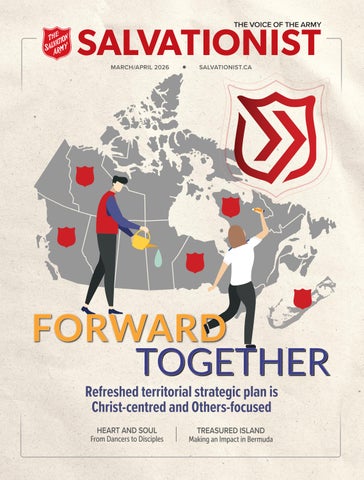
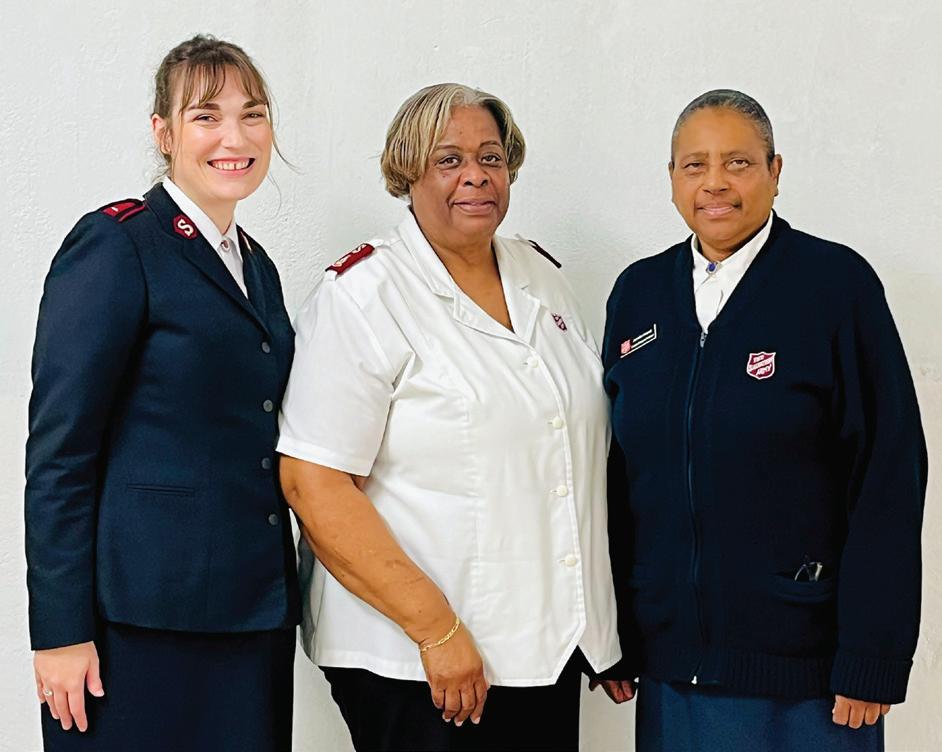
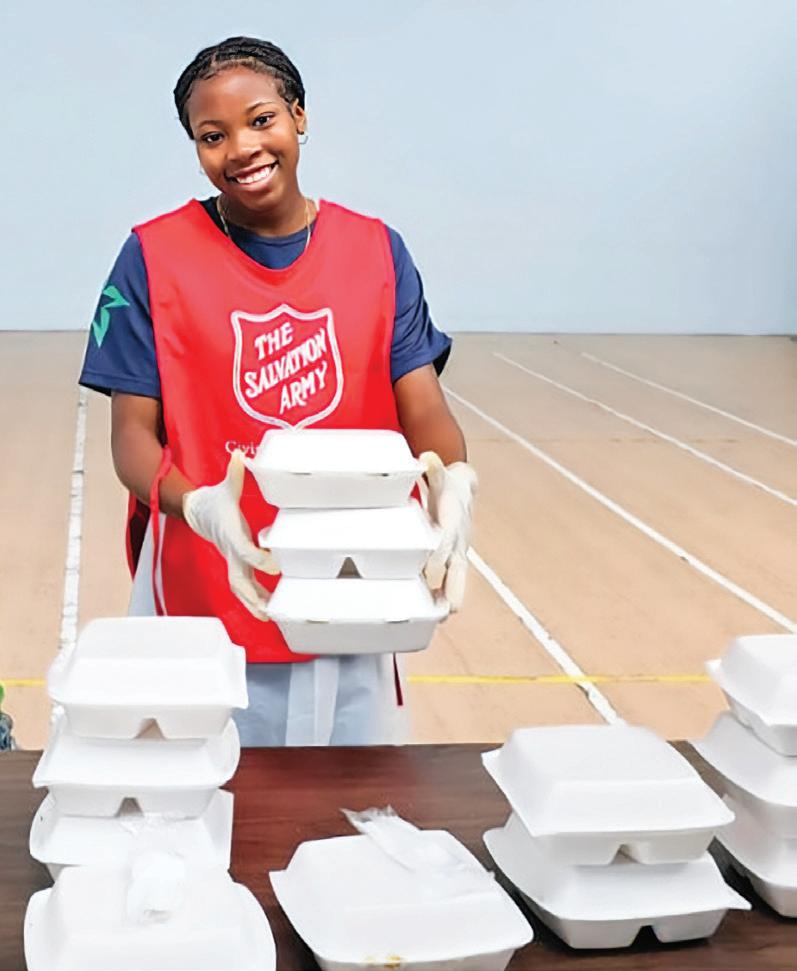
Refreshed territorial strategic plan is Christ-centred and Others-focused.
12 / “I Am the Resurrection and the Life”
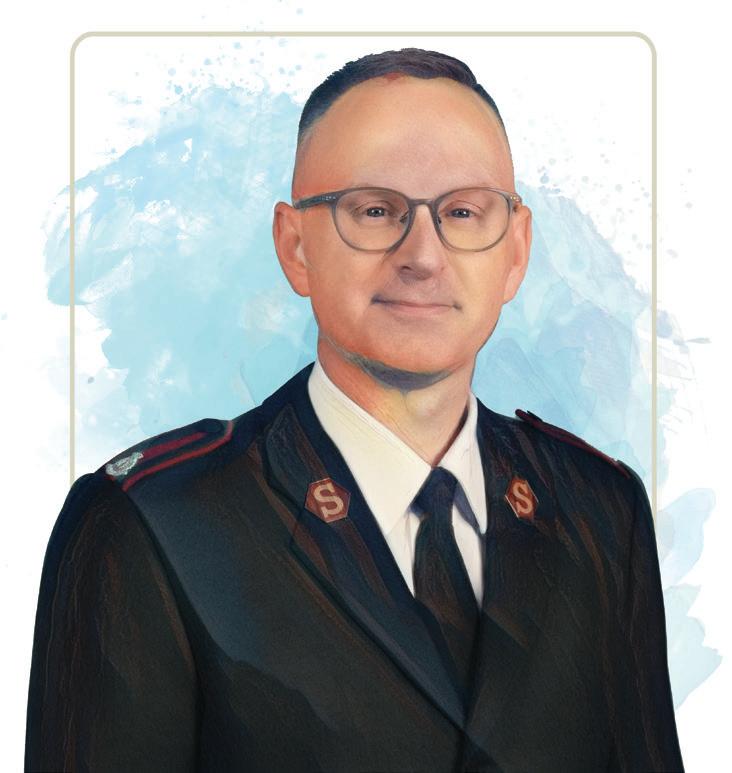
A life infused with the presence of God begins the moment we place our trust in Jesus, the risen Saviour. by General Lyndon Buckingham
14 / Finding the Light
Women’s ministries at Calgary’s Glenmore Temple introduced Rodica Railean to a renewed life of purpose in God. by Abbigail Oliver
18 / Christ Is Risen
Stepping into the story of Easter through the days of Holy Week. by Major Donette Percy, Major Sheldon Bungay, Captain Justin Gleadall, Captain Jaclyn Wynne, Major Leslie Wiseman, Major Krista Andrews, Lieutenant Zach Marshall and Captain Angela Kerr
21 / The Search for Water
How The Salvation Army is providing access to this vital resource. by Lt-Colonel Brenda Murray
22 / From the Soul
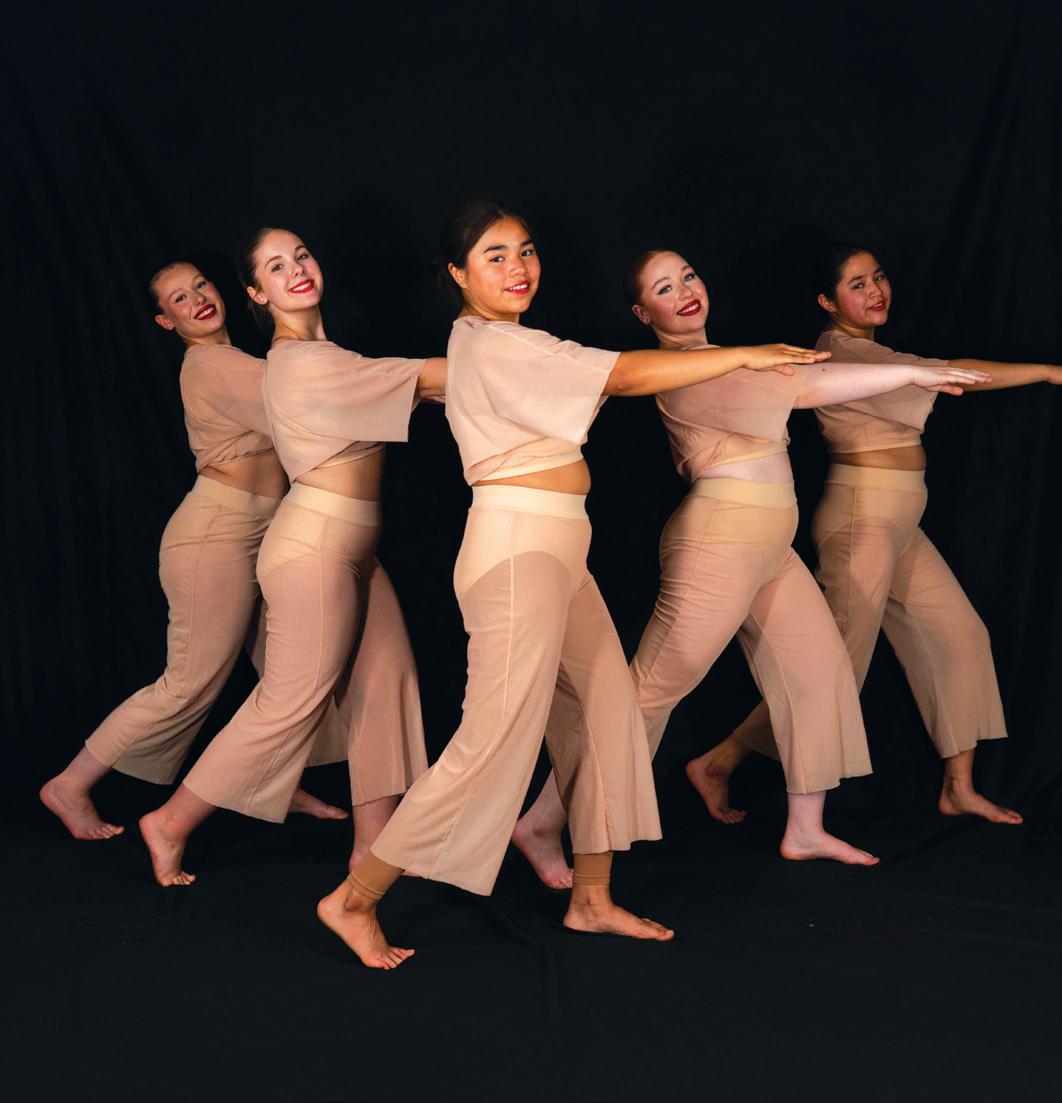
Dance ministry at Prince George Community Church, B.C., turns dancers into disciples. by Abbigail Oliver
We move forward not as individuals pulling in different directions, but as one Army.
LEE GRAVES, PAGE 9
SALVATIONIST
is a bimonthly publication of The Salvation Army Canada and Bermuda Territory
Lyndon Buckingham
General
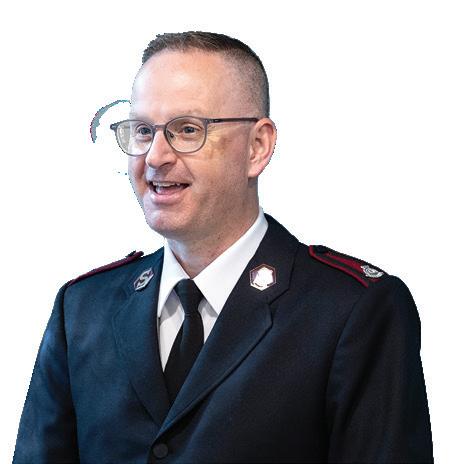
Commissioner Lee Graves
Territorial Commander
Lt-Colonel John P. Murray
Secretary for Communications
Geoff Moulton
Director of Communications, Editor-in-Chief and Literary Secretary
Pamela Richardson
Assistant Editor-in-Chief
Kristin Ostensen
Managing Editor of Salvationist and Salvationist.ca
Inquire by email for rates at salvationist@salvationarmy.ca.
News, Events and Submissions
Editorial lead time is seven weeks prior to an issue’s publication date. No responsibility is assumed to publish, preserve or return unsolicited material. Write to salvationist@salvationarmy.ca or Salvationist, 2 Overlea Blvd, Toronto ON M4H 1P4.
Mission
The Salvation Army exists to share the love of Jesus Christ, meet human needs and be a transforming influence in the communities of our world. Salvationist informs readers about the mission and ministry of The Salvation Army in Canada and Bermuda.
Salvationist.ca
Facebook: /salvationistmagazine
Threads: @salvationistmagazine
YouTube: /salvationistmagazine
Instagram: @salvationistmagazine
POWER IN THE BLOOD
James Harrison never set out to be a hero. He was just 14 years old when he learned that the blood transfusions that saved his own life after major surgery carried a quiet obligation. When he was old enough, his heart was moved to give back. And give back he did—over and over again—for more than six decades.
Known in Australia as the “Man with the Golden Arm,” Harrison possessed a rare antibody in his plasma called Anti-D that could prevent a deadly blood disorder in unborn babies. Beginning at age 18, he donated blood and plasma every few weeks, rarely missing an appointment, until he was forced to retire at 81. His blood was used to develop a life-saving treatment for pregnant mothers, ultimately saving the lives of an estimated two million babies. His quiet faithfulness made him a national hero, though he was far more comfortable deflecting praise than accepting it.
Harrison’s story is remarkable not just because of the rarity of his blood, but because of the way his life intersected with the needs of others. He carried something uniquely powerful within him—something that brought life where before there had been grave risk. And he gave it freely.
As we approach Easter, it’s impossible not to hear echoes of a far greater gift. Unlike James Harrison, Jesus offered his blood once and for all—sufficient for all, necessary for all. At the cross, Christ gave what only he could give. Through his sacrifice, life was made possible where death once reigned. We are, each of us, profoundly indebted to that gift.
In his Easter message, General Lyndon Buckingham reminds us that the death and Resurrection of Jesus—Christ’s victory over sin and evil—make it possible for us to live “a life infused with the presence of God, and it begins the moment we place our trust in Jesus.” It is a message that resonates deeply with our present moment, when we need God’s presence more than ever to bring clarity of direction and purpose (page 12).
We are delighted that the General and his wife, Commissioner Bronwyn Buckingham, World President of Women’s Ministries, will be visiting the Canada and Bermuda Territory in April and May. Their time with us as international leaders promises encouragement, challenge and inspiration. The theme of their visit, Jesus Our Compass, connects directly with the General’s global Compass call to action and strategy—inviting Salvationists to centre our lives, decisions and ministries firmly on Christ.
I encourage you to attend one of the public events during their visit. Details are available at Salvationist.ca/ jesusourcompass. These gatherings will be moments to listen, worship and realign together.
That sense of alignment also runs through our territory’s refreshed strategic framework, Forward Together, which is thoughtfully unpacked by Commissioner Lee Graves in his Onward column (page 9). Strategy, after all, is not about programs or plans alone—it is about faithfulness to our calling and responsiveness to the Spirit’s leading.
At Easter, we remember the blood that was shed, the tomb that was empty and the hope that was secured. It is this message that continues to guide us. As Salvationists, may we move forward together, guided by Jesus, our compass, and compelled by love to give ourselves for the life of the world.
GEOFF MOULTON EDITOR-IN-CHIEF
Salvation Army Responds to Hurricane Melissa in Jamaica
On October 28, 2025, hurricane Melissa made landfall in southwest Jamaica as a category 5 storm, quickly becoming the third-strongest hurricane on record in the Atlantic Ocean.
The Salvation Army’s presence in Jamaica includes two divisions, 42 corps and nine outposts. Before the storms, the divisions took proactive steps to prepare for severe weather, including visiting their corps communities to encourage residents to move to government-designated shelters, and persuading those living on the street to seek safety in evacuation shelters.
Of the 29 Salvation Army corps in the Jamaica Western Division, 22 experienced major to catastrophic damage.
The international Salvation Army responded swiftly, dispatching teams of personnel from across Australia, Iceland, Canada, England and the United States. These teams provided direct support to those 22 affected corps and their surrounding communities. Weekly distributions of vital supplies included food, water, Starlink satellite internet and communications equipment, and other essential items.
The Salvation Army currently has base warehouse operations in Kingston,
Spanish Town (in partnership with Convoy of Hope) and Montego Bay, and the Caribbean territorial headquarters is operating as an incident command centre.
From October to December, The Salvation Army distributed more than 7,600 food parcels to families; 59,000 cooked meals and 91,380 individual meal kits; 14,700 hygiene items; 5,400 care parcels including items such as flashlights, blankets and socks; bags of clothing; shelter items, such as tarps and tents; communication items, such as generators and solar panels; paper products, baby items and cleaning supplies. Officers, volunteers and mission partners continue to provide on-theground emotional and spiritual care to survivors.
“Hurricane Melissa has left many communities in need, and The Salvation Army is committed to providing relief wherever it is needed most,” says Major Elaine Locke, project campaign manager, international development. “We are thankful for the continued generosity, prayers and encouragement of our supporters. It truly enables The Salvation Army to stand alongside those affected and help them begin to rebuild.”
Montreal Shelter Expands to Better Serve Residents
As a result of growing demand and long waitlists, the family program at L’Abri d’espoir in Montreal has expanded its capacity. This service provides shelter to women, particularly mothers, experiencing housing instability.
“There are not many places in Montreal where women in need can feel safe, comfortable and stay long enough to get back on their feet,” Maricarmen Raudales, executive director at L’Abri d’espoir, explains.
Guests in the family program can stay up to two years, making L’Abri d’espoir a crucial shelter option in the city and one that is in high demand.
With so many applications, Raudales knew a change was needed.
“We recently went from a capacity of seven to now 12 rooms, which is wonderful,” she adds.
The expansion was completed by creatively working with the space already available. Many of the family quarters were originally designed with connected spaces. By adding doors and separating these areas, they were able to add more suites. An oversized play area was also redesigned to create additional living space.
“Immediately, by doing that, we had four additional rooms,” say Raudales. “Even though it may not seem like a lot, these rooms make a difference because they respond to the needs of pregnant women and moms with preschool-aged children.”
Aside from adding accommodations, plans are in place for additional improvements.
“We need to add more showers as well as another fridge in the kitchen,” Raudales adds. “Children don’t always like to eat the meals we serve. Also, we have guests from different cultural backgrounds, so some mothers want their kids to eat food from their culture.”
Looking ahead, the goal at L’Abri d’espoir remains the same—to help women find safety, stability and to guide them toward permanent housing. While this expansion is one step in the right direction, Raudales is considering more ways to welcome additional guests.
“If we can take more of the space we have and maximize it, we could better respond to the needs of vulnerable women in our community.”
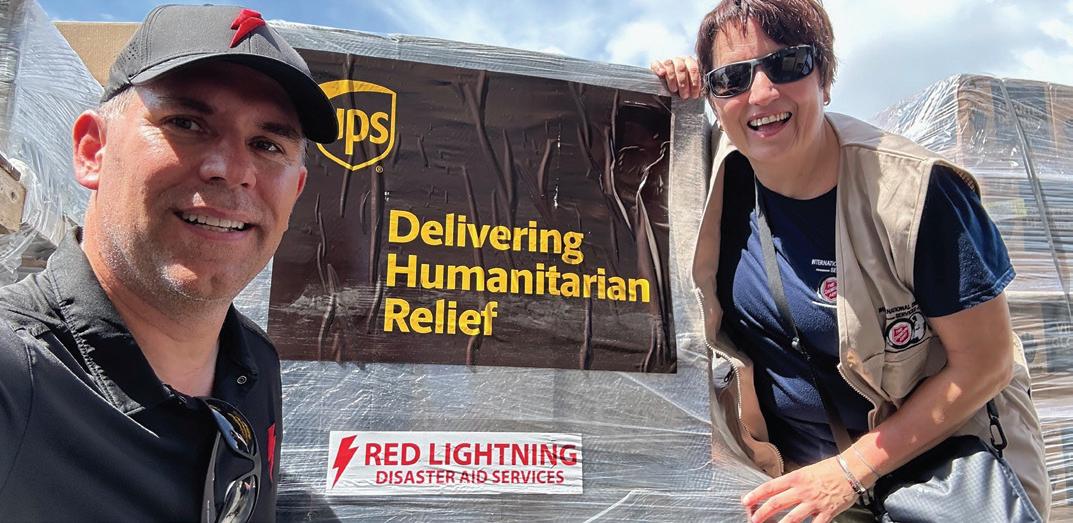
(Above) Mike Shiffler with Damaris Frick, The Salvation Army’s international emergency services director. Shiffler, from Red Lightning, visited the EDS team in Kingston, Jamaica, and brought several units of Starlinks, batteries, solar panels and generators
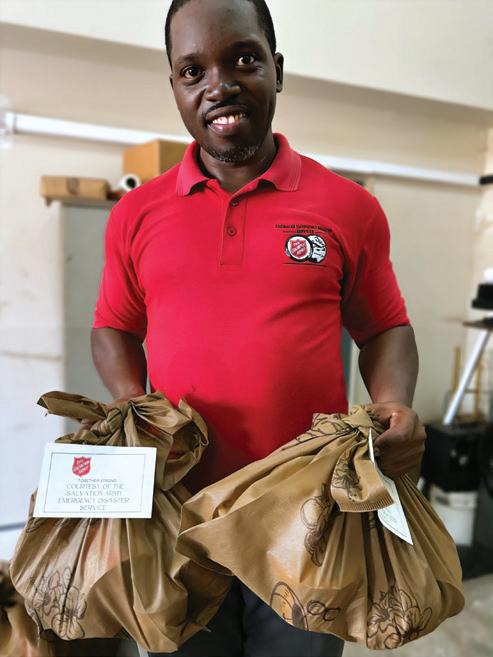
(Right) Between October and December, Salvation Army response teams distributed 7,600 food parcels to families, 59,000 cooked meals and 91,380 individual meal kits
Richmond, B.C., Army Launches Recovery Church
Aux-Captains Florence and Steve Yau, corps officers at Richmond Community Church, B.C., recognized that Richmond needed a program that went deeper than meal service alone. In response, the church recently opened its doors to Recovery Church, a transformative Sunday evening service designed to offer human connection, support and God’s love to those navigating the challenges of addiction.
Every week, nearly 30 guests fill the dining hall eager to enjoy a hot meal, meaningful conversations with peers and the spiritual care offered through the church. Recovery Church provides a welcoming space where individuals can share both victories and struggles, knowing they are surrounded by a community committed to walking with them toward sobriety.
For the past three years, the church’s mobile feeding program has distributed hot meals five times a week, giving volunteers and staff the opportunity to build trust with those who visit the food truck regularly. These relationships laid the foundation for what would eventually become Recovery Church.
“It’ll be tragic if we just feed for the rest of our lives,” shares Aux-Captain Steve Yau. “It’s a second step from the feeding now to the recovery. We’re praying and believing that a lot of them will recover, be delivered from their addiction, come clean and eventually help others.”
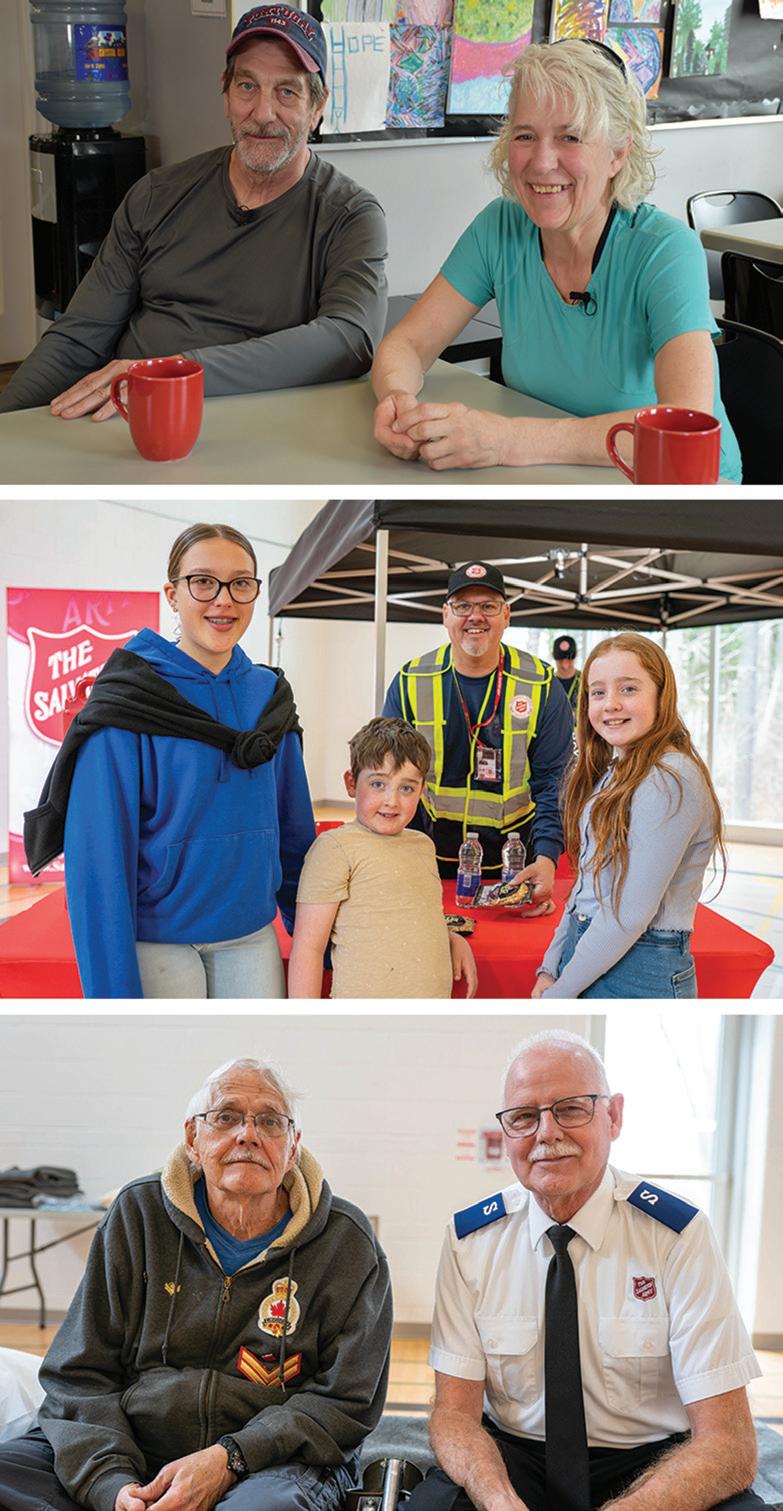
For some, like Dan, Recovery Church has become a lifeline. A longtime supporter of The Salvation Army, he never expected to need its services. “I didn’t know 40 years later I would be here for help,” he shares. The program has strengthened Dan both physically and spiritually.
“It helps keep me physically strong, to keep my body working like it should by having proper, balanced meals at regular times,” says Dan. “I’m very grateful for that, because sound body, sound mind are very important. And having faith is the best thing.”
For others, the greatest impact comes through community. Since the launch of Recovery Church, Chris and Dwayne have rarely missed a Sunday. For Chris, the gathering provides a grounding sense of connection: “Coming here, it’s a strong sense of community, and helps me get out of my head, and be around people.”
Dwayne shares that the program has given him a network he can trust, saying, “Now I’ve got people I can lean on.”
Recovery Church continues to nurture relationships and provide spiritual care, encouraging guests to grow in faith, build community and pursue freedom from addiction. Through prayer, worship and messages of God’s love, guests are reminded that they are not alone and that hope is always within reach.
Christmas Kettle Campaign Raises $22.7 Million for Ministry
The Salvation Army’s 2025 Christmas kettle campaign was a resounding success, raising a total of $22.7 million across Canada. Hundreds of kettle shifts were filled by dedicated volunteers in each community, with supporters nationwide generously giving throughout the holiday season.
“Kettles are iconic and allow supporters across our territory to engage and give to The Salvation Army. Most importantly, these funds enable our mission throughout the year,” says Janet Park, chief development officer.
“Kettles are iconic and allow supporters across our territory to engage and give to The Salvation Army.”
JANET PARK
Of the total, $22.25 million was raised directly through kettles, with cashless TipTap donations contributing $3.75 million. In addition, National Recycling Operations’ goodworks@work kettle campaign raised $498,846, exceeding its goal by 43 percent. Staff at Salvation Army thrift stores across the country engaged 110,000 donors, and 11.1 percent of all transactions included a donation.
Together, these efforts brought the total kettle campaign revenue to $22.7 million.
Bermuda also had a successful season, with its kettle campaign raising $63,571 to support Salvation Army ministry on the island.
“We know that front-line officers, staff and volunteers work tirelessly for the kettle campaign,” says Park. “Thank you for your excellent efforts.”
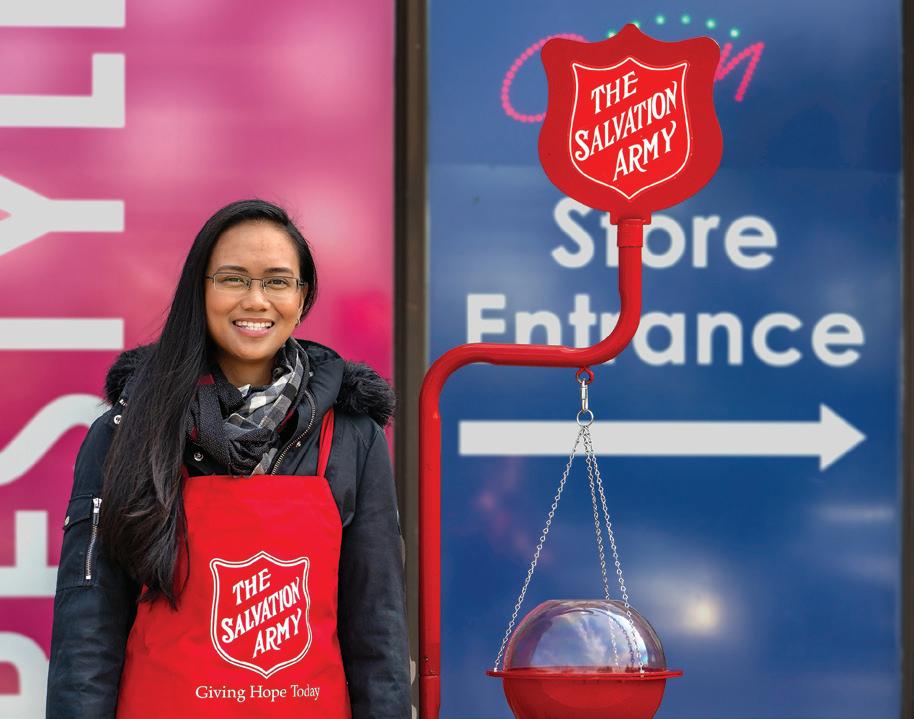
The 2025 kettle campaign raised a total of $22.7 million, including contributions from TipTap donations and thrift stores
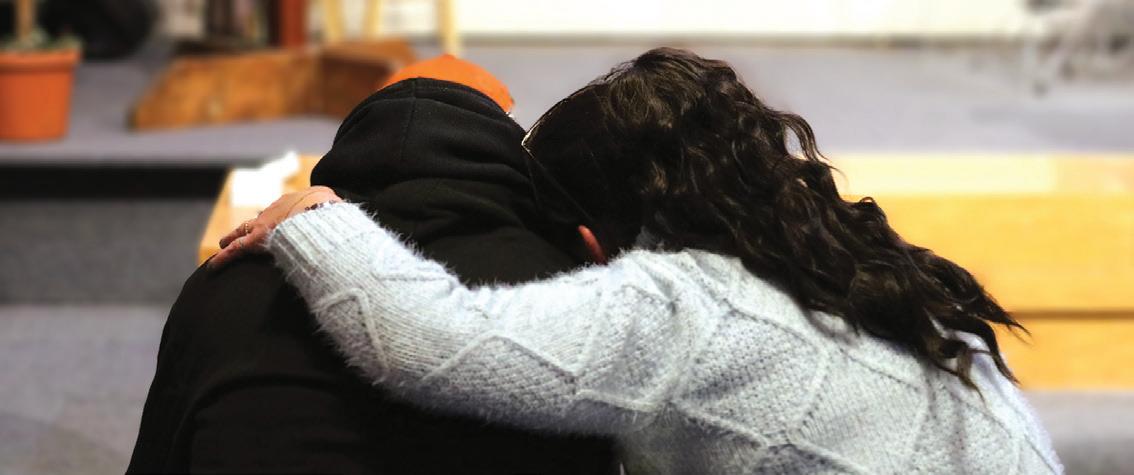
Recovery Church provides a supportive and spiritual community for individuals on the journey to addiction recovery
TERRITORIAL NEWS
Photo: Gavinder Randhawa
Brunch Program at Boundless Vancouver Builds Community Connection
Every Thursday, The Salvation Army’s Boundless Vancouver church hosts a community brunch program where guests come for a delicious meal and leave with more than a satisfied appetite. They leave with a sense of community, dignity and hope.
The community brunch program is open to everyone and provides an inclusive space for those facing food insecurity or simply seeking community. On average, the program serves 70 to 80 people. For ongoing support, a community fridge provides barrier-free access to fresh food, helping nearly 100-150 people every day.
“Beyond a meal, I think the most important thing that it provides is companionship. It really brings our community and our neighbours together,” says Pamela Burt, food services manager.
When Burt joined Boundless Vancouver as the food services manager seven years ago, she made it her mission to eliminate the need to purchase food and instead rescue it to help minimize food waste in the community. Within her first year, she achieved her goal by building relationships with local grocery stores and businesses. Now all the food programs at Boundless Vancouver use 100 percent rescued food.
When guests come in to attend the community brunch or access the community fridge, they will find that the meals are prepared with care and the food stocked in the fridge has been picked with love. The space is filled with the sounds of the
kitchen, conversations among the guests and the scents of home cooking, creating a warm and welcoming atmosphere.
“When people come in our door, I want them to feel really special and spoiled. Sometimes that’s the only meal they’re going to get that day, and I want it to be the best meal,” says Burt.
What began as providing meals for the community and an effort to reduce food waste has grown into a powerful point of connection and hope. The food programs not only fight food insecurity but also open the door to many other opportunities at Boundless Vancouver. For many, accessing a food program has led to graduating from Pathway of Hope, attending church or a Dance Fit class, volunteering and so much more.
“I love that food is a doorway because everybody eats and everyone wants to be a part of that. It’s like breaking bread, right? When neighbours come in and they’re a part of the food, it just opens that door to everything we do,” says Burt.
Volunteers serve a nutritious brunch to the community every Thursday, a program that serves 70-80 people
Photo: Julianna Acosta
BLAZING A TRAIL
Thank you for this excellent summary of the revised training program for cadets (“Trailblazers,” September/October 2025).
I commend the emphasis on practical field training, as well as the intentional exposure and opportunity for social mission. I have no doubt that this training model will have long-lasting benefit for the corps and centres they train in, the growth and development of the individual cadets and the future of the Army. Well done, College for Officer Training.
Major Ron Millar
ENCOURAGING COMMUNITY
Reading about Stephanie’s journey is truly inspiring (“A Warm Welcome,” Salvationist.ca, October 2025). It’s amazing how she found a supportive community at The Salvation Army’s Cedar Hill Corps during such a challenging time. Her courage and openness to connect with others, participate in creative activities and even travel for spiritual growth is a wonderful example of resilience and faith. The way the women’s ministry welcomed her and became a source of encouragement shows the power of community and prayer. So glad she found such a meaningful and uplifting space!
Frederick Armstrong
WELL DONE
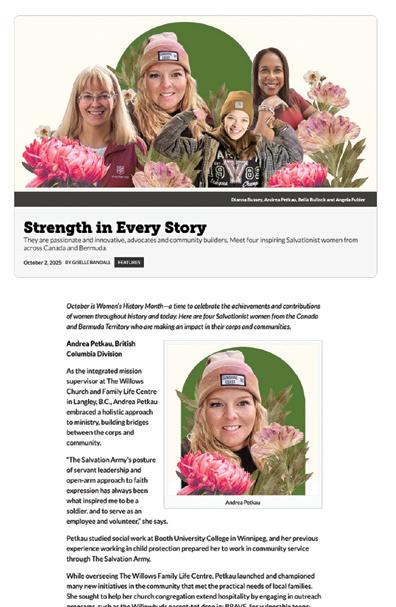
I have read many stories in Salvationist that support William Booth’s pronouncement: “My best men are women.” Thank you to all the women featured in this article for Women’s History Month (“Strength in Every Story,” Salvationist.ca, October 2025). Keep up the good work!
Major Ira Barrow
THE SPIRIT AT WORK
I’m writing in response to the article by James Read on the Holy Spirit (“The Lord and Giver of Life,” September/October 2025). As I read through this issue of Salvationist, I see the Holy Spirit at work in the honouring of John Lam’s leadership of the Canadian Staff Band, Lori Barry’s teaching of young people and the provision of safe showers for the homeless by Victoria’s Connection Point Church. And more. Thanks to the Salvationist team for its good work.
Major Ray Harris
To be considered for publication, letters to the editor must include your name and address, and a phone number or email address where you can be contacted. Letters may be edited for space and clarity, and may be published in any medium.
DO SOMETHING
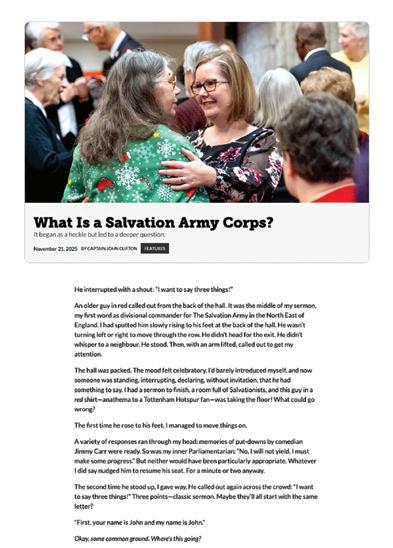
Captain Clifton has seemingly written words that could have been ripped from the pages of my own prayer journal (“What Is a Salvation Army Corps?” Salvationist.ca, November 2025). Having sat at tables where tears have figuratively saturated the prayers of friends and colleagues lamenting their unenviable task of closing a corps, I am convinced that few (if any) take pleasure in ceasing the operations of a corps building.
Yet, many corps have closed and some due to factors such as population decline, financial restraint and other societal changes. The author reminds us that no healthy and fruit-bearing congregation need fear the act of some headquarters entity coming to permanently lock their doors. If there are members engaged in “covenantal responsibility,” evidenced by mission fruitfulness, corps will flourish. Unfortunately, some are content to show up for a weekly gathering, taking no responsibility for congregational health and community impact, and then protest publicly when news of potential closure arrives. Some “doth protest too much” and instead should take responsibility and “do something!”
Major Sheldon Bungay
TAKE ACTION FOR WOMEN AND GIRLS
Thank you for drawing attention to the 16 Days of Activism Against GenderBased Violence (“While Women Weep,” November/December 2025). This is super important work for The Salvation Army and the church at large.
Captain Renee McFadden
ADVENT ART
What a creative way to encourage spiritual intimacy: visual art that brings viewers close to a fragile God (“Honest Advent,” Salvationist.ca, November 2025). Sometimes the good news needs no words!
Aimee Patterson
AT THE RIVER’S EDGE
Advancing together in God’s purpose and promise.
BY COMMISSIONER LEE GRAVES
Every so often, God brings his people to a place where stopping to take stock is not a sign of hesitation, but of wisdom.
In the opening chapter of Joshua, we meet Israel at such a moment. Moses’ leadership had come to an end. Years of preparation lay behind them. Ahead was the Jordan River—wide, daunting and impossible to cross without God’s help. Before Joshua ever gave an order or formed a plan, the Lord spoke words that steadied his heart: “Be strong and courageous … for the Lord your God will be with you wherever you go” (Joshua 1:9).
That assurance was not only for Joshua. It was for a people about to move forward together.
As The Salvation Army in Canada and Bermuda, I believe we are standing at a similar point in our journey.
In 2021, this territory adopted its first strategic plan, setting before us a clear vision for 2030: “We are an innovative partner, mobilized to share hope wherever there is hardship, building communities that are just and know the love of Jesus.” Over the past five years, that vision has guided us well. It has helped us make necessary decisions, address important realities and prepare ourselves for the future God is shaping.
Those early years required focus and discipline. We mobilized as an Army. We strengthened systems, clarified governance and sharpened our mission focus. That work was essential. Like Israel’s time of preparation before crossing into the Promised Land, it positioned us for what comes next.
Now, halfway through this 10-year journey, we pause—not to linger, but to listen, reflect and realign. This refreshed territorial strategic plan is not a new direction so much as a renewed com-
mitment to the one God has already given us. We continue to build on the same four pillars that have guided our work: Strengthen Spiritual Health, Design for People, Forge Innovative Partnerships and Optimize Mission Impact.
What brings renewed clarity to this next season is our theme: Forward Together—Christ-centred, Othersfocused.
Those words describe not only where we are going, but how we are called to travel. We move forward not as individuals pulling in different directions, but as one Army. And we do so anchored in Christ, with our attention firmly fixed on others.
From its earliest days, The Salvation Army has understood that our calling cannot be divided. We are called to proclaim the gospel of Jesus Christ and to meet human needs in his name. These two expressions of mission belong together. One reflects the other, and both reveal God’s love.
When we share the gospel, we offer hope, forgiveness and new life. When we serve those who are suffering, we offer compassion, dignity and healing. Each speaks to the whole person—body, mind and soul. To lose hold of either is to risk drifting from the very reason God raised up this movement.
That is why balance matters. As our ministries grow and adapt, we must ensure that everything we do remains Christ-centred and Others-focused. This refreshed strategy calls us to deepen spiritual life and discipleship, strengthen leadership, support and equip our people, and align our resources so that they serve the mission faithfully and effectively.
At the heart of this work are our corps and social ministry units. These
are sacred places—where faith is lived out, relationships are formed and hope is offered day by day. In a time of fewer officers, changing communities and increasing complexity of need, we must invest wisely and care deeply for those who serve. We are committed to equipping officers, employees and lay leaders to lead with confidence, faith and resilience, and to strengthening partnerships that help us extend our reach.
We do this mindful that we are part of a global Army. In 2024, General Lyndon Buckingham introduced Compass, our international strategic framework, emphasizing people, mission and legacy. Our faithfulness contributes to a worldwide ministry.
I am especially grateful that this refreshed strategy has been shaped by many voices. Officers, employees, advisors, volunteers, Indigenous partners, French-speaking communities and young people have all been heard. This plan reflects the lived experience of the territory—and now it calls for our shared commitment.
Friends, the river still lies ahead. But the promise remains sure. The same God who spoke to Joshua speaks to us today: Be strong and courageous. I am with you.
May we step forward together— Christ-centred, Others-focused—trusting the Lord to lead us into all that lies ahead.
COMMISSIONER LEE
GRAVES
is the territorial commander of the Canada and Bermuda Territory.
north star as we rally “Forward Together: Christ-centred, Others-focused.” This plan will carry us through the final stage of our journey. It expresses our shared commitment to move ahead in unity, anchored in Christ and dedicated to serving others. It captures who we are and how we lead—as one Army, walking together in purpose, compassion and faith.
This affirms that our strength for the journey ahead comes from Christ, and our collective desire to live out his mission in every community we serve.
“As our ministries grow and adapt, we must ensure that everything we do remains Christ-centred and Othersfocused,” says Commissioner Lee Graves, territorial commander. “This refreshed strategy calls us to deepen spiritual life and discipleship, strengthen leadership, support and equip our people, and align our resources so that they serve the mission faithfully and effectively.”
are just and know the love of Jesus.”
A vision tells us where we are going. A strategy tells us how we will get there. Our refreshed territorial strategic plan continues to be founded on the four pillars: Strengthen Spiritual Health, Design for People, Forge Innovative Partnerships and Optimize Mission Impact. Over the past five years, these pillars have laid a foundation for the future, and they remain our building blocks as we address the opportunities and challenges facing The Salvation Army.
At the midpoint of our journey, it is important to ensure our direction remains aligned with our vision, mission and current ministry realities. Refreshing our territorial strategy allows us to reflect on what we’ve learned, remain responsive to changing community needs and strengthen how we serve so we can move forward with clarity, unity and purpose.
can be together.
MAIN PRIORITIES
While our vision, mission, values and four pillars remain unchanged, what has evolved are updated objectives and initiatives that reflect what we’ve heard from the field, what we’ve learned over the past five years, and what is needed to strengthen sustainability, discipleship, partnerships and impact across the territory.
Our refreshed strategy will focus on deepening spiritual life and discipleship, engaging with young people to deepen their relationship with Jesus, strengthening our team’s capacity, expanding mission reach through collaboration and partnerships, and aligning programs and resources for maximum missional impact—all grounded in a shared, Christcentred, Others-focused vision for 2030. Our key focuses will be:
Illustrations: Rivonny Luchas
• Corps and social ministry unit sustainability and strategic growth
• Evangelism and discipleship that is grounded in Salvation Army doctrine
• Relationships with diverse populations
• Creating engagement opportunities for children, youth and young adults
• Christian leadership—officers, lay leaders and employees
• Recruitment and retention— officers and employees
• Internal and external partnerships
• Operational effectiveness and accountability
The strategy builds on a strong foundation while creating space for new ideas and approaches. Some current programs may be adjusted to better align with our mission, encourage collaboration and increase impact. Over time, new initiatives may also be introduced in response to emerging needs and opportunities.
CHALLENGES
Communities, ministry contexts and resources are changing, and we must respond with prayerful consideration, wise stewardship and thoughtful planning. The pillars, objectives and initiatives of our territorial strategic plan address key aspects of our movement. Our ministry units are vital to our outreach and community connections, and now is the time to strengthen and sustain them for the long term. We need to hold both sides of our mission in balance—sharing the love of Jesus and meeting human needs. If we lose balance, we risk drifting from who we are.
We are looking to the future with confidence and a clear long-term plan. Fewer officers, aging congregations and changing community realities mean we must invest in those who serve. We’re equipping and empowering officers, employees and lay leaders to grow and lead with confidence. By collaborating
across ministries, stewarding our resources wisely and building strong partnerships, we’re ensuring that The Salvation Army remains united, resilient and ready to meet the needs of tomorrow. This underscores the importance of staying rooted in our Christ-centred, Others-focused purpose. Addressing these challenges helps us remain focused, aligned and prepared for the future.
LOOKING TO THE FUTURE
We are thankful for all that has been achieved already toward our vision. Those who have come before us had a deep passion for our mission and set us on a great course. We are thankful to our previous territorial leaders, Commissioners Floyd and Tracey Tidd, for starting this journey, and we can honour them and God by continuing to give our best.
We are looking to the future with confidence. We’re building for the long term—strengthening leadership, investing in our people and ensuring our ministries remain sustainable and effective. Our hope and strength for the future comes from our collective ongoing commitment to the mission, and the continued dedication of our officers, employees, partners, friends and volunteers who live the mission every day.
You are integral to this journey. Stay focused on what you do best—live out your calling with compassion and faith. Here’s what we’re asking of you:
Live the Mission: Continue leading with compassion, faith and service—your work is central to achieving our vision.
Engage and Contribute: Learn about the refreshed plan, ask questions and help shape how it comes to life in your ministry context.
Move Forward Together: Support one another, embrace new ways of serving and trust that we are building a stronger, more united future—together, as one Army. Your voice and commitment make this possible as we move forward together.
In 2024, General Lyndon Buckingham launched Compass, a global strategic framework that emphasizes people, mission and legacy. Our refreshed territorial strategy aligns with these themes in ways that reflect our local priorities and realities. Compass calls us to develop people, deepen mission and sustain the movement—priorities that also guide our territory as we strengthen leaders, invest in spiritual life and build long-term stability. Our territorial refresh applies these shared commitments in practical ways across Canada and Bermuda, equipping officers and employees, revitalizing ministries and partnerships, and aligning resources for greatest impact.
“ I AM THE Resurrection and the Life”
A life infused with the presence of God begins the moment we place our trust in Jesus, the risen Saviour.
BY GENERAL LYNDON BUCKINGHAM
It was a good Saturday. Or was it? Truthfully, it could have been disastrous. It certainly did not look good in the beginning. I suffered a heart attack. Seems it was quite a significant episode; frightening for Bronwyn and, yes, deeply troubling for me. Was this it? Had my time come? Is this how the Lord was calling me home? What about the kids and the grandkids? What about Bronny? What about my ministry? I still had things that needed to be done. This was not a good Saturday. It was awful, frightening, dark and scary. And yet, yes, as it happens, it was a good Saturday. As I reflect on that day last October, I celebrate the miracles of that scary day. The right people intervening at the right time. Christian concern that led to action. A beautiful Salvationist nurse whose friend was a Christian cardiologist. A life-saving intervention and even a promise from God himself that all will be well. God’s timing was perfect. His providence abundant. So, as I reflect and look deeper into the events that transpired, I have come to the conclusion that it was a good Saturday after all.
“GOOD” FRIDAY?
I remember as a young junior soldier being perplexed by the use of the word “good” in the Easter story. Good Friday—the day they crucified Jesus. How can that possibly be described as good? I mean, let’s not sugar-coat it. It was a horrible day. A day of unjust conviction, brutal torture, of unrelenting pain and suffering. The cross, a weapon of the devil, used against the Lamb of God. Horrifying, ugly and unforgivable. But if, without excusing the events of the day, we look deeper, we actually witness God himself in action. God
meets the manifestation of pure evil represented by a physical cross, with all its brutality, with the redeeming love that conquers evil, sin and, yes, death itself. He turns an ugly Friday into an exceptionally “Good Friday” indeed. Understand this: whatever else was going on, Jesus himself was motivated by love. He went to the cross out of love for all humanity; out of love for you and for me. In his letter to the Romans, Paul wrote: “But God demonstrates his own love for us in this: While we were still sinners, Christ died for us” (Romans 5:8). Christ demonstrated the extent of God’s love for all of us by taking upon himself the sin of the world. On this Friday, Jesus was motivated by love. The truth is, God loves us and Jesus is the proof.
FAITHFUL AND TRIUMPHANT
The writer to the Hebrews asks the question: “... how shall we escape if we ignore so great a salvation?” (Hebrews 2:3). The prophet Isaiah wrote: “... by his wounds we are healed” (Isaiah 53:5). It is a mystery for sure. In some mysterious and divine way, the events of Good Friday hold the key to our own healing, our forgiveness, our salvation and our adoption. The atonement makes possible our being embraced by Almighty God himself. Jesus, motivated by love, makes possible our restoration, redemption and reconciliation. We are healed; we are saved. We are loved. It can be difficult to see the events of Good Friday as triumphant, but that is exactly what it is. First, it is a triumph for Jesus. He was faithful and obedient, even to death on the cross. “It is finished,” he declared (John 19:30). I have completed my mission. It is done. The power of sin and death is defeated.
Second, the triumph of Calvary is the defeat of evil. In Jesus’ victory over sin and evil, his “triumph” becomes our triumph as well. Because we live on this side of the Resurrection, we are able to celebrate our Lord’s vindication. He conquered death and lives forevermore. His victory becomes ours. It was Jesus himself who said: “I am the resurrection and the life. The one who believes in me will live, even though they die; and whoever lives by believing in me will never die” (John 11:25-26).
LIFE
IN CHRIST
Jesus acknowledges the reality of physical death, but goes on to declare that death does not have the final word over those who, by faith, belong to him. This means death is no longer a wall, but a doorway. It has lost its ultimate power and its terror, and it cannot sever a person from the life Jesus gives. Eternal life is not only duration, but also dimension. It is a life infused with the presence of God, and it begins the moment we place our trust in Jesus. Turns out, it was a very “Good Friday” indeed!
My prayer for each of you is that you will be captivated by, and experience for yourselves, the reality of God’s love for you, revealed in the person of Jesus Christ, the Son of God and Saviour of the world. God bless you.
GENERAL LYNDON BUCKINGHAM is the international leader of The Salvation Army.
FINDING THE LIGHT
Women’s ministries at Calgary’s Glenmore Temple introduced Rodica Railean to a renewed life of purpose in God.
BY ABBIGAIL OLIVER
ForRodica Railean, the 2025 women’s retreat at Pine Lake Camp, Alta., was life changing.
Though she was invited each year by a friend from Calgary’s Glenmore Temple, Railean always found a reason to decline, until last year, when she felt drawn to accept the invitation. That retreat marked the start of her new journey with Christ, as she now faithfully attends services at Glenmore Temple and joins Bible study bi-weekly.
“I’m no longer alone in the darkness, looking for answers. I’m not rushing the spiritual learning, but I’m getting my answers piece by piece,” says Railean. “The Bible group has helped me a lot.”
FINDING HOPE
Railean was born and raised in Moldova as part of the Eastern Orthodox Church, but she was never devout.
“My faith was mostly just tradition,” she says. She knew about God and believed that he was out there somewhere, but not in her heart. Her family
celebrated major holidays and occasionally went to the Orthodox church, but she never felt welcomed.
“I didn’t find peace and love there,” she shares. “I tried many times but couldn’t find a place where I felt accepted.”
Railean moved to Canada in 2013 with her second husband at the time and her eight-year-old son, and for a while, her beliefs remained the same. “God was far away,” she explains. “I prayed sometimes in the hard moments, but that was it.”
And, as Railean describes, there were many hard moments. She suffered abuse from both her first and second husbands, and she was constantly searching for a “normal life” with a normal family, a good job and stability. “I thought having that would bring me happiness,” she says.
After her second divorce, Railean married again, this time to a kind and loving man whom she is still with today. They were blessed with another child, a daughter, and she slowly began to feel like she was achieving that “normal” life
she had dreamed about.
“But I couldn’t understand why I still felt this emptiness, despite having everything I had wanted. I had a full family, wonderful friends, a good work environment, and I should have been happy, but for some reason I wasn’t,” she admits. “I still didn’t have that feeling of complete joy and love that I was searching for. I didn’t know at the time that God was still leading me where I was supposed to go.”
A LIFE CHANGED
One of Railean’s good friends, Olesea Vasiliev, a woman also from Moldova whom she met here in Canada, is a soldier at Glenmore Temple and had invited her to women’s camp many times. Railean always used life circumstances as an excuse to say no.
But in 2025, when she was once again invited, something different happened.
“I just had this feeling inside that I had to go,” says Railean. “It was something I desperately needed, I just didn’t know it yet.”
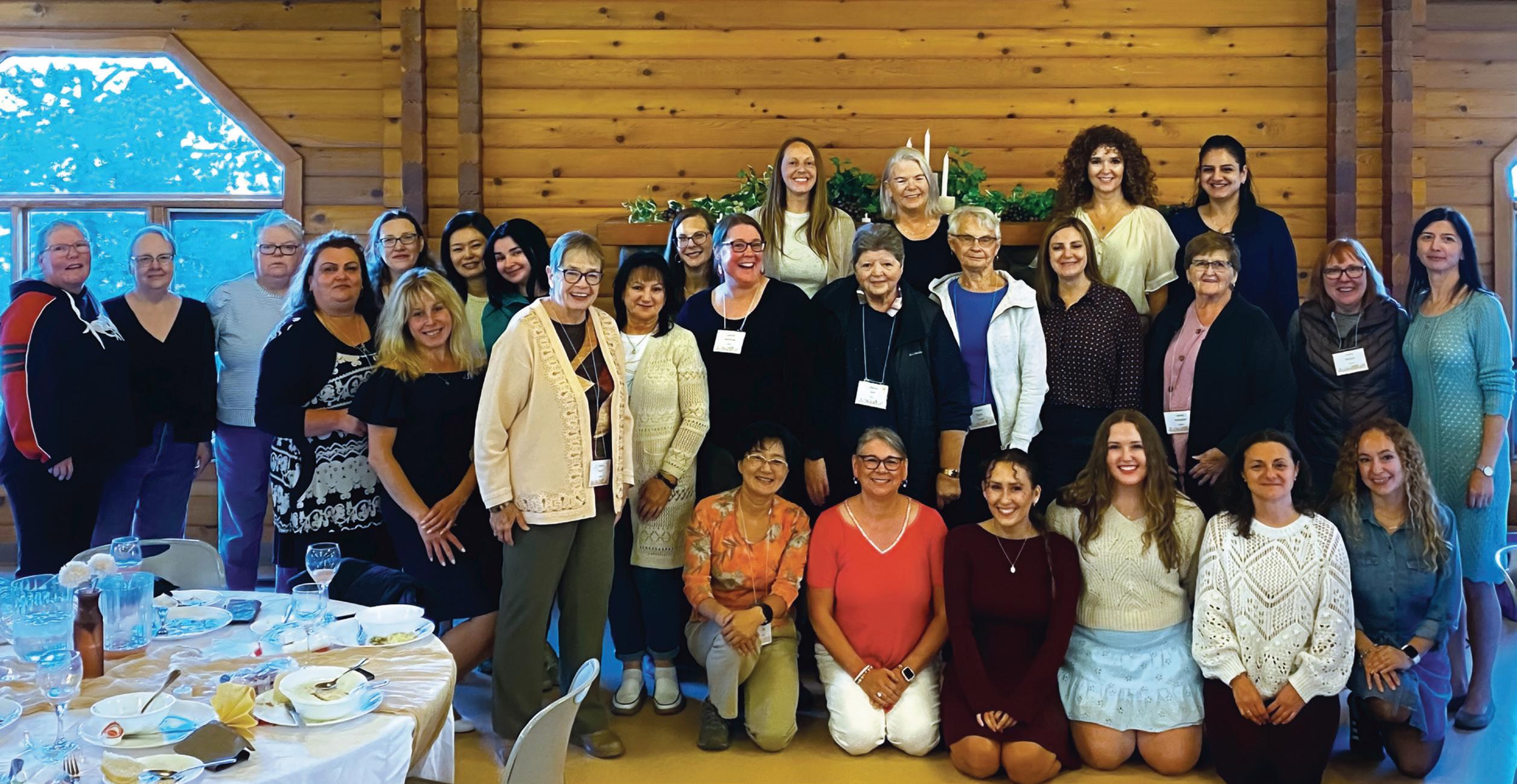
Women from Glenmore Temple, including Rodica Railean (far right), attend a women’s retreat at Pine Lake Camp, Alta.
So, she went to camp and she tried worshipping. The topic of camp that year was an invitation to Jesus’ table, and Railean thought, How can this be possible?
“I was seeking something and there was the invitation. It whispered to me. During the worship, I just felt it,” she says. “I don’t know how to explain it. It was like a bucket of something warm—like sunshine, love and light—just washing over me.
“I started crying. I think I cried the whole weekend. At first, I thought they were cleansing tears, a release of all the pain that I was holding on to. But then I realized they were tears of joy, because I understood now that I didn’t need anything else but this to feel happy and have a full life.”
A PLACE TO BELONG
In 2025, more than 30 women from Glenmore Temple attended the divisional women’s retreat at Pine Lake Camp. While the corps typically sends a group each year, Major Dena Hepditch, corps officer, says interest in women’s ministries is steadily growing, particularly among young adults and newcomers.
“Several of them are between the ages of 19 and 25, and they’re genuinely excited about women’s ministries. It’s amazing to see,” she says. “They are eager to lead, plan and run events and share new ideas. As older women in the church, it’s important that we encourage them, show grace and be supportive, because they’re doing an amazing job.”
After returning from women’s camp in September 2024, a few of the young women were inspired to keep the momentum going. They launched a Monday night Bible study, mentored and hosted by a senior member of the group, to supplement the corps’ regular Thursday women’s Bible study. Now, up to 18 women attend regularly.
“They keep inviting friends, and some of our ESL ladies have joined and found fellowship there,” says Major Hepditch. “It’s very exciting for me to see that they’re hungry for the Word. They’re not just getting together to hang out. There’s a spiritual depth to it—they want to study together and grow.”
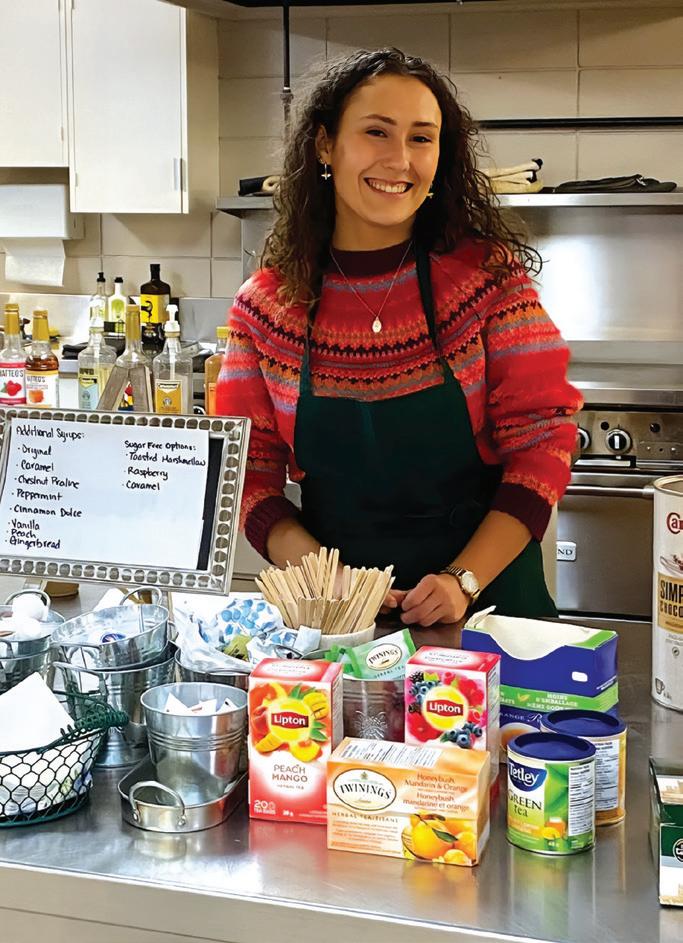
In November, the young adults in the group hosted a board game café one Saturday morning, creating handcrafted cappuccinos and lattes, and serving muffins, scones and pastries with a selection
of fun board games. Participants of the corps’ ESL program were invited to join and many of the games could be enjoyed without a language barrier.
With several newcomers to Canada and ESL participants now attending the corps and its programs, Glenmore Temple is hoping to launch an ESL Bible study to help introduce more people to the gospel.
“Some of them don’t come from Christian backgrounds, so they have a lot of questions,” says Major Hepditch. “There’s a need here to create a safe space where they can learn more about God and Christianity, ask questions and learn the basics at their own pace.”
“HERE I AM”
Everything changed for Railean after women’s camp. Colours seemed to become brighter. She became hungry for more. She wanted to learn about God and to come to know him, and she started attending worship every Sunday at Glenmore Temple. She joined the Monday night women’s Bible study and is now surrounded by people who are loving and willing to support her on her faith journey.
“They share love and joy all around me. Everyone is so caring, and I feel like I belong,” she says.
“I’M NO LONGER ALONE IN THE DARKNESS, LOOKING FOR ANSWERS.”
—RODICA RAILEAN
Railean says that this is just the beginning of her journey. She still needs God’s Word.
“I need to listen and to keep seeking my answers, and I will continue to be blessed with this joy,” she says. “Life has changed for me. I’m thankful for the people who are around me now and encouraging me. I now understand how God was working in my life, putting the right people in my path and protecting me along the way. And here I am.”
For Railean, being a part of community, having people to speak to and learn about God with, has been a blessing—one that she never would have discovered if it weren’t for the supportive group of women at Glenmore Temple and God’s steady prompting.
Isabella Haskey serves coffee and lattes at a Saturday morning café and board games fellowship event
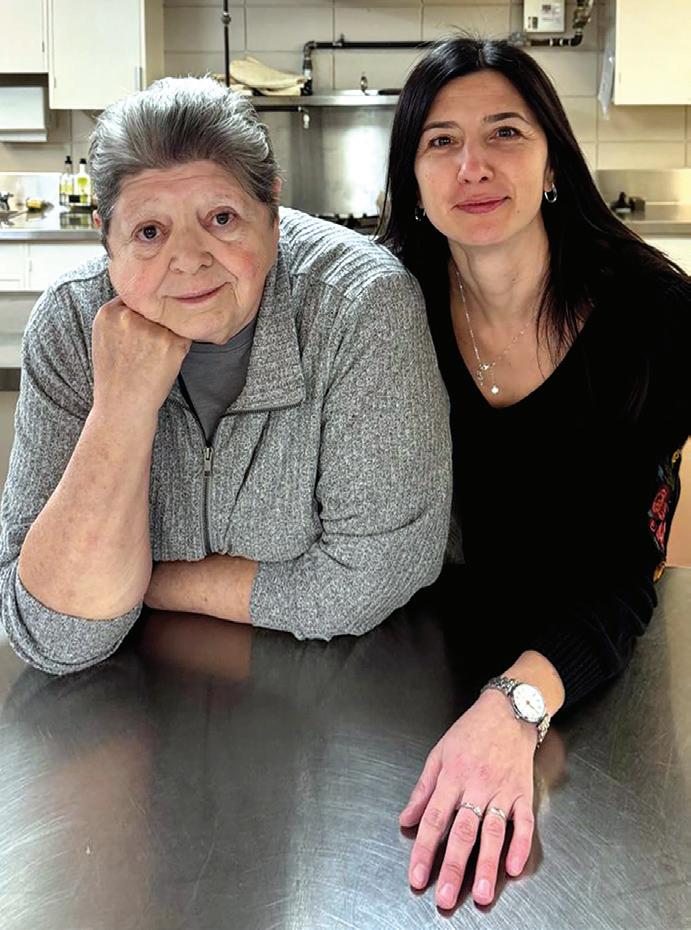
Railean (right) with Marion Wier (left), a member of the women’s ministries group who hosts the Monday Bible study and happily mentors younger members
The Home Front is an ongoing series where we highlight the mission and ministry taking place around our territory. We will visit each Canadian province and territory, as well as Bermuda, and celebrate the innovation and impact the Army is having in corps, social services and youth ministry
AT A GLANCE
LT-COLONEL SCOTT RIDEOUT
Divisional commander
LT-COLONEL MICHELLE RIDEOUT
Divisional officer personnel secretary and divisional spiritual life development secretary
ISLAND BEAT
Youth, outreach and community development in Bermuda.
BY TAMIKO RAMABUKE, MELISSA YUE WALLACE AND GISELLE RANDALL
COMING HOME
There’s something truly special about coming home—especially when home is where your calling began. For Captains Alfred and Cathy Esdaille, who were appointed to North Street Citadel in Hamilton, Bermuda, last year, returning to the country marks not only a homecoming, but a new chapter of ministry rooted in faith, experience and love for their island community.
Captain Alfred Esdaille now serves as the first Bermudian area commander for The Salvation Army in Bermuda, alongside his role as corps officer. It’s a dual appointment that reflects both his passion for faithbased leadership and his commitment to community transformation.
Before entering full-time ministry, Captain Alfred worked for 10 years with the Bermuda Land Development Company as assistant facilities manager, gaining valuable experience in management and organizational development. In 2016, following studies in Canada at the College for Officer Training in Winnipeg and Booth University College, he was commissioned and ordained as a Salvation Army officer. His ministry journey has taken him far beyond Bermuda’s shores—first to the North Vancouver Corps, B.C., where he served for five years, and then to New Westminster Citadel, B.C., for four years. Both appointments shaped his leadership style and deepened his commitment to being a transforming influence in the communities he serves.
Now, as area commander, Captain Alfred hopes to build on the strong legacy of The Salvation Army in Bermuda. “Coming home gives us the opportunity to apply what we’ve learned abroad in ways that speak directly to the needs of our people,” he says. “We want to help create spaces of hope, inclusion and renewal across the island.”
Serving alongside her husband, Captain Cathy Esdaille brings her own remarkable story of faith and service. Her journey began
at her home corps in St. George’s, Bermuda, where she first sensed God’s call to ministry. After training and commissioning in 2016, she, too, served in North Vancouver and New Westminster, building relationships and nurturing spiritual growth with a heart full of compassion.
Before her ministry, Captain Cathy spent 14 years in the accounts department at the Bermuda Land Development Company—experience that strengthened her administrative and leadership abilities. Today, those same skills are helping her shape ministry at North Street Citadel with purpose and excellence.
“It’s an incredible blessing to serve in the very place where my faith journey began,” she reflects. “Our prayer is that people will not only see The Salvation Army as a place of worship but as a community where love and hope are lived out daily.”
In their new roles, both captains have begun to sense the opportunities and challenges ahead for ministry in Bermuda. Their shared vision is one of renewal— spiritual, social and communal—with a focus on youth, outreach and community development.
“Bermuda has changed in many ways since we last served here,” says Captain Alfred. “But the heart of the people—their generosity, resilience and faith—remains the same. We want to walk alongside them, offering practical help and spiritual guidance that truly makes a difference.”
For the Esdailles, returning home isn’t just about familiarity—it’s about purpose. With their international experience and deep local roots, they bring renewed energy to The Salvation Army’s mission of serving others with faith, integrity and love.
As Captains Alfred and Cathy lead North Street Citadel into a new season, their message is clear: the best ministry begins at home, and Bermuda’s future is brightest when its sons and daughters return to serve. —by Tamiko Ramabuke
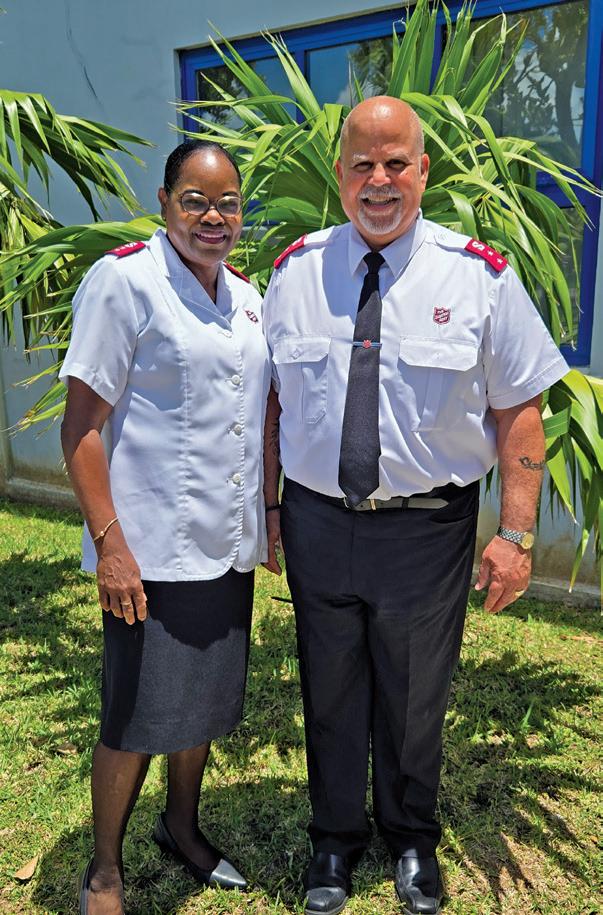
Cpts Cathy and Alfred Esdaille
Photo: Tamiko Ramabuke
Bermuda
FEEDING BERMUDA
For the second year, The Salvation Army’s Feeding Bermuda program received a generous grant to provide nourishment, care and hope to individuals in need through its six ministries.
Those ministries include the Harbour Light Addictions Treatment Centre, Harbour Light street ministry vehicle, North Street Citadel food bank, North Street Citadel feeding program, St. George’s Corps food bank and the West End Community Church food bank. More than 50,000 visits were reported to these ministries over the past year.
It has meant all the difference to Anna, a single mother of two who came to the St. George’s Corps food bank last year. It was her first time asking for food from a food bank and she was in tears about not being able to provide for her family. After talking with staff, she felt much better. She received food and has felt comfortable returning for more visits. She told staff how grateful she is to be able to provide school lunches for her children and prepare meals for them until her next paycheque.
Another client, who receives food from the North Street Citadel feeding program, says: “The Salvation Army has benefited me in many ways—just being fed every day with kindness and love. There are a lot of homeless people who can’t get anything to eat for that day, and it’s important that The Salvation Army takes care of them and makes sure everyone gets a meal. I’m grateful for what they do for all of us.”
Feeding Bermuda received support from the Centennial Bermuda Foundation in the 2024-2025 year and, recently, for the 2025-2026 year.
“We are very pleased and thankful to have received the support of Centennial Bermuda Foundation’s Community Health and Fundamental Needs Committee again through their grant of $80,000 for the Feeding Bermuda initiative,” says Lieutenant Lester Ward, executive director, Bermuda Community Services. “Their support continues to provide hot meals, bagged lunches, food vouchers, groceries and care for anyone in need of help at The Salvation Army.
“As the impact of rising costs is deeply felt among the people we serve, we are seeing more people come through our doors. The Foundation’s support has allowed us to plan ahead, be efficient with our spending and vary our menus, so we can purchase fresh fruit, meat and vegetables to help our clients eat healthier and feel valued.”
YOUTH AT CEDAR HILL
After FUSE last May, a fun retreat weekend for youth in Grades 7 to 12, Lieutenant Amy Patrick, corps officer at Cedar Hill in Warwick, Bermuda, wanted to keep the momentum going.
“We had a ton of teens come out and they had a wonderful time, but we didn’t have the programming to bring them into the church—there was a gap,” she says. “We had something for younger kids, but we wanted to create a space for the teens connected to the corps.”
Along with two other leaders, she started a monthly youth group, engaging the teens in conversations about life, faith and Jesus using the Alpha Youth series.
“At first, they were hesitant, but then a popular YouTuber would come on the screen and talk about their faith,” she says. “Or there would be interviews with people on the street, asking questions like, ‘What makes you happy?’ ‘Who is Jesus to you?’
—by Melissa Yue Wallace
“The questions get the kids thinking, and the conversation is starting to grow. A few of them have spoken really openly and honestly about some of the prompts.”
The group has grown from five teens to 10 over a short period of time. Those who have attended the corps before have helped create a welcoming atmosphere for others.
“It’s really encouraging to see our young people explore their faith, but also step into leadership among their peers,” says Lieutenant Patrick.
After the discussion, it’s time for fun and games—with Minute to Win It, life-sized tick-tack-toe or variations of Family Feud.
“We call one of our leaders Mary Poppins, because she always has a bag of tricks,” says Lieutenant Patrick. “She pulls up all these TikTok games, and they get into it right away with us.”
Next up is a scavenger hunt, with clues all over the island, ending up back at the corps.
“We’re still in the early stages of this group, but I think it’s important to have our kids come together and continue to build friendships and grow in faith,” she concludes.
—by Giselle Randall
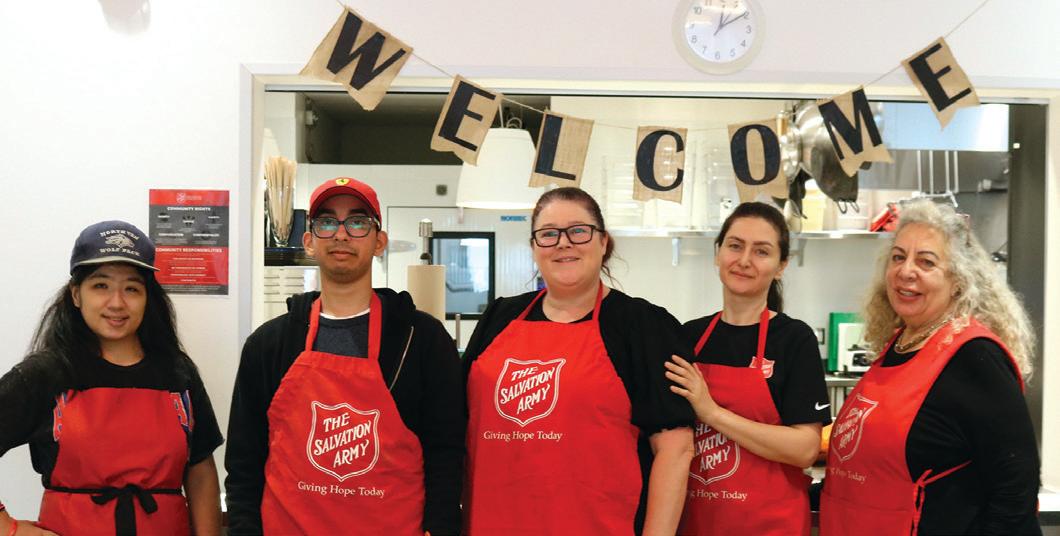
A volunteer serves meals at North Street Citadel
From left, Lt Amy Patrick, Mjr Susanne Fisher and CSM Jennifer Nisbett lead the senior youth group at Cedar Hill
Photo: Tranell Nisbett
CHRIST IS RISEN
Stepping into the story of Easter through the days of Holy Week.
You are Invited!
Palm Sunday Fig Monday
We all love unwrapping gifts, wondering what’s inside and hoping it might be something we’ve long desired. But sometimes we receive a gift we didn’t expect—or even want. Yet those unexpected gifts often turn out to be far better than we imagined.
On Palm Sunday, the people of Jerusalem expected a powerful king who would overthrow Rome and restore Israel’s glory. Their hopes were focused on earthly victory, but Jesus came to bring a deeper freedom—deliverance from sin and death. His mission reached far beyond their expectations.
As Jesus approached Jerusalem, he sent two disciples to find a donkey and her colt. It was an unusual request, yet it fulfilled prophecy and revealed a Saviour who often works through the unexpected to accomplish the miraculous.
I’m grateful that God doesn’t work the way I would. His plans always surpass mine. While I may pray for quick fixes or temporary relief, God offers transformation that requires trust.
Like the man in the parable who sold everything to gain a hidden treasure, we are called to recognize the true worth of Jesus. Palm Sunday reminds us that he came not to meet temporary desires but to fulfil our deepest need—salvation.
As we move closer to the cross and the empty tomb, reflect on this: Have you fully trusted Jesus as your king? If he rode into your life today, how would you receive him?
MAJOR DONETTE PERCY is a retired Salvation Army officer.
“L ove, joy, peace, patience, kindness, goodness....” You may remember singing these words as children, as we were taught that a life lived for Christ would have evidence of the Holy Spirit’s “fruit” (see Galatians 5:22-23) in our words and behaviours.
Perhaps this is why Fig Monday appeals to me during Holy Week. The shouts of “Hosanna” from the previous day’s triumph have grown quiet and are replaced with the dramatic actions of Jesus as he forcefully cleanses the temple and curses a seemingly innocent fig tree (see Mark 11:12-26; Matthew 21:12-22). Could it be that Jesus was unapologetically warning against spiritual fruitlessness and dangerous hypocrisy? As Jesus knocked over the tables in the temple and commanded the fig tree to wither from its roots, he communicates his desire for fruit-filled, authentic faith and genuine sincerity and reverence in our worship and service.
Fig Monday allows us to pause for introspection and perhaps even repentance. Are we serving prayerfully and with genuine devotion? Do we still show reverence toward the Lord and the places dedicated to his glory? Are we showing evidence of fruitfulness?
Teaching Tuesday
As Holy Week continues, we move from Fig Monday to Teaching Tuesday, the last day of Jesus’ temple teachings. In Matthew 21:28-22:14, we read three parables spoken not to “outsiders” but to those who believed they already knew God’s will. The lessons Jesus shared challenge them—and us—to examine our hearts and how we respond to him.
The first, the parable of the two sons, reminds us that faith is shown not in words, but through action. One son says no but later obeys; the other says yes but fails to act. It calls us to look honestly at our own discipleship and consider if our prayers and promises lead to real change— lives shaped by obedience, mercy, grace and love.
In the parable of the tenants, Jesus reveals the tragedy of continued resistance to God. Again and again God reaches out; again and again he is rejected. As we approach the cross this year, we see how human fear, pride and desire for control led to violence. Yet we are reminded that God’s purpose is not defeated; the rejected Son became our cornerstone of salvation.
Finally, the parable of the wedding banquet shows both the depth of God’s mercy and the seriousness of our response. The invitation is offered freely, even to the seemingly unexpected and unworthy, but it requires transformation. Grace is experienced where we are, yet it does not leave us unchanged.
Together, these parables remind us that Holy Week is not only about remembering what Jesus endured but examining how we choose to respond to his teaching and invitation. May we move beyond words to faithful action as we walk with Christ toward the cross, and into new life.
MAJOR SHELDON BUNGAY
is the divisional youth secretary in the Prairies and Northern Territories Division.
JUSTIN GLEADALL is the corps officer at Oshawa Temple, Ont.
CAPTAIN
Spy Wednesday
Spy Wednesday, a term that comes primarily from the Roman Catholic tradition, is the day we consider Judas and his agreement to hand Jesus over to the authorities for 30 pieces of silver (see Matthew 26:14-16).
I doubt that Judas began his journey intending to be a “spy,” but eventually he becomes one. Scripture doesn’t tell us Judas’ exact motives, but he breaks trust and offers Jesus over to those who would kill him, all for 30 pieces of silver.
What is clear about the betrayal of Judas is its intimacy. He was not an enemy or stranger; he was a friend. He travelled with Jesus, ate with him and called him teacher. There was no outright hostility observed, only a decision made secretly, like a spy.
Jesus’ response was not to expose Judas or retaliate, but to remain faithful to the path that led to the cross, motivated by love.
Spy Wednesday holds a gentle invitation to look inward. In what quiet ways might we betray Christ? Could it be through compromises, such as silence in the face of injustice, or choosing self-interest over compassion?
The good news is that we are not without hope. The story is still moving toward redemption, and we are invited to return and realize that God’s love will have the final word.
CAPTAIN JACLYN WYNNE
Maundy Thursday Good Friday
Maundy Thursday commemorates the night Jesus shared his final meal with his disciples. The word maundy comes from the Latin mandātum, meaning “command” or “mandate,” and refers to the pivotal moment when Jesus gives them a new commandment: “Love one another. As I have loved you, so you must love one another” (John 13:34). This command is not merely spoken; it is first embodied when Jesus kneels to wash the disciples’ feet.
This day reminds us that the love to which Jesus calls his followers is demonstrated before it is demanded. In John 13, Jesus takes a towel and assumes a posture of vulnerability and service. In doing so, his authority is not diminished but revealed. His power is expressed through humility, attentiveness and care.
By modelling love before naming it, Jesus invites the disciples to experience what love looks like in action. We notice love as presence, as service; love that meets human fragility with gentleness. While foot washing may not be a widespread practice today, the meaning it carries remains timeless. Love is a posture.
Maundy Thursday reminds us that love often takes shape in ordinary acts of service: listening deeply, remaining present with one another and offering attentive care when words fall short. It calls us to embrace humility in our relationships, trusting that loving presence can be transformative. May the posture Jesus demonstrated continue to guide how we serve, walk alongside others and embody love in the world.
MAJOR LESLIE WISEMAN
is the corps officer and community ministries officer at Bridgetown Community Church, N.S., and the regional corps health resource officer for the Atlantic Division.
Good Friday does not offer resolution; it offers presence. It invites us not to escape the darkness, but to enter it with Christ. The cross stands at the centre of human suffering, declaring that God does not remain at a safe distance from pain but steps fully into it. Jesus’ anguished cry—“My God, my God, why have you forsaken me?” (Mark 15:34)—names the raw reality of abandonment, grief and loss. This is not symbolic suffering. It is God’s costly solidarity with a wounded world.
Scripture insists that this descent is not accidental but essential. “He was despised and rejected … a man of sorrows, and acquainted with grief” (Isaiah 53:3 RSV). On Good Friday, God refuses denial. Violence, sin and death are faced honestly—not bypassed by optimism or explained away by theology too tidy for grief.
As darkness falls over the land (see Luke 23:44), creation itself bears witness: something decisive is taking place in the depths. The darkness becomes the place where God does his most transformative work—where love absorbs what would otherwise destroy.
Good Friday teaches us that resurrection is never cheap. New life is born only because Christ journeys all the way into death. The tomb becomes a womb precisely because love was willing to descend. To enter the darkness is to trust that God is already at work—reshaping death from the inside out.
MAJOR KRISTA ANDREWS is the corps officer at Richmond Hill Community Church, Ont.
is a chaplain at Community Venture in Winnipeg.
SSolemn Saturday
olemn Saturday marks the stillness between Crucifixion and Resurrection, a stillness the disciples did not choose. Their teacher was dead. Their hope had unraveled. The One who opened blind eyes and welcomed the forgotten now lay in the tomb sealed by the empire. To them, the story had ended.
Luke tells us they rested on the Sabbath (see Luke 23:56). This rest is not peaceful. It is the kind that comes when a heart has been hollowed out. No miracle is expected. No future imagined. Only a pause filled with sorrow.
We seldom pause with them. We rush toward the joy of Easter without honouring the weight of this middle day. Yet many of us live in places like this, caught between what was lost and what has not yet been restored. Solemn Saturday gives language to those seasons. It lets us acknowledge the sorrow we prefer to ignore.
The church has long reflected on Christ’s descent, his work beyond our sight, in what has become known as the “Harrowing of Hell.” But the disciples knew none of that promise. They simply mourned. By joining them in that honest sorrow, we discover a deeper gratitude for the hope that arrives on Sunday. When we allow ourselves to feel the grief of this day, the announcement of Resurrection becomes deeper, sharper and full of hard-won hope.
LIEUTENANT ZACH MARSHALL
is the corps officer and community services officer at Community Church of Lethbridge, Alta.
Il ove sitting in silence anticipating dawn’s arrival, filled with the assurance that the sun will soon reveal itself. In those early hours, I never doubt that the One who doesn’t slumber will stir the sunrise and daylight will replace the darkness of night. I wonder if Mary and the women who journeyed to the tomb “while it was still dark” (see John 20:1) were just as certain? Were they confident that light would invade the darkness that loomed in the days following Jesus’ Crucifixion?
Grief can cloud our ability to trust that there is relief on the horizon. We meet the women in this story amid despair. They are journeying to Jesus’ tomb in the early hours of the day, prepared to honour their friend. The words “while it was still dark” can easily fade into the background, yet they are profound. It was in the darkness that hope glowed brightly. In discovering the empty tomb, the beauty of the Resurrection was revealed. While it was still dark, God raised Jesus from the dead.
At times in our lives, we will experience despair, confusion, pain and loss. We may be uncertain if the light will ever come, but Easter reminds us that “while it was still dark,” God was at work. Jesus is alive, the risen Saviour is with us and he is the Light of the World. The wonder and joy of the Resurrection came after the pain, grief and loss of the Crucifixion.
In our darkness, we can trust that God is working in ways that we cannot yet see or imagine. We have the assurance of knowing that the light has already triumphed over darkness and the empty tomb is not the absence of Jesus; it is the presence of hope. Hallelujah!
CAPTAIN ANGELA KERR
is the corps officer at Saskatoon Temple and the regional women’s ministry secretary for the Prairies and Northern Territories Division.
SELF-DENIAL
THE SEARCH FOR WATER
How The Salvation Army is providing access to this vital resource.
BY LT-COLONEL BRENDA MURRAY
Theheat hit first; thick, unrelenting, the kind that makes the horizon shimmer. From the window of the small plane banking toward Kenya’s Turkana region, the landscape below looked scorched and strangely still. As we slipped beneath the cloud cover, the truth sharpened into view; drought had carved its signature into the landscape.
As we descended, what had, at first, looked like a lush tree line revealed itself to be something far more sobering. The trees clung to the edges of what was once a river, but now, with a closer look, only a long, snaking ribbon of dust remained where the water once flowed. The roots of the trees, reaching desperately downward, survived on water so deeply buried it no longer broke the surface.
After landing, our team set out on an eight-hour drive deeper into Turkana’s remote expanse. The road unwound past dry riverbeds and villages where residents crouched in the blistering sun, digging into the earth in search of water—just enough to drink, to keep livestock alive, to coax meagre crops from unforgiving soil.
In that moment, I became acutely aware of the distance between worlds. Back home in Canada, I turn on a tap and clean, safe water flows instantly, thoughtlessly. In Turkana, water is not an expectation but a daily quest for survival, one shared by countless communities around the globe.
This stark reality is what prompted the United Nations General Assembly to formally declare March 22 as World Water Day, first observed in 1993. The intention was simple yet profound: dedicate a global moment to spotlight the urgent need for every person, no matter where they live, to have access to clean, safe water.
This year’s theme, “Groundwater: Making the Invisible Visible,” brought me back to that day in Turkana, watching people dig deep into the cracked earth in search of water that no longer met the eye but remained essential for life. Groundwater is often unseen, often forgotten, until it is gone.
Across the globe, The Salvation Army is working to bridge that divide through humanitarian initiatives centred on water, sanitation and hygiene, commonly known as WASH projects. One such effort is underway at The Salvation Army Polytechnic College in Liberia, where a borehole and a water tank are being constructed, along with the installation of solar power to operate a new clean water system. Once completed, this project will supply purified water to the school, reducing waterborne diseases and ensuring that students stay healthy and able to complete their studies. An estimated 1,100 students and 5,500 community members will directly benefit.
In eastern Rwanda, where a savannahlike climate and scant annual rainfall leave communities chronically short of water, the Rwanda and Burundi Territory has taken decisive action. With funding from the Canada and Bermuda Territory, they launched the Rwimiyaga WASH Project, a $345,000 (USD) initiative that will serve 6,000 direct and 12,000 indirect beneficiaries. The project will establish four clean, accessible boreholes, support the creation of community-led water management committees and promote healthier hygiene and nutrition practices among households and schoolchildren alike.
The commitment goes beyond individual countries. At The Salvation Army’s International Headquarters in London, England, the international development department recognized the global urgency of clean, safe water and convened a dedicated community of practice focused on WASH. Among its members is Bothwell Mhashu, project manager in the Zimbabwe and Botswana Territory. He underscores the critical importance of this collaboration for both best practices and shared learning: “The community of practice is a platform that enables knowledge and experience sharing that can enhance project outcomes, and some projects have benefited by applying lessons learned from other implementing territories.” In a world where water scarcity knows no borders, this shared approach ensures that solutions travel farther, reach deeper and change more lives.
Having visited many places where The Salvation Army is providing access to clean water, I am reminded that safeguarding this vital resource is not only the work of organizations, but also the responsibility of each of us.
So how do we help “make the invisible visible”? How do we become better stewards of the water we so easily take for granted? And how can we support others around the world who dream of the same effortless access we enjoy? Here are a few simple places to begin:
• Be mindful when flushing the toilet.
• Turn off the tap while brushing your teeth.
• Shorten your showers to conserve water.
• Collect rainwater for watering plants.
• Support Gifts of Hope water initiatives (SalvationArmy.ca/GOHWater).
Together, we can make the invisible visible. Are you up for the challenge?
LT-COLONEL BRENDA MURRAY is the director of the international development department.
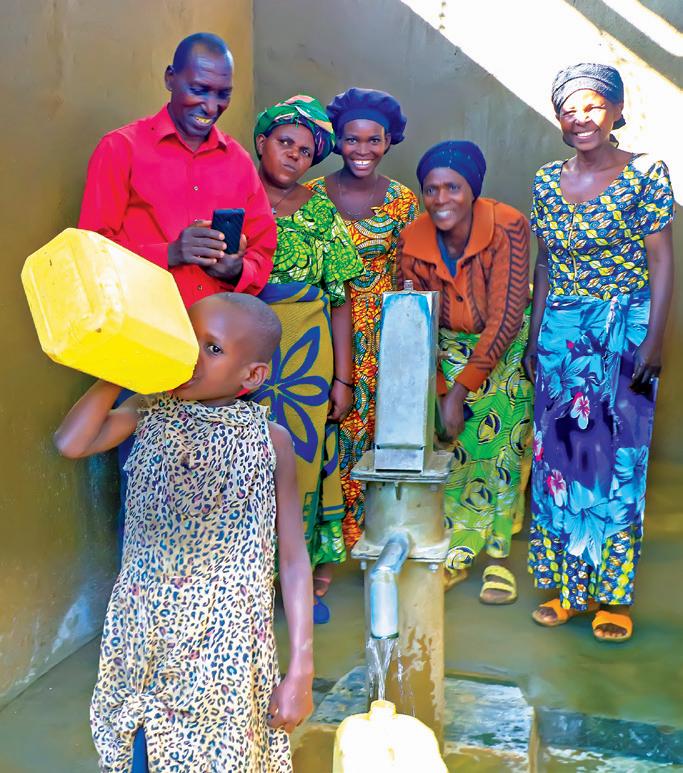
A new borehole in Rwimiyaga, Rwanda
Formore than a decade, the S.O.UL.
Dance program at Prince George Community Church, B.C., has been providing an accessible outlet for children and youth to express their souls, while learning about God and dance.
“Dance is such a beautiful combination of physical and soul expression,” says Kessa Daniels, who leads the program. “When we’re able to connect with God through music, movement and the teachings of the Bible, we can express our faith in a way that no other art form can.”
S.O.UL. Dance (Seeking Out U Lord) has two main program branches: the first, called the recreational stream, is outreach based. The other is the competitive stream with a greater focus on advanced dance skill, technique and vocabulary, paired with a discipleship component.
According to Daniels, most of the youth at the corps are connected to the church through S.O.UL. Dance. “We’re meeting new kids through the recreation program. They’re coming back for a couple sessions, and then they’re getting involved in the competitive program,” she says. “It’s wonderful to see that outreach ministry filtering into our corps, bringing discipleship to youth from the community.”
FROM THESoul
Dance ministry at Prince George Community Church, B.C., turns dancers into disciples.
BY ABBIGAIL OLIVER
A DIFFERENT MESSAGE
With the cost of living on the rise, there is a high demand for affordable extracurricular activities for youth. Many parents struggle to afford to put their children into clubs and community sports, especially those such as dance that require significant start-up costs for equipment and registration fees.
“DANCING AT THE SALVATION ARMY MEANS SPREADING THE LOVE OF GOD.”
—CHARLIZE ADOLPH
The S.O.UL. Dance recreational stream reaches out to kids in the community who have an interest in taking dance lessons but whose families may not be able to afford traditional dance studios. Some students experience other barriers, such as a disability, that prevent them from participating in traditional dance education. Others in the recreational program prefer S.O.UL. Dance because of its commitment
to using Christian, Jesus-centred media rather than secular music.
“We only dance to faith-based music because we know the importance of how music interacts with your soul,” explains Daniels. “We can share a different message by dancing to faith-based music rather than secular music.”
Participants pay a $25 registration fee, with subsidies available for unique individual needs, which includes everything required to participate, such as proper footwear, costumes and instruction. The program is led by volunteers and fuelled by public donations of supplies and equipment, allowing it to operate in a more cost-effective way.
“Here in Prince George, we’ve built relationships with some of the local studios, people and organizations within the competition world. At the end of competition season, many of them will bring older costumes, which we then mend and use,” says Daniels. “We have also had some support from our community and family services for funding our recreational program and covering some registration fees for families in financial need. Footwear has been provided by the generous donations of the community.”
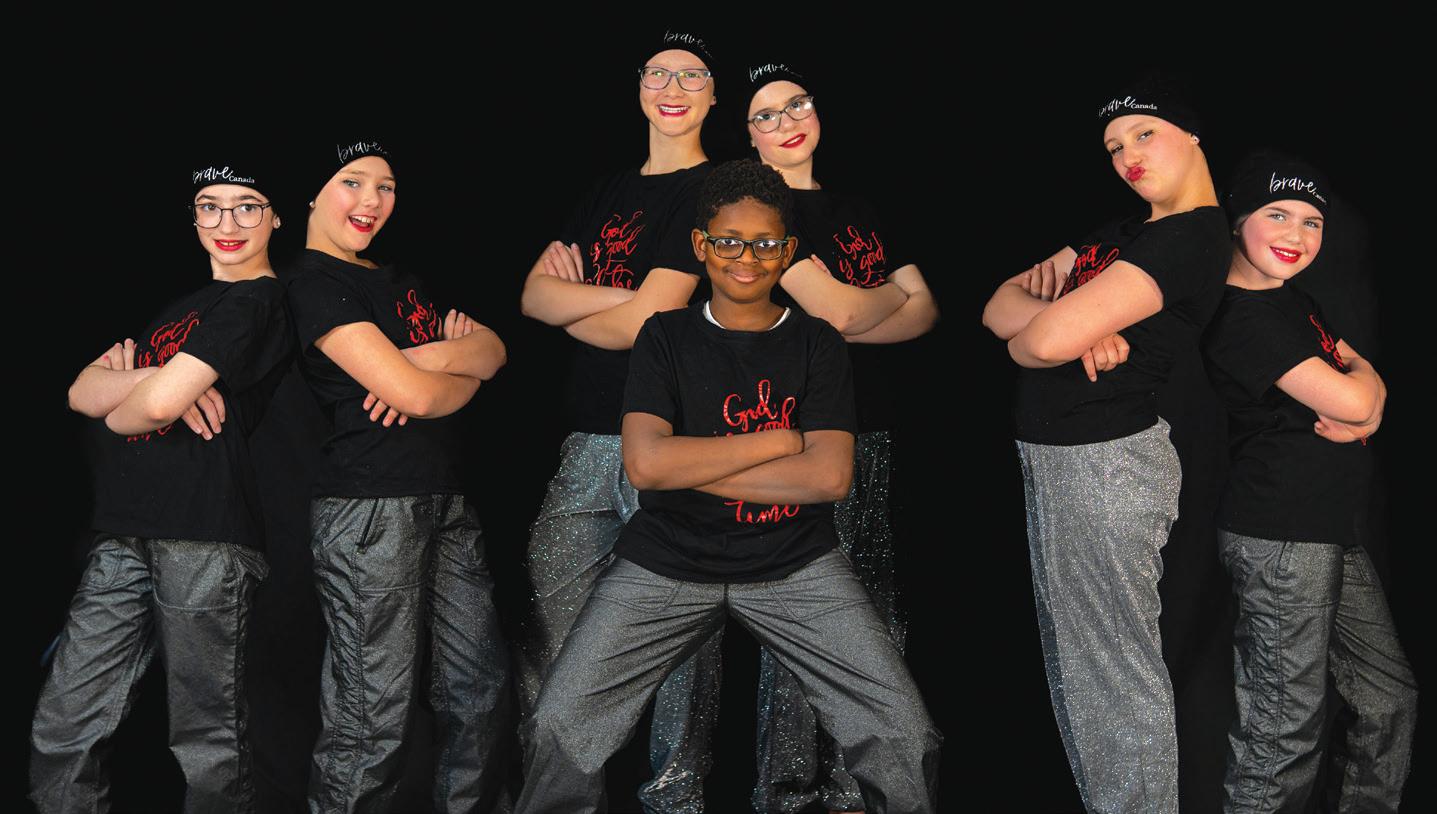
Dancers Emma Boutcher, Faith Wilkinson, Brooke Durocher, Zavanna Dube-Peterhans, Siphesihle Van Dijk and Tanner Mackenzie
The recreational program runs for 10 weeks, twice a year, and typically sees up to 40 participants at a time. It’s available to children of all ages and abilities, but most dancers fall between the ages of nine and 15. Youth spend the full 10 weeks learning the basics of dance and technique, and at the end, they put on a showcase performance.
MAKING DISCIPLES
The competitive branch of S.O.UL. Dance has a greater focus on discipleship. It invites youth who regularly or repeatedly attend the recreational program, and who express interest in dancing more than 20 weeks out of the year, to continue their dance education in a more intensive way.
This stream emphasizes not only developing dancing skills, but also spiritual character. To be part of the competitive program, dancers must also participate in weekly discipleship classes.
“We’re getting out there, we’re going on stage, and sometimes we are the only connection that people have to the Word of God,” says Daniels. “Youth develop their dancing abilities, but they are also developing their faith, and we are walking alongside them in their spiritual growth.”
The competitive program teaches all different styles of dance from lyrical to jazz to tap. As Daniels notes, some dancers will begin their journey in the recreational program and move into the competitive stream as they make the decision to take dance—and discipleship— more seriously.
CLOSER TO GOD
One dancer, Charlize Adolph, first began in the recreational stream when she was seven. She grew up in the program and now at 20, she participates in the competitive program and teaches younger dancers at the recreational level. As part of her commitment to S.O.UL. Dance, Adolph also attends the young adult Bible study, an outlet that helps deepen her relationship with God alongside her dance learning.
She didn’t have any experience starting out, but she began attending S.O.UL. at Prince George Community Church because it was more affordable than other dance studios in the community.
“Since then, my faith has grown a lot through dance. It makes me feel closer to God,” says Adolph. “Modern dance is my favourite because I find it easy to show my emotions.”
Adolph recalls going through a difficult time in 2021 and 2022. She experienced a lot of anxiety, and it was hard to express her emotions in a healthy way, but dance helped her through it and kept her connected to her faith during hardship.
Over the years, she has learned that dancing is a competitive sport, and there is a lot of animosity and bullying that happens within the dance community. For Adolph, the supportive community at S .O.UL. Dance is much different. “Through S.O.UL. Dance, I’ve learned to cheer everyone on, even if I’m competing against them,” she says.
“Dancing at The Salvation Army means spreading the love of God,” says Adolph. “We all want to dance the best we can, but in the end, spreading the gospel is the most important part of dancing with this studio.”
MINISTRY IN MOTION
Rooted in the love of Christ, S.O.UL. Dance intentionally cultivates an atmosphere where everybody is welcome, regardless of their ability or dance knowledge. Kindness, compassion and inclusivity are at the foundation of the curriculum and are just as important as the dance technique.
According to Daniels, one longtime dancer who has cerebral palsy has been able to participate with her peers, and the team found creative ways to incorporate and accommodate her wheelchair into the dance so that she would feel included.
“From a dance world perspective, when we go to competitions year after year, we’re seeing more of that inclusivity and boundaries being pushed in ways that they haven’t been before,” explains Daniels.
“We hope that those reading this article will keep this ministry in their prayers,” she says. “I pray that God will continue to use children and youth and the ministry of dance for the greater kingdom.”
From left, Brooke Durocher, Faith Wilkinson, Chloe Adolph, Hailey Durocher and Skyla Adolph dance “Peace,” choreographed by Kessa Daniels
A hip-hop performance, “King Jesus,” choreographed by Chloe Adolph
“Il ove the mission and the sacred work of The Salvation Army,” says Major Carson Decker, territorial candidates secretary, “sharing the love of Jesus, meeting human needs and being a transforming influence.
“It’s been a beautiful journey, filled with incredible moments, and I can’t imagine doing anything else. And if I had to do it all over again, I would still say yes.”
A LIFE IN SERVICE
Major Decker was raised in a Salvation Army family in Woodstock, N.L., a small outport community. Church attendance was important in their home. He remembers falling asleep one evening while his mother attended an evening service and his father looked after the sleeping little boy.
“When I woke up,” he recalls, “I remember being very upset that my mom had left me home from church. And so my dad had to put up with my mood and my disappointment.”
Major Decker was involved in all aspects of church life: junior soldiers, corps cadets, youth group and other corps activities.
“It was a place that fostered my own spiritual journey and discipleship,” he reflects. “I was encouraged by people in the corps who saw something in me. Officership was often spoken over me as I was growing up, and I did sense, as a young boy, the calling. I wasn’t sure what that meant then, but I knew God had set me apart for something. And I wanted to be obedient to that.”
After high school graduation, Major Decker went right to the training college that was located in St. John’s, N.L., at that time. As an officer, he has served from coast to coast—from Newfoundland and
A SACRED TRUST
Serving those discerning a call to officership.
BY KEN RAMSTEAD
Labrador to Nova Scotia, British Columbia and Ontario. This coming June, he will have been an officer for 28 years.
A NATURAL FIT
Having served for nine years as a divisional youth secretary with responsibility for candidates, Major Decker found that that role resonated with him.
“It was a sacred part of the ministry, and I enjoyed journeying with people, hearing their stories, seeing their potential, offering encouragement and support.”
So, when he was asked in 2023 to step into the role of territorial candidates secretary, it felt like a natural fit for him.
“The weight of responsibility is significant, but it does come with incredible joy,” he says. “I don’t take any of that for granted, and I consider it a sacred privilege. I’m grateful for the opportunity to serve in this capacity.”
IT TAKES AN ARMY
The territorial candidates secretary role is based out of territorial headquarters in Toronto, and focuses on recruitment, strategy and resourcing. Major Decker believes this role is important because it helps steward God’s call on individual lives.
“In my role,” he explains, “I ensure that those who are sensing a call to Salvation Army officership and ministry are prayerfully guided and supported to help them respond faithfully to God’s leading. It ensures a healthy sustainable flow of called and prepared leaders who will carry the mission forward in the years to come.”
The territorial candidates secretary role, along with support from the divisional candidates secretaries, helps translate that calling into faithful action.
The importance of this role, Major Decker feels, lies in its unique combination
of strategy and pastoral support; it involves implementing strategies, while also journeying alongside an individual in their discernment. The balance ensures that recruitment is not merely about numbers, but deeply spiritual, thoughtful and aligns with the values of Salvation Army officership.
“However, recruitment is not the work of one individual or one department,” he says, “but is the responsibility of the whole Army.”
MADE FOR A DIVINE PURPOSE
The candidates department focuses on call and commitment each year, usually choosing a new theme. This year’s theme, rooted in Jeremiah 15, is: “Made for a Divine Purpose.”
It reminds us that God has set us apart for something and he has an appointment for us to serve.
“For some,” says Major Carson Decker, “that will be Salvation Army officership. For others, that might be other things, but we’re all created with intention and purpose.
“Our hope this year is that people will take time to pause, reflect and consider how God might be setting them apart, and what that appointment looks like for them in their lives. We hope that people will respond faithfully to whatever God is asking of them.
“This theme launched in February across the territory, and we’re excited for the conversations that will happen, how God will speak to people and how people will respond,” he concludes.
THE LIGHT OF THE WORLD
Jesus is with us in the dark.
BY MAJOR CORINNE CAMERON
Areyou afraid of the dark? Even if the answer is no, many of us would admit to a sense of unease being in a dark room. We can’t see tripping hazards, clothes left lying on a chair seem to morph into the shape of a monster, and noises seem amplified when we can’t easily identify the source of the sound. We stumble around, find the light switch, turn it on and breathe a sigh of relief.
The contrast between light and darkness is a theme woven throughout John’s Gospel, whose opening paragraph tells us how “the light shines in the darkness, and the darkness has not overcome it” (John 1:5). This theme of contrast often refers to the spiritual dynamics of belief versus unbelief or understanding versus ignorance. However, it also refers to the presence and purpose of Jesus entering our world and being the light among us. When Jesus said, “I am the light of the world” (John 8:12), it is more than an intellectual statement; it is a promise of relationship as we share the light that dwells with and within each of us.
We understand this relationship of presence by paying attention to the context in which Jesus makes this statement, the Festival of Tabernacles (Sukkot). Jesus has travelled with his disciples to Jerusalem to celebrate this festival. Sukkot is a joyous autumnal festival, occurring in the northern hemisphere just as the days are becoming shorter. Gathering together in the lands that surround the temple, temporary shelters are built with wood and tree branches, and for a week people live in these shelters, dance, feast and celebrate in community.
In the Sukkot celebrations, those gathered remember the wilderness wanderings, and the gracious provision of God as the Israelites packed up and moved regularly on their journey to the Promised Land. As well as this holy remembering, they also thank God for their harvest and anticipate the gift of the Messiah.
Every evening, at each corner of the outer courtyard of the temple, four enormous bowls filled with oil and wicks are lit,
transforming the temple into a shimmering beacon of light. Try to picture how incredible this sight would have been. Almost two millennia before electricity was invented and with no tall structures, the dark night would have been completely transformed. As the people gathered to remember God’s presence as the pillar of fire that led the Israelites by night (see Exodus 13:21) and look forward to the Messiah, Jesus proclaimed: “I am the light of the world.” It is not surprising that the religious leaders who heard this claim were furious.
As we read the remainder of this verse, we realize this name is more than a proclamation—it is a promise of relationship. Jesus goes on to say: “Whoever follows me will never walk in darkness, but will have the light of life” (John 8:12). Just as temple lanterns transformed the dark sky, Jesus will transform the darkness of our lives. This transformation is not a magic eraser that eliminates our circumstances; rather, it is a promise of God’s presence in our circumstances. Just as the pillar of fire was the presence of God that led the Israelites through the wilderness, so, too, will Jesus be present with us in our darkness.
At times, the shadows of grief—the darkness of a diagnosis for ourselves or a loved one, the bleakness of past-due notices and stress-filled work environments—threaten to overwhelm us. Jesus, as our light in the world, promises to be with us in the midst of these dark circumstances, and that they will not overcome us (John 1:5).
When Jesus ascended into heaven, his presence continued in the hearts and lives of believers. Jesus raised up the church to be his presence in the world. Therefore, as we claim Jesus as our light in our world, let us also consider how we may reflect his light in the lives of others.
Exploring the “I am” statements of Jesus in the Gospel of John.
MAJOR CORINNE CAMERON is the corps officer at Yorkminster
PRAYER PRACTICE
In a dark or dimly lit room, light a candle. Rest in God’s presence as the burning light transforms the darkness that surrounds it. As you watch the candle burn, begin with a time of holy remembering for how God has been present through your life, then offer a prayer of gratitude. Continuing in this time of prayer, consider these questions:
• Where in my life do I need the light of Christ?
• How may I shine the light of Christ to another?
Citadel in Toronto.
GROWING IN COMMUNITY
Finding friendship and belonging in The Salvation Army.
BY COLONEL MARGARET McLEOD
Last fall, I visited Glace Bay, N.S., where The Salvation Army serves a homestyle meal for lunch every week, and met Robert. Stepping into any new situation for the first time can be difficult, but Robert embraced the challenge. He arrived one Thursday and found a warm welcome to a new community—a place of acceptance, a place where he was comfortable, a place of friendship. He returned week after week. The lunch was good; the community was great.
After attending for some time, Robert enrolled as an adherent of Glace Bay Corps. What started as a community where physical food was served has become, for Robert, a community where spiritual food is served.
How would you define community? What about your community?
ALTHOUGH EVERY COMMUNITY UNDER THE SHIELD IS DIFFERENT, EACH ONE IS A GATHERING PLACE WHERE INDIVIDUALS CAN FIND RELATIONSHIPS WITH OTHERS.
In the Canada and Bermuda Territory, “community” is found wherever there is a Salvation Army shield. The shield is symbolic; although every community under the shield is different, each one is a gathering place where individuals can find relationships with others.
Envoys Bob and Charmaine McLeod love the community of northeast Calgary, where they lead and serve under the Salvation Army shield of Berkshire Citadel Community Church. Recently, brass instruments were donated to the church and within a few weeks, a community of beginner musicians began learning to play music. Last summer, church members created a community garden on the property, growing fresh food to distribute within the larger community of the neighbourhood. Berkshire Citadel is finding ways to be a community. During Advent, I read a devotional book in my quiet time called Advent and Christmas Wisdom from Henri J.M. Nouwen, a collection of his writings. Nouwen reflects on Mary’s visit to Elizabeth, describing community at its finest with these words:
“I am deeply moved by this simple and mysterious encounter … two women meet each other and affirm in each other the promise given to them. The humanly impossible has happened to them. God has come to them to begin the salvation promised through the ages. Through these two women God has decided to change the course of history. Who could ever understand? Who could ever believe it? Who could ever let it happen? … For three months Mary and Elizabeth live together and encourage each other to truly accept the motherhood given to them. Mary’s presence makes Elizabeth more fully aware of becoming the mother of the ‘prophet of the Most High’ (see Luke 1:76) and Elizabeth’s presence allows Mary to grow in the knowledge of becoming the
mother of the ‘Son of the Most High’ (see Luke 1:32). … The story of the visitation teaches me the meaning of friendship and community. How can I ever let God’s grace fully work in my life unless I live in a community of people who can affirm it, deepen it and strengthen it?”
Henri Nouwen concluded his reflections, taken from his book The Road to Daybreak: A Spiritual Journey, with a challenge: “By offering gentle assistance to someone in our environment who is in need; of praise, of a good word, of daybrightening laughter,” community can be found.
Common interests are often the basis for creating community. Within The Salvation Army, there are many smaller communities formed around common interests that offer space for anyone: quilting, knitting, book clubs, vocal or instrumental groups, English conversational groups, and so on. To deepen faith and spiritual journeys, a number of Salvation Army communities host Bible studies, prayer times and Alpha programs.
With Advent behind us and Easter ahead of us, is there someone you can invite into a Salvation Army community, with the hope and possibility of spiritual transformation? What a great way to define community.
COLONEL MARGARET McLEOD is the chief secretary of the Canada and Bermuda Territory.
In the late 19th century, General William Booth, co-Founder of The Salvation Army, put forward a scheme to help aspiring British emigrants find new homes in Canada. By 1914, the Army had helped bring more than 100,000 people to Canada, a total that eventually rose to an estimated 250,000.
Living History is an ongoing series showcasing just a small assortment of the more than 350,000 items housed at The Salvation Army Heritage Centre in Toronto. This month, we spotlight a lapel pin and leaflet associated with The Salvation Army’s immigration department.
PINNING HOPES
A century-old lapel pin produced for The Salvation Army’s immigration department highlights a forgotten but important chapter in Canadian history.
Leaflets (above) advertising lectures by Salvation Army officers describing the wonders of Canada would be posted, and interested par-
ticipants could learn more about what lay ahead. Upon their arrival at ports in either Quebec or Nova Scotia, the immigrants were greeted by Salvationists wearing one of the pins pictured above right. Henry Birks, silversmith and founder of the renowned jewelry company, Henry Birks and Sons, produced the pins and was himself the son of immigrants who came to Canada earlier in the century.
Intriguing stories of Canadian newcomers who were assisted by the immigration department can be found in meticulously recorded ship logs, which list names, dates and places of birth, occupations, embarkation points and ultimate destinations, as well as progress reports.
Only one immigration colony still carries its original name: Coombs, B.C., named after Commissioner Thomas B. Coombs, territorial commander for Canada from 1884 to 1889 and, again, from 1904 to 1911
MONTREAL—Montreal Citadel celebrates the enrolment of five senior soldiers and four adherents. From left, Cpts Juan Chirinos and Indira Albert, COs; Juan Pablo Vasquez, adherent; Oto Samuel, senior soldier; Elizabeth Shepherd, adherent; Meshac Zimbala, Grace Zimbala and Murielle Mondelice, senior soldiers; Samuel Chirinos, adherent; Udeme Samuel, senior soldier; Juan Esteban Vasquez, adherent; and Cols Eleanor and Glen Shepherd.
MONTREAL—Eglise Communautaire Nouveaux Départs welcomes seven new adherents, supported by Lt Wilder Jean-Charles and Lt Josette Joseph, COs, as well as Cols Glen and Eleanor Shepherd; soldiers Adline Joseph Séraphin and Kerlain Jean; and Debe Gradys, holding the flag.
and Resource Centre
the
and
KAMLOOPS, B.C.—The Salvation Army Kamloops Church
celebrates
enrolment of 16 adherents, supported by their families and Mjrs Orest
Tracy Goyak, COs.
ST. GEORGE’S, BERMUDA—St. George’s Corps celebrates a recent home league enrolment. From left, Janet DeShields; Lt Almeta Ward, CO; Gloria Knight; and Beverley Ratteray.
LONDON, ONT.—London Citadel hosted special guests General Brian Peddle (Rtd) and Comr Rosalie Peddle for a weekend of worship, remembrance and celebrating newly appointed local leaders. From left, Kevin Cole, holding the flag; newly commissioned AYPSM Taylor Mitchell; General Brian Peddle; Kelly Robertson and Karen Butler, CCM co-ordinators who received Warrants of Service; and Lt-Col Morris Vincent, CO.
TORONTO—Nine senior soldiers are enrolled at Etobicoke Temple. Back, from left, ACSM Keo Soutthiphanh, holding the flag; Mjr Robert Reid, CO; Tovakriss Ofuasia, Faithtovia Ofuasia, Novalysia Ofuasia and David Ogunlalu, senior soldiers. Front, from left, Alysha Christian, Nia Christian, Michelle Nadiadwala, Michelle Knol and Saranya Leonard, senior soldiers; and Mjr Dana Reid, CO.
GAZETTE
INTERNATIONAL
Appointments: Mar 1—Lt-Col Nelia Almenario, TC, The Philippines Tty, with rank of col; Mjr Emerald Urbien, CS, The Philippines Tty, with rank of lt-col; Apr 1—Lt-Cols Elisabeth/Ian Gainsford, directors, ISJC; Lt-Cols Nyarai/Sipho Mbangwa, TSWM/CS, Rwanda Tty
Promoted to colonel: Lt-Cols Beatrice/Harun Chepsiri, TSWM/CS, Kenya West Tty; Lt-Cols Celeste/Mario Nhacumba, TSWM/CS, Kenya East Tty
Promoted to lt-colonel: Mjrs Laurindo/Luisa Nombora, CS/TSWM, Mozambique Tty
TERRITORIAL
Appointments: Mjr Linda Daley, assistant executive director, HamiltonHalton-Brantford Housing and Support Services, Ont., social mission department, THQ; Mjr Sheldon Feener, executive director, Ottawa Booth Centre (THQ); Mjr Jennifer Hillier, territorial social mission secretary, THQ; Mjr Karen Hoeft, assistant territorial director of public affairs, office of the secretary for communications, THQ (pro tem); Lt Glenna Cryderman, CO, Nipawin, Sask., Prairies and Northern Territories Div (additional responsibility); Lt Mirna Dirani, resource officer, immigrant and refugee services, Toronto Harbour Light Ministries (THQ); Lt Tharwat Eskander, chaplain, New Hope Leslieville, Toronto Housing and Homeless Supports (THQ); Apr 1—Col Wendy Swan, executive director, Ethics Centre, Booth UC (additional responsibility)
Promoted to glory: Mjr Catherine Price, Nov 21; Mjr Margo Goodger, Nov 27; Mjr Franklin Johnson, Dec 3; Mjr Judy Regamey, Dec 22; Mjr Ruth Eason, Dec 26; Mjr Gladys Bates, Dec 28; Mjr Marguerite Lloyd, Dec 28; Cpt Lucy Graves, Dec 29
CALENDAR
Commissioners Lee and Debbie Graves: Mar 20-28 International Conference of Leaders, Nairobi, Kenya; Apr 18-May 4 visit of General Lyndon Buckingham and Commissioner Bronwyn Buckingham (WPWM) (Apr 18-21 Newfoundland and Labrador, Apr 22-23 Alberta, Apr 24-25 Manitoba, Apr 26-28 British Columbia, Apr 29-May 4 Ontario); Apr 25 convocation, Booth UC
BISHOP’S FALLS, N.L.—Two junior soldiers are enrolled at Bishop’s Falls Corps. From left, Kevin Burton, holding the flag; Abigail Arnold, junior soldier; Glenys Thorne, youth leader; and Rhylie Arnold, junior soldier.
Colonel Margaret McLeod: Mar 5-14 Senior Leaders Orientation and Development Conference, London, England; Mar 22 CFOT; Mar 23-24 National Leadership Dinner and Prayer Breakfast, Ottawa; Apr 3 citywide Good Friday service, Mountain Citadel, Hamilton, Ont.; Apr 5 Mountain Citadel, Hamilton, Ont.; Apr 11-12 40th anniversary, Berkshire Citadel CC, Calgary; Apr 18-May 4 visit of General Lyndon Buckingham and Commissioner Bronwyn Buckingham (WPWM) (Apr 18-21 Newfoundland and Labrador, Apr 22-23 Alberta, Apr 24-25 Manitoba, Apr 26-28 British Columbia, Apr 29-May 4 Ontario); Apr 25 convocation, Booth UC
Canadian Staff Band: Feb 28-Mar 1 Brockville CC, Ont.; Mar 28 Festival 57, Bayview Glen Church, Thornhill, Ont.
Canadian Staff Songsters: Feb 28-Mar 1 Belleville Citadel, Ont.; Apr 11-12 Mountain Citadel, Hamilton, Ont.
LONDON, ONT.—Lt-Col Morris Vincent, CO, presents certificates of appreciation to three outgoing members who have served on the ministry board at London Citadel. From left, Lt-Col Vincent; BM John Lam; YPSM Seritha Rowsell; and CT Jeff Wilson.
COVE, N.L.—
Cove Corps celebrates its 125th anniversary under the leadership of Lt-Cols Michelle and Scott Rideout, divisional leaders, Atlantic Div. From left, Cpt Stephen Frank, CO; Dorothy Rowe; and Lt-Cols Michelle and Scott Rideout.
CHANCE
Chance
“I’ve been through addiction and depression. I know what the struggle is, and I know there’s a way out. There’s hope. You can overcome,” says Aux-Cpt Matthew Pittman
QA &
Aux-Captain Matthew Pittman is the corps officer at Robert’s Arm-Pilley’s Island, N.L.
Tell us about your early years.
I grew up in a town called Pilley’s Island in Newfoundland and Labrador. The current population is a little less than 300. My childhood was simple—we made our own fun. My family has deep roots in The Salvation Army. My grandparents were heavily involved in the corps, and my dad’s brother and sister are officers. I wasn’t in church every Sunday, but my parents did send me to Sunday school and I was involved in different activities. I was enrolled as a junior soldier and went to the youth group.
When I was around 19, I started feeling very tired— I didn’t know what was going on. The doctor did all sorts of tests, and everything was OK, but I still felt like I couldn’t function. I totally crashed and went into a deep depression. I turned to marijuana—that was my coping mechanism for several years. Eventually, I also turned to drinking and drugs, and that just spiraled me further. It finally came to the point where my family fell apart. My girlfriend at the time moved out with my daughter. That was my rockbottom moment.
How did you come to faith?
A family friend kept inviting me and my daughter to church. I started going and absolutely loved it—I had always loved gospel music.
THE MERCY SEAT
After struggling with depression and addiction, I found hope in Jesus.
One day, the pastor at the corps in Triton, N.L., gave an altar call. He wanted everybody to close their eyes, and if somebody was struggling, to slip their hand up. I thought, Well, nobody’s looking. So, I did, and heard him say, “Bless you, my friend.” I remember kneeling at the altar, and two men I had known growing up came alongside me. Everything came pouring out—and I gave it all to Jesus. When I stood up, the whole church was around me. That was April 3, 2016. My life changed that day.
And now my testimony is that I’ve been there. I’ve been through addiction and depression. I know what the struggle is, and I know there’s a way out. There’s hope. You can overcome.
Tell us about your call to ministry. My wife, Laura, was the youth director at the corps in Triton when I came to Christ. She had seen me at some of my darkest and lowest points and still cared for me. We became friends and eventually ended up in a relationship. Now we’re married with three children.
The call to ministry was always there, even when I was young. At six years old, my ambition was to be like Billy Graham! I drifted away from it, but every time I drove by the church, I had that longing.
In 2019, we went to the Officership Information Weekend in Winnipeg. We felt that the Lord was calling us, but he didn’t open the doors at that time.
When we started the application process the
second time, things just fell into place, and within six months we were here at Robert’s Arm-Pilley’s Island.
How is God working in your corps?
The Lord is moving in a mighty way. We’ve seen growth in the corps in attendance and in people coming out to the Alpha program. A lot of the congregation members wanted to bring back the Sunday evening service, and I’m happy we did, because we had four people saved within the first five months.
I think people have come to Christ in the days we’ve been here because we’ve been receptive to the Spirit. We encourage people to come to the mercy seat. In a recent sermon, I noted that the mercy seat is not a place of shame; it’s a place of exchange. You bring your brokenness, and the Lord will give you strength. You bring your tears, and he’ll give you joy.
And we’ve been seeing the results of the Spirit moving. People are coming into our services who are not followers of Jesus. They’re hungry for something. And it’s not just adults. We’re also seeing a stir in our youth programs. We’ve had youth worship nights and had young teenagers come up to the altar, just weeping. They’ve been starved of hope. There’s a hunger in their hearts. And then they come and hear about the hope that’s in Jesus.
This article has been adapted from the Salvationist podcast. For the full interview, visit Salvationist.ca/podcast.
BOOTH UNIVERSITY COLLEGE Saturday, April 25, 2026
Special Guests: General Lyndon Buckingham and Commissioner Bronwyn Buckingham
International Leaders of The Salvation Army
BACCALAUREATE | 9 am
CONVOCATION | 12 pm
Calvary Temple | 440 Hargrave Street, Winnipeg
Faith & Friends
TO BEAR CROSS
PHRASE BE is an ongoing series highlighting the dozens of everyday sayings that originate with biblical text.
In this issue, we unpack:
PHRASE: Cross to bear.
DEFINITION: A hardship or burden that causes trouble or worry for someone to endure.
When Jesus spoke these words, it was as a challenge to His disciples to follow the path He was making. He was soon to bear His own cross, and He was warning them that while following Him would not be easy, it would be worth it.
EXAMPLE: I want to further my education, but, yikes more student loans are a tough cross to bear.
SOURCE: “Then Jesus said to His disciples, ‘If any of you wants to be My follower, you must give up your own way, take up your cross, and follow Me.’ ” —Matthew 16:24 (New Living Translation)
We don’t have to take up a real cross when we become Christians, as Jesus did during the first Easter, but the burden may seem as heavy. Breaking old habits, acquiring new and unfamiliar ways, even perhaps parting with old friends who just don’t “get” us anymore. The path may be lonely and hard, but the resulting transformation is beyond imagining. A new life in faith!
SOMEONE CARES
5 A Perfect Team
The Salvation Army in Milton, Ont., offers a safe location for the Support House’s mobile health van team.
GOD IN MY LIFE
8 “A Guiding Light”
Salman found faith and community in Canada on his journey from Pakistan to Winnipeg.
BE BLESSED
10 Blessed Are the Merciful
When we accept the undeserved mercy of God, it fills our hearts with mercy for others.
12 Loving My Scars
A bike accident left Kristin Ostensen with chronic pain. Could she still find healing?
16 Hope, Hard Work and MVPs
In an exclusive interview, hockey icon Ron MacLean shares why he supports The Salvation Army and its mission.
22 Faith at Easter
Easter meets us where we are, even in our weakness.
FAITH BUILDERS
25 A Stand-Up Dad?
New Nate Bargatze movie answers every parent’s question: How do we remain cheerful when life is challenging?
LITE STUFF
28 Eating Healthy With Erin Word Search, Sudoku, Quick Quiz.
A GLOBAL LENS
31 A Lifeline of Care
At The Salvation Army’s Chikankata Public Health Clinic in rural Zambia, dedicated health-care workers provide essential services to nearly 75,000 people.
The Gloves Are Off
It was the first slushy storm of the year, and I was on the bus home after a book-club outing. Snug in my gloves and toque, I waited for my glasses to unfog. As they did, I saw a youth sitting at the front of the bus. Dressed in only a hoodie, half soaked from wet snow outside, his Crocs were soaked through and he kept trying to warm his hands. I could see that he was in a bad way, though not complaining, but it was obvious he had nowhere to go.
I had no money on me, and my book would not help him. What can I do? I thought. I hesitated, but I finally took my gloves off, reached across and gave them to him. He mumbled his thanks and got off at the next stop. Why did I hesitate? I realized with chagrin that I had been afraid of his reaction. Would he have thrown the gloves back in my face? Told me to mind my own business? Yelled at me in front of everyone?
I am glad I did what I did, even though my own hands were frozen by the time I got home, but I realized that to do the right thing is, really, the right thing to do, no matter what. As the Bible says, “So whoever knows the right thing to do and fails to do it, for him it is sin” (James 4:17 English Standard Version).
In this issue of Faith & Friends, you will find other examples of people doing the right thing. Besides our exclusive interview with hockey icon Ron MacLean, you will read about how The Salvation Army in Milton, Ont., offered a safe space for a mobile health van. And in Winnipeg, an Army church helped an immigrant find faith and community. For them, doing the right thing is all in a day,s work.
Ken Ramstead
Mission Statement
To show Christ at work in the lives of real people, and to provide spiritual resources for those who are new to the Christian faith.
Faith & Friends is published bimonthly by:
The Salvation Army 2 Overlea Blvd, Toronto Ontario, M4H 1P4
International Headquarters 101 Queen Victoria Street, London, EC4P 4EP, England
Lyndon Buckingham, GENERAL
Commissioner Lee Graves
TERRITORIAL COMMANDER
Lt-Colonel John P. Murray
SECRETARY FOR COMMUNICATIONS
Geoff Moulton, DIRECTOR OF COMMUNICATIONS, EDITOR-IN-CHIEF AND LITERARY SECRETARY
Pamela Richardson
ASSISTANT EDITOR-IN-CHIEF
Ken Ramstead, EDITOR
Kristin Ostensen
MANAGING EDITOR OF SALVATIONIST AND SALVATIONIST.CA
Lisa Suroso
GRAPHIC DESIGN SPECIALIST
Emily Pedlar
JUNIOR GRAPHIC DESIGNER
Rivonny Luchas
DIGITAL MEDIA SPECIALIST
Giselle Randall
SENIOR EDITOR OF SALVATIONIST
Abbigail Oliver
EDITOR OF JUST FOR KIDS AND STAFF WRITER
Logan Graves CIRCULATION CO-ORDINATOR
Scripture Unless otherwise indicated, all Scripture references are taken from New International Version
Subscription for one year: Canada $17 (includes GST/HST); U.S. $22; foreign $24 P. (416) 422-6153
circulation@ salvationarmy.ca
All articles are copyright The Salvation Army Canada & Bermuda and cannot be reproduced without permission. Publications Mail Agreement No. 40064794 ISSN 1702-0131
Here to Help
A new mobile health van is a source of pride for, from left, Bradley D'Gama, community services assistant; Joanna Dickinson, nurse practitioner; Kevin Dzisah, nurse; Linda Piccione, community services worker; and Marisa Prada, community services manager. The Khi Salvation Army partners with Support House to provide medical care to the underserved of Milton, Ont.
Being Prepared
Joanna examines Kevin inside the mobile health van before the morning rush at the Khi Salvation Army in Milton, Ont.
A Perfect Team
The
Salvation Army in Milton, Ont., offers a safe location for the Support House’s mobile health van team.
by Jeanette Levellie
When Joanna Dickinson went back to university to earn a nurse practitioner degree, she wanted to help a particular group of people: the overlooked and underserved.
“I started out as a neonatal nurse, which was my original goal as a nursing student,” she says. “But by the time I decided to become a nurse practitioner, I had a family. I was out in the community more, so I saw the needs of people.”
Volunteering in her neighbourhood gave Joanna the chance to see first-hand how underserved many individuals are.
“I was drawn to working with this group,” she states.
After years of working with a mental-health and addiction focus, Joanna began working for Support House, an organization that helps people overcome barriers to housing. In March 2024, Support House received government funding to add a mobile health team for basic services, such as blood work, prescriptions and vaccinations. But there was one obstacle: they lacked a place to host the mobile health van.
“Helping People, Period”
After several months of searching for the perfect location, God led Joanna to Khi—A Community Church of The Salvation Army in Milton, Ont.
“The Army has the right fit for people with diverse needs,” she says. “We needed a spot where people who are underserved can feel comfortable and safe.”
Most of the clients who need medical care often lack in other areas, such as housing and food, she adds. This is why The Salvation Army was the perfect location.
“All the individuals who work there are committed to creating a welcoming environment, and to meeting as many needs as they can for every person they serve.”
The van offers their services by an interprofessional team, which includes addiction treatment and peer counselling, every Tuesday from 9 a.m. to 1 p.m. One of Joanna’s patients, a homeless man, had not received any type of health care for 20 years. Now, he has a safe place to find medical help. And much more.
Joanna notes that The Salvation Army acts as a hub for many types of help.
“It’s the human connection,” she says. “You can’t address people’s needs with only one thing.”
She appreciates the way the Army reaches out to the underserved by bringing together many kinds of services, each playing a role in building community.
“They promote other organizations, too. They aren’t just about themselves. They’re about helping people. Period.”
On-Call Duo
Joanna and Kevin are happiest when serving others. Here they pose with the mobile health van
The Perfect Team
Captain Ruth Hickman, corps and community ministries officer at Khi, feels honoured to host the mobile health van.
“As a Salvation Army pastor, I count it a privilege to journey with this diverse community as we endeavour to speak and show the love of God for all people,” she says.
Captain Ruth thanks God for the opportunity to lead ministry in a location that is becoming a hub of neighbours helping neighbours.
“Joanna and the team from Support House consistently bring their expertise and passion for wellbeing into Khi, allowing us to work together to offer supports for body,
mind and soul.”
Captain Ruth enjoys seeing the change in people they help.
“We often see neighbours coming in for one support, such as the food bank, and discovering that they can also talk about their burdens, pray with the pastors and be seen by a nurse in the same visit. It’s not unusual to see a physical change in a neighbour’s demeanour, having arrived weighed down by so much and leaving lighter and with hope.”
From medical care to mental health to spiritual encouragement, The Salvation Army and Support House’s mobile health unit make the perfect team to offer neighbours hope.
Nurse at Work Kevin in the fully equipped mobile health van
“A
Guiding Light”
Salman found faith and community in Canada on his journey from Pakistan to Winnipeg.
by Hurmat Habib
When Salman arrived in Winnipeg in June 2024, he carried with him more than just a suitcase—he carried hope, faith and the courage to start over.
Life in Pakistan had become increasingly challenging, and while his wife and two children remain there, Salman made the bold decision to pursue freedom to live out his Christian faith in Canada.
Purpose and Connection
“Salman lives close enough to our centre to be familiar with The Salvation Army’s Living Hope Community Church, and it was his aunt and neighbours who encouraged him to reach out to us,” says Lieutenant Krishna McFarlane, the pastor. “Even before arriving, however, he admired the Army’s work and mission while still in
Bible Students
Salman with Lieutenant Krishna McFarlane, pastor at The Salvation Army’s Living Hope Community Church in Winnipeg
Pakistan, which truly inspired him to seek our help upon his arrival.”
From the moment he stepped into the church, Salman felt a sense of belonging.
“He’s been incredibly eager to learn more about The Salvation Army, but his hunger to deepen his faith is even greater,” says Lieutenant Krishna. “As we pray together, I’m reminded that we share a few similarities in our newcomer experiences. Because I’ve walked a path with some of the same struggles and uncertainties, I can confidently tell him that things will get better by the grace of God.”
The church welcomed Salman warmly and introduced him to the Pathway of Hope program—a support system that quickly became a cornerstone in his journey.
“Everything felt new and overwhelming at first,” Salman recalls. “But the people here showed me kindness, and that gave me strength to move forward.”
With the church’s guidance, Salman tackled the practical challenges of settling in a new country. He obtained his driver’s license, secured a work permit and found employment. Yet, what made the biggest impact was the spiritual and communal support he discovered. Salman became an active member of the worship team, shared his time at the church’s English Café and volunteered in various church
activities, deepening his sense of purpose and connection.
Inspiring Journey
Salman’s commitment to faith grew even stronger when he became a Salvation Army soldier—an official member of The Salvation Army—a role he takes pride in every Sunday, donning his uniform as a symbol of devotion and service.
“I have learned and grown in so many ways,” he says. “All glory to God. The church has truly been a guiding light in my life.”
Today, Salman thrives as a valued member of the Living Hope community. His story is one of resilience, courage and the power of community to transform lives. For Salman, hope isn’t just a word—it’s a lived experience, one he continues to share through service, worship and unwavering faith.
And that journey of faith continues as he now works toward reuniting with his family in Canada, trusting that God will make a way for them to be together again.
“Salman’s journey is truly inspiring,” says Lieutenant Krishna. “Through every challenge, he holds onto faith, hope and the dream of being reunited with his family. It’s a blessing to walk alongside him and see how his courage, humility and trust in God touch everyone around him.”
Blessed Are the Merciful
When we accept the undeserved mercy of God, it fills our hearts with mercy for others.
by Jeanette Levellie
We love to see justice meted out. For the fictional criminal to wind up in prison. For the cartoon character who’s plotting to push someone in a puddle, to fall into a lake. For the cinematic arch-villain to be utterly defeated.
But Jesus shows us that justice isn’t what we really need. It’s mercy.
Choosing Mercy
“Blessed are the merciful, for they will be shown mercy” (Matthew 5:7) is the fifth point of Jesus’ first sermon in what we call the Sermon on the Mount.
Mercy isn’t simply feeling sorry
for someone and empathizing with their plight. It’s knowing we can make a person who’s wronged us suffer for their wrong—and choose instead to set them free.
Mercy can only come from one source: God. Mercy is part of God’s very nature. Jesus showed us that when He told the woman caught in the act of adultery, “I do not condemn you, either. Go. From now on do not sin any longer” (John 8:11 New American Standard Bible).
Jesus, as God in the flesh, was the only one who had the right to judge the woman. Yet He chose to show her mercy, reflecting the heart of God.
Jesus showed us God’s mercy by ransoming us and giving us back to God.
JEANETTE LEVELLIE
More Precious Than Silver
In the opening scene of the 1998 film Les Misérables, Jean Valjean, a paroled convict, steals a bishop’s expensive silver and attacks the bishop to make his escape. When the authorities capture Valjean with the silver, the bishop claims he gave it to Valjean. Shocked, the police remove the handcuffs and leave. The bishop uncovers the thief’s hood so he can look him fully in his face.
“I’ve ransomed you from fear and hatred,” he says. “And now I give you back to God.”
What a perfect reflection of Jesus’ mercy toward us.
Moments before He died, Jesus forgave those who mocked Him, spit on Him and nailed Him to a cross. He even asked God to forgive them, adding, “for they do not know what they are doing” (Luke 23:34).
Jesus willingly chose to take the punishment for our disobedience. When we decide to accept Jesus’ gift of mercy, as Valjean accepted the bishop’s favour, Jesus changes us to live new lives.
How can we possibly thank Him for that kind of love? He tells us how
in this sermon. By showing mercy to others.
Mercy Me!
People get hurt. And then they hurt us. If we let them, those hurts will keep us handcuffed to fear and hatred. When we decide instead to see Jesus’ favour, we realize that He didn’t give us justice; He gave us mercy. He freed us from the sins of our past. We now have His power to show mercy to those who have wronged us.
Easter is a day of celebration when we give praise that a man named Jesus, who was God in the flesh, died in our place. Jesus showed us God’s mercy by ransoming us and giving us back to God. Through His death and Resurrection, Jesus gives us the chance to live a new life.
This is the miracle of Easter. A miracle of mercy.
This is the fifth article in our series on the Beatitudes, key teachings from the Sermon on the Mount (see Matthew 5-7), Jesus’ first sermon during His earthly ministry. Read the fourth article at salvationist.ca/blessedhunger.
A BIKE ACCIDENT LEFT ME WITH CHRONIC PAIN. COULD I STILL FIND HEALING?
by Kristin Ostensen
Fourteen years ago, I went for a bike ride that would change my life forever. Less than a kilometre from my house, my tires got stuck in some streetcar tracks, and I was violently thrown over my handlebars. My right shoulder hit the pavement first, taking the brunt of the impact and breaking badly in the process.
I still feel sick to my stomach when I remember that terrifying experience. My memories, at once both hazy and vivid, make it seem all the more surreal. My head on the pavement as I watched my new cellphone skid down the road away from me. The pregnant woman who was passing by and stayed with me until the ambulance arrived. The pop song Call Me Maybe playing on the radio in the background when I called my emergency contact and asked them to meet me at the hospital. The firefighter who hovered over me as I sat on the side of the road, making sure I didn’t pass out.
That accident was responsible for two surgeries and at least three subsequent related injuries, the most recent of which was an unfortunate case of tennis elbow.
I’ve often thought of that accident sardonically as “the gift that keeps on giving.” But I didn’t know how true that could be until a fateful conversation with my physiotherapist last fall.
(left) Before the Fall Kristin Ostensen with her new bike, just days before the accident in May 2012
The
Way to Healing
I was making dinner for my kids when the latest injury happened— about as far away from playing tennis as you could imagine. And so, when I found myself in my physiotherapist’s office yet again, I was slightly embarrassed. Who wants to admit they got tennis elbow from awkwardly grabbing a loaf of bread from the back of the fridge?
The pain was so bad, severely limiting my ability to work. Changing a diaper, zipping up a coat, making dinner— all these ordinary, everyday tasks were agony.
KRISTIN OSTENSEN
There was no way around it, however. The pain was so bad, I couldn’t use a mouse or a keyboard, severely limiting my ability to work. Changing a diaper, zipping up a coat, making dinner—all these ordinary, everyday tasks were agony.
She examined my right arm slowly and carefully, wrist to shoulder, feeling each muscle and tendon.
“I think this,” she said finally, gently squeezing my forearm, “goes back to your bike accident.
(below) All Smiles Kristin, wearing an arm brace for her tennis elbow injury, carves pumpkins with her daughter, Natalie, in October 2025
The muscles, the tendons, everything—they’re all connected.”
I felt tears of frustration welling up in my eyes as she explained how all these moving parts fit together. But my arm was not a well-oiled machine; it was a mess.
Thanks to surgery and a metal plate, my broken collar bone has been knit back together, but it will always be lumpy and uneven; the curving 15-centimetre scar on my shoulder has faded but will never disappear.
My shoulder is forever scarred, and I expected it never to be the same; what I didn’t expect was how it would impact the rest of my body. It wasn’t fair.
She paused, noticing my tears. We’d been working together on various issues for almost a year, so she knew how much I had been struggling.
“You need to accept it—your shoulder,” she said, placing her hand there. “Ask yourself: What has it given you?”
I scoffed, thinking of the accident and all the pain it had caused me. “Nothing.”
She came around to face me. “You need to learn to love it,” she continued. “It’s the only way to healing.”
Love my shoulder? Love one of the worst things that had ever happened to me? Impossible, I thought.
Photos: Courtesy of Kristin Ostensen
(above) Thumbs-Up Kristin puts on a brave face at the hospital following the bike accident
(inset) A metal plate in Kristin’s shoulder helps the bone to heal
An Imperfect Body
But her words stayed with me, and over the next few days, I tried to imagine what that might be like—to learn to love my accident, my pain, my scars.
And I found myself thinking about Jesus—His death on the cross, His Resurrection, His scars.
After He came back from the grave, Jesus could have given Himself the “perfect” body, free from the signs of what He’d endured. But He didn’t. He kept the nail marks in His hands, the puncture wound where His side was pierced.
These scars proved that the resurrected Jesus was the same Jesus who went to the cross. They reassured His disciple Thomas who declared that he would not believe Jesus had risen again unless he saw the nail marks in His hands and put his hand into His side (see John 20:24-29). When they meet again and Thomas does just that, it’s a moment of joy and reconciliation, as Thomas says to Him, “My Lord and my God!”
Reading this story, we tend to see this encounter with the body of Christ from Thomas’ perspective and celebrate his journey from doubt to faith. But as I reflected on my own wounds, I wondered how Jesus felt about His post-Resurrection body. Did Jesus love His scars?
I tried to imagine Jesus resenting His wounds, the way I resented mine, but I couldn’t. So, what had they given Him?
What had they given us?
Signs of Salvation
Jesus chose to make His scars a part of His story—a reminder not just of what He had endured, but what He had overcome.
Jesus conquered death. His scars are signs of our salvation. They are the love of God in flesh. The greatest of all gifts.
What has my accident given me? Fourteen years later, it has given me a much greater focus on my physical health—something that benefits me now and will continue to do so as I get older. I exercise every day and feel stronger than I have in years.
It has given me gratitude for the life I have now. My injuries could easily have been much worse, even fatal.
It has given me a better understanding of what it is like to suffer from chronic pain and has increased my compassion toward myself and others who find themselves in a similar situation.
And it has given me a new lens through which to understand the death and Resurrection of Jesus; a new appreciation for what it meant for God to become a man, to suffer greatly and to carry that suffering with Him even after His body was restored.
Trying to reframe the accident around what it has given me doesn’t erase the pain it has caused me. I’ll always remember that bike ride. I’m sure Jesus never forgot the nails.
The path of healing is slow, winding and full of setbacks. But maybe one day, I will truly be able to say I love my scars.
and MVPs Hard Work Hope,
IN AN EXCLUSIVE INTERVIEW, HOCKEY ICON RON M acLEAN SHARES WHY HE SUPPORTS THE SALVATION ARMY AND ITS MISSION.
Courtesy
Photo:
of Sportsnet
Broadcaster and sportscaster Ron MacLean has been a welcome and familiar presence on Canadian screens for decades. The affable, longtime host of CBC ’s Hockey Night in Canada , Ron’s knowledge and quick wit have become legendary. Ron has won 10 Gemini Awards and one Canadian Screen Award, and he has been inducted into the Alberta Sports Hall of Fame, the Canadian Association of Broadcasters Hall of Fame and Canada’s Walk of Fame and has twice won the George Gross Award for excellence in sports broadcasting from Sports Media Canada. Among the many philanthropic projects he supports are the Oakville Hospital Foundation, the Canadian Armed Forces and cancer research.
Faith & Friends interviewed Ron in Toronto after he was the keynote speaker at the Hope in the City breakfast, the traditional kickoff of The Salvation Army’s kettle season.
How did you wind up speaking at the Hope in the City event?
It started with a simple phone call. Major Al Hoeft, who is currently the executive director of The Salvation Army’s Regina Waterston Ministries, approached me to do two events in Edmonton and Calgary. That was four years ago, and I’ve never looked back.
Were you aware of The Salvation Army before this?
Oh, yes! A friend named Mark Stubbert and his parents were Salvation Army members. His mother, who passed away in 2017, taught Sunday school at The Salvation Army’s community church in Mississauga, Ont., and Mark attended the Army’s summer camp at Jackson’s Point, Ont. It was there that he met his wife, Paula, and both of them became counsellors.
Just watching Mark lead our
hockey league in Oakville, Ont., was an example of how one person on a team can make a difference, such as Max Muncy of the Los Angeles Dodgers and Jason Varitek of the Boston Red Sox. These are individuals who have a low profile but actually are the catalysts of their team.
Mark was that way with us. He would stand up for teammates, have an encouraging word for everyone and was the bedrock of our team; in other words, everything you would expect in a person with that kind of spiritual upbringing. He was an inspiration.
Speaking of bedrocks, what do you think is the bedrock of The Salvation Army?
All of us have experienced the Christmas kettles, and seeing the happy volunteers manning those kettles has to be the happiest moment in any long day. Edmonton
Oilers former head coach Tom Renney once said that playing hockey without a quality centre was like playing Scrabble without vowels. That’s how I feel about volunteers. Volunteers mean everything to the Christmas kettle campaign and to The Salvation Army. God bless them!
What does The Salvation Army’s slogan— Giving Hope Today—mean to you?
I think it means embracing the difficulty of it all. That’s how The Salvation Army operates. They have the ideals of hope, but they also put in the hard work that’s involved in giving hope today. They cling to that hard work, which I think is what’s so admirable.
From your perspective, why are organizations like the Army so important in Canadian communities? Because they are just so approachable. Everybody is welcome here. This idea of being welcomed is awesome, in a world so polarized by politics and beliefs. The Salvation Army’s stayed above the fray, to my mind, and that’s been admirable.
Has your perception of The Salvation Army changed since you stated volunteering?
No. It’s a brand that has never lost an ounce of its credibility. In fact, that’s only grown with time. We always say in branding
Shield and Puck
In December, The Salvation Army partnered with Hockey Night in Canada and Ron MacLean to kick off the Christmas kettle campaign during one of the most-watched hockey nights of the year. The special oncamera segment, hosted by Ron, shined a national spotlight on the mission of The Salvation Army and invited Canadians to give hope this Christmas season
that frequency is important, consistency is important, but the most important aspect to a brand is called anchoring: the feeling a word or organization gives you.
As an example, if I were to show you a Norman Rockwell painting, you’d know right away what I’m talking about. And when I say The Salvation Army, you know right away what I’m talking about, too. That’s anchoring.
It’s the good feeling that you have when you see the brand, and it was instilled in me as a child. It’s a lovely association to have in the first place, but the Army continues to spread its wings and spread its ideals.
“Volunteers mean everything to the Christmas kettle campaign and to The Salvation Army. God bless them!”
RON M acLEAN
From the Heart
Ron was the keynote speaker at The Salvation Army’s Hope in the City breakfast in Toronto, the traditional kickoff of The Salvation Army’s Christmas kettle season
Photo: Mark Yan
What is something new you have learned about The Salvation Army since getting involved?
Like everyone else, I’m aware that 92 countries were represented at the Olympics in Italy. But The Salvation Army is in more than 130 countries worldwide, so that gives you an idea of the scope of the Army’s influence.
But the thing that really struck me is the numbers, the sheer scope of what the Army does to combat homelessness, poverty, hunger and addiction. I didn’t realize you were feeding so many children and families, helping so many people experiencing homelessness and destitution. It blows my mind that the Army does so much for so many—and that doesn’t happen without hard work. It all comes back to the concept of teamwork. The Salvation Army is kind of a team, too, and it reminds me of the sports teams that I cover. I’ve learned that it’s a very team-driven enterprise. Except with the Army, there’s no MVP trophy—you’re all MVPs!
Faith at Easter
EASTER MEETS US WHERE WE ARE, EVEN IN OUR WEAKNESS.
by Louis Kyron
Easter is not merely a holiday on the calendar. Easter is the very soul of a Christian’s life. At Easter, we proclaim with complete conviction that the tomb is empty and Jesus Christ is risen. Death is defeated. Sin has lost its power. God’s love has overcome.
My journey with The Salvation Army has revealed that Easter is not just Scripture and celebration, but a summons. It is a call to live Easter in real time, in real places, among real people—every day.
The Salvation Army carries Easter from their churches into the streets, food banks, shelters, hospitals, homes and every place where hope is needed most.
Easter was yesterday. Easter is today. Easter is tomorrow. Easter is every day you choose to walk in the power of the risen Christ.
Yes, faith will stretch you. It will test you. But it will also transform you.
When Doubt Meets Faith
When I first stepped into The Salvation Army’s Whitby Community Church, Ont., I wrestled with doubt. I promised myself that I would give it a few months—until Easter, then I’d decide if I would stay.
Their Easter service was alive. It was joyful. It was a celebration of the risen Christ that pulsed with power.
I asked myself, “Do I belong?”
And in that less than a heartbeat’s moment of uncertainty, I did not hear God—I felt Him deep into my soul: There is no single way to worship Me. You belong. When prayers seem to go unanswered and grief hangs on, the message of Easter becomes crucial. Easter does not expect perfect faith. Easter meets us where we are, even in our weakness, and offers support. Even those closest to Jesus made mistakes. Peter denied Him. Thomas wanted evidence of His Resurrection.
Peter was given another chance. Thomas experienced grace firsthand. Easter reminds us that to follow Him starts with true
Easter was yesterday. Easter is today. Easter is tomorrow. Easter is every day you choose to walk in the power of the risen Christ.
LOUIS KYRON
repentance, turning to God, and that God’s mercy is available to everyone.
The Power of the Empty Tomb
That first Easter morning, so long ago, changed everything. The stone was rolled away. The grave stood empty. And, in that moment, hope was reborn.
Jesus did not rise to offer us a metaphor or some abstract theological concept. He rose to give us movement.
Resurrection is the ultimate proof that hope is alive. Hope walked out of that tomb and spoke peace to the fearful and fallen. We proclaim with joy: He is risen! And we live that out with compassion and with humility.
Resurrection in Action
At The Salvation Army, faith is not something reserved for Sunday mornings. It is something lived all week to offer support and care, especially to the vulnerable and the troubled.
To me, the resurrection is about more than bringing peace and hope. It is about restoring and healing. It is about celebrating that Jesus is risen. Easter is everlasting resurrection.
And if Easter is resurrection in
motion, then The Salvation Army is its heartbeat in the world. We are Easter when we serve the hungry and offer comfort to the broken. We are Easter when we walk beside the suffering and the grieving. We are Easter when we bring light to the darkness.
Easter Is for You
If your faith is strong, then Easter is for you. If your faith feels fragile or broken, then Easter is for you. If you are carrying questions, then Easter is for you. If you are tired, hurting or wondering whether God still sees you, then, yes, Easter is for you.
Let Easter into your heart to remind you that Jesus is alive—not only in history but in our lives today. That His love is eternal and is given freely to us.
So, whether your faith is bold or barely holding on, know this: You are still His. And your faith, even if it is trembling, is enough.
Easter is every minute of every day, and Easter is for you! Easter is the rock we stand on while the rest of the ground is sinking sand.
He is risen—hallelujah!
Louis Kyron is a CPA with an MBA from the Royal Military College of Canada in Kingston, Ont. He lives in Whitby, Ont., and has two adult children.
(left)
A Stand-Up
Dad?
New Nate Bargatze movie answers every parent’s question: How do we remain cheerful when life is challenging?
by Diane Stark
The Breadwinner, in theatres now, is a comedy written by and starring stand-up comedian Nate Bargatze.
Nate Wilcox (Bargatze) is a husband and father of three young daughters. He is the breadwinner in his family while his wife, Katie (Mandy Moore, This Is Us), stays at home to care for their children. When Katie appears on the television show Shark Tank, the investors love her product and agree to invest.
Nate and Katie switch places. She becomes the provider and Nate’s
new role is to tend to the children and their home.
This transition is far from seamless. Nate struggles to remember his daughters’ schedules, while refereeing their disagreements and attempting to keep up with the grocery shopping, the laundry and the cooking. How did his wife make this look so easy?
Nate can’t even get it together enough to remember which day the trash gets picked up. His house and his family descend into chaos—and he knows it’s his fault.
Will Nate ever find his footing as a stay-at-home dad?
Photo:
Courtesy of Sony Pictures Entertainment
Nate can’t even get it together enough to remember which day the trash gets picked up.
DIANE STARK
Keeping It Clean
Nate Bargatze is known for his clean comedy. He grew up in a Christian home with very protective parents.
“Growing up, my parents didn’t let me watch a lot of stuff,” he said in a recent interview, “so everything I write is for Little Me. I want to make sure everyone can be in the room when I’m speaking.”
Nate’s comedy centres on telling stories about everyday life. Attending career day at his daughter’s school. Arguing with his wife over chocolate milk. Going to the doctor after the age of 40.
Cheerful Challenge
Everyday life can feel mundane.
Working, caring for our families, maintaining our homes—it can all feel like every day is much the same. There’s not always a lot to laugh about.
But what happens when life throws us a curveball? An unexpected health problem. The loss of a loved one. A relationship issue we didn’t see coming.
Sooner or later, something like this will happen to all of us. How we respond to it matters almost as much as the event itself. Proverbs
Kitchen Confab
Nate Bargatze’s movie family in a scene from The Breadwinner
Photos:
Courtesy of Sony Pictures Entertainment
17:22 says, “A cheerful heart is good medicine, but a crushed spirit dries up the bones.” Laughter is good for us—not just emotionally, but physically, too.
But how do we remain cheerful when life is challenging? How do we feel safe when life can be so uncertain? Proverbs 31 describes a wife of noble character. It says she works hard and cares for her family. Verse 25 says, “She is clothed with strength and dignity; she can laugh at the days to come.”
Heavenly Breadwinner
How are we to “laugh at the days to come” when we can’t see the future?
The only way is to put our hope and trust in our all-knowing God. He knows everything we will face in this life, and He promises to walk through it with us. Even more than that, He offers us an eternity in heaven with Him. He sent His Son, Jesus, to die so that our sins can be forgiven, and all we have to do is believe in Him. It’s a free gift and we only have to accept it.
In John 6:35, Jesus refers to Himself as “the bread of life.” In biblical times, bread was the most important food. It was essential to life. Jesus is essential to our lives today. He offers us love and forgiveness, and He is the only path to eternal life in heaven.
God gives us everything we need. He’s the ultimate provider. Our heavenly breadwinner.
(left)
Diane Stark is a wife, mother of five and freelance writer from rural Indiana. She loves to write about the important things in life: her family and her faith.
Man About the House Will Nate ever find his footing as a stay-at-home dad?
Eating Healthy With Erin
HERBED TOMATO SPAGHETTI
TIME 30 min MAKES 5 servings SERVE WITH salad
1/4 white onion, diced
1 garlic clove, minced
750 ml (3 cups) crushed tomatoes
750 ml (3 cups) diced tomatoes
22 ml (11/2 tbsp) dried oregano
5 ml (1 tsp) dried thyme
5 ml (1 tsp) dried parsley
2 bay leaves
75 ml (1/3 cup) olive oil
22 ml (11/2 tbsp) brown sugar
250 ml (1 cup) fresh basil
salt and pepper to taste
400 grams (14 oz) pasta
MANGO AVOCADO SALAD
1. In pan, fry onion and garlic until soft. Transfer to pot.
2. Add crushed tomatoes, diced tomatoes, oregano, thyme, parsley and bay leaves.
3. Cook over medium-high heat, stirring frequently until boiling. Reduce heat and simmer for 20 minutes, stirring every 5 minutes.
4. Add olive oil, brown sugar, fresh basil, and salt and pepper to taste.
5. Cook together for 2 minutes, stirring frequently.
TIME 5 min MAKES 2 servings SERVE WITH spaghetti or your favourite pasta
1 avocado, pitted and cubed
1/2 small red onion, thinly sliced
45 ml (3 tbsp) unsalted peanuts
30 ml (2 tbsp) fresh lime juice
2 ml (1/2 tsp) red pepper flakes
2 ml (1/2 tsp) honey
15 ml (1 tbsp) olive oil
15 ml (1 tbsp) fresh cilantro, coarsely chopped
1. In mixing bowl, add mango, avocado, onion and peanuts.
2. Mix lime juice, pepper flakes, honey, olive oil and cilantro together and add to bowl. Stir gently and arrange on 2 plates.
3. Garnish with more lime or cilantro if desired.
QUICK QUIZ
1. What is the largest country in Africa, by population?
2. What province is Red Deer located in?
3. What is the official flower of Quebec?
Word Search Paralympic Winter Games
ARENAS
BEIJING BIATHLON BRONZE
CEREMONIES
CHEERS
CORTINA CROWDS
CURLING
D’AMPEZZO
DIVERSITY
DUALITY
FINO
FRENCH ALPS GOLD ICE HOCKEY INNOCENCE ITALY
IT’S YOUR VIBE LIVIGNO LOMBARDY LUGE MASCOTS MEDALS
A Lifeline of Care
At The Salvation Army’s Chikankata Public Health Clinic in rural Zambia, dedicated health-care workers provide essential services to nearly 75,000 people. Here, Lt-Colonel Brenda Murray, director of international development (right), stands next to just a few of the clinic’s doctors and staff. Thanks to the support of donors and a partnership with the Zambian Ministry of Health, the clinic continues to be a lifeline for the community, delivering care to individuals who need it most.
Help When It Matters Most
Canadians are facing growing financial strain. Rising costs are forcing families to make impossible choices.
As demand for assistance increases, The Salvation Army continues to provide food, shelter and essential support to neighbours who never expected to need help.
Your generosity restores stability, dignity and hope—when it’s needed most.
Visit SalvationArmy.ca or call 1-800-SAL-ARMY to donate.