Advertising Inquire by email for rates at salvationist@salvationarmy.ca.
News, Events and Submissions
Editorial lead time is seven weeks prior to an issue’s publication date. No responsibility is assumed to publish, preserve or return unsolicited material. Write to salvationist@salvationarmy.ca or Salvationist, 2 Overlea Blvd, Toronto ON M4H 1P4.
Mission
The Salvation Army exists to share the love of Jesus Christ, meet human needs and be a transforming influence in the communities of our world. Salvationist informs readers about the mission and ministry of The Salvation Army in Canada and Bermuda.
Salvationist.ca
Facebook: /salvationistmagazine
Threads: @salvationistmagazine
YouTube: /salvationistmagazine
Instagram: @salvationistmagazine
TRANSITIONS
There’s something about appointment season in The Salvation Army that stirs up every emotion at once: excitement, anxiety, gratitude, grief, hope….
Across the Canada and Bermuda Territory, officers and their families have been preparing for transition—packing up their belongings, saying goodbye to people they love and stepping into communities that feel unfamiliar. Corps members are doing their own adjusting, preparing to welcome new leaders while letting go of those who have walked beside them through life’s sacred moments.
Transitions are never simply administrative. They are deeply personal.
In recent weeks, an anonymous list circulated on social media titled “Things We Need to Know About Our Salvation Army Officers.” It was thoughtful, honest and surprisingly moving. Here are some lines that lingered with me: “They love God and you a lot. Be appreciative.” “They hear much more negative information than positive. Be encouraging.” “They need help. Be available.” And perhaps most importantly: “They are just regular people. Be real.”
It struck a chord because, during appointment season especially, we can’t forget the humanity behind the uniforms.
Officers are expected to lead, preach, comfort, organize, inspire, administrate, counsel and care—often all in the same day. They carry the weight of leadership while also navigating the ordinary pressures of family life, health concerns and uncertainty about the future. They do it willingly and faithfully, but not flawlessly.
Maybe that’s why welcome matters so much. A healthy corps understands that welcoming new officers is about far more than handshakes at the door or unloading a moving van. It is choosing patience while relationships are still forming. It is offering encouragement before criticism. It is extending grace when mistakes happen—as they inevitably will. It is praying faithfully for leaders who often carry burdens invisible to everyone else.
And it is remembering that ministry has always been a shared calling.
Speaking of shared calling, the recent visit of General Lyndon Buckingham and Commissioner Bronwyn Buckingham, featured in this issue’s cover story, reminded us powerfully that we are a Jesus people first (see page 10). Their tour across the territory carried a spirit of encouragement, humility and forward-looking faith. Again and again, they challenged us not merely to maintain the Army, but to embrace God’s mission for us.
That anonymous list on social media reinforced their message with a simple reminder: “They are greatly encouraged by your faithfulness. Be there.” Corps flourish not because officers carry everything alone, but because Salvationists choose to serve, support, pray and lead together.
As another season of transitions unfolds across the territory, let’s embrace change with open hearts, welcome generously, speak kindly and remember that God often does some of his best work in seasons of transition
GEOFF MOULTON EDITOR-IN-CHIEF
I want to express sincere thanks to Colonel John Murray for his faithful leadership of the com munications team over the past eight years as territorial secretary for communications. John and his wife, Brenda, took up their new appointments as territorial leaders of the Uganda Territory on May 1. We also warmly welcome Graham Moore, chief external relations officer, as he assumes leadership in John’s stead. We pray God’s blessing on both these transitions— and on all those taking place across our territory.
Booth University College Celebrates 44th Convocation
Winnipeg’s Booth University College (Booth UC) marked a historic milestone in April, as it held its 44th annual spring convocation—conferring degrees, associate degrees and certificates upon its largest graduating class in institutional history. The celebrations spanned a baccalaureate service and a convocation ceremony held at Calvary Temple, drawing graduates, families, faculty, civic leaders and distinguished guests from across Canada and around the world.
A bachelor of social work graduate, San Diego reflected on navigating her studies while accompanying her mother through a cancer diagnosis and subsequent loss.
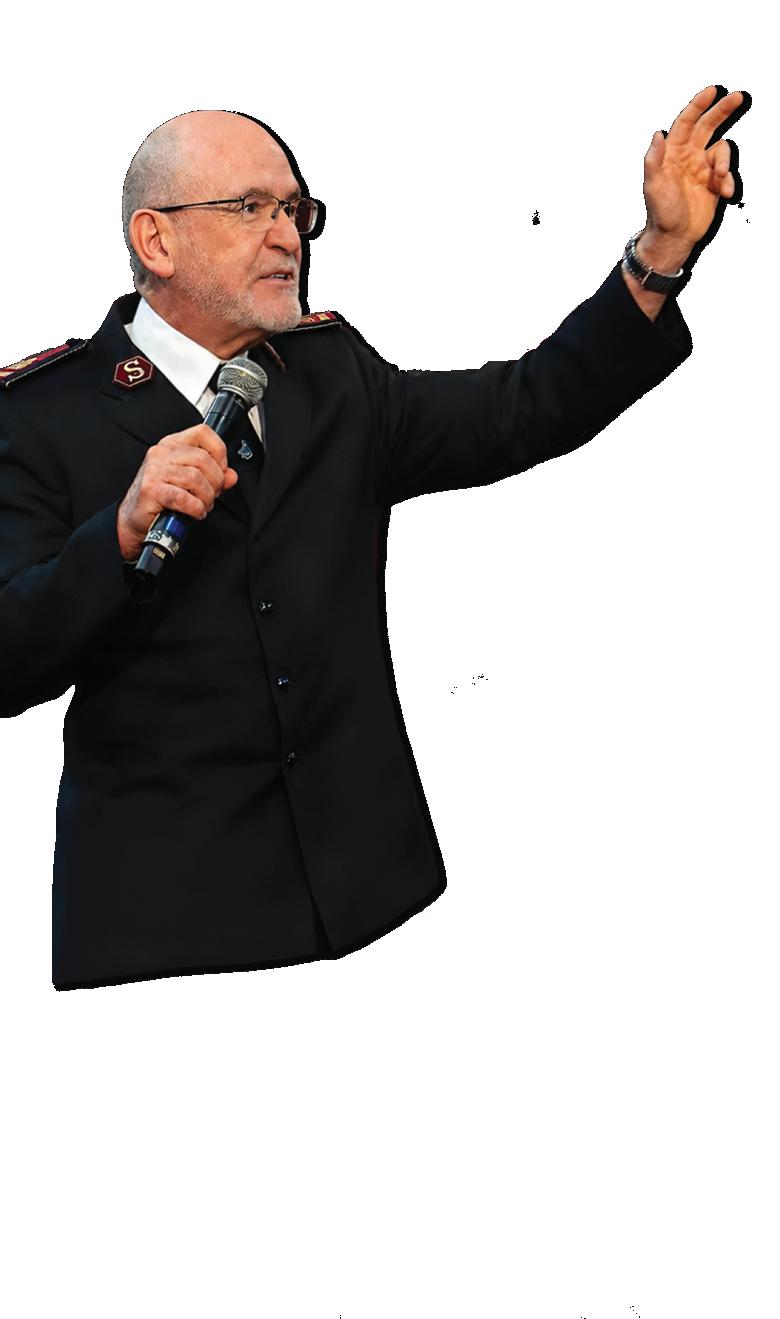
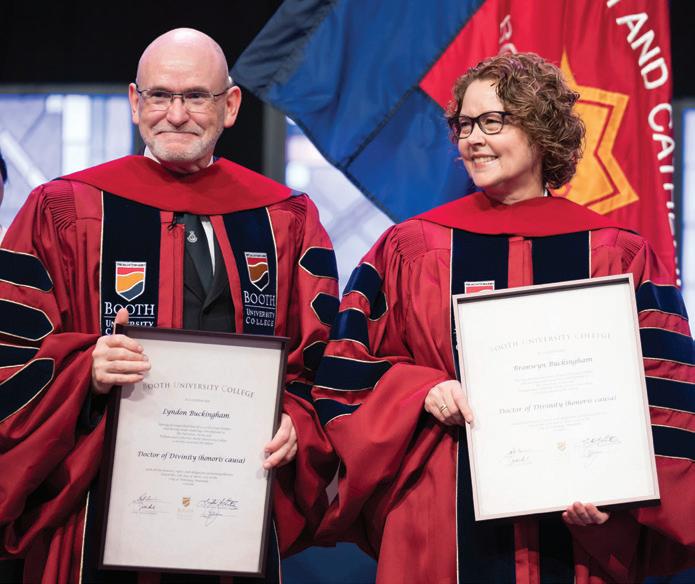
In a landmark occasion for Booth UC and the Canada and Bermuda Territory, General Lyndon Buckingham and Commissioner Bronwyn Buckingham, World President of Women’s Ministries, were present at the services. Both leaders were awarded honorary doctor of divinity degrees by Booth UC in recognition of their outstanding contributions to servant leadership, theological service and the advancement of the common good through the global Salvation Army.
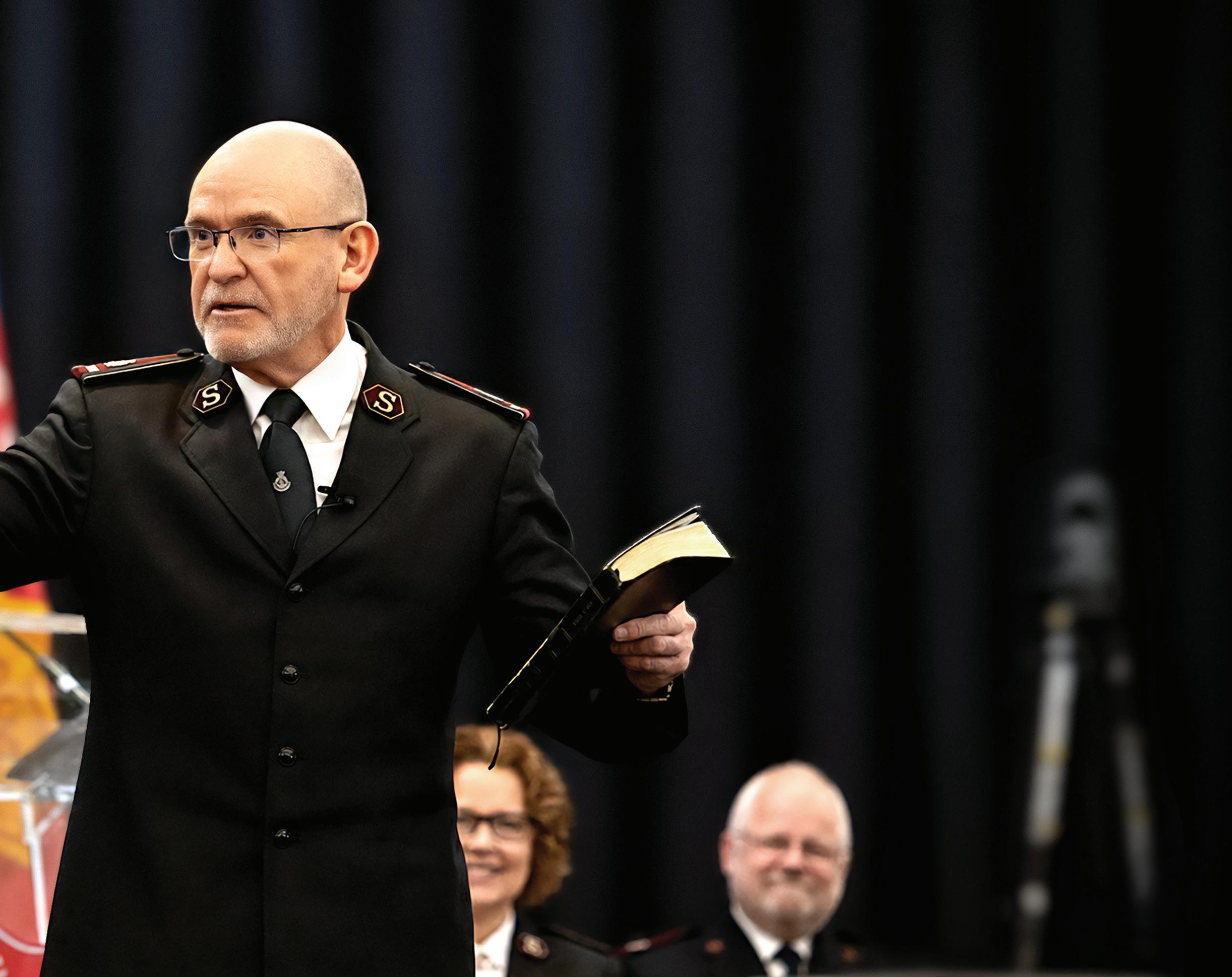
The General delivered the convocation address, drawing from Philippians 2 and challenging graduates to lead with the posture of Christ—in humility and service rather than dominance. “The world is not transformed by the powerful demanding attention,” he said, “but by the humble offering themselves in love.” He charged the graduating class to go into the world as salt, light and servants of the kingdom.
Commissioner Buckingham brought the baccalaureate message, anchored in Philippians 1:6, encouraging graduates to trust that “God who began a good work within you will carry it on to completion.” She called graduates to cultivate three daily practices: presence, perseverance and gratitude, framing them as essential rhythms for a life of faithful service.
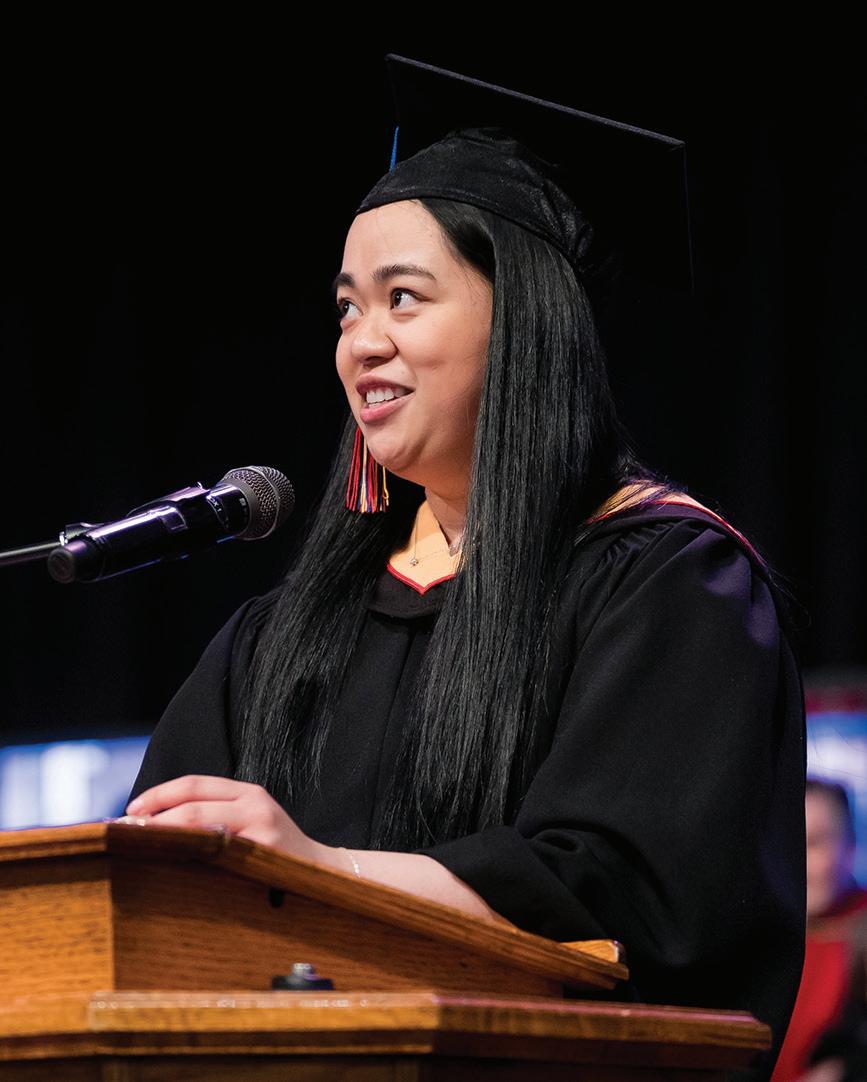
Pamela San Diego, valedictorian of the class of 2026, delivered a moving address that honoured community, resilience and the quiet power of showing up for one another. A bachelor of social work graduate, San Diego reflected on navigating her studies while accompanying her mother through a cancer diagnosis and subsequent loss, and shared how Booth UC’s community of belonging carried her through. She was also awarded the Chancellor’s Medal by Commissioner Lee Graves, territorial commander, recognizing outstanding academic achievement, spiritual development and significant contribution to campus and community life.
Lieutenant Jason Brinson, corps officer at Saint John Hope Community
Church, N.B., received the General’s Medal, awarded to an extended learner graduate who has demonstrated exceptional academic standing, Salvation Army leadership potential, and a grasp of the Army’s distinctive mission and theology of holiness.
Along with the distinguished Salvation Army guests, the ceremony was graced by greetings from all three levels of government: the Honourable Terry Duguid, member of Parliament for Winnipeg South; Jennifer Chen, member of the Legislative Assembly of Manitoba for Fort Richmond; and Mayor Scott Gillingham, representing the City of Winnipeg. Their presence underscored Booth UC’s deep roots in the Winnipeg community and its reputation as an institution whose graduates contribute meaningfully to civic and social life.
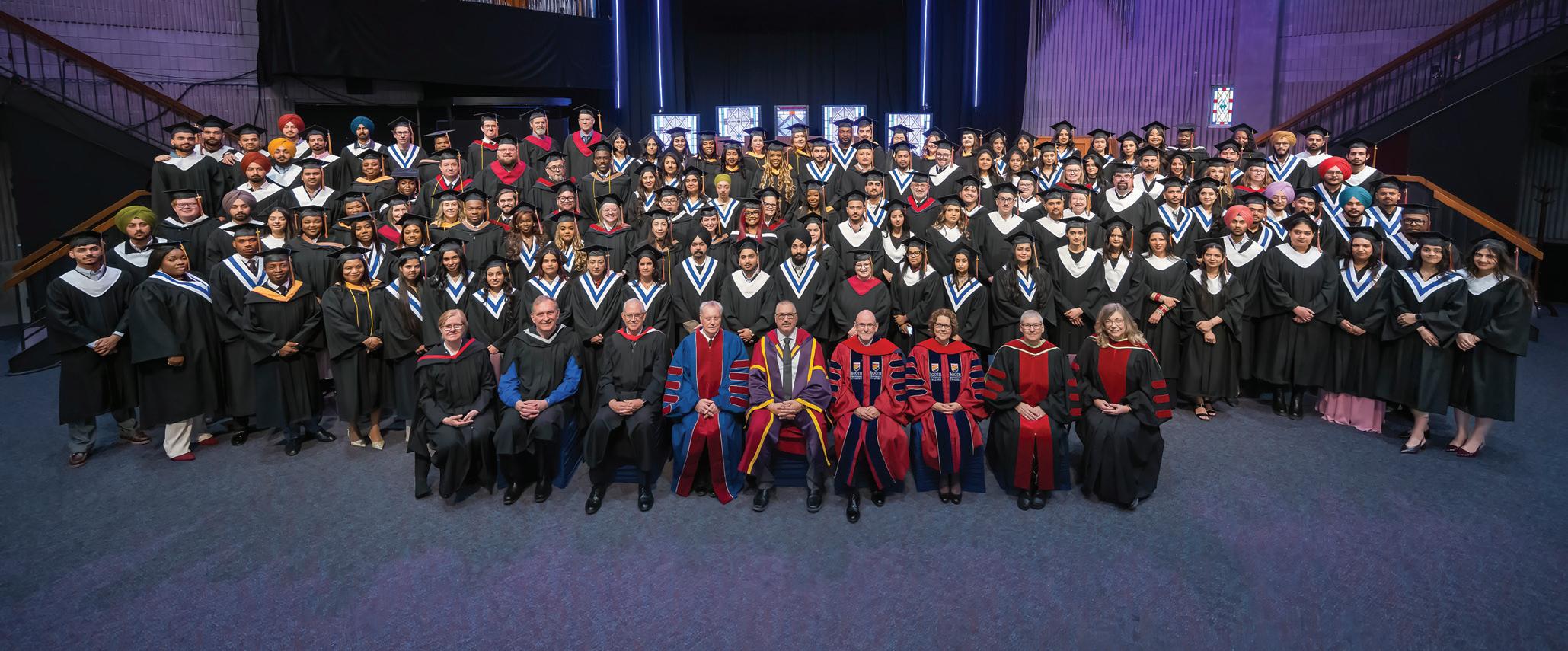
The Booth UC graduating class of 2026, with territorial and international leaders
Pamela San Diego addresses the graduates in her valedictory speech
INTERNATIONAL NEWS
The Salvation Army Updates International Positional
Statements
Earlier this year, The Salvation Army released updated International Positional Statements on several subjects, including the Use of Power, reaffirming its commitment to ensuring power is exercised with love, justice and mutual respect. The statement recognizes that power, whether economic, political, social, spiritual or personal, can shape individuals, communities and institutions for good when used responsibly. At the same time, it warns that misuse of power can lead to manipulation, exploitation and harm, and strongly opposes power that is oppressive, corrupt or denies essential human rights.
Grounded in Christian teaching, the statement emphasizes that power is neither inherently good nor evil; its character is defined by the purposes it serves and the way it is exercised. It also acknowledges The Salvation Army’s historical influence and the importance of exercising that influence with integrity, humility and accountability. Through the updated position, the Army commits to modelling ethical leadership and promoting human dignity, accountability and social justice worldwide.
Through additional positional statements, The Salvation Army has also reaffirmed its commitment to the rights of women and girls and to protecting children from sale, sexual exploitation and abuse.
Working in more than 130 countries, The Salvation Army supports children and families affected by poverty, trafficking, displacement and online exploitation. In 2025 alone, it assisted more than 25,000 survivors of modern slavery and human trafficking, including many children subjected to sexual exploitation.
Despite progress, significant protection gaps remain. Many children lack safe reporting mechanisms, while migrant and displaced children face heightened risks. The Salvation Army emphasizes the need for stronger trauma-informed training and resources for front-line workers.
The Salvation Army urges three key priorities: increased investment in community-based prevention; strengthened cross-border collaboration focused on protection rather than bureaucracy; and ensuring child- and survivor-led approaches inform policy and accountability.
TERRITORIAL NEWS
Salvation Army Gathers for Week on Parliament Hill
Salvation Army representatives from across the territory gathered in Ottawa in March for the annual Salvation Army Week on Parliament Hill. This important week aims to raise awareness of the Army’s mission and ministry in Canada, while building connections and strengthening relationships with members of the federal government.
From Monday to Thursday, delegates met with more than 50 elected officials, including senators, members of Parliament and other government staff to share the work of the Army, and to advocate for the needs of the people it serves in more than 400 communities nationwide.
Officers and staff also attended the National Leadership Dinner and National Prayer Breakfast, where ensembles from the Canadian Staff Band (CSB) and Canadian Staff Songsters (CSS) performed as musical guests.
The week began with the National Leadership Dinner on Monday evening, which was attended by 1,100 people. The CSB and CSS led the singing of the national anthem at the beginning of the dinner and shared musical selections.
“It was an opportunity ... to share meaningful moments together and to pray for our nation.”
COLONEL JOHN MURRAY
The event also featured a panel discussion moderated by Rachael Thomas, member of Parliament for Lethbridge, Alta., where various members of Parliament shared their experiences working in government, their faith journeys and how the two intersect.
The following morning, delegates attended the 60th annual National Prayer Breakfast, along with more than 1,600 people. The event welcomed representatives from several political parties, including Prime Minister Mark Carney, Conservative leader Pierre Poilievre, and Speaker of the House Francis Scarpaleggia. Once again, the CSB and CSS provided musical entertainment.
In his address, Prime Minister Carney referred to Matthew 1:23 and spoke of the generosity that exists at the heart of the Canadian identity. “Canadians take care of each other,” said Carney. “The Christian tradition holds that generosity is not an original act. We give because we have first received.”
“This was a beautiful all-party event,” says Colonel John Murray, then territorial secretary for communications. “It was an opportunity for The Salvation Army as a faith-based organization to come into this space, to share meaningful moments together and to pray for our nation.”
Throughout the week, an emergency disaster services community response unit was stationed on the streets of downtown Ottawa, serving free hot chocolate and engaging with local residents, students, tourists and passersby.
On Tuesday evening, Salvation Army officers and representatives hosted a reception that gave opportunity for parliamentarians and government staff to stop in for refreshments, fellowship and to learn more about the Army’s work.
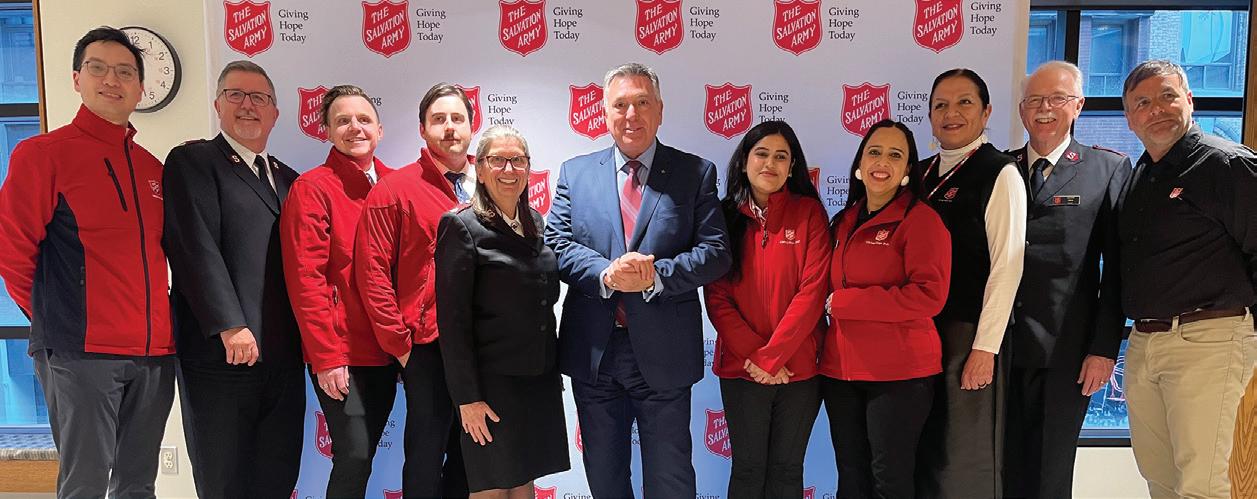
Salvation Army officers and personnel with Charles Sousa (middle), member of Parliament for Mississauga-Lakeshore and former Ontario minister of finance
Photo: Abbigail Oliver
International Conference of Leaders Meets in Nairobi, Kenya
The Salvation Army’s International Conference of Leaders (ICL) was held in Nairobi, Kenya, in March. More than 120 senior Salvation Army leaders gathered from around the world for the first ICL ever held in Africa, centred on the theme of Compass: The Way Forward.
On the opening day, General Lyndon Buckingham welcomed the leaders with an encouraging message of determination for the future and gratefulness to God. He then painted a picture of the current world environment in which Compass, The Salvation Army’s new Global Strategic Framework, was designed to help the movement reach for higher levels of impact and effectiveness throughout the world. He said The Salvation Army was weathering global storms, including the lasting impact of a global pandemic, geopolitical uncertainty, a rise in nationalism and wars.
But General Buckingham instilled hope when he reminded delegates that, despite such volatility and uncertainty, The Salvation Army continues to be salt, light and a beacon of hope, healing and salvation for the world.
“The very existence of our movement is in and of itself a protest; we are a protest movement,” he said. “We are a visible resistance that dares to declare … that there is hope, that there is a way, that there is a Saviour, that there is salvation for the world.”
The conference continued with a service attended by more than 9,000 Kenyan Salvationists. The Ulinzi Sports Complex
filled with music and celebration as the international leaders and Salvation Army ICL delegates were greeted with applause. Music was provided by the Kenya East Territorial Band, the Kenya East praise team, and a 400-strong youth and children’s choir.
The conference concluded with a strong sense of unity, shared purpose and renewed commitment. Speaking from James 3:17, General Buckingham urged leaders to seek heavenly wisdom marked by purity, peace and mercy.
“This week has been evidence that, from talking with leaders from around the world, there is a clear understanding of who The Salvation Army is and what it is we are trying to do in the proclamation of the gospel and living out our theology of social action; that desire to meet human need in Jesus’ name, without discrimination,” he concluded.
KEEP COOL THIS SUMMER!
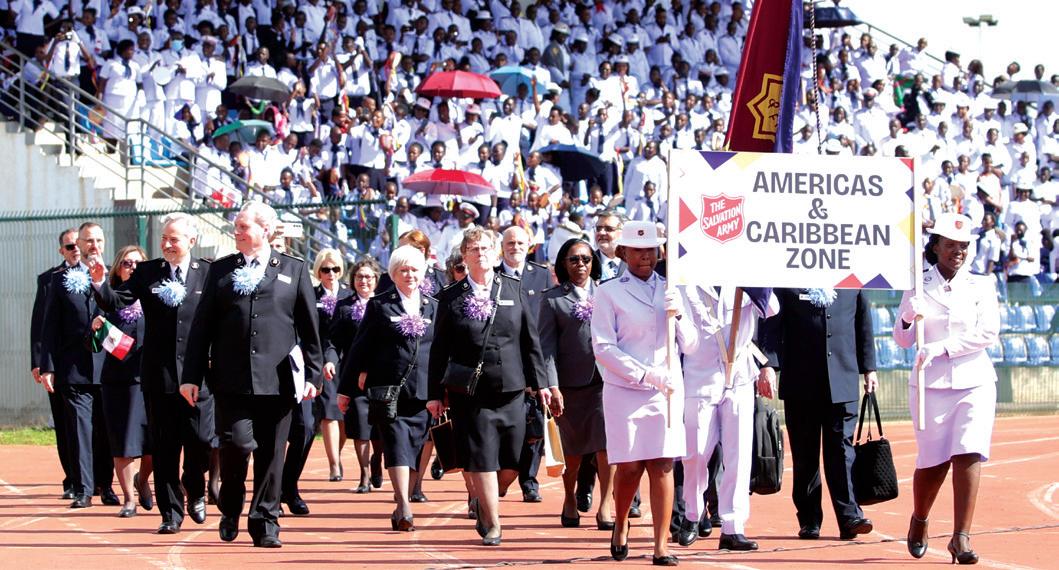
Commissioners Lee and Debbie Graves, territorial leaders, march into the mass service at the Ulinzi Sports Complex in Nairobi, Kenya, during the International Conference of Leaders
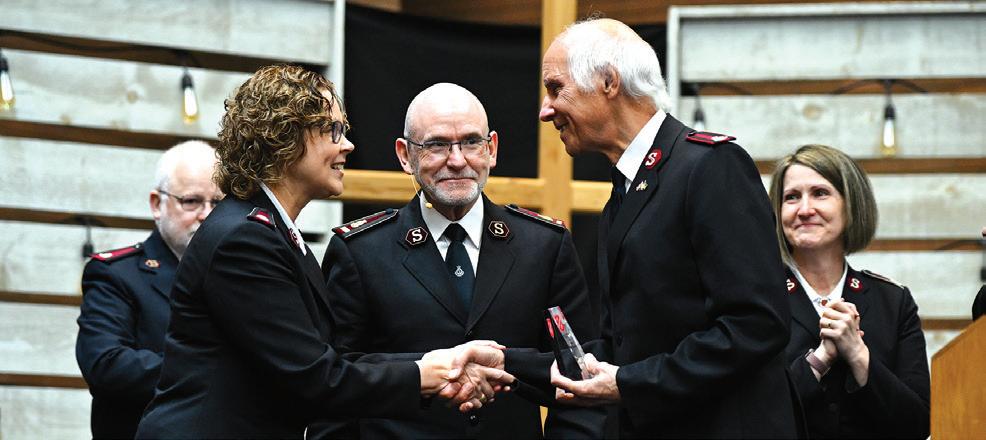
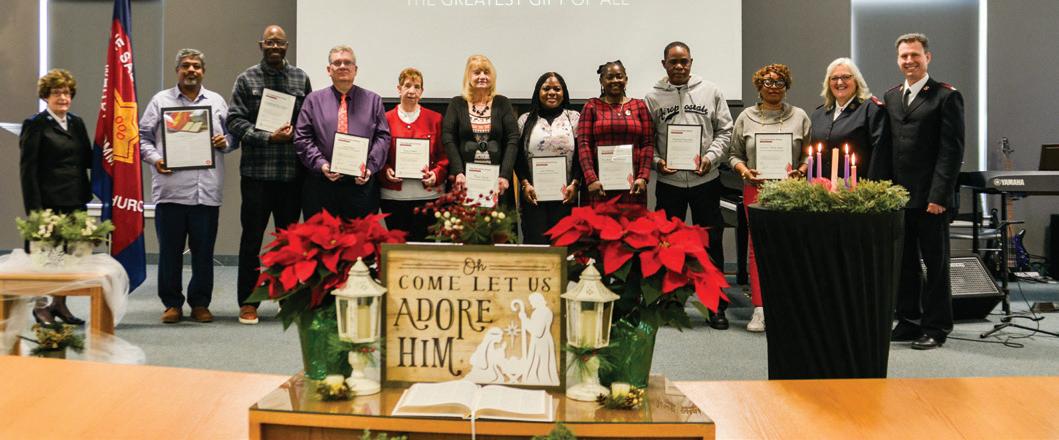
With the endorsement of Commissioners Lee and Debbie Graves, territorial leaders, 25 individuals and groups across the territory have received the Others Award, which recognizes those who lead by example, who display a selfless and sustained dedication to serving others and who have made a notable and enduring contribution to the mission and work of The Salvation Army.
The award is inspired by a telegram sent on Christmas Eve in 1910 by General William Booth to all Salvation Army officers around the world. It contained a single word that spoke volumes: OTHERS. This simple message was a powerful call to action for officers, commissioning them to put others first with every thought, every step and every prayer.
This award has been presented to deserving recipients who personify the spirit of “OTHERS” as envisioned by General Booth, demonstrating humility, compassion and a legacy of lasting impact.
TERRITORIAL NEWS
Others Award Presented to Recipients Across Territory
ATLANTIC DIVISION
• Thomas Banfield
• Brenda Butt
• Claire Deziel
• Major Lorraine Hart
• Marie-Rose Rousseau
• St. John’s Street Ministry emergency disaster services team
PRAIRIES AND NORTHERN TERRITORIES DIVISION
• Margaret Blackburn
• Bruce Finkel
• Hurmat Habib
• Jillian Haskey
• Gladis Koshkarian
• Staff at William Booth Special Care Home
BRITISH COLUMBIA DIVISION
• Don Armstrong
• Major Samuel Fame
ONTARIO DIVISION
• Manjita Biswas
• Paul Goodyear
• Major Shirley King
• Commissioner Christine MacMillan
• Commissioner Susan McMillan
• Janet Park
• Colonels Eleanor and Glen Shepherd
• Dr. Jake Tran and the senior leadership team at Toronto Grace Health Centre
• Susan Waterfield
• Lt-Colonel Neil Watt
The General and Commissioner Buckingham present Mjr Sam Fame with the Others Award at the Compass2026 Conference
Photo: Ray Shum
THE WAY, TRUTH AND LIFE
International leaders encourage Salvationists to embrace Christ and confidently move forward in him as a renewed, vibrant and ready Army.
BY COMMISSIONER LEE GRAVES
“Jesus answered, ‘I am the way and the truth and the life. No one comes to the Father except through me.’ ”—John 14:6
WhenJesus says, “I am the way,” he is declaring that he is the singular path to a relationship with God the Father. Identifying himself as “the truth,” he is not just speaking truth but embodying the ultimate reality and nature of God in human form, countering all other claims to spiritual truth. And as “the life,” he represents the source of both eternal life and a transformative, abundant life here and now.
Chilly temperatures did not dampen enthusiasm as Salvationists and friends gathered in St. John’s, N.L., to warmly welcome General Lyndon and Commissioner Bronwyn Buckingham, World President of Women’s Ministries, to the Canada and Bermuda Territory in April. Inspiring music and worship, energetic testimonies and challenging messages from our leaders resulted in many kneeling at mercy seats across Canada as we travelled to Calgary, Winnipeg, Vancouver, Ottawa and Toronto (see page 10). Our spiritual life campaign has energized Salvationists and friends who gathered in person and those who joined us via livestream from around the world.
Under the theme Jesus Our Compass, the visit of the international leaders highlighted Jesus as the centre of everything we do and celebrated that we must look to him as our way, truth and life. All that we are and do is anchored in this gift of the Father, the source of divine love that is to be received and emulated, and our motivator to be about our Father’s business. We are not an Army distracted or discouraged but a movement that is strongly proclaiming his name as his disciples and witnesses.
The stated vision of the General in his Global Strategic Framework “is for every part of The Salvation Army to be
unapologetic about its confidence in the gospel of Jesus Christ to transform lives and reconcile men and women, boys and girls to the loving embrace of their heavenly Father.”
Keeping our focus on Jesus in every ministry unit protects against mission drift, the danger of being distracted and forgetting our primary responsibility of being him to the world. But we are not distracted. We know that we must never have one meeting or one program void of this emphasis, and we must never be intimidated to speak his name.
An audit of all we do should reveal that we exist to share the love of God. If it instead reveals that Christ is not the centre, the program is not worthy of bearing our branding. The General and Commissioner Buckingham masterfully articulated this emphasis. The General’s Global Strategic Framework, focused on people, mission and legacy, is embedded in our own territorial strategic plan. All three of these themes are inseparable, bound together by Christ’s own example and ministry. What we do missionally should be done in Jesus’ name, and a willingness to evaluate and then let go of things that are not fruitful allows the redeployment of resources, ensuring an enduring legacy. The Global Strategic Framework asks that we focus upon
the well-being of the Lord’s labourers, people, so that we can be strong and ready to deliver the mission.
Our international leaders challenged us to imitate Christ, to move forward confidently in him, to be strong witnesses for him, thus leading to an Army that is renewed, vibrant and ready. We are renewed, we are vibrant, we are ready. We are moving, marching, delivering, active, fruitful.
The General and Commissioner Buckingham embraced youth and young adults across Canada. From St. John’s to Vancouver, young people are stepping up to lead, witness and gather to pray over and with each other, celebrating faith in Jesus through authentic praise. We are in good hands. Their compass is Jesus! Jesus, our compass, the way, truth and life is life-giving, memorable and livable. The Canada and Bermuda Territory is ready to step into the next chapter, and, in many ways, already has. From east to west we must end the narrative that wants only to consume our energy and time, convincing us that we are a shrinking movement. This tour has been a strong witness to the work the Holy Spirit is doing through the lives of our soldiers and friends. We will continue to shape, mould, prune and plant. This is why we are called a movement, for we dare not remain stagnant. This is us! But our mission will not change.
COMMISSIONER LEE GRAVES is the territorial commander of the Canada and Bermuda Territory.
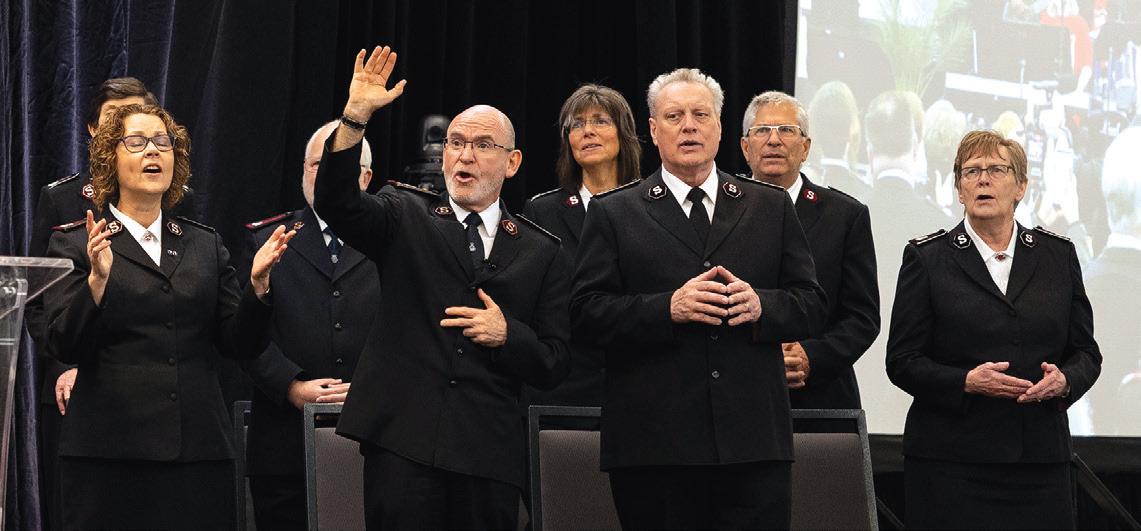
Commissioner Bronwyn Buckingham, General Lyndon Buckingham, Commissioner Lee Graves and Commissioner Debbie Graves share in worship during the Jesus Our Compass tour
Photo: Steve Nelson
WE ARE A
PEOPLE!” “ JESUS
General Lyndon Buckingham and Commissioner Bronwyn Buckingham inspire Salvationists in the Canada and Bermuda Territory.
BY GEOFF MOULTON
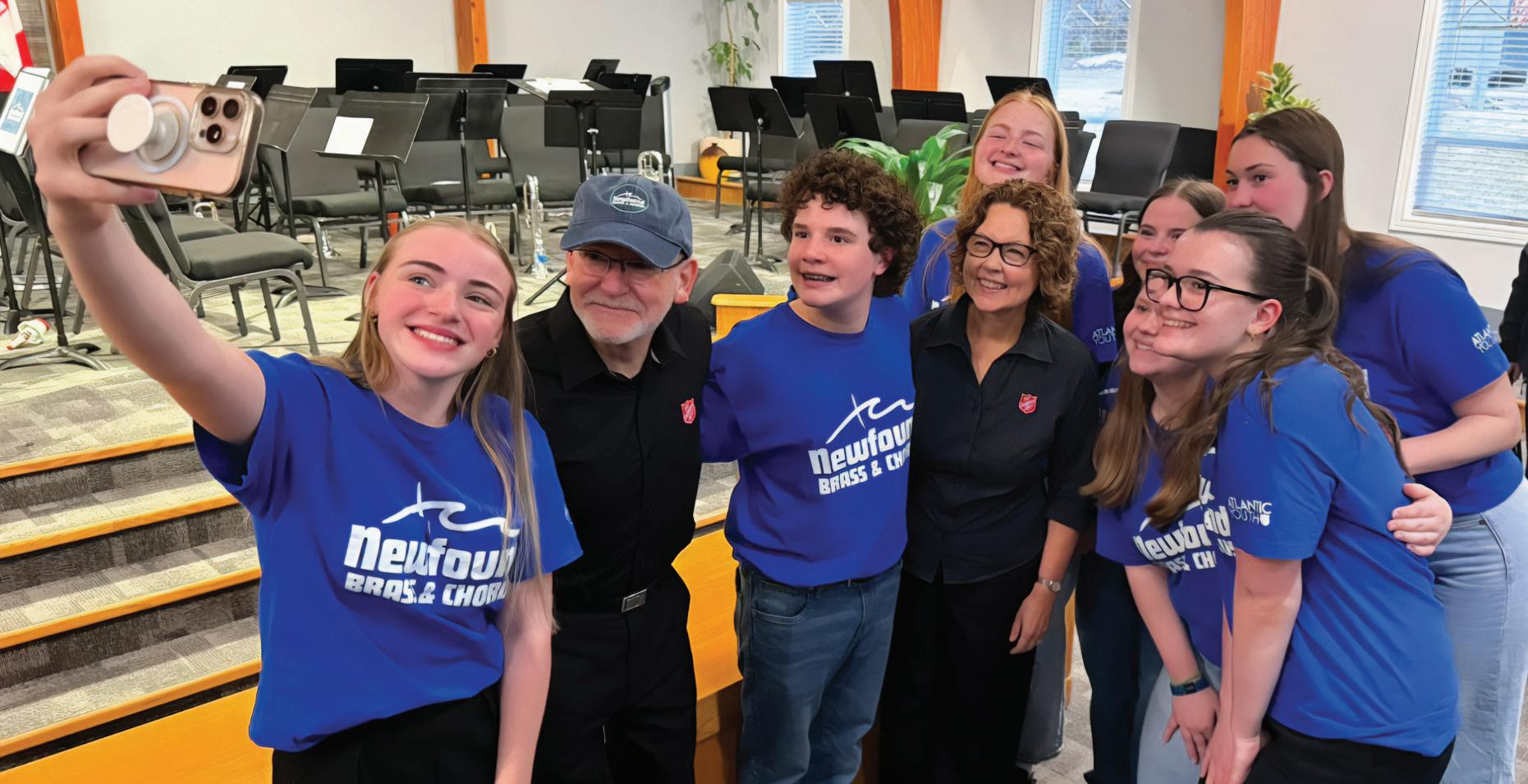
(Above) Selfie with the General and Commissioner Bronwyn Buckingham at a youth event at Conception Bay South Corps, N.L.
right) The General shares from God’s Word at the Sheraton Parkway North Hotel, Richmond Hill, Ont.
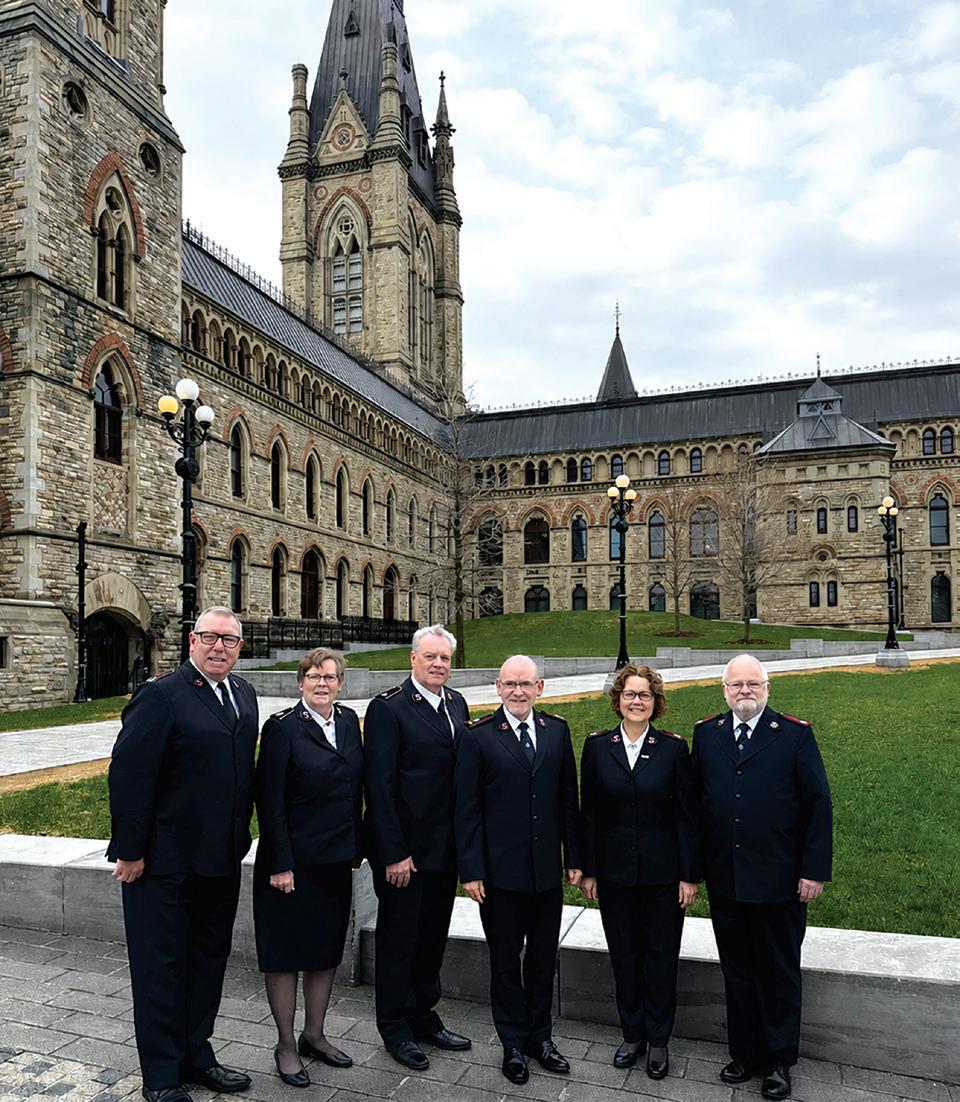
Salvation Army leadership
Parliament Hill in Ottawa. From left, then Lt-Col John Murray, then territorial secretary for communications; Commissioner Debbie Graves; Commissioner Lee Graves; General Lyndon Buckingham; Commissioner Bronwyn Buckingham; and Mjr Chris
(Right) A warm western welcome at Glenmore Temple, Calgary, for the international leaders and Mjr Chris
Mulryne
(Top
Photos:
Geoff Moulton and Glenn
van Gulik
(Bottom right)
visit
Mulryne
“THIS
UNIQUE PART OF THE BODY OF CHRIST KNOWN AS THE SALVATION ARMY …. IT WANTS TO ENGAGE; IT’S WHO WE ARE.”
GENERAL LYNDON BUCKINGHAM
Packed sanctuaries, joyful worship and powerful moments of prayer marked the Jesus Our Compass tour as General Lyndon Buckingham and Commissioner Bronwyn Buckingham, World President of Women’s Ministries, visited the Canada and Bermuda Territory from April 17 to May 4. Supported throughout the tour by Commissioners Lee and Debbie Graves, territorial leaders, the international leaders inspired front-line ministry workers, celebrated faithful service and challenged the territory to remain fully centred on Christ. From vibrant rallies and youth gatherings to heartfelt moments at the mercy seat, the international leaders encouraged Salvationists to fix their eyes firmly on Christ.
OUR MISSIONAL MANDATE
The tour kicked off in the Atlantic Division as Salvationists filled the Sheraton Hotel Newfoundland in St. John’s, N.L., for Sunday morning worship. Lt-Colonels Michelle and Scott Rideout, divisional
leaders, and Commissioners Graves welcomed our international guests. Worship was enhanced by the Newfound Brass and Chorus, the St. John’s Temple Singing Company and a worship team.
During the service, four individuals and groups were recognized with the inaugural Others Awards for their sacrificial service to the Lord through The Salvation Army. Throughout the tour, a total of 25 awards were presented. (See page 8 for a complete list of recipients.)
In his message, General Buckingham urged the congregation to not only make Christ present and prominent in their lives, but also preeminent.
“Everything we’re doing, everything we’re engaging in, and everything that we’re about finds its crucible in the person of Jesus Christ,” the General said. “He is central to our life, to our being, to our mission, to our ministry. He needs to be in that place if we have any hope of fulfilling the missional mandate that’s been laid on this movement.”
Photo: Steve Nelson
The General and Commissioner Buckingham brought their energy to a youth rally at Conception Bay South Corps later that day, followed by a late-night Tim Hortons run for a true taste of Canada.
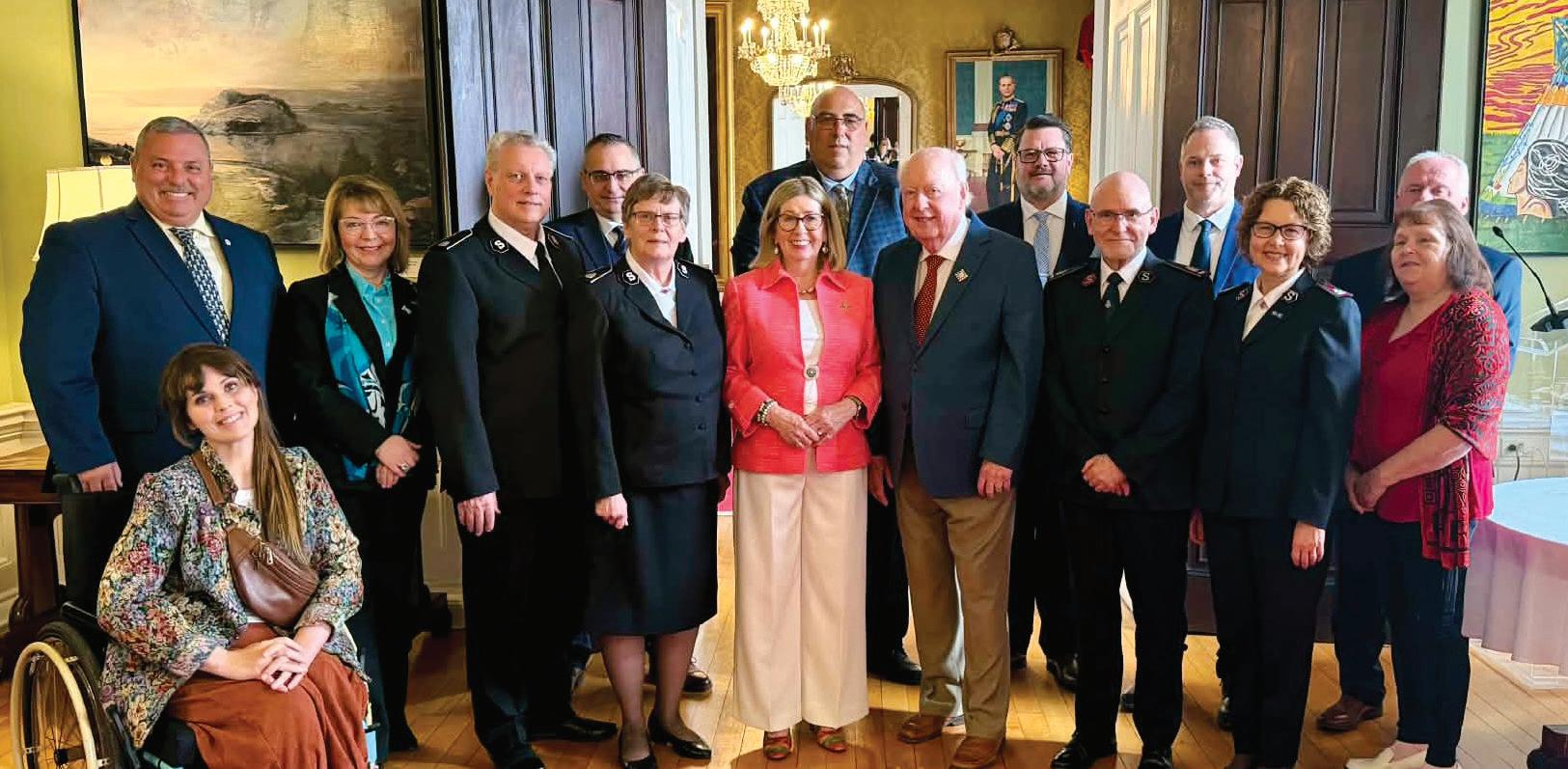
The international leaders were also hosted by the Lieutenant-Governor of Newfoundland and Labrador, Joan Marie J. Aylward, at Government House in St. John’s. She expressed appreciation for the Army’s impact, particularly through its emergency disaster services ( EDS) and the Ches Penney Centre of Hope in downtown St. John’s. The General and Commissioner Buckingham later toured the centre, a five-storey facility that offers comprehensive social services and housing support for vulnerable individuals.
In a fun moment celebrating the spirit of Newfoundland and Labrador’s culture, the General and Commissioner Buckingham became honorary Newfoundlanders when they kissed the cod at a screech-in ceremony before bidding farewell to the Rock, as the island is affectionately known.
ORDER OF THE FOUNDER
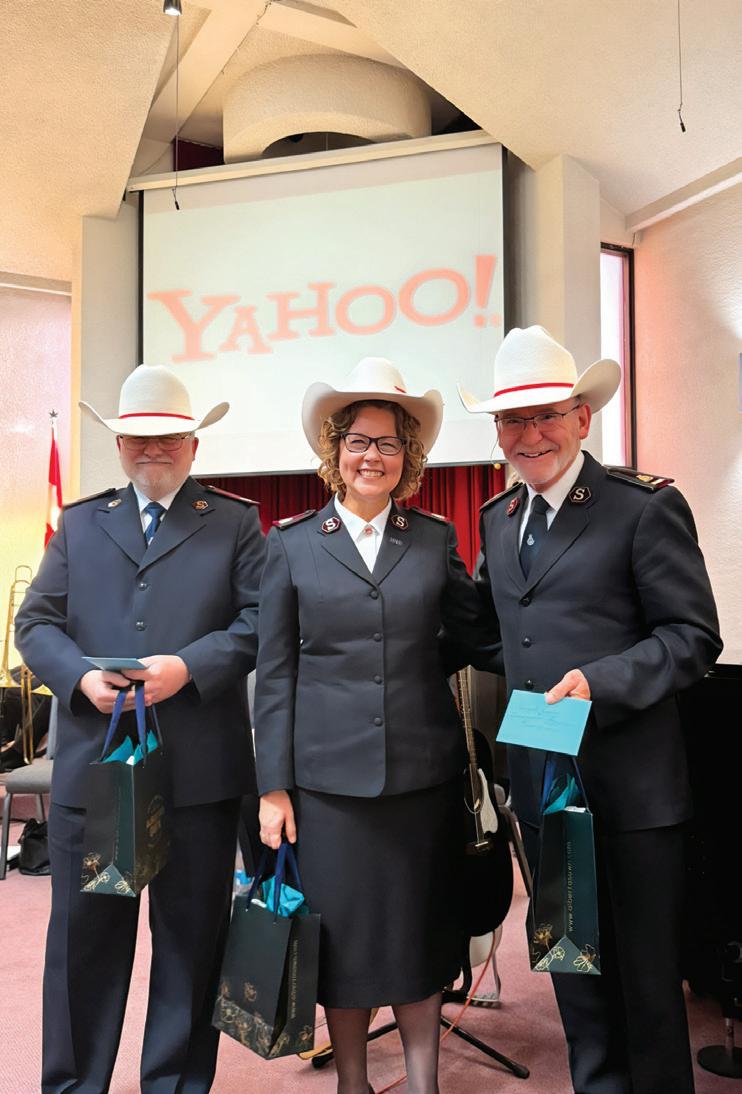
As the tour continued, the international leaders received a warm western welcome to the Prairies and Northern Territories Division from Salvationists and Lt-Colonels Donald and Donna Bladen, divisional leaders. A Salvationist rally at Calgary’s Glenmore Temple was marked by enthusiastic worship and praise, and featured the presentation of white cowboy hats, the symbol of the world-famous
Calgary Stampede and the city of Calgary, to the Buckinghams and Major Chris Mulryne, private secretary to the General. A youth event and a candid Q&A with the General and Commissioner Buckingham took place after the rally.
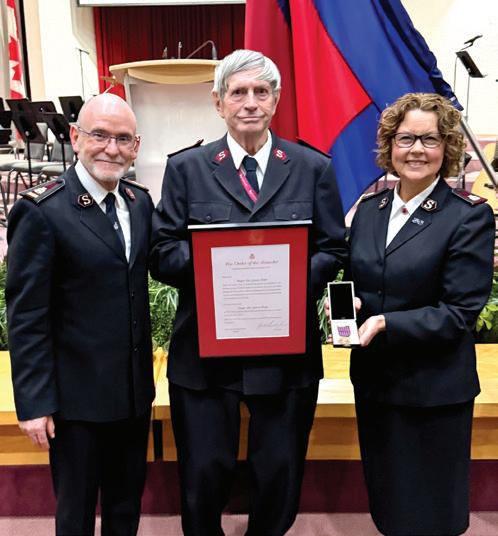
A highlight of the evening was the presentation of the Order of the Founder, The Salvation Army’s highest honour, to Major (Dr.) James Watt. Major Watt, together with his wife, Bette, is a retired Salvation Army officer and physician renowned for his medical work at Howard Hospital in Zimbabwe, serving the underprivileged and establishing critical health-care infrastructure.
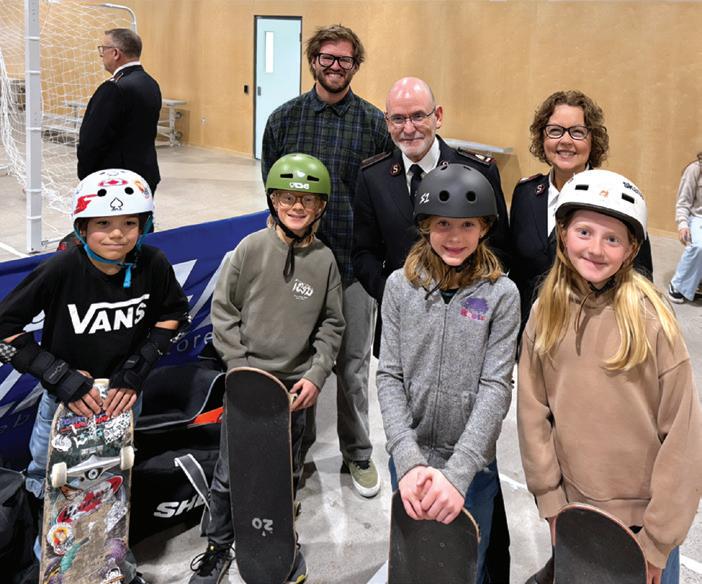
While in Calgary, the international leaders toured Forest Lawn Community Resource Centre, a 50,000-square-foot facility supporting local families through a food bank, mobile outreach, after-school care and an indoor skate park. They also visited Barbara Mitchell Family Resource Centre, a community service hub that provides vital social services, supportive housing and employment counselling.
HONOURED AT BOOTH UC
Following their time in Calgary, the General and Commissioner Buckingham were special guests at Booth University College’s graduation festivities in Winnipeg.
As part of this year’s ceremonies, Booth UC conferred honorary doctorates of divinity upon the General and Commissioner Buckingham. In her address, Commissioner Buckingham urged graduates, “In an age of hurry and distraction, choose to be fully where you are—first with Jesus and then with those around you. Your presence may open the opportunity for God’s presence to be known.” (See page 5 for a full report on the graduation festivities.)
COMPASS2026 CONFERENCE
Heading west, the international leaders visited the British Columbia Division where Salvationists converged on Cariboo Hill Temple, Burnaby, for Sunday morning worship. The Holy Spirit’s presence was felt as many gathered at the mercy seat for prayer following the General’s message.
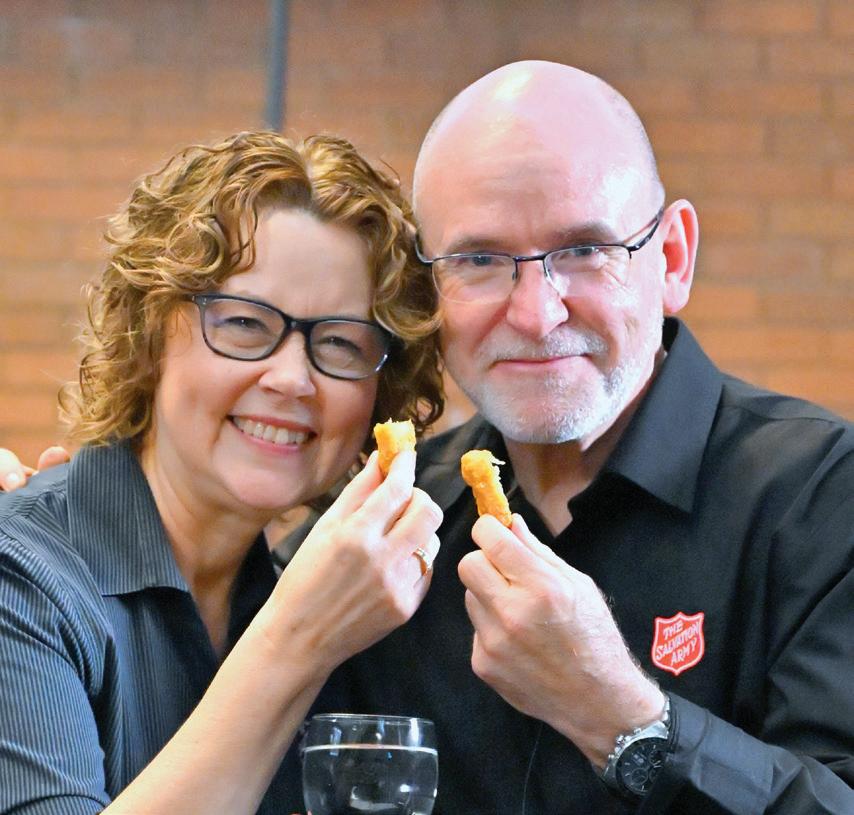
Cariboo Hill Temple also hosted a youth rally in the evening, where young Salvationists enjoyed a “Truth and Tenders” time with the leaders, which included chicken tenders/nuggets, fellowship and a relaxed Q&A with the Buckinghams, along with worship and prayer.
The next day, Lt-Colonel Tiffany Marshall, divisional commander, kicked off the division’s Compass2026
(Right) The international leaders share a moment with young people at the indoor skate park at Calgary’s Forest Lawn Community Resource Centre
Photo: Janessa Hynes
(Below) Honorary doctorates of divinity are conferred upon the General and Commissioner Bronwyn Buckingham during Booth University College’s graduation celebrations
(Left) The international leaders and Commissioners Lee and Debbie Graves with the Lieutenant-Governor of Newfoundland and Labrador, Joan Marie J. Aylward, at Government House in St. John’s, N.L.
Photos: Geoff Moulton and Aaron Sivertson
Conference at Cascade Community Church, Abbotsford, with more than 200 in attendance. Delegates came together to explore The Salvation Army’s global strategic framework, designed to revitalize spiritual and missional life.
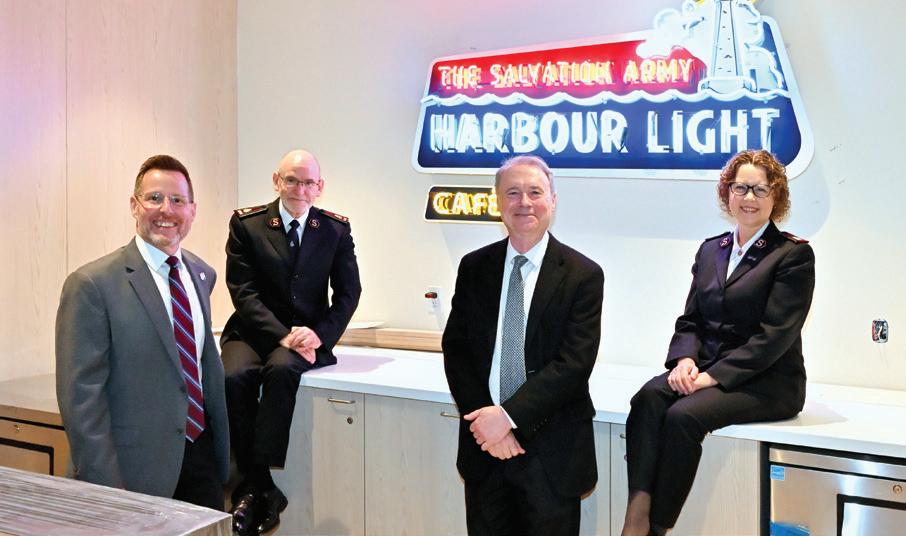
Earlier on Monday, the General and Commissioner Buckingham unveiled the dedicatory plaque for the new Harbour Light facility in Vancouver, a major nine-storey social services and housing complex currently under construction in the Downtown Eastside.
The international leaders also toured Belkin House, a residential facility in downtown Vancouver dedicated to breaking the cycle of homelessness, and the new EDS training and command centre in Abbotsford.
A VISIT TO PARLIAMENT HILL
Travelling to the Ontario Division for the final leg of their tour, the General and Commissioner Buckingham began their visit in Ottawa, where Assistant Sergeant-at-Arms Paul Gallant and member of Parliament Rob Oliphant (Don Valley West) hosted The Salvation Army’s international and territorial leaders on Parliament Hill.
In the House of Commons, Oliphant paid tribute to The Salvation Army and welcomed the delegation. Francis Scarpaleggia, Speaker of the House, affirmed, “The Salvation Army is always there,” as members of Parliament unanimously rose in applause.
Later that day, hundreds gathered at the Infinity Convention Centre for a Salvationists’ rally and reception with contingents from Eastern Ontario, Ottawa and Montreal. Lt-Colonels Brian and Lynn Armstrong, divisional leaders, welcomed participants, and worship was enhanced by Legacy Brass, Legacy Chorus and the Montreal Citadel Timbrel Brigade.
THREE GENERALS
The Buckinghams then travelled to the Greater Toronto Area, where they met with senior executive Salvation Army leaders and the National Advisory Board. In his remarks, the General commended the Canada and Bermuda Territory for its service to the Lord and urged us to “keep Jesus at the centre.”
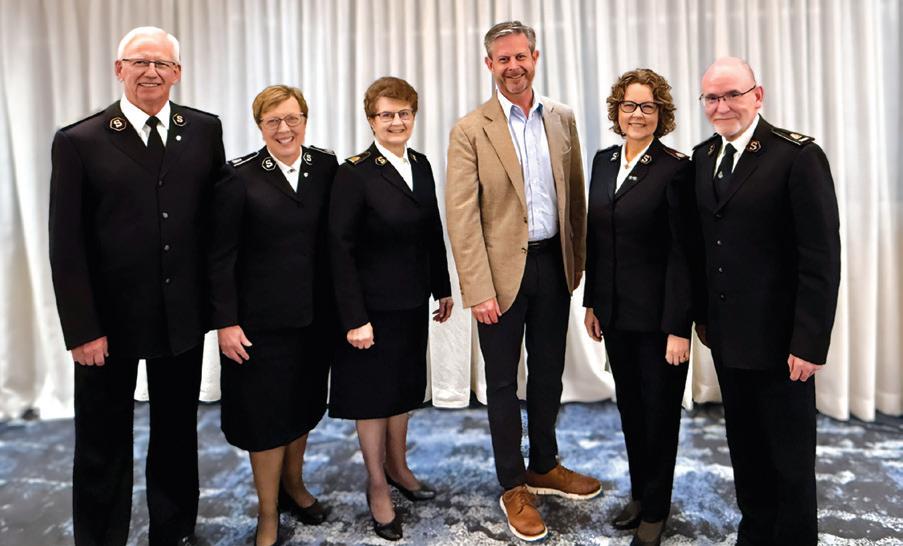
The evening was a historic occasion, as it gathered three Salvation Army Generals together in one room—General Lyndon Buckingham, General Brian Peddle (Rtd)
“YOUR PRESENCE MAY OPEN THE OPPORTUNITY FOR GOD’S PRESENCE TO BE KNOWN.”
COMMISSIONER BRONWYN BUCKINGHAM
and General Linda Bond (Rtd)—along with the grandson of General Arnold Brown, Neil Hetherington.
The tour continued the next evening with a worship concert that brought hundreds to the Canada Event Centre in Whitby, Ont. Attendees were blessed by various music groups, including the territory’s three staff sections—the Canadian Staff Band, Canadian Staff Songsters and NEON—and the divisional youth sections, Impact Brass, Solidarity Brass and Soul Chorus.
“God wants to be known,” shared Commissioner Buckingham in her reflection on Jeremiah 29:13, “but we have to want this seriously enough to seek him with all our heart, making that search the highest priority of our lives.”
Following this time of worship and devotion, Canada Bermuda Youth hosted a “General Admission” youth event featuring games, food and an open Q&A session with the international leaders.
“IT’S WHO WE ARE”
A final public meeting was held at the Sheraton Parkway North Hotel in Richmond Hill, Ont., where a capacity crowd of Salvationists and friends gathered for Sunday worship. In his message, the General referenced the Apostle Paul’s words to the church in Corinth about the body of Christ, as recorded in 1 Corinthians 12.
“This unique part of the body of Christ known as The Salvation Army, an Army on the march, an Army on the move, an Army so convinced about the reality of who Jesus is that it can’t stand still, that it can’t be satisfied with an hour on a Sunday to celebrate, to pray…. It wants to engage; it’s who we are. We are a Jesus people!” he declared.
The tour concluded when the General and Commissioner Buckingham led a chapel service with territorial headquarters staff and met with cadets at the College for Officer Training.
From left, General Brian Peddle (Rtd); Commissioner Rosalie Peddle; General Linda Bond (Rtd); Neil Hetherington, grandson of General Arnold Brown; Commissioner Bronwyn Buckingham and General Lyndon Buckingham share a moment together
Photos: Geoff Moulton
(Above) Mjr (Dr.) James Watt receives the Order of the Founder, The Salvation Army’s highest honour
(Above right) The international leaders with Jim Coggles, executive director (left), and Brian Dust, principal architect at Vancouver-based NSDA Architects (centre), at the newly constructed Harbour Light Café, Vancouver
Photo: Karl Banath
Onthe final day of the Jesus Our Compass tour, managing editor Kristin Ostensen sat down with General Lyndon Buckingham and Commissioner Bronwyn Buckingham, international leaders of The Salvation Army, to talk about the tour, God’s faithfulness in their lives and their final message for Salvationists in Canada and Bermuda. Listen to the full interview on the Salvationist podcast at salvationist.ca/podcast.
What were some highlights of the tour for you?
General Lyndon Buckingham: As is always the case, my interactions with people. I met so many people who are committed to The Salvation Army, its mission and ministry, whether they’re officers, staff, volunteers or soldiers. That’s been really encouraging.
Commissioner Bronwyn Buckingham: When we were in Vancouver, Cariboo Hill Temple hosted a youth service. We saw young adults coming forward for prayer at the end of the service, praying for themselves and for each other. And then, after we sang the final song, they just stayed there, worshipping so freely and enthusiastically. And I said in my heart, Thank you, Lord, for the next generation, who I believe really are the now generation for The Salvation Army.
Throughout the trip, you made engagement with youth a priority through rallies like the one at Cariboo Hill. Why was this important to you?
LB: We’ve had a passion for young people’s ministry for many years, and we’re seeing a move of the Spirit among young people around the world. The Lord is speaking to this generation. He’s making himself known to them, and it was important for us to give expression to that, to remind
INTO THE FUTURE
International leaders encourage Salvationists to stay faithful, press in and press on.
young people that they are appreciated, they’re valued. They have a place within the movement. We need them. When I think about renewal within the movement, I have a sense that that’s where it’s going to come from.
BB: The next generation is all in for the gospel, they are all in for Jesus, and I believe they are all in for The Salvation Army. But we need to make space for them to grow The Salvation Army in ways that are going to be relevant for their generation and the one that’s coming behind them. We want to be their cheerleaders.
Having travelled the world, what stands out to you about The Salvation Army in Canada? What are some of our strengths?
LB: The diversity, how multicultural it is. There’s an opportunity for The Salvation Army in Canada to paint a beautiful picture, that it’s possible to bring people from different backgrounds together and celebrate community, fellowship and understanding.
I also think that the footprint of The Salvation Army in Canada is large, and you have a very good reputation. You were
spoken about positively in Parliament in Ottawa, and that was a beautiful affirmation of the mission and ministry of the Army here—being recognized as making a really valuable contribution to society.
Of course, this wasn’t your first experience of Canada—you were corps officers in Windsor, Ont., from 1994 to 1998. What are some precious memories from that time, and how did it shape you as people and officers?
BB: At that time, we were young, not only in years, but also in our officer journey— we were lieutenants, so we were inexperienced. And the corps family at South Windsor Citadel completely embraced us, so we felt like we belonged very quickly. It was a rich learning experience for us, moving away from our family and all that was familiar, bringing our two little children to the other side of the world, long before social media and FaceTime. They were years of establishing ourselves as a family unit and establishing ourselves in ministry.
LB: We had lots of crazy ideas that we wanted to try, and the leadership team at South Windsor were very patient and
Young people join in worship during the youth event at Cariboo Hill Temple, Burnaby, B.C.
(Inset) The Buckinghams enjoy some food at Cariboo Hill Temple
Photos: Karl Banath
accommodating of these young Kiwis from Down Under. And I think their patience and our adventurous spirit led to some exciting times in that corps. We saw God moving, we saw a fellowship of believers getting together to try new things to reach their community. We learned lots of lessons about leadership and ministry, and it shaped the rest of our officership journey. We’re so grateful for those years.
Last October, General, you experienced a health crisis, a heart attack while you were visiting Hong Kong. What was it like to go through that while also being the international leader of the Army, and how was God faithful to you in that difficult time?
LB: Looking back, I’m grateful because so many people intervened on that day—the Lord had the right people in the right place at the right time, and so we can see his hand on it. As a result, the actual incident—the heart attack and follow up—was not really where I had most of my journey to do. The dark night of the soul came afterward. I felt like, “Come on, Lord—I was about your business. What’s the deal here?” And then there were moments of doubt: Am I going to be well enough to keep going? Would the Army be better served by having a different leader? Do I want to keep going? All of that occupied my mind in those weeks of recuperation. But again, I’m thankful to God for mentors and other people who spoke into my life at the right time, and the Lord used them to help me on that journey and get my heart and mind back into the place where it’s surrendered to the will of the Lord, where I’m trusting and joyful and ready to go.
And I was very grateful, in February of this year, to have confirmation that
there’s no damage to the heart muscle. My cardiologist told me that if I look after myself, I’ll have even more energy than I had before. So, the Lord’s good hand has been on us.
BB: And we were so grateful for the prayers of the people.
LB: Yes, we were flooded with messages from people promising ongoing prayer support, and we’re carried by that. It’s very humbling. So, we’re both determined to continue to serve with energy and passion, because that’s what the Lord is calling us to do.
You both come from multi-generation Salvationist families. How has that influenced the way you lead the Army today? How do you continue the Army’s legacy while also leading us into the future?
BB: I’m incredibly grateful for that heritage. I know I’m the product of praying grandparents, praying parents who dedicated me as a baby and gave me back to the Lord. I’m grateful for my home corps, the programs that I was involved in, the mentors that surrounded me as a child and a teenager. But what I realized, many years ago, is that while it’s beautiful to be a multi-generation Salvationist, you can only be a first-generation believer. The heritage is a gift, but each of us has to own the faith for ourselves.
LB: I’m inspired by my family’s history. In 1883, a 19-year-old and a 20-year-old came from the United Kingdom to bring The Salvation Army to New Zealand. My family became involved with the Army around 1886 under the ministry of one of those young men—two generations got saved in one evening. Those two officers had no idea that the meeting they conducted in that town, which resulted in two
“SALVATIONISTS ARE ENTHUSIASTIC ABOUT SHARING THE GOOD NEWS, ABOUT LIVING A LIFE THAT BRINGS HONOUR AND GLORY TO GOD.”
—GENERAL
LYNDON BUCKINGHAM
people coming to the Lord, would result in another generation and another and another coming under the influence of the gospel. It gets me thinking about the legacy we are creating today—the decisions we make, the actions we take. I think about Salvationists all around the world sharing the gospel, engaging in ministry. It’s not just the immediate reaction; it’s the impact on subsequent generations. Do you know the impact that your life, your witness, your service, is having, not only in your time, but in generations to come? Those young men were brave enough to say yes and come and bring the gospel to my family. So, I’m looking for men and women and young people now who are saying yes, because it’s going to have a similar impact on future generations.
As you leave the Canada and Bermuda Territory, what’s the final message you’d like to give to Salvationists here?
LB: We’ve shared about having Jesus as our compass—not losing sight of the fact that we are in mission and ministry for the king. Salvationists are enthusiastic about sharing the good news, about living a life that brings honour and glory to God. And I think if we can keep that focus, then the Lord will continue to use us in powerful ways.
BB: I’d like to finish by encouraging everyone who’s been moved by the Spirit, to hold on to that and keep going deeper with it. Don’t let it be just a high moment— “That was great a week ago, but now I’m back at work or school, and I’ll just let that go.” What was the Spirit saying to you in those moments? Keep going hard after that and keep following Jesus with everything you’ve got.
LB: Stay faithful, press in and press on.
The international leaders are warmly welcomed by the capacity crowd gathered for Sunday worship at Sheraton Parkway North Hotel, Richmond Hill, Ont.
Photo: Steve Nelson
WHEN TIME FROZE
Healing from cancer doesn’t mean returning to normal. It means learning a new way to live.
BY MAJOR KATHIE CHIU
Ilayin bed feeling immobilized by exhaustion. My head throbbed as though caught in a vice, my throat was raw from coughing, and two empty boxes of tissues sat accusingly beside me. Relief was nowhere in sight. It was COVID. And it was my 65th birthday.
My phone rang. I’d turned the volume down so the sound wouldn’t split my skull, but I answered anyway.
“Hello?”
“This is imaging calling. You recently had your annual breast cancer screening, and we need you to come in for a follow-up ultrasound.”
Silence.
“Hello? Are you there?”
AN UNWELCOME GUEST
I had always known there would be a day when the call came. It didn’t haunt me or play out dramatically in my imagination— it simply felt like an unwelcome guest that had already visited my family too many times. So, when it arrived, I didn’t panic. What followed was a blur that felt both endless and rushed: ultrasound, referral to a surgeon, biopsy. Weeks later—June 13 at 9:15 a.m.—the diagnosis.
Still no panic. Just calm organization. I took notes. I asked questions. What type? What stage? Five-year survival rates? It appeared hormone-positive, which usually means good outcomes.
“Oh,” I thought. “Like my mom’s.”
My husband leaned against the wall,
visibly holding himself together. The doctor said, “Don’t worry—everything is going to be all right.”
“I think you need to tell him that,” I replied.
At home, I made tea. I ate a late breakfast—because if your life is going to fall apart, it may as well be on a full stomach. I hugged my husband as he unravelled. I reassured my daughter as she cried. I chatted with my best friend while she cried on one side of the screen and I calmly handed out reassurance on the other.
I’ll be fine. I’ll survive.
What surprised me wasn’t fear—it was the calm. Big things have always done that to me. They push me into lists and logic, into holding emotions at arm’s length. It’s the little things that undo me; the big things, at least, give me something solid to organize.
By evening, though, a strange unreality crept in.
Knitting seemed like a reasonable response.
I’d spent 30 years in ministry, followed by a slightly early retirement and what I told myself would be a gentler season— teaching leadership part-time at a Christian university. It was still service, just quieter and slower, often alongside students who somehow made me feel both wise and ancient.
As a teenager, I was certain I’d become an English professor and write great
novels. Instead, I built a life of service and learned to squeeze my writing into the margins—between ministry, family and a level of exhaustion that creeps in so gradually you mistake it for adulthood.
This season felt like a gift. I’d even started a PhD—because apparently, I still needed something to achieve.
Then everything stopped.
Like a scene from Star Trek when Q snaps his fingers and time freezes. No forward. No backward. Just suspended.
Cancer does that. It stops you in your tracks.
STAND TALL
When I finally met the oncologist, it became real. Until then, cancer had been statistics and treatment plans—abstract, almost theoretical. Sitting in that office something shifted. For the first time, I was afraid.
My husband was working, so my son, Nathan, came with me. He’s steady and stoic—like me—and instinctively, I knew he was the right one to have beside me. When he saw the fear flicker across my face, he slipped an arm around me and said quietly, “It’s going to be OK, Mom.”
The oncologist told me I had triple negative breast cancer. She didn’t soften her words. Aggressive. Fast spreading. Harder to treat. Even the name felt unfair, defined entirely by what it isn’t: negative, negative, negative.
I assumed surgery would come
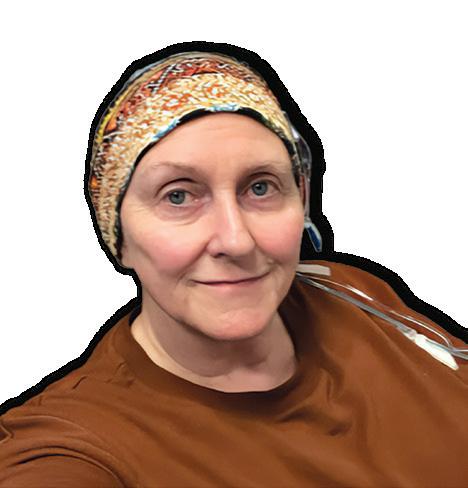
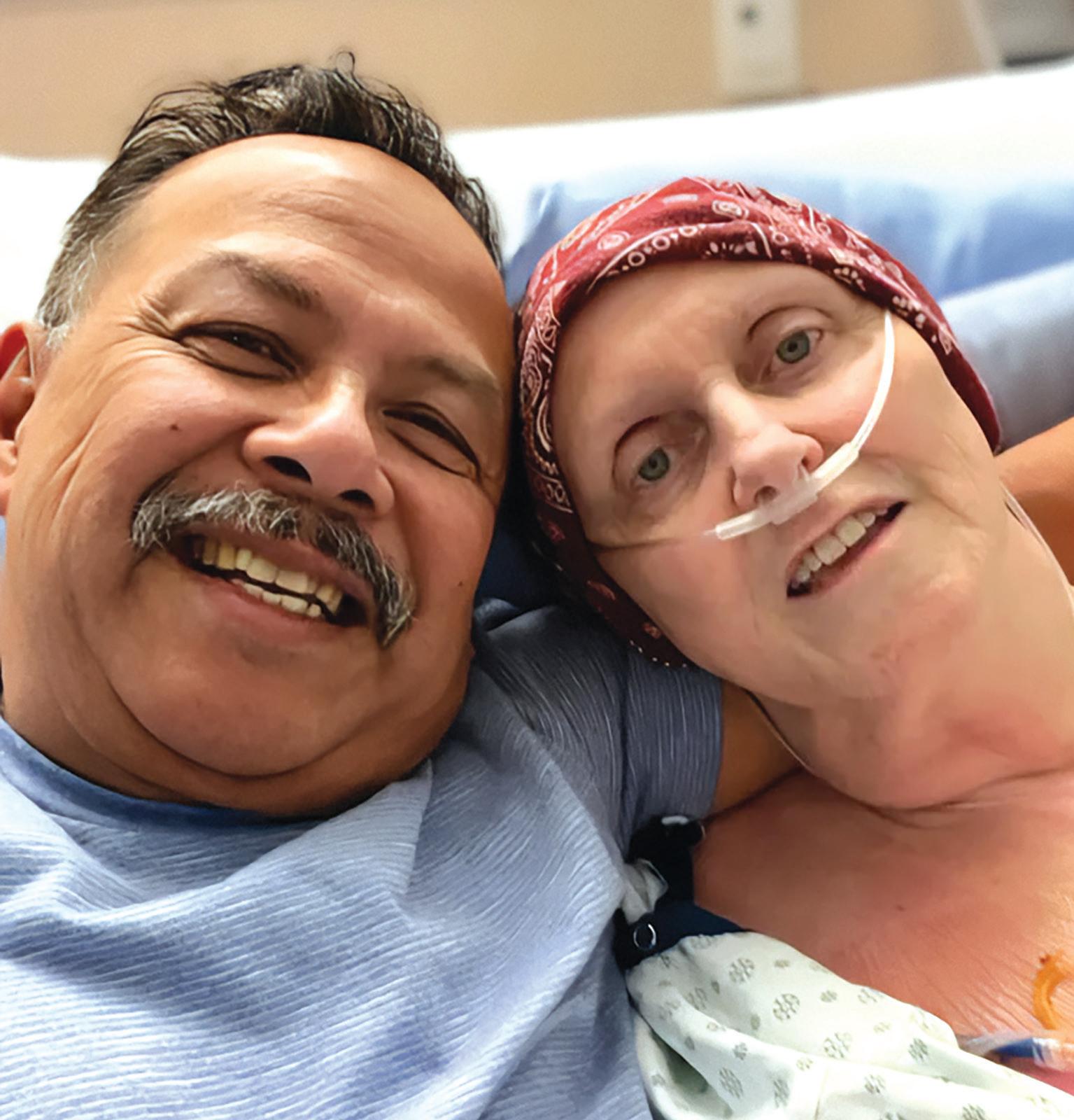
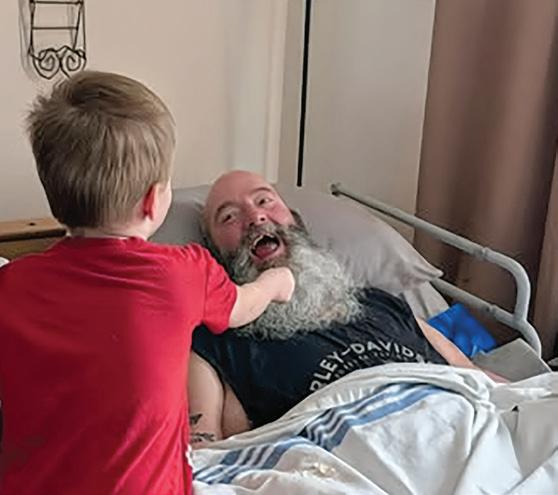
Mjr Kathie Chiu receives treatment for triple negative breast cancer, supported by her husband, Mjr Ed Chiu
first. Instead, she laid out the plan: four chemotherapy drugs, immunotherapy, surgery, radiation. A year of treatment.
Then she added, kindly but bluntly, “You should probably cut your hair. After the second chemo, it’ll fall out—and when it’s long and curly, it doesn’t look pretty.”
I appreciated her honesty. We spoke the same language.
By then, the cancer had already grown faster than expected. Fear tightened its grip. The nurse explained things I don’t remember at all. Thank God Nathan was there, writing everything down.
The drive home was heavy. Old companions—fibromyalgia and arthritis— decided to join the protest. My joints swelled. My muscles ached. Sleep became elusive.
“MY FAITH DIDN’T DISAPPEAR— IT SIMPLIFIED ... I DISCOVERED GOD MORE AS COMPANION THAN PROBLEM-SOLVER.”
—MAJOR KATHIE CHIU
Then came the needles, scans, IVs— fast and furious.
Some days I was a warrior. Other days I was convinced I’d be in the 20-25 percent who don’t make it. Most days lived somewhere in between.
I’m deeply grateful those early weeks were spent at our trailer at The Salvation Army’s Camp Sunrise in Gibsons, B.C. The Douglas firs stood quietly, having weathered centuries of storms. They felt like a wordless sermon: Stand tall. I will sustain you.
THE LONG MIDDLE
I started chemotherapy the way I approach most intimidating things: on time, organized and pretending I wasn’t scared. The nurse smiled knowingly, drew the curtain and hung the lineup— steroids, anti-nausea meds, saline, then the toxins.
At first, I kept teaching. Two MA courses. Practicum students. I held on
until November, when chemo wiped out my immune system and hemoglobin. I landed in isolation, receiving blood transfusions.
That was my cue to stop—mostly. I kept my practicum students because that still felt doable and meaningful.
Then the hair fell out.
I’d always been easygoing about hair. Chemo changed that. When it grew back, the curls were so tight I looked like Nurse Crane from Call the Midwife. A scarf tied under my chin would’ve completed the look.
Emergency visits became routine— usually when my temperature hit 38 C. I’d present my golden ticket from the cancer centre and be ushered into isolation.
I begged for a break and had surgery in December. What should’ve been an overnight stay turned into 10 days after my lung collapsed—over Christmas, no less. Humour became essential. Duct tape for the soul.
Once my blood counts recovered, I went back for more chemo. Then radiation—15 daily visits with a cold, humming machine the techs had named Vivian. Finally, immunotherapy. A year that stretched into 15 months.
The long middle lived up to its name.
The physical toll was relentless— chemo brain, aching muscles and joints, metallic-tasting food and mind-numbing fatigue. But the psychological toll surprised me more. Cancer gets into your head. You start interrogating your life. Was it food? Hair dye? Standing too close to the microwave waiting for popcorn?
Then there’s the heart-squeeze of imagining your children’s grief. Your grandchildren growing up without their Nana.
NOT ALONE
My faith didn’t disappear—it simplified. Prayer became smaller, slower. I let go of outcome-based faith and discovered God more as companion than problemsolver.
“Cancer didn’t make me wiser in tidy ways. It clarified what matters,” says Mjr Chiu
Some days I didn’t want to pray at all. I was angry. Psalm 13 became my mantra—How long, O Lord?—ending, irritatingly, with trust.
What held me together was community—my prayer group, friends. Writing on Substack became a lifeline, words pouring out like exhaling. The cancer-writing community there met me in my contradictions: faith and doubt, fear and hope. Now, treatment is over—but is it? Scans. Follow-ups. Fatigue that lingers. An immune system that hasn’t caught up. Recovery looks less like triumph and more like managing, resting, adjusting.
Cancer didn’t make me wiser in tidy ways. It clarified what matters, what can be released. What matters is time with the people I love and doing things that fill my soul.
People look at you and assume you’re fine. You look fine. Your hair is growing back. But healing doesn’t mean returning to normal—it means learning a new way to live.
I end every Substack post the same way: with gratitude. To God. To my readers. To friends. For walking with me. For sharing stories back. For reminding me that none of us do this alone.
And that—more than anything—is what sustains us.
MAJOR KATHIE CHIU
is a retired Salvation Army officer. Find more of her writing at kathiechiu.substack.com.
Kingdom in Kingston Work
College for Officer Training team joins in mission with Salvationists in Jamaica.
BY CADET MELISSA CRUMP
In May, the College for Officer Training led a two-week “Learn and Serve” trip to Jamaica, where cadets, auxiliary-captains and staff deepened their understanding of God’s mission as they served alongside local officers, Salvationists and cadets from the Caribbean Territory. The Shirley McInnes Endowment, which supports the training and development of cadets for ministry in an international setting, helped make this possible, covering the costs of nine cadets to be part of this unique experience. Cadet Melissa Crump shares some of her journal entries from the trip.
Before the Trip
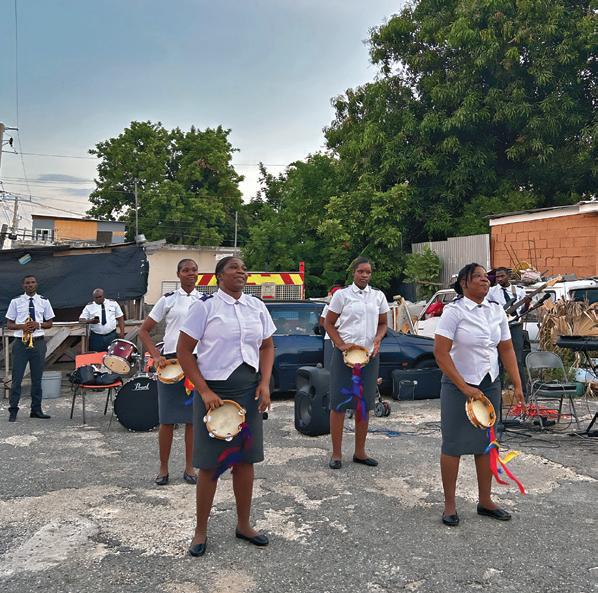
The team leads an open-air service
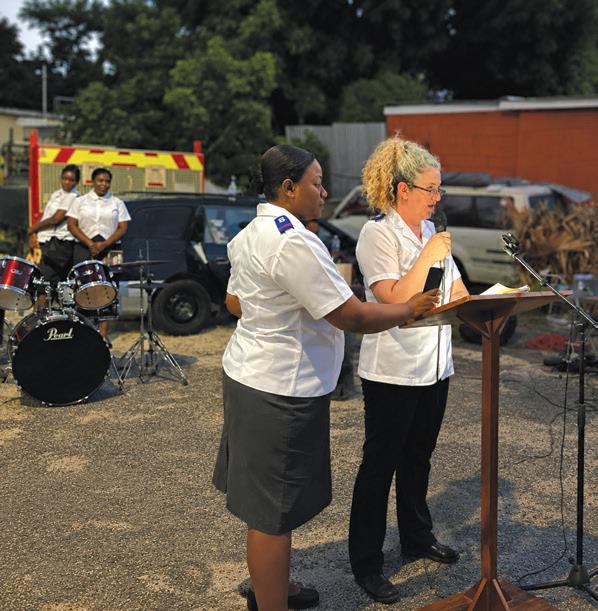
Cdt Michelle Wade shares from the Word, assisted by Cdt Sydonnie Housen
Friday, May 8
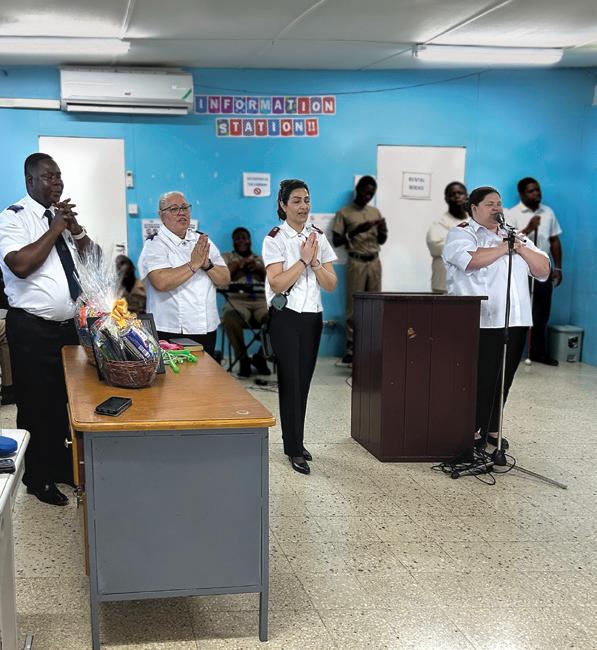
Today we held an open-air service in Jones Town, a neighbourhood in Kingston. It was my first open-air experience, and it was amazing. We set up on a street corner and had music, timbrels and testimonies. My fellow Canadian session-mate, Cadet Michelle Wade, brought a beautiful word on transformation. It was so powerful to see people come up for prayer. After the service, I hung out with the kids, and they played with my hair as we talked about Jesus and how what we learn at church affects our lives at school.
Living Sacrifice program in 2023, God changed my life. I know this trip will be different, but I’m excited to return to a place where I felt God’s presence so profoundly. I wonder what he has in store this time.
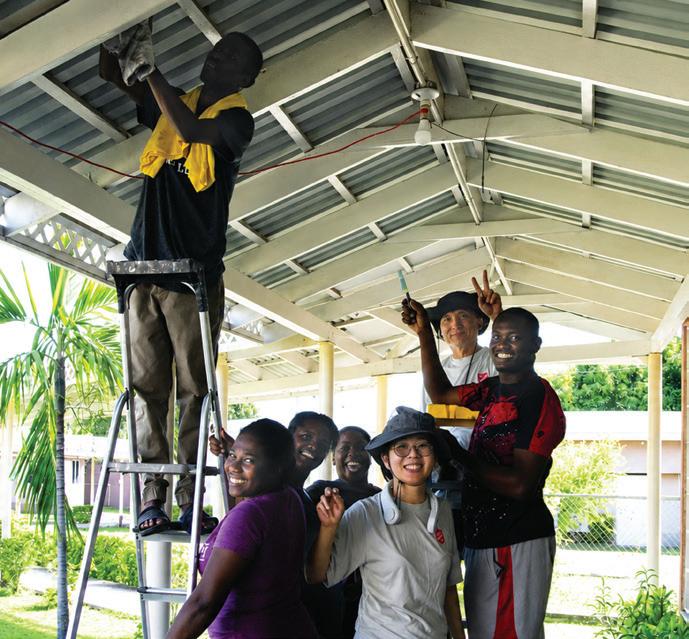
Learn and Serve participants power wash the awnings at the training college in Kingston, Jamaica
Sunday, May 10
Our first Sunday together was an “in-Sunday,” when all the cadets and auxiliary-captains came together for a weekend of worship. The morning worship was led by the Caribbean Territory’s training college, and the afternoon worship by the Canada and Bermuda Territory’s training college. We learned each other’s songs, preaching styles and creative expressions of worship. We prayed in pairs with a cadet from another territory, which was my favourite part. Then we all pitched in to decorate the dining hall for a banquet, and I learned a cool new way to fold napkins, a subtle and thoughtful act of hospitality that I will bring home.
Monday, May 11
We split into two groups to work on projects around the training college. One group organized the basement, and another power washed the awnings (I think they had the most fun).
Sunday, May 17
Tuesday, May 12
Today, we broke into two groups again to serve in two different schools. At the school I visited, some of the cadets performed a short skit for about 1,000 children (wow!) at their morning chapel, demonstrating that what goes into your heart comes out through your actions.
The other group went to The Salvation Army’s School for the Blind and Visually Impaired, which is on the same grounds as the training college and other Salvation Army ministries. They led some joyful songs and activities, gave a lesson and enjoyed what the children had prepared for nurse appreciation day.
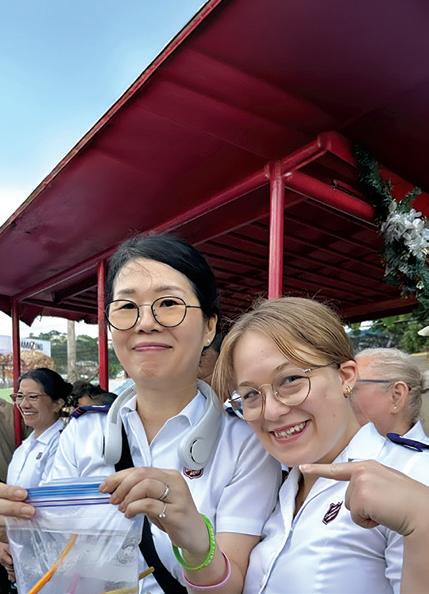
Later that evening, we walked over to The Nest, an orphanage run by the Army. What a beautiful ministry. We played games with the children, sang songs and had dinner together. This time, the group I was in led a short Bible lesson, with an object lesson on trust using a sealable bag full of water and sharp pencils. It looked like the pencils might puncture the bag and spill water everywhere, but they didn’t. We can trust God even when it might look like we can’t.
A group leads songs and activities at the School for the Blind and Visually Impaired. From left, Cdt Alberto Theola, Cdt Sandra Herrera, Aux-Cpt Elahe Bagheri and Aux-Cpt Laura Pittman
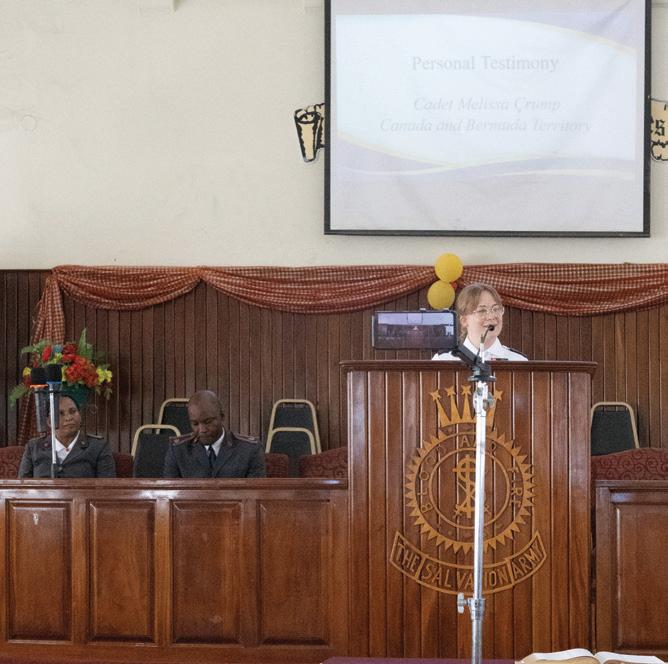
Cdt Melissa Crump shares her testimony on Sunday at Kingston Central
On our final Sunday, we split into groups and attended three different corps around Kingston: Havendale, Kingston Central and Allman Town. I went to Kingston Central, where I had the privilege of sharing my testimony. Then Cadet Alberto Theola spoke powerfully about God’s nearness.
Monday, May 18
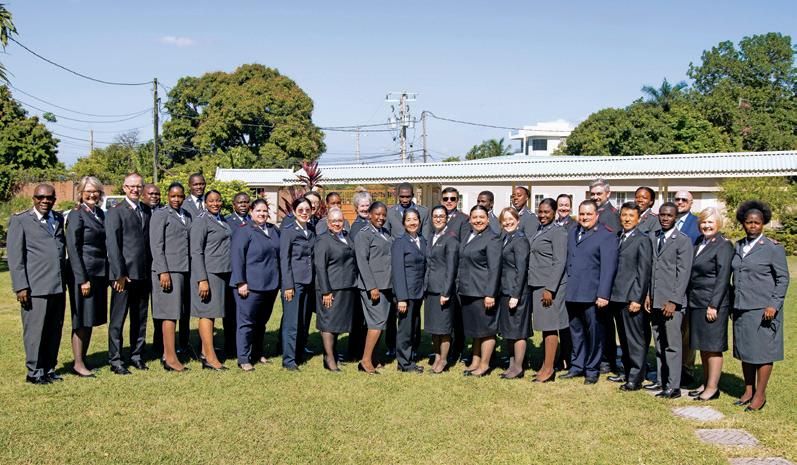
The Learn and Serve team of cadets, auxiliarycaptains and officer staff from the Canada and Bermuda Tty and the Caribbean Tty
The cadets and auxiliary-captains from the Canada and Bermuda Territory represent seven different countries. Combined with our colleagues from the Caribbean Territory, the number grows to 10. We learned so much from each other. During the farewell service, Major Vilece Thomas, training principal at the training college in Jamaica, remarked, “This is a taste of heaven,” as we joined hands to sing and pray the blessing. I wholeheartedly agree.
We hear the term “one Army,” and on this trip I saw that lived out. I love that every year, all cadets across the international Salvation Army are commissioned under the same sessional name. It was special to meet other Proclaimers of Transformation. In training, we are guided by the same requirements for ordination and commissioning, we memorize the same doctrines, and we will sign the same Officer Covenant. Following commissioning, we will probably also share similar nerves and excitement about what the future holds. What’s awesome is that our connection will continue, even after we are commissioned. When we visited different places around Kingston, the officer staff were able to meet session-mates from different territories. It is cool that we are so connected, no matter the distance.
Final Thoughts
This is a taste of heaven!
Throughout the trip, we were asked to reflect on the question: “What might God be teaching me?” The main thing I learned is that it’s the Holy Spirit who does the work of holiness. Of course, we let him in and work with him, but it’s less about striving than we usually think. We can do nothing without him. We pondered this idea during our holiness seminar on May 14-15. When we stay connected to the vine (see John 15), the Lord grows the fruit.
This is a concept the Lord has been working on with me for a while, and one that’s so important for those of us who are training to become officers, and who can so easily shift to doing things in our own strength—though I think this is a temptation for all Christians.
At the end of our holiness seminar, we made our own declaration of holiness and shared it in groups of three. I recommend this exercise to any Christian. Our denomination is a holiness movement, and to put how you will embody holiness in your own words, and share that with others, is so profound.
Food insecurity is on the rise across the Canada and Bermuda Territory, and The Salvation Army is well-positioned to assist through its food banks—but the ministry goes far beyond just sharing food.
With 220 community services locations in the territory, food banks are one of the first ways that the Army connects with individuals and families in need. They’re an open door to providing support wherever it’s needed, from housing and employment services to addiction recovery.
“We are so much more than just food banks,” says Peter Thomas, community services consultant in the community mission department, who works closely with ministry units operating food banks. “Food and shelter and a safe space is the first step, but the goal is not just to provide one meal today; it’s to help people change their lives so they don’t need us for that anymore.”
GREATER NEED
Each year, food banks are seeing more people coming through the doors for assistance. According to Thomas, food insecurity is no longer limited to vulnerable groups but is now affecting a broader range of people. The issue is becoming increasingly widespread and complex.
In Huntsville, Ont., approximately 26 percent of households experience some level of food insecurity, and nearly one in three struggle to afford adequate or nutritious food. Wider economic stress contributes to the issue, with many people spending 70 to 90 percent of their income on housing alone.
MORE THAN A FOOD BANK
Breaking
the cycle of poverty through transformation, not transaction.
BY ABBIGAIL OLIVER
“When people think of Muskoka, they picture wealth and cottage country, but that isn’t always the reality,” says Major Dwayne LeDrew, corps and community services officer at Huntsville Corps. “Food insecurity is one of the most pressing social challenges in our region. It affects a wide range of individuals and families.”
On the other side of the country in Williams Lake, B.C., the food bank has seen a nine percent increase in usage so far this year, following a 30 percent increase the year before. “Rising costs of living are placing increased pressure on households,” says Tamara Robinson, community ministries director at Williams Lake Corps.
“WE ARE SO MUCH MORE THAN JUST FOOD BANKS.” —PETER THOMAS
And the same trend exists in Fort Frances, Ont., which has seen a growing number of people, including a significant population of seniors, relying on the food bank in recent years. “When I started working here three years ago, we were distributing about 40,000 pounds of food a year. Now we’re moving well over 80,000 pounds annually,” says Ryan Daw, community and family services co-ordinator. “People need consistent access to
basic, nutritious food without having to choose between paying rent and buying groceries.”
WHAT SETS US APART
In each of these communities, ministry units agree that the problem isn’t just food—and neither is the solution. Many people who are facing food insecurity are also facing additional needs, such as housing instability, health challenges and deep isolation.
Army food banks are addressing the shift by focusing on wraparound supports that are transformational, not just transactional. Programs such as The Salvation Army’s Pathway of Hope help to break the cycle of poverty by addressing the root causes and introducing a strengthsbased case management system to provide targeted services to people in need. Food banks are a valuable entry point to providing these kinds of comprehensive supports.
“We see food as just one way to bring people through our doors. It gives us an opportunity to connect, have conversations and listen. It might lead to kids going to camp, employment programs, or connections to other supports,” explains Thomas. “We want to break the cycle of poverty, and food is just the beginning. Housing, education and long-term supports are what set us apart from other organizations that offer similar food services.”
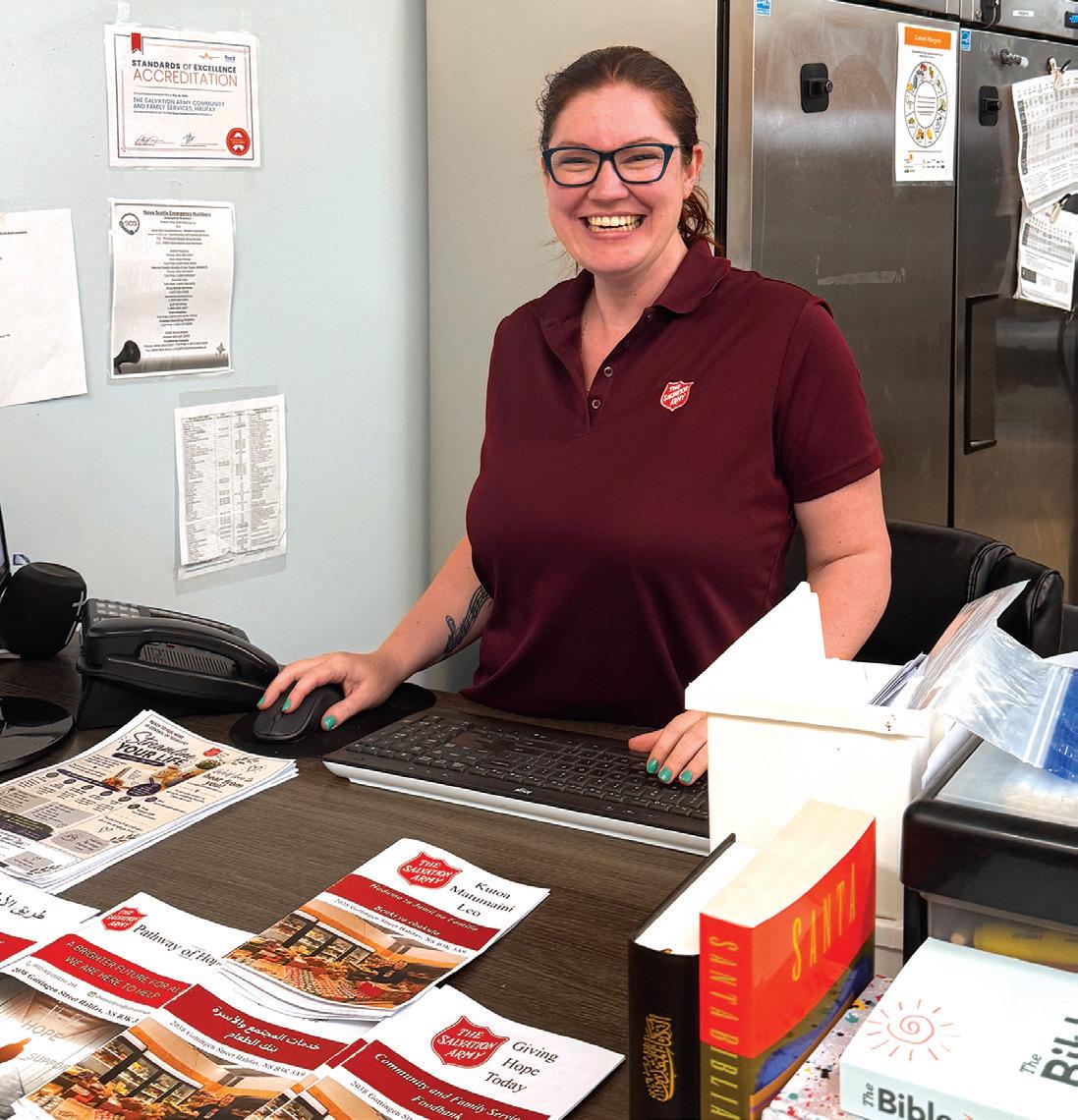
According to Keely Brower at the Halifax Centre of Hope, people may come for food, but what they find is relationship. “Often, the most impactful part isn’t
the
Charles III
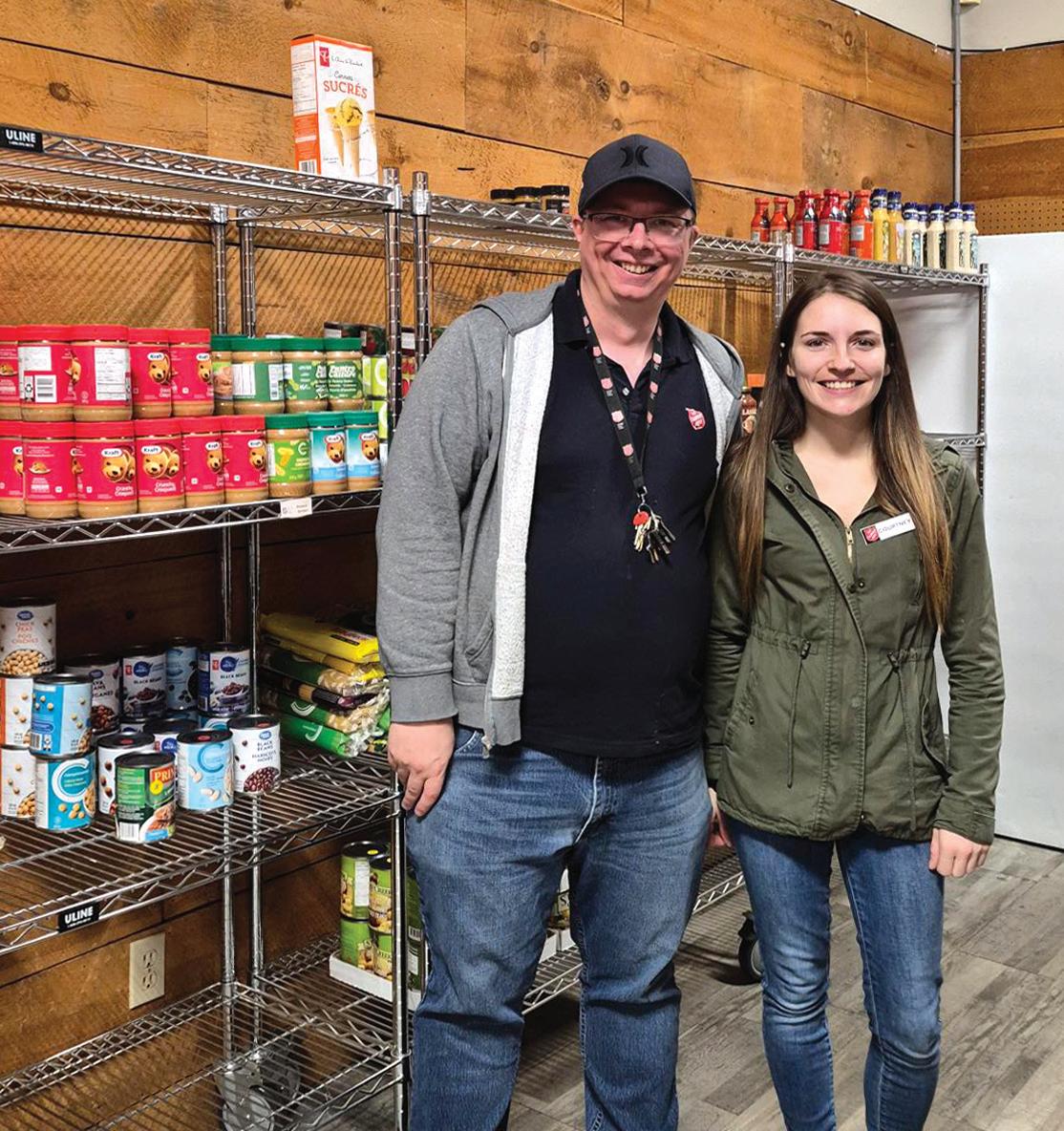
in recognition of his contributions to the community in Fort Frances, Ont. “I’ve always simply strived to serve my community to the best of my ability, so it was an honour to have that work recognized,” says Daw, who is pictured here with Courtney Dolph (right), community ministry worker
the food itself—it’s being seen, known and treated with dignity,” she says. “We also provide referrals to housing, income supports and Pathway of Hope. Our food bank is the gateway to everything else we do.”
For Daw, the food bank is about providing hope when it’s needed most. The people who come into the food bank are considered neighbours and are met with dignity and respect. “We help however we can, whether that’s food, assistance or simply sitting with someone in their moment of crisis,” he says. “Behind every request for assistance is a story, and we meet people with compassion instead of judgment.”
A NETWORK OF HOPE
In Canada and Bermuda, there are 82 ministry units that are direct members of Food Banks Canada, the national network of food banks working together to address food insecurity. Membership ensures food banks are aligned with national standards and best practices, while strengthening their ability to serve their communities through resources and advocacy.
“Membership provides access to national food sourcing, shared standards, training and research,” says Major LeDrew. “This affiliation enhances both the capacity and effectiveness of our food bank.”
Food Banks Canada developed its national standards of excellence in partnership with Imagine Canada. The framework covers six key areas including governance, people management, financial accountability, public engagement, client care and food safety.
“This process has raised the bar for how we operate,” says Thomas. “It ensures that local ministry units are meeting the standards that are already in place nationally.”
“Being a member of Food Banks Canada means we’re part of a national
network that understands our challenges and shares our mission. It also means security,” explains Daw. “It’s the peace of mind that comes from knowing we’ll be able to fill these shelves, even when the need feels overwhelming.”
Daw recalls a devastating flood in September 2025 that temporarily halted operations at the food bank. A water main burst and sent sludge and clay into the foundation of the building, causing severe damage. “It was a moment of true crisis for us. We made one call to Food Banks Canada, and they sent an entire pallet of food immediately,” he says. “That’s not just a transaction; that’s support. You’re not alone in this work, and when disaster strikes, you have a partner who understands the urgency and responds with compassion and efficiency.”
HELPING US SERVE
In addition to their Food Banks Canada membership, these ministry units have also undergone an extensive accreditation process. Out of the 82 ministry units connected to Food Banks Canada, 52 are currently accredited, and many others are in the process of becoming accredited.
Accreditation is a full review of food bank operations, including food safety, client dignity, policies and reporting. The process involves a self-assessment, documentation submission and exter nal evaluation and feedback, and it can often take several months to a year to complete.
Huntsville was one of the first ministry units in the ter ritory to complete the process in April 2025. “While we were already doing much of the work, it wasn’t always in writing,” explains Major LeDrew. “This helped us formalize best practices and strengthen our operations.”
Today, The Salvation Army has become a leading influence, and Food Banks Canada now shares materials from accredited ministry units as resources to help guide others.
“There are strong supports available, including templates, training, webinars and direct guidance. You’re not doing it alone,” says Brower.
to conduct the accreditation review, and Daw was surprised to find that it was more than reviewing policies and procedures.
“They weren’t just checking boxes; they genuinely wanted to understand our approach and philosophy to food support,” he says. “It felt less like an inspection and more like a collaborative conversation aimed at helping us improve and affirm the good work we were already doing. They were able to provide valuable insights and resources for improvement.”
A LASTING IMPACT
Food is a critical need, but it’s just one need that The Salvation Army addresses. Food services, including food banks, meal programs and even mobile canteens, are vital entry points to transformation and access to services.
“The food bank is a key expression of our mission,” says Robinson. “Through it, we’ve been able to build relationships and become a trusted source of support. These connections allow us to better understand people’s challenges and walk alongside them.”
“We want to break the cycle. We want to reduce poverty. We’re doing that,” says Thomas. “It’s not just about food—it’s a ministry of presence.”
At Fort Frances Corps, two representatives from Food Banks Canada visited
(Left) Ryan Daw (left) received
King
Coronation Medal
Keely Brower is ready to greet guests at the Halifax Centre of Hope food bank
Afriend once asked me a simple q uestion I had never thought to ask of myself: “Why The Salvation Army?”
At the Army’s Whitby Community Church in Ontario, family was not a slogan but a practice. It let me breathe (easily), sing (badly) and finally belong (totally). I soon found myself reading Scripture and volunteering at their community events.
WHERE LOVE TRAVELS
For where I was, where I am and where I expect to be, The Salvation Army is my home. I learned to worship God through inward faith and outward love.
The Army embraces those who might otherwise go unnoticed, bringing light where ordinary light does not reach. It is a bridge connecting hearts to each other and to God.
Its outreach extends far beyond sharing his Word, serving the community, especially those who slip through ordinary care. All are welcome to receive freely the help it offers, even if just a hot coffee and a warm meal.
The Army is love, God’s love in words and deeds. It is care shaped for the receiver, not the giver.
REACHING HEARTS
Stillness is woven into every service. Worship is lively and dynamic, yet it makes room for quiet in a way I had never known.
I learned that The Salvation Army does not prescribe a single Bible translation, a practice I admire. This changed how I hear Scripture. Language shifts, and people learn differently. Hearing the same passage rendered differently, charity becoming love, men becoming all, reminds me that we do not own his Word; we host it.
FINDING HOME
How
The Salvation Army shaped my faith.
BY LOUIS KYRON
Each translation whispers to my heart in its own way: the King James Version with its majesty, the New International Version with its warmth, the First Nations Version with a voice I never knew I needed, written in a way the original biblical authors could never have foreseen. As translations multiply, his Word reaches hearts that might otherwise be missed.
WHY THE ARMY?
I still remember my first visit. I was offered a warm cup of tea before I sat down. The woman who greeted me did not ask anything. She simply sat with me, and in that quiet, I was seen, heard and held.
The Army lives the kind of love that shaped me when I needed it most and taught me how love travels in the world. It taught me to be still, to listen, to receive and to give. That is where faith becomes a visible pathway of hope.
I still cherish spending countless hours wrapping toys for children and making sandwiches for the many participants in the Santa Shuffle. I did not do this alone. At the Army, no one serves alone.
The Salvation Army feeds more than mouths and shelters more than bodies, restoring dignity without gatekeeping. It reaches beyond its walls, where salt, light and Scripture meet in action.
I did not choose the Army so much as discover it as a place of welcome and love. This is where I belong, because God’s presence is felt in every service and every act. It is family, lived out in loving God and loving one another.
AND SO …
I stay at The Salvation Army because it is not merely a place I attend.
They are a people who carry God’s love with intention. It is a community where Scripture breathes, where rest is honoured, where welcome is not conditional. It is where I learned that love is shaped for the wounded, the weary and the wandering. It taught me Psalm 46:10: “Be still.” Here, love does not simply speak; love lives. The Army is 1 Corinthians 13.
And so, when I am asked again, “Why The Salvation Army?” my answer is simple.
Because here, I learned to be still.
And here, I found home.
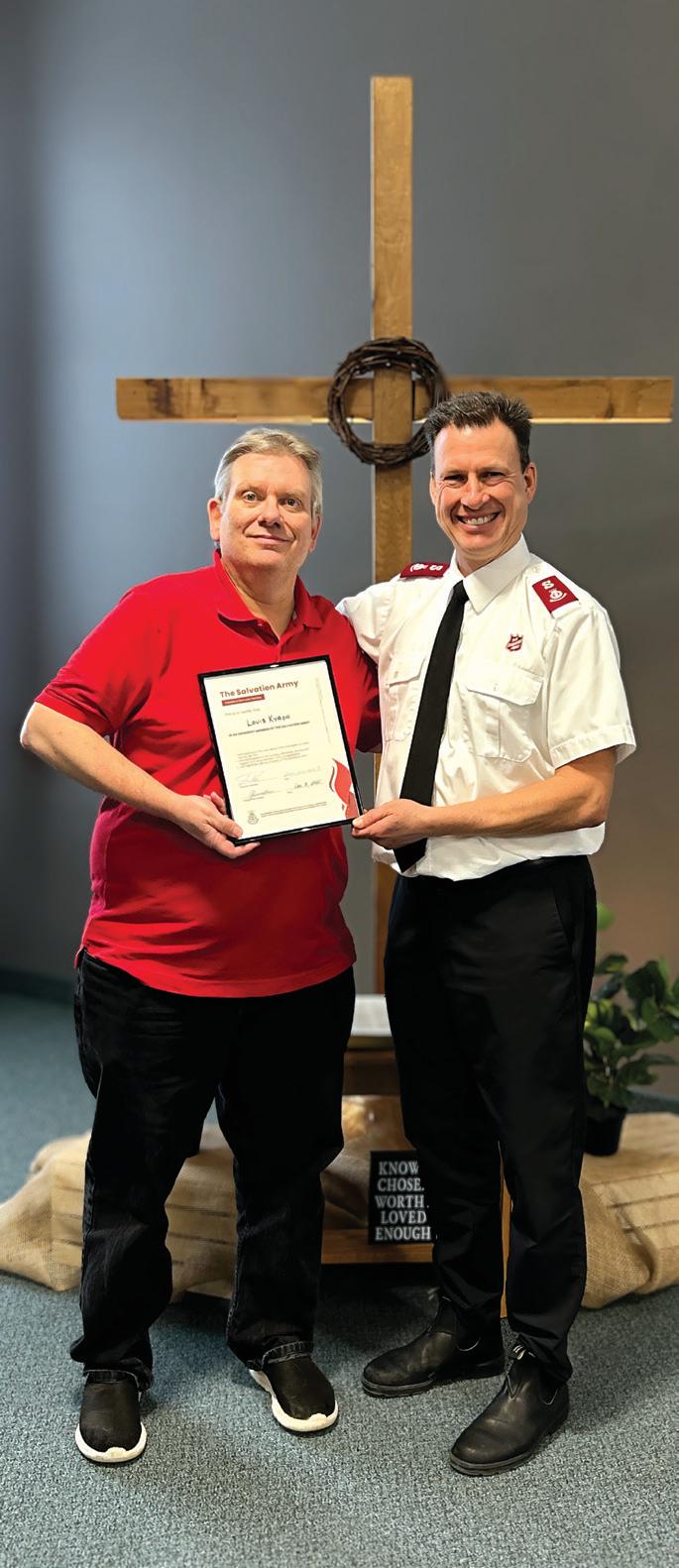
Louis Kyron is welcomed as an adherent at Whitby CC by Mjr Mark Dunstan, CO
UNDIVIDED WORSHIP
Is there something that holds a place in my heart that only God deserves?
BY JACOB PEARO
Thedoctrines of The Salvation Army, while often viewed as our theological distinctives, deeply root us in the broader historic Christian faith. The Nicene Creed and the Apostles’ Creed—two of the most widely affirmed statements of belief in the church—both begin with a declaration of God that closely echoes the second doctrine of The Salvation Army: “We believe that there is only one God, who is infinitely perfect, the Creator, Preserver, and Governor of all things, and who is the only proper object of religious worship.”
As the church, we believe that our world came into being not by accident, but thoughtfully and intentionally created by the one true God. We believe that this creator God, having created the world, did not vacate his creation, but rather continues to be present in it, preserving and directing it according to his will and purposes. As such, we believe he also carries the role of governor—the one who has ultimate power, authority and control over all created beings.
of our second doctrine: to worship God and God alone.
As the German theologian Martin Luther put it, idols are anything we look to more than we look to Christ for our sense of acceptability, joy, significance, hope and security. American pastor and author Tim Keller famously defined idols as “good things [i.e., family, achievement, work and career, romance, talent] made ultimate things.” The sin here is not the
Articles of Faith is a new series on the 11 doctrines of The Salvation Army.
typically fall into idolatry together, which means the question that comes out of our second doctrine is not just a question to ask of ourselves, but also of our church and denomination: Is God the only object of our worship?
In light of who this doctrine confesses God to be, it closes by reminding us of the only proper response to him: undivided worship. It’s here that we are naturally confronted with a question: Is God the only object of my worship?
It’s interesting that the first law given to Moses and the Israelites—“You shall have no other gods before me” (Exodus 20:3)—is the law that God’s people struggled most to follow. If there’s anything that the Old Testament shows us, it’s that there’s something in the human condition that causes us to elevate things over God, or that redirects our worship from the Creator to created things. The Bible calls this idolatry, and it directly violates the call
“thing” itself, but our attachment to the “thing,” whereby our heart’s desire, adoration and worship is directed more toward “the thing” than to “the giver” of all good things (see James 1:17). And so, we must ask ourselves: Is God the only object of my worship? Is there something that holds a place in my heart that only God deserves? Might he be inviting me to surrender something to him, and trust that he himself is greater than anything he could give me?
Idolatry is a universal struggle for all followers of Jesus, and it requires continual repentance. Idolatry, however, is not just the sin of an individual, but often the sin of a community. In the Bible, God’s people
As a church seeking to live out God’s mission in the world, our worship of God can easily shift to a worship of his mission or, even worse, a worship of the method by which we carry out his mission. Our worship is to be directed toward him, not toward what he calls us to do or how we’ve traditionally chosen to live out what he’s called us to do. And so, it’s here we find the invitation to reflect: Is our worship solely directed toward God? Are we more interested in love and good deeds than the God to whom our love and good deeds are meant to bear witness? Are there distinctive Salvation Army practices that have become idols—things in which we find our acceptance, joy, significance, hope and security, rather than in Christ himself? Can we honestly say that all our worship is directed toward its proper place in God?
As we seek to be a people who not only declare doctrine, but live as if it’s true, may we assume the posture of King David in Psalm 139, when he prays: “Search [us], God, and know [our] hearts; test [us] and know [our] anxious thoughts. See if there is any offensive way in [us] and lead [us] in the way everlasting.”
JACOB PEARO is the pastor of discipleship and spiritual formation at Northridge Community Church in Aurora, Ont.
Exploring the “I am” statements of Jesus in the Gospel of John.
PRAYER PRACTICE
1. Choose a picture of Jesus holding a lamb.
2. Feel his arms, tenderly and lovingly hold you. Rest here for a while.
3. Prayerfully consider: How do I belong to Jesus, and how am I known and loved by Jesus?
I AM THE GOOD SHEPHERD
Jesus meets our need to be known, to belong and to be loved.
BY MAJOR CORINNE CAMERON
Ireally enjoy the summer. Not just the weather (which is a welcome reprieve when one lives in Canada) but also the pace. I get to know my neighbours as we pause and chat while out on walks. I enjoy picnics in the park. One of my favourite activities is sitting around a bonfire, simply enjoying being in the company of others. I find relationships deepen in a unique way in these unstructured months of summer.
Deepening relationships is at the heart of the “I Am” statements. Nestled in John’s Gospel are seven names of Jesus. They are expressions of self-disclosure that show how God wants to be in relationship with us, and how we may encounter relationship with God through Jesus.
“I am the Good Shepherd” (see John 10:1118) is a wonderful example of a relational name. This fourth name is filled with imagery and promise, not just of protective care but of our salvation hope. It is a royal and messianic image that is filled with missional possibility.
The Good Shepherd is also a name of relationship. We are created to be in relationship with one another and with God. Humans have three basic needs: to be known, to belong and to be loved (the third level of American psychologist Abraham Maslow’s hierarchy of needs). The passage that encases Jesus’ name “I am the Good Shepherd” reveals to us how these three needs are met in Jesus.
In John 10:14-15, we discover how Jesus meets our need to be known. This knowledge runs far deeper than roles we fulfil or our accomplishments. Jesus knows our joy and sorrow, our fear and vulnerability. Jesus sees beneath our personas to who we are at the centre of our being, and the possibilities of who we can become. This is a knowledge of relationship. As we grow in our relationship with Jesus, we open up the ever-deeper recesses of our soul.
The next verse promises how the Good Shepherd meets our need to belong. A sense of belonging is cultivated when we feel a connection with other people, when we feel accepted for who we are (more than what we do). Belonging provides a place where we both give and receive care.
The name Good Shepherd happens within a larger discourse of Jesus’ sixth sign (healing the man born blind in John 9). This man had spent his life on the margins of society, viewed as a sinner. He was restored physically and, hopefully, spiritually, as well. Yet this healing so angered the religious leaders that rather than being fully welcomed into community, he was thrown out (see John 9:34). Not only was this healing rejected by the religious leaders, but so, too, was the man. The next verses show how Jesus finds the man and welcomes him into the fold. Jesus met this man’s need for belonging and identified that this belonging is available to everyone: “I have other sheep that are not of this sheep pen. I must bring them also. They too will listen to my voice, and there shall be one flock and one shepherd” (John 10:16). From knowing to belonging, we discover how our need to be loved is met by Jesus. Jesus’ name the Good Shepherd is intimately connected to his relationship with his Father. The Father loves the shepherd, and the shepherd will express God’s love by laying down his life for his sheep. In this way Jesus differentiates himself from all the “hired help” who will flee at the sign of danger. He will remain present and steadfast in the face of danger. He will sacrifice his own life so his sheep may live. Later in John’s Gospel, Jesus explains how there is no greater love than laying down one’s life for another (see John 15:13).
When we hear the name “Good Shepherd” it is natural to picture a tender image of enfolding a lamb in arms of love. However, as Jesus describes his name we encounter a fierce love, one that crosses to the margins to invite people to a space of belonging, one that perseveres through appearances to a space of knowing, and one that will steadfastly and sacrificially provide a space of loving.
MAJOR CORINNE CAMERON
was the corps officer at Yorkminster Citadel in Toronto. She will take up a new appointment as the principal of the College for Officer Training as of July 3.
The words of Jesus quoted above provide a powerful framework for any conversation about mission fruitfulness. They remind us that fruitfulness is not ultimately the result of effort or innovation, but of abiding—of staying deeply connected to Christ. And yet, as Jesus continues, the expectation is clear: those who remain in him will bear much fruit. This dual reality—dependence and direction—sits at the heart of our calling as The Salvation Army.
As we seek to move our ministries toward bearing fruit, our newly created mission matrix provides a practical tool. Built on two intersecting axes—Christcentred and others-focused, the theme for our refreshed territorial strategy—it captures this biblical call. It reminds us that fruitfulness is cultivated when we align ourselves with the heart of Jesus.
To be Christ-centred is to ground everything in a living relationship with him. This is where fruitfulness begins. Before Jesus sent his disciples out, he called them to be with him. A Christ-centred ministry today prioritizes authentic worship, intentional discipleship and missional programs that will help shape people into Christlikeness.
In the Canada and Bermuda Territory, this is especially important. We serve in a diverse and often secular context, where faith can become peripheral. A Christcentred posture ensures we do not drift or lose our distinctiveness. It keeps us anchored in the gospel, dependent on the Spirit and attentive to God’s leading.
Yet to live as Jesus did is also to be others-focused. Jesus consistently turned outward—toward the lost, the marginalized, the overlooked and the
BEARING FRUIT
New mission matrix guides us toward mission fruitfulness with Jesus as our compass.
BY LT-COLONEL LES MARSHALL
“Remain in me, as I also remain in you. No branch can bear fruit by itself; it must remain in the vine … apart from me you can do nothing.”
—John 15:4-5
broken. He fed the hungry, welcomed the outsider, healed the sick and proclaimed good news to the poor. This shapes our second axis. To be others-focused is to embody the love of Christ in practical ways, meeting human needs as a core expression of our faith.
Across our territory, The Salvation Army is uniquely positioned to live this out. From community services to shelters to corps ministries, we are already meeting human needs in significant ways. But the mission matrix challenges us further: Are these efforts integrated with our spiritual life? Are we creating pathways for people not only to receive help, but to encounter Jesus?
The intersection of these two axes— Christ-centred and others-focused—is where mission fruitfulness emerges. A ministry that is strong in one but weak in the other will struggle.
Spiritual depth without outward engagement can lead to isolation, while social action without spiritual grounding can lose its perspective. Held together, they lead to transformed lives and communities.
For our ministry units, the mission matrix offers an invitation to reflect and realign. Where are we thriving? Where might we be out of balance? This is not about criticism, but growth. Fruitfulness is a journey requiring dependence on God and openness to change.
Leadership is vital. Officers and ministry teams are called to model Christcentred, others-focused lives, cultivating cultures where prayer is central, mission is shared and disciples are the outcome. They also make adjustments—rethinking programs and exploring vibrant new ways to engage their communities.
While abiding in Jesus, our measure of success must remain rooted in transformation. While numbers matter, true fruitfulness is seen in changed lives—people coming to faith, growing in discipleship and finding hope. It is seen where justice is pursued, dignity upheld and Christ’s love made known.
The Salvation Army’s mission in Canada and Bermuda calls us to nothing less. Sharing the love of Jesus Christ and meeting human needs is a unified calling. The mission matrix tool helps us hold these together with intention and with clarity.
As we look ahead, the opportunity is significant. A Christ-centred, othersfocused life is the outcome of discipleship and the pathway to deeper mission fruitfulness. We become a people who not only speak about Jesus but live like Jesus, with Jesus as our compass (see John 14:6).
In so doing, we trust the promise of Scripture where the expectation is clear: those who remain in him will bear much fruit—fruit that reflects his character and will bring lasting transformation to the world around us. That’s mission fruitfulness.
If you are interested in learning more about the mission matrix tool, please contact your area commander.
LT-COLONEL LES MARSHALL was the secretary for mission. He is the divisional officer personnel secretary and divisional mission resources secretary in the British Columbia Division as of July 3.
CHOOSE CURIOSITY
Jesus asked more questions than he answered.
BY CAPTAIN LAURA VAN SCHAICK
My son recently had one of those sudden, pre-teen growth spurts, which meant an overdue and somewhat ruthless reckoning with his wardrobe. T-shirts once worn on repeat were reluctantly set aside. Of everything he outgrew, one loss hit hardest: a beloved black T-shirt so worn that more of its silk-screened design had vanished than remained. What lingered was a faint pink aquatic creature and the barely-there words, “I Axolotl Questions”—a testament to the inquisitive nature that has become a proud part of his identity.
Kids, of course, are famous for asking the darndest questions. Why can’t I see the air? Where do squirrels sleep? Does the letter “W” start with a “D”? Their curiosity is relentless, unfiltered and often disarming for even the most prepared parent.
But children aren’t the only ones who ask the darndest questions. Jesus did, too—and a lot of them!
It’s often been observed that Jesus asked far more questions than he answered. More than 300 questions appear in the recorded words of Jesus in the Gospels. We hear him ask things such as, “Can any one of you by worrying add a single hour to your life?” (Matthew 6:27); “Why do you call me good?” (Mark 10:18); and, perhaps most profound of all, “Who do you say I am?” (Luke 9:20).
He posed questions to disciples and Pharisees, to seekers and skeptics, to those in need of healing and those convinced they had no need at all. Though he knew everything, Jesus repeatedly chose the posture of curiosity. His questions weren’t for himself, but for others—an invitation to pause, reflect and wrestle honestly with what they believed.
Andy Bannister, author of How to Talk About Jesus Without Looking Like an Idiot, suggests that we can learn a lot from Jesus’ posture of curiosity and his tendency to ask thoughtful questions. Rather than struggling to find the perfect response in difficult conversations, Bannister encourages us to follow Jesus’ lead: to slow down, ask questions and allow meaningful dialogue to flow from a place of listening. It’s a simple shift, but a powerful one, especially when there’s a temptation to become defensive, or when we’re afraid of saying the wrong thing.
For example, imagine a friend says, “I just think faith is a crutch for people who can’t handle reality.” Instead of immedi-
ately jumping in to defend or debate, we could respond with a question: “That’s interesting—what makes you feel that way?” Or even, “Have you always thought that, or did something shape that perspective?”
Suddenly, the tone of the conversation changes. It’s no longer about defending our faith by delivering the perfect answer, but about understanding the person in front of us. And in that curious, open and unhurried space, relationships have room to grow.
This approach works in all sorts of ways and across all kinds of conversations. We can respond with curiosity when someone challenges us at a party on the ethics of abortion or sexuality. We can respond with curiosity when a family member steers the conversation at a holiday gathering toward politics. We can respond with curiosity when a coworker asks us about Christianity. In each case, the goal isn’t to win an argument, but to open dialogue.
Of course, engaging in conversations with curiosity doesn’t always come naturally. It can take time and intention to learn how to ask good questions. Good questions are often openended and gently probing. They invite reflection rather than demand agreement. They may even expose hidden motives and assumptions. Above all, they help create respectful conversations and foster healthy relationships.
While my son’s well-worn shirt is now tucked into his memory box—it was too beloved to fully part with—I hope he continues to embody the playful invitation in its faded words: “I Axolotl Questions.” It’s a posture worth holding on to.
In a world quick to argue and slow to listen, adopting a posture of curiosity can feel countercultural. And yet, it’s a beautiful way that we can reflect the heart of Jesus—one question at a time.
CAPTAIN LAURA
VAN SCHAICK
is the corps officer at Barrhaven Church in Ottawa, and the territorial gender equity officer.
ONWARD, CHRISTIAN CULINARY CADETS
A century-old cookbook at the Heritage Centre highlights the domestic side of salvation.
The index page from this Cadets’ Cookery Notes includes two handwritten recipes for eggless cake and gingerbread sponge cake
TheCadets’ Cookery Notes is an example of informational booklets created and distributed to cadets at the International Training College/ Garrison in London, England. Other booklets, to name just a few, included Outlines of Cadets’ Lessons in Orders and Regulations, Outlines of Cadets’ Bible Lessons, Summary of Cadets’ DoctrineLessons and Summary of Fifty Lessons for Cadets in Field Organization.
Salvation Army cadets were expected to prepare some of their own meals. These booklets likely helped guide them on what they could cook, as well as provide general cooking information about such things as food supplies, fireless cookery, how to make tea and coffee, and basic kitchen hints, and even offered a suggested weekly bill of fare. The suggested bill of fare section, which is kind of like a menu plan, is particularly interesting because it gives a snapshot of what cadets might have eaten during that
Living History is an ongoing series showcasing just a small assortment of the more than 350,000 items housed at The Salvation Army Heritage Centre in Toronto. This month, we spotlight Cadets’ Cookery Notes.
time. The 1928 copy of the Cadets’ Cookery Notes has several pages of handwritten recipes, including an eggless cake, gingerbread sponge cake, and (wartime) lemon curd. These recipes likely reflect the realities of the times in which they were written—the interwar period and the Second World War.
Also included in the Heritage Centre’s collection is a copy of a bill of fare from the Territorial Training College in Toronto, dated December 18, 1919. This document provides information about what cadets and probably training college staff would have been eating during the interwar period in Toronto.
It was also common for recipes to appear in the weekly editions of The War Cry. The earliest recipe that the Heritage Centre has found dates to 1923. However, it is likely that recipes appeared in even older issues of The War Cry. The recipes that comprise the Lite Stuff
department of Faith & Friends are thus part of a long and venerable culinary tradition!
It is somewhat of a mystery how these booklets made their way from England to Canada. It seems likely that Salvationists who were trained in the United Kingdom brought them when they immigrated. One booklet has “M. Orr” written on the cover and another has “Annie McDonald” inscribed on the inside cover. These booklets could have belonged to Margaret Orr or Annie May McDonald, who were both officers in Canada during the 1900s. It is not known if the owners of these booklets were trained in London, England, and then immigrated to Canada or if they were given these booklets when they were at training college in Canada.
(Above) The Territorial Training College’s bill of fare, December 1919. Roast beef is on the menu for Wednesday, tripe and onions on Friday
Cadets’ Cookery Notes
HAMILTON, BERMUDA—At North Street Citadel, Illys Richardson celebrates her 97th birthday surrounded by family and friends. From left, Whitney Matthew; Cpt Alfred Esdaille, AC, Atlantic Div; Richardson; Debra Matthew; and Cpt Cathy Esdaille, CO.
MEDICINE HAT, ALTA.—Nine new adherents are enrolled at Medicine Hat CC. Front, from left, Art Hamilton; Sophie Colehouse; Karen Broder; Mjrs Charlene and Corvin Vincent, COs and associate community ministries officers; Judy Moore; Kimberly Matson; and Patricia Hamilton. Back, from left, Gary Gould, Larry Kohls and Jim Unrau. Richard Van Schaick holds the flag.
WOODSTOCK, ONT.—Woodstock CC enrols three junior soldiers. From left, YPSM Anne Williston; Eden Ivany, Bronwyn Ryerse and Sarefina Aref, junior soldiers; and Mjr Kristen Adams, CO. Ryan Noels holds the flag.
—Shaganappi CC welcomes two new senior soldiers. From left, Lt-Col Donald Bladen, DC, Prairies and Northern Territories Div; Lt-Col Donna Bladen, divisional officer personnel secretary and divisional spiritual life development secretary, Prairies and Northern Territories Div; Lara Peters and Shawn Malsbury, senior soldiers; Mjr Glenda McKenzie, holding the flag; and Cpt Connie Cristall, then CO.
EDMONTON—After a successful territorial standards of excellence review, the Edmonton Centre of Hope receives a certificate of excellence, presented by Lt-Col Fred Waters, then social mission regional director, Prairies and Northern Territories Div. From left, Mjr Steven Barrett, then associate executive director; Lt-Col Waters; Vanessa Sim, assistant executive director; and Mjr Elaine Bridger, then executive director.
Olanike Rotimi-Andu; Mjr Jodi Dunstan,
Dunstan, CO.
WHITBY, ONT.—Whitby CC celebrates Immanuel Ebenezer Paul, who was accepted as a candidate for officership, a significant step as he continues to explore God’s calling. From left, Lt Jeff Robertson, then divisional candidates secretary, Ont. Div; Paul; and Lt Miya Bradburn, then divisional candidates secretary, Ont Div.
and
ONT.—London Citadel honours the retirement of Alan Bolam after 58 years of music ministry in the London Citadel Band.
left, BM John Lam presents a commemorative plaque to Bolam for his distinguished service.
LONDON,
From
CALGARY
WHITBY, ONT.—Whitby CC welcomes new members. From left, Dianna Reid; Immanuel Ebenezer Paul; Collins (Oluwagbenga) Olatunji; Louis Kyron; Daisy Langdon; Mabel Keats; Lola Kokumo; Grace Olagunju; Babatope Olagundoye;
CO
CFS officer; and Mjr Mark
INTERNATIONAL
Appointments: Jul 1—Comr Henrik/Lisbeth Andersen, IHQ consultant on corps and congregational development/TC, Sweden and Latvia Tty; Cols Bo/Christina Jeppsson, international secretaries for Europe, IHQ, with rank of comr; Cols Nara/Wilson Strasse, TPWM/TC, Spain and Portugal Tty; Lt-Cols Daniel/Heidi Imboden, territorial leader for international relations/TC, Switzerland, Austria and Hungary Tty, with rank of comr; Lt-Cols Karina/Rafael Giusti, TPWM/TC, Brazil Tty, with rank of col; Lt-Col Brian Saunders, CS, U.S.A. Southern Tty, with rank of col; Lt-Cols Jöel/ Karen Etcheverry, CS/secretary for territorial development, Switzerland, Austria and Hungary Tty; Mjr Richard Gaudion, executive secretary to the General, IHQ, with rank of lt-col; Mjrs Ariane/Jean Olekhnovitch, TSWM/CS, France and Belgium Tty, with rank of lt-col; Aug 1—Lt-Cols Abraham/Mercy Mudda, TC/TPWM, India Northern Tty, with rank of col; Lt-Cols Samraj/Santhi Babu, territorial leader for leader development/ CS, India Western Tty; Lt-Col Jashiben Khristi, CS, India South Eastern Tty; Lt-Cols Robert Masih/Sunita Robert, CS/TSWM, India Northern Tty
TERRITORIAL
Appointment: Comr Susan McMillan, officer personnel strategic initiatives director, THQ
Retirement: Apr 1—Mjr Glenn Fraser
Promoted to glory: Mjr Margaret Foley, Mar 22; Mjr Pamela Woods, Apr 2
CALENDAR
Commissioners Lee and Debbie Graves: Aug 29-Sep 5 Territorial Music School, Jackson’s Point, Ont.
Colonel Margaret McLeod: Aug 28-30 Celebration of Culture, Pine Lake Camp, Alta.
ADVERTISE WITH
Visit salvationist.ca/advertising for rates
KITCHENER, ONT.—Captain Lucy Graves was raised near Orwell, Ont., where she had vivid memories of growing up on a farm. In 1957, she married Cecil Graves and they settled in St. Thomas, Ont., where they had four sons. In 1978, they answered God’s call on their lives and became full-time officers, and for the next 20 years served faithfully and ministered to congregations and communities in Tillsonburg, Ont.; St. Mary’s, Bermuda; and East Toronto. Predeceased by her husband, Cecil, Lucy retired as an officer and found her next calling as a full-time chaplain at the Village of Winston Park in Kitchener where she shared God’s love with staff, residents and families. Her smile, sense of humour, boundless joy and musical talents were an inspiration and encouragement to all. Lucy loved family and friends unconditionally, and her faith was paramount. She will be missed by her children Commissioner Lee (Commissioner Debbie) Graves, Michael (Paula), Wendell (Cindy) and Christopher (Denise); brother, Charles (Dorcas); and many grandchildren, great-grandchildren, and nieces and nephews whom she loved greatly
CELEBRATION OF
CULTURE
LIVING KNOWLEDGE
AUG 28-30, 2026
REGISTER VISIT SALVATIONIST.CA/COC
TRIBUTES
TORONTO—Joan Elizabeth
Ash was born in Parry Sound, Ont., in 1935, to Samuel and Jessica Greer. A devoted soldier of The Salvation Army, Joan lived faithfully by the Army’s motto, “Heart to God, Hand to Man.” She joined the Sword Bearers Session and was commissioned as an officer in June 1956. She faithfully served in several ministry roles for more than 16 years. In October 1972, Joan resigned from officership to marry her beloved Clifford Ash. Together, they shared 43 wonderful years of marriage until Clifford’s promotion to glory in 2015. She served as young people’s sergeant-major and then corps sergeant-major for 40 years, offering leadership, encouragement and a steadfast example of faith at West Toronto Corps and York Community Church in Toronto. Recently she enjoyed worship at Yorkminster Citadel in Toronto. Predeceased by her husband, Cliff; brother, Ralph; and sister, Doris, Joan will be missed by her stepson, Gordon (Susan); sister, Diana; her grandchildren, nieces and nephew
WINNIPEG—Major Ruth Eason was born in 1930 to Salvation Army officers in Sydney, N.S. She was an active member of many Salvation Army churches, and sensing the call of God to ministry, she entered the College for Officer Training in Toronto and was commissioned as an officer in 1953. After serving in appointments in Ontario, Ruth met and married Lloyd Eason, an officer from Newfoundland and Labrador, and the couple went on to serve God together. They lived in several provinces, including Ontario, Saskatchewan, Alberta and British Columbia. After retirement in 1995, Ruth and her husband resided in Windsor, Ont., and later Winnipeg. Ruth leaves behind a legacy of godliness, self-sacrifice, kindness and graciousness that will be remembered and cherished by those who knew her. She was a faithful follower of Jesus and a source of inspiration to her loved ones. Predeceased by her husband, Lloyd; siblings Paul, Al, Shirley and John David, she leaves behind children Sharon (David), Peter (Karen) and Andrew; grandchildren, great-grandchildren, nieces and nephews.
“It’s
been such a gift to walk through life with the teens and share the gospel with them,” says Alex Ma
QA &
Alex Ma is the youth pastor/director at Cariboo Hill Temple in Burnaby, B.C.
How did you first encounter The Salvation Army?
As a kid, I was in the daycare at New Westminster Citadel, B.C. Brent White was the youth pastor at the time, and he would teach me the Word through Bible studies at the daycare on Thursdays. After I grew out of daycare, he asked me to help lead “kids corner,” an after-daycare program. He would have me teach a little bit of the Bible and play dodgeball with the kids. He also had me work on a “Bible investigators” video series with him where we made skit videos about Scripture together. It was awesome because I got to have my friends join in the fun.
How did your faith evolve as you grew up?
As a teenager, I was terrified of taking on the label of being a Christian and experiencing persecution. I saw the Bible more as a book of wisdom, and I was pretty distant from God. I don’t think I fully understood what life in Jesus looked like.
But in my Grade 12 year, I realized that having a personal relationship with God was important. During that time, it was helpful to meet many people who were passionate about God at The Salvation Army’s
ARMS WIDE OPEN
Whatever challenges I face in life, I know my Father loves me.
Camp Sunrise in Gibsons, B.C., where I was a camper, a leader in training and a member of staff. Those were pivotal years of fellowship with other Christians and people who wanted to know more about life with Jesus.
Can you share a key moment in your walk with God?
About eight or nine years ago, I was having a very rough few weeks. After a church service at Cariboo Hill Temple, I decided to walk home to New Westminster from Burnaby. Over the course of that long walk, everything kind of welled up in my mind and my heart. And that was when I saw this picture in my mind of the Father’s arms wide open and hugging me. It was a meaningful moment for me as someone who didn’t grow up with a father or mother.
I was raised by my grandmother, and she taught me to be generous even when we had little. When I first received an access key to the Cariboo Hill Temple building, I was on top of the world— having access to a space that was so much bigger than my home and had lots of great stuff. But I quickly realized that material things mean nothing if they are not shared. So, I started running basketball drop-ins and bringing people to the church for card games and gatherings. It filled my heart to see people enjoy these things, but what was more important was hoping that my friends would come to Christ and sharing the goodness of God and deep fellowship with them.
How has God sustained you when life didn’t go as planned?
Earlier this year, I had a surgery that I was really nervous about. I was afraid of negative outcomes and the potential that, rather than solving the problem, things might get worse. In the moments when I was on edge and emotionally overwhelmed, I found refuge in John 16:7: “But very truly I tell you, it is for your good that I am going away. Unless I go away, the Advocate will not come to you; but if I go, I will send him to you.” I knew that God was with me and that I wasn’t suffering alone.
Once the surgery was over, I expected that things would be back to normal again, but I was shocked by how much pain I was experiencing and how it disrupted my day to day. Even still, God kept me from growing bitter and cynical. He gave me hope when I didn’t understand it all. I’ve been really blessed to have my wife with me every step of the way, and I was comforted by a close friend, a fellow believer, who had experienced similar problems. God may not give me what I want but he will give me what I need, and I grow to know him that way.
What makes your ministry with The Salvation Army meaningful for you? It’s been such a gift to walk through life with the teens and share the gospel with them. Seeing them develop a relationship with Jesus is what keeps bringing me back. I love seeing the expression of faith in each of their lives and how Jesus walks with whoever receives him as Lord and Saviour.
Photo:PhilOh
HONOUR & HOPE HARVEST DINNER
present: in support of our program Shelter U
and September 25, 2026 Southlands Community Church
Doors open at 5:30pm, event starts 6:00pm 85 Keslar Rd, Winnipeg, MB R3T 6A5
With Guest Speaker:
Dr. Stephen D. Borys, PhD, OM, DLitt
President, Civic Muse, Inc.
Former Director & CEO, Winnipeg Art Gallery – Qaumajuq
Visit: boothuc.ca/harvest OR scan this QR code to learn more about how you can partner with us.
FIGHT THE GOOD FIGHT
Photo: Leo Lintang/stock.Adobe.com
PHRASE BE is an ongoing series highlighting the dozens of everyday sayings that originate with biblical text.
In this issue, we unpack:
PHRASE: Fight the good fight.
DEFINITION: To encourage and persist and overcome any difficulties, by doing what is right.
EXAMPLE: It was a difficult election, but the candidate was proud to have fought the good fight.
SOURCE: “Fight the good fight for the true faith. Hold tightly to the eternal life to which God has called you, which you have declared so well before many witnesses.”
—1 Timothy 6:12 (New Living Translation)
Reading the first four words of this Bible verse might make you want to head to the wrestling mat or boxing ring—until you get to the rest of the first sentence and the all-important word “faith.” What we’re talking about here is a spiritual battle more important than any physical one.
Make no mistake, however. Fighting the good fight of faith takes even greater stamina and perseverance. When you align yourself with the values and teachings of Jesus Christ, you need determination, because a call to faith is a privilege and a responsibility not taken lightly.
But you’re not fighting this fight alone. The reference to “many witnesses” means that you have a spiritual army at your back, a community of fellow Christians— whether in your church, your Bible study group or online friends—that will help you persevere in your faith journey. With their help and encouragement, this is one fight you will win!
SOMEONE CARES
5 The Honest Cobbler
One shoemaker’s compassion has helped thousands of people stand on their own two feet—with proper footwear.
BE BLESSED
8 Blessed Are the Peacemakers
Why does Jesus applaud them?
GOD IN MY LIFE
10 Plans Far Greater
Or, how Dana-Lyn Phillips unexpectedly found God’s purpose for her life.
12 Out On a Limb
An almost-fatal car accident brought Patricia Huber closer to God.
16 Toys Versus Tech
In Toy Story 5, our heroes face their biggest challenge yet.
22 Taking the Next Step
Mike Olver’s not dying from ALS; he’s living with ALS .
CAMP TALES
26 Experience of a Lifetime
At Beaver Creek Camp in Saskatchewan, Amelia Tremblay returns as staffer to inspire the next generation.
LITE STUFF
28 Eating Healthy With Erin Word Search, Sudoku, Quick Quiz.
A GLOBAL LENS
31 Smiles That Transcend Borders
The Salvation Army supports a network of 102 schools across Indonesia, serving more than 8,300 students.
Living, Not Dying
It began with a stumble.
My mother, usually so sure-footed, chalked it up to some crack in the sidewalk, but soon she realized that it was more serious than that.
Medical tests confirmed the awful truth, that she had an advanced form of ALS (amyotrophic lateral sclerosis). Otherwise known as motor neuron disease or, more commonly, Lou Gehrig’s disease, it is a rare neurodegenerative disease.
There is no known cure for ALS. And it is also terminal.
The doctors gave my mother three months to live but she stubbornly held out for three years, in large part due to her loving husband and her devoted mother—my grandmother—who looked after her until Mom had to be admitted to the hospital. In that time, she went from a nimble, active woman to one who could only move her eyelids to communicate yes or no. Always slim, she had wasted away to nothing by the end of her life.
But her family and her faith were her support. Though my Catholic mother could not attend church, every Sunday, we brought back a communion wafer for her.
I wish she could have read Mike Olver’s article in this month’s Faith & Friends. Diagnosed with ALS, his faith, hope and God’s loving presence helps him to deal with the situation in a positive manner.
“I’m not dying from ALS,” he writes. “I’m living with ALS.”
Read Mike’s inspiring story on page 22.
Elsewhere in this issue, you’ll see our take on the newest Toy Story movie, read how one young woman has inspired a new generation of Salvation Army campers, and find out how another woman unexpectedly found God’s purpose in her life.
Ken Ramstead
Mission Statement
To show Christ at work in the lives of real people, and to provide spiritual resources for those who are new to the Christian faith.
Faith & Friends is published bimonthly by:
The Salvation Army 2 Overlea Blvd, Toronto Ontario, M4H 1P4
International Headquarters 101 Queen Victoria Street, London, EC4P 4EP, England
Lyndon Buckingham, GENERAL
Commissioner Lee Graves
TERRITORIAL COMMANDER
Graham Moore
CHIEF EXTERNAL RELATIONS OFFICER
Geoff Moulton, DIRECTOR OF COMMUNICATIONS, EDITOR-IN-CHIEF AND LITERARY SECRETARY
Pamela Richardson
ASSISTANT EDITOR-IN-CHIEF
Ken Ramstead, EDITOR
Kristin Ostensen
MANAGING EDITOR OF SALVATIONIST AND SALVATIONIST.CA
Lisa Suroso
GRAPHIC DESIGN SPECIALIST
Emily Pedlar
JUNIOR GRAPHIC DESIGNER
Rivonny Luchas
DIGITAL MEDIA SPECIALIST
Giselle Randall
SENIOR EDITOR OF SALVATIONIST
Abbigail Oliver
EDITOR OF JUST FOR KIDS AND STAFF WRITER
Logan Graves CIRCULATION CO-ORDINATOR
Scripture Unless otherwise indicated, all Scripture references are taken from New International Version
Subscription for one year: Canada $17 (includes GST/HST); U.S. $22; foreign $24 P. (416) 422-6153
circulation@ salvationarmy.ca
All articles are copyright The Salvation Army Canada & Bermuda and cannot be reproduced without permission. Publications Mail Agreement No. 40064794
ISSN 1702-0131
The Honest Cobbler
One shoemaker’s compassion has helped thousands of people stand on their own two feet—with proper footwear.
by Janice Keats
With a shop already overflowing with boots and shoes waiting to be repaired, Darrell Hynes of The Honest Cobbler in St. John’s, N.L., still found room in his day— and in his heart—to take on one
more task: helping people who desperately need proper footwear. The idea for the campaign began when a woman walked into the shop with a pair of badly damaged boots, hoping they could be repaired.
Darrell Hynes and his daughter, Darra, at The Honest Cobbler’s counter
Sole Survivors There are always plenty of boots and orders at The Honest Cobbler
“I couldn’t fix them,” Darrell says. “What haunted me was knowing they were the only boots she owned.”
When Darrell posted the need for footwear on social media, the response was overwhelming, with donations arriving at his shop within hours.
“Within one week, the post went viral,” Darrell says. “So many outlets picked up the story that I was suddenly being interviewed all the time.”
Darrell opened his shop in 2020, working alongside his daughter and business manager, Darra. Since then, the pair have prepared more than 13,000 shoe tags—each one representing a pair of boots or shoes repaired or restored.
Making a Difference
The “Give Winter a Boot” campaign was born from that modest appeal. Before long, donated footwear was pouring into the shop, filling every corner with boots and shoes, reflecting the generosity of people who wanted to help.
“Boots are donated from a variety of sources,” Darrell says. “We have received donations from people across Newfoundland and Labrador who have heard about the campaign.”
Darra has been instrumental in organizing the steady stream of donated footwear, and she’s quick to give her father credit for the kindness that started it all.
“Dad came up with the name, and he created the logo,” she says, smiling. “This whole campaign began out of compassion for that one lady who could not afford a pair of boots.”
Companies have also contributed to the campaign. Suppliers donate fitted boots that could not be sold. Other retail companies donate “like new” boots that could not be returned to the manufacturers. Darra has been in conversations with social services as well as city councillors filling requests for clients.
“I often receive calls from them asking for work boots for people who need them to start a job,” Darra says. “So, these new boots truly make a difference.”
Remarkable Journey
As the campaign grew, volunteers came forward, increasing the resources available to keep it going. Local business owner Natalie Tibbo of Kalon Beauty and Glow, along with a couple of her employees who work in the same building as The Honest Cobbler, stepped in to help.
They have volunteered countless hours sorting and packing donations, turning what began as a small effort into a well-organized operation. Each time new footwear arrives, it’s carefully sorted, paired and packed into boxes, ready to be delivered.
“Most of the footwear is sent out to nonprofit organizations,” Darrell says. “In addition to the local requests we
Welcome Assistance
Darrell and Darra with just some of the donations they receive
receive, we also ship boxes of donated boots and shoes to The Gathering Place, The Kindness Closet and The Salvation Army’s Centre of Hope.”
Carolyn Reid, executive director of The Salvation Army’s St. John’s Housing and Community Services, sees first-hand the impact donated footwear has on the people they serve.
“Many of the individuals who come to the Centre of Hope for a hot meal, or who arrive at the Wiseman Centre seeking shelter, have shoes that are worn out, or simply unsuitable for the weather,” she explains. “It’s not uncommon for someone to approach staff and ask if we have any boots or shoes available. A gentleman came in for a meal one day wearing plastic bags inside his sneakers just to keep them dry. To be able to provide a good pair of boots for this gentleman was so rewarding!”
Since the campaign first began— and after that initial wave of media attention—there has never been another formal call for donations.
“We haven’t advertised in two years,” Darrell says. “We just haven’t needed to. If I put out another media post, we’d be absolutely bombarded with donations.”
It’s inspiring to see the community’s needs being met, and even more
encouraging to know that there are resources available to support that work. With these tools in place, Darrell’s business and the volunteers are empowered to keep up with the growing demand and make an even greater impact.
“We are deeply grateful to partners like The Honest Cobbler, whose generosity allows us to offer hope—one pair of shoes at a time,” Carolyn says.
The campaign has grown quickly, meeting the needs of people from all walks of life, and the kindness behind it hasn’t slowed.
“We’ve heard from so many people who’ve cleaned out their closets just to donate footwear to this campaign,” Darrell says. “Some families have even donated shoes from loved ones who have passed on.
“It’s been a remarkable journey, and Darra and I are truly grateful to be part of it.”
Blessed Are the Peacemakers
Why does Jesus applaud them?
by Jeanette Levellie
In the Sermon on the Mount, Jesus tells us of the reward for creating harmony between people.
“Blessed are the peacemakers, for they will be called children of God” (Matthew 5:9), He says in the seventh Beatitude, one of eight blessings in Jesus’ first sermon.
What could honour us more than for God to call us His own children?
No Peace of Cake
There are peacekeepers and peacemakers.
Peacekeepers like to maintain peace. They go to great lengths, even
make compromises, to ensure no one “rocks the boat.”
Jesus didn’t praise those who simply make sure the kids don’t fight when Mom or Dad’s back is turned.
Jesus did, however, commend peacemakers.
According to Merriam Webster’s dictionary, a peacemaker is “one who makes peace, especially by reconciling parties at variance.” Peacemakers bring opposing sides together. They long for harmony to reign, even if the process of making peace proves uncomfortable.
We think highly of people who
Jesus was the greatest peacemaker in history. He stepped in between us and God to buy our freedom from sin with His own life.
JEANETTE LEVELLIE
arrange meetings between warring factions to help them harmonize with each other. We award such people much-deserved trophies, parades and accolades.
And we should honour them because making peace is no piece of cake.
Reaping the Harvest
Several decades ago, my friend Kathy and I developed a difference of opinion about a certain Bible teacher. That difference caused an unspoken chasm between us.
Bev, a mutual friend, noticed the tension and stepped in to help reconcile us. She sat us down in comfy chairs in her living room and asked each of us to share our viewpoint, and why we felt offended and hurt by the other.
At the end of that meeting, Kathy and I apologized for our unloving attitudes and shed tears of repentance. To this day, we remain close friends. All because Bev was willing to step between us and make peace. She didn’t choose sides. She listened to both viewpoints without judgment and gently asked ques-
tions that helped us discover the root of our conflict. She sowed the seeds of peace that “reap a harvest of righteousness” James talks about (see James 3:18).
Finding Peace
Jesus was the greatest peacemaker in history. He didn’t passively sit by and observe the sin that had caused humankind to become God’s enemies (see Romans 5:10). Jesus stepped in between us and God to buy our freedom from sin with His own life.
When we turn from our sins and turn to Jesus, we find God’s unconditional forgiveness and peace.
When we tell others about salvation, we’re following Jesus’ example of making harmony between God and people. We’re inviting individuals to find the peace that only God can give.
This is the seventh article in our series on the Beatitudes, key teachings from the Sermon on the Mount (see Matthew 5-7), Jesus’ first sermon during His earthly ministry. Read the sixth article at salvationist.ca/blessedpureinheart.
Monday Meltdown
“In that very moment, I became the stereotypical middle-aged woman who had lost her job, her income and her dignity, all in about four minutes,” says Dana-Lyn Phillips
It was just an average Monday morning in May as I arrived at work. As the company’s longestserving employee, I had crossed the threshold hundreds of times over the nine years I worked there. As a result, everything felt comfortable. The week prior, the boss had been on vacation, so there was no inkling that something life-changing was about to take place.
Lost on Monday
Just as I reached my desk, my boss asked if we could talk upstairs for a minute. I followed her up a flight of stairs to a sunroom she often used as a sanctuary from her daily routine.
Once we were both seated, she
Plans Far Greater
Or, how I unexpectedly found God’s purpose for my life.
by Dana-Lyn Phillips
turned to face me, then calmly began to speak.
“I just wanted to thank you for everything you have done for us the past nine years. We really couldn’t have done it without you. But we can no longer afford to pay you anymore, so we are letting you go, effective immediately.”
I sat frozen, not believing this was really happening. In that very moment, I became the stereotypical middle-aged woman who had lost her job, her income and her dignity, all in about four minutes. And it was only Monday.
As I drove myself home, I asked God to get me there safely because my mind was everywhere but on the
road. I felt blindsided, numb, angry, hurt, scared, underappreciated, disposable and, most of all, lost.
Trust and Follow
After a few days of grieving, I began to turn my thoughts toward the future. For years, I had questioned God’s purpose for my life.
I believed that everyone was created for a reason, and I desperately wanted to know my purpose, and how it could serve to bring glory to God.
I decided this blip on my resumé was an opportunity to seek God’s purpose for my life.
After recruiting some wonderful friends and acquaintances to pray on my behalf, I intentionally spent a few weeks with God. When I sought Him wholeheartedly, He showed up in big ways.
Slowly, and gently, He began to reveal His plan for me, but the clearer God’s voice became, the more I began to fear what He was asking me to do.
I had never considered that God might ask me to do something I did not feel qualified to do. As I continued to question His plan, I tried for once in my life to give up control, deciding instead to just trust and follow.
Listening and Obeying
Eventually, it was clear that God was asking me to write for the purpose of encouraging Christian women in
their faith. After a lot of research, I decided to create a space on Substack where I would write to fulfil His plan for me.
I named my newsletter “Plans Far Greater” because God’s plans for me are always far greater than the plans I have for myself.
Ephesians 3:20-21 says: “Now to Him who is able to do immeasurably more than all we ask or imagine, according to His power that is at work within us, to Him be glory in the church and in Christ Jesus throughout all generations, for ever and ever! Amen.”
This verse reminds me that even when I don’t feel qualified, God can still work through me. I just need to listen and be obedient to His calling.
Divine Intervention
Many days I still feel inadequate, but I commit each article to the Lord, and I trust that it will not be my words I am writing, but God speaking through me. Only He knows in advance who will be reading each post, when, and what they may need to hear at that moment.
Looking back, my job loss was difficult, but I know that I would never have intentionally walked away from a paycheque in search of God’s purpose for my life, so I am thankful that God intervened on my behalf.
For the first time ever, I feel like I am doing exactly what God wants me to do—and it feels great!
Connected by Catastrophe
Firefighter Lieutenant MaryAnn Brown (left) with Patricia Huber
Crash Site
Emergency crew at the scene of the accident. “I remember saying to Patricia when she was still sitting in the car, ‘Girl, you had some guardian angels with you today,’ ” says Lieutenant MaryAnn
Photos: Courtesy of Patricia Huber
Out On a Limb
AN ALMOST-FATAL CAR ACCIDENT
BROUGHT PATRICIA HUBER CLOSER TO GOD.
by Ken Ramstead
Last Labour Day weekend, Patricia “Trish” Huber was driving along Georgian Bay near Owen Sound, Ont. Formerly in real estate, the taxi driver and Salvation Army community driver had gone out to scout available property for her eldest daughter.
Right after lunch, she was heading home to Wiarton, Ont., when she stopped for an ice cream cone.
Ten minutes from her house, she suddenly started feeling sick, sweaty and dizzy.
I better get going, she thought to herself, and backed her car onto the road.
That was the last thing she remembered before she blacked out.
“Just
Hold On”
When Trish came to, “I thought I was in a movie set. That’s where my mind was at.”
Her vehicle had slid down to the bottom of a cliff, facing up.
“I was looking up at rocks in front
of me, Georgian Bay was behind me, and people were at the top yelling down, ‘Are you OK? Are you OK?’ ” Trish recalls.
“Where am I and how did I get here?” she called back.
“Just hold on, the ambulance is coming,” the crowd called down to her.
Long Trek Back
When firefighter MaryAnn Brown, a lieutenant at Wiarton Station 30 of the Town of South Bruce Peninsula Fire Department, arrived on the scene with her crew a short time after, what she saw confounded her.
The car had careered off the road toward Georgian Bay through a gap in the forest, and it had ended up with its front facing upward and its back against a tree, which held it from dropping into the bay.
Trish was seated in her car on an angle, uninjured, so the airbags had not hit her when they deployed.
Lieutenant MaryAnn was the first one down to the scene.
“When the call came in that a woman had driven over an embankment, we were trying to strategize how we were going to deal with this,” Lieutenant MaryAnn recalls. “We expected the worst, but when we finally arrived on scene, we couldn’t believe what we saw.”
The front of the car was entirely undamaged. It was almost as if Trish had backed down into the tree.
The emergency team lowered a ladder and checked Trish’s vitals. From there, they got her out of the vehicle and put her on a stretcher. Instead of going straight back up the ladder, the team took the long way around the escarpment. It was a longer hike but less strenuous than a straight climb back would have been.
“One Miracle After Another” “I wasn’t scared at all,” Trish says of her coming to when the team reached her. “I was miffed! How did I get here? I wasn’t fearful. I wasn’t injured. I was fine.”
“She was a good sport,” smiles Lieutenant MaryAnn. “She didn’t give us any grief.”
Brought to the hospital, the doctors checked her out and released her after a couple of hours of observation with nothing to show for her ordeal but a few bruised ribs.
What shocks Trish is that she did not wake up throughout the entire incident.
“I felt as if I wasn’t in the car,” she says. “God took me out of that car, because it’s an impossibility to have survived that without any injuries. That’s the thing. I keep going over it in my head, and it completely baffles me.”
Lieutenant MaryAnn agrees.
“I remember saying to her when she was still sitting in the car, ‘Girl, you had some guardian angels with you today.’
“Even looking at where she went in, that spot in particular,” Lieutenant MaryAnn continues, “there were guardrails on each side of the location. How she managed to go where she went through and up over that ledge, and how the car landed, is still ... you have to scratch your head about it.”
Wrong Way Up
“How could my car fall 30 feet, settling on its wheels facing the opposite way I went in?” Patricia marvels
“There’s only one being I can thank, especially after something like that. And that’s God.”
PATRICIA HUBER
“There was no damage to the front of my car,” Trish marvels. “I went through a forest, didn’t hit any trees, went up a tree, apparently, and the tree just cradled me down to the ground? How could my car fall 30 feet, settling on its wheels facing the opposite way I went in?”
The only reason rescue vehicles were on their way so promptly was because a concerned motorist, Josh Beaton, out of the corner of his eye, had seen Trish’s car speed up and go over the embankment.
In that split second, a life was saved.
“If it wasn’t for him taking the time to follow me, stand on the cliff making sure I was awake and calling the ambulance, I might still be there,” Trish declares. “Josh was a big part of the story, the hero really!
“It was one miracle after another.”
Living Proof
The doctors later deduced that Trish had been given an overdose of a blood pressure medication another doctor had inadvertently prescribed.
“As a firefighter, you deal with sad things,” Lieutenant MaryAnn says. “We expected the worst. Instead, we found the best result imaginable.”
Taia Anderson-McLeod, a caseworker who works with Trish at The Salvation Army Wiarton Community Church, says, “The experience brought her closer to knowing the living God who was clearly watching over her.”
Trish attends Salvation Army services regularly as well as Bible study.
“There’s only one being I can thank, especially after something like that,” she says. “And that’s God.
“I hope this story inspires people to realize that miracles happen every day, and I am living proof.”
Photos:CourtesyofPatric
Versus
IN TOY STORY 5, OUR HEROES FACE THEIR BIGGEST CHALLENGE YET.
by Diane Stark
THE FIFTH INSTALMENT IN
the Toy Story series, in theatres now, is an animated comedy starring a much-loved group that comes to life when no humans are present.
At the end of Toy Story 4, Woody decided to leave Bonnie’s room and live as a lost toy so he and Bo Peep can help abandoned toys find owners. The rest of the toys are living with a now eight-year-old Bonnie, and Jessie has become their leader, with Buzz Lightyear serving as her second-in-command. The toys are enjoying life in Bonnie’s room. She has a wonderful imagination, and they love their playtime with her.
Until one day when a package arrives that contains a frog-like computer tablet named Lilypad.
Lilypad quickly becomes Bonnie’s favourite plaything—to the exclu-
sion of the other toys. Things get so bad that Jessie begs Woody to return to Bonnie’s room to help them figure out what to do.
Can Woody, Jessie and the others help Bonnie remember how much fun they had together? Or is their playtime over forever?
Addicted to Distraction
Many of us can relate to Bonnie’s obsession with her new tablet. Some people anxiously await the release of a new phone model, even preordering it so they can be among the first to own the latest tech. Many of us can’t imagine life without a smartphone, and we panic when we misplace it. For many, our phone is one of our most important possessions. We use it every day, and it’s never far from our reach.
Illustration: Courtesy of Disney/Pixar
Shhh!
Smarty Pants, Jessie and the rest of the toys are determined to help Bonnie remember how much fun they had together
Smartphones can do so many things. They help us stay connected to others. We can order groceries, schedule medical appointments and find information on any topic we choose. It’s easy to see why we spend so much time staring at our phones. Technology is a tool and it helps make life easier in so many ways. But it can also become a huge distraction. It can take our attention away from more important things. Our families. Our jobs. Even—or maybe especially—our faith.
Studies show that more than half of adults admit to being addicted to their phones. A Statistics Canada
study showed that two thirds of Canadians are showing signs of phone addiction, including using their phones at least once every hour. In 2022, the Canadian Internet Use Survey interviewed 50,000 phone users, and their responses showed that the more often a person checks their phone, the less satisfied they feel with their personal relationships. And in 2012, an American ad agency even invented a new word: phubbing. It’s a combination of the words “phone” and “snubbing” and it refers to the act of ignoring a person to engage with one’s phone.
Technology is a tool and it helps make life easier in so many ways. But it can also become a huge distraction.
DIANE STARK
That word might hit a little too close to home for some. Hopefully, if we are guilty of phubbing, our loved ones will kindly point it out so we can properly re-order our priorities. But what happens when the One we are neglecting is God?
Losing Focus
God gives each of us free will. We are free to choose Him—or not. We can spend time praying and reading His Word—or not.
God wants a relationship with us, but He never forces us. He allows us to make our own decisions, even if that decision is to ignore Him.
Christians can sometimes be guilty of ignoring God. Even though we trust Him with our lives, we can still daily neglect our relationship with Him. We often don’t give God the time He deserves, and our attention can be so scattered.
Let ’s Play?
Buzz Lightyear and Woody confront Lilypad
Illustration:
Courtesy of Disney/Pixar
This world is loud, and there are so many distractions. Losing focus and neglecting our most important priorities can happen quickly. And often, if we look closely, we’ll see that excessive phone use plays a role in that neglect.
Strengthening Our Faith
So what do we do in a world where technology is seemingly everywhere? The most important thing is to remember that God is everywhere, too. He’s with us every moment, and we can talk to Him
whenever we want throughout the day. Just as we might send a quick text to a loved one, we can say a brief prayer to thank God for something or ask for His help. He’s always ready to listen and connect with us.
We can also make a rule that we will open our Bibles—or the Bible app on our phones—before we open any other apps. We can prioritize our relationship with God by giving Him the first few minutes of our day. The YouVersion Bible app is free to download, comes in many translations and includes hundreds of Bible
Illustration: Courtesy of Disney/Pixar
Prepared for Action Buzz stands at the ready
Face-Off Buzz and Woody face their greatest threat yet
reading plans. It’s a great way to use technology to strengthen our faith.
Enjoying quiet, tech-free time in God’s creation helps many people feel closer to God. Others use their phones to play worship music or listen to faith-based podcasts. Many churches broadcast their weekly sermons online, allowing us to listen even when we can’t be physically present.
Life is about choices. These days, owning a smartphone might seem like a necessity, but we can still decide how we use it. Tech is sneaky,
though. We must decide to control it, or it will control us. We can allow it to distract us from our family and our faith, or we can harness the technology for a higher purpose and set it aside when we need to.
In Toy Story 5, Bonnie becomes obsessed with her new tablet. The same can happen to us. After all, a lot of tech was designed to be addictive. But the Creator of the universe designed us and, with His help, we can beat phone addiction and prioritize our relationships with Him—and with one another.
Welcoming the Next Generation
Mike and Bev Olver enjoying every moment with their new grandson, Wesley
Taking the Next Step
I’M NOT DYING FROM ALS; I’M LIVING WITH ALS.
by Mike Olver
Growing up, I lived for sports. School was made bearable by the promise of a pickup game of hockey, baseball or football after the final bell. Every day, if it bounced or rolled, we chased it. I couldn’t have dreamed up a better life.
After graduating from high school in Alberta in 1985, I enrolled in Bible college. To be honest, I didn’t
come for the Bible, but for the hockey. After one semester, hockey was going well, but school wasn’t. One day the dean called me in. Since he was also my father, we met in the living room.
“I don’t think you should return second semester,” he said.
That was fine with me. I was no scholar.
Photos: Courtesy of Mike Olver
Smilin’ Through Grandson Noah “shares” Timbits and Mike and Ike candies with Grandpa Mike
That led me into the restaurant business and, in one of the best decisions of my life, I married Bev Wilson, a former classmate, and took a job as a chef. Perks of the job included taking time off on summer afternoons to perfect my golf game and the opportunity for schooling to upgrade my skills. Our son, Theoren, and daughter, Christina, arrived, and for the next 21 years we enjoyed life in the community where I grew up. We loved watching our kids grow and, in what seemed like no time, grandchildren began to arrive.
“You Have ALS ”
But then my body began to let me down. First, it was the tingling in the left leg, then the twitching in the left arm. I consoled myself with the fact that there was no pain. But one day when my left foot wouldn’t respond to my brain’s command to lift and take a simple step forward in the dining hall, I tripped and fell heavily against a wall. Clearly something was very wrong.
The long search for answers began. But X-rays, bloodwork and ultrasounds all yielded nothing. It wasn’t until I went for a nerve and muscle test in Calgary that the mystery was solved.
On March 13, 2024, Bev and I sat silently in an office awaiting the verdict. The doctor entered and cast a nervous glance. There was no way to soften the blow.
Finally, he said, “You have ALS. Lou Gehrig’s disease.”
Difficult Prognosis
In an odd way, there was almost a sense of relief after so many months of not knowing. But the silent drive home was almost unbearable as we wondered how to tell our children. Tears flowed freely over the next weeks as we also began to share our new reality with other family and friends. ALS is a neurological disease that slowly robs its victims of the ability to control voluntary movements. Nerve cells in the brain and spinal cord are affected, causing loss of muscle control, and muscles get weaker as more nerve cells die. I had always been physically strong, so it seemed ironic to be stricken with a disease characterized by increasing weakness. We hadn’t realized, however, that
I had always been physically strong, so it seemed ironic to be stricken with a disease characterized by increasing weakness.
MIKE OLVER
Happier Days
Mike and Bev, taken just before the diagnosis
ALS treats everyone differently. Simply put, it’s impossible to know exactly when and where the losses will be felt. At first, my left arm and leg lost strength, but I enjoyed the use of my right side. A year later, and I am relegated to my comfy recliner. My angel wife and numerous volunteers are the hands and feet and face of Jesus, caring for my every need.
Research into the disease holds promise, but there is no getting away from the fact that one day, sooner than I’d planned, I’ll be changing my address and meeting my Saviour face-to-face.
Living, Not Dying
Despite the difficult path ahead, I often remind myself of how blessed
I am. Each new day brings reminders of the goodness and love of God.
Bev and I have seen others in absolute despair over a similar diagnosis, and there are certainly dark moments, days when I feel useless.
But I believe that the eternal hope we have and God’s constant loving presence in our lives have made it possible to deal with this situation in a positive way. A good friend advised us to live our lives intentionally and that is what we are choosing to do.
I’m not dying from ALS; I’m living with ALS.
“I’ve Got This”
In high school, I dreamed of a trip with my sweetheart, and, after
Photo: Courtesy of Mike Olver
the diagnosis, nothing stood in the way. We were reminded that relationships built throughout our lives and the precious memories stored up are priceless treasures that nothing can take away.
We visited places like Oklahoma, Montana and Ontario, with no idea how many would bless our socks off.
One highlight was a trip to Seattle, Washington, to watch my Toronto Blue Jays play the Seattle Mariners!
On one trip, in our haste to leave, I neglected to purchase American money. While visiting a friend, I mentioned I needed to get to a bank. When he learned why, he vanished, then returned with an envelope.
“We want you to have this,” he said, smiling. I stared wide-eyed at fives and tens. And twenties. And fifties and hundreds. To this day, I can’t talk about it without tears.
It was like God was saying, “I will never leave you, Mike. I’ve got this.”
Counting Our Blessings
Proverbs 18:22 says, “The man who finds a wife finds a treasure” (New Living Translation). How true. Bev has been God’s gift to me. At my side through all of this, there is very little that I can do now without her assistance.
Our children have showered us with their love and time. When I told a friend that our daughter and her husband were moving so they and the grandchildren could be near us, I broke down in tears.
I can’t begin to count the number of people who have told us they are praying for us. What a wonderful illustration to me of the incredible privilege of belonging to the family of God. Why would we not count our blessings?
On the Way
When Pastor Tim Keller received news that his cancer was terminal, he said, “I’m not suffering from anything that a good resurrection can’t fix.” I share his unshakeable hope. It is the greatest blessing of all. Yet hope can often take a backseat to the challenges and uncertainties of my condition.
As a young man, I valued strength and the ability to be active, never thinking that those days would come to such an end. Where do we turn when life leads us into a new season that we weren’t prepared for? Meaningful music and God’s promises have meant so much. Bev and I have both been drawn at different times to the words of Isaiah 41:10, “So do not fear, for I am with you; do not be dismayed, for I am your God. I will strengthen you and help you; I will uphold you with My righteous right hand.”
Our strength fails. Yet, He is our strength. The way ahead is uncertain. Yet, He is our hope. We did not choose this journey, but one thing we do know is that we are held in God’s loving hands, and He will give enough light for the next step.
Experience of a Lifetime
At Beaver Creek Camp in Saskatchewan, Amelia Tremblay returns as staffer to inspire the next generation.
by Juan Romero
Long before she was old enough to attend, Amelia Tremblay knew she would spend her summers at Beaver Creek Camp in Saskatchewan. Growing up in a Salvation Army family, she watched her older siblings head off to camp every year.
“As soon as I turned seven, I said, ‘I’m going to camp.’ Every single year since then, I’ve been a camper or part of the staff,” Amelia shares.
Coming Out of Her Shell
As a young camper, Amelia remembers feeling excited and at ease, thanks to the welcoming environment created by the staff. That comfort helped shape her childhood in meaningful ways.
“I felt like this was a place where I had time to be a kid and play,” Amelia says. “I was learning new skills as well, so it was really fun. I remember many of the cabin leaders and staff. At camp, I found people I looked up to.”
Amelia discovered a love for nature at camp, where she enjoyed hiking and learning how to guide others. The many arts and crafts activities helped spark her creativity.
Camp also helped her grow personally. It encouraged her to come out of her shell and build confidence, which made it easier to make friends each summer.
Standing Proud
For Amelia Tremblay, The Salvation Army ’s Beaver Creek Camp in Saskatchewan became her life each summer
“At camp, I found people I looked up to.”
AMELIA TREMBLAY
Shaping Young Lives
In her teens, Amelia joined the Leaders in Training (LIT) program to prepare for a staff role. Since 2019, she has returned to Beaver Creek every year, now as a leader, helping others grow the way she once did.
“My role is program support and leaders-in-training co-ordinator,” Amelia explains. “Campers aged 13 and 14 come out for three weeks and go through leadership training. I walk them through shadowing jobs and show them how the camp runs. The other half of my job is supporting the program team.”
With her background as a longtime camper, Amelia’s knowledge provides valuable insight to the staff.
“My experience gives me a perspective not everyone has. I know which activities were fun and which ones not so much. I have an insider
perspective. I can look back on previous experiences and remember what might work.”
Now that she is on the staff, Amelia encourages more parents to consider The Salvation Army’s summer camps for their affordability and the personal development they can bring to participants.
“It could end up being one of the best experiences a parent could put their child through,” Amelia says. “We see quite a few campers from rougher home lives who don’t always get the chance to go out and play. Camp becomes that place where they don’t have to worry. They know there are people here who care and will listen.”
Amelia is currently studying at the University of Winnipeg, but each summer, she returns to the place where she grew up, a place that continues to shape who she is.
(left) Juan Romero is the staff writer/news media relations specialist at The Salvation Army’s territorial headquarters in Toronto.
Eating Healthy With Erin
BLACK BEAN QUINOA VEGGIE BURGERS
TIME 45 min MAKES 8 servings GARNISHED WITH mayonnaise, cheese, lettuce and tomato
125 ml (½ cup) water
60 ml (¼ cup) quinoa
15 ml (1 tbsp) oil
60 ml (¼ cup) onion, diced
1 garlic clove, minced
125 ml (½ cup) bell pepper, diced
15 ml (1 tbsp) cumin
5 ml (1 tsp) chilli powder
2.5 ml (½ tsp) paprika
375 ml (1½ cups) black beans
2 eggs
125 ml (½ cup) breadcrumbs
8 burger buns (see recipe below)
1. Preheat oven to 205 C (400 F).
2. Bring water and quinoa to a boil, reduce to mediumlow and cover with lid. Allow to simmer until liquid is removed, about 15 minutes.
3. In frying pan, add oil, onion, garlic and pepper and cook until soft, about 5 minutes. Stir in spices.
4. Mash black beans roughly, add to frying pan and stir together. Cook for 1 minute.
5. Combine quinoa and contents of frying pan in large bowl. Add eggs and breadcrumbs.
HOMEMADE BURGER BUNS
6. Line baking sheet with parchment paper and make 8 patties. Bake at 205 C (400 F) for 10 minutes, flip over and bake another 10 minutes.
TIME 40 min MAKES 8 servings SERVE WITH burger or steak sandwiches
250 ml (1 cup) warm water
30 ml (2 tbsp) dry yeast
80 ml (1/3 cup) oil
60 ml (¼ cup) sugar
1 egg
5 ml (1 tsp) salt
750 ml (3 cups) flour
1. Add warm water, yeast, oil and sugar to bowl. Allow to stand for 5 minutes.
2. Beat egg and slowly add along with salt and flour.
3. Flour a surface and mix by hand, kneading dough for 5 minutes.
4. Separate into 8 equal pieces and roll into balls. Place on a baking sheet lined with parchment paper and cover with plastic wrap and a tea towel to rise for 20 minutes.
5. Preheat oven to 220 C (425 F) and bake for 10 minutes. Transfer to a cooling rack.
QUICK QUIZ
1.
SHOP
by Kevin Frank
Word Search 1976 Montreal Olympics
WEIGHTLIFTING
Smiles That Transcend Borders
Lt-Colonel Brenda Murray (centre), then director of international development, shares a joyful moment with students from Palu Elementary School in Indonesia.
The Salvation Army supports a network of 102 schools across Indonesia, serving more than 8,300 students—including those in Palu, Central Sulawesi. Through these schools, students are provided with opportunities to learn, grow and build a strong sense of community, supported by dedicated teachers and ongoing efforts to strengthen literacy and enhance learning environments.