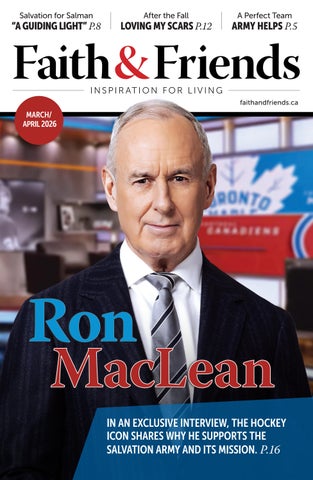
Faith & Friends March/April 2026

Page 1


Faith & Friends

TO BEAR CROSS

PHRASE BE is an ongoing series highlighting the dozens of everyday sayings that originate with biblical text.

In this issue, we unpack:

PHRASE: Cross to bear.

DEFINITION: A hardship or burden that causes trouble or worry for someone to endure.

When Jesus spoke these words, it was as a challenge to His disciples to follow the path He was making. He was soon to bear His own cross, and He was warning them that while following Him would not be easy, it would be worth it.

EXAMPLE: I want to further my education, but, yikes more student loans are a tough cross to bear.

SOURCE: “Then Jesus said to His disciples, ‘If any of you wants to be My follower, you must give up your own way, take up your cross, and follow Me.’ ” —Matthew 16:24 (New Living Translation)

We don’t have to take up a real cross when we become Christians, as Jesus did during the first Easter, but the burden may seem as heavy. Breaking old habits, acquiring new and unfamiliar ways, even perhaps parting with old friends who just don’t “get” us anymore. The path may be lonely and hard, but the resulting transformation is beyond imagining. A new life in faith!

SOMEONE CARES

5 A Perfect Team

The Salvation Army in Milton, Ont., offers a safe location for the Support House’s mobile health van team.

GOD IN MY LIFE

8 “A Guiding Light”

Salman found faith and community in Canada on his journey from Pakistan to Winnipeg.

BE BLESSED

10 Blessed Are the Merciful

When we accept the undeserved mercy of God, it fills our hearts with mercy for others.

12 Loving My Scars

A bike accident left Kristin Ostensen with chronic pain. Could she still find healing?

16 Hope, Hard Work and MVPs

In an exclusive interview, hockey icon Ron MacLean shares why he supports The Salvation Army and its mission.

22 Faith at Easter

Easter meets us where we are, even in our weakness.

FAITH BUILDERS

25 A Stand-Up Dad?

New Nate Bargatze movie answers every parent’s question: How do we remain cheerful when life is challenging?

LITE STUFF

28 Eating Healthy With Erin Word Search, Sudoku, Quick Quiz.

A GLOBAL LENS

31 A Lifeline of Care

At The Salvation Army’s Chikankata Public Health Clinic in rural Zambia, dedicated health-care workers provide essential services to nearly 75,000 people.

The Gloves Are Off

It was the first slushy storm of the year, and I was on the bus home after a book-club outing. Snug in my gloves and toque, I waited for my glasses to unfog. As they did, I saw a youth sitting at the front of the bus. Dressed in only a hoodie, half soaked from wet snow outside, his Crocs were soaked through and he kept trying to warm his hands. I could see that he was in a bad way, though not complaining, but it was obvious he had nowhere to go.

I had no money on me, and my book would not help him. What can I do? I thought. I hesitated, but I finally took my gloves off, reached across and gave them to him. He mumbled his thanks and got off at the next stop. Why did I hesitate? I realized with chagrin that I had been afraid of his reaction. Would he have thrown the gloves back in my face? Told me to mind my own business? Yelled at me in front of everyone?

I am glad I did what I did, even though my own hands were frozen by the time I got home, but I realized that to do the right thing is, really, the right thing to do, no matter what. As the Bible says, “So whoever knows the right thing to do and fails to do it, for him it is sin” (James 4:17 English Standard Version).

In this issue of Faith & Friends, you will find other examples of people doing the right thing. Besides our exclusive interview with hockey icon Ron MacLean, you will read about how The Salvation Army in Milton, Ont., offered a safe space for a mobile health van. And in Winnipeg, an Army church helped an immigrant find faith and community. For them, doing the right thing is all in a day,s work.

Mission Statement

To show Christ at work in the lives of real people, and to provide spiritual resources for those who are new to the Christian faith.

Faith & Friends is published bimonthly by:

The Salvation Army 2 Overlea Blvd, Toronto Ontario, M4H 1P4

International Headquarters 101 Queen Victoria Street, London, EC4P 4EP, England

Lyndon Buckingham, GENERAL

Commissioner Lee Graves

TERRITORIAL COMMANDER

Lt-Colonel John P. Murray

SECRETARY FOR COMMUNICATIONS

Geoff Moulton, DIRECTOR OF COMMUNICATIONS, EDITOR-IN-CHIEF AND LITERARY SECRETARY

Pamela Richardson

ASSISTANT EDITOR-IN-CHIEF

Ken Ramstead, EDITOR

Kristin Ostensen

MANAGING EDITOR OF SALVATIONIST AND SALVATIONIST.CA

Lisa Suroso

GRAPHIC DESIGN SPECIALIST

Emily Pedlar

JUNIOR GRAPHIC DESIGNER

Rivonny Luchas

DIGITAL MEDIA SPECIALIST

Giselle Randall

SENIOR EDITOR OF SALVATIONIST

Abbigail Oliver

EDITOR OF JUST FOR KIDS AND STAFF WRITER

Logan Graves CIRCULATION CO-ORDINATOR

Scripture Unless otherwise indicated, all Scripture references are taken from New International Version

Contact Us P. (416) 467-3188, F. (416) 422-6217

Websites faithandfriends.ca, salvationist.ca, salvationarmy.ca

Email faithandfriends@salvationarmy.ca

Subscription for one year: Canada $17 (includes GST/HST); U.S. $22; foreign $24 P. (416) 422-6153

circulation@ salvationarmy.ca

All articles are copyright The Salvation Army Canada & Bermuda and cannot be reproduced without permission. Publications Mail Agreement No. 40064794 ISSN 1702-0131

Here to Help

A new mobile health van is a source of pride for, from left, Bradley D'Gama, community services assistant; Joanna Dickinson, nurse practitioner; Kevin Dzisah, nurse; Linda Piccione, community services worker; and Marisa Prada, community services manager. The Khi Salvation Army partners with Support House to provide medical care to the underserved of Milton, Ont.

Being Prepared

Joanna examines Kevin inside the mobile health van before the morning rush at the Khi Salvation Army in Milton, Ont.

A Perfect Team

The

Salvation Army in Milton, Ont., offers a safe location for the Support House’s mobile health van team.

When Joanna Dickinson went back to university to earn a nurse practitioner degree, she wanted to help a particular group of people: the overlooked and underserved.

“I started out as a neonatal nurse, which was my original goal as a nursing student,” she says. “But by the time I decided to become a nurse practitioner, I had a family. I was out in the community more, so I saw the needs of people.”

Volunteering in her neighbourhood gave Joanna the chance to see first-hand how underserved many individuals are.

“I was drawn to working with this group,” she states.

After years of working with a mental-health and addiction focus, Joanna began working for Support House, an organization that helps people overcome barriers to housing. In March 2024, Support House received government funding to add a mobile health team for basic services, such as blood work, prescriptions and vaccinations. But there was one obstacle: they lacked a place to host the mobile health van.

“Helping People, Period”

After several months of searching for the perfect location, God led Joanna to Khi—A Community Church of The Salvation Army in Milton, Ont.

“The Army has the right fit for people with diverse needs,” she says. “We needed a spot where people who are underserved can feel comfortable and safe.”

Most of the clients who need medical care often lack in other areas, such as housing and food, she adds. This is why The Salvation Army was the perfect location.

“All the individuals who work there are committed to creating a welcoming environment, and to meeting as many needs as they can for every person they serve.”

The van offers their services by an interprofessional team, which includes addiction treatment and peer counselling, every Tuesday from 9 a.m. to 1 p.m. One of Joanna’s patients, a homeless man, had not received any type of health care for 20 years. Now, he has a safe place to find medical help. And much more.

Joanna notes that The Salvation Army acts as a hub for many types of help.

“It’s the human connection,” she says. “You can’t address people’s needs with only one thing.”

She appreciates the way the Army reaches out to the underserved by bringing together many kinds of services, each playing a role in building community.

“They promote other organizations, too. They aren’t just about themselves. They’re about helping people. Period.”

On-Call Duo
Joanna and Kevin are happiest when serving others. Here they pose with the mobile health van

The Perfect Team

Captain Ruth Hickman, corps and community ministries officer at Khi, feels honoured to host the mobile health van.

“As a Salvation Army pastor, I count it a privilege to journey with this diverse community as we endeavour to speak and show the love of God for all people,” she says.

Captain Ruth thanks God for the opportunity to lead ministry in a location that is becoming a hub of neighbours helping neighbours.

“Joanna and the team from Support House consistently bring their expertise and passion for wellbeing into Khi, allowing us to work together to offer supports for body,

mind and soul.”

Captain Ruth enjoys seeing the change in people they help.

“We often see neighbours coming in for one support, such as the food bank, and discovering that they can also talk about their burdens, pray with the pastors and be seen by a nurse in the same visit. It’s not unusual to see a physical change in a neighbour’s demeanour, having arrived weighed down by so much and leaving lighter and with hope.”

From medical care to mental health to spiritual encouragement, The Salvation Army and Support House’s mobile health unit make the perfect team to offer neighbours hope.

Nurse at Work Kevin in the fully equipped mobile health van
“A

Guiding Light”

Salman found faith and community in Canada on his journey from Pakistan to Winnipeg.

When Salman arrived in Winnipeg in June 2024, he carried with him more than just a suitcase—he carried hope, faith and the courage to start over.

Life in Pakistan had become increasingly challenging, and while his wife and two children remain there, Salman made the bold decision to pursue freedom to live out his Christian faith in Canada.

Purpose and Connection

“Salman lives close enough to our centre to be familiar with The Salvation Army’s Living Hope Community Church, and it was his aunt and neighbours who encouraged him to reach out to us,” says Lieutenant Krishna McFarlane, the pastor. “Even before arriving, however, he admired the Army’s work and mission while still in

Bible Students
Salman with Lieutenant Krishna McFarlane, pastor at The Salvation Army’s Living Hope Community Church in Winnipeg

Pakistan, which truly inspired him to seek our help upon his arrival.”

From the moment he stepped into the church, Salman felt a sense of belonging.

“He’s been incredibly eager to learn more about The Salvation Army, but his hunger to deepen his faith is even greater,” says Lieutenant Krishna. “As we pray together, I’m reminded that we share a few similarities in our newcomer experiences. Because I’ve walked a path with some of the same struggles and uncertainties, I can confidently tell him that things will get better by the grace of God.”

The church welcomed Salman warmly and introduced him to the Pathway of Hope program—a support system that quickly became a cornerstone in his journey.

“Everything felt new and overwhelming at first,” Salman recalls. “But the people here showed me kindness, and that gave me strength to move forward.”

With the church’s guidance, Salman tackled the practical challenges of settling in a new country. He obtained his driver’s license, secured a work permit and found employment. Yet, what made the biggest impact was the spiritual and communal support he discovered. Salman became an active member of the worship team, shared his time at the church’s English Café and volunteered in various church

activities, deepening his sense of purpose and connection.

Inspiring Journey

Salman’s commitment to faith grew even stronger when he became a Salvation Army soldier—an official member of The Salvation Army—a role he takes pride in every Sunday, donning his uniform as a symbol of devotion and service.

“I have learned and grown in so many ways,” he says. “All glory to God. The church has truly been a guiding light in my life.”

Today, Salman thrives as a valued member of the Living Hope community. His story is one of resilience, courage and the power of community to transform lives. For Salman, hope isn’t just a word—it’s a lived experience, one he continues to share through service, worship and unwavering faith.

And that journey of faith continues as he now works toward reuniting with his family in Canada, trusting that God will make a way for them to be together again.

“Salman’s journey is truly inspiring,” says Lieutenant Krishna. “Through every challenge, he holds onto faith, hope and the dream of being reunited with his family. It’s a blessing to walk alongside him and see how his courage, humility and trust in God touch everyone around him.”

Blessed Are the Merciful

When we accept the undeserved mercy of God, it fills our hearts with mercy for others.

We love to see justice meted out. For the fictional criminal to wind up in prison. For the cartoon character who’s plotting to push someone in a puddle, to fall into a lake. For the cinematic arch-villain to be utterly defeated.

But Jesus shows us that justice isn’t what we really need. It’s mercy.

Choosing Mercy

“Blessed are the merciful, for they will be shown mercy” (Matthew 5:7) is the fifth point of Jesus’ first sermon in what we call the Sermon on the Mount.

Mercy isn’t simply feeling sorry

for someone and empathizing with their plight. It’s knowing we can make a person who’s wronged us suffer for their wrong—and choose instead to set them free.

Mercy can only come from one source: God. Mercy is part of God’s very nature. Jesus showed us that when He told the woman caught in the act of adultery, “I do not condemn you, either. Go. From now on do not sin any longer” (John 8:11 New American Standard Bible).

Jesus, as God in the flesh, was the only one who had the right to judge the woman. Yet He chose to show her mercy, reflecting the heart of God.

Jesus showed us God’s mercy by ransoming us and giving us back to God.
JEANETTE LEVELLIE

More Precious Than Silver

In the opening scene of the 1998 film Les Misérables, Jean Valjean, a paroled convict, steals a bishop’s expensive silver and attacks the bishop to make his escape. When the authorities capture Valjean with the silver, the bishop claims he gave it to Valjean. Shocked, the police remove the handcuffs and leave. The bishop uncovers the thief’s hood so he can look him fully in his face.

“I’ve ransomed you from fear and hatred,” he says. “And now I give you back to God.”

What a perfect reflection of Jesus’ mercy toward us.

Moments before He died, Jesus forgave those who mocked Him, spit on Him and nailed Him to a cross. He even asked God to forgive them, adding, “for they do not know what they are doing” (Luke 23:34).

Jesus willingly chose to take the punishment for our disobedience. When we decide to accept Jesus’ gift of mercy, as Valjean accepted the bishop’s favour, Jesus changes us to live new lives.

How can we possibly thank Him for that kind of love? He tells us how

in this sermon. By showing mercy to others.

Mercy Me!

People get hurt. And then they hurt us. If we let them, those hurts will keep us handcuffed to fear and hatred. When we decide instead to see Jesus’ favour, we realize that He didn’t give us justice; He gave us mercy. He freed us from the sins of our past. We now have His power to show mercy to those who have wronged us.

Easter is a day of celebration when we give praise that a man named Jesus, who was God in the flesh, died in our place. Jesus showed us God’s mercy by ransoming us and giving us back to God. Through His death and Resurrection, Jesus gives us the chance to live a new life.

This is the miracle of Easter. A miracle of mercy.

This is the fifth article in our series on the Beatitudes, key teachings from the Sermon on the Mount (see Matthew 5-7), Jesus’ first sermon during His earthly ministry. Read the fourth article at salvationist.ca/blessedhunger.

A BIKE ACCIDENT LEFT ME WITH CHRONIC PAIN. COULD I STILL FIND HEALING?

Fourteen years ago, I went for a bike ride that would change my life forever. Less than a kilometre from my house, my tires got stuck in some streetcar tracks, and I was violently thrown over my handlebars. My right shoulder hit the pavement first, taking the brunt of the impact and breaking badly in the process.

I still feel sick to my stomach when I remember that terrifying experience. My memories, at once both hazy and vivid, make it seem all the more surreal. My head on the pavement as I watched my new cellphone skid down the road away from me. The pregnant woman who was passing by and stayed with me until the ambulance arrived. The pop song Call Me Maybe playing on the radio in the background when I called my emergency contact and asked them to meet me at the hospital. The firefighter who hovered over me as I sat on the side of the road, making sure I didn’t pass out.

That accident was responsible for two surgeries and at least three subsequent related injuries, the most recent of which was an unfortunate case of tennis elbow.

I’ve often thought of that accident sardonically as “the gift that keeps on giving.” But I didn’t know how true that could be until a fateful conversation with my physiotherapist last fall.

(left) Before the Fall Kristin Ostensen with her new bike, just days before the accident in May 2012

The

Way to Healing

I was making dinner for my kids when the latest injury happened— about as far away from playing tennis as you could imagine. And so, when I found myself in my physiotherapist’s office yet again, I was slightly embarrassed. Who wants to admit they got tennis elbow from awkwardly grabbing a loaf of bread from the back of the fridge?

The pain was so bad, severely limiting my ability to work. Changing a diaper, zipping up a coat, making dinner— all these ordinary, everyday tasks were agony.
KRISTIN OSTENSEN

There was no way around it, however. The pain was so bad, I couldn’t use a mouse or a keyboard, severely limiting my ability to work. Changing a diaper, zipping up a coat, making dinner—all these ordinary, everyday tasks were agony.

She examined my right arm slowly and carefully, wrist to shoulder, feeling each muscle and tendon.

“I think this,” she said finally, gently squeezing my forearm, “goes back to your bike accident.

(below) All Smiles Kristin, wearing an arm brace for her tennis elbow injury, carves pumpkins with her daughter, Natalie, in October 2025

The muscles, the tendons, everything—they’re all connected.”

I felt tears of frustration welling up in my eyes as she explained how all these moving parts fit together. But my arm was not a well-oiled machine; it was a mess.

Thanks to surgery and a metal plate, my broken collar bone has been knit back together, but it will always be lumpy and uneven; the curving 15-centimetre scar on my shoulder has faded but will never disappear.

My shoulder is forever scarred, and I expected it never to be the same; what I didn’t expect was how it would impact the rest of my body. It wasn’t fair.

She paused, noticing my tears. We’d been working together on various issues for almost a year, so she knew how much I had been struggling.

“You need to accept it—your shoulder,” she said, placing her hand there. “Ask yourself: What has it given you?”

I scoffed, thinking of the accident and all the pain it had caused me. “Nothing.”

She came around to face me. “You need to learn to love it,” she continued. “It’s the only way to healing.”

Love my shoulder? Love one of the worst things that had ever happened to me? Impossible, I thought.

Photos: Courtesy of Kristin Ostensen
(above) Thumbs-Up Kristin puts on a brave face at the hospital following the bike accident
(inset) A metal plate in Kristin’s shoulder helps the bone to heal

An Imperfect Body

But her words stayed with me, and over the next few days, I tried to imagine what that might be like—to learn to love my accident, my pain, my scars.

And I found myself thinking about Jesus—His death on the cross, His Resurrection, His scars.

After He came back from the grave, Jesus could have given Himself the “perfect” body, free from the signs of what He’d endured. But He didn’t. He kept the nail marks in His hands, the puncture wound where His side was pierced.

These scars proved that the resurrected Jesus was the same Jesus who went to the cross. They reassured His disciple Thomas who declared that he would not believe Jesus had risen again unless he saw the nail marks in His hands and put his hand into His side (see John 20:24-29). When they meet again and Thomas does just that, it’s a moment of joy and reconciliation, as Thomas says to Him, “My Lord and my God!”

Reading this story, we tend to see this encounter with the body of Christ from Thomas’ perspective and celebrate his journey from doubt to faith. But as I reflected on my own wounds, I wondered how Jesus felt about His post-Resurrection body. Did Jesus love His scars?

I tried to imagine Jesus resenting His wounds, the way I resented mine, but I couldn’t. So, what had they given Him?

What had they given us?

Signs of Salvation

Jesus chose to make His scars a part of His story—a reminder not just of what He had endured, but what He had overcome.

Jesus conquered death. His scars are signs of our salvation. They are the love of God in flesh. The greatest of all gifts.

What has my accident given me? Fourteen years later, it has given me a much greater focus on my physical health—something that benefits me now and will continue to do so as I get older. I exercise every day and feel stronger than I have in years.

It has given me gratitude for the life I have now. My injuries could easily have been much worse, even fatal.

It has given me a better understanding of what it is like to suffer from chronic pain and has increased my compassion toward myself and others who find themselves in a similar situation.

And it has given me a new lens through which to understand the death and Resurrection of Jesus; a new appreciation for what it meant for God to become a man, to suffer greatly and to carry that suffering with Him even after His body was restored.

Trying to reframe the accident around what it has given me doesn’t erase the pain it has caused me. I’ll always remember that bike ride. I’m sure Jesus never forgot the nails.

The path of healing is slow, winding and full of setbacks. But maybe one day, I will truly be able to say I love my scars.

and MVPs Hard Work Hope,

IN AN EXCLUSIVE INTERVIEW, HOCKEY ICON RON M acLEAN SHARES WHY HE SUPPORTS THE SALVATION ARMY AND ITS MISSION.

Courtesy

Photo:
of Sportsnet

Broadcaster and sportscaster Ron MacLean has been a welcome and familiar presence on Canadian screens for decades. The affable, longtime host of CBC ’s Hockey Night in Canada , Ron’s knowledge and quick wit have become legendary. Ron has won 10 Gemini Awards and one Canadian Screen Award, and he has been inducted into the Alberta Sports Hall of Fame, the Canadian Association of Broadcasters Hall of Fame and Canada’s Walk of Fame and has twice won the George Gross Award for excellence in sports broadcasting from Sports Media Canada. Among the many philanthropic projects he supports are the Oakville Hospital Foundation, the Canadian Armed Forces and cancer research.

Faith & Friends interviewed Ron in Toronto after he was the keynote speaker at the Hope in the City breakfast, the traditional kickoff of The Salvation Army’s kettle season.

How did you wind up speaking at the Hope in the City event?

It started with a simple phone call. Major Al Hoeft, who is currently the executive director of The Salvation Army’s Regina Waterston Ministries, approached me to do two events in Edmonton and Calgary. That was four years ago, and I’ve never looked back.

Were you aware of The Salvation Army before this?

Oh, yes! A friend named Mark Stubbert and his parents were Salvation Army members. His mother, who passed away in 2017, taught Sunday school at The Salvation Army’s community church in Mississauga, Ont., and Mark attended the Army’s summer camp at Jackson’s Point, Ont. It was there that he met his wife, Paula, and both of them became counsellors.

Just watching Mark lead our

hockey league in Oakville, Ont., was an example of how one person on a team can make a difference, such as Max Muncy of the Los Angeles Dodgers and Jason Varitek of the Boston Red Sox. These are individuals who have a low profile but actually are the catalysts of their team.

Mark was that way with us. He would stand up for teammates, have an encouraging word for everyone and was the bedrock of our team; in other words, everything you would expect in a person with that kind of spiritual upbringing. He was an inspiration.

Speaking of bedrocks, what do you think is the bedrock of The Salvation Army?

All of us have experienced the Christmas kettles, and seeing the happy volunteers manning those kettles has to be the happiest moment in any long day. Edmonton

Oilers former head coach Tom Renney once said that playing hockey without a quality centre was like playing Scrabble without vowels. That’s how I feel about volunteers. Volunteers mean everything to the Christmas kettle campaign and to The Salvation Army. God bless them!

What does The Salvation Army’s slogan— Giving Hope Today—mean to you?

I think it means embracing the difficulty of it all. That’s how The Salvation Army operates. They have the ideals of hope, but they also put in the hard work that’s involved in giving hope today. They cling to that hard work, which I think is what’s so admirable.

From your perspective, why are organizations like the Army so important in Canadian communities? Because they are just so approachable. Everybody is welcome here. This idea of being welcomed is awesome, in a world so polarized by politics and beliefs. The Salvation Army’s stayed above the fray, to my mind, and that’s been admirable.

Has your perception of The Salvation Army changed since you stated volunteering?

No. It’s a brand that has never lost an ounce of its credibility. In fact, that’s only grown with time. We always say in branding

Shield and Puck

In December, The Salvation Army partnered with Hockey Night in Canada and Ron MacLean to kick off the Christmas kettle campaign during one of the most-watched hockey nights of the year. The special oncamera segment, hosted by Ron, shined a national spotlight on the mission of The Salvation Army and invited Canadians to give hope this Christmas season

that frequency is important, consistency is important, but the most important aspect to a brand is called anchoring: the feeling a word or organization gives you.

As an example, if I were to show you a Norman Rockwell painting, you’d know right away what I’m talking about. And when I say The Salvation Army, you know right away what I’m talking about, too. That’s anchoring.

It’s the good feeling that you have when you see the brand, and it was instilled in me as a child. It’s a lovely association to have in the first place, but the Army continues to spread its wings and spread its ideals.

“Volunteers mean everything to the Christmas kettle campaign and to The Salvation Army. God bless them!”
RON M acLEAN

From the Heart

Ron was the keynote speaker at The Salvation Army’s Hope in the City breakfast in Toronto, the traditional kickoff of The Salvation Army’s Christmas kettle season

Photo: Mark Yan

What is something new you have learned about The Salvation Army since getting involved?

Like everyone else, I’m aware that 92 countries were represented at the Olympics in Italy. But The Salvation Army is in more than 130 countries worldwide, so that gives you an idea of the scope of the Army’s influence.

But the thing that really struck me is the numbers, the sheer scope of what the Army does to combat homelessness, poverty, hunger and addiction. I didn’t realize you were feeding so many children and families, helping so many people experiencing homelessness and destitution. It blows my mind that the Army does so much for so many—and that doesn’t happen without hard work. It all comes back to the concept of teamwork. The Salvation Army is kind of a team, too, and it reminds me of the sports teams that I cover. I’ve learned that it’s a very team-driven enterprise. Except with the Army, there’s no MVP trophy—you’re all MVPs!

Faith at Easter

EASTER MEETS US WHERE WE ARE, EVEN IN OUR WEAKNESS.

Easter is not merely a holiday on the calendar. Easter is the very soul of a Christian’s life. At Easter, we proclaim with complete conviction that the tomb is empty and Jesus Christ is risen. Death is defeated. Sin has lost its power. God’s love has overcome.

My journey with The Salvation Army has revealed that Easter is not just Scripture and celebration, but a summons. It is a call to live Easter in real time, in real places, among real people—every day.

The Salvation Army carries Easter from their churches into the streets, food banks, shelters, hospitals, homes and every place where hope is needed most.

Easter was yesterday. Easter is today. Easter is tomorrow. Easter is every day you choose to walk in the power of the risen Christ.

Yes, faith will stretch you. It will test you. But it will also transform you.

When Doubt Meets Faith

When I first stepped into The Salvation Army’s Whitby Community Church, Ont., I wrestled with doubt. I promised myself that I would give it a few months—until Easter, then I’d decide if I would stay.

Their Easter service was alive. It was joyful. It was a celebration of the risen Christ that pulsed with power.

I asked myself, “Do I belong?”

And in that less than a heartbeat’s moment of uncertainty, I did not hear God—I felt Him deep into my soul: There is no single way to worship Me. You belong. When prayers seem to go unanswered and grief hangs on, the message of Easter becomes crucial. Easter does not expect perfect faith. Easter meets us where we are, even in our weakness, and offers support. Even those closest to Jesus made mistakes. Peter denied Him. Thomas wanted evidence of His Resurrection.

Peter was given another chance. Thomas experienced grace firsthand. Easter reminds us that to follow Him starts with true

Easter was yesterday. Easter is today. Easter is tomorrow. Easter is every day you choose to walk in the power of the risen Christ.
LOUIS KYRON

repentance, turning to God, and that God’s mercy is available to everyone.

The Power of the Empty Tomb

That first Easter morning, so long ago, changed everything. The stone was rolled away. The grave stood empty. And, in that moment, hope was reborn.

Jesus did not rise to offer us a metaphor or some abstract theological concept. He rose to give us movement.

Resurrection is the ultimate proof that hope is alive. Hope walked out of that tomb and spoke peace to the fearful and fallen. We proclaim with joy: He is risen! And we live that out with compassion and with humility.

Resurrection in Action

At The Salvation Army, faith is not something reserved for Sunday mornings. It is something lived all week to offer support and care, especially to the vulnerable and the troubled.

To me, the resurrection is about more than bringing peace and hope. It is about restoring and healing. It is about celebrating that Jesus is risen. Easter is everlasting resurrection.

And if Easter is resurrection in

motion, then The Salvation Army is its heartbeat in the world. We are Easter when we serve the hungry and offer comfort to the broken. We are Easter when we walk beside the suffering and the grieving. We are Easter when we bring light to the darkness.

Easter Is for You

If your faith is strong, then Easter is for you. If your faith feels fragile or broken, then Easter is for you. If you are carrying questions, then Easter is for you. If you are tired, hurting or wondering whether God still sees you, then, yes, Easter is for you.

Let Easter into your heart to remind you that Jesus is alive—not only in history but in our lives today. That His love is eternal and is given freely to us.

So, whether your faith is bold or barely holding on, know this: You are still His. And your faith, even if it is trembling, is enough.

Easter is every minute of every day, and Easter is for you! Easter is the rock we stand on while the rest of the ground is sinking sand.

He is risen—hallelujah!

Louis Kyron is a CPA with an MBA from the Royal Military College of Canada in Kingston, Ont. He lives in Whitby, Ont., and has two adult children.

(left)

A Stand-Up

Dad?

New Nate Bargatze movie answers every parent’s question: How do we remain cheerful when life is challenging?

The Breadwinner, in theatres now, is a comedy written by and starring stand-up comedian Nate Bargatze.

Nate Wilcox (Bargatze) is a husband and father of three young daughters. He is the breadwinner in his family while his wife, Katie (Mandy Moore, This Is Us), stays at home to care for their children. When Katie appears on the television show Shark Tank, the investors love her product and agree to invest.

Nate and Katie switch places. She becomes the provider and Nate’s

new role is to tend to the children and their home.

This transition is far from seamless. Nate struggles to remember his daughters’ schedules, while refereeing their disagreements and attempting to keep up with the grocery shopping, the laundry and the cooking. How did his wife make this look so easy?

Nate can’t even get it together enough to remember which day the trash gets picked up. His house and his family descend into chaos—and he knows it’s his fault.

Will Nate ever find his footing as a stay-at-home dad?

Photo:
Courtesy of Sony Pictures Entertainment
Nate can’t even get it together enough to remember which day the trash gets picked up.
DIANE STARK

Keeping It Clean

Nate Bargatze is known for his clean comedy. He grew up in a Christian home with very protective parents.

“Growing up, my parents didn’t let me watch a lot of stuff,” he said in a recent interview, “so everything I write is for Little Me. I want to make sure everyone can be in the room when I’m speaking.”

Nate’s comedy centres on telling stories about everyday life. Attending career day at his daughter’s school. Arguing with his wife over chocolate milk. Going to the doctor after the age of 40.

Cheerful Challenge

Everyday life can feel mundane.

Working, caring for our families, maintaining our homes—it can all feel like every day is much the same. There’s not always a lot to laugh about.

But what happens when life throws us a curveball? An unexpected health problem. The loss of a loved one. A relationship issue we didn’t see coming.

Sooner or later, something like this will happen to all of us. How we respond to it matters almost as much as the event itself. Proverbs

Kitchen Confab
Nate Bargatze’s movie family in a scene from The Breadwinner
Photos:
Courtesy of Sony Pictures Entertainment

17:22 says, “A cheerful heart is good medicine, but a crushed spirit dries up the bones.” Laughter is good for us—not just emotionally, but physically, too.

But how do we remain cheerful when life is challenging? How do we feel safe when life can be so uncertain? Proverbs 31 describes a wife of noble character. It says she works hard and cares for her family. Verse 25 says, “She is clothed with strength and dignity; she can laugh at the days to come.”

Heavenly Breadwinner

How are we to “laugh at the days to come” when we can’t see the future?

The only way is to put our hope and trust in our all-knowing God. He knows everything we will face in this life, and He promises to walk through it with us. Even more than that, He offers us an eternity in heaven with Him. He sent His Son, Jesus, to die so that our sins can be forgiven, and all we have to do is believe in Him. It’s a free gift and we only have to accept it.

In John 6:35, Jesus refers to Himself as “the bread of life.” In biblical times, bread was the most important food. It was essential to life. Jesus is essential to our lives today. He offers us love and forgiveness, and He is the only path to eternal life in heaven.

God gives us everything we need. He’s the ultimate provider. Our heavenly breadwinner.

(left)
Diane Stark is a wife, mother of five and freelance writer from rural Indiana. She loves to write about the important things in life: her family and her faith.
Man About the House Will Nate ever find his footing as a stay-at-home dad?

Eating Healthy With Erin

HERBED TOMATO SPAGHETTI

TIME 30 min MAKES 5 servings SERVE WITH salad

1/4 white onion, diced

1 garlic clove, minced

750 ml (3 cups) crushed tomatoes

750 ml (3 cups) diced tomatoes

22 ml (11/2 tbsp) dried oregano

5 ml (1 tsp) dried thyme

5 ml (1 tsp) dried parsley

2 bay leaves

75 ml (1/3 cup) olive oil

22 ml (11/2 tbsp) brown sugar

250 ml (1 cup) fresh basil

salt and pepper to taste

400 grams (14 oz) pasta

MANGO AVOCADO SALAD

1. In pan, fry onion and garlic until soft. Transfer to pot.

2. Add crushed tomatoes, diced tomatoes, oregano, thyme, parsley and bay leaves.

3. Cook over medium-high heat, stirring frequently until boiling. Reduce heat and simmer for 20 minutes, stirring every 5 minutes.

4. Add olive oil, brown sugar, fresh basil, and salt and pepper to taste.

5. Cook together for 2 minutes, stirring frequently.

TIME 5 min MAKES 2 servings SERVE WITH spaghetti or your favourite pasta

1 avocado, pitted and cubed

1/2 small red onion, thinly sliced

45 ml (3 tbsp) unsalted peanuts

30 ml (2 tbsp) fresh lime juice

2 ml (1/2 tsp) red pepper flakes

2 ml (1/2 tsp) honey

15 ml (1 tbsp) olive oil

15 ml (1 tbsp) fresh cilantro, coarsely chopped

1. In mixing bowl, add mango, avocado, onion and peanuts.

2. Mix lime juice, pepper flakes, honey, olive oil and cilantro together and add to bowl. Stir gently and arrange on 2 plates.

3. Garnish with more lime or cilantro if desired.

QUICK QUIZ

1. What is the largest country in Africa, by population?

2. What province is Red Deer located in?

3. What is the official flower of Quebec?

Word Search Paralympic Winter Games

ARENAS

BEIJING BIATHLON BRONZE

CEREMONIES

CHEERS

CORTINA CROWDS

CURLING

D’AMPEZZO

DIVERSITY

DUALITY

FINO

FRENCH ALPS GOLD ICE HOCKEY INNOCENCE ITALY

IT’S YOUR VIBE LIVIGNO LOMBARDY LUGE MASCOTS MEDALS

A Lifeline of Care

At The Salvation Army’s Chikankata Public Health Clinic in rural Zambia, dedicated health-care workers provide essential services to nearly 75,000 people. Here, Lt-Colonel Brenda Murray, director of international development (right), stands next to just a few of the clinic’s doctors and staff. Thanks to the support of donors and a partnership with the Zambian Ministry of Health, the clinic continues to be a lifeline for the community, delivering care to individuals who need it most.

Help When It Matters Most

Canadians are facing growing financial strain. Rising costs are forcing families to make impossible choices.

As demand for assistance increases, The Salvation Army continues to provide food, shelter and essential support to neighbours who never expected to need help.

Your generosity restores stability, dignity and hope—when it’s needed most.

Visit SalvationArmy.ca or call 1-800-SAL-ARMY to donate.

Turn static files into dynamic content formats.

Create a flipbook