22 February 2020 20p/25c
THE SWEET TASTE OF FAIR TRADE
PRINCE OF EGYPT TAKES TO THE STAGE
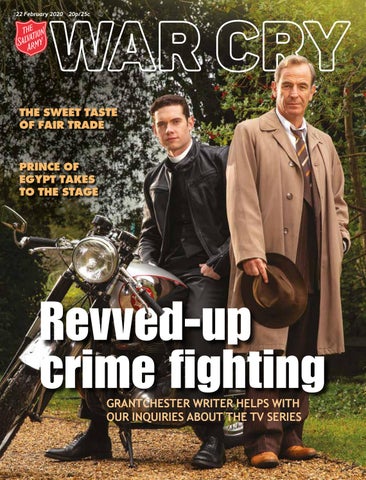
Revved-up crime fighting GRANTCHESTER WRITER HELPS WITH OUR INQUIRIES ABOUT THE TV SERIES
From the editor’s desk
What is The Salvation Army? The Salvation Army is a Christian church and registered charity providing services in the community, particularly to those who are vulnerable and marginalised. Motivated by our Christian faith, we offer practical support and services in more than 700 centres throughout the UK to all who need them, regardless of ethnicity, religion, gender or sexual orientation. To find your nearest centre visit salvationarmy.org.uk/find-a-church
THERE are only five days left for children aged between 5 and 13 years old to submit their story to the BBC’s 500 Words competition. It is expected that by the time the final entries are submitted next Thursday (27 February), more than one million stories will have been sent in for the competition since it began in 2011. A lot of people, and not just children, enjoy having the opportunity to tell a story. Using your imagination to engage the imagination of others is a sought-after skill. Those people who can do it well are held in high esteem because most of us want to hear a good story. In this week’s War Cry we feature three stories that are being told in the public sphere. We speak with director Ben Cookson about his film adaptation of Michael Morpurgo’s novel Waiting for Anya. The story is about French villagers working together to protect Jewish children from the occupying Nazi forces during the Second World War. We also speak with Daisy Coulam, who writes ITV’s murder-mystery series Grantchester. In the interview Daisy describes how writing about people of faith, particularly parish clergymen, has affected the way she looks at and interacts with the world around her. In another interview, Alexia Khadime talks about her role in the new stage adaptation of the animated film The Prince of Egypt, which is based on the story of Moses and the Israelites escaping from 400 years of slavery. To some people, it may seem incredible that a Bible story that has been handed down over thousands of years still has enough appeal to fill a West End theatre eight times a week. Yet that is the power of story. In particular, it is an example of the power of the stories contained in the Bible. They have changed the lives of millions of people through the centuries – and, if we engage with them, have the power to change our own lives as well.
What is the War Cry? The Salvation Army first published a newspaper called the War Cry in London in December 1879, and we have continued to appear every week since then. Our name refers to our battle for people’s hearts and souls as we promote the positive impact of the Christian faith and The Salvation Army’s fight for greater social justice.
WAR CRY Issue No 7462
Editor: Andrew Stone, Major Deputy Editor: Philip Halcrow Production Editor: Ivan Radford Assistant Editor: Sarah Olowofoyeku Staff Writer: Emily Bright Staff Writer: Claire Brine Editorial Assistant: Linda McTurk Graphic Designer: Rodney Kingston Graphic Designer: Mark Knight War Cry office: 020 7367 4900 Email: warcry@salvationarmy.org.uk The Salvation Army UK Territory with the Republic of Ireland 101 Newington Causeway London SE1 6BN
Contents
Tel: 0845 634 0101 Helpline: 020 7367 4888 Subscriptions: 01933 445445 (option 1, option 1) or email: subscriptions@satcol.org Founder: William Booth General: Brian Peddle Territorial Commander: Commissioner Anthony Cotterill Editor-in-Chief: Major Mal Davies
Published weekly by The Salvation Army ©The Salvation Army United Kingdom Territory with the Republic of Ireland ISSN 0043-0226 The Salvation Army Trust is a registered charity. The charity number in England, Wales and Northern Ireland is 214779, in Scotland SC009359 and in the Republic of Ireland CHY6399. Printed by Walstead Roche Ltd, St Austell, on sustainably sourced paper
Your local Salvation Army centre
FEATURES 3
Fairtrade chocolate unwrapped The benefits of co-operating with co-operatives
4
Sister act Actress talks about playing Miriam in The Prince of Egypt
6 Why Grantchester writer is clued up on faith Daisy Coulam on her detective Revs 10
Shepherd shows the way Director discusses message of Waiting for Anya
6
REGULARS 12
Browsing the Bible
13
Now, There’s a Thought!
14 Puzzles 15 War Cry Kitchen Front-page picture: ITV
2 • WAR CRY • 22 February 2020
4
15
FEATURE
RAISING THE BAR
Fairtrade Fortnight is set to wage a campaign against inequality, writes Emily Bright ANY of us think that chocolate is divine (as can be seen by the fact M that we devour an average of three bars a week in the UK). But for one organisation, it actually is. Divine Chocolate will be one of the
brands taking part in Fairtrade Fortnight, which begins on Monday (24 February). This year, the annual campaign will focus on encouraging people to buy Fairtrade chocolate, such as that produced by Divine, to ensure a sustainable income for farmers. In 1997, a Ghanaian co-operative of cocoa farmers voted to set up a UK chocolate company, and secured funding from the likes of Body Shop International, Christian Aid and Comic Relief. A year later, from hunting and logging. Divine Chocolate was born. The project boosts farmers’ Divine’s group CEO, Sophi Tranchell, tells incomes by offering Fairtrade the War Cry: ‘Our mission was to improve the prices and premiums. Women livelihood of cocoa farmers in west Africa by are also empowered to take establishing a branded chocolate marketing up leadership roles within the company that gave them a share of the wealth co-operative. they were helping to create.’ But Sophi admits that Divine ensures a minimum Fairtrade farmers need more help. price for cocoa farmers and pays a fee to the ‘Despite all of our work, Fairtrade Foundation to audit the supply chain. they’re still far away from In addition, it having a living income,’ she offers a premium says. ‘So this year, Fairtrade to its cocoa Fortnight is talking about co-operatives. how to get them a sustainable ‘We pay income, so they can send a Fairtrade their children to school, build premium so that houses and get help when the communities they’re sick.’ have some extra It is not an easy task, money to create water wells, build schools and but Sophi is motivated support women in alternative income-generation by a passion to further social justice around schemes,’ Sophi explains. the world. She is certain that she has been ‘We have now started working with farmers in influenced by her upbringing. Sierra Leone to protect the rainforest and work ‘Being brought up as a Christian was key in harmony with the animals that are there.’ to why I wanted to do this job, and I think that Organisations including Divine, the RSPB and inequality is the driver behind the problems of Comic Relief are backing a co-operative called the world,’ she explains. Ngoleagorbu, which practises ‘forest-friendly Christians believe that God cares about social farming’ and grows cocoa organically on the edge justice and equality. In the Bible, one of God’s of the Gola rainforest. The farms create buffer prophets says: ‘See that justice is done – help zones around the rainforest, protecting animals those who are oppressed’ (Isaiah 1:17 Good News Bible). God wants people to be r me far a Coco treated fairly, because he loves Lucia is part of and cares about everyone. He the Ngoleagorbu hates to see people hurt and ive rat pe co-o distressed and offers to help them through any tough times they face. Some of us may feel that life has been unjust or simply that there’s no hope. But, if we ask him, God will draw near and support us through our toughest times.
Inequality is the driver behind the problems of the world
Beshey, 14, collects cocoa pods in Sierra Leone
22 February 2020 • WAR CRY • 3
celebration
‘The show is a cele ALEXIA KHADIME tells Sarah Olowofoyeku about her act of faith in the new Prince of Egypt stage musical the very first note you hear ‘FyourROM played by the orchestra, it takes breath away.’ Alexia Khadime,
who plays Miriam in the new musical The Prince of Egypt, is full of praise for the production, which opened earlier this month at the Dominion theatre in London. She was introduced to the musical when she was invited to a table read at the beginning of last year. ‘We didn’t know very much about it. It was all hush-hush,’ she says. ‘But once we were told it was for The Prince of Egypt, it was so exciting. ‘It’s an original company, so creating a role rather than taking over a role has been very different.’ All the elements of the production, from the orchestration to the lighting are, she says, ‘stunning’. The stage adaptation of the 1998 Dreamworks animation The Prince of Egypt, features 10 new songs, in addition to five songs from the original. The film tells the story of Moses. He was born an Israelite, but because of a decree from the Pharaoh to kill all Israelite baby boys, his mother put
him in a basket and sent him down the River Nile. At the end of the river, he was found by the Pharaoh’s daughter and was raised as a prince of Egypt. Later, when he learnt that he was not truly an Egyptian, he went on a journey of discovering his true identity and what his purpose was. God met with him and told him to set free the Israelites, who were enslaved by the Egyptians. One of the key figures in Moses’ life is his sister, Miriam. In the Dreamworks adaptation, she, as a young girl, watches over his basket as he is carried along the river and helps the Pharaoh’s daughter to look after him. When Moses grows up, Miram tells him the truth about who he is, and encourages him to be who God has created him to be. Alexia believes that she is inspirational. ‘Miriam is the one character who is consistent in her belief,’ she says. ‘She has unwavering faith. She knows what she’s been put on the Earth to do. ‘She is a prophetess, which means she has insight into what is going to happen with Moses and the Israelites, but she has to be patient in waiting for it. I found a great quote that says, “Faith is not only daring to believe, it’s daring to act”, and she did act. Even though everyone was laughing, she took action.’ It’s why, although Miriam might have what Alexia describes as ‘crazy faith’, Alexia does not want to play her as ‘crazy’. ‘The challenge is not to go too wild with her, but to make her normal. She is just somebody who is unshaken. That makes her more inspirational, because she is just a human who is solid in what she believes.’ Alexia thinks that it is the idea of belief or hope that makes the story resonate with people. ‘We all live in hope. We all go to bed and have the belief that we are going to wake up tomorrow, and that tomorrow might be better,’ she says. ‘For Miriam, the character
The challenge is not to go too wild with my character
A computer-generated image of the set
4 • WAR CRY • 22 February 2020
n of belief bration of belief’
INTERVIEW
DARREN BELL
resonates personally because there are times when you are in a dark place, but having faith helps you to pick yourself up and move forward. My life hasn’t been perfect, but it’s about walking in faith and not in fear. ‘Moses’ story of being told that he’s an Israelite, and realising who he is and what he’s meant to do with his life is quite magical. The show as a whole is a celebration of belief – that’s the driving force for being human.’ In the biblical
account of the story, found in the Book of Exodus, Moses visits the Pharaoh at a time when the Israelites had been living in captivity for 400 years. Moses asks the Pharaoh to ‘let my people go’, but is met with a refusal. The next time he asks, the Pharaoh’s attitude has become even harder. He relents only after Egypt has been ravaged by 10 plagues. Finally the people are allowed to leave as God’s plans for the Israelites come to fruition. Alexia says that she feels blessed to be a part of the production that tells a story about God. ‘Whether you believe or don’t believe – and I respect every religion and every choice – being able to do a show on this scale that is a biblical piece in the West End is really precious for me, because faith
is a big part of my life. ‘I’ve always known God to be in my life. I knew I believed in him and loved him. I grew up going to church with my parents, but as I became an adult, I needed something a bit deeper. ‘What I’ve learnt about, and what the show shines a light on, is God’s love for us, and the fact that he will never forsake us. Even in the times when it looks dark, he is the light.’ 22 February 2020 • WAR CRY • 5
Collared As the fifth series of ITV’s Grantchester comes to an end, writer DAISY COULAM is questioned by Claire Brine about crime-solving clergy Screenwriter Daisy Coulam
Daisy, you developed Grantchester for television and have written episodes for every series. What was it about James Runcie’s novels that appealed to you? As soon as I read the first novel (which I devoured on a train journey) I could picture it clearly. The characters were so vivid and even though the book was set in 1953, the themes that James Runcie explored felt pertinent for our modern times. His books aren’t just murder mysteries – James always says they’re ‘whydunnits’ more than ‘whodunnits’. He looks at faith and death and the human condition in a really interesting and complex way. That’s what I loved most. How familiar were Christianity and the Church to you before you began writing the series? We always knew that faith had to be front and centre in the show. This show 6 • WAR CRY • 22 February 2020
ITV
I
N 2014, fictional clergyman the Rev Canon Sidney Chambers began solving murder mysteries in the ITV series Grantchester. Based on the 1950s crime novels by James Runcie, the first series (starring James Norton) was a hit with viewers. Unsurprisingly, four more series followed. Writer Daisy Coulam has been responsible for taking the Grantchester stories from the page to the screen since the beginning. Last year, when actor James Norton left the series, she introduced a new vicar-cumdetective to the crime scene. The arrival of the Rev Will Davenport (played by Tom Brittney) assured fans that the series wasn’t about to disappear without trace. In fact, Daisy feels that with a new vicar at the helm, Grantchester still has plenty of life in it.
INTERVIEW The Rev Canon Sidney Chambers (James Norton) was succeeded by the Rev Will Davenport (Tom Brittney, bottom) as the vicar of Grantchester
We always knew that faith had to be front and centre in the show was going to be a murder mystery, but it was also going to be about Christianity. My grandad was a vicar, so I grew up with the church in my life. He was in charge of the parish of Newchurch on the Isle of Wight and in his latter years worked as a prison chaplain at HMP Parkhurst. He had started out life as a bricklayer so his faith tended to be quite practical and straightforward. It was interesting to me that, in the books, Sidney’s faith is so much more complex. Sidney questions everything and struggles with himself and his choices in relation to God. When it came to creating the character of Will, we were interested in exploring a different notion of faith again – one in which Will is thoroughly dedicated to the church and God, but with a sense that his steadfastness is a way for him to escape the troubles of his past. Also – on a side note – I loved it when my grandad put on his
robes. I told him once he looked like Darth Vader. That was a high compliment at the time! What research did you undertake to ensure that the characters of Sidney and Will were believable as vicars? We have been very lucky: Diederick Santer, who executive produced the first four series of the show, is the son of Bishop Mark Santer (former Bishop of Birmingham). So Bishop Mark became our full-time adviser. We would run the scripts past him and talk to him about the themes we wanted to explore (for example, the notion of punishment or forgiveness). He’d always give very thoughtful and useful notes. He helped us make individual choices too: Sidney delivers his sermons not from the pulpit, but from the front of the church. Some viewers felt this was anachronistic, but Bishop Mark agreed that it was the kind of thing a progressive vicar like Sidney might have done. Sidney wants to look his congregation in the eye, not look down on them. Bishop Mark has now handed over the
Turn to page 8
➥
22 February 2020 • WAR CRY • 7
From page 7 baton to Father Gillean Craig (who, incidentally, was the inspiration for Tom Hollander’s character in the BBC comedy Rev). He was incredibly helpful in shaping the character of Will and giving us useful guidance on the themes of the later series. Was there any part of creating the series that you found particularly enjoyable or poignant? One of my favourite parts of filming is sitting in the beautiful church of St Andrew and St Mary in Grantchester. Even with a full crew in there, it’s such a peaceful space. The vicar there, the Rev Rachel Rosborough (who doesn’t fight crime on the side!), has been very warm and welcoming – as have the villagers. We’re very lucky. Also, I’ve spent a lot of time over the years with James Runcie, and he very graciously talked to me about his father, former Archbishop of Canterbury Robert Runcie. James had written the books with his father in mind – he was a source of inspiration for the character of Sidney. Like Sidney, James’s dad lived through the Second World War. He was a member of the Scots Guards, a tank commander who had experienced horrors, just as Sidney had. Like many men of the time, he came home but the shadow of war (as James’s first book is titled) was a constant reminder of all he’d survived. I found it very moving to talk about a man who was so clearly a huge part of James’s life and, indeed, so influential within the Church of England.
platform to change things: ‘We have a boat, why not rock it?’ I love that about Will. If he sees injustice, he will challenge it. Others may think Will is radical, but he doesn’t see it as radical to want a just society. Will wants to change the world, not just preach about it, and I think that’s highly admirable. How would you describe Will’s faith in God and how it develops throughout the series? The character of Will started with an unlikely inspiration: the politician Tony Benn. We talked a lot about Benn’s attitude to his faith: he was quoted as saying that he believed in ‘Jesus the prophet. Not Christ the King’. Benn’s faith was egalitarian – he believed that no man was
When Sidney left Grantchester the villagers welcomed in their new vicar, the Rev Will Davenport. What do you admire about Will’s faith? The first time we met Will, he told Sidney that he considers himself ‘a boat rocker’. As a vicar he feels he has a
Will wants to change the world, not just preach about it
8 • WAR CRY • 22 February 2020
Will and Sidney have both worked to solve crime alongside DI Geordie Keating (Robson Green, top left)
INTERVIEW
Faith isn’t a static state: it shifts and changes ITV
above another. God, as he saw it, sent his Son not to side with rulers and kings, but to be one of us. It was a very refreshing approach and felt fitting for Will: he arrives in 1956 when the world was changing, when Elvis and rock’n’roll were taking over the world. It felt optimistic and modern and so different from Sidney. Will’s faith is much more steadfast than Sidney’s. It’s people that Will struggles with – the injustice and unfairness he sees in society. How has writing about a vicar’s faith influenced your personal view on faith in God? Writing this show has given me a new appreciation for anyone who does have a faith. It strikes me that faith isn’t a static state: it shifts and changes with each new challenge in life. It takes a lot of hard work to keep faith through good times and bad – I admire anyone who can do that. And I very much admire those of religion who give back to their community. That’s a wonderful thing. Have Sidney or Will taught you anything? I think in a strange way they have. I’m much more outward-looking than I was before. I try to give to more charities and to be aware of those around me who are less fortunate. Maybe it’s because writing this show has coincided with a time when the world has become so much more divisive.
It seems like now more than ever we need to be compassionate. Why do you think a series where faith is so prominent has become so popular to a largely secular audience? That is a very good question! I’m not sure I have the answer. But I do believe that people are looking for meaning. In a world where we have all the answers at our fingertips, I feel like people are still striving to understand their lives. To make sense of the world. Maybe we give them a bit of that. Along with a handsome vicar, a cute dog and some lovely countryside! On top of Grantchester, you also wrote Channel 4’s Deadwater Fell, a rather dark crime thriller. What are the challenges and joys you find with both styles of writing? I had a strange time last year where I was writing both programmes simultaneously. But the strange thing is, although they’re totally different, they both explore similar themes: the nature of good and evil; the lengths that humans will go to – both good and bad; the grey areas in all our lives. And the notion of community: the responsibility we have to look after each other.
latest series of Grantchester is • The available on the ITVHub
22 February 2020 • WAR CRY • 9
Wartime shepherd story is a test of character BEN COOKSON filmed a wartime story about a shepherd boy in the area where it was set – an area that was used for smuggling Jewish children away from danger. He talks to Philip Halcrow about risk and doing the right thing IRECTOR Ben Cookson had to be sensitive when D making his wartime film in one of the villages in the French Pyrenees. ‘We were aware,’ he says, ‘that there
were some people still alive in that community who had lived through the German occupation. The last time they saw Nazi soldiers traipsing round their village, the uniforms were real and the guns were loaded with live ammunition.’ Ben filmed his adaptation of Waiting for Anya – released in cinemas yesterday (Friday 21 February) – in Lescun in the Vallée d’Aspe, where the author Michael Morpurgo set his original novel. The same village had inspired Michael to write the story. Thirty years ago, the author had been travelling through the region, and had stayed in Lescun, where a man told him stories of what life was like when the area was occupied during the Second World War. The man said that the area had been
used to smuggle children – many of them Jewish – across the border and into Spain. The smuggling operation became part of Michael’s story about a shepherd boy named Jo (Noah Schnapp) and his grandfather (Jean Reno) helping a widow, Horcada (Anjelica Huston), to hide Jewish children from Nazi patrols. The story appealed to Ben. ‘I lived in France for five years, and was struck by how the national memory of the war differs from that of people in the UK. Whereas here, war is remembered as something that you were either sent away to fight in or evacuated from, in France the war was brought to their doorstep. ‘An elderly lady from Brittany told me how there were two brothers on the street where she lived – one who joined the Resistance and one who began collaborating with the Nazis. When the latter discovered that his brother was operating with the Resistance, he informed on him, and his sibling was
In France, the war was brought to their doorstep
Ben Cookson (right) talks on set with actor Jean Reno 10 • WAR CRY • 22 February 2020
INTERVIEW Noah Schnapp plays shepherd boy Jo in ‘Waiting for Anya’
whisked away, never to be seen again. ‘The fact that France was occupied really tested the characters of its citizens.’ Making the film, Ben became aware that the war had left its mark on Lescun. ‘We decided to hold an open meeting in the village hall, where anyone could come and ask questions about anything to do with the film. When I arrived, the mayor had a quick word in my ear to let me know that there were people in the room who had lost loved ones in the war – and not just because they had been in the fighting but because they had been executed by German soldiers.’ But Ben does not see the themes of the film as being consigned to history. ‘When I read the book, I couldn’t help but notice parallels with events today, with people fleeing conflict zones and persecution, and risking their lives to cross borders and find sanctuary in other countries,’ he says. The war becomes a test of character for many figures in Waiting for Anya. Some turn a blind eye to the evil taking place. ‘But Jo knows that, despite the risk, the right thing to do is to help those in danger,’ says Ben. ‘He acts not because of any political persuasion or deep critical thinking, but because it’s in the goodness of his character.’ Many of the villagers follow the shepherd’s example.
A plan of action is put into motion by the priest when he announces a series of diversionary events designed to help the Jewish children escape. In making his announcement in church, he quotes some symbolic words of Jesus, found in John’s Gospel: ‘I am the good shepherd. The good shepherd lays down his life for the sheep.’ The words, says Ben, do more than move the film’s plot along. ‘The idea that the shepherd lays down his life is key in the film. It goes back to Jo and his duty as a shepherd. ‘When he doesn’t protect his sheep, he feels shame and is looked upon as not performing his duty as a shepherd and as a man. But through his actions as a boy becoming a man, you see that he does have the bravery to do the right thing. He finds the courage to risk his life, whether it’s to save his flock or the Jewish children.’ And Ben hopes that the words will speak to cinemagoers about the need to have the right attitude in any circumstances. ‘Film, art and literature often look at times when people’s character is truly tested, because you need to be able to look at yourself in the mirror and know that you are doing the right thing. You don’t always need to risk your life, but you do need to be able to say: I did my best. I did my duty as a human to the rest of humanity.’
The idea that the shepherd lays down his life is key
22 February 2020 • WAR CRY • 11
EXPLORE Prayerlink YOUR prayers are requested for Peter, that he will find strength, hope and courage; for Keeley, who has pain in her legs; and for Connor, who wants to strengthen his bond with his son. The War Cry invites readers to send in requests for prayer, including the first names of individuals and details of their circumstances. Send your requests to Prayerlink, warcry@salvationarmy.org.uk or War Cry, 101 Newington Causeway, London SE1 6BN. Mark your correspondence ‘Confidential’.
Becoming a Christian There is no set formula to becoming a Christian, but many people have found saying this prayer to be a helpful first step to a relationship with God Lord Jesus Christ, I am truly sorry for the things I have done wrong in my life. Please forgive me. I now turn from everything that I know is wrong. Thank you that you died on the cross for me so that I could be forgiven and set free. Thank you that you offer me forgiveness and the gift of your Holy Spirit. Please come into my life by your Holy Spirit to be with me for ever. Thank you, Lord Jesus. Amen Extract from Why Jesus? by Nicky Gumbel published by Alpha International, 2011. Used by kind permission of Alpha International
Nigel Bovey gives chapter and verse on each book in the Scriptures
1 Thessalonians AUL’S missionary visit to Thessalonica P (the modern-day Greek city of Thessaloniki) is recorded in Acts 17. While
there, in the synagogue, he used the Jewish Scriptures in ‘explaining and proving that the Messiah had to suffer and rise from the dead’ (Acts 17:3). Some Jews and many Greeks became Christians, but others chased Paul out of town (Acts 17:1–10). In the first of two letters to the Christians in the city, Paul reminds them that they ‘turned to God from idols to serve the living and true God’ (1 Thessalonians 1:9). Their faith is well known and they are ‘a model to all the believers in Macedonia and Achaia’ (1:7). He is grateful for their response to, and partnership in, the gospel (chapter 2). Paul’s main topic is the second coming of Jesus. The day of Christ’s return – the ‘day of the Lord’ (5:2) – will be unmistakable. He writes: ‘The Lord himself will come down from Heaven, with a loud command, with the
voice of the archangel and with the trumpet call of God’ (4:16). God will then gather two groups of Christian believers: those who have died and those who are alive. God will raise the dead (those who have ‘fallen asleep’) to life (4:14). Indeed, they
Paul is grateful for their response to, and partnership in, the gospel
will be raised before Christ attends to the living (4:16). To the bereaved, this offers the hope of an eternal reunion. The living will then be ‘caught up together with them in the clouds to meet the Lord in the air’, after which they will be with him for ever (4:17). Paul goes on to say that such insight requires a twofold response: the avoidance of speculation and a constant state of readiness. Times and dates are not the issue (5:1). To the unprepared, though, Christ’s return will be as unannounced, unexpected and unwanted as the workings of a thief (5:4). Paul, therefore, urges his r ffe su to us readers to be alert and ‘For God did not appoint tion through lva sa alive in their faith (5:6– ive ce re to t bu h wrat 9 5: s ian 22). He prays that God lon sa es (1 Th our Lord Jesus Christ’ will keep them ‘blameless ion) at the coming of our Lord New International Vers Jesus Christ’ (5:23).
Key verse
"
Looking for help? Just complete this coupon and send it to War Cry 101 Newington Causeway London SE1 6BN Basic reading about Christianity Information about The Salvation Army Contact details of a Salvation Army minister
12 • WAR CRY • 22 February 2020
Name Address
EXPRESSIONS
NOW, THERE’S A THOUGHT!
by Callum McKenna
QUICK QUIZ
1. In what year is England due to host the Rugby League World Cup? 2. Who played the lead role of Holly Golightly in the 1961 film Breakfast at Tiffany’s? 3. Which dystopian novel by Margaret Atwood was the joint winner of the Man Booker Prize last year? 4. What is the first day of Lent called? 5. What type of animal is the children’s TV character Basil Brush? 6. Who had a No 1 hit in 1978 with the song ‘Rivers of Babylon’?
ANSWERS 1. 2021. 2. Audrey Hepburn. 3. The Testaments. 4. Ash Wednesday. 5. A fox. 6. Boney M.
CBAD a warcry@salvationarmy.org.uk @TheWarCryUK facebook.com/thewarcryuk
Lent time gives chance to share AST Easter, I spent some time with friends who live in Dhaka, the Lpopulation capital of Bangladesh. Less than 1 per cent of Bangladesh’s are Christians, and so the major Christian festivals and
holidays are, for the vast majority of people, ‘business as usual’ days. Nonetheless, they are still exciting for the minority group which gathers in small churches to worship. At the end of the joyful Easter service, the congregation shared traditional Bangladeshi sweets, jilapis. For the uninitiated, a jilapi is a sugar hit like no other: it’s a type of fried doughnut, bright in colour, and drenched in lashings of honey. Most of the food we ate in Bangladesh was spicy or savoury, so the contrast of this post-Easter treat was stark. It was a sweet, dynamic taste sensation. And that vibrant experience is made even better by the Christian period of Lent. After Mardi Gras celebrations in Rio de Janeiro or Pancake Day in the UK, many Christians around the world will embark on a more sparse season in the 40 days leading up to Easter. During this time, people will ‘give something up’ by cutting out an aspect of daily life that may otherwise be considered as a bit of luxury. Others may ‘take up’ habits, such as giving to charity or volunteering, which are perhaps costly, but help to make the world a better place. Lent, then, is intended to be a season of simplicity. But why? Our lives can sometimes be so busy and overloaded that it is easy to get carried away in the flow of day-to-day living. Lent mirrors the 40 days that Jesus spent in the wilderness before he began his ministry. It is designed to provide a contrast to our usual way of living. It is a time to go a tad slower, to live a little more simply, and to share what we have with those who have less. It may sound difficult, but the difference it offers means that when Easter Sunday comes, we are able to experience it for what it truly is: a vibrant, sensational, stand-out celebration.
Our lives can be so busy and overloaded
B www.salvationarmy.org.uk/warcry 22 February 2020 • WAR CRY •13
PUZZLES
QUICK CROSSWORD QUICK CROSSWORD
by CHRIS HORNE
ACROSS DOWN 15. Hearing organ (3) 3. Bath (3) 16. In favour of (3) 1. Arrival (6) 7. Provide proof (6) 18. Fugitive (6) 2. Nauseous (6) 8. Showy plant (6) 19. Succeed (4, 2) 3. Was inclined (6) 9. Order (6) 20. Scandinavian (6) 4. Straw hat (6) 10. Extreme fear (6) 21. Flaw (6) 5. Dung beetle (6) 11. Make last (3) 22. _______ borealis (6) 6. Overly expensive 12. Remained (6) 23. Jack Worthing’s item (3-3) 14. Reject (6) alter ego in Oscar 12. Star (3) 17. 11th-century invader (6) 13. Greek letter (3) Wilde play (6) 21. Storage compartment (6) 24. Bravo! (3) 25. Steamship worker (6) 26. Baking of ceramics in a kiln (6) 27. Polynesian island (6) 28. Stroke affectionately (6) Fill the grid so that every 29. Feline (3)
SUDOKU column, every row and every 3x3 box contains the digits 1 to 9
4
HONEYCOMB
2
HONEYCOMB 7
Each solution starts on the coloured cell and reads clockwise round the number
4
WORDSEARCH
8
HONEYCOMB 1. Martin. 2. Choral. 3. Heroic. 4. Listen. 5. Finish. 6. Extend.
DESOLATION ROW EVERY GRAIN OF SAND FOREVER YOUNG GOTTA SERVE SOMEBODY HURRICANE
I SHALL BE RELEASED I WANT YOU
JUST LIKE A WOMAN LIKE A ROLLING STONE LOVE SICK
MR TAMBOURINE MAN SHELTER FROM THE STORM TANGLED UP IN BLUE THINGS HAVE CHANGED
QUICK CROSSWORD ACROSS: 3. Tub. 7. Adduce. 8. Orchid. 9. Demand. 10. Terror. 11. Eke. 12. Stayed. 14. Rebuff. 17. Norman. 21. Drawer. 24. Olé. 25. Stoker. 26. Firing. 27. Tahiti. 28. Caress. 29. Cat. DOWN: 1. Advent. 2. Queasy. 3. Tended. 4. Boater. 5. Scarab. 6. Rip-off. 12. Sun. 13. Eta. 15. Ear. 16. For. 18. Outlaw. 19. Make it. 20. Nordic. 21. Defect. 22. Aurora. 23. Ernest.
1
9
2
3
6
4
7
8
5
1
3
6
9
7
8
2
4
5
VISIONS OF JOHANNA
3
7
9
6 7
7
7
7
4
3
5
WORDSEARCH
8 7 5 9 2 4 1 3 6
6 8 3 5 4 9 2 1 7
4 1 2 6 7 8 3 5 9
7 5 9 2 3 1 6 4 8
2 9 8 3 6 5 4 7 1
3 6 1 4 8 7 5 9 2
5 4 7 1 9 2 8 6 3
SUDOKU SOLUTION
3
14 • WAR CRY • 22 February 2020
9
3
1. ________ Clunes, actor 2. Sung by a choir 3. Very brave 4. Make an effort to hear something 5. Come to an end 6. Make larger or longer
ANSWERS
5
8 2
2 8
2
3
4 1
1
7 4
3 Look up, down, forwards, backwards and diagonally on the grid to find these Bob Dylan songs
5 4 6 7 9 8 1 2 3 B G E V E R Y G R A I N O F S A N D K 2 8 3 1 5 4 7 9 6 M R O T S E H T M O R F R E T L E H S V T N T Y Z N Q 7 9W 1Q M L S G J G F S Y 2 3 6 4 5 8 I X Q A T A N G L E D U P I N B L U E 6 3 4 9 8 1 5 7 2 S N A L M A W O R N O I T A L O S E D 1 F G 5 2J U Q H D M F H Z K 4 7 3 6 8 9 I A C P E O S O M Z H O M W E O D K C B S Y T Y C H 8 7 9 5 6 2 3 4 1 N E A U S E F A R R E A Y F L C I W R 4 6 5 3 2 9 8 1 7 S N K O H L N A E V E M Z G V S B H E O I P Y V K B A A K E V W C E Z P C 3 2 7 8 1 5 9 6 4 I F R S T Z P S H C U I S E V W F Z S W 9 1 8I L 6 L O R A E K 4 7 2 3 5I L J U E N O T S G N O O J A Q G J M Q L R L T M Y S N M B H B S W N B W Z D T G R E S E O K K P A M C I E E W B B D C V U Z U B U L X N A H L X P W R C J S W M H P J O N A N T I S H A L L B E R E L E A S E D G A R R Q I Q S S L X Z R V A S Z C Z Y Y M P N L N C I G Z T Z D F Q D X A M
3
7
8
4
1
7
2
1
RECIPES
Why not try these pancake recipes on Sh rove Tuesday (25 February), traditionally marked in the Christian calend ar as a day of celebratio n before the fasting of Le nt
Blueberry pancakes 2 large British Lion eggs, separated 75ml milk 100g self-raising flour 4tbsp caster sugar Salt 100g blueberries SERVES
4
1tbsp vegetable oil, for frying Soured cream, to serve Maple syrup, to serve
Crempog pancakes 250g plain flour 50g caster sugar, plus extra, to serve 1tsp bicarbonate of soda Salt 284ml buttermilk 2 large British Lion eggs 1tbsp lemon juice Vegetable oil 75g raisins
Sift the flour, caster sugar, bicarbonate of soda and a pinch of salt into a large bowl. Make a well in the centre of the dry ingredients.
Place the egg yolks and milk in a large bowl. Sift in the flour, caster sugar and a pinch of salt. Mix well. Whisk the egg whites in a clean grease-free bowl until they form soft peaks. Fold into the flour mixture. Gently stir in the blueberries. Heat a little oil in a large frying pan. Drop 3tbsp of the pancake mixture into the hot pan and cook for 2 minutes until crisp and golden. Flip over the pancake and cook for a further minute until golden. Transfer to a clean tea towel to keep warm. Cook the remaining batter in the same way to make 12 pancakes in total. Serve the warm pancakes stacked and topped with soured cream and maple syrup.
In a separate small bowl, beat together the buttermilk and eggs, then add to the dry ingredients along with the lemon juice. Mix well. Leave the mixture to stand for 10 minutes. Heat a frying pan and brush the surface with a little oil. Drop 3tbsp of the mixture into the pan, and sprinkle a few raisins into the centre of the pancake. Cook for 2 minutes, or until bubbles begin to form on the surface. Flip over and cook for a further few minutes until the base is golden. Remove from the pan and keep warm in a clean tea towel. Repeat with the remaining mixture to make about 10 pancakes in total. Serve the pancakes warm with a sprinkling of caster sugar. Recipes reprinted, with permission, from the British Egg Information Service website eggrecipes.co.uk
SERVES
10
22 February 2020 • WAR CRY •15
Lord, open my hands to receive your gift of love Henri Nouwen