Ringing in 150 years of the telephone

Ringing in 150 years of the telephone
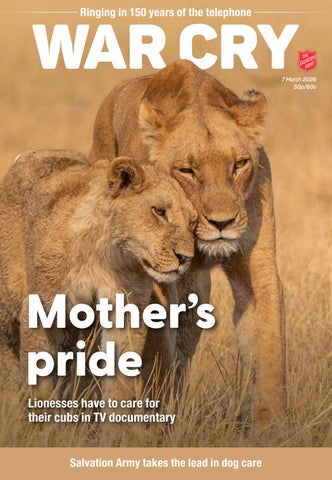
Lionesses have to care for their cubs in TV documentary
Salvation Army takes the lead in dog care
The Salvation Army is a Christian church and registered charity seeking to share the good news of Jesus and nurture committed followers of him. We also serve people without discrimination, care for creation and seek justice and reconciliation. We offer practical support and services in more than 700 centres throughout the UK. Go to salvationarmy.org.uk/find-a-church to find your nearest centre.
The Salvation Army first published a newspaper called the War Cry in London in December 1879, and we have continued to appear every week since then. Our name refers to our battle for people’s hearts and souls as we promote the positive impact of the Christian faith and The Salvation Army’s fight for greater social justice.
Editor: Andrew Stone, Major
Managing Editor: Philip Halcrow
Staff Writer: Emily Bright
Staff Writer: Claire Brine
Staff Writer: Ewan Hall
Editorial Assistant: Linda McTurk
Graphic Designer: Mark Knight
Graphic Designer: Natalie Adkins
Email: warcry@salvationarmy.org.uk
The Salvation Army United Kingdom and Ireland Territory 1 Champion Park London SE5 8FJ
Tel: 0845 634 0101
Subscriptions: 01933 445445 (option 1, option 1) or email: subscriptions@satcol.org
Founders: Catherine and William Booth
International leaders: General Lyndon Buckingham and Commissioner Bronwyn Buckingham
Territorial leaders: Commissioners Jenine and Paul Main
Editor-in-Chief: Major Julian Watchorn
Published weekly by The Salvation Army
© The Salvation Army United Kingdom and Ireland Territory ISSN 0043-0226
For those who are unlikely to go on safari, watching wildlife programmes on TV is the nearest they’ll get to seeing animals such as elephants, giraffes and hyenas living out their lives in their natural habitats.
As we note in this week’s War Cry, BBC2 is airing Big Cats 24/7, which explores the lives of cheetah, leopard and lion families in Botswana’s Okavango Delta over a six-month period. The programme brings viewers up close to the wildlife, allowing them to see the behaviour of creatures they would otherwise know little about.
Rather more familiar animals are the focus of another feature this week, as we discover how The Salvation Army is working with Dogs Trust to support dog owners who are experiencing homelessness.
We tell the story of Roderick, who was provided accommodation at Ty Diogel Lifehouse, a Salvation Army hostel in Cardiff. He was fearful that he wouldn’t be able to keep his four-legged friend, Juno, but was delighted to discover that, not only could they stay together, but he would also be given help in caring for his canine companion.
‘For the residents that we work with,’ Major John Stark, a Lifehouse chaplain tells us, ‘their dog is like a family member and is their lifeline, so it’s important that we are as serious about looking after their dog’s wellbeing as we would be with a family member or close friend. It shows that we are interested in every part of the residents’ lives.’
The Salvation Army is interested in every part of residents’ lives because it wants those lives to be full of meaning and purpose. And that commitment to help people live life to the full isn’t restricted to those in its Lifehouses.
The organisation believes that Jesus wants everyone to live out their lives in a fulfilling way that benefits them and the people they interact with. It’s a concept that’s worth us all exploring.
When you’ve read the War
The Salvation Army Trust is a registered charity. The charity number in England, Wales and Northern Ireland is 214779, in Scotland SC009359 and in the Republic of Ireland CHY6399. Printed by CKN Print, Northampton, on sustainably sourced paper






The Xudum family rest after dodging male lion intruders

TV feature: Big Cats 24/7 BBC2 and iPlayer
By Emily Bright
Wildlife documentary Big Cats 24/7 is roaring back for a second series on BBC2, thanks to a film crew’s return to Botswana’s Okavango Delta to capture the behaviour of cheetah, leopard and lion families around the clock.
Over the course of six months, the team document how the animals navigate life-and-death struggles against the backdrop of extreme drought and flooding.
In the first episode, they spot the 40-strong Xudum lion family – the largest pride in the world. With so many mouths to feed, and with starvation accounting for a quarter of all the deaths of cubs under two years old, the stakes have never been higher for the lion mothers.
During the dry season, there is not much prey to go round, and dominant male Madumo devours the lion’s share. Becoming increasingly desperate, the matriarchs hunt out food wherever they can, with one even clambering up a tree to steal a carcass from a leopard.
The outlook for the pride worsens when Madumo mysteriously disappears, leaving them defenceless. A coalition of four males, nicknamed the ‘Rogue Boys’, take full advantage of his absence, straying confidently into Xudum territory. Male lions can act with brutality, killing cubs of rivals in order to mate with the females.
As the series continues, the Rogue Boys make their presence felt by scentmarking and hunting in the heart of Xudum territory. Sensing danger, mothers Naledi, Tsebe and Matho keep their eightmonth-old cubs on the move. But as the males draw closer, it’s only a matter of time until a deadly confrontation takes place.
The mothers are desperate to protect their cubs from the threat of the Rogue Boys, while also needing to find food for themselves and their young. It’s a relentless challenge. And, while we may not necessarily be facing life-and-death decisions ourselves, it’s possible that we
know what it feels like to be out of our depth in difficult circumstances, unable to see a way out.
But help is available.
One ancient writer – who knew what it felt like to be surrounded by enemies – cried out to God: ‘I am completely exhausted and my whole being is deeply troubled.’ And having done so, he felt the reassurance that the Lord ‘listens to my cry for help and will answer my prayer’ (Psalm 6:2, 3 and 9 Good News Bible).
Since those words were written, millions more people have discovered that God does hear their cries for help and answer their prayers – although perhaps not always how they might expect.
We too can experience God’s support in our times of crisis. If we ask him, he will provide us with the comfort and strength we need to face every difficulty.
The reality is that we’ll never regret making a relationship with God the mane source of strength in our lives.
Claire Brine gives her take on a story that has caught the attention of War Cry reporters
Every year on 8 March, people across the world celebrate International Women’s Day (IWD). It’s an opportunity to recognise the achievements of women and girls – and a reminder to keep striving for gender equality where it’s lacking.
Clicking on the IWD website, I was inspired to find stories of countless women from history who played a foundational role in making the world a better and fairer place. The women’s rights activist Emmeline Pankhurst has always been a bit of a hero of mine.
But I’m also always interested to read further afield about women who are making a positive mark on the world today – so step forward footballer Michelle Agyemang, The Sunday Times Young Sportswoman of the Year. Without her and her late equalisers, said the paper, the Lionesses ‘would probably not have won the Euros’ last year. I would agree with that.
I’m full of admiration for Agyemang
In an interview with The Sunday Times, Agyemang reflected on her England career highlights, discussed the progress she is making after an ACL injury, and spoke about the value she finds in her Christian faith. The paper pointed out that she is an active member of her church and often posts Bible verses on social media.
‘It’s almost a ministry,’ explained Agyemang. ‘I’m doing it to give back to God for the gift he’s given me... I want to come in and spread the gospel more, because I think the love of Christ is available to everyone and that’s really important for them to know.’
When I remember that Agyemang is just 20 years old, I find myself feeling full of admiration for the way in which she chooses to share the Christian message so boldly and publicly. Having experienced the life-changing love of God for herself, she has a passion for others to discover it too.
On this IWD, I’m thankful for all the women – past and present –who have made it their mission to tell the world just how much God loves them. Because of their courage and commitment, people have found faith and their hearts have been changed. And, as a result, the world has become a better place – for us all.
The chimes they are a-changin’
After 50 years of silence, the bells of St Sampson’s Church in South Hill, Cornwall, are ringing again – thanks to modern technology and a major restoration effort, reported BBC News.
Bellfoundry John Taylor & Co removed the church’s fragile historic bells and kept them safe in Loughborough while the parish spent four years raising funds for their repair.
The bells, four of which date back to 1698, were too delicate to be rung in the traditional way with a rope and clapper, so each was fitted with an internal electromagnetic hammer for ‘stationary electronic chiming’.
Controlled by a small touchscreen inside the church, the system now delivers preprogrammed peals at the push of a button.
Miranda Lawrence-Owen, a member of the St Sampson’s congregation, said on hearing the bells chime again: ‘It was wonderful and made me want to cry.’
An architect who helped to transform a Buckinghamshire church used in the TV comedy The Vicar of Dibley has won a Church Architecture award.
BBC News reported that Libby Watts – who was named in the awards as the young architect of the year – came up with a plan to restore St Mary the Virgin in Turville after an inspection showed that ‘areas of the grade II listed building needed extensive repairs and upgrades’.
Back in the 1990s, the building’s exterior was used to represent the Church of St Barnabas in the BBC sitcom which starred Dawn French as the Rev Geraldine Granger.
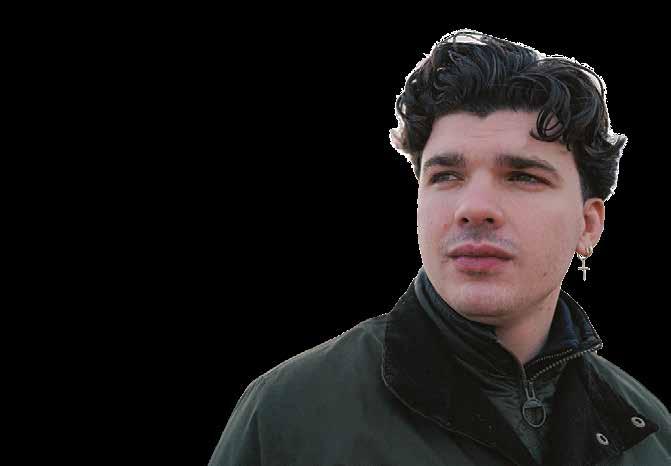
Polish ski-jumper Kacper Tomasiak (pictured) thanked God for his successes at the Winter Olympics by placing his medals on a chapel altar in Italy, reported the OSV News website.
After winning a silver and a bronze in individual events, the 19-year-old told his chaplain, Father Edward Pleń, that he wanted to thank God for his successes. The priest subsequently held a ‘thanksgiving Eucharist’ in a church in Predazzo.
A day after the service, the athlete won a further silver medal in a team event.


A Christian boxing group is helping to tackle youth violence in London, reported Premier Christian News.
An online feature highlighted sessions run by the Christian Boxing Alliance in south London, which give young people a safe space to channel aggression, learn discipline and build confidence.
The initiative, which has so far welcomed 150 young people, is run by founder Darrell McLeish.
‘Boxing helped me get on top of my aggression and find Christ,’ he said. ‘You don’t need weapons. You deal with it in the ring, you shake hands at the end, and it’s done. It humbles you very quickly and teaches discipline, control and respect.’
He added: ‘God has done good things in my life, and I want to show the young people that he can do the same for them.’
A BBC TV documentary is to follow a winner of The Traitors as he goes on a journey from Slough to the Vatican, where he hopes to meet Pope Leo XIV.
Harry Clark (pictured) is joined by his mum, Georgia, as he travels to

As proud dog owners gather in Birmingham this week for Crufts, another group of owners are being supported in the care they give to their four-legged friends as they overcome the challenges of homelessness
Feature by Emily Bright
Chihuahua Juno may be small in stature but he has played a mighty role in the life of his 18-year-old owner, Roderick. The young man, who fled an unstable environment and became homeless, remembers: ‘Juno got me through the hardest time of my life.’
When Roderick secured accommodation in Ty Diogel Lifehouse, a Salvation Army hostel for young people in Cardiff, he initially feared that Juno would not be able to move in with him. But thanks to a partnership between The Salvation Army and the Dogs Trust, Juno was well cared for.
Wherever possible, The Salvation Army will house residents with their four-legged friends. It has signed up to the Dogs Trust scheme Together Through Homelessness, which enables people staying in its Lifehouse accommodation to receive free veterinary care for their dogs.
As well as veterinary care, the scheme supplies starter packs – including items such as collars, leads, bowls and beds – which are distributed to residents by The Salvation Army. Specialist support teams from the Dogs Trust are also on hand to provide owners with advice on training or canine behavioural challenges.
‘Dogs Trust has helped with everything from starter packs to






thoughtful gifts for Juno,’ says Roderick. ‘This has taken a huge weight off my mind. Knowing my dog is truly welcome here has been such a relief. Having this support means we can both feel safe and cared for.’
Abigail Owens, a senior regional engagement officer at Dogs Trust, said that she was impressed with how The Salvation Army made its accommodation as dog-friendly as possible.
‘The services I visited throughout the endorsement process offer safe, welcoming spaces where people and their dogs can feel at home,’ she says. ‘The compassionate and psychologically informed approach seen at their Lifehouses embodies the values of Together Through Homelessness.’
Major John Stark, a chaplain at Ty Gobaith Lifehouse in Cardiff – another centre that participates in the scheme – explains why The Salvation Army’s compassionate approach to man’s best friend matters.
‘For the residents that we work with,’ he says, ‘their dog is like a family member and is their lifeline, so it’s important that we are as serious about looking after their dog’s wellbeing as we would be with a family member or close friend. It shows that we are interested in every part of the residents’ lives.’
Ty Gobaith currently has two canine residents. John has a particular soft spot for Fergus, ‘a dachshund-Yorkshire terrier mix’ who comes over to him
for a ‘cwtch’– a Welsh word roughly translated as a cuddle.
‘Fergus has really helped his owner, one of our residents, in his wellbeing,’ says John. ‘Andy feels like he has to keep well because he’s got Fergus to look after.’
With a dog,
John cautions that there can be complications for pet owners who experience homelessness.
‘Sometimes having a bigger dog can be a hindrance if you want to move on to another property. A lot of council properties and private lets want a dog under a certain size if it’s living in a communal area.
‘But,’ he adds, ‘with a dog, you’ve got someone to chat to – they don’t answer you back and they always agree with you.’
Canine care is only one dimension of Ty Gobaith’s holistic support for people experiencing homelessness. The Lifehouse provides 24/7 supported accommodation for single adults over the age of 18. It has 15 beds for residents, and 4 additional flats are set aside for those with complex needs.
It also has communal lounges, a canteen, a laundry, skills and IT suites to enable residents to pursue education and employment, and private one-to-
one meeting spaces for weekly sessions with support workers.
The centre runs detox programmes to help people who are struggling with addictions to get their lives back on track. It also offers housing advice, job clubs and opportunities for volunteering. It even has its own football team.
Whatever activities residents are engaged in, John is on hand to give pastoral support.
‘I try to introduce myself to new residents and say that I’m here to help them,’ he explains. ‘Quite often, residents are with us for a little while, but some stay for years and years. It has been good to build relationships.’
As chaplain, John has run the faithbased course Christianity Explored, enabled residents to find a church if they have wanted one, and – with their permission – prayed for them.
‘One of the residents wanted to light a candle for her nan, grandad and partner who had died,’ recalls John. ‘So we went to a nearby church, St Mary’s, and she lit three candles. She said a prayer, I said a prayer, and we sat and chatted for about half an hour.’
In his role, John is determined to help residents live life to the full.
‘I encourage them to reach out for support, so when they move on from the Lifehouse, they’ll see the benefits of their time here. I gather up my hope and faith, telling people that things can change, because I believe that God wants to help them flourish.’

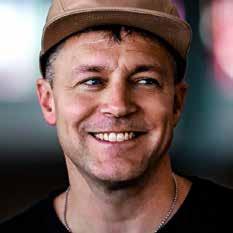
Shelby Abbott
Author of a new book Why We’re Feeling Lonely SHELBY ABBOTT explains what’s causing loneliness in young people and what they can do about it
Interview
by Ewan Hall

Shelby Abbott has spent more than 20 years listening to young adults.
As someone who has a Christian ministry among US college students, he has travelled to multiple campuses across the country. And recently he noticed that in his conversations with the young people, the same theme kept resurfacing: loneliness.
Shelby defines loneliness as ‘the sense of being isolated and unseen, as if no one understands who you are’. And in his new book, Why We’re Feeling Lonely (and What We Can Do about It), he tries to help young people understand that everyone has a deep craving to be known and that there is a way to overcome loneliness.
‘The genesis of the book came to me as I thought about the universal issues that young people at college and those in their 20s were wrestling with,’ he says. ‘I narrowed down the challenges to a top five list. After that, I began mentally examining conversations I’d had with students over the previous year. Even when they didn’t say they were lonely, the symptoms were there, and I realised this was an issue.’
They’re trying to figure out their place in the world
That recurring theme prompted him to write his book, which examines the core struggles that students are facing.
‘We’re now in a post-Covid generation, with young people still remembering how that period affected them,’ Shelby tells me. ‘They’re trying to figure out their place in the world.
‘Loneliness has become one of the most glaring symptoms coming out of that, so I thought I would address the issue from a Christian perspective. I wanted to help young people understand that the places they run to in order to ease
their loneliness can actually become more problematic and detrimental.’
Shelby primarily writes for US college-age students – though he hopes his book will be appreciated by other young people.
Focusing on the challenges that students face, he found that even when they appeared to be doing fine – and were surrounded by friends, classmates and roommates and a wider community – many were struggling. He saw that people can be in a crowd every day but still experience deep loneliness.
‘The book is an attempt to help young people go deeper as I talk about the symptoms they wrestle with and the dangerous crutches they tend to turn to.’
Shelby identifies some of these crutches as being screen time, relationships, community and emotions.
‘There are lots of things that young people run to, but I found that when it came to screen time and our digital identities, they are a huge deal for everyone,’ he says.
‘It’s easy to say that people on social media project a certain version of themselves, but honestly, even if you’re not on social media, you still do project an image through how you message elsewhere online. For example, you can edit what you’re communicating in an email so that it is not a fully authentic version of who you are.’
Shelby notes that online interaction isn’t necessarily bad – it can be fun, helpful and supportive – but it can’t replace real human connection. Endless scrolling may offer brief comfort, but it doesn’t give the deeper feeling of being truly known that comes from face-to-face relationships. In the end, Shelby explains, young people
Turn to page 10 f

don’t just need contact; they also need genuine connection.
Other ways in which young people try to alleviate loneliness include casual sex and the use of pornography. Because of his work on campuses, Shelby knows how important it is to have open and honest conversations about these ‘crutches’.
‘No matter how much technology shapes our lives, people will always talk about how to relate to the opposite sex and how to do that well.’
Travelling to colleges across America, Shelby notes that when he has presented seminars on relationships, they are packed full of students desperate to learn more. It doesn’t surprise him.
‘Relationships are a topic where everybody wants clarity,’ he says. ‘Many young people are starving for gospeldriven guidance rather than relying on what the current culture tells them to do.
‘So when I have spoken to young people on this topic, instead of facing a backlash, I get questions. They want to live well, but they need to know the reasons behind the actions they should take. Young people are looking for authentic solutions to real-world problems. They are sick of candy-coated advice that is not actually fixing anything in their lives.’
Shelby also explores the idea of community and the growing polarisation among young people and in wider society. He highlights how, when feeling lonely, young people often look for connection and may be drawn into groups
that shape their behaviour and beliefs – yet those groups may end up valuing them only if the individual’s opinion matches the group’s.
‘When you tell people that they’re angry, most of the time they respond, “No, I’m not. I’m not angry at all”, or they compare themselves to others, saying, “They are the angry ones”, when the truth is that everyone is angry.
‘When writing the book, I wanted to dig into polarisation and help people see that, if you’re trying to find a connection in a group that bases its identity on what it is against or angry about, as soon as you question the ideal, you quickly discover that its “relationship” with you is secondary. It cares more about the ideal than you. And when people realise this and that the group only cares about its own opinion, authenticity alarms set off in young people’s heads.’
One student who read Shelby’s book later admitted to him that they had not realised how angry they were until they read the chapter on emotions. They became aware of previously unnoticed anger towards people and circumstances.

‘In the book I describe it as being “blind to your own blindness”,’ Shelby says. ‘You don’t see it until someone puts a mirror up to your face and shows you who you are. In the Christian community, that mirror is often God’s grace.
‘There might be some strong emotions inside of you, and those need to be brought to God.’
The final part of Shelby’s book covers depression and anxiety.
Being naturally anxious since he was young, Shelby understands that some young people spend their whole lives managing such mental health issues.
‘I wanted to be careful about saying that faith alone will remove every issue,’ he says. ‘In the book, I use the example of my migraines – I pray for healing, but I will also go to the doctor and take medication, because sometimes the pain is

overwhelming. If we do that for physical conditions, why wouldn’t someone do the same for anxiety or depression?
‘God works through modern medicine. God works through people to help address real problems in a broken world.
‘Depression and anxiety have physical and emotional layers. So I’d say, go to a counsellor, get medical help if needed.’
Shelby encourages readers who are struggling with such issues to trust God to guide them through life rather than trying to handle everything on their own. He refers to this as ‘walking with God’.
Shelby points out that Christians aren’t immune to using the crutches he has identified. Even when they surround themselves with church communities, they can still suffer from loneliness.
‘Loneliness is universal, and the reasons behind it vary widely,’ he says. ‘There are many roots to loneliness, and just treating the symptoms won’t solve it. If you don’t address the root, the same “bad fruit” appears again in the
next difficult time.
‘I help people see the underlying issue – that feeling of angst, or the sense that no one understands them. Many turn to things that offer connection but can’t truly deliver – modern solutions that try to replace God, but never satisfy.’
Shelby believes that one of the real solutions to the challenges of modern life is ‘gospel friendships’.
He explains: ‘The friendships I’ve experienced that are centred on the gospel are unique because both people are following Jesus and committed to him. When your relationship with God becomes the core of your identity, sharing that same spiritual identity with someone else creates a friendship unlike anything else.
‘One of my best friends, Gabe, is an example of this. We enjoy plenty of the same light-hearted things, such as sports, stand-up comedy and Mexican food. But what makes us truly close is that we both love Jesus and challenge each other to walk with him.
‘I want young people to see that gospel friendships are a powerful antidote to loneliness because they offer a type of connection nothing else can. Walking with the Creator of your soul brings a depth that shapes how you relate to others.’
Regardless of whether his readers have faith or not, Shelby hopes that after finishing his book they will know that having a relationship with God can help them tackle loneliness.
‘For someone walking with God – or wanting to – I would say that you are never truly alone. God is always with you. He is always present, always listening.’

l Why We’re Feeling Lonely is published by the Good Book Company
The War Cry invites readers to send in requests for prayer, including the first names of individuals and details of their circumstances, for publication. Send your Prayerlink requests to warcry@salvationarmy.org.uk or to War Cry, 1 Champion Park, London SE5 8FJ. Mark your correspondence ‘Confidential’.
Becoming a Christian
There is no set formula to becoming a Christian, but many people have found saying this prayer to be a helpful first step to a relationship with God
Colossae was located in the region of Phrygia (in modern-day Turkey). Although the Book of Acts records that Paul visited the region, this letter to the Colossian Christians raises the possibility that he had not met them (2:1). He is mentoring their local church founder, Epaphras, who has visited him in his Roman prison (1:7 and 4:12).
The letter focuses on two themes: who Jesus Christ is and how Christians should behave.
Paul addresses the prevailing ‘deceptive philosophy’ (2:8 New International Version), which denied the divinity of Christ.
Lord Jesus Christ, I know that I have done things in my life that are wrong and I’m sorry. Thank you that I can ask you for forgiveness because of the sacrifice you made when you died on the cross.
Please forgive me and help me to live a better life in the future as I learn how to love you and follow your way of living.
Thank you, Lord Jesus.

If you’ve prayed this prayer, scan the QR code or contact us using the coupon on this page

The word ‘Christ’ comes from the Greek word ‘christos’, meaning ‘anointed’. Its Old Testament Hebrew equivalent is ‘mashiyach’, from which the word ‘messiah’ originates. Paul now outlines the nature of that divine anointing. Jesus’ death and resurrection are the way God chose to forgive and redeem people (1:14). Christ is ‘the image of the invisible God’ (1:15) – meaning that if we want to know what God is like, we need only look at Jesus.
Christ has the divine attributes of Creator and sustainer of the universe (1:16 and 17). He is the head of the Church and, therefore, rightly the object of worship (1:18), and he is divine (1:19 and 2:9).
Through his death and resurrection, Christ has reconciled a sinful creation with its sinless Creator (1:20–22). His death is the means by which God forgives all our sin (2:13 and 14). He is the fulfilment of the principles and practices of the Old Testament Law (2:16 and 17).

Using imagery familiar at the time, Paul describes Christ as sitting at God’s right hand (3:1). One day, Paul assures his readers, they will be with Christ (3:4).
In preparation for that unknown day, believers are to stop their old life of sin, characterised by the likes of sexual immorality, anger, malice and greed. Instead, they are to live as Jesus lived, showing compassion, kindness and gentleness, being forgiving and ruled by love (3:5–14), ensuring they conduct all their relationships in ways that honour God (3:18 to 4:6).

To receive basic reading about Christianity and information about The Salvation Army, complete this coupon and send it to
War Cry 1 Champion Park London SE5 8FJ
Or email your name and postal address to warcry@salvationarmy.org.uk


1 2 3 4 5 6
David Caves plays forensic scientist Jack Hodgson in which long-running TV crime drama?
Briton Aden Durde is the current coach of which Super Bowlwinning NFL team?
What does the British monarch’s motto ‘Dieu et mon droit’ mean in English?
Who wrote the novel Wuthering Heights?
What is the fastest land mammal?
Who is the president of France?

Feature by Ewan Hall
Ring, ring. ‘Hello?’ ‘Hello.’ It’s an exchange that takes place countless times every day, but 150 years ago the idea of speaking with someone far away was generally unheard of. But then, on 10 March 1876, Alexander Graham Bell made the first telephone call.
Working in his laboratory in Boston, Massachusetts, with his assistant Thomas Watson, Alexander used the principles of sound and electricity to invent the telephone. Three days after being granted the patent on his application for ‘improvements in telegraphy’, he used a phone transmitter in his laboratory to say to his assistant, who was waiting in another room with a reed receiver: ‘Mr Watson – come here – I want to see you.’
Since then, telephones have become a crucial part of how we communicate. Alexander’s creation has evolved. Along the way, calls have even been made to and from places that no human had ever been to in 1876, such as the moon and the summit of Mount Everest.
As a society, we have never been more connected. Yet, for many people, life has never felt more lonely. We can hear the voices we love over the phone, but it is not the same as being with them. And too often, we have perhaps stopped ourselves from calling someone, afraid that we will be a burden, that the timing is inconvenient or that a request to meet up in person will be seen as a sign of neediness.
Thankfully for each one of us, a connection with God is always possible and never a problem.
One Bible writer described how he called out to God through prayer. ‘In my trouble I called to the Lord,’ he said. ‘Yes, I cried out to my God for help… He heard my voice. He heard my cry for help’ (Psalm 18:6 Easy-to-Read Version).
When we talk to God, he does not put us on hold or ask us to wait until he’s free. He is always listening and ready to comfort, reassure and steady us, especially in the moments when we feel disconnected from others.
He is waiting for us to call him – even if we only begin with a quiet hello.

ACROSS
1. Woody plant (5)
4. Amidst (5)
8. Unusual (3)
9. Farewell (5)
10. Appetising (5)
11. Garland (3)
12. Make payments (5)
13. Malice (7)
16. Character (6)
19. Meritorious (6)
23. Rumbling noise (7)
26. Eagle’s nest (5)
28. Beam (3)
29. Also-ran (5)
30. Loitered (5)
31. Transgression (3)
32. Rendezvous (5)
33. Holy (5)
2. Uplift (5) 3. Large rock (7)
Respect (6)


Each solution

on the coloured cell and reads clockwise round the number
Complying (7)
Concede (5)
Apprehend (6)
Claw (5) 24. Disconcert (5)
Filthy (5)
Frequently (5) 6. Zest (5) 7. Purchaser (5) 9. Fire-raising (5) 14. Vehicle (3) 15. Exclamation of disgust (3) 17. Cinders (3) 18. Vase (3)
Angered (5)
Look up, down, forwards, backwards and diagonally on the grid to find these notable women

INGREDIENTS
METHOD
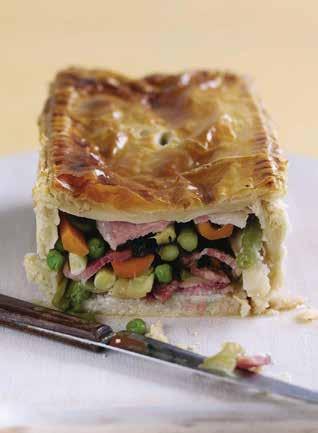
500g pack shortcrust pastry
225g sweet-cured back bacon rashers
4 baby carrots, peeled and cut in half
6 asparagus spears
2tbsp caramelised onion chutney
3 baby leeks
25g green beans
Salt and pepper
500g pack puff pastry Egg wash

INGREDIENTS
450g premium butcher’s-style sausages
2tbsp fresh parsley, chopped Salt and pepper
2 pears, peeled and cored
½ tsp runny honey

Preheat the oven to 180C/Gas Mark 4. Roll out the shortcrust pastry and line a loaf tin with it.



Place 2 rashers of bacon in the tin and layer the carrots and asparagus. Top with the chutney and continue to layer with the leeks, green beans and bacon. Season to taste.
Roll out the puff pastry and use it to make a lid for the pie. Brush with the egg wash. Bake in the oven for 50 minutes, until the pastry is golden.

METHOD
Preheat the oven to 180C/Gas Mark 4.
Use a knife to slit the sausage skins, then remove the meat. Place the sausage meat in a bowl and discard the skins. Mix the meat together with the parsley and seasoning.

Set aside half of the meat for later. Divide the remaining meat evenly between 2 individual pie dishes.
Push the meat down slightly, then place a whole pear in each dish and drizzle with runny honey. Top with the remaining sausage meat.

Divide the puff pastry block in 2 parts and roll out to make lids for the pies.
Place a pastry lid on top of each pie and brush with the egg wash.
Bake in the oven for 45 minutes, until the pastry is golden, then serve.