Top of the bill
Documentary highlights puffins among National Trust treasures

Priest posts about parody parish online

Documentary highlights puffins among National Trust treasures
Priest posts about parody parish online
The Salvation Army is a Christian church and registered charity seeking to share the good news of Jesus and nurture committed followers of him. We also serve people without discrimination, care for creation and seek justice and reconciliation. We offer practical support and services in more than 700 centres throughout the UK. Go to salvationarmy.org.uk/find-a-church to find your nearest centre.
The Salvation Army first published a newspaper called the War Cry in London in December 1879, and we have continued to appear every week since then. Our name refers to our battle for people’s hearts and souls as we promote the positive impact of the Christian faith and The Salvation Army’s fight for greater social justice.
When many people think about the National Trust, their thoughts turn to former stately homes with beautifully kept gardens and grounds that are now open to the public. However, as we report in this week’s War Cry, BBC2’s documentary series Hidden Treasures of the National Trust reveals that the organisation’s work covers so much more.
In this week’s programme, viewers can discover what the National Trust is doing to support puffins on the islands off the Northumberland coast and see how it is preserving the first translation of the complete Bible into the Welsh language.
Bibles have been treasured by people for centuries – and for various reasons. Sometimes they are valued because of their age or their cultural importance. But many readers treasure their Bible because they believe that its words were inspired by God and can help them to live the best life possible.
This week, we speak with author Claire Williams, who teaches at Regents Theological College in Worcestershire. Claire tells us about her experiences of living with anxiety and how some of the teachings and real-life stories contained in the Bible have helped her.
Editor: Andrew Stone, Major
Managing Editor: Philip Halcrow
Staff Writer: Emily Bright
Staff Writer: Claire Brine
Staff Writer: Ewan Hall
Editorial Assistant: Linda McTurk
Graphic Designer: Mark Knight
Graphic Designer: Natalie Adkins
Email: warcry@salvationarmy.org.uk
The Salvation Army United Kingdom and Ireland Territory
1 Champion Park London SE5 8FJ
Tel: 0845 634 0101
Subscriptions: 01933 445445 (option 1, option 1) or email: subscriptions@satcol.org
Founders: Catherine and William Booth
International leaders: General Lyndon Buckingham and Commissioner Bronwyn Buckingham Territorial leaders: Commissioners Jenine and Paul Main
Editor-in-Chief: Major Julian Watchorn
Published weekly by The Salvation Army
© The Salvation Army United Kingdom and Ireland Territory ISSN 0043-0226
The Salvation Army Trust is a registered charity. The charity number in England, Wales and Northern Ireland is 214779, in Scotland SC009359 and in the Republic of Ireland CHY6399.
Printed by CKN Print, Northampton, on sustainably sourced paper

Among other passages, she highlights three accounts of individuals who are living in anxiety-inducing situations and who respond to Jesus.
Describing these people as remarkable, she tells us: ‘They step towards Jesus and identify who he is. There’s this moment where each person recognises who Jesus is, and something about him is revealed. It’s a pinpoint in the story. Then they all risk their social standing, embarrassment or worse by saying, “You are the Christ.”’
When some people think about Jesus, their thoughts can turn to a historical figure and of some beautifully kept churches built in his honour. They may not realise that there is so much more to him than that.
The truth is that he is divine, alive and able and willing to act in our lives – so that we can discover a new and better way of living.
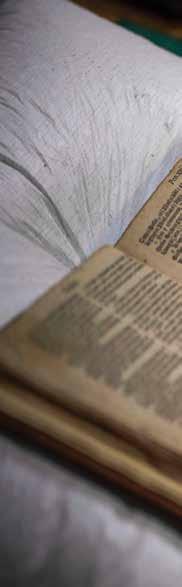


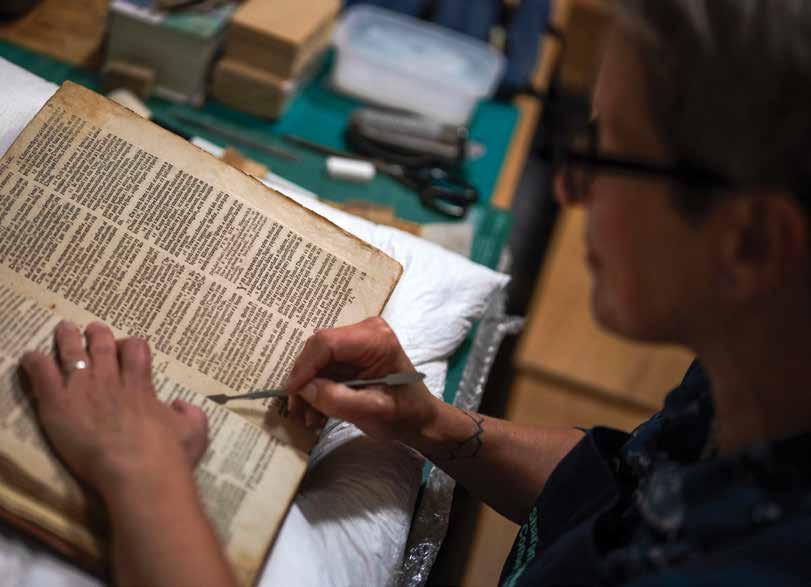
Specialist conservator Sharon repairs a Welsh Bible from 1588
TV feature: Hidden Treasures of the National Trust BBC2 and iPlayer
By Claire Brine
Arugged island, once home to a renowned monk. A remote farmhouse that shaped the soul of a nation. As the BBC2 series Hidden Treasures of the National Trust continues, viewers are invited to step inside two remarkable places that have been inspiring pilgrims for centuries.
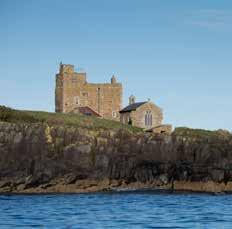
Just off the coast of Northumberland lie the Farne Islands, which – narrator Toby Jones explains – have long been a place of spiritual retreat. In the seventh century, the monk Cuthbert left the monastery on the island of Lindisfarne for a solitary life of prayer on the nearby Inner Farne.
After his death, his reputation spread and he became regarded as a saint. It was then that pilgrims began travelling to the island, keen to follow in Cuthbert’s footsteps, marvel at the medieval chapel dedicated to him and take time to contemplate their faith.
The islands ‘have that kind of heavenly feel about them’, says Nick, the National Trust’s collections and house manager for the site. ‘And I think that draws people.’
While Nick arranges for the chapel’s 19th-century stained-glass window of Cuthbert to be cleaned, rangers on another part of the island are monitoring
puffin burrows. The site provides sanctuary to hundreds of thousands of visiting seabirds – and rangers must work together to ensure their protection in the face of climate change.
Meanwhile, in north Wales, another National Trust site is attracting pilgrims. On display at the Tŷ Mawr Wybrnant farmhouse is a book that dates back to 1588. And the site’s programming and partnerships officer, Fflur, considers Y Beibl Cyssegr-lan a treasure of national importance.
‘This is the first translation of the complete Bible into the Welsh language,’ she explains. ‘People come here from far and wide to witness ... its cultural importance and history.’
In the 16th century, Queen Elizabeth I commissioned a Welsh Bible to help secure the Protestant Church in Wales, and clergyman William Morgan – who was born at Tŷ Mawr – was chosen to carry out the translation. One thousand copies were printed. And it’s believed that Morgan’s Bible played a key role in preserving the Welsh language.
While thousands may flock to see the artefact for its cultural significance, readers of the Bible across the centuries and across the world would argue that the religious text’s greatest value lies not
in the age of a copy or how it’s packaged, but in its content.
Woven throughout the Bible’s pages are stories of a God who loves us. A God who forgives us when we confess our wrongdoing. A God who sent his Son, Jesus, to teach us the best way to live.
One Bible writer captures the overarching narrative of the book when he summarises: ‘God loved the world so much that he gave his only Son, so that everyone who believes in him may not die but have eternal life’ (John 3:16 Good News Bible).
Whatever Bible we read – whether it’s a rare and priceless manuscript from history, or a copy found in a hotel drawer – the message remains the same: God’s love, which has been there since the beginning, will never end. He wants to be part of our future. And when we invite him into our lives, it’s a moment we will treasure for ever.
Emily Bright gives her take on a story that has caught the attention of War Cry reporters
British Bake Off winner Jasmine Mitchell revealed her sound approach to life on an episode of The Sacred. Created by the religion think tank Theos, the podcast asks people of all faiths and none about the values that define their lives.
Host Elizabeth Oldfield began by asking Jasmine about what was sacred to her. She replied: ‘Two different parts of go slow and go with God.’
Jasmine explained how, about a year ago, she was studying to become a doctor when she was accepted on to Channel 4’s baking competition. ‘Life got really busy. It got really intense.’
As she became overwhelmed by exhaustion, her flatmate challenged her to take a day off. Jasmine’s mindset shifted, and she surrendered her busyness to God.
‘I’ve prayed more than I ever have before over the past year, just saying: “God, I can’t do this on my own. I need your strength, I need your help,”’ she told Elizabeth. ‘Every week, I’ll take a day to just stop and rest and go slow with God. And that has really sustained me.’
I can fully relate. Sometimes life seems overwhelming – when creativity is draining from me as deadlines loom or I’m feeling exhausted by non-work commitments. In those times, I’ll cry out to God, asking for his strength to keep going.
Lately, I’ve tried to take a weekend day to go slow with God. I’ll drive to the beach, go for a walk and invite God along. Watching the waves lap on the shore calms my weary soul.
I then sit quietly in God’s presence, read my Bible or listen to my favourite music. It’s bliss – a sacred time to slow down and remember that, regardless of my circumstances, God is good and bigger than my problems.
At some points in life it may be that we can only take moments, not days.
But if we pause for a day or even for a minute, breathe deeply and surrender our lives to God, it can help us refocus. By looking upward rather than inward, we’ll be reminded that God supplies all the strength that we need.
Church of England attendance rose for a fifth consecutive year in 2025, with steady gains across weekly, Sunday and major seasonal services, according to preliminary figures from the church.
Regular worshippers reached an estimated 1.023 million – up 1.4 per cent on 2024. Weekly attendance averaged 707,000 and Sunday services 590,000, both showing continued growth.
There were sharper increases in attendance at seasonal services, with Christmas attendance at 1.9 million – 5.5 per cent higher than 2021 – and Easter numbers rising to 1.03 million, a 7.8 per cent increase.
Despite continued recovery and growth since the pandemic, overall attendance levels remain below those from before the coronavirus.
‘It is so encouraging to see the ways that God is at work in our church,’ says the archbishop of Canterbury, the Most Rev Sarah Mullally. ‘With more people coming to services on Sundays and throughout the week, as well as Advent, Christmas and Easter, it shows a yearning for meaning and connection in our often busy and fractured world.’

Bukayo Saka gave ‘glory to God’ after scoring the winning goal to send Arsenal through to the Champions League final, which takes place on Saturday (30 May).
After the Gunners beat Atletico Madrid 1-0 in the semi-final second leg, Saka (pictured celebrating the goal) reflected on his matchwinning contribution in a post-match interview on Prime Video.
‘Sometimes it bounces for you, sometimes it doesn’t,’ he said. ‘But you have to be there and I was there and it fell for me and I got my goal. So, glory to God, I thank God, and we go to the final now.’


Gamers are able to become the character of Jesus and experience his life as recorded in the Gospels in a new video game, reported The Times. According to the article, the Polish video game I Am Jesus Christ enables players to ‘live out the New Testament’, from Jesus’ baptism in the River Jordan to the Crucifixion at Calvary.
It explained: ‘Players can roam around Roman Judaea, performing 30 miracles, resisting temptations in the wilderness, battling demons, casting the money changers out of the Temple and getting up the noses of the Sanhedrin.’

The game has received positive reviews on Steam, a global platform for downloading games, with players praising ‘the engrossing quality of the gameplay and the faithful recounting of the New Testament, which is largely quoted verbatim’.
The vicar of Ranmoor, the Rev Canon Matthew Rhodes, completed a 192-mile walk from the Irish Sea to the North Sea to raise money for his church’s Save Our Spire appeal, reported the Church Times Choosing the length of the walk because the spire of St John’s Church in the Sheffield suburb is 192 feet tall, Matthew covered up to 22 miles a day. After finishing the challenge, which raised £15,000 to go towards the spire’s repair, he said: ‘I felt very supported by the prayers of my congregation and wonderful friends and it made me more reliant on Jesus in a different way.’
Radio 1Xtra DJ Swarzy (pictured) told Premier Christianity how she turned to God after she was caught shoplifting at the age of 14.
In an interview with the magazine, she said: ‘The shopkeeper locked the door and was on the phone to the police. I remember thinking: I’m in real trouble here. I just said: “God, if you are real, get me out of this situation. I will never shoplift again, and I will follow you for the rest of my days.” As soon as I said “Amen”, the shopkeeper put down the phone, opened the door and said: “Just go.”’ Swarzy discovered faith at a difficult time in her life. ‘My mum and dad were divorced and home was tricky,’ she said. ‘I just wanted something new – and I got more than that. I got Jesus Christ. I got God himself. When you find that treasure, everything else just falls away.’
The Rev Canon TOM KENNAR reveals why he posts stories about a fictional church on Facebook – and explains how its congregation is learning to be kind
Interview by Claire Brine
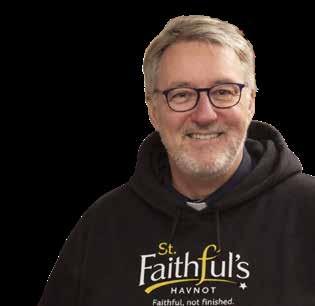
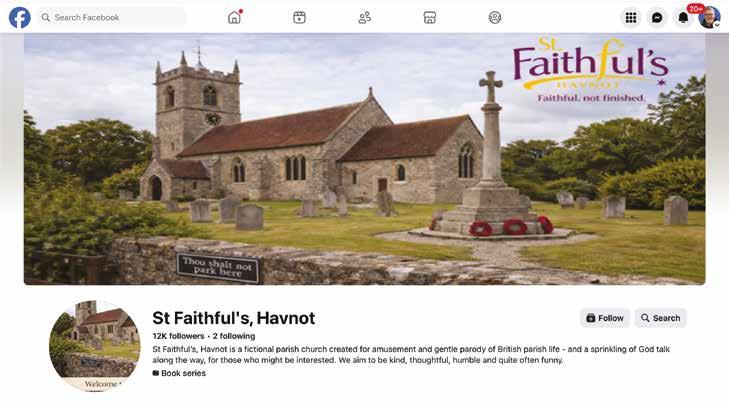
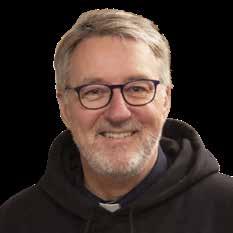
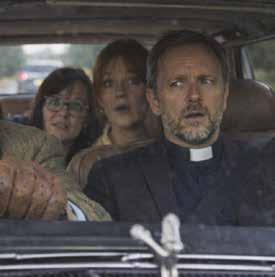
Feeling bored after Christmas, the Rev Canon Tom Kennar decided to create a fictional church and post stories about its priest and parishioners on social media. The Facebook page of St Faithful’s, Havnot, welcomes its visitors by pointing out that it’s not a real church, but exists nevertheless as a warm and inviting community created for ‘amusement and gentle parody of British parish life’ and a ‘sprinkling of God talk along the way’.
‘St Faithful’s is a typical English church – the kind I have experienced in my 20-odd years as a priest – and the parish of Havnot is populated with characters I recognise,’ says Tom, who runs the real-life St Faith’s Church in Havant, Hampshire.
‘You’ve got characters such as Dobbs, the verger, who is a crusty old fellow moaning about everything. Then there’s churchwarden Perry, who is a gentleman – but not when he’s behind the wheel of a car.
‘And running the church is Tim, the vicar. He’s in his early 50s, pretty sensible, and the person who everyone turns to when they have problems. He sits quietly among all these competing voices, but then drops in a pearl of wisdom, bringing Christ’s words to each situation. He’s the anchor in the parish.’
Every day, Tom uploads new Facebook
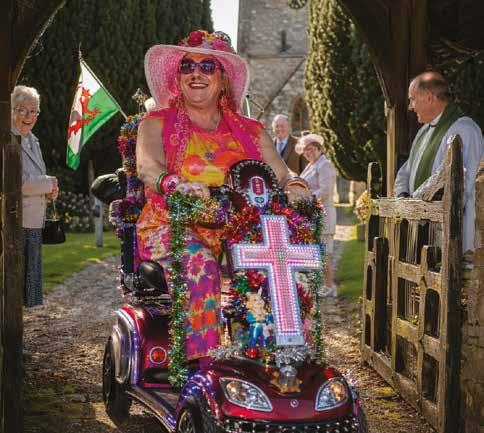
posts, full of entertaining tales about life at St Faithful’s. In recent weeks, there have been stories about the hiccups of installing wi-fi in the church, the chaotic first rehearsal of the Havnot Male Voice Choir, and the arrival of a larger-than-life transgender woman at Sunday worship.
‘I introduced Paula – who, the parishioners learn, used to be Paul –because her story is a good example of how churches today have to grapple with all sorts of people coming through their doors,’ says Tom. ‘Dobbs couldn’t cope

Churchwarden Perry is depicted getting irate when driving
with Paula at first, having grown up knowing her as Paul. But then he has a chat with Horse, the gardener, who helps him process it.’
Addressing Dobbs’s shock at encountering Paula, Horse reminds his friend that ‘most of the time, after the surprise, people are still just people. The main thing is whether you mean them kindness or not.’
Reflecting on Paula’s storyline, Tom explains: ‘St Faithful’s is a kind community. The parishioners are always learning what it means to be kind – even though, sometimes, it costs them.’
Humour has a way of breaking down barriers
Creatingbelievable characters and coming up with interesting stories for them is a pastime that Tom enjoys. He finds inspiration in the everyday routines of life.
‘I wrote a story about Perry getting angry behind the wheel, and that was because, when I was in the car one day, I felt frustrated at a driver in front of me. I then thought to myself: “I can’t change that person. But I can change my reaction to their bad driving.” So that experience sparked the idea for a story.’
Although Tom created his fictional parish because he was fed up with watching Christmas television, five months later, the Facebook page for St Faithful’s is attracting 12,000 followers. Tom has even been invited to share snippets of Havnot life on BBC Radio
Solent every Sunday morning.
‘People are contacting me from all over the world,’ he says. ‘Some are saying things like, “Thank you for helping me to see this particular topic in a new light”, or “I might go to church on Sunday”. I’ve had some significant pastoral encounters as a result of St Faithful’s Facebook page.
‘I think it’s because many people are attracted to the idea of church and community but often feel that churches are places where they wouldn’t be welcomed. They’re nervous to step over the threshold.
‘By reading about life at St Faithful’s, they can step over that threshold in their mind. They can get a sense of what happens in church. The Facebook posts allow me to move towards people, helping them to feel confident that if they do set foot in a church one day, they’ll have an understanding about what’s going on.’
Mildly humorous, the stories also point people towards Jesus’ teachings. Tom explains why creating amusing scenarios to address matters of faith was a conscious choice.
‘Humour has a way of breaking down
barriers,’ he says. ‘It helps us to see ourselves through a different lens. And I’d say that Jesus used humour in his teachings. When he talks about removing the plank in your own eye before trying to remove the speck in your brother’s eye, he’s using comic imagery.
‘Although Jesus is rarely mentioned by name in the St Faithful’s stories, I think his wisdom infuses the conversations that the characters have. I try to avoid preaching –that’s my day job. Instead, I’ll just drop an idea and allow people to think about it for themselves.’
And whatever conclusions his readers come to – whether they develop a faith or not – Tom hopes that St Faithful’s will bring comfort and encouragement to anyone who encounters it.
‘The message is that we are all glorious and different,’ he says. ‘And it’s possible for people to live well together, with kindness and love, despite our weird and wonderful differences.’
l For more information visit tomkennar.blogspot.com
‘GOD
CLAIRE WILLIAMS, author of a new book about anxiety, reveals how faith has helped her mental health
Interview by Emily Bright
An unwelcome visitor is taking up residence in minds across the UK –anxiety. According to an NHS survey of mental health and wellbeing published last year, one in five people in England alone experiences a common mental health condition, such as anxiety and depression.
Sometimes used as a byword for worry, nervousness or unease, anxiety can be dismissed as something we all experience from time to time. But when it begins to interfere regularly with our mental and physical health, it’s an entirely different matter.
Physical symptoms of anxiety disorders vary, but they can include headaches, breathlessness, feeling light-headed, an irregular heartbeat and shaking. Anxiety can also cause sleeplessness, obsessive and catastrophic thoughts, tearfulness and difficulty in concentrating.
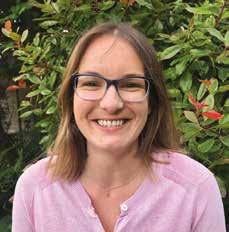
Claire Williams, who teaches at Regents Theological College in Worcestershire, articulates how her experience of anxiety affects her.
‘It feels like a constant sense of uncertainty, which comes either higher or lower on a scale of threat,’ she says.
‘I’m not sure that’s necessarily a universal way of experiencing anxiety, but that’s certainly how it comes across for me. I’m thinking: “Am I OK? Are other people OK?” Sometimes it’s to do with what might happen. Other times it can be about what has already happened.
‘I also know that some people can ruminate. For instance, if you’re particularly socially anxious, you might go through conversations that have already happened, thinking: “Oh, no, what did I say? What did I do?”
‘But I think the more commonly understood version of anxiety is the one in which people ask themselves: “What could happen? Is something going to go wrong?”
‘Anxiety can centre on uncertainty about both the future and past.’
As a Christian, Claire has taken comfort from the teachings in the Bible. And in her book Blessed Are the Anxious, she seeks to offer similar reassurance to other people who may be living with anxiety.
‘I can remember flicking through the Bible as an anxious child,’ she recalls over a Zoom call. ‘One thing I regularly looked at was Matthew 11:28–30, in which Jesus says: “Come to me all who are weary and
heavy-laden, and I will give you rest.”
My book is an exploration of what is comfort and rest, and what that means for someone who’s anxious.’
In her opening pages, she clarifies that she has not written a ‘how-to guide’ or a ‘professional mental health treatment’, but rather a ‘theological reflection’. The book reveals her personal experience of living with anxiety, and offers wisdom gleaned from her academic study.
One of the areas that Claire explores is how we can communicate with God in the midst of anxiety. She delves into the Bible, where Paul in his Letter to the Romans reassures his readers that, when they don’t know what to pray, the Holy Spirit ‘intercedes for us through wordless groans’. This passage takes on a personal significance for Claire.
‘The reason I’m anxious is because I’m autistic,’ she tells me. ‘It is a common experience for autistic people to live in a constant anxious state. One interesting thing that I’ve thought about theologically is the relationship between autism and speaking. Some autistic people don’t speak. They’ll communicate in different ways. They might point to pictures, make noises or have a mixture of communication methods.
‘The passage in Romans is reassuring. It means that the human ways we communicate – which are flawed, temporary and rife with misunderstandings – are not the case in our communication with God. He understands the human condition and communication better than we do. As much as words help us, they aren’t necessary to be in God’s presence.’
Claire also explains how interactions with God don’t need to feel overwhelming or be restricted to sacred spaces. To illustrate her point, she uses the story of the meeting between Mary, who at the time is pregnant with Jesus, and Mary’s cousin Elizabeth.
‘They are in Elizabeth’s house, talking about God and this amazing moment in history. Academically, that has been quite important for me, because to hear the voices of women on their own is rare.
‘Their conversation is not in a temple; it’s in a really disempowered space. Women without power are suddenly empowered by the Spirit. Mary speaks what’s known as the Magnificat, which is a revelation of who her baby is. And she does it in a house presented as a safe space.
‘People with anxiety will often hide or retreat to make themselves feel safe. But the story is reassuring because it shows that God is in your situation, wherever you are.’
In Blessed Are the Anxious, Claire also investigates how Jesus communicated
From page 9
with people during his ministry – as documented in the Gospels – and how he gave them a sense of agency over their lives.
She tells the stories of a man who is born blind, a prayerful widow named Anna and a Samaritan woman who faced social exclusion from her community – with all three turning to Jesus in their anxiety-inducing situations.
‘These people I write about in the book are remarkable,’ says Claire. ‘They step towards Jesus and identify who he is. There’s this moment where each person recognises who Jesus is, and something about him is revealed. It’s a pinpoint in the story. Then they all risk their social standing, embarrassment or worse by saying, “You are the Christ.”’
Claire believes that the courageous actions of these individuals can offer comfort to people experiencing anxiety today because they teach that the most important and brave thing to do is understand who Jesus is.
In the book, Claire also celebrates examples of bravery from one of Jesus’ followers, Martha, in the midst of anxious times. When Martha’s brother Lazarus dies, she is devastated and rages at Jesus for not intervening to save her brother’s life.
‘She’s brave in that moment,’ Claire tells me. ‘Then she says, “I know that whatever happens, you can sort this.” That is amazing. I’d love to know what she thought Jesus would do, because I doubt she would have thought that he would raise him from the dead.’
But, after grieving with Martha and her sister Mary, Jesus does bring Lazarus back to life.
Claire highlights how the story of Lazarus can provide hope for those experiencing anxiety.
‘It shows that you don’t necessarily have to have a clear sense of what is going to happen. You just cling to who Jesus is, and he will do what’s needed.’
This theme of clinging on to hope in hardship can also be exemplified by the day known as Holy Saturday – the day between Good Friday, when Jesus was crucified, and Easter Sunday, when he was resurrected.
Claire thinks that Christians tend to ‘skip to Sunday too quickly sometimes’, overlooking the significance of the Saturday. She sees it as a time that those with anxiety can relate to.
‘If you pause in that moment of Holy Saturday, Jesus may never rise again,’ she says. ‘I call that day “living dreadfully”, which can describe how we may feel.
‘Sometimes we spend a lot of time clinging on by our fingernails. But that day shows that there is space in the Christian story for clinging on, where we are just existing and hoping but not knowing what will change.’
Thankfully, Easter Sunday does come. Mary Magdalene, one of Jesus’ followers, is the first to see him resurrected. Her instinctive reaction is to hold on to him, although he tells her that he needs to ascend to Heaven.
‘Mary just knew that Jesus had transformed her life, and that Jesus is the answer,’ explains Claire. ‘Physically clinging on to him is the solution to his being lost, I suppose. Separation anxiety is a real thing, isn’t it.’
But Claire adds that we need never fear separation from Jesus.
‘I guess what Mary didn’t have,’ she
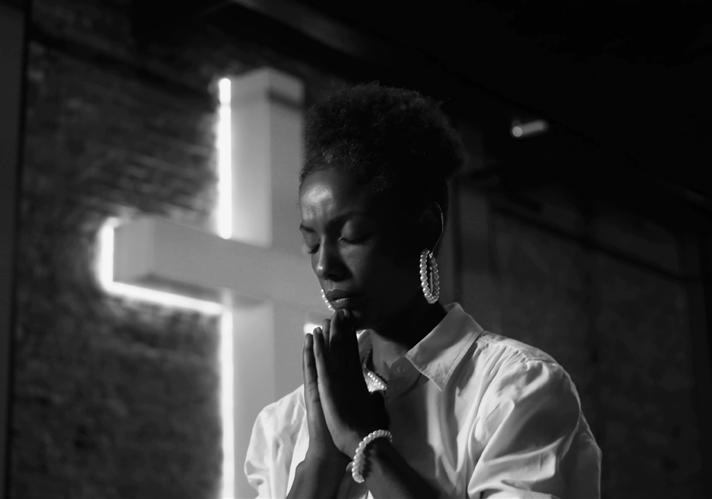
Claire says that ‘God is available to you in rest, and he prescribes it’
continues, ‘is the knowledge that even if we can’t physically see Jesus or necessarily discern his presence in the middle of our struggles, we can know that we are held by him. We are able to have his presence with us even when we can’t really find it.
‘That’s not necessarily a neat resolution to feeling anxious. Maybe you’re in horrible debt or you’re facing a diagnosis of something scary. It’s dismissive to say that God will fix all our problems, because we know that doesn’t always happen. But there certainly is power in saying: “God sees me.” God is good, despite the circumstances which are anxiety-inducing.’
In a particularly difficult time in her life, when she felt overwhelmed by anxiety, Claire found that turning to the Bible offered her reassurance of God’s goodness.
‘When I was an undergraduate,’ she recalls, ‘I had a moment where I was like, “I’m done. This is too hard.” Then the
chaplain told me about the Bible story of the prophet Elijah. Elijah goes, “Right, this is far too much. I cannot do it.” He’s allowed to lie down and to have a meal.
‘God speaks in a still small voice and says that rest is allowed.
‘Again, as an autistic person, the story is reassuring because God is not even loud. It’s nice and quiet. Resting in that moment of being overwhelmed is the right response.’
She believes that the story remains relevant today.
‘God is available to you in rest, and he prescribes it. Elijah gives a good example of the need to stop.’
Claire pauses to share one last encouragement for people who may be experiencing anxiety.
‘It’s tempting to say that God will heal you,’ she says. ‘I do believe that God heals people of things like this. But I think the reassurance that people need is that if
he hasn’t – for whatever reason – removed the anxiety, that’s not something to despair about.
‘There is hope because God is there, even when we’re anxious. All these people in the Bible are in spaces that are completely normal to be anxious about. And God was right there in the middle of these spaces with them.’
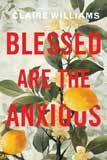
l Blessed Are the Anxious is published by
The War Cry invites readers to send in requests for prayer, including the first names of individuals and details of their circumstances, for publication. Send your Prayerlink requests to warcry@salvationarmy.org.uk or to War Cry, 1 Champion Park, London SE5 8FJ. Mark your correspondence ‘Confidential’.
There is no set formula to becoming a Christian, but many people have found saying this prayer to be a helpful first step to a relationship with God
Lord Jesus Christ,
I know that I have done things in my life that are wrong and I’m sorry.
Thank you that I can ask you for forgiveness because of the sacrifice you made when you died on the cross.
Please forgive me and help me to live a better life in the future as I learn how to love you and follow your way of living.
Thank you, Lord Jesus.
If you’ve prayed this prayer, scan the QR code or contact us using the coupon on this page
Nigel Bovey gives chapter and verse on each book of the Scriptures
In this letter, the apostle John, introducing himself with the pen name of ‘the elder’, is writing either to a specific Christian woman or to a church that he cryptically calls ‘the lady chosen by God’ (verse 1 New International Version). Whoever the intended readership, it is more specific than that of his first letter in the Bible.
He does, though, touch on areas that occupied him for much of that letter –the Antichrist, truth and love.
He identifies, and warns against, the presence of itinerant teachers who are teaching that Jesus was not God in human form, and he describes any such teacher as ‘the deceiver and the Antichrist’ (7).
Later in Church history, there were many heresies – false teachings –regarding the human and divine natures of Jesus Christ and his relationship to God and the Holy Spirit.
These heresies may have been rooted in two streams of thought that ran through the Jewish and the Greek worlds.
In the Old Testament, God is portrayed as being so holy that no member of the sinful human race could see him and live (see Exodus 33:20). God could not, therefore, appear as a human.
Similarly, a line of Greek philosophy taught that the transcendent spirit was far removed from unholy material beings, such as humankind.
John’s remedy to the false teachers he identifies is twofold. First, it is practical. Contrary to common practice – as seen, for example in the experience of the travelling evangelist Paul – the Christian community is not to offer hospitality to these false teachers. John reasons that by welcoming such a teacher, Christians would be supporting their erroneous teaching (10 and 11).
Secondly, John’s remedy is doctrinal. He reminds his readers that their faith is based on ‘truth’ and ‘love’ (he uses each word five times). They are to walk in truth (4), in obedience to God’s commands and in love (6).
While outlining the nature of a believer’s ‘walk’ with God, he warns of the danger that awaits the person who ‘runs ahead and does not continue in the teaching of Christ’. He says that they will not ‘have God’ (9).

To receive basic reading about Christianity and information about The Salvation Army, complete this coupon and send it to
War Cry 1 Champion Park London SE5 8FJ a
Or email your name and postal address to warcry@salvationarmy.org.uk



Feature by Ewan Hall
Tabletop game creators will be aiming for a critical hit with fans and families as they showcase their products at the UK Games Expo.
The three-day event, which concludes at the NEC, Birmingham on Sunday (31 May), is the largest hobby games convention in the country.
Now in its 20th year, the event attracts 72,000 visitors over three days and features more than 730 exhibitors. The event is a celebration of tabletop games – such as board, card, role-playing and party games – which focus on social interactions in a group setting with friends or family.
Visitors are invited to enjoy trade halls where they can discover new and unreleased games. They can also participate in tournaments of well-established games such as Warhammer 40,000, Catan and chess.
Organisers hope the expo will offer something for both casual visitors and dedicated fans.
Tabletop games can be enjoyable for everybody, but when we’re new to one, the rules may sometimes feel confusing and even intimidating, which can make us hesitant about playing it.
In a game, getting the rules wrong is usually not a serious problem –we laugh it off, learn and try again without any lasting consequences. Mistakes are easy to move on from. However, in real life, the stakes are much higher. When we are unsure what to do, our choices are sometimes more important – and the possibility of making the wrong decision can make us worry.
Yet Christians take solace in knowing that God will support and guide them through life’s challenges.
They have discovered the truth of a passage in the Bible which reassures them: ‘Whether you turn to the right or to the left, your ears will hear a voice behind you, saying, “This is the way; walk in it”’ (Isaiah 30:21 New International Version).
If we choose to let God guide us, we will receive peace, direction and the confidence that we are never alone. Even when life feels uncertain, we can trust him to play his part and give us all the help that we need.

1. Associate (7) 5. Indian currency (5)
Separated (7)
Garish (5)
Only (4)
False praise (8)
(7) 3. Naked (4) 4. Impolitely (6)
Kinsman (8)
Money bag (5)
Annihilated (9)
Imaginings (9) 12. Dark-haired (8)
Ridiculed (7)
Frail (6)

Traffic-light colour (5)
Minor quarrel (4)
Each solution starts on the coloured cell and reads clockwise round the number



Fill the grid so that every column, every row and every 3x3 box contains the digits 1 to 9
Look up, down, forwards, backwards and diagonally on the grid to find these board games
MONOPOLY OWARE PICTIONARY REVERSI SCRABBLE SNAKES AND LADDERS TRIVIAL PURSUIT

For the tomato sauce
2tbsp olive oil
2 shallots, finely diced
2 garlic cloves, finely diced
2tbsp capers
1tbsp basil, finely chopped
1tbsp rosemary, finely chopped
1tbsp oregano, finely chopped
1tbsp balsamic vinegar
1 can chopped tomatoes
Pinch sea salt and cracked black pepper
For the cheese sauce
50g salted butter
1-2tbsp plain flour
1tsp Dijon mustard
½ tsp grated nutmeg
1pt milk
100g cheddar cheese, grated
75g mozzarella cheese, diced
50g Parmesan cheese, grated, plus extra for topping
1 egg yolk
For the lasagne
2 packets MSC-certified smoked salmon

Preheat the oven to 180C/Gas Mark 4.





Heat the oil in a large non-stick pan over a medium heat, then cook the shallots, garlic, capers and herbs for 4-5 minutes, until softened and lightly golden. Stir in the vinegar and tomatoes, reduce the heat, then bring to a simmer and cook for 10-15 minutes. Season, to taste.
Meanwhile, to make the cheese sauce, add the butter to a pan over a medium heat. Stir in enough flour to make a paste, then add the mustard, nutmeg and milk and cook for 3-4 minutes, stirring, until slightly thickened.
Add the cheddar, mozzarella and Parmesan and stir, until melted. Remove from the heat and beat in the egg yolk, until smooth.
Spoon a little of the tomato sauce on to the base of an ovenproof dish. Then add layers of lasagne sheets, cheese sauce and smoked salmon until all the ingredients are used, finishing with the cheese sauce.
Scatter over the extra Parmesan and bake in the oven for 30-35 minutes, until golden and piping hot.
Serve with a salad.